







Abstract
This article argues that actors legitimize the benefits associated with professional status through practices congruent with social values. Such congruence is ‘thin’ when activities correspond with the values of industry actors and ‘thick’ when practices relate to broader social principles. The category of ‘semi-professionals’ is extended to actors whose legitimization of professional privileges remains precarious as their ‘thin’ congruence with narrow principles impedes broader correspondence with wider social values. The ‘thin’ congruence with narrow notions of sustainability by leading British and American accounting firms, banks and credit-rating agencies since the outbreak of the most recent financial crisis is illustrated as contributing to their persistent ‘semi-professionalism’. It is maintained that only through ‘thick’ congruence with wider notions of sustainability may these and other market actors more broadly legitimize the privileges associated with professional status.
Introduction
Long familiar to sociologists, the boundaries of professionalism have more recently attracted the attention of scholars of global political economy. 1 Professionals are intriguing due to their capacities to avoid similar degrees of competitive forces and government regulation experienced by other occupations. Such privileges are, however, neither automatically generated nor naturally given. Rather, the organizational autonomy and ‘shelter from the vicissitudes of the market’ (Hanlon, 1998: 843) enjoyed by professionals are socially and politically determined. Whilst existing scholarship considers how the privileges of professionalism are accrued, the process of legitimizing such benefits has been analysed far less extensively.
This article argues that market actors legitimize the benefits of reduced public regulation and competitive market forces through practices congruent with values underpinning both narrow and wider public interests. The identities fostered in what is considered here as the ‘thin’ congruence with the principles of narrow groups of actors, are important as they determine possibilities for ‘thick’ congruence with broader social values. The category of ‘semi-professional’ is extended to actors whose identities developed in the ‘thin’ congruence of their activities with the values of narrow groups of industry actors preclude ‘thick’ correspondence with broader social principles. With their constrained, yet nevertheless privileged, status not widely legitimized, semi-professionals are actors who remain in states of flux marked by continual challenges to their restricted degrees of market competition and self-regulatory capacities. It is suggested that only through ‘thicker’ congruence with broader social values may ‘semi-professionals’ more widely legitimize the privileges of professionalism.
In substantiating these arguments, qualitative data on the largest British and American firms in three key sectors of the ‘Anglo-American’ financial services industry are examined. Headquartered in the leading global financial centres of Manhattan and the City of London, leading firms of the accounting, banking and credit ratings sectors long benefitted from the ‘light-touch’ regulation that characterized the public governance of the wider financial services industry in the United Kingdom (UK) and United States (US) (Engelen et al., 2011). Highly influential in Europe, Asia and elsewhere (Bordo and Sylla, 1995; Cassis, 2010; Langley, 2002; Soederberg, 2004), this Anglo-American financial culture has more recently been chastised for contributing to reoccurring crises, including the most recent period of market instability (Baker, 2010; Gamble, 2014; Gowan, 2009). Despite becoming targets of enhanced public governance since 2008, leading British and American accounting firms, banks and credit-rating agencies have managed to maintain privileged degrees of independence from both government regulation and competitive market forces.
This article contends that leading Anglo-American financial market actors have sought to legitimize a constrained, yet continually privileged, status through practices congruent with specific notions of sustainability, a leading social value encompassing a range of contemporary socioeconomic and ecological concerns. Identities developed in ‘thin’ congruence with narrow notions of sustainability have, however, undermined the ‘thick’ congruence with wider conceptions of sustainability in ways that have perpetuated the semi-professional status of leading British and American financial services firms. Until their practices correspond more substantially with wider notions of sustainability, these firms will continue espousing rhetoric that is viewed suspiciously beyond the financial services industry as mere window dressing and appeasement of the self-interests of a narrow community of actors.
These arguments are elaborated in five subsequent sections. The following conceptual discussion explores the legitimization of professional privileges as well as notions of both semi-professionalism and sustainability. The proceeding three sections then scrutinize Anglo-American financial services firms before a final section reflects on implications for the study of professionalism as well as for the legitimacy of the privileged status of these leading actors.
Legitimizing professional privilege
The benefits associated with professional status, whilst multiple, most centrally involve a high degree of independence from both competitive market forces and government regulation relative to other occupations. Protected ‘from the naked forces of the market’ (Strange, 1996: 142) professionals, to varying degrees, benefit from monopolies over certain areas of activity. These actors equally possess private authority in self-regulating through associations, groups and organizations, which may ‘develop and enforce binding obligations on their members and often for the industry as a whole’ (Cutler et al., 1999: 13). This second central privilege of professionalism may reinforce the first as credentials, designations and other requirements to prove expertise in specialized bodies of knowledge can serve as barriers to entry restricting competition.
Though long considered naturally given and automatically generated (Carr-Saunders and Wilson, 1933), the privileges of professionalism have become recognized as stemming from practices fulfilling the specific interests of states, as well as those of the broader public. In functioning as extensions of state bureaucracy and ‘a key resource of governing’ (Johnson, 1995: 13), professional privilege is bestowed by state elites, for instance through specific requirements for market actors to legally operate in a given territory (Freidson, 2001; Larson, 1979). The benefits of professionalism equally stem from the ability of certain occupations to orient their practices towards the needs of society more widely. In addition to functionally fulfilling the interests of state elites, professional privileges are regarded as flowing from a broader ‘social service ethos’ (Hanlon, 1997: 196) and ‘a primary orientation to community, or societal values and interests’ (Strange, 1996: 142). Professionals thus acquire wider ‘social prestige’ in combining ‘private practice with a pursuit of the public interest’ (Coffee, 2006).
Underlying practices fulfilling the interests of either states or the broader public are processes of legitimization. Whilst leading analyses of professionalism maintain that ‘legitimation justifies both what professions do and how they do it’ (Abbott, 1988: 184), the specific pathways to legitimize professional privileges have rarely been explored in existing literature. Indeed, a recent review of scholarship on professionalism advocates enhanced consideration of ‘the changing nature (and context-dependency) of professional legitimacy’ (Adams, 2015: 9). The proceeding subsections elaborate three key themes and concepts for understanding how professional privilege is legitimized; first, the ‘thin’ with ‘thick’ congruence with social values; second, the notion of semi-professionalism and third, the leading contemporary social value of sustainability.
‘Thin’ and ‘thick’ congruence with social values
The special status of professionals has traditionally been considered legitimate to the degree that affected actors simply believe such prestige to be so (Freidson, 1970). Although widely influential (Stanley, 2014), efforts have been undertaken to move beyond ‘belief-in-legitimacy’ and understand legitimization as the correspondence of practices of power with social values (Grafstein, 1981). Dowling and Pfeffer (1975: 122) for example conceive legitimacy as the ‘congruence between the social values associated with or implied by activities and the norms of acceptable behavior in the larger social system’. Similarly Beetham (1991: 11) has maintained that a ‘given power relationship is not legitimate because people believe in its legitimacy, but because it can be justified in terms of their beliefs’. Importantly, for Beetham beliefs are the moral principles ‘of justice, of right, of social utility – necessary to the justification of power relations’ (Beetham, 1991: 11). Legitimization, as the process of justifying practices of power with moral principles, is then intimately intertwined with values, morality and general ‘expressions of “oughtness”’ (Barker, 2001: 23). As the congruence of power relations with moral principles, legitimization is ‘socially ordained’ in dynamics that are ‘inherently social’ (Reus-Smit, 2007: 159). Indeed, Clark (2003: 80) has maintained that ‘for there to be legitimacy there needs to be a community/society’.
Whilst the social nature of legitimization is widely accepted, differences arise over the breadth of actors considered necessary to legitimize practices of power. Disagreement exists over the extent to which legitimization may be considered a ‘thick’ or ‘thin’ social process. At the former extreme legitimization is the correspondence of practices with the values of society, broadly conceived as the principles communities prioritize to be just, right and worth striving for. This initial pathway to legitimacy, the subject of predominant scholarly focus, maintains that the credibility of certain actions rests upon their incorporation of values held by a wide community of relevant stakeholders (e.g. Best, 2007). Alternatively, however, a ‘thin’ form of self-legitimization may be distinguished as deriving from the congruence of activities with the particular principles of more restricted communities of actors (Barker, 2001). This second pathway to legitimacy differs from oxymoronic notions of ‘automatic legitimation’ (Reus-Smit, 2007: 159) as the ‘self’ here refers to groups beyond, yet narrowly related, to individual actors seeking legitimacy. For professionals then ‘thin’ self-legitimization denotes the congruence of practices with the values of communities of clients as well as other professionals often represented in industry associations, institutes and foundations.
The implications that ‘thin’ processes of self-legitimization pose for the development of particular actor identities have largely been overlooked in scholarly focus on ‘thick’ or wider forms of social legitimization. Poststructuralist perspectives as well as certain variants of social constructivism assert that values and principles are not merely ‘tools’, but may rather profoundly shape identities, outlooks, preferences and subsequent actions (de Goede, 2006). As Barker (2001) suggests, self-legitimization and identity are inextricably linked, with the former expressing what Giddens (1991) labels ‘narratives of the self’. Narrow self-legitimization is thus important to consider since tensions and difficulties may arise when the specific identities invoked in ‘thin’ congruence with societal values undermine or preclude any ‘thick’ correspondence with the values of society more broadly. In other words, identity traits asserted in narrow self-legitimization may impair wider social legitimization. The following subsection proceeds to further link these conceptual insights with the legitimacy of professional privileges.
Semi-professional status
This subsection illustrates how overlaps between identity and legitimization entail that the qualities asserted in narrow justifications of the privileges of professionalism may undermine any wider justifications of such benefits. Studies since the 1970s that have revealed such tensions as commercialization, corporatization and the loss of independence have progressively tilted many professions to privilege their own interests and the preferences of their clients above the welfare of the broader communities in which they operate (Hanlon, 1998; Johnson, 1972). Whilst wider commitments to public service were certainly not overtaken in all professions, the narrower orientation of many professions came to be regarded as ‘no longer filling the same impartial and authoritative mediating role in the economy that had originally justified their social status’ (Strange, 1998: 130). In the terms introduced above, the ‘thin’ congruence with the narrow principles of clients have increasingly impaired the ‘thick’ correspondence with broader social ethos that previously widely legitimized the privileges of many professionals.
Certain actors have however succeeded in maintaining reduced, yet nonetheless privileged, degrees of restricted market competition and public governance that are not widely legitimized. So-called semi-professionals occupy a ‘middle ground’ (Etzioni, 1969: vii) along with paraprofessionals and quasi-professionals (Carr-Saunders and Wilson, 1933; Taman, 1978) on the ‘continuum of professionalism’ (Toren, 1969: 144) between ideal type professionals and nonprofessionals. Benefitting from ‘labor market shelter and control over […] training, credentialing, and supervision’ (Freidson, 2001: 90), semi-professionals possess ‘less autonomy from supervision or societal control’ (Etzioni, 1969: v) than ‘fully’ professional actors. Semi-professionals work alongside (Taman, 1978: 238) or perform ‘a sub-set of tasks’ (Goode, 1969) for ‘full’ professionals, yet compete to a higher degree with other market actors as their restricted degree of market competition is recurrently encroached upon. With public governance initiatives also continually threatening to limit self-regulatory capacities, this middle ground group of actors, like professionals themselves, ‘exist as relatively unstable entities’ (Suddaby and Viale, 2011: 425). They are caught in a ‘transitional stage’ (Etzioni, 1969: ix) where they remain vulnerable to further erosion of their remaining professional privileges and complete ‘deprofessionalisation’ (Leicht and Fennel, 2001: 11). Benefitting from degrees of professional privileges that are less firmly established and less broadly legitimized, semi-professionals identify with and incorporate prominent social principles in seeking to obtain and justify the ‘full’ privileges professional status. The following subsection details a leading example of one premier social value incorporating a range of contemporary socioeconomic and ecological concerns that has increasingly been emphasized by a variety of market actors in recent years.
Sustainability
Identification with notions of sustainability has soared since the turn of the century (Parr, 2009). Sustainability has become a strong contender for ‘word of the decade’ (McCormick, 2012: 79) as more than half of the companies surveyed in one study in had implemented sustainability programmes (Conference Board, 2011). Like professionalism, however, sustainability is a concept that is difficult to accurately delineate in a single all-encompassing description. The roots of the word stem from the Latin sustinere, meaning to uphold and persist (Sun et al., 2011: 7). The idea of survival yields three relevant dimensions of the concept (Costanza and Patten, 1995). First and foremost are the specific processes, objects and constructs to endure. These range most broadly from considerations of the durability of ecology, humanity and the economy to narrower conceptions of the persistence and preservation of individual nations, communities, firms, families and persons. A second dimension entails the length of time required for objects and processes to persist in order to be deemed sustainable. The United Nations World Commission on Environment and Development stressed that sustainability involves the ‘ability of future generations to meet their own needs’ (Brundtland, 1987: chapter 2). This temporal dimension is particularly relevant for Anglo-American societies in which the Schumpeterian destruction of firms and industries is widely regarded as desirable. In this sense, long-term sustainability may require varying degrees of short-term instability. The third dimension of sustainability relates to interconnectedness, which recognizes that processes, objects and constructs at various scales of life inevitably influence and hold repercussions for one another. The Brundtland Commission, named after the chairwoman of the World Commission on Environment and Development, emphasized the importance of systemic linkages and definitions of sustainability have since incorporated either the survival of complex, intertwined systems or have framed the preservation of individual objects or processes with the durability of wider systems (Sun et al., 2011).
These three dimensions of sustainability hold important implications for market actors identifying with this social value in attempting to legitimize the privileges associated with professional status. Simply put, commitments to short-term client and industry survival may yield ‘thin’ forms of self-legitimization. Alternatively, wider legitimization may be attained through ‘thick’ commitments to the endurance of broader socioeconomic and ecological systems. Although commitments to the former may overlap with the latter, the destruction of firms and industries often required for the survival of these wider systems can stand in tension with commitments to narrow conceptions of sustainability. To achieve wider legitimization instances in which the sustainability of individual actors remains at odds with or impairs the sustainability of the broader systems must be recognized and acted upon by imparting from specific private commitments to the former in order to ensure the endurance of the latter. In other words, short-term profit maximization and commitment to the endurance of individual actors must be set aside for the broader systemic good in order for professionals to more widely justify the benefits of self-regulation and limited market competition. This may certainly a tall order for market actors, yet it is one to which professionals, whose privileges are ‘given in exchange for a basic orientation towards public interest or common good’ (Dion, 2005: 222), must aspire when invoking sustainability to legitimize their professional status.
The remainder of this article examines enhanced identification by leading British and American financial service firms with sustainability since the outbreak of the most recent period of economic instability in 2007. It is argued that in undertaking actions that ‘thinly’ correspond to narrow notions of sustainability, these market actors have perpetuated what the following section begins by identifying as the semi-professional status of Anglo-American financial services firms.
The semi-professionalism of Anglo-American financial services firms
Orienting their activities to meet the specific needs and values of state elites as well as those of the wider public has historically assisted British and American financial services firms to legitimately acquire and maintain advantages associated with professional status. These actors long constructed their business practices as socially valuable contributors to stable and productive market functioning, distinguished from activities such as gambling and speculation that have long been regarded far less socially useful (de Goede, 2005; Graafland and van de Ven, 2011: 608–611). Meanwhile, these firms have oriented their practices as necessary to fund and maintain formal and informal empires (e.g. Ferguson, 2001; Konings, 2008; Soederberg, 2004; Steil and Litan, 2006). Such significance to both state power and broader public priorities has provided measures of protection from market competition as well as self-regulation capacities. A prominent example of the former is how the requirement by the Securities and Exchange Commission that credit-rating agencies be widely established across American capital markets to obtain the designation of Nationally Recognized Statistical Rating Organizations long served to limit competition and underpin a ‘government sponsored cartel’ in this sector (Coskun, 2008: 265). Self-governance capacities have meanwhile been granted to key financial industry foundations, colleges, institutes and associations such as the British Bankers’ Association as well as to important standard-setting bodies like the Connecticut-based Financial Accounting Standards Board and the London-based International Accounting Standards Board.
The outbreak of crisis in 2007, however, challenged the compatibility of Anglo-American financial practices with broader social interests in the maintenance of stable and productive markets. For example, the trio of leading British and American accounting firms contributed to instability by failing to alert the public of their clients’ massive loses, and in some instances even helping to disguise the extent of these losses (Campbell-Verduyn, 2014). The New York City-based ratings duopoly of Moody's Investment Services Inc. (Moody's) and Standard & Poor's Financial Services LLP (S&P) meanwhile colluded with producers of structured securities in rendering pools of bad debts liquid and subsequently intensified instability by issuing cascades of rating downgrades (Campbell-Verduyn, 2013). Disregard for stable and productive market functioning was perhaps most visible in the activities of large Anglo-American banks in lead up to the crisis. These firms misleadingly lent to those ill prepared to service debts, repackaged and spread these risky loans throughout the financial system, and relied on governments to shore up their overleveraged and systematically destabilizing positions when loan defaults rose and speculative bets made with customer deposits went awry (Graafland and van de Ven, 2011). These self-interested practices in turn led to counterclaims that the Anglo-American financial services industry no longer meet the criteria of professionalism (Boatright, 2010). Like actuaries and other individual financial professionals, the leading accounting firms, banks and credit-rating agencies became viewed as ‘fallen heroes’ (Collins et al., 2009). National and global level efforts since 2007 in turn sought to weaken both the self-governance and limited competition long enjoyed by the leading firms in these sectors. 2 The severity of the crisis and ambition of the subsequent international reform agenda conjured the spectre of a Polanyian ‘double movement’ in which a shift away from long accepted standards of financial governance might occur (Helleiner, 2010).
The privileges of professionalism enjoyed by actors in key sectors of the Anglo-American financial services industry since 2007.
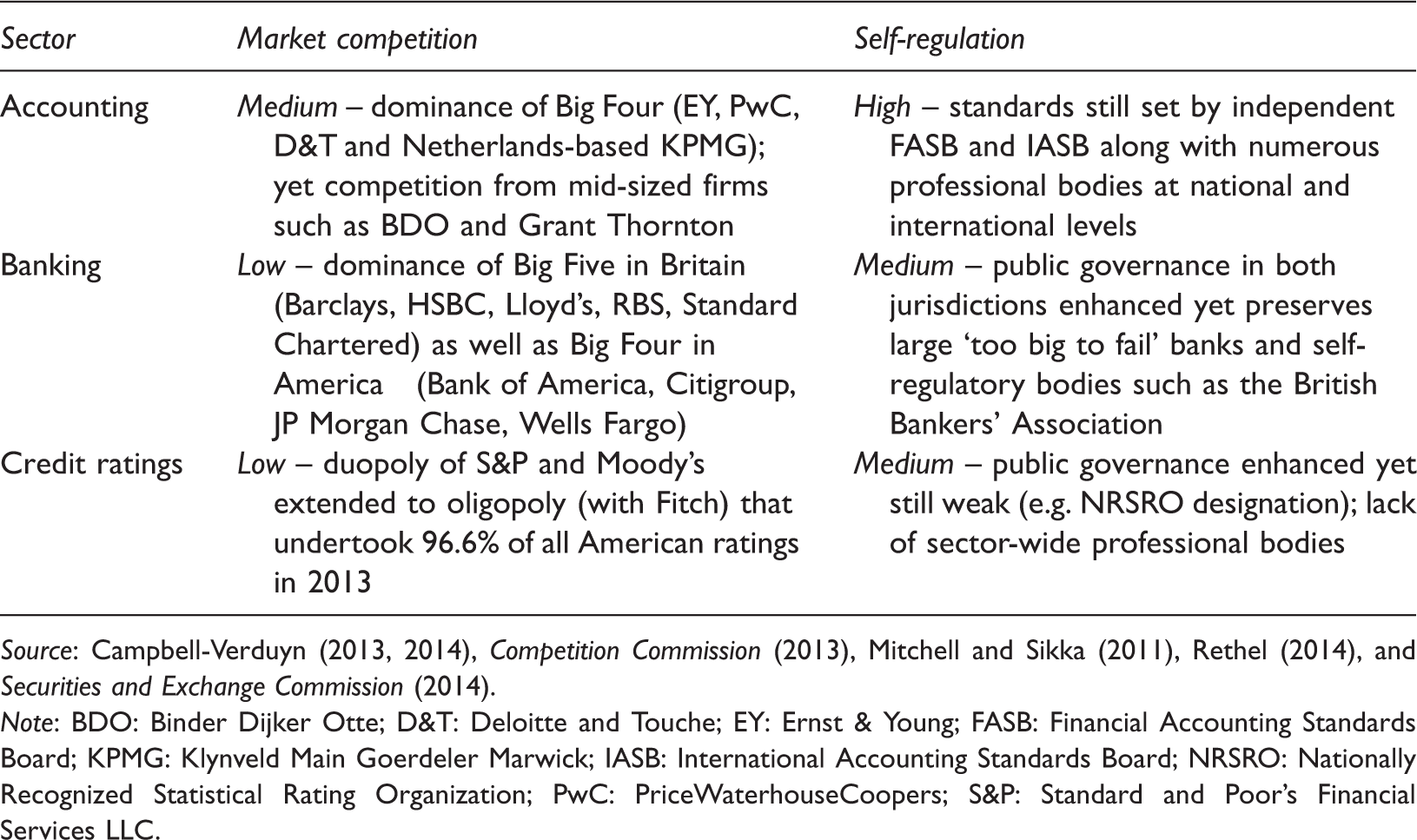
Source: Campbell-Verduyn (2013, 2014), Competition Commission (2013), Mitchell and Sikka (2011), Rethel (2014), and Securities and Exchange Commission (2014).
Note: BDO: Binder Dijker Otte; D&T: Deloitte and Touche; EY: Ernst & Young; FASB: Financial Accounting Standards Board; KPMG: Klynveld Main Goerdeler Marwick; IASB: International Accounting Standards Board; NRSRO: Nationally Recognized Statistical Rating Organization; PwC: PriceWaterhouseCoopers; S&P: Standard and Poor's Financial Services LLC.
Anglo-American financial services firms and the ‘sustainability surge’
Though gaining attention in the early years of the new millennium, the notion of sustainability was not granted a much notice by leading British and American financial services firms prior to the outbreak of the most recent crisis in 2007. Studies indicated that merely one major credit-rating agency had sought to emphasize sustainability (Finch, 2004: 67), whilst the others primarily ‘focused on immediate gain rather than growth based on sustainable social reproduction’ (Sinclair, 2005: 60). Meanwhile, although they began to take environmental risks into account and to pay increasing attention to notions of sustainability, the largest Anglo-American banks viewed the concept as more of ‘a threat than an opportunity for profitable lending’ (Thompson and Cowton, 2004: 200). Empirical research confirmed that ‘[t]he main herd of the banks is largely inactive’ (Jeucken, 2002: 16) in sustainable financial services and that ‘[a]t this time, the goal of sustainable banking appears to be feasible for only a few niche players’ (Jeucken, 2001: 74). Thorough debates over sustainability in accounting scholarship (Matthews, 1997) failed to provide leading Anglo-American firms with sufficiently clear guidelines for integrating notions of sustainability into financial reporting prior to the crisis. Lacking definitive measures and definitions, accountants were largely unable to incorporate sustainability criteria into comparable common standards. As was observed, in sum, towards the turn of the millennium: For financial markets, sustainability information remains at best a curiosity. Except in the relatively small social investment community, environmental, social, and nonfinancial economic information is rarely used in investment, lending, and underwriting decisions. The mounting evidence that such “extraneous” factors may affect stock performance has yet to permeate mainstream Wall Street. Such a realization is some years away. (White, 1999: 42)
The largest Anglo-American accounting firms have embraced sustainability since 2007. Through aggressive hiring and takeovers of boutique sustainability consultancies, Deloitte and Touche (D&T), Ernst & Young (EY) and PricewaterhouseCoopers (PwC) became leading suppliers of both sustainability risk assurance as well as sustainable consulting services. 3 These firms have also undertaken various internal changes to promote sustainability. For instance, in 2009 D&T opened a new business unit called the Centre for Sustainability Performance as well as created a post of ‘global head of climate change and sustainability’. Meanwhile, the major Anglo-American accounting firms have increasingly considered ‘the potential of new reporting models for business which include non-financial information’ (Schaltegger and Burritt, 2010: 376). These firms have been closely involved in developing and piloting the leading new reporting model that purports to enhance ‘financial stability and sustainability’, called ‘integrated reporting’ or IR, through their roles in the International Integrated Reporting Council, a private body established in 2010.
The presence of sustainability in the credit ratings sector has been equally enhanced since 2007. In addition to annual reports emphasizing sustainable practices and detailing the impact of environmental and social issues on creditworthiness (e.g. Moody's Foundation, 2011), major credit-rating agencies have adopted new methodologies that include sustainability issues (Standard and Poor's Ratings Services, 2012: 6). S&P has boasted of its contributions to sustainability conferences and roundtables as well as its establishment of a Global Industry Focus Team promoting ‘the global consistency and analytic rigor of our environmental finance sector analysis, including global carbon markets, climate change finance and clean energy’ (Standard and Poor's Ratings Services, n.d.). Judgements of creditworthiness have increasingly emphasized sustainability, particularly in sovereign ratings (e.g. Magtulis, 2013), whilst credit-rating agencies’ research reports have highlighted numerous risks involved with various environmental and social problems (Maguire, 2014; Standard and Poor's Ratings Services, 2014).
The enhanced emphasis on notions of sustainability since 2007 has perhaps been most visible in the Anglo-American banking sector. The major British and American banks increasingly compete in sustainability lending niches where ‘[m]any of the innovative products and services once introduced by social banks have now entered mainstream, and are increasingly popular with both customers and conventional banks … [who are] starting to discover the promises of sustainability’ and have begun ‘to offer products and services labelled as “sustainable”’ (Weber and Remer, 2012). Anglo-American banks have equally added sustainability officers, directors and executives; signed on to sustainability principles elaborated by various United Nations bodies and nongovernmental organizations; hosted and sponsored sustainability conferences; sought to develop their internal infrastructure in sustainable manners; all whilst periodically boasting of their sustainability achievements in glossy sustainability reports (Park, 2012: 144; e.g. HSBC, 2011). The Sustainable Finance Awards, jointly established by the Financial Times newspaper and the International Finance Corporation in 2006, have attracted record entries and in 2012 designated British bank Standard Chartered as the ‘Sustainable Global Bank of the Year’.
In short, the largest British and American firms in three key sectors of the Anglo-American financial services industry have increasingly identified with sustainability since the outbreak of the most recent financial crisis. This premier social value appears to have ‘filtered down as an approach from a few academic think tanks and progressive companies’ to mainstream financial services industry (Schaltegger and Burritt, 2010: 376). As the following section however argues, this ‘sustainability surge’ (Johnson, 2011) has self-legitimized the professional privileges of leading British and American financial services firms merely within a narrow community of industry actors.
The renewed semi-professionalism of Anglo-American financial services firms
This section contends that the semi-professional status of prominent Anglo-American financial services firms has persisted despite enhanced identifications with sustainability in the wake of the most recent financial crisis. Despite increasingly identifying with sustainability since 2007, leading British and American financial service actors have equally persisted with practices that are ‘thinly’ congruent with the short-term survival of a narrow set of firms rather than ‘thickly’ corresponding with the longer term durability of wider economic, social and ecological systems. The lack of orientation towards wider notions of sustainability has been most visible in ongoing activities that have sought to maximize short-term profits in all three financial sectors examined.
The enduring inability of Anglo-American financial services firms to set aside short-term commitments for wider socioeconomic and ecological systems has been evident in the persistence of socially detrimental activities of large British and American banks since 2007. Subsidized by state guarantees as a result of their designation as systemically important financial institutions (SIFIs) and in some cases even partially government owned, the large Anglo-American universal banks have continued taking large, risky positions in financial markets. Potentially enormously profitable, these gambles have left public sectors dealing with the instabilities that have resulted when such risky transactions run amok and leave SIFIs teetering on the verge of insolvency. The substantial losses that have resulted from such bets have generated enormous controversy with for example a high-profile Congressional investigation into the billions of dollars lost by American bank JP Morgan Chase in its ‘London Whale’ trades (Permanent Subcommittee on Investigations, 2013). Another prominent example of enduring short-termism and disregard for wider notions of sustainability in Anglo-American banking since 2007 has been the persistence of so-called I'll be gone and you'll be gone (I.B.G-Y.B.G) attitudes in remuneration structures rewarding excessive risk-taking with massive bonuses and pay packages (Hill, 2011). Major Anglo-American banks have furthermore privileged immediate profits whilst neglecting long-term systemic sustainability by continuing to fund environmentally damaging operations (Gass, 2011); speculating in agricultural commodity markets (Clapp, 2013); and facilitating client tax avoidance (Fichtner, 2014; Shaxson, 2011) as well as financial transfers on behalf of clients that have included authoritarian governments, terrorist organizations and drug cartels (Murphy, 2013; Tsingou, 2014: 142). The sum of these and other activities, including manipulations of various key markets benchmark rates that have entailed costs for individuals and public institutions worldwide, 4 has led prominent regulators to question the ‘social usefulness’ of the major Anglo-American banks (Haldane, 2012).
The trio of large British and American accounting firms has also undertaken practices that persistently privilege narrow individual rather than wider systemic notions sustainability. Ongoing scandals have echoed the failures of these firms to reveal suspicious and fraudulent client behaviour in the lead up to the most recent financial crisis (Mitchell and Sikka, 2011: chapter 4). Pointing to how external accountants ‘kept mum about weak or nonexistent controls over riskier activity at JPMorgan’ as well as ‘about regulatory compliance issues like anti-money laundering faults at HSBC and Libor manipulation at Barclays and at least 12 other banks including JPMorgan’ former auditor Francine McKenna (2012) has argued that the accounting firms ‘are too busy trying to maintain longstanding relationships and selling consulting services to raise their hands about accounting manipulation and illegal activities’. The leading Anglo-American accounting firms have also privileged short-term profits and the survival of their clients at the expense of long-term systemic sustainability by amassing ‘lucrative’ revenues from services that have aided and enabled tax evasion (Economist, 2013; see also Houlder, 2014; Mitchell and Sikka, 2011: chapter 2; Shaxson, 2011; Sikka and Willmott, 2013). The endurance of such practices has led to public debates over how ‘socially useful’ these firms remain (Skapinker, 2014).
The leading American credit-rating agencies have further persisted with self-enrichment and the privileging of narrow client sustainability over wider notions of sustainability. Where ratings competition has been more pronounced since 2007, clients have not ceased to aggressively ‘shop’ between different agencies to obtain favourable ratings. In order to gain or maintain market shares, the major credit-rating agencies have continued to issue inflated ratings that minimize general public knowledge of the risks involved with investments in complex financial products, the demand for which mimics the ‘boom’ that preceded the great ‘bust’ of 2007 (Popper, 2013). 5 The ‘thin’ congruence with sustainability in this sector has been confirmed in further scholarly analysis (e.g. Clarvis et al., 2013: 3–4) as well as by panellists of 2014 conference organized by the United Nations-backed Principles for Responsible Investment that granted the leading credit-rating agencies a grade of just 3 on 10 for ‘failing to adequately take account’ environmental and social issues (Environmental Finance, 2014). Stemming such ‘largely unsustainable’ practices, the major credit-rating agencies have been derided by a former staffer for ‘actually increasing – rather than simply measuring – credit risk for individual issuers and raising systemic risk for the market as a whole, whilst at the same time creating negative outcomes for capital markets, the environment and society’ (McAdam, 2012).
The ‘thin’ congruence with narrow notions of sustainability by leading Anglo-American financial services firms from three different sectors supports the self-legitimization of the privileges of professionalism. However, the individualistic identities fostered through such self-sustaining activities undermine the ‘thick’ congruence with wider notions of sustainability. The practices of these large British and American accounting firms, banks and credit-rating agencies reveal how these leading actors in the Anglo-American financial services industry more generally lack the ability to recognize and resolve tensions between commitments to the survival of clients and to the durability of the wider socioeconomic and ecological systems in which they operate. Prioritizing their own profitability and that of their clients avoids the competition and creative destruction necessary for markets to thrive in liberal capitalist economic systems and prevents the broader legitimization of the reduced, yet nonetheless privileged, status of large British and American financial services firms. Although narrow and wide conceptions of sustainability are not necessarily contradictory, until it more substantially corresponds with the latter, the sustainability rhetoric emanating from these sectors will continue to be suspiciously viewed beyond the financial services industry as mere window dressing and appeasement of the self-interests of a narrow community.
The semi-professional flux of Anglo-American financial services firms is thus perpetuated as this industry lacks broader legitimacy, but nevertheless benefits from the narrower self-legitimization of restricted, yet nevertheless privileged, benefits of professionalism. Yet even this status has remained subject to challenge as public initiatives are continually proposed to enhance public interventions and revoke even these privileges. The precariousness of semi-professional status is illustrated by the ongoing elaboration of public measures proposing to reduce the persistent self-governance capacities and constrained competition enjoyed by the largest British and American financial services firms in the accounting (Competition Commission, 2013; Public Company Accounting Standards Board, 2011), banking (Brown and Vitter, 2013; UK Parliament, n.d.) and credit-rating sectors (Chasan, 2012; Martin, 2015). Although such initiatives have thus far remained largely unsuccessful, continual threats of enhanced public governance and industry competition highlight the precariousness of this persistent semi-professional status.
Conclusions
This article explored the legitimization of professional privileges, a process not yet thoroughly considered in literature on professionalism. An initial section contended that the central benefits of professionalism – reduced public oversight and competitive market forces – may be narrowly self-legitimized through practices congruent with the values of industry actors and more widely legitimized through activities corresponding with broader social principles. It was suggested that identities fostered in ‘thin’ congruence with narrow values determine the possibilities for ‘thick’ congruence with wider social principles. The category of ‘semi-professional’ was extended to actors whose self-legitimization of professional privileges precludes broader legitimization leaving them in precarious states of flux. To more widely legitimize and enhance their reduced yet nonetheless advantageous privileges, semi-professional actors seek to identify with leading social values, of which sustainability was introduced as a prominent contemporary example.
The case of Anglo-American financial services actors in the wake of the most recent financial crisis was subsequently drawn upon to illuminate these arguments. Leading British and American multinational firms dominating the key sectors of accounting, banking and credit rating were shown to have each maintained significant professional privileges since 2007. Yet contributions to the outbreak of the most recent financial crisis undermined the wider legitimization of the professional benefits enjoyed by these market actors. The subsequent ‘thin’ congruence of practices by Anglo-American accounting firms, banks and credit-rating agencies with narrow conceptions of sustainability was shown to preclude ‘thicker’ congruence with wider notions of sustainability. Rather than enhancing the broader legitimization of professional privileges, the persistence of individualistic identities has perpetuated the semi-professional status of Anglo-American financial services firms. Continual threats to revoke the remaining privileges of reduced market competition and self-governance have left these actors in a state of semi-professional flux.
This analysis holds several implications for the study of professions as well as for the fate of leading actors in the Anglo-American financial services, an industry crucial not only to British and American economies but also to the survival of wider socioeconomic and ecological systems. Scholars scrutinizing professionalism may benefit from considering the congruence of activities by actors enjoying the privileges of professional status not merely with wider social values but also with narrower industry principles. Self-legitimization, which is not akin to automatic legitimization, is important to analyse as a process supporting narrow justifications of competitive and self-regulatory advantages as well as shaping the potential for wider social legitimization of the benefits of professionalism. As this paper argued, the values engaged in self-legitimization are not always superficially ‘used’ as tools, but may also shape the very identities and actions of actors invoking them in ways that may undermine the potential for broader social legitimization of professional privileges. Leading Anglo-American financial services firms that since 2007 have increasingly engaged with narrow notions of sustainability prioritizing their own profitability and the survival of their clients have undermined the wider legitimization of their reduced yet nonetheless privileged status. Until the practices of its leading firms more substantially correspond with wider notions of sustainability, this industry will likely remain in a state of semi-professional flux marked by continual challenges to its restricted degrees of market competition and self-regulatory capacities.
Future research would benefit from continued scrutiny of how British and American financial services firms respond to the enduring twin challenges of semi-professionalism and sustainability. Whilst maintaining a healthy degree of scepticism, studies should remain open to possibilities that further integration into ‘sustainability culture’ (Parr, 2009) may lead to practices corresponding more ‘thickly’ with wider notions of sustainability that more fully take into account the endurance of the broader socioeconomic and ecological systems in which these actors operate. Scholars should equally remain alert to whether different social values are being drawn upon and identified with attempts to enhance the legitimacy of semi-professional actors. Methodologically, studies might delve beyond the firm level and analyse internal dynamics of financial conglomerates in order to detail potentially distinctive roles played by individual actors at different levels, from junior staff to executives, in contributing to processes of legitimization. Ongoing research could also examine actors in sectors of the financial services industry that were not scrutinized here, such as insurance firms. In short, several potential avenues exist for scholars of global political economy as well as other social scientists to empirically explore the legitimacy of professional privileges and shifting boundaries of professionalism through the concepts developed in this article.
Footnotes
Acknowledgements
The author wishes to thank two anonymous reviewers, the journal editor, and Tony Porter for providing insightful feedback that substantially improved this article. Earlier versions of this article presented to the 2013 International Conference on Public Policy at Grenoble University and the 2014 Mapping the Global Dimension of Policy conference at McMaster University also benefited from constructive comments by Berkay Ayhan, Steve Haarink, Hugh McDonnell, and Liam Stanley.
Declaration of conflicting interests
The author(s) declared no potential conflicts of interest with respect to the research, authorship, and/or publication of this article.
Funding
The author(s) disclosed receipt of the following financial support for the research, authorship, and/or publication of this article: This research was supported by a Doctoral Fellowship from the Social Science and Humanities Research Council of Canada, number 752-2013-2672.