







Abstract
Do trade-labour linkages improve the conditions and rights of workers in low-wage countries? We consider this question in Vietnam, a market economy with socialist orientation that has seen rapid growth in export manufacturing and foreign direct investment, while signing regional trade agreements, which include labour rights provisions, with high-income trading partners. Our paper focuses on two such agreements – the Trans-Pacific Partnership and the European Union-Vietnam Free Trade Agreement. We ask how, if at all, these negotiations have influenced changes in Vietnam's labour regime, particularly regarding the representation and participation of workers in the country's system of industrial relations. Comparing binding and nonbinding provisions, we find that the effects of trade-labour linkages are mediated by their enforceability, and prospects for strengthening associational rights are improved by the possibility of commercial sanction. Overall, we find that gains for workers in Vietnam continue to be made by collective action, despite a context hostile to freedom of association, and that external influences to improve labour standards and conditions have had a minimal effect.
Keywords
Introduction
The 1990s witnessed both the institutionalization of a multilateral trade regime under the World Trade Organization (WTO), and a proliferation of regional trade agreements (RTAs). While these developments advanced business and commercial interests through new binding obligations, environmental standards and labour rights were largely excluded from the core trade agenda. The first generation of regional free trade agreements advanced by the United States, beginning with the North American Free Trade Agreement (NAFTA) in 1994, consigned labour rights to a side agreement and an arbitration process that was primarily consultative (Lazo Grandi, 2009). Apart from the notable exception of the Generalized System of Preferences (GSP), 1 concerns over labour standards were addressed through voluntary initiatives, such as code of conduct auditing in export factories, which became a prominent feature of Corporate Social Responsibility portfolios in the U.S. and Europe.
In the past decade, however, we have witnessed a significant shift in the relationship between trade agreements and labour reforms. As Jeffrey Vogt explains, ‘there is a broad acceptance of the trade-labour linkage and labour clauses [that] are appearing with greater regularity in international instruments’, even as disagreements remain ‘on the scope of the obligations and the enforcement mechanism’ to be used (2015: 828). One particularly noteworthy development in this regard is the increasingly common inclusion of language addressing labour rights in RTAs. With the WTO's Doha Round stalled, many governments have turned to negotiating RTAs, a significant number of which have been brokered between developed and developing countries. In this context, the high-income country is likely to have greater power over its negotiating partner than it would in a multilateral setting to demand labour standards in return for market access. 2
Thus, while labour standards continue to be excluded from the WTO, their inclusion in RTAs is potentially very significant, given that bi- and plurilateral trade frameworks now account for nearly 55% of all trade (ILO, 2016a). Labour provisions in RTAs increasingly refer to the United Nations' Sustainable Development Goals and International Labor Organization (ILO) conventions, particularly those referenced in the 1998 ILO Declaration on Fundamental Principles and Rights at Work (henceforth, ILO, 1998 Declaration; see Granger and Siroen, 2006; Polaski, 2004). A recent review by the ILO found that as of 2015, 76 trade agreements included some kind of labour provision, and half of these were negotiated after 2008 (ILO, 2016a).
A key factor in the expansion of labour provisions in trade agreements is the recent adoption of agreement templates or frameworks by the United States (U.S.) and the European Union (E.U.). The U.S. and E.U. have been particularly enthusiastic in their pursuit of RTAs, and both require that labour provisions be included in the body of all bilateral and regional agreements they sign. In the United States, this requirement dates from a deal struck by the George W. Bush administration and Congressional leaders in 2007. Officially titled the Bipartisan Agreement on Trade Policy, but commonly referred to as the May 10th Agreement, the measure reflected growing skepticism among the U.S. electorate about the implications of trade deals for U.S. manufacturing employment, and a rising chorus of calls for ‘fair’ as well as ‘free’ trade (Candland, 2009). Supporters of the Agreement claimed that it laid the foundation for a new generation of RTAs with robust environmental and labour protections (Weisman, 2007).
The Bipartisan Agreement on Trade Policy introduces two new requirements for RTAs negotiated by the U.S. government. First, signatories would be required to pledge observance not just of their own domestic labour law, but also the core international labour standards laid out in the ILO 1998 Declaration. Second, disputes pertaining to alleged labour violations are to be subject to the same dispute settlement mechanism that the RTA outlines for commercial disputes (Bolle, 2016; Vogt, 2015). When the May 10th Agreement was reached, it had immediate implications for four pending RTAs – specifically, with Colombia, Panama, Peru and South Korea. The Trans-Pacific Partnership (TPP) – an agreement negotiated between the United States and eleven other countries on four continents – would have been the first ‘mega-regional’ trade deal to be negotiated and implemented in the context of the May 10th framework. At the time of writing, the U.S. approach to RTAs was in flux, following the presidential election of Donald Trump, whose administration withdrew U.S. support for the TPP and filed notice to renegotiate NAFTA.
Although the E.U. has been less consistent than the U.S. in insisting on the inclusion of labour provisions in RTAs, such clauses are found in several of the most recent agreements it negotiated, including those with South Korea, Iraq, Central America, Colombia and Peru. In general, the E.U.’s approach to trade-labour linkages is at once ‘more expansive and more limited’ as compared with the United States (Vogt, 2015: 850). In terms of content, the E.U. favours normative language that exceeds the narrower references to domestic law and the ILO 1998 Declaration preferred by the U.S. For example, the language proposed by the European Commission for the proposed Transatlantic Trade and Investment Partnership mega-regional deal includes a reference not only to the ILO 1998 Declaration, but also to the 2008 ILO Declaration on Social Justice for a Fair Globalization (Tham and Ewing, 2016).
Where the E.U.’s approach can be considered more limited than that of its U.S. counterpart is in the area of enforcement. Europe has declined to make demands of its trade partners in the area of labour compliance as a condition of ratification. Moreover, the E.U. does not insist upon binding dispute settlement procedures in the case of alleged violations of the social content of RTAs, including labour standards. In general, and as we specify below in the Vietnamese case, the E.U. does not outline any trade-related sanctions in the event a party does not implement the labour and environmental commitments detailed in the agreement. This leads Vandenberghe (2008: 562) to suggest that ‘the social provisions of E.U. preferential agreements seem to be included as objectives to be achieved rather than as legal commitments to be enforced’. Tham and Ewing (2016: 17) conclude their comparison of the E.U. and U.S. by summarizing the former's approach to trade-labour linkages as ‘one of a broad agenda based on promotional measures’ including technical cooperation, and the latter's as ‘a narrow agenda based on conditional measures’.
The efficacy of labour standard clauses in E.U.- and U.S.-negotiated RTAs continues to be debated. Perhaps not surprisingly, existing research suggests that ratification of such an agreement does not necessarily lead to improved labour standards. Rather, effectiveness requires some combination of ‘carrots’ (positive incentives) and ‘sticks’ (trade-related sanctions) to achieve compliance (Salem and Rozental, 2012; Pahle, 2015). Several scholars distinguish between pre-ratification or pre-ante effects, on the one hand, and post-ratification or ex-post effects on the other. Vogt's review of multiple RTAs signed by the U.S. and E.U. finds some evidence of positive impacts, though he emphasizes that these ‘fall well short of ensuring compliance with ILO fundamental labour rights in law or in practice’ (2015: 828). Such effects come primarily via the exercise of leverage during the negotiating process – for example, by making a final agreement contingent on changes in a trade partner's domestic policy or practice. Drawing from an analysis of trade with the United States and its partners, Kim (2012) argues that even anticipating the negotiation of an RTA with a high-income country promotes improved labour rights protections in the aspiring partner. Because, as noted above, the E.U. does not impose pre-ratification requirements on its negotiation partners, one might expect that its RTAs will have less pronounced ex-ante effects. However, Postnikov and Bastiens (2014) claim that the EU's preferred approach of promoting labour standards via the normative power of consultation and dialogue with civil society actors is associated with improved performance ex-post. These studies indicate the need for additional research to understand the conditions under which trade-labour linkages are effective in securing changes in the content or enforcement of domestic labour law, and compliance with international labour standards.
Vietnam offers a rich and unique case for exploring the interactions between extra-national forces and national reforms. Considered a lower middle-income country by the World Bank, Vietnam's GDP growth has averaged 6.4% annually since 2000, and exports as a percent of GDP have grown from 50 to 93% over the same period (World Bank, 2017). The country has undertaken a rapid process of export and foreign investment promotion and has pursued a large number of trade and cooperation agreements, making it an ideal location to evaluate the effect of external influences on domestic labour regimes. We define labour regime inclusively to encompass not only the country's labor laws, but also labour rights struggles, and relations among labour, the state, and capital. In this paper, we focus on the TPP and the European Union-Vietnam Free Trade Agreement (EVFTA), two major agreements that aim to link preferential access to international markets to changes in domestic law and practice. Specifically, we ask how, if at all, these interventions have influenced changes in Vietnam's labour regime, particularly regarding the representation and participation of workers in the country's system of industrial relations. Our analysis draws from primary documents in Vietnamese and English, as well as from fieldwork conducted by the first author, who made multiple trips to Vietnam between 2009 and 2016.
The article proceeds as follows: in the next section, we provide an overview of the Vietnamese context. In the section titled ‘External pressures for reform', we describe the TPP and EVFTA, highlighting the labour rights obligations adopted in the completed agreements. We go on to explore changes in Vietnam's labour regime over two periods. In ‘Wildcat strikes and workplace reforms: responding to labour unrest (2009-2015)', we assess the relatively modest reforms that occurred while the TPP and EVFTA were being negotiated, highlighting the Vietnamese government's efforts to create new mechanisms of bipartite dialogue in Vietnamese enterprises in the context of labour unrest. In ‘The dimming prospect for freedom of association in post-TPP Vietnam (2016 – present)', we examine whether there is any evidence that the United States withdrawal from the TPP has weakened the Vietnamese government's commitment to complete reforms regarding associational rights – an area of labour standards prioritized by the U.S. government. Specifically, we compare two drafts of proposed revisions to the Labor Code – one written before the U.S. withdrawal from the TPP (Draft 1), and one released after (Draft 2). We conclude by discussing the current limitations to improving associational rights through trade-labour linkages.
Labour rights and standards in the context of Vietnam's market reforms
Few countries have undergone a transformation as dramatic as Vietnam's over the last several decades. After the 1989 disintegration of the Soviet Bloc (whose members were Vietnam's major trading partners), Vietnam opened itself to other markets, especially Japan, ASEAN, and the E.U., to circumvent a U.S. trade embargo. During the second half of the 1980s, Vietnam initiated reforms designed to create a ‘market economy with socialist orientation’. In 1994, U.S. President Bill Clinton ended the United States’ nearly 20-year trade embargo, and the following year, established diplomatic relations with Vietnam. This normalization of relations spurred foreign direct investment from the United States and its Western allies. Vietnam joined ASEAN in 1995. The country entered into a bilateral cooperation agreement with the U.S. in 2000, and an agreement on textile trade with the U.S. in 2003. In 2007, Vietnam joined the World Trade Organization.
Vietnam's pursuit of foreign trade and investment has occurred in an authoritarian political context marked by high levels of labour unrest in recent years (Anner and Liu, 2016). The country's official trade union – the Vietnam General Confederation of Labor (VGCL) – is affiliated to the Vietnamese Communist Party. Union formation independent of the Communist Party is not permitted under the Labor Code, and the Party appoints the leadership at the upper levels of the VGCL. The VGCL is not monolithic, however, and at least some of its leaders and the VGCL-controlled newspapers try to reconcile a mandate to fight for the interests of workers with their obligation to serve the Vietnamese Communist Party (Tran, 2013). Although independent union formation is constrained, the Labor Code requires that unions be established at the factory level, and at every administrative level (city, district and enterprise) and by industry (such as textile/garment/footwear, commerce, and railroads).
Since Vietnam began pursuing market-oriented economic reforms in the 1980s, workplace-level unions have been the weakest link for worker representation (Tran, 2013). While under the Labor Code, enterprise-level union leadership is to be elected by workers, in practice, management often appoints leaders or otherwise orchestrates the selection process to ensure that only loyal and trusted employees assume leadership roles (Do, 2008). Enforcement of the Labor Code is divided between the government's Ministry of Labor, Invalids and Social Affairs (MOLISA) and the VGCL, but ‘in practice the main responsibility falls to MOLISA, since VGCL has almost no leverage outside the state-owned sector’ and is particularly weak in the export processing zones that host foreign-owned factories (Clarke et al., 2007: 549).
The subservience of the VGCL to the Party is enshrined in the 1990 Trade Unions Law, the opening line of which states that ‘A trade union is a large political and social organization of the working class voluntarily established under the leadership of the Vietnamese Communist Party’. The VGCL has exclusive control over mandatory employer contributions (equivalent to 2% of payroll) that were first introduced under the Trade Unions Law of 1957 (Dang 2012). When the Trade Unions Law was revised in 1990, the new law contained no reference to the specific amount employers were required to pay. This was stipulated in two subsequent circulars. First, a 2004 circular reaffirmed 2% as the required contribution from all companies (domestic and foreign-owned); 3 this was changed in a 2009 circular, which reduced the mandatory percentage payment to 1% of payroll for FDI (e.g., foreign-owned) companies. 4
The comprehensive Labor Code that was adopted in 1994 outlines a tripartite structure for industrial relations, recognizing a role for workers, employers and the state. In addition to covering working hours, overtime and social insurance benefits, the Code also granted Vietnamese workers the right to strike. This right is seriously eroded, however, by the regulations placed on such actions. As Cox (2015: 276) explains: ‘a strike must be led by a trade union, who must give two weeks’ notice prior to any industrial action to allow time for mediation’. Legal strikes can only be called after the failure of conciliation attempts of the Labor Conciliation Council at the company level and the Labor Arbitration Council at the provincial level (Article 171). Moreover, in the 2012 Labor Code, workers are only permitted to strike, under VGCL leadership, on issues that are not defined in the Labor Code, such as health and social insurance benefits (i.e. ‘interests’). Strikes are forbidden on issues that are defined in the law (i.e., ‘rights’); as such, these conflicts are to be settled in the labour courts (Tran, 2013: 118–119, 144–145).
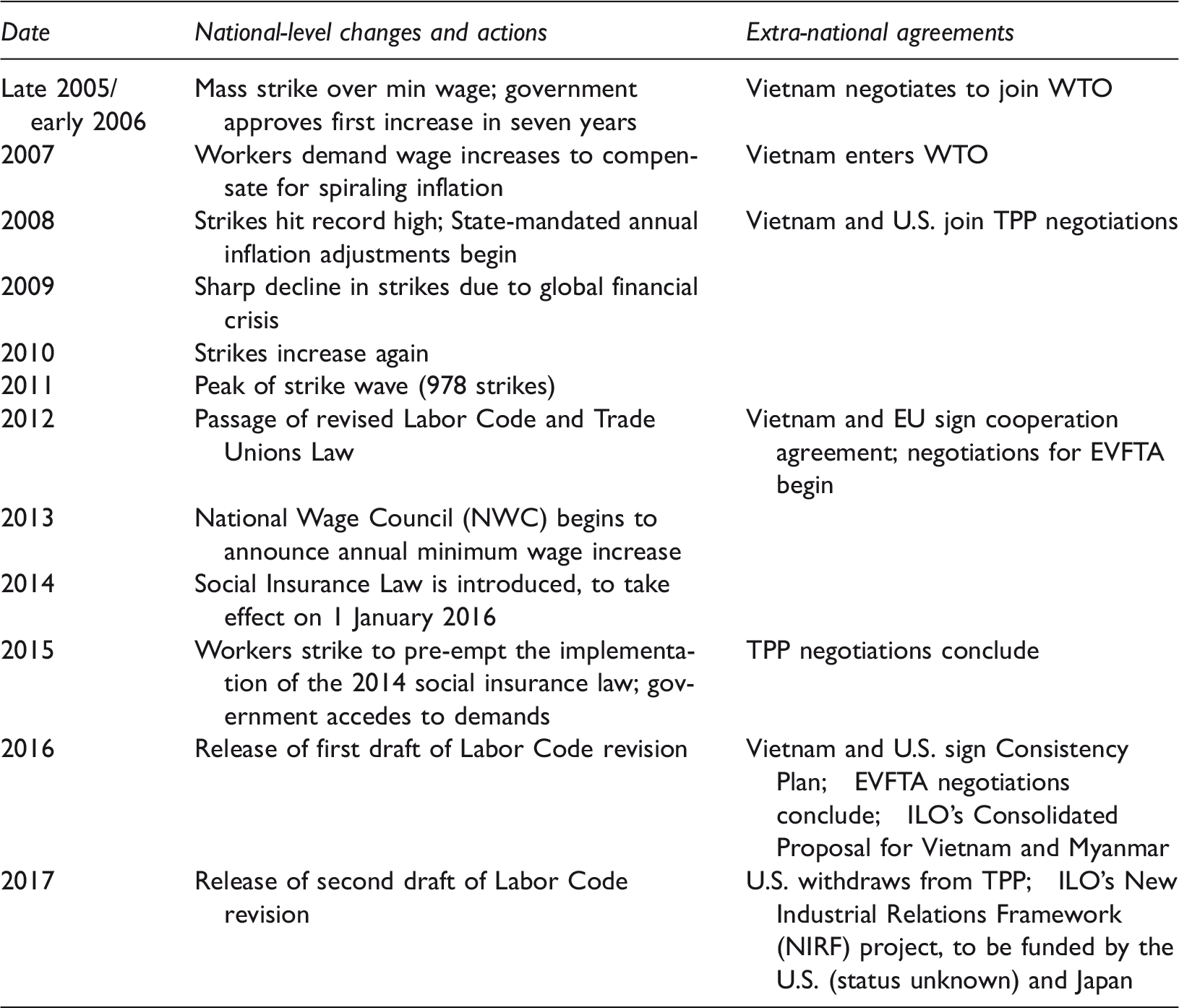
In spite of these restrictions, Vietnam has experienced an upsurge in labour militancy, particularly in the export sector, where foreign ownership is common and unionization rates are low relative to state-owned enterprises. Strike activity was modest in the early 2000s, but increased dramatically starting in 2005 when inflation rose sharply (see Figure 1). Between 28 December 2005 and 7 January 2006, tens of thousands of workers participated in a 10-day strike in foreign-owned factories in the South. This historic strike ended when the Prime Minister issued a decree mandating a 40% increase in minimum wages in the export sector's foreign-owned (FDI) factories. However, the increase in the FDI minimum wage soon provoked a second wave of strikes when workers in domestically-owned factories also demanded wage increases. These wildcat strikes were organized and led by workers, not their union representatives. Nevertheless, journalists affiliated with newspapers controlled by the VGCL provided extensive coverage, criticizing irresponsible state officials who had failed to respond to workers' demands for a wage increase.
Vietnamese strikes by year, 1995–2015. Source: Tran (2013) and VGCL (2016).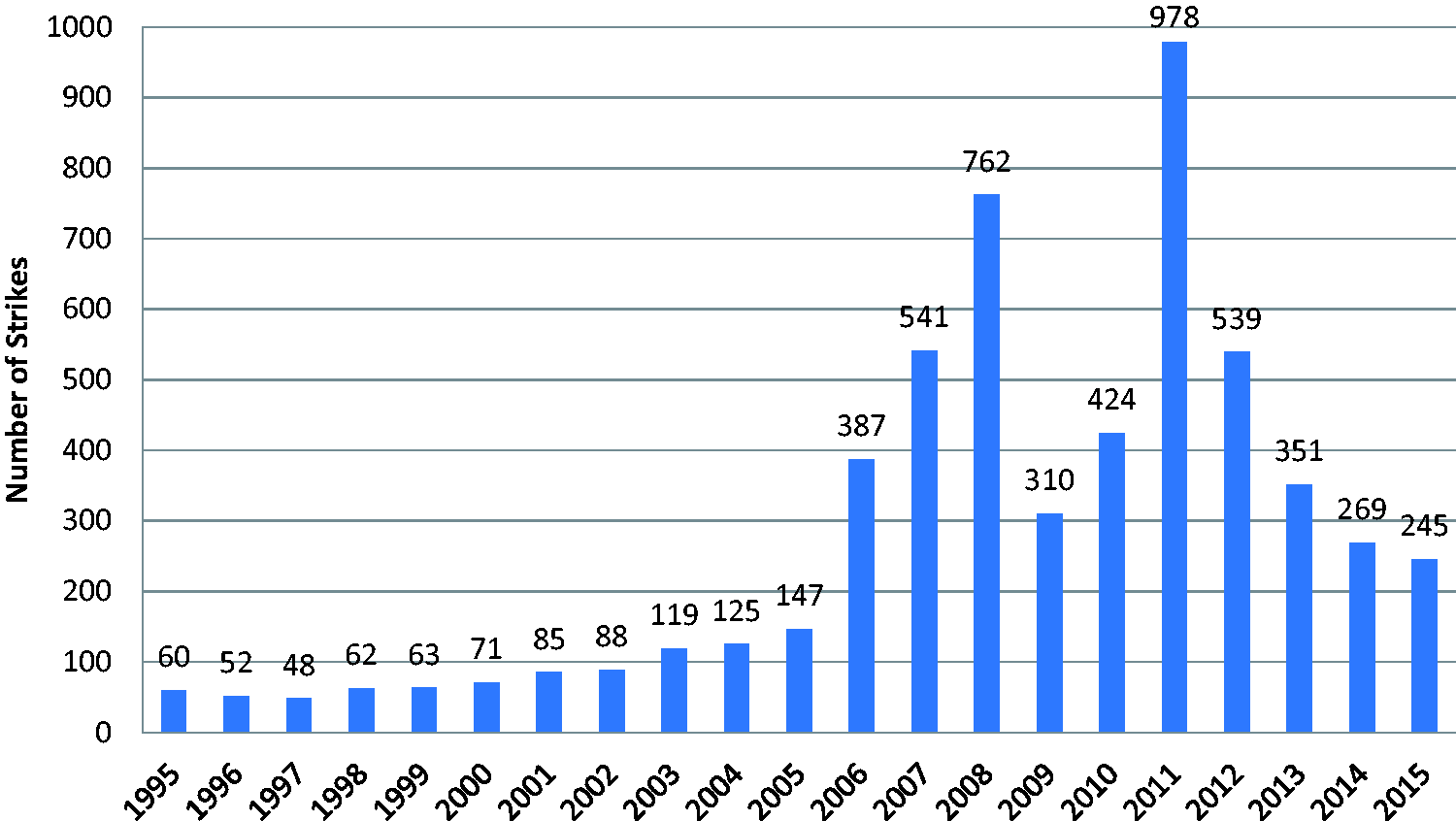
Workers in the export sector again struck in 2007, demanding wage increases to compensate for spiraling inflation. The strikers, again receiving strong support from the VGCL's media, succeeded in securing the state-mandated annual inflation adjustment, which took effect in January 2008. That year, strike activity surged to what was then an historic high of 762 strikes. This time, workers were protesting the failure of the foreign-owned factories to implement the inflation-adjusted minimum wage. Since then, each October, the Prime Minister has announced the percentage increase for the minimum wage, to start at the beginning of the following calendar year.
By 2008, government and industry officials alike had to acknowledge that the wildcat strike had become an increasingly common, and arguably effective, form of labour protest in Vietnam, especially in foreign-owned garment factories (Anner and Liu, 2016). Although these actions tended to be relatively short, peaceful affairs, employers expressed frustration about such frequent disruptions to production, particularly when they had to fill time-sensitive orders from overseas buyers. When the Vietnamese government announced its intention in November 2008 to join the TPP negotiations, the problem of labour unrest in the export sector took on a new urgency, given the expanded opportunities for trade and investment that the proposed mega-regional agreement was expected to bring. In the next section, we review the commitments that Vietnam assumed under the TPP and the bilateral E.U.-Vietnam agreement, before turning in subsequent sections to the question of whether and how these obligations shaped the evolution of Vietnam's labour regime during a period of unprecedented worker mobilization.
External pressures for reform: the TPP and EVFTA
To date, Vietnam has signed 11 RTAs, including bilaterals with Korea and Chile, and a free trade agreement with ASEAN, as well as ASEAN-negotiated RTAs. These RTAs, however, do not include labour provisions (ILO, 2016a). In contrast, as negotiated, the EVFTA and the TPP include labour clauses. Moreover, if enacted, these two agreements would govern a significant proportion of Vietnamese trade. The United States and Japan, both parties to the TPP, represent 20% and nearly 9%, respectively, of the country's total exports, while the European Union, taken as a unit, represents a share similar to that of the United States. China remains Vietnam's largest trading partner.
TPP
The TPP was negotiated over a period of seven years, commencing in 2008 and concluding in October 2015. The final agreement included a dozen countries, which collectively represent 40% of global GDP. 5 Consistent with the Bipartisan Agreement on Trade Policy discussed above, the TPP commits signatories to observe core labour rights as outlined in the 1998 ILO Declaration: freedom of association and collective bargaining, elimination of forced labour, abolition of child labour and the elimination of discrimination in employment (ILO, 1998). The Agreement also goes significantly further, however. In the final text, the TPP incorporates the ILO's Fundamental Rights into Chapter 19 and specifies additional labour standards for ‘acceptable conditions of work’, which include language regarding minimum wages, hours, and occupational safety and health. The TPP also mandates an extensive consultation process in the case of alleged violations, and unresolved disputes regarding compliance with the labour chapter are subject to the dispute settlement process established for the Agreement as a whole.
Parallel to the main Agreement, the U.S. government also negotiated ‘Consistency Plans’ with three parties to the TPP: Vietnam, Malaysia and Brunei. The goal of these corollary agreements was to align domestic laws and regulations in the signatory country to the standards set out in the TPP. The Consistency Plan with Vietnam, called the US-Vietnam Plan for Enhancement of Trade and Labor Relations, was signed in 2016. This Plan stipulates a host of legal (Section II) and institutional (Section III) reforms that the government of Vietnam committed to undertaking in tandem with the anticipated implementation of the TPP. 6 Within five years of the TPP entering into force, the U.S. would review progress on the Plan. If within two years after this grace period Vietnam had not complied, tariff phase-outs for Vietnamese exports would be suspended, including for key products such as apparel and footwear (Basu Das et al., 2017).
The legal reforms outlined in the Plan include freedom of association, which, if enacted, would represent a major departure from Vietnam's current industrial relations system. For example, the second item in Section II states ‘Viet Nam shall ensure that its laws and regulations permit workers, without distinction, employed by an enterprise to form a grassroots labour union [in Vietnamese tổ chỘc ngḑỗi lao động] of their own choosing without prior authorisation. To operate, a grassroots labour union shall register with its choice of either the Viet Nam General Confederation of Labour or the competent government body’ (p. 1). The same item requires Vietnamese law to ensure that ‘a grassroots labour union registered with the competent government body is entitled to collect and manage its membership dues and to receive the grassroots union share of the 2% fee paid by the employer on a non-discriminatory basis’ (Basu Das et al., 2017). Also included in Section II is a provision to ensure the autonomy of grassroots unions over their own affairs. Specifically, the Plan prohibits any law that mandates ‘a labour union registered with the competent government body to operate according to the Statutes of Viet Nam General Confederation of Labour’ and requires that Vietnamese law ‘provides the authority to any labour union registered with the competent government body to adopt and operate according to that union's own statutes’ (p. 2). The right of workers to call ‘rights-based strikes, consistent with ILO guidance’ is also included (p. 3).
Specified in each provision are the relevant clauses of the Vietnamese legal code that will need to be revised or eliminated to ensure compliance with TPP's labour standards. For example, ‘ensuring that labour unions are able to administer their affairs with autonomy’ affects Trade Unions Law Article 4(8), Article 6(2), Article 26 and Article 27 (p. 2); guaranteeing the right to strike over rights as well as interests requires a change to Article 215(1) of the 2012 Labor Code. Overall, the intent of the Consistency Plan is to eliminate the VGCL's monopoly on worker representation, and to create a legal environment in which ‘grassroots’ unions, or independent, non-party affiliated, unions formed at the enterprise level can function without state interference.
The institutional reforms outlined in Section III focus primarily on ensuring that the Vietnamese government has the capacity ‘to implement the amended laws and regulations’ and allocates ‘sufficient resources necessary for…enforcement of labor law’. Specified are the numbers of permanent labour inspectors the Ministry of Labor, Invalids and Social Affairs (MOLISA) is expected to employ: 750–800 by the end of 2016 and 1200 by the end of 2020 (as compared with 500 inspectors when the Plan was signed) (p. 5). The Consistency Plan also calls for Vietnam to create, and the U.S. government to support, ‘a Technical Assistance Program (TAP) by the ILO in Viet Nam to provide continuous and regular support to Viet Nam to facilitate the implementation of the legal and institutional reforms described in this Plan’ (p. 8). In October 2016, the U.S. Department of Labor committed $3 million for the first year of what was envisioned as a three year ILO project to develop such a program, called the New Industrial Relations Framework for Vietnam (United States Department of Labor, 2016). 7 We note that the Plan omitted third-party participation (Item #4, Section VII), which is allowed in the general TPP Chapter 28 – Dispute Settlement.
EVFTA
Building upon the 1995 and 2012 framework cooperation agreements between the E.U. and Vietnam, negotiations for the EVFTA began in 2012. The negotiations were the first undertaken by the E.U. since its adoption of the Strategic Framework on Human Rights and Democracy in 2012, which emphasized the inclusion of human rights norms in E.U. foreign policy (Sicurelli, 2015). On 1 February 2016, the text of the EVFTA was published, following the announcement of the conclusion of the negotiations. At the time of writing, the legal review of the negotiated text was ongoing; if approved by both parties, the Agreement is scheduled to take effect in January 2018. 8
As has now become the practice in regional trade agreements promoted by the E.U., labour provisions are included within a chapter titled Trade and Sustainable Development, which also includes environmental standards such as commitments around climate change. 9 Article 1 of the Agreement includes a footnote clarifying that references to labour in the chapter are understood to include ‘the issues under the Decent Work Agenda, as expressed in the ILO 2008 Declaration on Social Justice for a Fair Globalisation’ (p. 1). Similar to the TPP, the EVFTA promotes a commitment to the fundamental ILO rights outlined in the ILO 1998 Declaration. The agreement also calls for the ratification of core and non-core conventions, albeit using weak language, i.e., ‘Each Party will make continued and sustained efforts toward ratifying… core ILO conventions’ (Article 3.3) and ‘Each Party will also consider the ratification of other conventions’ (Article 3.4).
The European Commission's Report on the agreement stated that the EVFTA includes a ‘robust, comprehensive and binding Chapter on Trade and Sustainable Development, dealing in an integrated manner with labour and environmental matters of relevance in the context of trade relations between the E.U. and Vietnam’. It also claims that the Agreement ‘provides for a tailored mechanism for the resolution of disputes on its implementation, including governmental consultations, an independent panel of experts whose reports are public and require follow-up, and transparency and accountability measures (e.g. publication of the outcome of governmental consultations, involvement of the civil society mechanisms)’. 10 However, the first paragraph of Article 16 of the Chapter clearly exempts disputes regarding the Trade and Sustainable Development chapter from the Agreement's dispute resolution procedure (p. 11). Instead, the procedures outlined in Articles 16 and 17 include consultations in the event of a dispute and the possibility of consulting with a Specialized Committee on Trade and Sustainable Development. If the parties are unable to reach an agreement, the matter is referred to a Panel of Experts, which must issue a written report of its findings and recommendations within 150 days. However, there is no sanction for failing to comply with the Panel's recommendations. Moreover, while civil society may participate, the Panel's decision is communicated only to domestic groups consulted during the dispute. Public transparency is not guaranteed because EVFTA allows public release ‘unless the Parties mutually decide otherwise’ (p. 13).
This separate, non-binding dispute resolution procedure is consistent with the European orientation towards trade-labour linkages (Vogt, 2015). Analysts of this process argue that the outcome reflects ‘internal constraints’ on the normative power of European stakeholders that have pushed for human rights standards in trade agreements; they are relegated to a separate negotiating table that is marginal to the commercial negotiations led by the European Commission (see Sicurelli, 2015; Woolcock, 2014).
With respect to enforcement, there is no EVFTA equivalent to the Consistency Plan. However, a 2016 ILO funding request proposed a targeted technical assistance program ‘to implement the improved application of international labour standards in Vietnam under the EVFTA…’ (ILO, 2016b). The application for 900,000 Euros (to be split between the Vietnam EVFTA project and a different project in Myanmar) sets out four immediate objectives consistent with the EVFTA, but more limited than the Consistency Plan: promote legal changes to eliminate forced labour and discrimination (ILO Conventions 29 and 111); aid Vietnam's ratification of the three outstanding ILO core conventions (87, 98 and 105); enhance enforcement of new legislation on forced labour and discrimination; and increase multi-stakeholder action to eliminate forced labour and discrimination (p. 3).
In short, the TPP and EVFTA both include language committing signatories to enforce their own domestic labour laws and to observe international core labour standards. To support compliance with these obligations, the U.S. and the E.U. also committed resources to technical assistance programs, with much of this funding channelled through the ILO. Where these two trade agreements differ more markedly is in their enforcement provisions. The TPP was accompanied by a Consistency Plan detailing specific changes to Vietnam's labour laws. As an ex-post enforcement provision, the Plan allowed for the loss of trade privileges in the event that Vietnam failed to comply. We turn now to the question of what influence the trade-labour linkages outlined in these Agreements had on reforms to Vietnam's domestic labour regime during two time periods: 2009–2015, during which the TPP and EVFTA were negotiated, and the period following the conclusion of both Agreements in 2016.
Wildcat strikes and workplace reforms: responding to labour unrest, 2009–2015
Throughout the 2009–2015 period, freedom of association was a particularly delicate issue given ongoing negotiations of both the TPP and EVFTA. In this context, reforms of the Labor Code and the Trade Unions Law, both of which were announced in 2012 and went into effect in 2013, were closely watched by the United States and the European Union. Moreover, these reforms were announced in the immediate aftermath of a historic wave of wildcat strikes. Although strike activity had declined markedly in 2009 and 2010 – a period when Vietnam's export sector was grappling with slumping demand in the West due to the global economic crisis – it resumed in 2011. The total number of strikes surged past the previous high of 762, set in 2008. By the end of 2011, with a final count of 978 wildcat strikes, observers wondered ‘whether Vietnam's strike wave had become so significant that it would begin to curtail foreign investment’ (Anner, 2017: 20).
The 2012 revisions to the Labor Code tightened restrictions on the right to strike. While the distinction between ‘interests’- and ‘rights’-based strikes was introduced in a 2006 revision to the Code, the law still permitted strikes in both kinds of disputes after a certain amount of time had been spent exhausting all required channels (Tran, 2007b: 444–445). The 2012 revision eliminated this possibility, and declared all rights-based strikes impermissible, while maintaining the legality of interests-based ones. The refusal to recognize rights-based strikes was criticized by labour advocates, who pointed out that the prohibition had not succeeded in suppressing wildcat strikes in previous years – precisely because rights and interests are closely connected, as has been recognized by the VGCL (Tran, 2013: 119, 145). 11
Where the 2012 Labor Code more clearly departed from precedent was in the introduction of a new chapter on workplace dialogue (Chapter 5, ‘Dialogue at the Workplace, Collective Bargaining, and Collective Labour Agreement’). Implementation of this provision was the subject of a Ministerial Decree (60/2013/ND-CP) the following year. In Decree 60, the Prime Minister announced that the implementation of Chapter 5 would feature the creation of “democratic” ( ) dialogue at the factory level.
12
Democratic dialogue aims to level the power imbalance between workers and managers, because it requires management to disclose production plans, financial statements and responsibilities to workers, and to give workers the right to know, give feedback, and monitor all issues related to their rights, interests and responsibilities (Tran, forthcoming).
) dialogue at the factory level.
12
Democratic dialogue aims to level the power imbalance between workers and managers, because it requires management to disclose production plans, financial statements and responsibilities to workers, and to give workers the right to know, give feedback, and monitor all issues related to their rights, interests and responsibilities (Tran, forthcoming).
The VGCL attempted to implement this decree by publishing guidelines for management and for unions to facilitate democratic dialogue at the enterprise level, but their efforts were largely unsuccessful. Therefore, the VGCL collaborated with the Research Center for Employment Relations, an independent organization which was commissioned by the ILO to draft two manuals to guide the implementation of Decree 60: one for management and the other for enterprise-level unions (Do et al., 2016). The manuals elaborate a step-by-step procedure for ‘emergency dialogues’ (Đối thoại đột xuất) to deal with potential strikes, sudden policy changes that can negatively affect workers without their input, and external conditions such as inflation and natural disasters (Manual for Employers: 11). The manuals also emphasize employers’ responsibilities, including full pay for workers who participate in democratic dialogues at work and not penalizing workers who air grievances (Manual for Employers, 9).
Chapter 5 of the 2012 Labor Code is frequently interpreted as the introduction of ‘social dialogue’ into the Vietnamese context. Social dialogue, or consultation among the social partners at the enterprise level, is a concept that the ILO has advocated via various projects in Vietnam since the opening of the ILO's office in Hanoi in 2002. More recently, it has been promoted via the Better Work Program, a collaboration between the ILO and the World Bank's International Finance Corporation to audit export factories and remediate violations via social dialogue. However, the difference between social dialogue, as promoted by the ILO, and democratic dialogue as the standard enshrined in Decree 60, is significant (Tran, forthcoming). By insisting on information sharing and worker input, the latter recognizes the necessity to establish a more level-playing field between labour and management, given that the interests between the two may differ. Despite this difference in concept, the introduction of workplace dialogue in the 2012 Labor Code and the ILO promotion of social dialogue suggests additional, or more likely, complementary interactions between FTA negotiations and more long-standing external influences, particularly the ILO, on labour regimes. The degree to which ILO program priorities, or those of other multilateral agencies such as the World Bank, influence bi- or plurilateral trade negotiations is beyond the purview of this paper. Nonetheless, we note here direct influences such as the two ILO funding proposals to develop industrial relations institutions and practices in the contexts of the TPP and the EVFTA, in addition to the ILO core conventions serving as a baseline international standard in both agreements.
Another workplace reform introduced in the 2012 Labor Code is Article #155, which reasserted gender-related accommodations that had been introduced in the 1994 Code, but were never widely implemented. These provisions provide for women to receive a paid 30-minute break daily during menstruation, and for working mothers to be given a 60-minute break while nursing infants under the age of 12 months. While these long-overdue reforms were to take effect in 2013, they were not implemented until late 2015 due to further employer delays and resistance (Le, 2017a).
A final proposed change in Vietnam's labour regime during the 2009–2015 period would have affected Article 55 of the 2006 Social Insurance Law, which permitted workers to withdraw one lump-sum before reaching retirement age (60 for men and 55 for women). In 2014, the Vietnamese government passed Social Insurance Law (58/2014/QH13) which would have abrogated, starting in 2016, the right of workers to receive this pre-retirement payment. However, workers successfully pre-empted this change via a seven-day strike of a Taiwanese-owned factory, Pou Yuen Co. Ltd, in Ho Chi Minh City. The strike, which started in late March 2015, involved 90,000 workers (Tran, 2015). Journalists from the two VGCL-controlled newspapers reported daily from the scene of the strike action and published workers' voices with first-hand accounts and poignant photos. On 2 April 2015, the Prime Minister issued Decree 93/2015/QH13, which was ratified by the National Assembly on 22 June 2015. This measure allows workers to receive one lump-sum payment of their social insurance benefit whenever they stop working, even if they accumulate less than twenty years' work time. That November, the government also implemented Decree 88/CP/2015, which imposes heavier fines on employers who fail to make their required social insurance payments. Fines were increased three- to five-fold for not providing financial compensation to workers when they are sick, pregnant, injured on the job, or have occupational illnesses.
The picture that emerges of Vietnam's changing labour regime in the 2009–2015 period is a mixed one. Some elements of the 2012 Trade Unions Law and the Labor Code were expected to benefit workers, but progress on freedom of association was modest, even though it was clear that this would be a core labour standard prioritized by the U.S. in trade negotiations. The 2012 Trade Unions Law clearly stipulated the 2% employer contribution applied to both domestic and foreign companies (Law on Trade Unions, 2012: 41), thereby reversing the 2009 circular which halved the employer contribution from FDI companies (discussed in section ‘Labor rights and standards in the context of Vietnam's market reforms’). Insofar as these resources are to be used to support labor organizing, the reinstatement of the 2% contribution from foreign-owned companies can be considered a victory for workers.
Timeline of key developments affecting Vietnam's labour regime.
The dimming prospects for freedom of association in post-TPP Vietnam
On 6 November 2016, just two days before the US Presidential elections, the Vietnamese government signed resolution 06-NQ/TW, announcing deeper integration into the global economy, welcoming the new FTAs, and acknowledging the 1998 ILO Declaration. The resolution, signed by the Party General Secretary, Mr Nguyễn Phú Trọng, declared the country's commitment ‘to implement international economic integration, maintaining social political stability in the context of Viet Nam's participation in the new generation of free trade agreements’. Acknowledging the need for reforms pursuant to the FTAs, it announced the government's intention ‘to improve and to complete the legal framework, in accordance with national conditions and international agreements’ (The Laborer, 2016). The government then charged the Ministry of Justice with reviewing the laws required for the implementation of the TPP and proposing an implementation plan to the government at the regular meeting in December 2016 (AmCham Vietnam, 2016).
Top VGCL leaders demonstrated their support for TPP and EVFTA ratification as well. They engaged in a strategic planning process in anticipation of competition with independent labour unions that was expected to occur following Vietnam's ratification, as required under the RTAs, of ILO Conventions #87 (Freedom of Association) and #98 (Collective Bargaining) (Interviews with Mr Đặng Ngọc Tùng and Mr Trần Văn Lý, July 2016). 13 Also in November 2016, the VGCL President met with the U.S. Ambassador to communicate the organization's commitment to reforms, including the legalization of independent trade unions (Kym, 2016). In addition, the leadership announced a mass membership drive to reach 10 million members (Interview with Mr Trần Văn Lý, July 2016). 14 The Confederation pledged improvements in several areas, including participation in legislative discussions, representation of workers in labour disputes, monitoring occupational, safety and health and social insurance payments, and signing collective bargaining agreements (VGCL, 2017). In December 2016, the VGCL President signed four decisions affecting the organization's budget, finances and expenditures, which were intended to demonstrate reforms to the way the organization would utilize the mandated 2% employer contribution for labour organizing in the future.
The impacts of the TPP and the EVFTA on domestic reforms following the developments of late 2016 and early 2017 can be derived from an analysis of the process of Labor Code reform. As discussed in the previous section, the 2012 Labor Code already included provisions on social dialogue and enterprise-level representation; however, the legal basis for freedom of association, a top priority in the labour provisions of both RTAs and spelled out in Section II of the Consistency Plan, was inadequate. In December 2016, MOLISA released a draft of the revised Labor Code (henceforth Draft 1), in no small part meant to fulfil the country's specific obligations under the Consistency Plan. A 10-month consultation process was planned with submission of the final draft to the National Assembly for ratification in October 2017. Draft 1 was soon released in English with a detailed side-by-side comparison with the 2012 Labor Code. 15
On 21 March 2017, two months after the U.S.' withdrawal from the TPP, MOLISA released a second draft (henceforth Draft 2) of the Labor Code in Vietnamese only. The second draft contained some key gains for workers relative to the first draft. For example, Draft 1 of the revised Labor Code had eliminated the two female workplace accommodation measures (paid breaks for menstruation and nursing). The reinstatement of this benefit in the proposed Draft 2 reflected a broad-based campaign led by labour unions and women's organization to advocate for, and monitor the implementation of, these policies (Hong, 2017). Several key items remained unchanged between the two drafts and met the commitments under the Consistency Plan. Draft 1 expanded the scope for strikes, for example, removing the legal prohibition on rights-based strikes Article 215); this reform remained in place in Draft 2.
Key differences in pre- and post-TPP Labor Code reform proposals. 19
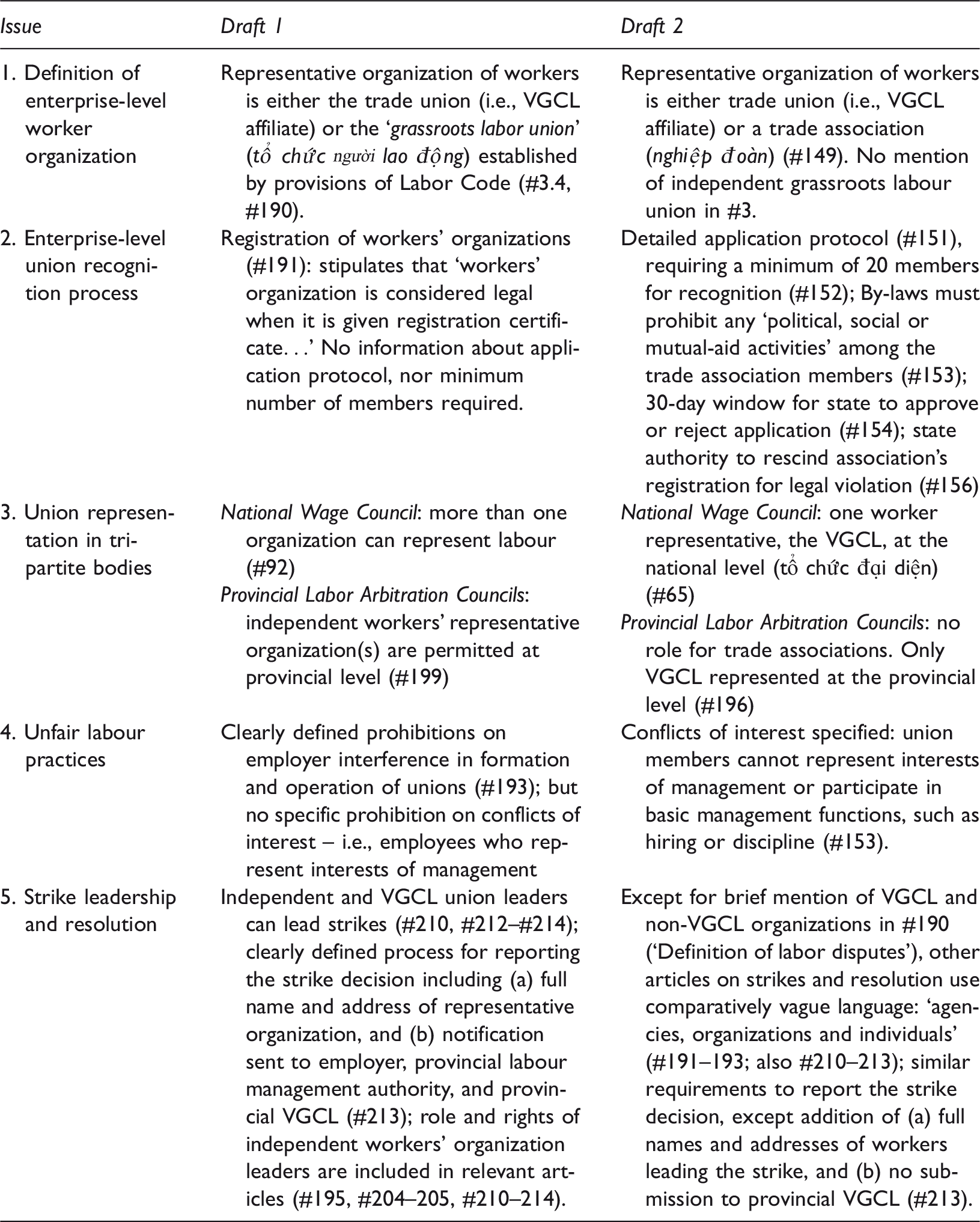
We note significant differences in the definition of enterprise-level worker organizations and the process to recognize these organizations. Whereas Draft 1 uses the term ‘grassroots labor union’ (tổ chỘc ngḑỗi lao động) to describe independent worker organizations, Draft 2 refers instead to ‘trade association’ (or nghiệp đoàn in Vietnamese) and removes the clear definition that was included in Draft 1 (i.e., #3.4). In fact, trade associations, with workers joining based on the same occupation or trade, are directly linked to the VGCL. An example would be the fishing associations found along the central coast of Vietnam that are established by the district and provincial levels of the VGCL (Le, 2017b). The shift in terminology and lack of clear definition is a retreat from the recognition of independent, non-VGCL worker-based organizations as proposed in the Labor Code revision drafted when the United States was still a participant in the TPP. In addition, the administrative process to obtain union recognition in Draft 2 is both more cumbersome and more constrained, including the proscription of ‘political, social or mutual-aid activities among the association members’ (#153). The increase in bureaucratic burden and restriction on activities indicates tighter control by the state over enterprise-level unions.
Also notable is the removal of clauses that specified that workers could be represented by independent worker organizations on tripartite bodies such as the National Wage Council and provincial Labor Arbitration Councils. 16 Draft 2 only mentions one worker representative, which is the VGCL, for the National Wage Council and no role for trade associations on Labor Arbitration Councils. In effect, if Draft 2 changes were implemented, independent worker organizations would be obliged to appeal to the VGCL representatives to represent their members in disputes and negotiations in these key tripartite fora.
Unfair labour practices have been a core concern of the VGCL and thus one of their priorities for legal reform. A 2016 study by the Institute for Workers and Trade Unions (IWTU) found widespread use of intimidation by management to weaken workplace unions and to appropriate the 2% employer contribution (VGCL, 2016). Draft 1 of the Labor Code responded to these allegations by introducing a detailed list of unfair labour practices, but did not specifically prohibit membership by employees that represent management's interests or carry out management functions. Draft 2 incorporated strong and clear language prohibiting participation in the union by employees who represent management's interests or undertake management functions. This later addition to Draft 2 signals the inclusion of a core VGCL concern – one, we note, that has also been frequently observed by labour scholars as well (see Do, 2008; Clarke et al., 2007).
Finally, in the area of leading and resolving strikes, the right of workers to engage in strikes organized and led by non-VGCL worker representatives is weakened by the inclusion of vague language used to describe worker organizations. One concession to independence in Draft 2 can be found in the removal of a clause that obligated worker organizations to notify the provincial VGCL of their intent to strike (the union must still notify the provincial labour authority and the employer). This small concession does not compensate, however, for the addition of a clause in Draft 2 that requires strike notifications to include the full name and address of strike leaders (as opposed to the worker organization as a whole). This latter change suggests an increase in state surveillance and control of independent labour organizations and leaders.
Conclusion
Although the current Labor Code draft under consideration by the Vietnamese government recognizes independent unions, it undercuts the latter's ability to represent workers in significant ways, especially as compared with the draft that was on the table before the U.S. withdrawal from the TPP. Differences between the two drafts offer strong evidence for the binding labour provisions in RTAs as a mechanism for labour reforms. Given that the EVFTA also commits Vietnam to respect core labour rights, the weakening of the draft labour code suggests that the Vietnamese government is not particularly concerned about these obligations – or at a minimum, that the government does not believe it needs to implement, for the Europeans, the kind of domestic reforms spelled out in the U.S. Consistency Plan.
We must acknowledge, however, that even if such reforms were passed into law, and even if the TPP had gone forward, effective implementation would not be guaranteed. This requires careful monitoring and a willingness on the part of the trade partner to make active use of the carrots and sticks available. The relatively weak post-facto enforcement provisions in the EVFTA may reduce the incentive to develop a meaningful mechanism to assess Vietnam's compliance with the Agreement. Future study is needed to examine the various models for the enforcement of trade-labour linkage and monitoring of compliance with core labour standards. Existing models include Better Work (which evolved from the joint ILO/IFC program Better Factories Cambodia), 17 RespectVN (a civil society organization which introduces a model called WE@WORK to monitor compliance and tackle unfair labour practices), 18 and the VGCL's efforts to implement democratic dialogue at the enterprise level.
In sum, as our detailed analysis has illustrated, the reinstatement – or expansion – of a small number of pro-labour measures during the RTA negotiations period was achieved through mass mobilization with active civil society support, in a context of relatively weak external pressures via RTAs and the ILO. While RTAs and external compliance mechanisms represent one source of pressure to enshrine expanded associational rights in labour law and to improve labour standards, the outcomes will ultimately depend upon the balance of forces among the State, labour and capital in Vietnam. The possibility that labour provisions in RTAs support improved standards and rights for workers is clearly determined by the binding nature of these provisions, including meaningful, transparent compliance mechanisms and commercial sanctions for violations in firms. The transformation of the Vietnamese labour regime from one characterized by rampant labour violations and severe restrictions on associational rights will be determined by workers' success, through collective action, in pressuring the government and multilateral organizations to create countervailing forces to stop multinational capital from reaping benefits from labour's relative weakness in the market system.
Footnotes
Acknowledgement
Appreciation goes to Joe Lubow for his assistance with research and editing.
Declaration of Conflicting Interests
The author(s) declared no potential conflicts of interest with respect to the research, authorship, and/or publication of this article.
Funding
The author(s) disclosed receipt of the following financial support for the research, authorship, and/or publication of this article: The authors would like to acknowledge the funding from the Baldy Center for Law and Social Policy (University at Buffalo-SUNY), which funded the Symposium where the paper was first presented.