







Abstract
Comparative political economists have been late to acknowledge the role of municipalities in industrial policy. Given that industrial policy is traditionally the province of central governments, when and why do cities follow national industrial policy priorities and when and why do they deviate from them? To address the question, the article compares three middle-sized municipalities in Central and Eastern Europe whose economic catch-up strategies shaped their transformation into dynamic economic hubs for the region – a different fate from other comparable cities. Thus, Gdansk (Poland) becomes a manufacturing and knowledge economy hub, Cluj (Romania) morphs into a knowledge economy hub with manufacturing in tow, while Debrecen (Hungary) is reborn predominantly as a manufacturing hub accompanied by an emerging business services sector. While the initiatives of municipal developmental alliances complemented the national export-led growth model in all three cities, only Debrecen fully aligned with the national industrial policy, while Cluj sharply deviated from it, with Gdansk being an intermediary case. The paper argues that this variation can be explained by three factors: pre-existing economic legacies in frontier and legacy sectors, the politics of leadership in local developmental alliances, and the politics governing the embedded autonomy of city governments in both the private sector and the central government (double embedded autonomy).
Keywords
Introduction: a tale of three cities
Neo-Schumpeterian economists define economic catch-up as narrowing a country’s economic gap vis-à-vis a leading set of countries (Lee, 2019 for an overview). The stakes for doing this are high, as this literature in economics demonstrated that countries that fail to narrow this gap through graduating from passive imitation (typically through insertion on the lower value added parts of global value chains) to adaptation, innovation and, ideally, creation, are at risk of facing important barriers to development, with these desirable processes extensively enabled by industrial policy. Yet states are not the only players in powering through catch-up through industrial policy. Regional governments and cities are as well (Bailey et al., 2018; Cimoli et al., 2009; Safford, 2009; Storper, 2013). Indeed, city-level development coalitions often play a key role in overcoming economic decline (Safford, 2009) and even shifting the local economy onto knowledge-intensive paths (Indergaard, 2019). Still, little is known about city-level development coalitions and their industrial policies in advanced semi-peripheries, where institutional, academic, and economic endowments are very different from those of the large cities and mega-cities in the core capitalist states that dominate the literature (Indergaard, 2019; Storper, 2013; special issue introduction). This gap is important because, as Breznitz (2007) showed, context is consequential for how developmental actors are embedded in national political economies. In this regard, Central and Eastern Europe (CEE) offers an excellent context to explore the workings of municipal developmental work in such semi-peripheries. Here, the dependencies associated with foreign investment combine with the imperatives of their export-led growth model to generate demand for national industrial policies geared around the catch-up of legacy sectors (established and mature sectors with limited growth potential) demanded by most lead firms in global value chains (Bohle and Regan, 2021; Ban and Adascalitei, 2022; Edgars and Naczyk in this special issue). But while some CEE cities conformed to this demand, others did not. Hence the question: when and why dis CEE cities follow national industrial policy priorities, and when and why do they deviate from them?
This paper departs from the literature on municipal industrial policy in large and mi-size cities but unlike Safford’s (2009) classic comparison of a clear success in a midsize US city with failure in another, we focus less on outcomes and more on what explains the choices of the local developmental alliance on the spectrum between legacy sectors and frontier sectors (nascent sectors with high catch-up potential based on high levels of innovation, technological advancement, and growth) (Aghion and Griffith, 2008; Lee, 2019). We consider the case of three medium-sized cities in CEE that successfully recovered from postcommunist industrial collapse. One (Gdansk, Poland) becomes a manufacturing and tech hub, another (Cluj, Romania) morphs into a tech hub with new medium-value manufacturing in tow, while still another one is reborn as a manufacturing hub, with some business services attached (Debrecen, Hungary). As such, they dodged the scourge of postcommunist immiseration and even became nodes of medium and high value added in global value chains for goods and services. We attempt to explain the variation between their distinctive specializations given their shared communist past in heavy industry manufacturing. Our case comparison therefore links up strands of existing work on why some, much larger cities (city-regions) merely modernized manufacturing legacies (Krätke, 2011) while (fewer) others neared the status of frontier sector hubs (Wolfe, 2016).
These cities represent ideal cases to study how municipal horizontal (aimed to develop all industries) and vertical industrial policies (aimed to develop specific industries) were organized and fared in an economic environment dominated by multinational capital (Ban and Adascalitei, 2022; Ban and Volintiru, 2021; Bohle and Greskovits, 2012; Bohle and Regan, 2021; Bruszt and Langbein, 2020; Vukov, 2020). The semi-peripherality of these economies is rooted in their insertion in global value chains whom industrial policy designers must treat as a structural form of power. Drawing on Bonvillian and Weiss (2015), we distinguish between industrial policies aimed at modernizing legacy sectors that are core to the national growth model (i.e. manufacturing in CEE) and those aimed at technological frontier sectors (or even frontier-proximate ones), meaning riskier specializations reliant on innovation and creation (i.e. ICT, R&D, biotech and advanced manufacturing). In this regard, we do not imply that all manufacturing activities are not high value added or undesirable for national economic growth. We only assume, based on the neo-Schumpeterian literature on growth (Aghion and Griffith, 2008; Lee, 2019), that the more innovation-reliant frontier sectors (which includes R&D in manufacturing or process innovation in manufacturing) have a higher value added via superior productivity gains than legacy sectors do.
Given that domestic capital is generally underdeveloped in high value-added sectors and that state subsidies are limited, industrial policies have to rely on FDI for economic catch-up. Still, by itself, the FDI-led growth model prevailing in CEE (Ban and Adascalitei, 2022) does not tell us why cities would prioritize tech FDI, business services FDI, manufacturing FDI or balance the three in their catch-up strategies rather than let the market ‘discover’ what the local comparative advantage is, as one would expect policy elites to do in these social environments permeated by neoliberal policy ideas (Ban, 2016). The same sectoral indeterminacy follows from approaches that link national industrial policies to electorally motivated national alliances between government actors and influential producer groups (Naczyk and Edgars, 2023, in this special issue).
The main argument of the paper is that in all three cities, different economic catch-up strategies can be traced back to the emergence of different legacies in frontier sectors, the nature of leadership in local developmental alliances (linking municipal authorities, business and academia, with varying relationships to the central government and the EU), and the politics governing the embedded autonomy of city governments towards both the private sector and the central government. The argument qualifies canonical capitalist diversity theories (varieties of capitalism, growth models, neo-Polanyian) (Baccaro et al., 2022 for an overview) assuming the territorial homogeneity of growth models and limiting industrial policy to central governments. In contrast, the paper reveals remarkable levels of agency at the local level, both when the state is weak (Romania) and strong (Poland), with the Hungarian case showing that a strong state relying on subordinate local development alliances leads to greater alignment with central government industrial policy.
The paper is organized as follows: first, we introduce the theoretical framework and the ways in which we advance the state of the art; then, we elaborate on methods and data; the three sections dealing with each city are the bulk of the paper; and the last section concludes.
Theoretical framework
A rich literature in economics (Bailey et al., 2018; Cimoli et al., 2009), development studies (Samford, 2022) and organizational studies (Drejer and Christensen, 2021) has extensively covered subnational industrial policy, albeit with an emphasis on regions. Iconic European case studies include those of Italian industrial districts (for a summary see Bianchi and Labory, 2011) or Silicon Saxony (Vicente, 2022). In this scholarship, regions craft new specializations through the ‘discovery of new domains of opportunity and local concentration and agglomeration of resources and competencies in these domains’ (Foray et al., 2015: 1). Such policies can lock in high value-added capital and retain value by allocating funds to sectors pregnant with ‘entrepreneurial discovery’, knowledge spill-overs, innovation, scale, agglomeration and commercial exploitation (Foray et al., 2015). Safford (2009) and Indergaard (2019) took the literature on local developmental elites to focus on cities instead of regions and demonstrated that cities are well positioned to trigger innovation by structuring local networks.
The thrust of this ‘place-based’ turn in industrial policy scholarship (Bailey et al., 2015, 2018) is the analysis of the most optimal policy instruments relative to local features such as legacies and the make-up of the relevant governance institutions. This paper follows the special issue introduction’s call to focus instead on the politics of the institutions governing industrial policy in the context of the constraints posed by the national industrial policies ‘feeding’ the national growth model as well as the limits of those constraints (editorial introduction). Furthermore, the paper fills in a gap in the literature on the comparative political economy of CEE by drawing attention to regional and municipal level industrial policy in this region.
In terms of the make-up of the industrial policy interventions, we suggest that for medium-sized cities that are also late entrants in the knowledge economy the use of classical fiscal industrial policy instruments (low interest loans, subsidies, tax credits, credit guarantees) (Bulfone, 2023) is highly constrained because middle-sized cities lack substantial fiscal resources of their own. Indeed, this luxury only applies to mega-cities. Therefore, municipalities face two choices. One is to make the most of coordination with academia by encouraging the supply of higher value-added sectors with relevant skills and having universities become directly involved in institutional cooperation with the private sector via clusters, grants, research projects, as emphasized by economic geographers (Breznitz and Feldman, 2012; Wolfe and Bramwell, 2008). But if a city does not have a large academic community able to supply those skills, the transition to a knowledge economy would be lengthy, at best.
The other choice is to connect fiscal resources (their own as well as from regional authorities, central governments or the EU) with local networks to launch catch-up strategies. The point is not for municipalities to give expensive subsidies and tax credits to niche sectors (medium size municipalities do not have the fiscal base for that) but to intermediate such external funding for partnerships with capital (derisking) while ramping up municipal investment to improve quality of life and governance (Zheng and Warner, 2010).
In the context of the CEE region, in addition to fiscal transfers from national governments, municipalities can tap into EU funds that between 2007 and 2013 averaged 2.7% of GDP. Of particular relevance here are EU-funded clusters and hubs that ‘de-risk’ private investment in knowledge economy sectors (Bailey et al., 2018). Municipalities thus become indirect rather than direct (Cimoli et al., 2009) ‘equity investors’ in such clusters and hubs. In this way, they can trigger the double embeddedness that Indergaard (2019) found between the US federal government’s programs and their appropriations by city (in his case NYC) developmental coalitions. Federal grants to industrial policy programs supported particular development directions in NYC, (2019: 395–396) and the EU-funded municipal CEE programs can be assumed to function in a similar logic. Such EU-led programs are designed to give local ‘translators’ in municipal growth coalitions the space to appropriate the agenda from the EU ‘center’. The similarities should be qualified, however, as cities like NYC’s mighty fiscal base and sheer market size enabled them to ‘define the upper limits of national industrial policies’ (ibid). This is not the case in cities such as Gdansk, Cluj and Debrecen but what makes these cities comparable is that they can expand their fiscal base by using EU funds for municipal industrial policy, an option that is in turn shaped by unevenly distributed bureaucratic capacity.
In terms of the sectors targeted by catch-up strategies, the paper builds on existing research to suggest that industrial legacies and politics are key. According to the ‘place-based’ turn, pre-existing local specializations and the local supply of advanced skills are strong predictors of what economic catch-up is focused on. Regarding legacies, the existence of knowledge economy firms and university specializations delivering the skills and research environment should be critical factors (Breznitz, 2014).
Concerning the politics of municipal industrial policy, the paper aims to advance the state of the art on the politics of developmental coalitions. Building on comparative institutional analysis of industrial policy at the state (Block, 2008; Evans, 1995) and city levels (Indergaard, 2019), we suggest that the differences in state structures, politics and coalitions that explain the diversity of developmental strategies can be ‘imported’ to the city level. At a minimum, a local developmental coalition engaging in industrial policy needs the town hall, business and academia and that the alliance is strong when these actors coordinate with each other without any of them having disproportionate power over industrial policy agenda setting. This view also resonates with calls to take local agency, as opposed to structural preconditions, more seriously (Grillitsch and Sotarauta, 2020).
What does this mean in practice? To shape the orientation of the coalition, the municipal public sector managers need to have ‘embedded autonomy’ (Evans, 1995), that is (a) ability to forge links and shape the strategies of market actors (embeddedness) and (b) Weberian conditions that incentivize discipline and resistance to corruption or revolving door effects (autonomy). This thesis should travel in the case of local developmental coalitions in CEE, with the metrics of autonomy being elite status (via salaries, allowances and complements) for industrial policy managers relative to the private sector (Evans, 1998: 71–72), plus capacity to deploy planning capabilities and performance standards (Amsden, 1991: 284–285), and weak revolving door effects with the private sector (Evans, 1995). In turn, embeddedness can be measured in terms of institutionalized collaborative activities with the private sector (joint strategies, boards, clusters, etc.) (Evans, 1995). Our analysis does not emphasize performance standards because Amsden’s performance standards were based on export volumes, a practice now illegal in the EU because of the TRIMS-agreement (Collins, 2021). Furthermore, the three municipalities relied on EU-funded industrial clusters designed to have in-built EU monitoring mechanisms, to this venerable literature we add the importance of the politics shaping relations between the state, the municipal government and academia. This dimension of embedded autonomy is more relevant than the traditional business-bureaucracy relationship because municipalities are subject to state sovereignty and lack the ample tax base that central government has, a critical factor in doing ambitious industrial policies in an age of very high costs for these policies. Embedded autonomy vis-à-vis the state should be measured in such terms as high budgetary autonomy (low percentage of the municipal budget that depends on central government transfers), access to EU funds for industrial policy purposes to compensate for low budget autonomy (a particular CEE feature, as we have seen) and the non-occurrence of risk of bailouts by the central government.
Based on this literature, we expect that where the central government has weak capacity (in the ‘embedded autonomy’ sense defined by Peter Evans), municipal growth coalitions develop from the bottom up, based on firms that capitalize on the joint effects of education, local capital and social conditions. In this context we refer to state capacity along a tri-dimensional space: core capacities (rule of law and avoiding capture by vested interests), midwifery capacities (fostering investment in more complex sectors and integration of legacy sectors in transnational markets) and husbandry capacities (upgrading in value chains). By this categorization, the existing literature suggests that state capacity is strongest in Poland, weakest in Romania (most notably on husbandry capacity), with Hungary in the middle (special issue by Bruszt and Langbein, 2020).
If the state is weak and the private sector leads the growth coalitions and municipal actors have weak autonomy vis-a-vis that sector, industrial policies stand to favour a thinly diversified local growth regime (Cluj). Second, the same should happen where the city lacks embedded autonomy vis-à-vis the central government (Debrecen), with the resulting industrial policy favouring the sectors preferred by the central government’s industrial policies. This may lead to tensions with local governments, an outcome most probable where the authoritarian turn in politics is accompanied by fiscal re-centralization, which is the case in Hungary (Szigetvári, 2020), but not in Poland (Bukowska and Siwińska-Gorzelak, 2019). Third, a sectorally diversified industrial policy (Gdansk), observable through industrial policies targeting both legacy and frontier sectors should be the hallmark of diverse and balanced coalitions, in which the local government has embedded autonomy vis-a-vis both the private sector and the central government.
Methodology and data
We look at cities with similar features embedded in similar FDI-led growth models that nevertheless end up with different outcomes: modernization of legacy sectors in Debrecen, focus on frontier sectors (mostly digital subsectors like software development and industrial R&D) in Cluj and balancing both legacy sectors (mostly manufacturing) and frontier sectors in Gdansk. All three cities started from a point of extensive industrial collapse and have become regionally successful and since they are less frequent, industrial policy successes at the city level are worth studying. Within their national contexts, each city has excelled at securing particular economic niches and high value-added investments, placing them among the top domestic performers (Table 2 and empirical sections).
Top 10 localities with at least 15 foreign investment projects between 2004 and 2020 ranked by the share of HVA foreign investments.
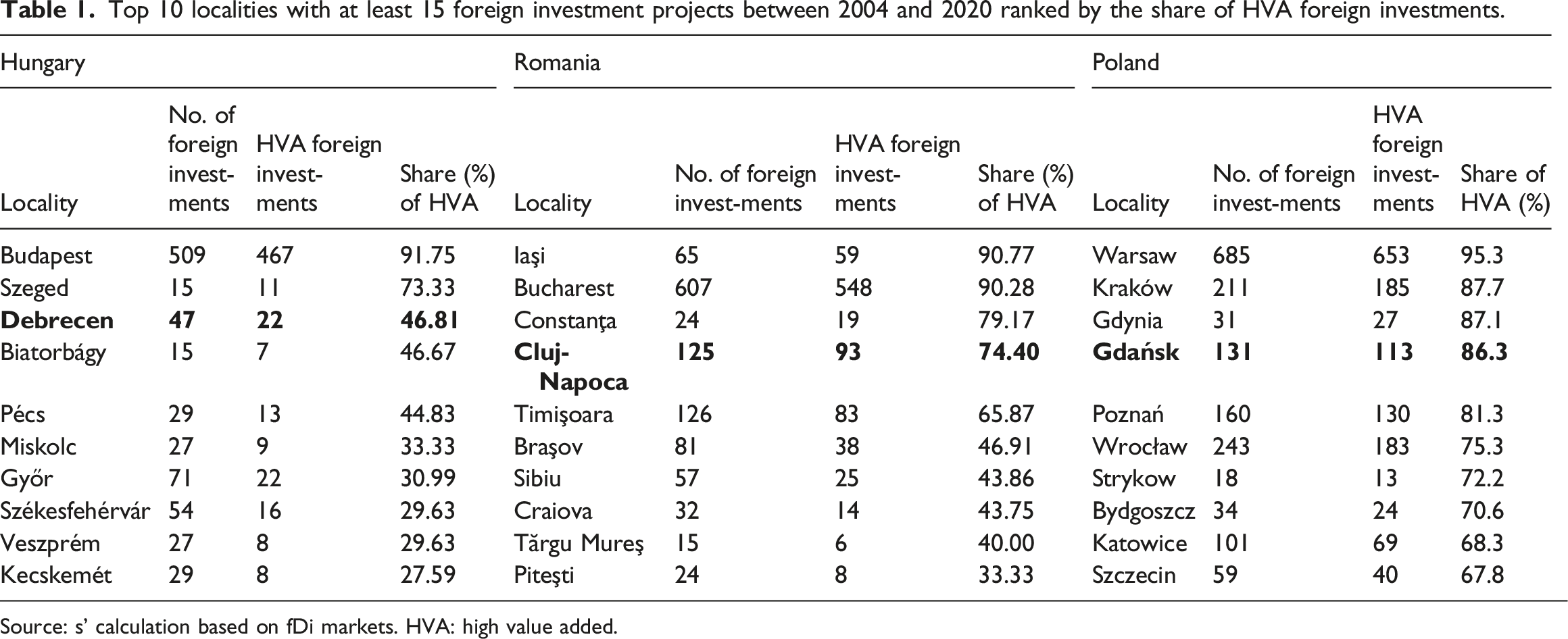
Source: s’ calculation based on fDi markets. HVA: high value added.
Selected characteristics of the three cities.
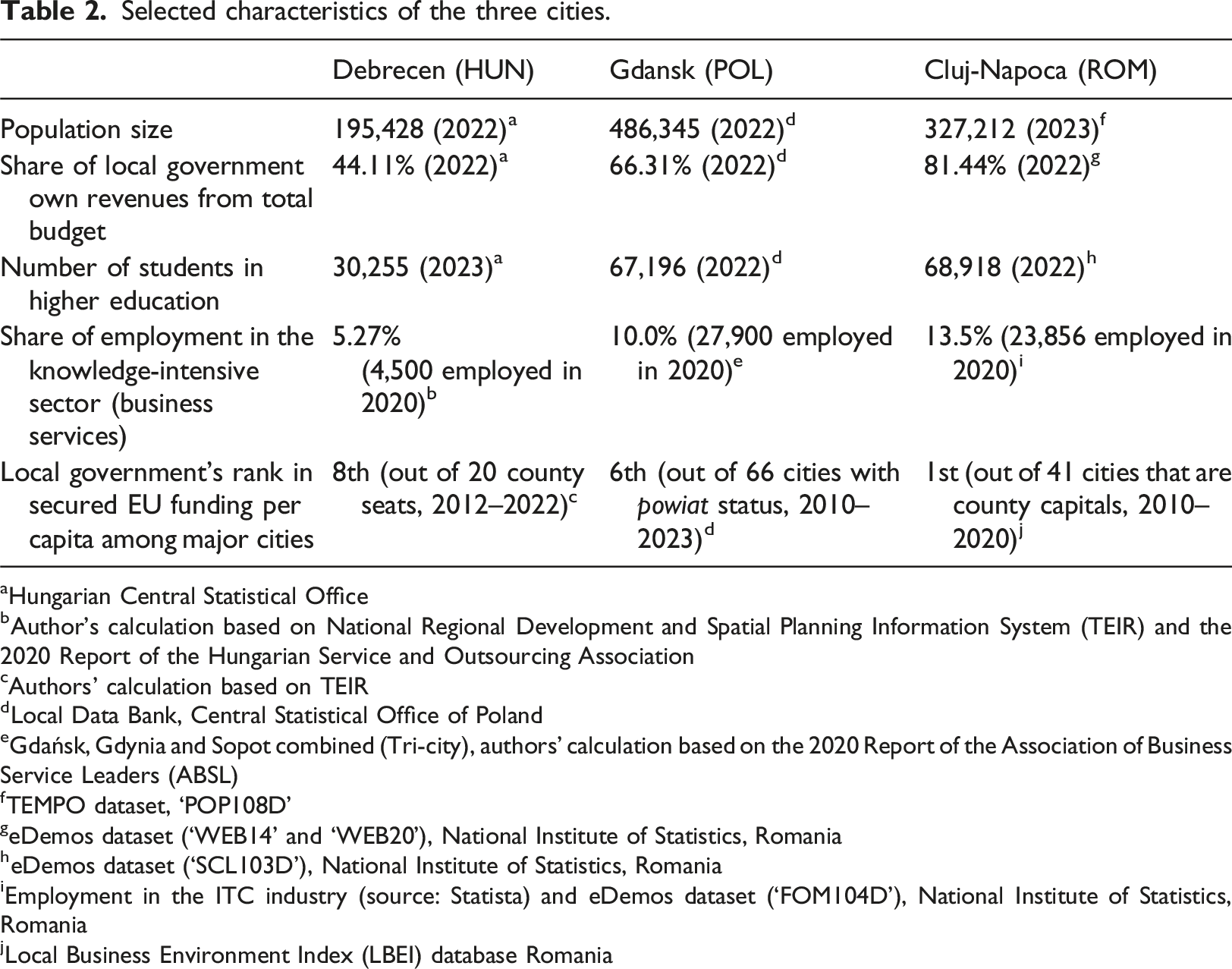
aHungarian Central Statistical Office
bAuthor’s calculation based on National Regional Development and Spatial Planning Information System (TEIR) and the 2020 Report of the Hungarian Service and Outsourcing Association
cAuthors’ calculation based on TEIR
dLocal Data Bank, Central Statistical Office of Poland
eGdańsk, Gdynia and Sopot combined (Tri-city), authors’ calculation based on the 2020 Report of the Association of Business Service Leaders (ABSL)
fTEMPO dataset, ‘POP108D’
geDemos dataset (‘WEB14’ and ‘WEB20’), National Institute of Statistics, Romania
heDemos dataset (‘SCL103D’), National Institute of Statistics, Romania
iEmployment in the ITC industry (source: Statista) and eDemos dataset (‘FOM104D’), National Institute of Statistics, Romania
jLocal Business Environment Index (LBEI) database Romania
We used qualitative data in Polish, Hungarian and Romanian, following fieldwork in the three cities. We used local media monitoring and fifteen semi-structured interviews conducted in 2019–2020 with senior city administrators, business leaders and consultants involved in or informed about municipal industrial policy (see Appendix 1 for the list of interviews). We asked interviewees a standard set of questions about the composition of the local development coalition, its evolution, achievements and relationship with regional and central authorities, and how cooperation between the actors involved has been institutionalized.
Debrecen (Hungary): central government-led development coalition
Debrecen inherited a diversified economy with food-processing, light industry, pharmaceuticals, metalworking, car repair services and some manufacturing (Kozma, 1993), but unlike Cluj or Gdansk, it did not inherit from late socialism an emerging ICT sector. Local academia did not have a strong set of technical specializations either, which made it more difficult than in the other two cities to jump-start the IT segment. Most of the local industries suffered a steep decline after 1990 and domestically owned SMEs operating in low value-added segments and the service sector became the backbone of the local economy (Kozma et al., 2020). Still, the city has become a hub for foreign investment in car manufacturing (passive imitation catch-up), with some high value-added business services and pharmaceuticals in tow.
During the 1990s, Debrecen’s economy was plagued by lack of basic horizontal industrial policies aimed at developing a basic infrastructure (highways, airport) and lack of professional skills for the foreign manufacturing and knowledge-intensive industries moving East. Its single university had technical education available only at the undergraduate level in manufacturing, constructions and architecture (Lengyel, 2003). R&D activity was also limited because the university did not have any established links with local business (Lengyel, 2003; Molnár and Kozma, 2019). Debrecen therefore seemed destined for the grim deindustrialization that wrecked many cities in East-Central Europe.
Breaking this deadlock required well-funded catch-up strategies orchestrated by a local development coalition. During the mid-1990s, a collaborative arrangement between the city council, the university, and the private sector formed that applied horizontal and vertical industrial policies. For example, the city council purchased the abandoned airport and turned it into Hungary’s second largest international airfield. The Regional Economic Development Foundation established by the city government served as the primary vehicle for catch-up through vertical measures such as industrial parks targeting FDI in higher value-added sectors and forging municipality–university cooperation (Kozma and Molnár, 2018: 39; Molnár and Kozma, 2019).
Yet since 2010, the strong political alignment between the city council and the central government resulted in an increasing mismatch between the diversified developmental objectives of the local coalition and manufacturing-focused ones promoted by the central government. This raises the issue of embedded autonomy. The integrity of the Debrecen authorities has not been compromised by severe corruption cases or the existence of a revolving door between city hall and firms. Also, in terms of Evans’s ‘elite status’ as proxied by pay, the city hall upper ranks have been receiving base salaries at senior levels that are much higher (€3857) than the corresponding ones in the private sector (€2802). 2 However, the role of this variable is less relevant here because after 2010, the central government’s growing influence over both the local government of Debrecen and its allies in the development coalition of the 1990s has marginalized the local development objectives to such an extent that we cannot speak of embedded autonomy either vis-à-vis the central government or vis-à-vis the large (foreign) investors favoured by it.
Although Debrecen is the second largest city in Hungary, its budgetary autonomy is low because municipalities in Hungary have limited powers to levy local taxes and therefore rely on a high level of discretionary funding from central government (Vigvári, 2010). After 2010, the right-wing Fidesz government stripped local governments of most of their former powers in exchange for taking over their debt (Hegedüs and Péteri, 2015). After the reform, the central government has rewarded loyal local governments with discretionary intergovernmental transfers (Vasvári, 2024). Debrecen therefore reveals the limitations faced by local development coalitions with little embedded autonomy vis-à-vis the central government.
EU structural funds, which were mostly spent on improving local transport infrastructure, did not substantially reduce this dependence on the coffers of the central government. While in Gdansk and Cluj, wage supplements linked to the absorption of EU funds significantly increased local bureaucrats’ wages, this is less likely to happen in Debrecen because the applications for EU funds are largely outsourced to private companies – a common practice among Hungarian municipalities. Between 2012 and 2022, Debrecen secured EUR 3,295 per inhabitant in paid EU funds, placing it only in the 8th position among the 20 major Hungarian cities (Table 2).
This relatively poor performance in obtaining EU funding has been offset by overly generous central government transfers. Debrecen has been a Fidesz stronghold since the 1990s, with the party’s candidates securing the city council in six consecutive local elections. Fidesz’s continued local popularity provided a comfortable political backdrop for strengthening ties between the city and the central government. Coordination resulted in increased foreign investment inflows after 2014, but given the weak embedded autonomy of local authorities vis-à-vis the central state, industrial policy ideas came from the capital, emphasizing manufacturing, a legacy activity and the workhorse of Hungary’s export-led growth model, with business services in tow.
All this reshaped the sectoral-specific supply of skills. Thanks to financial support from the central government, by the mid-2010s Debrecen developed an academic-industrial complex but both the university and the city council had to embrace the central government’s vision of the university as a supplier of skills for a manufacturing hub (Bohus, 2018), with the MNCs bolstering this with educational programmes and training opportunities for students (Berényi, 2021). The local development coalition’s initial ideas of shifting to a knowledge-intensive economy were thus undermined by the central government’s manufacturing-oriented strategy. Although Debrecen secured several high value-added investments in business services until the mid-2010s, the investor profile has since shifted towards low value-added manufacturing activities.
In 2018, Debrecen announced its most spectacular investor so far: BMW’s most advanced plant for manufacturing luxury electric cars. The mayor stressed that landing the deal required major commercial diplomacy with the central government (Ratalics, 2018). However, the mayor also noted that the city should not become an industrial hub but should develop a strong capacity in offering business services (Ratalics, 2018). This was not appreciated by the central government. The medium-term development programme (Debrecen, 2030) adopted by the city council has incorporated the central government’s development objectives, revealing the growing discrepancy between the local development alliance’s original vision and the central government’s ideas. The city’s current development plan aims to integrate more deeply into the advanced manufacturing activities of foreign manufacturers. To reach this goal, the state will turbo-charge horizontal policies aimed at developing the city’s transport, education and cultural infrastructure with around EUR 1.67 billion. 3 Among other things, the plan envisages the expansion of the airport, the construction of a new ring road around the city, German language teaching and the expansion of the university’s technical curricula.
Yet the most striking example of the growing gap between local and central goals is the announcement of the largest foreign investment in Hungary’s history, the €7.5 billion construction of a battery plant by the world’s leading battery manufacturer, China’s CATL (Deme, 2022). The plant, which will employ 9000 workers, has caused a huge local uproar. The citizens of Debrecen launched a petition against it because of its environmental risks and organized protests of several thousand people, supported by opposition representatives in the city council, but to no avail.
Debrecen is thus a case of a central government-led development alliance, where industrial policy is focused on modernizing the technology of manufacturing activities, which are reinforced within the country’s FDI-led growth model. Since 2015, foreign investment in Debrecen has reached EUR 12.5 billion, creating 19,500 jobs (Nagy, 2024), and the city’s share from Hungary’s industrial output is expected to grow from 2.8% in 2022 to 16% by 2030 (Portfolio, 2023). In this catch-up model, the municipal actors have no embedded autonomy vis-à-vis the state. This state-led alliance has turned Debrecen into a successful manufacturing hub with promising academic–industrial coordination but configured without the aim of diversifying the economy and make it more innovation-oriented like Gdansk and Cluj did.
Gdansk (Poland): city-led developmental coalition
Gdansk’s initial endowment looked promising for a successful industrial policy: several prestigious universities, Poland’s third largest international airport, good transport connections and a rich industrial tradition. While both Cluj and Debrecen were late industrializers, Gdansk is one of the few cases of early industrialization in CEE (Prawelska-Skrzypek and Morgan, 2020). But history often does not translate into continued success. In the mid-1990s, Gdansk entered a structural crisis, with all major sectors in free fall and unemployment at 22%. 4
Still, Gdansk avoided what happened in much of Poland: deindustrialization and mass migration followed by reinvention through low- and medium-skilled manufacturing. Instead, the city triggered economic catch-up effects for its legacy sectors (through more advanced manufacturing) while carving out a niche in the knowledge economy, a performance that makes it the most sectorally balanced case of economic rejuvenation among the three cities. This balanced diversification is largely the result of a city-led development alliance coordinated with (but not subordinated to) the central government, regional government and the business sector, with a more reluctant academic sector joining as a late mover.
Gdansk had many usable legacies. Abundant engineering skills were an obvious one but, as we will see in the case of Cluj, these may not be the focus of industrial policy. Instead, as in Cluj and unlike Debrecen, the agglomeration of STEM departments on the city's campuses led to an initial IT take-off in the late 1990s and early 2000s. This surge can be traced back to the late communist years, when Gdansk boasted Poland's first IT company (Wojnicka-Sycz, 2018).
However, the provision of skills for higher value-added sectors alone does not automatically lead to actual catch-up. The city’s forging of a development coalition, targeting high value-added sectors in both manufacturing and tertiary sectors, proved crucial in this respect. Initially focused on horizontal policies, from the mid-2000s the city’s main strategy was vertical industrial policy: the transition to high value-added tertiary services and advanced manufacturing. The city council initiated several institutions aimed at simultaneously promoting the local SME sector and foreign investment.
In 2005, the Gdansk Foundation for Entrepreneurship started its activities and launched a business incubator, which facilitated the creation and development of innovative start-ups and SMEs by providing specialized consultancy, high-quality office space and access to potential business partners (Interview F). The promotion of foreign investors in higher value-added sectors has been assigned to the Gdansk Economic Development Agency (InvestGDA), which was established in 2008 with the task of commercializing future investment sites, which the city has transferred to the agency. The upscaling of investment promotion activities came in 2011 with a mix of horizontal and vertical industrial policies targeting both legacy and frontier sectors. Then, on the initiative of the Gdansk City Council, the dedicated body of the regional self-government established the Invest in Pomerania agency to serve as a one-stop-shop for potential investors in a productive act of city-regional government coordination (Interview D, E).
As in the other two cities, Peter Evans (1995)’ condition that industrial policy works best when its managers have long horizons was met. Gdansk’s administrative continuity has been remarkable: liberal-centrist mayors associated with the Civic Platform (PO, since 2018 called Civic Coalition) have won eight consecutive elections since 1998, which has created a stable political environment for realizing industrial policy objectives.
As in the case of Cluj and Debrecen, Gdansk City Hall has benefited from political alignment with the central government in 2008–2015, when the PO was the main governing party in parliament. However, unlike in Debrecen, this alliance did not prove debilitating for the city’s industrial policy. Nor did the political imbalance in 2015–2023, when Gdansk’s liberal government faced a passionately conservative right-wing central government. Like in Cluj, the reason for this was the city’s relative fiscal autonomy. In 2022, Gdansk’s own revenues reached 66% of all income, which put the city at fourth place among the 66 major Polish cities. 5 This is considerably higher than Debrecen (44%) and closer to Cluj (81%), granting the city a strong embedded autonomy vis-à-vis the central government.
EU funds have been an additional source of fiscal autonomy: Gdansk city council excelled at absorbing EU funds, reaching the third-best performance among all major Polish cities. The EU support was mainly spent on education and climate change projects (energy efficiency, emission reduction) and on improving public transport. Success in securing EU funds allowed for paying competitive wages to city bureaucrats, enduring elite status for senior staff and co-fund industrial policies. 6 Here, senior managers earn €4400 a month, compared with €4300 in similar positions in the private sector. 7 The stable fiscal base has allowed the city to improve public services, promote clean energy production and improve the quality of the environment (Kisała, 2021), which are important variables considered by potential investors and employees, particularly in the knowledge economy sectors.
In contrast to Cluj, where the city council was reluctant to intervene directly in the market during the IT boom, the local development coalition in Gdansk joined forces with the central government’s dedicated agency to de-risk investments in the office space market. Cooperation resulted in the creation of the Gdansk Science and Technology Park in 2005, the first public investment to develop office space to attract business services on a large scale (Interview B). This strong vertical industrial policy push, based on long-term planning capabilities, had lateral effects: private property developers became involved in the creation of office space, and several large, prime office buildings opened their doors to technology and business services firms (Interview D). The city’s growing specialization in IT and business services has been further facilitated by the consistent supply of IT talent and the coordinated investment promotion activity of Invest in Pomerania and InvestGDA. Thanks to the embedded autonomy of the city vis-à-vis the state, the division of labour between the central government-led and the city-led promotion agencies seems to work smoothly. As a government official explained, ‘we have the same goals and we play the same game to support enterprises and attract more investment’ (Interview B).
Gdansk has created a sectorally-balanced growth model: between 2000 and 2020, employment in services increased by 69%, while employment in industry grew by 59% (Strachan, 2021). Besides the growing business services sector, the city excels in manufacturing highly specialized vessels, it hosts Poland’s biggest cosmetic producer (Ziaja) and has recently also attracted e-mobility investors such as Northvolt’s battery plant and engineering R&D centre. Nevertheless, Gdansk has lagged behind Cluj in boosting the knowledge economy, despite having an even larger university sector. The less prominent role of academia in the local development alliance seems to play an important role in this. Gdansk’s universities enjoy less autonomy from the ministry, which makes them less willing to respond to coordination opportunities presented by the city and the business community, particularly with regard to the needs of the labour market (Interviews C, D), with investors complaining of a crisis in the supply of workers with advanced technical skills. 8 The only exception is the Gdansk University of Technology (GUT), which has developed close links with Intel, one of the largest foreign investors in the city and created a cluster initiative that brings together local and transnational ICT companies. The city council and the regional chamber of commerce. GUT also established an Innovation and Technology Transfer Centre to commercialize innovative research by forging links between academia and relevant businesses.
This is important, yet it compares unfavourably to the dozen clusters co-forged by two of Cluj’s largest universities and, most importantly, to the foundational role of the Cluj technical university in the developmental alliance targeting high value-added sectors already during the 1990s. Although individual cooperation with interested professors is possible, those do not involve the changing of existing or launching of new study programmes (Interview C, F). This is in sharp contrast with the ultra-decentralized Romanian system, in which individual departments (including those in humanities) are allowed to set up MA degrees and research centres providing the skills and capabilities demanded by the IT and business services sectors.
Cluj (Romania): business-academic coalition, with latecomer municipal statecraft
The combination of extensive engineering education and a 20-year old income tax waiver for IT workers helped Romania become a player in European tech, with Cluj emerging as an IT hub. In 2022 Cluj generated over 80% of Romania’s exports in this sector and in 2019, 11% of the city’s 206,000 employees were directly employed in IT (Fan et al., 2019; Petrovici and Mare, 2020). If one adds to IT the industrial R&D, ‘creative industries’ and business development, Cluj boasts 22% of employment in the knowledge economy, going up to 31% if one adds education. In contrast, employment in advanced manufacturing makes up barely 3.8% (Petrovici and Mare, 2020). Throughout the 2010s, Cluj-based IT firms were purchased on international markets at high prices, while American and European IT investments as well as R&D manufacturing took root in Cluj. The overall growth of the IT sector, especially in local start-ups, is one of the contributing factors to the over 2 billion US dollar increase in local companies’ turnover. All this helped Cluj have the fastest growing GDP amongst European cities and an unemployment rate of 1.2%. Although this growth is distributed very unevenly (Cluj has pockets of extreme poverty and is unaffordable for many ordinary workers), the city’s development contrasts sharply with the low and medium skill nature of the Romanian export sector based around low wage manufacturing.
By itself the tax waiver does not explain Cluj’s role as an outlier success in IT, amidst a national growth model based around low and medium skill manufacturing demanding a predominantly horizontal industrial policy stance at best (Naczyk and Ban, 2022). Other Romanian cities (Timisoara, Iasi) with similar prerequisites for a knowledge economy take-off but which failed to take-off also benefited from the tax waiver. Unlike in Gdansk, the city government was generally passive and its role became more important in the tech industry’s consolidation phase. Furthermore, it was not multinational tech companies that gave Cluj its tech edge in the take-off phase of the late 1990s and early 2000s. Instead, the first movers were local entrepreneurs who turned Banca Transilvania into one of the largest bank in Romania and began bankrolling the budding IT sector firms springing around the local Technical University. Indeed, the transformation of Cluj during the 1990s was led by this corporate-academic alliance, with the town hall as a delayed add-on two decades later. Absent Gdansk-style, multisectoral industrial policies, the result was a local catch-up strategy dominated by tech that marginalized manufacturing. Also, unlike the MNC-oriented tech sector in Gdansk, Cluj’s was born as a predominantly domestic SME sector. 9
As outlined in the theoretical framework, this catch-up strategy ran on a favourable socialist legacy in a frontier sector (IT). During socialism (1949–1989) Cluj was a heavy industry boomtown, but it also saw a fivefold increase of the number of students, with a focus on STEM, including cutting-edge fields such as molecular physics and IT. An elite institution of the socialist era (The Information Technology Institute) effectively trained much of the entrepreneurial elite of the late 1990s and early 2000s (Bocu et al., 2020). Furthermore, socialist planners also created research infrastructure based around the Babes-Bolyai University, the Technical University and the School of Medicine that linked up with key manufacturing plants and emerging knowledge economy in the Cluj area, leaving behind a large pool of high skill workers (Interview J). This gave Cluj a large mass of tertiary trained people used to applied research.
The city hall had little to contribute so the politics of the developmental alliance was led by business and the technical university. Although a stable liberal municipal alliance ensconced itself in the town hall from the 2000s until today and twenty years of Emil Boc’s stance in office as mayor and prime minister did not do much for the tech take-off. Both as PM and as mayor, he embarked on a strong pro-FDI line but the FDI Boc had in mind was not tech, but legacy manufacturing and most of that went to the rural areas almost an hour outside of Cluj. State aid to a Siemens research operation established in Cluj during the early 2010s at the behest of Boc (the premier, not the mayor) remains the only exception.
While in Gdansk, local government was a leader in promoting the knowledge economy, in Cluj it was only in the late 2010s, after the sector matured (following large contracts intermediated by Romanian expats in Silicon Valley) that the city stepped in to further support it, with the initiative coming not from city hall but from the regional development agency handling EU funds. Public-private collaborations advanced local cluster policy, establishing structured, long-term relationships with tech and industrial R&D investors (Breznitz and Ornston, 2013) while providing access to EU grants for private sector beneficiaries. During this time, the Cluj municipality and the regional development agency amplified the networks between IT capital and academia by co-applying for EU funds for industrial clusters (Interviews I,O,N). Six out of eight local knowledge economy clusters funded by the EU have the municipality as a founding partner, yet, as hypothesized, the cluster specialization reflects the preferences of the IT and engineering sectors.
Although business and academia remained the leaders of the alliance, having the city on board gave the alliance more clout (Interviews H, J). This was enabled by the fact that the local government in Cluj has had a low dependency on the central government due to the comfortable fiscal base of the city, the highest amongst the three cities, a position amplified by a remarkable capacity to absorb EU funds for infrastructural and educational development. Thus, between 2007 and 2023, the city hall implemented EU funded projects worth 420 million euro, with projects estimated at 4.5 billion euro being filed at the time of writing (mostly infrastructure and green city projects). 10 This strong fiscal position enabled the Cluj municipal government to buffer the fiscal centralization drive of the central government when in misalignment and at times even conflict (2013–2020). In terms of the politics of double embedded autonomy, proximity to business was not a vulnerability to city hall’s embedded autonomy, with high salaries preventing both revolving door effects and a high turnover of skilled staff (Interviews J, M). Gross base wages in 2022 (€3000 base salary vs €4076 in senior positions in the private sector) 11 compare favourably with both Debrecen’s and Gdansk’s 12 and can be easily exceeded with the performance bonus for successful bids for EU funds.
The municipal-industrial-academic alliance has been strengthened recently by the active partnership between the Cluj city hall and the Babes-Bolyai University, the country’s highest ranked academic institution. Babes-Bolyai kickstarted intelligent specialization clusters with EU funds, the effectiveness of which is too early to assess, however. This university also uses the high academic autonomy from the education ministry awarded to Romanian universities to address the IT sector’s demand for specialized skills by allowing department chairs to set up MA programs delivering digital skills in all academic departments, an enabling feature absent in Debrecen and even Gdansk. 13
Discussion
The comparison of the three cases from CEE urban economies implies that city-level developmental alliances in these semi-peripheral economies can mobilize fiscal transfers from national and EU sources while building local networking capabilities. In doing so, the paper links the literature on neo-Schumpeterian growth theory, the comparative political economy of national industrial policy within national growth models and on local economic development. While the literature on growth models sees the sectors of national-level growth drivers as structural, this paper shows how city-level developmental alliances can soften those structures. While the catch-up strategy for legacy sectors that are core to the national growth model (i.e. manufacturing in CEE) is the main industrial policy of CEE states, the three cities span the spectrum between updating their legacy sectors in manufacturing and nearing technological frontier sectors enabling faster catch-up.
The alignment between municipal industrial policies and national ones in terms of value added and sectoral diversification appears to have been shaped in all three cases by different legacies in frontier (or frontier-proximate) sectors, the politics of leadership in local developmental alliances (linking municipal authorities, business and academia, with varying relationships to the central government and the EU), and the politics governing the embedded autonomy of city governments towards both the private sector and the central government (double embeddedness).
Sectoral focus municipal industrial policy.
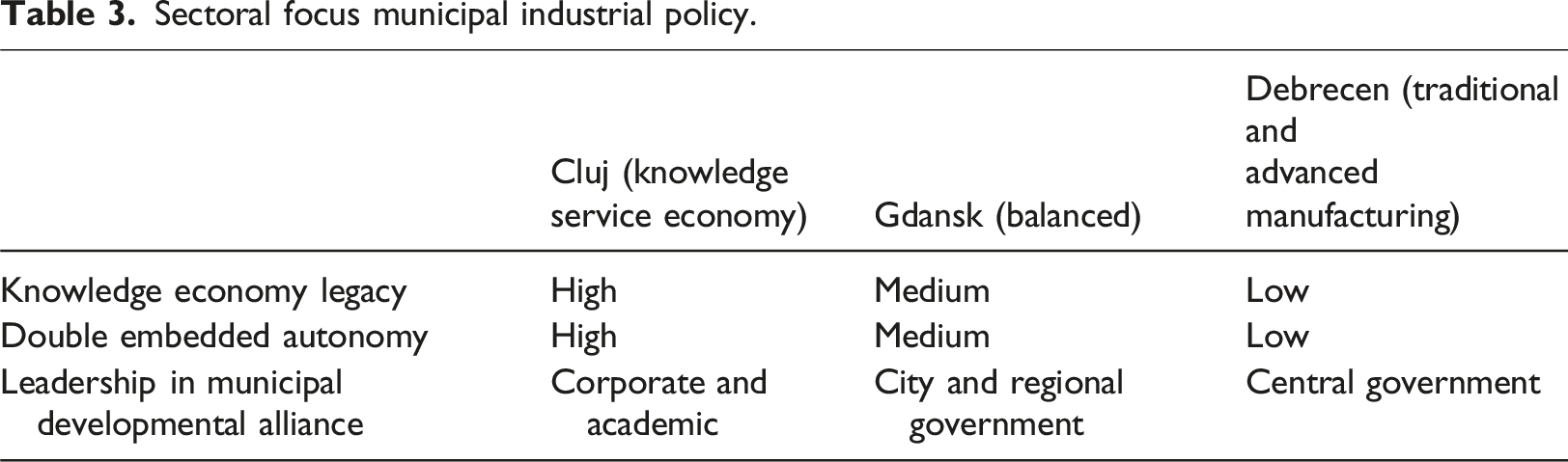
Finally, the politics of that leadership was shaped by the degree of embedded autonomy of local cities and universities from the private sector as well as the budgets and policies of central governments: the higher was their double embedded autonomy, the more policy space cities and universities had for promoting either frontier or balanced sectoral development. The Cluj and Gdansk city halls were much more autonomous vis-à-vis the central governments of their countries than Debrecen’s both in terms of the nature of revenue institutions (more decentralized) as well as in terms of capacity to mobilize EU structural funds (stronger than Debrecen’s) to compensate for weak municipal fiscal resources. But while Cluj’s universities had high levels of autonomy vis-à-vis a generally weak bureaucratic state in terms of supplying the skills demanded by the lead frontier sector (ICT), the autonomy of Gdansk universities vis-à-vis the national education ministry was lower, which impaired the stronger tech growth that we saw in Cluj. However, unlike in Gdansk, the Cluj city hall only engaged in industrial policy during the late consolidation phase of the knowledge economy and cannot be credited by spurring the processes when this economy was forged.
Finally, several caveats are in order. Not all medium-sized cities in the world have access to EU funds. Also, not all CEE can achieve adaptive and innovative catch-up based on developing on or close to frontier sectors because not all enjoy the combination of very large cohorts of university graduates with skills relevant to frontier sectors. Few have pre-existing tech legacies, risk-taking local finance, or city governments with long horizons and double embedded autonomy. Some do, however, and they can become growth poles in a regional economy threatened by the crisis of the internal combustion engine on whose value chains CEE economies depend.
Conclusions
When and why do cities follow national industrial policy priorities and when and why do they deviate from them? The paper answers the questions by adopting the place-based perspective in industrial policy by getting at the politics governing the tensions and synergies between local and national industrial policies, using EU-provided funds as leverage.
The main argument of the paper is that catch-up strategies that are more ambitious than those of national ones are enabled by past legacies in frontier sectors, the nature of leadership in local developmental alliances (linking municipal authorities, business and academia, with varying relationships to the central government and the EU) and the politics governing the embedded autonomy of city governments towards both the private sector and the central government. The evidence unearthed remarkable levels of agency to deviate from national strategies at the middle-city level, both when the state was weak (Romania) and strong (Poland), with the Hungarian case showing that a strong state relying on subordinate local development alliances leads to greater alignment with central government industrial policy. Future work could undertake more firm studies to get at the more granular politics of the local developmental alliances (Whitfield, 2023) or disaggregate the independent impact of universities from business and state interests on the outcomes of the cases (Breznitz, 2014).
Overall, these findings challenge theories of capitalist diversity assuming the territorial homogeneity of growth models and limiting industrial policy to central governments. They also provide a revisionist account of the embedded autonomy literature by specifying the conditions of ‘double embeddedness' under which these alliances may embrace local catch-up strategies that differ from national ones. Two caveats are in order, however. First, few secondary cities outside the EU are eligible for external grants on the scale that these cities benefit from by virtue of the EU membership of their countries. Second, the conventional emphasis on bureaucratic capabilities specific to the embedded autonomy literature needs to be relativized: the case of Cluj shows that even where the city government is a latecomer in the municipal developmental alliance, higher-productivity sectors might emerge still, however imbalanced the result in terms of sectoral diversity.
Footnotes
Declaration of conflicting interests
The author(s) declared no potential conflicts of interest with respect to the research, authorship, and/or publication of this article.
Funding
The author(s) disclosed receipt of the following financial support for the research, authorship, and/or publication of this article: This work was supported by NO Grants 2014-202 (22/2020). Gergő Medve-Bálint is a recipient of the János Bolyai Scholarship of the Hungarian Academy of Sciences (BO/00932/23).

Notes
Appendix
A: Deputy Director of the Department for Regional Development, Marshal’s Office, 5 November 2019.
B: Project Manager at Pomerania SEZ, 8 November 2019.
C: Communication Director of InvestGDA, 7 February 2020.
D: Deputy Director of Invest in Pomerania, 7 November 2019.
E: Vice-Mayor of Gdańsk, 6 February 2020.
F: Manager at STARTER Business Incubator, 6 February 2020.
G: Manager at Gdansk Centre for Innovation and Technology Transfer, 6 February, 2020.
H: Mircea Bolos, Director of the Nord West Regional Development Agency, August 3, 2020.
I: Emil Boc, Mayor of Cluj, undated.
J: Liaison between City Hall, Universitatea Tehnica Cluj and the ITC sector, undated.
K: Cristian Hordilă - Director Transilvania International Film Festival (TIFF), Founder of Un singur Cluj, interview 19 May 2020.
L: Sorin Maxim, President of the Association of Regional Development Agencies in Romania and Director of the Western Regional Development Agency, 6 May 2022.
M: Ovidiu Cîmpean – Director, Cluj-Napoca City Hall, interview 12 May 2020.
N: Gabriel Badescu, Babes-Bolyai University Professor, November 3, 2022.
O: Norbert Petrovici, consultant for city hall, 10 July 2022.