







Abstract
While inclusive growth has been considered a major characteristic of post-war Japan, this is no more the case since the early 1990s as the country transitioned to a post-industrial economy. This paper seeks to explain that digitalization is a primary drive of growing inequalities in post-industrial Japan and argues for incorporating the digital divide into the investigation of changing economic structures and growth patterns. We mobilize the Régulation theoretical framework, which posits that the impact of technology on growth and inequality regimes is not homogenous across countries and over time. Our empirical investigation combines macro-level data and institutional perspective with case study of the hospitality sector, in line with the Régulationist concept of the ‘anthropogenic’ mode of development. Our major conclusion is that digitalization, in the specific Japanese context, is leading to non-inclusive growth patterns through its effects on the wage-labour nexus, in an idiosyncratic way.
Keywords
Introduction
Japan has been once characterized as a country that managed to combine high growth and equity (Dore, 1994). Its trajectory, which confirmed that there is no trade-off between efficiency and equality, has been at the origin of the conceptualization of inclusive growth (World Bank, 1993, 2018, 2019) and has given birth to burgeoning literature (Rodrik and Stantcheva, 2021; Boarini et al., 2015; Anand, R. et al., 2013; Saad-Filho, A., 2010; Rauniyar and Kanbur, 2010). However, for many years now (at least from the early 1990s), Japan has been characterized by low growth (below the OECD average) and increasing inequalities. This evolution has led to intense debates about the determinants of growth and the causes of growth slowdown as well as about the extent of increasing inequalities and their causes in a post-industrial context (Chiavacci and Hommerich, 2016; Lechevalier, 2014; Shibata, 2020). 1 In this context, our research question can be summarized as follows: is technological change, namely, digitalization, a major cause of the end of inclusive growth since the early 1990s, in post-industrial Japan, whereas it has been considered a major characteristic of post-war Japan?
To our knowledge, the role of digitalization or the lack of digitalization in the context of Japan’s growth model has not been systematically investigated, with the exception of studies explaining the growth slowdown due to limitations of the innovation system (e.g. Nezu, 2004) or, more recently, of comprehensive books such as Whittaker (2024). This is even more surprising that digitalization is recognized as a major trend that is affecting our societies and economies from the perspective of growth and inequalities, for the best (Brynjolfsson and McAfee, 2011) or the worst (Durand, 2020; Mazzucato, 2019). Despite the divergence of analyses, there is an agreement that the future of our economies will be partly shaped by the on-going digitalization. It means that it will also affect the possibilities for inclusive growth. There have been various definitions of digitalization. This paper adopts the definition that describes digitalization as the process of changing or improving business models, that leverage digital technologies and digitized resources in order to create new sources of value creation (Van der Zande et al., 2020:32).
There are two major reasons for the lack of research on the impacts of digitalization on inclusive growth in Japan. One is quite general: the inclusive growth research agenda has been developed largely independently (with very exceptions such as Dahlman et al., 2016) from the research on digitalization and its effects on work and labour. The inclusive growth approach has been focused on non-OECD countries while the literature on digitalization mainly looks at the Global North with a few exceptions (Raj-Reichert et al., 2021).
The other one is more Japan-specific: digitalization in Japan has been pushed by policymakers as one solution to revive the Japanese economy, enabling an increase in labour productivity (and thus GDP growth) and solving the labour shortage issue, in the context of fast ageing of the population and restrictive immigration policies (Whittaker, 2022, 2024). Moreover, it is expected that digitalization will lead to a wage rise (as a result of increasing labour productivity) and to improved working conditions (through shorter working hours, telework, elimination of repetitive tasks, etc.). In short, the entire Japanese society should benefit from technological progress in various fields and enjoy a positive post-industrial growth scenario (Whittaker, 2024). This optimistic outlook of digitalization, encapsulated by the ‘Society 5.0’ (presented in the 5th Science and Technology Basic Plan (2015), has been widely embraced by government, unions, employers’ associations, and academia. However, it has been promoted without much critical investigation on the possibility of a digital divide between labour and capital or between different types of workers – distinguished by their level of education, their age, the type of firms that are working for (sector and size), and the region where they live and work (OECD, 2001).
In this paper, we try to bridge the gap between the general literature on inclusive growth that focuses on non-OECD countries and the Japanese literature on digitalization that largely overlooks inequality. We argue that the impact of digitalization on inequalities and growth regime in post-industrial Japan deserves dedicated research. Moreover, we try to identify whether Japan follows an idiosyncratic trajectory or converges towards the patterns observed in other countries, as explored in previous research (e.g. Durand, 2020; Mazzucato, 2019). In doing so, we refer to two key insights from French Régulation theory (Boyer et al., 2011). 2 First, we contribute to the analysis of the diversity of inequality regimes, in challenging the idea of globalization of inequalities (Bourguignon, 2015). This focus on the diversity of inequalities across countries mobilizes the concept of ‘wage-labour nexus’, which is central in the Régulation theory. This nexus represents, at a given time, the interplay between labour organization, workers’ ways of life and the ways in which they are reproduced. As such, it encapsulates the labour dimension of production relations. It allows capturing and enduring the heterogeneity of inequality regimes.
Second, as not everything is determined by technology, whose impact is embedded in a certain political economy context (Shibata, 2022). Rather, the effects observed in Japan (and in other political economies) stem from how new technologies are mediated by various political economy variables (e.g. bargaining power of workers, and implementation of public policies in the fields of digital economy and labour). This perspective allows us to conceive diverse patterns of digitalization and digital divides. To put it differently, from this perspective, we examine how digitalization influences growth and inequalities, creating a digital divide perpetuated by these growth patterns, rather than comparing technology’s impact on individuals with different characteristics (sex, education, etc.). In the Japanese case, given the fact that key characteristics of the wage-labour nexus are defined at the firm level, studying the impact of digitalization on inequalities requires looking at the evolution of heterogenous managerial practices across sectors but also within them (Lechevalier, 2014). This characteristic underpins our research agenda, which mobilizes sector case study.
The rest of the paper proceeds as follows. After having introduced our theoretical framework inspired by the Régulation theory, we mobilize it to look at the transformation of the Japanese wage-labour nexus in showing how and why the effects of digitalization on work and labour in Japan are idiosyncratic: this is not only due to some characteristics of the former Toyotist wage-labour nexus, to the nature of the neoliberal transformation of Japanese capitalism but also due to the coincidence of a technological race and a human resource management race to the bottom. After having specified our methodology and the diverse data that we mobilize in this paper, we present our empirical investigation, which includes two steps. First, we analyze the specificities of digitalization in Japan based on comparable OECD data and the analysis of public policies. Second, we investigate the impact of digitalization on the wage-labour nexus through the combination of a macro perspective and sectoral case study. We conclude in a final section that digitalization, in the specific Japanese context, leads to non-inclusive growth patterns but it does not correspond to the patterns observed in the US or in most European countries.
A Régulationist perspective on digitalization and its effects on the wage-labour nexus
The purpose of this section is to emphasize the benefits of adopting a framework inspired by the Régulation theory, to study the diverse effects of digitalization on the growth and inequality regimes that mainly go through the wage-labour nexus. It allows going beyond the dominant debate between Techno-optimists and Techno-sceptics, who share, despite their major differences, the idea of a quite homogeneous impact of technology on growth regimes and inequalities. By contrast, the Régulation theory, which can be defined as a political economy approach to the diversity of capitalism (Amable, 2003; Boyer, 2005), enables us to analyze the diverse paths to digital (post-industrial) growth by extending the variables that should be considered in the analysis, namely, political economy variables such as the forms of the state or the bargaining power of workers (Boyer, 2015, 2016, 2022). A second major benefit comes from the concept of the ‘anthropogenic’ mode of development, whose purpose is to allow us to grasp major characteristics of growth and inequality regimes in a post-industrial era dominated by services (in particular health, education, culture, and leisure), as an alternative to the inclusive growth approach. More precisely, it is a relevant concept to analyze post-Fordist regimes, for which well-being issues are more crucial than growth ones.
The debate between Techno-optimists and Techno-sceptics in the time of digitalization
The academic debates on the impact of digitalization on the economy are characterized by a polarization between Techno-optimists and Techno-sceptics (Shibata, 2022). Techno-optimists view that automation has historically displaced workers, but it has also delivered more jobs since rising productivity creates new jobs that require more skills and pay higher wages. They explain that new technologies and crises tend to lead to ‘new modes of collaboration and new institutional relationships’ (Ramella 2021; Schwartz and Riss 2021:51, 56-57, 69). Optimists therefore emphasize the significance of technology (Roose 2019; Walsh and Sculos 2018), agile management (Shildt 2020), job satisfaction (Bisht et al., 2023), its ability to improve productivity and create value with less input (Manyika et al., 2013), and the enhancement of human quality of life and human labour (Brynjolfsson and McAfee, 2011). Danaher contends that techno-optimism is not monolithic but rather consists of multifaceted dimensions, and therefore, it is important to acknowledge the spectrum of optimism, in which some have an unwavering conviction in techno-solutionism, whereas others recognize the potential harm and misuse of technologies (Danaher 2022). Nevertheless, techno-optimism is strongly influenced by the mainstream economic approach to technology, whose focus is on performance, the volume of employment and productivity. It assumes that its impact on labour is homogeneous across countries, even if it is recognized that the effects can be heterogeneous for different individuals (e.g. distinguished by their skills or education) within the same country (Calvino and Virgillito, 2018).
On the other hand, Techno-sceptics are putting in doubt the capacity of digitalization to fundamentally improve the situation of labour and/or the working conditions (Dyer-Witheford et al., 2019), for various reasons. One is that the number of jobs that will be replaced during the process of digitalization should not be underestimated (Frey, 2019). It is also predicted a possible bifurcation between well-paid professional jobs and low-wage jobs, with zero-hour contracts being the most extreme case of the negative impact of digitalization on workers (Mazzucato, 2019). Moreover, digitalization is also seen as a way to reduce the autonomy of workers (whose activities are conditioned by algorithms) while increasing the surveillance of workers and thus their discipline (Zuboff, 2019).
This argument aligns with diverse approaches that diverge from the mainstream economic approach to technology. Among them, the techno-feudalism thesis has become popular in recent years (Durand, 2020; Mazzucatto, 2019; Morozov, 2022). 3 This thesis posits a transition from familiar capitalism to a new feudal order, intertwined with the ascent of Silicon Valley. Among its characteristics that are central to our question, one should emphasize prolonged stagnation and increasing inequalities that lead to the coincidence of ostentatious consumption by the elites combined with increasing immiseration of the masses (Morozov, 2022). In other words, from this perspective, growth in the time of digitalization is poles apart from inclusive growth.
The Techno-feudalism thesis offers important insights into digitalization, but it mainly focuses on the production mode and the overarching trends that are more or less homogenous across countries. Our objective is to elucidate the diverse pathways to digital growth and their impacts on work, labour, and inequalities, aligning with the Régulation theory (Boyer, 2015, 2016, 2022).
Analyzing the diverse impacts of digitalization on growth and inequality regimes: A Régulationist perspective
A key finding of the Régulation theory, which allows us to overcome the limitation of the above debate, is that while technologies have played and continue to play a major role in the capitalist dynamics, their influence should not be overstated. This is evident in the institutional diversity observed across economies at a given level of technology (Amable et al., 1997; Boyer, 2005, 2019; Shibata, 2022; Whittaker, 2024). This result is supported by both economic historical analysis and international comparison. An important implication of this perspective is that the outcome of digitalization depends on political economy variables (e.g. corporate governance at the level of the firms, bargaining power of workers, and the role of the state in the regulation of working conditions). These factors influence how benefits are distributed among different categories of employers and employees (see also Raj-Reichert et al., 2021, with a different theoretical perspective but a similar conclusion). It means that technologies can be deployed with different effects (increased productivity but also, among others: more control, loss of skills, or changes in the balance of power between labour and capital) – both intentionally and unintentionally. The effective integration of technology is conditioned by non-technological adjustments such as work organization and governance.
To put it differently, the Régulation theory reminds us that technical progress is itself embedded in the socio-economic institutions (wage-labour nexus, finance, state, etc.) and contexts within and across each national economy (Boyer, 2019). In the case of digitalization, it may have a major impact on the wage-labour nexus, but at the same time the characteristics of the wage-labour nexus, as well as its complementarities with other institutions, will condition and define the concrete conditions for the implementation and the uses of digital technologies. For example, in the case of Japan, the decentralization of the wage-labour nexus at the level of firms may be a source of differentiation in the introduction of digital technologies, and thus, of inequalities. It means that, in studying the impact of digitalization on labour, it is essential not to restrict ourselves to the volume effects (employment, unemployment, productivity and wages) but also to consider work practices, workstyle, and nationally specific labour institutions (e.g. emphasis on teams rather than individual performances, long working hours and wage-bargaining institutions) that are also parts of the wage-labour nexus (Shibata, 2022), which should be studied in a way to take into consideration their heterogeneity and their variability in time and in space.
Diversity of inequality regimes.
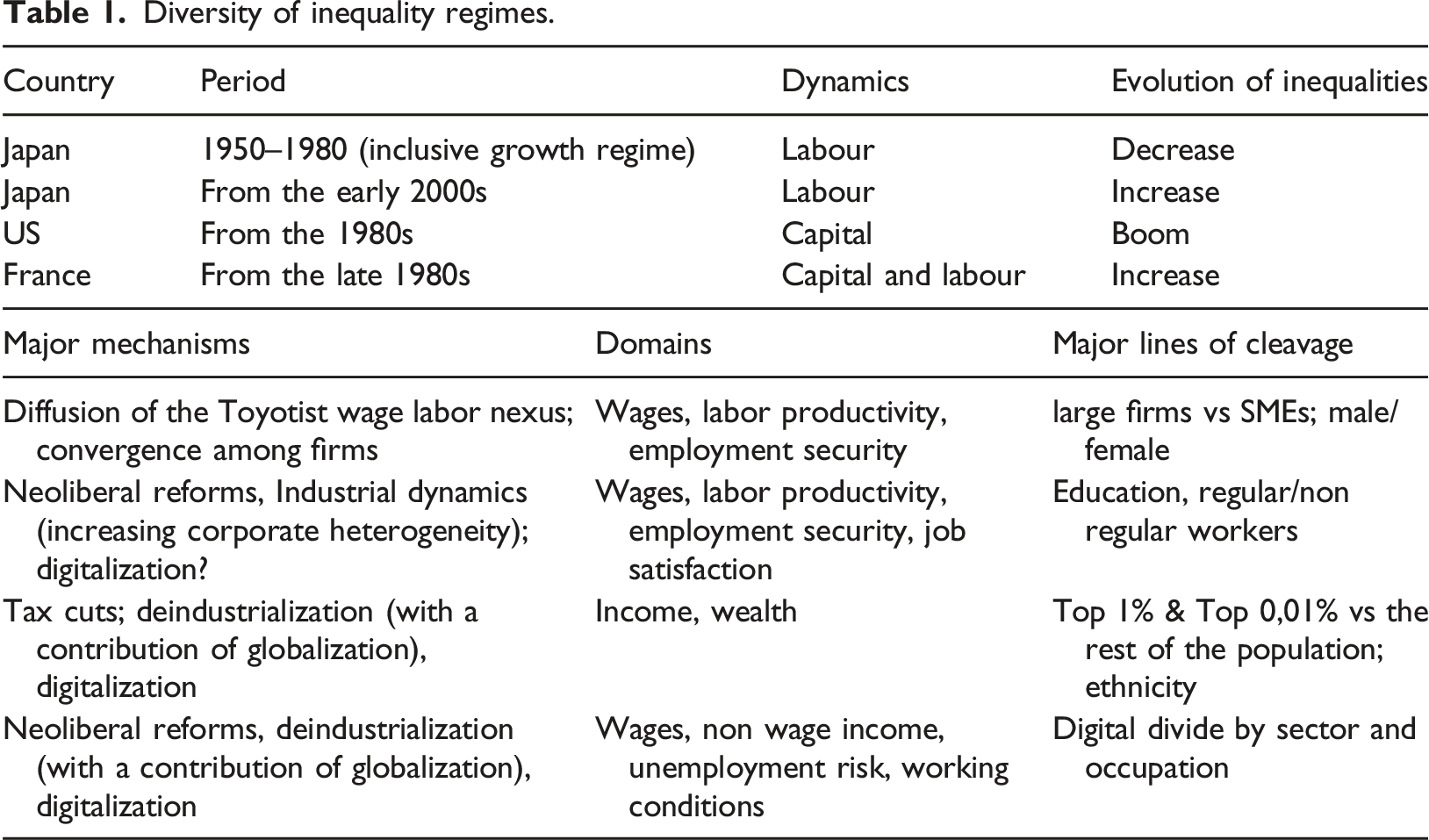
The concept of the ‘anthropogenic’ mode of development, introduced in the context of discussions regarding successors to the Fordist regime (Boyer, 2019; Lechevalier 2024), characterizes a mode of development centred on the service sectors of healthcare, education, and culture. These sectors have increasingly supplanted the acquisition of standard goods and services (Boyer, 2019). 5 Focussing on the production of people by human labour, this model prioritizes well-being as a key criterion to evaluate the outcomes of this new mode of development. This is in contrast with Fordism, which is usually used to characterize the Post-war mode of development, dominated by manufacturing industries (e.g. the car industry, and one of its leading companies, Ford). More precisely, in Régulationist terms, Fordism refers to a mode of Régulation, that required a synchronized expansion of mass consumption and mass production, placing the wage-labour nexus at the heart of the overall institutional architecture (Amable, 2003). 6 With the hypothesis of the changing hierarchy of institutional forms and the effort to understand financialization, the wage-labour nexus has gradually lost its centrality (Boyer, 2000, 2005). We argue that re-examining the wage-labour nexus is becoming essential again because, in some of the diverse forms of modern capitalism, it has become the locus where contradictions converge (Amable and Palombarini, 2009). The concept should be nonetheless revised, as, in its original form, it did not incorporate the most recent development in well-being studies (see Clark, 2010, among many others, for a synthesis). It does not mean that inequalities in labour productivity, income, working conditions, and employment security should be left aside. However, in the ‘anthropogenic’ mode of development, inequalities in well-being are key and should lead us to investigate more closely the evolution of job satisfaction that may have some impact on other variables and in the end help us define the sustainability conditions of digitalization, as well explained by Castellacci and Tveito (2019) in a different framework. 7
Methodology and data
With this theoretical background in mind, our empirical strategy is to discuss the impact of digitalization on inequalities and growth regimes through the wage-labour nexus, in different dimensions, by focussing on the period when its effects are visible, which is approximately, in Japan, from the late 1990s–early 2000s to nowadays (including the COVID-19 crisis). While we look at labour productivity and wages, we extend the analysis to other dimensions, such as workers’ well-being or labour discipline, which are relatively neglected in the literature. As no database allows a systematic and direct investigation of these dimensions, we combine macro-comparative analysis and sectoral case study, based on a set of data that is introduced below.
The first category of data we mobilize is related to digitalization. As explained in the introduction, among its diverse definitions, we adopt the one proposed by Van der Zande et al. (2020), mainly because its high degree of generality is compatible with our Régulationist perspective it leads to mobilize data that are well identified and comparable, thanks to the work done by the OECD. To the best of our knowledge, the Going Digital Toolkit, provided by the OECD (https://goingdigital.oecd.org/), is the most comprehensive attempt to establish criteria in different fields and to gather them in order to compare the diverse stages of digitalization in various countries, beyond OECD countries, as a total of 43 countries are covered. This is thus particularly useful to put the Japanese case in perspective and to go beyond anecdotal evidence. However, even in this case, the vision of digitalization is characterized by some partly ad hoc choices and some specific focuses that are not always well justified (Bukht and Heeks, 2017). To put it shortly, the OECD focus is on competition and regulation in digital markets. 8
The second set of data utilized in this paper is related to the measurement of the impact of digitalization on the wage-labour nexus. To our limited knowledge, it is not possible, with available Japanese data, to conduct a comprehensive aggregate-level analysis of digitalization’s influence on key labour dynamics such as labour productivity, wage growth, job satisfaction, or income inequality. Thus, we adopt a dual strategy. First, we look at the stylized facts regarding the evolution of these variables in light of Japan’s digitalization landscape, as detailed in a dedicated section. Second, we conduct in-depth case studies of the service sector that offer a granular perspective on Japan’s service sector digitalization process. The case study incorporates Japan’s unique labour market challenges, including a labour shortage, low productivity, low wages, and long working hours into the analysis of how ongoing digitization has interacted with the existing wage-labour nexus and produced specific outcomes. This method helps us to identify both the outcomes of digitalization and the new challenges digitalization creates in the specific context of Japan’s wage-labour nexus. By drawing on primary data including interviews, business journal articles, reports, and public documents, the case study seeks to provide concrete examples of the impacts of digitization on workers’ well-being and inequality in Japan. In doing so, we follow the same strategy as several other authors, as shown by Bourguignon (2022) in his survey of the empirical literature on digitalization and inequalities in OECD countries.
As a whole, our empirical strategy aims to uncover key patterns in how digitalization impacts the wage-labour nexus that affects the growth and inequality regimes. While the first stage of our dual strategy identifies aggregate trends in labour productivity, income inequalities, and job satisfaction, including the recent surge in telework during the pandemic, the latter. The second stage, focussing on the hospitality sector as exemplar of post-industrial, anthropogenic mode of development, enables in-depth analysis through interviews and sectoral database.
The great transformation of the Japanese wage-labour nexus and the idiosyncratic effects of digitalization in Japan
The Toyotist wage-labour nexus: Its contribution to the success of Japanese capitalism and its influence on the debate on inclusive growth in World Bank reports
Until the 1980s, the Japanese form of capitalism was characterized by i) a certain mode of organizing firms – distinguished from their American counterparts by an orientation towards the long term and at the core of the Toyotist wage-labour nexus (WLN), 9 which has been considered as the institutional form at the top of the institutional hierarchy (Boyer and Yamada, 2000), ii) by the importance of non-market coordination (such as shunto [a coordinated wage bargaining process], the keiretsu structure, or industrial policy), and iii) by an absence of trade-off between efficiency and equity (Boyer and Yamada, 2000; Lechevalier, 2014).
All these three dimensions were connected. The Japanese wage-labour nexus was extremely decentralized, shaped more by firm-level practices and norms than by labour law. This decentralized structure enabled non-market coordination forms 10 to play a crucial role in mitigating significant inequality growth while preserving certain structural disparities (e.g. between men and women). This is also visible in the renowned report entitled ‘The East Asian Miracle’, which analyzed the economic performances of East Asian economies and formalized a model that looked more or less like the Japanese model of accumulation-led growth (World Bank, 1993), especially from the viewpoint of what we call ‘coordination forms’.
A Neoliberal transformation but no convergence towards market capitalism
However, Japanese capitalism has evolved over 30 years, and now may be clearly distinguished from the ‘model’ of the 1980s (Boyer et al., 2011; Dore, 2000; Lechevalier, 2014). The transformations that have been a key feature of Japanese capitalism over the years may be summarized as follows: i) increasing heterogeneity of firms in terms of their performance and their mode of organization, so that it is no longer possible to speak of a J-model of the firm; ii) decline of earlier forms of co-ordination, iii) rise in inequalities. These changes have been underestimated because of their gradual nature but also as Japan has followed its own way, without convergence towards the Anglo-Saxon type of capitalism or the European types of capitalism. 11 This idiosyncratic pattern is explained by the initial conditions (i.e. the extreme decentralization of the post-war Japanese WLN and the key role of coordination forms) and the process of neoliberal reform, which has been non-linear (Lechevalier, 2014).
A major consequence of these neoliberal reforms has been rising inequalities. Although their overall dynamics are complex and should be explained by several factors, previous studies such as Lechevalier (2014) and Shibata (2020) confirmed the predominant role of neoliberal policies. As such, rising inequalities reveal a drastic change in the egalitarian post-war social compromise and confirm that the new Japanese model of growth is no longer inclusive. Moreover, although neoliberal reforms have been sold as the only solution to the growth slowdown from the 1990s (less than 1% real GDP growth rate since then, which is below the OECD average for the period), they may be considered a major reason for it, as they have been introduced gradually from the late 1970s and have contributed as well to deflation from the mid-1990s (Lechevalier and Monfort, 2018). Last but not least, they are at the origin of a process of financialization, certainly less remarkable than in the US or the UK, but that has contributed to the change in the logic of accumulation in the growth model and had negative consequences on the effectiveness of industrial policies (Lechevalier et al., 2019).
If neoliberal policies are the main cause for the shift towards a non-inclusive growth model, how should we assess the role of digitalization in the emergence of the non-inclusive growth pattern? This is a complex question to which we now turn our attention. First, it is important to specify the interrelations between the implementation of technological progress (i.e. digitalization) and neoliberalism. As shown by Lechevalier (2014), the necessary adaptation to technological revolutions has been a pillar of the neoliberal argument for structural reform since the 1990s.
Second, if one focuses on the structure of inequalities, it is important to recognize that there are various dimensions and realities of the so-called ‘digital divide’ and they have to be specified. One – referred to as skill-biased-technological change – is related to the impact of new technologies on the wage gap by education level (Katz and Autor, 1999); another one is related to differences in terms of infrastructure on regional differences; a final one is subtler but even more important to us: it is related to the correlation between the technological race and the race to the bottom regarding the wage-labour nexus, a dynamic that takes place at the firm level.
Technological race and human resource management race to the bottom: The Japanese way to digital divide
The period that runs from the 1970s and that can be considered the Golden Age of the ‘J firm’ (both in practice and in theory) to the 1990s–2000s is particularly relevant for the analysis of the evolution of the relationship between technologies and labour within the Japanese firms.
As well explained by economists and management specialists 40 years ago (e.g. Aoki and Dore, 1994), the success of Japanese firms mainly rested on a model of organizational innovation, rather than on technological innovation. The concept of ‘Toyotism’ was precisely introduced to express that this model was based on corporate investment in training workers and fostering their commitment to the firm. The core of Toyotism was neither robotics nor mechanization nor automation, but rather a form of intensification of human work, through its involvement at each stage of the production (Boyer and Yamada, 2000).
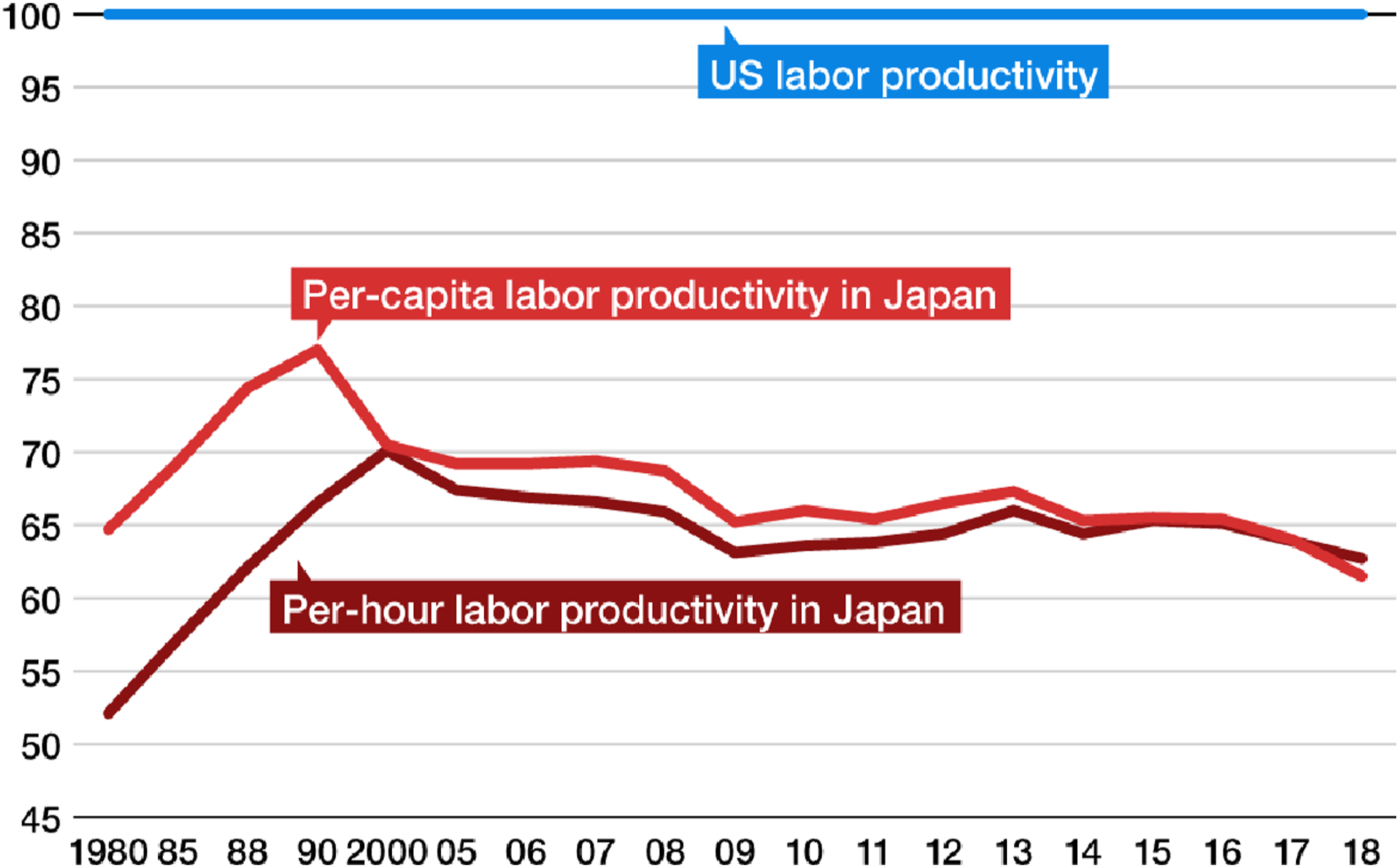
Paradoxically, once the catching-up period was over (end of the 1980s), Japanese firms seemed to forget the lessons from their past success, and even more so during the 1990s when the concept of New Economy, imported from the US and incorporating the ideology of technological innovation, dominated. They have committed to a technological race, with massive R&D investments, and an HRM race-to-the-bottom, including wage cuts, in the context of competitive pressures from countries characterized by lower labour costs (Lechevalier, 2019; see also Figure 1). The results of these strategies in terms of economic efficiency have been disappointing, to say the least. Over-investment in R&D has led to poor returns (OECD, 2005), while a relative decline in labour productivity has been observed from the late 1980s (Figure 2). R&D race and HRM race to the bottom in Japan. Sources: Ministry of Health, Labour, and Welfare (MHLW) for the Labour cost index (‘Monthly Labour Survey’); Statistics Bureau of Japan (‘Report on the Survey of Research and Development’) for total expenditures in R&D (https://www.stat.go.jp/english/data/kagaku/index.html). Notes: The labour cost index is calculated by dividing the labour costs by the number of hours worked. Labour costs include costs for wages and salaries as well as non-wage costs like employer social contributions. Evolution of labour productivity level in Japan by comparison to the US (1980–2018). Source: Japan Productivity Centre, Productivity statistics. Note: The data of output is based on three data of Ministry of Economy, Trade and Industry (METI). As for mining and manufacturing industries, Indices of Industrial Production (IIP) is used. As for non-manufacturing industry, the Indices of Tertiary Industry Activity (ITA) and Indices of All Industry Activity (IAA) are used. Labour input in each industry is based on the Ministry of Health, Labor, and Welfare (MHLW)’s Monthly Labor Survey (establishment with five or more employees). In addition, labour input index is generated on the basis of employment indices times hours worked indices.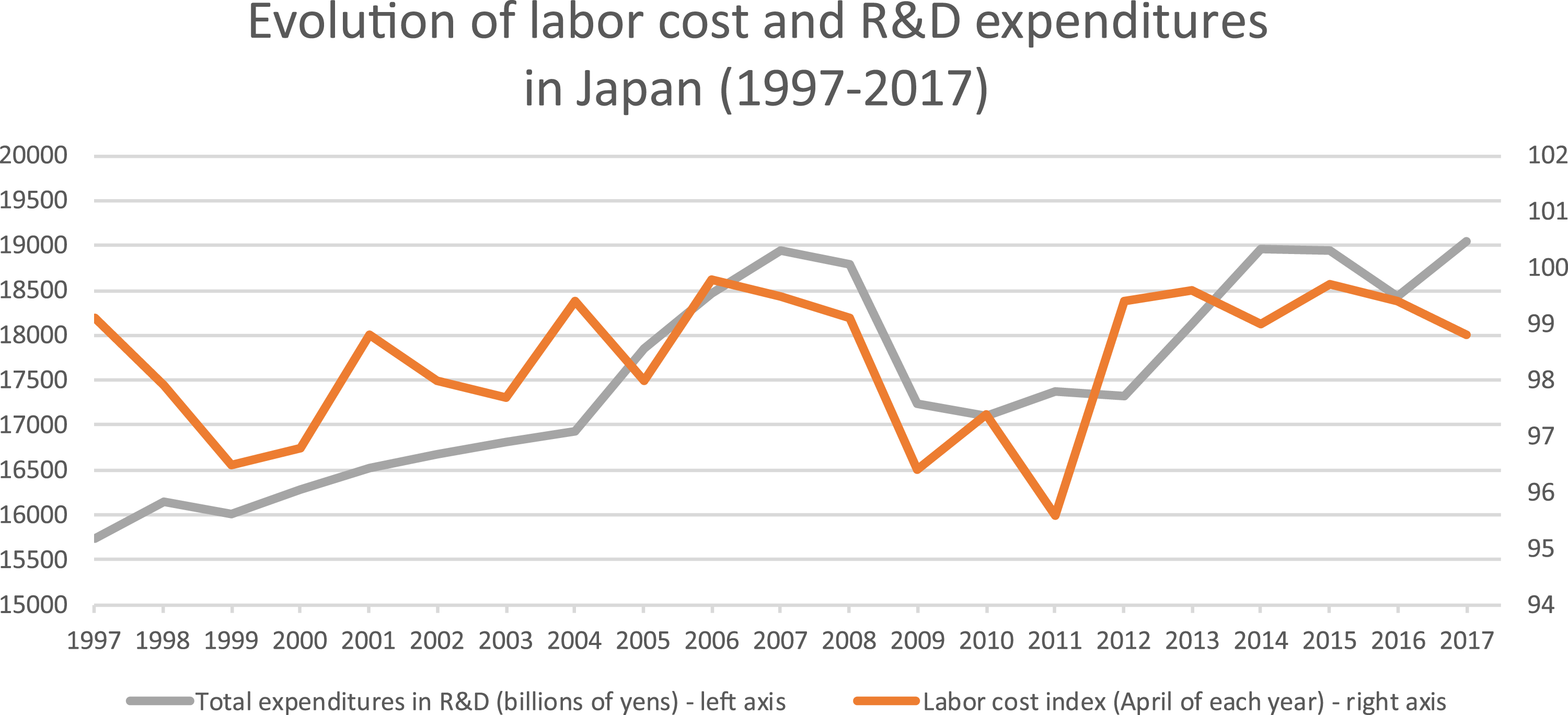
The correlation between the R&D race and wage race to the bottom in Japan and its negative impact on labour productivity has to be further investigated, as it is at odds with the standard theory of capital and labour: any increase in the capital/labour ratio, both quantitatively and qualitatively (increasing efficiency of capital through R&D investment), should lead to an increase in labour productivity, and thus in wages. This has not been observed in Japan since the 1990s. There are several possible explanations. One is related to the decay of various forms of training in the companies (e.g. on-the-job training): after a dramatic increase in corporate investment in worker training (as captured by training expenditures at the firm level) from the early 1990s, the Japanese figures are nowadays below the OECD average, after having been at the top (Yokoyama et al., 2019). Another possible explanation for this is that wage stagnation and well-being issues (e.g. long working hours) have led workers to lose motivation. This is visible in the low level of job satisfaction in Japan (Figure 3; see also Baudrand et al., 2018) and it has an impact on efficiency (Halkos and Bousinakis, 2010). Comparison of job satisfaction by countries: percent of employees in selected countries who feel satisfied at work (2019). Note: Poll of 13,600+ employees in 34 countries in Q4 2019. Source: Randstad workmonitor (2020).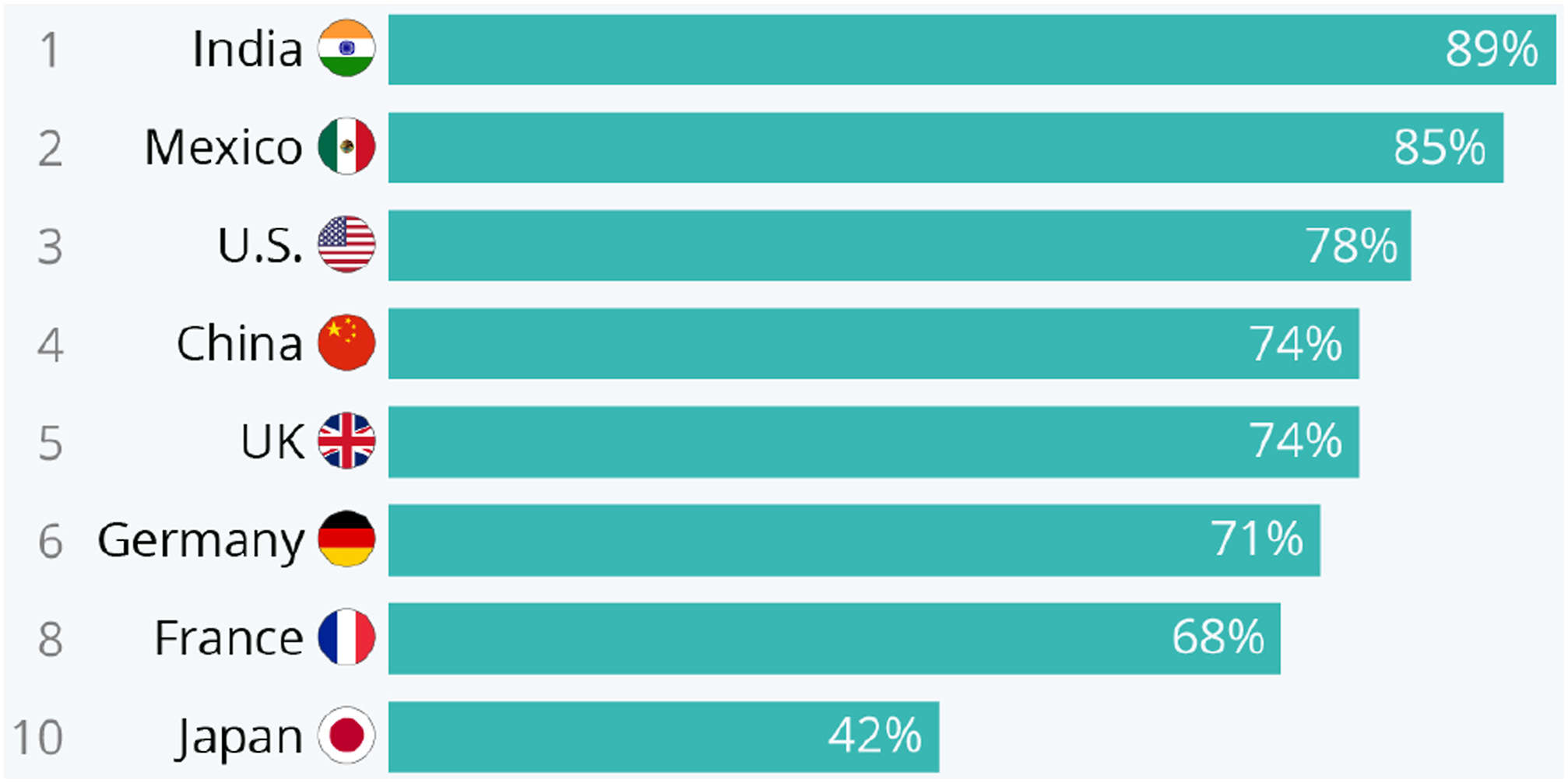
How much and how has Japan digitalized?
After having characterized the mechanisms at the core of the Japanese way to digitalization – namely, the negative correlation between R&D expenditures and investment in human resources – it is necessary to analyze more precisely the very process of digitalization in Japan itself in order to better understand its idiosyncratic nature. It requires first to dismiss the myth of a non-digital Japan through a mobilization of OECD comparable data.
The myth of non-digital Japan
According to a mainstream view, Japan is lagging behind other OECD countries and eventually some non-OECD countries in Asia in terms of digitalization (Kawai, 2023). Is this confirmed by data or is it a myth, which would be similar to the one regarding the decay of Japanese innovation capabilities (Branstetter and Nakamura, 2003)? The difficulty in answering this question comes from the lack of consensus on the definition of digitalization and, consequently, the absence of a consolidated database for unambiguous international comparison (Bourguignon, 2022). This is why, contrary to the prevailing narrative in the press suggesting a digitally backward Japan, we argue that evaluating the country’s current state of digitalization is far from straightforward.
Based on this database, it is possible to characterize Japan’s current state of digitalization relative to other OECD countries as follows (Figure 4). First of all, Japan is far from being a laggard in all the domains analyzed by the OECD. While lagging in areas such as public spending on active labour market policies, the share of ICT task-intensive jobs, household broadband access, and the uptake of digital government services, it significantly leads in mobile broadband penetration (infrastructure and access), the proficiency of adults in problem-solving with technology (use), and the application of ICT patents (innovation). For other indicators (such as fixed broadband penetration, R&D in information industries, or jobs in digital-intensive sectors), Japan aligns with the OECD average. Overall, Japan’s digitalization should be assessed more comprehensively. It requires a clear articulation of Japan’s vision of digitalization and its implementation strategy. Digitalization in Japan in seven dimensions. Source: OECD (Digital tool kit: https://goingdigital.oecd.org/).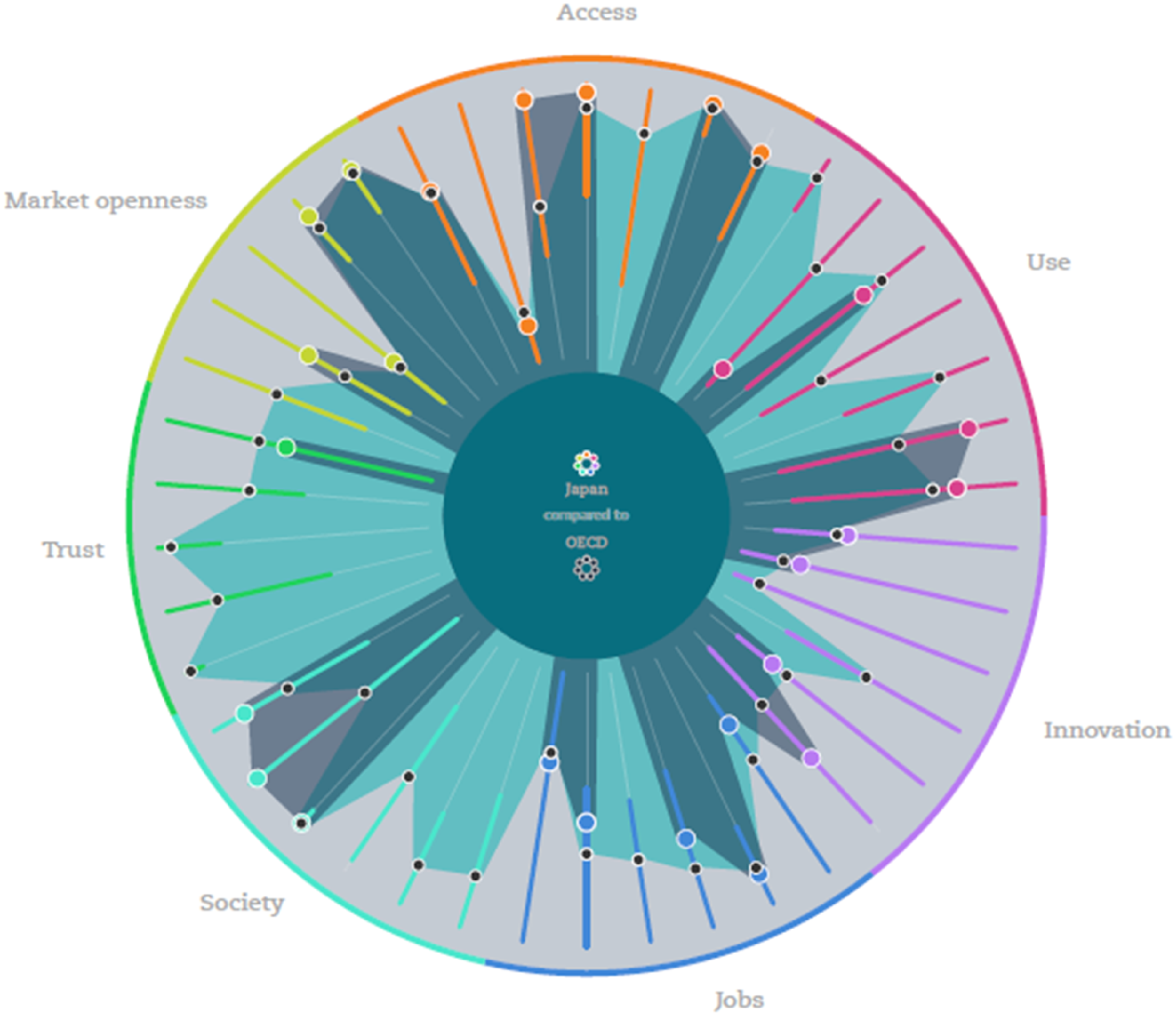
Before moving to this dimension, it is also worth emphasizing the specificity of the Japanese digital landscape from an industrial perspective, which may partly explain the myth of non-digital Japan. More specifically regarding the digital economy, although some Japanese firms were frontrunners in the 1990s and some of their products (such as i-mode) did partly inspire the future US GAFAM (Google, Apple, Facebook, Amazon, Microsoft), they failed to reach a monopolistic position to become Japanese type GAFAM (Whittaker, 2024). This is mainly due to their lack of vision on the importance of data in the early stage of digitalization, and it explains why the digital industrial landscape in Japan does not look like in the US, especially if one considers the existence of a national ecosystem (Kümmerle, 2022).
The Japanese vision on inclusive digitalization (Society 5.0) and its implementation in public policies from e-Japan (2001) to the creation of the digital agency (2021)
Having discarded the myth of non-digital Japan, we introduce political economy variables with the aim to explain the specific path of digitalization in Japan and its impact and the growth and inequality regime, in accordance with the theoretical perspective of the Régulation theory, which has been explained above. More precisely, we argue here that some of the characteristics of the non-inclusive growth regime that emerged in Japan from digitalization come from the unbalanced nature of the implementation of public policies in the fields of labour and the digital economy. This is all the more striking since the vision at the origin of these policies, which has been summarized ex-post in the concept of Society 5.0, is very much connected to the inclusive growth model. Society 5.0 is a concept that has been proposed in the 5th Science and Technology Basic Plan (December 2015) as a future society that Japan should aspire to. According to this vision, which is supposed to represent a human centric vision of innovation, it will be possible to solve a certain number of social issues, including work and labour-related issues, thanks to advanced digitalization. For example, it is expected that AI will free humans from the burdensome work of analyzing huge amounts of information, the use of robots will expand the possibilities open to humans, and Internet of Things (IoT) will connect people and things, which allow us sharing all sorts of knowledge and information. In short, the expectation is to overcome the limitations of Society 4.0 (information society) and its predecessors (Council for Science, Technology, and Innovation, 2015). To our knowledge, this vision is certainly one of the most advanced ones among similar visions proposed in other OECD countries. As well stated by Whittaker (2022, 2024), the originality of this vision of a digital society is to be different from both the market-oriented Silicon Valley on the one hand and China’s state-dominant approach on the other. It is also very much compatible with the objectives of inclusive growth policies in the digital era.
However, when one moves from this vision to its implementation in terms of public policies, it is fair to recognize an important gap. Certainly, we agree with Whittaker (2022, 2024) that the influence of this vision is visible in a wide range of government documents such as METI’s ‘New Industrial Structure’ and several ‘DX’ (digital transformation) reports that ultimately led to the creation of the Digital Agency in 2021. Therefore, the Society 5.0 vision and industrial policies are not disconnected. Nevertheless, given the loss of complementarity between the state in its allocative structure (which is at the heart of industrial policies) and finance (Lechevalier et al., 2019), there are doubts about the government’s ability to implement this vision.
In order to understand this point, it is useful to compare two public policies in this field, namely, the e-Japan strategy in 2001 (which has been therefore implemented before the emergence of the Society 5.0 vision) to the more recent DX (digital transformation) strategy with its associated creation of the digital agency. While there are some evolutions, strong continuities remain. The e-Japan strategy, implemented by the Koizumi government (2001–2006), focused exclusively on reinforcing business competitiveness (Kantei, 2001). To summarize, it concentrated on infrastructure, competition, corporate dynamics, and workers’ IT literacy, with the target to reduce a certain digital divide in Japan, while mimicking the Silicon Valley Model through startup promotion. It is striking that e-Japan strategy was disconnected from labour market reforms. For instance, there was no clear engagement in terms of how to re-educate workers for the IT era. In short, its purpose was not to build a digital society but rather to enhance economic competitiveness to catch up with the US.
What is the content of the DX strategy, almost 20 years later? Besides the official documents (e.g. METI, 2018), it is interesting to refer to the interview of Professor Jun Murai, Special Adviser to the Cabinet on digitalization policy, who has a rather candid view on the progress in the domain of digitalization, the targets, and the remaining obstacle (Murai, 2021). According to Murai, Japan’s IT strategy has been successful in terms of building infrastructure but less in terms of use and application, for which one observes a remaining ‘digital divide’, in terms of firms’ size, sectors, and geography. In this context, one of the purposes of the Digital Agency is to reduce this digital divide, in terms of use and not only of infrastructure, which is relatively new by comparison to the 2001 e-strategy. At the same time, it is fair to recognize a certain distance to the inclusive growth vision emphasized in the Society 5.0 documents. It is especially visible in the startup promotion policy, which has also become predominant in the policies package promoted by the ‘new capitalism’ vision (Kantei, 2022).
Digitalization, labour policies, and unions and employer associations’ contributions: A political economy perspective
As seen above, the Society 5.0 vision emphasizes concrete benefits for workers, customers, and citizens from digitalization. Given the limited evidence of these benefits in e-Japan and DX strategies, it is essential to examine labour policies in the context of digitalization more closely. We may indeed imagine a division of labour with the Ministry of Health, Labour, and Welfare (MHLW) which would take care of the consequences of digitalization on work and labour. However, this is not the case. Moreover, this lack of coordination is not mitigated by effective dialogue and bargaining between employers’ associations and trade unions. These two dimensions are successively analyzed below.
As shown by Shibata (2020), labour market reforms under the Koizumi government aimed to increase flexibility for enhanced economic competitiveness, particularly to adapt to a new technological landscape (Lechevalier, 2014). However, this came at the cost of rising inequality. By contrast, the Abe government started work-style reforms focused on improving working conditions and reducing inequality (Kantei 2017). Some analysists see value in incorporating employees’ perspectives into the labour market policies (Mizuho 2018). Notably, the second Abe administration from 2016 paid more attention to social welfare and labour policies, adopting a more inclusive approach to addressing wage disparities (Shibata 2021:168). This change can be explained by the persistent challenge of stagnant wage growth in Japan over the last three decades, which hindered Abenomics’ efforts to revitalize the Japanese economy and overcome deflationary economy (Lechevalier and Monfort, 2018).
Nevertheless, its key goal was to increase labour productivity through a virtuous cycle that is to be gained by growth and distribution. The improvement of working conditions and job satisfaction was mentioned, but not as a key factor in transforming labour markets in Japan. Moreover, what is striking is that the issue of the digital divide was never central in these policies. The government did not seem to have a proactive plan nor measure to correct the negative side-effects of digitalization on the economy and labour. For example, whereas the Abe government advocated equal pay for equal work, it did not try to limit the expansion of low-wage contracted gig work (Kantei 2016a; 2016b). To sum up, the government has not seriously considered any negative consequences of digitalization on the workplace, and there has been a disconnection between policy and workplace challenges.
This may explain why Prime Minister Kishida has tried to introduce his program on ‘New capitalism’ from 2021. Although the concept and its implication are still vague and it is not yet the matter of a consensus among Japanese elites, it can be interpreted as an attempt to define a way towards an inclusive growth model. However, given the content of the discussion within the ‘Council of New Form of Capitalism Realization’ and of the associated concrete policies, with more emphasis on the promotion of start-ups than mitigating the negative effects of digitalization for workers, it is allowed to have some doubt about the impact of this policy on inequalities (Lechevalier, 2024).
Is this policy gap at the government level corrected by the dialogue and bargaining process between employers’ association and trade unions? In the case of Keidanren, the largest business association, it seems to carefully study the impact of digitalization but without sufficiently considering the potential negative side effects on workers. For example, in its report titled ‘Strategy for the use of AI - Towards an AI-ready society’ (Keidanren 2019), it investigates how the Japanese businesses, individuals, and social infrastructure can be readier for AI. More precisely, it provides a guideline for knowledge workers but no specific measures for non-knowledge workers (Keidanren 2019:26-33).
A lack of awareness of the negative effects of digitalization is also visible among unions in Japan, maybe for different reasons that in the case of Keidanren, mainly because of lacks of interest and of analytical capabilities. According to the interviews with unions conducted by Rengosoken, which is Rengo’s research arm, unions mainly identified positive aspects of digitalization including the reduction of cumbersome and manual works (Rengosoken 2018:82,84) and integration of production line more efficiently by using AI and IoT and the resultant reduction of human labour (Rengosoken 2018: 78). Nevertheless, they have also identified a few concrete negative side effects (Rengosoken 2018:8). As for Rengo, which is the largest union association in Japan, it does point out the potential hazards of AI and IoT on human rights, privacy issues, and bias created by AI-based profiling (Rengo 2021:17-19) but not potential problems related to flexibilization as a result of digitalization, such as deteriorating working conditions for some workers such as gig workers, or intensification of work due to surveillance.
This blind spot can be partly explained by a shortage of data that would allow us to precisely study the relations between digitalization and the emergence of a digital divide in the Japanese labour market. In order to do so, it is necessary to proceed partly indirectly at the macro level and more directly through case study. These two complementary approaches are required to have a better understanding of the contribution of digitalization to non-inclusive growth in Japan.
What have been the effects of digitalization on the wage-labour nexus? Macro and sectoral evidence
Some aggregated stylized facts
Based on the data presented in the data section above and in keeping in mind the caveats mentioned about the impossibility to directly investigate the impact of digitalization on the wage-labour nexus at the macro level, we can derive the following series of stylized facts at the macro level for a period approximately from the mid-1990s (when the effects of digitalization on wage-labour nexus are supposed to become visible at the aggregate level) until the 2000s or the 2010s, depending on data availability for different types of variables. The first one concerns labour productivity. Although, Japan was engaged in a rapid catching-up of the labour productivity level of the US since the post-war period, it has stopped from the late 1980s. From that period, we observe a relative decrease of the per capita labour productivity in Japan, which was 62% of the level of the US in 2018, against 77% in 1989 (Figure 2). As shown in Figure 5, this relative drop in productivity goes hand in hand with the stagnation of real wage, with a relatively negative decoupling detrimental to workers, according to the OECD economic outlook (2018). What is striking is that the low unemployment rate – which reflects the tightness of the labour market – did not produce any increase in wages in the recent period.
12
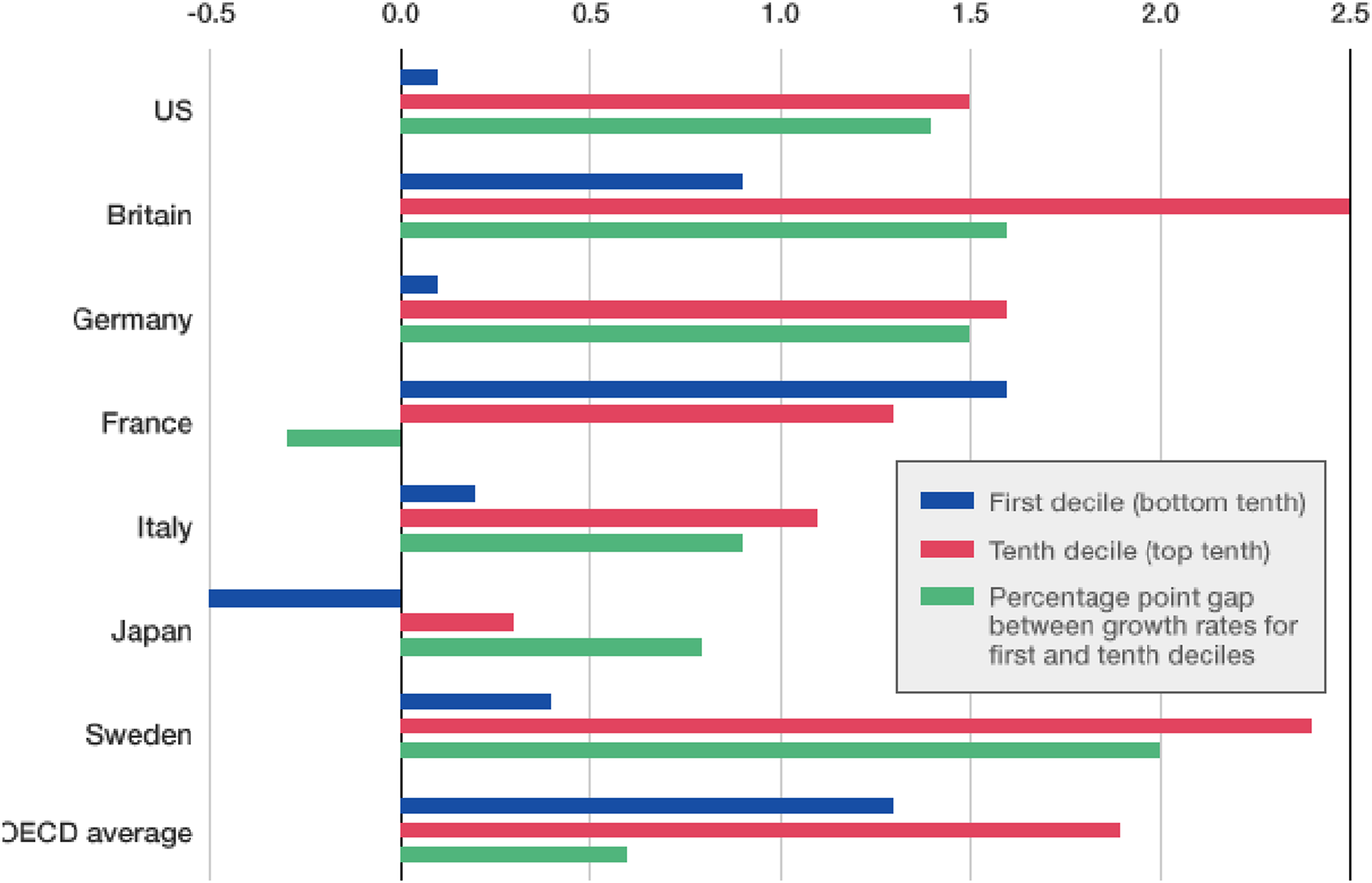
Last but not least, as in other countries, Japan has been characterized by rising income inequalities. Whereas it has been relatively limited by comparison to some other OECD countries, it is characterized by a unique feature: Japan is the only country where the first household decile (bottom tenth) has experienced a drop in real income over a decade, between the mid-1990s and the mid-2000s (Figure 6). Wage growth and unemployment rate in Japan (1997–2018). Source: OECD, Labour Statistics (https://data.oecd.org/jobs.htm). Average annual change in real income by income group in Japan and in selected OECD countries between the mid-1990s and the mid-2000s. Source: OECD Inequality database (https://data.oecd.org/inequality/income-inequality.htm).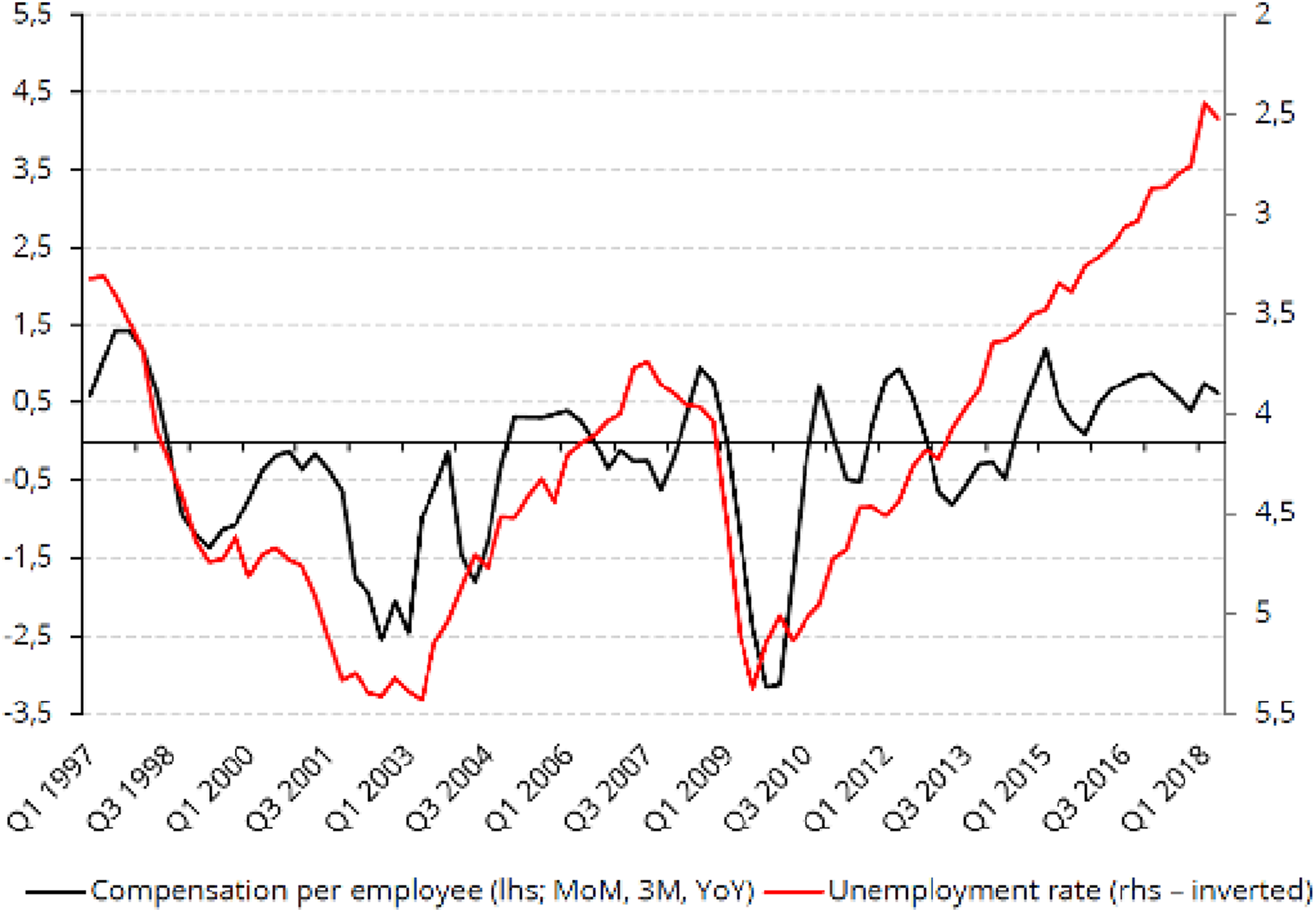
These macro stylized facts lead us to emphasize the double necessity to look more precisely at the mechanisms at work in the emergence of a new digital divide and to analyze at a more disaggregated level the nature of disparities in the context of digitalization in Japan during the most recent period, in order to better understand the nature of the non-inclusive growth regime and to detect any trend that would limit the rise of inequalities associated to digitalization. This is done below successively by focussing first on telework during the COVID-19 crisis (as this practice was marginal before) and then in studying the the impact of digitalization on the wage-labour nexus in the hospitality sector just before the COVID-19 crisis.
Telework during the pandemic in Japan: A manifestation of work digitalization and a source of digital divide
According to Bailey and Kurland (2002), the resort to telework is the symbol of a certain stage of digitalization, which should be beneficial to both employers (through increased efficiency) and workers (through higher job satisfaction, as a result of shorter working time and more balance between working life and private life). By international standards, it was very low in Japan until the pandemic (approximately 6% of Japanese workers were concerned, against an average of 20% in Europe, according to several converging sources, including the OECD). This fact is all the more noticeable that telework has been presented as a solution in the context of the work-style reform under Prime Minister Abe (2018–2019). However, the impact of this reform has been very limited from this viewpoint (Lechevalier, 2021).
During the COVID-19 crisis, a rapid and substantial increase of telework has been observed, from 6% to 25% of the employees over a short period of time, in Spring 2020 (Takami, 2021a). However, it did not produce the expected effects. The major consequence has indeed been a productivity decrease on average. 13 However, this productivity dynamic has been in fact diverse: approximately 1/3 of the workers have maintained or increased their productivity while about half of the workers have experienced a drop in the productive efficiency. 14 How to understand the origin of this disparity? There are various reasons, the major ones are not related to personal characteristics but are to be found on the firms’ side. The effective and efficient development of telework and other types of work practices does not depend only on the existence of relevant technologies. It requires changes in the work organization (Lechevalier and Mofakhami, 2023), which has not been done properly in many Japanese companies.
There is another important channel that comes from the evolution of job satisfaction, which has been relatively neglected in the literature. Takami’s study (Takami, 2021b) is one of the rare exceptions. Although preliminary, the results are meaningful: overall, telework has increased life satisfaction, especially through a better work–life balance. However, there are some exceptions, the major one being when telework implies longer working hours (e.g. because boundaries between work and non-work become blurred). Moreover, it is worth reminding that in Japan, resort to telework has not been mandatory from a legal perspective. It has been only a recommendation from the government, which has been followed only by some firms, for some types of jobs, which might be again a source of disparity at the firm level. This might be connected to the drop of productivity, as self-assessed by the workers (Okubo et al., 2020), which implies some dissatisfaction. It may be at the origin of a digital divide in terms of job satisfaction and labour productivity. As a whole, it means that there is no sign of a reverse trend in the most recent period, by comparison to what has been identified in the previous sub-section, at the aggregate level, during the previous period of digitalization (from the mid-1990s). Moreover, the mechanisms at work (productivity and job satisfaction) imply the rising inequalities are deeply rooted in the growth regime under digitalization. It is also confirmed at the sectoral level, in a sector, which is representative of the anthropogenic mode of development.
Digitalization in the service sector: The case of the hospitality sector
The service sector in Japan, which includes medical care and welfare, hospitality, education, and logistics industries, has seen ongoing digitalization. A first motivation has been to address a persistent problem of low productivity. Indeed, labour productivity in Japan’s service sector has historically been lower than in other OECD countries. This can be seen, for instance, in the hospitality industry, which has productivity levels that were only 38.5% of that in the US in 2016 according to data from the Japan Productivity Centre. 15 A second motivation has been to address the problems related to Japan’s ageing society, especially the associated labour shortage, which is particularly severe in some sectors.
Regulation theory points us to country-specific socio-economic contexts when we examine technological changes and their impacts on labour. We first focus on the hospitality industry and its specificities where digitalization takes place. The hospitality industry in Japan has faced one of the most acute labour shortages and comparatively low levels of labour productivity. The restaurant industry in Japan faces notoriously low-profit margins, averaging around 8% (Digital Shift Times 2023). Growing competition from efficient chain restaurants offering affordability and quality has intensified the pressure. While Japan’s restaurant industry might have achieved high-quality and low-cost dining, this tends to conceal a reality of employee overwork and labour shortages. The pandemic exacerbated these issues, shrinking the market by over 30% and leaving many restaurants facing an uncertain future amid dwindling government support (Digital Shift Times 2023). The severity of the working environment, including long working hours, and an ageing workforce in the hospitality sector, has necessitated the improvement of operational efficiency through digitalization.
Key improvements arising from digitalization in the hospitality sector in Japan.
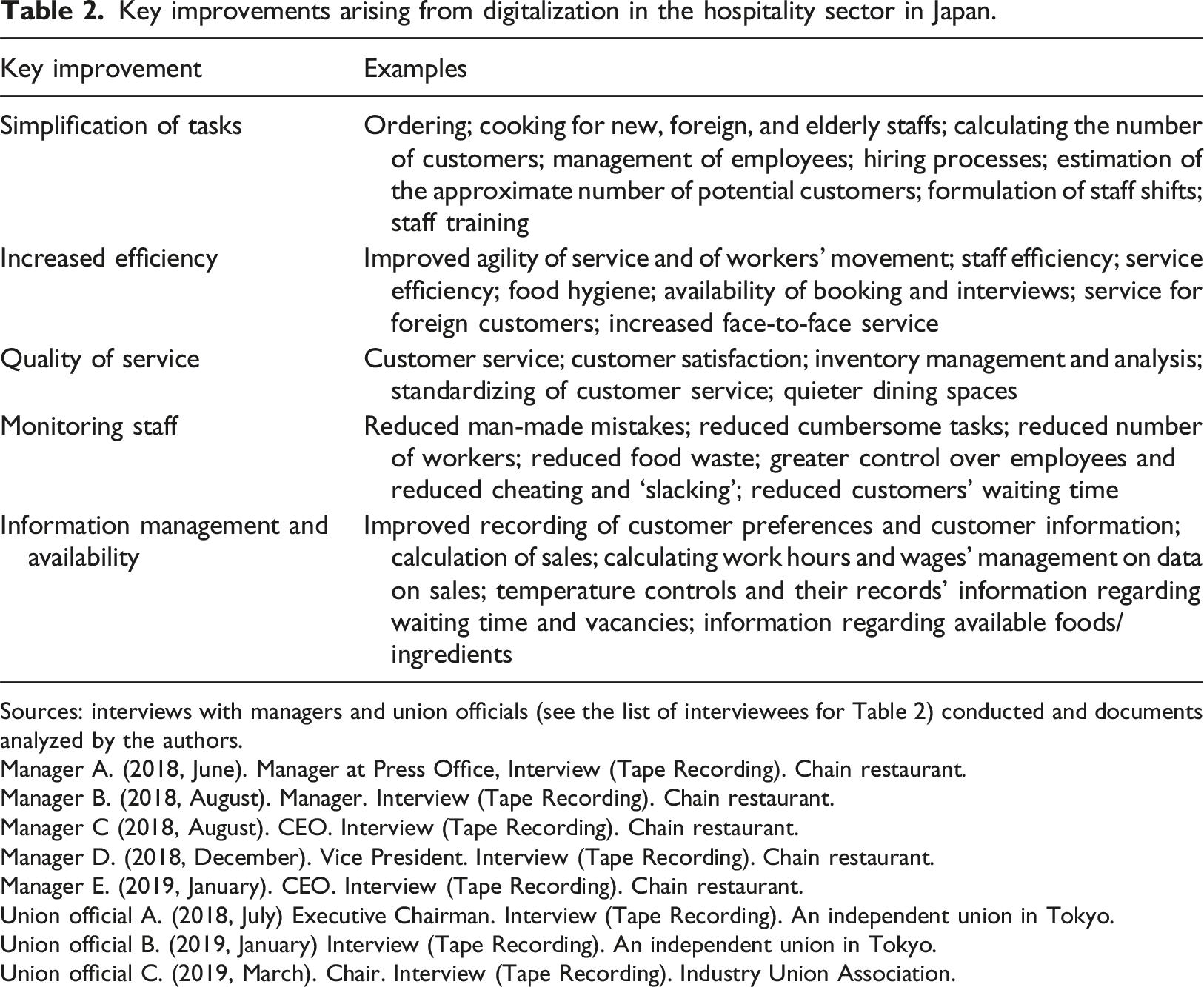
Sources: interviews with managers and union officials (see the list of interviewees for Table 2) conducted and documents analyzed by the authors.
Manager A. (2018, June). Manager at Press Office, Interview (Tape Recording). Chain restaurant.
Manager B. (2018, August). Manager. Interview (Tape Recording). Chain restaurant.
Manager C (2018, August). CEO. Interview (Tape Recording). Chain restaurant.
Manager D. (2018, December). Vice President. Interview (Tape Recording). Chain restaurant.
Manager E. (2019, January). CEO. Interview (Tape Recording). Chain restaurant.
Union official A. (2018, July) Executive Chairman. Interview (Tape Recording). An independent union in Tokyo.
Union official B. (2019, January) Interview (Tape Recording). An independent union in Tokyo.
Union official C. (2019, March). Chair. Interview (Tape Recording). Industry Union Association.
At the same time, from the employees’ perspective, there are a number of significant problems that arise as a result of the process of digitalization, including de-skilling, increased surveillance at the workplace, reduced workers’ autonomy, and intensification of work as a result. 16 First, we see a problem of ‘de-skilling’, which can be defined as a degradation of the quality, range, and depth of professional knowledge necessary to perform a job (Mishra et al., 2019). This is witnessed in the hospitality sector as workers are increasingly required to follow digital instructions given by machines and digital tools, resulting in them losing overall control of their own work (interview with manager A, 2018). For example, some Japanese restaurants continue to introduce and renew machines and wearable devices under a labour shortage and ageing workforce (Shibata 2022, interview with manager B, 2018). For instance, restaurant manager C mentions that ‘we have installed a broad range of devices to reduce workload and improve efficiency in our restaurants. … We also abolished some devices when they became obsolete and more advanced devices became available’ (interview with manager C. 2018). Whilst digital devices reduce the burden on workers (interview with manager C. and manager D, 2018), they also render workers dependent upon digital instructions, rather than using their skills to ascertain the situation within the restaurant. Restaurant manager D mentions that ‘we sometimes become too dependent on technologies’ and ‘encounter difficulties, for instance, when the internet that connects the restaurant operations became temporarily unavailable, which makes it hard to work without technologies’ (interview with manager D, 2018). Nevertheless, manager D points out that ‘Despite such limitations, technologies brought about many advantages, so we will continue to use available technologies’ (interview with manager D, 2018). The acute labour shortage and long working hours that have become Japan’s key labour market challenges explain the continuing progress of the utilization of technological devices despite certain limitations in the case of Japan. Nevertheless, the way in which technologies are introduced has not necessarily improved workers’ well-being, making workers reliant on devices rather than being reskilled. Digitalization in the workplace creates a new tension between efficiency, which employers seek, and workers' skills and well-being, leading to a lack of equity in the workplace.
Digitalization thrives on more and better data, often collected through ‘metrics’. This allows companies to track employees more closely. For example, restaurants in Japan use wearable sensors to analyze worker movement, identify wasted time, and optimize performance (Kinki Keizai Sangyo Kyoku 2017:1, interview with manager B, 2018). While this might aim to improve customer service, it also intensifies work by heavily monitoring employees. Japan’s hospitality industry prioritizes low-cost dining and high-quality service, often achieved through suppressed wages and operational optimization. With long working hours and labour shortages, digital metrics have become attractive tools to further restaurant efficiency. However, drawing on Regulation theory, we consider that this increased efficiency raises concerns about a widening gap between employer benefits and worker well-being, reflecting Japan’s non-inclusive and unequal growth regime.
As electronic devices permeate the workplace, concerns about worker autonomy rise. Zuboff (2019) highlights this shift, noting the potential for technology to become a tool for control (p. 294). This concern translates into reality in Japan, where some employers utilize extreme measures: wearable devices and digital screens feed data to optimize workforce performance. For instance, some chain restaurants in Japan installed video cameras in their restaurants in order to oversee service provision within the restaurant, including through the monitoring of employees, and their performance (interview with union official A, 2018 and union official B, 2019). While employers enjoy increased restaurant operational efficiency by achieving consistency with new monitoring technologies throughout the chain of restaurants, workers are increasingly placed under strict surveillance and workplace pressure.
As a whole, it can be seen from this case study how much digitalization in the hospitality sector has been positive for employers but harmful for employees, leading to a form of digital divide between employers and employees. This case study example of digital divide suggests the current digitalization in the hospitality industry has contributed to a non-inclusive growth regime in the sector. The wage-labour nexus in Japan, which has been firmly focused on maintaining low wages and a flexible labour market in its post-industrial shift, integrates digitalization as a tool to improve efficiency.
Conclusion
In this paper, we have tried to connect the discussion on inclusive growth together with the research on digitalization and its impact on work and labour, with a focus on the transformation of the wage-labour nexus in Japan. Japan has been considered a successful example of combining equity and efficiency, which has given birth to the very concept of inclusive growth itself (World Bank, 1993); however, for at least three decades, the country has been experiencing low growth and increasing inequalities. In this context, digitalization is often presented as the solution and an opportunity to move towards a new model of growth that may solve current social problems: low labour productivity, lack of workforce in a context of ageing, and restrictive immigration policies. Surprisingly, the perception of digitalization as a risk (e.g. that Japan would follow the US path towards impoverishing growth) is not very common and not so much discussed in the Japanese context.
In order to study the Japanese case, we mobilize the Régulation theory framework that allows us to think about the diversity of digitalization patterns and growth regimes (Boyer, 2022), as well as the emergence of different inequality regimes (Boyer, 2015, 2016). We also mobilize the concept of an ‘anthropogenic’ mode of development (Boyer, 2019), which helps us enrich the debate on inclusive growth, in considering technological change (e.g. digitalization) and the structural shift toward post-industrial capitalist dynamics, in which the service sector (e.g. health, education, and culture) is dominant. It leads us to propose a revised concept of wage-labour nexus that pays more attention to well-being issues. We then combined an institutional–macro approach and case study of a sector (hospitality) that is central in the anthropogenic mode of development in order to check whether the predictions of the Régulation theory are contradicted or not by our empirical findings. The combination of these different levels of analysis allows for the generalizability of our findings and for identifying some of the mechanisms at work.
Our major finding is that digitalization, in the specific Japanese context, is contributing to non-inclusive growth patterns, through its effects on the wage-labour nexus, but it does not correspond to the patterns that have been analyzed by the previous literature, in the context of the US or most European countries. This result contradicts two main strands of the literature: 1) that which views digitalization as a catalyst of inclusive growth and 2) that which posits digitalization as a uniform driver of increased inequality converging towards the US model.
More precisely, we find a digital divide has emerged in Japan, with an increase of inequalities in several dimensions (income, working conditions, well-being, etc.) but without corresponding growth in labour productivity or wages. The overall result of this trend is that the benefits of digitalization have been very unevenly distributed: while employers have benefited from intensified work and enhanced labour discipline, most workers have experienced deteriorating working conditions. This is particularly evident for non-regular workers, who are not well protected by labour regulation and are not well taken into consideration by major trade unions. To put it differently, digitalization has become a crucial part of Japan’s neoliberal labour market amidst a labour shortage and an ageing workforce. The wage-labour nexus under digitalization, which creates more tension between employers’ focus on efficiency and a lack of focus on workers' well-being, is therefore likely to contribute to a non-inclusive growth regime.
Our second finding is that this digital divide differs significantly from those analyzed in previous Transatlantic studies (see e.g. Durand, 2020 or Mazzucato, 2019). For example, the gap between the top 1% and the rest of the population is not as pronounced as in the US. 17 This divergence is attributable to several factors of i) the Japanese capitalism, such as the decay of traditional coordination mechanisms (coordinated wage bargaining process, insurance effect of corporate groups, or inclusive dimension of industrial policy) under the neoliberal transformation of the Japanese capitalism, ii) the Japanese wage-labour nexus (inadequate representation of diverse workers and limited union bargaining power), and iii) the absence of domestic tech giants comparable to US GAFAM and the relatively stable market dominance of incumbent firms.
Does it mean that Japan is following its own way or a model shared with other East Asian countries? This is beyond the scope of this paper, but some interesting comparative insights are provided in the introduction of this special issue. Finally, among the limitations of our paper, we would like to emphasize the following one, which is not specific to our research (see Bourguignon, 2022): given the lack of data, it is the difficulty in isolating the role of digitalization from other contributing factors and trends in explaining the evolution of inequalities. In the Japanese case, we are only able to confirm that neoliberal policies have played a major role, much before the beginning of the 2000s, when the effects of digitalization became significant and contributed to non-inclusive growth.
Footnotes
Acknowledgement
The authors are grateful to Bruno Amable, Cédric Durand, Jonas Pontusson and other participants to the Political Economy Seminar at the University of Geneva (March 2024) for their helpful comments. Usual caveats apply.
Declaration of conflicting interests
The author(s) declared no potential conflicts of interest with respect to the research, authorship, and/or publication of this article.
Funding
The author(s) received no financial support for the research, authorship, and/or publication of this article.
