







Abstract
Higher education is becoming increasingly internationalized, and the use of English as a medium of instruction for academic content has become commonplace in countries where English is not the native language. However, concerns are growing that the trend toward English-medium instruction (EMI) has accelerated without sufficient thought to the challenges of the implementation processes. This article discusses the challenges facing higher education institutions adopting EMI and proposes a typology for understanding them. Drawing on previously unpublished data from a study of universities in Japan, a context in which EMI is rapidly expanding, the article reconceptualizes prior understandings and identifies four categories of challenges: linguistic, cultural, administrative and managerial, and institutional. The categories are dynamic and context dependent, with institutional challenges playing a particularly prominent role in Japan. The proposed typology is offered as a conceptual framework for policy makers and program implementers designing effective implementation strategies for EMI.
Keywords
Introduction
As higher education institutions (HEIs) around the world are seeking to internationalize, the teaching of academic subjects through the medium of English in non-native English-speaking countries has grown tremendously. According to a recent study, the number of European bachelor and master degrees taught fully in English rose almost 1,000% between 2001 and 2014, from 725 to 8,089 (Wächter & Maiworm, 2014). Elsewhere, English-medium instruction (EMI) is becoming increasingly ubiquitous, with nations in Asia, Africa, and Latin America reporting growth in, and government policies to promote, EMI in higher education (Dearden, 2015). EMI has been described as “an unstoppable train” (Macaro, 2015, p. 7) and the British Council’s director of English language has described the global use of EMI in higher education as “the most significant current trend in internationalising higher education” (Parr, 2014).
Teaching individual courses, modules, and entire degree programs in English is regarded by governments and institutions in many non-native English-speaking countries as advantageous for both domestic and international students, individual HEIs, and national education systems. EMI can help prepare domestic students for the global workforce and attract international students and scholars, which in turn raise the profile of HEIs in international ranking schemes and increase the global visibility of national education systems (Cho, 2012; Doiz, Lasagabaster, & Sierra, 2011; Shimmi, 2014; Yonezawa, 2010). However, the adoption of EMI in higher education is not a matter of simply switching the vehicle of communication and continuing as usual. There is concern that the enthusiasm and trend for EMI leads to unrealistic expectations regarding positive outcomes and a less than vigorous deliberation of the implementation processes and potential unintended consequences involved (e.g., Byun et al., 2011; de Wit, 2013; Hamid, Nguyen, & Baldauf, 2013; Macaro, 2015; Shohamy, 2013). Policy makers, HEI administrators, faculty members, and staff involved in implementing EMI must consider a multitude of issues, including the scope to which English is used, the quality of instruction and learning, and the integration of courses and programs into existing institutional frameworks.
Macaro (2015) encourages us to start asking difficult questions concerning the implementation of EMI. However, as EMI implementers in different contexts have different motivations and goals for introducing EMI (Hamid et al., 2013), it can be difficult to know which questions to ask. Much of the research concerning EMI is conducted in Europe, in particular in Scandinavia and the Netherlands, and focuses on content learning outcomes and linguistic impacts of EMI (e.g., Airey, 2010, 2011; Björkman, 2010; Dimova, Hultgren, & Jensen, 2015; Hellekjær, 2010; Smit, 2010; Vinke, Snippe, & Jochems, 1998). Yet, the expressed goal of EMI in many national contexts is much wider in scope, centering on the internationalization of education and human capital development (Hamid et al., 2013). In these contexts, the challenges facing HEIs implementing EMI are broader, incorporating such things as employing teaching faculty for EMI programs and expanding administration and support services to cater to an increasingly heterogeneous student body. Research that has been conducted on this wider picture of EMI implementation tends to originate in national contexts that have shorter histories with EMI. In particular, studies that examine issues faced by countries embarking on EMI in Asia are increasing (e.g., Bradford, 2013; Brown, 2014; Byun et al., 2011; Kuroda, 2014; Tsuneyoshi, 2005).
The different research foci reveal EMI implementation challenges spanning issues that are likely to be present to varying degrees in many contexts. Building on prior conceptualizations of challenges facing HEIs implementing EMI, this article introduces a framework for discussing emerging challenges from different perspectives and proposes a typology for understanding them. The article begins by discussing previous research concerning challenges associated with implementing EMI. It outlines three types of previously identified challenges—linguistic, cultural, and structural—to provide the framework for the current discussion. It then presents a multiple-case study of degree programs taught in English at three leading Japanese HEIs to give evidence for understanding the range of issues affecting EMI implementation. Japan provides a valuable context for investigating EMI challenges. In Japan, government initiatives promoting the internationalization of HEIs and the nurturing of globally minded human capital, coupled with domestic competition between HEIs, have recently led to a rapid expansion of EMI programming (Bradford, 2013; Brown, 2014). The results of this study corroborate the presence of the three types of challenge; however, the prominence of structural challenges in the current study suggest that a reconceptualization of that category and the addition of a fourth category, institutional challenges, are useful for improving understanding of the difficulties facing HEIs implementing EMI. All four categories of challenges will not be strongly present or even apparent in every instance. However, they are presented as a typology that may serve as a conceptual framework when designing an effective implementation strategy for EMI.
Three Types of Challenges Facing EMI Implementation
In a 2005 study detailing consequences subsequent to the adoption of English-taught short-term study abroad programs in Japan, Tsuneyoshi identified three types of challenges that EMI program implementers may face: linguistic, cultural, and structural. She found that low-level English abilities of both students (international and domestic) and faculty members, culture-dependent academic expectations, and dilemmas relating to the limitations of working in a Japanese HEI all posed difficulties. Drawing on the substantial body of literature about EMI in Europe and relatively nascent findings from Asia, Bradford (2012, 2013) elaborated on Tsuneyoshi’s (2005) three categories of challenges to determine the depth and range of challenges that may affect institutions adopting EMI. These challenges are important to consider when discussing the academic quality of teaching content in English (Choudaha & de Wit, 2014; de Wit, 2012).
Linguistic challenges are the difficulties experienced when instructors and/or students are working in a non-native language. They include such things as student inability to take notes from academic texts (Hellekjær, 2010) and professors’ reduced ability to use accessible language in the classroom (Tange, 2010). These challenges can result in reduced program quality and loss of confidence in faculty members’ instructional abilities (Vinke, 1995). They are perhaps the most apparent type of challenge and are the focus of much discussion in Europe, where researchers and educators are, for the most part, concerned with the dual goals of content and language acquisition in the EMI classroom. 1
Cultural challenges are those related to diverse EMI student and teacher populations that have different academic and social cultural norms. They include such things as difficulties arising from differences in contextual background knowledge (Tange, 2010), learning traditions, (Eaves, 2009), and intercultural competencies (Kuwamura, 2009). They can result in a loss of cultural texture in lessons, student resistance to tasks, and an absence of the inclusive practices required in the internationalized classroom. In addition, the English language, even if only used as a tool for communication, is not value free and often veils American academic discourse (Block & Cameron, 2002; Hashimoto, 2005). Acceptance of, or resistance to, this discourse can serve to promote or impede the successful adoption of EMI (Wong & Wu, 2011).
Structural challenges are those related to the administration and management of EMI. The recruitment of teaching and administrative staff (Tella, Räsänen, & Vähäpassi, 1999), assessment polices for admission and graduation (Hellekjær, 2010), and issues relating to the acceptance of and buy-in for EMI programs fall into this category. Structural challenges can result in reduced program coherence because of an insufficient number of EMI courses, support staff unable to work with diverse populations, EMI students without the academic competencies required to study in English, and program graduates lacking both content and language proficiency—a phenomenon that Hamid et al. (2013, p.10) have termed a double loss for EMI.
These three categories do not represent definitive demarcations between types of challenge. There is overlap among them, and challenges in one category may lead to challenges in another. However, the categorization is useful for comparative discussion and establishes a framework for the analysis of data in the current study of English-taught programs (ETPs) in Japan.
A Study of ETPs in Japan
Method
A multiple-case study research strategy was used to more fully understand the issues affecting EMI implementation. Data were generated from semi-structured interviews with 27 members of three Japanese HEIs. At the time of data collection (September 2013 to January 2014), the three case-study HEIs were receiving funding from the Japanese Ministry of Education, Culture, Sports, Science and Technology (MEXT) through the government’s Global 30 (G30) Project (see Ministry of Education, Culture, Sports, Science and Technology [MEXT], 2009). The mainstay of the project was the creation of degree programs taught entirely in English. The three HEIs in the study are large comprehensive universities. They had no undergraduate English-taught degree programs before the G30 funding and had established either one or two programs each by the end of the funding cycle (MEXT, 2012a). The universities represent diversity in that they had received differing grades in the 2012 interim MEXT evaluation of the G30 Project (MEXT, 2012b) and represented both private and national institutions. The shared patterns resulting from the study were therefore expected to “derive their significance from having emerged out of heterogeneity” (Patton, 2002, p. 233).
The study focuses on undergraduate English-taught degree programs as these are a new phenomenon in mainstream Japanese universities and are thus likely to experience a range of challenges. Likewise, it looks at degree programs that have a social science rather than natural science or engineering foundation, as the common use of English for scholarly research in hard science subjects means professors in these fields in Japan are often comfortable with English (Manakul, 2007). This study investigates the challenges faced in introducing new programs, and so emphasis was placed on social science programs.
To build a picture of the challenges from different perspectives, eight senior administrators, 13 faculty members, and six international education support staff were interviewed. As the heterogeneity of the study participants, in terms of how long they have been in their positions, nationality and international experience, may affect attitudes toward innovation within universities, particularly among faculty members (see, for example, Bernasconi, 2006; Hashimoto, 2005), the researcher sought to interview 20% of the full-time faculty members teaching on the selected EMI program at each HEI. Faculty member interviews continued until no new information was forthcoming, with the effect that 31% of the full-time faculty members involved in the program were interviewed at University A, 18% were interviewed at University B, and 40% were interviewed at University C. As fewer senior administrators and international education support staff were involved with the programs, fewer were interviewed. Twenty of the participants were Japanese nationals and non-native speakers of English, one participant was a non-Japanese non-native speaker of English, and six participants were native English speakers. Together, these individuals are referred to as program implementers. For the sake of anonymity, references to the participants’ title, academic field, program name, and HEI have been omitted from this study.
As this study focuses on the use of EMI to earn an entire undergraduate degree, and not for short-term programs designed for international students studying in Japan, it makes a distinction between the terms English-taught program and English-medium instruction program. ETP refers to the full-degree programs investigated in this study. EMI programs can be of any length. This distinction is important as the challenges emerging in the following discussion may be a product of the type and length of the program taught in English.
Overview of the ETPs
The design and characteristics of the ETPs studied affect the implementation challenges experienced. Although no ETP in this study shares the same unique set of characteristics, there are two discernible approaches to program design. Two universities integrated their ETP into an existing Japanese-taught program; the students studying their degrees in English follow the same majors as those studying in Japanese, and the courses are assessed similarly. The other university, however, created a new program that runs in parallel to the existing Japanese-taught program in the same faculty. In this parallel program, the English-taught and Japanese-taught programs have different majors, core requirements, homework, and assessment standards. All three institutions award the same degree to the students enrolled in the English or Japanese program within the same faculty.
The composition of students and teaching faculty in the English-medium classrooms vary by program. For example, one of the faculties housing an integrated ETP requires all students to enroll in some EMI courses, whether they are enrolled in the ETP or not. The other faculty with an integrated ETP does not require this. Consequently, EMI classrooms consist of a mix of ETP, international exchange, and Japanese students who have completed their schooling overseas, studying alongside varying numbers of domestic Japanese students. In the parallel program, non-ETP students are only permitted to enroll in certain EMI subjects, and therefore there are classrooms in which only ETP students are present. Contrasts can also be seen in the way that faculty members are recruited to teach on ETPs. Both of the integrated programs rely largely on faculty members employed in the departments before the introduction of the new program. Many of the faculty members were asked to simply convert their existing courses into English. The other HEI, however, employed a new cohort of staff specifically to handle the core teaching and advising elements of the ETP. In this cohort, only one is a Japanese national, and only one obtained a doctorate from a Japanese institution. In contrast, the majority of the faculty members teaching on the integrated programs are Japanese. However, all participants in this study have spent considerable time outside of Japan and most consider themselves to have an international outlook.
Results and Discussion: Redefined Challenges
Each of the HEIs in this study face linguistic, cultural, and structural challenges as they implement their ETPs. However, although linguistic and cultural challenges were experienced by program implementers in this study, they were not as prominent as the structural challenges. Given the acute nature of the structural challenges and the wide scope of issues involved, it was analytically helpful to re-examine what might constitute a structural challenge. This led to the reconceptualization of structural challenges to focus more tightly on administrative and managerial aspects that are somewhat logistical in nature, and to the identification of a new, fourth category of challenges that has been termed institutional.
Linguistic Challenges
Challenges concerning reduced academic content quality and quantity (e.g., Wilkinson, 2005), international student dissatisfaction with professors’ linguistic skills (e.g., Ammon & McConnell, 2002), increased workload because of the language change (e.g., Tsuneyoshi, 2005), and faculty members’ own perceived limitations with using English (e.g., Tange, 2010) are all documented in this study. For example, when discussing the mixed nature of their EMI classrooms, a number of teaching faculty spoke of alienating students with more advanced English skills if they focus their teaching on the lower level students. Professors feel frustrated trying to involve everyone and report that if they use only English, the content they can deliver to students is only about 70% or 80% as much as if the lecture were given in Japanese to Japanese students. One professor described how a native Japanese-speaker colleague experiences his EMI classes:
he can’t cover as much materials in English as he can in Japanese and so he’s having to trim the syllabus. And I think he views that primarily as because he doesn’t speak English at the level that he would like to be able to teach in, but equivalently, the Japanese students that are enrolled in the class can’t keep up at anything like a native English-speaking speed, let alone ingesting the concepts, so in that sense . . . the question is how do we keep the level of classwork and education and the content of the courses and curriculum at the same level, while accommodating this extra additional difficult hurdle, that’s the hard part. (Faculty member, University B)
Professors noted how it takes hours to prepare a good lecture that can satisfy these varied students. They also remarked that it is difficult, even for native Japanese professors, to gauge if quiet Japanese students are uninterested, do not understand the content or language, or are merely choosing to stay quiet. Some faculty members also mentioned a lack of confidence in their linguistic abilities to lecture in English for a whole class period, and cited difficulties in organizing an active, discussion-based classroom.
Despite the identification of these challenges in the case-study HEIs, overall, linguistic challenges were not voiced strongly by program implementers. In fact, consistent with other studies in East Asia (Lei & Hu, 2013; MacDonald, 2009), most implementers did not feel that their own English abilities created challenges in the classroom. When lack of English skill was mentioned, implementers were usually referring to other professors teaching in the program, or to the limited language competencies of students.
Cultural Challenges
Program implementers noted that variations in cultural knowledge created difficulties in teaching non-Japanese students when the subject matter focused on Japan, especially when Japanese students were in the same classroom. Issues of culturally conditioned classroom behavior and academic expectations also emerged. One faculty member reflected that in EMI classrooms,
there are many Japanese people and their attitude is just the same as the Japanese students in the Japanese class. So it’s not like an American lecture [where] many people raise their hands, it’s not like that. There are some foreign students, non-Japanese students, but because the number of them are very small, they seem to just follow the Japanese students and . . . they seem to understand that they should sit quietly in Japan. (Faculty member, University A)
Although at times challenging to manage, mixing students with different backgrounds, and passive and participatory behaviors in the same classroom was not viewed as a net negative by implementers. They see student exposure and adjustment to different learning styles as part of the 21st-century skill set that students in EMI classrooms should be developing.
The cultural challenge that emerged as most apparent is the tension created by differences between the Western-centric practices of the ETP and local academic practices. By design, the parallel program in this study espouses Western educational practices, adopting such elements as detailed syllabi, moderated assessments, and interactive classroom procedures to promote a global standard. The two integrated programs have also incorporated Western classroom practices. Reasons given for this include faculty members turning to seminar-style instruction to compensate for challenges associated with lecturing for a full class period in a second language, and the requests of students for classes more oriented to Western educational methods. One professor commented on the influence of the Internet:
there’s a lot of TED [talks] and those international standards [showing] how the audience and teacher interact with each other, so seems like there have been a lot of like of [sic] emerging demands from students who would like to speak up during the lectures, so I’m trying to adapt to those styles. (Faculty member, University B)
Program implementers in this study do not have ideological concerns about the involuntary loss of a distinct Japanese way of teaching or learning (see Coleman, 2006), nor do they find that Western practices conflict with Asian values (see Wong & Wu, 2011). Indeed, they believe that if a faculty member prefers to, it is possible to separate EMI from its dominant cultures and teach in English using a more traditional Japanese pedagogic approach. One faculty member comments, “the way I teach is the same, whether it’s English or Japanese” (Faculty member, University C), and another states,
the fact that we have a program in English, doesn’t automatically mean that we have to adopt western styles, that’s my own opinion. I personally adopt them, I do the western style with my students, but know that’s a question, I personally think the fact that we teach in English doesn’t actually mean that we do western system. (Faculty member, University B)
The faculty members are also not averse to accepting financial incentives for teaching in English and violating what has been described as an Asian value of parity among colleagues of equal status (see Jon & Kim, 2011).
Rather than worrying about a loss of Japanese practices, implementers are concerned more about the practical consequences of teaching in English. They worry that students and faculty members from both within and outside of the ETP may regard Western-centric practices as better than rather than different to the more usual Japanese teaching style, or that those who speak English well might be seen as superior to those who only speak Japanese. This could possibly lead to a two-tier system within an HEI. This view is particularly prevalent among teaching faculty in the parallel ETP program:
[I’m] not very comfortable with this hierarchy, if you speak English you’re better. I don’t like that and I don’t believe in it. And if we want kids, students, if we want them to have more cultural understanding, we really need to be careful how to communicate with them in terms of identity. (Faculty member, University C) . . . but we do want to try to adapt them [international students] to the Japanese environment, it’s such a hard thing to do because we find that . . . it’s almost like we’re trying to impose some kind of culturally sanctioned practices of education, well “that’s not what we do here,” but it turns out I don’t think that’s what we’re trying to do. I think we’re trying to do things that universities worldwide are having to deal with. (Faculty member, University C)
On another pragmatic note, the implementers are aware of the extra work that adjusting to new academic practices and standards entails and believe that this work deters other faculty members from participating in the ETPs.
Administrative and Managerial Challenges
Some of the administrative and managerial challenges identified in this study were predicted in the literature, but others are unexpected. The literature suggests that ETP implementation in Japan will experience challenges associated with English language assessment policies (Rivers, 2010), the job rotation system of administrative staff (Tsuneyoshi, 2005), and the recruitment and retention of teaching faculty (Lassegard, 2006; Tsuneyoshi, 2005). Of these, program implementers raised the issues of job rotation and the recruitment and retention of faculty members.
The employment status of international education staff was not mentioned as a challenge of great concern. Administrative staff at Japanese universities have traditionally been employed on a rotating basis, changing jobs every few years (Tsuneyoshi, 2005). However, program implementers describe that it is not job rotation that creates difficulties for ETPs, but rather the short-term specially funded contracts on which the international education staff are employed. With job rotation, the international skills acquired by staff members could aid in the internationalization of other parts of the university as the staff members change positions, but with the current limited-term employment system, the ETPs risk losing the considerable skills and institutional knowledge that international education staff members have acquired during the initial implementation phase of the ETPs.
More challenging for the ETPs is the recruitment and retention of teaching faculty. Contrary to suggestions in the literature (e.g., Kurtán, 2004; Vinke, 1995), additional compensation for non-native English speakers to teach in English, while welcomed, did not incentivize faculty members to become involved with the ETPs. Implementers commented that this incentive was too negligible to have meaningful impact. Instead they listed reasons related to the benefits the ETP brings to Japanese students and to their own personal development, as motivators for working on the program. Consistent with faculty members in Hashimoto’s (2005) study, those who chose not to be involved with the programs had concerns about program efficiency. Faculty members are resisting teaching in English because there are not enough non-Japanese speakers in the classrooms to make teaching in English efficient. In addition, very often only a few students enroll in the English-taught courses. Domestic Japanese students try to avoid English-taught courses as they do not want to risk their grade by taking a course that is difficult for them. Faculty members report difficulties teaching these small classes when student group work is required. One professor reports,
They [students] have some options among those [courses] provided in English, but unfortunately some classes are very small, small size classes are better in general, but some type of classes are group work, and so we need some amount of students for such kind of classes, still some professors have some difficulties organizing group working for non-native Japanese speakers. (Faculty member, University B)
Implementers are sensitive that this dynamic means that moving faculty members to new courses to expand EMI programming equates to increased burden on those teaching Japanese-medium courses.
A number of challenges related to the administration and management of the ETPs that had not been reported in the literature about EMI in Japan were keenly felt by program implementers in this study. These challenges relate more to the logistical side of implementing a full undergraduate program, and so are not likely to be issues for the short-term and graduate programs examined previously in Japan. An important theme that emerged was that of program coherence and expansion. Implementers at one of the HEIs expressed concern about the nature of the degree that students will eventually receive, lamenting that there are insufficient classes taught in English for ETP students to obtain a degree with a coherent specialism. This issue arose, in part, because faculty members were recruited to the program simply because they are able to teach in English, regardless of their area of specialism. Issues of coherence are placing constraints on plans for program expansion at the HEIs.
Another logistical challenge is the recruitment of students. Elite Japanese universities are not experienced in recruiting undergraduate students, having always been oversubscribed due to strong domestic reputations. Furthermore, a unified foreign credential evaluation system does not exist in Japan. At the case-study HEIs, this important task has become the responsibility of one or two implementers, usually international education staff members on short-term contracts. These implementers have no formal training in this and are making sense of it as they go along. One staff member described her situation:
I’m still struggling, but what I did first was, researching by using the Internet. But it’s, there’s a limit. So I asked the international students at [her HEI] about their countries’ famous high schools or, we have alumni in the world, so the alumni network is really strong, so I asked them which high schools we should visit [for recruiting], which area, so for example in the States, is California better? or New York? or should we go to the South? We did it for every single country but mainly in Asia. (International education staff member, University B)
Other challenges include those related to resources, such as issues related to a lack of scholarships and accommodation for international students, and the procurement of university materials in English. Program implementers also described inadequacies in the career and counseling support for international students.
Institutional Challenges
The fourth type of challenge that was identified is termed institutional. These challenges are related to the understandings of the ETP as an institution, that is, how the ETP participants self-identify as parts of a larger organization, how the program is perceived from the outside, how it relates to the rest of the university, and how it maintains its own standards. Any new program at an HEI faces challenges establishing itself as an institution, but the experiences of the implementers involved with the ETPs in this study demonstrate that this is especially relevant for them. Some challenges previously identified as structural challenges and relating to the administration and management of the ETP have been reclassified as institutional challenges when they display qualities more closely related to the perceived identities of the ETP.
The existing literature suggests that structural intransigence will be a significant challenge to the implementation of ETPs in Japan (see, for example, Newby, Weko, Breneman, Johanneson, & Maassen, 2009). However, it was mentioned overtly by only one HEI, most likely because participants within that ETP are making focused strides to advance the institutionalization of their program to lead change in the wider university. The other ETPs in this study had more modest goals and were satisfied with operating within the frameworks of existing Japanese-taught programs.
Branding and marketing are institutional challenges highlighted by implementers as reasons for the student recruitment challenges. As Japanese universities are relatively unknown overseas and the undergraduate ETPs had, at the time of study, not yet graduated students who could give testimony about the programs, the universities are finding that they have to actively recruit to attract quality students. Program implementers are trying to work out how to brand their programs to make them stand out. They are struggling with the issue of how much curricular focus to place on Japan. At one HEI, implementers described their focus on Japan as a strategic decision to draw in international students, but also called attention to the fact that the study of Japan does not hold much interest for international students. At another, implementers worried that the non-Japan-specific focus of their ETP is not appealing. They worry that their program does not differentiate itself from programs that could be studied elsewhere in the world. Simultaneously, implementers are thinking about why students should come to Japan to study in English rather than enroll in a program in a native English-speaking country. One faculty member explained that convincing people that there are high-quality educational programs across a broad area of academic interests in Japan is very difficult. He stated that “[Japan] is just not on the radar of a typical person outside of Japan, even people who are considering sending their children abroad for an education experience” (Faculty member, University B). Implementers with no branding or marketing experience are challenged to navigate this process.
Challenges concerning the branding and marketing of programs are a symptom of a broader institutional challenge relating to the situatedness and identity of the English-medium program, the faculty members teaching on the program, and the students enrolled. The programs in this study are, to varying extents, all still struggling to define themselves and find their place within local frameworks. Although implementers state that it was not difficult to convince university administrators and faculty to accept the overall concept of and funding for a program taught in English—because of the status that an ETP brings to the university—the ETPs struggle with fitting in and obtaining buy-in on a more practical level. For example, constrained by the Japanese norm of offering courses that meet just once a week, some implementers feel that students do not have enough time to delve deeply into subjects. In addition, the significant number of different courses that must be provided under this system creates difficulties for program coherence and in finding sufficient teaching staff. Moreover, there are those at HEIs, both within and external to the ETP, who lack a clear vision regarding what the program is trying to achieve. Is the ETP simply an English-medium extension or replication of an existing program, or is it a program that ultimately seeks to incite change throughout the entire university?
At one case-study HEI, implementers reported that resistance to the ETP comes not only from older Japanese professors and administrators that might be guarded when it comes to change, but also from younger international faculty members, even those employed specifically to teach on the ETP. If these faculty members do not have pedagogical training, they question what they are being asked to do. In addition, some faculty members working in the programs are examining their own identities and place within their faculties. They are conscious of the emergence of two academic cultures within their faculty and wary of potential tensions that could develop. Some ETP professors comment that they have different backgrounds and training from many other faculty members and they are mindful of being perceived as outsiders imposing Western educational practices.
Students also struggle with issues of identity. Often, there is not much interaction between international and domestic students, especially when they do not have the opportunity to study together. ETP students have expressed frustrations that students enrolled on Japanese-taught programs treat them as short-term exchange students, as outsiders, and make minimal effort to befriend them. One faculty member described a program evaluation session with ETP students: “They wanted to say ‘We’re not [short term exchange students]. We’re full-time. We live here, we’re doing four-year degrees here’” (Faculty member, University C). Faculty members too are guilty of othering the ETP students. In this study, students were constantly referred to by their status as ETP students, despite their status as fully enrolled members of the faculty. This othering possibly reinforces feelings of segregation.
Institutional challenges related to situatedness and identity are conceptually isolating and they are reinforced by the physical isolation of the ETPs. For example, two of the case-study ETPs are located on internationally oriented campuses, away from the main undergraduate campuses. These can be ideal places to foster an international environment. However, they increase the physical separation between ETP and non-ETP students and may discourage interaction with the program and further encourage feelings of otherness toward those involved with it. One implementer working within an ETP illustrated how some of these feelings manifest at his university:
. . . the most popular nickname of this school is like the “alien.” So there are many people in the other departments, they regard us as quite different . . . they understand that inside of [our school] there are very different people. (Faculty member, University A)
Implications and Conclusion: A Typology of Challenges
The categories of linguistic, cultural, and structural challenges were used as a framework for analyzing the data in the current study. However, analysis of the data revealed that the structural challenges were more significant than the others in the case-study HEIs and covered a much broader range of issues than previously suggested. As a result, the category structural challenges was reexamined and its related concepts were divided into two categories: administrative and managerial challenges and institutional challenges. Administrative and managerial challenges include elements that are logistical in nature, including the provision of facilities and services. For example, challenges related to student recruitment and accommodation for ETP students are administrative and managerial challenges. Institutional challenges relate to the understandings of the ETP as an institution within the university, that is, how the ETP participants self-identify as parts of a larger organization, how the program is perceived from the outside, how it relates to the rest of the university, and how it maintains its own standards. These challenges are less physical and pertain more to the way people, both those inside and external to the ETP, perceive the program. Challenges relating to the ETP’s branding, its position within the university and faculty buy-in, are institutional challenges. These two categories carry so much weight for this study that in the context of the undergraduate ETPs examined, they should be considered on the same analytical level as linguistic and cultural challenges.
The four categories of challenges are proposed as a typology. This typology illustrates the dynamic interrelatedness between challenges facing HEIs implementing EMI. The categories are context dependent and may manifest to a lesser or greater degree in different circumstances, not least because they are constructed by EMI stakeholders within their unique environments. Any challenge experienced in one category may be the result of, or result in, challenges experienced in other areas. There is overlap among the categories as a particular challenge may encompass elements from more than one category. Figure 1 illustrates the typology of challenges facing undergraduate ETPs as conceptualized by the current study.
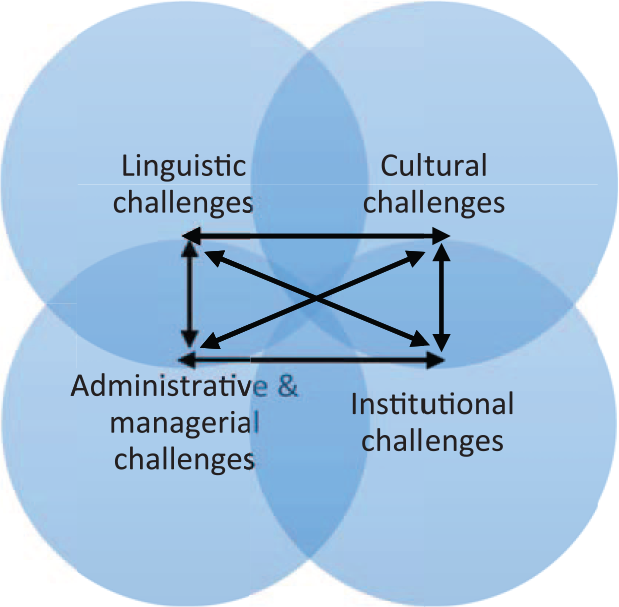
Typology of challenges facing the implementation of EMI.
The extent to which each category is evident in a particular context may be a function of the type of EMI program, context in which it is situated, and stage of implementation. For example, ETPs are more likely to experience a greater number of institutional challenges than short-term international exchange programs because they require greater resources and buy-in from the HEI. Furthermore, as suggested by the current study, ETPs in contexts with less experience with EMI may also face more institutional challenges. The prominence of these challenges in association with ETPs in Japan is not particularly surprising as similar challenges have been well-documented in association with other innovative activities in Japanese education, such as the implementation of information technology in the 1990s (Bachnik, 2003). However, their prevalence signifies how important it is for the HEI and program implementers to deliberately construct the program’s identity and decide how the program should be situated within the university and other local frameworks to fulfill its goals. When a HEI, or nation, moves into a more established phase of program implementation, institutional challenges may become less prominent, as indicated by the prevalence of linguistic challenges documented in research originating in Europe. As EMI continues to grow throughout the non-Anglophone world, this is a potential avenue for comparative analysis. Program implementers and policy makers must seek to find effective ways to introduce EMI initiatives. This article presents a typology of the challenges that HEIs may face, so that they may more easily consider an appropriate strategy for implementation.
Footnotes
Declaration of Conflicting Interests
The author(s) declared no potential conflicts of interest with respect to the research, authorship, and/or publication of this article.
Funding
The author(s) received no financial support for the research, authorship, and/or publication of this article.