







Abstract
To address the shortage of skilled workers in the 21st century, shifting demographics, competition for education funding, and the need to better serve underrepresented student populations, colleges and universities in the United States seek to increase internationalization efforts. While a number of instruments exist for measuring internationalization at the university level, few instruments are designed for measuring campus-level institutionalization, particularly at public community colleges. Moreover, current community college instruments are based on outdated literature or make use of qualitative tools that are not necessarily applicable in all settings. This study utilized an exploratory sequential mixed-method design to construct a quantitative instrument to measure institutional-level internationalization in public community college settings. Qualitative data were used to develop a theory of community college internationalization, from which the Community College Internationalization Index was developed. The CCII will be valuable for tracking public community colleges’ progress in internationalization efforts.
Keywords
Introduction
For the United States to fill the critical shortage of skilled 21st-century workers, the Obama administration set a goal of five million additional graduates from U.S. public associate colleges by 2020 (The White House, 2013). Also, the U.S. Department of Labor secured US$2.5 billion in funding to create the Trade Adjustment Assistance Community College and Career Training Grant Program, directed to support evidenced-based innovative program development in these colleges (U.S. Department of Labor, 2011). Adding to the challenges of global market fluctuations and rapidly changing technology, community college stakeholders encounter shifting demographics as immigrant, refugee, and underrepresented populations increasingly access educational options offered at their local community college. These trends indicate that the rate at which Americans attain associate degrees will extend beyond the current 25% level in upcoming decades (U.S. Census Bureau, 2013).
In response, an estimated 21% of associate colleges have developed institutional internationalization plans, which compares with 55% of their university counterparts (American Council on Education [ACE], 2012). Educating skilled millennial employees necessitates public associate college planning and funding, but federal, state, and local higher education budgets have dwindled during the prolonged economic recession. Consequences include community colleges competing with K-12 education for funding, greater numbers of families receiving public assistance, and increasing numbers of elderly supported by social programs while taxpayers and government agencies have increased scrutiny necessitating evidenced-based demonstrations of tax dollar spending (Berdahl, Altbach, & Gumport, 2011; Townsend & Dougherty, 2006).
Purpose
Despite the expanded community college role, increasingly diverse student populations, and increased need for evidence-based demonstrations of institutional effectiveness, there currently are no quantitative instruments designed specifically to measure institutional internationalization at the community college level. The purpose of this article is to report on the development and validation of the Community College Internationalization Index (CCII), a quantitative instrument designed to meet this distinctive need, which is theoretically derived and reflective of recent global population shifts, immigration issues, technological advancements, geo-political transformations, and socioeconomic effects of a global economy.
The History of Instrumentation to Measure Internationalization
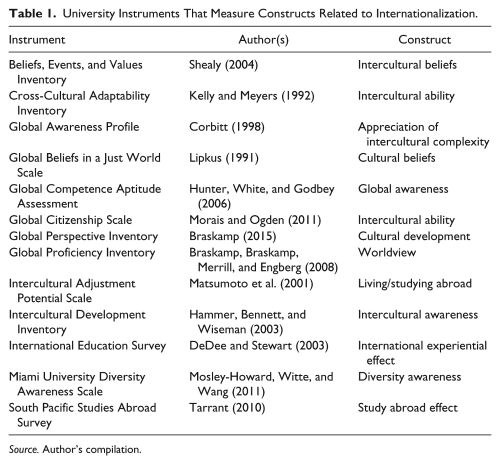
This section details the main reasons why current instrumentation is inadequate for measuring community college internationalization in today’s environment. First, current tools aim to measure constructs specific to university settings and stakeholders. In fact, a number of authors have discussed that, in the United States, the internationalization of higher education has been studied in 4-year institutions for decades, but has remained largely unaddressed in public associate college settings (Altbach & Knight, 2007; ACE, 2012; Berdahl et al., 2011; Brewer & Leask, 2012; Childress, 2009; Deardorff, 2006; de Wit & Merkx, 2012; Green & Siaya, 2005; Hudzik & Stohl, 2009; Klasek, 1992; Knight, 2004, 2012; Morais & Ogden, 2011). Table 1 displays current tools that have been developed for the assessment of internationalization-related constructs, each of which was developed in relation to university students and settings. Researchers have pointed out that instruments developed in a specific setting for a particular use may not be generalizable to another setting or use (DeVellis, 2012; Hudzik, 2011), or may simply be misaligned with the structure, mission, and goals of the different setting (Glaser & Strauss, 1967). Current tools were intended to measure individual student competencies, perspectives, or attitudes, but none have been designed to measure institutional levels of internationalization such as curricular offerings, budgets, and/or policies related to internationalization. Thus, measurement setting and objectives are reasons why it would be inappropriate to use existing university instruments to measure institutional-level internationalization in a community colleges setting.
University Instruments That Measure Constructs Related to Internationalization.
Source. Author’s compilation.
Second, the one existing quantitatively designed instrument that was designed for use in community college settings, “Measuring Internationalization at Community Colleges” (Green & Siaya, 2005), is outdated. This special report, which emerged from the American Council on Education (2012) mapping efforts, utilized data in the tool’s construction that were collected prior to the impact of September 11, 2001. Moreover, the literature review that guided tool development employed a 1990s body of work. Also, respondents to the survey represented leadership perspectives exclusively, with no voice given to other stakeholders. For these reasons, the tool may not adequately measure institutional levels of internationalization occurring in community colleges at the present time.
Third, the existing qualitative tools may not be suitable for community college settings. In particular, ACE provides several qualitative tools (rubrics, checklists, categories) available to educators and administrators through their website. In general, these tools were developed for use in university settings and constructs, with the exception of the Kapiolani Community College (KCC) matrix. This rubric is notable because it was developed while KCC was a member of a consulting organization to which KCC paid fees in exchange for a customized rubric (Community Colleges for International Development [CCID], 2013). In addition, KCC is located in Hawaii and serves high numbers of international students who transfer to the University of Hawaii. The unique demographic of KCC students, the offshore geographic location of KCC, and the fact that KCC paid a consultant for a service to gain assistance in internationalizing is not a situation that is typical of most U.S. community colleges, which suggests that this rubric may be of limited use for most community college institutions. Moreover, a general criticism about qualitative tools is that they represent a prescribed set of standards or best practices. Hudzik (2011, p. 22) has argued that the term best practice assumes that there is, in fact, an ideal approach. Furthermore, Hudzik posits that while effective models in a specific setting may be transferable to similar settings, this does not translate to the decisive approach. Best practices are proposed to provide an archetype that may be achievable only under particular conditions. Consequently, institutions that have chosen to accept the idea of, and seek to implement, best practices may inherently limit their innovative potential and institutional discovery because they are following a prescriptive template (Copeland, 2015).
Contextual Disparities
It is possible that instruments designed for use in university settings could be used in community colleges, but there are distinctions between these settings. For example, public associate colleges tend to serve greater numbers of nontraditional, undocumented, or immigrant students; have an open-door policy; are locally funded; and have high levels of local- and state-level accountability (Townsend & Dougherty, 2006; Valeau & Raby, 2007). In contrast, universities tend to have more expansive public profiles, admission standards, international interests, more frequent external partnering opportunities, and more alumni funding sources (Berdahl et al., 2011; Townsend & Dougherty, 2006). These differences affect what, who, and how to measure internationalization processes in these respective settings.
In addition to the potential misalignment between community college needs and existing university developed instrumentation, there is less internationalization research that is both current and specific to community college settings upon which to build an instrument, when compared to university settings. For example, there are two practitioner-based volumes of New Directions for Community Colleges directed toward general practices and case studies in community college internationalization efforts (2007 and 2013). However, many of the essays in the 2013 volume refer to essays in the 2007 volume, which in turn references the seminal but dated report by Green and Siaya (2005), as previously discussed. The few existing peer-reviewed studies to be found in the internationalization literature exploring community college settings include topics related to how global events have affected planning (Frost, 2009), faculty job satisfaction (Mamiseishvili, 2011), and student study abroad participation (Twombly, Salisbury, Tumanut, & Klute, 2013; Zhang, 2011). The number of currently available community college resources is insufficient to adequately develop a quantitative instrument aimed at measuring institutional-level constructs in a community college setting, particularly when compared with those arising from university settings (Table 1).
Thus, there is a need for a quantitative instrument developed within community college contexts, informed by literature relevant to community college settings, interpreted in the context of existing global conditions, aligned with current technology, consistent with campus demographics, and informed by the worldwide geo-political shifts in which these associate-level graduates will seek employment. The CCII fills this assessment need.
Method and Findings
A two-phase exploratory sequential mixed-method research design was appropriate for this instrument development study because no instruments currently exist to assess internationalization processes at community college institutions, nor are theories or variables entirely known (Creswell & Plano Clark, 2011; DeVellis, 2012). Phase I research questions were addressed through qualitative inquiry for the purpose of developing a theoretical framework relevant to institutionalization on community college campuses. Phase II questions, related to instrument development, were addressed using quantitative methods.
Research Questions
To posit a theory and delineate constructs related to internationalization processes, Phase I qualitative research questions included the following:
Instrument development was addressed during Phase II, driven by two quantitative questions:
Can an instrument that expands upon existing instruments that were designed to measure singular internationalization components in university settings be developed to measure public associate college internationalization holistically?
Can acceptable validity and reliability estimates be established for the newly created instrument to measure public associate college internationalization?
Consistent with the methods of instrument development and exploratory mixed-methods designs, data and results of both phases of the study were interpreted individually, each informing analyses of the other and emphasizing how results to both the qualitative and quantitative questions are connected (Creswell & Plano Clark, 2011).
Phase I: Developing a Theory of Community College Internationalization
In addressing the qualitative research questions, Phase I of the study used a systematic grounded-theory approach to gather data based on emerging concepts arising out of interviews, utilizing a procedure known as theoretical sampling (Corbin & Strauss, 2008). To adequately investigate the spectrum of perspectives by which a theory could be demarcated, a wide range of institutional sizes, community types, geographic settings, and individual stakeholders were purposively selected (Creswell, 2013, 2014; Creswell & Plano Clark, 2011). Corbin and Strauss (2008) have proposed that individual experiences contextualized in a broader phenomenon can illuminate processes and linkages. Consequently, a well-delineated model of internationalization was more likely to emerge by obtaining insights from varying stakeholders. Ultimately, leaders or administrators will use the instrument, but their roles require them to make decisions on behalf of many individuals.
Participants/Phase I
The following criteria were applied to the sampling of institutions (Items 1-5) and individual participants (Item 6).
The institution was regionally accredited by a recognized agency such as the Southern Association of Colleges and Schools (SACS).
The institution employed a representative (staff, administrator, or faculty member) who was responsible for internationalization issues or duties.
The institution was a public associate college, commonly referred to as traditional community colleges, meaning that no degree higher than an associate degree was awarded (Carnegie Foundation, 2013).
Institutional members of the for-profit CCID organization were excluded (CCID, 2013).
Specialty schools (e.g., military, tribal, schools for the blind, U.S. territories) were excluded from the study.
Individual participants were at least 18 years of age and a member of any stakeholder group (student, faculty, staff, employer, administrator, leader, board member, or community partner) who had an internationalization experience with the institution. In the context of this study, community partners represented organizations for which a college had a relationship to offer educational or training opportunities to students or faculty. This may have included, for example, other colleges that partner for study abroad programs, or local social service organizations that partner for service-learning projects, refugee or immigrant training, or guest speaker exchanges.
In addition, to facilitate a more representative community college sample, institutions were selected based upon geographic location, enrollment size, and community setting (suburban, rural, or urban-serving communities). Ultimately, 15 U.S. community colleges were selected for inclusion in the study sample. Using U.S. Census Bureau (2013) geographical distinctions, two of the 15 institutions selected were located in the Northeast, three in the Midwest, four in the West, and six in the South. In regard to institutional size, the sample was constructed to include one small, three medium, seven large, and four very large colleges (Carnegie Foundation, 2013). In regard to community type, four institutions were in suburban settings, eight in rural settings, and three were defined as urban-serving campus locations (Carnegie Foundation, 2013).
To yield a complex picture of internationalization, 29 participants were selected across all relevant stakeholder groups. Thirteen were faculty, three were staff, nine held leadership positions, three were students, and one fit the criteria for community partners. Faculty members represented a variety of departments in the humanities, arts, and social sciences, as well as business, science, and mathematics. Student participants contributed immigrant and veteran perspectives. Staff members provided student service, athletics, and campus ministry representation. Leadership included administrators in workforce development/continuing education and degree awarding departments as well as institutional foundation capacities. There were between one and 10 participants per institution. Twelve institutions were represented by one participant. Two institutions were represented by two participants. One institution had three participants. One institution had 10 participants. Participant gender was 51% female and 49% male. Most interviews (75%) lasted 15 to 20 min, while the remainder continued between 30 and 60 min. Figure 1 displays participant roles.
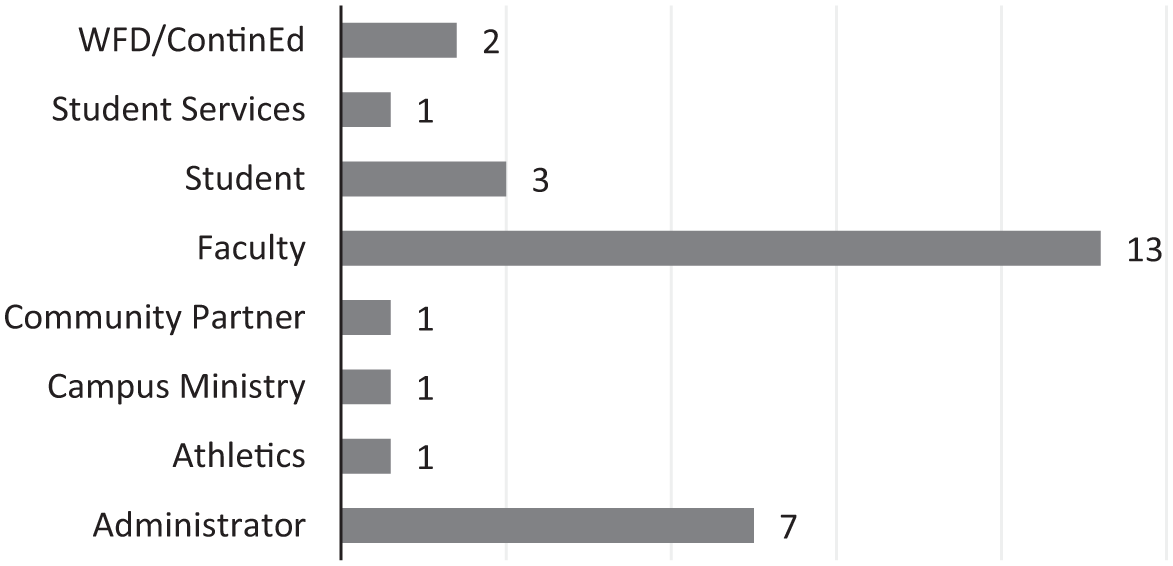
Phase I participants’ institutional roles. Note that WFD refers to work-force development programs.
Procedures/Phase I
Data were comprised of interview transcripts and related documents. To obtain dense data, the interview protocol included open-ended questions guided by a literature review with more specific follow-up questions as appropriate. Questions were posed in relation to the stakeholder’s role. Analysis of transcript data used a grounded-theory approach with MAXQDA® (Version 11) qualitative software. Data were deconstructed and reconstructed vis-à-vis coding, theoretical sampling, asking questions of the data, and constant comparisons processes (Corbin & Strauss, 2008; Creswell, 2013, 2014).
The analyses revealed two dominant typologies: recognition and integration of internationalization processes. Context was brought into the qualitative analysis so that interrelationships could be determined among and between stakeholder groups and institutional settings relative to specific variables (Corbin & Strauss, 2008). These processes were critical to development of a well-grounded theory and constructs upon which to develop the instrument’s dimensions, clarification of what should be measured, and determining the level of specificity of the analysis (DeVellis, 2012). Consideration of the span of each construct, typologies, and connections that were illuminated during coding processes was requisite to facilitate the generation of sufficient and adequate pool items for the CCII during Phase II.
Results/Phase I
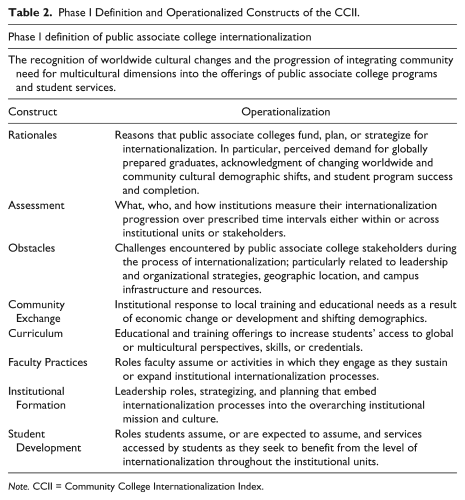
Results of qualitative analyses were distilled into a narrative theory, which was developed into an overarching definition and operationalized constructs that portray public associate college internationalization processes by which to guide instrument development (Table 2). The theory begins with students at all levels of preparedness entering the college as these open-door institutions strive to meet local community needs by way of degrees, certificates, or personal enrichment programs. In relation to internationalization, some stakeholders interact with external constituents responding to immigrant or refugee student needs, while others participate in study abroad or limited partnering opportunities. Students may encounter elements of internationalization, but efforts are uneven and fragmented across the institution.
Phase I Definition and Operationalized Constructs of the CCII.
Note. CCII = Community College Internationalization Index.
Phase II: Developing an Instrument to Measure Community College Internationalization
To address the quantitative research questions, Phase II constituted an eight-step instrument development procedure proposed by DeVellis (2012) that addressed two essential psychometric properties. The first, external validity, was established by employing an expert review and concurrent validity analyses. The second, internal reliability, was evaluated by computing Cronbach’s coefficient alpha and evaluating confirmatory factor analytic results (DeVellis, 2012; Nunnally, 1978). A final ninth step has been added here to present a scoring key, which makes the instrument useful to practitioners for the assessment of internationalization in community college settings. The details of the methodology are reported elsewhere (Copeland, 2015) and summarized below.
Participants/Phase II
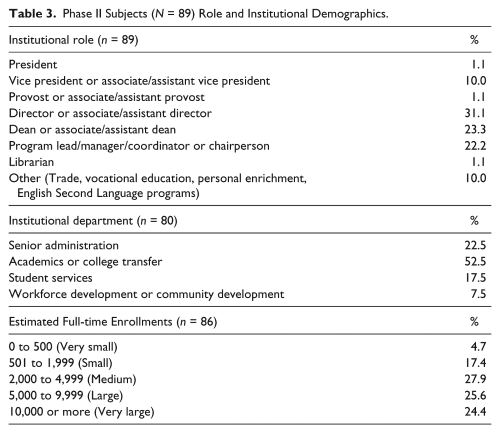
Public associate college leaders and administrators believed to be likely to be involved in internationalization at their institutions were identified as potential participants via an Internet search of publicly available institutional websites. A stratified sampling procedure was used that yielded a list of potential participants across 24 states. To optimize analyses related to instrument psychometric properties during Phase II, a sample of 300 respondents was targeted (DeVellis, 2012; Nunnally, 1978; Tabachnick & Fidell, 2013). Consequently, a recruitment e-mail was deployed via SurveyMonkey® to 2,000 prospective participants who met the inclusion criteria. One reminder e-mail was also sent to nonrespondents during the 3-week period the anonymous survey remained accessible. One hundred eighty-one respondents (9% response rate) accessed the survey. Eighty-nine respondents provided complete data, which were included in the final analyses. Table 3 displays the roles and institutional demographics in relation to Phase II respondents.
Phase II Subjects (N = 89) Role and Institutional Demographics.
Procedures and results/Phase II
The following steps were followed in the process that led to the development of the instrument.
Step 1. Establish what is to be measured.
Clarifying what was to be measured, and at which level of specificity, was based upon a well-grounded theory with delineated boundaries that was developed from Phase I data analyses (DeVellis, 2012).
Step 2. Develop an item pool.
An initial 80-item pool formed of written declarative statements that represented the instrument’s purpose and reflective of the theory developed in Phase I was constructed (DeVellis, 2012). Interview transcripts, quote summaries, posited constructs, and operational definitions were used to inform item construction in a manner to ensure content validity, and refinements to wording effectiveness occurred during this step (Copeland, 2015).
Step 3. Determine scale format.
Decisions about scale format, length, and instructions for use were informed by the choice of target participants for the study (public associate college leaders), noting that Likert-type scales successfully measure sentiments (DeVellis, 2012; Nunnally, 1978). Moreover, to enhance instrument reliability, scales with more gradations are recommended (DeVellis, 2012). Following these guides, response options were developed on a continuum ranging from 0% to 100%, at 10% intervals, where prospective respondents were asked to indicate their level of agreement to each statement. Additional refinements occurred to reduce the length of the instrument, resulting in a 52-item pool that reflected eight posited constructs: definitions or rationales (9 items), assessment (4 items), obstacles (4 items), community exchange (3 items), curriculum (6 items), faculty practices (6), institutional formation (9 items), and student development (11 items).
Step 4. Expert review.
For the purpose of both increasing content validity and decreasing the instrument’s size, 34 experts were identified by means of a literature review, professional groups, or through professional contacts (DeVellis, 2012). Each of these individuals had researched and/or been employed in the realms of community college research, internationalization of community colleges, community college leadership, internationalization of higher education, internationalization assessment, instrument development, or a combination of these specialty areas. Ultimately, 10 experts provided survey responses and feedback for use in three analyses.
First, each expert ranked the applicability of individual items as high, moderate, or low in relation to the posited constructs. The intraclass correlation coefficient, R, was utilized as an internal indicator of reliability, with an established acceptable level of R = .60 (Multon, 2010). Using a two-way random model and average measures, R = .556 was obtained, and the confidence interval statistics 95% CI = [.344, .718], which includes R = .60. In combination, these results may be interpreted as fair interrater reliability and suggested that approximately 95 of 100 rater samples would result in R measures between .344 (low) and .718 (high).
Second, each expert assigned individual items into one of eight categories, which represented the posited constructs derived during Phase I. Thirty-five of the 52 items (67%) were categorized similarly by two thirds of the experts, providing evidence of content validity. Consequently, these 35 items were retained for additional refinements prior to becoming the modified version of the instrument.
Third, experts were invited to provide commentary, both generally about the item pool and its operationalized constructs, and in relation to specific items. Feedback informed modifications with the goal of increasing content validity. Criticism emerged along three central themes: operationalized definitions; wording choices, clarity, or grammar, and potential data collection obstacles. Items were refined based upon the feedback. The modified 35-item instrument reflected four dimensions: institutional formation (15 items), curriculum (10 items), faculty practices (three items), and student development (seven items).
Step 5. Concurrent validity.
Five relevant and previously validated items that align to the two items on the developed instrument were integrated into the item pool, with modified wording to parallel the current instrument’s intended purpose, to assess concurrent validity (Braskamp, 2015; DeVellis, 2012; Morais & Ogden, 2011; Prieto, 2012), which was analyzed during Step 6.
Step 6. Survey administration and concurrent validity analyses.
As described above, a recruitment e-mail (and one reminder e-mail, if appropriate), including a link to the SurveyMonkey® instrument, was sent to 2,000 prospective participants who met the inclusion criteria. Data analysis was conducted on the responses of 89 participants who provided complete data. Concurrent validity was assessed for two dimensions (faculty practices and student development) through the inclusion of five pool items from three previously validated instruments (Braskamp, 2015; Morais & Ogden, 2011; Prieto, 2012). The other theorized dimensions (leadership, assessment, and community engagement practices) were not included as concurrent validity items because previously validated instruments that appropriately align to the purpose of the instrument do not currently exist. Interitem correlations were computed between five CCII items and the corresponding prevalidated items resulting in values between r = .681 and .859, indicating moderately strong positive correlations and suggesting that the developed pool items, in relation to their respective hypothesized dimension (faculty practices and student development), measure what they were intended to measure.
Step 7. Exploratory and confirmatory factor analyses (EFA and CFA).
Preliminary EFA and EFA were conducted to guide selection of pool items that may eventually lead to optimal instrument structure and reliability (see Copeland, 2015, for details). Using a criterion based on factor loadings obtained during EFA (Tabachnick & Fidell, 2013), the 35 items were reduced to a preliminary 30-item scale. The scale consisted of the following dimensions: (a) student development (direct and indirect) with eleven items, (b) institutional formation with eight items, (c) assessment (internal and external) with six items, and (d) amplifying efforts with five items. This refined scale was advanced to CFA procedures for further modification in relation to reliability.
Step 8. Concluding confirmatory factor analyses.
Final CFA serves to refine scale length and determine reliability, which is established utilizing Cronbach’s coefficient alpha (see Copeland, 2015, for details). This measure is computed for each dimension and its respective items. If a particular dimension demonstrates a Cronbach’s alpha coefficient of at least .70 but no higher than .89, the dimension is considered acceptable for instrument purposes (DeVellis, 2012) and items in that respective dimension are considered balanced (Churchill, 1979). If not, balancing strategies are used, which may include corrected item-total correlation values, detection of items demonstrating distinguishably low or high variances, or an item mean value that is far removed from midrange of its respective dimension. For items identified as possibly causing an imbalance, the item was removed from its dimension, and Cronbach’s alpha was recomputed to determine whether the dimension achieved an acceptable alpha level without the item. If that were the case, the item remained omitted from the subscale. If an acceptable level of Cronbach’s alpha was not achieved by removal of the particular item, then the item did not cause the imbalance and was replaced into the subscale (see Copeland, 2015, for details). The results after rebalancing efforts revealed a 20-item four-dimensional scale. Three of the four dimensions demonstrated acceptable reliability levels: student development (eight items; two subdimensions; α = .890 each), assessment (six items; two subdimensions; α = .846 and .876, respectively), and amplifying efforts (three items; α = .877). The fourth dimension, institutional formation (three items; α = .914) exhibited a less delineated structure because it demonstrated an alpha level beyond the acceptable upper threshold of .89. Table 4 reports reliability results, and the appendix displays the final 20-item pool.
Final Confirmatory Factor Analaysis (20 Items).
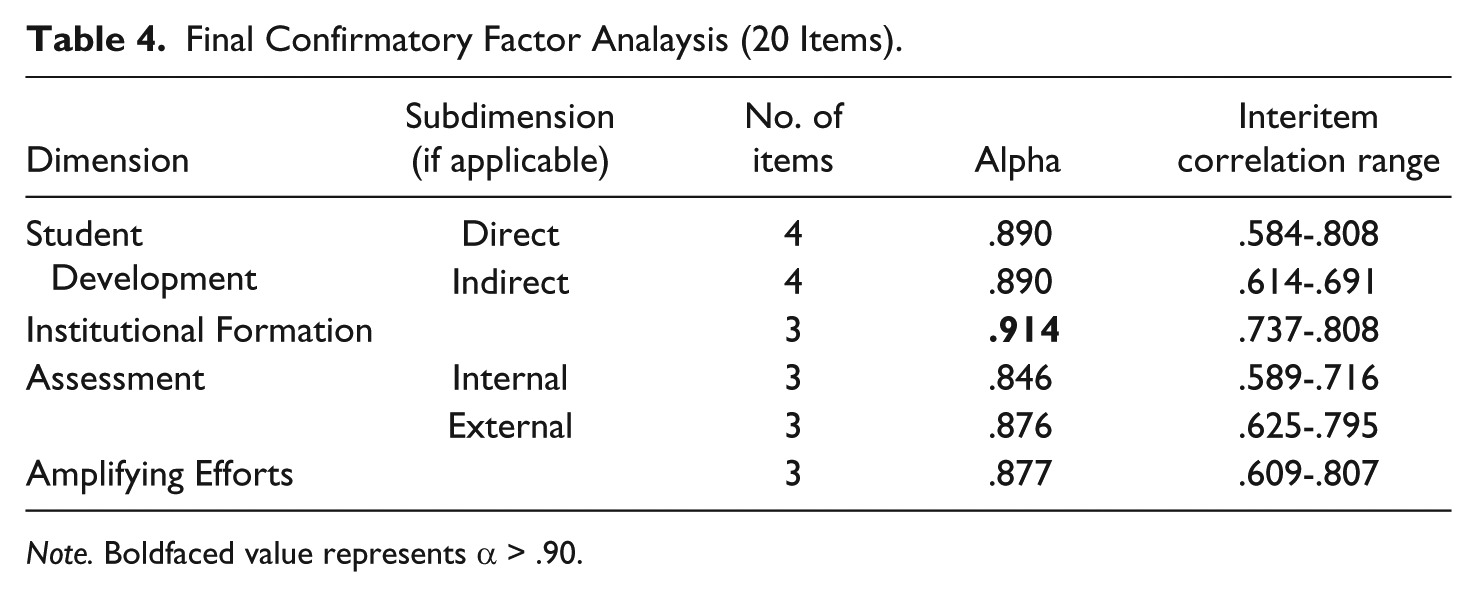
Note. Boldfaced value represents α > .90.
Sample size and communalities
The sample size obtained in Phase II (N = 89) necessitated consideration of germane sample size perspectives because CFA is a type of structural equation modeling that is sensitive to small sample sizes (e.g., DeVellis, 2012; Hogarty, Hines, Kromrey, Ferron, & Mumford, 2005; MacCallum, Widaman, Preacher, & Hong, 2001; Mundfrom, Shaw, & Ke, 2005; Nunnally, 1978; Tabachnick & Fidell, 2013). To determine whether a delineated structure resulting from a small-sized sample is stable and convincingly reliable, communality and factor loading analyses may be used.
These alternate approaches, which are addressed by a number of researchers (e.g., DeVellis, 2012; Hogarty et al., 2005; MacCallum et al., 2001; Mundfrom et al., 2005; Tabachnick & Fidell, 2013), indicate that for structure with high communalities or high factor loadings, smaller sample sizes are acceptable. In particular, if each item’s communality is at least .60 or if the mean level of the communalities is at least .70, small sample size impact is reduced. Moreover, if the number of variables (items) that load on each factor is at least three or if there are a small number of delineated factors (three to five) and five to seven variables (items) represent each factor, then the structure is deemed as stable. Applying these criteria to the current study, the CCII structure may be considered stable. In particular, the current study indicated that 27 of the 29 retained items revealed communalities over .60 whereas all items combined to an average communality of .72. In relation to a loading criterion, the final structure in the current study contained four dimensions (factors), of which each included at least three items.
Step 9. Scoring key
The scoring key was devised to provide a clear-cut calculation for both dimensional and total scores. Specifically, each dimension is scored by summing the responses for each item in the dimension and dividing by the number of items in the dimension, yielding a measure of the perception of the degree to which that dimension has been addressed in the target institution. Similarly, a total CCII score is calculated by summing the responses for all items and dividing by the total number of items in the instrument, which is 20. Thus, items for each dimension and the total will range from 0 to 100, with higher scores indicating the perception of stronger internationalization effort. This set of scores will be useful for longitudinal tracking of internationalization efforts within an institution and also for comparisons across institutions.
Mixed-Methods Results
Results of the qualitative and quantitative phases of the study were interpreted holistically so that qualitative analyses informed quantitative instrument design and the results of the quantitative analyses were extended beyond psychometric properties to assess the degree to which the statistical results further expanded the initial qualitative findings (Creswell & Plano Clark, 2011).
Answering Phase I Qualitative Research Questions
Qualitative data analyses culminated in a theory and posited constructs in relation to the overarching question: What are public associate college administrators’ perceptions regarding the process of internationalizing their respective institutions? To answer this question, findings were summarized into a guiding definition and operationalized constructs of community college internationalization that informed what was to be measured and at which level of specificity during instrument development. Although findings that contributed to these definitions arose from all stakeholder perspectives, the results were contextualized from the perspective of institutional leaders because ultimately these stakeholders would administer the CCII, on behalf of their institutional stakeholders. Table 2 displays these findings.
The second qualitative question posed: How do internationalization plans develop in public associate college settings? The answer to this question arises from results of qualitative analyses that suggested internationalization plans developed as corollaries to student success efforts. These strategies were often sheathed beneath essential institutional functions and generally disjointed, but internationalization plans emerged because stakeholders perceived particular student needs related to globalization and internationalization, and stakeholders sought to respond to these needs in a manner that optimized student success. While analyses often pointed to planning efforts aligned with existing student success pedagogy such as learning communities, experiential and service learning, and tutoring (Center for Community College Student Engagement, 2012), other discoveries underscored unique and organic efforts across all of the 15 institutions.
For example, one small-sized institution in rural Virginia offered faculty travel grants outside the United States for the purpose of curricular development. Notably, the funding was provided through the institutional foundation from a local donor who recognized that this rural community college could not readily offer travel opportunities for students. Instead, up to three faculty were awarded funding each year by which to develop curriculum that could affect many more students than the number that could ever travel due to costs, job, and family duties. Thus, faculty were expected to collaborate with faculty at the institution(s) being visited to develop curriculum related to specific programmatic offerings at the home institution. In one instance, a textiles faculty member visited a South American institution, during which the home-faculty member encountered tree species and manufacturing processes not present in the United States and the current curriculum. Upon return, the faculty member worked within the department to modify the existing home curriculum to include these insights. Ultimately, the curricular addition was intended to enhance students’ future employment prospects.
The third qualitative research question posited: How are dissimilar stakeholders engaged in internationalization processes in public associate college settings? The answer to this question is that stakeholders engaged in internationalization processes because they perceived their efforts would augment student success, enhance students’ employability, or increase students’ global competency. Moreover, engagement occurred in relation to an individual stakeholder’s role. For example, if a faculty member perceived that there were immigrant or international students present in their classroom along with locally born students, the faculty member often responded by involving students with each other collaboratively so that both local and foreign-born students could gain communication skills and team-building dynamics. This occurred in humanities courses as well as mathematics and science courses. In a different instance, a stakeholder in a leadership position noted that faculty were often underresourced as they attempt to bring perspectives that are more global into their classroom discussions. This particular stakeholder mediated an exchange between local service agencies and faculty members so that refugee- and immigrant-guest speakers could visit relevant classroom settings, such as sociology and religion courses, to provide first-person perspectives to students. A quote from a student-support stakeholder at yet another institution best summarizes the overall sentiment expressed by participants:
Our main goal is to support student success. So if students were to state that they needed some sort of more internationalized or global training at our institution I think the institution would be most likely to respond to that.
Answering Phase II Quantitative Research Questions
Instrument development was addressed with the two quantitative questions. The first is, can an instrument that expands upon existing instruments that were designed to measure singular internationalization components in university settings be developed to measure public associate college internationalization holistically? Here, holistic refers to whether the spectrum of singular stakeholder perspectives discovered in Phase I is present in the resulting tool developed in Phase II. In this regard, constructs that were revealed in Phase I analyses were indeed present after Phase II analyses, with the exception of institutional formation and leadership. This may be because efforts to internationalize tend to be bottom-up and fragmented as reported by participants in both phases of the study. Moreover, the CCII used development strategies to build on existing tools that assess only singular components such as student competencies or study abroad, but leadership and governance dimensions are potentially numerous.
The second quantitative research question is, can acceptable validity and reliability estimates be established for the newly created instrument to measure public associate college internationalization? As reported above, quantitative analyses resulted in a 20-item CCII that encompasses four dimensions. Validity (content and construct) was demonstrated through expert review analyses and concurrent validity strategies, respectively. Reliability was demonstrated by communalities, the number of variables (items) that load on each factor (dimensions), and the number of delineated factors (dimensions). Specifically, three CCII dimensions were clearly delineated and consisted of student development (eight items; two subdimensions; α = .890 each), assessment (six items; two subdimensions; α = .846 and α = .876, respectively), and amplifying efforts (three items; α = .877). The fourth dimension, institutional formation (three items; α = .914), exhibited less clear structure. In combination, both validity and reliability have been demonstrated on the CCII instrument.
Interpreting Results
Two main observations have been made in relation to the qualitative results of the study. First, student success as a rationale for community college internationalization efforts was prominently observed across the community colleges that participated in Phase I of the study.
Second, these same institutions did not embrace internationalization as an overarching mission. Rather, internationalization was contextualized more generally as an open-door mission in terms of responding to community and student educational and training needs, that is, admitting students at their current level of academic readiness and moving them along a continuum to greater employment and educational opportunities. This could mean providing English courses to immigrants or using social media to teach sociology students about the impact of global events.
Overall, these results stand in contrast when compared with rationales and missions emerging from university settings. As suggested by prior research (Berdahl et al., 2011; Knight, 2012; Raby & Valeau, 2007; Townsend & Dougherty, 2006; Valeau & Raby, 2007), 4-year institutions may often be motivated to internationalize as a revenue source collected from elevated international student fees; however, the current findings suggest that community colleges may tend to incorporate internationalization as a facet of student success, rather than economic gain. In relation to mission, internationalization may be the mission in a university setting (Altbach & Knight, 2007; Deardorff, deWit, Heyl, & Adams, 2012; Knight, 2012), whereas public associate colleges’ internationalization efforts tend to be more related to the open-door mission, often motivated by providing pathways to student success, and may be a component of a broader set of initiatives rather than the initiative. The apparent differences between these two institutional types in regard to internationalization underscores the need for a tool unique to community college settings, updated to reflect current global changes, and capable of yielding evidence-based demonstrations of institutional change. The findings of this study suggest that the CCII as a valid and reliable tool has meets this need.
Integrating Qualitative and Quantitative Results
Qualitative results of the study indicate that the dynamic between internal and external stakeholders appeared one-directional, with internal stakeholders reaching out to the community and then bringing internationalization efforts into the institution. However, the quantitative results suggested that external stakeholders may also initiate and engage the institution, which is more bidirectional than originally revealed. This result implies that while internal stakeholders engage outwardly to support internationalization efforts and student success, external stakeholders also engage inwardly to engage the institution in internationalized community needs. These inner-directed requests tended to be in relation to one of two areas: changing community demographics, particularly immigrant or refugee populations, or workforce development and educational needs in response to local businesses seeking to become more globally competitive.
In revisiting the theory of public associate college internationalization processes developed during Phase I of the study, internationalization processes were initially characterized as a component of student success, but the addition of Phase II results suggests that internationalization instead serves as a mechanism to student success. This finding indicates that participants recognized internationalization as a set of methods by which to advance student success, organize the institution, evaluate the institution, and strengthen institutional effectiveness efforts. Figure 2 displays these relationships.
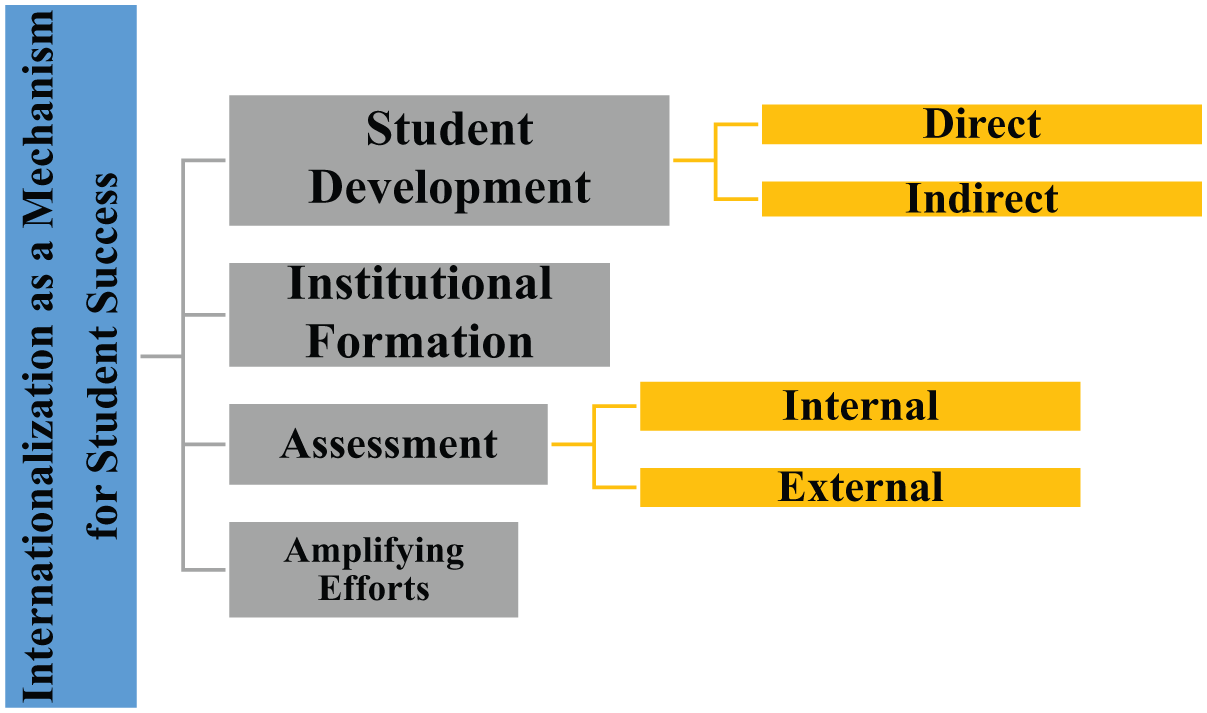
Final theory of public associate college internationalization.
In relation to constructs, the eight constructs developed from Phase I were amalgamated, giving rise to new labels more reflective of the interconnectedness discovered in Phase II. As a result of this two-phase process, the definition of community college internationalization and its constructs were modified (Table 5). For example, student development was initially described from the perspective of an active student stakeholder, but the revision conveys an active role for both student and nonstudent stakeholders. Assessment demonstrates a shift from internal matters only to inclusion of external elements. Amplifying efforts is a new construct that exhibits characteristics from two posited constructs: faculty practices and curriculum. While institutional formation still encompasses leadership and organizational strategies, actions focus on aligning rather than infusing internationalization processes.
Mixed-Methods Definition and Operationalized Constructs of the CCII.
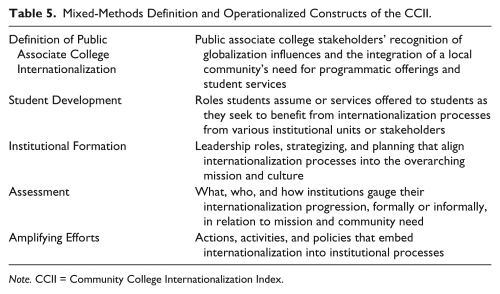
Note. CCII = Community College Internationalization Index.
Discussion
Two major implications of the study are noted. First, results of the current study expand our understanding of the processes, contexts, and apparent dichotomy emerging from community colleges that seek to internationalize. Key to these insights is the fact that multiple stakeholder views were explored rather than limiting perspectives to leadership stakeholders only. Analyses revealed that when internationalization is viewed hierarchically top-down from a leader’s perspective, community college institutions appear to have remained focused on the open-door mission without consideration toward internationalization. However, when internationalization is viewed through a bottom-up lens of faculty, students, staff, or community service organizations, stakeholders are found to be energetically and creatively responding to changing student and community needs. Despite frequent underfunding and fragmentation, the study discovered that dynamic, organic, and temporal activities and initiatives are common across the supporting structures and stakeholders of our community college institutions.
For example, collaborating with community service organizations can provide faculty with a mechanism for obtaining guest speakers, and can provide refugee and immigrant students an opportunity to adjust to their new communities. Students and faculty, some of whom have emigrated to the United States from other nations or have living-abroad experiences, can provide perspectives both in terms of curriculum content and institutional context for internationalization planning. Social media platforms can be used to connect students to classrooms and learning opportunities around the world. Local and foreign-born students can engage one another in classroom settings to harness unique technological skills that emerge as a result of pedagogical differences employed around the world. Local, global, internal, and external stakeholders may equally be utilized as internationalization sources and valuable assets in light of dwindling budgets. The finding that multiple stakeholders innovatively and bidirectionally engage in internationalization processes suggests that rich and varied teaching and learning resources are available within and outside public associate colleges. Thus, although leadership in community colleges is top-down with the primary mission focused on open-door educational opportunities, efforts and initiatives related to internationalization often germinate bottom-up and may reveal greater levels of internationalization engagement than is evident from top-down perspective.
The second major implication of the study is that the results have yielded a valid and reliable instrument for use across public associate colleges engaged in any level of internationalization. Thus, in the current era of accountability and global perspective-taking, internationalization efforts can be measured and prioritized in this setting. The CCII has an optimized scale length, minimizing response time, which may make administration of the CCII more appealing. Moreover, the brevity of the CCII scale allows for regular measurement within an institution that can be used to inform continuous improvement or guide organizational changes, to assess effects of pilot studies, or to serve as a barometer of institutional responsiveness to local and global shifts.
Recommendations and Future Use
This article reported on the development of a quantitative instrument, informed from multiple stakeholder views, designed to measure the unique needs of community colleges seeking to internationalize. These results can both inform policy and direct future research.
In relation to policy advancement, the apparent discrepancy between leadership-driven open-door mission initiatives and stakeholder engagement in internationalization need not conflict. Rather, policy should reflect that the dichotomy represents two lenses, both focused on student success. The CCII may serve to reveal ideological and priority differences between stakeholder groups in relation to how best address student success in an open-door institution in the era of global perspective-taking. The results of this study underscore the synergy that arises from bottom-up efforts related to community college internationalization, and reflective of student success and engagement practices that are vital to the community college open-door mission. As such, leadership strategies that harness and align internationalization efforts with those related to the open-door potentially strengthen the institution and its place in the local community.
In regard to future research, several recommendations are noted. First, the study should be replicated with larger samples to determine whether the CCII structure will remain unchanged or whether the institutional formation dimension would become more delineated. Second, additional studies, conducted with different practitioner groups as participants, can contribute to the development of norms. Third, correlational studies utilizing CCII scores in relation to specific internationalization efforts within an institution may illuminate strategies that effectively increase demonstrations of internationalization. Finally, comparative studies between institutions that use similar internationalization efforts but achieve different CCII scores may elucidate reasons for observed parallels and dissimilarities among and between the institutions.
Conclusion
The results of this study fill a persistent and germane gap in the body of literature as it relates to measurement of public associate college internationalization processes. This article reports how development of the CCII in relation to public associate college internationalization is reflective of multiple stakeholder perspectives and provides a valid and reliable instrument by which to measure efforts related to these perspectives. The CCII has unique utility for practice and research as a tool for quantitative measurement of internationalization in community college settings. The tool may inform policy and practice vis-à-vis examining multiple stakeholder perspectives in relation to internationalization efforts. Moreover, the scale can be utilized for continuous improvement because the data suggest that it is psychometrically valid and reliable, and can provide a longitudinal record of institutional changes over repeated administrations, which will serve to provide evidence-based demonstrations of change.
Footnotes
Appendix
The Community College Internationalization Index.
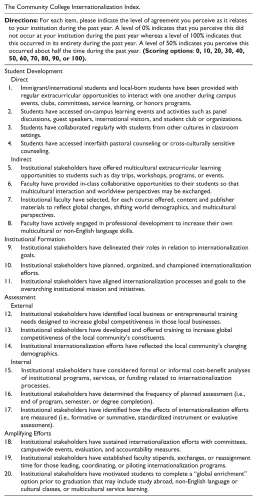
| Student Development |
| Direct |
| 1. Immigrant/international students and local-born students have been provided with regular extracurricular opportunities to interact with one another during campus events, clubs, committees, service learning, or honors programs. |
| 2. Students have accessed on-campus learning events and activities such as panel discussions, guest speakers, international visitors, and student club or organizations. |
| 3. Students have collaborated regularly with students from other cultures in classroom settings. |
| 4. Students have accessed interfaith pastoral counseling or cross-culturally sensitive counseling. |
| Indirect |
| 5. Institutional stakeholders have offered multicultural extracurricular learning opportunities to students such as day trips, workshops, programs, or events. |
| 6. Faculty have provided in-class collaborative opportunities to their students so that multicultural interaction and worldview perspectives may be exchanged. |
| 7. Institutional faculty have selected, for each course offered, content and publisher materials to reflect global changes, shifting world demographics, and multicultural perspectives. |
| 8. Faculty have actively engaged in professional development to increase their own multicultural or non-English language skills. |
| Institutional Formation |
| 9. Institutional stakeholders have delineated their roles in relation to internationalization goals. |
| 10. Institutional stakeholders have planned, organized, and championed internationalization efforts. |
| 11. Institutional stakeholders have aligned internationalization processes and goals to the overarching institutional mission and initiatives. |
| Assessment |
| External |
| 12. Institutional stakeholders have identified local business or entrepreneurial training needs designed to increase global competitiveness in those local businesses. |
| 13. Institutional stakeholders have developed and offered training to increase global competitiveness of the local community’s constituents. |
| 14. Institutional internationalization efforts have reflected the local community’s changing demographics. |
| Internal |
| 15. Institutional stakeholders have considered formal or informal cost-benefit analyses of institutional programs, services, or funding related to internationalization processes. |
| 16. Institutional stakeholders have determined the frequency of planned assessment (i.e., end of program, semester, or degree completion). |
| 17. Institutional stakeholders have identified how the effects of internationalization efforts are measured (i.e., formative or summative, standardized instrument or evaluative assessment). |
| Amplifying Efforts |
| 18. Institutional stakeholders have sustained internationalization efforts with committees, campuswide events, evaluation, and accountability measures. |
| 19. Institutional stakeholders have established faculty stipends, exchanges, or reassignment time for those leading, coordinating, or piloting internationalization programs. |
| 20. Institutional stakeholders have motivated students to complete a “global enrichment” option prior to graduation that may include study abroad, non-English language or cultural classes, or multicultural service learning. |
Declaration of Conflicting Interests
The author(s) declared no potential conflicts of interest with respect to the research, authorship, and/or publication of this article.
Funding
The author(s) received no financial support for the research, authorship, and/or publication of this article.