







Abstract
Hong Kong, along with other Asian societies with universities with top world rankings, has in recent years attracted an increasing number of international students, mainly from Asia. Previous research in English-speaking Western countries has indicated the importance of resources, including language proficiency, positive intergroup relations, and social support, in understanding international students’ stress and coping in cross-cultural adaptation. Guided by a similar acculturative stress and coping framework, we investigated predictors of psychological and sociocultural adaptation in a survey sample of 726 international students (62% female and 73% Asian-born) from Hong Kong public universities. We found that English language proficiency, social support, and a low level of perceived discrimination fostered both types of cross-cultural adaptation, while contact with local students and proficiency in the local dialect further enhanced sociocultural adaptation. Implications for future acculturation research and higher education internationalization policies and practices are discussed.
Keywords
Two notable trends in international education are the rapid growth in international students worldwide and the dynamic and shifting market share for destination countries. Organisation for Economic Co-operation and Development (2013) reported that in the decade ending in 2011, the number of international students worldwide had more than doubled, Asian students represented more than 50% of foreign tertiary students, and their major destinations were English-speaking Western countries. International Consultants for Education and Fairs (2017) noted that with the strengthening of the Asian higher education systems—with one tenth of the Times Higher Education 2016-2017 Top 100 list being Asian universities—increasingly Asian students were choosing to stay within the region.
Acculturation and International Students’ Cross-Cultural Adaptation
The rapid increase in international students studying in Western countries has stimulated a growing body of research on international students’ cross-cultural experiences, much of which is informed by the psychology of acculturation (Zhang & Goodson, 2011). Acculturation encompasses the cognitive processes of change and cross-cultural adaptation that individuals experience when they come into direct contact with individuals and aspects of another culture (Berry, 2002). According to Ward (1996), acculturation can be understood in terms of two domains of cross-cultural adaptation—psychological and sociocultural adaptation; this is the most used framework in the field and is also adopted by this article. International students can feel disoriented, anxious, isolated, or depressed when confronted with the realities of life and the need to adjust to an unfamiliar culture; these experiences reflect psychological adaptation difficulties during acculturation. Many international students may also experience issues in sociocultural adaptation, or ability to “fit in,” to interact and engage socially with members or aspects of their host culture (Ward & Kennedy, 1999).
Depending on the interplay of environmental and personal factors in the acculturation process, international students may experience different degrees of acculturative stress and subsequently different levels of psychological and sociocultural adaptation (Berry, 2002). International students benefit from mobilizing their internal and external resources to cope with the stress arising from studying and living in a new culture (Demes & Geeraert, 2015; Mak, Bodycott, & Ramburuth, 2015). Failure to do so has been found to have a detrimental effect on their mental health, can interfere with their ability to engage with their host culture, and hinder their education (Zhang & Goodson, 2011).
The Hong Kong Context for International Students
Hong Kong Special Administrative Region (HKSAR) in China or simply Hong Kong is a particularly interesting site to study the psychological and sociocultural adaptation of international students. Hong Kong, one of Asia’s financial and cultural hubs, has a predominantly ethnic Chinese population. A former British colony that only returned to Chinese rule in 1997, Hong Kong has continued to have both Chinese and English as its official languages, while English remains the medium of instruction in Hong Kong universities. Hong Kong also boasts of quality higher education, with three of its eight public universities included in a recent list of top 100 world university rankings (Times Higher Education, 2018). All these factors make Hong Kong an increasingly popular destination for international students from the Asian region and beyond. Hong Kong’s annual enrollment of international students has increased from 355 (0.4% of the total student number) in 2003/2004 to 4,950 in 2017/2018, accounting for 4.9% of the total student enrollment in University Grants Committee (UGC; 2001-2017)–funded universities.
Since Hong Kong’s return to Chinese rule, the use of English in the wider community has declined and the Cantonese dialect is the preferred language in social interactions in daily life (Hong Kong Census and Statistics Department, 2016). Nevertheless, Hong Kong retains British style government administrative features. While many of the international students in Hong Kong would share with local students a similar East Asian Confucius heritage culture and/or Chinese ethnicity, most international students might still experience spoken language and cultural differences and be perceived to be different by locals in the community and on campus. Language proficiency and positive interpersonal resources are likely to be particularly relevant for international students transitioning to university education in Hong Kong.
To date, there is a lack of research on language and interpersonal resource factors in the cross-cultural adaptation of international students in Hong Kong, a shifting international education market that affords up-takers with a more diversified destination choice. The present study examined two core adaptation outcomes of acculturation—psychological and sociocultural adaptation—of international students in Hong Kong universities, using a broad acculturative stress and coping resources theoretical framework. Coping resources—in this case language proficiency and interpersonal resources—can potentially mitigate international students’ experiences of acculturative stress, thereby enhancing the sojourners’ cross-cultural adaptation (Mak et al., 2015; Mak & Kim, 2011).
Language Proficiency and Cross-Cultural Adaptation
Previous research has shown that language differences, especially proficiency issues related to the host language of instruction, often represent a major stressor that international students need to contend with, adversely affecting their cross-cultural adaptation (Fritz, Chin, & DeMarinis, 2008; Poyrazli & Grahame, 2007; Yu, 2013; Yu & Shen, 2012). Such language challenges may lower students’ self-esteem and confidence, affect their interactions with others, and exacerbate their academic adjustment difficulties (Hickey, O’Reilly, & Ryan, 2010). Many of the international students in Hong Kong are nonnative speakers of English and can experience psychological and sociocultural adaptation problems in transitioning to university education where English is the language of instruction.
However, the impact of academic language proficiency may depend on the cross-cultural educational setting, domain of cross-cultural adaptation, and availability of other coping resources. Mak et al. (2015) found that the effect of English proficiency on Asian-born international students’ life satisfaction diminishes and becomes insignificant when their other coping resources are also considered.
Research has shown that lack of proficiency in the spoken host language can also have a detrimental effect on international students’ academic performance and cross-cultural adjustment (Hsiaowen & Chang, 2011; Poyrazli, Arbona, Nora, McPherson, & Pisecco, 2002). In the Hong Kong higher education context, studies have found that local students often use the local dialect Cantonese extensively in class and show unwillingness to use English with each other or with English-speaking international students outside the classroom (Evans & Morrison, 2011). It is conceivable that international students with more fluent in Cantonese will enjoy a smoother cross-cultural adaptation, particularly in terms of sociocultural adaptation.
In this study, we set out to investigate whether international students with greater proficiency in English (the medium of instruction) and Cantonese (the local spoken dialect) would experience better psychological and sociocultural adaptation in Hong Kong.
Interpersonal Resources and Cross-Cultural Adaptation
Positive intergroup relations are important interpersonal resources in the acculturation process and are indicated by high levels of social contact and nondiscrimination while interacting with locals. Research on international student adjustment in Western settings has generally identified low levels of social contact with local students, while intercultural interactions often represent one of the major difficulties experienced (Leask, 2010; Spencer-Oatey & Xiong, 2006). Students who interacted more with host nationals were found to experience improved communicative competence, better self-esteem, and fewer psychological and sociocultural adjustment issues (Kim & Semmler, 2013; Ward & Kennedy, 2001).
Although host institutions are often encouraging and friendly, there is always the possibility that students will at times experience issues related to being a cultural outsider and discrimination in their daily life. International students often report discriminatory practices while studying abroad, including discrimination based on race, gender, sexual orientation, and cultural stereotypes (Trilokekar & Kukar, 2011). Experiences of discrimination, be they actual or perceived, can lead to an increase in negative feelings around belonging issues and homesickness (Duru & Poyrazli, 2011) and place major stress on the student’s cross-cultural adaptation (Benson, Barkhuizen, Bodycott, & Brown, 2012; Scott, Safdar, Trilokekar, & El Masri, 2015; Smith & Khawaja, 2011; Vyas & Yu, 2018; Yu & Wright, 2017; Yu & Zhang, 2016). However, in the higher education context in Hong Kong, where the biggest source of international students are from the Asian region, the notion of perceived discrimination based mainly on ethnic and cultural heritage differences could be questionable.
The interpersonal resource of social support has typically been found to be vital for international students’ sociocultural adjustment (Zhang & Goodson, 2011). Research indicates that those who experience high levels of practical and emotional social support from host nationals, co-ethnics, and the international student community are more likely to feel socially connected and report lower levels of depression and difficulties adjusting to life and study abroad (Duru & Poyrazli, 2011; Hickey et al., 2010; Mak & Kim, 2011).
Based on the literature regarding interpersonal resources during acculturation, we would expect that international students who make more social contact with local students, experience a lower level of discrimination and report a higher level of social support, are likely to experience better cross-cultural adaptation.
The Present Study
To date, the bulk of research on international students’ cross-cultural experiences and adaptation has been conducted in English-speaking Western countries. However, there has been a lack of research on (a) coping resource factors in both psychological and sociocultural adaptation among the same participants and (b) the adaptation of international students in Asian universities that are relatively new to hosting such students, most of whom are themselves Asian.
The present study endeavors to address this research gap by investigating international students’ psychological and sociocultural adaptation in Hong Kong. The study was designed to examine the levels of and interrelationships among several coping resources—academic and spoken language proficiency, intergroup relations, and social support—and two core domains of cross-cultural adaptation. This would increase our understanding of not only the acculturation experiences of primarily Asian-born international students in an Asian society where universities use English as the medium of instruction, but also the types of practical coping resources that host institutions could cultivate to facilitate these students’ adaptation process.
Our first research objective was to examine the associations among language proficiency (in English and Chinese Cantonese), intergroup relations (i.e., contact with local students and perceived discrimination) and social support, and international students’ psychological and sociocultural adaptation. Our second research objective was to examine the relative contributions of the various language and interpersonal resources to the prediction of international students’ (a) psychological and (b) sociocultural adaptation. Specifically, we tested the hypothesis that language proficiency, better intergroup relations, and social support resources would be positively and significantly associated with each type of cross-cultural adaptation.
Method
Participants
Participants were 726 international university students (447 females, 279 males) from six public universities in Hong Kong who returned usable surveys. Among the participants, 81.1% were between the ages of 15 and 25 years; 75.1% of them identified themselves primarily as full-time international students, 2.8% as part-time international students, and 22.2% as exchange students. The sample consisted of 502 undergraduates, 120 master students, 88 doctorate students, and 16 others. More than half of the participants (57.6%) landed in Hong Kong for less than 6 months.
The largest cohort was from Asian countries (n = 532, 73.3%), including Eastern Asia (n = 310, 42.7%), Southern Asia (n = 67, 9.2%), Southeastern Asia (n = 75, 10.3%), Central Asia (n = 1, 0.1%), Western Asia (n = 9, 1.2%), and other Asian countries (n = 70, 9.6%).
This was followed by cohorts from Europe (n = 128, 17.6%), North America (n = 54, 7.4%), Australia and New Zealand (n = 13, 1.8%), Africa (n = 6, 0.8%), Central and South America (n = 4, 0.6%), and others (n = 2, 6.7%).
Measures
The survey questionnaire used seeks information on participants’ demographic background and comprises self-reported measures of adaptation (psychological and sociocultural), language resources (proficiency in English and Cantonese), intergroup relations (contact with local students and perceived discrimination), and perceived social support. Higher scaled scores reflect greater amounts of each of the attributes investigated.
Psychological adaptation
Students’ psychological adaptation was assessed as depressive symptoms and measured using a 10-item scale based on Mak and Kim (2011) and originally abridged from Radloff’s (1977) Centre for Epidemiologic Studies–Depressed Mood Scale (CES-D). The response categories for the rating scales are hardly ever, some of the time, and most of the time. An example item is “I am happy.” Responses were reverse scored for negatively worded items so that a higher overall score stands for better psychological well-being.
Sociocultural adaptation
Sociocultural adaptation was assessed by Wilson’s (2011) 19-item modification of Ward and Kennedy’s (1999) Sociocultural Adaptation Scale. International students’ competence in sociocultural adaptation in Hong Kong was measured using 5-point rating scales, where “1” stands for not at all competent and “5” stands for extremely competent. An example item is “Building and maintaining relationships.”
English language proficiency
Mak’s (2009) four-item measure of English proficiency was used to assess participants’ self-reported proficiency in writing, reading, speaking, and comprehension in English, on 5-point rating scales, where “1” stands for poor, “2” for fair, “3” for good, “4” for excellent, and “5” for native.
Chinese Cantonese proficiency
Students’ competence in Chinese Cantonese proficiency in listening and speaking was measured using a two-item scale comprising 5-point rating scales, where “1” stands for not at all competent and “5” stands for extremely competent. An example item is “Understanding and speaking Cantonese.”
Contact with local students
Students’ extent of contact with local students was measured using an eight-item Quantity of Contact Scale from Tawagi and Mak (2015) who originally adapted items from Ward et al. (2005). This measure comprises 4-point rating scales, where 1 stands for never, 2 for rarely (once a month), 3 for sometimes (2-4 times a month), and 4 for often (5-15 times a month). An example item is “Spending time together in the holidays.”
Perceived discrimination
International students’ extent of perceived discrimination experienced in Hong Kong was measured by 10 items adapted from Sandhu and Asrabadi’s (1994) Acculturative Stress Scale. The measure comprises 5-point rating scales, where 1 stands for strongly disagree, and 5 stands for strongly agree. An example item is “Racial discrimination exists in Hong Kong.”
Perceived social support
The seven-item measure on perceived social support was adapted from Mak and Kim (2011), providing an assessment of perceived social support from host institutions and locals, as well as nonhost sources (i.e., fellow international students, family, and friends back home). Participants were asked to indicate their extent of agreement with each statement (ranging from strongly disagree to strongly agree) on 6-point rating scales.
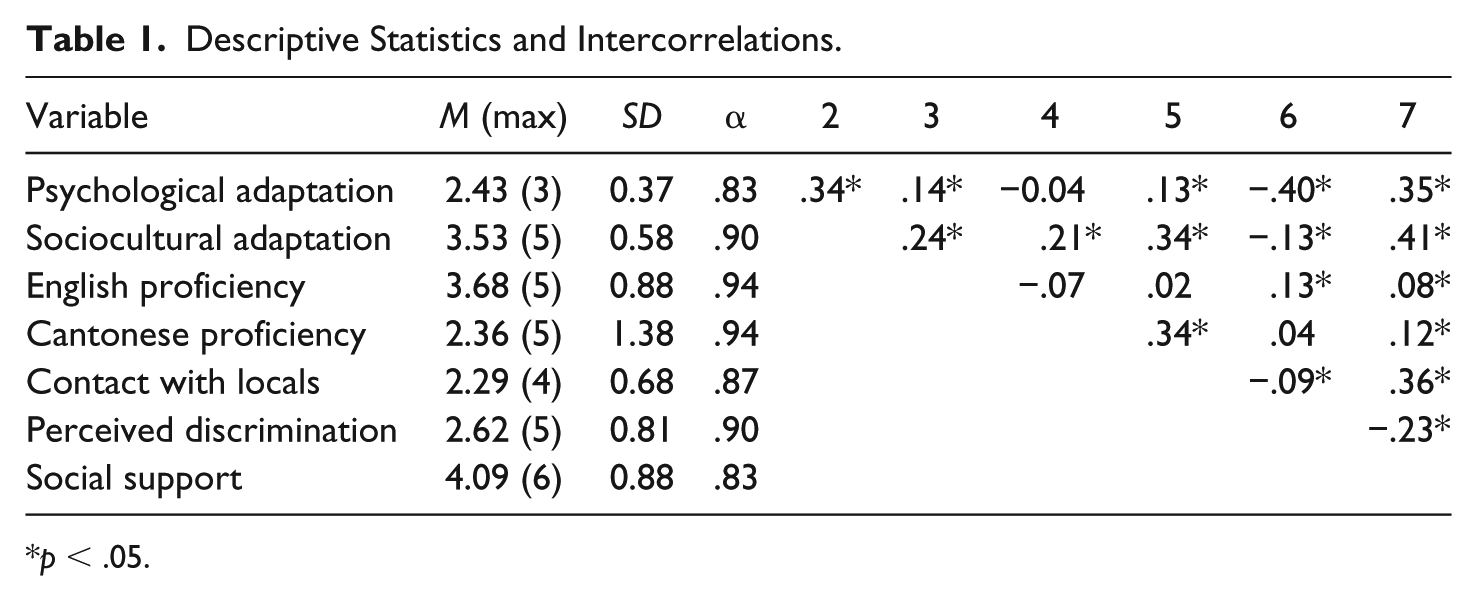
All the scales attained high internal consistency reliabilities in this study, with alphas ranging from .83 to .94 (see coefficient alphas in Table 1 that lists descriptive statistics for all the variables).
Descriptive Statistics and Intercorrelations.
p < .05.
Procedure
After obtaining ethics approval from the relevant university human research ethics committee, we contacted stakeholders in the eight public universities in Hong Kong to seek their help in promoting our research to their international students. Six universities subsequently provided assistance in sending out the “Call for Participants” email that included a link to an anonymous online Survey Monkey questionnaire. In addition, hard copies of the questionnaire were sent to classrooms where course teachers were willing to assist with distribution. The questionnaire took approximately 20 min to complete. Participants completed the survey on a voluntary basis and could choose to go into a lucky draw for one of 100 gift vouchers worth HK$50. Data collection took place from September 2015 to February 2016.
Results
Descriptive Statistics
Analysis of the skewness and kurtosis statistics of the distributions of the scaled scores showed they all approximated normal distributions. Table 1 presented the means and standard deviations of these variables. The mean scores of all the scales were above the scale midpoints, except for those of Cantonese proficiency and contact with local students.
Intercorrelations
Regarding the first research objective, intercorrelations presented in Table 1 show that almost all the language proficiency, intergroup relations, and adaptation scores were significantly intercorrelated with small and medium effect sizes. This included a positive moderate association between psychological and sociocultural adaptation scores, which suggested that they represented primarily distinct domains of cross-cultural adaptation.
Psychological adaptation was positively associated with English proficiency, contact with local students, and social support, and negatively associated with perceived discrimination. Sociocultural adaptation was significantly associated with each of the five language and interpersonal resource predictors in the expected direction.
Demographic Background and Cross-Cultural Adaptation
To check whether there was a need to control for the demographic background variables (gender, age group, educational level, length of residence in Hong Kong, and whether students were Asian-born) before the regression analyses, we conducted MANOVA tests of psychological and sociocultural adaptation scores, across the five above-mentioned background variables. We found no significant main effect of gender, F(2, 474) = 0.988, p = .373; age group, F(8, 948) = 0.807, p = .596; educational level, F(8, 948) = 0.824, p = .582; length of residence, F(10, 948) = 1.403, p = .174; or whether students were Asian-born, F(2, 474) = 0.017, p = .983. Subsequently, we did not include any of these background variables in the subsequent regression analyses of adaptation scores.
Regression Analyses of Psychological and Sociocultural Adaptation Scores
In relation to the second research objective, we conducted separate multiple regression analyses of psychological and sociocultural adaptation scores against the predictor variables language and interpersonal resources. Preliminary analysis indicated that all the assumptions for multiple regression analyses were met. Table 2 presents a summary of the regression analysis of international students’ psychological and sociocultural adaptation scores.
Summary of Multiple Regression Analyses of Adaptation Scores.
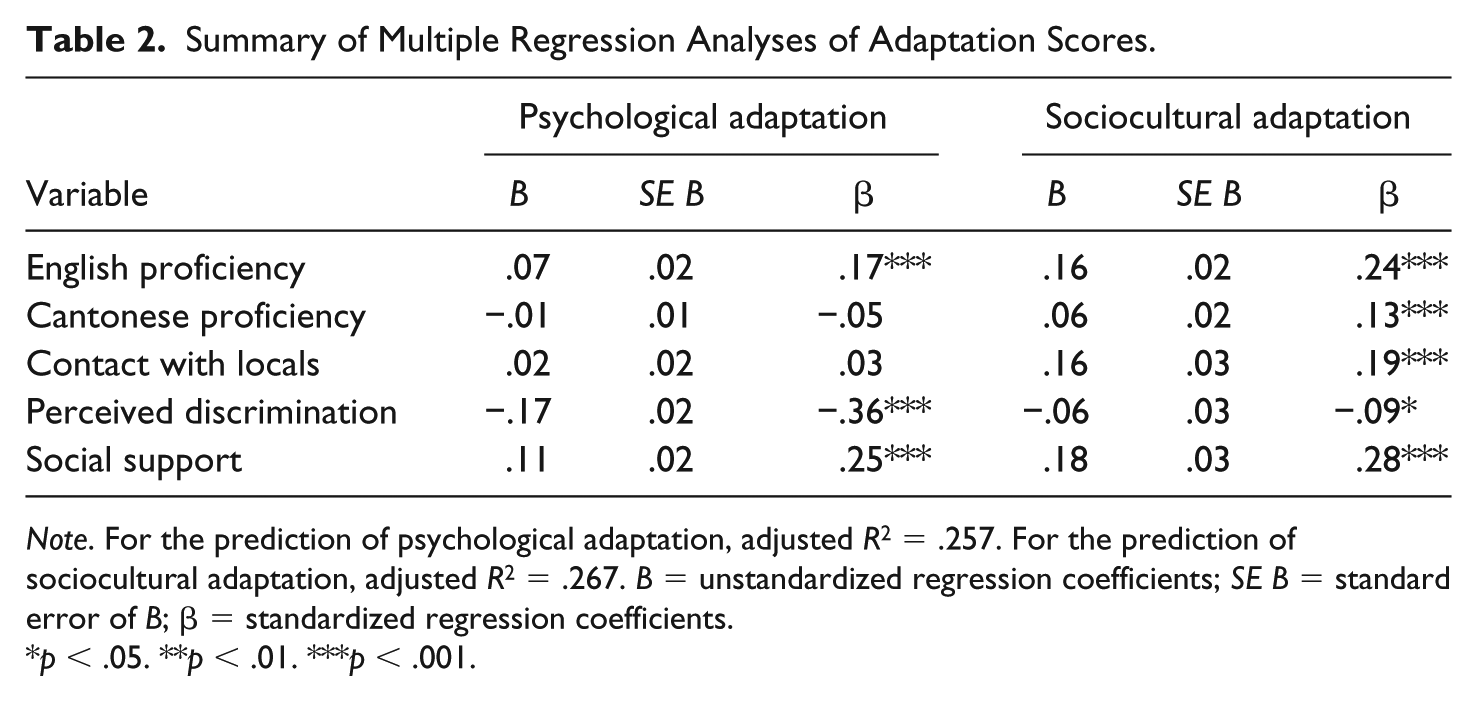
Note. For the prediction of psychological adaptation, adjusted R2 = .257. For the prediction of sociocultural adaptation, adjusted R2 = .267. B = unstandardized regression coefficients; SE B = standard error of B; β = standardized regression coefficients.
p < .05. **p < .01. ***p < .001.
As can be seen in Table 2, the three significant predictors of psychological adaptation were, in decreasing order of beta coefficients, perceived discrimination with a medium effect size, as well as social support and English proficiency with small effect sizes. The predictors explained 25.7% of the variation in psychological adaptation scores, F(5, 604) = 43.022, p < .001.
All of the language and interpersonal resource variables were significant predictors of sociocultural adaptation. They were—in decreasing magnitude of the beta weights and each exerting a small effect size—social support, English proficiency, contact with local students, Cantonese proficiency, and perceived discrimination. The predictors explained 26.7% of the variance in sociocultural adaptation scores, F(5,604) = 45.468, p < .001.
Discussion
Our large sample of Hong Kong’s international university students—close to three quarters coming from other Asian countries—generally reported a moderately high level of psychological adaptation and a somewhat high level of sociocultural adaptation. Despite many international students’ broad ethnic and heritage cultural similarity to that of the Hong Kong Chinese, some students expressed experiencing cross-cultural issues. Interestingly, we found that Asian-born and non-Asian-born international students in Hong Kong reported similar levels of cross-cultural adaptation.
Regarding the first research objective of examining the associations among language proficiency variables, intergroup relations variables, social support, and international students’ adaptation, we found that almost all of the relationships were significant in the expected directions. Notably, each type of cross-cultural adaptation was significantly associated with each of the language and interpersonal resource variables, except for a nonsignificant association between psychological adaptation and proficiency in the Cantonese dialect.
Regarding our second research objective, we examined the relative contributions of the various language and interpersonal resources to the prediction of international students’ (a) psychological and (b) sociocultural adaptation. In partial support of our hypothesis, we found that English language proficiency and interpersonal resources (particularly a lower level of perceived discrimination and a higher level of social support from various sources) were important for fostering both types of cross-cultural adaptation. In addition, when the predictor variables were simultaneously considered, better Cantonese proficiency and more contact with locals were predictors of a higher level of sociocultural adaptation, but not of psychological adaptation.
Language Proficiency and Cross-Cultural Adaptation
Our present finding on the importance of English language proficiency to both the psychological and sociocultural adaptation of international students is consistent with the bulk of the existing literature based on research in English-speaking Western countries (Fritz et al., 2008; Hickey et al., 2010; Poyrazli & Grahame, 2007; Yu, 2013; Yu & Shen, 2012). Proficiency in the language of instruction in an unfamiliar higher education system confers psychosocial benefits beyond academic requirements.
We further found that proficiency in the local Cantonese dialect contributed to international students’ sociocultural adaptation in Hong Kong, but was not linked to their psychological adaptation in Hong Kong. This finding is new to the literature and suggests that in host societies where the spoken dialect is different from the medium of instruction, proficiency in the local dialect provides sociocultural rather than psychological benefits. Beyond proficiency in the language of instruction, fluency in the host dialect facilitates international students’ interactions with locals as well their adaptation in everyday life. We further note that international students in this study generally reported a low level of proficiency in Cantonese. Attempting to master the Cantonese dialect with its numerous tones can be a tall order for international students, particularly at their initial stage of studying in Hong Kong.
Interpersonal Resources and Cross-Cultural Adaptation
Social support
We found social support to be a particularly important predictor of both psychological and sociocultural adaptation. Those students who felt socially supported and connected reported lower levels of psychological and sociocultural difficulties adjusting to life and study in Hong Kong. This finding is congruent with previous research conducted in Western countries (Duru & Poyrazli, 2011; Mak & Kim, 2011; Zhang & Goodson, 2011).
We have informally observed that many international students reported feelings of social alienation and provided examples of a lack of social support on Hong Kong campuses. These included being left out of social activities in halls of residence and on campuses generally, to not being called on to share academic understandings or sociocultural information from their home countries or cultures in classes.
Perceived discrimination
We found that while the level of perceived discrimination was generally moderately low, those international students perceiving discrimination reported more difficulties in cross-cultural adaptation, particularly with regard to psychological adaptation as indicated by depressed mood. This finding is consistent with research findings in Western countries; perceived discrimination constitutes a major acculturative stressor and impacts adversely on international students’ cross-cultural adaptation (Benson et al., 2012; Scott et al., 2015; Smith & Khawaja, 2011).
Contrary to Trilokekar and Kukar’s (2011) suggestion that perceived discrimination is often based on racial and cultural stereotypes, we found that a substantial number of those international students who were Asian-born nonetheless perceived some degree of discrimination from their (typically Chinese) Hong Kong peers and people in the wider community. It may be the case that ethnic similarity and sharing a broad Confucian cultural heritage may not be sufficient to curb prejudice and discrimination, especially where perceived cultural differences are sometimes amplified among ethnically similar groups.
Contact with locals
We found that greater contact with local students made a unique contribution to international students’ sociocultural adaptation in Hong Kong. Such contact was also found to be associated with psychological adaptation at the bivariate level, but not when other resources were also considered. Our finding on the importance of contact with locals is congruent with previous research on various indicators of international students’ psychosocial adjustment in Western settings (Kim & Semmler, 2013; Ward & Masgoret, 2004; Zhang & Goodson, 2011).
In the present study, we identified a moderately low level of contact with local Hong Kong students, despite many of the international students’ broad ethnic and cultural heritage similarity with the locals. Sadly, this relatively low level of social interactions is consistent with the social divide between domestic and international students that typically occurs in Western higher education (e.g., Mak, Brown, & Wadey, 2014; Spencer-Oatey & Xiong, 2006; Williams & Johnson, 2011).
We further found a positive association between Cantonese proficiency and social contact with local students. It would appear that international students’ limited contact with local peers is partly due to their limited Cantonese proficiency, in a campus environment where most local students prefer to speak in Cantonese and avoid communicating in the language of instruction if they can help it.
Implications for Future Research
Strengths of our present study include the use of a large sample in a novel higher education context where most of the international students share broadly similar ethnicity and cultural heritage with locals, and where the local dialect is different from the medium of university instruction. A major limitation of the present study is its cross-sectional survey design. Future research using a longitudinal design and in-depth qualitative studies can help gain a better understanding of the nexus between language proficiency, intergroup relations, social support, and cross-cultural engagement and adaptation. Research focused on acculturative stress, coping, and diverse domains of adaptation of international students in various Asian settings that have recently prioritized an internationalization agenda will be worthwhile. Mainland Chinese students’ acculturation and adaptation experiences in HKSAR will merit investigation.
Further research in Hong Kong can investigate how the use of English and Cantonese by local and international students can facilitate or inhibit their intergroup social contact in classes, halls of residences, extracurricular activities, refectories, and other social settings. Research on the forms and prevalence of perceived discrimination experienced by international students, and evaluation of strategies to support the well-being of affected students, is necessary.
Further investigation also needs to be undertaken into the nature, scope, and effectiveness of social support programs offered to international students, and ways to foster positive intercultural relations and develop intercultural competence—for both local and international students—in the formal and informal curriculum.
Implications for University Policies and Practices
Our present findings also offer implications for university policies and practices needed to facilitate international students’ cross-cultural adaptation and thereby their study experience in Hong Kong. It is important for Hong Kong universities to live up to the expectation of using English as the medium of instruction in classrooms and find ways to extend and encourage the use of English outside the classroom. The provisions of English and Cantonese language enhancement and communication programs can benefit all students, and facilitate the academic, psychological, and sociocultural adaptation of international students.
Interpersonal resources—social support from various sources and positive intercultural relations—play an important role in cross-cultural adaptation. Actual or perceived discrimination epitomizes negative intergroup relations, adversely impacts on the sojourners’ psychological and sociocultural adaptation, and runs contrary to the aspirations of HKSAR Government and educational institutions to grow international student numbers and to internationalize higher education.
Host institutions are keen to facilitate their international students’ cross-cultural adjustment and they should provide not only general student support services, but also intercultural or cross-cultural training (Sit, Mak, & Neill, 2017). Previous studies show that international students respond well to social support programs run by host institutions, including intercultural interaction programs and transformative learning programs (Trilokekar & Kukar, 2011).
We believe that the culturally mixed university classroom is where cultural learning and intercultural competence are most effectively developed for all students, and where international students are assets for domestic students’ development of intercultural knowledge and skills (Mak & Barker, 2013). This facilitates intercultural contact and underpins the development of favorable intergroup attitudes freed of prejudicial opinion as well as cultural and linguistic ignorance, including that of the substantial variation in cultures and languages within the Asian region. The development of intercultural skills in classrooms and through required institution-based extracurricular activities is integral to the internationalizing of higher education (Leask, 2010) and the creation of an engaging, connected, and harmonious academic and social environment (Bodycott, Mak, & Ramburuth, 2014). University teachers, like students, need development programs to ensure they have the critical skills needed to internationalize their subject matter and to engage students from culturally and linguistically diverse backgrounds (Mak & Barker, 2013).
Governments, university and school leaders and managers, parents, and students need to do more to understand and develop ways to reduce, if not eliminate, from education institutions all forms of discrimination and intolerance of out-groups. Successful social contact and integration require a willingness and opportunities for both local and international students to expand their “comfort zone” to mix with others (Wilson, 2011). A larger amount of high quality and nondiscriminatory social contact with locals engenders a greater range of practical and emotional social supports for international students beyond those provided by the educational institutions themselves. Provision of language support and interpersonal resources will not only enhance the academic and psychosocial adaptation of international students, but also deepen their understanding and appreciation of Hong Kong students, their host institution, and HKSAR itself.
Conclusion
Broadly consistent with acculturative stress and coping research conducted in Western countries, we found that proficiency in the language of instruction, intergroup relations free of perceived discrimination, and social support are important coping resources for both the psychological and the sociocultural adaptation of international students in Hong Kong. In addition, those with some proficiency in the local dialect and more contact with local students reported a higher level of sociocultural adaptation.
Despite the apparent ethnic and some degree of heritage cultural similarity between local and international students in Hong Kong universities, we found that some international students experienced difficulties in their cross-cultural adaptation. International students from other Asian countries are not immune to cultural stereotypes and differences while studying and living abroad in another Asian setting.
We recommend further research on various domains of international students’ adaptation in various Asian educational settings that have recently prioritized a higher education internationalization agenda. Mainland Chinese students’ acculturation and adaptation experiences in HKSAR will also merit investigation. We further recommend university leaders and teachers explore and develop ongoing programs on language development and social support for international students, as well as initiatives to support the development of intercultural competence for all students. Providing a high quality academic and interpersonal environment is important not only for attracting more international enrollments, but also for internationalizing the education and enriching the academic and social development of all students.
Footnotes
Declaration of Conflicting Interests
The author(s) declared no potential conflicts of interest with respect to the research, authorship, and/or publication of this article.
Funding
The author(s) disclosed receipt of the following financial support for the research, authorship, and/or publication of this article: This study is supported by General Research Fund (GRF 840313) funded by Hong Kong University Grants Committee (UGC).
