







Abstract
Higher education institutions (HEIs) play a critical role in creating and distributing the knowledge required to tackle the complex global challenges faced by society today. This role is frequently linked with the concept of the internationalization of higher education, but this concept in practice is also subject to criticism. This article argues that integrating the United Nations (UN) sustainable development goals (SDGs) into the teaching and learning functions, partnerships, research, and discovery functions of institutions has the potential to transform institutions and improve society through internationalization. In this article, the ideological and practical intersections of internationalization and the SDGs are discussed. Examples of initiatives around the world that have shaped societal discourse through the lens of internationalization and sustainable development are reviewed. The authors posit that integration of both concepts would enable HEIs to rise up to the global challenge of creating a better world for all.
Keywords
Introduction
Times are changing for higher education. Increasingly, higher education institutions (HEIs) are asked to both articulate and demonstrate how they are making a positive impact in the world. Traditionally, impact measurements have focused on student experience, international partnerships, and cross-border mobility of faculty, staff, and students (Ravenscroft et al., 2017).
The perception of what internationalization means to an institution varies considerably. Some experts consider the concept of internationalization to be around countries, cultures, education systems (Knight & International Association of Universities, 2006), and curriculum development, research, partnerships, and mobility (de Wit, 2011), while others approach internationalization more holistically and base it on the ethos and values of an institution (Hudzik, 2011). A more recent and evolved definition of internationalization is an intentional process of integrating an international, intercultural or global dimension into the purpose, functions and delivery of post-secondary education, in order to enhance the quality of education and research for all students and staff, and to make a meaningful contribution to society (de Wit et al., 2015).
While the positive merits of internationalization are well understood, a growing body of literature suggests that internationalization is leading to many undesired effects, including increased commoditization of higher education, increased number of students leading to a greater proliferation of campuses, increasing inequalities, and decreasing quality of education for a large number of students (Altbach, 2013). Moreover, critics suggest that internationalization is focusing less on education as a public good and is making a perilous shift toward financial motivations (Altbach, 2013).
Undoubtedly, there is pressure of revenue generation, international student and faculty recruitment, competition for the brightest minds, profile and the need to advance research publications in high impact journals, and the use of English as a language of research and instruction (de Wit, 2019). These neoliberal attitudes toward internationalization conflict with the more inclusive and equitable approach to quality education (SDG4). While the influence of globalization has narrowed the gap for no poverty (SDG1), it has worryingly increased inequality within and among countries (Rahim et al., 2014). For example, Sub-Saharan Africa has the lowest participation in higher education in the world (5%), and enrollment in Latin America is less than half that of high-income countries (Altbach et al., 2010), suggesting that internationalization of higher education currently favors the privileged.
Internationalization may offer many opportunities, but it also raises a number of ethical concerns. For example, the unequal global positioning and power of higher education systems is a concern (Marginson, 2006) and has raised ethical questions—How can institutions in the North enact ethical collaborations with institutions and communities in the South, given their often highly uneven positioning within the global higher education landscape (Collins, 2012; Dixon, 2006)? On what grounds can universities justify receiving public support without reproducing nationalistic entitlements and exclusions (Brown & Tannock, 2009; Shahjahan & Kezar, 2013)? Stein (2017) argues that Northern countries need to offer assistance on education, and training to Southern countries, so that they achieve similar levels of success to countries in the Global North to avoid actively contributing to the rise of global inequality and harm.
The internationalization of higher education has also been criticized as a racial, gendered, and economic system for extending Western Nations’ power, knowledge, and beliefs effectively erasing the cultural knowledge of Southern countries and indigenous people in the Global North and South (Bhandal, 2018). Other criticisms include concerns that the recruitment of international students may weaken the force of opportunities for minoritized local students and negatively impact local communities (Wanyenya & Lester-Smith, 2015).
Internationalization for Higher Education of Society aims “to benefit the wider community, at home or abroad, through international or intercultural education, research, service and engagement” (Brandenburg et al., 2019). Given the recent characterization of Internationalization for Higher Education of Society, and the emphasis that internationalization must impact not only an institution but also the environment outside of it, this article explores the complex relationship between the broader conceptualization of internationalization and the United Nations (UN) sustainable development goals (SDGs). This article is intended for a broader audience of an academic community, not limited to agents of internationalization, faculty, staff, and students.
The SDGs can be thought of as a catalyst and internationalization as a response. The March 24, 2021, occasion of the Virtual Forum on the Role of Universities in the 2030 Agenda was the first time in which leading universities across six continents made a statement on the SDGs. Reconnecting internationalization with a broader set of purpose can potentially enable HEIs to solve common challenges and achieve common goals. HEIs are suitably positioned to educate communities on internationalization and sustainability. Although HEIs vary in their geographical and historical context, missions, and structures, they have the capacity to make decisions, and organize and transform themselves to mainstream SDGs into institutional and internationalization practices (see Figures 1 and 2). For example, HEIs can transform classroom initiatives, campus operations, student experiences, organizational dynamics, leadership, governance, and community engagement initiatives (United Nations Educational, Scientific and Cultural Organization [UNESCO], 2014; Figure 2).
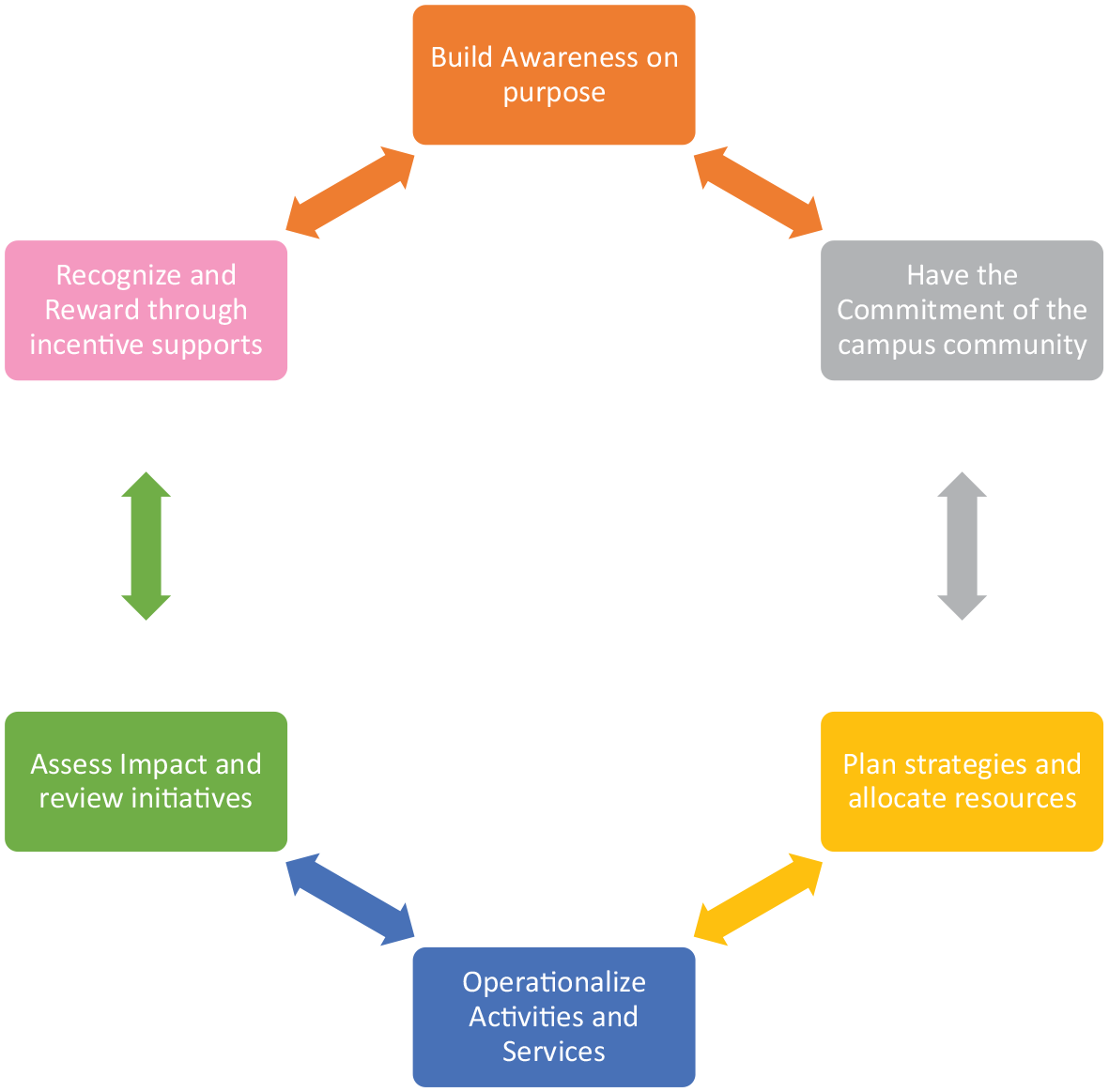
Six strategic actions to implement SDGs in HEIs.
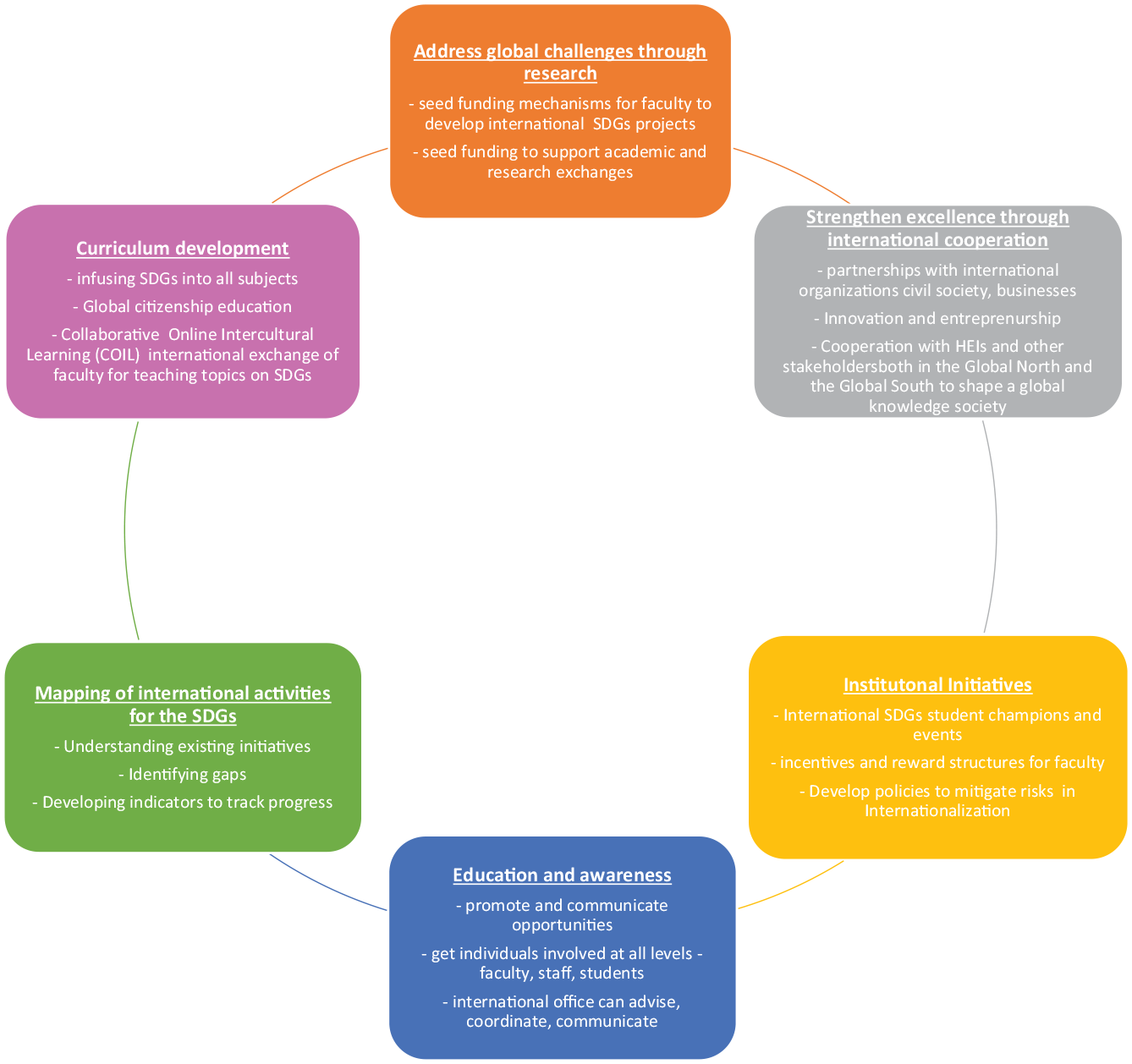
Reimagining international education through the lens of SDGs.
Higher education plays an important role in the 2030 Agenda for Sustainable Development both as a stand-alone target (SDG4, Quality Education) and as a pillar central to the achievement of all 17 goals. Although internationalization is encapsulated in SDG4, other SDGs including health, growth and employment, sustainable consumption and production, and climate change can be progressed through internationalization and thus should not be excluded in strategies to achieve them.
Internationalization has influenced the development of higher education in many countries (Egron-Polak, 2012). In a recent report, the British Council highlighted 11 European countries (Bulgaria, France, Germany, Greece, Ireland, Italy, The Netherlands, Poland, Russia, Spain, and the United Kingdom) that had created national policy frameworks on international student mobility, sustainable development, international research, and transnational education (British Council, 2019). A positive correlation was shown between countries which attract international students and those that have national policy frameworks in place to support international engagement (British Council, 2019). Countries with weaker policy frameworks for international students tend to experience lower rates of inbound mobility and, not surprisingly, international research outputs are greater in countries with inbound international student mobility flows as established research cultures attract global students. Although these findings are interesting, one could question the value and process of this one-model paradigm to compare and score national policies as it fails to take into account the complex economic, social, and political realities and regional policy interactions in those countries.
Global Citizenship Education and the SDGs
The 17 SDGs recognize that ending poverty and other deprivations must go hand-in-hand with strategies that improve health and education, reduce inequality, and spur economic growth—all while tackling climate change and working to preserve our oceans and forests. Internationalization of higher education has a profound transformative role to play in this regard, as it can address all of these common challenges through collaboration and engagement (Figure 2). Internationalization of higher education can transform actors to develop new perspectives and become global citizens. Although there is no widely agreed definition of the term “global citizenship,” here we refer to it as a sense of belonging to a global community and a common sense of humanity to generate actions to promote a better world and future through a framework of collective and civic action (UNESCO, 2016).
Approaches to global citizenship can range from foreign language study, applied programs, study abroad, and faculty exchanges to give faculty and students a competitive advantage to enact transformation in institutions and enable critical self-reflection on their own contributions to society (Aktas et al., 2016). The concepts of internationalization and global citizenship are increasingly connected in the literature. Both can help to promote values of collaboration, non-discrimination, diversity, cultural understanding, peace, and solidarity for humanity (UNESCO, 2016). The SDGs and global citizenship are also closely linked as they address efforts and actions targeted toward global and societal challenges.
Addressing internationalization through global citizenship requires pedagogies, curricula, teaching, learning, and research to be more holistic (Braskamp, 2009). Providing opportunities for experiences with communities of different backgrounds and views can enable individuals to develop values and attitudes to reform society to become more sustainable and internationalized. Studies show that internationalization can have a positive impact on students, staff, and faculty (Carrozza & Minucci, 2014; Leask, 2001; Marginson, 2011) through institutional strategies, faculty and student mobility, curriculum, and partnership development (Buckner & Stein, 2020; Stensaker et al., 2019).
Collegiality among faculty, staff, and students has also been shown to foster a culture of collaboration and infuse subcultures within colleges and departments with more global perspectives (Raby, 2007). However, although faculty are known to play a prominent role in accomplishing internationalization (Raby, 2007), not all faculty are agents of internationalization. According to a recent study, faculty engagement in internationalization is influenced by strong beliefs in efficacy and positive perceptions of institutional context (Nyangau, 2020). Studies also show that an institution’s characteristics and academic incentives can critically influence faculty engagement in international endeavors (Beatty, 2013; Finkelstein & Sethi, 2014; Friesen, 2013). Emerging literature on faculty motivations for internationalization shows desire to develop global citizens (Beatty, 2013; Friesen, 2013; Niehaus & Williams, 2016; Nyangau, 2020) and improve experiential student learning (Beatty, 2013; Friesen, 2013; Niehaus & Williams, 2016; Nyangau, 2020) as strong drivers of faculty engagement.
Reorienting Institutional Initiatives to Support Internationalization and the SDGs
The SDGs have started to gain traction with HEIs with the support of larger initiatives and alliances such as the Sustainable Development Solutions Network (SDSN), Higher Education Sustainability Initiative (HESI), International Association of Universities (IAU), UNICA (Network of Universities from the Capitals of Europe), Association of Public Land Universities (APLU), and the Association of Commonwealth Universities (ACU). According to the International Institute of Sustainable Development (IISD), the appeal for HEIs to partner with such organizations and alliances on the SDGs lies in, first, ensuring that governments live up to their commitments on implementing the SDGs and, second, supporting their students to become well-rounded global citizens through a systems approach lens.
Although literature on internationalization (de Wit, 2013, 2020; Robson & Wihlborg, 2019) and the SDGs (Anderberg et al., 2009; Fleacă et al., 2018; Hallinger & Chatpinyakoop, 2019) are in abundance as independent topics, limited data exists on internationalization and SDGs as a combined tool to improve society (Chinnasamy & Daniels, 2019). Two practical guides for HEIs have recently been developed by the SDSN—one focused on the implementation of the SDGs (SDSN Australia/Pacific, 2017) and the other focused on accelerating education for sustainable development (SDSN, 2020). Both guides emphasize the SDGs to be implemented through four key pillars—teaching and learning, research and development, operations and governance, and external leadership (SDSN, 2020; SDSN Australia/Pacific, 2017). Furthermore, the Global University Network for Innovation (GUNi), a network of 250 institutions from 80 countries, will launch a worldwide “GUNi World Report–Special Issue—New Visions for Higher Education Institutions Towards 2030,” which be presented at the UNESCO World Higher Education Conference 2022 (WHEC2022) in Barcelona, Spain.
HEIs can align and integrate programs and policies for the SDGs within their institutional (Figure 1) and internationalization (Figure 2) frameworks. Institutional actions (Figure 1) on the SDGs can be implemented through the support of internationalization (Figure 2) in six steps: awareness, commitment, resource planning, operationalization, impact assessment, and recognition. The first step involves raising awareness on the benefits of addressing the SDGs to stimulate campus-wide discussions and opportunities for engagement to enable both concepts to unfold. An integrated approach to commitment on the SDGs across various functions of an institution including teaching, learning, research, and partnerships (whole of institution approach) in addition to support for funding (internal seed funding) can facilitate transformation of a whole institution (Figure 1). An excellent example is the University of Tsukuba, Japan, where SDGs are strategically mainstreamed into the university’s research and educational practices to demonstrate how researcher activities support SDGs and contribute to resolving societal challenges. A further notable example is the University of Edinburgh, which has embraced the whole institution approach in its Strategy 2030, including a Social and Civic Responsibility Plan with the aim to actively reach out to its wider community, widen participation, and reach carbon neutrality under the aegis of the SDGs. Similarly, the International Islamic University, Malaysia, adopted the SDGs to enrich their internationalization policy (Moten, 2020). Allocation of resources is an important step to guide the development of processes to clarify priorities and directions for an institution. For example, cooperation with HEIs and other stakeholders in the Global North and the Global South to shape a global knowledge society can create a culture of collaboration so that activities (e.g., academic mobility) ensure equitable access to both its campus community and its partners (Figure 2). Review of activities on a regular basis through monitoring frameworks (e.g., indicators to monitor SDGs in international research projects and partnership agreements) would be necessary to ensure that outcomes lead to improved impacts. Recognizing and rewarding participation of faculty, staff, and students can also empower individuals to lead the change.
Figure 2 illustrates how HEIs can achieve the SDGs through international education in six steps. The development of internal funding programs to spur international research and academic exchanges with faculty, students, and staff can help HEIs develop solutions to address global challenges. Funding programs can also facilitate the development of collegiality and cross-sectoral partnerships with countries in the Global North and the Global South and build trust between partners. Such partnerships can enable diverse perspectives to be brought to the table and lead to the enrichment of knowledge, innovation, and entrepreneurship for social change. Recognition and celebration of students, faculty, and staff who serve as champions on both international education and sustainable development at a department, unit, and institutional level can help build momentum and excitement in our campus communities. Student champions can empower international and domestic students to establish clubs and events for the SDGs. This together with the support of SDGs in curricula, Internationalization at Home (IaH) programs, global citizenship education, and offerings of non-credit courses can lead to a powerful transformative force for international education and the SDGs to be created.
The path forward highlighted in Figures 1 and 2 implies changes in the modus operandi of an institution. We need to keep in mind that not all HEIs operate and internationalize in similar ways, but many of the activities and structures proposed in this article (institutional initiatives, international research and partnerships, mobility, global citizenship education, professional development, and declarations signed through networks or alliances) can be applied to an institution’s internationalization efforts and plans (Figure 2). Increasing visibility of an institution on the internet through research and partnerships has shown to be a key determinant of SDGs advancement and has led to increased internationalization, government investment in research and infrastructure, and higher revenues per student (Blasco et al., 2021). These results are not surprising, as internationalization hinges on partnerships abroad and can thrust sustainable development, especially in SDG17 (Partnerships for the Goals). While transitioning may be challenging for an institution due to lack of awareness, resistance toward change, procrastination, and power struggle issues, accelerating reform will require senior leaders to mobilize resources to reinforce the change. Hence, by supporting a culture that sustains internationalization, sustainable development can potentially be achieved.
While the SDGs are increasingly becoming part of sustainability strategies at HEIs, there is limited information on the measurement and reporting of the contribution of HEIs to the SDGs globally. This will continue to remain a challenge because disclosing a HEI’s contribution toward the SDGs is not mandatory. Second, the SDGs are embedded in different strategies at HEIs around the world, and institutions may use different methodologies and metrics to measure their outcomes. A standardized way to measure a HEI’s impact on sustainability is through the Times Higher Education (THE) Impact rankings published in 2019 for the first time. The declared aim of the initiative is to provide “a showcase for the work being delivered by HEIs in our communities, and it is an opportunity to shine a light on institutional activities and efforts not covered in other rankings”. The first edition in 2019 included 450 HEIs from 76 countries, which grew to 768 HEIs from 85 countries in 2020, respectively, indicating the keen interest of HEIs. The ranking assesses HEIs against three SDGs of their choice as well as SDG17, Partnership for Goals, the only mandatory element, which is a remarkable indication of the significance of international collaboration in the implementation of the goals.
Although the objectivity of rankings is often questioned for a number of reasons such as flawed methodology (Bekhradnia, 2016), the failure to recognize diversity and missions of institutions, incomparable or unverifiable data (Davis, 2016), and the inevitable influence of cultural bias (Ross, 2020), “the focus provided by the SDGs, as well as the targets that accompany them, offers a useful set of benchmarks against which HEIs can measure themselves” (Ivison, 2020). However, some critiques would argue that research and scholarly output from HEIs that do not use English as a primary language are often overlooked and that research for the benefit of society may not always be captured in a publication. One concern, however, is the lack of acknowledgment of the pivotal role of academic freedom in research and teaching in any of the world ranking systems. Despite its flaws, rankings are useful as they spark discussion, allow institutions to self-reflect on their performance in a certain field, help benchmark themselves with other HEIs, and provide a tool to keep track of efficiencies in implementing their sustainability commitments.
International Research and Partnership Activities to Support the SDGs
Solving real-world challenges requires research to lead to action and requires collaborations with governments, civil society, private industry, and communities (Johnson et al., 2003; Mitchell, 2017; Young et al., 2016). The cross-cutting nature of the SDGs requires involvement of actors who may not have previously needed to or considered working together on particular topics or with particular countries. For instance, as an example of fruitful collaboration between different realities, the University of Nairobi and the University of Helsinki joined forces to address challenges on food security, good health, and quality education. Thus, some can perceive the SDGs as contentious, while others can consider it as a safe and common ground to collectively tackle global problems.
Several countries have strategized and reformed their educational programs to meet the needs of their regional economies (Kagiri-Kalanzi & Avento, 2018). For example, organizations in South Africa have collaborated with Finnish entities to advance climate change science and disability studies (Kagiri-Kalanzi & Avento, 2018). UNESCO’s Education 2030 Framework for Action (FFA) addressing SDG4 (Quality Education) calls for international agreements to improve access, equity, quality internationalization, and digitalization. However, transcending international research projects to address the SDGs across borders is fraught with its own set of unique challenges including an understanding of the delicate geopolitical landscape; knowledge of local issues, infrastructures, and funding mechanisms; and compliance to international regulations. These challenges are faced by many HEIs, and thus institutions need to consider putting a plan in place to protect the society it is part of, its reputation and values, campus community, people, and partnerships.
At the core of an HEI’s research is academic freedom. It empowers researchers to undertake international research on the SDGs, which may involve sensitive areas or infrastructures. To address challenges and risks in research, HEIs need to be equipped with a range of policies to identify and manage international risks. While international collaborations for the SDGs may be beneficial to some, an understanding how a faculty’s international research project on the SDGs may intersect with international economic, political, and strategic interests would be essential. Similarly, failure to manage international security–related risks on global projects for the SDGs may result in financial, legal, and reputational consequences and affect national security and prosperity.
Although international research collaborations are fundamental to academic, reputational, and financial success of HEIs, there can be adverse long-term implications related to international research security. For example, theft and compromise of data may render a HEI to be unable to attract future funding, and non-compliance to foreign legislation and regulations with institutions abroad can expose faculty and HEIs to criminal charges and litigation. Geopolitical risks are difficult to address because external forces beyond the control of HEIs drive them. By conducting due diligence through a financial and reputational risk perspective and seeking guidance from governments and other sectors on their processes and policies to assess reputational, ethical, and security risks, risks may be managed effectively (Cline & McCaffrey, 2020). Maintaining a risk register to identify, monitor, and assess the impact of risks when embarking on international research projects on the SDGs can help HEIs reduce insecurity and build confidence and trust with researchers. Universities UK, a collective of 139 universities in England, Scotland, Wales, and Northern Ireland, is one of the first academic collectives to have developed a set of guidelines to manage risks in internationalization to protect its community of actors and sectors of HEIs (Universities UK, 2020).
Results from the 5th IAU Global Survey involving 907 HEIs from 126 countries identified insufficient financial resources to be a main obstacle for internationalization (Marinoni, 2018). In this survey, interestingly, only half of teaching-focused institutions had international research as an integral part of their institutional internationalization activities and that only half of the HEIs in Latin America, Caribbean, and the Middle East are involved with international research (Marinoni, 2018). However, despite its challenges, international research can enable HEIs to ensure that the “for all” aspect of the UN 2030 Agenda for Sustainable Development is met. For example, extrapolating information from international research projects can help institutions understand their activities addressing sustainable development, indigenization, equity, and diversity, and lead to the development of improved policies.
One of the barriers to internationalization is the time levied by faculty to engage in complex international endeavors. Coordinating study abroad or joint research activities takes time and resources. Recognition and reward structures are often not included in tenure and promotion, and alongside with time commitments may serve as a deterrent for participation (Beatty, 2013; Friesen, 2013). Institutional funding strategies allocated to academic exchanges, faculty development workshops, international curricular development, and research grants have shown to positively influence faculty engagement in internationalization practices (Childress, 2009).
Reimagining International Mobility and IaH to Support Sustainable Development
Internationalization begins at home. IaH can be defined as “the purposeful integration of international and intercultural dimensions into the formal and informal curriculum for all students, within domestic learning environments” (Beelen & Jones, 2015, p. 69). Some would say the higher education sector should be a space where “no one is left behind,” as prejudices are broken down and open deliberations with people from different backgrounds can safely occur (Bartell, 2003). Although some would argue that these environments are in fact entrenched with mechanisms of institutional racism and should serve as platforms for decolonization (Mirza, 2018), where students, faculty, staff, and senior leaders can grasp concepts, and reflect upon their own actions, which inadvertently transform HEIs. IaH can help students and the academy understand their role within a wider society and communicate their ideas to influence wider society and policy, including the SDGs in global and local contexts.
Student and staff mobility serve as one of the major tools to deliver internationalization to help achieve the SDGs. Both together can help enhance the quality of education (SDG4). The development of soft and hard skills which can be applied to further a learner’s academic studies and prospective careers (The Erasmus Impact Study, 2014; Jovanovska et al., 2018) boosts extracurricular activities (Brandon et al., 2020) and can support the overall purpose of internationalization (Teichler, 2017). Academic mobility, both inbound and outbound, can also contribute to the direct and indirect development of partnerships between sectors. Governments can support HEIs to recruit international students and encourage domestic students to visit countries to experience and develop a deeper understanding of how other societies function (Wieczorek, 2018).
Mobility can shape and strengthen large and common regional identities to develop a unifying sense of global citizenship. In this sense, one of the first and most successful student exchange initiatives is the Erasmus program of the European Union. Over the past years, the number of participants has increased significantly, from 3,000 students in the academic year of 1987/1988 (Engel, 2010) to more than 10 million in 2018 (Erasmus+ Programme Annual Report, 2018). These mobility trends are not limited to the Europe but show similar patterns at a global scale, reaching 5.3 million by 2017 according to UNESCO data (Migration Data Portal, 2020). Nevertheless, parallel to the rising number of internationally mobile students, faculty, and staff, climate considerations have turned the spotlight on the environmental impact of mobilities. Thus, despite its clear benefits for the participants and its positive impact on societies, critics increasingly point out its less favorable aspects, predominantly its negative environmental impact (Shields, 2019).
Although the COVID-19 crisis has put a halt to the dynamic growth of mobilities and may alter the way student exchanges, research, and teaching mobilities are delivered in the future, one can presume that once the current challenges will be overcome, previous tendencies and trends will continue with numbers on the rise again. International mobilities are calculated to account for at least 14 megatons of CO2 emissions on a yearly basis, but estimates range to as high as 40 megatons (Shields, 2019). These two extreme values equal the annual fossil CO2 emissions of Slovenia and Ireland, respectively, according to the 2018 fossil CO2 emissions of all world countries report (Muntean et al., 2018). Thus, even if emissions per mobile student are decreasing (Shields, 2019), mobility schemes in their current (or, to be more precise, pre-COVID) form are not sustainable in the end.
Movements like “Fridays for Future” (de Moor et al., 2020) played an undoubtedly important role in mobilizing the youth globally and drawing attention to the threat that climate change poses. Yet, this led to a slightly limited understanding of the SDGs by focusing on SDG13 (Climate Action). The COVID-19 crisis seems to be changing this perception and bringing the importance of health and the reduction of inequalities as well as international collaboration into international limelight, which might result in a more balanced approach in the long run. The current challenges in the context of disease might be also a good moment to reflect on how to strengthen the existing greening efforts of student, faculty, and staff mobility without losing its benefits, being forced to reduce its scale or discouraging the participation of environmentally conscious participants.
Without ignoring environmental considerations or underestimating the benefits of virtual exchanges and digitalization, it would be an error to renounce physical exchanges. Recognizing the need of a strategic, policy-level approach, the European Commission made the first steps to promote a greener Erasmus+ program and mobility process by converting it to paperless and providing financial compensation of more environmentally friendly, but costly travel alternatives (2021 Programme Guide of the new Erasmus+ Programme for 2021–2027. This path, pursued in the recently launched program, complements and responds to the countless bottom-up initiatives of HEIs and student organizations, and expects to set an example for other exchange programs in and beyond Europe. Grassroots initiatives and recommendations of students in this field are manifold. Good practices include providing students with green guidelines by the sender and the host organizations involved in organizing study programs, choosing closer destinations, supporting long-term or blended mobilities, encouraging the use of environmentally friendly travel schemes and making them more affordable and accessible, offsetting greenhouse gas emissions resulting from mobilities, promoting more sustainable consumption patterns, or providing students with free bike passes. HEIs can be encouraged to implement projects like SAVES 2 (Students Achieving Valuable Energy Savings 2), which aim to raise awareness of students of their carbon footprint in the HEIs and private accommodations, or prepare manuals with sustainability-related tips like the ones by CISaustralia (McGann, 2020).
Nevertheless, one should not forget that choosing the sustainable option is still too often a more costly alternative that plenty of students are unable to afford. Greening efforts should by no means result in turning mobility into a privilege, as it was the case in the past, but make it inclusive and accessible for all. To make it happen, further measures and financial resources at the policy level need to be adopted and become available, respectively.
Building Cultural Bridges for Sustainable Development
Cultural diversity can influence the progress of all SDGs through enrichment of values, beliefs, behaviors, language, and perspectives. Cultural exchanges in HEIs can boost student and faculty morale and enable them to become cross-cultural ambassadors. Internationalization on campuses can occur when domestic students, faculty, and staff genuinely engage with individuals coming from different cultures and countries (Pandit, 2013). HEIs have the responsibility to promote this approach by the transnational exchange of good practices and experiences among different countries and continents. In this sense, together with other Italian universities, La Sapienza supports the virtual exchange program “Italian Higher Education With Africa” for researchers to promote the internationalization of African HEIs (SDG17).
One of the realities and challenges of cultural diversity is personal biases. There may be an inclination to prefer or defend one culture or belief over another while rejecting or minimizing other perspectives. Educational course materials incorporating diverse perspectives place emphasis on equal values on narratives from other cultures. Refraining from building cultural bridges in course content can reinforce cultural stereotypes and support a dominant narrative that minimizes alternative or conflicting voices.
Leaders of institutions are often viewed as “architects of educational evolution” (McDonald, 2002) and can influence an HEI’s inclusive education culture and climate. By thinking about how their actions and interactions can improve the lives of others and how their actions and interactions can improve themselves, they can promote gender equality, inclusivity, and diversity. The Université Libre de Bruxelles actively promotes gender equality and inclusion, and as a result, one of its professors, Denis Mukwege, was co-awarded the Nobel Peace Prize for fighting sexual violence as a weapon of war (SDG5, SDG16) in 2018.
Conclusion
This article has highlighted ways in which HEIs can contribute to the SDGs through the lens of internationalization in research, partnerships, mobility, and institutional initiatives. Although the article views internationalization and SDGs as intertwined concepts, studies remain limited on the dynamics between these two concepts. In 2016, the World Economic Forum highlighted that business-as-usual cannot continue in the current financial, and economic climate and that nature and societal well-being must be at the heart of all our efforts. Some believe that the success of higher education will depend on embracing and implementing sustainability into their academic programs and practices (Kolb et al., 2017) and will support the well-understood notion that the crisis cannot be solved by the same kind of education that helped create the problems (Kolb et al., 2017; Orr, 1992). While the article acknowledges that the challenges in internationalization can influence the achievement of the SDGs, it posits that HEIs need to find alternative pathways to support complex human relationships involving multiple perspectives (de Wit et al., 2015; Knight & International Association of Universities, 2006) and, importantly, that HEIs can achieve these goals.
In this respect, reorienting international education toward sustainable development requires qualitative reform across all supportive structures of an HEI through the integration of sustainable development topics in subjects, departments, activities, mobility programs, institutional strategies, and reward structures (UNESCO, 2014). Developing competencies/skills to understand and appreciate different cultures and countries can enable individuals to become effective global citizens and agents of social change. The authors posit that the 2030 Agenda for Sustainable Development should serve as a framework to reimagine internationalization as an ethical and equitable approach to education because HEIs not only produce and disseminate knowledge but also serve as interlocutors to the global knowledge discourse. We hope that this article has set the tone for HEIs to consider, explore, and embrace new collaborative ways to internationalize for the SDGs and societal betterment.
Footnotes
Declaration of Conflicting Interests
The author(s) declared no potential conflicts of interest with respect to the research, authorship, and/or publication of this article.
Funding
The author(s) received no financial support for the research, authorship, and/or publication of this article.
Author Biographies
 , total impact factor > 500, H-index Google Scholar 45, Scopus 37). He coordinated several research projects in the field of pharmacology and has been referee for many national and international funding agencies and international scientific journals in the last 30 years. Prof. Saso has extensive experience in international relations and he is currently Vice-Rector for European University Networks at Sapienza University of Rome and the President of UNICA, the Network of Universities from the Capitals of Europe.