







Abstract
Although claiming to promote South-South internationalization, regional education hubs in the Global South should be viewed as localizing established Global North practices in higher education. By deploying epistemic justice and cognitive empire conceptual tools, this paper argues that establishing institutions to transform a country into a region's educational hub does not translate to recognizing and representing local and regional knowledge systems and languages. Data were collected through semi-structured interviews with 18 international students representing the international student body from 33 countries at Nazarbayev University. The findings show that international students are attracted by Western higher education, which universities at the center of South-South internationalization promote. Regional educational hubs seek to replicate and align with Western institutions, promoting globally competitive Western epistemology and serving as agents of the cognitive empire. In the process, this undermines Global South concerns about epistemic justice.
Keywords
Introduction
This article argues that establishing institutions to transform a country into a regional education hub (REH) does not necessarily result in the recognition or representation of regional knowledge, languages, and cultures in higher education curricula. The REH hub concept illustrates how these institutions have largely succeeded in localizing higher education policies and practices from the Global North, with a significant emphasis on using the English language. Numerous publications advocate for creating REHs to enhance global competitiveness, foster economic growth, and build knowledge-based economies (Knight, 2011, 2013; Lee, 2015a, 2015b). These hubs also aim to attract international students and promote research and innovation. Embedded within these discussions is the assumption that establishing such hubs will mitigate the costly, perennial migration of students from the Global South to universities in the Global North, particularly to countries like the UK, US, Canada, and Australia. Additionally, they offer access to international English-language education without necessitating expensive intercontinental mobility.
Kazakhstan is positioning itself as a REH for Central Asia (Imangali, 2023), encouraging inbound student and faculty mobility through attractive incentives, including generous scholarships for international students (Hwami, 2024). While this article does not exclusively focus on REHs, it uses this concept to analyze national and regional international higher education policies in addressing three key research questions. First, where do the international students promoting Kazakhstan's regional hub status come from? According to Knight (2014), “reliable data is not available on whether the international students in education hub countries originate from countries internal or external to the region” (p. 212). We partially address this question by examining international students at Nazarbayev University (NU), which serves as the model and springboard for Kazakhstan's aspirations as a REH (Kuzhabekova, 2024). Second, what constitutes the nature of international education being delivered in Kazakhstan? Engaging with contemporary debates on the geopolitics of knowledge, we explore key questions: Where does the knowledge taught in Kazakhstan international higher education come from? Whose knowledge is prioritized, and why? (Hwami, 2024). Lastly, what draws international students to Kazakhstan? This question leads us to an empirical micro-analysis of Kazakhstan's top-ranked university with regional and international implications. By engaging with international students, this paper contributes to scholarship advocating for epistemic justice, an internationalization process that emphasizes social responsibility and considers potential tensions arising from past colonial influences, local identities, cultures, languages, and institutional values (De Wit & Jones, 2022). We argue for internationalization that moves beyond merely adopting Global North higher education policies and practices in knowledge exchange, acknowledging that colonial legacies and Eurocentric geopolitics have often shaped global knowledge production (Santos, 2014). Most perspectives promoting internationalization neglect the existence of alternative ‘knowledges.’ Implicit or explicit in these perspectives is the assumption that regions in the Global South (such as Central Asia) should reproduce Western ideals and institutions, regardless of contextual differences or feasibility (Nyamnjoh, 2011, p. 152).
Following these discussions, the broad purpose of this qualitative study is threefold: to address the export of Global North (Western) epistemologies to the former Soviet region through the framework of REHs; to explore how the coloniality of knowledge (Quijano, 2007) is maintained through the reproduction of international higher education from external sources rather than from within; and to investigate how international higher education practiced in the Global South could contribute to the internationalization process through a perspective that emphasizes epistemic recognition and representation as equality is one of the global sustainable goals. By deploying epistemic justice and cognitive empire conceptual tools, we argue that establishing institutions to transform a country into a region's educational hub does not translate to recognizing and representing local and regional knowledge systems and languages. Our case study illustrates that there seems to be no alternative to the Western university, although a hybrid South-South model is feasible.
This investigation is significant for several reasons. Existing literature on REHs is mainly conceptual and lacks empirical engagement with critical stakeholders, such as international students. By employing graduate student narratives, this article addresses key issues surrounding the REH phenomenon, including the origins of students participating in these hubs. We also find that the Central Asian research context and the study population are underexplored in extant literature. Additionally, this study utilizes cognitive empire and epistemic justice as theoretical lenses in analyzing REHs - an approach not commonly observed in previous studies. We hope this contributes new insights and conclusions as developing countries work to enhance their higher education systems and meet sustainable development goals.
This article is structured as follows: first, the research context of Kazakhstani higher education as an emerging REH is introduced. Next, we review scholarship calling for epistemic justice in the Global South and utilize these critiques as the paper's theoretical framework. The unique context of the former Soviet space is highlighted from an epistemic justice perspective, particularly the Westernization of the education systems. The study's methodology is discussed, followed by an analysis of the findings and a conclusion that underscores the Westernization of international higher education under the discourse of education hubs.
Higher Education in Kazakhstan
Kazakhstan is the world's largest landlocked country, located in Central Asia and partly in Eastern Europe. It is the ninth-largest country globally, with a population of just over 20 million. Kazakhstan is bordered by Russia, China, Kyrgyzstan, Uzbekistan, and Turkmenistan. Historically, it was part of the Soviet Union until gaining independence in 1991. Thus, the collapse of the Soviet Union gave birth to the new nation of Kazakhstan. Since 1991, Kazakhstan has been transitioning, adopting a policy balancing act involving major powers, neighboring Russia, China, and Western Europe (Kuzhabekova, 2024). To modernize higher education, the government joined the Bologna Declaration in March 2010. It became the 47th member of the Bologna process and a full-rights member of the European Education Area (Oralova, 2012). This led to initiatives such as joint educational programs and international collaboration agreements to improve academic mobility. Adopting English as a medium of instruction is another new feature that promotes internationalization as the number of international students and faculty is rising (Hwami, 2024).
Higher education enrollments are increasing and have doubled from 250,000 to 595,000 students (Ministry of Education and Science (MES), 2024). To accommodate the increase in demand, the number of higher educational institutions has increased to 148, with more than half of these universities (93) being newly established private providers. The system has transformed from being centrally planned to being oriented to the needs of students and employers, developing public accountability, self-regulating with a system of independent quality assurance, accreditation, and participating in international rankings (Kuzhabekova, 2024).
Kazakhstan has modernized higher education by establishing international universities that adopt global curricula, hire internationally trained staff, and enroll international students. These universities fall into four types. The first type, international private institutions, are privately funded through tuition, alumni contributions, and grants. The second type includes jointly funded universities established through intergovernmental agreements, such as Kazakh-Turkish University, Kazakh-British University, and Kazakh-Russian University (Kuzhabekova, 2024). Unlike private institutions, these receive both private and public funding from Kazakhstan and the co-founding country.
Nazarbayev University, founded in 2010, represents a new type of international university inspired by the idea of flagship world-class institutions (Salmi, 2013). Kazakhstan has recently welcomed international branch campuses, hosting 12 foreign university branches. In 2024, four more were opened, including the City University of Hong Kong and Pennsylvania State University (Staff Report, 2024). By 2029, plans include 12 more branches, such as Michigan State University (USA) in Astana, Heriot-Watt University (Scotland) in Aktobe, and a branch of Canada's Tech University (Nurmaganbetova, 2023). Kuzhabekova (2024) notes that these trends highlight growing Western influence in Kazakhstan's higher education, prompting Russia and China to expand their soft-power efforts.
South-South Internationalization: Kazakhstan as a Regional Higher Education Hub
South-South internationalization in higher education promotes collaboration among Global South institutions to enhance educational and economic development (Leal et al., 2024). Unlike traditional North-South dynamics, this approach values diverse knowledge systems and fosters regional cooperation. Educational hubs play a key role in this model. Knight (2011) defines an educational hub as a planned effort to attract local and international academic institutions for cross-border education, training, and knowledge production. While regional hubs like South Africa (Majee, 2020), Botswana (John et al., 2014), and Kazakhstan-Uzbekistan (Muratov & Wilkins, 2024) compete for influence, some distinguish hubs from established education leaders like the UK and US, which primarily export branch campuses (Cheng et al., 2011). Others view hubs as strategic marketing tools to attract international students and legitimize local institutions (Knight, 2014).
Kazakhstan aims to establish itself as Eurasia's leading education hub to support its economic ambitions (Imangali, 2023). The government invests in infrastructure, branding (Study in Kazakhstan), and programs tailored to international students. With over 100 universities, Kazakhstan seeks to expand its academic reach despite having only one university ranked 501–600 globally (Times Higher Education, 2024). The growing anti-immigration sentiments and anti-international student policies in the established international higher education capitals in countries such as the US, UK, Canada, and Australia (Williams, 2025), highly ranked institutions in the Global South, such as Nazarbayev University (NU) in Kazakhstan, could benefit and be the next chosen destinations for international study.
Theoretical Issues: Cognitive Empire and Epistemic Justice
The cognitive empire (Santos, 2014, 2018) refers to the dominance and hegemony of specific ways of thinking, knowing, and understanding the world, often associated with Western or Eurocentric epistemologies. The concept of the cognitive empire is explored in the context of challenging the dominance of Western epistemologies. This idea suggests that the cognitive empire imposes its worldview and methods of knowledge production on other cultures and societies, marginalizing and devaluing non-Western ways of knowing (Ndlovu-Gatsheni, 2018). Ngugi wa Thiong’o (1986) termed it the metaphysical empire, Tatah Mentan (2015) defined it as cognitive imperialism, and Gildea (2019) calls it the empire of the mind. It can be understood as a form of intellectual and cultural colonialism, where Western or Eurocentric knowledge systems are privileged over those of other geographies. The modern universities, especially those referred to as international, are modeled after and essentially seek to replicate and align with those institutions of higher learning that emerged in the West, and therefore, “they have also cultivated their hierarchies, racial and gendered power relations, epistemologies, and ethnocentric constructions of what constitutes knowledge, and in which bodies and geographies it is supposedly located and enunciated (Hendricks, 2018, p. 16).
These analyses of knowledge production have led to the call for epistemological justice for the non-West. Epistemological justice refers to the fair treatment and recognition of different ways of knowing and producing knowledge (Fricker, 2007). Fanon (1968/2004, p. 236) famously declared, “Let us decide not to imitate Europe.” The call to the South-South internationalization scholarship implies the need for internationalization beyond copying and pasting global North practices in higher education. Epistemic justice involves challenging the cognitive empire, the dominance of certain epistemologies, often Western or Eurocentric, and valuing the diverse epistemic contributions of marginalized and non-Western groups (Santos, 2014). Epistemological justice addresses and rectifies the inequalities and biases in knowledge production and dissemination. It speaks to the recognition of the diverse ways of knowing by which people across the human globe provide meaning to their existence and understanding of the world. This follows Santos's scholarship that pushes for an epistemological shift that enables cognitive justice (i.e., recognition of different ways of knowing by which people across the globe provide meaning to their existence) as a departure from the cognitive empire.
Contemporary international or internationalization initiatives in higher education are accused of promoting Western or Eurocentric knowledge. “The international is synonymous with Europe and North America” (Ndlovu-Gatsheni, 2021, p. 78). International higher education initiatives inherent in the education hub discourse, for example, the privileging of the English language, marginalization of local scholars as universities hire faculty from overseas English-speaking institutions, partnerships and international branch campuses, are characterized by duplicating Western institutions and their practices. Such policies are accused of causing epistemicides and cognitive injustices (Santos, 2007, 2018) in non-Western countries, such as Kazakhstan.
Methodology
Case Study Approach
This article presents the findings of a qualitative research study conducted during Winter in 2024, which explored the experiences of international students studying at Nazarbayev University in Kazakhstan, the leading and exemplary international university for the country's quest for regional education hub status. In line with epistemic justice sensibilities, the methodology ensured that diverse voices, including those historically marginalized (students from the Global South, e.g., Africa), were recognized and valued (Fricker, 2007). This was a case study exploring the phenomena of South-South higher education internationalization. Yin (2018) conceptualizes a case study as an empirical inquiry investigating a contemporary phenomenon in depth and within its real-world context. It involved an in-depth study of a single case, Nazarbayev University. By focusing on this single university, this was an instrumental case study (Merriam & Tisdell, 2016), providing insights and redrawing generalizations. In instrumental case research, the case facilitates understanding of something else (Yin, 2018), in this study, South-South higher education internationalization.
The study focused on Nazarbayev University as the case. The university was established in 2010 to be a flagship academic institution in Central Asia with ambitions to achieve global recognition as a top-tier world-class research university (NU, 2025). Such attempts have been witnessed in Saudi Arabia, Finland, and China (Salmi, 2013). Nazarbayev University formed partnerships with established universities in the UK, the US, and elsewhere, including the University of Wisconsin-Madison, the University of Pennsylvania, Duke University, the University of Cambridge, and the University of Pittsburgh, to name a few. These partnerships and networks open opportunities for local students, enabling them to acquire international experiences without traveling abroad. Most (68%) of academic staff are expatriates and holders of Western credentials (NU, 2025). All students, local and international, are on full government grants. Of the over 7000 student population, 53% were in STEM. Of the international students, only 24 (0.5%) were undergraduate ( NU, 2025).
Population and Sample
The Nazarbayev University Institutional Research Ethics Committee granted ethical approval for this study. All participants were graduate international students. Undergraduate international students were excluded because they are very few, 0.5%. Also, the study wanted participants to compare NU with their previous universities. To recruit participants, the Office of the Registrar and Student Affairs provided the email addresses of potential participants. For the 2023–2024 academic year, there were 209 graduate international students from 33 countries. This was non-probability sampling (Merriam & Tisdell, 2016), which selected participants based on specific characteristics relevant to the study. First, purposive (judgmental) sampling was used to select participants based on specific characteristics relevant to the study: graduate international students. From this population, 27 students responded positively, of whom 14 were from Africa. Only eight interviews with African students were included in this article to obtain diverse data and after reaching saturation regarding African perspectives.
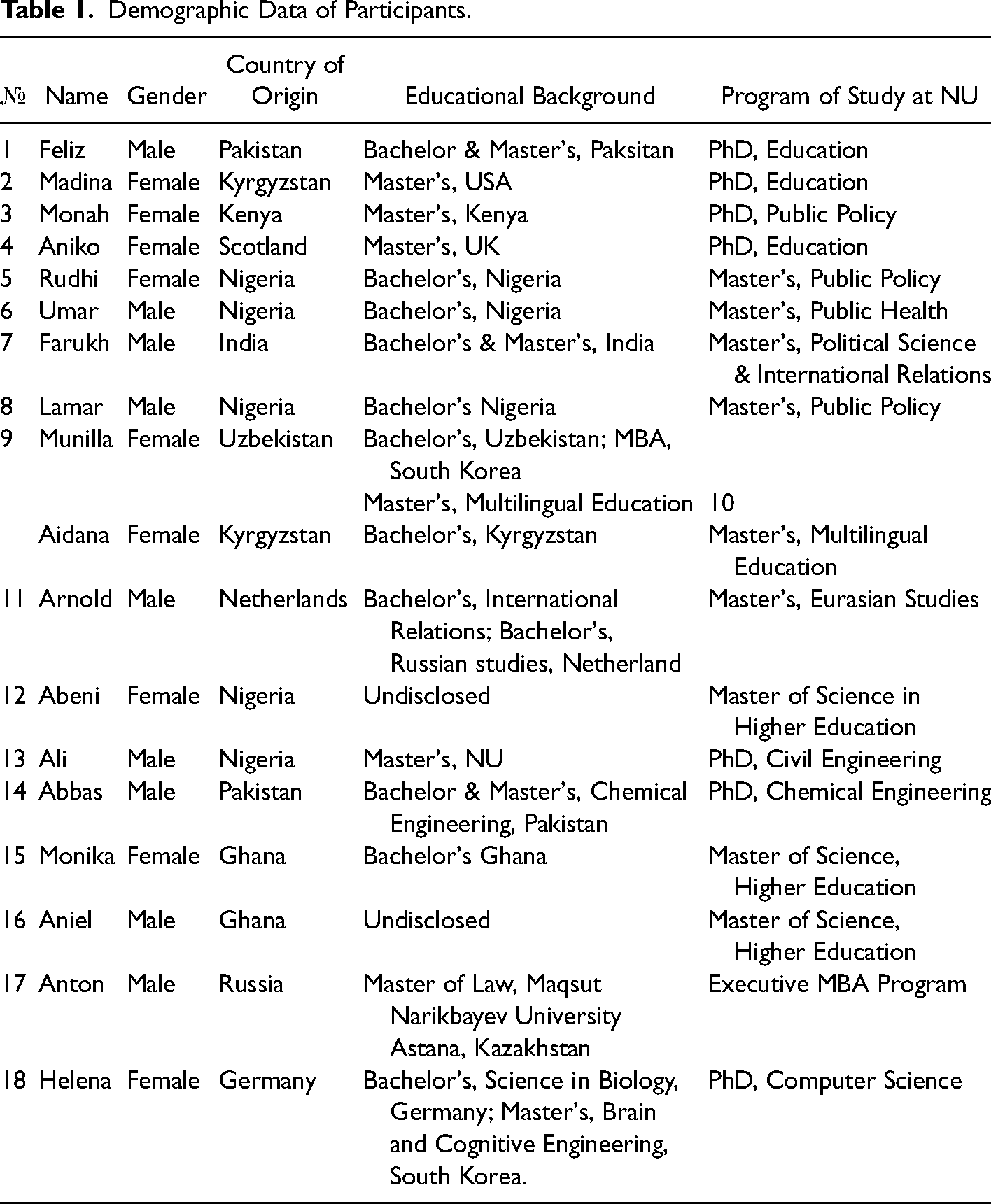
Furthermore, another non-probability sampling technique, snowball sampling, was employed to identify individuals with characteristics or relevant experiences for the study, such as country of origin or discipline. This led to the inclusion of an additional five participants in the sample. We snowballed some participants from the Global North, as we thought their perspectives towards studying in the Global South would be unique and rich. Although snowballing has challenges of bias and lack of representativeness (Naderifar et al., 2017), only five participants were selected using this approach. Snowballing helped us access these students who are a minority and hard to reach as some lived off-campus. This increased the diversity and representativeness of the sample. It also ensured the inclusion of marginalized non-Western perspectives and not privileging Western, elite, or dominant cultural narratives in respect of epistemological justice. After 18 interviews, no new perspectives emerged, and we decided to end the data collection process. Therefore, the study interviewed 18 international students. The international students were given pseudonyms and their demographic characteristics, including gender, country of origin, educational background, and program of study are summarized in Table 1.
Demographic Data of Participants.
Data Collection
The data collection team included a graduate student, thus respecting the epistemological justice principle of co-creation of knowledge with communities rather than extracting data from them (Santos, 2014). Initially, to collect the qualitative data, Phase One included dispatching a recruitment letter to enlist 20 to 25 participants and request their response within a month. Phase Two involved 18 master's and doctoral international students from NU participating in individual semi-structured interviews in person and via Zoom, prioritizing participant convenience and typically lasting around 30–40 min each. The data collection process took place between February and April 2024.
Data Analysis
In our data analysis, we adhered to the fundamental principles of qualitative research. The goal was to formulate a theoretical understanding of the participants’ backgrounds and motivation of students from the Global South to study in other Global South countries to obtain data on (1) the origins of the international students promoting Kazakhstan's regional hub status, (2) the origins and nature of international education being delivered in Kazakhstan, (3) motivations for studying in Kazakhstan and (4) implications to the global higher education hierarchy of emerging educational hubs in the global South.
We used the six-step thematic analysis, “a method for identifying, analyzing and reporting patterns (themes) within data” (Braun & Clarke, 2006, p. 79). This involved reading and summarizing the transcripts to familiarize ourselves with the data. Each interview had two transcripts, which we compared for accuracy before adopting it. Second, we coded the data. This meant identifying specific content relevant to the research topic and questions, such as country of origin, reasons for choosing Kazakhstan, future plans, and campus living conditions. Generating initial themes was the third step, which involved synthesizing the coded data to uncover deeper meanings. Our research focus influenced these meanings, as indicated in our research questions. We ended up with themes such as motivation to choose Kazakhstan, whose knowledge is in Kazakhstan's international higher education, and advantages and disadvantages of studying in Kazakhstan. These themes addressed the key research questions of this study. The remaining steps involved reviewing themes and considering how they relate to each other in constructing our thesis on South-South internationalization and leaving out certain chunks of data that were considered irrelevant. Step 5 defined and named the themes as they appear in the findings section below. As the final step, the write-up provides a detailed description of each theme, gives some illustrative quotes from the data, and discusses the broader implications of the findings.
The research team also practiced ethical reflexivity (von Unger, 2021), where we critically examined our positionality, biases, and influence throughout the study. In this case, we are Global South scholars composed of a faculty member whose academic socialization was obtained in the Global North and a Kazakhstani doctoral student.
Findings
This study's data show that of the 209 international students at Kazakhstan's flagship highly ranked university, most originate from outside Central Asia. Of the 33 countries represented, Pakistan (56) and Nigeria (38) had the most significant number of students, while neighboring Central Asian countries are lowly represented, with the Russian Federation (14), Kyrgyzstan (9) and Uzbekistan (7) appearing in the top 10 countries. The observation goes against extant research findings that claim that regional education hubs aim to become centers of excellence, drawing students and professionals from neighboring countries and regions (Cheng et al., 2011) or that they are a centralized location or institution that attracts students, scholars, and educational resources from various countries within a specific region (Kuzhabekova, 2024). Unfortunately, reliable data is unavailable on whether the international students in REH countries originate from countries internal or external to the region. The best guess is that overall, more students come from countries outside the region, but this is not true for all countries (Knight, 2014, p. 12.)
However, a more general conceptualization of the Global South to explain South-South internationalization outside the established traditional higher education institutions could make sense. Dominant themes from the data show the appeal of Western/English education credentials obtained at NU, the developed learning and research infrastructure, which is globally competitive, lucrative scholarships, and the opportunity to migrate later to the developed West. Consequently, we found that concepts such as REH, South-South internationalization, and epistemic justice do not influence the perspectives of the study's participants.
Motivation for Choosing Kazakhstan
The narratives from the international students touched on several issues related to the issues of the cognitive empire and epistemic justice. It was interesting to see that the world-class facilities at NU attracted students from developing countries or the non-West/Global South. For example, Feliz expressed her admiration for the university and its compatibility with established institutions in Europe or North America. For a year, I taught at the University of Wisconsin Medicine. It was an exchange program under the Fulbright Scholarship. I then joined NU for my PhD. I explored the university and I was surprised. I was like, wow, this is a cool university. It is like one of the best places, it's amazing. Nazarbayev University, it is great institution. Why would I want to go to America, or to Canada? It is so far away, it is very expensive, and I can get the same quality education, not going far away from my Central Asian location.
Our data further show that for some students, a well-developed and Westernized university is used as a means to migrate to the West. “And the easiest way is to pass through the easy routes. So, if I get to Kazakhstan, it may be very easy for me to access Europe” (Monika). Similarly, “I know many students, unfortunately, are here only for the scholarship. Many see it as just passing by, as just one stop, and then they go to the West” (Aniko). These expressions indicate that Kazakhstan's NU, a comparatively modern university, is viewed as a stepping stone towards migrating to the West and not as a Global South institution that exposes students to local and non-Western epistemology. It shows the appeal of Western epistemology, further strengthening Ndlovu-Gatsheni's (2021) claim that the international is Europe and North America. For Anton, from Russia, there was no alternative because of the war in Ukraine. “I came here because there are a lot of restrictions, and they have such restrictions just now. It is impossible to study in countries like the UK, US, and Canada with my Russian passport.”
However, our data show that students from developed countries presented different and pedagogical perspectives for studying in Kazakhstan. For instance, Arnold from the Netherlands explained that, My bachelor's degree was in international relations and a second one in Russian studies. So, I mostly studied, like Central Asian political and social relations. And we have the exact same master's program in the Netherlands. But I was like, well, if I want to study about Central Asia, where else to go better than Central Asia? My research is not on Kazakhstan but Uzbekistan. So, as a non-Central Asian, to study Central Asia, I needed solid support from a contextual perspective. But I think it is my duty, coming from, you know, outside the region. I can't just go do data collection and fieldwork and then go home and sit in front of my computer talking about other people.
The analysis around the concept of the cognitive empire unmasks the promotion of Western knowledge in education hubs, often driven by various factors, including historical ties, perceived prestige, and the desire to attract international students and institutions (Lee, 2015b). Western knowledge, particularly in science, technology, and business, is often seen as valuable and sought after by students and employers globally (Knight, 2013). However, there is also a growing recognition of the importance of incorporating and promoting local knowledge and indigenous perspectives within education hubs. Unfortunately, this is not observed in Kazakhstan in terms of both government and university policies. Neither is it seen as necessary by international students.
Epistemic Justice: Whose Knowledge is Acquired in Kazakhstan?
Lee's (2015a) study of educational hubs in Asia established that they aim to address local development goals and challenges by tailoring their educational programs and initiatives to meet the specific needs and aspirations of the local community. This could include incorporating local cultural practices, traditions, and languages into the curriculum and collaborating with local stakeholders. Our participants did not observe these practices. According to Aniko, “It is a Western University. For example, our program proudly states that it is a joint venture of Cambridge University and the University of Pennsylvania, so it is or is aspiring to come across as a Western University.” Munila added that “the facilities, buildings, yes, like Skywalk, I think only in the West, only the high-ranking universities have such facilities.” To Arnold, studying at NU feels very much like at home. Additionally, to Anton, “there are many Western professors here, so, they convey a Western vision of education.” Again, the participants corroborate the international as Western epistemology claim (Santos, 2014) and illustrate the reach of the cognitive empire into the post-Soviet spaces.
The above data show that the center of Kazakhstan's REH is transmitting what students perceive as Western education. Those who call for epistemic justice use the concept of ecologies of knowledge (Santos, 2007, 2014), which speaks to recognizing the diverse ways of knowing by which people across the human globe provide meaning to their existence and understanding of the world. This thinking appears to be a contradiction of what our participants are experiencing. They are exposed to Western epistemology at a highly developed institution and city. As Nyamnjoh (2011) critiqued, international education, as found at NU, largely neglect the existence of alternative knowledges. For example, Abbas confessed, When I got admitted here, people said Kazakhstan is like Pakistan, Afghanistan, and other countries. But when I came here, it was like the opposite. There is modern life; conditions are excellent here. The education is not a Global South one; there is no distinct Global South identity here. I'm also not sure because, as far as I know, often when I hear about Asian universities, for example, in Japan, Singapore, and several Chinese and Korean universities, they are basically also Western-based, Western style of education.
These sentiments clarify the nature and origins of higher education at NU. They also unmask international students’ motivation that goes beyond the idea of South-South internationalization but is an escape route from the Global South to the North as international English credentials carry great value and improve their well-being (Chankseliani, 2016).
Regional Education Hub: Perpetuating North-South Knowledge Hierarchy
This study's data further illustrate the unidirectional movement of knowledge and experts from the global North to the global South inherent in the regional education hub discourse. Knight (2014, p. 209) queried whether governments establishing REH are committed to developing the necessary infrastructure, services, policies, and regulations to establish an education hub or “are they more interested in developing a worldwide marketing plan to attract more international students into local public and private institutions and attach the label of education hub to legitimize and promote their efforts?” The data from our study show the hierarchical nature of modern epistemology as it is transferred from the North. Apart from modern facilities, participants are attracted by Western professors who make up the majority at NU. For example, Aidana said, “I really like my professors and how they work. Especially professors from Western countries.” Madina compared NU with the American University of Central Asia. “We did not have as many Western professors as it is here. I like NU. Lamar added, “I'm getting a Western education. Most of the professors in my department are from the West, Canada, and the US. The local professors also have Western education. This is what students like.”
Other participants, including Monika and Ali, mentioned the attraction of Western-educated professors. This further confirms the movement of epistemology from the global North to the rest of the world. It is considered valuable, and the credentials are internationally recognized. Some recognize epistemological hegemony as a worldview and a way of knowing oriented around Euro-American theory (Ndlovu-Gatsheni, 2021) and dominates REHs. When asked to address the South-South internationalization concept, Feliz from Pakistan said, For South-South collaboration and for introducing these corridors of internationalization, it is important to tailor the aims, and the values accordingly. I mean, you can't expect South-South collaborations, or you can't enhance this mobility if you are still looking towards the North, for example, for professors, texts and theories. If you're looking towards the North, all that is coming from behind, our history remains behind. What is important here is that you really have to start thinking as a university situated not only metaphorically, but geographically in the Global South. So, the university needs to reinvent itself, reorient itself and see what it can generally do to enhance, accommodate and encourage the Global South collaborations and development.
In support, Madina from Kyrgyzstan said, “Yeah, everything is Western, even the books, all the articles, majority of them, yeah, so that's why.” Furthermore, “We take one of our modules from the University of Pennsylvania. We spent two months in the US” (Aben). So, there is no attempt to localize the curriculum. This is corroborated by Kuzhabekova's (2024) study, which observed that the NU curriculum was predominantly Western in content and that NU graduates lacked an understanding of local realities.
Santos (2014) calls for an epistemological shift that guarantees cognitive justice, that is, recognition of different ways of knowing by which people across the globe provide meaning to their existence. This is not evident in Kazakhstan based on the data from this study. In other words, the REH idea is perpetuating the interests of the cognitive empire. As Kuzhabekova (2024) argued, Kazakhstan is exporting world-class education, a euphemism for Western education.
Conclusion
Mignolo and Walsh (2018) argued that Eurocentric knowledge systems are often perceived as universal and apolitical, leading to the erasure of alternative epistemologies. This study has demonstrated that in some cases, the South-South internationalization efforts, such as REHs, continue to promote Western epistemology. Therefore, establishing institutions to transform Kazakhstan into a REH does not result in the recognition or representation of local knowledges. The notion of epistemological self-determination does not seem to be a core motivation behind the establishment of these hubs. Rather, they serve as mechanisms for governments aiming to advance socio-economic development and transition into post-industrial or information-driven economies (Zhakyanova & Baisultanova, 2023).
From this study, both Global South and North students generally agree that Kazakhstan has developed a well-resourced and internationally competitive university that mirrors Western institutions. In doing so, Kazakhstan perpetuates the cognitive empire (Santos, 2018), prioritizing Western knowledge over local epistemologies as the regional hub concept illustrates how the country has succeeded in localizing Global North higher education policies and practices. Participants unanimously recognized that they were receiving Western education, largely from instructors either originating from the West or trained in Western universities - a preference they actively sought. However, Kazakhstani or Global South knowledge systems remain marginalized, leading to epistemic injustice, a consequence of the cognitive empire or “empire of the mind” (Gildea, 2019). The voices of the participants further underscore that the regional education hub is English-centric, which is notable given Kazakhstan's lack of historical ties with the West or the English language. Prestige and the desire to attract international students, therefore, appear to be driving factors (Knight, 2014) although claiming to promote South-South internationalization.
Additionally, it is important to note that all international students in this study were on scholarships funded by the Kazakhstani government. As an emerging nation that was historically overshadowed by Russia during the Soviet era, Kazakhstan's development of a REH could be a strategic attempt to enhance its soft power and global influence (Cheng et al., 2011; Knight, 2011). With international students from 33 countries serving as informal ambassadors, these efforts simultaneously market Kazakhstan abroad.
Thus, through the lenses of cognitive empire and epistemic justice, this study argued that despite claiming to promote South-South internationalization, REHs in the Global South are localizing established Global North practices in higher education, and concludes the following:
Regional education hubs, while claiming to promote South-South internationalization in the Global South, should be viewed as localizing established Global North practices in higher education, thereby reinforcing Western epistemological dominance. Nazarbayev University, as the flagship of Kazakhstan's regional education hub, has failed to shift the geography of knowledge production from the West to Central Asia. Instead, these processes continue to center the West as the primary site of epistemic authority and global knowledge production (Mignolo, 2011). International students from the global South are drawn to Kazakhstan not in pursuit of indigenous or global South knowledge but because they seek to be assimilated into the dominant cognitive empire. This indicates that in some cases, South-South internationalization is not an alternative Western epistemology but rather facilitates broader access to it for those unable to study in Western metropolitan centers. Modern higher education should aim to achieve globally recognized sustainable development goals. However, from a Global South perspective, the continued symbolic violence caused by the undervaluing of local cultures in higher education, which leads to epistemic injustices (Santos, 2018), undermines self-confidence among some students and is an obstacle to equality.
Finally, while regional education hubs in the Global South are often celebrated as sites of South-South collaboration, this study highlights how such initiatives risk entrenching rather than dismantling the dominance of Western epistemologies. By privileging globally competitive models rooted in Global North frameworks, these hubs function as extensions of the cognitive empire, sidelining local knowledge systems and languages. To move beyond symbolic internationalization, there is an urgent need for intentional strategies that foreground epistemic justice, enabling higher education spaces in the Global South to become sites of genuine knowledge pluralism and decolonial engagement.
Footnotes
Declaration of Conflicting Interests
The authors declared no potential conflicts of interest with respect to the research, authorship, and/or publication of this article.
Funding
The authors received no financial support for the research, authorship, and/or publication of this article.
