







Abstract
Pursuing transnational higher education (TNHE) has been a trend worldwide. A growing number of Chinese universities offer TNHE through transnational programmes (TPs) and dependent institutions (DIs), which far outnumber international branch campuses (IBCs). While previous studies have explored the reasons for choosing IBCs, few have focused on TPs or DIs. We integrated the push−pull model and the theory of planned behaviour to examine 43 Chinese students’ motivations for enrolling in TPs and DIs in a qualitative study. The findings reveal a unique combination of lower admission requirements and adequate financial ability as key drivers that distinguish these students from those enrolling in IBCs. We highlight 13 essential factors, including influences from social environments, English proficiency, and adaptability, which have not been extensively discussed before. The goal is to continue promoting mobility in TPs and DIs, whereas local universities may need to reflect on their curriculum design to remain attractive.
Keywords
Introduction
As the global higher education market has expanded, transnational higher education (TNHE) has emerged along with other forms of internationalisation, such as student mobility, academic staff mobility, and the global flow of ideas and knowledge (Chen, 2015). TNHE provides students with opportunities to access domestic and international education. TNHE refers to the mobility of an education programme or higher education institution provider between countries (Knight, 2016). Over the past four decades, TNHE has grown substantially as new models, institutions, and partnerships have been introduced (Healey & Michael, 2015), making TNHE a significant concern for policymakers and educators. As more undergraduates study in TNHE, for example, in China, the UK, and Australia, understanding their motivations becomes essential.
The demand for higher education in China has increased significantly, generating considerable market prospects for TNHE (Lai & Jung, 2024). By allowing students to obtain part of their degree through overseas programmes, TNHE is a favoured option (Guan et al., 2023; Liu et al., 2023b). According to data from the Chinese government, by 2022, China's gross enrolment rate in higher education had reached 57.8% (PRC Government, 2022). With governmental support, numerous Chinese educational institutions have partnered with foreign institutions to develop collaborative academic programmes, resulting in thousands of international cooperation projects (Zhang, 2021).
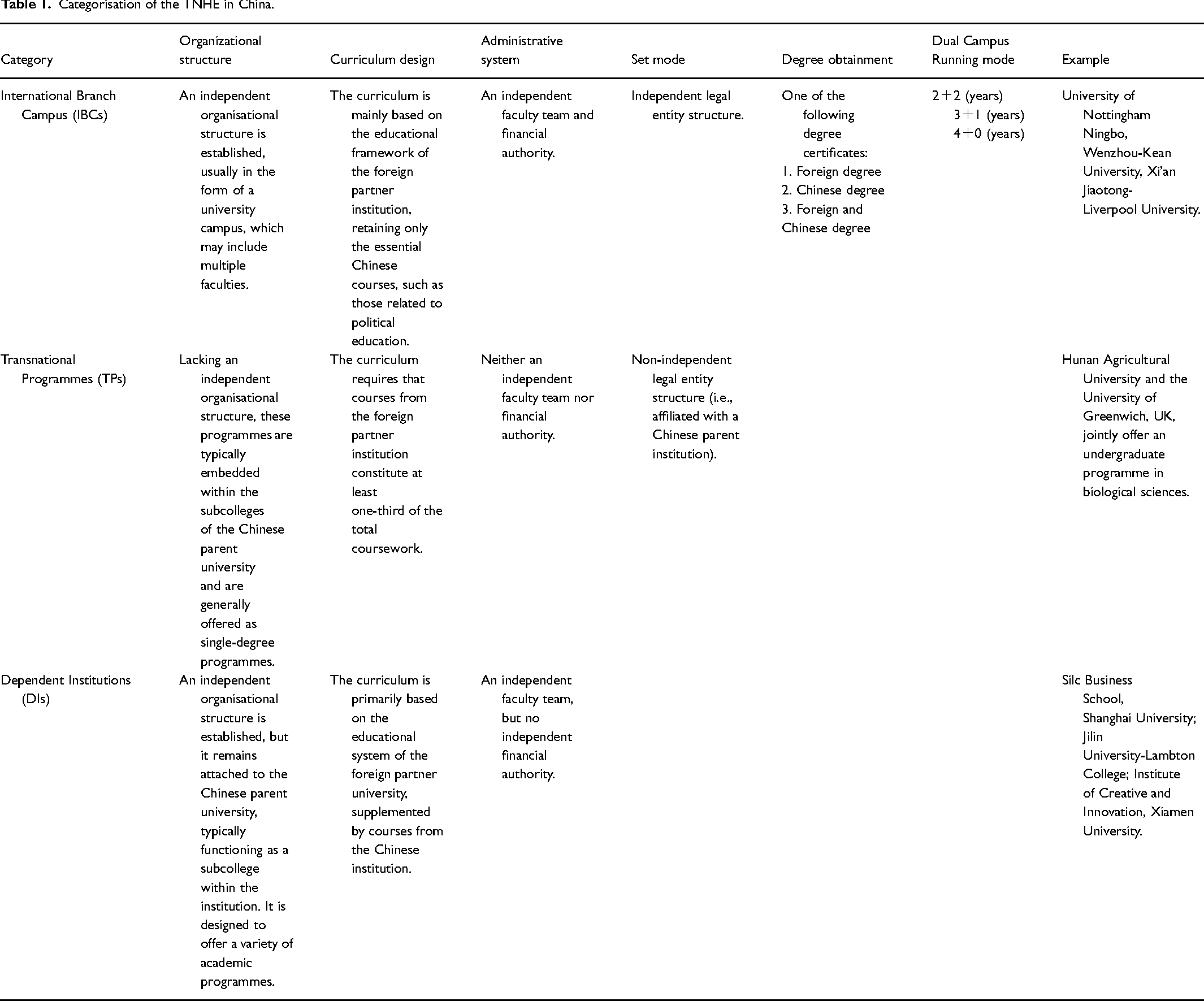
In the Chinese context, TNHE can be categorised into three distinct types (Fang & Wang, 2014) (Table 1): (1) international branch campuses (IBCs) are fully independent legal entities that are jointly established by Chinese and foreign institutions and operate at the university level with considerable academic and administrative autonomy; (2) dependent institutions (DIs) refer to educational entities that are jointly established by Chinese and foreign institutions within China and that primarily enrol Chinese students. Unlike IBCs, DIs lack independent legal status and operate under the administrative framework of their Chinese partner institutions; and (3) transnational programmes (TPs) refer to collaborative academic programmes between Chinese and foreign institutions that do not involve the establishment of a separate organisational entity (PRC Ministry of Education, 2004). These programmes focus on specific disciplines or courses and cater primarily to Chinese students. In China, TPs and DIs are overseen by both the Ministry of Education and provincial authorities. Most TPs and DIs in China operate through a dual-campus model, where students complete part of their studies at a Chinese university and the remainder at the partner university abroad (Oluwasegun, 2023).
Categorisation of the TNHE in China.
An extensive body of research on TNHE has been conducted (Kosmützky & Putty, 2016). The focal points include policy and quality assurance (Li et al., 2023; Sharp, 2017), student mobility and transnational spaces (Hartmann & Mok, 2021), geographic distribution (Jin et al., 2023; Li et al., 2024), teaching and learning practices (Levatino, 2017; Rytivaara et al., 2019; Wilson-Mah & Thomlinson, 2018), and motivations and experiences (Al Yafei et al., 2023; Liu et al., 2023a). Notably, why individuals opt for TNHE has received insufficient attention (Hoare, 2012). The decision-making is intricate and involves various contributing factors, such as personal interests (Yue & Lu, 2022), parental expectations (Pimpa, 2005), and institutional reputation (Mok & Han, 2016). Nevertheless, most studies have focused on IBC students (Hickey & Davies, 2022; Zhou et al., 2024) rather than TPs and DIs, although the latter far outnumber the former.
As of December 2023, 2,447 TNHE institutions and programmes were in operation, with only nine being IBCs (PRC Ministry of Education, 2023). TPs and DIs make up more than 99% of these DIs, making them the dominant model of TNHE in China. TPs and DIs exhibit significant similarities, as both are integrated within Chinese universities, function as nonindependent legal entities, and are organised around specific academic disciplines. Moreover, TPs and DIs are perceived as less ‘international’ than IBCs are. Using a qualitative approach, this study aims to answer the following question: What motivates Chinese students to choose TPs and DIs for their undergraduate studies?
Literature Review
The decision-making process for potential TNHE students is multifaceted, as they must weigh the attractiveness of TNHE against the push factors of local universities and the option of studying abroad (Wilkins & Huisman, 2015). McMahon's (1992) push−pull model provides a valuable framework for understanding the factors influencing students’ decisions to pursue TNHE. Research indicates that students enrolled in IBCs were motivated primarily by push factors, such as limited access to high-quality domestic education, as well as pull factors, including institutional prestige, Western-style pedagogy, and enhanced career prospects (Ahmad & Buchanan, 2017; Fang & Wang, 2014). Some scholars have categorised the factors influencing students’ choice of IBCs into different groups. For example, Xie et al. (2024) identified three sets of factors: student-related factors (e.g., academic performance), institutional attributes (e.g., global university rankings), and benefits for students (e.g., anticipated postgraduate income). Zhou et al. (2024) emphasised the influence of social context, institutional characteristics, and individual factors on students’ decision-making. In addition to academic considerations, financial and geographic factors also play a role. Ahmad and Buchanan (2017) highlighted that TNHE hubs, such as those in Malaysia, attract students due to their cultural similarities, lower tuition fees, and lower living costs than those in Western countries. Additionally, Chinese students may prefer IBCs for their perceived safety and affordability over those studying abroad and the opportunity to earn an internationally accredited degree while remaining in China (Dowling-Hetherington, 2020).
Despite the extensive research on IBCs, student motivations for selecting TPs and DIs remain underexplored. As the demand for TPs and DIs increases, educational providers need to understand the criteria that students use to evaluate these programmes (Ahmed et al., 2002). Existing studies suggest that students choosing TPs and DIs are driven primarily by cost-effectiveness, dual-degree opportunities, and access to English-language instruction (Liu et al., 2023a). Unlike IBCs, TPs and DIs operate within Chinese universities, providing a hybrid educational model that integrates Chinese and foreign curricula. Research indicates that students perceive experiences with Western-style pedagogy, particularly its emphasis on critical thinking and interactive learning, as a competitive advantage in the job market (Moufahim & Lim, 2015). Moreover, TPs and DIs facilitate English proficiency development, exposure to international faculty, and the development of intercultural competence, which ultimately enhance employability (Aminu et al., 2022).
A key distinction between students choosing IBCs and those opting for TPs and DIs is financial and academic accessibility. IBCs predominantly attract students from wealthier backgrounds seeking internationally ranked institutions, whereas TPs and DIs offer a more financially accessible alternative for students seeking international exposure at a lower cost (Hou et al., 2014). Additionally, government policies and institutional admission requirements differ between these TNHE models. IBCs generally uphold higher admission standards, requiring stronger academic performance (e.g., Gaokao scores), whereas TPs and DIs often have lower entry thresholds, enabling students with mid-range academic records to access international education (Oluwasegun, 2023). Although existing research has extensively examined IBCs, TPs and DIs represent a growing yet underexplored sector of TNHE which offers an alternative pathway to international education.
Theoretical Framework
We combined the widely adopted push−pull model and the theory of planned behaviour to provide a more comprehensive picture of the phenomenon. In what follows, we explain each model and how we combine them.
Push−Pull Model
Rooted in migration theory, the push−pull model is a useful and valuable framework for comprehending student mobility. Push factors are those related to conditions in students’ home country that drive them to seek education abroad, whereas pull factors denote the attributes of the host country that render it an appealing study place (Te, 2020). Many scholars (e.g., Fang & Wang, 2014; Liu et al., 2023a) have applied the push−pull model to explain that Chinese students are drawn to TNHE due to its international reputation, academic resource availability, and job opportunities.
The push−pull model offers valuable insights into the motivations for international study. However, it overlooks individual-level aspects, such as students’ social circumstances and perceptions (Phan, 2023). As Teichler (2004) highlighted, personal attributes such as gender, age, and academic ability are critical for analysing student mobility. Moreover, the push−pull model does not sufficiently explain why students may respond differently to the same push−pull factors. These differences may arise from individual values or perspectives that lead them to pursue different educational paths (Te, 2020). Considering these limitations, researchers (Chen, 2007; Dai et al., 2023a) have enhanced the push−pull model by incorporating individual factors. Our study adopted this enhanced push−pull model because it offers a more comprehensive framework for understanding students’ choices.
Theory of Planned Behaviour
The theory of planned behaviour focuses primarily on motivational factors, outlining what encourages or discourages students from studying abroad (Fitzsimmons et al., 2013). In 1991, Ajzen coined the theory of planned behaviour, proposing that human behaviour is determined primarily by behavioural intention and is impacted by three factors: attitudes towards the behaviour, subjective norms, and perceived behavioural control. Attitudes denote the degree of favourability or unfavourability with which an individual perceives the action they intend to undertake. Subjective norms include injunctive norms (i.e., the societal expectations of student behaviour) and descriptive norms (i.e., the preferences of significant individuals, such as parents) (Ito & Igano, 2021). Perceived behavioural control refers to an individual's belief in their ability to carry out the desired action, considering the elements that may facilitate or obstruct this process (Ajzen, 1991).
In summary, the push−pull model and the theory of planned behaviour have some explanatory power, but neither can fully address all the factors influencing students’ decisions. To address this gap, we integrate the revised push−pull model (Chen, 2007) with the theory of planned behaviour (Ajzen, 1991), attempting to explain why students make different decisions under the same conditions.
Research Design
The study received approval from the Human Research Ethics Committee at the first and third authors’ universities. The data were obtained from 43 undergraduate students enrolled in TPs and DIs, selected according to the principle of maximum variation. The participants included 25 males and 18 females. Of these, 29 students were enrolled in TPs, and 14 were enrolled in DIs. At the time of the study, five students were in their first year, 18 were in their second year, 11 were in their third year, and nine were in their fourth year.
Individual semi-structured interviews were conducted, which focused on four questions: Why did you choose a TP or DI compared to other alternatives such as IBCs, local universities, or study abroad? In what ways did your family influence your decision? Were there any significant people or experiences that influenced your choice? What other factors affect your decision to enrol in TPs or DIs? All of the interviews were conducted in Mandarin, the first language of the interviewees and the interviewer, to ensure clarity. Each interview lasted from 45 to 60 min and was recorded and transcribed. The participants were subsequently invited to review the transcripts through member checking to verify accuracy before the analysis began.
Immediately after the interviews, the first two authors independently and openly coded the data, followed by discussions to resolve discrepancies and reach a consensus. Once the coding was verified, the open codes were clustered to form themes and subthemes to answer our research question. Through multiple rounds of coding, revising, and fine-tuning, we identified 13 themes grouped into six categories: unsatisfaction with local non-prestigious universities and unaffordable costs for studying abroad (as push factors); university reputation, Western educational models and degree systems (as pull factors); family financial background and unsatisfactory Gaokao scores (as individual factors); programme preferences and study abroad expectations (as attitudes); the social environment and significant others (as subjective norms); and English proficiency and adaptability (as perceived behavioural control).
Findings
Push Factors: Unsatisfaction with Local Non-Prestigious Universities, Unaffordable Costs for Studying Abroad
Many participants perceived regular universities as offering limited career prospects, lower teaching quality, and weaker industry connections than prestigious institutions did. They viewed traditional lecture-based, exam-oriented teaching as lacking critical thinking, practical application, and international exposure. In contrast, TPs and DIs were seen as providing smaller class sizes, interactive learning, and global recognition, making them a more attractive alternative. For students whose Gaokao scores fell short of elite university entry, TPs and DIs offered a compromise—affiliation with a more reputable institution and better job market credentials. As Fan noted: I was not satisfied with attending a regular university, but my score needed to be higher for a Project 211 university. However, DIs provide me with a better opportunity. (Fan, Female, DI) My family cannot afford to send me overseas for my undergraduate studies. Compared with foreign universities, DIs are more affordable and convenient. (Huang, Male, DI)
Pull Factors: University Reputation, Western Educational Models, Degree Systems
Attending a prestigious university can lead to greater social recognition and enhanced prospects, such as higher income and social status (Dougherty, 2018). The respondents valued the reputations of both the Chinese and foreign partner institutions. Many participants chose TPs and DIs because of the reputation of the Chinese partner university and the global ranking of foreign partner universities. As Yang noted: I chose the Music Performance programmes offered jointly by Hunan Normal University and the Glinka State Conservatory in Nizhny Novgorod, Russia. The Glinka Conservatory's global ranking is comparable to that of the Central Conservatory of Music in China and has a long-standing international reputation. (Yang, Female, TP) The foreign professors assigned us reading materials and encouraged us to explore them independently. They focus more on students completing experimental projects independently, and the assignments are meant to develop independent thinking. (Zhi, Male, TP) I chose Xiamen University's College of Creativity and Innovation because I thought having two degrees would increase my resumption of future employment. This was one of the most appealing aspects of this DI. (Alice, Female, DI)
Individual Factors: Family Financial Background, Unsatisfactory Gaokao Scores
Parents need substantial financial resources to afford TPs and DIs because the tuition fees for these options are four to six times higher than those for local universities—ranging from 20,000 to 30,000 RMB per year compared with 4,000 to 5,000 RMB for regular local universities. As Xing noted, My decision to enrol in a TP was because my family could afford the high tuition fees. Otherwise, given the tuition cost, I would not have chosen the Food Science and Engineering programmes. (Xing, Male, TP) I am an only child, so my parents only need to support me. Our financial situation was not too tight, and they could cover my tuition. (Yu, Male, TP) My Gaokao score needed to be higher to meet the cut-off for a regular undergraduate programme. However, the Human Resource Management programmes offered by Hebei University of Economics and Business in partnership with Concordia University Chicago allowed me to apply with a lower score. (Zhao, Male, TP)
Attitudes: Programme Preferences, Study Abroad Expectations
All 43 interviewees positively perceived TPs and DIs before enrolment, with many citing programme preferences as a key factor in their decision-making. The alignment between their academic interests and the programme's curriculum was important for many students. Among the respondents, eleven specifically highlighted how the programme content matched their personal academic interests and career aspirations. This alignment was crucial in disciplines where TPs and DIs provided specialised knowledge, access to advanced teaching methods, and exposure to global industry standards. Meng, for example, deliberately sought out a programme that combined her passion for STEM with a high-quality curriculum: I am interested in STEM fields, and the Mechanical Engineering programme at Hubei University of Technology is the school's flagship programme. This TP with Merrimack College in the U.S. in Mechanical Design, Manufacturing, and Automation is also a priority project of the school. Participating in these programmes met my interests and ensured quality education. (Meng, Female, TP) I had wanted to study abroad since high school, but my parents disagreed. They only agreed to let me go abroad for my master's degree rather than a bachelor's degree. After the Gaokao, we learned about the Sino-European School of Technology at Shanghai University. My parents and I thought this was a great opportunity to pursue my dream of studying abroad. (Wei, Male, DI) I was planning to study abroad, and my programme is a Sino-foreign cooperative with the University of Tasmania. If my undergraduate grades are good enough, I will not even need to take the IELTS to go directly to postgraduate programmes at universities such as the University of Sydney or the University of Melbourne. (Han, Male, TP)
Subjective Norms: Social Environment, Significant Others
The social environment influences students’ choices to enrol in TPs and DIs; as the social acceptance of TPs and DIs increases, students are more inclined to consider these options. For example, Long, after these institutions were researched online, discovered that the majority of feedback on the learning experience from those who had enrolled in TPs or DIs was positive: With the continuous development of higher education in China, TPs have become more widely accepted. I believe that TPs offer more choices and opportunities to obtain high-quality education. (Long, Male, TP) Some of my older schoolmates were also enrolled in TPs. They said the programmes were quite good, with opportunities to compete abroad. They were very optimistic about the programmes, so I decided in high school to choose it too. (Yang, Female, TP) My homeroom teacher in high school recommended the TPs offered by Xiamen University of Technology and Victoria University of Wellington. I chose this programme because I like the more relaxed and open Western teaching style. (Zhi, Male, TP)
Perceived Behavioural Control: English Proficiency, Adaptability
Since TPs and DIs use English as the medium of instruction, students tend to assess their language skills before deciding to study in these programmes. Ten of the 43 interviewees expressed a strong interest in learning English and believed that their language skills were adequate, as Ella shared: I am strongly interested in learning English, and my English is quite good. I enjoy interacting with foreigners, so I was naturally drawn to TPs and DIs. After Gaokao, I chose the Maynooth International Engineering College at Fuzhou University. (Ella, Female, DI) I do not like the spoon-fed teaching style used in China, and I prefer a more unrestricted academic environment. I learned about the accounting programmes at Beijing Jiaotong University's International Education College, which focuses on developing students’ critical thinking and exploratory skills. I would adapt better to this Western style of education. (Zhe, Male, DI)
Discussion
Main Findings and Contributions
Students enrolling in TPs and DIs have unique characteristics. Their Gaokao scores typically do not qualify them for entering China's prestigious universities. In the competitive Chinese job market, a degree from these elite universities is often a prerequisite for securing stable, well-paying employment. China's urban unemployment rate averaged 5.1% in 2024 (PRC Government, 2025), which was relatively higher than in previous years (e.g., 4.1% from 2010 to 2013), reflecting persistent employment challenges. Unlike students who study abroad or attend IBCs, who typically have strong financial support, students in TPs and DIs come from middle-income households (Qin, 2021). While their families can afford the higher tuition fees of TPs and DIs, they often lack the financial resources to pursue overseas education. One main contribution of this study is to highlight that the decision to enrol in TPs and DIs is uniquely shaped by lower admission requirements and students’ financial ability, distinguishing them from those choosing IBCs.
Through interviews with 43 Chinese undergraduates in TPs and DIs, we found that students’ motivations for enrolling in TPs and DIs are seeing them as stepping stones for further mobility opportunities. The 13 factors influencing students’ decisions to enrol in TPs and DIs can be categorised into six groups (Figure 1).
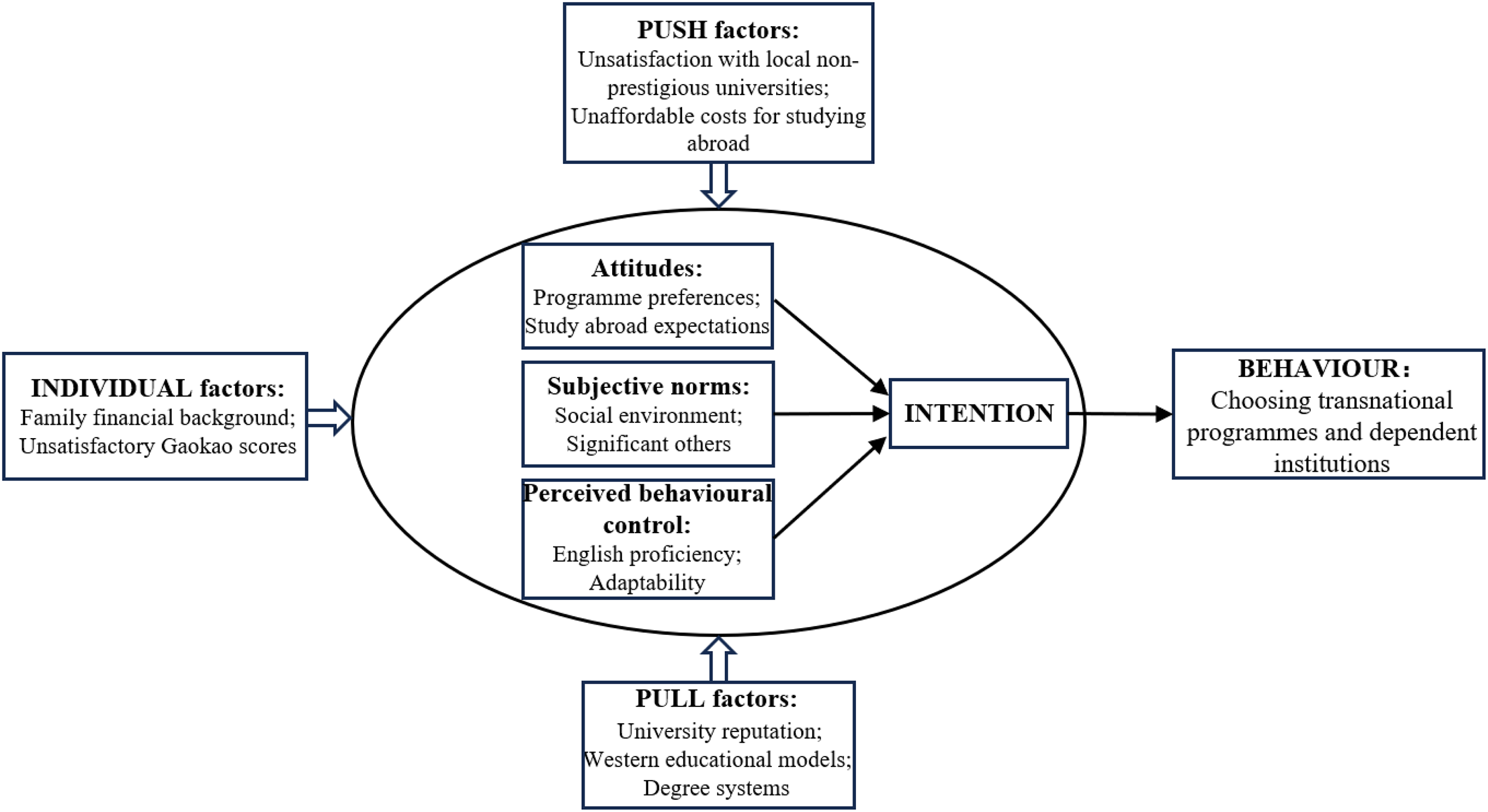
Factors affecting Chinese students’ choices of TPs and DIs based on a combination of the push−pull model and the theory of planned behaviour.
Concerning push and pull factors, many Chinese students value the reputations and international rankings of Chinese and foreign partner universities. Dai et al. (2023b) also identified institutional prestige and international academic experience as determinants of students’ decision-making. In our study, we further explain that many students in TPs and DIs unsatisfied with local non-prestigious universities are constrained by financial pressures and decide not to study abroad but are still eager to receive international education. This study also revealed that the dual-degree system is a significant draw for Chinese students, which aligns with the findings of Oluwasegun (2023), who indicated that the prospect of earning degrees from two universities at once is particularly enticing to international students. However, unlike international students, who are often motivated by the opportunity to complete two degrees within the time normal for one degree, Chinese students are attracted primarily to the competitive edge offered by dual degrees in the job market or further study.
Regarding individual factors, family financial background is found to be a determinant of international education choices, corroborating the findings of Mazzarol and Soutar (2002) and Wang (2020). Chen's (2018) research also established that students who enrol in TNHE generally originate from families with an annual income of no less than 200,000 RMB. In addition, our participants’ Gaokao scores were sufficient only for entering a regular university. Nonetheless, students strive to optimise whatever they can do with their unsatisfactory Gaokao scores, corroborating the findings of Xie et al. (2024), who noted that this phenomenon also exists in those who select IBCs. The shared pattern is that when conditions allow (e.g., the Gaokao scores meet the enrolment requirement and the family conditions are supportive), students prefer TNHE over local universities. In terms of the differences between Xie et al.’ s study and our findings, the IBC students in their study place greater emphasis on their parents’ financial capacity and support than our participants do when making their decisions.
Utilising the theory of planned behaviour, we identified three more groups of factors influencing students’ decisions: attitudes, subjective norms, and perceived behavioural control. Concerning attitudes, most participants exhibited favourable dispositions towards TPs’ and DIs’ curricula; this is consistent with the findings of Zhou et al. (2024), who identified institutional choice as the foremost priority for students, followed by programme interest. Additionally, many students who chose TPs and DIs initially intended to study abroad. TPs and DIs, with their predominant Western education model, were perceived favourably.
Inadequately examined in previous research, subjective norms also impact Chinese students’ decisions to study TPs and DIs. Healey (2020) suggested that TNHE might produce economic advantages for specific countries by providing substandard education to students from other countries. Interestingly, the participants in our study were not concerned about this; instead, they perceived TPs and DIs as representing high-quality education. Their perception was formed based on their online information search and input from their parents, teachers, and influential individuals. That said, we are mindful that students’ perceptions might change after they start their studies, and these changes also need to be examined in future to obtain a more complete understanding.
This research demonstrates the usefulness of combining the push−pull model with the theory of planned behaviour. We found that individual student characteristics mediate the impact of these factors, enriching our current understanding of the topic. Moreover, utilising the theory of planned behaviour enabled us to uncover important factors such as students’ assessment of their ability to adapt to the English-language environment and Western teaching methods. Approximately 80% of the participants mentioned that their TPs and DIs required a particular score in the English section of the Gaokao. Thus, fluency in English and the perceived ability to adapt to Western teaching methods greatly influenced their decision to choose TPs and DIs, adding weight to the findings of Zhou et al. (2024).
Implications
These findings inform educational practices. First, students face uncertain environments when selecting universities and need more complete information. Recruitment managers in TPs and DIs should use official websites and social media to provide transparent information about their educational models and programmes. Second, the high cost of TPs and DIs excludes students from lower socioeconomic backgrounds, so TPs and DIs are a privilege for those who have financial resources. To address this, TPs and DIs could offer targeted scholarships. Third, many Chinese students choose TPs and DIs for their high-quality foreign education resources and dual-degree opportunities. Thus, TPs and DIs must ensure that these expectations are met. Moreover, local universities outside China's 211 and 985 projects can also refer to our findings to reflect on their recruitment process and quality enhancement. Rather than trying to capture the advantages of TPs and DIs, local universities may need to review their mobility opportunities, such as internships, exchanges, and service learning, as well as teaching and learning practices and mediums of instruction.
Limitations
This study has several limitations. First, the small sample size limits the generalisability of the findings. Not all students choosing TPs and DIs are influenced by the same factors to the same extent. Although we tried to acknowledge individual factors in our analysis, our analytical framework may need further adaptation to different contexts or student groups. Quantitative measures to validate these conclusions with a broader sample could be developed in future studies. Second, students’ motivations for choosing TPs and DIs are dynamic and may change over time. We focused on students’ motivations for choosing TPs and DIs before enrolment without exploring how their motivations may have evolved afterwards. In future research, longitudinal data could be utilised to further examine and refine these findings. Third, the influence of unsatisfactory Gaokao scores, a factor identified in this study, is specific to China, where Gaokao results heavily influence university choices. However, the theoretical framework, which integrates the push−pull model and the theory of planned behaviour, could be applied to other countries with significant engagement in TPs and DIs.
Footnotes
Declaration of Conflicting Interests
The authors declared no potential conflicts of interest with respect to the research, authorship, and/or publication of this article.
Funding
The authors received no financial support for the research, authorship, and/or publication of this article.
