







Abstract
This study examines the impact of short-term international student mobility on the career trajectories of graduates from low-income backgrounds. Based on semi-structured interviews with Mexican participants who studied at U.S. community colleges between 2014 to 2016, the analysis draws on concepts such as employability and transnational human capital. The findings are structured around participants’ career progression, identifying three trajectory patterns: a) Continuous Career Progression
Keywords
Introduction
A persistent blind spot in international mobility research is the participation of students from low socioeconomic backgrounds. Most studies have focused on empirical cases involving socially privileged groups, leaving those who face greater disadvantages largely overlooked. From this perspective, a significant gap remains in understanding how this kind of mobility may affect students from disadvantaged origins and, more specifically, whether such experiences can partially counterbalance accumulated social inequalities.
This study therefore asks how participation in international academic mobility shapes the medium-term professional trajectories of graduates from bilingual technological universities (BTUs). It offers a perspective that highlights the interplay between transnational human capital, labor market structures, and career progression. Despite the growing body of literature on student mobility and employability (Bustos-Aguirre, 2016; Potts, 2015; Teichler, 2011; Wiers-Jenssen et al., 2020), few studies have examined graduates from socioeconomically marginalized backgrounds in Latin America, particularly in the context of short-term programs (approximately six months). In this regard, the analysis draws on the experiences of a group, the majority of whom are first-generation in higher education.
An essential aspect of this study is its methodological design. The student mobility took place in 2014, 2015, or 2016, while the interviews were conducted in 2022 and 2023. This six- to eight-year gap makes it possible to analyze participants’ development over the medium term. Such an approach offers a perspective distinct from synchronous studies that do not account for progression over time.
Beyond methodological considerations, the national context further shapes the impact of international academic experiences. In Mexico, where profound social inequalities influence both higher education and the labor market, 54.2% of the labor force is engaged in informal employment—compared to an average of only 10–20% in OECD countries—while 32.8% work under precarious conditions (INEGI, 2025). These figures highlight the need to examine international student mobility (ISM) outcomes in light of structural inequalities that condition graduates’ trajectories.
Literature Review
Social Background in Studies on Student Mobility
A substantial body of research has highlighted the high degree of social selectivity among those who participate in student mobility (Gerhards et al., 2017; Granato and Schnepf, 2024; Iorio & Pereira, 2018; King et al., 2011; Lörz et al., 2016; Maldonado et al., 2021; Murphy-Lejeune, 2002). These studies broadly agree that a socially and economically advantaged background is a key determinant of participation in such programs—reflected in factors such as parents’ educational attainment, access to financial resources, foreign language proficiency, and prior international travel experience. Student mobility thus becomes a marker of distinction for individuals with multiple social advantages (Schäfer & Walgenbach, 2024), contributing to the widening of inequality gaps in countries already marked by deep social disparities (Maldonado et al., 2021; Netz et al., 2020).
Participation by students from socially disadvantaged backgrounds in ISM remains rare, resulting in low representation both globally and in Mexico. According to Bustos-Aguirre et al. (2023), temporary, outbound, international student mobility accounts for less than 0.5% of total higher education enrollment in Mexico, with the majority of participants coming from the most prestigious public and private institutions.
These cases are empirically valuable, though rarely studied, due to their complexity and exceptional nature. They are often made possible by the creation of inclusive mobility programs, which some authors describe as pathways for agency within structurally constrained environments (Dassin et al., 2018). In this line of research, Herrero and Stanton (2021) found that short-term, inclusion-oriented mobility programs have a lasting and catalytic impact on participants’ academic and professional development, as evidenced in their career trajectories.
Student Mobility and Employability
A common view in the literature is that international academic experiences develop skills that improve employability by linking individuals to relevant job opportunities (Farrugia & Sanger, 2017; Potts, 2015; Potts and Kim, 2021; Sisavath, 2021). Some scholars have argued that ISM experiences facilitate access to jobs in globally oriented companies or to higher-status positions (Teichler, 2011; Wiers-Jenssen, 2011), although this does not necessarily imply better working conditions than those enjoyed by non-mobile graduates.
While certain studies demonstrate labor market advantages for mobility participants (Kratz and Netz, 2016; Mohajeri-Norris and Gillespie, 2008), others call for a more nuanced understanding, noting that student mobility across borders does not always translate into significant benefits (Kommers & Bista, 2021; Waibel et al., 2017). Waibel et al. (2017) argue that ISM does not necessarily yield the positive outcomes attributed to it in subjective studies. The authors conclude —based on objective information that includes both participants and non-participants— that student mobility does not inherently improve access to a first job; in fact, it may delay entry. They also note that while the positive relationship between mobility and income tends to be moderate, it generally increases over time. Furthermore, some authors highlight that the impact of mobility can be particularly significant for participants from socioeconomically disadvantaged backgrounds (Di Pietro, 2015; Waibel et al., 2017; Wiers-Jenssen et al., 2020).
As noted, multiple factors influence the relationship between ISM and employment, including country-specific characteristics, field of study, and sector of employment (Waibel et al., 2017). Clarke (2017) contends that international student mobility does not operate in isolation; it interacts with other elements such as human and social capital, individual attributes, perceived employability, and labor market conditions. From this perspective, some scholars question whether student mobility itself improves employability, arguing instead that participants often possess socially advantageous skills and profiles from an early age, which may largely explain their strong labor market outcomes after graduation (Bustos-Aguirre, 2016; Knutsen et al., 2024; Messer & Wolter, 2006).
The link between student mobility and employability is also shaped by the specific nature of the ISM and by labor market conditions. One general distinction in assessing mobility's influence is between short-term, credit-earning mobility and full-degree mobility. Dwyer (2004) notes that longer stays tend to yield greater benefits; however, even experiences as short as six weeks can have lasting personal, professional, and academic effects. In line with this, Van Mol et al. (2021) emphasize that labor market outcomes depend significantly on the level of education, the type of mobility, and the status of both the destination country and the host institution.
In Mexico, labor market characteristics strongly condition the employability outcomes of ISM participants. The labor market is characterized by heterogeneity, dynamism, and high levels of segmentation (De Ibarrola, 2016), with substantial variations in employment opportunities by geographic region and professional field. Moreover, rising informality and heightened labor precarity disproportionately affect recent graduates (Navarrete, 2012). These factors underscore the need for empirical studies that deepen our understanding of mobility's influence on employability.
It is important to consider the close commercial ties and patterns of ISM between Mexico and the U.S. (Maldonado et al., 2024). Given that the U.S. is Mexico's main trading partner, numerous opportunities arise for individuals who are proficient in English or who have work experience in companies with commercial links to the U.S.
Theoretical Framework
This study is grounded in two key concepts: capital and employability. It draws on the notion of transnational human capital (Gerhards et al., 2017) to explain the set of capitals that distinguish individuals who participate in student mobility programs. This concept, derived from the work of Bourdieu and Passeron, acknowledges that capitals may be social, economic, symbolic, or cultural. Transnational human capital emphasizes resources that enable individuals to act beyond the constraints of a given country or entity. As Gerhards et al. (2017, p. 2) explain: […] skills and credentials that allow individuals to act beyond the confines of the nation-state or in transnationalized contexts that transcend national borders. Language proficiency, knowledge of other countries, and intercultural skills […] are all part of transnational human capital. We consider these skills as ‘capital’ because they are resources that provide those who possess them with the ability to act transnationally and, potentially, to obtain specific ‘returns.’
The concept of employability has been extensively developed from different theoretical perspectives and disciplines. From a sociological standpoint, employability is a complex construct shaped by multiple dimensions and factors. Broadly, it refers to the capacity of a higher education graduate to secure and maintain desired employment (Robson, 2023). This implies that graduates seek jobs with a certain performance level, where they can apply their skills, obtain returns commensurate with their educational investment, and achieve substantial improvements over time. Hillage and Pollard (1998, p. 12, cited in Clarke, 2017) define employability as: […] the capability to move self-sufficiently within the labour market to realise potential through sustainable employment. For the individual, employability depends on the knowledge, skills and attitudes they possess, the way they use those assets and present them to employers, and the context (e.g., personal circumstances and labour market environment) within which they seek work.
Some authors argue that viewing employability solely as an individual capacity to obtain work is overly narrow, as it fails to account for broader structural factors (Clarke, 2017; Llinares Insa et al., 2020). Clarke (2017) asserts that employability extends beyond skills and knowledge to encompass social capital, perceived employability, personal attributes, career self-management, and the evolving demands of the labor market. Social inequality plays a significant role in labor market insertion (Robson, 2023), as social position continues to influence employment outcomes even for university graduates. Furthermore, labor markets evolve according to shifting demands, often requiring constant updating of skills. These dynamics create differentiated opportunities across fields of study, with technology-related sectors, for example, showing particularly high demand (OECD, 2025).
Spence's (1973) signaling theory suggests that recruiters seek signals or markers that indicate a candidate's suitability for a position. From this perspective, ISM serves as a differentiating signal (Huang & Yoon, 2024), indicating that an individual possesses relevant experience and skills for a given role. This signaling effect is strongest when employers seek candidates for globally connected firms (Teichler, 2011; Wiers-Jenssen, 2011).
Methods and Materials
The methodological approach is qualitative, drawing on participants’ interpretations of the factors that shaped their career development as graduates (Flick, 2007; Taylor & Bogdan, 1992). This type of analysis relies on personal narratives as a means of sharing experiences of social phenomena, recognizing language as a vehicle for objectifying perceptions of the context in which individuals operate and their interpretations of their own experiences (Berger & Luckmann, 1968).
The method employed is the biographical approach (Bertaux, 2011), which reconstructs life histories through a sequence of questions that begins with early life conditions and progresses toward later stages. While the interviews followed a general chronological sequence, narratives frequently moved between past, present, and future, and thus did not strictly adhere to a linear order.
The study of biographies was structured through a retrospective and longitudinal perspective, enabling the analysis of a social phenomenon over an extended timeline rather than at a single moment. The retrospective dimension refers to participants’ reconstruction of their past from the standpoint of the present.
Two interview guides were used. The first explored participants’ lives from early childhood to their university years, while the second focused on the post-graduation period. The first guide addressed sociodemographic data, social background, educational trajectory, entry into higher education, transnational human capital, and aspirations. The second covered employment trajectory, further education, personal trajectory, the meaning attributed to the ISM experience, perceptions of the completed studies, and aspects related to participants’ social mobility.
Participants were recruited via social media and the snowball technique, whereby interviewees provided additional contacts. Interviews were conducted through the Zoom platform. In total, 16 individuals whose profiles aligned with the study's objectives were interviewed. Their years of participation in ISM were 2014 (n = 3), 2015 (n = 12), and 2016 (n = 1). Interviews were conducted between 2022 and 2023, at least six years after the ISM, by which time nearly all participants were assumed to have entered the labor market.
Data analysis involved transcribing the interviews and subsequently categorizing the material. Ethical considerations included safeguarding participants’ identities through pseudonyms, informing them of the study's objectives, and obtaining permission to record the interviews.
Sampling
The study draws on the experiences of BTU graduates in Mexico who participated in the “SEP–Bécalos–Santander Universidades” initiative, which funded six-month placements at U.S. community colleges. Its goal was to strengthen English skills and integrate degree-related courses. Selection of participants was based on English proficiency and academic performance, although applicants had time to prepare through extra courses offered by the BTUs. The program formed part of FOBESII, launched in 2013 by Presidents Obama and Peña Nieto to promote academic exchanges with an emphasis on equity.
BTUs serve populations in highly marginalized areas and are characterized by the BIS educational model (bilingual, international, and sustainable). First implemented in 2012 with a specialized university in the state of Aguascalientes, the model later expanded as an alternative to traditional technological and polytechnic programs, reaching at least 45 institutions by 2019 across 18 states in Mexico. It is bilingual, with 50–70% of courses taught in English after a semester of immersion, aiming for graduates to reach B2–C1 proficiency, though no entry level is required. It is international, fostering intercultural skills and ISM (budget dependent), and sustainable, emphasizing environmental awareness.
Bilingual technological universities were selected for this study based on three key conditions: they serve marginalized populations, promote English proficiency, and are among the few institutions that, despite their constraints, offer student mobility programs to individuals who would otherwise be unlikely to participate.
This article focuses on 16 individuals drawn from seven different states—three in northern Mexico and four in the central region. Half of the interviewees were women. Table 1 presents the main characteristics of the participants.
Participant Profiles.
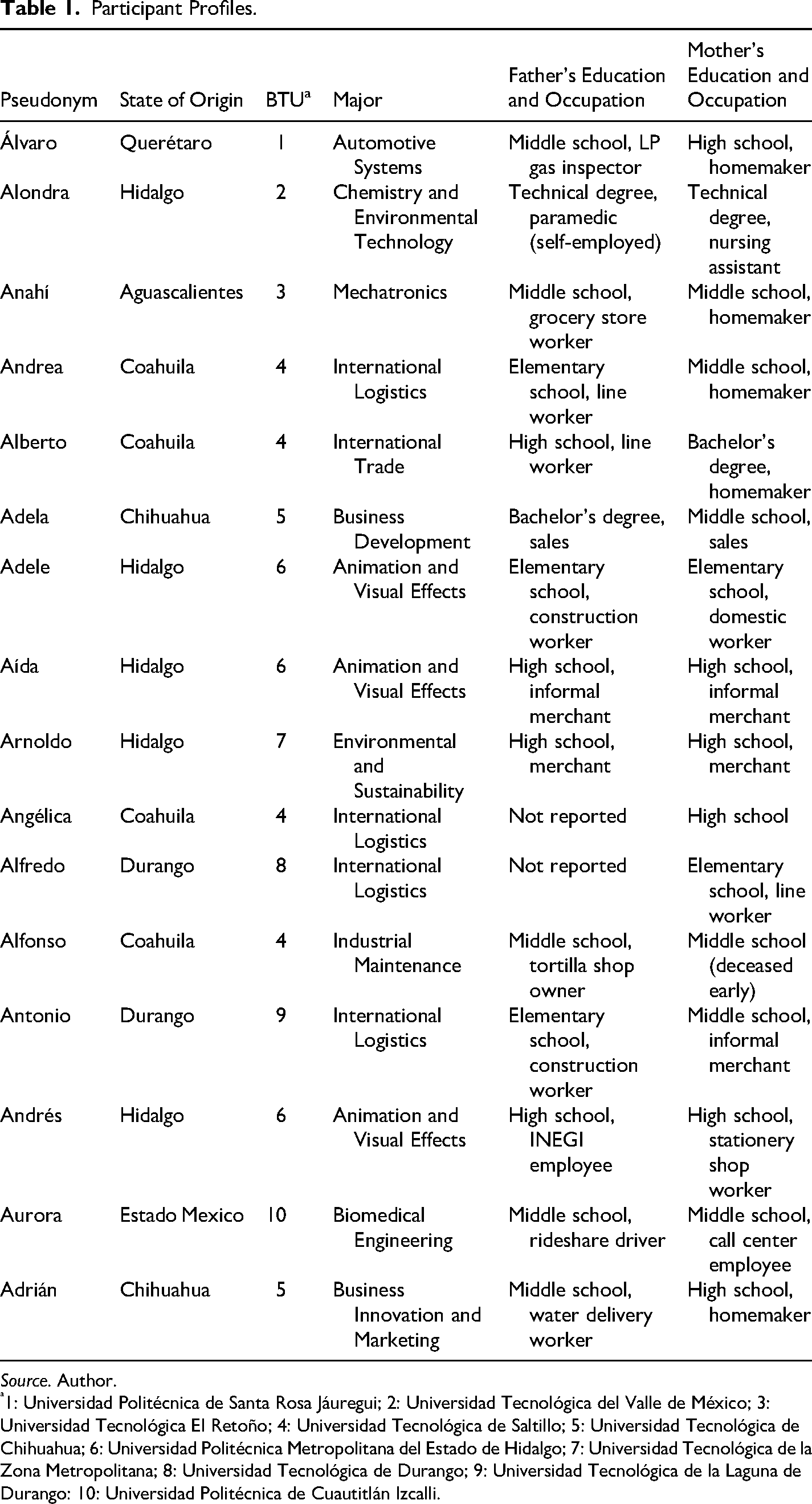
Source. Author.
1: Universidad Politécnica de Santa Rosa Jáuregui; 2: Universidad Tecnológica del Valle de México; 3: Universidad Tecnológica El Retoño; 4: Universidad Tecnológica de Saltillo; 5: Universidad Tecnológica de Chihuahua; 6: Universidad Politécnica Metropolitana del Estado de Hidalgo; 7: Universidad Tecnológica de la Zona Metropolitana; 8: Universidad Tecnológica de Durango; 9: Universidad Tecnológica de la Laguna de Durango: 10: Universidad Politécnica de Cuautitlán Izcalli.
The parents’ educational attainment and occupations serve as indicators of participants’ social origins. All participants came from low-income households. Only two had visited the U.S. prior to participating in the mobility program, although these visits were brief, associated with residence in border areas, and had little impact on their personal trajectories. Fourteen of the sixteen participants were first-generation college students.
Findings
Continuous Career Progression
This type of career trajectory was identified in 10 of the 16 cases and is characterized by sustained improvement in working conditions over time, either through promotions within the same company or through strategic job changes. In this subgroup, participants significantly improved their socioeconomic and educational status compared to their parents, whose jobs were predominantly manual or operational.
A distinctive feature of this subgroup is that they did not experience periods of unemployment; their transition into their first job occurred almost immediately after graduating with their engineering degree. All have held specialized positions, and some have attained managerial or executive roles within a relatively short period. Not all participants worked in internationally oriented jobs, but all credited ISM with helping them secure employment and advance to higher positions. The analysis identified five factors that influenced the sustained development of these career trajectories.
An initial factor lies in transnational human capital (Gerhards et al., 2017), exemplified by the active use of English in their jobs, the development of intercultural skills when working with people from different countries, and technical knowledge acquired during the ISM, which continued to develop over time. This type of capital is relatively scarce in Mexico, making it valuable for access to and progressive advancement in the labor market: All the jobs I’ve had have almost always been in service jobs, and the culture, the way of managing them, the communication has almost always been in English. Very American in the work style, the operations style. So, I feel that being [in the student mobility program] helped me a lot. I’m telling you […] speaking English, mastering it, is one of the fundamental requirements for a job vacancy […] it's essential to speak it. Many people here in the city speak it and can communicate, but the advantage of mobility is the way you communicate [with greater fluency and professionalism] (Adrián).
The symbolic value of student mobility was the second point (Potts, 2015; Sisavath, 2021). Such experiences was interpreted as a signal of commitment and adaptability (Spence, 1973). In these cases, ISM featured prominently in job interviews and in the structuring of CVs. Participants felt that recruiters perceived them as having experience in internationalized environments and a higher degree of commitment: [The student mobility experience was useful] to get the job or both jobs I had. I think it influenced quite a lot […] because generally, when I went to job interviews and they saw that on my CV, the recruiters would always emphasize ‘Do you speak English, and how have you related to that?’ (Andrés).
A further factor concerns individual attributes, such as the initiative to take on new challenges and the pursuit of career opportunities with greater international projection. This is also linked to the student ISM, which fosters a greater propensity to take on challenges in globalized contexts (Gerhards et al., 2017; Murphy-Lejeune, 2002). In these cases, participants expressed a heightened sense of self-efficacy, enabling them to perform better in the workplace and to face work environments in other countries (Teichler, 2011; Wiers-Jenssen, 2011). Clarke (2017) highlights this quality as part of perceived employability—confidence in one's ability to succeed in the labor market: [I was looking for a job in other countries] and I found this opportunity that said: ‘We’re looking for engineers to work abroad.’ I sent my résumé, and yes, I was accepted. They really liked that I already had the experience of the exchange, the exchange in the United States. I think that was what opened the doors for me the most (Alfonso).
Another relevant factor is prior work experience, which in several cases proved pivotal for career development, with its impact further reinforced by student mobility: Well, [when I did the student mobility program] I quit the job I had. At that time, I reported directly to the purchasing director. I told him, ‘[…] I got a scholarship and I’m going to study abroad, so I’m here to resign.’ And he said, ‘Oh, well congratulations, it's great that you got that scholarship. When you finish university, look me up, you have a secure position here.’ [And that's how I came back with the mobility experience and an engineering degree and got a very good position at the company] (Alfredo).
Taken together with the previous factors, individual performance and accumulated experience within the same company. As with other factors, this experience is often tied to ISM, particularly English proficiency: I’ve only been at one company. Fortunately, I’ve been able to build a professional career there, and I hope to continue, but later on as a director. I was in the laboratory in product development, which was actually my first job. And well, especially because they are precisely the generation of new products, they require English proficiency. So, in that regard, my boss also saw it [as very positive] (Alondra).
The case of Adrián, an engineering graduate in business and marketing, illustrates continuous career progression within his life story. The son of parents with limited education and manual jobs, he grew up in economic scarcity and with no prior exposure to English or foreign travel. In his family, university was seen as a privilege reserved for the elite. Participating in the mobility program was a challenge marked by uncertainty, but it strengthened his self-confidence. ISM in his social environment were limited to acquaintances who had migrated to the U.S. as undocumented workers. After graduating, he joined an international company, rising from an operational to a managerial role in just three years, with strategic and commercial responsibilities in a global environment—a rare achievement for someone from a low socioeconomic background. For Adrián, the student mobility experience improved his English fluency in real-world contexts, increased his confidence to interact in globalized environments, and enhanced his visibility in recruitment processes: And I feel that the student mobility experience was what I needed to be able to keep going and move forward because I was already falling into the mindset of ‘That's not for me, I was born poor and maybe I’ll stay poor, at best I’ll have a slightly better job in some office, but that's it.’ So yes, it opened a very different panorama for me […] (Adrián).
Sustained career progression stems from the interplay of transnational human capital, its recognition as symbolic capital, and personal attributes. This mix enhances employability internationally and distinguishes graduates nationally. The accumulation of such capital, reinforced by internships and strong performance, expands access to higher-level jobs.
Career Progression with Initial Employment Difficulties
This trajectory, identified in 4 of the 16 cases, is characterized by an initial insertion into precarious or informal jobs, followed by substantial improvement in working conditions after gaining experience and actively seeking better opportunities.
In general, the cases analyzed reveal that opportunities in their areas of specialization were limited in their immediate geographic environment. To access a job aligned with their field and level of education, participants accepted positions with low salaries, no social security, or long working hours—either to gain experience or as a temporary alternative while seeking a better opportunity. Although not all the jobs obtained corresponded to an internationalized profile, the ISM was recognized for its positive—sometimes indirect—influence on their working lives. Regarding the relationship between student mobility and employability, six factors of both positive and negative influence were identified.
The first factor is linked to structural limitations of the labor market. For these interviewees, the job market was perceived as small and offering conditions not commensurate with their educational level. In such cases, ISM loses its labor market influence when there are no positions in which its advantages can be leveraged: […] it was quite a while that I was unemployed because I graduated in 2018, months went by—honestly, I don’t remember exactly how long—and I think it was at the end of 2018 or the beginning of 2019 when I started at this second company, doing an internship, because I really wasn’t finding anything, I wasn’t doing anything, and I didn’t have much money (Alberto).
Another structural limitation is employers’ demand for prior work experience, which often serves as the main indicator of suitability for a position. As a result, interviewees were forced either to take manual jobs requiring no specialized training or to accept positions related to their profession but under conditions far below their expectations: Well, look, when I got to one of the companies I worked for, obviously I was looking for a certain salary level; however, I’m also aware that with the little experience I have in this field, it's practically impossible to get it, even if I have the knowledge. Sometimes people may have the knowledge, but companies don’t care what you know; what they really care about is the experience you have working in the same thing (Andrés).
A further factor influencing career trajectories was persistence. This was expressed through an ongoing search for new job opportunities, drawing on experience gained in their first job to position themselves, alongside their international academic experience as a symbol of skills and effort. Persistence and agency also manifested in the flexibility to adapt to new contexts, including relocating to geographic areas outside their place of origin. According to Murphy-Lejeune (2002), early student mobility foster precisely this flexibility and adaptability to new contexts, enabling access to better working or academic conditions: So yes, I plan to move eventually. I’d like to complete the year where I am and then start applying to other places. Nowadays, I’m very eager to move to another country—I don’t yet know which one. The truth is, it's still uncertain, but yes, I really want to (Adele).
An additional factor was the ability to adapt to unplanned work areas, which became a key strategy for professional insertion. In this study, those who changed fields had studied business administration, but their first experiences were marked by excessive hours and unpaid overtime. Faced with such conditions, they found opportunities in the same universities where they had studied, leveraging their English proficiency and the knowledge gained during ISM to teach new students: […] my schedule was from 6:00 a.m. to 5:00 p.m. So yes, it was exhausting. And because, apart from getting home supposedly to rest, no—I would get messages, I had to check emails, and I never stopped working [that's why I decided to move into teaching] (Alma).
Limited access to professional networks constituted a significant barrier to securing a first job. Narratives often mentioned the absence of contacts who could facilitate access to employment. Considering that these participants came from disadvantaged socioeconomic backgrounds, social origin still plays a significant role in employment (Robson, 2023). According to Clarke (2017), social capital involves networking connections that increase the likelihood of obtaining the first job or making a career move: I thought about getting a good job here in my country, but I believed I would never achieve it. Honestly, I saw that advantage many times from having been born into a certain family […] in Mexico, the whole ‘compadrazgo’ or ‘palancas’ thing is very common; [that is, the importance of social connections]. There were people you would look at and think, ‘Why was he so lucky to move up so quickly?’ And it really wasn’t due to his performance or skills, but because of his connections (Andrés).
In the narratives, symbolic capital linked to ISM emerges in a deferred and indirect manner. Participation in international mobility programs is not perceived as a direct symbol of skills and language ability, but rather as evidence of commitment and effort. Thus, academic international experience functions as a distinguishing feature enabling individuals from low socioeconomic backgrounds to achieve upward social mobility (Dassin et al., 2018): […] the mobility experience, I feel like it's a nice title you can add, a plus. […] It speaks of commitment, it speaks of responsibility—although it doesn’t explicitly say ‘responsibility,’ you can see it; it's synonymous with [student mobility]. So I feel that it did have some weight [when changing jobs]. Not everywhere and not in all cases, but I know it counts […] (Adele).
The most representative example of this trajectory is Adele's life story. The daughter of parents with basic schooling and low-paid manual jobs, she grew up facing multiple economic hardships. She was the first in her family to earn a higher education degree. Before participating in student mobility, she had never traveled abroad, and her English proficiency was very basic. Her first job in her home state was precarious: low salary, long hours, and no benefits. Five years later, she moved to another state and secured a professional position in digital marketing with better pay and stability. For Adele, ISM influenced her career improvement because: a) it boosted her confidence to apply for jobs outside her local context; b) it acted as a signal of adaptability and commitment in job interviews; and c) it awakened her “travel chip” (Murphy-Lejeune, 2002), making her more willing to relocate.
No Career Progression
Only 2 of the 16 cases showed no sustained career advancement. These are individuals with temporary or informal jobs, interspersed with long periods of unemployment or underemployment. Although ISM is recognized as a valuable experience that can increase the chances of employment, its impact is diluted in the face of scarce opportunities or a lack of commitment to professional development. Five factors are related to this type of trajectory.
Structural barriers appear most strongly in this group, highlighting the decisive role of the labor market. The scarcity of job opportunities in their field of study limits the possibility of full professional development. This is particularly acute in states where the main economic activity is agriculture. Structural barriers also include the lack of significant contacts and the absence of jobs with favorable conditions: Here […] the main source of income is farming, being a farmer. And as for what I studied, there has hardly been [anything]. Or [if there is], they don’t pay what it's worth, or what the product is worth, and I do see that as a big obstacle (Aida).
Second, a disconnect emerges between acquired capital and existing job opportunities Well, when I went to apply for a job, they hardly even asked me about [the student mobility experience]. So, I mentioned that I had gone on mobility, but it didn’t make any difference (Aida).
Another obstacle is the persistence of socioeconomic vulnerability, which is reflected in the need to take subsistence jobs, with no room to plan a long-term career or dedicate time to searching for more relevant positions. Moving to another region could be an alternative; however, this option requires financial resources that are not always available. In these cases, relocation is only considered when the job conditions are truly attractive; otherwise, the idea is discarded: Yes, I have also thought about moving somewhere else, but I have found that sometimes they ask for more experience or it is what I’m looking for but the pay isn’t good, and well, you also have to consider living expenses, and I realize that with the salary they would give me, I wouldn’t be able to cover those expenses (Aida).
The lack of commitment to academic or professional development is another limiting factor. Of the two cases without career progression, one participant acknowledged not having taken full advantage of available opportunities, becoming distracted and neglecting academic responsibilities, which prevented her from obtaining a university degree. These cases show that ISM alone does not generate benefits; its impact is enhanced when combined with other elements, such as obtaining the academic degree: I get distracted a lot. That is a big problem. I think that's pretty much it, besides the fact that I neglected my studies for a long time because of social activities. There were times when I even forgot what day I had an exam and I wouldn’t study. So, that's not good, and I think it has affected me in my work life (Adela).
Self-perceived failure reduces proactivity in the job search, while the belief in a limited labor market—even with a bachelor's degree and an international academic experience—weakens confidence in pursuing opportunities. A lack of success over long periods leads to abandoning the possibility of developing a career aligned with one's studies, opting instead for manual or informal activities tied to family tradition: As for contacts, I didn’t know anyone. And little by little, I’ve gotten to know more people, although there are times when I just want to give up and stop looking for a job in my field and take the easy way out; that is, do what my family says, which is to dedicate myself to manual activities (Aida).
The most representative example of a lack of career progression is Aida. She was the first in her family to graduate from higher education and the first to visit the U.S. Although the experience improved her English skills, she never managed to secure formal employment in her field. The few jobs she has held have been temporary and under poor conditions. Her career has been marked by low-paid manual work and periods of unemployment.
Discussion
The analysis of graduates’ career trajectories shows sustained progression in most cases. Several factors contribute to this outcome, including degree completion, prior work experience, and field of study; nevertheless, student mobility emerges prominently in participants’ accounts. Specifically, it enhances employability by strengthening skills such as language proficiency and intercultural competence, while also providing symbolic value (Crossman & Clarke, 2010; Farrugia & Sanger, 2017; Murphy-Lejeune, 2002; Potts, 2015). These benefits are particularly relevant for positions requiring transnational human capital, which distinguishes international student mobility from what can be gained solely through degree attainment (Gerhards et al., 2017).
Employability, however, is a multifaceted concept shaped by multiple factors (Clarke, 2017). ISM should not be seen as a guarantee of access to desirable jobs but rather as one element interacting with broader conditions of career progression.
Evidence also suggests that participating in student mobility programs has a greater impact among students from disadvantaged backgrounds (Messer & Wolter, 2006; Waibel et al., 2017; Wiers-Jensen, 2001). For these students, an international academic experience fosters agency and confidence in transnational settings, indirectly enabling better employment outcomes than those of their parents. This perspective helps address questions about whether outcomes stem from student mobility per se or from the privileged profiles that typically characterize mobile students (Bustos-Aguirre, 2016; Messer & Wolter, 2006).
At the same time, structural barriers can limit the benefits of ISM, echoing other studies on the importance of context and labor market conditions (Waibel et al., 2017). In contexts where opportunities are scarce or student mobility-acquired skills are undervalued, its impact may be muted, though such cases were less common in this study.
Conclusion
This article examines the influence of temporary international student mobility on individuals from underprivileged backgrounds in Mexico. The findings indicate that the transnational human capital (Gerhards et al., 2017) developed through these experiences can generate advantages in terms of employability. However, causal relationships cannot be established, as the effects of student mobility depend on contextual constraints and on other factors that also shape professional trajectories.
It is important to note that this study does not aim to be generalizable; however, it recognizes the importance of conducting macro-level research, particularly in Latin American countries. It would be advisable to design such studies with a longitudinal approach and to consider social origin as a key factor for comparison with the potential results obtained through student mobility. Future research should acknowledge that student mobility is not the only factor shaping employability, and this needs to be carefully considered in studies comparing mobile and non-mobile graduates.
The study concludes by highlighting the need to design mobility programs with an equity focus, as these experiences can foster socioeconomic mobility beyond what is often achievable through education or work experience alone.
Footnotes

Funding
The author received no financial support for the research, authorship, and/or publication of this article.
Declaration of Conflicting Interests
The author declared no potential conflicts of interest with respect to the research, authorship, and/or publication of this article.