







Abstract
From an early age, children are attracted to the aesthetics of music. Employing a cross-sectional design including school-aged children, the present exploratory study aimed to investigate the effects of age, gender, and music education on three important aspects of the aesthetic experience of music: musical preference, musical emotion recognition, and the use of the aesthetic categories for music. To this aim, we developed an experimental procedure suitable to quantify children’s musical preferences and their judgment of musical emotions and aesthetics. The musical material consisted of three short piano pieces: a piece in major mode, a piece in minor mode, and a free tonal piece. The responses of 78 children were analyzed, whereby the children were assigned to two age groups: 6–7-year-olds (n = 38) and 8–9-year-olds (n = 40). Children preferred the piece in major mode to the one in minor. Except for 6–7-year-olds without music education, children gave the highest happiness ratings for the major piece. Only 8–9-year-olds found the minor piece sadder than the major piece, and the major piece more beautiful than the piece in minor. The ratings of the free tonal piece were mostly indifferent and probably reflect children’s difficulty in judging music that does not yet belong to their short musical history. Taken together, the current data imply that school-aged children are able to make emotional and aesthetic judgments about unfamiliar musical pieces.
Introduction
Human desire for music is based on a variety of rewarding experiences, such as the recognition and induction of discrete emotions by music, and aesthetic judgments of music (e.g., beauty). Rather little is known, however, about the development of these aspects of music listening. For example, infants already show musical preferences, but when and how do they develop? At what age does an understanding of musical emotions occur? When do children develop a sense for beauty in music?
Musical preference
The literature on early preferences for music is rather scarce, especially if the search is restricted to studies that focus on the psychological mechanisms underlying preferences rather than the social factors influencing musical choices (e.g., Brittin, 2000; Greer, Dorow, & Randall, 1974; North & Hargreaves, 2008; O’Neill & Boulton, 1996). Studies aimed at determining musical preferences in neonates and young infants have commonly measured the time interval during which the participants are looking in the direction of an auditorily presented stimulus (headturn preference procedure, HTPP). Musical preference has also been operationalized in terms of liking judgments and studies have used drawings of smiling and frowning faces (Kopiez & Lehmann, 2008; Krumhansl & Keil, 1982; LeBlanc, Jin, Simpson, Stamou, & McCrary, 1998) along with other types of child-adapted rating scales and response devices (Lamont, 2003).
Despite these empirical efforts, there is still a debate in the field about whether early musical preferences are biologically determined or an effect of exposure. For example, early preferences for consonance (Trainor & Heinmiller, 1998; Trainor, Tsang, & Cheung, 2002; Zentner & Kagan, 1998) might be a direct consequence of the properties of the human auditory system, but they might also be learned through exposure. Preferences for other acoustic features that mediate the affective bonding between mother and child (Trainor, Clark, Huntley, & Adams, 1997; for a review, see Brattico, Brattico, & Jacobsen, 2009) point at the possibility of an innate preferential bias (Zentner & Kagan, 1998). An effect of cultural exposure and passive knowledge acquisition, however, cannot be disregarded. During pregnancy, and certainly at the age of several months, infants have generally been well exposed to speech and music (cf. Decasper & Fifer, 1980; Parncutt, 2006). In a similar vein, exposure to Western music in early childhood years might account for a preference for tonal music in school-aged children. In fact, using a probe tone paradigm, Krumhansl and Keil (1982) showed that children in the first and second grades have already acquired the basic principles of diatonic scale structure.
Musical preference: Interplay between cognition and emotion?
One important question is whether preference judgments are based on a purely cognitive analysis of the physical characteristics of a percept or whether there is a more direct link to emotional processes. The development of preferences based on exposure and the resulting knowledge about, for example, tonal structures argues in favor of a more cognitive approach to musical preferences. For instance, Zenatti (1991) proposed that correctness judgments and judgments of prettiness of music share common cognitive mechanisms that are inseparable in childhood. The author compared her experimental results to a study conducted by Sloboda (1985). In both experiments, similar stimuli (tonal vs. atonal musical sequences) were used and children were asked to evaluate the presented music. The type of judgment required was substantially different. In Sloboda (1985) children were asked to rate the correctness of the pattern, whereas in Zenatti (1991) the children had to judge the prettiness of the material. Because tonal music received both highest correctness and highest prettiness ratings, the author concluded that both judgment types might rest on similar cognitive mechanisms. Recently, the purely cognitive approach towards emotions, also in music, has been challenged and research has provided evidence for a more direct influence of spontaneous affective responses on preference judgments (for a review, see Reber, Schwarz, & Winkielman, 2004).
Musical emotion recognition
Besides the development of musical preferences, aesthetic experiences also comprise the recognition of emotions expressed by music. The recognition of musical emotions, especially happiness and sadness, is closely tied to tempo and modality in adults (Peretz, Gagnon, & Bouchard, 1998) and in children (Dalla Bella, Peretz, Rousseau, & Gosselin, 2001; Kastner & Crowder, 1990; Mote, 2011).
The ability to differentiate between major and minor mode seems to develop before the age of six, hence earlier than the representation of the hierarchical tonal structure. Five-year-olds are able to perceive a change from major to minor mode in music, and after a short period of training they can even correctly label the excerpts using the appropriate terms (Costa-Giomi, 1996). This earlier development of mode discrimination abilities could be due to the strong connotation of the major and minor modes with emotions in Western music (Heinlein, 1928; Hevner, 1935). Infants are able to discriminate emotionally expressive infant-directed speech from non-infant-directed speech and singing, which suggests the ability to extract and interpret acoustic features characteristic of emotional communication at an early age (for a review, see Juslin & Laukka, 2003). Dalla Bella and colleagues (2001) observed that 5-year-olds and older children were able to discriminate between happy and sad classical music excerpts that varied in both mode and tempo. To do so, 5-year-olds relied on tempo information, whereas 6–8-year-olds used both tempo and mode cues. In other studies, 5-year-olds were found to identify the affective content of classical musical excerpts expressing happiness, sadness, anger, or fear (Cunningham & Sterling, 1988; Terwogt & Van Grinsven, 1991). Interestingly, children associate music composed in major with happiness at a younger age than they associate music in minor with sadness (Cunningham & Sterling, 1988; Dolgin & Adelson, 1990; Gerardi & Gerken, 1995).
Musical emotions versus aesthetic experiences
How do musical emotions relate to aesthetic experiences of music? Do people like only music that expresses positive emotions but not negative emotions? It has been repeatedly reported that adult participants in experiments indicate a preference for happy over sad music (Thompson, Schellenberg, & Husain, 2001; Hunter, Schellenberg, & Schimmack, 2008). Considering that sadness is categorized as a negative emotion (e.g., Russell, 1980) this is not surprising. Nonetheless, nobody would listen to sad music if there were no aesthetic pleasure involved. Only recently have researchers begun to study liking for sad music (Hunter & Schellenberg, 2010; Schubert, 1996). For instance, Hunter, Schellenberg, and Schimmack (2010) showed that sad-sounding music might induce mixed feelings of happiness and sadness in the listener. Moreover, liking for music seems to be determined by the participant’s mood state; sad mood induction resulted in increased liking for sad music (Hunter, Schellenberg, & Griffith, 2011). The authors therefore suggest that sad music might build a bridge to one’s own negative emotions and that they might vanish through having been accessed. To the best of our knowledge, research in this line has so far only included adult listeners. Children have developed a wide repertoire of self-conscious emotions by the end of toddlerhood (Zeman, Cassano, Perry-Perrish, & Stegal, 2006). However, the ability to understand and cope with mixed emotions develops only during the course of elementary school and might still cause difficulties for children up to the age of 10 years (Kestenbaum & Gelman, 1995). Regarding this general emotional development of children, we can only speculate that school-aged children would dislike sad music, because of a general tendency to avoid negative emotions and because they are not yet capable of inferring aesthetic pleasure from sad music.
Aesthetic categories for music
A third aspect of aesthetic experiences in general and of music in particular is the use of aesthetic concepts such as beauty or ugliness. Istók et al. (2009) found that beauty is central to the cognitive concept underlying an aesthetic musical experience in adults. In their study, the authors asked more than 300 participants to list adjectives describing the aesthetic value of music. The adjective ‘beautiful’ was named most often. Besides music-specific vocabulary, adjectives related to emotions were also frequently produced, indicating that affective processes are an essential part of aesthetic responses to music. When asked to describe the aesthetics of objects, adult participants produced the adjective ‘ugly’ in addition to the term ‘beautiful’ (Jacobsen, Buchta, Köhler, & Schröger, 2004). This finding was not replicated by Istók et al. (2009), however, when participants were asked to list descriptors of music. This discrepancy might highlight the differences between the conceptual spaces of music and other artistic domains.
Music’s beauty
Only little is known about the development of the ability to judge music according to aesthetic criteria. For instance, do children make use of the term ‘beauty’ in a similar way to adults? In the psychology of music, studies have mainly been concerned with music perception and music cognition, including to some extent also emotional or aesthetic responses to mainly intra- musical features (Barrett, 2006). To the best of our knowledge, the question of whether children explicitly use aesthetic criteria (beauty, ugliness) to evaluate music has not been in the focus of research yet. Although Istók et al. (2009) found that beauty is central to a general understanding of music aesthetics, we do not know if children use a similar concept when judging or choosing music they find pleasing.
Rationale of the research
Our aim was to delineate the development of musical preference, the comprehension of musical emotions, and the ability to deliver aesthetic judgments. To this aim, we asked school-aged children to evaluate three pieces of music along the following scales: like/dislike (preference judgment), happiness/sadness (emotion recognition), and beauty/ugliness (aesthetic judgment). We employed a cross-sectional design including children of different age groups (6-, 7-, 8-, and 9-year-olds). The stimulus material consisted of three short piano pieces: a piece in major mode, a piece in minor mode, and a free tonal piece. The choice of the musical material served to test our three research questions.
First, we were interested in whether children’s musical preference judgments would be related to the piece’s tonality. If children based their preference judgments mainly on the piece’s tonality, we would expect that both the piece in major and the one in minor mode would be preferred to the free tonal piece. Further, responses of the younger and older age group should be comparable, because children have acquired the knowledge of tonality already by the age of six. On the other hand, if children made preference judgments on the subjective feeling evoked by the music rather than relying on the piece’s tonality, we would expect higher preference ratings for the piece in major compared to the piece in minor mode considering that sadness (known to be expressed by minor mode) is an emotion classified as being negatively valenced (e.g., Russell, 1980) and that children most probably are less capable of coping with ambiguous musical emotions than adults.
Second, with regard to the recognition of emotions expressed by music, we expected that the results of the emotion ratings would replicate previous findings. Hence, we hypothesized that children of both age groups would judge the major piece to be happier than the minor piece. However, since previous studies have shown that the ability to recognize sadness in music might develop at a later stage, we expected that only the older children would rate the minor piece sadder than the major one. Since the connotation of emotions for free tonal music has received little attention so far, we did not formulate any directional hypotheses concerning children’s ratings of the emotional content of free tonal music.
Third, regarding children’s abilities to judge the music according to aesthetic criteria, namely beauty and ugliness, we speculated that the children would not have difficulties judging the music’s beauty. The inclusion of the concept of ugliness was exploratory in nature. No explicit hypotheses were formulated.
Materials and methods
Participants
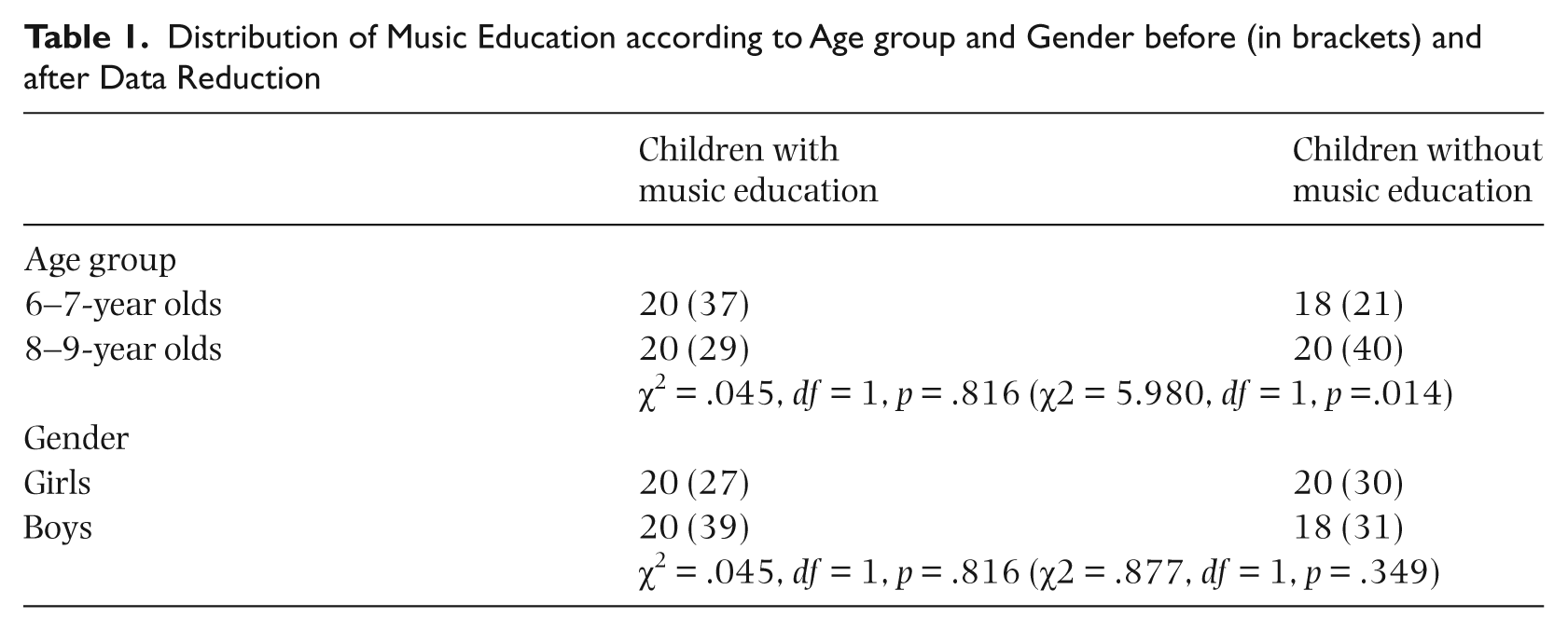
At the time of the experiment, the participants attended first and second grades in elementary school. In addition, we included a group of children from a preschool. All schools were located in the Helsinki area and can be described as having a middle class socio-demographic status. A total of 127 children (Mean age = 7.54, SD = .85; 57 girls) participated. Fifteen of them were 6-year-olds, 43 were 7-year-olds, 54 were 8-year-olds, and 15 were 9-year-olds. Sixty-six (52.0%) participants currently played or had played a musical instrument in their free time, whereas 61 (48.0%) had never played an instrument. For the analysis, two age groups were formed. The first age group included the 6- and 7-year-olds, and the second group included the 8- and 9-year-olds. Unfortunately, the distribution of the background variable Music education was unbalanced between the age groups. Further, a chi-square test revealed a significant relationship between the variables Music education and Age group (χ2 = 5.980, df = 1, p = .014). Since this unequal distribution could have seriously affected the analysis, we removed 49 children from the analysis. The mean age of the remaining 78 participants was 7.47 (SD = .83). The original and the resulting distributions of the background variable Music education are shown in Table 1.
Distribution of Music Education according to Age group and Gender before (in brackets) and after Data Reduction
Stimuli
Three short musical pieces (20 seconds each) resembling familiar children’s songs of Western music were composed for the experiment. All three pieces were matched in tempo (70 beats per minute) to rule out possible confounds due to tempo differences. Harmonic and melodic rhythm and melodic contour were kept constant across the pieces. Thus, only the musical mode varied. One piece was in G major, one piece was in G minor, and the third piece was a free tonal piece. Simple chord structures were used in the musical pieces similar to those in children’s songs. The free tonal piece did not contain any tonal center but major and minor chords that followed the melody. Figure 1 shows the scores for the pieces. Rather than being more dissonant than the other excerpts, the free tonal piece was composed of consonant chords and intervals without respecting tonal expectancies. To confirm this, we computationally analyzed the pieces using the MIRtoolbox, which was developed by Lartillot and Toiviainen (2007). MIRtoolbox found clear tonal centers for the major and minor pieces but not for the free tonal piece. The first author performed all three musical pieces with a Roland FP-2 electric piano as neutrally and steady as possible (i.e., without any artistic expression). Six independent judges with musical backgrounds listened to the musical pieces and agreed with 100% consistency that they were played without any expression. The pieces were recorded on audio CD with Adobe Audition 1.5. Gvox Music Time Deluxe version 3 was used for creating the scores (see Figure 1).
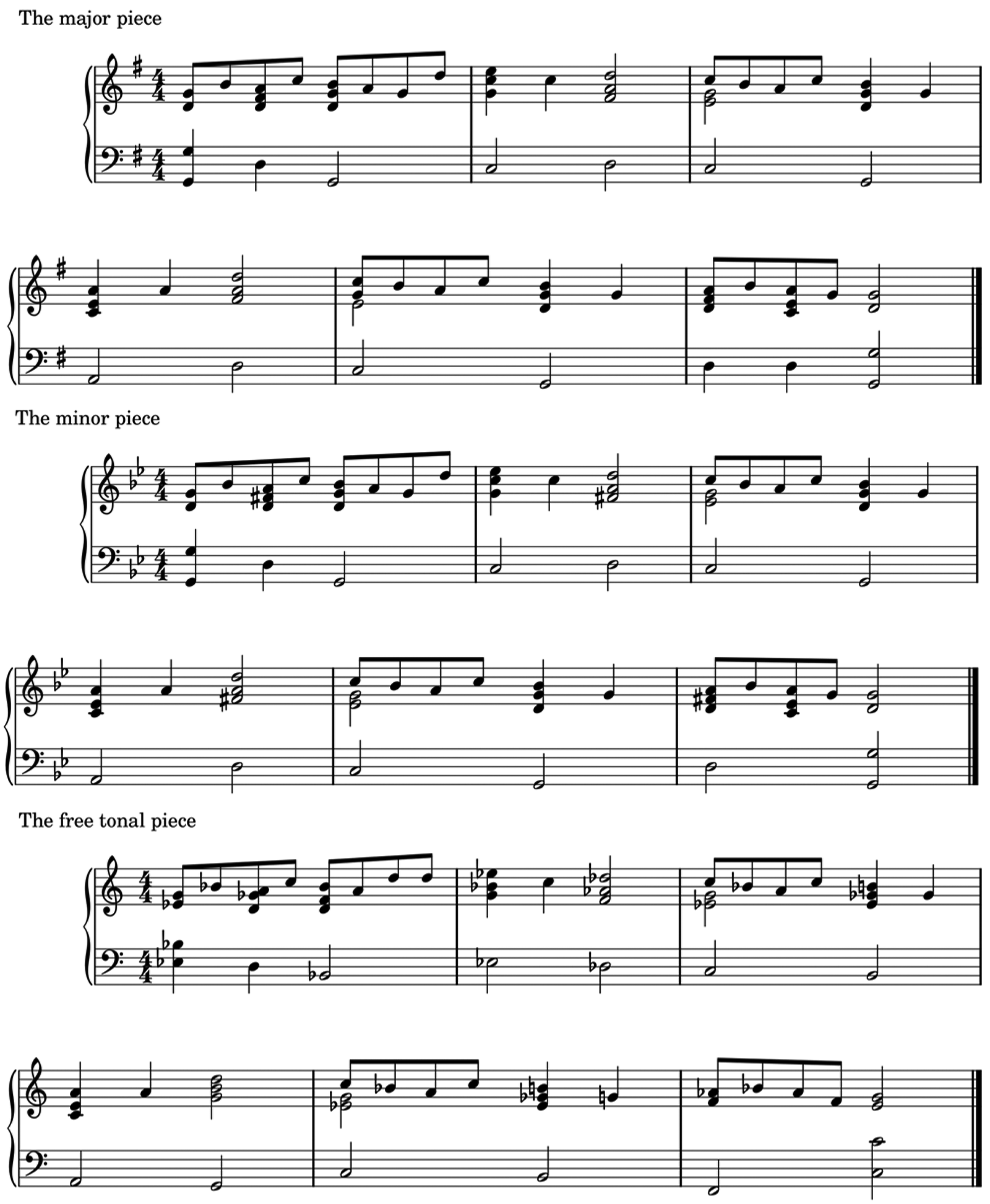
Music scores for the major, minor, and free tonal music piece.
Procedure
All pupils of one grade performed the task at the same time. Three first- and two second-grade classes from elementary school and one group of children from preschool participated in this study. The experimental sessions took place in classrooms at different schools. The participating children were told that the study consisted of many little tasks and that they should listen to the instructions carefully. Prior to the experimental sessions, the children completed a short demographic questionnaire regarding age, gender, and music education. The questionnaire contained three short questions that were explained and read out loud to the children. They, in turn, answered by circling the right answer.
After the children had completed the questionnaire, the first musical piece was played. The children were asked to think about how much they liked the piece and to invent an appropriate title. The participants wrote their titles on a paper and indicated their preference by checking one of the seven circles (7-point rating scale; point 1, the smallest circle, referring to ‘I did not like the piece at all’, and point 7, the largest circle, referring to ‘I liked the piece very much’; see Figure 2). In preschool, those who could not yet write by themselves were asked to whisper their titles to the investigator’s or teacher’s ear, and she then helped to write down the title. To minimize the effect of social expectancy, we asked the children to think about the title by themselves and then very carefully tell it to the teacher or to the investigator.

Child-adapted rating scale for preference judgments
In the next part, the children were given four small adhesive stickers showing different drawings and a paper with a special figure (see Figure 3). The drawings depicted a princess, which referred to the music’s beauty, a witch, which represented ugliness, a smiling sun for happiness, and a crying cloud to express sadness. The figure contained four horizontal rows with seven squares in each row. There was a picture of an eighth note in a box on the left-hand edge of the figure. The four horizontal rows extended from the box.
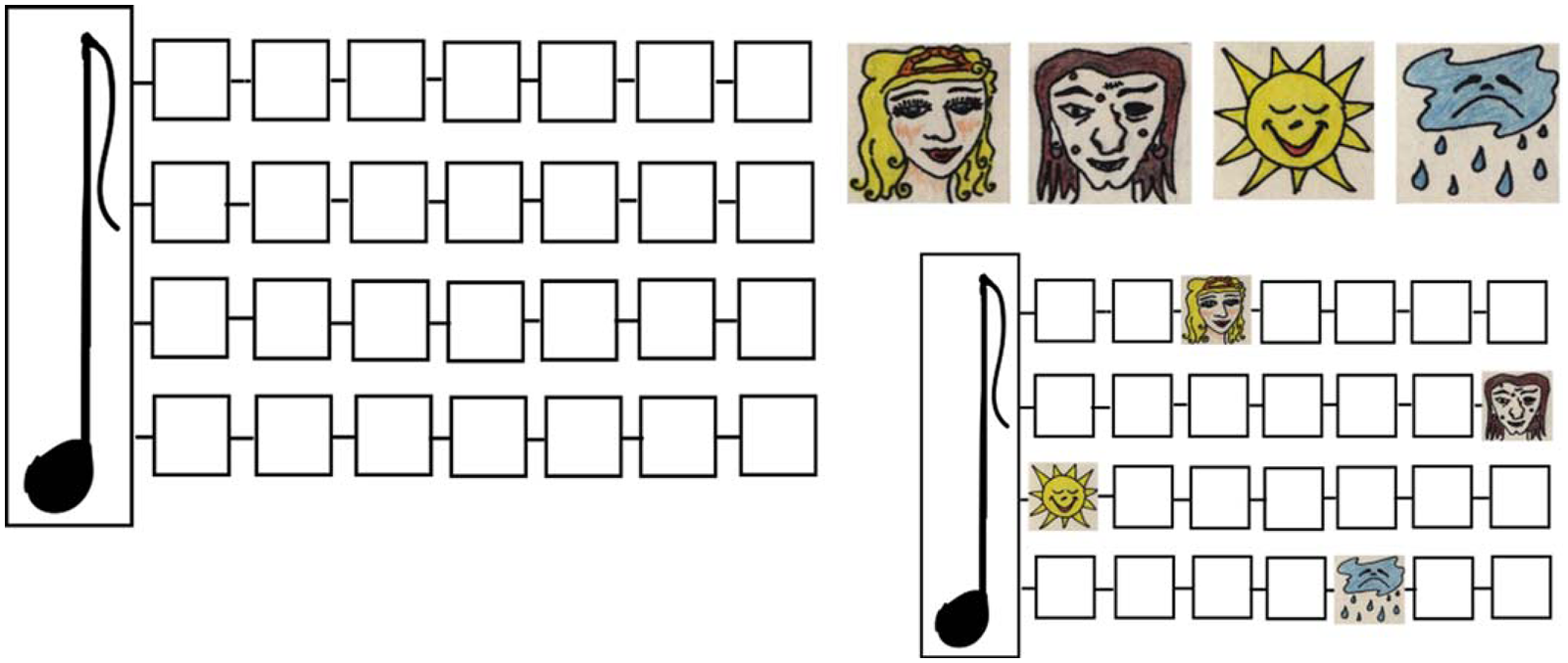
Child-adapted rating scales for emotion and aesthetic judgments with the respective drawings: a princess (beauty), a witch (ugliness), a smiling sun (happiness), and a crying cloud (sadness). A possible response pattern is shown along with the blank figure.
The children were told that they should stick the drawings to the squares in the horizontal lines in the figure. It was explained that the picture of the musical note on the left edge of the figure referred to the musical piece. The sticker that best resembled the musical piece should be attached in close vicinity to the note symbol, and pictures not resembling the piece should be placed more distant (each picture in its own row). It was clarified that the square closest to the note symbol meant ‘the piece sounded very beautiful/ugly/happy/sad’ and the furthest square meant ‘the piece did not sound beautiful/ugly/happy/sad’. It did not matter which row the different stickers were attached in as long as there was one picture in each row (Figure 3 includes an example of a possible response pattern). After the instructions were given, the same musical piece was played for a second time, and the children were asked to attach the drawings while or after listening to the piece. Children repeated the whole procedure for each of the three musical pieces. The experimenter visually monitored the participants during the rating tasks. The musical pieces were played through a compact disc player in a different order in all six participating classes to avoid the influence of the presentation order on the results. In total, the experiment lasted approximately 45 minutes.
Pilot study
The appropriateness of the musical pieces and the drawings were tested in a pilot experiment. Briefly, seven children from kindergarten and four other children who were piano students of the first author participated in the pilot study. They were asked whether they heard differences between the three musical pieces. Four 4-year-olds were not able to hear any difference, but seven older children (aged 5 to 10 years) indicated that the pieces sounded different. Moreover, according to the children at least 6 years old, the pictures looked beautiful (the princess), ugly (the witch), happy (the smiling sun), and sad (the crying cloud). All of them confirmed that the pictures resembled at least one of the musical pieces. On the grounds of earlier findings (Costa-Giomi, 1996; Dalla Bella et al., 2001; Krumhansl & Keil, 1982) and our pilot study, we were confident that children 6 years old and older would be able to express their aesthetic and emotional ratings of music through the drawings provided.
Statistical analysis
Our data were collected using child-adapted versions of 7-point rating scales. The squares in each row of Figure 3 were conceived as the discrete points on the scale. The square closest to the note symbol was equivalent to point 7 (‘the piece sounded very beautiful/ugly/happy/sad’), and the square furthest from the note symbol was equivalent to point 1 (‘the piece did not sound beautiful/ugly/happy/sad’). Firstly, we performed correlation analyses for all ratings of each of the three piano pieces. Next, separate mixed Analyses of Variances (ANOVA) for the preference, emotion, and aesthetic ratings respectively were computed. The following factors were entered into the analysis: Mode (major, minor, free tonal), Age group (6–7-year-old children, 8–9-year-old children), Gender (girls, boys), and Music education (children with music education, children without music education). Only significant effects are reported in detail. Whenever Mauchly’s test of sphericity was significant, Greenhouse-Geisser correction was applied. Original degrees of freedom for all analyses and e values when appropriate are reported. Significant interactions were followed up with a test of simple main effects using Bonferroni adjustments (a = 0.003) for multiple comparisons. The effect sizes of each independent variable (eta-squared, h2) and of each pairwise comparison of interest (Cohen’s d) are indicated.
Results
Preference ratings – within-subjects effects
The children’s preference rating scores differed between the three pieces (see Figure 4). This was confirmed by the significant main effect of Mode, F(2,140) = 5.767, p = .004, h2 = .070. Highest preference ratings were obtained for the piece in major mode (M = 4.64, SD = 2.33), lowest preference ratings for the piece in minor mode (M = 3.86, SD = 2.12), and an intermediate score for the free tonal piece (M = 4.24, SD = 2.05). Pairwise comparisons revealed that the ratings for the major piece were significantly higher than the scores for the piece in minor (p = .002). The effect size (Cohen’s d) was 0.3 and therefore small. However, there was a significant interaction effect between the factors Mode and Music education, F(2,140) = 3.330, p = .039, h2 = .037. Simple main effects analysis showed that it was only the children without music education who differentiated between the pieces in terms of their preferences, F(2,69) = 6.332, p = . 003. The major piece received the highest preference ratings (M = 5.03, SD = 2.25) and was rated higher than both the piece in minor (M = 3.82, SD = 1.98) and the free tonal one (M = 4.05, SD = 1.97). Nevertheless, only the difference between the piece in major and the piece in minor was significant, p = .001. Cohen’s d amounted to a medium effect size of 0.6. Surprisingly, the ratings scores of the major (M = 4.28, SD = 2.37), minor (M = 3.90, SD = 2.27), and free tonal piece (M = 4.42, SD = 2.13) did not differ for the children with music education. Analyzing the two age groups separately, we found that this interaction effect was mainly driven by the 6–7-year-olds. For them, there was no main effect of preference but a significant interaction effect between Mode and Music education, F(2,140) = 5.767, p = .004, h2 = .070. This interaction effect did not occur when performing an ANOVA for the 8–9-year-olds. Instead, as confirmed by the significant main effect of Mode, F(2,72) = 5.660, p = .005, h2 = .130, the older children preferred the major piece (M = 4.75, SD = 2.40) to the piece in minor (M = 3.83, SD = 2.10), p = .003 independently of their musical background. Cohen’s d was 0.4.
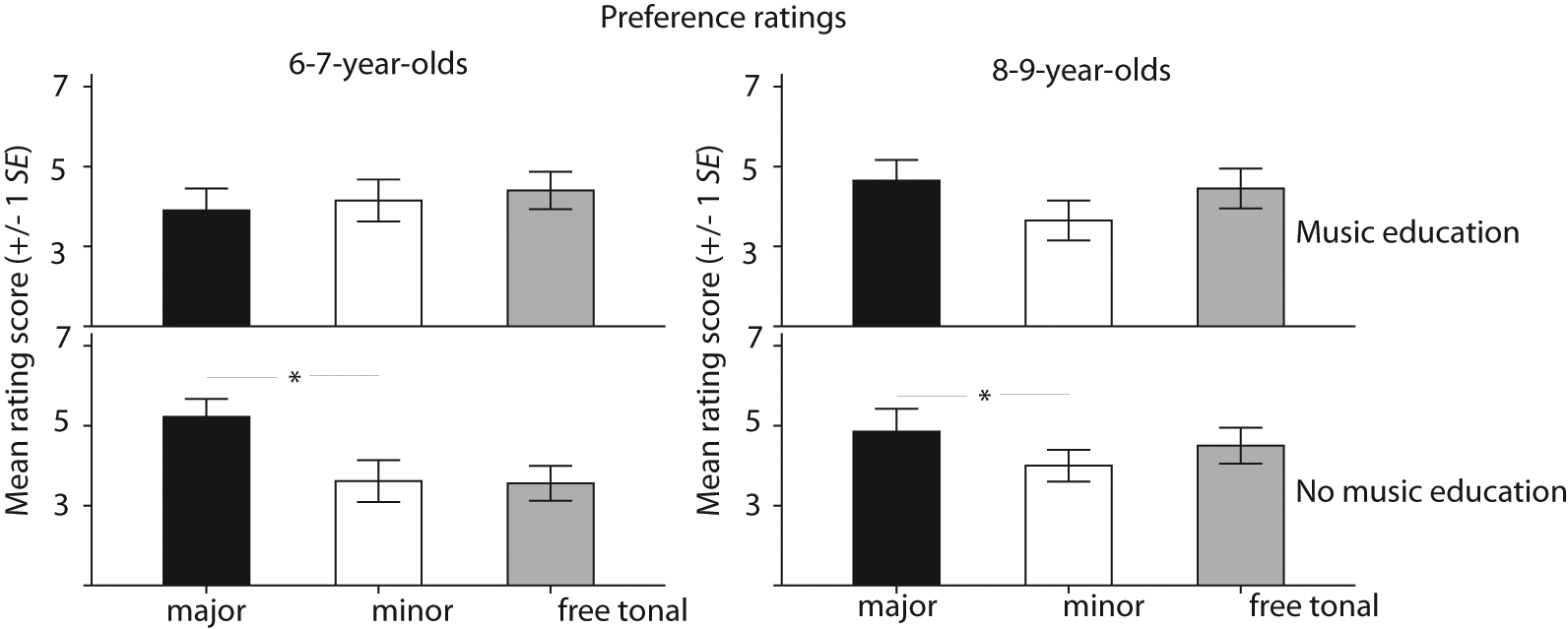
Error bars showing the rating scores for preference judgments in two age groups, separating the children with and without music education.
Preference – between-subjects effects
There was a significant main effect of Gender, F(1,70) = 5.215, p = .025. Girls gave higher overall preference ratings (M = 4.69, SD = 1.44) than boys did (M = 3.78, SD = 1.99). The effect size of this gender difference amounted to 0.5 and therefore can be considered medium.
Emotion ratings
Figure 5 shows the children’s emotion rating scores for the three pieces.
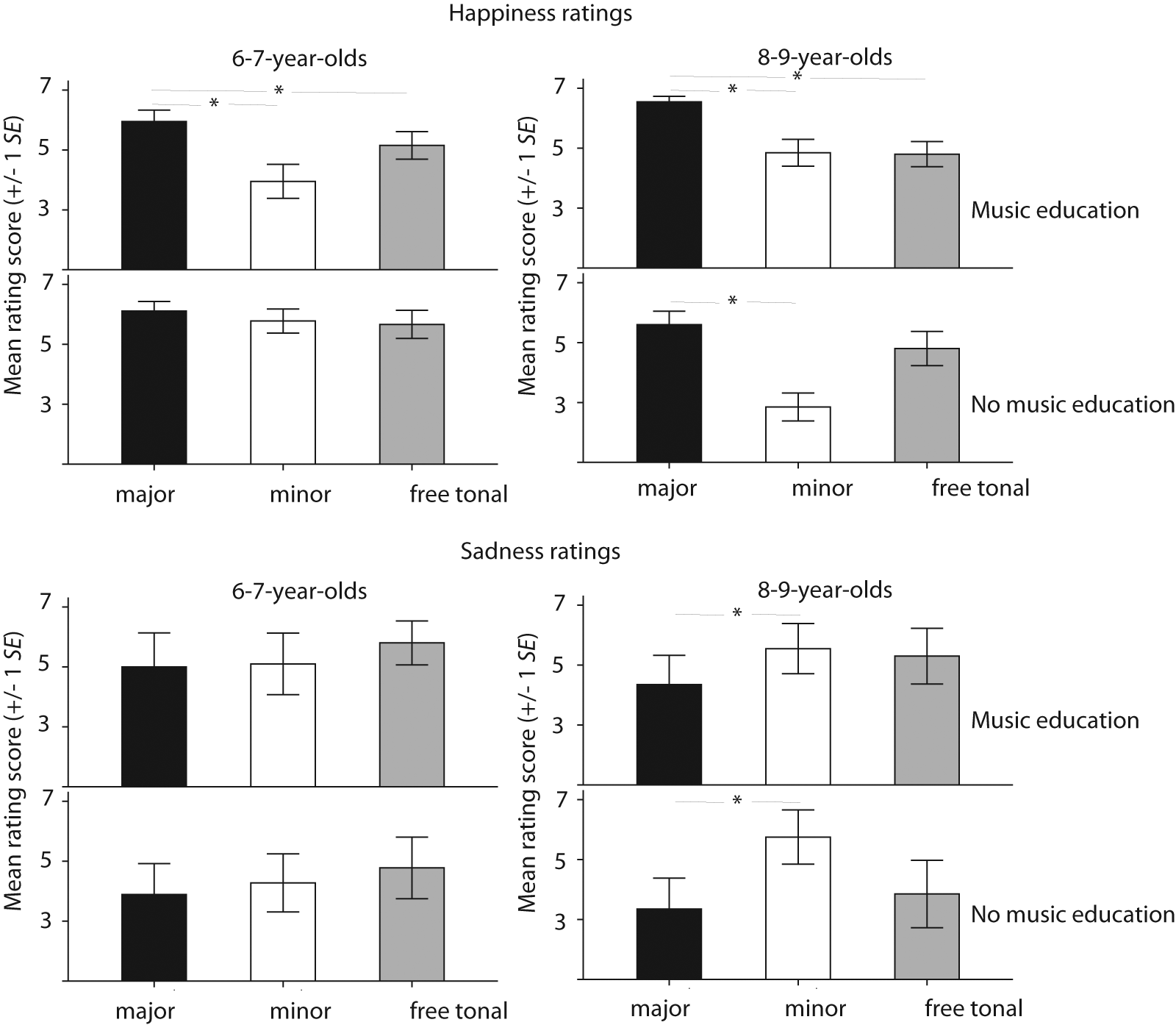
Error bars showing the rating scores for emotional judgments in two age groups, separating the children with and without music education.
Happiness – within-groups effects
For the happiness ratings, there was a main effect of Mode, F(2,140) = 15.446, p < .001, h2 = .166. Highest happiness ratings were given to the major piece (M = 6.05, SD = 1.55). The piece in minor reached a mean score of 4.32 (SD = 2.34) and the free tonal piece had a slightly higher mean score of 5.09 (SD = 2.13). Comparing the mean rating scores, we found a significant difference between the major piece and the minor piece (p < .001) with a large effect size of 0.9. The difference between the major piece and the free tonal one did not reach significance (p = .007) after Bonferroni correction. There was also a significant interaction effect between the factors Mode, Group, and Music education, F(2,140) = 4.255, p = .016, h2 = .045. To follow up this interaction effect, we computed separate ANOVAs for the group of children with music education and the group of children without music education. For the group of children with music education, we found a significant effect of Mode, F(2,72) = 12,832, p < .001, h2 = .252, but the interaction effect between Mode and Group was not significant, F(2,72) = 1,524, p = .225. Thus, independent of their age, the children with music education found the major piece (M = 6.25, SD = 1.35) to be happier than the piece in minor (M = 4.40, SD = 2.31), p < .001, and the free tonal piece (M = 4.97, SD = 1.95), p < .001. Both comparisons were characterized by a large effect size, of d = 1.0 and d = 0.8 respectively. For the children without music education, there was a significant main effect of Mode, F(2,68) = 4.995, p = .009, h2 = .116, as well as a significant interaction effect between the factors Mode and Group, F(2,68) = 3.659, p = .031, h2 = .085. Within the group of children without music education, it was only the older ones who differentiated between the pieces in terms of their degree of happiness, F(2,33) = 11,930, p < .001. Their mean happiness rating for the major piece was 5.60 (SD = 1.98), for the piece in minor 2.85 (SD = 2.08), and for the free tonal one 4.80 (SD = 2.55). The difference between the major and the minor piece reached significance, p < .001. Here, the effect size was large (d = 1.35). The mean happiness ratings obtained for the younger children without music education were almost identical for the three pieces: major piece 6.11 (SD = 1.37), minor piece 5.78 (SD = 1.70), and free tonal piece 5.67 (SD = 2.00).
Happiness – between-groups effects
There was a significant interaction effect between the factors Age group and Music education, F(1,70) = 10.435, p = .002, h2 = .066. Children with music education gave similar overall happiness ratings as confirmed by the non-significant simple main effects analysis, F(1,70) = .950, p = .333. Children without music education, however, differed in their overall happiness ratings, F(1,70) = 12.641, p = .001. The overall mean happiness rating of 6–7-year-olds without music education was 5.85 (SD = .77), whereas the overall happiness ratings of the older children without music education reached a mean score of 4.41 (SD = 1.26). The effects size of this group difference amounted to 1.4 and therefore is to be considered large.
Sadness – within-groups effects
For the sadness ratings, the analysis revealed a significant main effect of Mode, F(2,140) = 6.835, p = .001, h2 = .086. Highest sadness ratings were obtained for the minor piece (M =5.19, SD = 2.10), followed by intermediate sadness ratings for the free tonal piece (M = 4.94, SD = 2.12). The mean sadness rating for the major piece was lowest (M = 4.15, SD = 2.35). None of the pairwise comparisons, however, was significant. Importantly, there was a significant interaction between the factors Mode and Age group, F(2,140) = 5.662, p = .004, h2 = .067. Simple main effects analysis of this interaction revealed that 7–8-year-olds did not rate the three pieces differently, F(2,69) = 2.410, p = .097. Only 8–9-year olds differentiated between the sad emotional tone of the pieces, F(2,69) = 9.760, p < .001. They gave the highest sadness ratings for the minor piece (M = 5.65, SD = 1.93), the lowest ratings for the major piece (M = 3.85, SD = 2.27) and intermediate sadness ratings for the free tonal piece (M = 4.58, SD = 2.39). The difference between the ratings for the major piece and the minor piece reached significance (p < .001). The effect size (Cohen’s d) was 0.9 for the contrast between the major and the minor piece and therefore rather large.
Sadness – between-groups effects
For the sadness ratings, the only between groups effect occurred for the factor Music education, F(1,70) = 5.728, p = .019, h2 = .074. Overall, the children with music education gave higher sadness ratings (M = 5.18, SD = 1.48) than the children without music education (M = 4.32, SD = 1.69), Cohen’s d was 0.5, hence, of medium effect size.
Aesthetic ratings
Figure 6 shows the children’s aesthetic rating scores for the three pieces.
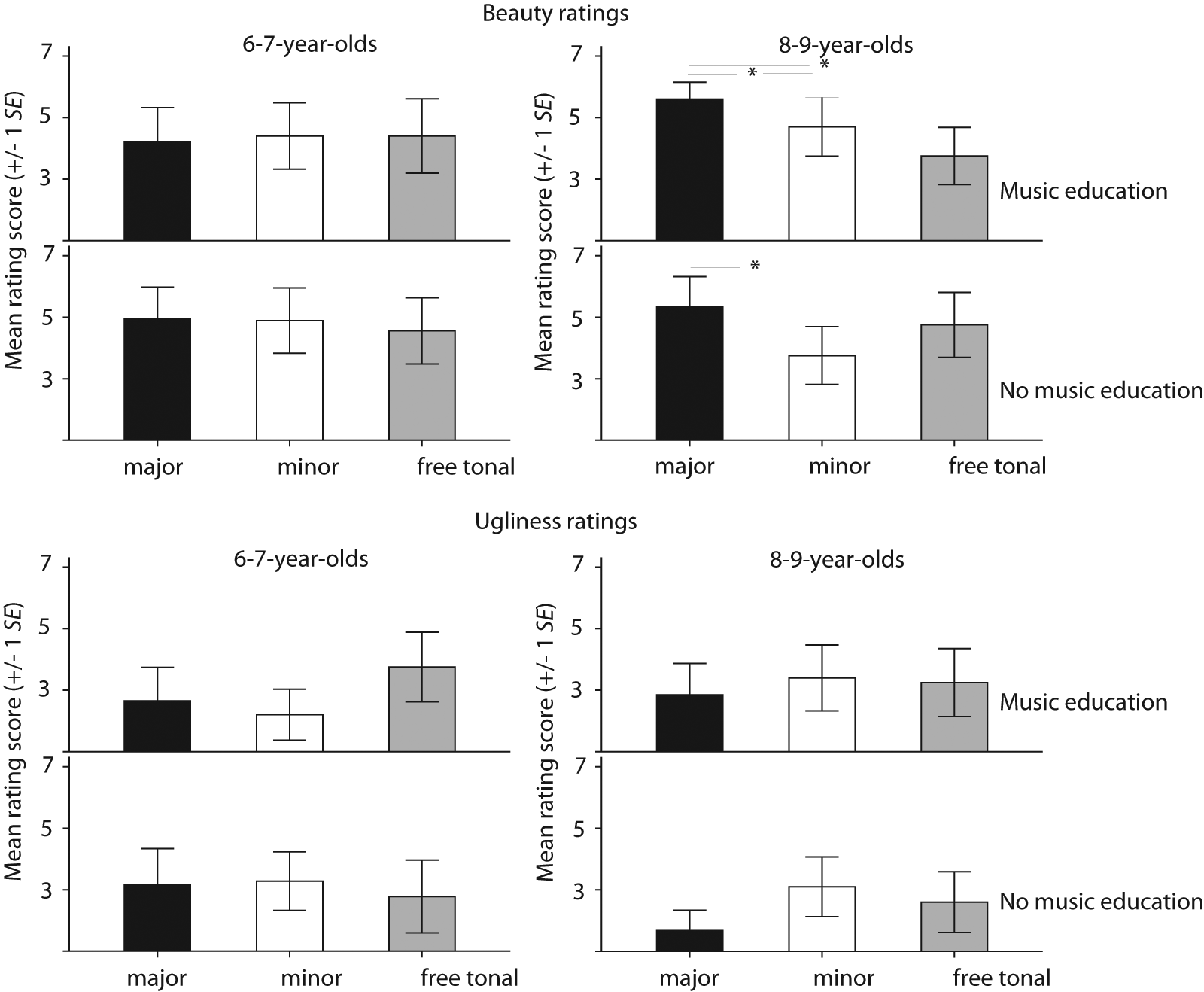
Error bars showing the rating scores for aesthetic judgments in two age groups, separating the children with and without music education.
Beauty – within-groups effects
There was also a significant main effect of Mode for the beauty ratings, F(2,140) = 3.208, p = .043, e = .908, h2 = .037. The major piece obtained the highest rating score (M = 5.03, SD = 2,10). Beauty ratings for the minor piece (M = 4.42, SD = 2.22) and the free tonal one (M = 4.36, SD = 2.35) were almost identical. Pairwise comparisons did not reach significance when Bonferroni correction was applied. Although the interaction effect between the factors Mode and Age group did not reach significance, we calculated ANOVAs for the two age groups separately. The younger children did not make any distinction between the pieces in terms of beauty. In turn, the older children clearly indicated the major piece (M = 5.48, SD = 1.74) to be more beautiful than both the minor (M = 4.23, SD = 2.14) and the free tonal one (M = 4.25, SD = 2.25). This was confirmed by the significant main effect of Mode, F(2,72) = 6.599, p = .002, h2 = .142, and the significant pairwise comparisons (p =.002 for both contrasts). The effect size amounted to d = 0.6 in either case.
Beauty – between-subjects effect
There were no between-subjects effects for the beauty ratings.
Ugliness – within-subjects effects
The children considered the major piece to be the least ugly (M = 2.58, SD = 2.21). The free tonal piece received the highest ugliness rating score (M = 3.10, SD = 2.46), which was, however, only minimally higher than the score obtained for the minor piece (M = 2.99, SD = 2.13). The effect of Mode was not significant, F(2,140) = 1.352, p = .262. Although the interaction effect between the factors Mode and Age group was non-significant, we examined the two age groups separately. The younger group rated the free tonal piece (M = 2.89, SD = 2.44) uglier than the piece in minor (M = 2.71, SD = 1.98) and the one in major mode (M = 3.29, SD = 2.53). The older children, in turn, considered the major piece (M = 2.27, SD = 1.96) to be less ugly than the piece in minor (M = 3.25, SD = 2.26) and the free tonal one (M = 2.93, SD = 2.46). However, there was not a significant effect of Mode for either of the age groups, nor did the pairwise comparisons reveal a significant difference between the ugliness ratings of the pieces in both age groups.
Ugliness – between-subjects effects
There were no between-subjects effects for the ugliness ratings.
Correlations
Examining the whole sample, we found significant correlations between preference and beauty ratings (r = .334, p = .003), happiness and beauty ratings (r = .516, p < .001), and sadness and ugliness ratings (r = .335, p = .003) for the piece in major (Bonferroni corrected alpha level: p = .003). A correlation between happiness and beauty rating scores was also found for the minor piece (r = .456, p < .001) and the free tonal one (r = .557, p < .001). Analyzing the groups separately, we found significant correlations between happiness and beauty ratings for the major piece (r = .475, p = .003) and the free tonal piece (r = .706, p < .001) in 6–7-year-olds. Happiness and beauty ratings were also correlated for the piece in major (r = . 604, p < .001) and the piece in minor mode (r = .516, p < .001) in the group of 8–9-year-olds.
The titles
In the titles for the music, children commonly used topics related to nature and plants, emotions, the animal kingdom, music, fairy tales, day and night times, and seasons. A few fictitious titles were also invented. The children generally associated happiness and sun with the major piece and rain with the minor and the free tonal pieces. Sadness was linked with the free tonal piece more often than with the minor piece. The older children produced longer and more emotion-related titles, which seemed to be directly referring to the music piece (e.g., ‘a happy fairy’ for the major piece and ‘a crying bird’ for the minor piece). The word beautiful occurred in four titles, and none of the children used the word ugly.
Discussion
The goal of the present study was to explore the development of three important aspects of the aesthetic experience of music in 6–9-year-old children: preference, emotion recognition, and the ability to judge music aesthetically. To this aim, school-aged children were asked to rate three short piano pieces (one in major mode, one in minor mode, and a free tonal one) along three scales: like/dislike (preference), happiness/sadness (emotions), and beauty/ugliness (aesthetics).
Preference ratings
All children gave the highest preference ratings for the major piece. This finding was expected and could be due to the prevalent use of the major mode in children’s songs (Cohen, Thorpe, & Trehub, 1987; Kastner & Crowder, 1990). The influence of passive cultural exposure and the resulting acquired knowledge might have led to overall high preference ratings for the major piece. On the other hand, the result could be explained by the positive connotation of the major mode with happiness. Listening to the major mode might have induced a positive affective state which, in turn, resulted in a positive evaluation. Taking into account that the difference between the preference ratings for the major piece and the free tonal piece was not statistically significant, it seems less likely that the children accomplished the liking task based on an estimation of whether the piece does or does not conform to the rules of Western tonality. Otherwise, the free tonal piece should have been liked less than the piece in major. Instead, the analysis showed that the piece in minor mode was liked less than the major and free tonal pieces. This suggests that the children evaluated the emotional content of the pieces rather than their correctness when making a liking judgment. Thus, the minor piece may have been the least liked because of the children’s increased ability to relate a piece’s mode to emotions (i.e., the minor tune might simply be disliked because it was perceived as being sad).
Moreover, a detailed analysis revealed that preference ratings were dependent on the child’s age and music education. For the 6–7-year-olds, only the children without music education clearly indicated having a preference for the major piece compared to the piece in minor mode. Music education, in contrast, did not affect the preference ratings of the 8–9-year-olds. The older children generally liked the piece in major more than the one in minor. It is difficult to explain why only the younger children with music education did not show this clear difference in preference ratings between the sad-sounding and the happy-sounding piece. We can only speculate that music education has a stronger impact on younger children in terms of widening their interest in music in general, whether it be sad or happy, and whether it conforms to the rules of Western tonality or not. At 8 to 9 years of age, the preference for emotionally positive compared to negative music, as often seen in adults, might begin to consolidate.
Interestingly, there was no difference between the preference ratings for the major piece and the free tonal piece (i.e., the children liked them both). This might be due to the fact that both the piece in major and the free tonal piece contained fewer dissonant chords than the minor piece. Consonant music is usually evaluated as pleasant and dissonant music as unpleasant (Peretz, Blood, Penhune, & Zatorre, 2001) already in infancy (Zentner & Kagan, 1998).
The overall preference ratings were relatively low. None of the pieces reached a mean preference score of more than 6.0. This might reflect the simplicity of the pieces as well as their inexpressive character. Children are used to listening to music that sometimes even exaggerates emotional expressions, similar to infant-directed speech. Our stimuli, in turn, were lacking any expression and this may explain why they did not receive high liking scores. In general, girls liked all the musical pieces more than the boys did. This result was in agreement with other findings, which showed that girls are often more positive toward music than boys (Crowther & Durkin, 1982; Hargreaves, Comber, & Colley, 1995; North & Hargreaves, 2008).
Why did the free tonal piece generally receive high preference ratings? The so-called open-earedness hypothesis (Hargreaves, 1982) provides a possible explanation. It originally states that young children might be more open to music that is considered to be ‘unconventional’ by adults and that young children might be less influenced by cultural and societal standards of ‘good taste’ than older music listeners. However, the hypothesis was developed based on studies comparing children’s responses to different music genres. Hence, it cannot be applied to our results without caution. The open-earedness hypothesis needs to be extended to include also ‘conventional’ and ‘unconventional’ music within a musical style. It could be assumed that in addition to showing more openness to ‘unconventional’ musical styles, younger children might also be more open to music that is unconventional in this more specific sense. Recently, Kopiez and Lehmann (2008) reported a decline of openness in tolerance toward unconventional music from 7–8-year-old school children. In our study, even 8–9-year-olds indicated that they liked the free tonal piece. A comparison of the results, however, is problematic, since Kopiez and Lehmann (2008) collected children’s responses to different musical genres (popular, classical, avant-garde), whereas the music pieces in our study belonged to one specific ‘style’. Moreover, in their study they used an average rating of several pieces as a liking score, whereas in our study the results can be attributed to this particular piece only, rather than to a special style of music.
Emotion ratings
As expected, the major piece was rated the happiest by all children. Also, the happiness ratings were dependent on the children’s musical backgrounds and their ages. Whereas children with music education found the piece in major happier than the piece in minor and the free tonal one, only the 8–9-year-old children without music education rated the major piece happier than the piece in minor. This result suggests that music education may foster the understanding of musical emotions based on mode differences in early school-age years. However, the ability to assign happiness to the major mode apparently develops also by passive exposure.
The sadness ratings between the different pieces did not differ in 6–7-year-olds. Only the older children judged the minor piece as sadder than the piece in major. Generally, the youngest participants appeared to be right at the cusp of forming connotations between musical mode and emotions. According to the present findings and those of several other studies (Cunningham & Sterling, 1988; Dolgin & Adelson, 1990; Gerardi & Gerken, 1995), the ability to associate major mode with happiness seems to develop at a younger age than the ability to associate the minor mode with sadness. This might be partially explained by the fact that most children’s songs are composed in major mode (Cohen et al., 1987; Gerardi & Gerken, 1995; Simonton, 1984). Although children generally learn to experience multiple emotions of varying intensity and opposite valence as they get older (Wintre & Vallance, 1994), perceiving emotional nuances in music does not appear to strictly follow the same developmental trends. Music education may promote the development of the perception of musical emotions. This was evident for the happiness ratings, but not for the sadness ratings. We speculate that the perception of negative emotions in music follows a stricter timeline in development and is less affected by external influences such as music education than the development of the perception of positive musical emotions. Previous findings have shown that children who are actively engaged in music are also more responsive to the tonal properties of music (Morrongiello, 1992; Morrongiello & Roes, 1990) than children who are only passively exposed to Western tonal music. One possibility is that musically trained children have learned tonal music to be ‘right’ and more pleasant because it is so prevalent in traditional Western music, including the pieces that children play and hear in music lessons.
Gender did not affect emotion ratings. Robazza, Macaluso, and D’Urso (1994) asked 9–10-year-old children and adults to associate a discrete emotion (happiness, sadness, anger, or fear) with musical fragments and rate the intensity of that emotion, and they did not find any effects of gender, age, or expertise on the perceived emotional connotations of classical music fragments (see also Kratus, 1993). The discrepancy between the present study and the psychophysiological data obtained by Nater, Abbruzzese, Krebs, & Ehlert (2006), which showed hypersensitivity in response to unpleasant music in females compared with males, may be explained by the differences in stimuli: piano melodies were rated for emotional connotations in the present study, whereas a classical orchestral piece from the Renaissance period (the Miserere by Allegri) was contrasted to a heavy metal tune (by the band Marduk) in the Nater et al. (2006) study. Future studies should investigate the development of gender differences in emotional ratings according to age, especially in reference to puberty and adolescence (cf. Everhart, Shucard, Quatrin, & Shucard, 2001).
Aesthetic ratings
Overall, children considered the major piece more beautiful than the minor piece and the free tonal piece. However, only the 8–9-year-old children judged the major piece to be significantly more beautiful than the minor and free tonal pieces. Interestingly, the development of aesthetic categories and their applicability to music appears to follow a comparable timeline to the recognition of discrete emotions in music. Although children younger than 8 years still showed difficulties in attaching discrete emotions or aesthetic categories to musical excerpts of different modes or tonalities, slightly older children began to use the concept in a manner similar to Western adult listeners. The free tonal piece was rated as being uglier than the major piece; however, none of the pieces were really rated as being ugly. This trend was reflected also in the titles the children chose for the different pieces. Several titles contained the adjective ‘beautiful’, whereas none of the children used the adjective ‘ugly’.
Our findings regarding the ability to formulate aesthetic ratings corroborate the results of Istók et al. (2009), who found that adults use the adjective ‘beautiful’, but not the adjective ‘ugly’, when describing the aesthetic value of music. The same seems to be true for children, at least in the case of tonal and free tonal music, because the children did not rate any of the presented pieces as being ugly. Accordingly, we tentatively speculated that 8–9-year-old children have already developed similar concepts of beauty and ugliness as adults, which they use as a basis for their aesthetic judgments of music.
However, there was an obvious correlation between the beauty and the happiness ratings for all three pieces. This could be due to school-aged children not yet having the ability to distinguish between the meaning of happiness and beauty. Children seem to infer that both concepts are of positive valence, however, the more subtle difference might not be accessible yet. In contrast to the emotion ratings, music education did not affect aesthetic ratings. This result was in agreement with a study by Madsen, Byrnes, Capperella-Sheldon, and Brittin (1993), which did not show any substantial differences between the aesthetic responsiveness of adult musicians and non-musicians.
Conclusions
The present study has shown that children have developed, and are able to express, specific music preferences by the age of 8 to 9 years. We have also shown that discrete emotional connotations, such as happiness and sadness, are attributed to music on the basis of mode around the age of 8 to 9, although the connotation of happiness with the major mode also occurs in 6- to 7-year-olds provided they have participated in music education. Moreover, we have shown that school-aged children are able to judge music according to aesthetic criteria.
The present results are remarkable, especially after taking into account that the musical stimuli were simple and carefully controlled. Therefore, we can reliably conclude that the different judgments of our participants were affected mostly by tonal stability and mode. In general, the newly developed method used in the present study proved to be suitable for exploring the development of preferences, emotion recognition, and aesthetic judgment. This method allowed us to test several children at once. The children obviously liked the method and were easily able to follow the instructions. However, since the music stimuli and musical parameters used in this study were strictly controlled, this design does not necessarily allow us to generalize the results. Moreover, additional refinements regarding the setup and careful modifications of the music material could be used to explore additional developmental aspects of music cognition and appreciation.
Footnotes
Funding
This work was supported by FP6-2004-NEST-PATH-028570-BrainTuning and the Finnish Centre of Excellence in Interdisciplinary Music Research.