







Abstract
It is unknown to what extent listeners in different Western countries share long-term representations of melodies as well as their genre associations, and whether such knowledge is modulated through music training. A group of German listeners (N = 40) rated their familiarity with 144 melody excerpts from different genres implicitly (melody structure) and explicitly (melody title). Melodies were identical to those used in a previous Franco-Canadian study (Peretz, Babaï, Lussier, Hébert, & Gagnon, 1995). In addition, melodies were attributed by the participants to predefined genre categories, and similarities between pairs of melodies were computed, using an algorithm by Müllensiefen and Frieler (2006). Results revealed patterns of (un)familiarity, which, in part, deviated from the previous study. Melodies from classical, ceremonial, and – to a lesser extent – children’s songs categories were rated as most familiar, whereas traditional and more recent francophone tunes from mixed categories were judged as unfamiliar. Music training had no significant influence on implicit memory for melodies but rather on explicit knowledge of their titles. Computational analyses suggest that highly familiar and highly unfamiliar tunes share structural features with melodies belonging to the same category, whereas dissimilarities were detected between certain clusters of genre categories. Taken together, these results suggest that long-term representation of melodies is influenced by a listener’s (Western) national background. Representations are differently affected by specific genres but only partially influenced by music training and by structural properties.
Melodies are a key feature of human music cultures around the world (Dowling & Harwood, 1986). Investigations on melody perception often focus on familiarity exclusively (Peretz, Babaï, Lussier, Hébert, & Gagnon, 1995) or in interaction with preference (Pereira et al., 2011; Peretz, Gaudreau, & Bonnel, 1998). Evaluation of familiarity usually requires listeners to judge well-known or overheard familiar melodies from previously set up repertoires (e.g. Berthier, 1979; Sharp, 1920; cf. Palmer, 1983) or self-selected playlists (e.g. Pereira et al., 2011; Plailly, Tillmann, & Royet, 2007; Platel, Baron, Desgranges, Bernard, & Eustache, 2003). In many studies familiarity is kept as a one-dimensional variable that categorizes tunes dichotomously as either known or unknown (e.g. Peretz et al., 1998; Szalárdy et al., 2014), or is assessed on a rating scale ranging from unfamiliar to (very) familiar (e.g. Müllensiefen & Halpern, 2014; Peretz et al., 1995).
Peretz and colleagues explored mental representations and long-term memory for more or less common tunes in an initial investigation of features that may contribute to and thus influence listeners’ concepts of melodic familiarity (Peretz et al., 1995). A set of 144 more or less popular melody excerpts – among them many French and Franco-Canadian tunes – served as stimulus material (for additional information see Table S1 in the Supplemental Material Online section). Two groups of 60 participants provided ratings on four different measures: one group assessed the degree of familiarity (on a 5-point scale) and the melodic category (vocal or instrumental), whereas the other group simultaneously estimated their own average age of acquisition (0–5, 6–10, 11–15, 16+ years), as well as vocal evocations of potentially recalled lyrics (naming either the title or initially remembered text phrases). The results were compiled as a list arranged by familiarity and further refined by Peretz and colleagues in several follow-up studies. One key finding by Gaudreau and Peretz (1999) was that familiarity seemed strongly influenced by the frequency of exposure rather than by specific styles, genres, or musical expertise.
Ehrlé, Samson, and Peretz (2001) sought to develop psychometric norms of melody excerpts in terms of familiarity and musical category ratings; that is, whether a melody was perceived as instrumental, vocal, unknown, or ambiguous (in terms of its vocal or instrumental origin). Results based on tests with 120 French university students showed that the number of excerpts assigned to the category ambiguous was higher than in the study by Peretz et al. (1995). This suggests that many of the Franco-Canadian melodies tested may be unknown even to French listeners, as specific corpora of nationally familiar melodies exist within larger repertoires of culturally well-known tunes. Such culture-specific influences and musical knowledge may modulate a listener’s familiarity with tunes (Demorest & Morrison, 2003; Demorest et al., 2010; Morrison, Demorest, Aylward, Cramer, & Maravilla, 2003; Schellenberg & Trehub, 1999).
Whereas cultural background may obviously influence listeners’ familiarity with a given body of melodies, other potential factors such as individual differences (e.g. musical expertise) or country-specific repertoires may be equally important. In a neuroscientific approach Demorest and Morrison (2003) found that professional musicians showed greater activation of their right STG in an fMRI study than did untrained listeners, reflecting an enhanced processing of tonal structures. Although no causality could be drawn from this study, it demonstrates that possible implications of both music training and distinct music cultures on musical concepts in the listener’s mind are being investigated in manifold ways.
Finally, implicit knowledge of structural features of Western music – especially tones, chords, and keys – is acquired in everyday life (Tillmann, Bharucha, & Bigand, 2001) and thus may play a key role in categorizing melodies. Whether melodies representing specific stylistic categories share a distinct set of features has been subject to computational approaches. Müllensiefen and Frieler (2005), for example, analyzed the similarity judgments from musically experienced listeners for pairs of melodies. The measures were used to develop computational models for implementation into the software toolbox SIMILE (Müllensiefen & Frieler, 2006), which can aid in the identification of structural relationships between melodies as predictors for their perceived similarity.
The present study was based on a 2 x 2 independent measures design with the independent variables of national culture 1 (German, Franco-Canadian) and degree of expertise (musicians, non-musicians; between subjects variable). Given such limitation of cultural focus, only a few insights from prior research exist from which to deduct our hypotheses. Thus, some research questions to be addressed here are rather exploratory.
The concern of our first major research aim is to assess both melody and title familiarity in a set of stimuli previously used in the study by Peretz et al. (1995), herein from a German-speaking group of listeners. Our aim is (a) to better understand the similarities and differences in familiarity judgments by listeners from different Western countries, and (b) to assess the relative influence of tunes that are internationally known in contrast to those more or less limited to their deriving national context. This approach partially replicates Peretz’s study, which on the one hand focused explicitly on musically untrained listeners and on the other hand assessed the above aspects – as well as additional factors – in a methodologically different way.
Regarding potential influences of national culture on melody familiarity, we expect that national context significantly modulates recognition. In particular, our listeners will rate melodies that are of Franco-Canadian origin less likely as familiar than melodies that bear no specific Franco-Canadian association. We further assume that some tunes of national origin – such as certain children’s and folk songs or chansons – may be unknown beyond their national territories and thus more difficult to attribute to a specific musical genre, even if listeners share similar social or ethnic characteristics. Thus, we chose national culture as perhaps the most appropriate level of cultural comparison for our purposes, for it focuses the broader view on Western music culture a little more on country-specific enculturation processes, as described by Stalinski and Schellenberg (2012) as well as by Morrison and Demorest (2009). In consequence, the term culture should not be used monolithically, but with respect to different levels that may entail geographic or regional differences even within a similar superordinate cultural environment. We expect that these have a significant modulating influence on familiarity ratings, which would also comply with findings by Ehrlé et al. (2001). Second, following Peretz et al. (1995), we expect the individual familiarity with melody titles to increase with the familiarity of melodic structures. However, the methodological approach used here is more elementary.
A crucial aspect in our experiment is the investigation of musical expertise. Regarding the assessment of familiarity with melody structures and titles, this extension of the first two hypotheses represents a novel aspect, for it had not been assessed in the study by Peretz et al. (1995). On the other hand, Gaudreau and Peretz (1999) found this factor to be less influential in establishing familiarity. Thus we consider our evaluations as rather exploratory with regard to implicit aspects of familiarity. However, we expect musical expertise to have a significant impact on explicit knowledge (i.e. melody titles) as implicated by previous work (e.g. Hansen & Pearce, 2014; Poulin-Charronnat, Bigand, Madurell, & Peereman, 2005; Waterman, 1996; cf. Bigand & Poulin-Charronnat, 2006, for a detailed review). Despite the methodological heterogeneity in this literature, musically trained individuals are consistently assumed to show higher implicit as well as explicit processing capacities of melodies.
Our second major research aim was to explore the relationship between musicological and subjective genre associations for each melody, as well as influences of structural similarities among and between tunes. Investigation of the latter as possible indicators of genre affiliation appears to be rarely considered at least in cognitive music research, so we applied the computational approach of similarity comparisons by Müllensiefen and Frieler (2006) to investigate in an exploratory way whether listeners form more or less steady genre concepts in their minds, which determine how they assign melodies to genre categories.
The according hypotheses are twofold and both relate to the familiarity aspect, but due to their exploratory nature they hardly bear any reference to previous research. The first hypothesis is that genre attributions of melodies become more sophisticated and thus more coinciding with theoretical genre categories – taken from collections of musical pieces or requested from music experts – the more familiar a melody is. Regarding the influence of musical expertise, it is further expected that sophistication in making assignments is stronger with musically trained listeners.
The second hypothesis focuses more on the structural aspects that may contribute to induce familiarization: if musical pieces share a certain musical style that relates to specific genres (e.g. children’s songs or ceremonial songs), then they may inherit a degree of structural homogeneity that may ease their recognition as members of that category and distinguish them from members of other genre categories.
Concluding, we want to address some methodological decisions regarding the chosen melody corpus. We adapted the stimulus list by Peretz et al. (1995) instead of setting up our own stimulus list with a potentially greater number of tunes that are genuinely German-originated. This was done because most melodies from this list are more or less well-known in Germany, among them even some of the French children’s and folk songs. The remaining portion of predominantly Canadian folk songs and chansons – including regional Québécois tunes – forms a corpus of supposedly rather unknown melodies to German listeners. As such it is of potential interest for us, especially regarding (a) the genre attributions to be made by our German-speaking participants, and (b) whether potential differences in their familiarity ratings depend on different degrees of musical expertise.
Eventually, with the re-arranged stimulus list based on the familiarity ratings of our German-speaking listeners we provide a tool that may prove helpful to be used in our future experiments on melody cognition in German-enculturated listeners.
Method
Participants
A total of 40 participants (22 female, 18 male; Mage = 27.9 years, SD = 5.78, age range: 20–46) were recruited from the area of Oldenburg, including the student and staff population of the Carl von Ossietzky University. All participants reported normal hearing abilities. We also wanted to evaluate the influence of musical expertise by defining at least four years of formal music training and at least one hour of weekly practicing by the time of the experiment as selection criteria. The latter criterion especially should warrant that participants classified as musicians were actively involved in music-making at the time of being tested. Accordingly, 21 participants (Mage = 26.3 years, SD = 6.59) qualified as musicians (M = 10.9 years of formal music training, SD = 4.83), whereas the remaining 19 participants (Mage = 29.6 years, SD = 4.26) were considered as nonmusicians (M = 4.3 years of formal music training, SD = 3.19).
Materials
Questionnaires included both basic demographic and background information on musical self-concept (e.g. self-assessment of one’s own musical expertise, or the ability to remember melodies) and involvement (e.g. frequency of attending music concerts, composing activities), as well as listening preferences. Some of the questions were taken from the Ollen Musical Sophistication Index (OMSI; Ollen, 2006), from its translated German version (Büring, Platz, & Kopiez, 2009). 2 In the scope of the current study, however, only a few of these questions have been used in the analysis.
The 144 audio stimuli (see the Supplemental Material Online section) were constructed from the tunes listed in the study by Peretz et al (1995). These included the beginnings of 100 vocal and 44 instrumental pieces. The average length of excerpts was 8.5 seconds (range: 3.6–19.2 seconds). We allocated each tune to one category from a predetermined set of eight musical genres we considered most appropriate 3 (German terms are given in parentheses): children’s song (Kinderlied), traditional folk song (Volkslied), ceremonial song (Festliches Lied), classical melody (Klassische Melodie), film melody (Filmmelodie), international Schlager music 4 (Schlager international), pop song (Pop), other (Andere) (see Table 5). Possible allocation criteria for a melody – additional to the above – were musical style (e.g. chansons as part of the international Schlager category), era of its composition and name of the composer (predominantly defining classical tunes or pop songs but also chansons), cultural context of usage (e.g. in ceremonial songs), or – if applicable – thematic concern of the piece (e.g. tunes being solely composed to be used in a film) or the according lyrics (which is helpful in separating some children’s songs from folk songs). A complete excerpt list with mean familiarity values and various genre association data is given in the supplemental material.
Each melody was realized in a monodic form without accompaniment. Dynamics, phrasal structure and timbre were held constant across all melodies. The tempo used for each stimulus also derived from the corresponding value chosen by Peretz et al. (1995). The tempo for some melodies could not be reconstructed from the available materials and thus was decided by the experimenters. The vocal and instrumental stimuli were generated as MIDI files – using recording software LOGIC Studio – and played back through standard notebook loudspeakers with a General MIDI grand piano sound on a DELL notebook computer. The 144 stimuli – originally arranged in both descending order from highest to lowest familiarity values and in musical style (Peretz et al., 1995) – were divided up into two subsets of 72 tunes for our study, allocating the excerpts along the original order to the first and the second list alternatingly. Within both lists, stimulus order was eventually randomized. To prevent potential effects of fatigue and to keep to the time limit of the experimental sessions, participants were randomly assigned to one of the two stimulus subsets (i.e. each participant rated 72 stimuli). All 144 melody excerpts are available as MIDI files from the Supplemental Material Online section.
Procedure
Participants were tested individually in a session split into halves, interrupted by a rest period of five minutes. The test script was programmed and executed using multimedia authoring software Mediator. First, each participant was seated in a comfortable chair, then filled out the demographic and musical background questionnaires and was given the opportunity to ask questions.
In the experiment, each stimulus was presented twice with an inter-stimulus-interval (ISI) of 1 s to make sure our listeners were not confused by possible distractions during the first presentation. As implemented in the programming of the script, participants had to listen to both succeeding presentations of each stimulus before they could make a familiarity judgment. Ratings had to be made on a 4-point-scale (1 = unfamiliar, 2 = rather unfamiliar, 3 = rather familiar, 4 = familiar) via mouse-click on the respective button. This represents a deviation from the study by Peretz et al. who used a 5-point scale. We considered the 5-point scale to be biased at its extremes because “unfamiliar” (1) is opposed to “familiar” (4) and “very familiar” (5), 5 which leads to a negatively skewed distribution of familiarity mean values in the Peretz results. Thus we decided to use a more balanced 4-point scale that may also help to reduce the risk of skewed data.
Participants were further asked whether they knew the title of the respective melody (known, not sure, unknown; equivalent German terms: bekannt, nicht sicher, unbekannt). Contrasting with Peretz et al. (1995), our participants did not have to name the title or recite excerpts from the lyrics. That is because we were less interested in explicit musical knowledge but rather, whether a difference exists in the decisiveness of participants, and whether potential differences can be attributed to musical expertise.
Each stimulus then had to be assigned to one of the eight predefined genre categories. Participants were asked to choose the category they considered most appropriate for each stimulus. This instruction was essential in case a melody could be assigned to several categories (e.g. a classical melody that was used as a main theme in a popular film) or was unfamiliar to the participant. Sessions lasted between 60 and 75 minutes per person, depending on a participant’s individual speed of providing answers and ratings.
Results
We first examined the overall familiarity judgments of our listeners for all 144 melody excerpts, separately and in comparison with the findings by Peretz et al. (1995). We then refined our analysis stepwise towards a more detailed inspection of more and less familiar rated melodies in both studies, as well as the possible influence of musical expertise in our study on both familiarity judgments and the frequency of knowing the respective melody titles.
In a second analysis we evaluated genre associations of listeners when being asked to assign familiar or unfamiliar melodies to categories of musical style. We included comparisons between our participants’ genre assignments and our previously set up categories, as well as the frequencies of stimulus assignments to each category, leading to inferences about their conceptual stability in the listener’s mind. Additionally, we ran structural melody analyses based on computational models to gain further support for our inferences, and we investigated whether the results bear any correspondence to our empirical findings.
Both analyses were further specified by comparing the 18 highest rated and the 18 lowest rated familiar melodies – from here on referred to as highly familiar and highly unfamiliar melodies. Taken together, these two subsets represent 25% of the whole stimulus set. The aim of juxtaposing well-known rated tunes against those supposed to be totally unknown to our participants was to further explore expectable differences in both familiarity ratings and genre assignments. More precisely, we wanted to explore (a) cross-cultural as well as culture-specific issues of familiarity, (b) the allocation of melodies to putative genre categories (further referred to as theoretical categories) compared with the empirical genre associations, and (c) structural characteristics that might play a role in similarity analyses on the conceptual construction of genre categories in the listener’s mind (a description of the structural characteristics is given in the Results section, “Structural similarity analyses”).
Familiarity
For a better comparability of familiarity results from the two studies (see “Procedure” in the Method section for details), we adjusted all mean values reported from the study by Peretz et al. (1995) from a 5-point to a 4-point scale, multiplying each value by 0.8, thus maintaining the relative distances between scale values. Yet still, a potential skewness in the Canadian data has to be considered because of the reasons described before. It should be further noted that raw data from the Peretz study was not available, so we used the data aggregated at item level for the following comparisons.
Because judgments on melodic familiarity were not always normally distributed, we also calculated all inference statistics using the non-parametric substitute methods for their parametric counterparts. Whenever significance was reached in the parametric tests described in this section, its level was found to be consistent with the respective non-parametric result.
An overall familiarity comparison of medians between the current study (Mdn = 2.63) and the Peretz study (Mdn = 3.70) showed a significant group difference in Mann-Whitney’s U-test (U = 6922.00; z = −4.88; p < .001; r = −.29). We then sought to divide our stimulus set into two subsets of either familiar or unfamiliar tunes, based on our participants’ judgments. The aim was to compare two distinct and rather opposing familiarity positions, a comparison we considered especially important regarding expectable judgment divergences between listeners from different national cultures. Our rating scale did not have a midpoint (1 to 4), so we categorized 78 melodies with mean ratings > 2.5 (54.2% of the stimulus set) as familiar by tendency, for they tended to be considered as rather familiar or even higher. The remaining 66 excerpts with a mean value ⩽ 2.5 (45.8% of the set) were accordingly categorized as unfamiliar by tendency. In contrast, the study by Peretz et al. (1995) yielded 133 excerpts (92.4% of the set) with average ratings of at least “fairly familiar” (i.e. the middle option on their 5-point-scale). As Table 1 displays, separate one-tailed Mann-Whitney tests on differences between the Canadian and the German familiarity ratings reveal that the melodies being judged as unfamiliar by tendency by the German listeners had been rated significantly higher by the Canadian participants. No significant differences, however, could be found for the melody category familiar by tendency.
Comparison of the German and Canadian mean familiarity ratings for the melody subsets “(un)familiar by tendency”.
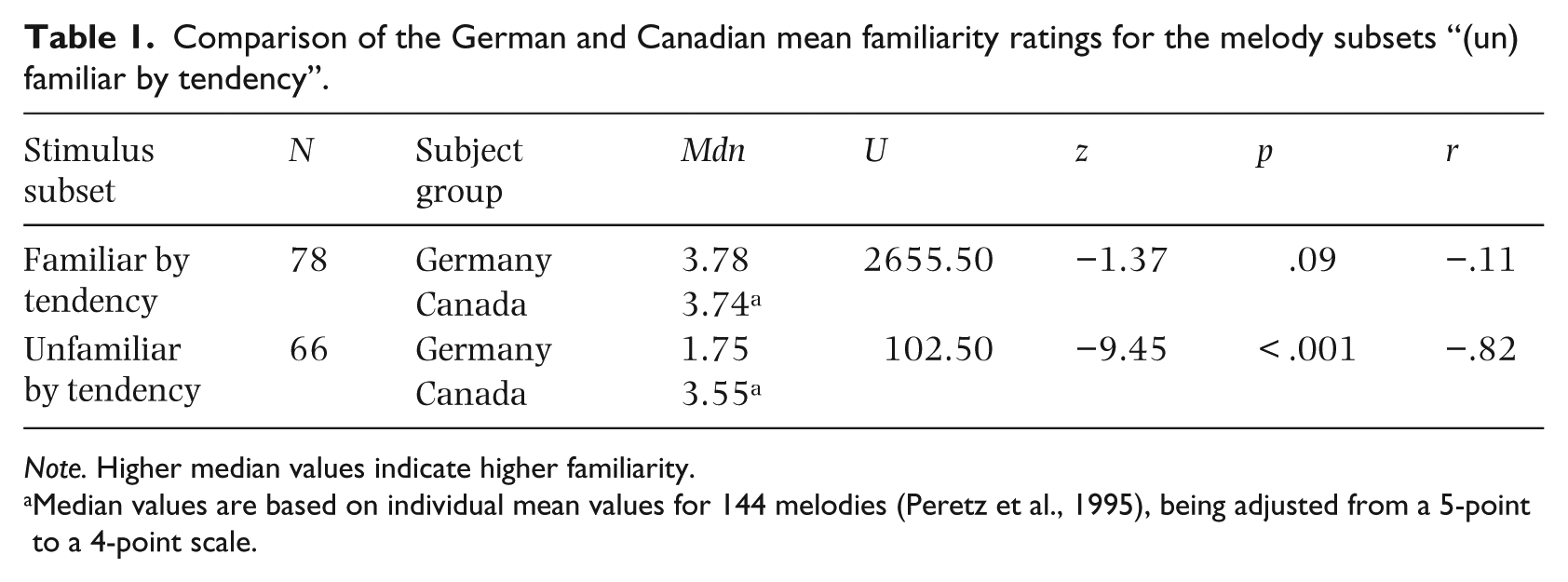
Note. Higher median values indicate higher familiarity.
Median values are based on individual mean values for 144 melodies (Peretz et al., 1995), being adjusted from a 5-point to a 4-point scale.
We further investigated possible influences of musical expertise on familiarity judgments in our study. An analysis of overall mean familiarity ratings for musicians (M = 2.70; SD = 1.03) and nonmusicians (M = 2.77; SD = 1.00) revealed a high degree of correlation (r = .93; df = 142; p < .001). A one-tailed t-test for independent samples investigating mean differences between both groups led to no significant results, t(286) = −.587; p = .28; d = −.07.
In a more detailed inspection for more or less familiar tunes, we found that musicians rated 76 excerpts as familiar by tendency (78 excerpts with nonmusicians) and 68 excerpts as unfamiliar by tendency (66 excerpts with nonmusicians). Sixty-eight stimuli (47.2% of the stimulus set) were judged consistently as familiar by tendency in both groups, opposed to 58 stimuli (40.3% of the set) judged as unfamiliar by tendency. Eighteen stimuli (12.5% of the set) were assigned to opposing subsets between the two groups. Separate comparative analyses for a possible influence of musical expertise on familiarity ratings between our data and the findings by Peretz et al. (1995) could not be conducted because the Canadian study included only nonmusicians as participants.
Highly familiar vs. highly unfamiliar melodies
As explained above, we conducted a separate comparison of the 18 most familiar rated with the 18 least familiar rated stimuli. The melodies in the highly familiar subset elicited consistent judgments from all participants, resulting in means of 4.0, with the only exception of “Are you sleeping, brother John?” receiving a mean of 3.95. Table 2 contains a juxtaposition of the German mean familiarity judgments for all 18 excerpts with the respective mean values from the Canadian study.
Mean familiarity ratings and their theoretical and empirical genre associations of the 18 most familiar melodies.
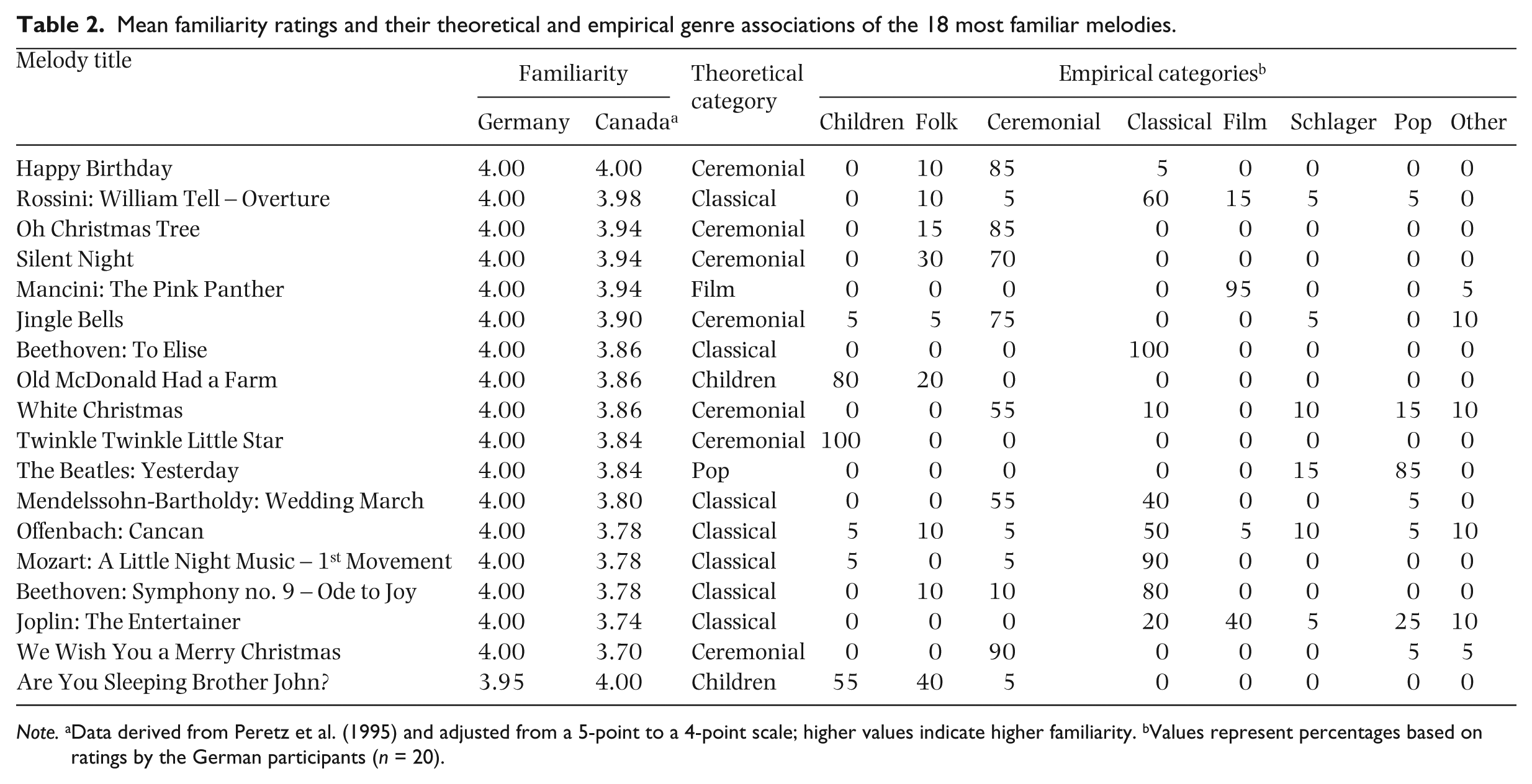
Note. aData derived from Peretz et al. (1995) and adjusted from a 5-point to a 4-point scale; higher values indicate higher familiarity. bValues represent percentages based on ratings by the German participants (n = 20).
An explorative analysis of these 18 means between German group (Mdn = 4.00) and the Canadian group (Mdn = 3.86) shows a weak negative correlation (rs = −.38; df = 34; p = .13) which could be due to the differences in the underlying 5-point scale (Canadian sample) vs. 4-point scale (German sample). A comparison of means between both groups reveals significant differences in a one-tailed Mann-Whitney test (U = 20.00; z = −4.87; p < .001; r = −.81).
Investigation of the subset of the 18 highly unfamiliar melodies unfolds more heterogeneous results, with mean familiarity values not higher than 1.55 out of 4 in our study. This leads to a strong discrepancy with the familiarity values ascertained by Peretz et al. (1995) from 2.18 up to 3.80. Table 3 shows a detailed list of both groups’ mean familiarity ratings.
Mean familiarity ratings and their theoretical and empirical genre associations of the 18 most unfamiliar melodies.
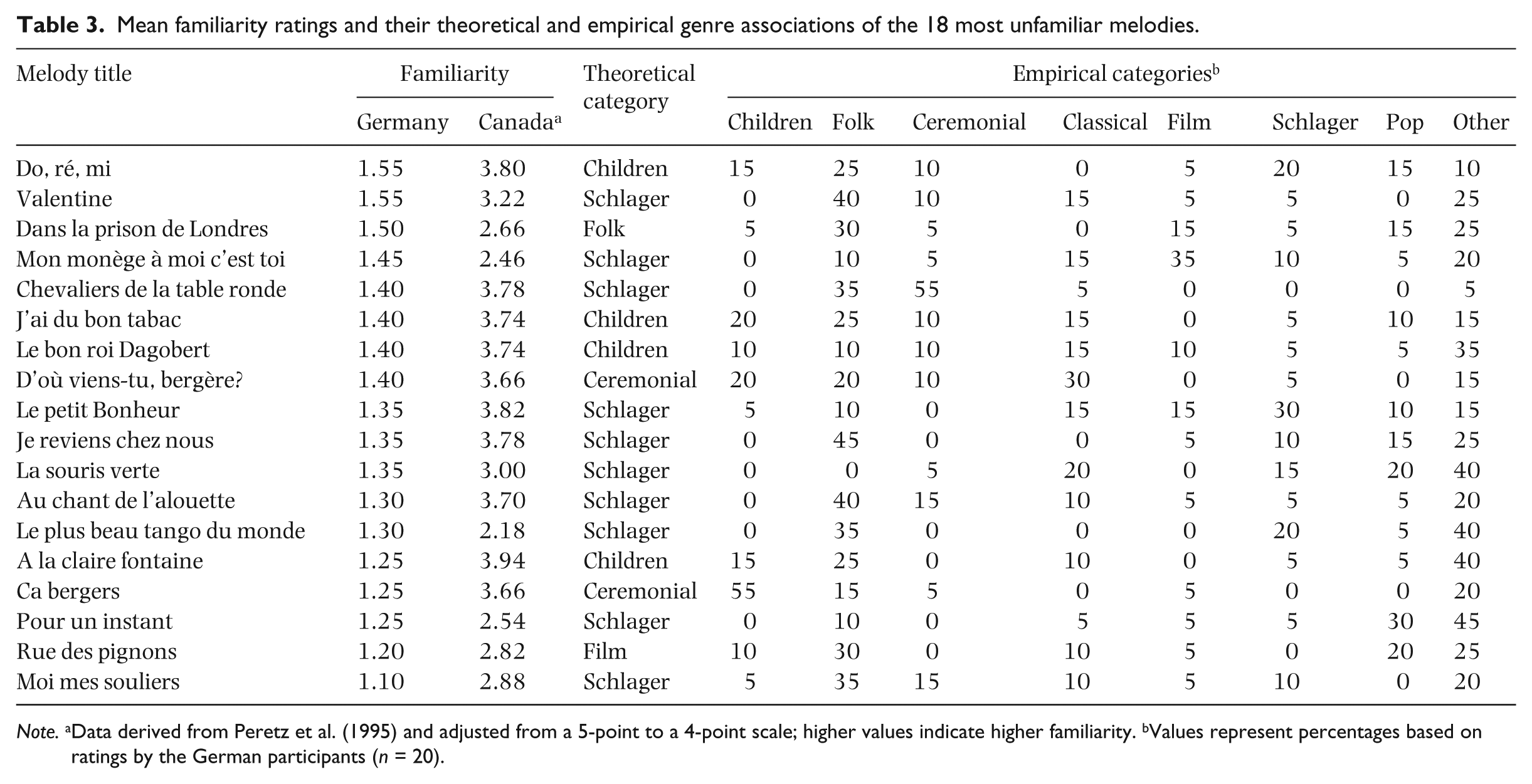
Note. aData derived from Peretz et al. (1995) and adjusted from a 5-point to a 4-point scale; higher values indicate higher familiarity. bValues represent percentages based on ratings by the German participants (n = 20).
The mean differences in these 18 familiarity ratings between German (Mdn = 1.35) and Canadian listeners (Mdn = 3.66) were highly significant in a one-tailed Mann-Whitney test (U = 0.00; z = −5.13; p < .001; r = −.86). Furthermore, the mean ratings from the two groups did not correlate (rs = .14; df = 34; p = .58).
Familiarity of melody titles
We calculated the frequencies of how often each of the 144 melody titles had been rated as either “known”, “not sure”, and “unknown” by our German participants. For each of these three rating options, we correlated the absolute frequency values and the average stimulus familiarity ratings separately. The frequency for titles rated as known (M = 5.3; SD = 6.76) correlated positively with melody familiarity (r = .84; df = 142; p < .001), indicating a higher number of participants knowing a title the more familiar its melodic structure was to them. In contrast, a strong negative correlation (r = −.93; df = 142; p < .001) was found between the listener’s confidence to rate titles as unknown (M = 12.2; SD = 7.38) and the average melody familiarity. As such, participants more frequently used the option “unknown” the less familiar they judged a melodic structure.
Separate correlational analyses for the two degrees of musical expertise showed a similar rating behavior for both title options known (musicians: r = .85; nonmusicians: r = .80) and unknown (musicians: r = −.92; nonmusicians: r = −.89), with df = 142 and p < .001 for all correlations. To investigate differences in the frequencies of title ratings between the two expertise groups, separate one-tailed t-tests for paired samples were conducted for each of the three title familiarity options across the complete stimulus set, showing a significant impact of musical expertise only for titles rated as known, t(143) = 5.84; p < .001; d = 0.2, between musicians (M = 3.0; SD = 3.74) and nonmusicians (M = 2.3; SD = 3.14). The results for further comparisons regarding musical expertise within the two subsets (un)familiar by tendency are given in Table 4.
Frequency comparison of melody title familiarity ratings between musicians and nonmusicians for the “(un)familiar by tendency” subsets.
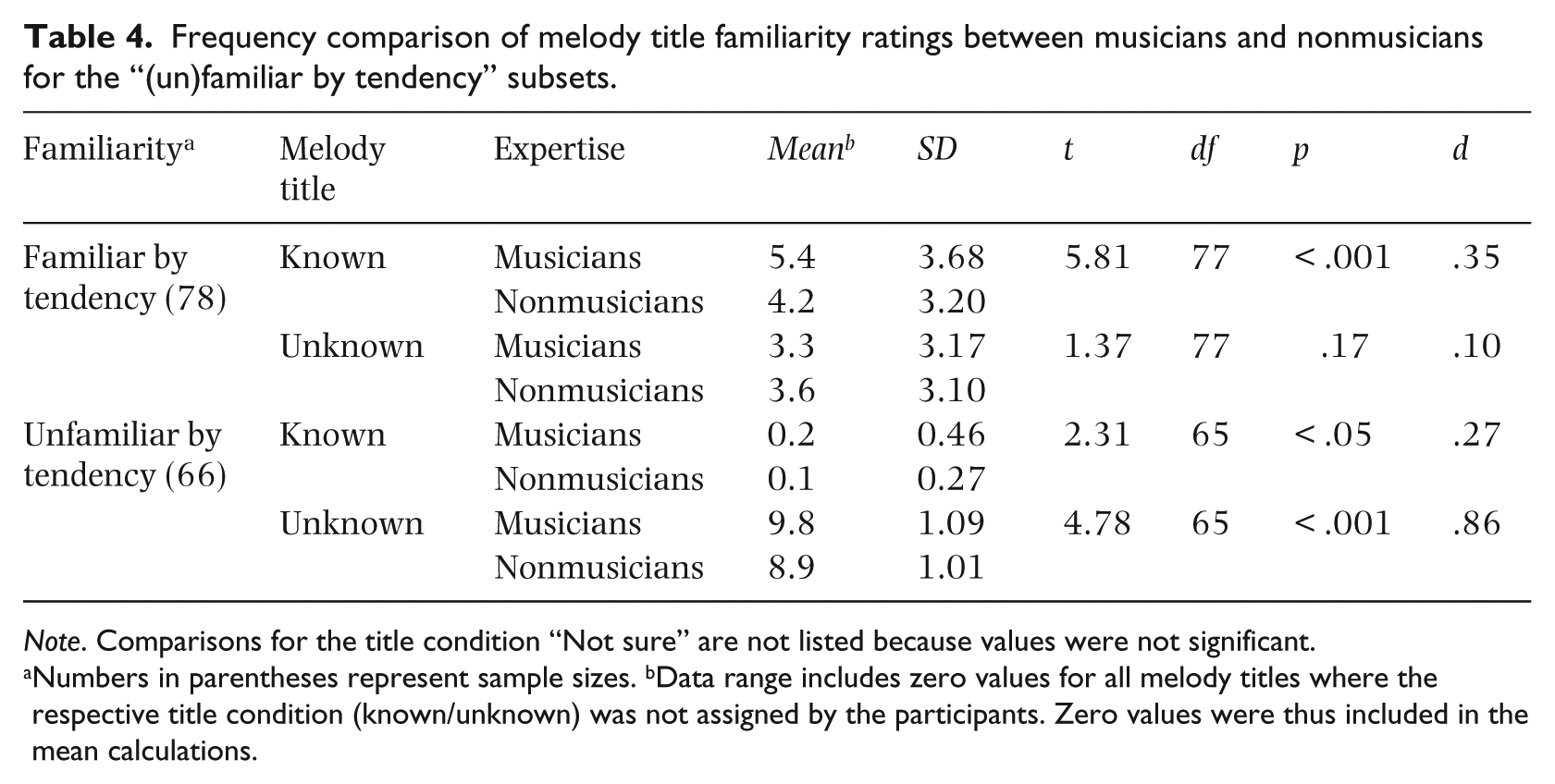
Note. Comparisons for the title condition “Not sure” are not listed because values were not significant.
Numbers in parentheses represent sample sizes. bData range includes zero values for all melody titles where the respective title condition (known/unknown) was not assigned by the participants. Zero values were thus included in the mean calculations.
A descriptive familiarity analysis for correspondences between tune and title for highly familiar and highly unfamiliar melodies within the German group revealed that the 12 most familiar rated titles also range in our subset of highly familiar melodies. In reverse, the 13 most unfamiliar rated tunes also range among the 22 least familiar-judged titles, all of which were rated as unknown concordantly by the participants.
Musical genre associations
We wanted to explore how melodies in our stimulus set are perceived in terms of musical genre affinity, and whether tunes being unfamiliar to listeners might still reveal structural clues that can make a listener anticipate a genre affiliation to a respective melody. Both analyses are described in more detail in the following sections. Evaluation focuses on participants’ results exclusively from our experiment.
Frequency comparisons of theoretical and empirical genre categories
Statistical analyses focused predominantly on the ratio between the number of stimuli allocated by us to each genre category and the number of stimuli assigned to each category by our participants in the experiment. The descriptive results are displayed in Table 5.
Frequency and range comparison of genre associations for all stimuli.
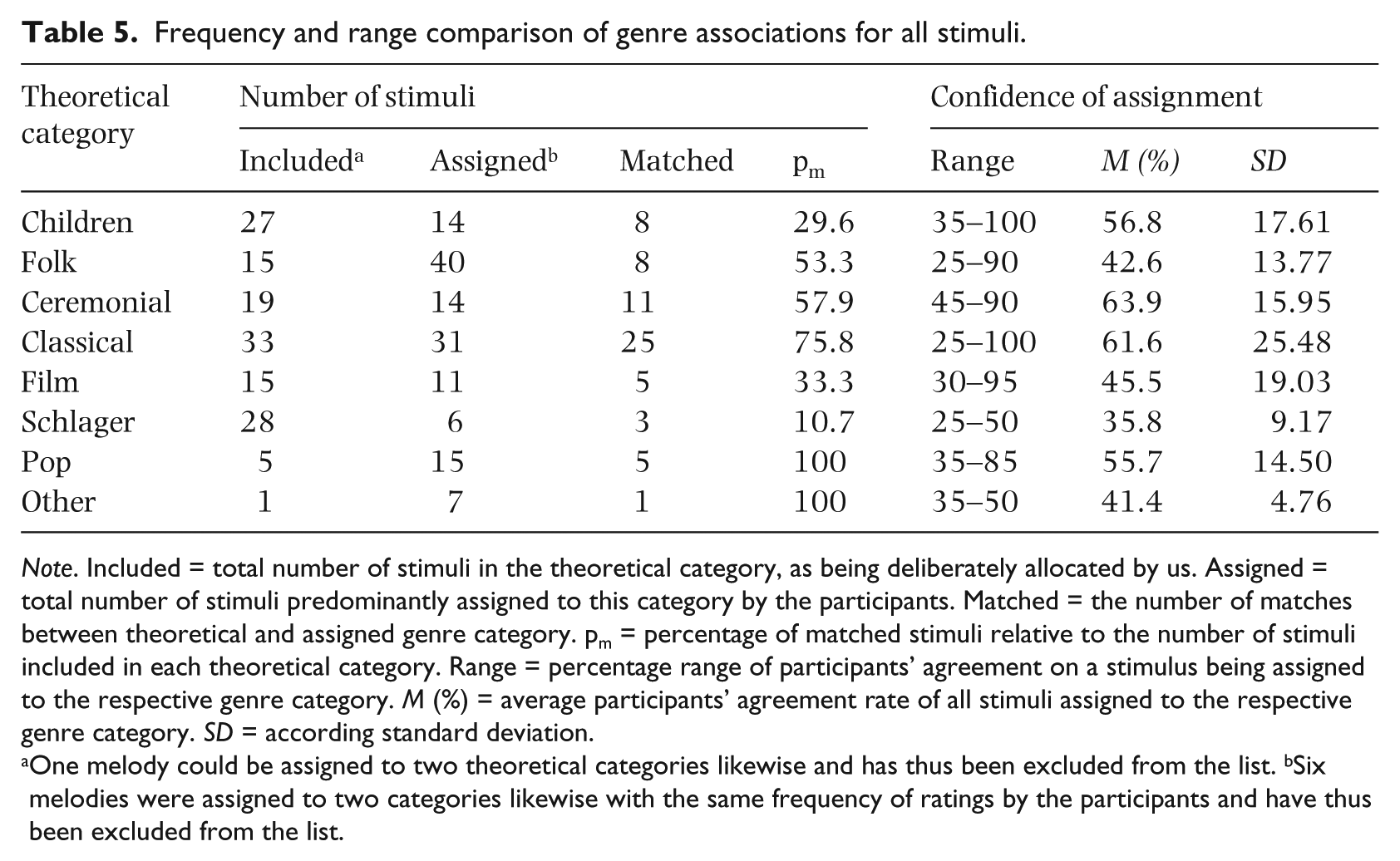
Note. Included = total number of stimuli in the theoretical category, as being deliberately allocated by us. Assigned = total number of stimuli predominantly assigned to this category by the participants. Matched = the number of matches between theoretical and assigned genre category. pm = percentage of matched stimuli relative to the number of stimuli included in each theoretical category. Range = percentage range of participants’ agreement on a stimulus being assigned to the respective genre category. M (%) = average participants’ agreement rate of all stimuli assigned to the respective genre category. SD = according standard deviation.
One melody could be assigned to two theoretical categories likewise and has thus been excluded from the list. bSix melodies were assigned to two categories likewise with the same frequency of ratings by the participants and have thus been excluded from the list.
In Table 5 the section “number of stimuli” represents the distribution of stimuli (a) we had included in the theoretical categories, (b) as assigned to empirical categories by our listeners, and how many empirical category entries matched the theoretical ones. The section “confidence of assignment” is supposed to give some indication on the conformity of genre categories, for it reflects how consistently our participants assigned genre categories to the respective stimuli.
The overall genre assignment analysis for all 144 stimuli showed that a total of 66 stimuli (45.8% of the set) were empirically matched perfectly with the category they had previously been allocated to (theoretical category). The average absolute percentage for the most frequently assigned empirical category per stimulus ranges around the midpoint (M = 51.2%; SD = 19.53) and includes values from 25 to 100%. A correlational analysis between familiarity judgments and genre assignment frequencies (r = .58; df = 142; p < .001) indicates that – regarding the category most frequently selected – genre assignments became more consistent the more familiar a melody excerpt was rated.
The two subsets familiar by tendency as well as unfamiliar by tendency were analyzed separately to answer the question of how theoretical and empirical categories matched. For the familiar by tendency subset, 51 out of 78 stimuli (65.4%) turned out to be perfectly matched in category by the relative majority of participants. The most frequent categories were classical melody (22), followed by ceremonial song (11), and folk song (5). It must be noted, however, that mean percentages vary between categories within a range up to 75% (i.e. between 25 and 100%) and show a more heterogeneous distribution (M = 67.7%; SD = 19.76), although the average frequency for matched stimuli pm ranges in the upper third of the scale.
A rather reversed pattern can be observed with the subset judged as unfamiliar by tendency: only 15 out of 66 stimuli (22.7%) received ratings that matched in category by the relative majority of participants. The most frequent empirical category assigned was children’s song (4), followed likewise by folk song, classical melody, and Schlager international (3). Variation within mean percentage values ranges from 25 to 65% and is more homogeneous in its distribution (M = 42.3%; SD = 11.48) compared to the subset familiar by tendency.
Frequency analyses of empirical genre categories for the two subsets of highly familiar and highly unfamiliar melodies showed high consistency values for the 18 most familiar rated excerpts being listed in Table 2: seven tunes were classified as ceremonial songs (M = 73.6%; SD = 14.35; range = 55–90%) and additional five excerpts as classical melodies (M = 76.0%; SD = 20.74; range = 50–100%) by the majority of the participants. A comparison of the most frequently assigned and the theoretical genre categories revealed 15 matches, thus supporting the idea of concepts in the listeners’ minds about the nature of most of the excerpts.
Regarding the 18 least familiar rated melodies in Table 3, eight of these were thought to be folk songs (M = 33.7%; SD = 7.44; range = 25–45%). Five melodies could not be assigned by the majority of the participants to any specific genre and were thus classified as “other” (M = 40.0%; SD = 3.54; range = 35–45%). Only three mean melody ratings from this subset matched with their theoretical category. Note also that for none of these melodies the percentage of matched assignment surpassed 40%.
Structural similarity analyses
To investigate influences of structural features of melodies on genre affiliation, all melodies were submitted post-hoc to the SIMILE software toolkit (Müllensiefen & Frieler, 2006) in order to determine similarity scores by pairwise comparisons. For our purposes the “opti3” measure was found most appropriate. It comprises three structural melodic factors, and the weight for each factor had been derived from listening experiments. The opti3 measure can be used in large melody sets with both similar and dissimilar tunes and is calculated as follows (Eq. 1):

The factor “ngrukkon” analyzes interval predictability within a four-note group on a 3-gram basis, transformed over intervals and using the Ukkonen Measure. The factor “rhythfuzz” describes rhythmic fuzziness between melodies, transformed over tone durations and using the “(Simple) Edit Distance” measure. This very algorithm was also applied to calculate the harmonic correlation factor “harmcore”, transformed over the pitch dimension. All three values inserted into the above formula can be calculated to an opti3 value (range: 0.0 = no structural similarity, …, 1.0 = structures are identical) as an indicator of structural similarity between the two tunes being compared (for detailed descriptions of all measures and algorithms in this paragraph see Müllensiefen & Frieler, 2006).
Following the application protocol for the opti3 measure, structural dis/similarities between all tunes within a category (genre, un/familiarity) were computed by comparing each melody pairwise with all other melodies in the category. 6 Thus for each genre category, an averaged opti3 value (mean) and the according standard deviation were calculated. The results are displayed in Table 6, together with the number of pairwise comparisons calculated within each genre category.
Descriptive statistics of the structural similarity measures for the distinct genre categories.
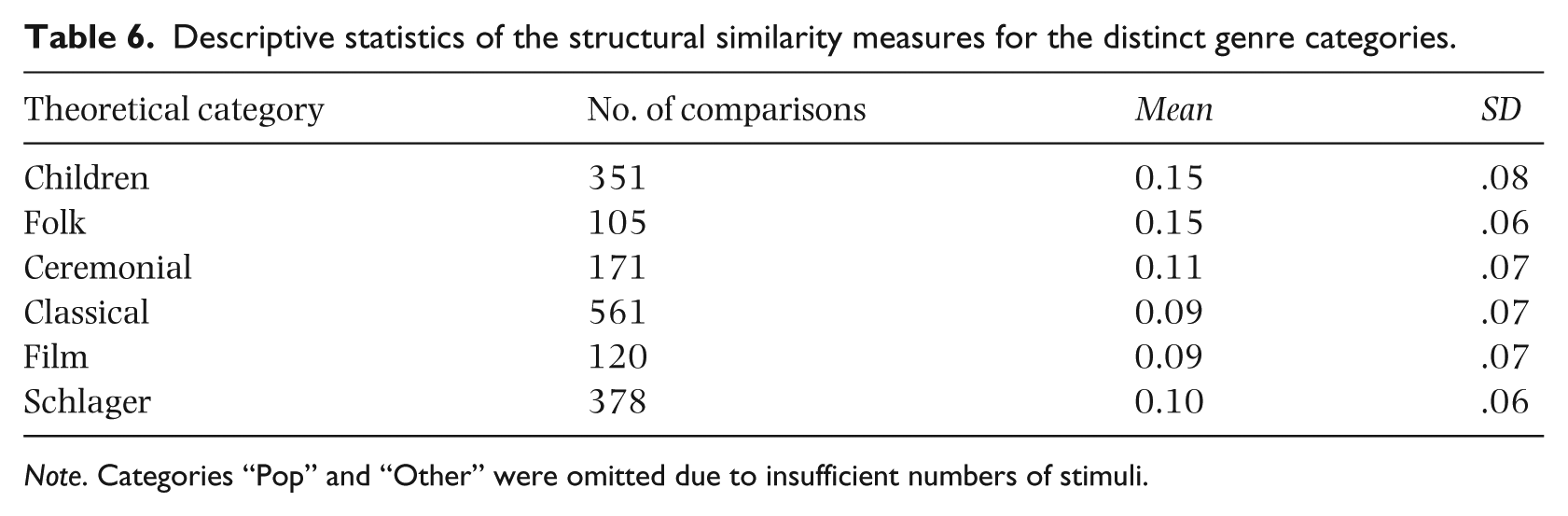
Note. Categories “Pop” and “Other” were omitted due to insufficient numbers of stimuli.
Mean differences between categories are listed in Table 7. A one-factorial independent ANOVA on the mean differences revealed a significant main effect for category, F(5, 1680) = 47.00; p < .001;
Bonferroni-corrected pairwise comparisons of mean differences in structural similarity of melodies across distinct genre categories.
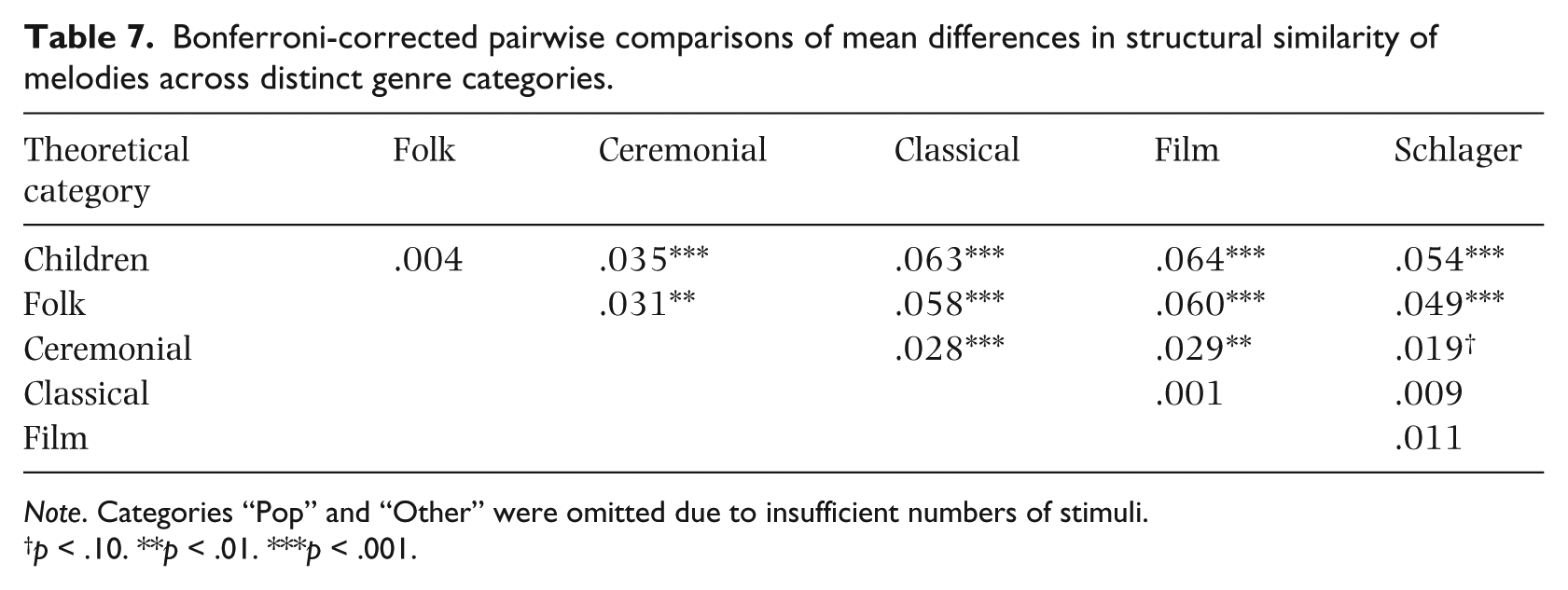
Note. Categories “Pop” and “Other” were omitted due to insufficient numbers of stimuli.
p < .10. **p < .01. ***p < .001.
Structural inter-stimulus similarity analyses for the 18 melodies within each of the two subsets highly familiar and highly unfamiliar showed comparable results between highly familiar (M = 0.10; SD = 0.07) and highly unfamiliar (M = 0.09; SD = 0.08) melodies. A comparison of means showed no significant differences in a t-test for independent samples, t(297.3) = −1.02; p = .31; d = .13.
Discussion
We investigated different aspects that may modify listeners’ concepts of familiarity with melodies under specific national influences within a shared broader cultural background (i.e. Western culture). Hence we let a group of German listeners rate their familiarity with 144 melodic excerpts from a previous Franco-Canadian study (Peretz et al., 1995). As expected, similarities and differences in familiarity emerged as an influence of the listeners’ national backgrounds in the two studies. Musical expertise appears to be less influential when investigating degrees of familiarity with melodic structures, but seems more determining for explicit musical knowledge (i.e. melody titles). Genre associations of excerpts were investigated, and again, similarities and differences between theoretical and empirical genres emerged. Structural stimulus comparisons both within and between the predefined genre categories helped us to assess issues of structural homogeneity, which might serve as one possible exploratory approach to investigating structural cues that may assist in forming concepts of melodic familiarity. We will address all these issues in turn.
Familiarity
Although the concept of familiarity incorporates manifold factors (Müllensiefen & Halpern, 2014), we decided to collect familiarity in one manifest variable and then broaden or limit its focus, using familiarity dichotomously (un-/familiar by tendency), or comparing subsets of highly un-/familiar melodies from the extreme ends of the scale. As expected, especially those stimuli being less universally known received lower familiarity judgments among our listeners. The familiar rated melodies include many popular tunes of expectably higher familiarity in most Western countries – a possible explanation for the similarities in the rating behavior between the German and the Canadian group for the familiar and the familiar by tendency condition. The subsets of melodies rated as unfamiliar or unfamiliar by tendency differ in size – as well as significantly in their grades of familiarity – between the German and the Canadian group. This should not surprise because the large number of French and Canadian traditional melodies and chansons in the stimulus set could hardly be expected to be familiar to the majority of German listeners.
In this respect, the strong correlations between high familiarity of melody structures and the respective titles should coincide with everyday observations but do also hint at comparable interactions found by Hansen and Pearce (2014). In reverse, a lower structural familiarity correlates negatively with the listener’s confidence to mark a title as unknown. Because musical expertise showed no significant influence in this rating behavior these findings further attest the coexistence of universally familiar tunes on the one hand and nationally determined melody corpora on the other.
The age of acquisition for each melody, being investigated in the study by Peretz et al. (1995), was not considered in our study because the Canadian stimulus set included hardly any genuinely German children’s or folk songs. Since previous work has addressed age-dependency in melody acquisition (Morrongiello & Roes, 1990; Schellenberg & Trehub, 1999; Trehub & Hannon, 2009), this factor – in light of the present study – may be of interest cross-culturally.
A one-to-one comparison of familiarity ratings between both studies proved difficult because of the 5-point rating scale being used in the Canadian study. Three of its scale points referred to rather familiar judgments, leaving two scale points for rather unfamiliar judgments. Due to this circumstance, participants were given a broader range to rate melodies that were more familiar to the Canadian listeners.
It should not surprise that our 18 most familiar rated melodies feature ceremonial songs and many popular classical themes being prominent in many Western countries – including their titles, as indicated by the high frequencies of their recollection. Respective familiarity judgments showed a high consistency within our study as well as in comparison with Peretz et al. (1995). However, in spite of their applied 5-point scale allowing more differentiated judgments for highly familiar melodies, it lacks a proper specification of (rather) unfamiliar melodies. This may also be an explanation why (a) ratings for the highly unfamiliar subset in our study deviate significantly from the Franco-Canadian judgments, and (b) our participants were most confident about their unfamiliarity with more than two thirds of the according melody titles. These findings are consistent with the heterogeneous ratings across groups in the unfamiliar by tendency condition and display the country-specific disparity between both participant groups more obviously than already in the comparison of the unfamiliar by tendency subset. Disregarding musical expertise, these results tend to reflect the approach by Demorest and Morrison (2003) and Demorest et al. (2010) albeit more narrowed towards country-specific differences.
Musical genre associations
As shown in Table 5, the categories most often selected by our participants are traditional folk songs, classical melodies, and pop music, whereas the theoretical categories containing most stimuli are classical melodies, Schlager music, and children’s songs. The fact that theoretical and empirical category correspond to a match rate over 75% only for “classical” hints at concepts in the listener’s mind about what features tunes may need to share to be categorized as classical music, especially since this category includes a broad range of various compositional styles and epochs that may complicate the elaboration of distinct features to define “typical” classical melodies. The category second most frequently matched is “ceremonial” with a confidence rate of assignment even surpassing “classical”. Similar to that category, many ceremonial songs included (e.g. Christmas and birthday songs) are sung in many Western countries on respective occasions.
As for the confidence of assignment ranges, the limited range for “Schlager” may hint at a weak spot related to that category: only few stimuli were assigned to this genre with even fewer matches, although a quite high number of stimuli were included in this category. This suggests that certain tunes – supposedly well known to French and Canadian ears – are hardly present in the German national environment. The participants tended to assign unfamiliar tunes with less distinctive genre references to the category “folk songs”; that is, 30 out of the 66 stimuli (45.4%) in the unfamiliar by tendency subset. This appears reasonable when considering that many chansons included in this category (23 stimuli, i.e. 34.8% of the subset unfamiliar by tendency) seem to bear more resemblance to folk music of francophone origin than to the specifically German genre “Schlager” music with rather distinctive structural features.
Regarding the highly familiar vs. highly unfamiliar melodies, the categories ceremonial songs and classical melodies once more do not only dominate highly familiar melodies, they also match perfectly with the corresponding theoretical categories, presumably for the reasons stated above. The observed correlation between the genre assignment frequency and familiarity suggests that more familiar melodies may evoke meta-categories as part of their mental representation.
Finally, most of the classical melodies have gained such presence in Germany – especially in the media (movies, commercials, etc.), or on the playlists of many classical concerts – that they are difficult to ignore and thus to categorically “mismatch”. An explanation for the discrepancy between empirical and theoretical genre category with the three stimuli that do not match could be that all three melodies have been vastly used in a different context and thus are partially associated with the accordingly assigned category. 7
Structural similarity analyses
The constitution of genre categories in three distinct melody structure groups might reflect musicological tendencies that appear logical. For instance, children’s songs and folk songs in the first group both share intrinsic and extrinsic features mostly deriving from grown cultural traditions. Ceremonial songs in the second group are usually uniquely associated with and thus exclusively heard or sung on special occasions. Christmas songs especially often seem to follow a certain structural concept such as a finite number of keys, similarities in melodic lines, and rather simple rhythms. Film melodies in the third group obviously share structural features with classical melodies but also with Schlager songs. Further support for this last aspect may be the fact that many film composers state that their compositions are based on inspirations from classical pieces, quite often from the late Romantic period. Sometimes compositions that are classical by origin are used in films and some Schlager songs use quotes from classical tunes or represent modern cover versions of classical pieces.
Musical expertise
The overall familiarity ratings of the German participants partially met our expectations and confirm the findings of Bonnel, Faïta, Peretz, and Besson (2001), namely, that in implicit tasks, musical expertise would hardly make a difference between participant group judgments. Indeed, a high correlation between both groups’ melody ratings – paired with almost no differences between average rating behavior by musicians and nonmusicians – implies stable categorization criteria for stimuli, that is, into universally familiar melodies and country-specific tunes (i.e. in this study predominantly a mixture of French and Franco-Canadian origin). However, significant differences in the melody title ratings – obviously determined by musical expertise – hint at a stronger linkage of implicit and explicit musical knowledge in musicians. This also reflects findings by Hansen and Pierce (2014) towards a stronger connection of both components in a musician’s expectation while listening to melodies. Actually, musicians often gather melodic knowledge in its respective intra- and extra-musical context (e.g. through formal, instrumental or vocal music training), which is not only limited to structural information (i.e. predominantly contour and rhythm). Moreover, musicians seem to be more decisive than nonmusicians in their ratings for supposedly unfamiliar melodies whose titles they do not know. These results coincide with findings that musicians use such domain-specific skills as references, for example, when coping with musical tasks (Bigand & Poulin-Charronnat, 2006; Poulin-Charronnat et al., 2005) or to describe their emotional engagement when experiencing music (Waterman, 1996).
Finally, these findings might shed a more differentiated light on Demorest and Morrison (2003), who suggested a general influence of musical expertise on familiarity ratings. A possible explanation can be found in the composition of the stimulus set that contained tunes either well-known in Western countries or so country-specific that they can hardly be expected to be familiar to German listeners, regardless of musical expertise.
Conclusion
To sum up, we suggest that research on familiarity with musical materials may benefit from more differentiated views on both listeners’ cultural background and a deeper understanding of structural information as provided by the corpora of melodic materials that are pertinent in long-term representations. In particular, our argumentation is based on country-specific melody sets which we interpret as a national level of cultural influence. Following a wealth of anecdotal evidence which suggests an important role of national culture, we have found first evidence of how this level of knowledge might be relevant in melody cognition. Furthermore, the investigation of coherences and distinctions between genre categories provides another novel aspect that can be studied on the basis of both structural and empirical data, as well as their possible interaction.
Limitations
Our explorations represent a new approach in the analysis of musical genres which may open promising avenues for further research. However, important limitations remain, which need to be addressed. In particular, further refinements of our methods to assess cultural and structural influences on familiarity might provide more detailed insights into mental categorization processes. More knowledge may be also gained from participants’ answers in our questionnaire that could not be further evaluated in the scope of the current study, thus, no according test quality criteria have been provided so far. Yet, the role of musical expertise in this regard is still unclear. Its investigation, especially with respect to lay music culture, remains an issue for future systematic studies.
At a technical level, the differences between the rating scales used in the Canadian and the German samples may have led to ceiling effects in the latter. Therefore, to ascertain statistical scrutiny, more coherent use of rating scales is advisable for future studies.
What are the mechanisms responsible for giving rise to feelings of familiarity with songs that we already know, or leading us to familiarize ourselves with novel tunes? Some promising answers have been provided along the lines of research on structural features (e.g. Dalla Bella, Peretz, & Aronoff, 2003; Narmour, 1990; Schellenberg, 1996; Schellenberg, Stalinski, & Marks, 2014; Schulkind, Posner, & Rubin, 2003), as well as by studies on likeability, which is found to increase with growing familiarization of previously unheard tunes. Research in this field focuses predominantly on the role of exposure in melody familiarization, as has been investigated especially in follow-up studies by Peretz and colleagues (e.g. investigations of the mere exposure effect, cf. Peretz et al., 1998), and is still a topic of current research (Müllensiefen & Halpern, 2014; Schellenberg, Peretz, & Vieillard, 2008). As such, our findings partially confirm but also differentiate the findings by Gaudreau and Peretz (1999), that is, that familiarity seems to be influenced by exposure rather than by specific styles, genres, or musical expertise: on the one hand we found genre to be of some influence in the differentiation between musical styles, or when confidence issues in genre attribution are concerned. Musical expertise on the other hand might play a stronger role in explicit rather than implicit memory, as we saw musicians being more decisive about (not) knowing melody titles compared to nonmusicians. Aspects of national cultural influence – as we found them – are by no means trivial but rather contribute to the understanding of forming culture-based melody corpora, being more sensitive to structural violation than extra-cultural music, as shown by Demorest and Osterhout (2012). How far and to what extent all these factors contribute to the complex concept of melodic familiarity has to be further clarified and thus awaits future research.
Supplemental Material
sj-xlsx-2-msx-10.1177_1029864915613390 – Supplemental material for Familiarity of Western melodies: An exploratory approach to influences of national culture, genre and musical expertise
Supplemental material, sj-xlsx-2-msx-10.1177_1029864915613390 for Familiarity of Western melodies: An exploratory approach to influences of national culture, genre and musical expertise by Niklas Büdenbender and Gunter Kreutz in Musicae Scientiae
Supplemental Material
sj-zip-1-msx-10.1177_1029864915613390 – Supplemental material for Familiarity of Western melodies: An exploratory approach to influences of national culture, genre and musical expertise
Supplemental material, sj-zip-1-msx-10.1177_1029864915613390 for Familiarity of Western melodies: An exploratory approach to influences of national culture, genre and musical expertise by Niklas Büdenbender and Gunter Kreutz in Musicae Scientiae
Footnotes
Acknowledgements
The authors would like to thank Daniel Müllensiefen and Klaus Frieler for their support in the application of their software toolkit SIMILE for the calculation of similarity indices for the melody set, as well as Andrea Halpern for her advice on how to include that measuring device in this study, and for proofreading.
Funding
This research received no specific grant from any funding agency in the public, commercial, or not-for-profit sectors.

Notes
References
Supplementary Material
Please find the following supplemental material available below.
For Open Access articles published under a Creative Commons License, all supplemental material carries the same license as the article it is associated with.
For non-Open Access articles published, all supplemental material carries a non-exclusive license, and permission requests for re-use of supplemental material or any part of supplemental material shall be sent directly to the copyright owner as specified in the copyright notice associated with the article.
