







Abstract
It is of fundamental importance for radio broadcasting companies that their listeners do not turn off the radio or switch to another station. Audiences continue listening if they like the program – especially the music. This positive appraisal can be explained by the concept of flow (Csikszentmihalyi, 1975), which illustrates how the right balance between the challenge of completing a task and the skill of the individual can lead to a particularly fulfilling mental state. We therefore conducted two 2 × 2 between-subjects experiments in cooperation with a major German broadcasting company in which we varied the complexity and familiarity of a 1-hour prime time radio program. In Study 1 we examined the effects of Adult Contemporary radio programs on a sample of the appropriate target group (120 participants, 51% female, 30 to 39 years old), while in Study 2, equivalent Contemporary Hit radio programs were evaluated by that genre’s younger target group (217 participants, 49% female, 14 to 31 years old). We found that, dependent on the musical skill or listening modes of the recipients, the complexity of the music programs could be associated with higher or lower flow experiences, which in turn had an influence on positive listener appraisal.
The major interest of any Adult Contemporary (AC) or Contemporary Hit Radio (CHR) broadcasting company is that people listen to their program and stay with their radio station. From an economic perspective, listeners are the most important factor in success. The main goal for radio companies is therefore to get people to listen to their programs, and then not to switch to another station or turn off the radio. The crucial factor that keeps listeners engaged is music, making the composition of music programs key to success (Peters, 2007; Schramm, 2008a).
When people like a radio program, and especially the music, they are more likely to stay with that radio station. One way to explain how radio stations provide positive appraisal through their music programs is the concept of flow (Csikszentmihalyi, 1975, 1990; Sherry, 2004): an ideal balance between the challenge of a task and the skill required of the individual, which leads to a particularly fulfilling mental state. The task need not be a performance-based activity, but can be an ordinary daily activity with no specific goal, or no goal that one is aware of. For example, Csikszentmihalyi and Hendin (1996) have noted flow experiences while people were dancing, and Sherry (2004) found people experiencing flow in a variety of daily media use settings: television viewing, computer gaming, and radio listening. The difficulty of the task of using and processing media content can be increased by the complexity of the content, and only when the challenge of the content and the skill of the content user are balanced do flow experience and liking arise. Schramm (2008a, p. 1689) hypothesized that “in order to create radio music programs compatible with large groups of people, the degree of complexity of radio music must remain rather low,” with the logic being that most of the target audience lacks the skills or motivation to listen to a challenging program offering complex or unknown songs. In the present study, we tested this hypothesis by exploring whether the degree of musical complexity and the familiarity of the songs in a music program led to a higher flow experience and greater liking of the program.
Theoretical background
Recent research has shown that the radio is still the most relevant device for everyday music listening (Krause, North, & Hewitt, 2013). Although there have been some studies about the reception (i.e. enjoyment; liking or disliking) and effects of listening to music on the radio, none of them investigated the effects of music programming on either the reception or the appraisal of radio programs. For example, Martín-Santana, Reinares-Lara, and Muela-Molina (2015) recently conducted an experimental study examining the influence of music in radio advertising, as well as music’s effects on the credibility of the spokesperson and the effectiveness of the advertisement, on a comprehensive sample of radio listeners. Carpentier (2010) also conducted two experiments to determine if having background music enhances the enjoyment and processing of radio news. To the authors’ knowledge, Carpentier has been the only researcher in this area to manipulate the complexity of the background music, finding that playing complex music in the background had a negative effect on both the enjoyment and retention of the news.
These two studies only examined small sections of radio programs (i.e. advertisements and news), and no studies investigating these effects for entire radio programs have yet been conducted. While radio stations do conduct research on what music their listeners prefer, this is done only by asking listeners to evaluate short excerpts of songs called hooks (Schramm, 2008b). As a result, while radio stations can tell which songs their audience likes, they do not know anything about the best order, frequency, or variety of popular songs in their program. For example, while many listeners would say that they like pop ballads, they probably would not enjoy an entire hour of this type of music in a prime time show. The authors of the present study wanted to know more about the most important steps and goals in music programming, how radio stations select the music for their programs, and whether the concept of flow is applicable for explaining what entices audiences to listen to an entire music radio program.
Music radio programming
Radio stations spend a lot of money on research to help them determine the best music programs. Schramm and Knoll (2012) found that music market research and the experience of music editors are the most important factors in the successful compilation of music programs. Ahlkvist and Fisher (2000) found there to be a standard process in music programming in the United States for the commercial radio market, with little variation in the music playlists of the most successful radio stations. At the same time, Ahlkvist (2001) has suggested that there are four different philosophies for the programming of music radios, positing the existence of aesthetic-, research-, audience-, or industry-driven programming strategies. Levi (2002) found that even for-profit classical music radio stations use more music that is liked by the listeners and editors than do non-profit stations.
As in most Western countries, the two mainstream radio formats in Germany are Adult Contemporary (AC) and Contemporary Hits Radio (CHR; Schramm & Hofer, 2008). Since AC music programs aim to attract adults, these stations do not want music that could annoy or distract listeners who are engaged in their everyday routines. These programs therefore tend to exclude genres like hard rock (which can be loud or aggressive) or jazz (which can require close attention), and instead focus on popular music from the past few decades (Stack, 2008). In contrast, CHR seeks to attract younger listeners, and therefore favours music from the Top-40 charts, as well as genres that are popular among young people, like electronic music or hip-hop (Kropp & Morgan, 2008). Whatever the type of station, radio stations strive to offer well-known songs that will be liked by most of their listeners, with the goal of keeping listeners tuned to their station.
Flow and music listening
Csikszentmihalyi (1975) was the first to identify and outline the concept of flow, an enjoyable state of consciousness achieved while taking part in an activity. If the challenge of the task and the skill of the individual are correctly balanced, then nothing else seems to matter for this person (Jackson & Csikszentmihalyi, 1999). Individuals have described the flow experience as feeling totally absorbed and comfortable, and losing track of time. This experience can be attained by listening to music; Cziksentmihalyi (1990) wrote that “Listening to music wards off boredom and anxiety, and when seriously attended to, it can induce flow experiences” (p. 109). This was confirmed by Sherry (2004), who agreed that “many have experienced temporal distortion, losing track of time while reading a novel or listening to music” (p. 333). In light of these statements, we would assume that experiencing flow during radio reception would encourage listeners to stay tuned to the program, the desired outcome for radio stations. This is especially true when people focus on listening to music, but recipients of radio programs usually multitask during the reception (Jeong & Fishbein, 2007). It is probable that both focused music listening and listening to music during an everyday task promote flow experience. However, this has not been empirically tested yet. One can think of several ways of listening to a radio music program, and this study deals with one of them: the focused music reception.
The focus of research on flow and music to date has been on music performance and creation, rather than on listening (Diaz, 2013). Studies on music students or music groups show that flow is often experienced during rehearsals and improvisation (e.g. Croom, 2015; De Manzano, Theorell, Harmat, & Ullén, 2010; Diaz & Silveira, 2013; Freer & Raines, 2005; Wrigley & Emmerson, 2013), with a number of studies focusing on flow in music education (e.g. Bakker, 2005; Custodero, 2002; Fritz & Avsec, 2007). The creative process of songwriting has been found to enhance the flow experience, and even to provide therapeutic effects (e.g. Baker & MacDonald, 2013). For a general overview of current and historical research on flow, we recommend the article by Engeser and Schiepe-Tiska (2012).
We especially wish to highlight two studies that have been conducted on flow experiences during music listening. First, Diaz (2013) found that mindful music listening leads to greater flow, and that experiencing flow is not necessarily a reaction to aesthetic experiences. Second, Lamont (2011) reported that flow experiences lead to happiness, enjoyment, and a positive appraisal of the music, especially when listening to live music. The findings of these two studies support the moderated mediation model that we propose in Figure 1: the perception of music that matches one’s skills can lead to flow experiences, which lead to satisfaction (Baker & MacDonald, 2013), enjoyment, or happiness (Lamont, 2011); this should ultimately result in a positive appraisal of the music that was listened to.
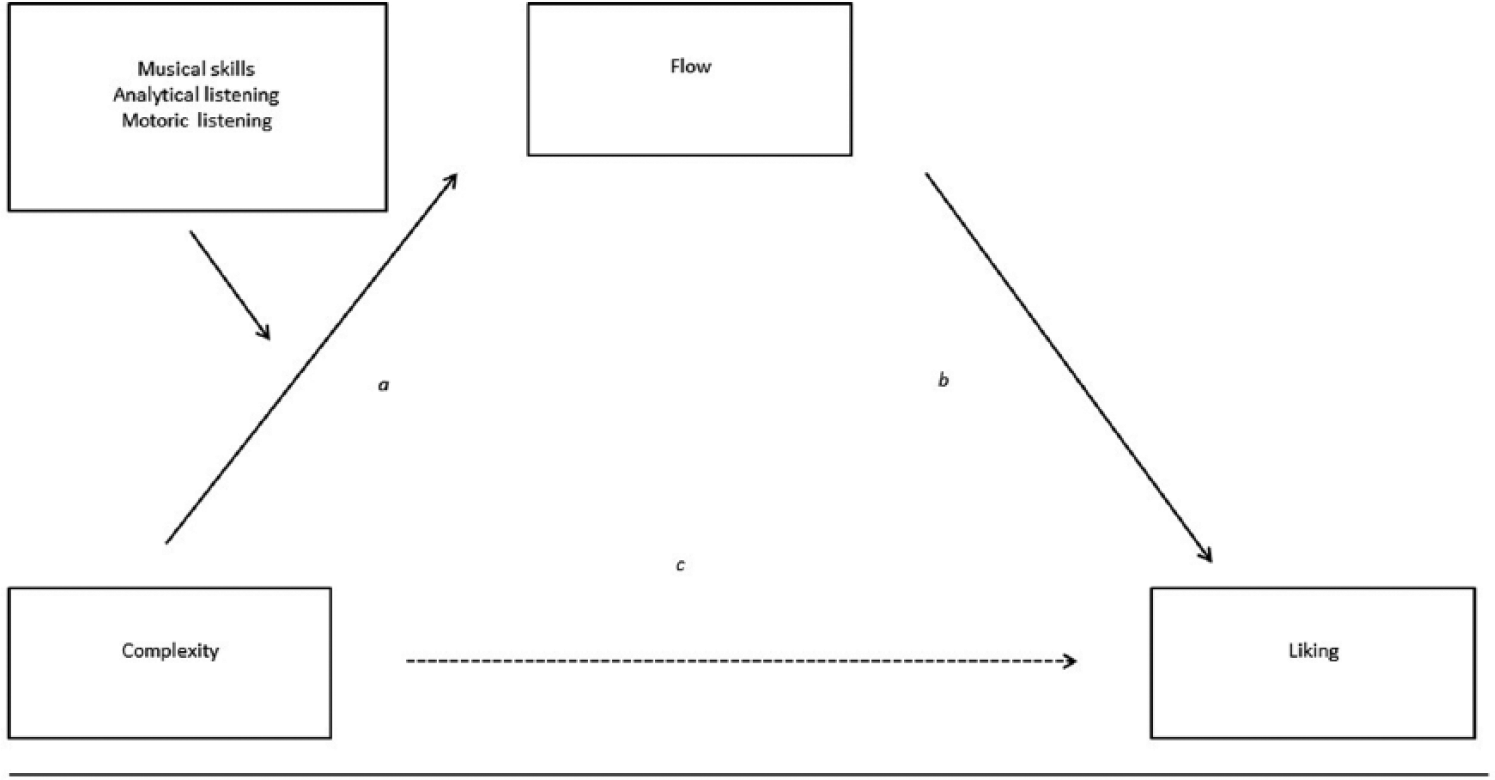
Hypothesized moderated mediation: musical skill, analytical listening, and motoric listening moderate mediation, whereby the complexity of the music promotes a flow experience, which facilitates liking the music.
Nakamura and Csikszentmihalyi (2002) have suggested that more complex tasks can lead to greater flow experiences: “As people master challenges in an activity, they develop greater levels of skill, and the activity ceases to be as involving as before. In order to continue experiencing flow, they must identify and engage progressively more complex challenges” (p. 92).
In our moderated mediation model, the complexity of the music program influences flow experience, depending on the musical skill of the individual listener, and leads to a positive appraisal of the music program, i.e. liking (see Figure 1). When there is an indirect effect on liking, there should be no significant direct effect on liking, as shown in the model. Studies such as that by Custodero (2002) have shown that strong musical skills can lead to more flow experiences when composing or performing music, and the challenge of a more complex music radio program should be better at creating a flow experience in individuals with strong musical skills than a less complex program.
However, musically skilled individuals might not listen to music in an analytical way, which could result from their musical training and education; instead they might listen to music very emotionally and try not to analyse the music like they do during performances or rehearsals. At the same time, less musically skilled individuals can be analytical listeners. They might not fully comprehend the structure or a melody like a musically skilled person would, but they might enjoy following and analysing patterns, melodies, etc. Behne (1986) conceptualized different types of listening modes like analytical listening (i.e. listening that is associated with analytical and evaluating attitudes; for a summary of Behne’s listening modes, see Schramm, 2006). People who listen analytically would logically experience more flow while listening to a more complex music program than while listening to a less complex program. Another promising way to assess flow is motoric listening (i.e. the desire to take action like moving, singing, or dancing); persons listening in this way would be expected to experience flow when engaging in activities like dancing while listening to music (Csikszentmihalyi & Hendin, 1996). Behne (1986) noted that adolescents who are motoric listeners feel a desire to move or sing along to the music. For motoric listeners, the complexity of the music should be low enough to enable easy dancing and singing, leading to a greater flow experience.
There are two possible sub-dimensions of complexity that can be manipulated to enhance complexity of commercial radio programs, as they are limited to the popular music catalogue that is considered suitable for radio broadcast. The first option is to increase musical complexity by selecting music with unusual parameters, such as an atypical structure, instruments from another country, or vocals sung in a different language. Musical complexity is inherent in the song and therefore hard to measure (North & Hargreaves, 1995). Still, there is music that features parameters that influence subjective complexity, for example songs played with unknown instruments or songs that do not contain a chorus could be considered as more complex than songs that are played by guitar, bass, and drums and consist of an ABAB structure. The second option is to play more songs that listeners are not familiar with. As people expect to hear a limited, consistent selection of music on a given radio station (Heller, 1999), new and surprising songs can enhance the complexity of the music program and therefore cognitive engagement. An unfamiliar song does not have to be complex per se, but a music program that includes some unfamiliar songs can be considered as more cognitive engaging than a program with all the greatest hits.
Hypotheses
The complexity of a music radio program has influence on whether listeners will like the program and whether they will experience flow. Typical radio listeners have been found to prefer mainstream radio programs that offer well-known and non-complex music (Ahlkvist & Fisher, 2000; Schramm, 2008b), implying that a music radio program that features only well-known and non-complex songs should be more positively appraised than programs featuring complex or less well-known music. We therefore propose our first hypothesis:
H1: The target audience will like a mainstream radio program comprising non-complex and well-known songs more than a program comprising complex or unknown songs.
Since flow experiences during radio reception should coincide with liking, the second hypothesis is:
H2: The flow experience of the target audience of a mainstream radio program will be higher when listening to a program comprising non-complex and well-known songs than when listening to a program comprising complex or unknown songs.
The expected correlation between flow and positive appraisal is presented in our third hypothesis:
H3: The more radio listeners experience flow during radio reception, the more they will like the radio program.
Following our proposed model for the moderated mediation of complexity on liking via flow experience, the first moderator is musical skill. Many studies have suggested that when the skill of an individual matches the skill needed to complete a task, that task should lead to a higher flow experience than if the task does not sufficiently challenge the individual (e.g. Nakamura & Csikzentmihalyi, 2002). Alternatively, a person with low skills could be over-challenged by a complex radio program, and not experience flow. The fourth hypothesis is therefore:
H4: A more complex music radio program facilitates or decreases positive appraisal via flow experience when listeners have higher or lower musical skills, respectively.
Further, a musically educated person especially, but also everyone else, can be an analytical listener who finds pleasure in analysing and thinking about music (Behne, 1986). A person who tends to be an analytical listener should therefore experience flow when listening to complex music, while someone who is not an analytical listener should experience less flow when listening to complex music. The fifth hypothesis is therefore:
H5: A more complex music radio program facilitates or decreases positive appraisal via flow experience when listeners are more or less analytical listeners, respectively.
Finally a motoric listener should experience less flow when listening to a complex music program, as overly complex music is not conducive to engaging in the desired motoric reactions. This leads to the last hypothesis:
H6: A more complex music radio program decreases positive appraisal via flow experience when the listeners are highly motoric listeners.
Method
Design
To test these six hypotheses, two 2 x 2 between-subjects laboratory experiments were conducted. Their main focus was to measure the influence of complexity and familiarity in music radio programs on listener perception. The participants of both studies were asked to listen to one of four different radio music programs. These programs varied in terms of the factors of complexity (complex vs. non-complex) and familiarity (unknown vs. well-known) of the songs, the independent variable. Participants were assigned randomly to the four groups, with an equal number of male and female participants per group. Participants were then asked to listen to the 1-hour radio program of their assigned experimental group independently via headphones. After listening to the program, participants were then asked to fill out a questionnaire on a desktop computer.
Stimuli and procedure
To compile realistic radio programs, we worked with a major German private radio broadcasting company, whose music editor helped the authors to select the featured music, background music, and incidental sounds needed to create a standard 1-hour AC morning program for Study 1, and a comparable standard 1-hour CHR program for Study 2. The morning show setting was chosen because this is the most important time slot in the radio market.
Instead of the station promotions that are normally regularly broadcast through a radio program, neutral interjections and comments were produced for the present studies. This allowed the broadcasting company to stay anonymous, and ensured that the participants were not prejudiced by hearing the name of the station. A professional announcer produced interjections – the most common being “Turn your radio louder!” and “We play the best music!” – and news to keep the program as realistic as possible. The news and service reports (i.e. traffic announcements) were for a city in southern Germany that is not within the actual broadcasting area of the company. The announcer was told to invent news and topics that contained no messages that might evoke strong emotions in listeners.
The music editor chose eight well-known and non-complex songs from the latest German airplay charts; these eight songs were used on all of the radio programs for both Study 1 and Study 2. The remaining four songs in each 12-song playlist – the third, sixth, ninth, and 12th songs – were then different for each program. Well-known songs had already aired on German radio stations and had been on the top-40 charts for at least a week. Unknown songs had to be of a format and quality that could be played on a commercial radio station, but that had not been played prior to the investigation period – for example, a song that was just released by a well-known artist. Non-complex songs had to have genre-typical structures and instrumentation, with no foreign harmonies or melodies, while complex songs needed to contain instrumentation, structures, sounds, languages, harmony patterns, or melodies that would be unorthodox for Western ears. It was difficult to find songs that fit the criteria for complex songs but that were still appropriate for commercial radio stations; examples of complex songs were “Gangnam Style” by PSY (chosen because of the foreign language) or Connor Maynard’s “Animal” (chosen because of the unusual Dub-Step related sound and instrumentation) in contrast to non-complex songs of the same genre like Jay-Z’s “Empire State of Mind” or “Hangover” by Taio Cruz.
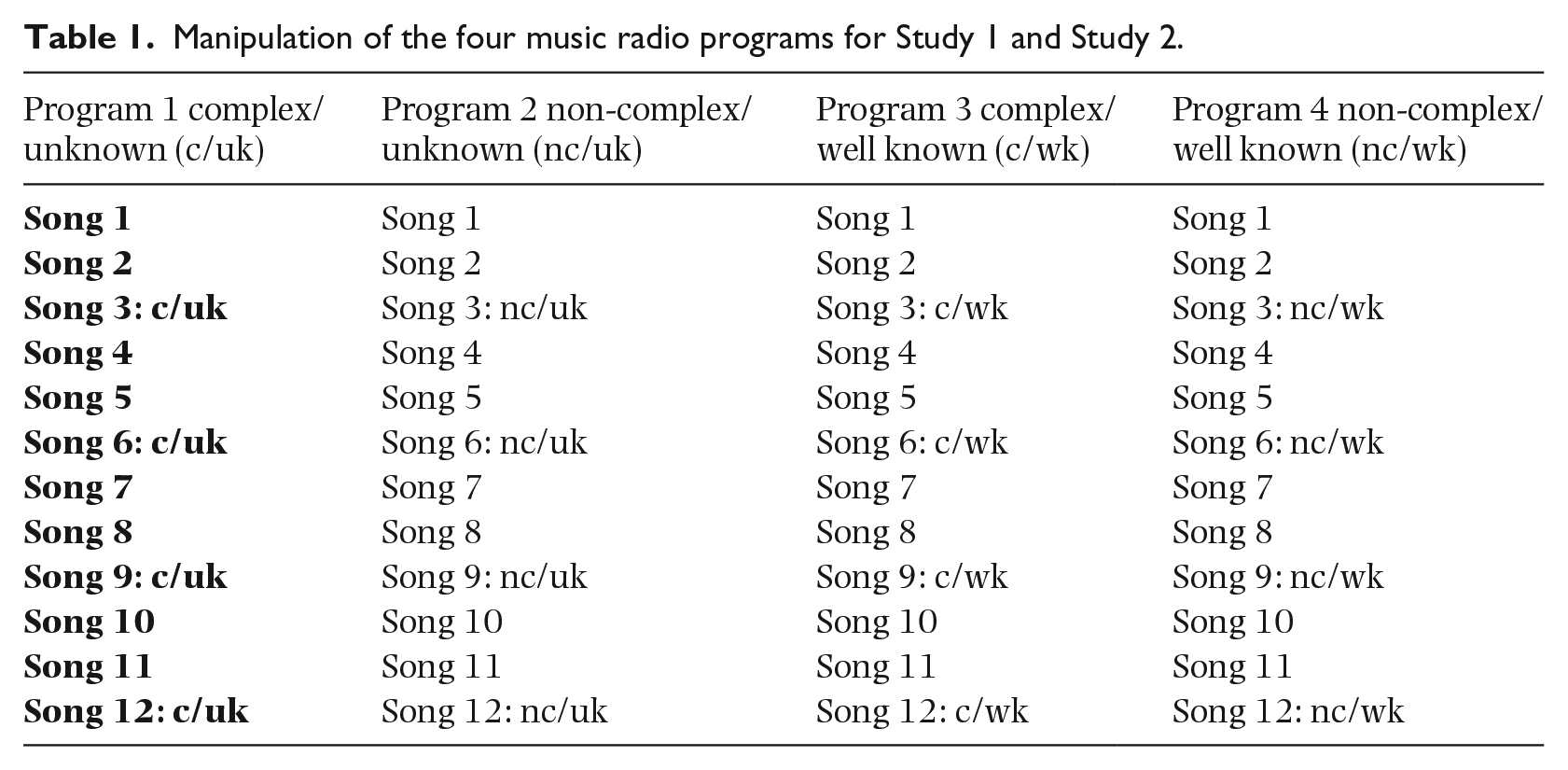
In both studies, the first group of study participants was asked to listen to a 12-song program comprising the eight songs that were common to all playlists, plus four complex and unknown songs. Examples for the well-known and familiar songs were Rihanna’s “Diamonds” or “I Gotta Feeling” by the Black Eyed Peas. The second group’s program included four non-complex but unknown songs; the third group’s program included four known but complex songs, and the fourth group’s program included four non-complex and well-known songs (see Table 1). The external validity of the four programs was guaranteed, as all four music playlists were compiled by a professional music editor from a major German CHR station. The music editor and the authors also accounted for other parameters of the manipulated songs. In both studies the four manipulated songs were from the same genres, with singers of the same sex. In Study 1, for example, the third song was a rock song, performed by a male vocalist: “Kaleidoscope” by The Script (Program 1), “This’ll Be My Year” by Train (Program 2), “Pumped Up Kicks” by Foster The People (Program 3), and “Hero” by Chad Krueger (Program 4). The sixth song was German pop/rock performed by a male vocalist, the ninth song was a pop ballad performed by a female vocalist, and the 12th song was electronic dance performed by a male vocalist.
Manipulation of the four music radio programs for Study 1 and Study 2.
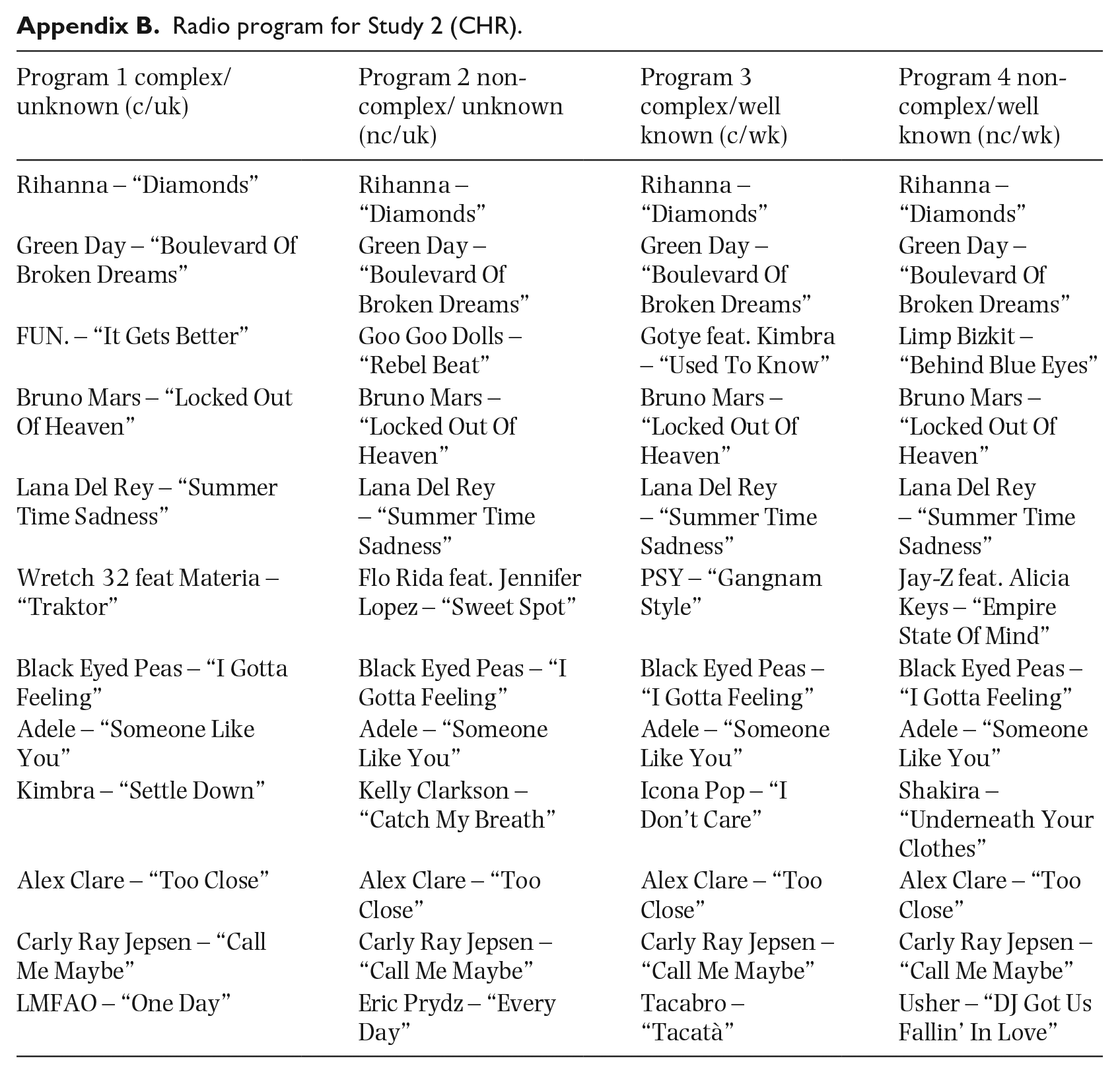
In Study 2, the third song was pop/rock performed by a male vocalist, the sixth song was hip-hop performed by a male rapper, the ninth song was pop/R&B performed by a female vocalist, and the 12th song was electronic dance performed by a male vocalist: “One Day” by LMFAO (Program 1), “Every Day” by Eric Prydz (Program 2), “Tacatá” by Tacabro (Program 3), and Usher’s “DJ Got Us Falling In Love Again” (Program 4). The playlists for both studies can be seen in Appendix A and B.
Manipulation check
The music selection was subjectively compiled depending on the expertise of the music editor and the authors. In order to examine if the playlists were actually perceived as more or less complex, manipulation checks were incorporated in both studies. As complexity is very subjective and everybody has his or her own definition of complexity, the participants were asked if the selection of songs in the playlists was somehow unusual to them. This question matched our procedure: the songs were chosen because they were either unfamiliar to the recipients or musically complex and the playlist compiled of unknown and complex songs should be regarded as unusual (as described in the previous chapter). The participants rated whether they felt that the playlist they listened to contained unusual songs on a 7-point Likert scale. We used an ANOVA to test the differences between the four groups in each of the two studies. The descriptive results were in line with the intended directions and support our manipulation for both studies. The ANOVA revealed that the differences between the groups in Study 2 were highly significant, Fstudy1(3, 116) = 1.86, ns and Fstudy2(3, 213) = 21.22, p < .01, η2 = .23 (albeit not in a significant way in Study 1; see Table 2 for the descriptive statistics).
Manipulation check for Study 1 and Study 2.
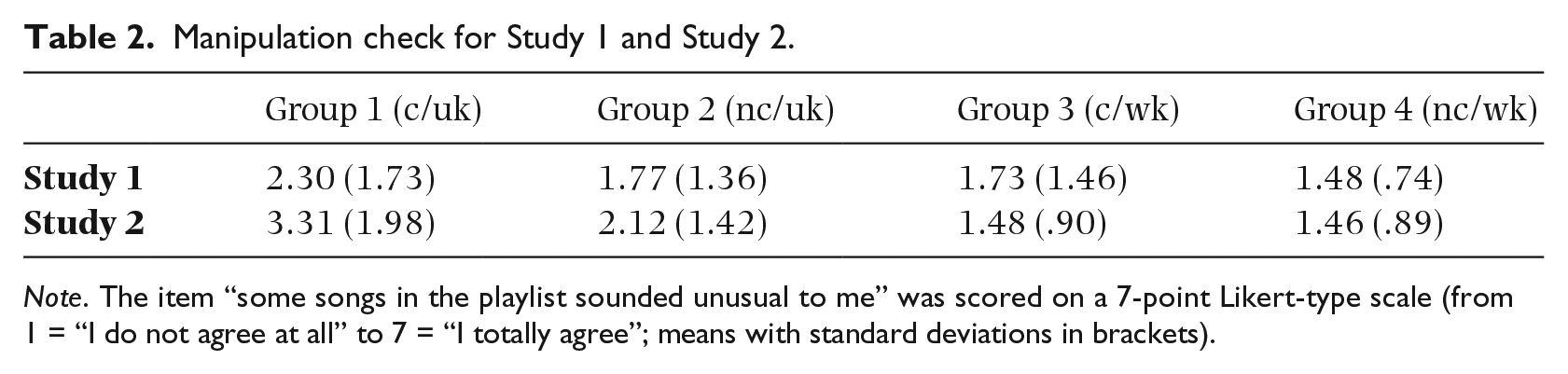
Note. The item “some songs in the playlist sounded unusual to me” was scored on a 7-point Likert-type scale (from 1 = “I do not agree at all” to 7 = “I totally agree”; means with standard deviations in brackets).
Measures
Flow (dependent variable, mediator)
We measured flow using 12 items from the Flow Short Scale (Engeser & Rheinberg, 2008; Rheinberg, Vollmeyer, & Engeser, 2003). All items were scored on a 7-point Likert-type scale from 1 = “I do not agree at all” to 7 = “I totally agree”. For example, participants were asked if they were deeply interested in the radio program, or if they lost this feeling at any time while listening to the program.
Liking (dependent variable)
We compiled 15 items from various radio market research programs, and confirmed the appropriateness of these items with the music editor of the broadcasting company. All items were scored on a 7-point Likert-type scale from 1 = “I do not agree at all” to 7 = “I totally agree”. Example items include: “I would like to listen to the program again” and “It sounded like my favourite radio station”.
Listening modes (moderators)
Participants were given Behne’s (1986) Listening Modes Questionnaire. All six items were scored on a 7-point Likert-type scale from 1 = “I do not agree at all” to 7 = “I totally agree”. Analytical listening was assessed with four items, such as “I find it interesting to follow the different themes, melodies and rhythms”. Motoric listening was assessed by two items, such as “I feel like moving to the music”.
Musical skill (moderator)
Musical skill was assessed with five items that were drawn from Schramm’s study (2005). All items were scored on a 7-point Likert-type scale from 1 = “I do not agree at all” to 7 = “I totally agree”. Example items include “I have a lot of knowledge about music” and “I often get asked for advice on the topic of music”. The reliability and descriptive statics of all variables can be seen in Table 3.
Descriptive statistics of variables of Study 1 (N = 120) and Study 2 (N = 217).
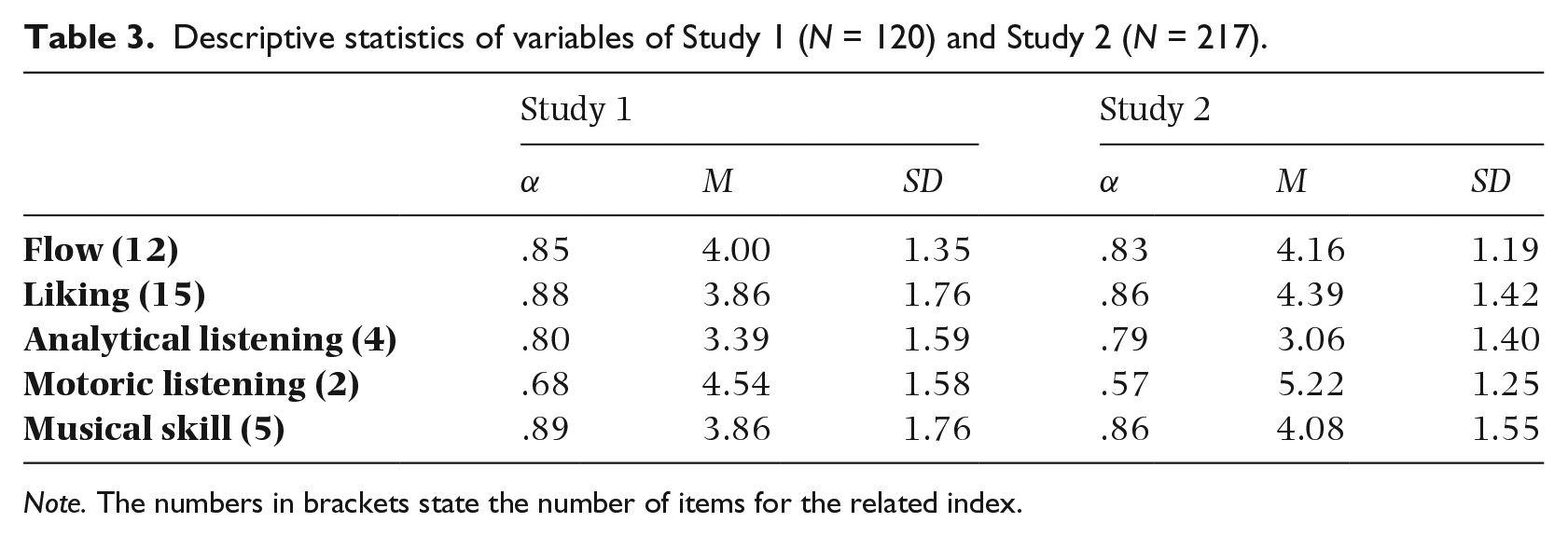
Note. The numbers in brackets state the number of items for the related index.
Study 1
Sample
As agreed upon with the radio station, the participants of Study 1 were recruited from the target population of AC radio listeners within the broadcasting region of a large southern German city. Potential participants had to be between 30 and 40 years old and enjoy listening to major German AC radio stations like Bayern 3 or Antenne Bayern. The study was advertised in local newspapers and online magazines, as well as through the local job centre and via posters and flyers in local shops and bars near the local university. In these advertisements, potential participants were informed that the university was looking for participants between 30 and 40 years old who like to listen to the radio and who would be willing to evaluate a radio program for 15 euros. Everyone who finished the study received 15 euros as remuneration. At no point during the study were participants informed about the true goal of the study or the actual cooperating radio station. Afterwards they were debriefed except for the name of the radio station that wanted to stay anonymous.
All of the 120 recruits were randomly assigned to one of the four experimental groups, with the male–female balance maintained between the four groups. Participants were between 30 and 39 years, with a mean age of 33.64 years (SD = 3.07); 50.8% were female. The distribution across the groups is given in Table 4.
Participant demographics for the four experimental groups of Study 1.
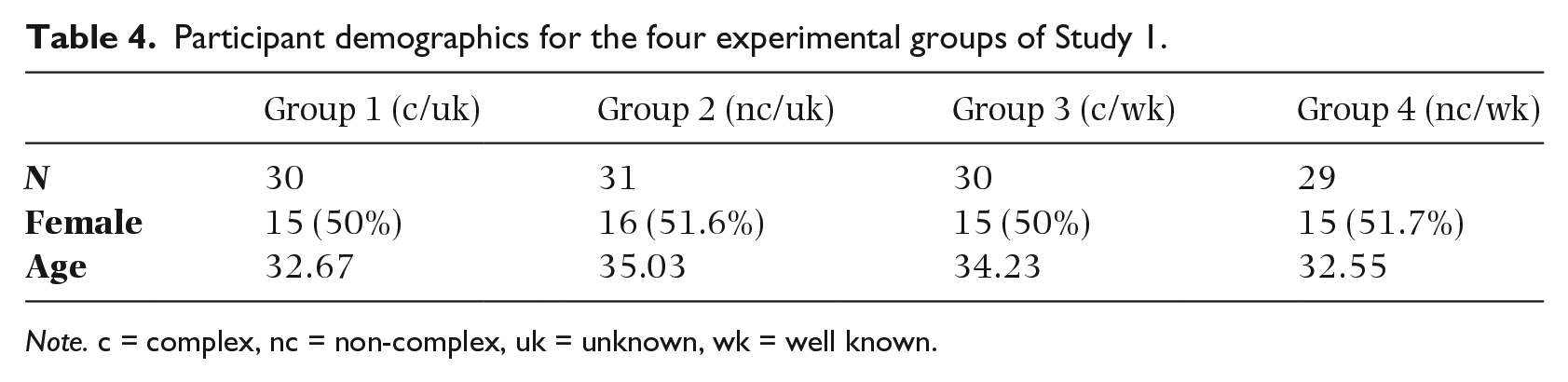
Note. c = complex, nc = non-complex, uk = unknown, wk = well known.
Results
To test the first hypothesis – which states that a radio program with well-known and non-complex songs will evoke a greater liking than a program with unknown or complex songs – we used a two-way ANOVA. The two factors were the familiarity and complexity of the songs in the program. There was no significant main effect for familiarity, F(1, 116) = .365, p = .55, η2 = .003 or complexity, F(1, 116) = .147, p = .70, η2 = .001 on liking, nor was there any significant interaction between complexity and familiarity on liking during program reception, F(1, 116) = .043, p = .84, η2 = .000.
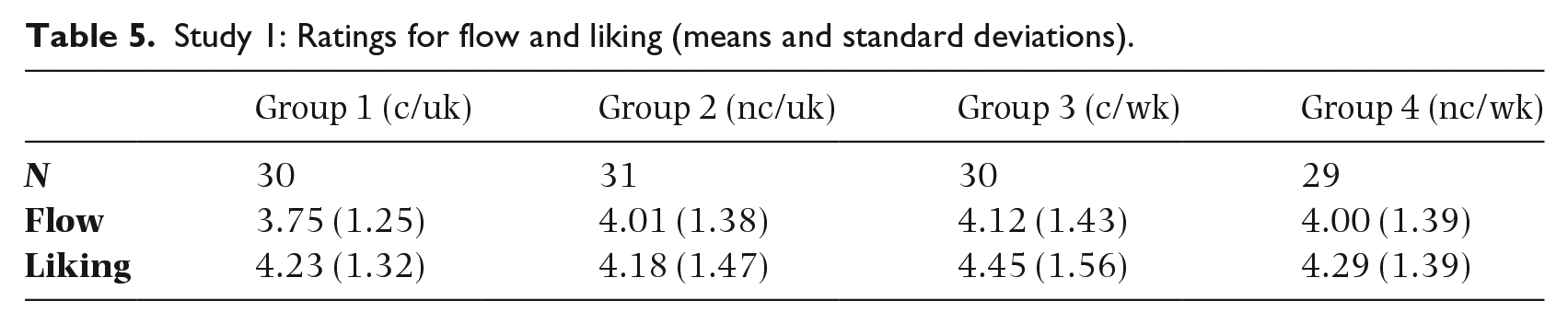
A two-way ANOVA was again used for the second hypothesis, namely: The flow experience of the target audience of a mainstream radio program will be higher when listening to a program comprising non-complex and well-known songs than when listening to a program comprising complex or unknown songs; results were comparable to those for the first hypothesis. We found no significant main effect for familiarity, F(1, 116) = .501, p = .48, η2 = .004 or complexity, F(1, 116) = .084, p = .77, η2 = .001 on flow experience, nor was there any significant interaction between complexity and familiarity on the flow experience, F(1, 116) = .610, p = .44, η2 = .005. The descriptive statistics for flow and liking can be seen in Table 5.
Study 1: Ratings for flow and liking (means and standard deviations).
To test Hypothesis 3 which says the more radio listeners experience flow while listening to the radio, the more they will like the radio program, and Hypothesis 4 which predicts that a more complex music radio program can facilitate or decrease positive appraisal through flow experience when listeners have higher or respectively lower musical skills, we used our moderated mediation model described in the section on flow (see Figure 1). A moderation and mediation analysis was conducted using Hayes’ (2013) PROCESS. Complexity was used as the predictor variable, musical skills as the moderator of flow experience (i.e. mediator), and liking as the outcome variable. As can be seen in Figure 2 and Table 6, there was no indirect effect of complexity on liking through flow experience for persons with either low or high musical skills, b = –.02, 95% bias corrected and accelerated confidence intervals (BCa CI) [–.310, .263]; confidence intervals are based on 1,000 bootstrap samples in all our mediation analyses. In all tests the cut-offs for high and low musical skill were the top and bottom 10% for musical skills of the participants.
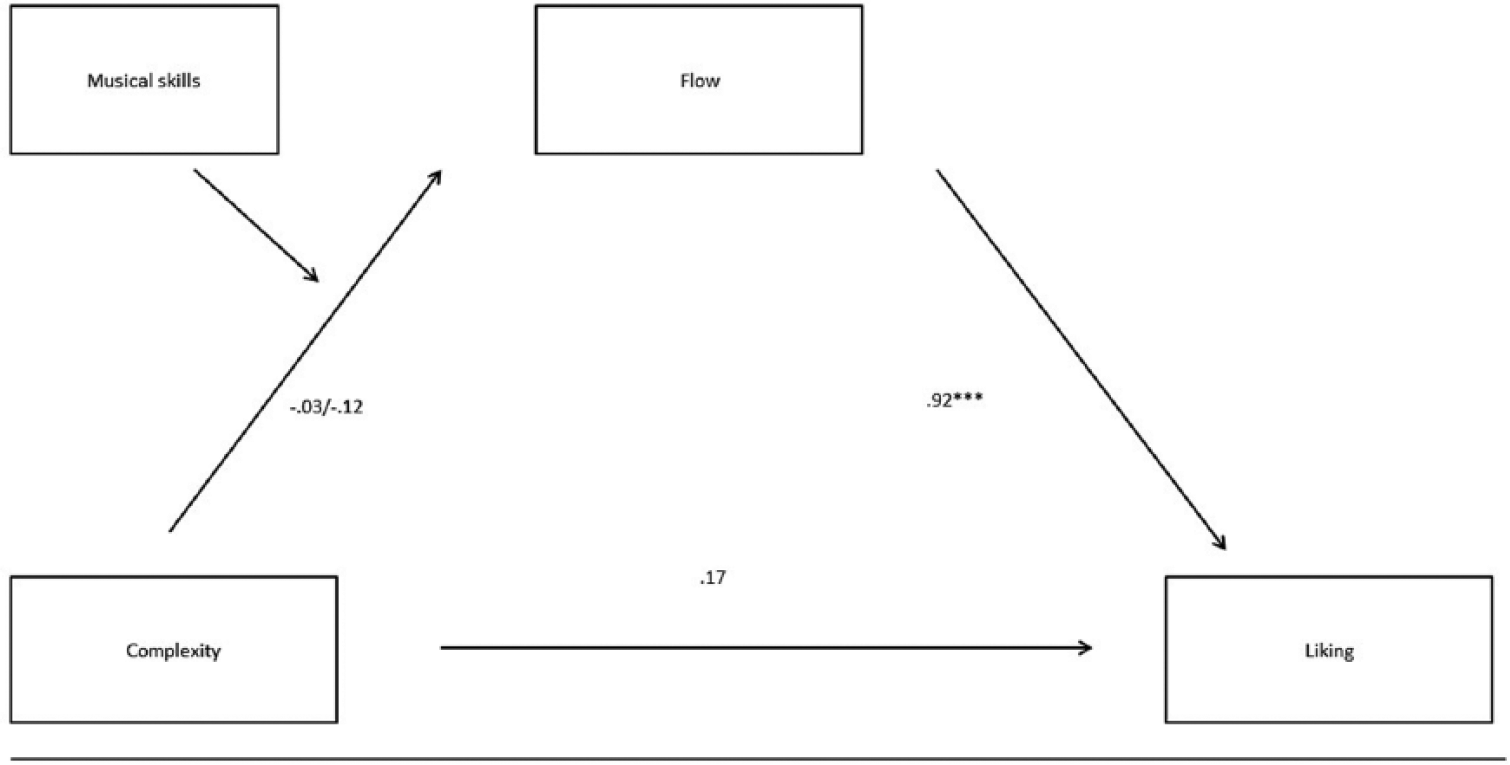
Indirect effect of complexity, moderated by levels of musical skills on liking via flow experience. Path values represent unstandardized regression coefficients. The value in front of the slash, –.03, is the unstandardized regression coefficient for recipients with low musical skills; the value after the slash, –.10, is the unstandardized regression coefficient for recipients with high musical skills.
Results of the indirect effect of complexity, moderated by levels of musical skills on liking via flow experience.
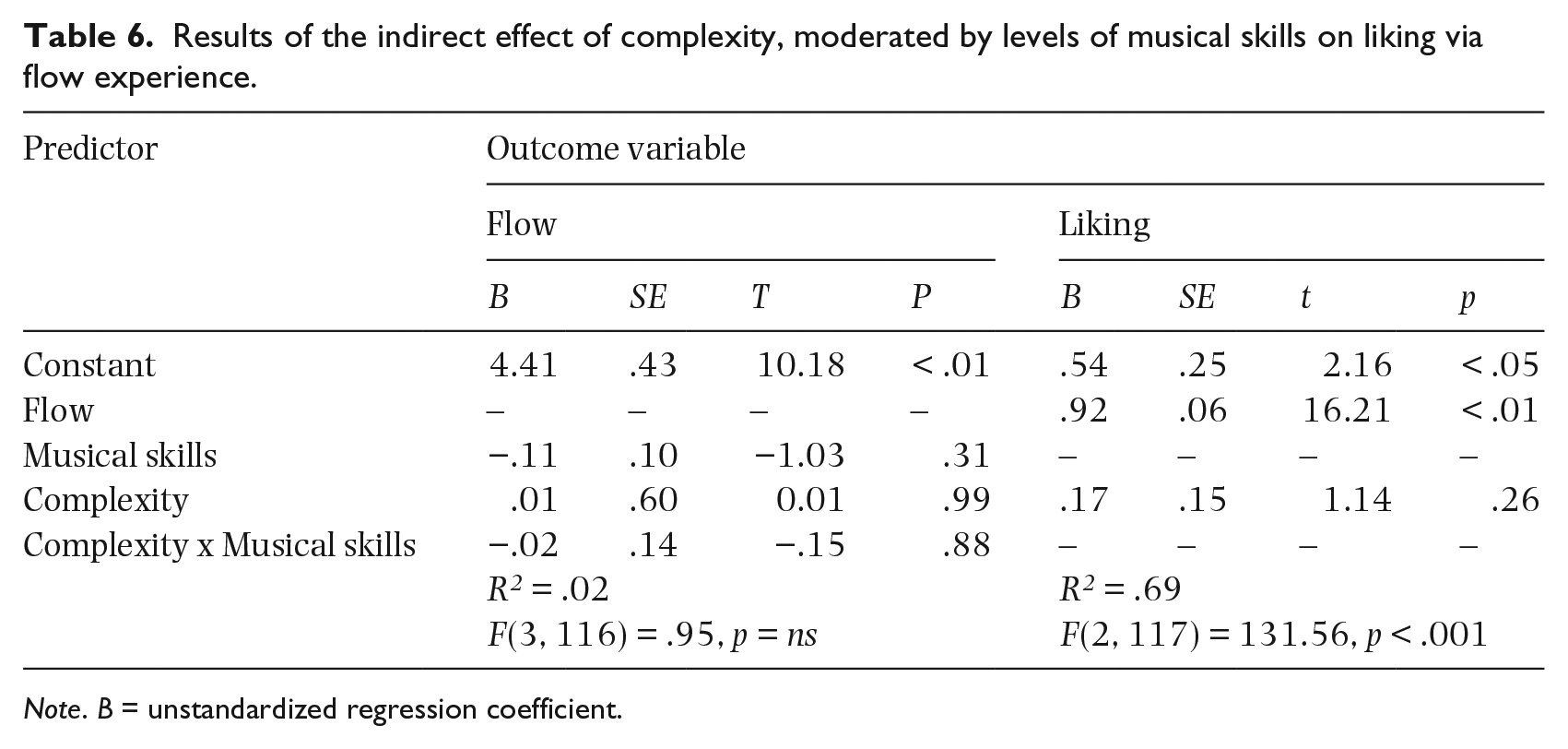
Note. B = unstandardized regression coefficient.
The simple regression from flow on liking was highly significant (see Table 6). Hypothesis 3 is therefore supported by the results.
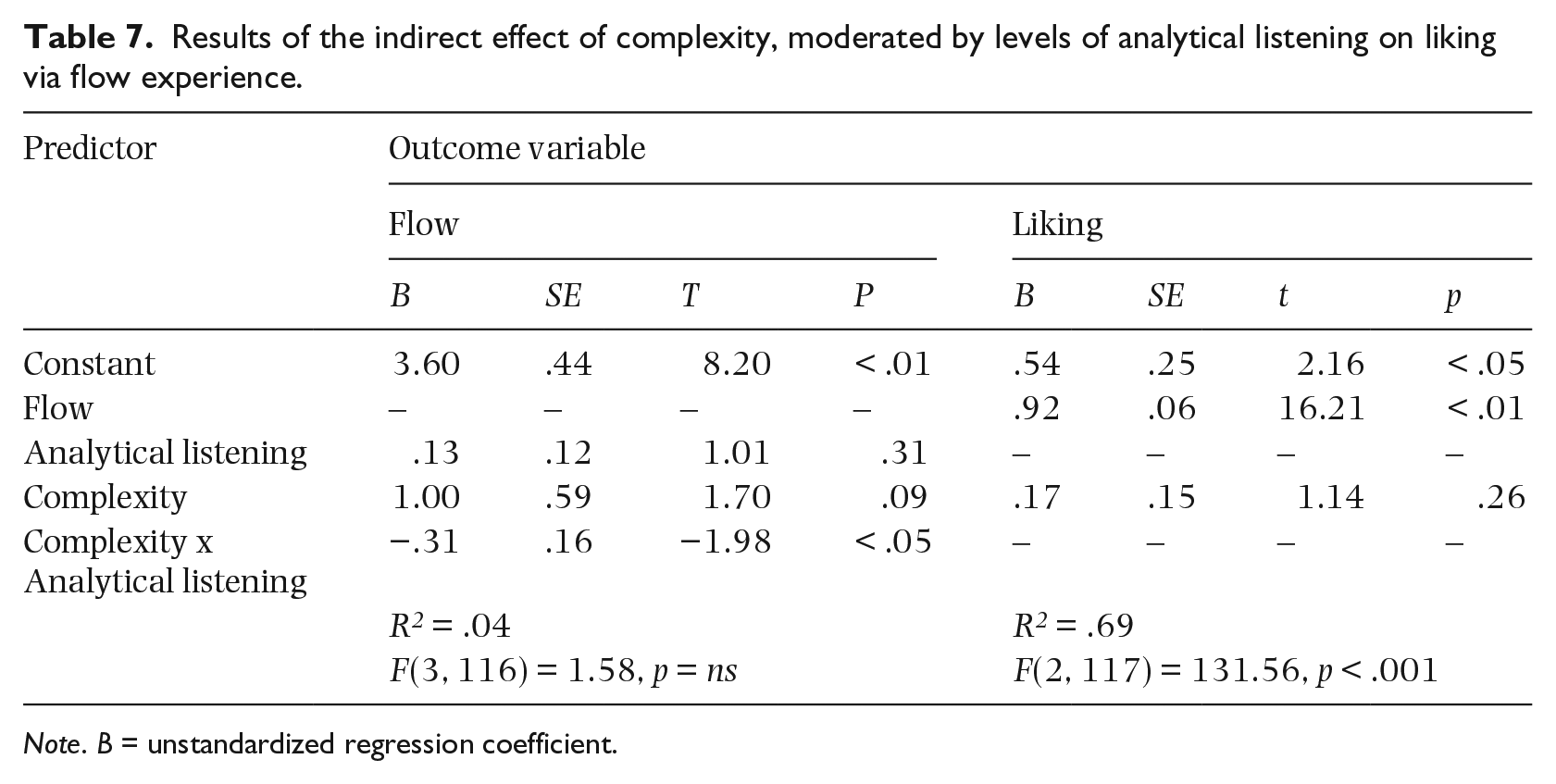
To test Hypothesis 5 that states that a complex music radio program affects the appraisal through flow experience when listeners are more or less analytical listeners, the same moderated mediation model described in the section on flow (see Figure 1) was used, but with analytical listening as the moderator. There was a significant indirect effect of complexity, moderated by analytic listening on liking through flow experience (see Figure 3 and Table 7). However, contrary to Hypothesis 5’s supposition, only highly analytical listeners showed less liking while listening to complex programs, b = –.32, 95% BCa CI [–.628, –.001].
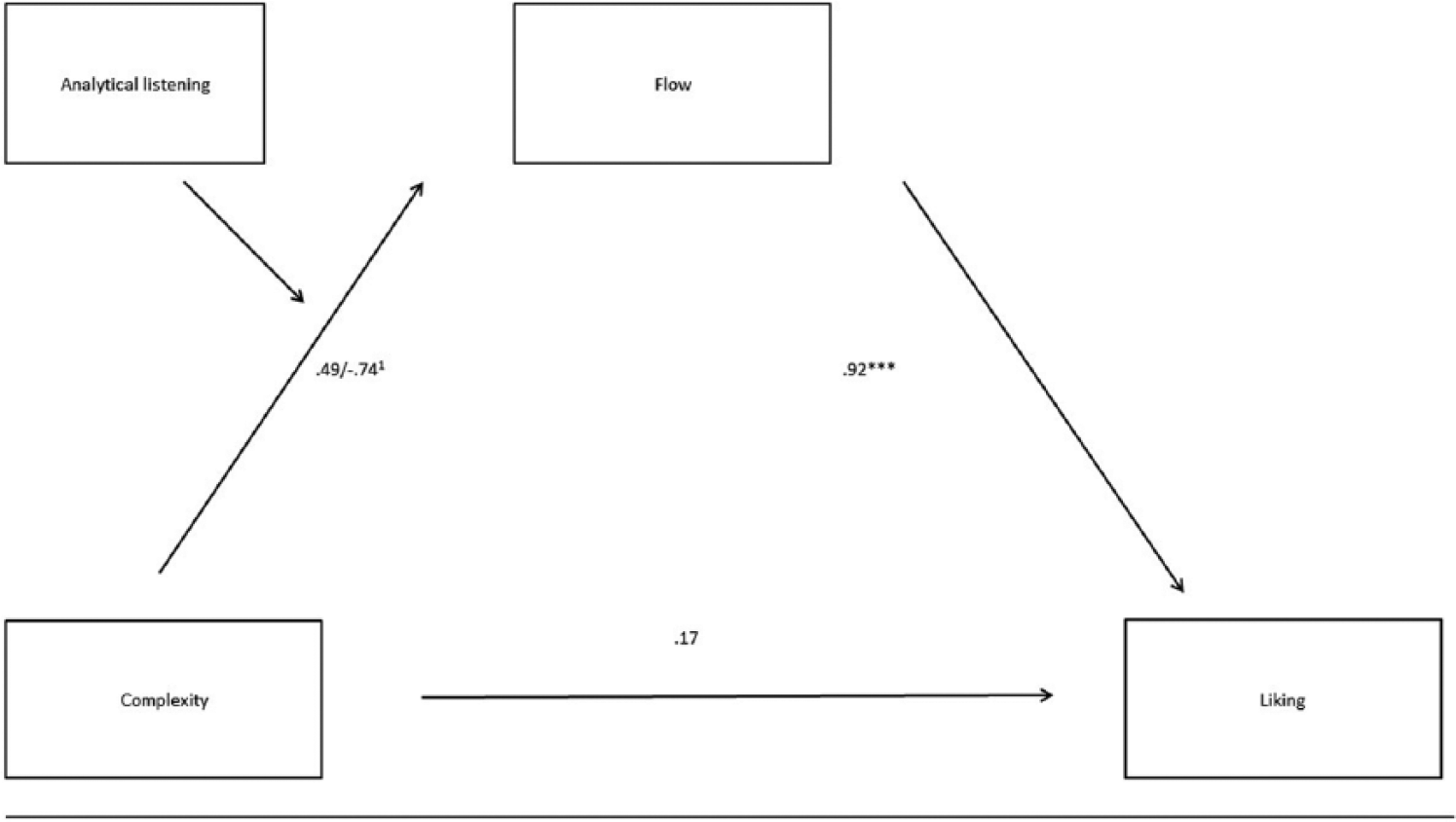
Indirect effect of complexity, moderated by levels of analytical listening on liking via flow experience. Path values represent unstandardized regression coefficients. The value before the slash, .49, is the unstandardized regression coefficient for recipients with low musical skills; the value after the slash was the unstandardized regression coefficient for recipients with high musical skills.1 No significant effect was found at the 10th and 90th percentile, but significant moderation was found from the value 5.39 (on a 7-point scale) using the Johnson-Neyman approach (t = −1.98, p < .05).
Results of the indirect effect of complexity, moderated by levels of analytical listening on liking via flow experience.
Note. B = unstandardized regression coefficient.
Finally, to assess Hypothesis 6 which predicts that a more complex music radio program reduces positive appraisal through flow experience when listeners are motoric listeners, the same moderated mediation model described in the section on flow (see Figure 1) was used, but with motoric listening as the moderator. The conditional process analysis did not support this hypothesis, as there was no significant indirect effect of complexity, moderated through motoric listening on liking via flow experience, b = .05, 95% BCa CI [–.284, .405].
Study 2
Sample
To obtain the correct sample for Study 2, the radio broadcasting station recommended that people between the ages of 14 and 30 should be invited to take part in the study. Eligible participants also needed to like current popular music and R&B, the preferred genres for listeners of the cooperating CHR station.
We advertised this study in local newspapers and online magazines, as well as through the local youth centres, and via posters and flyers in shops and bars near the local university. The advertisements stated that the university was looking for participants between 14 and 30 years of age who would be willing to listen to and evaluate a radio program, with 15 euros as remuneration. At no point during the study were participants informed of the true goal of the study or of the identity of the cooperating radio station. Afterwards they were debriefed except for the name of the radio station.
All 217 participants were randomly assigned to one of the four experimental groups, with the male–female ratio preserved across groups. Participants were between 14 and 31 years of age, with a mean age of 21.87 years (SD = 3.90); 49.3% were female. The distribution across the groups is given in Table 8.
Participant sample for Study 2.
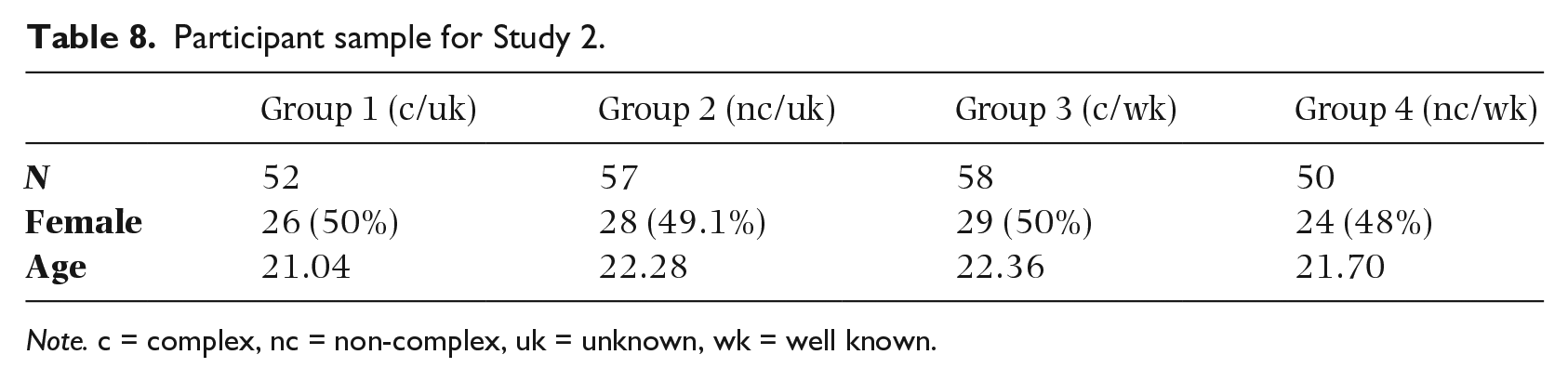
Note. c = complex, nc = non-complex, uk = unknown, wk = well known.
Results
As with Study 1, the first (The target audience will like a mainstream radio program comprising non-complex and well-known songs more than a program comprising complex or unknown songs) and second hypotheses (The flow experience of the target audience of a mainstream radio program will be higher when listening to a program comprising non-complex and well-known songs than when listening to a program comprising complex or unknown songs) were tested using a two-way ANOVA, with complexity and familiarity as the independent variables. We found no significant main effect for complexity, F(1, 213) = 1.552, p = .21, η2 = .007 or familiarity, F(1, 213) = 3.079, p = .08, η2 = .014 on liking, nor was there any significant interaction between complexity and familiarity on the reported liking of the programs, F(1, 213) = .155, p = .69, η2 = .001.
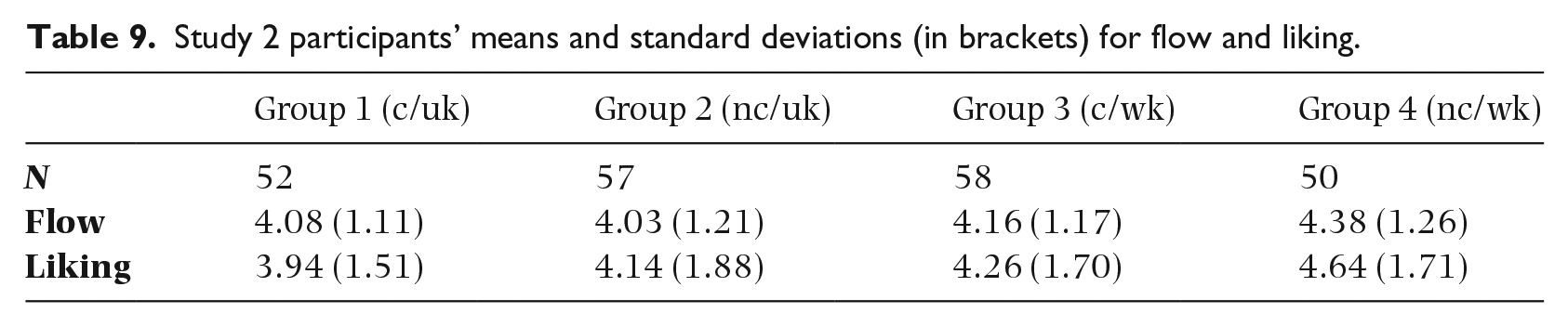
For the second hypothesis, there was no significant main effect for complexity, F(1, 213) = .275, p = .60, η2 = .001 or familiarity, F(1, 213) = 1.827, p = .08, η2 = .009 on flow experience, nor was there any significant interaction between complexity and familiarity on flow experience during program reception, F(1, 213) = .714, p = .40, η2 = .003. The descriptive statistics for flow and liking can be seen in Table 9.
Study 2 participants’ means and standard deviations (in brackets) for flow and liking.
As in Study 1, we applied our model (see Figure 1), and conducted moderated mediation analysis to test Hypothesis 3 that predicts the more radio listeners experience flow while listening to the radio, the more they will like the radio program and Hypothesis 4 that states that a more complex music radio program can facilitate or decrease positive appraisal through flow experience when listeners have higher or respectively lower musical skills. We found a significant indirect effect of complexity, moderated by musical skills on liking through flow experience, b = –.79, 95% BCa CI [–1.27, –.31], for participants with low musical skills (i.e. those whose musical skill scores were within the bottom 10%) and high musical skills (i.e. those whose musical skill scores were within the top 10%; b = .61, 95% BCa CI [.09, 1.16]; see Figure 4 and Table 10). We also found the simple regression from flow on liking to be highly significant, as shown in Table 10. Hypotheses 3 and 4 are therefore supported by the results.
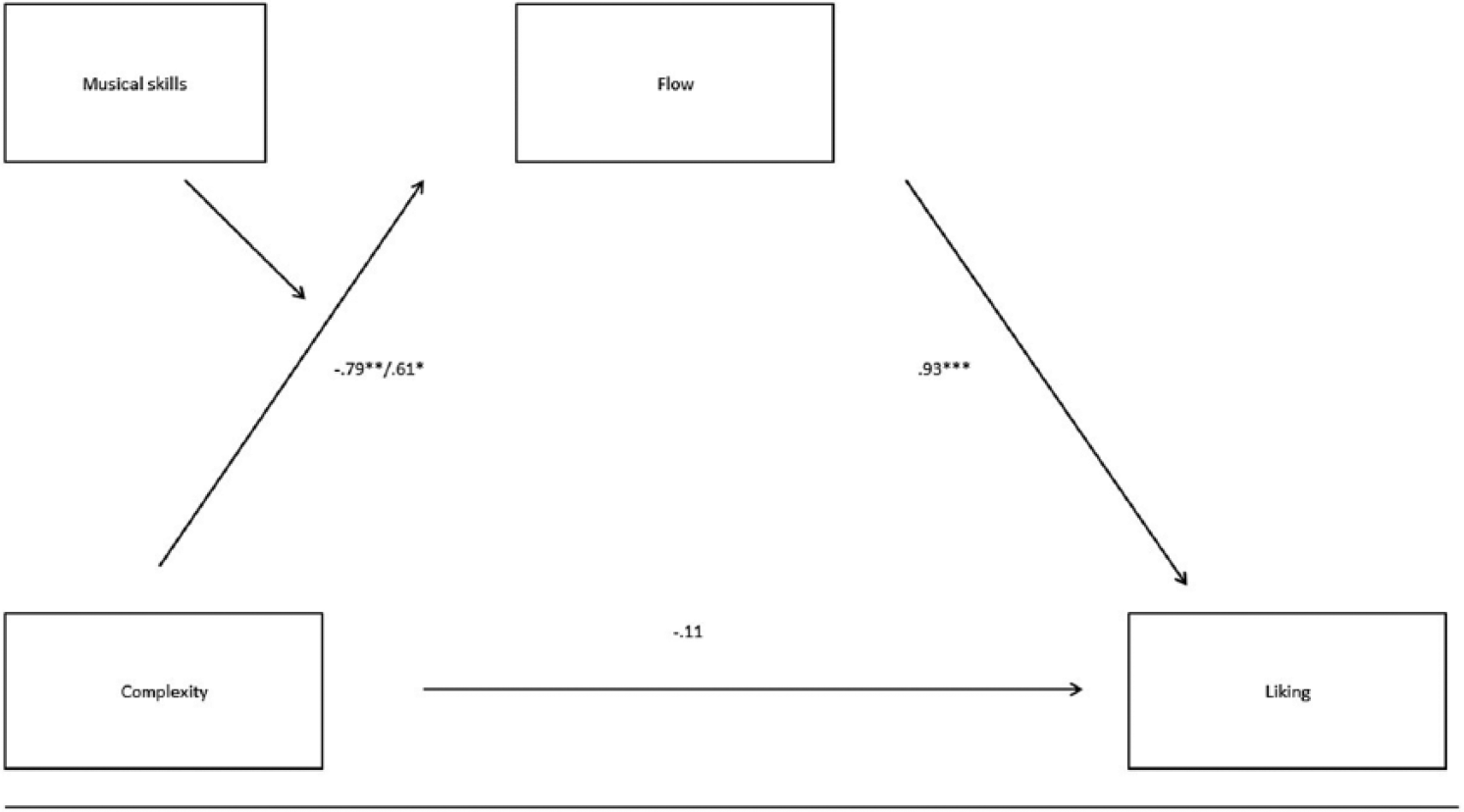
Indirect effect of complexity, moderated by levels of musical skills on liking via flow experience. Path values represent unstandardized regression coefficients. The value before the slash, –.79, is the unstandardized regression coefficient for recipients with low musical skills; the value after the slash, .61, is the unstandardized regression coefficient for recipients with high musical skills.
Results of the indirect effect of complexity, moderated by levels of musical skills on liking via flow experience.
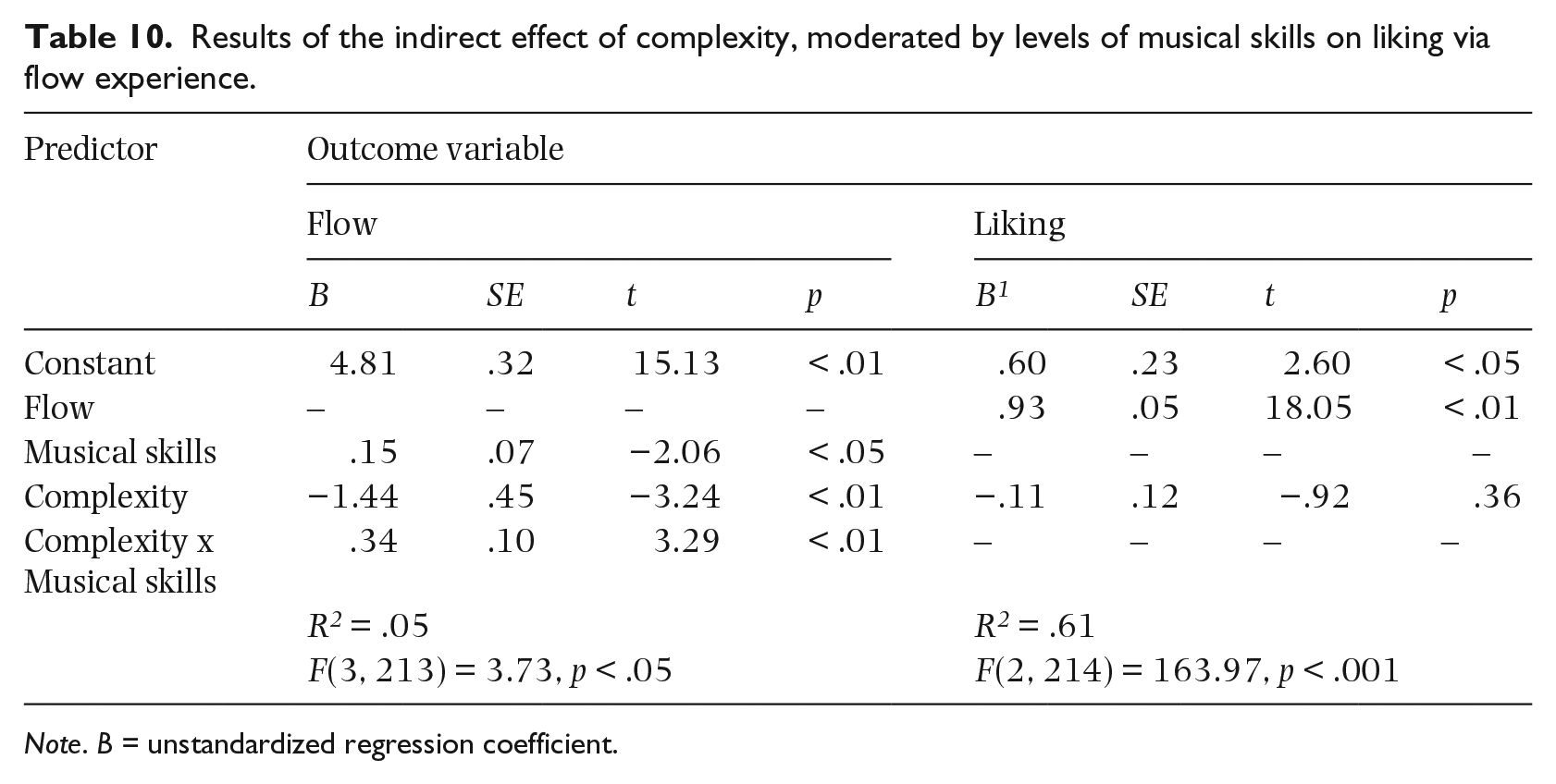
Note. B = unstandardized regression coefficient.
The results reported in Figure 5 and Table 11 partially support Hypothesis 5 which states that a complex music radio program affects the appraisal through flow experience when listeners are more or less analytical listeners, as only participants who had a low analytical listening mode (i.e. those whose analytical listening scores were within the bottom 10%) experienced less flow and showed less liking when listening to a more complex radio program, b = –.46, 95% BCa CI [–.89, –.02].
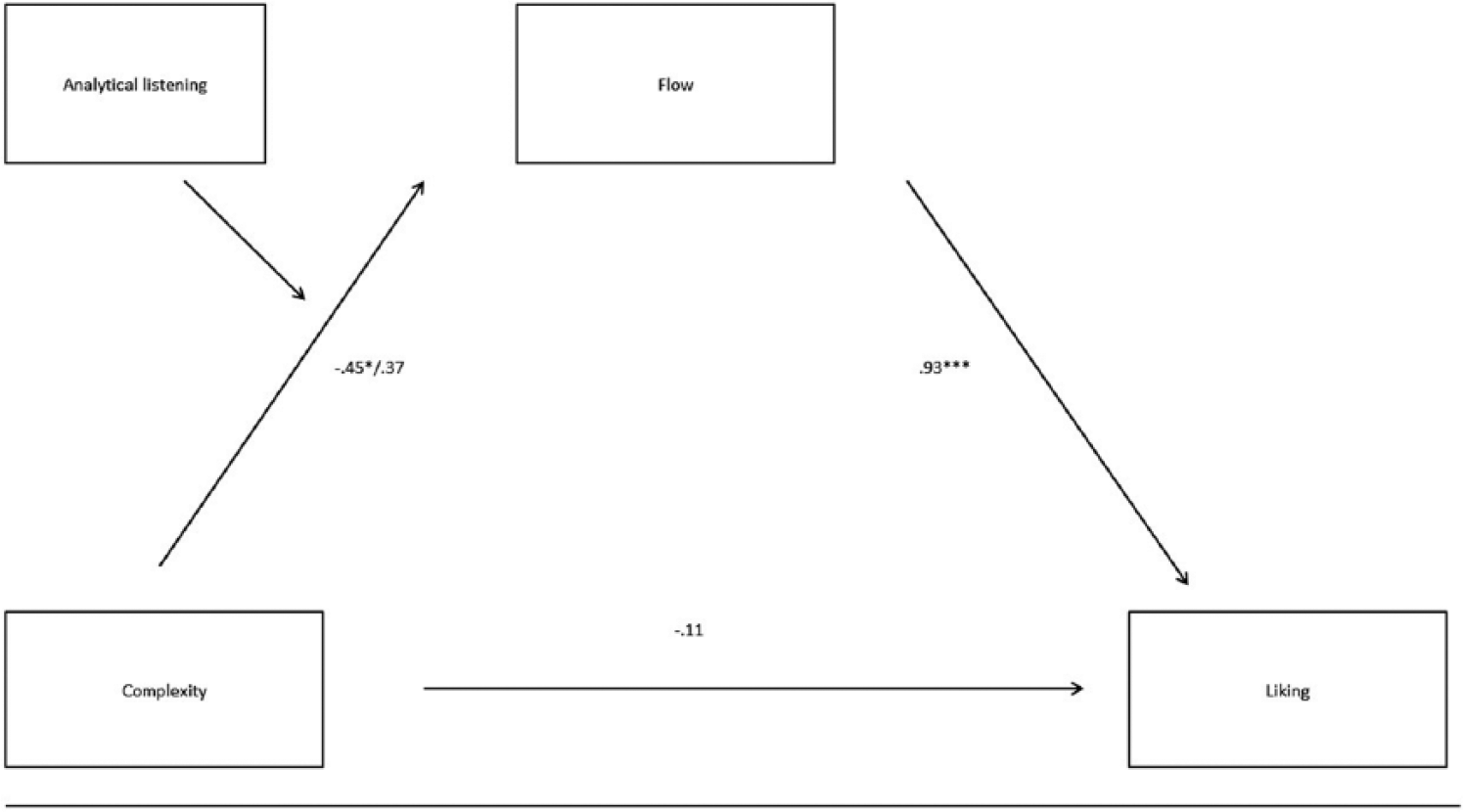
Indirect effect of complexity, moderated by levels of analytical listening on liking via flow experience. Path values represent unstandardized regression coefficients. The value before the slash, –.45, is the unstandardized regression coefficient for recipients with low analytical listening; the value after the slash, .37, is the unstandardized regression coefficient for recipients with high analytical listening.
Results of the indirect effect of complexity, moderated by levels of analytical listening on liking via flow experience.
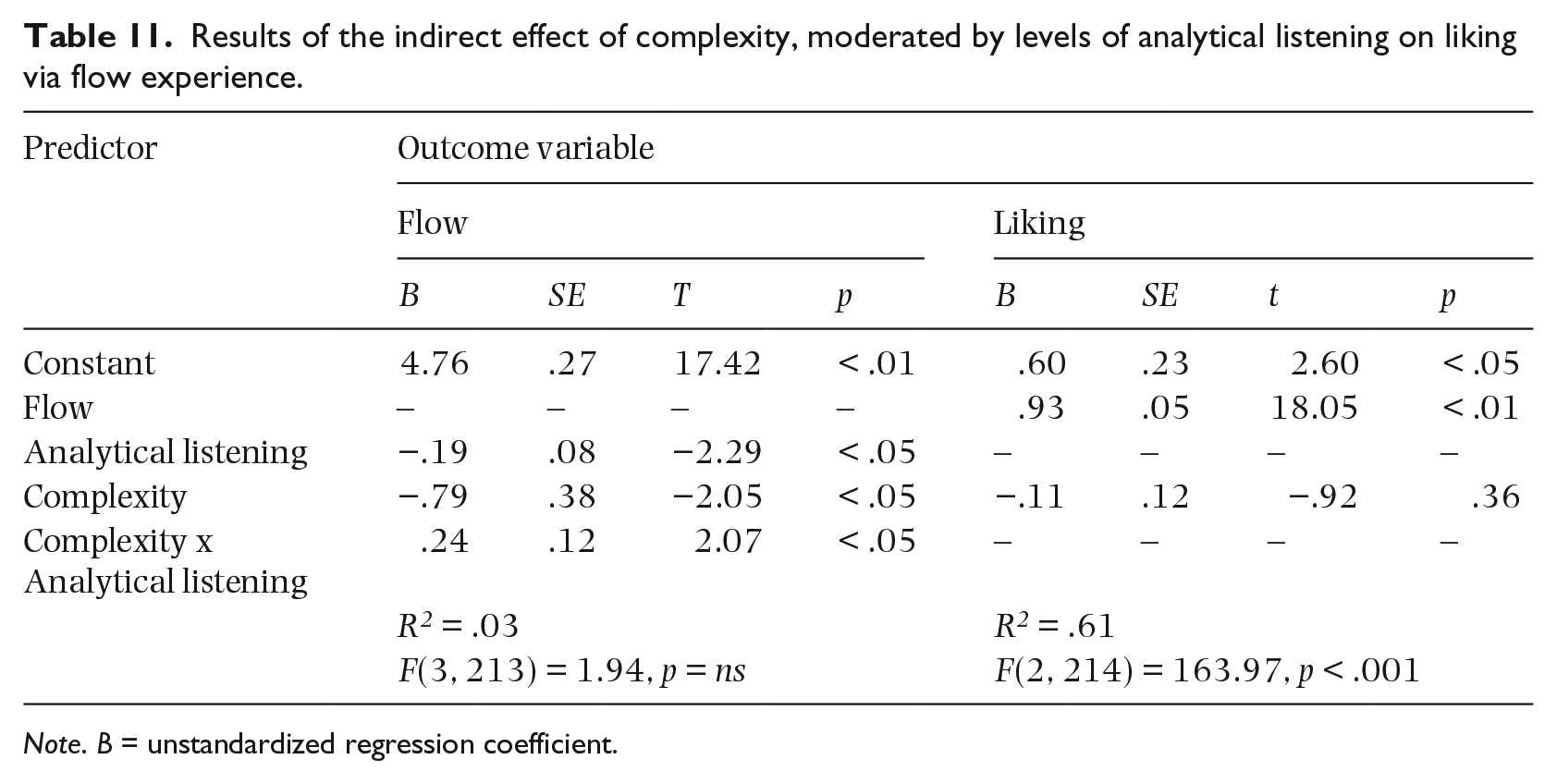
Note. B = unstandardized regression coefficient.
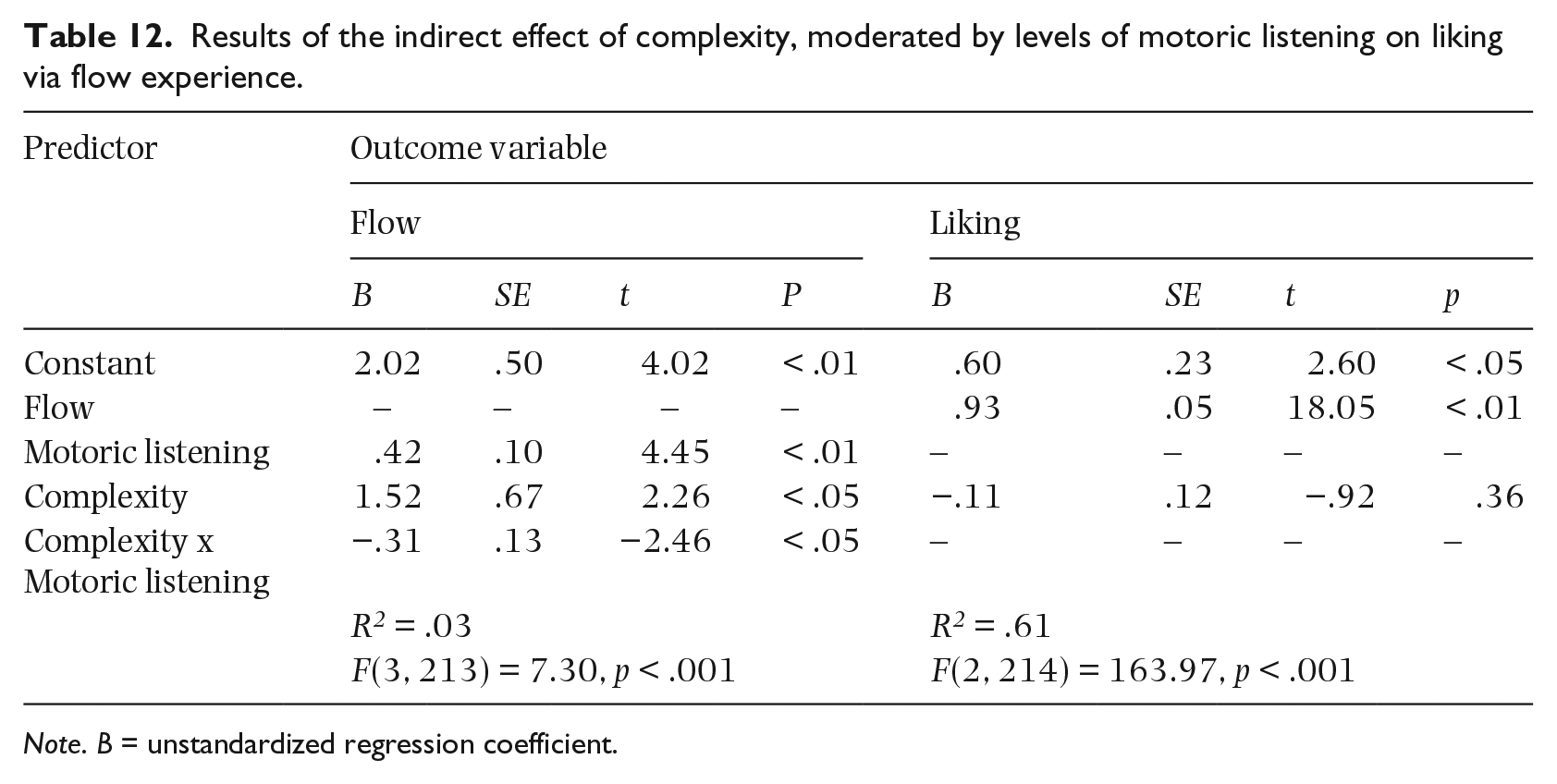
Hypothesis 6, which states that a more complex music radio program reduces positive appraisal through flow experience when listeners are motoric listeners was well supported by the results (see Figure 6 and Table 12). Highly motoric listeners (i.e. those with motoric listening scores within the top 75%) experienced less flow and therefore less liking when listening to a complex radio program, b = –.45, 95% BCa CI [–.83, –.08].
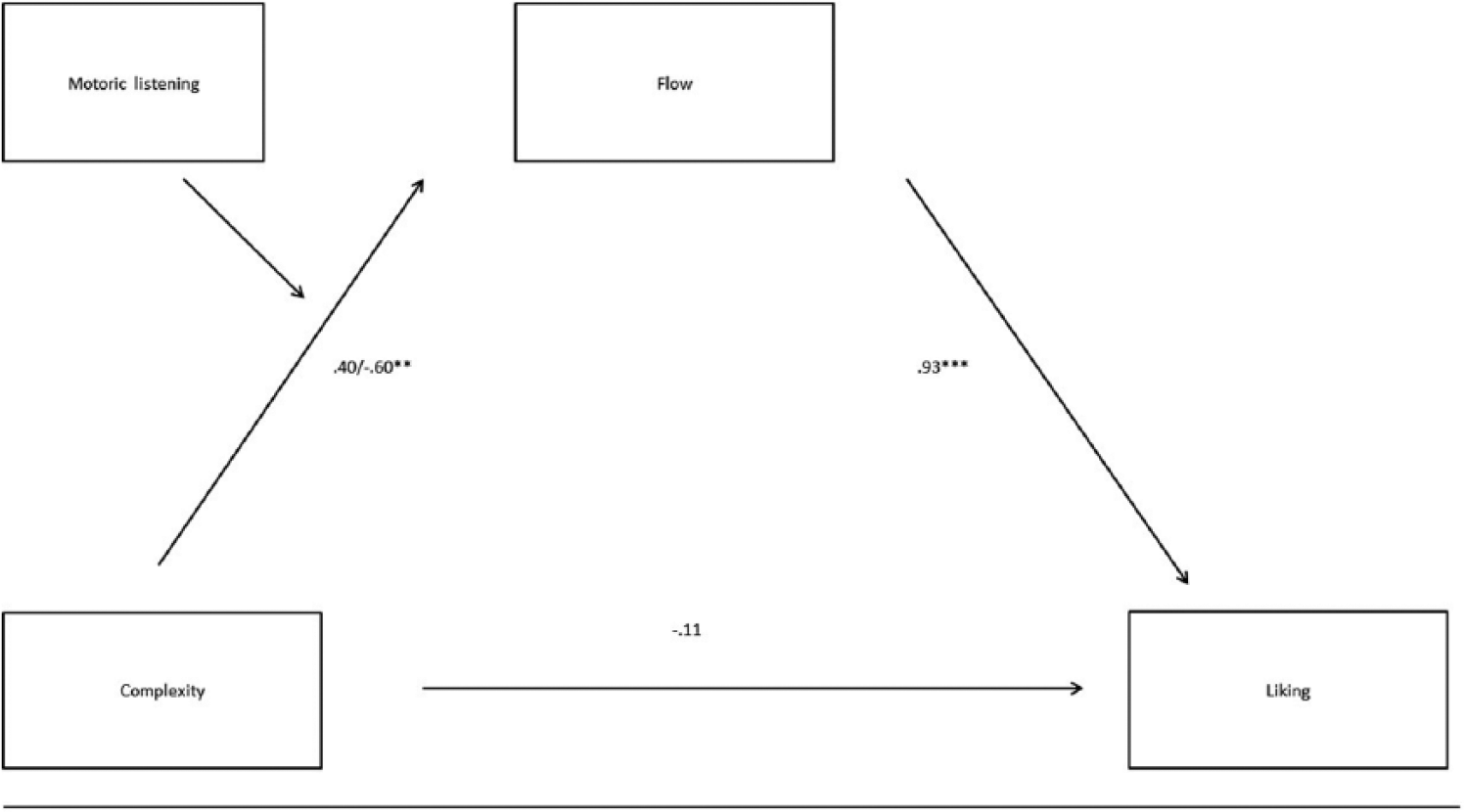
Indirect effect of complexity, moderated by levels of motoric listening on liking via flow experience. Path values represent unstandardized regression coefficients. The value before the slash, .40, is the unstandardized regression coefficient for recipients with low motoric listening; the value after the slash, –.60, is the unstandardized regression for recipients with high motoric listening.
Results of the indirect effect of complexity, moderated by levels of motoric listening on liking via flow experience.
Note. B = unstandardized regression coefficient.
Discussion
In the two presented studies, we tested the influence of the musical complexity and familiarity of the songs comprising a radio program on the flow experience and appraisal of listeners. We also proposed and tested a moderated mediation concept for the influence of complexity moderated by musical skills, analytical listening, or motoric listening on liking via flow experience. The results lead us to the following conclusions:
First, regarding Hypotheses 1 and 2 we found no significant differences between the music programs compiled in both studies, as the manipulation of four out of the 12 songs in a 1-hour music program was not associated with greater liking or a stronger flow experience. Reviewing our descriptive results, the complex and well-known playlist in Study 1 was liked the most, and most enhanced flow experience; in Study 2, the non-complex, well-known playlist was rated best and was associated with the most flow experience. Although the results in Study 2 support our Hypothesis 1 for the CHR station, the differences between the four playlists are not significant. The practical importance of this finding for music radio stations is that programs with complex or less well-known music are predicted to be rated as highly as more standard programs, and to be equally effective in inducing flow.
Second, we found a strong and significant association between flow experience and liking throughout all of our studies and tests as proposed in Hypothesis 3. This confirms the second path of our moderated mediation concept, as well as the findings of other studies on this effect (Baker & MacDonald, 2013; Lamont, 2011). When listeners experience flow during an activity – in this case, listening to a music radio program – it is therefore more likely than not that they like the activity. Sherry (2004, p. 344) proposed: “Flow offers a theoretical explanation for a gratification that has been reported in many studies: enjoyment.” Following Sherry’s remark, liking and enjoyment can be explained by flow experience. The connection between flow and enjoyment seems to be very plausible: when you think about being absorbed in a music program and forget about time and everything around you, you would probably call it a state you enjoyed and liked. These findings highlight the initial idea of the radio programmers who thought that inducing flow is the right way to get the listeners to enjoy the program and therefore to stay with the radio station.
Third, regarding Hypothesis 4, the impact of musical skills was supported, but only by the results of Study 2, which, in the CHR target group, found a positive effect of complexity on liking via flow experience for participants who were highly musically skilled, as well as a negative effect of complexity on liking via flow experience for participants who had low musical skill. These results confirm that when individuals’ skills – in this case, musical skills – match the challenge posed by a more complex radio program, those individuals experience more flow (Nakamura & Csikzentmihalyi, 2002). This is true for the younger listeners who rely on their musical skills when they are confronted with a complex radio program, a program they are not used to listening to. Apparently, older AC listeners do not need their musical skills to process a more complex radio program. A possible explanation could be that older listeners are more experienced in music listening. They do not need their musical skills to handle an even more complex radio program (that might not even feel complex for them at all).
Fourth, examining Hypothesis 5 we found that analytical listening seems to be a moderator that influences the effects of complexity on liking through flow experience, as an effect was observed in both studies: the highly analytical listeners from the AC target group in Study 1 and the low analytical listeners of the younger CHR group in Study 2 both showed a negative effect for complexity on flow experience. The results from Study 2 support our hypothesis that listeners who tend to listen in a non-analytical way experience less flow during the reception of a complex music radio program. This could be explained again by the age of the listeners. Only younger non-analytic recipients who listen to a complex music program experience less flow because they are over-challenged and feel no enjoyment in analysing a musically challenging radio program. In line with Berlyne’s (1970) theory about the interrelations of complexity and novelty, the study by Hargreaves and Castell (1987) showed that the reception of complex music changes when people grow older and become more and more familiar with complex music. In this sense, music that is too complex for children and adolescents can be optimally complex for adults. Given that the prevalence for and the way of analytical listening also changes during our lifetime, our results support this theoretical assumption. Only the results of Study 1 are not in line with our hypothesis. The results show that analytical listeners of a complex radio program experience less flow and therefore less liking. This could be explained by the fact that these analytical listeners recognize that the complex program was intended to be a musically more complex program and therefore they react differently to the program. They might think about the program or the current study and neglect that they experience flow.
Fifth, Study 2 found a negative effect of complexity on liking via flow for highly motoric listeners, confirming our sixth and final hypothesis. We suggest that this may indicate that people who feel like moving and singing along to the music are prevented from doing so by a complex program that does not match their skill, and therefore experience less flow.
Limitations
There are a number of limitations to the present study. First, although we conducted a study with high external validity – utilizing authentic radio programs featuring music compiled by a major radio station – the laboratory is not a typical setting for listening to the radio. Listening to the radio is typically an everyday, incidental activity (Schramm, 2008a) that most people engage in while completing other tasks, like housework or driving; this is not the case in a laboratory setting. However, this setting was chosen because it enabled the best control over possible confounding variables like headphone volume, physical environment, and competing noise. Further, we wanted to try to induce flow, which requires that listeners pay a certain amount of attention to the music (Csikszentmihalyi, 1990). Future studies should examine whether a music program can enhance flow experience of people in a multitasking mode, especially during an everyday task that is associated with radio reception (Jeong & Fishbein, 2007). Certainly, it might be possible that music even distracts people from their work, but this perspective is not within the scope of commercial radio programs.
Second, several scholars have been critical of the validity of the self-assessment of flow (Massimini & Carli, 1991; Rheinberg et al., 2003). We tried to minimize this risk by presenting participants with the flow scales directly after they listened to the program – measurement during music reception would have distracted the participants from a possible flow experience. We used established scales that had been reliable in previous studies to assess motoric listening (Behne, 1986; Schramm, 2005). As these scales had been found to be reliable in previous studies, we retained the motoric listening index in the present two studies, although it did not prove to be as reliable as we had hoped it would be.
Third, the results relying on the experimental manipulation can only be interpreted to a certain extent as the manipulation check showed descriptive differences between the groups but no significant differences between the groups in Study 1. The item we used for the manipulation check (“some songs in the playlist sounded unusual to me”) refers only to a specific single aspect of complexity and possibly does not approve the manipulation for complexity in a broader sense, respectively, in the way we defined it. Therefore, in future studies additional items should be added to the manipulation check to cover the whole range of possible aspects of complexity. By doing so, we would be able to prove the impact of specific music program parameter variations on specific sub-dimensions of complexity.
Nevertheless, our primary goal in these first two studies was not to create perfectly distinct variations of complex and non-complex playlists that would produce highly significant differences in perceived complexity, flow experience, and appraisal without fail (as we would do in a classical pure psychological lab experiment), but to test if playlists of mainstream radio music formats can be varied discreetly and tentatively in terms of complexity with positive effects on the audience. In other words: as this piece of research was commissioned by a commercial radio broadcasting company, all playlists had to be created in a highly realistic way which means that the station’s music editor considered them as completely acceptable and applicable for their formats. Given that our studies had to run under this pragmatic constraint, this piece of applied music research can be regarded as an approach to test perfectly produced external valid stimuli (that do not differ significantly and reduce the internal validity of the cause-and-effect chain) in an internal valid controlled lab surrounding (that does not perfectly match the daily radio reception situation and consequently reduces the external validity of the results). Thus, we combined advantages of the two “worlds” and got some disadvantages of both worlds, too.
However, future studies that can be run without pragmatic constraints in a pure academic way might want to enhance the internal validity of the stimuli and test playlists with more extreme and even pre-tested variations of complexity.
Conclusions
We found the concept of flow to be a very useful one for music radio research. Flow fits the interests of radio broadcasting companies – as was confirmed by our cooperation partner – and helps to evaluate entire programs, as opposed to evaluating individual songs through hook tests. The evaluation of single songs is a very important indicator for liking, but flow is a construct that helps us and the radio editors to understand why recipients feel absorbed in the radio program and therefore stay with a radio station. Manipulating aspects like the genre or language of the vocals, like we did in this study, can decrease or increase the musical complexity of a program, and therefore the challenge of the music listening task; but of course there are other factors that can be imagined that influence the complexity of a program.
Our proposed moderated mediation model helped us to identify an interesting chain of effects that is promising for further research, including research into other related contexts, such as live concerts or music television.
Footnotes
Appendix
Radio program for Study 2 (CHR).
| Program 1 complex/unknown (c/uk) | Program 2 non-complex/ unknown (nc/uk) | Program 3 complex/well known (c/wk) | Program 4 non-complex/well known (nc/wk) |
|---|---|---|---|
| Rihanna – “Diamonds” | Rihanna – “Diamonds” | Rihanna – “Diamonds” | Rihanna – “Diamonds” |
| Green Day – “Boulevard Of Broken Dreams” | Green Day – “Boulevard Of Broken Dreams” | Green Day – “Boulevard Of Broken Dreams” | Green Day – “Boulevard Of Broken Dreams” |
| FUN. – “It Gets Better” | Goo Goo Dolls – “Rebel Beat” | Gotye feat. Kimbra – “Used To Know” | Limp Bizkit – “Behind Blue Eyes” |
| Bruno Mars – “Locked Out Of Heaven” | Bruno Mars – “Locked Out Of Heaven” | Bruno Mars – “Locked Out Of Heaven” | Bruno Mars – “Locked Out Of Heaven” |
| Lana Del Rey – “Summer Time Sadness” | Lana Del Rey – “Summer Time Sadness” | Lana Del Rey – “Summer Time Sadness” | Lana Del Rey – “Summer Time Sadness” |
| Wretch 32 feat Materia – “Traktor” | Flo Rida feat. Jennifer Lopez – “Sweet Spot” | PSY – “Gangnam Style” | Jay-Z feat. Alicia Keys – “Empire State Of Mind” |
| Black Eyed Peas – “I Gotta Feeling” | Black Eyed Peas – “I Gotta Feeling” | Black Eyed Peas – “I Gotta Feeling” | Black Eyed Peas – “I Gotta Feeling” |
| Adele – “Someone Like You” | Adele – “Someone Like You” | Adele – “Someone Like You” | Adele – “Someone Like You” |
| Kimbra – “Settle Down” | Kelly Clarkson – “Catch My Breath” | Icona Pop – “I Don’t Care” | Shakira – “Underneath Your Clothes” |
| Alex Clare – “Too Close” | Alex Clare – “Too Close” | Alex Clare – “Too Close” | Alex Clare – “Too Close” |
| Carly Ray Jepsen – “Call Me Maybe” | Carly Ray Jepsen – “Call Me Maybe” | Carly Ray Jepsen – “Call Me Maybe” | Carly Ray Jepsen – “Call Me Maybe” |
| LMFAO – “One Day” | Eric Prydz – “Every Day” | Tacabro – “Tacatà” | Usher – “DJ Got Us Fallin’ In Love” |
Funding
This research received a grant from a German commercial radio broadcasting company that wishes to remain anonymous. We would like to thank this company very much for their support in both production and funding.