







Abstract
In human memory, the ability to recognize a previously encountered stimulus often undergoes cumulative interference when the number of intervening items between its first and second presentation increases. Although this is a common effect in many domains, melodies composed in tuning systems familiar to participants (e.g., Western tonal music) do not seem to suffer such cumulative decrements in recognition performance. Interestingly, melodies in unfamiliar tuning systems do show cumulative decrements. This finding has been predicted by a novel Regenerative Multiple Representations (RMR) conjecture. The present study further explores this phenomenon and the conjecture by investigating pitch-only (isochronous rhythm) and rhythm-only (monotone pitch) sequences of melodies in an unfamiliar tuning system that previously showed cumulative disruptive effects. Experiment 1 replicated previous studies reporting significant interference effects from the number of intervening items when melodies use uncommon rhythms and are composed in an unfamiliar tuning system. Furthermore, as predicted by the RMR conjecture, when rhythmic information was neutralized (Experiment 2), the cumulative interference related to the number of intervening items was retained. This was also the case when the original pitch information of each melody was neutralized, leaving variation only in the rhythmic information (Experiment 3). Results are discussed in the context of the RMR conjecture: given converse results, the conjecture would have been falsified. However, it currently remains plausible and appears to be a useful tool for precise predictions about the link between prior experience, perception, and formation of new memories.
In a variety of stimulus domains, recognition of a previously encountered stimulus commonly undergoes cumulative disruption as the number of intervening items between its first and second presentation increases (Buchsbaum, Padmanabhan, & Berman, 2011; Bui, Maddox, Zou, & Hale, 2014; Campeanu, Craik, Backer, & Alain, 2014; D. Deutsch, 1970, 1975; Donaldson & Murdock, 1968; Hockley, 1992; Konkle, Brady, Alvarez, & Oliva, 2010; Olson, 1969; Poon & Fozard, 1980; Rakover & Cahlon, 2001; Sadeh, Ozubko, Winocur, & Moscovitch, 2014). In the musical domain, however, melodies composed in culturally familiar tuning systems (e.g., Western tonal music) do not show cumulative decrements in recognition performance as time elapses (Schellenberg & Habashi, 2015), nor systematic and cumulative decrements as the number of intervening items increases (Herff, Olsen, & Dean, submitted; Herff, Olsen, Dean, & Prince, submitted). Interestingly, interference effects that are due to the number of intervening items are observed if melodies are sounded in unfamiliar tuning systems (Herff, Olsen, Dean, & Prince, submitted). A regenerative multiple representations (RMR) conjecture has been developed to explain this disparity (see below for more detail).
In the present study, three experiments were designed to further investigate the predictions of the RMR conjecture in the context of memory for melodies in unfamiliar tuning systems. This was achieved by separating the pitch and rhythmic components of the melodies from Herff, Olsen, Dean, et al. (submitted) and testing for cumulative disruption effects. Here, the components were separated by using a constant pitch in the rhythmic-only sequences (i.e., monotone pitch), and a constant note duration (i.e., isochronous) in the pitch-only sequences. The RMR-conjecture would be fundamentally refuted if pitch-only and rhythm-only sequences did not show cumulative disruptive interference when the combined melodies do. However, in the present investigation, both sequences independently did show cumulative disruptive effects. Before discussing the present experimental manipulations in more detail, an overview of the conjecture and its relevance to memory for melody will first be presented.
Regenerative Multiple Representations conjecture
The RMR conjecture describes a crucial link between prior experience, perception, and subsequent formation of memories. Prior experience provides information about the most useful way of perceiving our environment (similar to D. Deutsch, 1986; see also J. A. Deutsch & Deutsch, 1963). Perception then, in turn, influences the formation of memories. In other words, we first learn the most relevant way of perceiving our environment. We then perceive objects according to this information and form memories according to the perception. Therefore, the conjecture assumes that if useful, information from prior experience can change a single percept into multiple percepts, depending on the stimulus that is being perceived. For example, an empty coffee cup is most usually perceived as a useful device to satisfy the need for a refreshing beverage. However, if for some reason an individual is in need of a projectile, the coffee cup may be perceived as a potential candidate to throw. Affordance theory (Gibson, 1977, 1978) describes the fact that humans not only perceive objects as their underlying components such as object shape, but also perceive possible actions that can be performed with an object. According to the RMR conjecture, however, additional percepts also lead to additional memory representations. In the example above, the coffee cup would be perceived as a useful drinking device as well as a potential projectile, leading to multiple memory representations of the same coffee cup. Interestingly, the two representations would code partially overlapping information, for example the weight of the coffee cup. These memory representations are then subject to decay (time) and interference (e.g., number of intervening items) (Norman, 2013; Oberauer & Lewandowsky, 2011; Oberauer, Lewandowsky, Farrell, Jarrold, & Greaves, 2012). However, in cases where multiple representations code partially overlapping information, the RMR conjecture posits that representations can regenerate each other, thus providing resilience to decay and interference in the context of memory (similar to Paivio’s (1969) Dual-Coding theory).
Regenerative Multiple Representations in the context of music
Music in general and melodies in particular provide a rich context in which to investigate the RMR conjecture. This is because melodies can be perceived as integrated whole melodies, as well as underlying components such as notes, intervals, and short phrases (see D. Deutsch, 1986; Krumhansl, 1991, p. 295; Margulis, 2012; Schneider, 1997, p. 119). In this case, the RMR conjecture predicts formation of multiple representations of a target melody. These multiple representations of a melody share some information. For example, representations of intervals, short phrases, or a rhythm co-relate to a representation of an integrated, coherent melody. Once encoded, the multiple memory representations that co-relate in the form of partially overlapping information provide a melody representation with resilience towards decay and interference. This resilience could be realized in the form of strong melody expectancies that listeners generate when they are familiar with the underlying rules of a music tradition. Melodic or rhythmic expectancies can then be used to interpolate forgotten parts of a melody, similar to how they are used to predict what comes next in a melody (Margulis, 2005; Pearce, 2014; Schellenberg, 1996).
For listeners encultured in Western music, melodies composed in this tradition do not show memory decay effects even after delays of up to a week (Schellenberg & Habashi, 2015). In terms of interference, neither recognition nor perceived familiarity of such melodies show cumulatively disrupted interference effects from intervening items, even with multiple corpora of music and up to nearly 200 intervening melodies (Herff, Olsen, & Dean, submitted). In four experiments, Herff, Olsen, & Dean (submitted) presented novel melodies in a familiar tuning system to participants. After each melody presentation, participants indicated whether or not they had heard the melody in the experiment before. The number of intervening melodies until a target melody reappeared was manipulated between zero and up to nearly 200. Participants consistently performed significantly above chance. Furthermore, the probability of producing a correct recognition judgment was statistically identical between 1 and up to nearly 200 intervening melodies. The only exception was zero intervening melodies (immediate repetition). However, this pattern does not hold for all melodies.
Take the case of novel melodies composed in an unfamiliar tuning system (i.e., incompatible with the Western tonal tradition). As described above, the RMR conjecture assumes that knowledge is acquired from past experience. Without this experience, listeners cannot use such information to integrate notes, rhythm, intervals, and short phrases into coherent musical melodies. As a result, this information cannot influence their perception and subsequent memory representation, and no memory representation of the stimulus as an integrated musical melody will be formed.
In this context, the RMR conjecture predicts that melodies in unfamiliar tuning systems should elicit cumulative disruption of recognition memory from the number of intervening melodies, because they are not integrated into coherent memory representations. Indeed, such a cumulative disruption of recognition has been observed in a recent study as the number of intervening melodies increased up to ~100 intervening melodies (Herff, Olsen, Dean, et al., submitted). Three experiments tested two unfamiliar tuning systems, and similar to Western tonal melodies, recognition performance was ubiquitously above chance. Dissimilar to Western tonal melodies, performance decreased as the number of intervening melodies increased.
This finding provided preliminary evidence for the RMR conjecture and, at the same time, motivated further empirical testing of the conjecture that we report here. Specifically, we examine cumulative disruption effects for separate components of melodies composed in an unfamiliar tuning system. The most obvious components to test are the pitch and rhythmic patterns that comprise a melody, as these are the primary dimensions of melodic sequences. In an unfamiliar tuning system, pitch and rhythmic information should not be integrated into coherent melodies and thus should elicit the cumulative disruptive effects described earlier. The RMR conjecture predicts that this cumulative disruptive effect should also emerge when either pitch or rhythmic information is learned (from pitch-only sequences and rhythm-only sequences, respectively: see Figure 1 for examples of such sequences).
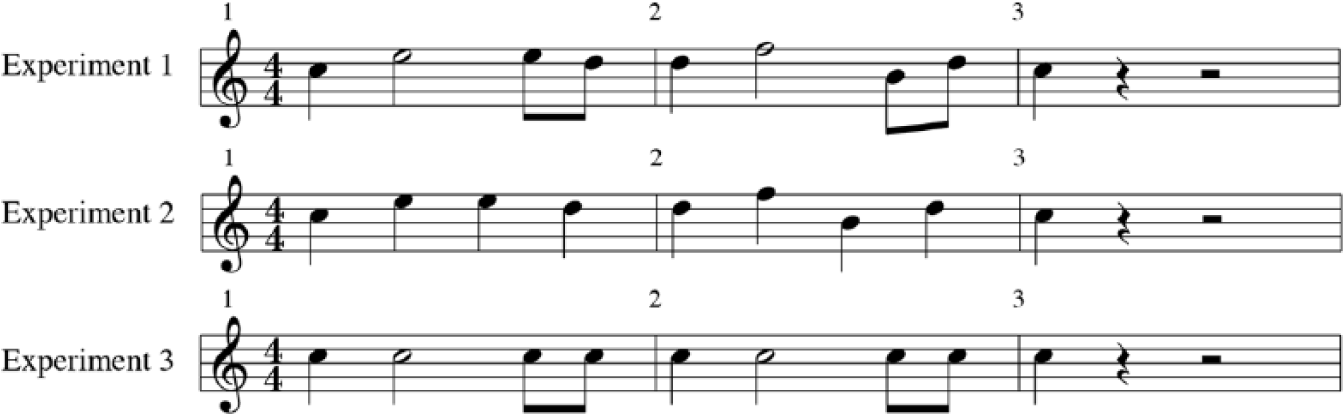
Example of the stimulus manipulations used in the study. Experiment 1 used melodies that consist of a combined melodic and rhythmic sequence. Experiment 2 used the pitch-only sequence of the original stimuli. Experiment 3 used the rhythm-only sequence of the original stimuli. Note that this figure is only an example of how the stimuli were manipulated. The actual stimuli presented in the study were melodies in an unfamiliar tuning system, and with more irregular note inter-onset intervals, as described in the Methods section.
To create pitch-only sequences, we present each note in a set of melodies for the same duration, keeping all inter-note durations identical and effectively neutralizing rhythm information. Note that participants may still perceive rhythm due to perceived segmentation that may be evoked by the pitch-sequences’ melodic contours (Brochard, Abecasis, Potter, Ragot, & Drake, 2003; Deutsch, 1986). Nevertheless, the actual temporal placement of notes in all pitch-only sequences is identical.
To create rhythm-only sequences, we present each note in a set of melodies at the same pitch (frequency) while retaining its original rhythmic structure, thus effectively neutralizing the pitch information. In this context, the pitch- and rhythm-only sequences may show more interference than the original combined versions because there are fewer possible representations for the listeners. However, a lack of cumulative disruption on recognition of pitch- and rhythm-only sequences would provide strong evidence against the RMR conjecture.
Memory for pitch-only sequences
When melodies in a familiar tuning system are separated into their component pitch and rhythm sequences, listeners are better at recognizing when they hear a pitch-only sequence compared to a rhythm-only sequence (Hebert & Peretz, 1997; White, 1960). Dowling, Kwak, and Andrews (1995) conducted a thorough investigation of recognition for pitch-only melodies. They used seven-note isochronic melodies but no cumulative disruptive effect on recognition was observed with up to eight intervening items. However, recent studies have shown that relatively large numbers (~100) of intervening items are required to appropriately assess cumulative disruptive effects on recognition of musical stimuli (Herff, Olsen, & Dean, submitted; Herff, Olsen, Dean, et al., submitted). Here we investigate relatively large numbers of intervening items as well as melodies in an unfamiliar tuning system.
Melodies containing their original pitch and rhythm information, composed in an unfamiliar tuning system, elicit cumulative disruptive effects on recognition (Herff, Olsen, Dean, et al., submitted). The RMR conjecture predicts that removing rhythmic information from these melodies means listeners will perceive fewer underlying components of the melodies upon first presentation, compared to listeners who hear melodies with both pitch and rhythm information. Therefore, listeners that hear the pitch-only version form fewer representations of the melodies. Consequently, the pitch-only sequences should elicit cumulative disruptive effects on recognition from intervening melodies. It is this prediction that is tested here in Experiment 2.
Memory for rhythm-only sequences
As mentioned above, pitch information in a melody tends to be a better cue for melody recognition than rhythmic information (Dowling et al., 1995; Hebert & Peretz, 1997; White, 1960). Nevertheless, rhythms do significantly contribute to recognition of melodies. This is demonstrated in higher recognition performance when rhythm and melody are combined, compared to conditions where only one varies (Hebert & Peretz, 1997). In terms of memory decay, recognition performance in response to rhythms decreases in a ‘same-different’ task as the time interval between first and second presentation of rhythms increases from 1,000 to 7,250 ms (Collier & Logan, 2000). However, literature is sparse in terms of systematic investigations of the effect of the number of intervening rhythms on memory for rhythms.
In Experiment 3, we investigate memory for rhythm-only sequences. In the context of the RMR conjecture, we test whether there are cumulative disruptive effects of the number of intervening rhythms on memory for rhythm-only sequences. The RMR conjecture predicts such disruptive effects by considering that similar to pitch-only sequences, rhythm-only sequences should lead to fewer memory representations upon first encounter compared to the original melodies.
Before investigating the influence of pitch (Experiment 2) and rhythm (Experiment 3) on cumulative disruptive effects in memory for melody, we first conducted an experiment to establish baseline interference effects for the present set of melodies composed in an unfamiliar tuning system when the melodies include all of their original pitch and rhythm information.
Experiment 1 – Recognition of melodies in an unfamiliar tuning system
Method
Participants
Thirty-seven students were recruited from Murdoch University (Mage = 25.3 years, SDage = 8.4, male) and received course credit for their participation. The mean years of musical training was 1.9 (SD = 3.7). 1
Stimuli
In total, thirty-seven melodies were composed in an unfamiliar tuning system, consisting of variations of the following pitches: 480, 520, 560, 605, and 665 Hz (pure tones with 10ms linear on/off ramps). Each melody had five or six notes with variations of note durations of 60, 100, 550, and 920 ms, and constant inter-note silent intervals of 100 ms. Neither rhythm nor melodic sequence of each melody conformed to the Western tonal tradition. The pitch and duration discrimination of adjacent values of the pitch and duration was piloted (N = 9) and discrimination performance was above 90% for both. The stimuli of all three experiments can be found in the Supplemental Material Online section (file Appendix S1 – Stimuli.zip).
Procedure
Participants provided informed consent and were instructed that they would hear different melodies one after another. Melodies were presented in a continuous recognition paradigm in random order (Shepard & Teghtsoonian, 1961). Participants were required to indicate which of the melodies have been sounded before in the experiment using two keys on a computer keyboard. The keys were counterbalanced between participants. One key was always associated with ‘Old’ and one with ‘New’. A response of ‘New’ indicated that a melody was heard for the first time, and a response of ‘Old’ indicated that the participant believed they had previously heard the melody in the experiment. In total, thirty-seven different melodies were presented three times each. The number of intervening melodies varied between one and 100.
Statistical approach
We used generalized linear mixed effects models to investigate the effect of the number of intervening melodies on binary recognition data (Baayen, 2008; Baayen, Davidson, & Bates, 2008; Judd, Westfall, & Kenny, 2012; Kass & Raftery, 1995; Kruschke, 2010, 2013; Nathoo & Masson, 2016). The models were implemented in the R software platform (R-Core-Team, 2013) using the lme4 package (Bates, Maechler, Bolker, & Walker, 2013) and consisted of the experimental fixed factor Number of Intervening Melodies. Random Participant and Melody variation was taken into account in the form of random intercepts. Coefficient and p-values for Number of Intervening Melodies are reported for each experiment. Models that show statistically significant effects from the Number of Intervening Melodies are further assessed with a model comparison approach. We use log-likelihood tests to compare models with the experimental factor Number of Intervening Melodies against similar models without the experimental factor of Number of Intervening Melodies (Wilks, 1938).
In each experiment, mixed effects models assess overall performance by comparing recognition in response to the first presentation of each melody with recognition in response to their second presentation (Melody Presentation), while controlling for random effects of Melody and Participant. Z-score and coefficient p-values for Melody Presentation are reported at the beginning of each results section to report whether performance in each experiment was above chance.
Similar to previous research, response tendency shifts were taken into account in the form of conservative Dynamic Response Tendency models (Herff, Olsen, & Dean, submitted; Herff, Olsen, Dean, et al., submitted). These models account for any shift in participant response tendencies as the recognition experiment progresses (e.g., Berch, 1976; Donaldson & Murdock, 1968; Snodgrass & Corwin, 1988). For example, some participants may always respond ‘old’ when in doubt in the beginning of the experiment, however, over the course of the experiment their response tendency may change to always respond ‘new’ when in doubt.
To take this into account, we use generalized mixed effects models that were trained on ‘old’ responses to first melody presentations (False Alarms) as a function of trial number. The fitted models were then used to predict the probability of pressing ‘old’ on the second presentation of each melody (Hits) as a function of trial number. These predictions were then implemented as a fixed factor in the statistical assessment of the data.
Results
Figure 2 shows melody- and participant-wise performance. Overall, participants performed significantly above chance (Z = 13.85, p < .001).
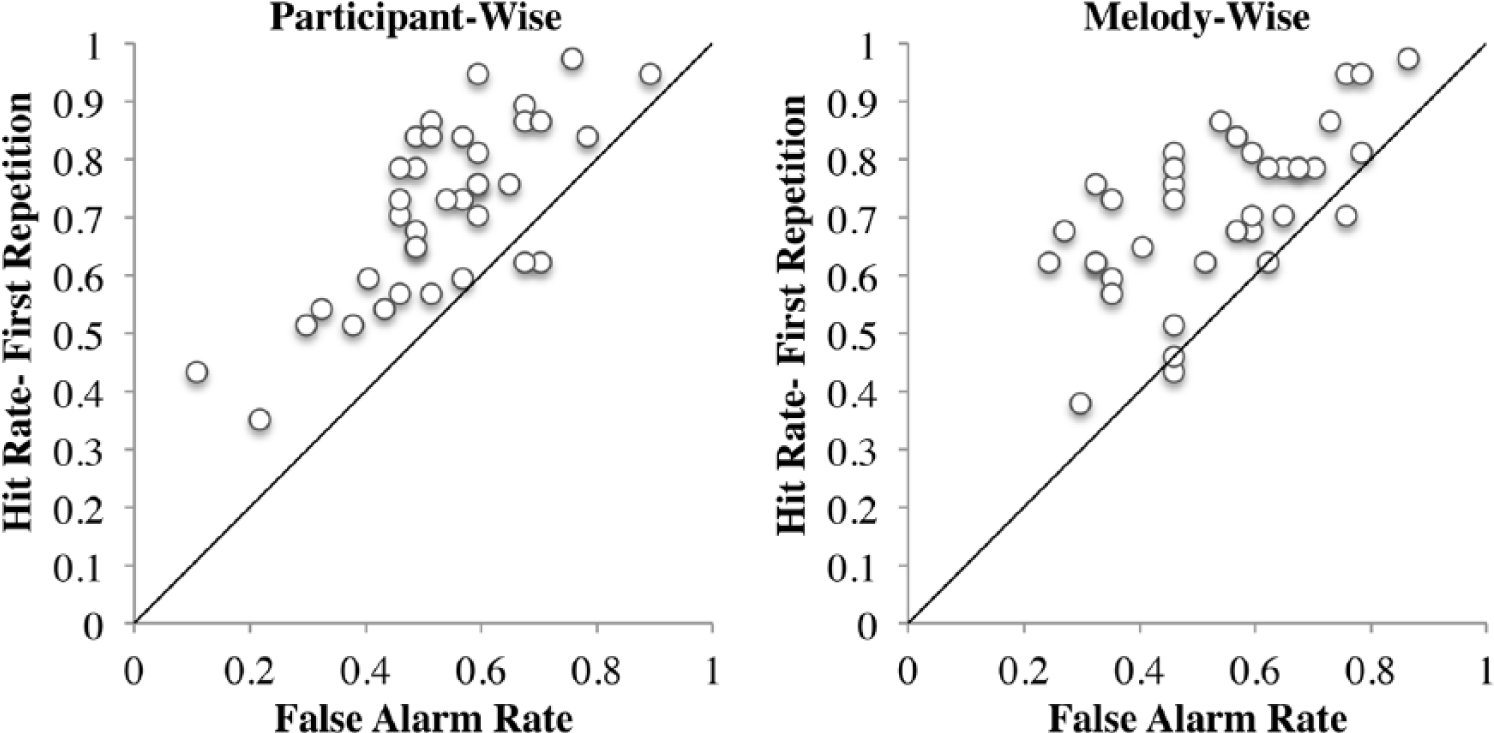
Hit rates and false alarm rates in response to melodies in an unfamiliar tuning system used in Experiment 1. The left panel shows the data participant-wise, and the right panel melody-wise. The reference line represents chance level. Overall, participants performed significantly above chance (see text for more detail).
As expected, the number of intervening items between the first and second presentation of each melody had a cumulative disruptive effect on melody recognition when melodies were sounded in an unfamiliar tuning system. A model predicting ‘old’ responses on melody repetitions using a random intercept for Participant, Melody, and a systematic factor for Dynamic Response Tendency (LogLik = -759.03) improved significantly when provided with the Number of Intervening Items (LogLik = -757.00, p = .041). In other words, intervening items showed significant cumulative disruption on participants’ melody recognition performance (coef = -.008, p = .044). Figure 3a shows the modeled probability of producing bias-corrected recognition as the number of intervening melodies increases between first and second presentation of a melody.
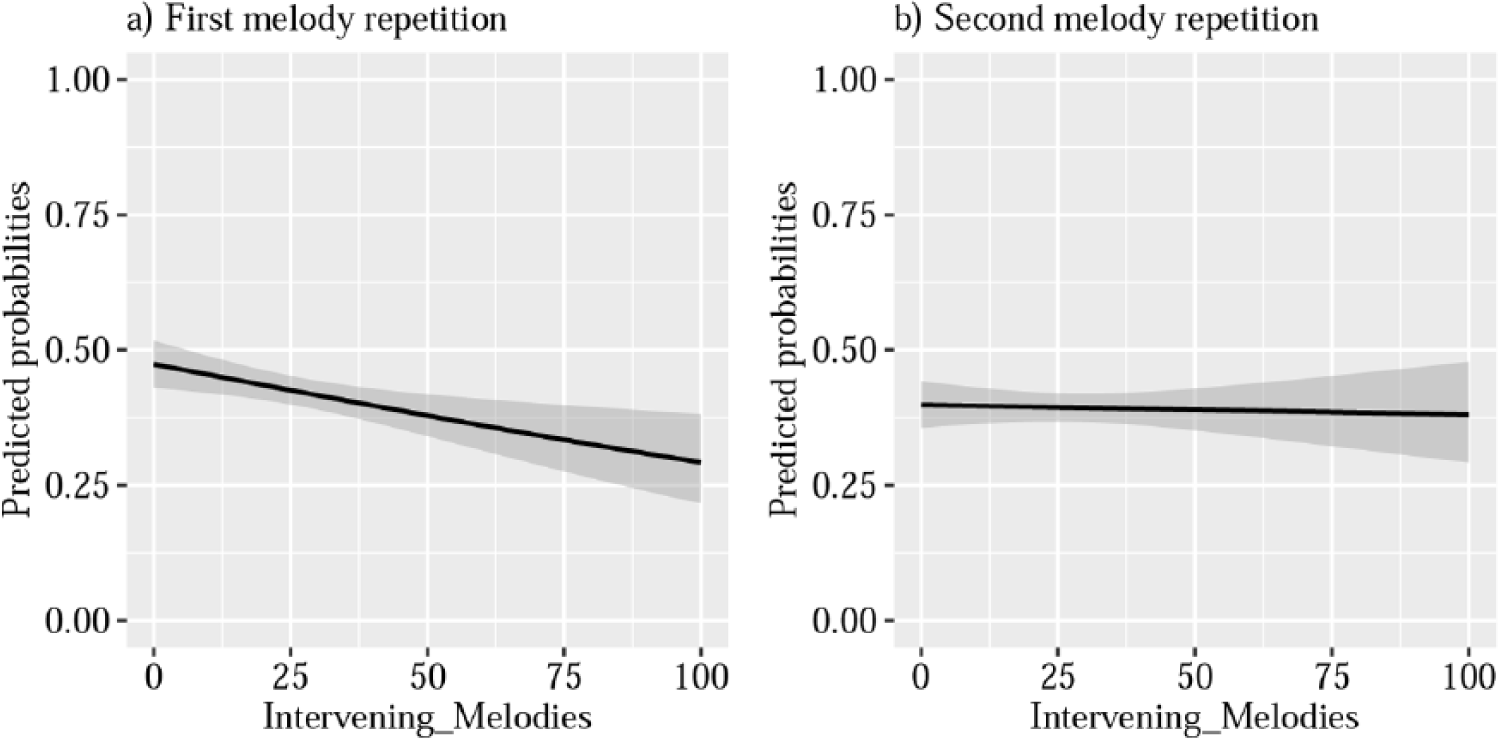
Prediction lines of generalized mixed effects models that model the probability of bias corrected recognition (y-axis) of melodies in an unfamiliar tuning system in Experiment 1. The left panel shows the effect of the number of intervening melodies between the first and second presentations of the melodies. The right panel shows the effect between the second and third presentations. A downward slope indicates cumulative disruptive effects. A statistically significant disruptive effect of the number of intervening items on bias corrected recognition performance was only observed between the first and second presentation of the melodies. The grey area around the prediction line represents a 95% confidence interval.
Interestingly, a disruptive effect of the number of intervening melodies did not reach significance between the second and third presentation of the melodies (coef = -.0008, p > .05). Figure 3b shows the modeled probability of producing bias correct recognition as the number of intervening melodies increases between second and third presentation of the melodies.
Discussion
The goal of Experiment 1 was to establish baseline interference effects when melodies composed in an unfamiliar tuning system include all of their original pitch and rhythm information. This design also enabled a replication of findings observed in Herff, Olsen, Dean, et al. (submitted), where cumulative disruption of memory for melodies in an unfamiliar tuning system was observed by varying the number of intervening melodies. Interestingly, only a partial replication was achieved in the present study. Specifically, the predicted disruptive effect on recognition from intervening melodies emerged only between the first and second presentation of the melodies, but not between the second and third presentation.
A possible explanation is that the previous studies investigating cumulative effects of the number of intervening items incorporated a greater number of participants (105 compared to 37, Herff, Olsen, Dean, et al., submitted) or a greater number of melodies (110 compared to 37, Herff, Olsen, & Dean, submitted). Thus it could be that the present experiment did not provide enough statistical power to replicate both effects. It is also worth noting that the Dynamic Response Tendencies models that corrected for shifts in response tendencies over the course of the experiment resulted in a conservative approach that will have decreased the probability of finding significant effects. Nevertheless, Experiment 1 was successful in its design to provide a baseline to further test melody recognition and the RMR conjecture by using a similar number of participants, melodies, and statistical analysis, but with pitch-only sequences (Experiment 2) and rhythm-only sequences (Experiment 3). The RMR conjecture predicts that cumulative disruptive effects on recognition from the number of intervening melodies is likely to be stronger (or at least equivalent) in sequences where only rhythm or pitch information is available, relative to sequences that retain both rhythm and pitch information together. It is this prediction that is tested in the following experiments.
Experiment 2 – Recognition of pitch-only melodies in an unfamiliar tuning system
Experiment 2 investigated disruptive effects from the number of intervening melodies on pitch-only versions of the melodies used in Experiment 1. A disruptive effect from the number of intervening melodies was hypothesized between the first and second presentation of the melodies. If this hypothesis is supported, then the findings will provide support for the predictions afforded by the RMR conjecture. The absence of a disruptive effect would serve as evidence against the RMR conjecture. No clear predictions can be made for disruptive effects of the number of intervening items between the second and third presentations. This is because no such effect was observed in Experiment 1. Only a condition that showed cumulative disruption effects on recognition in Experiment 1 can be used in Experiment 2 and 3 to test the RMR conjecture.
Method
Participants
Thirty-four undergraduate students were recruited from Murdoch University (Mage = 23.3 years, SDage = 6.2). The mean years of musical training was 2.6 (SD = 3.0). Participants were not involved in Experiment 1.
Stimuli
The melodies of Experiment 1 were used, however, the original rhythms were removed. All notes in each melody lasted 400 ms with inter-note intervals of 100 ms of silence.
Procedure
The procedure was identical to Experiment 1.
Results
Figure 4 shows melody and participant wise performance. Overall, participants performed significantly above chance (Z = 11.66, p < .001).
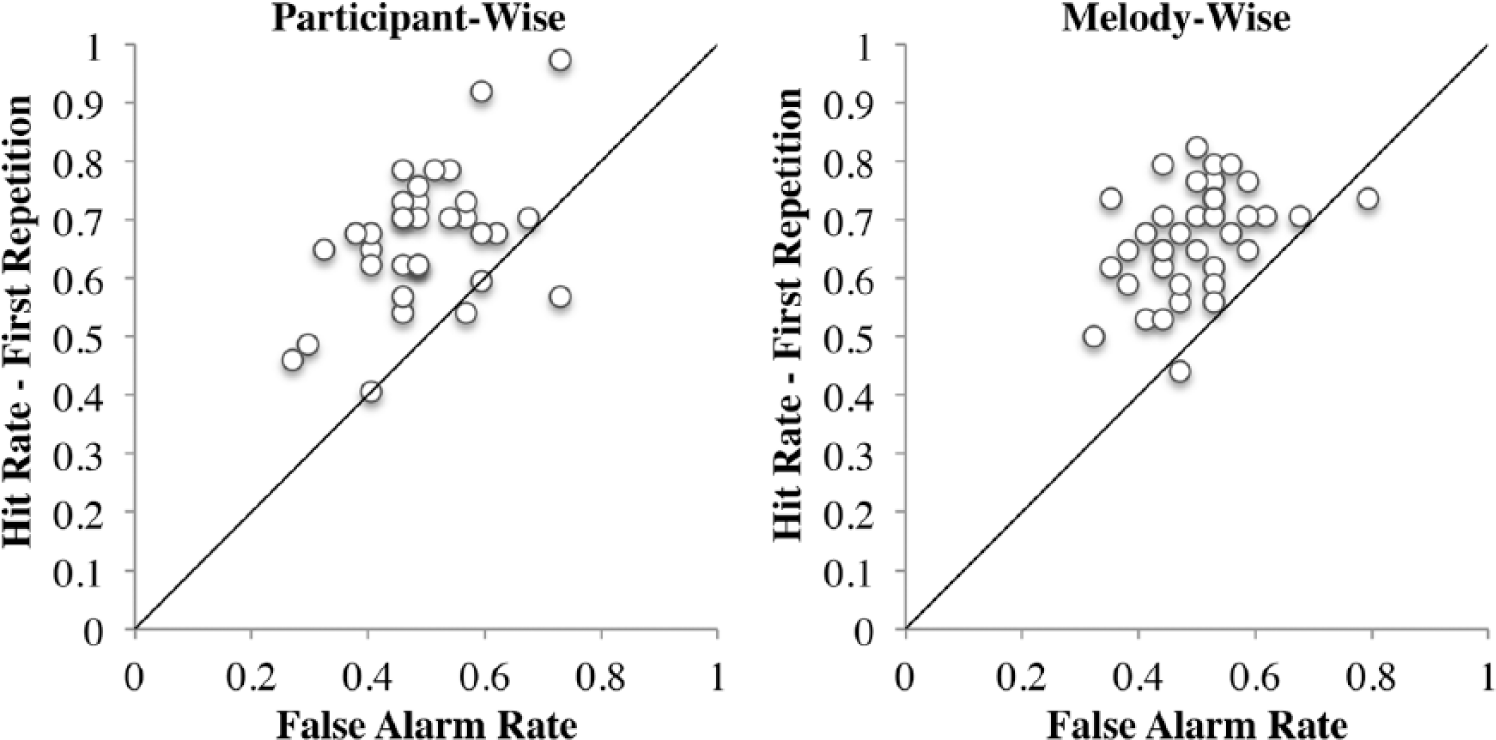
Hit rates and false alarm rates in response to pitch-only sequences used in Experiment 2. The left panel shows the data participant-wise, and the right panel melody-wise. The reference line represents chance level. Overall, participants performed significantly above chance (see text for more detail).
As anticipated, the number of intervening items between the first and second presentation of the pitch-only sequences had a cumulative disruptive effect on recognition performance. A model predicting ‘old’ responses on melody repetitions using a random intercept for Participant, Melody, and a systematic factor for Dynamic Response Tendency (LogLik = -792.37) improved significantly when provided with the Number of Intervening Items (LogLik = -789.22, p = .012). In other words, the Number of Intervening Melodies showed significant cumulative disruption (coef = -.009, p = .012) of participants’ melody recognition. Figure 5a shows the modeled probability of producing bias-corrected recognition as the number of intervening melodies increases between first and second presentation of a melody.
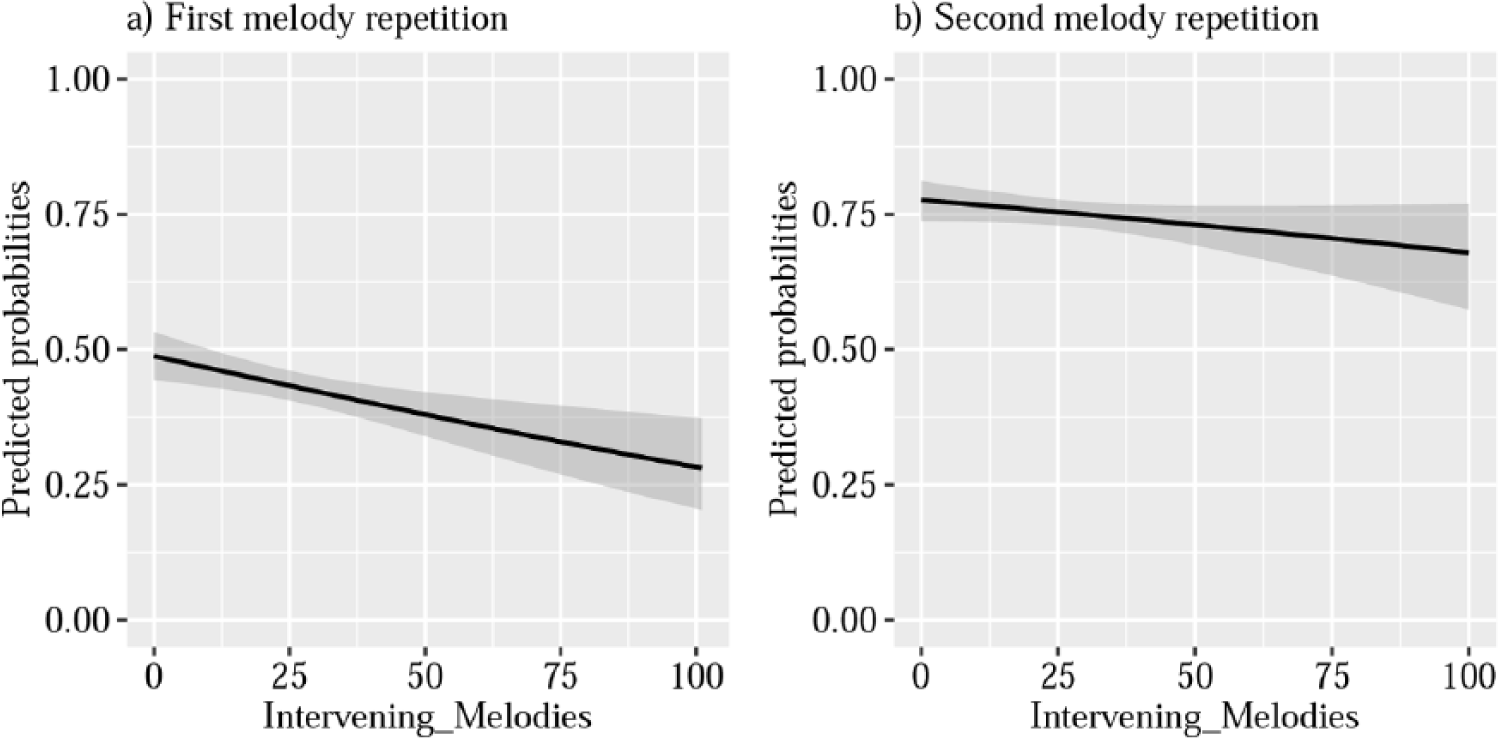
Prediction lines of generalized mixed effects models that model the bias corrected probability of recognition (y-axis) of pitch-only sequences. The left panel shows the effect of the number of intervening melodies between the first and second presentations of the melodies. The right panel shows the effect between the second and third presentations. A statistically significant disruptive effect of the number of intervening items on bias corrected recognition performance was only observed between the first and second presentation of the melodies. The grey area around the prediction line represents a 95% confidence interval.
Similar to Experiment 1, no significant disruptive effect on recognition performance with increasing Number of Intervening Melodies was observed between the second and third presentations of the melodies (coef = -.005, p > .05), as depicted in Figure 5b.
Discussion
Experiment 2 aimed to further test the RMR conjecture by specifically investigating possible cumulative disruptive effects from intervening items on recognition of pitch-only sequences in an unfamiliar tuning system. In Experiment 1, a disruptive effect from the number of intervening items between the first and second presentation of the melodies was found when both the original melodic and rhythmic information was retained in each melody. A similar result was observed in Experiment 2, where the same melodies were used as in Experiment 1, but in pitch-only versions. This result shows that a disruptive effect on memory for melodies composed in an unfamiliar tuning system is still evident when rhythmic information is removed (which means less opportunity for multiple representations). This result was predicted by the RMR-conjecture and shows that reducing the number of perceptual experiences does not reduce cumulative disruptive effects. Or put differently, less perceptible information of a stimulus (pitch and rhythm combined vs. pitch-only) does not reduce cumulative interference from intervening items.
Similar to Experiment 1, no disruptive effect from the number of intervening items was found between the second and third presentation of the melodies. Having established the effect of intervening items when melodies in an unfamiliar tuning system are presented without their original rhythmic information, we now turn to melodies presented without their original pitch information.
Experiment 3 – Recognition of rhythm-only sequences
Experiment 3 investigates cumulative disruptive effects from the number of intervening items in rhythm-only sequences. A cumulative disruptive effect from the number of intervening rhythms on rhythm recognition is hypothesized between the first and second presentation.
Method
Participants
Thirty-six undergraduate students were recruited from the Murdoch University (Mage = 24.8 years, SDage = 7.7). Average years of musical training was 1.2 (SD = 2.8). Participants did not previously participate in Experiment 1 or 2.
Stimuli
The same stimuli from Experiment 1 were used. However, the melodies were transformed into rhythm-only sequences by sounding all notes at 566 Hz (the average pitch of the entire set of melodies).
Procedure
The procedure was identical to Experiments 1 and 2.
Results
Figure 6 shows melody- and participant-wise performance. Overall, participants performed significantly above chance (Z = 12.12, p < .001) in recognizing rhythm-only sequences.
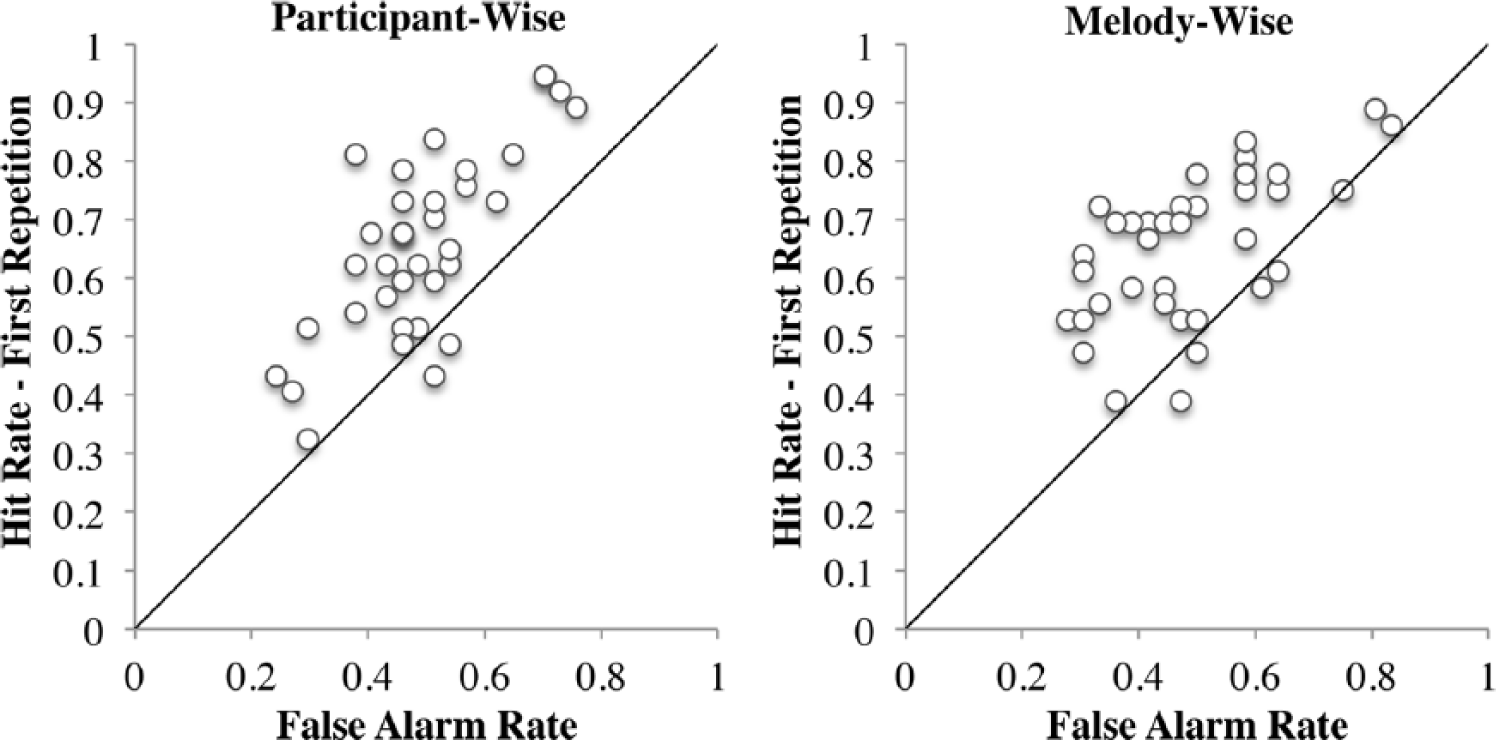
Hit rates and false alarm rates in response to rhythm-only sequences used in Experiment 3. The left panel shows the data participant-wise, and the right panel melody-wise. The reference line represents chance level. Overall, performance was significantly above chance (see text for more detail).
Consistent with Experiments 1 and 2, the number of intervening items between the first and second presentation of the rhythms had a disruptive effect on recognition performance. A model predicting ‘old’ responses on rhythm repetitions using a random intercept for Participant, Melody, and a systematic factor for Dynamic Response Tendency (LogLik = -811.02) improved significantly when provided with the Number of Intervening Items (LogLik = -807.98, p = .013). As with the previous two experiments, this result shows that intervening items cumulatively disrupt participants’ rhythm recognition performance (coef = -.009, p = .013). Figure 7a shows the bias-corrected modeled probability of recognition as the number of intervening items increases between first and second presentation of a rhythm.
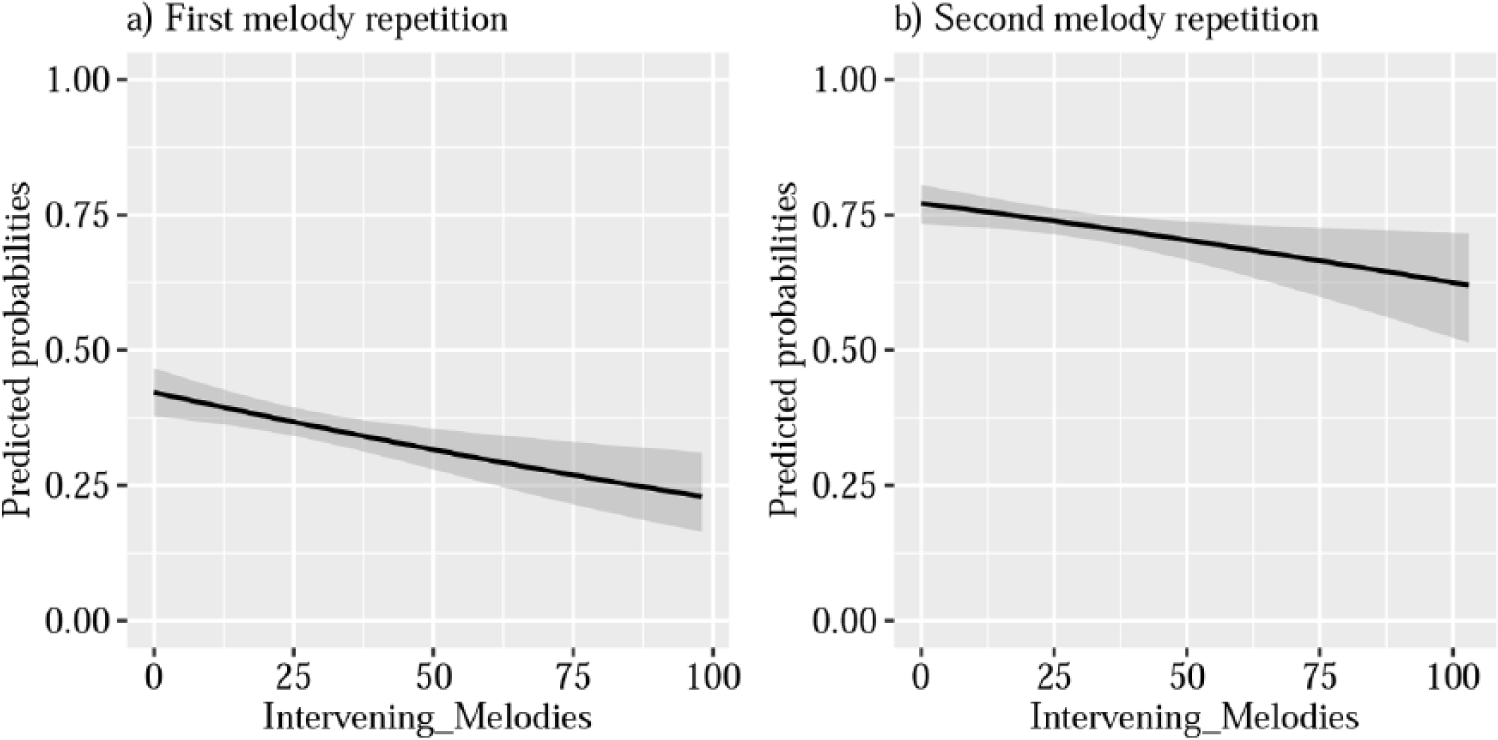
Prediction lines of generalized mixed effects models that model the bias corrected probability of recognition (y-axis) of rhythms. The left panel shows the effect of the number of intervening melodies between the first and second presentations of the melodies. The right panel shows the effect between the second and third presentations. Significant disruptive effects of the number of intervening items on bias corrected recognition performance were observed in both of these comparisons. The grey area around the prediction line represents a 95% confidence interval.
In contrast to Experiments 1 and 2, a disruptive effect on recognition performance with increasing number of intervening items was observed between the second and third presentations of the rhythms in Experiment 3 (coef = -.007, p = .037). A model predicting ‘old’ responses on third presentations of the rhythms (LogLik = -726.79) improved significantly when provided with the Number of Intervening Items between the second and third presentation (LogLik = -724.67, p = .040). Figure 7b shows the modeled probability of producing bias corrected recognition as the number of intervening items increases between second and third presentations of a rhythm.
Discussion
Experiment 3 aimed to provide a further test of the RMR conjecture by specifically looking at possible cumulative disruptive effects from intervening items on recognition of rhythm-only sequences. As hypothesized, a cumulative disruptive effect from the number of intervening rhythms on recognition was observed between the first and second presentation of the rhythms. Unlike Experiments 1 and 2, this effect was also observed between the second and third presentation of the rhythms. Observing such an effect between the second and third presentation using rhythm-only sequences suggests that memory representations of rhythms alone may be less resilient to interference from the number of intervening items than the combined rhythmic and melodic sequence.
General discussion
Cumulative disruptive effects from the number of intervening items have been observed using a variety of stimuli (Bui et al., 2014; Donaldson & Murdock, 1968; Hockley, 1992; Konkle et al., 2010; Olson, 1969; Poon & Fozard, 1980; Rakover & Cahlon, 2001; Sadeh et al., 2014). Memory for melodies is also affected by these disruptive effects. However, this seems to be the case only when melodies are sounded in an unfamiliar tuning system (Herff, Olsen, & Dean, submitted; Herff, Olsen, Dean, et al., submitted). This finding has been previously predicted by a regenerative multiple representations (RMR) conjecture (Herff, Olsen, & Dean, submitted). The RMR conjecture describes an important link between prior knowledge, perception, and subsequent formation of memories. The present study aimed to elucidate further the influence of prior knowledge and perception on recognition in the context of the RMR conjecture. This was achieved by first establishing baseline interference effects when melodies composed in an unfamiliar tuning system included all original pitch and rhythm information. We then took these stimuli and separated the original musical content into pitch-only sequences and rhythm-only sequences. The RMR conjecture predicts cumulative disruptive effects from the number of intervening items for melodies in an unfamiliar tuning system (Experiment 1), for their pitch-only sequences (Experiment 2), and for their rhythm-only sequences (Experiment 3).
The main prediction of the conjecture was supported by showing disruptive effects from the number of intervening items between the first and second presentation of stimuli presented in Experiment 1, 2, and 3. These results will be discussed and interpreted in the light of the RMR conjecture. Experiments 2 and 3 had the potential to falsify the RMR-conjecture if no cumulative disruptive effects were observed. However, those experiments did show cumulative disruptive effects, thus providing preliminary support for the RMR-conjecture.
Recognition of melodies in unfamiliar tuning systems
Experiment 1 partially replicated the results of the study in Herff, Olsen, Dean, et al. (submitted). In that study, a robust and strong disruptive effect from the number of intervening melodies was found between the first and second, as well as second and third presentation of melodies in an unfamiliar tuning system. In Experiment 1, we observed the same patterns of results, however only the number of intervening melodies between the first and second presentation of the melodies had a statistically significant effect on melody recognition. In the original work, the disruptive effect was weaker between the second and third presentations compared to the first and second; however, it was still significant. A likely explanation for this quantitative discrepancy is that the original study used nearly three times as many participants (N = 105) than Experiment 1 here (N = 37). This suggests the importance of large sample sizes in studies that aim to investigate cognitive processes measured over relatively large numbers of continuous conditions, such as the number of intervening items presented here. Nevertheless, the partial replication of the original study, namely the significant disruptive effect of the number of intervening melodies between the first and second presentation, served its original purpose here of providing a baseline to further test melody recognition and the RMR conjecture with pitch-only sequences (Experiment 2) and rhythm-only sequences (Experiment 3).
Memory for pitch-only melodies in an unfamiliar tuning system
Experiment 2 used pitch-only versions of the melodies presented in Experiment 1. The stimuli were taken from the melodies of Experiment 1 but modified to comprise note durations and inter-note onsets that were identical between each note. The RMR conjecture predicts cumulative disruptive effects from the number intervening melodies for pitch-only sequences in instances where they were observed using the original rhythmical melodies. This is because the RMR conjecture first assumes that prior knowledge informs perception and perception influences formation of memory representations. If prior knowledge informs multiple ways of perceiving the same stimulus, then the conjecture suggests that the formation of multiple representations can support or regenerate each other if they code at least partially overlapping information. In the context of music, this means that prior experience informs perceptual relevance of notes, intervals, short musical phrases, as well as an integrated melody as a whole.
Our results support the RMR conjecture: melodies in an unfamiliar tuning system and with uniform rhythmic structure are not integrated as a whole, at least not to the extent that is required to recover from disruptive effects from intervening melodies. Specifically, the results in Experiment 1 showed a significant decrease in recognition performance with increasing number of intervening melodies between the first and second presentation of the melodies. Secondly, a cumulative disruption between the first and second melody presentations was observed in Experiment 2.
Therefore, we now have evidence together with that reported in Herff, Olsen, Dean, et al. (submitted) that the use of melodies in an unfamiliar tuning system disrupts formation of a coherent representation of an integrated, musical melody. This might be because information on how to integrate notes, intervals, and short phrases into coherent melodies has not been acquired because of a lack of exposure to the unfamiliar tuning system. This finding suggests interesting follow up experiments. For example, future research could investigate cumulative disruptive effects in atonal melodies. These are melodies that use a familiar pitch set but unfamiliar arrangements of these pitches. Due to the unfamiliarity with the tonal-grammar, the RMR conjecture also predicts cumulative disruptive effects for atonal melodies, even if they incorporate a familiar pitch set.
Memory for rhythm-only sequences
Experiment 3 used rhythm-only versions of the stimuli presented in Experiment 1. This means that the stimuli in Experiment 3 were identical to Experiment 1, but with the original pitch information removed. Similar to Experiment 2, results from Experiment 3 provide support for the RMR conjecture. As with the pitch-only sequences used in Experiment 2, the conjecture also predicts cumulative disruptive effects on recognition from the number of intervening items in instances where they were observed using the original melodies. This prediction was supported.
However, in contrast to Experiments 1 and 2, Experiment 3 also found a significant disruptive effect from the number of intervening items between the second and third presentation of the rhythms, and not just between their first and second presentation. The rhythm-only sequences in Experiment 3 provide less perceptible information than the original melodies with both rhythmic and melodic information in Experiment 1. This is also the case for the pitch-only sequences in Experiment 2. The statistically significant disruptive effect on recognition of rhythm-only but not pitch-only sequences between the second and third presentation of the melodies can be explained by general performance differences between memory for rhythms and memory for melodic sequences. That is, memory for rhythms in general tends to be worse than memory for pitches (Hebert & Peretz, 1997; White, 1960). Nevertheless, the findings of Experiment 3 again provide further preliminary support for the RMR conjecture.
Memory for rhythm-only sequences has been thoroughly investigated using relatively short intervals of time (~ 10 sec) (Collier & Logan, 2000; Schaal, Banissy, & Lange, 2015). The present study is the first empirical work investigating the effects from the number of intervening rhythms on recognition performance for rhythm-only sequences over relatively large numbers of intervening rhythms (up to 100). It is clear from the present study that memory for rhythm-only sequences is similar to other stimulus domains that do elicit cumulative disruptive effects from intervening items (Bui et al., 2014; Donaldson & Murdock, 1968; Hockley, 1992; Konkle et al., 2010; Olson, 1969; Poon & Fozard, 1980; Rakover & Cahlon, 2001; Sadeh et al., 2014), at least when the rhythmic structure is relatively unfamiliar to the listener.
Conclusion
Previous research has shown that melodies in a familiar tuning system show no systematic cumulative disruptive effects from the number of intervening items. However, melodies in an unfamiliar tuning system do show systematic disruptive effects, similar to those observed using many other non-musical stimuli. Here, we replicated the previous finding that melody recognition in an unfamiliar tuning system is possible with up to 100 intervening melodies, but is still susceptible to cumulative disruptive effects as the number of intervening items increases. We further extended this finding to rhythm-only sequences and pitch-only sequences in an unfamiliar tuning system. The overall pattern of results observed here support the predictions of a new and novel RMR conjecture (Herff, Olsen, & Dean, submitted).
An important next step for the development of the RMR conjecture into a complete theory is to test its applicability with stimuli outside of the musical domain. The original rationale of the conjecture was motivated by findings in the domain of music, language, and vision (Herff, Olsen, & Dean, submitted). So far, only music has been investigated from the perspective of the RMR conjecture. Nevertheless, the conjecture appears to be a useful tool in which to make precise predictions about the link between prior experience, perception, and formation of new memories.
Footnotes
Acknowledgements
We thank Andrew Milne and the MARCS Institute Music Cognition and Action group for valuable comments on a previous version. We thank Barbara Tillmann, Mari Jones, and Kate Stevens for their involvement in the artificial grammar study that, as a side product, produced the data analyzed here, as well as their willingness to share data. We thank Donna Caporn, Rebekah Hunt, Christopher Innes, Farah Jaffar, Harry Malcom, Prachi Singh, Sarah Tan-Nygard who assisted in data collection.
Funding
This research received no specific grant from any funding agency in the public, commercial, or not-for-profit sectors.
Supplementary material

Notes
References
Supplementary Material
Please find the following supplemental material available below.
For Open Access articles published under a Creative Commons License, all supplemental material carries the same license as the article it is associated with.
For non-Open Access articles published, all supplemental material carries a non-exclusive license, and permission requests for re-use of supplemental material or any part of supplemental material shall be sent directly to the copyright owner as specified in the copyright notice associated with the article.
