







Abstract
Mental practice refers to the use of imagery as opposed to the physical or motor skills used in physical practice. It is a strategy frequently discussed with regard to the acquisition of skills required for music performance, and recent scientific literature confirms the benefits of mental practice. However, a review of that literature reveals inconsistencies and a lack of clarity in the use of terminology. To better understand this problem of terminology, 33 current studies on mental practice in music performance were assembled and examined for both the quantity and quality of term usage. Terms were identified and recorded using terminology and classification methods from Cabré (1999), and The Pavel, Terminology Tutorial. Terminological records were created for each term appearing more than once in the literature for a total of 83 records. Issues related to frequency of use (repetition), use of multiple terms (synonymy), lack of term definitions, and the need for clarity in term usage (semantic vagueness and ambiguity) were then analyzed using these records. This terminology process resulted in the creation of a glossary of 21 terms and a corresponding hierarchical taxonomy (tree diagram). These tools were developed to clarify the terminology of mental practice in music performance in order to provide a foundation for a more systematic use of the terminology in future research, as well as to assist with comprehension of the existing literature.
Music performance requires an extended period of technical and artistic skill development and practice is important in the acquisition of these skills. Practice involves both physical (practice with an instrument) and mental aspects (practice away from an instrument). Although its use in music performance involves several aspects of imagery, especially auditory, mental practice is traditionally defined mainly in terms of visual imagery. The Oxford Dictionary of Sport Science & Medicine defines mental practice as a form of practice in which subjects produce a vivid mental image of actually performing a technique; that is, they do not imagine that they are watching themselves perform, but they actually carry out the activity in their imagination without overt physical movement. (Kent, 2007, p. 430)
In the APA Dictionary of Psychology, mental practice is defined as “the use of [imagery] to practice a specific skill whereby the performance of a task … is visualized but not carried out” (“Mental practice”, 2007, p. 569).
Mental practice in music performance originated with musicians: violinist Fritz Kreisler and pianists Vladimir Horowitz and Walter Gieseking were known to have used mental practice in their study. The scientific study of mental practice in North America began in the field of psychology with the development of a motor theory of consciousness by Washburn (1916), and the study of mental practice related to music performance followed with Rubin-Rabson (1941). For the remainder of the 20th century, studies on mental practice demonstrated positive effects in the development of motor skills in general (L. V. Clark, 1960; Driskell, Copper, & Moran, 1994; Shepard, 1978), and music performance in particular (Ross, 1985; Rosenthal, Wilson, Evans, & Greenwalt, 1988; Theiler & Lippman, 1995). More recent studies continue to demonstrate evidence of benefits (Bernardi, De Buglio, Trimarchi, Chielli, & Bricolo, 2013; Brown & Palmer, 2013; Cahn, 2008; Fine & Bravo, 2011; Frewen, 2010; Haddon, 2007; Henley, 2001; Highben & Palmer, 2004). Specifically, performance improvements have been found in movement velocity, timing, and coordination (Bernardi, De Buglio, et al., 2013); learning and recall of melodies, pitch accuracy, and vulnerability to interference (Brown & Palmer, 2013); learning and performance from memory (Haddon, 2007; Highben & Palmer, 2004); and rhythm and tempo mastery (Henley, 2001).
While the benefits of mental practice in music performance have been established, an initial review of the scientific literature revealed issues with consistency and clarity in the use of terminology. Overall, very few terms were provided with definitions (10.8%); and in the case of two articles, there were no term definitions (Henley, 2001; Morrison, Montemayor, & Wiltshire, 2004). Even in cases where term definitions were included, some were vague (Frewen, 2010; Highben & Palmer, 2004; Morrison et al., 2004). Another issue involved the use of synonyms (multiple terms), which were used interchangeably in all studies. Synonymy creates a lack of consistency in the terminology making comprehension more difficult (Oversteegen & Wijk, 2003). Because vocabulary is the most important factor affecting comprehension (Bailin & Grafstein, 2016), the lack of definitions and use of synonyms in the literature were problematic. Given the established benefits of mental practice for musicians at any level of proficiency, even young students and beginning musicians (Freymuth, 1993), it is likely that mental practice will continue to occupy a growing space in the research in this field. For this reason, it is important to know how mental practice can be understood and defined in the empirical research literature. Clearly defined terms consistently applied are critical for study design, theory development, and the presentation and advancement of knowledge in the field. The current lack of clarity and consistency in the terminology of mental practice in music performance creates a disruption in this research development.
The purpose of this study was to analyze the terminology in the empirical research literature with the goal of producing a glossary and taxonomy to assist in the advancement of research in this field by clarifying the terminology. Two groups of users were identified for this terminology work. The first group consists of subject field specialists in the area of mental practice in music performance; the producers of the empirical research literature. For this group, terminology is the “formal reflection of the conceptual organization of a special subject and a necessary medium of expression and professional communication” (Cabré, 1999, p. 11). The second group are end users, such as music educators and students, for whom terminology is a “set of useful, practical communication units which are assessed according to criteria of economy, precision, and suitability” (Cabré, 1999, p. 11). The products of this terminology work, a glossary and taxonomy, were developed with a prescriptive purpose in the hope that they will serve as useful resources for these users.
Method
To develop a clear and concise glossary and taxonomy based on the terminology used in the literature on mental practice in music performance, a content analysis was undertaken, and terms were identified and recorded using terminology and classification methods from Cabré (1999) and The Pavel, Terminology Tutorial. 1 For the purpose of this work, terminology is defined as “the set of special words belonging to a science, an art, an author, or a social entity” (Pavel & Nolet, 2001, p. 119); a glossary is defined as “a monolingual list of difficult or specialized terms with their definitions” (Pavel & Nolet, 2001, p. 109); and a taxonomy as “a hierarchical classification or categorization system” (Hedden, 2010, p. 1).
Procedure
The preparation of a glossary and taxonomy began with the examination of mental practice terminology in the empirical research literature on music performance. This process involved assembling a corpus, identifying and recording terms, and analyzing, defining, and presenting the terminology according to methods used in terminology work. The first step was to find and collect a corpus of relevant literature.
Assembling a corpus
The corpus was based on empirical English language literature on mental practice in music performance, and is defined here as a collection of selected texts assembled for the purpose of performing terminological analysis. Empirical research, and not pedagogical, literature was chosen for the corpus to increase the possibility of adoption by subject field specialists and educators. Although mental practice originated with musicians and pedagogues, the use of language in pedagogical material is much more diverse and includes analogies and imagery that are effective in the pedagogical context but less so in scientific literature. Corpus material was located using search engines at the researchers’ university library and both Google and Google Scholar search. The following keywords were used: “covert rehearsal”, “mental practice”, “mental imagery”, “motor imagery”, “music performance”, “silent rehearsal”, “auditory modeling”, “aural modeling”, “auditory imagery”, and “aural imagery”. Google alerts were also created as an additional search aid. Thirty-three items were identified and selected for the corpus. The items are listed alphabetically by author, and include the article title, year, and name of publication (Table 1).
Corpus for terminology of mental practice in music performance.
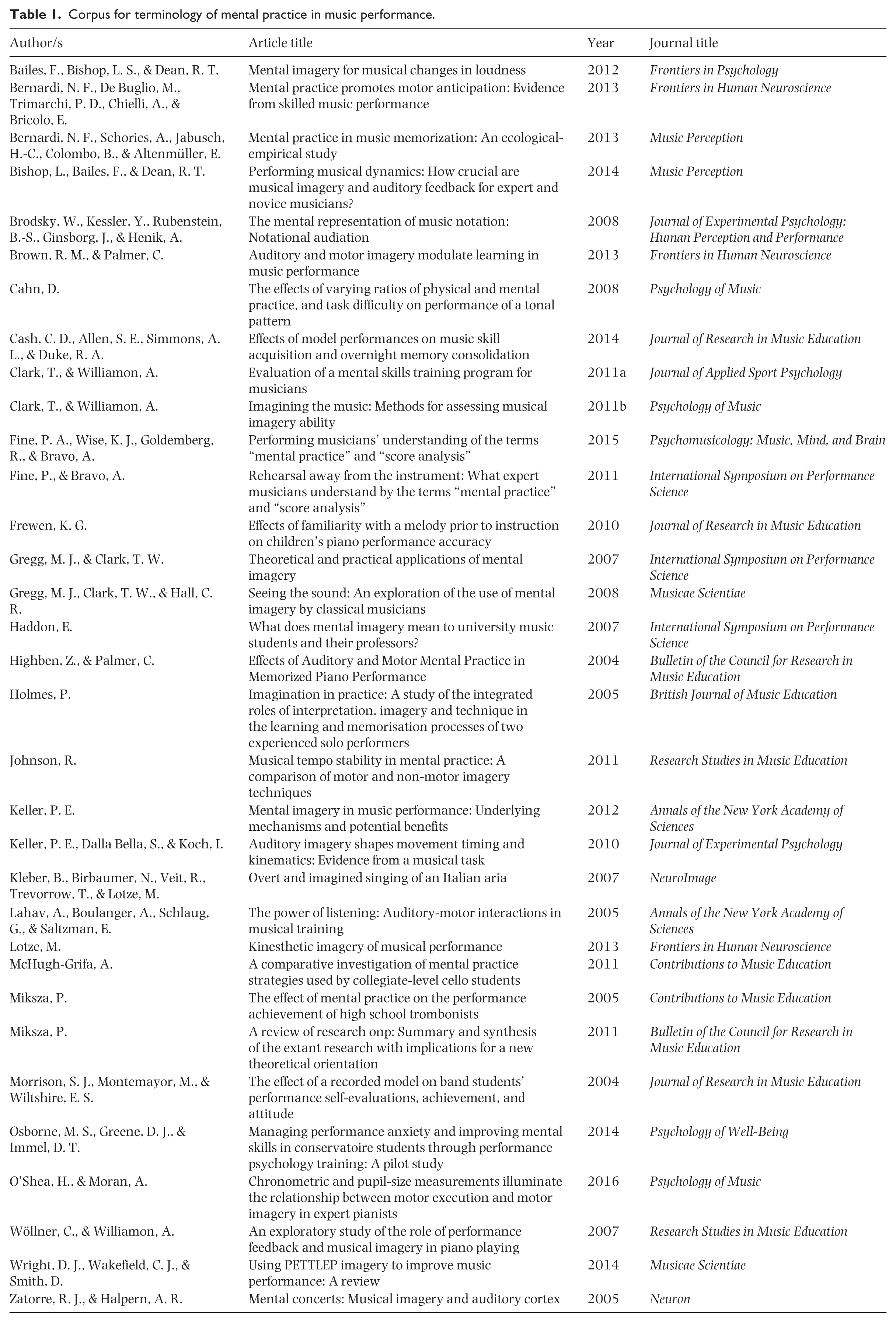
Source material selected for a corpus was assessed using the following criteria. The material must be 1) up to date and 2) representative of the subject matter, in accordance with the research question or objectives (Cabré, 1999). The corpus must be up to date both regarding the terms used by the researchers (experts) and regarding the topic (mental practice) (Cabré, 1999). For this reason, only material from the past several years (2004–2015) was used for the corpus. Older research literature on mental practice in music performance was also identified and reviewed, but revealed no new data (see Table S1 in the Supplemental Material Online section). This review of older literature was conducted to improve validity and to further demonstrate that an acceptable level of data saturation was achieved within the existing corpus. Representativeness in this context, was measured by the degree of saturation (McEnery, Xiao, & Tono, 2006), and “the extent to which a sample includes the full range of variability in a population” (Biber, 1993, p. 243). In addition, to be representative, the corpus should be composed of enough source material to allow for a “sufficiently large initial list of units” to be identified (Cabré, 1999, p. 121). Accordingly, the corpus used for this study allowed for the identification of a large number of term units (132). The corpus is a sample of the empirical literature that has been assembled and analyzed with the goal of clarifying and presenting the mental practice terminology as a contribution to the extant and future scientific knowledge in this field. In order to consider which terms were best suited for inclusion in the glossary and taxonomy, a multi-step process of terminology work was followed including identifying, recording, analyzing and defining the terms.
Identifying terms
In terminology work, terms are considered to be different from general language because they refer to a concept in a specific subject field (Cabré, 1999); mental practice in music performance in this case. Hard copies of the 33 items of the corpus were examined manually, in their entirety, and the key simple and complex terms were identified using a highlighter pen. Terms such as musician, auditory cortex, and modeling condition which are related to music in general, to other disciplines, or to the methodology, were excluded from this study. An attempt was made to include only those terms that would be used widely in the discussion and/or study of mental practice in music performance. The term identification process was also repeated near the end of the study to check accuracy. In addition, to increase the reliability of the results, the list of identified terms was revised in consultation with three music experts and checked for conceptual and terminological gaps using resources such as older empirical research, pedagogical materials, and specialist dictionaries.
Recording terms
Once a term was identified, it was recorded in two main documents: an identification document, and a terminological record. Every term from each item in the corpus was recorded in the term identification document (Microsoft Excel). Repeated appearances of terms were not recorded; so the term frequency was based, not on the number of times a term was used in one article but rather, on the number of times the term was used in the corpus as a whole. The type of defining context was also categorized and recorded using the following standard terms: defining (essential information about fundamental characteristics of the concept), explanatory (information about some, but not all, of the characteristics of the concept), and associative (demonstration of use, but not meaning, in the subject field). This information was then transcribed to the terminological record; a “medium for recording, in a structured set of fields, the terminological data for a specialized concept” (Pavel & Nolet, 2001, p. 119).
Terminological records were prepared in Microsoft Word for each term appearing more than once in the corpus. The records were created as an aid in the analysis of term usage and to assist with decisions about term inclusion in the glossary. The terminological record format was adapted from Cabré (1999) and Kaennel Dobbertin and Prüller (n.d.) and is shown in Table 2.
Terminological record example.
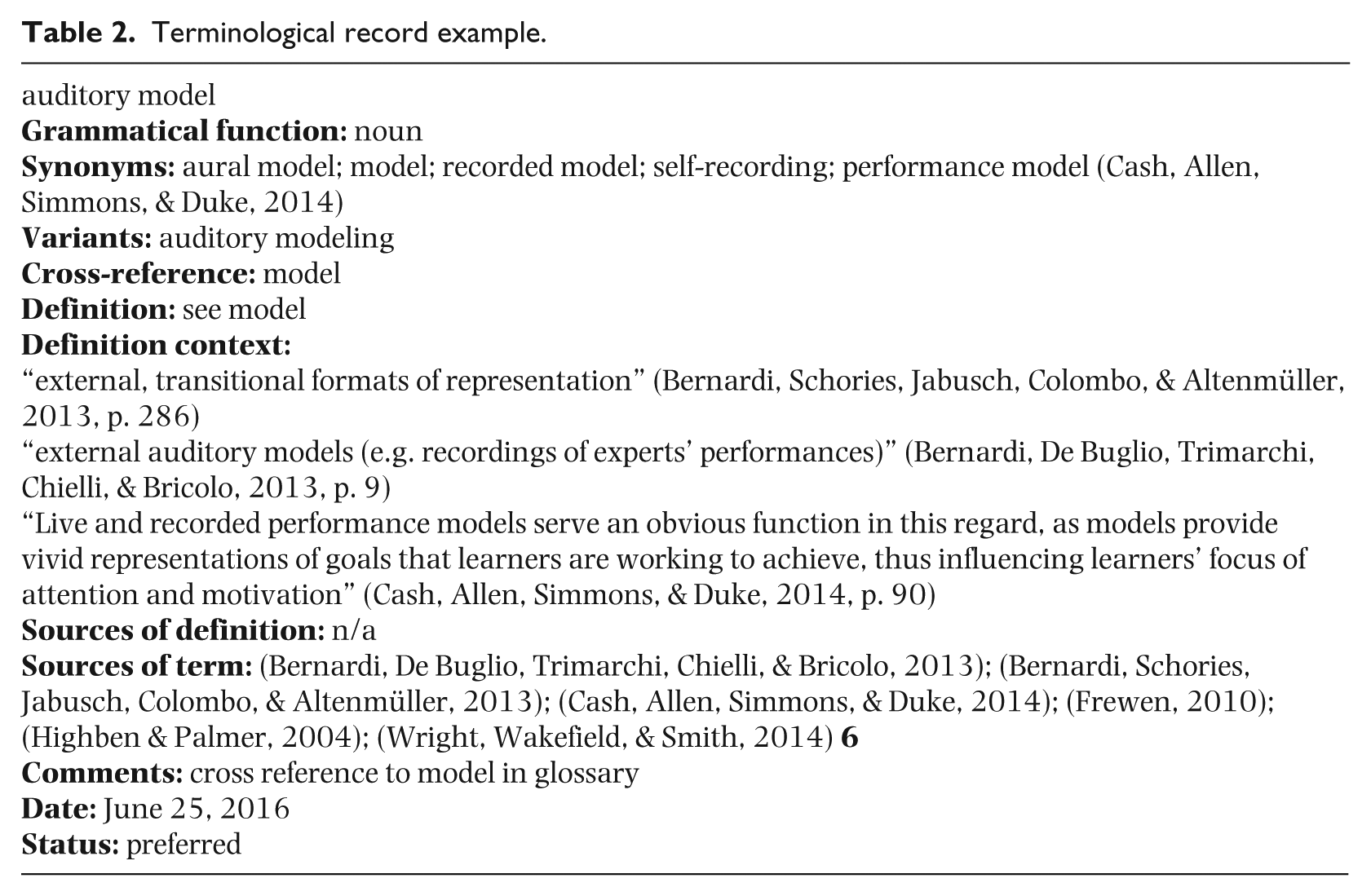
In total, 83 terminological records were created using data from the term identification document and defining context from the corpus (see Appendix S1 in the Supplemental Material Online section). Synonyms (terms that designate the same or almost the same concept) from the literature were recorded. Also noted were variants (terms with similar meaning but not in all contexts) and spelling variants (Kaennel Dobbertin & Prüller, n.d.). References of sources for the synonyms and variants were provided only if the synonym or variant term did not have its own terminological record for reasons of insufficient usage. Otherwise a cross-reference was made to the corresponding terminological record for additional information. A definition was either provided or a cross-reference made. Sources where the term appeared were also referenced.
Analyzing terms
Manual content analysis included the corpus of empirical studies on mental practice in music performance (33), the identification document (132 terms), and the terminological records (83 terms). The terminological records were the main source for analysis and were examined manually with regard to issues such as the frequency of use, synonym usage, and definition context. The records were examined individually and also compared to each other, especially in the case of synonyms. This terminological record analysis was performed in order to learn about terminology usage in the corpus, to make decisions about term inclusion in the glossary, to assist in the creation of definitions where none existed, and to examine term relationships to assist in the creation of the taxonomy.
Defining terms
Analysis of the terminological records, especially the defining context, was central to the development of term definitions. Defining context is material from the corpus that provides essential information about fundamental characteristics of the concept. In the case where no definitions were provided in the literature, material such as general language dictionaries, encyclopedia, and specialized dictionaries were also used in the development of term definitions. An attempt was made to create concise and neutral definitions that allow for the addition of qualifying material for specific term usage. The need for definitions comes from a desire to avoid semantic “vagueness” and “ambiguity” (Srinagesh, 2006, p. 24). Semantic vagueness occurs when the meaning of a word or term is not clearly stated (Srinagesh, 2006), and semantic ambiguity occurs when terms have more than one meaning. One way to avoid ambiguity is to be clear with grammatical function: to “distinguish between the noun and verb forms of some words, which can be used in both forms” (Srinagesh, 2006, p. 25). To be clear about terms having both noun and verb functions, the definitions for mental practice, model, physical practice, and practice differentiate between the noun and verb forms.
Developing a glossary and taxonomy
Terminology practice stipulates that “terms for a special language glossary must be ‘collected’ from real texts, and not ‘invented’ or ‘created’ by terminologists” (Cabré, 1999, p. 115). In keeping with this terminological practice, the terms selected for the glossary were not invented but rather they were identified and collected from the corpus. Terminology standards also dictate that a term should be unambiguous; having only one meaning and corresponding to only one concept (Cabré, 1999). The work of a terminologist is to “search for semantic clarity, the elimination of factors that disturb communication … this leads them to avoid multiple forms” (Cabré, 1999, p. 111); therefore polysemy, synonymy, and homonymy were avoided. After identifying, recording, analyzing, and defining the terminology for mental practice in music performance, a status was assigned: either “preferred”, “preferred but not recommended for glossary”, or “not recommended”. “Preferred” meant that the term was included in the glossary as the recommended term. Terms were given a “preferred” status based mainly on frequency of use and the elimination of synonymy and homophony. “Preferred but not recommended for glossary” meant that although a term may have been a recommended term, it was not included in the glossary. Despite the value of a term, reasons for non-inclusion in the glossary included the fact that a term was determined to be part of general language rather than terminology, or was used with insufficient frequency in the corpus. “Not recommended” meant that the term was not desired for use; for example, this was the case for synonyms of “preferred” terms. Twenty-one “preferred” terms and their definitions were then listed alphabetically in the glossary.
Using only the 21 terms selected for the glossary, a hierarchical taxonomy was developed using term definitions and base word forms to understand hierarchical relationships. The taxonomy shows the term relationships in a top-down fashion where each term is connected to a broader term and to one or more narrower terms (Hedden, 2010). Terms were printed and grouped together by base term; for example, imagery is the base term for variant terms such as auditory imagery, kinesthetic imagery, motor imagery, and visual imagery. The printed glossary terms were then manipulated in various configurations to determine the hierarchy that best corresponded with the term concepts. For the final product, a tree diagram was chosen to provide a graphic depiction of the terminology structure beginning with a single node, branching to additional nodes showing the hierarchical relationships between terms.
Results
During the term identification process, 132 terms were found in the corpus. Of these, 83 were provided with terminological records. Based on frequency of use and the elimination of synonymy and homophony, 21 terms were selected for inclusion in the glossary and taxonomy. Two characteristics of term usage that affect consistency and clarity in the literature were frequency and definitions.
Term frequency
Term frequency, or the repetition of a single term, is important for consistency and was measured looking at the frequency of term use in the corpus as a whole. While term frequency (repetition) is beneficial for consistency and clarity; term variety (synonymy) is detrimental. In the literature on mental practice, efforts were sometimes made to exclude synonyms; for example, a brief discussion about term consistency and frequency was included in an article favoring the use of the term mental practice over mental rehearsal (Fine, Wise, Goldemberg, & Bravo, 2015). However, synonyms were used in all but four corpus items (Keller, Dalla Bella, & Koch, 2010; Lahav, Boulanger, Schlaug, & Saltzman, 2005; Miksza, 2005; Osborne, Greene, & Immel, 2014). Using the example of the term imagery, seven terms applied as synonyms were found in the literature: auditory imagery, mental imagery, mental musical imagery, music imagery, musical imagery, musical auditory imagery, and pitch imagery.
Term definitions
Of 132 terms that were identified in the corpus, only 44 terms (33.3%) were defined explicitly. Explanatory or partial definitions were provided for 24 (18.2%) of the 132 terms. Of the 24 explanatory definitions, half (12 or 9.1% of the total) represent overlap with the 44 explicitly defined terms, and the remaining half (12) represent explanatory definitions as the only type of definition provided. Overall only 42.4% (56 of 132) of the terms used in the literature were provided with some type of definition. The majority of terms was undefined (76 of 132 or 58%) leading to semantic vagueness and ambiguity.
Semantic vagueness can most obviously occur when terms are left undefined as was the case with most terms in the corpus. Semantic vagueness may also occur when a term is only partially defined. Another cause of vagueness is less about the clarity of a definition and more to do with inconsistent definitions. The term motor imagery was usually defined as imagining movements (Fine et al., 2015; Johnson, 2011; O’Shea & Moran, 2016). However, it was also defined as imagining the feeling of movements (Holmes, 2005); a slightly different meaning that is more related to kinesthetic imagery. Semantic ambiguity in this terminology is largely associated with the fundamental terms imagery and mental practice and their various synonyms (mental imagery, motor imagery, mental rehearsal). Definitions for the term imagery were inconsistent within the corpus. Sometimes imagery was described as an experience, and therefore synonymous with mental practice (T. Clark & Williamon, 2011b; Gregg, Clark, & Hall, 2008; Wright, Wakefield, & Smith, 2014), and other times as a collection of mental representations (Bishop, Bailes, & Dean, 2014; Fine et al., 2015). Although both experiential and representational definitions for imagery are correct and are frequently used in the same literature (Thomas, 2014), a distinction should be drawn between the two concepts and any definitions should be unambiguous in order to avoid confusion. In order to avoid this type of semantic ambiguity, imagery was defined in the glossary in accordance with the representational rather than the experiential definition.
Glossary
Nineteen of the 21 glossary terms are defined, and the remaining two are cross-referenced to corresponding base terms which are defined. With the exception of the term music performance, all entries are defined in the context of mental or physical practice in music performance. Where possible, the definitions are confined to one sentence in accordance with terminological guidelines (Cabré, 1999). There are five simple terms (feedback, image, imagery, model, practice) which could be argued to belong to general rather than specialized language. However, for this work, these terms are narrowly defined within the context of mental practice in music performance. Italics are used for all terms appearing in the text of the glossary. Term entry headings are boldface plain text. References used for definition creation are listed after each entry. Where
(verb) To use imagery (auditory, kinesthetic, motor, visual) to repeatedly perform, cognitively, an activity in order to acquire or maintain proficiency on a musical instrument or the voice (“Mental practice”, 2007; Miksza, 2011; “Practice”, 2016).
(verb) To provide or use a live or recorded sound or music performance as an example. (Cash et al., 2014; “Model”, 2016).
(verb) To repeatedly perform an activity in order to acquire or maintain proficiency on a musical instrument or the voice (Miksza, 2011; “Practice”, 2016).
(verb) To repeatedly perform, physically and/or mentally, an activity in order to acquire or maintain proficiency on a musical instrument or the voice (Miksza, 2011; “Practice”, 2016).
See also mental practice; physical practice.
Taxonomy
The purpose of the taxonomy is to classify the language of mental practice in music performance to help clarify the terminology and to illustrate the term relationships. Beginning with the top term music performance, the 21 terms of the glossary have been organized into a hierarchical tree diagram to illustrate the term relationships uncovered during the process of this work (Figure 1).
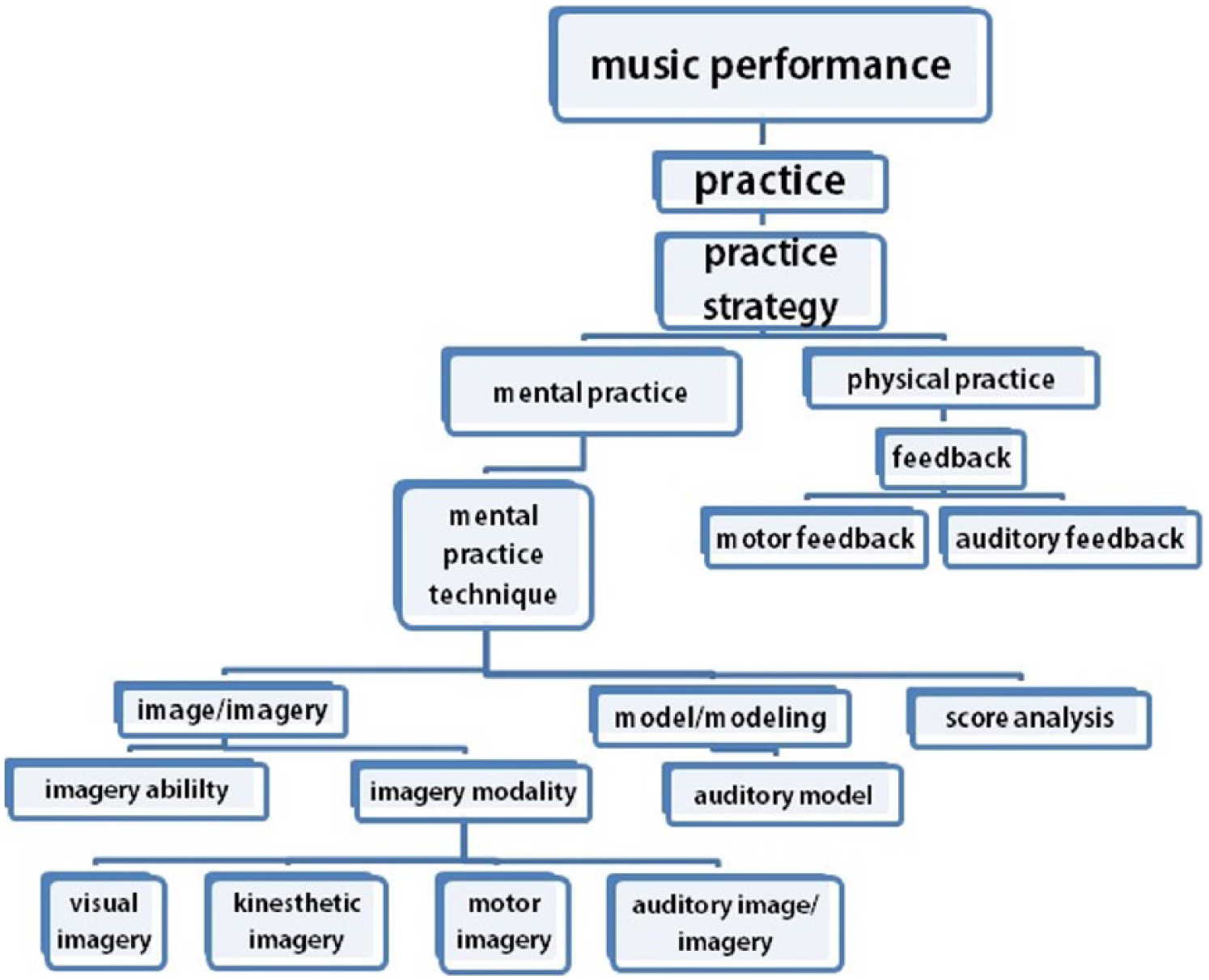
Tree diagram of the taxonomy of mental practice in music performance.
Conclusion
Through a process of quantitative and qualitative analysis, the terminology of mental practice in music performance was recorded and presented as a glossary and taxonomy. The detail oriented nature of this work may seem inconsequential and place undue emphasis on readability, but a “better point of view is that readable writing is desirable and important for the reader’s sake. If it is not readable to an intended reader it is not readable” (Klare, 2000, p. 11). It is the reader of this literature who will examine and compare results, identify knowledge gaps, and develop theories for future research. Clearly defined terminology is an essential research tool (Srinagesh, 2006). This prescriptive work represents an initial attempt to organize and clarify the terminology in the field of mental practice in music performance.
Because this terminology work is literature-based, periodic updating of the glossary and taxonomy is recommended. This process could address issues such as term inclusion; for example, terms such as subvocalization, mental skills training, and notational audiation are important and may be emerging terms but were not used with enough frequency in the current literature to warrant inclusion in the glossary. Review of the terminology work will also allow for revision of the terminology records to ensure continued accuracy of relevant information such as frequency of use and defining context. The terminology work presented here will be considered a success if it helps to increase awareness about the importance of consistency and clarity in the use of terminology, and improves the communication of information thereby advancing the scientific understanding of mental practice in music performance. The adoption and standardization of the glossary and taxonomy is also welcome.
Footnotes
Funding
This research received no specific grant from any funding agency in the public, commercial, or not-for-profit sectors.
Supplementary Material

Notes
References
Supplementary Material
Please find the following supplemental material available below.
For Open Access articles published under a Creative Commons License, all supplemental material carries the same license as the article it is associated with.
For non-Open Access articles published, all supplemental material carries a non-exclusive license, and permission requests for re-use of supplemental material or any part of supplemental material shall be sent directly to the copyright owner as specified in the copyright notice associated with the article.
