







Abstract
Adolescents who are members of youth music groups learn music and develop other skills such as group work and conflict resolution. These skills and feelings may represent socioemotional factors underlying increased life satisfaction, leadership capacity, and academic motivation, together with the acquisition of emotional skills. The aim of the research was to determine the degree of life satisfaction reported by a sample of 660 Spanish adolescents who were members of a youth band or choir. It also aimed to examine correlations between life satisfaction, leadership capacity, academic motivation, and emotional development. Potential differences between these variables attributable to participants’ age, gender, type of youth music group, and musical instrument played were explored using a cross-sectional survey comprising four standardized questionnaires. The results show that the participants were highly satisfied with their lives. There were strong positive correlations between the variables studied but also some significant differences between the two groups (choirs and bands), and between players of different instrument families. These results are in line with those other studies, confirming the positive influence of group music making on adolescents’ social and emotional growth.
Adolescence is a stage of life characterised by numerous physiological, cognitive, and socioemotional changes. These changes involve a series of adjustments that are influenced by a range of variables, such as the individual’s personal and social context (e.g., friends, family, and culture), their interests and motivations, and digital technologies (Gallardo et al., 2020; Swanson et al., 2010).
All these changes mean that adolescents have experiences that are complex for them, and they look for resources in their environment that could generate greater subjective wellbeing and life satisfaction (Proctor et al., 2009). High life satisfaction correlates with an absence of social and psychological problems: individuals who are satisfied with life are good problem solvers, achieve more in the course of their education and at work, are better at coping with stress, and enjoy better physical health. Hope and vitality are positive predictors of life satisfaction. In young adolescents, love and gratitude are also notable (Park & Peterson, 2009).
Establishing interpersonal relations and belonging to groups where these strengths of character can develop will therefore enable socioemotional skills to be fostered and used. These skills have a direct impact on the development of psychological characteristics specific to this stage of life that enable, for example, the formation of identity, relationships with peer group and family, life satisfaction, wellbeing, self-esteem, and self-perception (Hessler & Katz, 2010; Raboteg-Saric & Sakic, 2014).
Music is one of the resources used most often by adolescents to develop all types of skills, including socioemotional skills (Miranda, 2013; North et al., 2000). Listening to and/or performing music is useful for forming and consolidating identity (Evans & McPherson, 2017; Saarikallio, 2019), relating to others and developing a sense of belonging to a group, self-worth and self-esteem (Bennet & Nikulinsky, 2019; Kuntsche et al., 2016; Pearce et al., 2016), and expressing, regulating, and intensifying emotional states (Baltazar, 2019; Baltazar & Saarikallio, 2016; Chanda & Levitin, 2013). For this reason, the development of adolescents’ socioemotional skills and wellbeing, both individual and social (Miksza, 2010; Ros-Morente et al., 2019), could benefit from the adolescent’s participation in a youth music group, such as a band or a choir, in which the main aim is to make music together. Although numerous studies such as those described above, and others (e.g., Grebosz-Haring & Thun-Hohenstein, 2018; McFerran et al., 2019), compare the effects on different adolescent groups of musical activities such as listening, singing, and playing, this article focuses specifically on adolescents who belong to a youth band or a youth choir. In other words, they are young people who receive informal music education and perform music together in groups led by a conductor.
Informal music education differs from formal music education in terms of its function and the benefits it can offer adolescents; for example, it can often be adapted to the needs of individuals, unlike formal music education, which tends to be more general, regulated, and conservative, and is therefore less flexible. The results of several studies have confirmed that informal group music practice in adolescents contributes to the development of collaborative and critical reasoning skills, and a commitment to work and respect for others, among other skills (Calderón et al., 2016). Because informal music groups and choirs are based in the local community, members of the community can play a leading role in the artistic experience offered to the members of each group, according to the customs of each region. In this way, traditional divisions are overcome between musicians who have been trained formally and informally (Green, 2008).
The tradition of forming associations for music is well established in Spain; bands in Valencia and choirs in Catalonia have a history that is almost two centuries long.1 These groups provide high-quality, informal music education for young people. They are also symbols of culture and identity, as they are characteristic of and promote the culture of each region (Oriola et al., 2018). The aim of the present study was to find out more about the members of youth music groups. While we have presented evidence of the many benefits to young people of making music in bands and choirs, there is no literature on potential similarities and differences between the socioemotional profiles of adolescents in the two types of music group.
Youth bands and choirs share many characteristics, both musical (e.g., active listening, synchronisation with colleagues, leadership by a conductor) and non-musical (e.g., co-existence with colleagues, teamwork, empathy, non-verbal communication, organisation in teams, technical and logistic support (Kawase, 2016; MacLellan, 2011). However, they also differ in some notable features such as the members’ gender and music training. To play in a band, a minimum level of music knowledge is required, as well as the ability to play an instrument, while this is not an essential condition for singing in a choir (Oriola et al., 2018). Furthermore, girls are predominant in adolescent choirs for various reasons, such as the voice changes experienced by adolescent boys and gender stereotypes (Freer, 2016; Warzecha, 2013). Given these differences between youth bands and choirs, it was worth examining potential similarities and differences between the degrees of life satisfaction and emotional development experienced by the members of the two types of group.
Leadership capacity is another factor that is closely associated with some socioemotional skills such as empathy, assertiveness, and potential to manage other people. These are all evident in the work of music groups. In fact, some studies directly relate music making to the development of competences and skills for leadership (Bogotch & Ruccolo, 2017; Calderón et al., 2015; Gornall & Bickerton, 2018). However, it was worth asking if players of musical instruments and singers, and girls and boys, develop them to similar or different degrees.
In addition to having a major socioemotional dimension, group music practice also requires cognitive skills such as concentration, the ability to read musical scores and to keep time with others. These mental processes have a positive impact on academic performance (Hallam, 2015; Martin et al., 2016; Sandu, 2019). We could therefore ask if these also influence the academic motivation of adolescent instrumentalists and singers respectively.
There are numerous studies of the influence of musical activities on the life satisfaction and wellbeing of young people (Caleon, 2019; Demirbatir et al., 2013; McFerran, 2016), but very few have been carried out with the members of amateur music groups such as bands and choirs, and particularly with adolescents. This study was therefore designed to determine the degree of life satisfaction, leadership capacity, academic motivation, and emotional development of a large sample of adolescent musicians who were members of a young band or a young choir in Spain and to analyse potential differences between these variables attributable to type of music group, musical instrument, age, and gender. These variables are thought to be closely interrelated, contributing to individuals’ socioemotional profiles. Additional aims were to analyse correlations between these variables and gauge the extent to which they can explain adolescents’ life satisfaction, so as to gain a more holistic view of the socioemotional impact of group music performance on adolescents, depending on the type of band to which they belong.
Method
Design
An exploratory, non-experimental, cross-sectional survey was used to analyse correlations between life satisfaction, leadership capacity, academic motivation, and emotional development in a sample of adolescent members of youth bands and choirs in Spain.
Sample
The sample comprised 660 adolescent musicians (average age 14.26 years, SD = 2.23), of whom 367 (55.6%) played in 10 youth bands in Valencia and the other 293 (44.4%) sang in 10 youth choirs in Catalonia. The majority, 423 (64.1%), were female and 237 (35.9%) were male. In the choirs, 254 (86.6%) were female and 39 (13.4%) male, while in the bands 198 (53.9%) were male and 169 (46.1%) female. Of the band members, 227 (34.7%) played woodwind instruments, 98 (14.8%) played brass instruments, and 42 (6.4%) were percussionists.
The process by which respondents were selected was guided by an analysis of the census of existing groups in the two regions, considering factors such as the geographical location and density of the population, the popularity of the band or choir, the number of members, and its years of existence. First, on the basis of these variables, 100 groups were identified (50 bands and 50 choirs). Experts in music education and statistics advised on the selection of the final sample of 10 bands and 10 choirs. Although the sample was intended to be non-probabilistic, we endeavored to make it representative by selecting individuals from the most traditionally visible types of musical ensembles (namely, bands, and choirs) so that the results of the study might better reflect the realities of making music in the regions chosen.
Materials
To analyse the variables, a survey was prepared, including items for collecting sociodemographic data including age, gender, and school year, and data on music studies (e.g., instrument, years of study), and the following standardized scales:
Satisfaction with Life Scale (SWLS; Diener et al., 1985). The Spanish version by Atienza et al. (2000) was used. This is a self-report questionnaire with a 5-item scale for measuring life satisfaction on a 7-point Likert scale ranging from 7 (strongly agree) to 1 (strongly disagree). The items are interdependent, and a final score is obtained by summing the individual scores for each item. Final scores are classified as follows: 30–35 extremely satisfied, 25–29 satisfied, 20–24 slightly satisfied, 15–19 slightly dissatisfied, 10–14 dissatisfied, and 5–9 extremely dissatisfied. It showed in previous research satisfactory psychometric properties and factorial structure, Cronbach’s Alpha ranging from .80 to .89 (Diener & González, 2011; Vazquez et al., 2013).
The Questionnaire on Capacity for Leadership (LID; Ávila de Encío, 2012) is a self-report questionnaire based on Cattell’s 16PF questionnaire (Cattell & Cattell, 2005; Porter & Cattell, 2002), using a 15-item scale to evaluate leadership capacity on a 5-point Likert scale from 5 (totally agree) to 1 (totally disagree). The final score is obtained by summing the individual scores for each item. Final scores are classified as follows: 15–20 low capacity, 21–40 moderate capacity, and ⩾ 41 high capacity for leadership. The LID has satisfactory internal consistency (α > .70), with test–retest correlations indicating good test–retest reliability (.83).
The Academic Motivation Test (MOT; Sáez, 2008) is a self-report questionnaire using a 25-item scale to evaluate adolescent’s predisposition for and motivation towards their academic training on a 3-point scale (true, false, or doubtful). The final score is obtained by summing the individual scores for each item. Final scores are classified as follows: ⩾30 high, 15–29 moderate, and ⩽14 low motivation. The MOT also has satisfactory internal consistency (α > .70), with test–retest correlations over two months indicating good test–retest reliability (.81).
The Emotional Development Questionnaire (QDE; López & Pérez-Escoda, 2014) is a self-report questionnaire using a 48-item scale to measure the development of emotional competences identified by the Research Group on Counselling in Psychopedagogy (GROP) (Bisquerra & Pérez, 2007) on an 11-point Likert scale from 10 (totally agree) to 0 (totally disagree). It comprises five subscales assessing emotional awareness, emotion regulation, emotional autonomy, social competence and life competences, each with its own score from which a total score can be calculated. Cronbach’s Alpha ranged from .88 and .91, indicating satisfactory reliability.
Procedure
Contact details for the 10 bands in Valencia and the 10 choirs in Catalonia were obtained from the census of the federations to which they belong. Their conductors were contacted via telephone or email and an invitation was made to them for their groups to take part in the study. They were also entrusted with the task of informing the members of their group about the research.
When the invitation had been accepted by the conductor on behalf of the group, the parents or caregivers of its members, who were of course minors, were given a participant information sheet and consent form agreeing that their children could complete the questionnaires anonymously and voluntarily. Once informed consent had been obtained, a researcher went to the venue where each group rehearsed to hand out the printed questionnaires. The data that were obtained were processed using identification codes to maintain the anonymity of the participants. At all times, the researchers followed the principles of the Belmont Report and their university’s Code of Good Research Practice. As the research was reported in a doctoral thesis, the university’s doctoral committee was responsible for approving the protocol regarding ethical questions on data collection and use.
Data analysis
Descriptive statistics were calculated from the sample’s responses, and differences between groups were determined using t-tests for two variables and analyses of variance (ANOVA) for more than two variables. In addition, correlations between measures were analysed using Pearson’s test, and Levene’s test was carried out to establish the homogeneity of variance in all cases. A hierarchical multiple regression analysis was carried out to examine relationships between variables.
The Statistical Package for the Social Sciences (SPSS) version 21.0 was used for all calculations. The significance threshold for all tests was set at p < .05 (two-tailed).
Results
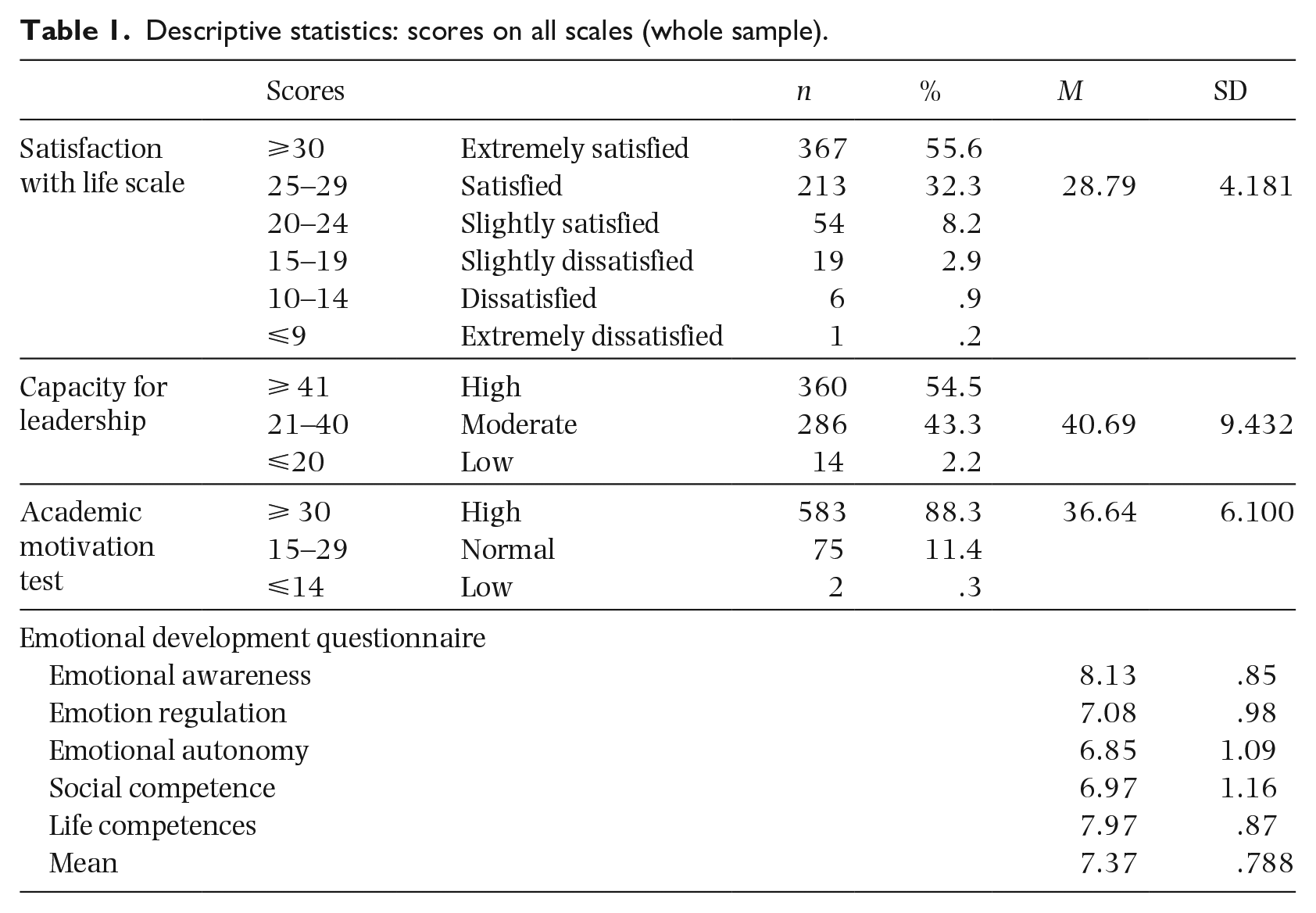
As shown in Table 1, the vast majority of the sample were extremely satisfied or satisfied with life, had high or moderate leadership capacity, high academic motivation, and obtained an average score of 7.37 (/10) for emotional development. The dimensions on which they scored highest were emotional awareness and life competences. The dimensions on which they scored lowest were social competence and emotional autonomy.
Descriptive statistics: scores on all scales (whole sample).
Statistically significant differences were observed between the scores of the two groups on two scales such that the band members reported higher life satisfaction and leadership capacity than choir members. Significant differences were also found between their scores on the Emotional Development Questionnaire (see Table 2).
Descriptive and inferential statistics by music group and instrument.
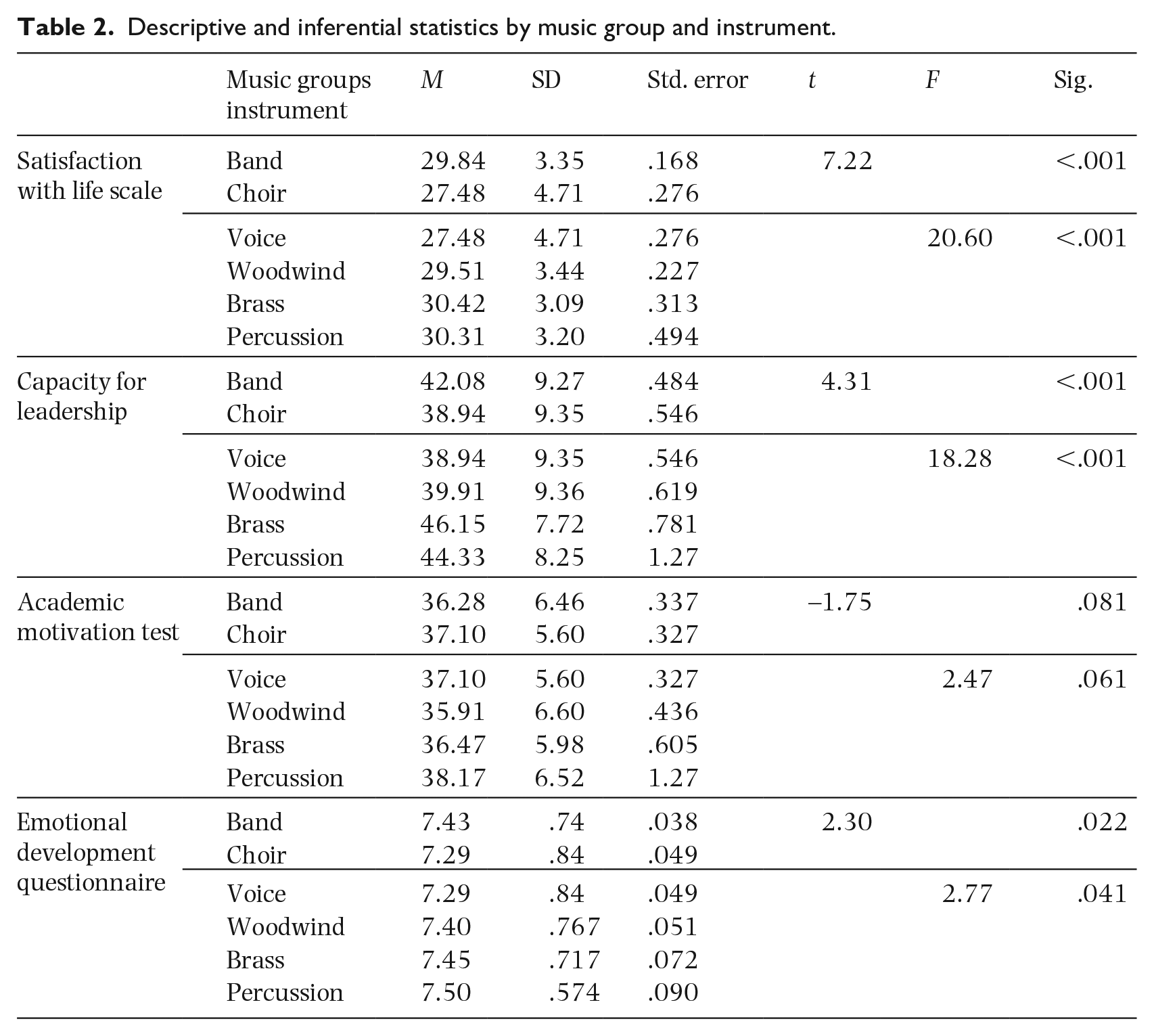
Life satisfaction: post-hoc Tukey tests revealed significant differences between the scores of singers and the players of each of the three groups of band instruments (all ps < .001). There were no significant differences between the scores of woodwind, brass, and percussion players.
Leadership capacity: post-hoc Tukey tests revealed significant differences between the scores of singers and brass players (p < .001), singers and percussion players (p = .002), woodwind and percussion players (p = .020), and woodwind and brass players (p < .001).
Emotional development: post-hoc Tukey tests yielded significant differences only between the scores of singers and percussion players (p = .040).
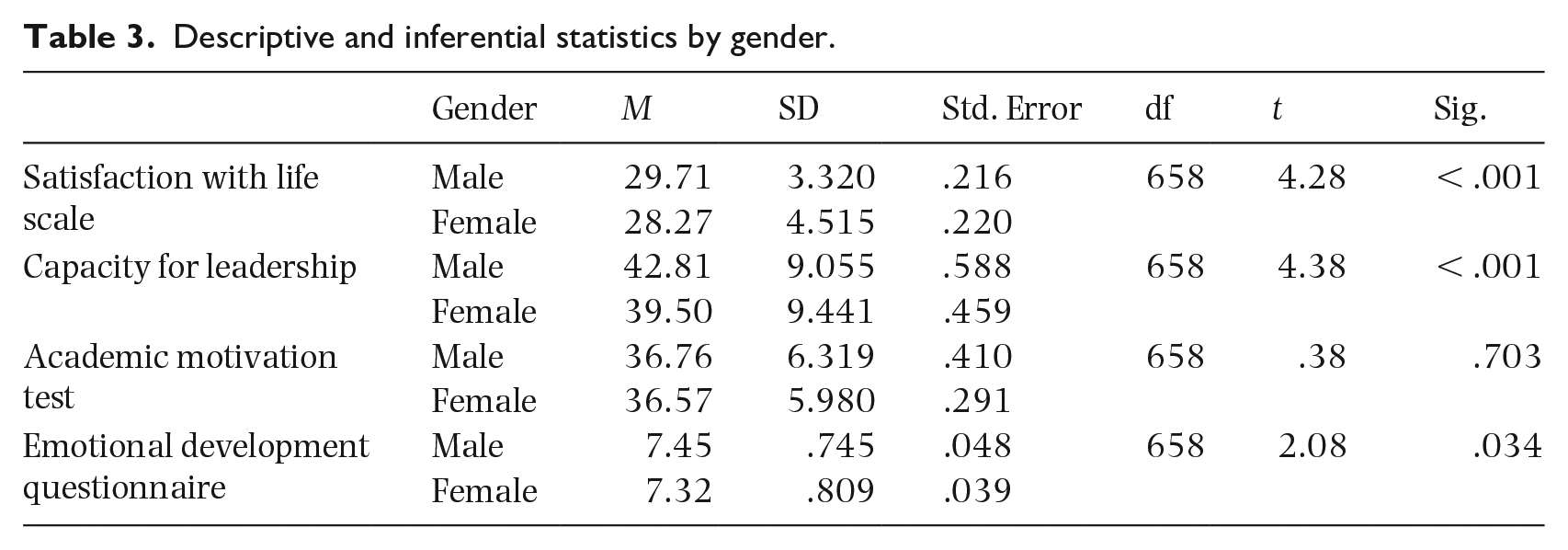
In addition, significant differences were observed between the scores of male and female participants on the measures of life satisfaction, leadership capacity, and emotional development. The data are shown in Table 3.
Descriptive and inferential statistics by gender.
The results show correlations between the scores on all measures. However, the strongest correlations for the whole sample were between the scores for life satisfaction, leadership capacity, and emotional development (see Table 4).
All scales: Means, standard deviations, and Pearson intercorrelations.
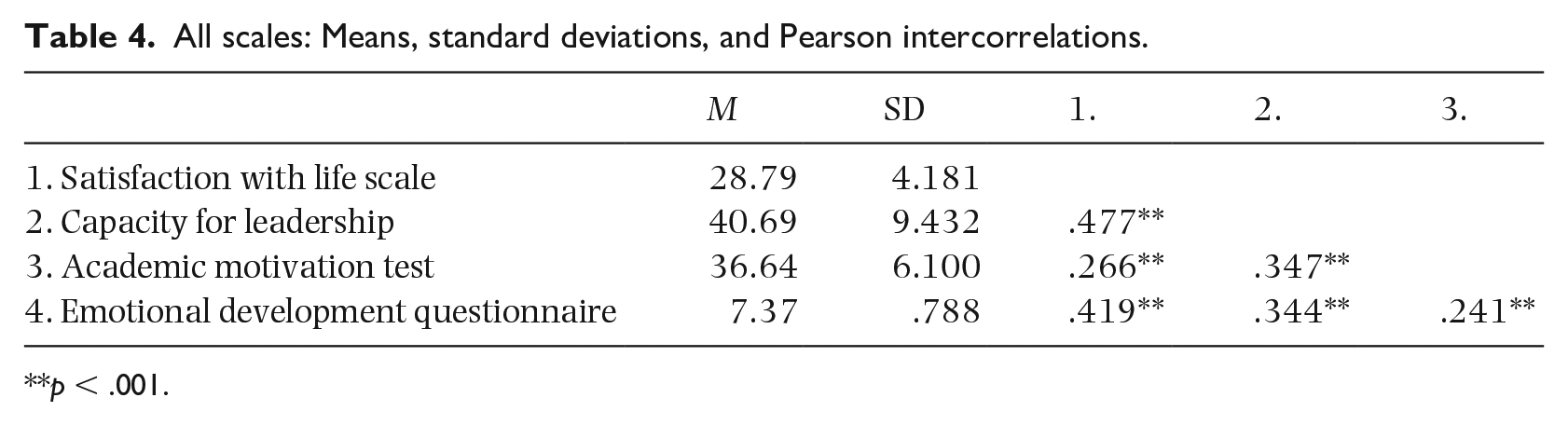
p < .001.
There was a weak negative correlation between life satisfaction and age of participant, r = -.132 (p = .001). The strongest positive correlations between life satisfaction and the other three measures for the singers and the players of each of the three band instruments were with emotional development, for singers, r = .463, and with leadership capacity for players of wind instruments, r = .481, brass, r = .553, and percussion, r = .515 (all ps < .001).
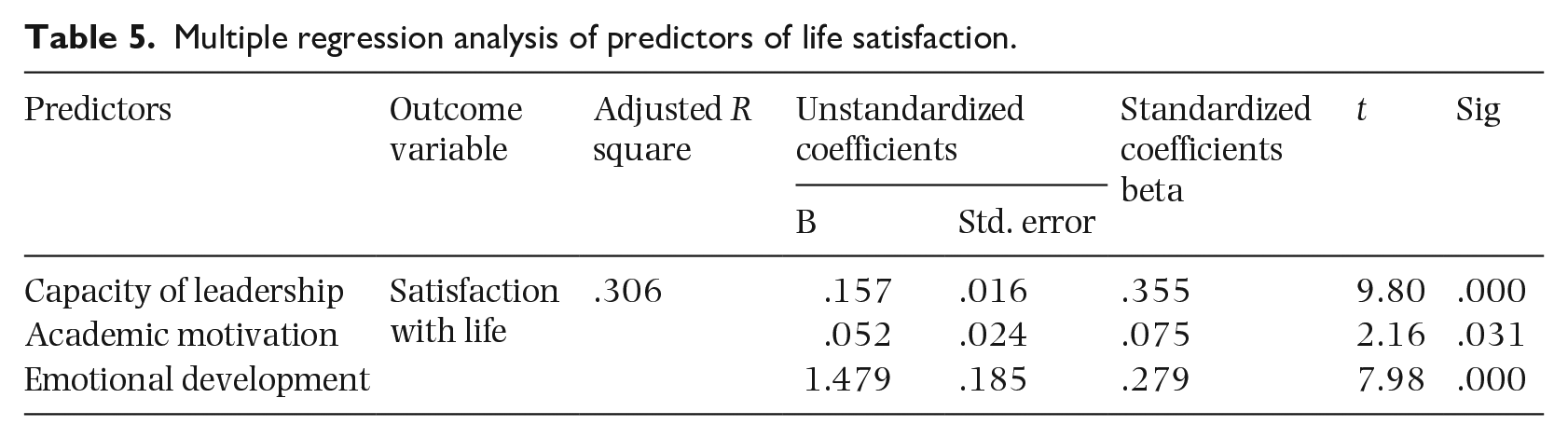
Finally, a multiple regression analysis indicated that leadership capacity, academic motivation, and emotional development predict life satisfaction, explaining 30.6% of the variance (F = 96.453, p < .001), as shown in Table 5.
Multiple regression analysis of predictors of life satisfaction.
Discussion
Based on the results obtained, the members of the youth music groups who participated in the research had high life satisfaction. They also had a notable development in capacities that are closely linked to satisfaction such as socioemotional skills, leadership capacity, and academic motivation. These results are in line with some studies that establish a direct relationship between music making and human characteristics and abilities such as emotional awareness (Schellenberg & Mankariou, 2012), emotional regulation (Goldstein, 2011), and interpersonal skills (Kokotsaki & Hallam, 2007), and an increase in wellbeing (Altenmüller, 2016; Bennett & Nikulinsky, 2019). There were significant differences, however, between the results for choir and band members respectively.
As already noted, adolescence is a stage of life characterised by many internal and external changes that require considerable capacity for adaptation that is frequently externalised by socioemotional ups and downs that can have an impact on life satisfaction. Studies undertaken in developed countries with non-musician adolescents report mean scores for the SWLS questionnaire (Diener et al., 1985) in the range 20–24 points. That is, on average, adolescents feel slightly satisfied with their life, although they would like improvement in some areas (Di Fabio & Gori, 2015; Salgado & Duque, 2018). By contrast, the adolescents in our sample, who were all musicians, stated that they felt satisfied or even very satisfied with their lives, as reflected in the mean values of 29.84 and 27.48 points for members of bands and choirs, respectively. These results are in line with studies such as those by Aryanto and Hartono (2019) and Araújo et al. (2017), according to which musicians had significantly higher life satisfaction and wellbeing than non-musicians. Similarly, Maury and Rickard’s results (2020) suggest that choir membership, like engagement in group physical activities, contributes to the emotional wellbeing of older people.
Band members’ scores for life satisfaction results were on average two points higher than those of choir members. This could be attributable to the finding that male participants scored significantly higher on this scale than female participants, although there is no evidence that gender (male vs. female) is associated with life satisfaction (Al-Attiyah & Nasser, 2013; Goldbeck et al., 2007). A possible future avenue for research would be to explore the differences between male and female adolescents’ life satisfaction in more depth.
Another possible explanation could be the type of musical training received by band members and singers respectively. The findings of several studies suggest that the nature of band members’ training and the close link they feel with their instruments could have a positive influence on their wellbeing and consequently on their life satisfaction (Rohwer & Coffman, 2006; Simoens & Tervaniemi, 2013). However, studies confirm that singers obtain higher scores than instrumentalists on the Big Five Personality Traits scales of extroversion, kindness, and openness. While these traits might appear at face value to relate to life satisfaction, they are more closely related to greater social desirability (Sandgren, 2019).
Many variables influence people’s life satisfaction: gender, education, and personality, among others. The results of our study suggest that age too could be a variable, as life satisfaction decreased with age, as shown in another research (Fujita & Diener, 2005; Steptoe et al., 2015).
Our results also confirm the findings of previous studies showing that adolescent musicians have good leadership capacity; according to Bennett et al. (2019) and Hallam and Creech (2010), leadership abilities are particularly likely to develop and skills to be gained by young people who study, rehearse and perform music. Band members scored significantly higher for leadership capacity than choir members, which may be related to the different types of training offered and the way the two kinds of music group function. To our knowledge there are no studies of leadership capacity specifically in relation to the members of bands and choirs. However, it has been suggested that working in a group, and the internal and external situations that can arise in such work, can influence the development of individuals’ leadership styles and capacities (Senge, 1994). Applying this suggestion to the participants in the present study, it can be speculated that band members underwent two kinds of music training: both as individuals learning an instrument and as members of a group playing in a band (Schiavio et al., 2020). They thus experienced two types of leadership, exercised by their teacher in their lessons and by the conductor in rehearsals and performances. As most adolescent singers do not receive individual training, they were more likely to experience only the leadership of the conductor of the choir, although it should be noted that the nature of the training experienced and delivered by each conductor, and their emotional skills, could have a positive or negative impact on their students, regardless of whether they led a band or choir (Gustems et al., 2015). The finding that band members scored higher than choir members for leadership capacity could also be explained by the fact that male participants scored higher than female participants for leadership capacity, and there were more male participants in the bands than there in the choirs.
Players of brass and percussion scored significantly higher for leadership capacity than woodwind players and singers. Because of the sound qualities of their instruments, brass players and percussionists have a leading role in youth bands. On the one hand, the findings of some studies have shown that these players are characterised by being more extroverted, sure of themselves, and less neurotic than other musicians (Butkovic & Modrusan, 2019; Vaag et al., 2018). On the other hand, they may be more vulnerable to stress and performance anxiety. The conductors of youth bands, however, are typically careful to ensure that their leadership styles are different from those typically exercised in adult and professional ensembles (Gustems et al., 2015), and to create a climate of trust and avoidance of reproach. This, together with the prominence of the sound of brass and percussion in each band, could contribute to the building of performers’ self-confidence, protect them from psychological vulnerability on stage, and consolidate their own capacity for leadership (Zarza-Alzugaray et al., 2016).
Scores on the Emotional Development Questionnaire were on average a point higher than those reported in studies of non-musician adolescents in a similar context (Pérez-Escoda & García-Aguilar, 2016; Pérez-Escoda & Pellicer, 2009), suggesting confirmation that engagement in music making contributes to the development of socioemotional skills (Campayo-Muñoz & Cabedo-Mas, 2017; Rabinowitch et al., 2013; Theorell et al., 2014). Percussionists scored significantly higher for emotional development than singers. Again, this might be attributable to personality characteristics, gender, and/or the type of leadership provided by each director, as well as the function and artistic objectives of the bands or choirs (Ros-Morente et al., 2019). Future research could explore relationships between leadership of youth music groups and their members’ emotional development.
The relationship between leadership capacity and life satisfaction, identified in the correlational and multiple regression analyses could be explained by the concept of self-efficacy, which is necessary to the study of music and also a fundamental element of life satisfaction (Weber et al., 2013). Experiences at the heart of the music groups that were analysed pursue rigour and extroversion through behaviours that require a certain amount of neuroticism, elements that predict general self-efficacy and therefore the life satisfaction and general health of adolescents (Cohen & Panebianco, 2020).
Both band and choir members scored high for academic motivation, above that of adolescents who are not musicians (Oriola et al., 2018). There were no significant differences between the two groups. Some research has shown that music making has a positive influence on the achievement of academic goals (Dos Santos-Luiz et al., 2016; Müllensiefen & Harrison, 2020), which could indicate strong motivation to achieve. In future studies, it would be worth exploring the academic background of participants’ families to identify its potential effects on participants’ academic motivation.
Our study has limitations in that it used a cross-sectional design. Causal relationships could be identified in future longitudinal research. Variables should include the way bands and choirs are organised, type of leadership, and participants’ wellbeing.
Our participants were amateurs, mostly receiving informal music education. It can be surmised that they are less affected by the pressure of meeting their obligations to practice, rehearse, and perform than young people studying music at conservatoires with the intention of becoming professional musicians. Such students are likely to be perfectionists, imposing high standards on themselves. Their perceptions, attitudes, and behaviour are potentially damaging for health (Araújo et al., 2017). Future research could investigate the factors underlying the socioemotional profiles and wellbeing of amateur musicians and those who aspire to careers as professional performers.
Conclusion
The aim of this study was to determine the life satisfaction of adolescents who are members of a youth band or a youth choir, and the relationship between life satisfaction and other variables (leadership capacity, academic motivation, and emotional development), considering the age and gender of the performer, type of youth music group, and musical instrument played.
Participants scored high on measures of life satisfaction and leadership capacity, especially male band members who played brass and percussion. Significant relationships between life satisfaction, leadership capacity, and emotional development suggest that making music in this way has a positive influence on the life satisfaction of the members of youth music group. A favourable climate for those responsible for establishing and running such groups, particularly conductors and management teams, should be encouraged and promoted by policy makers and local governments.
The findings of the study, which highlight the importance of psychosocial factors in life satisfaction, have practical and educational applications. Life satisfaction is a subjective dimension of wellbeing, so it is important to identify the variables that contribute to it. Interventions based on the findings could be developed to boost these psychosocial factors. For example, fostering a good social climate in a choir or band could improve its adolescent members’ self-esteem and thus their life satisfaction. This could be achieved by considering how the group is organised, managed and directed, so as to ensure that the form of training it offers is as efficient as possible, that the group continues, and that its members are open to the experiences it offers; these are all factors related to wellbeing (Keyes et al., 2002).
Differences in wellbeing attributable to income seem to be rare while, in contrast, differences in wellbeing attributable to friendships, other social relationships, and the enjoyment of everyday activities are common (Diener & Seligman, 2004). These are inherent to youth music groups, which have the capacity to improve their members’ life satisfaction and ultimately their happiness.
The findings of our study support the notion that people can change their environment and have a degree of control over the conditions that promote their well-being themselves. For an adolescent to join a band or choir could be a transformative experience, affecting the rest of their lives.
The results of the study will contribute to an increasing knowledge of the way youth bands and youth choirs function, and the impact of group music making on adolescent wellbeing. This knowledge can be applied by conductors to learn the strengths and needs of the members of their groups. It can also benefit educators and researchers interested in topics such as choirs and bands, and their leaders; music education in informal contexts more widely; and the effects of music making on wellbeing. The contribution of youth bands and choirs, in particular, to the wellbeing of young people deserves consideration and should be investigated further.
Footnotes
Acknowledgements
We would like to thank the conductors and all 660 musicians who took part in this study. We would also like to thank the reviewers and the editor for their advice and comments.
Declaration of conflicting interests
The study was carried out as part of Salvador Oriola’s doctoral research. The authors state that there are no conflict of interests.
Funding
The authors received no financial support for the research, authorship, and/or publication of this article.
