







Abstract
Participatory music activities designed to fulfill both artistic and social aims have become widespread across the world. Such activities are often linked to the generation of social impact. In the present research, we explored musicians’ perspectives on the social impact of these activities. A total of 47 musicians with experience in leading participatory music activities in various settings in Belgium completed a survey; 21 took part in follow-up, in-depth interviews. We used a constructive grounded-theory approach to analyze the data. The findings of previous research, typically exploring participants’ perspectives, suggest that social impact should be understood as effects on participants that persist after the activity has taken place. Our findings suggest, by contrast, that musicians who lead participatory music activities conceptualize the social impact of their work as layered and dynamic: layered meaning that social impact can be situated on the level of the musicians’ intentions, the core aspects of their practice, and its effects on themselves as musicians, on participants, and on the wider society; dynamic meaning they see these layers as interacting with and influencing each other. These findings may contribute to a more nuanced understanding of the social impact of participatory music activities and have implications for practice, policy, and future research.
Social impact as a driving force of participatory music activities
Making music can not only “lead to aesthetically valued outcomes [but also] facilitate some significant personal or group effect beyond the achievement of a musically satisfying activity” (Sloboda et al., 2020, p. 116). In other words, music making can be linked to social impact (Hesser & Bartleet, 2020). Although this can be said of a variety of musical activities, participatory music activities designed specifically and explicitly to meet both artistic and social aims, often engaging people living in challenging circumstances, have become widespread in various countries (Bartleet & Higgins, 2018; Veblen, 2007). What are these participatory music activities? And what is meant by social impact?
Participatory music activities are led by accomplished musicians with the dual aims of (1) creating musical outcomes, including learning new repertoire or working toward a performance or recording, and (2) addressing social goals such as improving intercultural dialogue; contributing to resilience, identity building, and inclusion or integration in society; and empowering specific groups or people who have fewer chances in life (Sloboda et al., 2022). The people who take part in these activities have diverse backgrounds and are often described by reference to their social needs or deprivation (Sloboda et al., 2020).
Different terms are used for these activities, including socio-artistic work, socially engaged music making, community music practice, community cultural development, and social action through music (SATM), and new terms continue to emerge (Baker, 2021; Bartleet & Higgins, 2018; Kerremans, 2010; Matarasso, 2019). We use the term participatory music activities because it emphasizes the participatory character of the work and specifies our focus on music. The ways in which the work is participatory can range from valuing the specific background of participants to engaging in co-creation processes from start to finish. The musician who leads the activities often takes a dialogical approach to pedagogy, demonstrating “the capacity to allow the collective wisdom of the group to shape, at least in part, the creative direction of the work” (Camlin, 2015, p. 240).
In addition, the term “participatory music activities” is typically used in Belgium, where we carried out our study, and has been used in previous research (Lenette et al., 2016; Perkins et al., 2020; Verneert et al., 2021). There has been an increase in such activities in Belgium since the 1990s (De bisschop, 2011; De Bruyne, 2011). They build on a rich history of community music in the United Kingdom and elsewhere, in which music making is linked to social activism, critical pedagogy, and inclusive concepts such as cultural democracy (Higgins, 2007; Matarasso, 2019). They are also linked to orchestra-based practices, such as El Sistema in Venezuela and other countries (Baker, 2014; Fenercioglu, 2015), and more context-specific practices such as music projects conducted in prisons (Doxat-Pratt, 2021; Lamela, 2021) and during cultural conflicts and forced displacement (Rojas, 2021), to name but a few examples.
More and more importance is currently being placed on the social impact of participatory music activities, influencing decisions made in various domains as to the activities that should be encouraged, funded, and taught. Despite its growing importance, the meaning of the term social impact and how it can be achieved through music making is often taken for granted, defined in different ways, or poorly conceptualized (Baker, 2014; Clarke, 2018).
One of the most influential publications in the field is by Matarasso (1997), who identifies as many as 50 kinds of social impact. While Matarasso argues that these are difficult to assess, and can be negative as well as positive, his main conclusion is that they are both inevitable and demonstrable. His research was criticized both on methodological grounds and for its links with policy makers’ agendas emphasizing the importance of evidence to support the spending of public money on the arts (Belfiore, 2002; Merli, 2002), but it paved the way for increased interest in the social impact of the arts in general (Belfiore & Bennett, 2006, 2010; Fancourt et al., 2020), and music in particular (Bartleet & Pairon, 2021; Sloboda et al., 2020).
Notions of social impact and how it might be achieved through making music are not unproblematic, however. Social impact can be understood as occurring at one or both of two levels, individual or societal. It can refer to changes in individual participants’ well-being (Lenette et al., 2016; Perkins et al., 2020) or to outcomes such as successful peacebuilding and increased social cohesion (Hirschmann & Van Doesum, 2021; Rojas, 2021). Furthermore, the concept of social impact has been shaped by assumptions and arts advocacy rather than critical investigation (Belfiore & Bennett, 2010; Clift et al., 2021). For these reasons, it deserves explicit and close attention (Bartleet & Pairon, 2021).
In this article, we focus on social impact as conceptualized by musicians who lead or facilitate, and therefore play a key role, in participatory music activities addressing social as well as artistic goals. The perspectives of such musicians on this topic have rarely been investigated. In this research, we asked the interviewees how they would define social impact, if they believed their work produced it, and, if so, whether they could provide an example of how it did so. In this way, we approached the term as a discursive construction, a term that is loaded with meaning when used (Blommaert, 2005; Potter, 1996).
The social impact of participatory music activities: Research directions
Studies of the social impact of participatory music activities have some features in common. First, most studies explore participants’ perspectives. For example, participants in Parker et al.’s (2018) study were young people at a school in England. The authors analyzed their experiences of music making and reported that music-making activities combined with mentoring support contributed to positive social changes. Hense and McFerran (2017) carried out collective qualitative interviews with young people recovering from mental illness and found that promoting their musical identities facilitated their recovery. These types of approaches are used by researchers seeking to measure and understand relationships between, or the effects of, interventions involving music on participants’ skills (Kraus et al., 2014; Osborne et al., 2016), sense of well-being (Devroop, 2012), and personal and social lives (Levy et al., 2014). But, we know remarkably little about musicians’ perspectives on participatory music activities. Several authors have noted the importance of training musicians to lead these activities and musicians’ influence on achieving social effects (Caló et al., 2020; Verneert et al., 2021; Vougioukalou et al., 2019). There have been investigations of musicians’ perspectives on the co-construction of a shared musical environment (Schiavio et al., 2019); key competences in teaching (Gande & Kruse-Weber, 2017); and musicians’ professional identities, characteristics, motivations, and challenges (Hallam et al., 2016; Preti & Welch, 2013), but few explorations of musicians’ conceptualizations of social impact.
Second, many studies examine the social impact of single projects or programs involving musical activities. One example is the investigation of a music program for young adults with learning difficulties in Scotland (Wilson & MacDonald, 2019). The authors analyze the experiences of the participants, members of their families, and staff, describe the social impacts of the program, and discuss the factors that were key to achieving those impacts. Other examples of program-specific social-impact research include studies by Levy et al. (2014), Harkins et al. (2016), Millar et al. (2019), and Caló et al. (2020). Although such examples can provide insights into the social impacts of music making in particular settings and, the results are highly context-specific (Caló et al., 2020; Gómez-Zapata et al., 2021; Wilson & MacDonald, 2019) and cannot, therefore, be generalized (Clift et al., 2021).
Finally, the social impact of musical activities is often conceptualized in terms of input and output, whereby the intervention (input) must have taken place before it can be observed to have had lasting effects (output). This model has given rise to a toolkit approach that provides organizations with the ingredients of social impact and the steps that are necessary to achieve it (Sandbrook, 2018). Such an approach is typical of the quest for a straightforward way of evaluating impact (Belfiore & Bennett, 2010) and has been criticized because it can be used as evidence to support instrumental cultural policies. Focusing on arts and culture as a way of addressing social problems may serve “as a convenient means to divert attention from the real causes of today’s social problems and the tough solutions that might be needed to solve them” (Belfiore, 2006, p. 33). Furthermore, conceptualizing social impact only in terms of lasting effects of interventions may not do justice to the reality of participatory music activities. In the present article we report research in which we interviewed a sample of musicians who described their experiences of leading a wide variety of musical activities in different contexts. This allowed us to develop a new concept of social impact based on constructive grounded theory rather than the input-output model.
Method
Data were collected in the scoping, survey, and interview phases of a 3-year, four-country international study, Music for Social Impact: Practitioners’ Contexts, Work, and Beliefs (Sloboda et al., 2020). The study received ethical approval from the Research Ethics Committee of the Guildhall School of Music and Drama, United Kingdom. In this article, we report only on the analyses of data collected in Belgium.
Data collection
First, an online survey in Dutch and French was distributed via researchers’ institutional websites, mailing lists, and social media, with the aim of obtaining information on the range and characteristics of musicians leading participatory music activities in Belgium and the contact details of those who were willing to be interviewed. There were 47 responses. Second, potential interviewees were selected on the basis of their geographical location and experiences of working in the field. The aim was to create a sample representing all the regions of Belgium with experiences of leading participatory music activities that were as diverse as possible. Sixteen individuals were interviewed in Dutch and five in French (21 in total). Figure 1 presents an overview of the interviewees’ main characteristics.
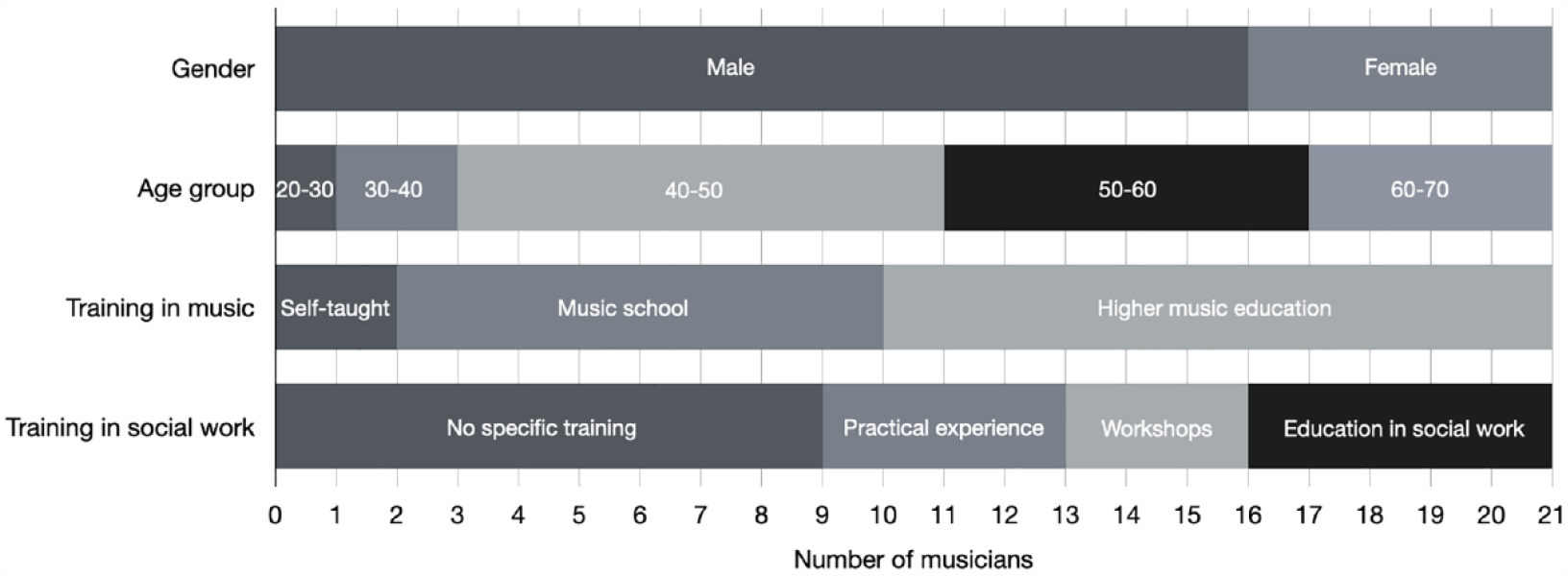
Characteristics of the musicians interviewed.
Survey respondents reported leading participatory music activities including community orchestras; (community) choirs; different kinds of bands and ensembles; percussion groups; workshops involving activities such as multi-instrumental improvisation, singing, and song writing; one-to-one coaching including instrumental playing, composing, and producing; and music theater. Although many activities were open to all they were designed for people who could be categorized as underprivileged (e.g., “vulnerable socio-economic position,” “homeless people”), newcomers (e.g., “refugees,” “people from various backgrounds,” “cultural minorities”), physically or mentally disabled (e.g., “hospitalized children,” “people with a double diagnosis, such as psychoses and alcohol addiction,” “people with Down Syndrome,” “people with dementia,” “disabled people”); and people in detention (e.g., “prisoners”).
Potential interviewees received a letter providing information about the research and were encouraged to ask questions and give their informed consent before they were interviewed. Due to COVID-19 pandemic travel restrictions, the interviews were carried out via Zoom video-conferencing technology. The interviews were semi-structured, in-depth, and had a mean duration of 94 min (SD = 37 min). When the interviewer had introduced herself and the project and obtained verbal consent, she asked the interviewee to reflect on (1) their musical and social background; (2) what happens in their practice, both musically and socially; (3) their motivation for their work; (4) their beliefs about any added value or impact their work might have; (5) whether, and if so how, their work is monitored or evaluated; (6) how their work is embedded in its context (i.e., setting or settings); and (7) any other issues that had emerged. The interviews were transcribed verbatim (mean word count = 10,688).
Data analyses
We analyzed the survey data to obtain demographic data from respondents and the participatory music activities they reported using descriptive statistics (Field, 2009), and the interview data using qualitative content analysis (Tonkiss, 2004). We began by coding the main themes of the interview using the qualitative data analysis software NVivo. We further analyzed the theme perspectives on social impact (164) 1 using a constructive grounded-theory approach. According to Charmaz (2006), “theory-building is a process of inductive construction, starting from the themes that emerge to be relevant in the data” (p. 10). First, we carried out initial line-by-line coding “to study the data closely and begin conceptualizing ideas starting from the words and actions of the interviewees” (Charmaz, 2006, p. 49). Second, we carried out focused coding, sorting, and synthesizing the data in relation to the main initial codes, which were belief in social impact (21), thoughts on terminology (34), having a mission or strong belief regarding a potential social impact (58), concrete examples of social impact (148), and (dis)belief in any special characteristics of music (37). Third, we carried out axial coding to specify the properties and dimensions of the concrete examples of social impact identified in the data (148). Fourth, these concrete examples we analyzed each for positivity (141), level (including participant [106], musician [34], and society [8]), and content (257 statements that we grouped into 37 categories). At the same time, we used the technique of memo writing “to explore ideas about the codes, emerging categories, and their relationships” (Charmaz, 2006, p. 85) before sorting, diagramming, and integrating the memos until we had conceptualized the social impact of participatory music activities as perceived by the interviewees. Finally, we summarized each interview to ensure that we had preserved the context of the categories and the individual codes from which they had been derived and checked that the concept that had emerged still fitted the interview data.
Results
Analysis of the data yielded a complex picture of the interviewees’ perspectives on their work and beliefs about its impact. In summary, the concept of social impact is not straightforward. Social impact can occur both during participatory music activities and after they have taken place; it can be short-term or long-lasting, and it can affect the musicians who lead the activities, the people who take part in them, and/or society more widely. It takes different forms, and it can be positive, negative, or both.
Analysis also revealed that interviewees’ intentions for engaging in participatory music activities make an important contribution to their beliefs about the impact of their work. We found that their intentions related to core aspects of their practice when leading the activities, which may explain the impact of the activities while they are taking place as well as (or rather than) their subsequent impact.
Musicians’ intentions
The interviewees recounted their personal histories, filled with musical and social experiences that inspired and motivated them to engage in musical activities with a wide variety of people. From the data we distilled a set of ideological intentions clustering into three areas: personal, artistic, and societal.
On a personal level, musicians aim to do something meaningful for others, to help people grow, and to provide enjoyment. 2 To quote three interviewees: “Wanting to help people comes from deep within me” (ID#5); “Feeling the satisfaction of doing something for other people and experiencing the pleasure others can get from my work is just amazing” (ID#3); “Enhancing people. Getting people to surpass themselves in some way. That’s why I do it, that’s my goal” (ID#7).
On the artistic level, musicians in this field may be driven by the urge to create good music and/or intention to provide access to music for everyone. Most of our interviewees emphasized the importance of artistic quality. Whether they worked with professional musicians or people who had never made music before, they intended to create music that would be meaningful to its makers and audience alike: “You start off with the intention of doing something good, something high quality. Not in the sense of all those prejudices from the Western canon, but based on a broad spectrum, something that’s good” (ID#6); “In participatory music activities, the artist’s task is to create a work of art that adds value both for themselves and for the participant” (ID#5). Several interviewees referred to the value of arts and culture, regarding access to these as a human right:
It’s part of being human. And it’s something we need in order to develop—I am absolutely convinced of that. That’s one of the reasons why I think: “These children aren’t going to be musicians, but any opportunity they get to play music together or do something—we need to make sure they actually get that.” (ID#1)
On the societal level, many of our interviewees mentioned the prejudices that prevail and the stigmatization of certain people. The musicians aim to bring about societal change; and connect people:
Prejudices, even among people who mean well, run so deep. By
chatting to people, listening to people, making music . . . you sometimes get to hear completely different views. That’s the kind of message I try and get across, including through music. (ID#9) How do you turn all those different perspectives into a richness instead of a problem? That is what I’m aiming for, basically: the richness of the different perspectives, to get people to finally realize that every “newcomer” essentially adds value for our personal growth, for our society . . . What I want to do through my work is to really encourage people to look at things differently. And if I have to do that by changing children’s mentalities—because they will be adults too one day—then that’s how I will do it. (ID#16)
Finally, another interviewee claimed that he wanted “to connect all the people in the world. That’s what I try to do through music” (ID#11).
Core aspects of practice
A wide range of participatory music activities was reported. While there were many differences between these activities, all the interviewees described core aspects of their practice that may explain the impact of the activities while they were taking place. We identified 10 core aspects of practice, 6 applicable to joint activities in general, as shown on the left of the black arrow in Figure 2, and 4 applicable to music making in particular, as shown on the right.
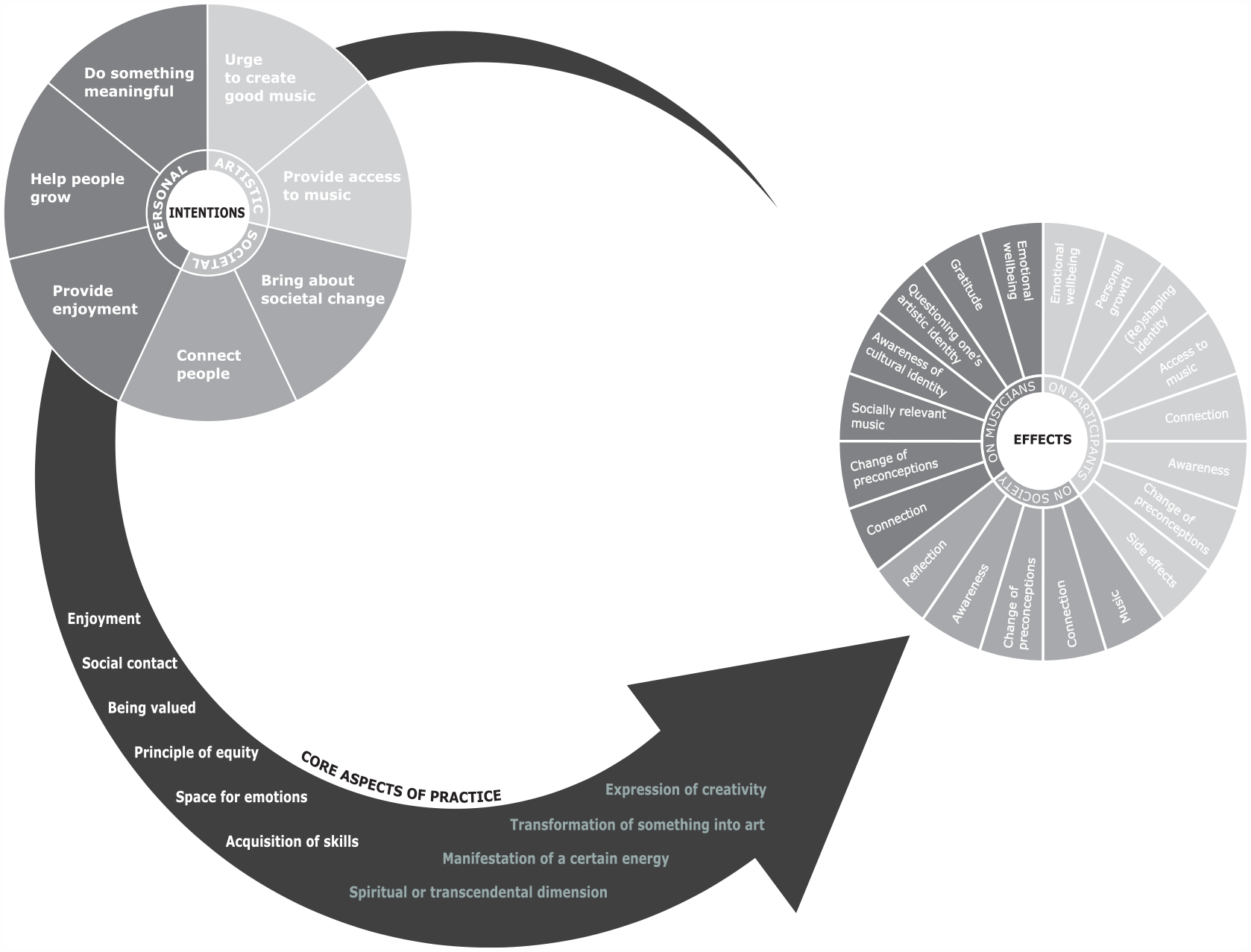
Musicians’ perspectives on the layers and dynamics of social impact in participatory music activities.
The six aspects applicable to joint activities in general relate to societal intentions and include the principle of equity: we are all human beings who share many things. Examples were provided of being valued, for example, “making music with people who literally think: ‘I’m not worth it—no-one ever notices me.’ Then I think: ‘OK, so what would you like to do?’” (ID#7). Interviewees described as well providing a space for emotions, enjoyment, and social contact:
A rehearsal is successful when I see people leaving with a smile on their face or singing . . . But also when there are frustrations, and they can be expressed, because then . . . That shows that enough of a sense of safety or openness has been created to enable them to say that, to name it. (ID#2) We meet for two hours a week to sing together. If the choir members see each other on the other days, it’s a win-win situation . . . they come to sing. But it’s not just to sing, it’s also to live a social life. (ID#20)
The skills referred to in the core aspect of practice as acquisition of skills could be musical, social, and/or transferable from the musical activities to participants’ lives: “things like arriving on time and staying committed, or just keeping on practicing until you can do something. Those are things we want the children to take away from this” (ID#14).
The four core aspects of practice that may be specific to music making include the expression of creativity. Our interviewees often contrasted participatory music making with the formal system of music education in which they were trained. Instead of music theory, reproduction and imitation, and technical perfection, participatory music activities involve creation, expression, and improvisation:
We let the children decide everything: the subject, the lyrics of the song, the melody . . . Then they discover that there are no limits to their imagination and that they can create something great out of nothing, even if they don’t play an instrument or aren’t songwriters. (ID#16)
Creativity can produce the transformation of something personal into art:
A guy at the asylum seekers’ centre said to me: “I can’t sleep here because there is so much noise.” So I wondered: “Why can’t we turn that noise into a piece of music?” Then we recorded the noise and he wrote lyrics to it. Not that the problem was solved—I can’t solve that. I can’t go knocking on doors at night and telling people to be quiet . . . But by having that conversation and working on that composition, we were able to address it from an artistic point of view and make something out of it, which helped him process it. (ID#10)
Taking this idea further: “Everything you do with your emotion, everything you transform into an art form, is a kind of healing process. That quest is there; you work on it. You transform it, so it doesn’t stay bottled up inside you” (ID#16). What can happen when people make music together, however, remains elusive. Our interviewees described it in terms of the manifestation of a certain energy that may possess a spiritual or transcendental dimension:
In the sense of experiencing art, experiencing it on a higher level . . . All those different people who are suddenly in tune with each other. That energy, that’s suddenly all on the same trajectory and shoots upwards like a rocket. We have often had that. (ID#5) For me, music is the vector of emotion. I think it’s something important . . . and it can even touch a certain spirituality. Any kind of music may touch that. In the hospital, you are in a context where there are not many things that allow this dimension. To let emotions out . . . to connect with something beyond ourselves, perhaps with beauty, too. (ID#17) By singing together with lots of people . . . it creates a more shared or a . . . more universal thing than your own personal truth. It’s something . . . transpersonal, transgenerational, even transcultural . . . Yeah . . . You can end up in that . . . something that transcends the personal story. (ID#2)
Thus musicians’ beliefs about the effects of participatory musical activities on themselves, the participants, and wider society, are influenced both by their intentions and the core aspects of their practice.
Effects on musicians
Leading participatory music activities affects the musicians themselves. As can be seen in Figure 2, seven effects were distinguished. Two relate to personal intentions; we labeled them emotional wellbeing and gratitude:
I can also see what it does to me. I have recently been through a difficult time in my private life, too. Sometimes I had to drag myself to rehearsals: I was like, “Oh, I’m not going.” But I do go, and I end up . . . in a position of strength and through those exchanges . . . I give a lot, but I also gain a lot. That’s the great thing about these kinds of rehearsals. And that’s how I go home afterwards with everyone else: with a lighter heart. (ID#2) You get home and you think: “I have a home, a roof over my head. I can choose what to eat. I have a shower.” You are thankful for the small things: things people at an asylum seekers’ centre don’t have any choice about. (ID#10)
Three effects relate to artistic intentions; we labeled them questioning one’s artistic identity, awareness of cultural identity, and socially relevant music. One example of each is given in turn here:
Doing this made me think: “OK, but wait a minute, what am I actually doing myself? Is that really so worthwhile? Shouldn’t I change it? And if so, how would I do that?” I’m talking about my own songs now, my own band. By doing participatory music activities, I also started to question my own work. I was like, “Why would I even do that, just write songs? Is all that still relevant?” (ID#5) The more I travel, the more I am aware that I am Flemish . . . I have never tried to play like an Arabic violinist; after all, I am Flemish and not an Arab . . . As a Western musician I have much more training in harmony, for instance. They have that much less in Arabic music, but they do find it interesting. (ID#9) Well . . . I can still occasionally enjoy an ordinary concert . . . But . . . I don’t always find it socially meaningful. Not any more. Hmm, something really has changed there. I think it’s important for orchestras like the Brussels Philharmonic to keep on playing concerts, but: people, find a way to get everyone involved! That’s really losing its appeal for me: welcoming chic, dressed-up white people to your concert hall every weekend . . . and that’s it. It’s still such an incredibly elitist thing. (ID#2)
Finally, two effects relate to the musicians’ societal intentions; we labeled them change of preconceptions and connection:
My perception has changed completely. And that gets reflected in your daily life. In the past, I would have been thinking things like: “Oh, those homeless people, so sad” or “Those poor asylum seekers.” But now you see them more as human beings. They are people too, after all. They just happen to be in that situation. (ID#10) Music and . . . contacts in general have started to revolve more and more around that connection. What do we have in common? Where do we differ? And how does that affect me? And how does it affect you? How can we build bridges? . . . Things don’t exist on their own. Everything exists in relation to something else. (ID#2)
Effects on participants
Our interviewees believed that participatory music making affects participants not only when they are actually making music but also in their daily lives. The interviewees’ claims were both modest and nuanced:
I’m not going to make that into something bigger than it is. For some people, it’s just two great hours a week. But I also like to think of it as . . . seeds that . . . could also have some kind of impact on other aspects of people’s lives. (ID#2)
They also acknowledged the difficulty of measuring effects that are both elusive and may be attributable to a variety of factors: “I think it’s different for every young person. It depends how they are when they come, it depends how they absorb it all, but also what they do elsewhere in the meantime, and what opportunities they get (ID#14). Eight potential effects on participants were distinguished. The potential effects referred to most often were emotional wellbeing, personal growth, and (re)shaping one’s identity:
You get to see these people growing every year, as people and as singers. In the first year they didn’t have the confidence to do anything on their own, in the second year they didn’t either, in the third year it’s “Maybe I would like to sing a bit . . .” and by the fifth year they’re standing there: “Hey, guys, here I am!” (ID#7) Decisions are constantly made about them, about the asylum seekers. They are not involved in that process, which makes them feel terrible. By participating in this music project, they feel that they have a voice again, and so they can start rebuilding their identity. (ID#10)
Access to music enabled participants aspiring to become musicians to develop their skills:
All of a sudden we’re playing all kinds of big festivals, on big stages. It’s a world that opens up to all those young people. So in that sense, it opens doors for an underprivileged group . . . You have to have that link to the regular arts circuit. And I hope I’ve been able to play a role in that. (ID#6)
Most of our interviewees said that it was important for groups to be heterogeneous, promoting connection between people from different backgrounds. Awareness that those perceived as others are not so different after all, and change of preconceptions, can pave the way for mutual understanding and friendship: “I see people becoming friends. It might be just a minuscule thing—but something changes in people’s minds. They start becoming a bit more open-minded about various things, so they might act differently or think differently in the future” (ID#9). Finally, our interviewees mentioned the side effects of participatory music activities such as the building of social networks. If a participant were to find accommodation or employment through someone else taking part in the musical activity this would clearly affect their lives beyond the activity.
Effects on society
Even more modest claims were made for the effects of participatory music activities on society, including audiences. We labeled these reflection, awareness, change of preconceptions, and connection:
We might be writing a song about garbage, for example, and then those conversations just happen by themselves. If I were to start wagging my finger, it wouldn’t work, of course. But if I write a semi-light-hearted song about it, with messages, then you get a kind of to-ing and fro-ing going on. Then you hear the mums and dads starting to sing it as well, because they come along to watch their sons or daughters perform. And very quietly—I’m not saying I do solve problems with this, mind you—you can see an awareness developing. (ID#16) It’s about people meeting each other, being drawn in to watch creative people and becoming creative themselves. And seeing that people—homeless people—can also do things, that they aren’t being stigmatised. That’s the most important thing—that they aren’t just troublemakers but that they also have a right to be there. And that they can share something beautiful with the world. Overcoming that stigmatisation—for me, that’s incredibly important. When people come to a concert like this, it’s a unique opportunity to achieve that. (ID#5)
No claims were made for the effects of participatory music activities on society at large; indeed disbelief was expressed that this might be possible:
Participatory music activities as a lever to eradicate poverty or injustice—I don’t see it that way. Lots can happen when you grow as an individual or in a group. It’s like they say: a butterfly flapping its wings in the Amazon can cause a hurricane here. Although I haven’t seen that yet. (ID#7)
Yet the music created in the course of some participatory music activities may find its way into society and thus have a lasting effect:
If you look back, there is such a thing as a shared repertoire. I think it’s a great idea that there is a group of people somewhere who can play a particular repertoire together if they want to, something that isn’t related to traditional things. That isn’t a samba or some kind of djembe rhythm from a book from West Africa. That isn’t reproducing a culture . . . but people creating something together right here, right now. (ID#14)
The dynamics of social impact
The final step of our analysis—reviewing the summaries of each interview and checking that our concept of social impact still fitted the data—suggested that the relationship between musicians’ intentions, the core aspects of their practice, and its perceived effects, differed according to the activity and its setting. For instance one interviewee, whose work took place in a hospital, described music making as providing space for emotions and a spiritual dimension (core aspects), leading to emotional wellbeing (effects on participants). According to another, whose work took place in a prison, the principle of equity and expression of creativity (core aspects) lead to change of preconceptions and connection (effects on society). Although the specific intentions, core aspects of practice, and potential effects (i.e., the layers illustrated in Figure 2) were different, they were all applicable to the activities and settings described by our interviewees. To some extent at least their intentions influenced their practice and its effects, which in turn influenced their intentions and so on (illustrated by the arrow in Figure 2). For example, the intention help people grow influenced the core aspect of practice [people] being valued and the perceived personal growth of participants whereas the perceived personal growth of participants in turn influenced the intention to help people grow. Similarly, the intention to create good music influenced the core aspect of practice transformation of something personal into art and its effect on the musician, questioning one’s artistic identity which in turn influenced the intention to create good music.
Discussion and conclusion
In the present study, we investigated musicians’ perspectives on the social impact of their practice in the course of leading a wide variety of participatory music activities in different settings. We took a constructive grounded-theory approach, rejecting the input–output model, and show that the social impact of participatory music making can be observed not only after the activities have taken place (Belfiore & Bennett, 2010; Lonie, 2021) but also in musicians’ intentions and practice, and their effects, while they are taking place. Our findings suggest that the musicians who lead such activities conceptualize the social impact of their work as layered, insofar as their intentions and the core aspects of their practice affect the musicians themselves, participants, and wider society, and dynamic, insofar as the musicians’ intentions and practice, and their effects on individuals and society, interact with each other. Social impact may thus be a more complex concept than previously thought. According to the data provided by our interviewees, it has three layers: intentions, practice, and effects.
First, our findings support those of previous research acknowledging the importance of musicians’ intentions and beliefs (Veblen, 2007; Verneert et al., 2021). According to Matarasso (2019), three categories of intention underpin participatory art (in general, rather than music in particular): “increasing access to art . . . creating social change . . . [and] advancing cultural democracy” (p. 63). These categories are reflected by three of the intentions we identified: provide access to music, bring about societal change, and connect people. The other four (do something meaningful, help people grow, provide enjoyment, and urge to create good music) could be added to Matarasso’s categories.
Second, while the majority of our interviewees did not believe that the participatory musical activities they led were likely to have lasting effects on society once the activity had finished, they did agree that they could make an impact while the activity was taking place. This reinforces the importance of their intentions, particularly in relation to the core aspects of their practice. Those core aspects which we identified as being applicable to joint activities in general overlap with and complement aspects identified as relevant to the co-construction of shared musical environments (Schiavio et al., 2019), key competences in teaching (Gande & Kruse-Weber, 2017), and pedagogical support in music programs with social aims (Creech et al., 2020). The core aspects of practice we identified as applicable to music making are of particular interest because they may capture its uniquely human qualities (Van Zijl, 2019).
Third, our data suggest that participatory musical activities have lasting effects, both social and artistic, on the musicians who lead them. This is a novel finding because most previous research has focused on the effects of such activities on participants, and it may be relevant to the development of higher music education curricula (Gaunt et al., 2021; Willingham & Carruthers, 2018). Similar effects on participants and society at large were proposed. This may represent a projection of interviewees’ experience onto others, but future research could explore this by interviewing participants and a representative sample of the population and comparing their responses to our data.
The dynamic nature of social impact is characterized by the interactions between intentions, core aspects of practice, and its potential effects. These interactions are not always straightforward or easily discernible. For instance, change of preconceptions could occur because of the setting in which the activity takes place (e.g., bringing together people from different backgrounds) as opposed to being either addressed explicitly in practice, or as a projection of the leader’s personal experiences and intentions (e.g., to bring about societal change). If change of preconceptions is the result of the leader’s intention to bring about societal change it might reflect the underlying narrative, deeply rooted in Western intellectual and philosophical traditions (Belfiore & Bennett, 2006), that the arts have a transformative power. In future research it would be worth identifying other narratives that underlie musicians’ perspectives on their work.
Implications for practice, research, and policy
Our interviewees were more concerned with the specifics of making music together, where social impact occurs and is situated at the time of the music making, than defining social impact in terms of the long-lasting effects of a participatory musical activity that has already taken place. This means that it is important to focus on the musical process as an artistic process, with the specific characteristics (core aspects) of participatory music making. In addition, it seems to be important to pay attention to musicians’ intentions, as these influence their practice.
Mirza (2006) was one of the first to make a similar point in relation to research on participatory arts designed to produce social impact. Artistic as well as social variables and dynamics should be studied, not only by those who are critical of the rhetoric that “art is good for you” (Belfiore & Bennett, 2006, p. 182) but also by those who are interested in musicians’ views. This is because, as we have seen, our interviewees regarded artistic and social effects as inextricably intertwined. More recently, Clift et al. (2021) have criticized research on the social and health impacts of the arts on the grounds that they pay insufficient attention to aesthetic criteria, the characteristics of the professional creative artists involved, and the development of participants’ artistic identities. These need to be better understood if nuanced conclusions are to be drawn as to the role of the arts in improving health and reducing social inequalities.
Our findings challenge the prevalent view in dominant policy discourses that policymakers can assess the social impact of participatory music activities using the input–output model. Attempts to do so are described in the literature as reflecting an outcome approach (Lonie, 2021) or a toolkit mentality (Belfiore & Bennett, 2010). They ignore musicians’ perspectives on such activities, fail to recognize the complex dynamics of their practice, and define social impact solely in terms of effects that are observable and measurable only once the activity has taken place. We would argue that, for a more nuanced understanding, it is essential to listen to the voices of the musicians who tell us that the social impact of participatory music activities is far more complex, layered, and dynamic.
Footnotes
Acknowledgements
The authors would like to thank, in the first place, all the musicians who participated in the survey and in the interviews for their time and for sharing their interesting stories and views. The authors thank as well John Sloboda and Geoffrey Baker, two anonymous reviewers and the editor for their insightful comments on earlier drafts of this article as well as the staff of the eCO-CITY Research group (HOGENT) that supported this research.
