






Abstract
Most branches of music theory and analysis (e.g., Formenlehre, semiotics, Schenkerian and motivic analysis) assume that global musical structures are perceptually salient. Empirical research, however, has cast doubt on the abilities of both untrained listeners and experienced musicians to appreciate form-salient aspects of global structure, even in cases where they recognize that a form is lacking in coherence. The two fields might be expected to engage in active discourse to reconcile these discrepancies, yet there is little collaboration between them regarding the perception of global structure. This article reviews the current state of knowledge regarding structural perception, emphasizing Irène Deliège’s research contributions and theoretical accounts of segmentation, categorization, and structural schematization. It then turns to music theory, discussing Caplin’s phenomenologically oriented account of formal/temporal functions. Synthesizing the two frameworks yields a novel approach highlighting the potential of musical cues to convey temporal information to the listener about where they are in the overall form at a given moment. This article demonstrates the dual lens of cue abstraction and temporal function in the perceptual analysis of works by Haydn and Beethoven. It concludes with a discussion of how interdisciplinary research into large-scale structure might be of value in pedagogy as well as in performance contexts, suggesting avenues along which such research might proceed in the future.
Keywords
Large-Scale Structure in Music Theory and Music Perception Research
Theoretical Assumptions and Empirical Doubts
Music theorists do not agree on how form functions in musical aesthetics. In fact, they do not even fundamentally agree on what form is (Grimley, 2015). Sonata form, for instance – described as “the most important principle of musical form, or formal type, from the Classical period well into the 20th century” (Webster, 2001, par. 1) – has been the site of intradisciplinary debate since the 19th century (Arndt, 2017; Bent, 1994; Schmidt-Beste, 2006). Are the essential components of sonata form to be found in thematic/motivic (e.g., Marx, 1837; Reicha, 1824–1826), harmonic processes (e.g., Caplin, 1998; Hepokoski & Darcy, 2006; Ratner, 1949), or a combination of the two (Schmalfeldt, 2011)? Is “form” even the most instructive way to think about the sonata concept, as opposed to calling it a compositional “principle” (Rosen, 1980) or “dramatic” dynamic (Tovey, 1911)? Out of an assemblage of contested theoretical systems and analytical lenses, there do, however, emerge two points of consensus: (1) that a competently composed large-scale structure, whatever it may be, requires organization and coherence (Whittall, 2001) and (2) that a large-scale structure is aesthetically relevant, not just to composers but also to listeners.
Theorists may tend to agree on these points, but the second of those two assumptions regarding listeners is not ceded by empirical researchers, many of whom point to experimental evidence challenging the perceptual relevance of large-scale form. Their skepticism is based on results revealing what listeners could not do. Some were unable to recognize tonal structures over periods longer than about a minute (Cook, 1987a; Marvin & Brinkman, 1999); others did not notice when structures were re-ordered in various ways (Eitan & Granot, 2008; Karno & Konečni, 1992); still others did not rate such “scrambled” structures as deficient in aesthetic interest or expressiveness (Gotlieb & Konečni, 1985; Tillman & Bigand, 1996) even in cases where they could identify a manipulated structure as lacking in coherence (McDonald & Wöllner, 2022). Participants also struggled to veridically reconstruct scrambled pieces in “puzzling” tasks (Deliège et al., 1996; Granot & Jacoby, 2012; Tillmann et al., 1998). For methodological purposes, these studies adopt and assess concretized definitions of form, but, as a result, they are forced to set aside alternative constructs, like “structure” (Schenker, 1935), “Formung” (Westphal, 1935), “inner logic” (Kurth, 1913), or “design” (Salzer, 1952).
The Value of Perceptual Analysis
Given the gap between traditional theory and empirical research on the subject of large-scale structure, the limited interchange between the disciplines is understandable. It is also the more regrettable – especially if we aspire to analysis that describes the experience of nonexpert listeners or to analysis that is of practical relevance to performing musicians. Some foundational writers have invoked phenomenology in analysis (e.g., Clifton, 1983; Cone, 1989; Cook, 1999; Lewin, 1986); others have proposed novel analytical formats oriented toward less-trained audiences (e.g., Bernstein, 1959; Keller, 1957/1994). More recent work signals growing interest in reconciling traditional analytical prerogatives with perceptual epistemology (e.g., Cambouropoulos & Tsougras, 2009; Cox, 2016; Kim, 2022; Lee, 2020; Llorens, 2021; London, 2012; Patty, 2009; L. Zbikowski, 2017), though these only occasionally incorporate what has been learned from empirical studies, and they rarely discuss nonexpert listeners. The practice of analysis of and for performance is also still in the early stages of emerging from its more vernacular pedagogic origins into a systematic practice (Rink, 2024).
If such ambitions are to come to fruition, we must foster a robust program of perceptual structural analysis that is based on what listeners can perceive, whether overlapping with, supplemental to, or simply independent of traditional analytical approaches. If, as K. Agawu (2004) says, “there is no final state to hearing, only the latest state” (p. 271), the partner disciplines of theory and analysis might still profit from examining initial states of hearing and cognition. An analysis that addresses doubts emanating from empirical research is one fundamentally enriched and amplified in scope. The potential benefits of a more encompassing and inclusive analytical paradigm should be plainly evident to anyone interested in Western art music. In what follows, I examine not just the null results but also the affirmative knowledge, limited as it still is, regarding large-scale structural perception. I also highlight potential points of contact between a structurally oriented psychological model – Deliège’s cue abstraction – and a phenomenologically oriented music theory – Caplin’s formal/temporal functions. The aim is to demonstrate that synthesizing the two perspectives can yield insights that go beyond how music is constructed by composers or understood by theorists and instead emphasize how it is experienced by listeners.
Concatenationism and the Listener
When researchers question the role of structural perception (e.g., Eitan & Granot, 2008; Tillman & Bigand, 2004), they are buttressed, philosophically, by the theory of “concatenationism” (Levinson, 1997). Reviving the anti-formalism of Gurney (1880), Levinson (1997, pp. 13–14) argues that the enjoyment of music consists solely of engagement with segments of smaller scale (i.e., melodies) – not from any reciprocal influence between larger segments or immanent relationships between material separated by long durations. This argument appears, at first, to be a hard-nosed rejection of all structural hearing (e.g., Salzer, 1952), which Levinson calls “architectonicism.” While he has modified his position slightly over time (see Levinson, 2006), the core assertion has remained firm, and the principal antagonists squarely in view. That is, even Levinson’s “qualified concatenationism” intends to shield music lovers “against purveyors of intellectual appreciation of music primarily in terms of theoretical concepts, formal schemas, and spatial diagrams (p. 173).” His was not the first or the only polemical attack on traditional form aesthetics (see Konečni, 1984; Konečni & Karno, 1994), but its publication led to heated discussion (Huovinen, 2013; Kivy, 2002; London et al., 1999) among aestheticians, empirically minded researchers, and “new musicologists.” If music theorists, for their part, bristled at the quasi-ethical framing, they did not let on; instead, they responded with silence.
Concatenationism can be slippery in its particulars, though. Levinson’s sympathy with “ordinary” (used interchangeably with “amateur”) listeners is underspecified. In some of the perception studies mentioned above, there were differences between experienced and inexperienced listeners; or between musicians and nonmusicians; or enculturated and unenculturated ones. Yet, other studies did not find that training and/or enculturation accounted for significant differences in task performance (Tillman & Bigand, 2004). Such incongruities might be explained by methodological variations and differing stimulus repertoires (e.g., Lalitte & Bigand, 2006); or they may depend upon which of the many distinct perceptual capacities is being examined (Deutsch, 2013). There are also discrepancies surrounding definitions like “experienced” listener, “trained” musician (Bigand & Poulin-Charronnat, 2006; Müllensiefen et al., 2014), and “attentive” listening (Clarke, 2005; Kassabian, 2013; Kuch & Wöllner, 2021; Rice, 2015).
Another imprecision of concatenationism – and a distinction that is often elided in empirical literature – involves whether it addresses structural cognition or the effects of structure on enjoyment. Research by McDonald and Wöllner (2022) – in which listeners recognized that scrambled versions of a Bach Prelude lacked predictability and coherence but nevertheless evaluated those versions as similar to the original version in ratings of “interest” or “pleasantness” – suggests that the relationship between hedonic effects and structural awareness is not a straightforward one. It may turn out to be true that the functional-aesthetic aspect of form/structure is a matter of indifference for most listeners in most pieces, but this leaves open other important possibilities, for example, that large-scale structure aids recall (Snyder, 2001) or “enhances subconscious processing” (Repp in London et al., 1999, p. 483).
Concatenationism also leaves unaddressed the related issue of musical complexity. Most structures in Western art music are not more complex than a strophic song; no theory appears to claim that every iteration of form bears interpretive weight. Listeners may not recruit large-scale coding strategies to grasp a folksong, but they may be aided by them when listening to a stylized Berio Folksong, and absolutely require them to follow a Berio Sequenza. Another issue may be scale: perhaps listeners make crude sense of longer pieces using schematic strategies, and to whatever extent a piece fails that schematic metric of coherence, it is likely to baffle or bore them.
The point here is not that concatenationism is a bad theory of music psychology – rather, so formulated, concatenationism is not a properly falsifiable hypothesis of structural relevance and perception (Davies, 2005). Thus, while it is regrettable that so little music theory has come to terms with concatenationism (in whatever guise), we must also acknowledge that the null results from empirical research do not yet provide enough data to accept or reject their implications.
Building Blocks of Perceptual Analysis
Segmentation, Salience, and Cue Abstraction
What do we know, then, about what listeners can apprehend? To begin with, a considerable body of research sheds light on a process that is foundational both to theories of musical structure and to empirical models of perception: that of segmentation (McAdams et al., 2022). Seminal studies found that the strongest perceptual boundaries corresponded to long rests, followed by pronounced contrasts in dynamics, register, texture, and rhythmic surface (Clarke & Krumhansl, 1990; Deliège, 1987a, 1989; Deliège & El Ahmadi, 1990; Krumhansl, 1996). More recent studies support these results with respect to harmonic closure (Sears et al., 2014; Vos & Pasveer, 2002) and extend them to diverse repertoires, both tonal (Martínez, 2018) and nontonal (Ordoñana & Laucirica, 2017; Phillips et al., 2020). We can thus feel confident that listeners recognize theoretically salient segment boundaries; however, this neither explains what listeners make of the material within those boundaries, nor how they might relate larger units to each other, globally.
Cue Abstraction
Deliège (1987b) proposed “cue abstraction” (“mécanisme d’extraction d’indices”) to describe the way in which listeners conceptualize and recall musical segments once parsed. It originates in Wittgenstein’s (1953) observations on “family resemblances,” which were transferred to prototype research by Rosch, Mervis, and other psychologists (reviewed in Rosch, 1988). Cognitive behaviors around schematization and meaning construction via the perception of similarity and difference have been demonstrated in both visual and conceptual domains (Malt, 2024); Deliège (1987a, 1989, 2007) was among the first to study them in musical contexts.
Cue abstraction is comprised of four elements: segmentation, categorization, schematization, and imprint formation. The first, segmentation, has been mentioned above in relation to phrases and segments but applies here to smaller units that represent only the most “striking attributes” of a segment (Deliège, 1987b). The factors that contribute to cue segmentation overlap with those influencing phrase boundaries, but it is worth emphasizing that rhythm was found to be more determinative of salient cue boundaries than harmony/melody (discussed in Deliège et al., 1996; Lalitte et al., 2009). These findings converge with those for other styles, such as popular music, where corpus studies observe that memorable cues (i.e., “hooks”) are most often associated with distinctive rhythmic patterns (Byron & O’Regan, 2022; Traut, 2005). Cue abstraction does not require a listener to retain an entire segment in memory; a musical phrase might be considered a kind of malleable vessel for salient cues. Deliège (1992) analogizes it to the figure/ground dichotomy in visual perception, whereby attention is directed toward memorable features, reducing cognitive load and allowing salient features to be stored as signposts.
Deliège (1995) described the earliest stage of cue abstraction, segmentation, as effectively pre-conscious – in her words, “peripheral and perceptual” (p. 63). The second phase, categorization, is analogous to processes outlined in Gestalt research (Deliège, 2001a); it is more cognitively “direct” (Deliège, 1995) but remains low level or not necessarily fully conscious (Koniari et al., 2001; Mélen & Wachsmann, 2001; Woodcock et al., 2017). Thus, at this point in the model, listening could involve the recognition of attention-catching features and end there. It is the third concept, schematization – described as the “mental line” of the music – that is more analytical, going beyond in-the-moment listening:
As soon as it has been abstracted, the cue plays an active role in more than one aspect of the listening process. In the first place, it has attracted the listener’s attention and thus becomes all the more effectively fixed in long-term memory . . . Musical time is thus progressively marked out, with the different cues that are abstracted during listening acting as waymarkers or milestones. This gives rise to the notion of a mental line that makes reference to a symbolic “musical space” in which the fundamental articulations of the mental schema of the work are drawn. (Deliège, 2001a, p. 238)
A comparable approach is discussed by L. M. Zbikowski (2002), who adapts a framework developed by Rosch and Mervis (1975; Mervis & Rosch, 1981) wherein all objects forming a “natural category” contribute to a pool of attributes, and perceived “prototype effects” emerge as those features most frequently exhibited by class members. This statistical approach to prototypicality aptly describes the episodic way we encounter objects and concepts in the world; although, as applied to the constrained temporal frame of music, primacy effects may be more influential (Ebbinghaus, 1913; Snyder, 2001). Zbikowski is also more agnostic than Deliège regarding which kinds of features will contribute most to prototypicality; although as mentioned above, rhythm has been found to play a central role in cue segmentation, and contour has been found more salient than specific pitch content (see Dowling et al., 1995; Dowling & Fujitani, 1971). Finally, Deliège observed that certain kinds of parametric distortions of a segment (e.g., extreme shifts in register) resulted in it being rejected from group membership, concluding that prototype theory may not fully explain how listeners deal with individual cue variation (see discussion of integral vs. separable dimensions, as well as exemplar theory in Deliège, 2001b, pp. 400–401).
These differences aside, both Deliège and Zbikowski draw active parallels with Schoenberg’s definition of motive: “the smallest part of a piece or section of a piece that, despite change and variation, is recognizable as present throughout” (1995, p. 169). Schoenberg’s motive does, indeed, overlap with Deliège’s understanding of cue – the composer-theorist even intuited that distinctive rhythm is more memorable than melodic contour (Schoenberg, 1967) – yet Deliège stops short of equating the two terms, perhaps to avoid definitional overlap with other theories. For example, Réti’s and Schenker’s definitions of motive both prioritize intervallic relationships over rhythm and contour, and have, in part because of this narrow conception, been criticized as lacking perceptual validity by phenomenologically oriented theorists (Clifton, 1983; Cook, 1987b) and empirical researchers (Eitan & Granot, 2008). Cues, on the contrary, are defined simply as any feature of the music that is “especially salient” (including texture, dynamics, orchestration, register shifts, etc.) – a view that extends beyond even Schoenberg’s motive and more closely resembles his use of the term Gestalt (Arndt, 2019). Ultimately, the most important distinction is that motives may be understood as compositional building blocks, while cues are emergent perceptual building blocks. The dimensions and destinies of cues are not so much the prerogatives of the composer as they are the provenance of the listener: elastic products of a mind grasping the music.
A major challenge for any analysis that makes assumptions about salience is that it is difficult to specify which musical materials will be abstracted by listeners as cues – difficult but not impossible, given what has been observed above about rhythm, as well as the evidence that participants of all kinds judge similarity based on “surface features” rather than deeper structural relationships (Berz & Kelly, 1998; Lamont & Dibben, 2001; McAdams et al., 2004). Other studies have found that training corresponds to increasing recognition of thematic content (Krumhansl, 1991; Pollard-Gott, 1983; Ziv & Eitan, 2007), though the materials used in those studies were intact melodies rather than arcane transformations of melodic cells. Research by Cambouropoulos (2001) and Wiggins (2010) also demonstrates the promise of information-theoretical models that comport with similarity judgments made by listeners in Deliège’s experiments and which may eventually be able to predict perceptual salience in specific musical stimuli. Thus, while it will be necessary to continue testing empirically the interaction of features that lead to salience, we may already identify elements of the musical surface that are more likely to be salient to listeners based on existing empirical data. For example, when forced to speculate about cue salience, one could likely do no better than the locus classicus of memorable cues: Beethoven’s Fifth Symphony (“short enough to remember and portentous enough to be memorable,” per Guerrieri, 2012, p. xii). Its so-called “Fate” motive exhibits empirically validated salience characteristics: segmentation via an extended note, or fermata; clear rhythmic definition/melodic simplicity (for memorable categorization and ease of schematization); and a high degree of repetition (Figure 1).
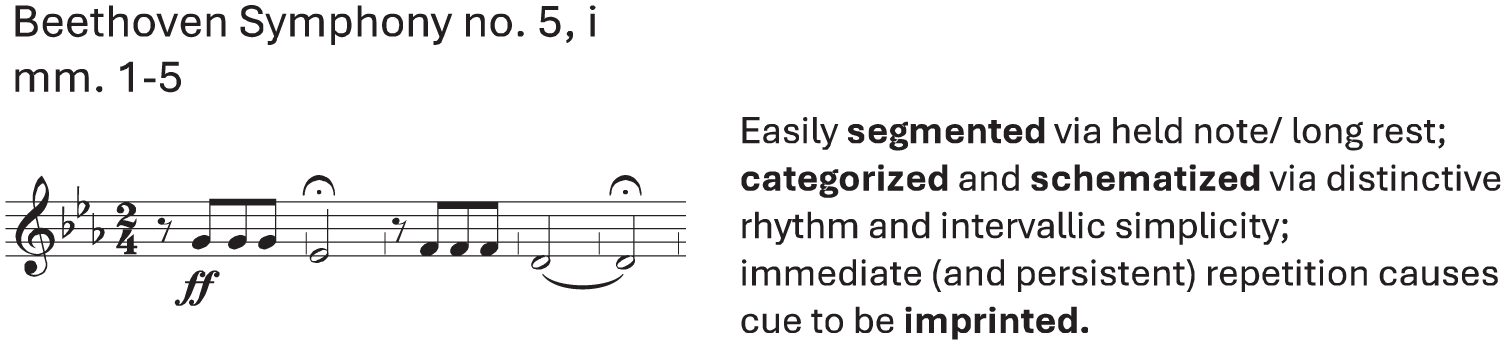
Salience and cue abstraction components vis-à-vis main motive/cue from Beethoven’s Fifth Symphony.
The final element of cue abstraction, imprint formation, emphasizes the importance of this last factor, repetition, for the long-term coding and recall of the cue. A cue can be memorable after one hearing, but the more it is heard, the better it is remembered and the richer its family of subclasses and contextual associations may become.
Research on segment salience by Margulis (2012) found that untrained listeners were, at first, better able to recognize the repetition of smaller units; upon repeating the task with the same stimuli, those participants showed an increased “attentional shift toward larger temporal spans across multiple hearings” (p. 377). A segment can thus evolve into a different musical object on repeat listening – either during the piece (see Hanninen, 2003 on “recontextualization”) or over iterated hearings of a complete piece (discussed in Cone, 1989). Here, too, Beethoven’s Fate motive matches cue abstraction criteria to the letter: after its introductory frame, it persists with storied single-mindedness “in almost every bar of the first movement” (Kerman et al., 2001).
A Sense of Place
Having proposed a mechanism for how cue material is apprehended and sorted, Deliège does not commit to a theory about global structure, as such. The “mental line” links nonconcatenated structures but not into a continuous mental representation. This makes intuitive sense; it would not be parsimonious for listeners to be constantly incorporating new segments into an ever-growing schema if they are already capable of storing cues as “a succinct . . . sort of label, that reduces the memory load required to internalize the whole structure” (Deliège, 2001a, p. 238). Clarke and Krumhansl (1990) developed this point in parallel research, suggesting that sections “may be labelled with their functions (e.g., ‘ends the piece,’ ‘develops the first idea’) . . .” (p. 218), suggesting an analog to experiments in verbal retention carried out by Jackson (1985). In those studies, participants tasked with memorizing lists performed better when they organized the words into a narrative than when they memorized by rote. This signposting strategy closely resembles the mnemonic technique of loci (Foer, 2011) and the coding efficiency principle known as chunking (Johnson, 1970). It is also one that Deliège explicitly invoked in her instructions to participants (e.g., Deliège, 1989; Deliège & El Ahmadi, 1990; Deliège et al., 1996 [Experiment 1]).
Formal/Temporal Functions
The suggestion that musical segments might evoke a sense of beginning, middle, or end is well supported by our involuntary tendency to mentally organize experiences or phenomena according to a coherent event structure (Zacks & Tversky, 2001). In the 18th century, music theorists began referring explicitly to temporal phases, trending over time toward considerations of ever-longer spans: Mattheson (1731) and Koch (1782) examine melody and period; 19th-century theorists like Momigny (1806) and Marx (1837) widen the aperture to formal sections; for Kurth (1913), Schenker (1935), Schoenberg (1967), and Ratz (1951), the horizon extends to whole movements or pieces. Modern writers like Cone (1968), Meyer (1967/1994), Dahlhaus (1978), Kramer (1988), Rosen (1995), and V. K. Agawu (2009) all thematize the beginning/middle/end paradigm in some fashion, as well, but the theorist who has embraced it most systematically is Caplin (1998).
Caplin proposes functional isomorphisms between harmony within a single phrase (e.g., initiation, continuation, and cadence) and temporal phases. Each of these functional processes is identifiable based on a combination of immanent harmonic characteristics in the phrase – its “intrinsic” function – as well as that phrase’s “contextual” function within the piece. In later writing, he effectively shades formal functions into equivalence with “temporal functions” (in Caplin et al., 2010), which is the term preferred below. Returning to the opening of Beethoven’s Fifth Symphony (Figure 2), we can identify the clear temporal phases of the first full “sentence” phrase through the repetition of a basic idea and the continuation to cadence.

The first full phrase of the Fifth Symphony exemplifies the normative temporal phases of the classical-style sentence structure.
An essential characteristic of temporal functions is that they nest hierarchically within the structure of the piece. For example, the phrase above contains a segmented local beginning, middle, and end; yet in its “tight-knit” construction, establishment of the tonic harmony and conclusion on a half cadence, it also exhibits signature features of a global beginning. At this higher altitude, it can be understood as the beginning of the beginning, while the expositional codetta of a sonata movement is the end of the beginning, or the subdominant function at the start of many codas is the beginning of the end.
Caplin maintains that “only a limited number of parameters have a direct bearing on the expression of formal function,” and it is evident that harmony is foremost among them (Caplin et al., 2010, p. 144). Thematic material, on the contrary, is not held to be temporally functional (1998, p. 4). This downplaying of musical themes compared to harmonic process is common enough in classical sonata form theory (Ratner, 1949), but, as a perceptual determinant of global structure, it would be undesirable to give harmony too much emphasis, given the more limited role of that parameter in musical memory.
Caplin’s theory has been subject to criticism from some of his colleagues. For example, Rohringer (2016) assails the distinction between intrinsic and contextual function as flimsily drawn, while Webster calls it “unprovable” (p. 47). Moreover, from a compositional standpoint, the term, function, is indeed loaded with implications of doing something in and to the music (Hepokoski and Webster in Caplin et al., 2010). A more neutral construction like temporal “marker” or “signal” may thus be more apt as music theory, but as music psychology, anything that helps the listener recognize where they are in the overall progress of a piece amounts to much the same thing: it functions in the mind as a sign or index. The notion of hierarchically nesting functions has also come under fire; yet it is the case that listeners experience differing levels of emphasis in metrical hierarchies (London, 2012) and local modulations (Woolhouse et al., 2016), so it is not far-fetched to suppose they sense multiple layers of temporal orientation simultaneously. In other words, notwithstanding temporal functions’ potential vulnerabilities, we can acknowledge that, as a heuristic for first-order structural perception, they need not satisfy all theories of musical construction.
Nor must we constrain ourselves to Caplin’s precise understanding of them, because the overall concept invites an encompassing link between music and existing models of event structure, both in terms of nonlinguistic experience and those events in which structural coherence is overdetermined by language (e.g., narrative). One need not be familiar with the taxonomies of sonata form to recognize beginnings, middles, and ends; enculturated exposure to patterns in Western tonal music should be sufficient. In that sense, the universal quality of the beginning/middle/end paradigm that some writers denigrate as “banality” (Ayer, 1991, quoted in V. K. Agawu, 2009) or “triviality” (see Hepokoski’s response to Caplin in Caplin et al., 2010) is precisely what gives that paradigm explanatory power as a perceptual phenomenon.
There is also some preliminary empirical evidence that listeners can identify snippets of a phrase as a beginning, middle, or end (Vallières et al., 2009). Sears et al. (2014) found that musicians and nonmusicians were aware of the strength of specific kinds of cadences, supporting the idea that listeners recognize relative degrees of closure in context. Other studies suggest that, at higher levels of structure, listeners maintain a rough sense of temporal orientation (Granot & Jacoby, 2011, 2012; Lalitte & Bigand, 2006). Another (De Souza et al., 2020) showed that even untrained listeners could distinguish classical-style first movements (i.e., sonata-allegro forms) from last movements (i.e., rondos) based on characteristics in their opening themes. This last bit of evidence supports the idea that something like the “beginning of the beginning” and the “beginning of the end” can be recognized at the global level of a multi-movement work.
It is not essential that listeners be continually aware of the beginning/middle/end schema at all moments in the piece – it may surface at specifically relevant moments. Considered this way, cues can be more than just memorable signposts (You have been Here before), they can also function as arrows indicating a vector in musical time (You are going There now). Margulis reached a similar conclusion interpreting the results of a study in which participants had difficulty recognizing repetition when a unit ended one phrase and immediately began the next:
when it occurred the first time, the measure-long unit was heard as an ending. This ending aspect may have seemed like an essential part of the identity of that unit – it was an ending thing. If this was the case, when the unit recurred – even immediately – as a beginning, it may not have been recognizable as the same object. (Margulis, 2012, p. 383)
This could be true if the single measure in question was not salient enough to be abstracted as a cue. When they are sufficiently imprinted, however, cues might, indeed, perform multiple functions, even at great temporal remove while retaining categorical identity. As an initial analytical example, consider the first movement of Beethoven’s Eighth Symphony. The piece irrupts forth from silence with a motive that (if not repeated quite as much as the ubiquitous “Fate” motive in the Fifth) permeates the first movement enough to be assumed a salient cue. It is most often heard as a phrase initiation, though later in the development, it both initiates and enacts sequential continuation. What it never does is end a phrase – that is, until the very end of the movement, where it appears in the bassline measures as a quiet tonic peroration (Figure 3). Because the figure completes a tonic triad in root position after perfect authentic cadences, we have no trouble understanding it, intrinsically, as a functional ending; yet we may also recognize that, given the context of its use in the movement, the cue sounds rather misplaced as a conclusory gesture (wryly so, in keeping with the tone of the whole piece). This temporal-functional ambiguity signals, perhaps, that there is more music to come, inviting attentional continuity from one movement to the next.
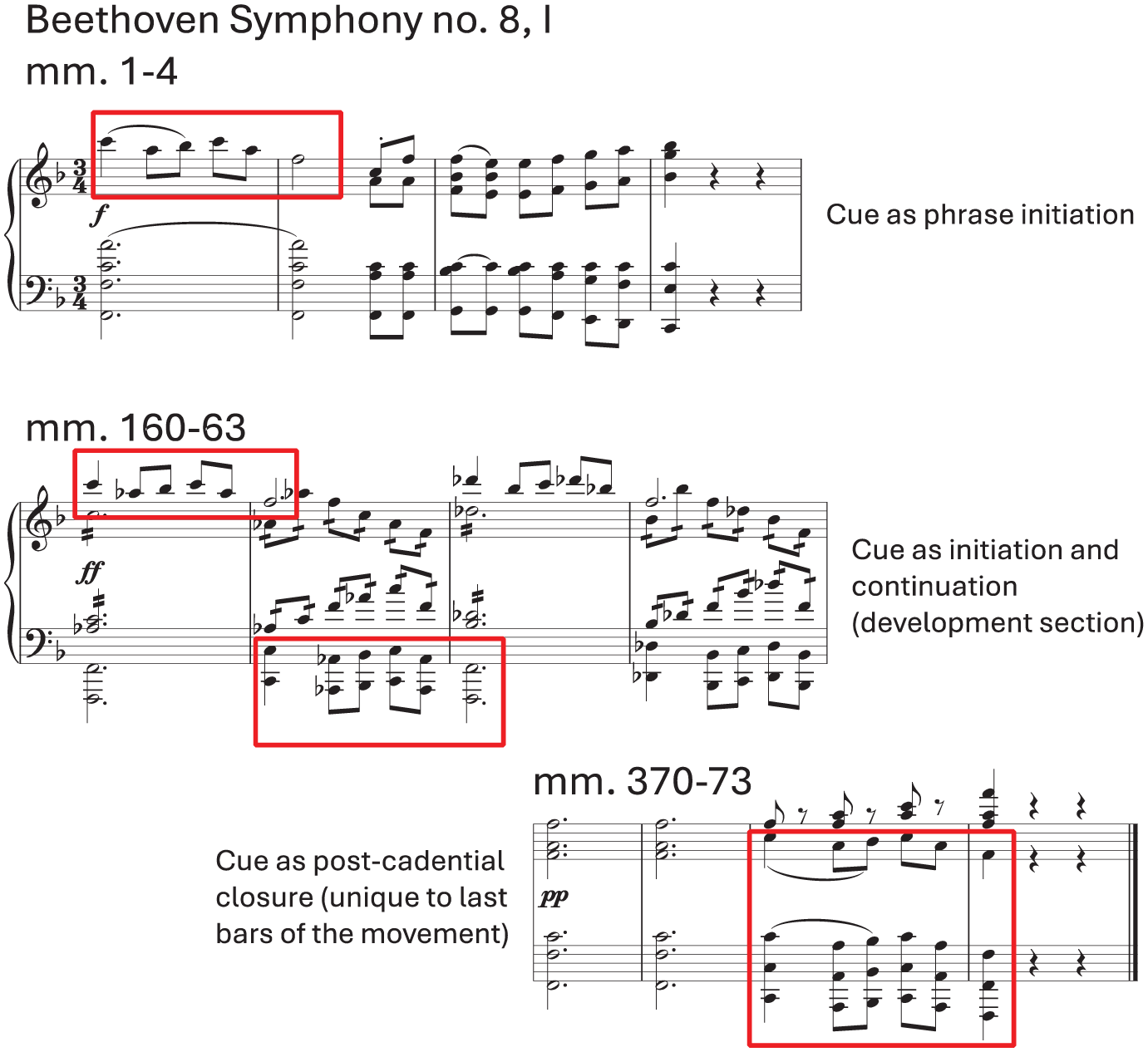
Temporal transformations of the main cue in Beethoven’s Eighth Symphony.
Synthesizing Cue Abstraction and Temporal Function
Music analysts often resist adopting multiple theoretical frameworks at once (Ohriner, 2010); yet, for perceptual analysis of large-scale structure, there may be special value in modifying temporal functions to accommodate cue abstraction. That is, Caplin’s (1998) theory “minimizes the motivic content as a criterion of formal function” (p. 4) because such content is subsumed into (for him, more important) harmonic processes. When, however, motives are understood in a less restrictive way (i.e., as cues), parameters other than harmony assume greater importance. These dimensions can be temporally relevant over long durations in the way Caplin’s harmonic processes preside over short ones, as suggested by the movement-spanning relationships in the Beethoven Eighth example above. The analysis below supposes that temporal functions may apply to a basic level of musical understanding requiring no exceptional domain-specific expertise. Reybrouck (2009) makes a related point about cues’ indexical, or deictic, potential, noting that this approach has the dual benefit of being both “congruent with real-time perception” and “not restricted to particular types of musical structures” (p. 106). Perhaps by synthesizing Deliège’s and Caplin’s perspectives, we might approach one of the most confounding problems in music psychology – the perception of large-scale structure – in a novel way that proposes how relatively untrained listeners can make some sense of longer, complex structures.
Analysis
Cue Manipulation at Structural Junctures
To show how cue construction/variation codes temporal function, we continue with Beethoven’s Fifth Symphony. In the prime occurrence and restatement of the cue, mm. 1–4, the decisive rhythmic element is held constant while the melodic material changes. This parametric bivalence generates two temporal implications: the rhythm of the cue denotes initiation (via anacrusis), and the pitch content suggests continuation (via tonal ambiguity and nonclosure). The latter effect is achieved with admirable economy: the collection of four pitches implies either C minor or Eb major (NB: as few as four notes are sufficient for listeners to abstract an underlying tonality in Cohen, 1991). Regardless of the initial perceived key, an anticipated resolution is delayed by the fermata on D in m. 5. To these temporal levels, we may add a third: the grand rhetorical gesture of a global introductory frame, or what Caplin (1998) has described as the framing function “before the beginning” (p. 15; Figure 4).
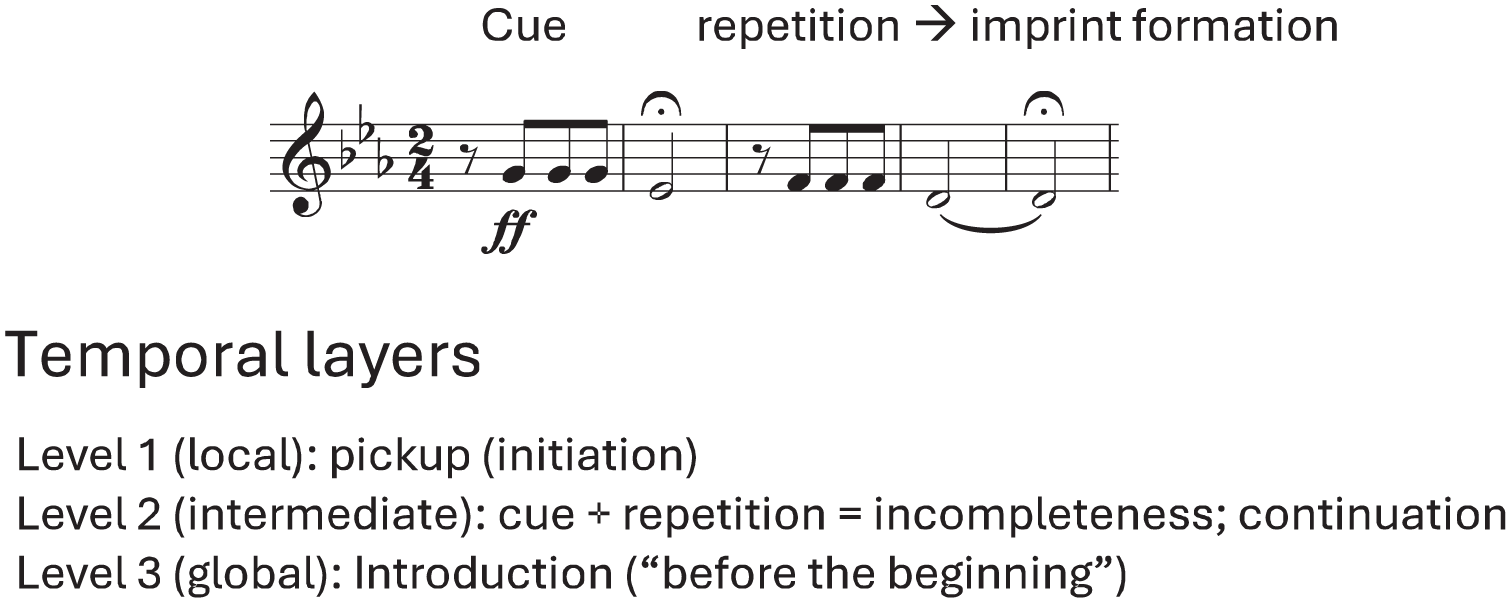
Temporal multivalence of the first statement of the opening cue.
The rhythm is maintained throughout the piece as unrelenting forward musical progress, while the melodic contour of the cue changes. It is based on these contour alterations that we can identify three subclasses of the cue. In the presentation of the basic idea, the essential eighth-note rhythm appears, as in the introduction, on a repeated pitch and descends over the barline. In the continuation phase, the eighths move in stepwise motion. The cadential version of the cue inverts the motion of the initiatory version, with repeated-note eighths now resolving upward. Figure 5 demonstrates three subclasses of the cue and their associated role in the structure. This is where a purely statistical approach to motive recognition (i.e., family resemblances) might miss that large-scale organizational principles can be influenced by order effects. The transformations of the cue are not randomly distributed; instead, each class of variation is easily recognized and highly localized within the form.
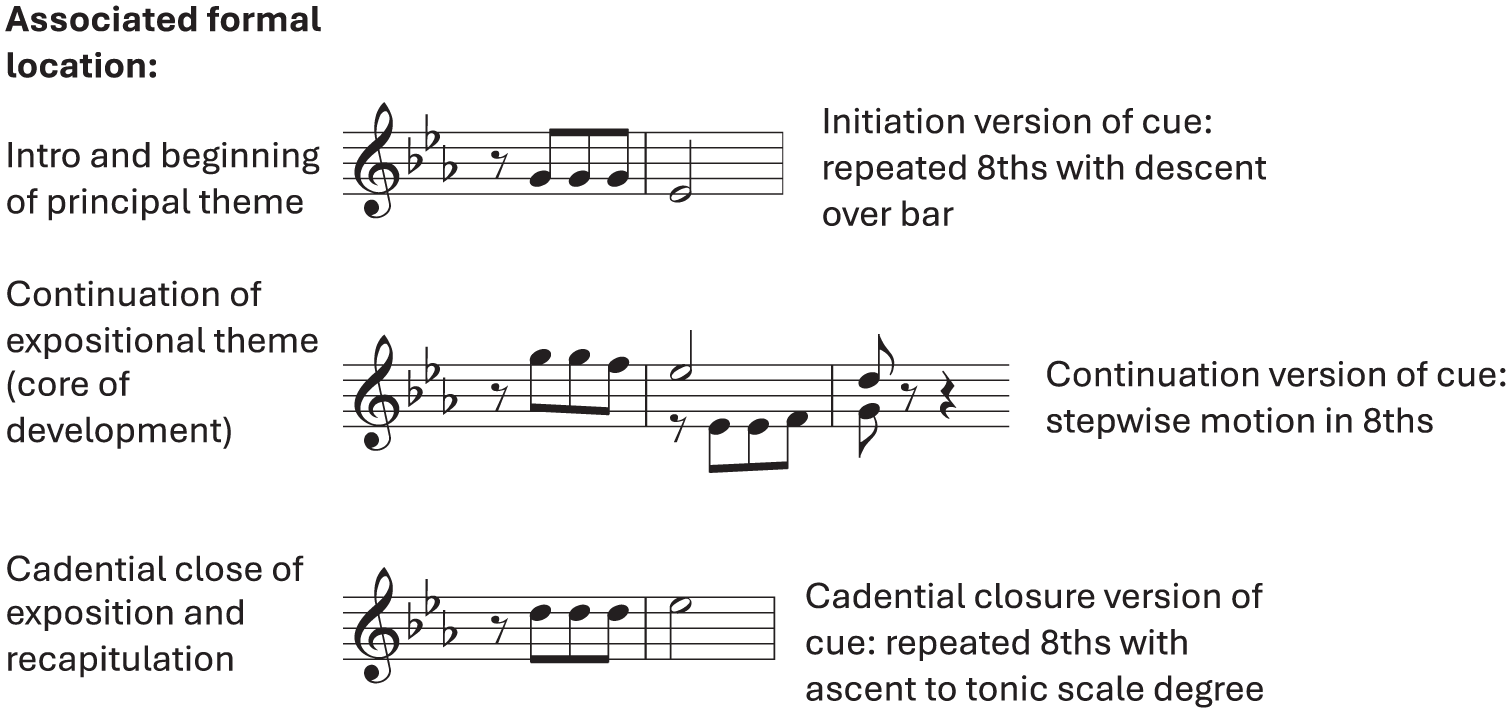
Three subclasses of the “Fate motive” cue, based on contour and associated form-functional location.
We are compelled for the purposes of this analysis to assume two things: (1) that the listener can identify any instance of the Fate motive rhythm as belonging to the same overall class and (2) that they are nevertheless capable of recognizing the contour variations as genuine subclasses. If so, the stepwise subclass indicates continuation rather than initiation (i.e., the stepwise eighths never once begin a phrase). This categorization thus seeds large-scale structural implications for the listener: the stepwise subclass is used very prominently in the core of development (see mm. 137–167), marking that section of the piece as a large-scale continuation process, not a beginning or end.
I have spoken about the way in which the three-note anacrusis of the main cue points forward in the exposition at the level of the notated measure. As most analyses of this movement point out (e.g., Furtwängler, 1951; Imbrie, 1973; London, 2012; Schenker, 1921; Schuller, 1997), there is also an “emergence of various levels of meter above the notated measure” (London, 2012, p. 111) that establish four-beat “hypermeter” (Cone, 1968).
The rhythm of the cue implies forward drive and reinforces the longer periods of regularity; however, in the famous passage beginning at m. 196, the cue disappears entirely, resulting in a collapse of the hypermeter and an arrest of forward progress. The piece is here thrown into a turmoil of “metric dislocation” (Imbrie, 1973). We are unable to hear which way is up or down[beat], until the cue finally returns at m. 228 (a “reviving flash of anger,” per Berlioz, 1994, p. 19), restoring orderly hypermeter and (mm. 240–248) galloping toward the recapitulation of the opening like a colossally extended pickup. It is no contradiction to hear this as the return of an initiating function, nor does such recognition require knowledge of sonata form. As a thought experiment, we might consider how much less effective this sense of re-initiation would be had Beethoven used one of the other subclasses of cue (Figure 6). Certainly, as Beethoven wrote it, even a naïve listener may vault at this moment in the piece to a higher-level comprehension of structural flow, attuned to what Smyth (1990) calls “the slow pulsation of the rhythm of form itself” (p. 237).
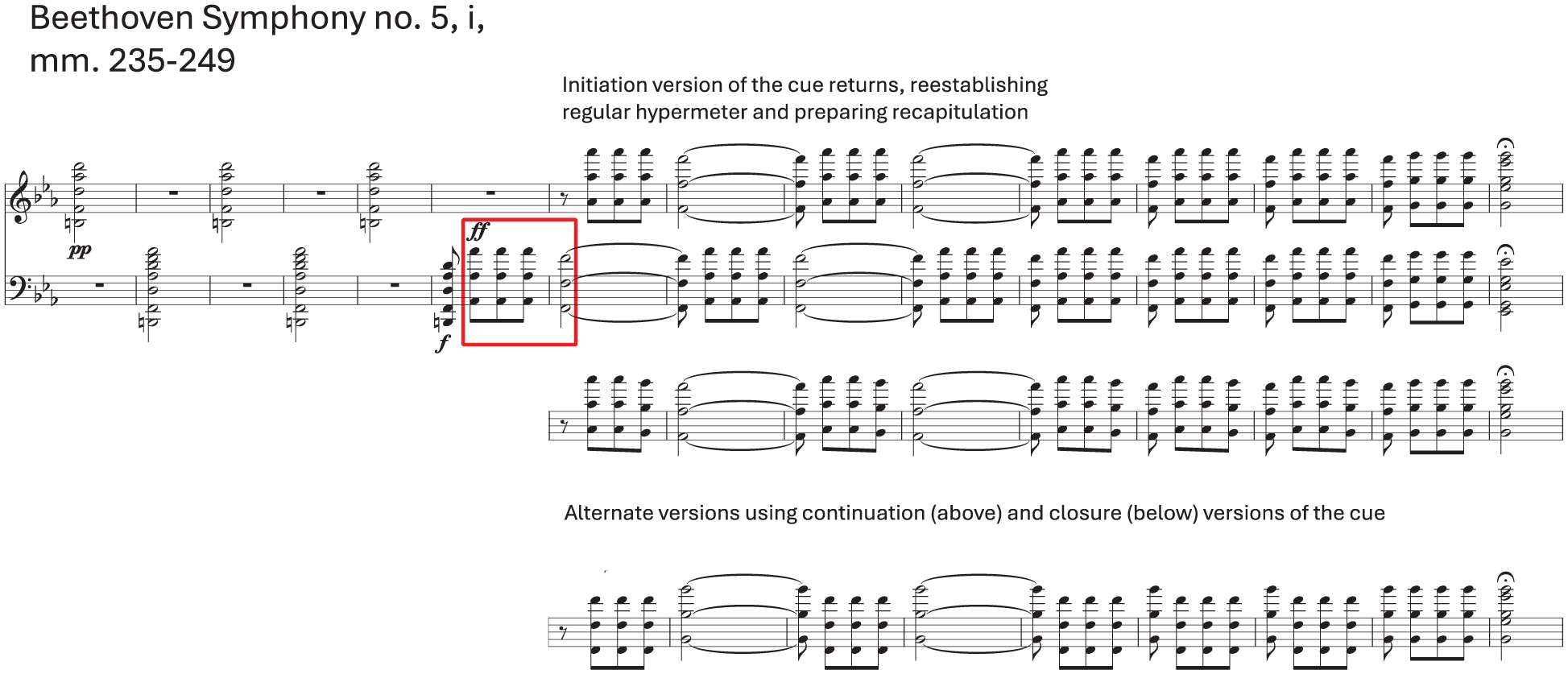
The restored cue (in prime, initiating form) functions as an anacrusis to the recapitulation.
Beethoven’s recapitulatory coup may, from the standpoint of music history, be a singular achievement, but the technique employed can be found elsewhere. In the first movement retransition of Haydn’s Piano Sonata No. 49 in Eb major, two cues from earlier in the movement are interleafed. The first is the anacrusis to the principal theme (Figure 7), a melodic figure repeated enough throughout the piece to ensure its salience. The second motive is also a pickup, but it functions as an agent of uncertainty and delayed closure, first at the closing theme of the exposition (mm. 53–56) and again toward the end of the development (mm. 108–116; Figure 8). If an argument needs to be made for how this secondary cue achieves salience, one might point to the way in which it is “framed” by silence, almost as an object for the listeners’ inspection. 1
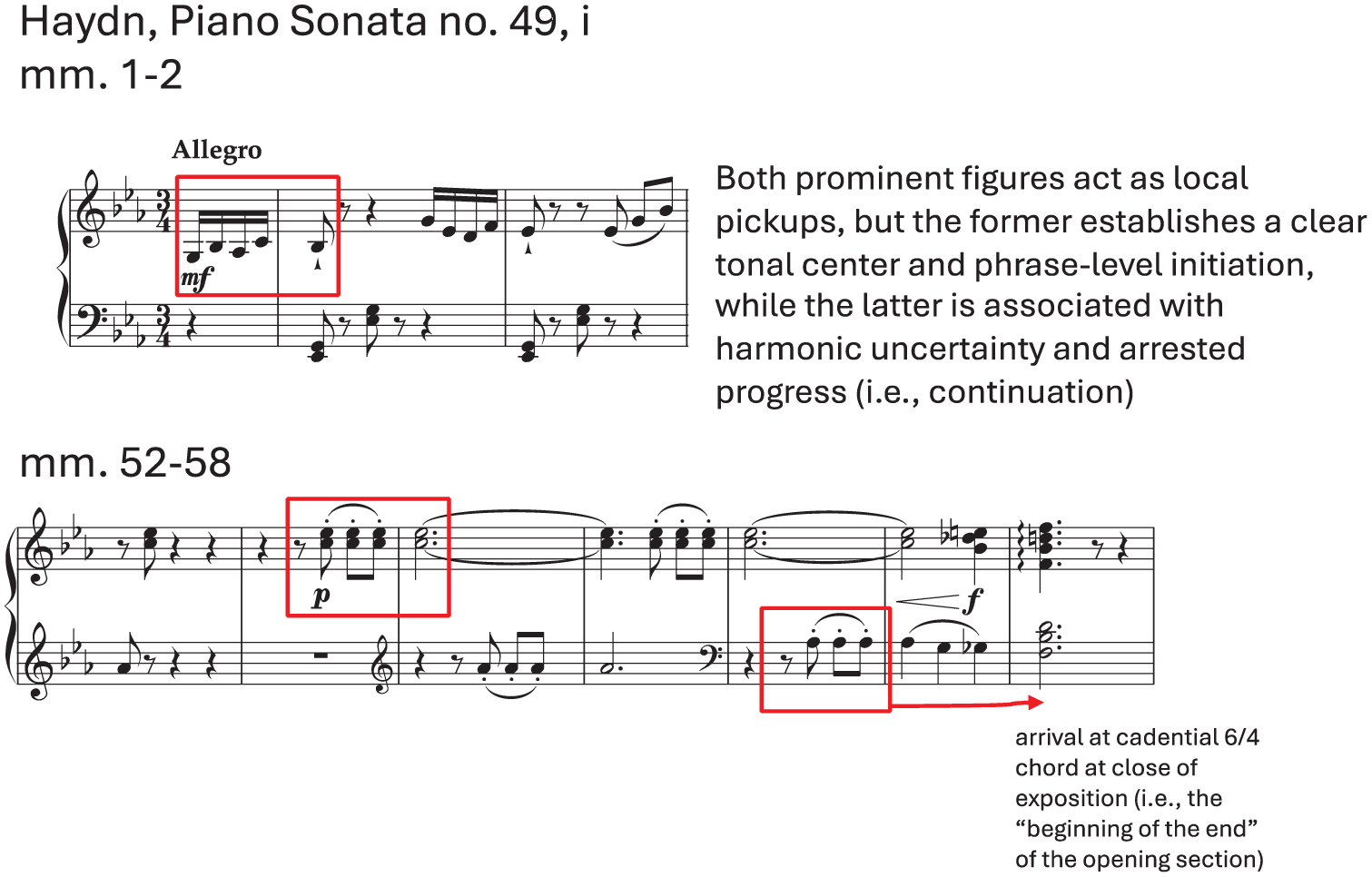
The two main pickup cues in Haydn’s Piano Sonata No. 49 in Eb major have divergent temporal functions at a higher temporal level.
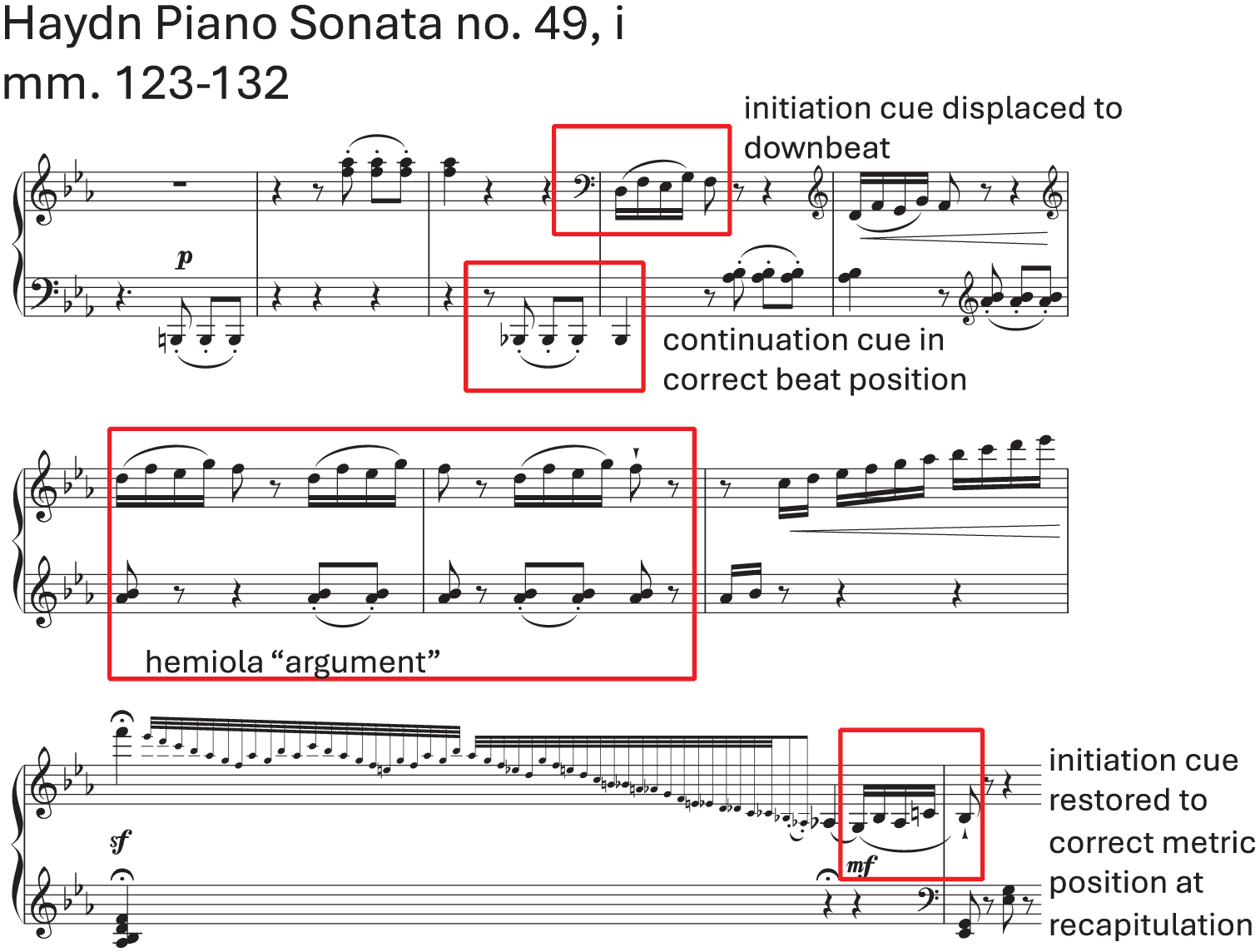
Disruption (and restoration) of the metric association of the initiating cue at a critical moment of perceptual and structural “return.”
The secondary cue opens out to a dominant at m. 126. In harmonic terms, recapitulation is imminent (Caplin, 1998, pp. 144–145). More noticeable, however, for the first-order listener – who will not recognize the tonal implications of a B-flat dominant and is unfamiliar with the term, “standing on the dominant” – is the metric conflict (hemiola) established between the pickups. The ensuing argument is resolved only after the right hand ascends to a climactic F (the climactic pitch of the movement), and a cadenza-like scale passage unwinds the tension, finally setting things in metrical order at the return of the opening theme (Figure 8)
In the example of the Fifth Symphony, the cue was imprinted unabatingly, and its temporal function was felt as a forward-driving, anticipation-building initiation, a quality that is reinforced and amplified just before the recapitulation. In the Haydn example, we see how the temporal implications of two different pickups are staged in conflict at an analogous moment of formal anticipation. In both examples, the interplay of cue and temporal function alerts the listener that a large-scale process is coming to a head.
The Role of Secondary Parameters
While secondary parameters, such as timbre, dynamics, and texture, do not typically feature prominently in traditional theoretical approaches, such surface features can greatly affect perceptual salience. They happen to play leading roles in the Rossini-esque allegretto scherzando of Beethoven’s Eighth Symphony. The dominant key area of this second movement lands in broad buffo fashion (m. 22) with a sudden fortissimo of outraged 128th notes. The abruptness of dynamic and textural change, as well as the collapse of a polyphonic texture into unison (for the first time in the movement), all mark this brief cadential gesture as a salient cue, even if it is heard sparingly (Figure 9). In fact, it is the very restraint with which Beethoven employs this closing gesture that gives it power in the coda. That is, this cue only occurs (with immediate repetition) at the major cadential points in the exposition and recapitulation (i.e., mm. 23, 25, 56, 58), and it is the only strong marker of cadential closure in the entire movement. We therefore reach the coda primed for its return. From Measure 74, after the harmonic close, uncertainty remains high. Measures 77 and 78 build on this entropic tension, only partly discharging the debt of a closing gesture through elevated dynamics and energy. While Measures 79 and 80 point decisively to the end with almost frantic reiterations of closing cadence, it is only in the final measure (where both expected statements of the cue are heard end on end) that we get what we are owed.
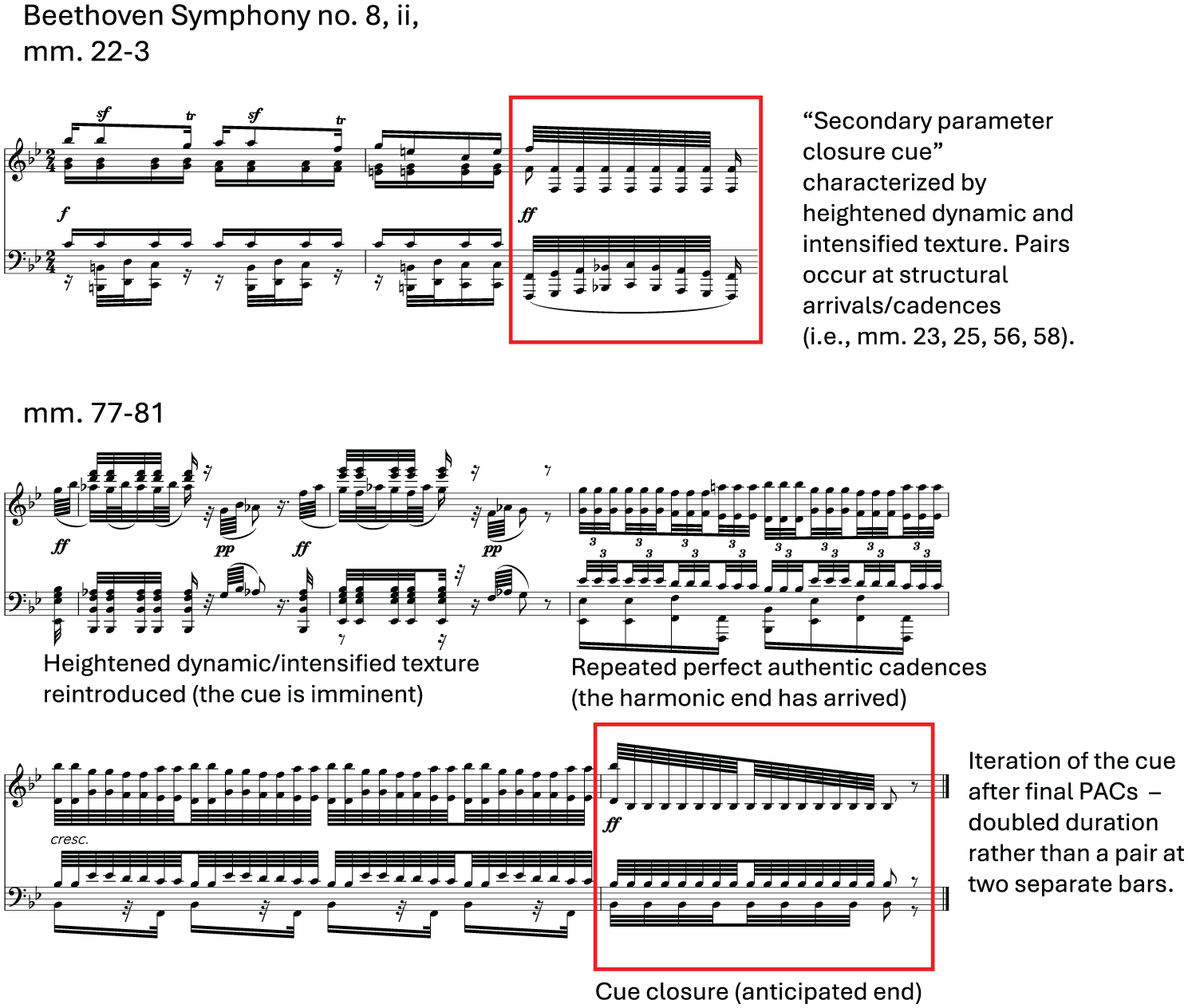
The use of secondary parameters to mark large-scale temporal closure.
It must be emphasized that this texturally and dynamically defined gesture is not a motive in the traditional sense – nor is it harmonically necessary, given the perfect authentic cadences preceding it. As such, it would likely pass unremarked in a conventional harmonic or motivic analysis. Yet from the perceptual standpoint, this lightning flash of pure secondary parameter culminates in a large-scale process, landing like the punchline to an extended joke. The comic brusqueness that made the cue surprising in the first instance also partly undermines its finality – appropriately so, given the movement’s interior position in the overall structure. In that sense, this textural-dynamic cue is part of a superstructural pattern of closure that spans the whole piece: the endings of the first three movements in this symphony are all relatively weak, priming us for the (equally comic) cadential excesses of the coda in the Finale.
The Adagio introduction to the Finale of the First Symphony also uses secondary parameters to shade the temporal function of a cue. Recapitulating distinctive rhythms from all three previous movements in a sort of ontological game, Beethoven sculpts a cue idea out of raw scale (Figure 10). This gesture is evidently the goal (conclusion) of the introduction, but through repetition in the exposition proper, it will be imprinted as a pickup – a “beginning thing,” per Margulis (2012) – for the main theme. The cue returns after the essential cadence at the end of the exposition, in the second violins at m. 83. Here, it elides the arrival of the codetta, thereby serving a triple function: at the phrase level, it has been displaced (like the Haydn example, above) such that it is now reacting to strong beats rather than initiating them (i.e., acting as a phrase continuation); at the higher section level, it has returned after long absence only following the clear cadences that announce the codetta (conclusion); and, finally, it retains its association with its first appearance as an introduction/pickup (initiation). As the cue drives the functional melodic tone up and away from tonicized G major back up to the dominant function, it replicates its initial function in the introduction, building anticipation for whatever process will follow. If the temporal convolutions involved defy simple description, they are no less hearable for that fact. More to the point is how this section sounds: the cue extends the tension of a local ending while projecting the initiation of future action (Figure 11).
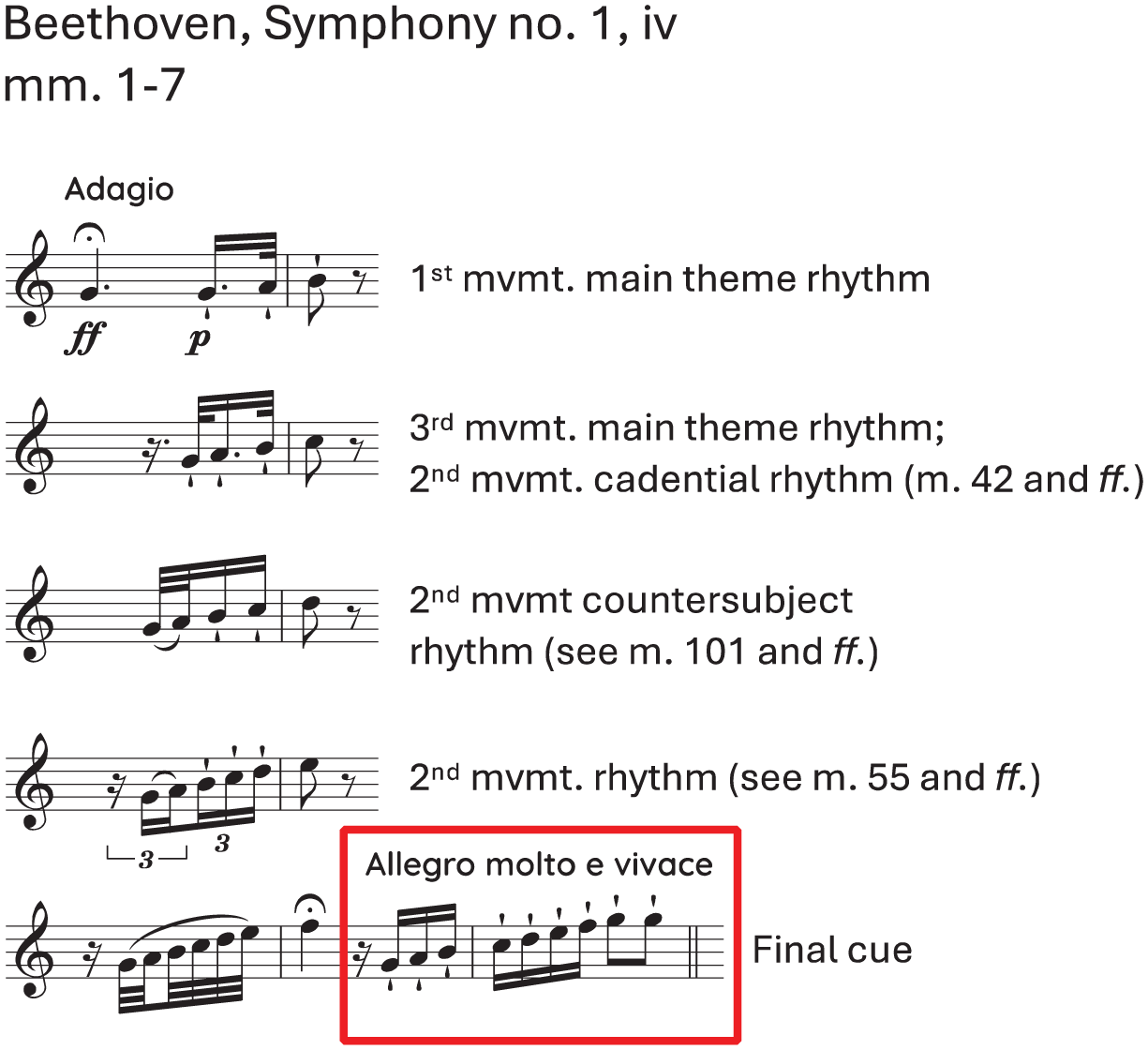
The scalar and rhythmic generative paradigm of the main cue of the finale of Beethoven’s Symphony.
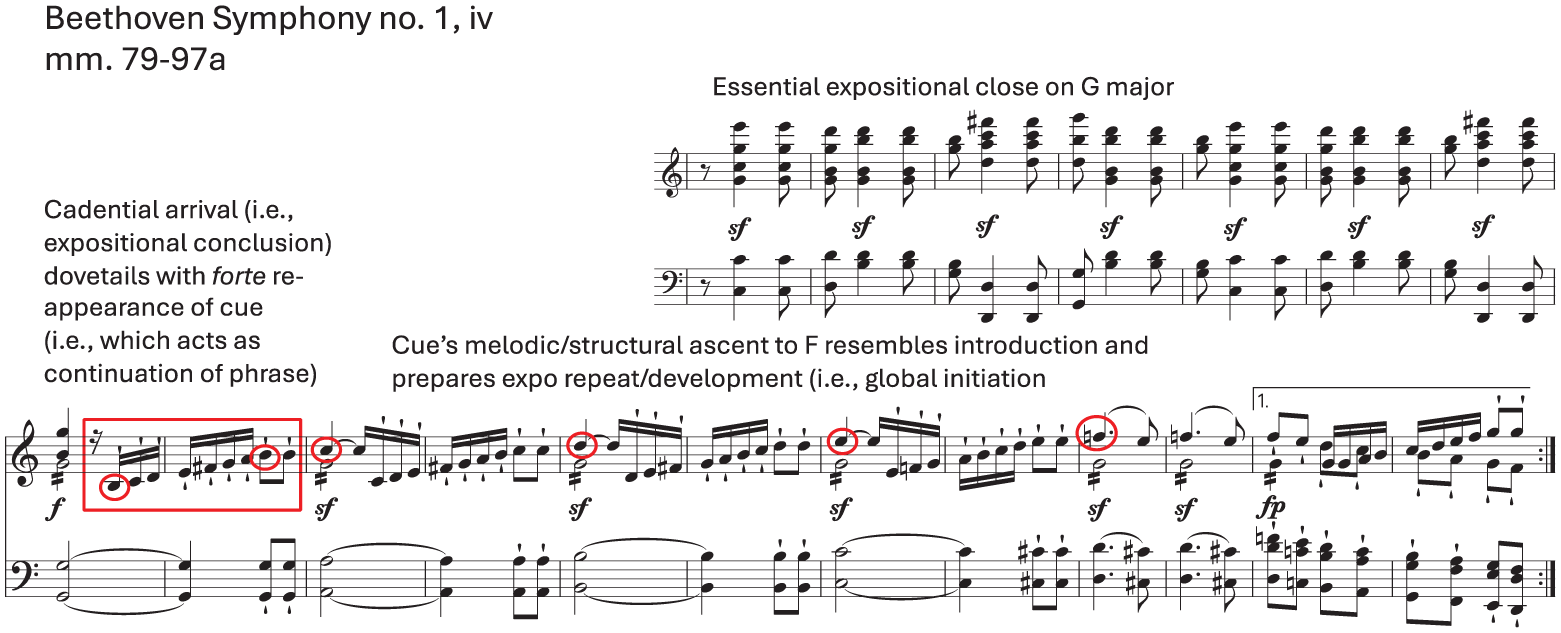
A temporal-phenomenological tangle: At a moment of sectional closure, the cue returns to act as a continuation in a phrase that conveys global (re-)initiatiwon.
So, as in a few of the examples above, a deftly manipulated cue indicates multiple temporal dimensions simultaneously; we also see the critical role that dynamics and orchestration can play in that multivalence. When encountered as an initiation, the texture is spare and the dynamic is piano. When the cue appears in closing guise, it is forte. The same pattern obtains for the development: piano and spare in the introductory pre-core, forte and fully scored at the end of the development. The recapitulation even more emphatically affirms the loud version of the cue as a local structural ending (here, fortissimo and, for the first time, doubled). The coda begins with what seems like another iteration of the first theme, but dynamics intervene, shockingly, to break the pattern at m. 246. 2 Now, the largest instrumental group yet grabs hold of the cue, driving toward the conclusion with ever-increasing intensity as still more players join the “pickup to the end.” It is yet another instance in which secondary parameters (i.e., dynamics and orchestration) play a decisive role in large-scale structural signposting.
Open Questions and Empirical Horizons
Our discussion began by outlining some doubts surrounding traditional analysis, particularly regarding its phenomenological relevance for nonexpert listeners. Music theorists have, at times, made extravagant claims regarding the relevance of large-scale structure – or have approached the topic in ways that too easily elide compositional process with aesthetic experience. Yet the empirical corrective has also occasionally succumbed to overbroad inference. There is a great deal more to learn about large-scale structural perception before we can make pronouncements about its validity, and both communities of musical researchers could do more to acknowledge and “share uncertainties” between domains (Cross, 2024).
The perceptual-analytical framework above proposes one kind of bridge across that interdisciplinary gap. Deliège’s theory of cue abstraction harmonizes with some theorists’ (especially Schoenberg’s) conception of motive or Gestalt, yet hers is also unencumbered by ideological commitments regarding the aesthetics of construction. Caplin’s theory of formal functions is, to many, a long-needed corrective among theories of harmonic construction (i.e., Classical sonatas) that can so often appear indifferent to phenomenology or perception. He is focused on a specific repertoire because he relies on tonal harmony as the central parameter. Yet, because the temporal paradigm fuses concept and precept – because its broader implications transcend style, and tonality, and the medium of music, altogether – I have seen fit to extract his ideas from their original remit so that they encompass more of what is known about how listeners experience musical events. Indeed, the broader applicability of these ideas has been recognized by several theorists who have adapted them to the analysis of 19th- and 20th-century repertoire (e.g., Bor, 2009; Moortele et al., 2015; Arndt, 2018; Utz, 2023). In combining temporal function with cue abstraction, I suggest that cues can form music’s temporal warp and weft, orienting the listener as to where they are and where they are likely to go.
Even integrating, as I have above, several strands of traditional musicology with an empirical stance may not bring the whole into view. It may be time to accept that traditional approaches, which tend to isolate primary parameters, are not always as germane to perception as looser concepts, like tension, motion, affect, closure, and so on (reviewed in Elek, 2023). There is, for example, an analytical tradition, broadly groupable under the aegis of musical “energetics” (e.g., Kurth, Halm, Kretzschmar; see Rothfarb, 2006, 2009), oriented toward the experience of comparatively untrained listeners, including primary school students. Energetics have been neglected in theoretical circles, but not because they lack nuance or insight; it is, one might suppose, because they are not as tidily systematic as the dominant methodologies, and, likely for the same reason, they have also not been integrated into empirical research. Relatedly, as emphasized above, a proper role will have to be recognized for secondary parameters, which are often set aside in analytical frameworks (Margulis, 2013) but may be determinative “form-bearing” features in cognition (McAdams, 1989) and contribute profoundly to highly salient structural events, like climax (Meyer, 1967/1994) and closure (Hopkins, 1990).
Nor should we ignore perceptual strategies that are not exclusively musical but that could still contribute to sense-making or “coping” with complex musical stimuli (Reybrouck et al., 2020). To that end, we might recruit theoretical constructs and adapt methodologies from narratology or reader response theory (Popović Mladjenović et al., 2009; Whiteley & Canning, 2017), mental imagery (Taruffi & Küssner, 2019), embodied cognition (Bowman, 2000; Cox, 2016), cross-modal correspondence (Elkoshi, 2020; Timmers, 2020), research into the experience of time (Wöllner & London, 2023), or the interrelation of global parameters and perceived emotion (Juslin & Sloboda, 2010; Repp, 1995). Musical training and familiarity with a musical style or a specific piece are also continua, not binaries; discerning when those factors exert an influence – as opposed to when simple enculturation sufficiently levels the perceptual playing field – requires further study. So do the roles of repetition, stimulus duration, and complexity. Finally, the function of the performer as interpreter/communicator of structure at the global level has neither been sufficiently addressed by music theory (Cook, 2013; Elek, 2023), nor has it been the subject of extensive empirical inquiry (but see Llorens, 2018; Timmers et al., 2006).
In this larger context of questions and caveats, what has been offered here must certainly be understood as limited in scope. And even then, it comes with risks. One can never assume that any analysis “represents, in a simple way, what someone “has in mind” when confronting music” (Zbikowski, 2002, p. 48); and any conjecture must be chastened by awareness of population variances and cultural contexts (Baker et al., 2020). Yet, it is a fact that certain aspects of musical structure (e.g., beat salience, tension, closure, principles of melodic expectation, segmentation) are shared by almost all listeners; and these may be stipulated for the purposes of a provisional perceptual analysis, even while empirical research continues, in parallel, to supply provocations in the form of new knowledge and fresh uncertainties. An analytical-empirical research paradigm of this kind – alert to the way listeners, rather than just composers and theorists – experience and understand musical materials, will be better equipped to guide the attention and interest of a listening public, be it through music appreciation pedagogy, explanatory notes, or concert programming. It is beyond the scope of the present writing to elaborate on the ways in which performers of the pieces analyzed above might shape tempo, shade dynamics, or highlight cues based on observations of the kind made here, although some possibilities are likely clear, already. This is merely a starting point for growing perceptual analysis into a paradigm that serves the aims of music students and professional performers interested in the overall experience of a movement, piece, or program.
Footnotes

Funding
The author received no financial support for the research, authorship, and/or publication of this article.
Declaration of conflicting interests
The author declared no potential conflicts of interest with respect to the research, authorship, and/or publication of this article.