







Abstract
In 1983, the Canadian government established a television fund to facilitate the development of a vibrant independent production sector by investing the production of domestic entertainment in four key genres. Over the next three decades, the annual budget of the Canadian Television Fund grew from C$35 million to over C$325 million1. In taking a stakeholder approach to explore the evolution evaluative practices at the Fund from 1983 to 2010, this study contributes to our understanding of performance measures as a networked practice. It also highlights the centrality of performance measures to multiple accountings of performance in the entertainment industry.
Introduction
Through the latter half of the twentieth century, television emerged as one of the most important forms of mass entertainment. Governments around the world have enacted policies to shape television programming in the public interest in whatever way it might be defined (Dunnett, 1990). When it comes to broadcast policy, Canada is a special case in many respects. The country shares a border with the most expansionist and successful producer of film and television programs in the world. In the 1950s, Canadians purchased television sets to watch American programming beaming across the border because there were no domestic broadcasters (Hoskins and McFadyen, 1986). The country’s relatively small population is divided into English- and French-language markets making it difficult to build the critical mass necessary for a self-sustaining entertainment industry. Although Canada’s broadcast policy was initially framed by concerns over cultural sovereignty and national identity, in many ways, Canada was the first to grapple with the effects of globalization in the entertainment industry given the combination of easy access to American programming and the small size of its domestic market.
Established in 1983 as an instrument of the Broadcast Act, the Canadian Television Fund’s (CTF) (“the Fund”) 1 mandate was to support the production of domestic entertainment content and build an independent production sector in Canada. At the outset, the Fund established a rudimentary set of performance measures to assess its performance against economic criteria. Over the next three decades, the Fund’s resources grew from an initial parliamentary appropriation of C$35 million to C$325.7 million, and the number of participating broadcasters increased from 4 to 79. As the industry matured, the Fund’s performance measurement system evolved into a complex set of metrics that incorporated assessments of quality and audience success with details on production volume of entertainment content.
The purpose of this article is to explore the evolution of the performance measures and evaluative practices at the Fund over the three decades from its inception in 1983 to its consolidation into the Canadian Media Fund (CMF) in April 2010. By taking a stakeholder approach to explore the evolution of performance measures over time, this study contributes to our understanding of how the networked nature of performance measures facilitates the integration of the different values of industry and government stakeholders in a regulated setting. It also highlights how measures and metrics are integral to a number of different accountings of performance in the entertainment industry.
The balance of this article proceeds as follows. The next section provides a brief overview of the structure of the television industry in Canada and the role of the Fund in this regulated sector. The third section provides a brief overview of the theoretical perspectives that guided my analysis. While the literature on performance measures is vast, my focus is on the subset of this literature that engages with the problems of measuring and the negotiated settlements on particular metrics. After identifying the research methods used in the fourth section, the fifth section details the evolution of performance measures at the Fund as it navigated a number of crises and a rapidly changing industry landscape. In the final section, I provide some reflections on the findings and concluding comments on the role of the state in popular culture.
Canadian television and the creation of the “Fund”
Since its creation in 1983, the Fund and the Broadcast Act have been the two main policy levers for the television industry in Canada. The Fund has experienced a number of structural changes over the years, but independent producers have remained its direct beneficiaries. The introduction of the Fund was a departure from prior policy initiatives that primarily focused on foreign ownership restrictions and revenue protections for Canadian broadcasters. The latter included a lucrative practice that became known as “simultaneous substitution,” which allowed Canadian broadcasters to insert their own signal (and commercials) when they aired the same programming as a US network (Hoskins and McFadyen, 1989). This protection was reinforced by tax policy that only allowed the deduction of advertising expenses for commercials aired on Canadian television stations.
Tax shelter incentives were introduced in 1974 to encourage private investment in domestic film and television production. However, these incentives failed to achieve their intended aim of building an independent production sector. By the early 1980s, concerns were growing over the dearth of Canadian programming in both the English- and French-language markets. At the time, around 98 percent of the dramas watched by Canadians originated in foreign markets, largely the United States (Collins, 1990). Since the cost of American dramas was largely recovered in their domestic market, they were licensed to the Canadian broadcasters for a fraction of their cost (Hoskins and McFadyen, 1986). While broadcasters were required to fill 55 percent of their schedules with domestic programming, they met this requirement through their news and sports offerings, which were much less costly to produce than dramatic series.
Given this dynamic, there was no viable independent production community at the Fund’s inception in 1983 (Standing Committee, 2003). Nor did any broadcaster – public or private – have sufficient domestic content to fill their schedules. To ensure demand for the Fund, the Canadian Radio and Telecommunications Commission (CRTC) instituted additional regulatory requirements on public and private broadcasters over the acquisition of scheduling of Canadian Content (CanCon) programming. For instance, in the first year of the Fund’s operations, the Canadian Broadcasting Corporation/Société Radio-Canada (CBC/SRC) 2 was mandated to acquire 50 percent of its content from independent producers (Collins, 1990). Over the next two years, similar regulations were imposed on private broadcasters, along with time and expenditure requirements for CanCon programming. The definition of CanCon was set out in an objective 10-point scale (see Table 1) developed by the Canadian Audio-Visual Communications Office (CAVCO). The CAVCO scale replaced the vague and subjective definitions of CanCon that prevailed before the inception of the Fund.
CAVCO scale for CanCon.
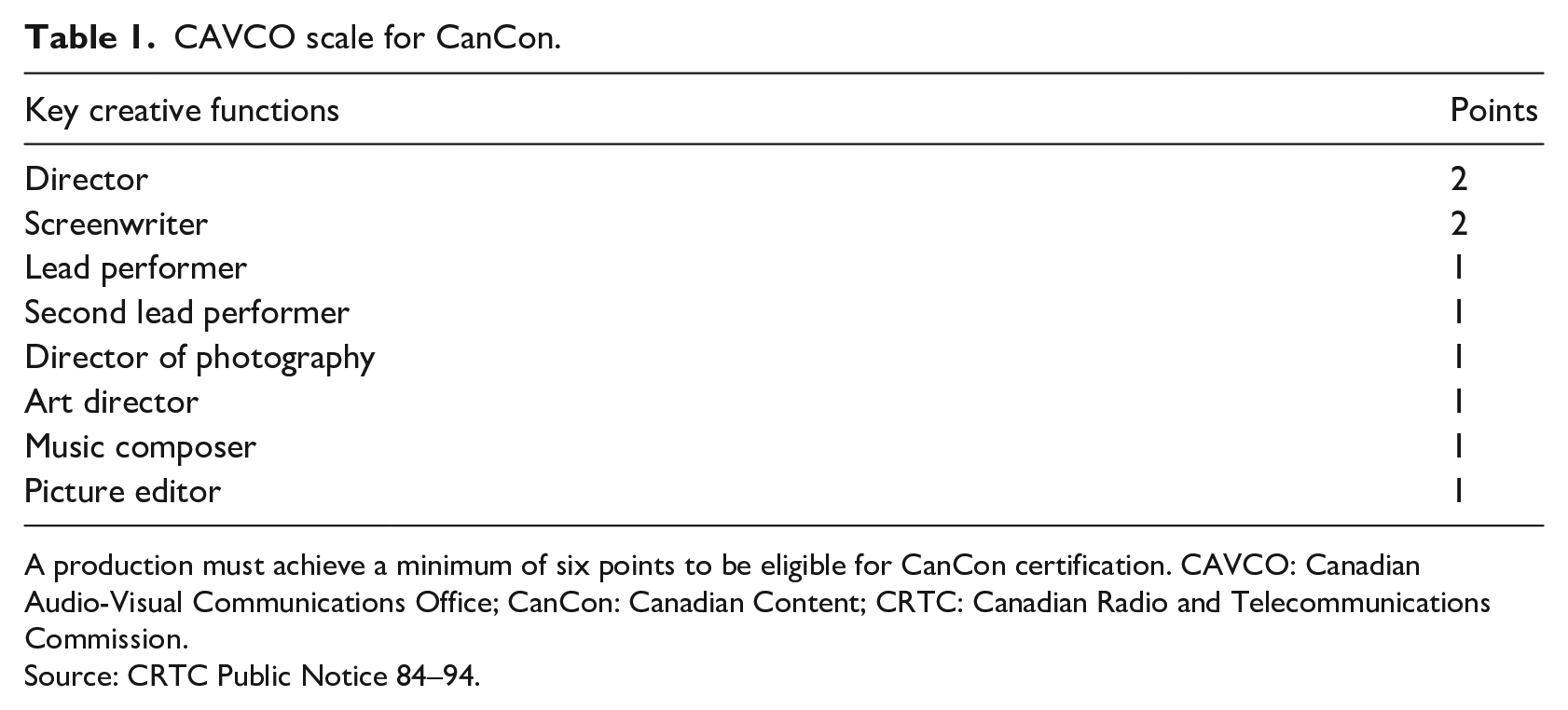
A production must achieve a minimum of six points to be eligible for CanCon certification. CAVCO: Canadian Audio-Visual Communications Office; CanCon: Canadian Content; CRTC: Canadian Radio and Telecommunications Commission.
Source: CRTC Public Notice 84–94.
To access the Fund, independent producers had to secure a license agreement with a Canadian broadcaster that included a commitment to air the program within two years of delivery (Hoskins and McFadyen, 1986). Independent production companies had to qualify as Canadian-controlled private corporations with no ownership ties to broadcasters. Eligible projects had to achieve a minimum of 6 out of 10 points on the CAVCO scale. Independent producers also needed to raise C$2 for every C$1 received from the Fund. Since the license fees from Canadian broadcasters only covered between 10 and 15 percent of production budgets, independent producers looked to the international markets to complete the financing for their projects.
Although the established protections for broadcasters remained in place, the Fund was viewed primarily as a market-based initiative that would provide resources to build an independent production community that would be competitive in both the domestic and international markets (Collins, 1990). The key aim of the Fund was to build a vibrant domestic industry by focusing “on financial measures designed to permit Canadian program producers to successfully meet this competition” (Hoskins and McFadyen, 1986: 229–230). This move toward market allocations reflected the prevailing ideas at the time that market-based initiatives were more effective as instruments of public policy (Collins, 1990). Yet, the Fund was also rooted in cultural imperatives linked to the development of a distinct national identity.
The Fund was initially administered by Telefilm Canada, a Crown corporation that operated at arm’s length from the government and had no direct influence on the programming decisions of broadcasters. Although the Fund was an autonomous entity, its operations were influenced by the actions and objectives of other public-sector organizations. Table 2 provides an overview of the roles and responsibilities of the different governmental organizations involved in the sector.
Key government agencies involved in the Fund’s administration.
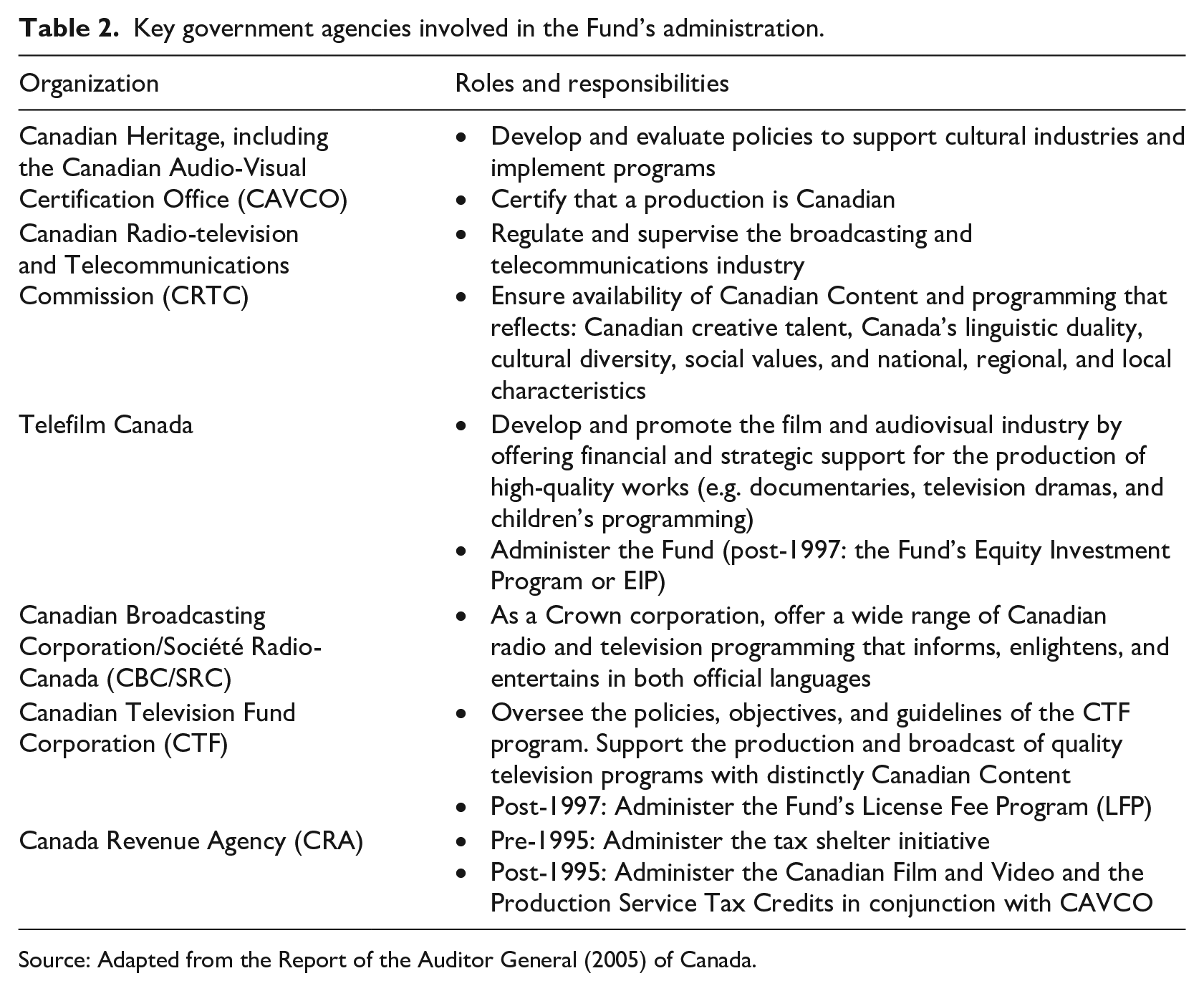
Source: Adapted from the Report of the Auditor General (2005) of Canada.
Other key industry stakeholders included broadcasters, independent producers, creators, and the viewing public. By the end of the decade, cable and satellite service providers or “broadcast distribution units” (BDUs) would also be an important stakeholder. As the industry grew, so did the entertainment infrastructure to support it. For instance, the Gemini Awards were introduced in December 1986 as the Canadian version of the Emmy Awards. The Banff Television Festival grew in prominence as an important market. Industry trade publications such as Playback Magazine and Canadian Cinema were established, and newspapers started publishing columns by television critics in their entertainment sections. By the 1990s, the Hollywood trades were also covering major events in the Canadian industry.
The industry landscape evolved considerably over the course of the study period. Advances in cable, satellite, and digital technology led to the proliferation of cable and digital channels. Audiences fragmented in the 500-plus channel universe and unscripted/reality television became a popular form of entertainment. Throughout this era, the Fund experienced a number of transformations in its governance and performance measurement systems. In the early years, when the independent production sector was in its infancy and available funding was plentiful, the goals of the Fund were broad and management control systems were rudimentary (Hoskins and McFadyen, 1989). As the Fund grew in size and the industry landscape became increasingly complex, a more sophisticated set of performance measures were required. Over the course of the study period, the performance measurement system evolved enabling the Fund to develop into a much more fine-grained policy tool.
Performance measures, metrics, and values
Research in the broader management literature has shown how the production of popular culture is shaped by polarities and conflicting values (Caves, 2000; DeFillippi et al., 2007; Lampel et al., 2000). Firms operating within the creative industries must balance trade-offs between artistic excellence and financial viability in order to be successful (Lampel et al., 2000). As they navigate the twin poles of art and commerce in the production of these goods, they also face the uncertainty of demand in an often putative market (Townley et al., 2009). The high failure rate in the entertainment genres of film and television is reflective of the “nobody knows” principle formalized by Caves (2000) to describe the inability of entertainment industry executives to predict which program will be a hit.
In many ways, the film and television industry is a sector at odds with the technologies of governance associated with state-level interventions and programmatic efforts to make organizations more efficient (cf. Miller and Power, 2013). At the same time, we have accounts of the transformative role of calculative practice at the BBC during the introduction of a market discipline at the storied institution (Carter and McKinlay, 2013). As financial responsibility devolved to the level of program and producer, key measures for evaluating program quality shifted from peer reviews based on cultural criteria to value for money (Carter et al., 2019).
While much of our knowledge on the development of performance measurement systems arises from in-depth studies of single organizations, Dambrin and Robson (2011) adopt a field-level approach in their exploration of the pharmaceutical sector. Their study highlights how regulatory limitations in the pharmaceutical center prevent the circulation of particular measures and metrics due to patient confidentiality concerns. At the same time, organizational actors are still able to “make do” with this interruption by creatively combining and comparing different inscription devices (Dambrin and Robson, 2011: 448). For instance, in order to alleviate uncertainty around self-reported data, sales managers combined drug reps’ activity reports with things like recall tests, expense reports, and return on promotional investment to assess performance.
The creative contribution of inscription devices is also central to the evaluative practices of experience goods or singularities, a category that includes film and television programs (Karpik, 2010). Since these goods are singular, users cannot be certain of their value prior to consumption and standards of quality exist only in the abstract as consumers may attach fundamentally different meanings to product attributes (Townley et al., 2009). Furthermore, their quality can be assessed on a number of different dimensions, so multiple evaluative criteria are drawn on when assessing their value (Karpik, 2010). For instance, film goers may rely on the ratings, rankings, and reviews of films provided by individuals and experts on the Internet Movie Database (IMDb) to inform their decisions on which film to see (Bialecki et al., 2017).
The coexistence of multiple evaluative frames also happens within organizations. The accounting literature has highlighted how performance measurement systems are characterized by ongoing struggles as different groups advocate for their own interests (Chenhall et al., 2013). At the same time, the confluence of multiple evaluative principles has the potential to produce a productive friction that enables organizations to come up with creative ways to recombine ideas and perspectives (Stark, 2009). Performance measures are often a site of compromise as their ability to represent performance is inherently incomplete (Chenhall et al., 2013). The ideal is not to strive for perfection in the measures (Dambrin and Robson, 2011) but to leverage their imperfections in reaching temporary settlements that give rise to a productive friction (Stark, 2009).
Taken together, the preceding paragraphs provide the scaffolding for an exploration of how the evolution of performance measures over time is shaped by stakeholders with different evaluative frames. My analysis is guided by a conception of performance measures as inscriptions or “signs that translate the world in its absence” (Dambrin and Robson, 2011: 430). From this perspective, performance measures are not understood as a concrete representation of actual performance but as a reference to a series of interpretations made by different users. In following the evolution of performance measures from the Fund’s inception, it is possible to trace how different evaluative principles were integrated into the metrics selected for different assessments of value.
Research methods
Data for the study comprised publicly available documents related to Canadian broadcast policy and the operation of the Fund from its 1983 through to 2010. Documents included the annual reports from Telefilm Canada, the government agency that administered the Fund in whole (1983–1995) and in part (1996–2005), and the CTF. The CTF, a public–private partnership, administered a portion of the Fund from 1996 to 2005, and assumed responsibility for the entire Fund from 2006 to 2010. To gain visibility into the perspectives of other stakeholders in the sector, additional data included government policy documents, reports of industry studies conducted by Parliamentary and Senate Committees, Auditor General Reports, CRTC task force reports, and the transcripts of public hearings held by CRTC in 2008. The Committee reports and public hearing transcripts contain direct quotes from a variety of industry stakeholders. The study also draws on the admittedly limited scholarly research that provided analysis and reflections on the creation of the Fund (e.g. Collins, 1990; Hoskins and McFadyen, 1986, 1989).
In adopting an accounting perspective in the analysis of the data, I focus on the performance measures and evaluative criteria used by the Fund. Particular attention was paid to the interrelations between performance measures used to assess the Fund’s performance and the evaluate criteria that guided project selection in order to understand how these two components shaped the production of CanCon programming. This analysis followed the six-phase approach outlined by Braun and Clarke (2006): (1) data familiarization, (2) generating initial codes, (3) searching for themes, (4) reviewing themes, (5) defining and naming themes, and (6) producing the paper. Initial codes were developed based on the Fund’s response to the numerous studies conducted by various government bodies. These codes were then refined through the integration of other stakeholder perspectives on the operation of the Fund.
These steps allowed me to become familiar with the changing landscape of Canadian television over the time of the study. 3 The initial codes allowed me to track how the objectives for the Fund evolved in response to the controversies and crises that arose over the timeline of the study. These codes were tentative and continually reworked through a chronological categorization of the themes, which provided an effective narrative structure given the analytical focus on the evolution of performance measures over time. The following section details the chronological emergence of particular performance measures used to assess the funds operations and their interrelations with the evaluative criteria used to assess potential projects for funding.
The evolution of performance measures at the Fund (1983–2010)
The findings outline the evolution of the performance measures used by the Fund from its inception in March 1983, until its transformation into the CMF in April 2010. The performance measures used by the Fund were relatively stable for the first 10 to 12 years of its operations. However, certain events that occurred during period provide the background for the conflicts that emerged as the industry matured and the Fund reached the limits of its growth in the mid-1990s. At this point, the conflicts arising from the different evaluative frames of industry stakeholders could no longer be contained. The Fund became the focus of numerous industry studies and conducted its own stakeholder consultations in an effort to alleviate these tensions. The sections that follow detail how the evaluative frames of different stakeholders shaped the evolution of the performance measures used at the Fund.
Building an independent production sector: the early years (1983–1995)
At its inception, the Fund had two main objectives: (1) to increase the quantity and the quality of Canadian programming in the drama, children’s programming, and performing arts/variety categories; 4 and (2) to produce programs using independent producers in order to support the development of a vigorous independent film and television industry (Telefilm Canada, 1986). Although the Fund was not directly involved in any production activities, it originally selected the projects that received funding. During this era, Telefilm’s annual reports highlighted a number of basic performance metrics that were aligned with their objectives (see Table 3). The inclusion of macroeconomic data was a way to justify the use of public monies in television production and bolster the legitimacy of the emerging sector.
The Fund’s original performance measures.
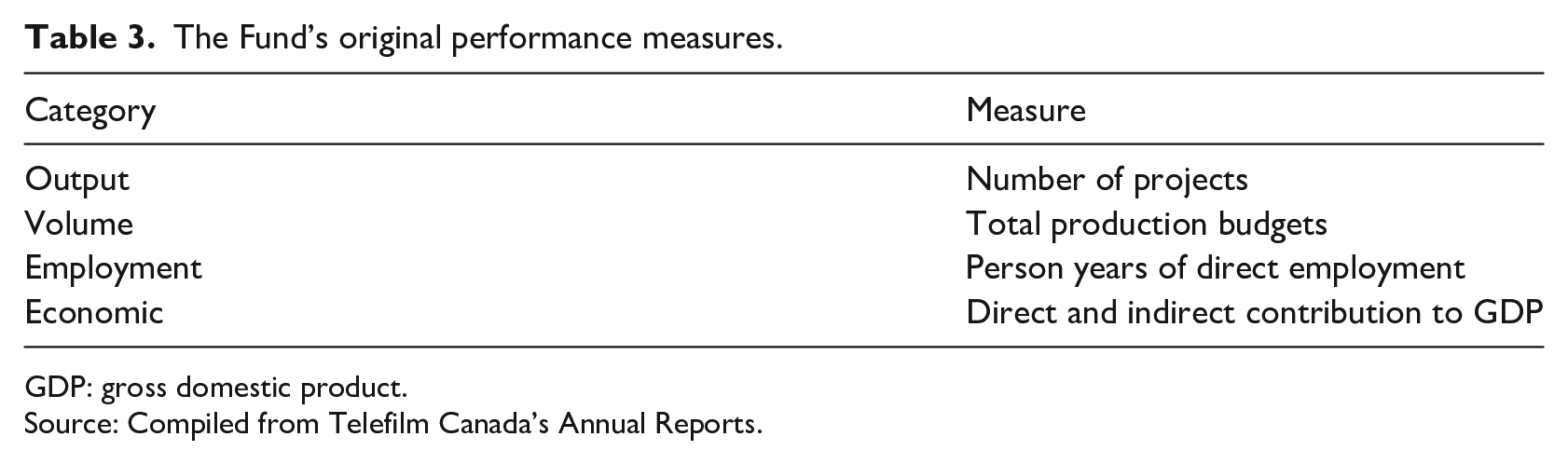
GDP: gross domestic product.
Source: Compiled from Telefilm Canada’s Annual Reports.
The output measures highlighted in the annual reports provided convincing evidence of industry growth (see Figure 1), which was not surprising since they were building the sector from a virtually non-existent base. However, audiences ultimately determine success in the entertainment industry, not production volume. When the Fund was established, many industry insiders wondered whether Canadians had an appetite for homegrown programming. These doubts were removed by the Fund’s third year of operations when the Anne of Green Gables (1985) mini-series attracted 5.8 million viewers in the English-language market. The success of Anne was ground breaking in many ways for the fledgling sector. Starring Megan Follows, the series won 10 Gemini Awards and an American Emmy Award. Telefilm featured the international success of Anne in its annual report to highlight its efforts to create a presence for Canadian producers in the international markets. This included Telefilm’s success in developing international co-production treaties with a number of countries.
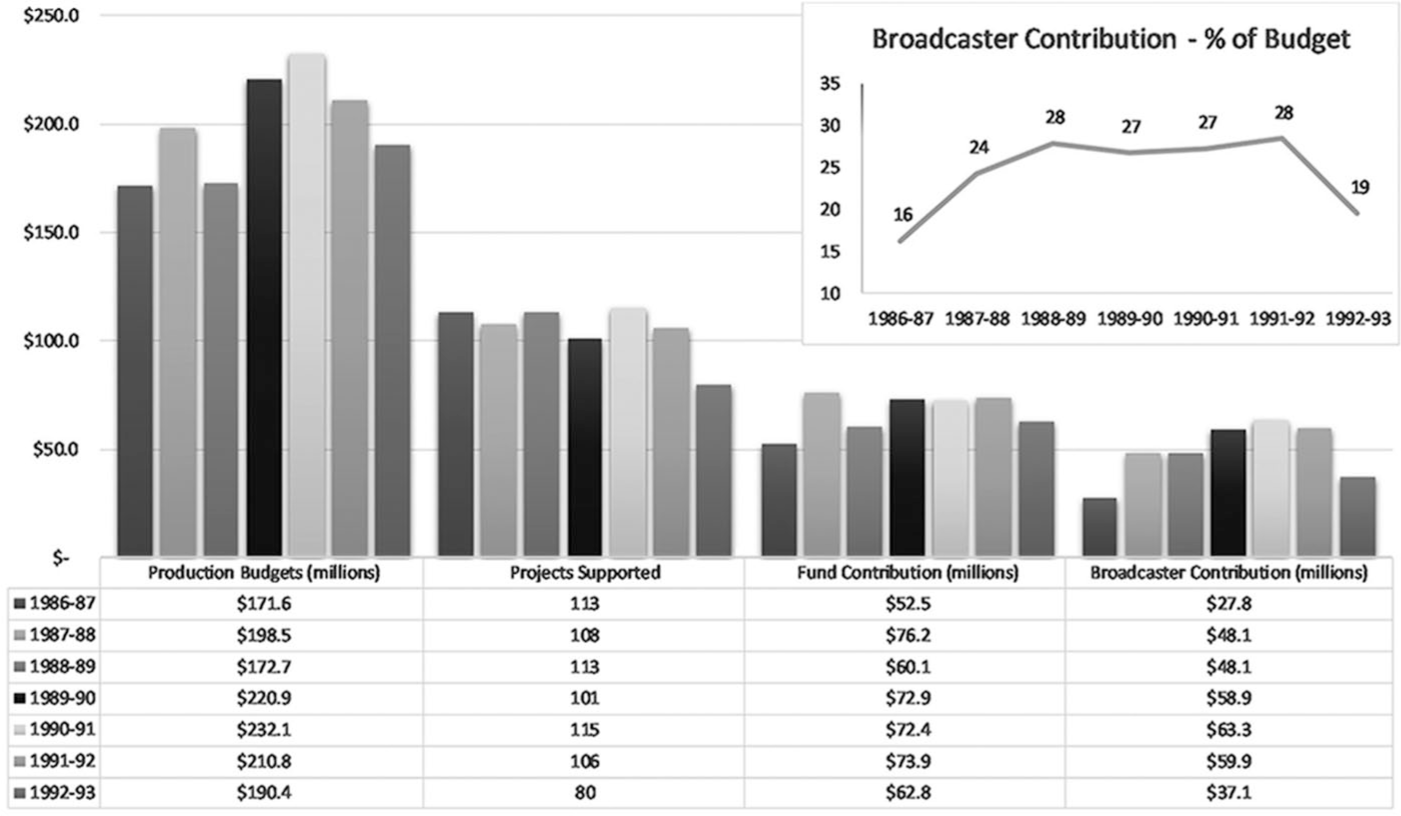
Financial contributions to CanCon programming (1986–1993).
While developing a vibrant domestic industry was central to Telefilm’s mandate, it did not view its international focus as conflicting with this goal. In many ways, audience success in the international market affirmed the legitimacy of CanCon programming in the eyes of viewers at home. During this era, the Fund provided financing for series such as Lorne Greene’s New Wilderness and Night Heat that garnered lucrative syndication deals in the US market (Hoskins and McFadyen, 1989). While these shows provided Telefilm with a 10 percent return on investment (ROI), many industry insiders considered these shows ‘American clones’ and felt that this type of programming was incompatible with the Fund’s cultural objectives (Janisch, 1993). Yet, beyond supporting the production of CanCon programs, the Fund’s cultural objectives were never clearly defined.
By 1988, the Fund had grown to over C$70 million, and Telefilm was recovering from a crisis largely of its own making. In 1986, the newly elected Conservative government initiated a series of deep budget cuts to the CBC/SRC. These cuts were followed by the announcement that the tax incentives for private investors would be phased out over the next few years. While the tax incentives never accomplished the intended policy aim of industry building, a number of independent producers relied on them in to finance their projects. In order to save projects put at risk by these changes, Telefilm agreed to raise the limit of its financial participation from 33 to 49 percent of the production budget.
Unfortunately, Telefilm’s internal control systems had not kept pace with its growth or its aspirations. In October 1987, Telefilm announced that the Fund had overcommitted to the tune of C$48 million and it was suspending any new funding for the fiscal year ending on 31 March (Hoskins and McFadyen, 1989). The industry trades published accounts from Telefilm staffers that exacerbated concerns over the governance of the Fund. According to these staffers, funding allocations made to individual projects were not the results of assessments made against established criteria but the results of lobbying efforts by independent producers to Fund executives (Cinema Canada, 1987). Both the Chair of the Board and the recently appointed Executive Director were forced to step down amid accusations of political interference, favoritism, and inadequate financial controls.
The scandal prompted Telefilm to develop a robust internal control system and improve transparency in the resource allocation process (Telefilm Canada, 1988). The efforts to repair its systems and reputation were still underway when the results from an industry study commissioned by the Conservative government were released. The Caplan–Sauvigeau Report (1987) raised a number of concerns about the state of the television industry in Canada, but the one that galvanized public attention was the low license fees paid by Canadian broadcasters for CanCon programming. The report highlighted that independent producers in Canada received an average of 14.9 percent of budgeted costs as license fees from Canadian broadcasters. In contrast, their counterparts in the United States, France, and Great Britain typically recovered between 80 and 100 percent of their production costs from domestic broadcasters (Caplan and Sauvigeau, 1987). With private broadcasting receiving protections worth an estimated C$90 million annually, the public and other industry stakeholders viewed the low license fees as evidence that they were not reinvesting sufficient profits back into the industry.
In the years following the release of the Caplan–Sauvigeau Report, there were some interesting movements in the broadcaster contributions reported by Telefilm (see Figure 2). For instance, in 1986–1987, the level of broadcaster participation averaged 16 percent of the production budget, consistent with the license fee levels detailed in the Caplan–Sauvigeau Report. In the next five years, the reported broadcaster contributions averaged from 24 to 28 percent of budgeted costs, before falling back to 19 percent in 1992–1993. In that year, Telefilm noted that they were reverting to their prior practice of disclosing the only license fees paid to producers; however, no explanation was offered as to the nature of the additional contributions included in this calculation for the preceding five years. In the absence of an explanation, it is possible that Telefilm presented broadcaster contributions in a way that would ease some of the friction between broadcasters and other industry stakeholders.
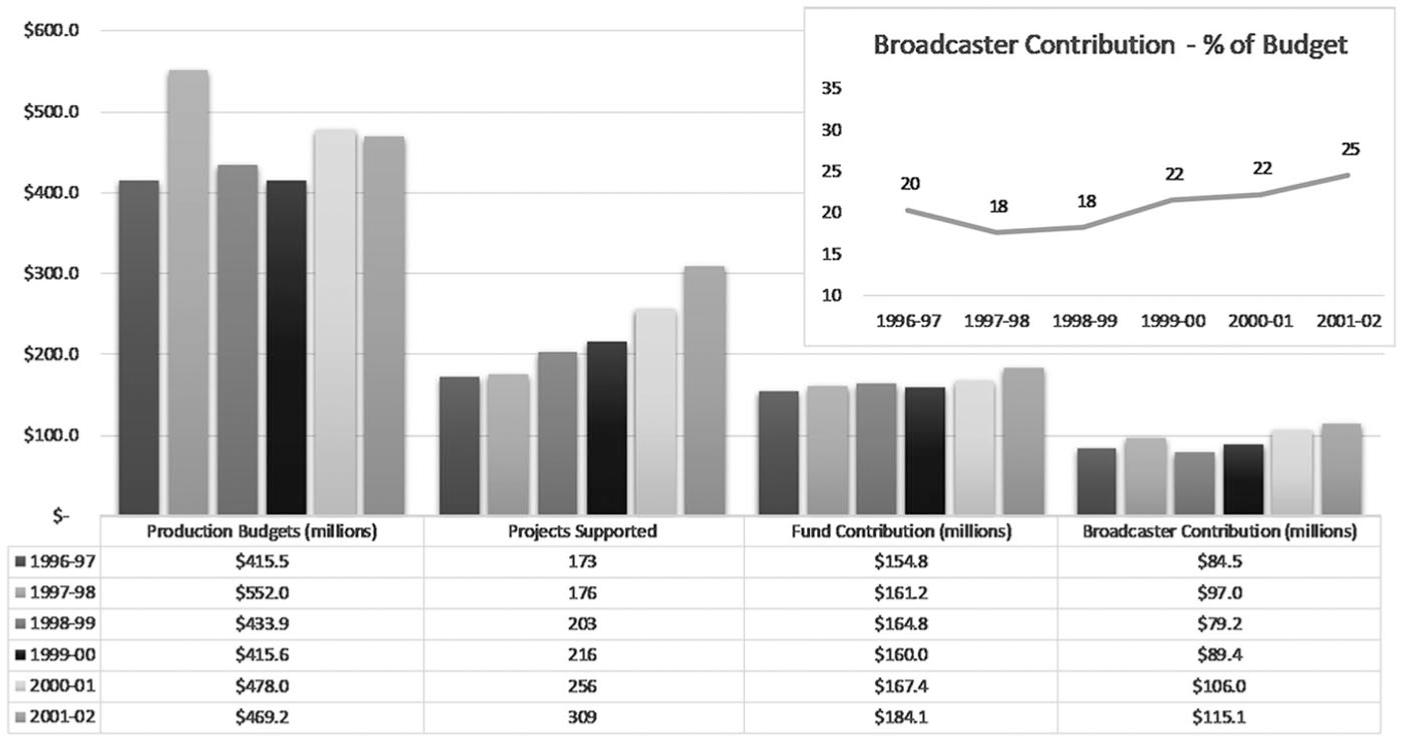
Financial contributions to CanCon Programming (1996–2002).
Figure 2 also highlights fluctuations in the total amount available for the Fund to distribute. While the drop to C$60.1 million in total commitments for the year 1987–1988 is attributed to efforts to manage the overspend in 1987, the drop to C$62.8 million in total commitments for the year 1992–1993 is the result of budget cuts by the Conservative government (Telefilm Canada, 1993). In Canada, the early 1990s were marked by a recession that ushered in an era of fiscal restraint. The new Liberal government, elected in October 1993, continued these cuts sending a clear signal that the Fund’s era of expansion was ending (Telefilm Canada, 1994). At the same time, the new government also introduced two new initiatives for the sector.
The first of these was a program that came to be known as the Cable Fund. The Cable Fund was financed by a levy assessed on cable and satellite service providers and operated as a private, non-profit entity. Its creation was the result of a negotiation between the CRTC and cable and satellite service providers over the proceeds of a rate increase charged to subscribers. When the monies were not spent on capital expenditures as originally intended, the CRTC allowed the service providers to retain half of the proceeds as long as they directed the remainder to an independent production fund. The Cable Fund provided independent producers with a license fee “top-up” (i.e. grant) to bridge the gap between the license fees paid by broadcasters and the production budget (Standing Committee, 2003). This was an entirely different contractual arrangement from the equity stake (i.e. contingent loan) taken by the Fund in the projects it financed.
The second initiative introduced by the new government was a new tax incentive to replace the one phased out by the Conservatives. Unlike the previous incentive scheme that was aimed at private investors, the new system of tax credits was directed at independent producers. Producers of eligible CanCon projects were entitled to receive a refundable tax credit that allowed producers to claim 25 percent of labor costs to a maximum of 15 percent of the total production budget (Canadian Heritage, 2008). In 1997, the program was expanded to include a “production service” tax credit equal to 11 percent of labor costs for foreign productions filmed in Canada using Canadian labor. Although the aim of the tax credits was to help capitalize independent production companies and carry them between projects, broadcasters and the Fund began factoring them into the financing structures of individual projects.
The tumultuous years of the Fund’s oversubscription: 1996–2002
In 1996, the Liberal government announced the expansion of the Cable Fund with an additional C$100 million in public funding. The original Fund would continue to exist as the “Equity Investment Program” (EIP) under Telefilm’s administration. The expanded Cable Fund, which became the License Fee Program (LFP), would operate as a public–private partnership administered by the CTF. Together, they would form two programs under one Fund. Both programs would focus on “distinctively Canadian” programs and eligible projects needed to meet a minimum of 8 out of 10 points on the CAVCO scale. This was a departure from Telefilm’s original requirement of 6 out of 10 points. While Telefilm welcomed the infusion of C$100 million in additional public funds to the industry, the expansion of the LFP diminished its role in the sector and raised concerns about its future.
Despite the significant injection of new money, the expanded Fund was oversubscribed from the start. After a round of industry consultations, the Fund changed the eligibility criteria in the hope of dampening demand. The new guidelines included a minimum domestic license fee equal to 20 percent of the production budget. The required CanCon points were raised to 10 out of 10 on the CAVCO scale, with the additional stipulation that projects must also reflect Canadian themes and subject matter. This last requirement was not well received by industry stakeholders. The Fund had not provided a definition of Canadian themes anywhere in its 60-page guidelines. Many viewed this as a step back toward the era before the CAVCO scale where subjective assessments of CanCon were open to multiple interpretations. Furthermore, the “distinctively Canadian” focus raised concerns in the independent production community about their ability to raise financing in the international markets and the marketability of the projects that accessed the Fund.
Yet, the “distinctively Canadian” requirement had little impact on the demand for the Fund. In April 1998, the Fund received 559 applications requesting a total of C$325 million in financing, but only C$198.6 million was available. The Fund was forced to make difficult decisions on which programs received financing and nobody was pleased with the results. Broadcasters had no input into the funding decisions and no ability to prioritize projects. Since the criteria for funding decisions did not include any metrics around program quality or audience ratings, the decision-making processes seemed arbitrary to independent producers. While their counterparts in Hollywood suffered studio difficulties, Canadian independent producers suffered bureaucratic difficulties as the marketplace demands and audience response seemed to matter little when it came to which programs received funding. Some broadcasters suggested that the Fund should operate more like a lending institution and they should make the decisions over which programs received financing.
While the Fund was grappling with ways to resolve the growing discontent among industry stakeholders, the CRTC quietly introduced a new set of rules that eased some of the broadcaster requirements for CanCon programming. Beginning in September 2000, broadcasters were no longer required to air dramatic series in prime time in order to meet their CanCon obligations. Instead, they could satisfy these requirements by airing children’s programming, documentaries, and variety shows, genres that were much less costly to produce. Since this change coincided with the rise of factual entertainment and reality television, it had a significant impact on the mix of genres that received financing from the Fund over the next few years (see Figure 3).
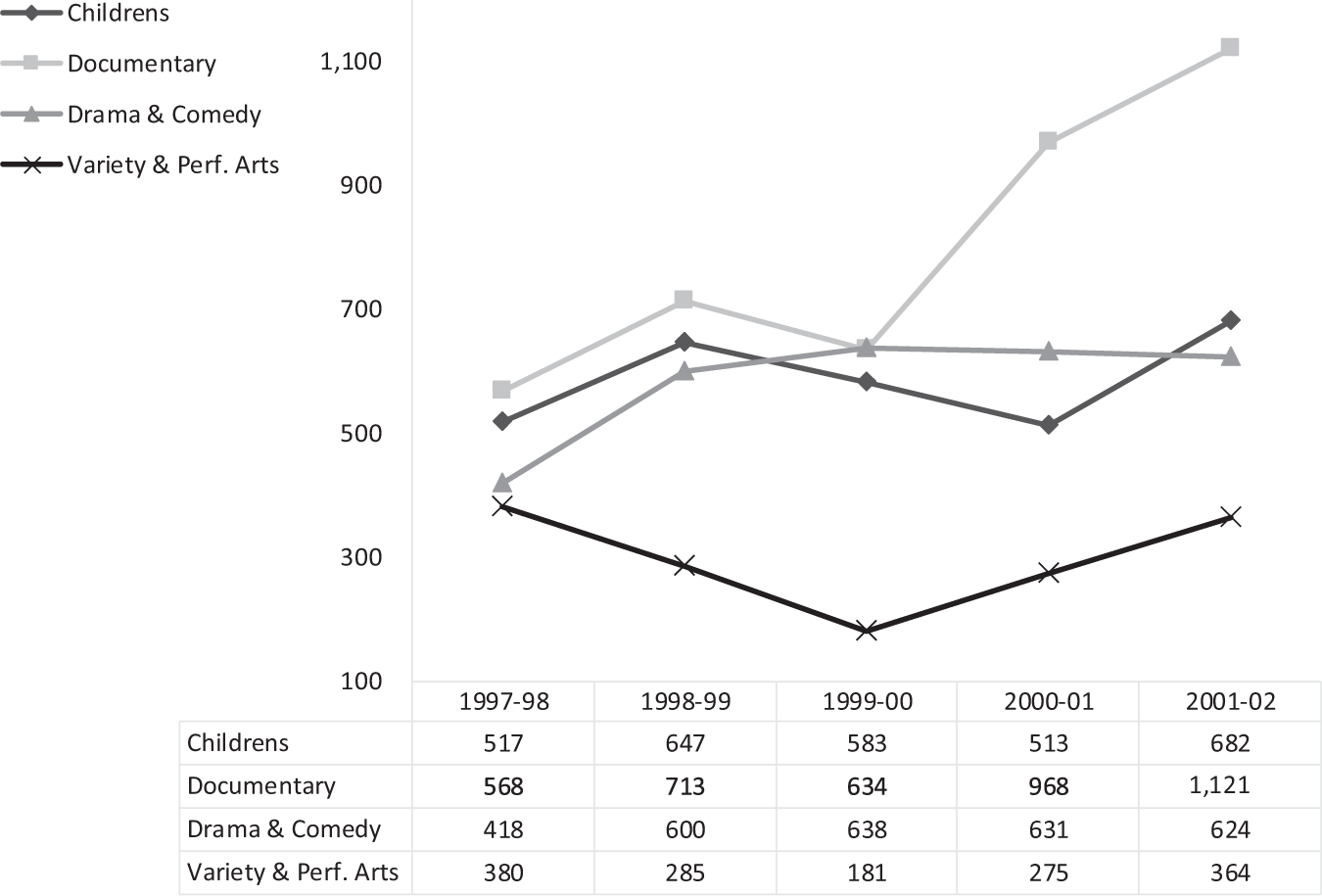
Hours of programming supported by genre (1997–2002).
While foreign formats and reality shows were eligible projects for the Fund, many factual entertainment series qualified as documentaries. The growth shown in the documentary category was attributed to the increase in the number of these programs financed. The relatively flat numbers for dramatic series shown in Figure 3 warrant further exploration. Telefilm used ‘production hours’ as a performance metric for measuring output; however, the CTF used ‘program hours,’ which includes the number of ‘plays’ or airings that broadcasters negotiated in their license agreements. The use of this metric masked the decline in the number of hours of dramatic series production. Only three years after the CRTC announced the new definition of priority programming, the number of homegrown dramatic series produced for the English-language market had dropped from 12 series to 5 (Standing Committee, 2003). Since dramatic series were becoming more costly to produce, the total dollars invested in this genre were increasing as the number of series produced decreased.
Mediating clashing perspectives: 2003–2006
In the midst of the growing tensions between the Fund and key industry stakeholders, a scandal broke in the popular and business press that cast a shadow over the entire sector. In September 1999, reports surfaced that Cinar, a Montreal-based production company known for programs such as Arthur and The Adventures of Paddington Bear, had falsified the names and nationalities of writers in order to receive CanCon certification. Since the Fund had invested in a number of Cinar projects, Telefilm was implicated in the debacle. The scandal prompted the formation of a Standing Parliamentary Committee (“the Committee”) mandated to recommend reforms on the use of public money to subsidize film and television production. The Auditor General’s Office also conducted an in-depth audit of Canadian Heritage, the ministry responsible for the oversight of Telefilm and the public portion of the CTF.
The Committee’s two-year investigation was the most comprehensive review of the sector since the 1986 Caplan–Sauvigeau Report. The study comprised extensive interviews with industry stakeholders, including broadcasters, program creators, producers, journalists, actors, and ordinary Canadians (i.e. audiences). The findings of the investigation were published in a 900-page report released to the public in June 2003. The report covered a number of themes but drew particular attention to the inadequacies of performance measures contained in the annual reports of the Fund published by Telefilm and the CTF. Both sets of annual reports focused on Fund activities and not on governance or accountability. Consequently, there was “little serious measurement or reporting of outcomes” in the annual reports (Standing Committee, 2003: 600). For example, neither Telefilm nor the CTF had any way of measuring the impact of the projects they helped finance, nor was there any agreement on a common set of metrics for performance within the industry as a whole. As a result, the Committee had no way to assess how the Fund – or the broadcast system in general – was performing against stated objectives.
In the view of the Committee, the Fund’s criterion for “distinctively Canadian” programming (see Table 4) was too subjective and economically unviable. They also objected to the Fund’s distinction between “industrial” and “distinctively” Canadian production as it was rooted in a confused interpretation of its cultural and industrial goals. This distinction implied that the former was somehow less worthy than the latter. Furthermore, the Fund’s focus on the cultural imperatives meant that independent producers ran into problems on the business side. Some producers responded to this challenge by adapting their projects to conform to the evaluative criteria. In their scripts, writers replaced lions with beavers and crews strategically – or subversively – placed Canadian flags on their sets to provide the “maple syrup” factor to meet the subjective criterion (Standing Committee, 2003). Others opted to structure their projects as international co-productions, which automatically qualified as CanCon for the purpose of the Fund. This added complexity to the production process as a portion of the work needed to happen in another country. It also required producers to give up some creative control on their projects to foreign partners.
Distinctively Canadian criteria.
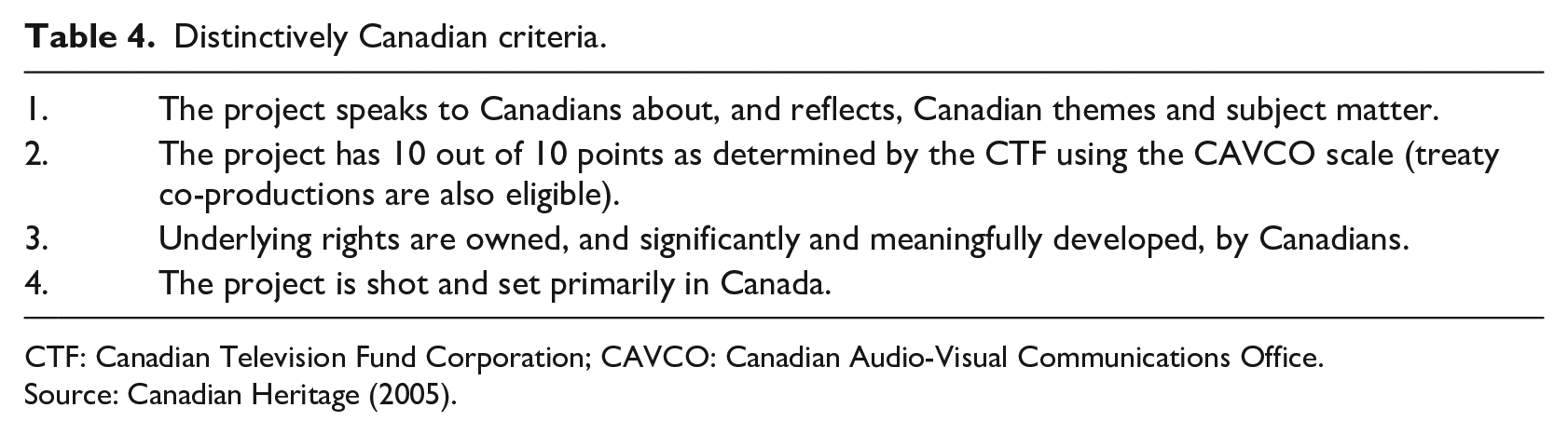
CTF: Canadian Television Fund Corporation; CAVCO: Canadian Audio-Visual Communications Office.
Source: Canadian Heritage (2005).
The release of the Standing Committee Report prompted the Fund to establish new objectives and develop a broader set of performance measures that included audience measures (Telefilm Canada, 2004). Telefilm and the CTF embarked on a joint project with the Canadian rating agencies (BBM and Nielsen) to build the database needed to provide audience data. Unfortunately, Telefilm did not have the opportunity to see this project through to fruition. In November 2005, when the Auditor General’s report was finally released, it included the recommendation to consolidate both of the Fund’s programs under the CTF. This would alleviate the inefficiencies caused by the two different administrative structures and streamline the cumbersome application process for independent producers. The CTF was also required to develop a clear set of objectives to help navigate the competing priorities inherent to public–private partnerships (Auditor General, 2005). Canadian Heritage was tasked with developing a comprehensive set of performance measures that would facilitate the evaluation of the Fund’s impact on the sector. The Auditor General stressed that these measures needed to go beyond the Fund’s current focus on outputs to include medium-term indicators related to consumption as well as long-term metrics to measure the impact of industry supports.
As the audit was underway, Canadian Heritage conducted its own evaluation of the Fund in preparation for its renewal by parliament. The responses to the issues raised by the Auditor General were integrated into its Summative Evaluation Report. This included a set of four performance measures for quality: production values (measured by budgets), critical acclaim (e.g. Gemini Awards), audience success (i.e. ratings), and public perception (obtained through surveys). All of these measures became a central feature in the CTF’s annual report. Beginning in the 2006–2007 fiscal year, extensive audience analysis was presented along with details of Gemini nominations and award for Fund-financed projects. An analysis of production budget by genre accompanied the overview of projects financed. For the first time, the CTF reported on the average processing times for applications as a measure of its own efficiency.
The Summative Evaluation Report also provided insight into the origins of the chronic oversubscription experienced by the Fund. Subsequent to the Fund’s expansion in 1996, the CRTC issued 49 additional licenses for cable channels. The new channels increased the required hours of CanCon programming from 33,000 hours in 1997–1998 to 90,000 hours in 2002–2003 (Canadian Heritage, 2005). The injection of additional money was insufficient to meet this dramatic increase in the demand. While unaware of these figures at the time, the Fund introduced a broadcast “performance envelope” system to manage the oversubscription problem in the fiscal year 2003–2004. The performance envelopes were essentially a pool of funding earmarked for each broadcaster that was segregated into specific amounts for each of the four genres. While the Fund would ensure that individual projects met the eligibility criteria, broadcasters would select the projects they wanted to finance.
The Fund retained control over the total amounts allocated to each broadcaster. The Fund established a set of weighted measures to guide this determination (see Table 5). An element of flexibility was also introduced into the performance envelopes that allowed broadcasters to transfer up to 15 percent of the funding available for one genre to another (CTF, 2008). Furthermore, the particular measures and weights used in these allocations could be adapted to incorporate different policy goals as they changed over time.
Broadcaster performance envelopes: weighted measures.
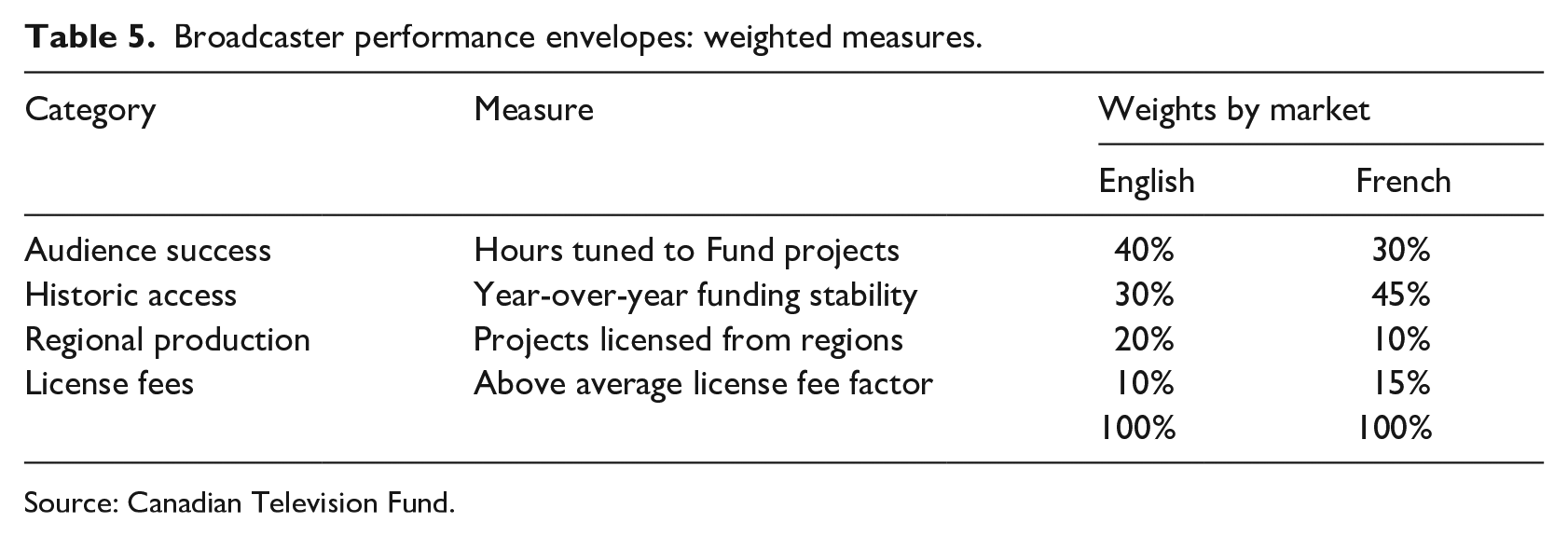
Source: Canadian Television Fund.
These changes had a significant impact on the administration of the Fund, and the introduction of the performance envelope system effectively eliminated the oversubscription problem. However, they were not sufficient to quell the frustrations experienced by two cable and satellite service providers. In December 2006, Shaw Communications (English-language) and Quebecor (French-language) withheld their monthly payments to the Fund in protest of its operation. Shaw cited concerns over funds being allocated to programs with relatively small audiences, noting that the Fund “does not explain how or even whether it measures its success in supporting high quality Canadian programming” (Standing Committee, 2007: 7). In contrast, Quebecor focused on the CTF’s failure to recognize the rise of new media and the ability to disseminate CanCon through different distribution channels such as video-on-demand (VOD) services.
Toward a temporary settlement: 2007–2010
This highly unusual maneuver sent shockwaves throughout the industry, with many stakeholders questioning its legality. The suspension of payments prompted yet another series of hearings by the Parliamentary Standing Committee on Heritage and the Senate Committee on Transportation and Communication. In February 2007, the CRTC created a task force with the stated aim of reaching “a consensus to resolve the concerns raised by stakeholders” (CTF, 2007: 7). In its report, the Senate Committee noted that the existing broadcast policy was not opposed to commercial interests, but it also went “beyond them to meet social and cultural needs” (Standing Committee, 2007: 13). Recognizing that the suspension of payments by the two service providers put the entire industry at risk, the Senate Committee advised the CRTC to make the monthly contributions to the Fund a legal requirement. However, they deferred to the CRTC Task Force for recommendations on the other issues raised.
The CRTC Task Force Report included the extraordinary recommendation of splitting the Fund into two streams: one for the private-sector stream and one for the public-sector stream. To ensure a more market-driven focus for the private-sector stream, the CRTC recommended reducing the required CanCon points to 8 out of 10 points on the CAVCO scale (CRTC, 2007). They also suggested that audience success along with actual and potential ROI should be the primary criteria for assessing performance in the private-sector stream. The public-sector stream would focus on “distinctively Canadian” programming. In other words, the private stream would finance “commercial” projects and the public stream would finance “cultural” projects. In addition, the CRTC recommended that the CTF increase the minimum amount of broadcast license fees required to trigger the Fund and reduce the amount of federal tax credits included in the finance structure of projects to 50 percent.
Although the Task Force Report was the product of industry consultations, the CRTC conducted public hearings after its release. As the hearings unfolded over a full week in February 2008, representatives from each of the key stakeholder groups offered their perspectives on the recommendations. Surprisingly, a number of stakeholder groups advocated for the retention of the 10 out of 10 CAVCO points. Jack Blum, a filmmaker and board member of the Toronto Film commission, pointed out that in Los Angeles, 8 out of 10 CAVCO points meant “replace the writer” (CRTC, 2008). This was tantamount to giving up creative control on dramatic series productions. Others pointed out that there was already over C$1 billion of “American-lite” programming made in Canada each year without the assistance of the Fund. Reducing the required CAVCO points would mean that funding would go to projects with the least need for funding and to programs primarily intended for non-Canadian audiences.
Independent producer and creative groups (e.g. writers, directors, and actors) were vehemently opposed to the idea of splitting the Fund into two streams. Not only would this mean the loss of the efficiencies achieved with the recent amalgamation, in their view it was based on a false dichotomy between commercial and cultural objectives. Some of the most popular programs such as Corner Gas, Little Mosque on the Prairie, and Degrassi: Next Generation were both “distinctively Canadian” and internationally successful. Given its powerful influence, successes in television were also culturally significant. These groups argued that it was impossible to separate the commercial and cultural. Independent producers questioned how projects would be slotted into either the commercial or the cultural stream. They also raised the concern that the so-called cultural projects would be “ghettoized” in a funding stream that predetermined their lack of viability. This was particularly frustrating for creatives given the reality that even documentaries dealing with arcane subject matter were made with a view to attract the widest audience possible.
During the hearings, a number of stakeholders reminded the CRTC that the original Cable Fund was created from the fees charged to consumers by cable and satellite service providers. The service providers negotiated the original agreement with the CRTC in their own interest and existing regulations compelled them to make this contribution to the Fund. For this reason, many objected to classifying the contributions from cable and satellite service providers as private funds. From their perspective, the Fund was financed entirely from one source whether it came in the form of taxes or cable subscriptions. Maintaining a single Fund was the most efficient way to manage these resources in the public interest.
Different stakeholder groups offered a number of alternatives for the metrics used to evaluate performance. While there was a consensus on the need to define and measure audiences and support hits, a number of different metrics were put forward on how to best accomplish this. One cable service provider suggested using “Canadian television in prime time” as a metric to determine the size of each performance envelope, while one of the national broadcasters suggested the use of “total hours tuned during prime time.” The use of the latter would correct issues with the historic access metric used by the Fund. Many of the smaller, niche cable channels had an issue with the use of Nielsen ratings as a single measure of audience success. Given Nielsen’s focus on establishing advertising rates for conventional broadcasters, it did not have audience numbers for many of the smaller cable offerings.
Many stakeholder groups argued that audience numbers may be a useful indicator of the popularity of a program, but this did not necessarily equate to quality as evidenced by the phenomenon of reality television. Other suggested measures of quality included foreign sales, longevity (e.g. second-window airings), and critical reviews. By unanimous agreement, the use of ROI as a measure for program success was pronounced a non-starter. In an industry plagued by protracted contract negotiations over arcane definitions of gross and net profits for royalty and residual payments, ROI was a morass as it would be an entirely different calculation for different parties. Furthermore, given the 75 percent failure rate of new television programs, predicting the potential ROI was an impossible task:
If making a hit could be quantified like baking a cake, every show would be a hit and we wouldn’t be here today. (Charles Lazar, VP Writers Guild Canada to CRTC Commission)
After the public hearings, the CRTC reversed their recommendation on reducing the number of required CAVCO points. However, all of their other recommendations were retained, including the creation of a separate private-sector funding stream. This recommendation was never implemented. In December 2008, the government announced its decision to combine the CTF and the Canadian New Media Fund to form a new entity called the Canadian Media Fund. With its recognition of digital media properties and distribution channels, the creation of the CMF addressed many of the concerns raised by Quebecor. Many of the measures used by the Fund prior to this transformation were retained by the CMF, including the broadcast performance envelope system. The CMF also integrated some of the measures discussed in the CRTC hearings into its performance envelope calculations. For instance, a new category for “original first run” programs was added in 2011 and the weight assigned to historic access reduced. By integrating the perspective of the different stakeholders, the refined measures provided the right mixture of flexibility and stability to provide an enduring temporary settlement across the stakeholders in the sector.
Reflections and conclusion
The purpose of this article was to explore the evolution of performance measurement and evaluative practices at the Fund, one of the main levers of broadcast policy in Canada. The findings detail a trajectory that began with the pairing of rudimentary performance measures with macro-level statistics to build an economic case for the industry. In its first decade of operations, the Fund made a number of investments in lightly camouflaged American programs that many industry insiders considered Canadian in name only. By the end of the study period, with the independent production sector firmly established, these projects were no longer eligible for assistance from the Fund. At this point, the Fund’s performance measurement system had evolved into a complex mix of metrics that allowed the Fund to become a more fine-grained policy tool.
Many of these metrics emerged as the industry matured and the proliferation of cable channels created a level of demand for the Fund that exceeded available resources. With the need to prioritize projects, multiple industry stakeholders had an interest in the evaluative criteria used to assess potential projects. The Fund’s decision to focus on “distinctively Canadian” programming produced conflict on a number of levels as different stakeholders had different interpretations of the Fund’s commercial and cultural objectives. For the (Parliamentary) Committee, the commercial or industrial aims meant supporting industry development, while the CRTC interpreted them as programs with 8 out of 10 points on the CAVCO scale. Independent producers found it impossible to separate the commercial and cultural aims as they were integrated into every project that they made.
Conflicting values not only arise from the different evaluative frames of particular groups (Stark, 2009), they can also create a productive friction within individuals. The change in the independent producers’ stance on the requirement for 10 out of 10 CAVCO points only a few years after they argued against it, is an example a creative response to the productive friction generated by conflicting values. By embracing this requirement, independent producers found a niche market for their “distinctively Canadian” products that generated larger audiences at home and abroad than the mediocre “American-lite” programs produced with fewer CAVCO points.
This exploration parallels prior studies that view performance measurement systems as ongoing constructions (e.g. Chenhall et al., 2013; Dambrin and Robson, 2011). With its expanded focus on key industry stakeholders, rather than a single organization, it also goes beyond them to show how particular metrics evolve over time. Once a temporary settlement is no longer sustainable, metrics and measures must be adapted to reach a new compromise with industry stakeholders. As an instrument of Canadian broadcast policy, the Fund continually engaged in industry consultations to elicit the various perspectives of industry stakeholders. This process mirrors the consultative approach taken by the various government agencies involved in setting broadcast policy and objectives for the Fund. These consultations provided an arena for stakeholders to “advance their particular interests and values” (Chenhall et al., 2013: 269). For instance, the discussion in the CRTC hearings around the different metrics used to assess performance and establish the allocations to broadcaster performance envelopes revealed the imperfections of different metrics. As noted by Dambrin and Robson (2011), imperfections in the numbers are a feature, not a flaw, as they focus attention on efforts directed to their improvement. In this instance, stakeholders advocated for the use of multiple judgment devices to assess performance, as no single measure was sufficient on its own. Prior studies have not highlighted how collaborations across industry stakeholders influence the acceptance and adoption of particular measures and metrics. While the consultative approach is not the most efficient approach to policy development, it facilitates the integration of different stakeholder interests.
The Fund’s ability to adapt to the changing industry landscape was critical to its success. As noted by the former CEO of the Banff Television Festival, success in the Canadian industry was achieved through a combination of public–private partnerships, entrepreneurship, and inspired public policy (Ferns, 2001). This extends to the Fund’s decision to delegate decision making on project selection to broadcasters – a process accomplished through the development of performance envelopes that relied on a weighted set of measures. Not only did this change provide broadcasters with control over their schedules, it eliminated the oversubscription problem that was a key source of industry tension.
This study provides some interesting insights into the role of accounting in one of the largest sectors of the entertainment industry. While jokes about “creative accounting” in the film and television industry abound, the measures used to assess program performance are also relied on to understand audience demand. Broadcasters renew or cancel series based on audience ratings in their targeted demographic. At the policy level, performance measures are crucial in the assessment of results against stated objectives. Even more importantly, a balanced mix of measures is an important tool for developing a proactive rather than reactive response to issues that emerge in a rapidly changing industry landscape.
