







Abstract
In February 2019 Queensland became the third Australian jurisdiction to enact a statutory human rights charter. The Queensland Human Rights Act is modelled on the Victorian Charter of Human Rights and Responsibilities Act 2006 and the ACT Human Rights Act 2004. However, it also provides for an accessible complaints mechanism for alleged contraventions by a public entity, which is a significant point of difference from the other two Acts. This article considers whether the Queensland act is an improvement on the Victorian and ACT acts, or whether it also fails to provide effective remedies for people whose human rights have been breached.
Queensland became the third Australian jurisdiction to enact a statutory human rights charter with the passing of the Queensland Human Rights Act 2019 (the Queensland HRA). According to the Attorney-General and Minister for Justice Yvette D’Ath, this was an historic moment, asserting that the Queensland HRA ‘is about a better Queensland – modern, fair and responsive’. 1 It also represented the culmination of a long and well organised campaign by human rights advocates, community legal centres and the general community to provide stronger human rights protections in the Sunshine State.
The Queensland HRA is closely modelled on the Victorian Charter of Human Rights and Responsibilities Act 2006 (the Victorian Charter) and the ACT Human Rights Act 2004 (the ACT HRA). However, as was noted by the Attorney-General when she introduced the legislation into Parliament, the Queensland HRA also provides for an accessible complaints mechanism for alleged contraventions by a public entity. This is a significant point of difference between the Queensland HRA and the other two Acts. The question that this article will consider is whether this difference makes the Queensland HRA a significant advancement on the Victorian Charter and the ACT HRA, or whether it has followed the pattern of Australian human rights charters in failing to provide effective, accessible and fair remedies for people who allege that their human rights have been breached.
The Queensland HRA – Following the dialogue model
Like the Victorian Charter and the ACT HRA, the Queensland HRA legislates a ‘dialogue’ model of human rights protection that preserves parliamentary sovereignty and does not focus on enforcement by the courts. 2 Each of these Acts shares similar features with the legislative models of human rights Acts in the UK (Human Rights Act 1998) and New Zealand (Bill of Rights Act 1990). In the main, the human rights protected by these instruments are predominantly civil and political rights enshrined in the International Covenant on Civil and Political Rights. In both the ACT HRA and the Queensland HRA there is also some protection provided for a limited number of economic, social and cultural rights (that is, the right to education, specific protection of cultural rights for Aboriginal and Torres Strait Islander peoples and the right to health services). 3
Obligations of public entities
Under section 58(1) of the Queensland HRA, it is unlawful for a public entity to act or make a decision in a way that is not compatible with human rights, or in making a decision to fail to give proper consideration to a relevant human right. The Queensland HRA replicates some of the most criticised aspects of the Victorian Charter with respect to the circumstances in which a person may seek relief or remedy in situations where a public authority has acted unlawfully under s 58(1). While the Act creates a ground of unlawfulness for breaching human rights obligations, it does not create a right to a stand-alone cause of action for a contravention of those obligations. Section 59(1) states that a person may seek any relief or remedy in relation to an act or decision of a public entity on the ground that the act or decision was, other than because of s 58, unlawful.
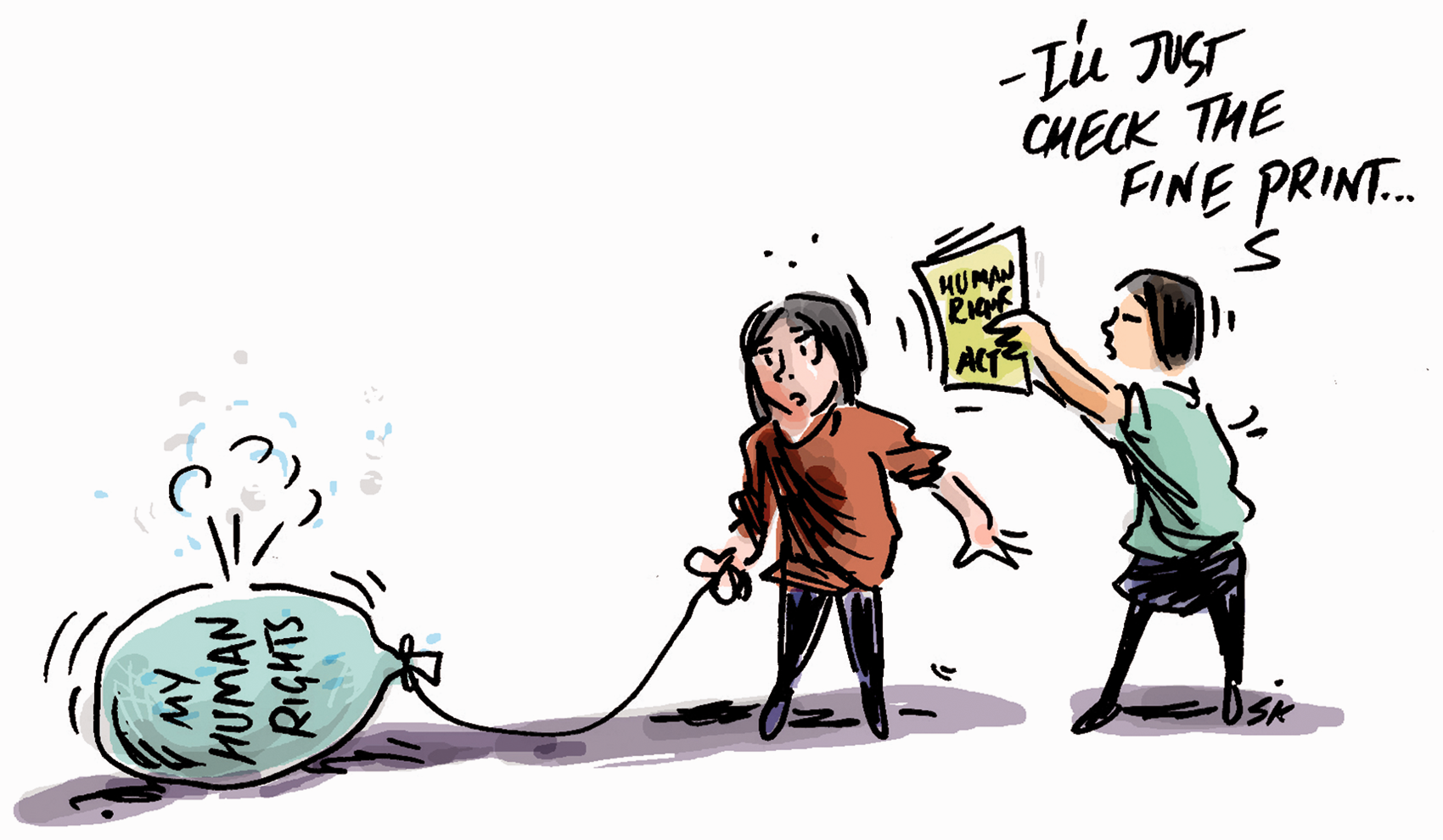
Sections 58–59 have a similar effect to ss 38–39 of the Victorian Charter in that s 59(1) limits legal proceedings to instances where there is an assertion of unlawfulness separately from a claim under s 58 of the Act. The complicated and confusing equivalent sections in the Victorian Charter have been the subject of considerable criticism by human rights advocates and legal professional bodies. The requirement for a person to have a pre-existing non-Charter claim for relief or remedy in respect of an act or decision of a public authority on the ground that the act/decision was unlawful, to enable a claim for relief or remedy on the basis of Charter unlawfulness (often referred to as the ‘piggy-back’ cause of action), is a significant barrier for people bringing claims for human rights breaches.
In the 2015 statutory eight-year review of the Charter, the Law Institute of Victoria (LIV) stated that the requirement for a piggy-back cause of action can lead to significant resources being expended on resolving preliminary jurisdictional issues, ‘bringing judicial review proceedings in the Supreme Court’, and ‘arguing potentially “weaker” claims of non-Charter unlawful conduct, when the “stronger” claim arises from a breach of the Charter’. 4 Both the LIV and the Victorian Bar Council noted that the absence of a direct cause of action for a breach of human rights under the Charter is a barrier to accessible, just and timely remedies for infringements of people’s basic human rights. Both organisations strongly argued for a stand-alone cause of action. 5 Like the Charter, s 59(1) of the Queensland HRA effectively legislates a ‘piggy-back’ cause of action: there is no provision for a stand-alone cause of action. 6
According to the Bar Association of Queensland, the ‘piggy-back’ provisions in the Queensland HRA do not go far enough in allowing for the effective enforcement of protected human rights. The Association was critical of the provisions, stating that they create a level of uncertainty with respect to the enforceability of the legislation, which could lead to public entities having a lack of motivation to reform practices and ensure human rights compliance in their operations. This could create a perception of the Queensland HRA as ineffective. 7 The ‘piggy-back’ provisions in the Queensland HRA were also criticised in several submissions to the Queensland Parliament’s Legal Affairs and Community Safety Committee review of the legislation. 8
The Queensland and Victorian provisions stand in contrast with s 40C(2) of the ACT HRA, which provides a person who claims that a public authority has acted unlawfully under the Act with a freestanding cause of action in the ACT Supreme Court. This section allows a person either to start a proceeding against a public authority in respect of an alleged violation of her/his rights, or to rely on her/his rights in any other legal proceeding. In such a proceeding the Court may grant any relief other than damages that it considers appropriate. 9
Non-entitlement to an award of damages for a breach of human rights is a common feature across the Queensland, Victorian and ACT Acts. Section 59(3) of the Queensland HRA makes it explicit that a person is not entitled to be awarded damages on the ground of s 58(1) unlawfulness. This replicates s 39(3) of the Victorian Charter, which states that a person is not entitled to be awarded any damages because of a breach of the Charter. This provision has attracted significant criticism from legal professional bodies such as the LIV. 10
During the committee consideration of the Queensland legislation, the Queensland Law Society, the Bar Association of Queensland, the Australian Lawyers Alliance and the organisation Human Rights Act for Queensland all commented that the legislation should provide for the full range of remedies for breaches of human rights, including monetary compensation or damages. 11 While it was acknowledged that appropriate remedies for human rights infringements may often be practical directions to prevent or stop the infringements, or provide an acknowledgment or apology to the victim, it was stated that there are situations where the breaches are so serious that damages may be the only way to fairly compensate a victim of such breaches. 12
Section 58(3) of the Queensland HRA grants an exemption to religious organisations from being obliged to act in a way or to make a decision that has the effect of impeding or preventing that organisation from acting in conformity with its religious doctrines, beliefs or principles. 13 This replicates s 38(4) of the Victorian Charter which provides a significant limitation on the ability of affected individuals to seek a remedy for a breach of human rights that has been committed by a religious organisation. Given that many religious bodies perform functions of a public nature that have been outsourced by government, particularly key welfare and homelessness services, s 58(3) may result in services not being subject to human rights obligations, even though the same services provided by government bodies or non-religious non-government bodies would be subject to those obligations. Such an exemption for religious organisations does not appear in either the UK or NZ human rights Acts. Nor does it appear in the ACT HRA.
Queensland Civil and Administrative Tribunal's jurisdiction
There is no provision in the Queensland HRA for the Queensland Civil and Administrative Tribunal (QCAT) to have jurisdiction to hear applications for relief or remedy in relation to alleged unlawful conduct under s 58. This reflects the positions in both Victoria, where there is no provision for the Victorian Civil and Administrative Tribunal (VCAT) to hear applications for relief or remedy in relation to alleged unlawful conduct under the Victorian Charter, and also in the ACT, in relation to the ACT Civil and Administrative Tribunal (
It is therefore almost inevitable that QCAT will follow the approaches to those determined for VCAT by the 2011 Victorian Court of Appeal decision in Director of Housing v Sudi 14 (Sudi) and the 2013 ACTCAT decision in Commissioner for Social Housing in the ACT & Massey (Massey). 15 In Sudi, the Court determined that VCAT’s original jurisdiction did not encompass a judicial review jurisdiction. Where the question of validity or lawfulness of a decision arises incidentally as part of a defence to the application, the Court determined that VCAT would not have jurisdiction to consider the Charter lawfulness of the decision or action. The Court concluded that under s 39(1) of the Charter there is no collateral review power conferred on VCAT and that the right to argue that an administrative action is unlawful because of non-compliance with the Charter can be asserted only when there would be a right to seek review of the action on grounds that are independent of the Charter. 16 The Chief Justice stated that any person wishing to resist a social housing tenancy eviction on Charter grounds cannot do so in VCAT, but must bring an application in the Supreme Court, which she acknowledged was a less accessible and more expensive forum. 17 A similar approach was adopted by ACTCAT in relation to the ACT HRA in 2013 in Massey. 18
The effect of the Court of Appeal’s decision is that while VCAT retains jurisdiction to consider Charter issues in other ways, it does not have jurisdiction under s 39 of the Charter to conduct a collateral review of a decision of a public authority. 19 The Court found that these matters should be referred to the Supreme Court through judicial review proceedings. 20
Following the Sudi decision, several community legal and human rights organisations expressed concern that the decision placed a significant limitation on the ability of the most disadvantaged people in the community to seek quick resolution, through VCAT, of disputes in which Charter non-compliance is alleged. 21 The Victorian Equal Opportunity and Human Rights Commission (VEOHRC) said that the ‘chilling effect of Sudi’ may have generated a mistaken belief in some advocates and public authorities that VCAT had no jurisdiction at all to consider human rights, and may have deterred people from relying on the Charter in legal proceedings. 22
In response to these concerns, the statutory eight-year review of the Victorian Charter concluded that VCAT should be given original jurisdiction to hear and determine claims that a public authority has acted incompatibly with human rights protected under the Charter. The review noted that VCAT is a more accessible and less costly forum than the Supreme Court, and has more experience than any other Victorian court or tribunal in dealing with Charter arguments. 23 To date the Victorian government has not acted on this recommendation.
Several submissions to the Queensland Parliament Legal Affairs and Community Safety Committee's review of the legislation recommended that QCAT should have original jurisdiction to hear and determine claims that a public authority has acted incompatibly with human rights, given that it is a more accessible, quick and inexpensive forum. 24 It is therefore disappointing that under the Queensland HRA, people who allege that their human rights have been breached and who wish to take action against a public authority for that unlawfulness will have to initiate complex and costly judicial review proceedings in the Supreme Court, as is the case in Victoria and the ACT. The preferable alternative would have been to give QCAT original jurisdiction to hear and determine claims that a public authority has acted incompatibly with human rights.
An additional limitation is in s 58(6) of the Queensland HRA, which states that an act or decision of a public entity is not invalid merely because by doing the act or making the decision the entity contravenes s 58(1), and that a person does not commit an offence merely because they act or make a decision in contravention of s 58(1). This effectively prevents any application to review a decision or action of a public authority on the basis that it is unlawful under s 58(1), and is discussed by Chen in this issue. 25
Complaints to the Queensland Human Rights Commission
Following the decision in Sudi, one of the most common criticisms of the Victorian Charter relates to the absence of an accessible complaints mechanism for alleged contraventions by a public entity. The statutory eight-year review of the Victorian Charter recommended that the Charter be amended to give VEOHRC a statutory function and resources to offer dispute resolution for human rights complaints under the Charter. 26 The Review accepted the statement from the VEOHRC that the confusing and limited availability of remedies under the Charter has inhibited the development of a human rights culture, and creates a disincentive for compliance as there are no obvious consequences of a breach. 27 Similarly, the absence of any provision in the ACT HRA that gives the ACT Human Rights Commission a statutory function to provide dispute resolution services for complaints of unlawful conduct or decisions by public authorities under the Act is one of the major weaknesses of that Act as well.
It is in relation to the inclusion of an accessible complaints mechanism for alleged contraventions by a public entity that the Queensland HRA has been presented as a significant advancement on the Victorian Charter and the ACT HRA. Section 64(1) provides for an individual who has been the subject of an alleged contravention of protected human rights to make a complaint to the Queensland Human Rights Commission (the Commission). Under s 79, if such a human rights complaint is accepted by the Commissioner it can be referred to a conciliation conference. The purpose of conciliation of a human rights complaint is to promote the resolution of the complaint in an informal, quick and efficient manner (s 80).
The inclusion of an accessible mechanism for making a complaint about a human rights breach recognises that such a process is essential in facilitating the development of a human rights culture across government and the community. According to the Attorney-General, the provision of a dispute resolution function for the Commission complements the dialogue model of the bill. It creates a process by which a person, who believes that they have been the subject of a public entity’s failure to act compatibly with human rights, may make a complaint to the entity itself. If the complaint cannot be resolved with the public entity, the complainant may then make a human rights complaint to the Commission. The Commission may then try to informally resolve the complaint by discussing the matter with the complainant and the public entity or, if appropriate, attempt to resolve the complaint through conciliation. This can include compulsory conciliation. 28
The clear message from the legislation and the Attorney-General’s Explanatory Speech was that an effective complaints process needs to be accessible. In this regard the legislation envisages public authorities developing appropriate internal complaint handling and dispute resolution processes to facilitate human rights complaints. This would be particularly appropriate in Queensland where access to efficient dispute resolution processes in regional and remote areas is an important and necessary element in developing a human rights complaints framework. The involvement of the Commission to facilitate informal resolution or conciliation-based resolution is also beneficial for remote communities, providing an avenue that does not require access to a formal court or tribunal process.
However, even with this significant improvement on the Victorian and ACT models, the process of conciliation as provided in the Queensland HRA is deficient as there is no binding or clear outcome from a complaint being brought to the Commission. Section 88 states that if the conciliation fails to resolve the complaint, the Commissioner must prepare a report about the complaint for the complainant and the respondent, which sets out the substance of the complaint and the actions taken to attempt to resolve it. The Act does not provide the Commissioner with any power to direct a public entity to address the issues raised in the complaint that have been acknowledged by the respondent or which the Commissioner considers to have been substantiated. Even in circumstances where the conciliation leads to an acknowledgment by the public entity that is the subject of the complaint that it has acted unlawfully under HRA, there is no provision in the legislation that obliges the entity to remedy the breach or provide some redress to the complainant. Nor is there any provision that gives powers to the Commission to compel the entity to remedy the breach in these circumstances. There is not even a provision that empowers the Commission to make a recommendation to address the issues raised in the complaint that have been acknowledged by the respondent or which the Commissioner considers to have been substantiated.
Several witnesses before the Queensland Parliamentary Legal Affairs and Community Safety Committee review of the Human Rights Bill expressed concern about the Commission’s inability to deliver binding outcomes, and the lack of enforcement mechanisms. This included concerns that in the absence of an effective remedy, complainants may be reluctant to engage in the complaint process. 29 In addition, there was also a concern that there would be little incentive for a respondent to seek a consensual resolution of the matter, thereby curtailing the prospect of a successful conciliation of the complaint. 30 Moreover, the failure to provide the Commission with a power to deliver binding outcomes or for enforcement of the protected rights was considered to be a major weakness in the proposal, and one that could have the unintended and unfortunate consequence of a loss of confidence in the process.
Conclusion
At the time of its introduction and throughout the parliamentary committee process, the Queensland Human Rights Bill was lauded as going beyond the Victorian and ACT human rights acts, by providing ‘an accessible, independent and appropriate avenue for members of the community to raise human rights concerns with public entities with a view to reaching a practical resolution’. 31 However, the limited nature of this mechanism, combined with the replication of some of the most criticised aspects of the Victorian Charter in terms of access to effective remedies for human rights breaches, suggests that some of the initial celebrations for this new and improved model of legislative human rights protection were perhaps somewhat premature. On closer examination the Queensland HRA, like the Victorian Charter and the ACT HRA, falls short in providing effective, accessible remedies and causes of action for individuals who allege that their rights have been violated. Under international law, access to effective dispute resolution mechanisms with the full suite of remedial measures, including compensation, is considered to be an essential component of an effective regime that seeks to protect and promote human rights. 32 By replicating some of the deficiencies in the Victorian Charter and the ACT HRA in failing to provide such a framework, the ability of the Queensland HRA to fulfil one of its main objects, namely to help build a culture in the Queensland public sector that respects and promotes human rights, is significantly undermined.
Footnotes
Declaration of conflicting interests
The author(s) declared no potential conflicts of interest with respect to the research, authorship, and/or publication of this article.
Funding
The author(s) received no financial support for the research, authorship, and/or publication of this article.

1
2
George Williams, ‘The Victorian Charter of Human Rights and Responsibilities: Origins and Scope’ (2006) 30(3) Melbourne University Law Review 880, 893.
3
Human Rights Act 2004 (ACT) ss 27–27A, 28, 36–37; Human Rights Act 2019 (Qld) ss 28, 36–37. See also Tamara Walsh and Bridget Burton, ‘Queensland’s New Right to Education: What does it mean for children with disabilities?’ (2020) 45(1) Alternative Law Journal 18.
4
5
6
See further discussion of s 59 in Bruce Chen, ‘The Human Rights Act 2019 (Qld): Some perspectives from Victoria’ (2020) 45(1) Alternative Law Journal 4.
7
Bar Association of Queensland, Submission No 32 to Legal Affairs and Community Safety Committee, Queensland Parliament, Inquiry into the Human Rights Bill 2018 (23 November 2018) 3.
8
Queensland Law Society, Submission No 103 to Legal Affairs and Community Safety Committee, Queensland Parliament, Inquiry into the Human Rights Bill 2018 (26 November 2018), 6–9; Human Rights Act for Queensland, Submission No 44 to Legal Affairs and Community Safety Committee, Queensland Parliament, Inquiry into the Human Rights Bill 2018 (24 November 2018), 2–3; Australian Lawyers Alliance, Submission No 24 to Legal Affairs and Community Safety Committee, Queensland Parliament, Inquiry into the Human Rights Bill 2018 (22 November 2018), 14–15.
9
Human Rights Act 2004 (ACT) s 40C(1).
10
Law Institute of Victoria (n 4) 21.
11
Queensland Law Society (n 8) 6; Bar Association of Queensland (n 7) 3–4; Human Rights Act for Queensland (n 8) 3; Australian Lawyers Alliance (n 8) 15.
12
Queensland Law Society (n 8) 6.
13
Human Rights Act 2019 (Qld) s 58(3).
14
Director of Housing v Sudi [2011] VSCA 266.
15
Commissioner for Social Housing in the ACT & Massey (Residential Tenancies) [2013] ACAT 41.
16
Director of Housing v Sudi [2011] VSCA 266, [282] (Weinberg J).
17
Director of Housing v Sudi [2011] VSCA 266, [56] (Warren CJ).
18
Commissioner for Social Housing in the ACT & Massey (Residential Tenancies) [2013] ACAT 41.
19
Director of Housing v Sudi [2011] VSCA 266, [34-45] (Warren CJ).
20
Director of Housing v Sudi [2011] VSCA 266, [281] (Weinberg J).
21
See, eg, Victoria Legal Aid, Submission No 93 to 2015 Review of the Charter of Human Rights, 7; Victorian Council of Social Service, Submission No 64 to 2015 Review of the Charter of Human Rights, 23; Justice Connect Homeless Law, Submission No 79 to 2015 Review of the Charter of Human Rights, 24--5; Federation of Community Legal Centres (Vic), Submission No 91 to 2015 Review of the Charter of Human Rights, 14.
22
Victorian Equal Opportunity and Human Rights Commission, Submission No 90 to 2015 Review of the Charter of Human Rights, 12, 66–7.
23
Michael Brett Young, From Commitment to Culture: The 2015 Review of the Charter of Human Rights and Responsibilities Act 2006 (Final Report, September 2015) 128–9.
24
Human Rights Law Centre, Submission No 101 to Legal Affairs and Community Safety Committee, Queensland Parliament, Inquiry into the Human Rights Bill 2018 (26 November 2018), 13–14; Lindsey Stevenson-Graf and Narelle Bedford, Bond University Faculty of Law, Submission No 138 to Legal Affairs and Community Safety Committee, Queensland Parliament, Inquiry into the Human Rights Bill 2018, 1; Endeavour Foundation, Submission No 126 to Legal Affairs and Community Safety Committee, Queensland Parliament, Inquiry into the Human Rights Bill 2018, 3.
25
Chen (n 6).
26
Brett Young (n 23) 105.
27
Ibid 124.
28
Queensland, Parliamentary Debates, Legislative Assembly, 31 October 2018, 3186 (Yvette D’Ath, Attorney-General).
29
Joint University of Queensland TC Beirne School of Law academics, Submission No 39 to Legal Affairs and Community Safety Committee, Queensland Parliament, Inquiry into the Human Rights Bill 2018 (23 November 2018), 2; Human Rights Law Centre (n 24) 15; Australian Lawyers Alliance (n 8) 18–19; Community Legal Centres Queensland, Submission No 117 to Legal Affairs and Community Safety Committee, Queensland Parliament, Inquiry into the Human Rights Bill 2018 (26 November 2018), 4.
30
International Commission of Jurists Queensland Inc, Submission No 105 to Legal Affairs and Community Safety Committee, Queensland Parliament, Inquiry into the Human Rights Bill 2018 (26 November 2018), 4–5.
31
Queensland, Parliamentary Debates (n 28).
32
International Covenant on Civil and Political Rights, art 2(3); Basic Principles and Guidelines on the Right to a Remedy and Reparation for Victims of Gross Violations of International Human Rights Law and Serious Violations of International Humanitarian Law, UN GAOR 60th sess, GA Res 60/147 (16 December 2005).