







Abstract
Ramona Vijeyarasa recently published in this journal an article advocating for the law in general, and legislation in particular, to be gender responsive. She argued that to redress gender inequality, the law must address the different needs and position of women. Here I propose a bigger scope for the intervention needed to redress legally-originated gender inequality. I contend that a system of transitional justice for women is necessary. This intervention, based on the equity principle of fairness and a need to repair a damage caused by the law, is proposed as a temporary measure until adequate redress is provided.
Keywords
Recently, Ramona Vijeyarasa published an article in this journal advocating for the law in general, and legislation in particular, to be gender responsive. 1 In her article, the author argued that to redress gender inequality the law must address the different needs and position of women. 2 Vijeyarasa's arguments were based both on feminist legal theory 3 and the obligations imposed by international law, namely the Convention on the Elimination of All Forms of Discrimination against Women. 4 Although her reasoning is philosophically sound and responds to an idea of justice, Vijeyarasa anticipated that it may not convince those who disagree in principle with the underlying idea that the law should treat different groups of people differently. I refer to them as ‘the partisans of colorblindness’. 5
Transitional justice as a reparation for legal discrimination against women
To solve this problem, this article is based instead on a more conventional legal concept, already ‘in the books’: the need to repair a damage. Leaving aside the doctrinal changes in English law regarding equity and the mainstreaming of the concept of unjust enrichment or restitution only partially witnessed in Australia, 6 I contend that the law must be gender-responsive and treat women in a differentiated manner as a ‘mechanism of reparations’. The legal system itself must compensate for how that very same legal system has unjustly enriched men and the law must ensure the restitution to women of what the law has taken from them. 7
In other words, I propose that legal systems should respond as a transitional-justice-making tool to redress the legal discrimination 8 suffered by women over the years. While redressing legally-originated gender inequality – the ‘damage’ – will undoubtedly require a broader public intervention – in terms of politics, policies and laws – having legislation committed to redress the previous discrimination is essential. I believe that anchoring this approach merely as a ‘reparation’ will address, at least at a theoretical level, the worries of the partisans of colourblindness: 9 the law is not treating a group differently, it is just correcting the damage caused in the past, precisely when it was treating men and women differently. In that sense, the final objective of this ‘transitional justice through the law’ is to enforce equality.
Equality is recognised as a founding principle of most extant legal systems. The law should aim at delivering that equality, and not just correcting previous mistakes through the reform of the legislation that promoted or protect inequality. 10 This proposition may resonate with those who have argued, notably in the United States and South Africa, for legal redress, or ‘affirmative action’, or ‘positive discrimination’ for minorities legally – and not just socially – discriminated against in the past, the victims of ‘institutional racism’. 11 This is the ‘justice’ part.
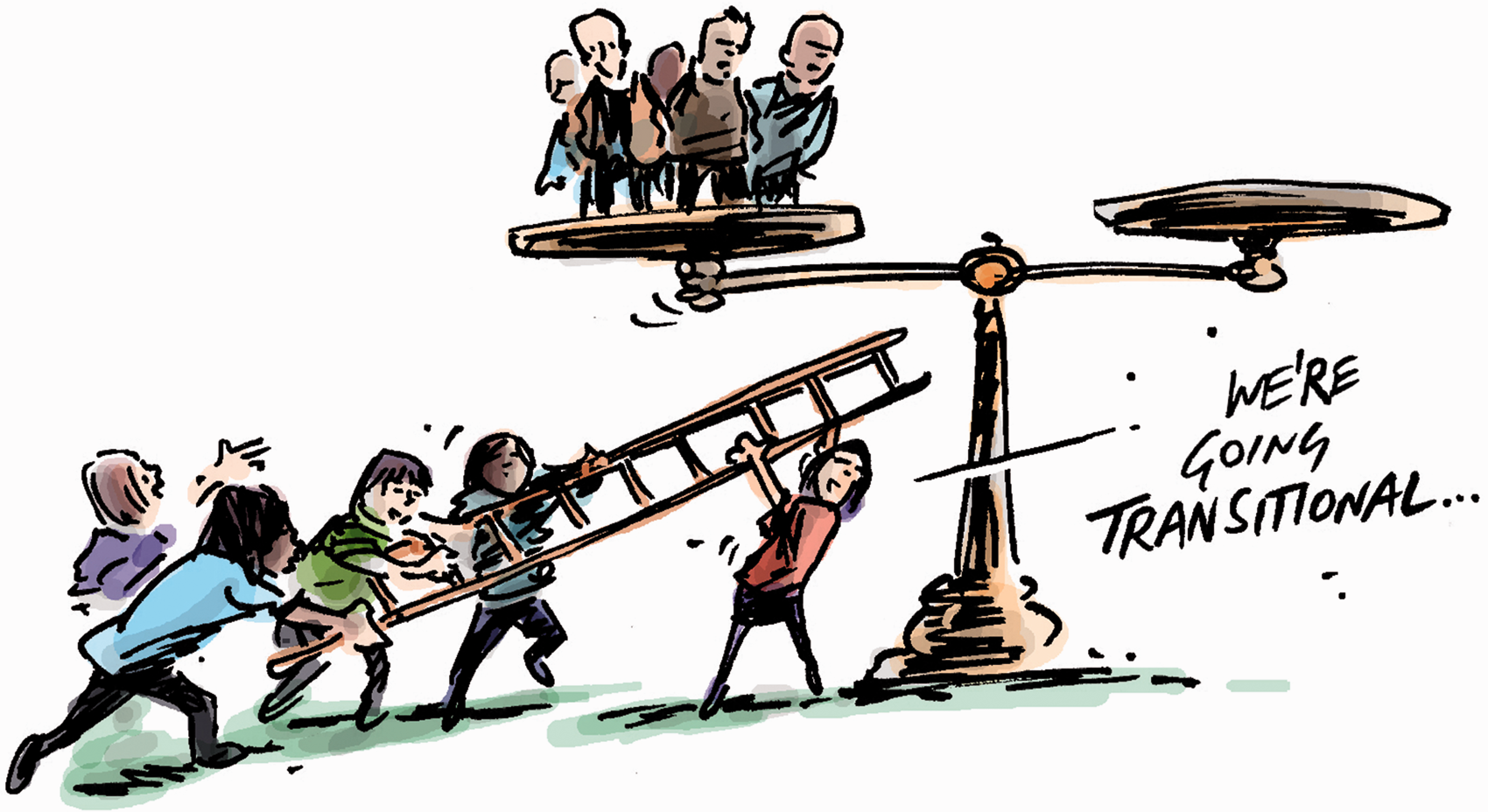
Yet, the justice mechanism must also be ‘transitional’ to be legitimate. The system proposed here can only be justified in these terms as a temporary measure, until adequate redress is provided. This article assumes that if laws are properly drafted, adequately implemented and enforced during a given number of years – probably something between two and four generations 12 – those transitional mechanisms could be reverted and ‘genderblindness’ could be a reasonable standard again. 13 Final equality (justice) is the objective of the system, but for the measures themselves to be ‘just’ they have to be temporary. This restriction demands that they can only last the time it would take to transition from injustice to justice. In that sense, this proposal can be directly linked to the 1988 Committee on the Elimination of Discrimination against Women’s General Recommendation No 5 which promoted using temporary special measures such as preferential treatment or quota systems to advance women's integration into education, the economy, politics and employment. 14
There are three key elements in this proposal. First, the reparations are not due as a compensation for a different position in society or as a moral case, but simply as a way for the entity that has caused the damage – the law – to revert that damage and leave the offended party – women here – in a situation of equality, where all gender disparities caused by the legal system have been repaired. Second, I do not consider here whether the discriminatory laws that existed in most countries were legally wrong or not. By definition they were legal in the societal context in which they were created and enforced and, hence, never caused an illegal or wrongful harm in tort terms. The only relevant factor here is that those discriminatory laws affected gender equality as it subsists today, even when the laws were later modified. Third, these transitional justice demands are legally justified in equity – in its common-law meaning. On the basis of the ‘superior sanctity inherent to equity principles’ and the maxim that equality is equity, 15 the inequality caused by the legislation must be redressed. In that way, this transitional justice is not only reasonable but also required by equity principles based on fairness.
Why not simply reparations?
Following from the introduction, some readers may be wondering why this article advocates for something as complex as transitional justice, instead of arguing just in favour of reparations. Some may even point out at the oxymoron of addressing gender inequalities through transitional justice, a concept that has received strong criticisms from feminist authors.
16
A logical starting point to assess if reparations – monetary or of some other kind – are possible is to consider whether it is feasible to (i) quantify the damage caused by legal discriminations against women in the past and (ii) establish who should benefit from those reparations. Although it may seem difficult to achieve both, it may not be impossible.
Modern econometric techniques have assessed in monetary terms the effects of different legislative options. 17 An iterative process of different discriminatory legislation in different countries may be gargantuan, but it is feasible. Once having assessed the damage caused, reparation for all women could be relatively simple. For example, one can imagine that people who would have fallen in the scope of the discriminatory legislation – ie, often biological women 18 – could benefit from reduced rates in their income taxes or receive a lump-sum public payment every year. Once the aggregate amount of these compensations reaches the level of the collective damage, the reparations would be complete.
In my view, the need instead for a ‘transitional justice’ approach responds to more philosophical reasons. Transitional justice, as a concept, encapsulates two ideas. On the one hand, it refers to the legal approaches adopted by societies to respond to the legacies of repression. On the other hand, it touches upon the significance of those responses to the society’s liberalising prospects. 19 It does so while balancing justice and political realism. 20 It is not an isolated intervention, but a conception of justice associated with political change. 21
A transitional justice approach to gender inequality would involve several elements which go beyond the more chrematistic implications. First, it requires a recognition of the damage caused to women. It is common knowledge that the international intervention in Afghanistan lifted several of the restrictions imposed by the Taliban on women’s rights. Yet, few are aware that women could not vote in Kuwait until 2005, 14 years after the US-driven coalition liberated the country from Iraq’s invasion. 22 Many know about the historic disparities in inheritance rights between men and women in countries in Europe over the centuries. Not that many would know, however, that differences of current rates in land ownership in Latin America can be partially explained by the different treatment provided by former (and current) legal norms in inheritances, public programmes and marriage, which (directly or indirectly) favoured men. 23 The list of examples, from fairly recent legislation in developing and developed countries about family, employment, taxation, resources, etc., has no end.
If a racial or geographic minority had received the same normative treatment, the call for a process of reconciliation and societal change, with or without transitional justice mechanisms, would be overwhelming. Interestingly, Vijeyarasa had advocated exactly this for Indigenous peoples in Australia. 24 Democratisation and full participation of those discriminated against in the past requires the kind of institutional and societal effort that only comprehensive approaches such as transitional justice mechanisms can offer. Yet, when the victim of the legal discrimination is a majority of the population, as women are, there has been no push for such an approach.
A second argument against monetary reparations concerns who will receive such a compensation. In the example offered above, only the existing women would receive tax breaks or lump-sums. The current generation will benefit for a damage sustained by many previous generations. There would then be a misalignment between victims – the group of biological women as a whole – and those receiving compensations – women living today. The effects of that monetary reparation will easily be diluted in the following generations and we will be back at the starting point.
Furthermore, a system of monetary reparations would not deliver the objective of liberalisation of the society. I understand this liberalisation process, in line with Isaiah Berlin’s ideas, as the setting up a framework for maximising the liberties of each individual while avoiding interference or collision with the others’ liberties. In his words, the liberty of the minority must not have been gained at the expense of ‘exploiting, or, at least, averting their gaze from, the vast majority […] [I]f individual liberty is an ultimate end for human beings, none should be deprived of it by others; least of all that some should enjoy it at the expense of others’. 25 Only a system that establishes the adequate framework for this liberalisation can ensure a lasting change for the situation of women.
A third limitation in reparation-based systems is the discontent that ‘third-world feminists’ 26 are likely to feel with the suggestion that women as a homogenous group deserve compensation. Plain compensations ignore the different levels of suffering among different groups of women in different countries. 27 Transitional justice mechanisms, on the other hand, offer a qualitative character and an adaptability to accommodate different voices, which would allow the experiences of different groups of women to be acknowledged.
Transitional justice outside conflict settings
Transitional justice mechanisms originated in – and are still often linked to – post-conflict settings. A report of the Secretary-General of the United Nations from 2004 conceptualised transitional justice as a ‘full range of processes and mechanisms associated with a society’s attempts to come to terms with a legacy of large-scale past abuses, in order to ensure accountability, serve justice and achieve reconciliation’. 28 Subsequent United Nations documents, however, have accommodated a more expansive and contemporary concept of transitional justice.
For example, a 2012 resolution of the Human Rights Council specifically underlined 'the importance and urgency of national and international efforts to end human rights violations, restore justice and the rule of law in conflict and post-conflict situations and, where relevant, in the context of transitional processes'. 29 That same document acknowledged as well the different contexts where transitional justice operates and the panoply of objectives it may serve, notably ‘preventing the recurrence of crises, future violations of human rights and to ensure social cohesion, institution-building, ownership and inclusiveness at the national and local levels’. 30
In that sense, transitional justice is a process that escapes a narrow legal construction, being seen by academia as an eminently ‘interdisciplinary field in which law, political science, history, sociology, anthropology, theology, and other disciplines converge’. 31 Consequently, a better understanding of transitional justice today is as a theoretical and practical process which explores how the state should handle fairly and equitably claims arising from wrongdoings, often originated by the very same state and its agents. 32
Pablo de Greiff, a former UN rapporteur on the issue and one of the leading experts in the field, was already writing in 2013 that the field ha[d] become ‘normalized’ in the sense of now forming a part of the presumptive package of measures that are applied (or at least considered) not just in the contexts that were the ‘birth place’ of those measures [post-conflict and post-authoritarian regimes, but also] in situations that are acknowledged to be quite different.
33
In our case, the ‘historical injustice’ suffered by women requires a comprehensive approach manifested in a commitment by all public institutions in general and the legislators in particular to redress the legal discrimination suffered by women. Modest interventions by the executive or by certain independent agencies just recognising the damage are not sufficient. It is the State as a whole – being the source and origin of the legal system which caused the discrimination suffered by women due to its intervention – who must (i) face the truth, (ii) produce an adequate recognition of the damage caused and (iii) state its intention to redress it. It should be noted here that when I refer to the State, I include the legislative branch and the judiciary, as well as the executive branch understood in an expansive manner.
Transitional justice for women mechanisms in practice
Once justified the need for transitional justice for women, the obvious question would be to inquire about the mechanisms needed to deliver it. The concrete level of legal gender discrimination suffered by women and its effects will necessarily be different in each jurisdiction. However, the starting point must be a recognition on behalf of the State of the existence of a former or current institutionalised discrimination accompanied by a process in which victims have a voice. Transitional justice mechanisms may therefore include the participation of concrete victims telling their stories in front of commission and other more informal approaches. This recognition-voice duality would reinforce societal support for the ensuing reparation mechanisms.
Such a recognition would not necessarily involve an apology, as this could sound vacuous. Rather, it should focus instead on outlining contemporary and ongoing consequences of past legal discrimination. Contrarily, in some places where legal discrimination subsisted until recent times, an explicit apology may be due. 35 A good candidate for such an apology is Switzerland, assuming responsibility for the rejection in the 1959 referendum to granting the right to vote to women. Other candidates may include countries where family law imposed obedience of wives to their husbands, or deferred to the latter certain decisions; or where employment and administrative law limited certain positions only to men.
Once that is established, reparation mechanisms can kick in. It seems logical that the best way to redress the damage is using the same tools that caused the initial legal discrimination: the law and public policies. Similar to Vijeyarasa, I see new legislation as a cornerstone of a transitional justice process and I would subscribe to the approach proposed in her Gender Legislative Index (GLI). 36 Laws have to meet the challenge of addressing underlying gendered inequalities suffered by women, instead of just papering over them. 37 The objectives of the GLI align perfectly with a transitional justice approach of acknowledgment of the damage, fixing it and establishing the mechanisms to avoid repetition.
Public policies, such as positive discrimination in public recruitments or tenders, or more favourable retirement rights, are probably where the State has done more work and an area that has been explored to a much more significant extent. 38 With better or worse results, 39 the work on this domain is already on its way in many countries and it may only need refinement and learning from best practices across the world.
Finally, it could not be ignored that any transitional justice approach, given its scale, requires, above all, a strong political will from governments to seriously and courageously tackle the issue. Many may not see the need to invest political capital in this kind of discussion. The current partisan-style politics in many countries does not favour the proclivity of government leaders to deal with this issue on this scale either. Nonetheless, the need to address and repair legal gender discrimination is both an issue of justice and an opportunity to provide closure. A collective action by several countries, for example at the G7 or OECD level, could minimise the political costs while putting pressure on other States where that institutionalised gender discrimination still exists.
Conclusion
The starting point of this article was supporting Vijeyarasa’s call for gender-responsive legislation, while justifying the need for that legislative approach in a wider framework concerning the need for transitional justice for women. The article clarified how mere reparations are not enough and underlined the importance of recognition by the State of the damage caused to women.
The transitional justice approach supported here is not a one-size-fits-all solution to gender disparities. However, it is a strong political message and a multi-purpose tool for addressing the effects of legal discrimination from several angles which reinforce each other.
Regretfully, probably the countries more likely to seriously consider this option are the ones who may need it the least. In any case, a step in this direction would set a precedent that many others may follow, as was the case with transitional justice mechanisms in post-communist Eastern Europe 40 and Latin America. 41
Footnotes
Declaration of conflicting interests
The author(s) declared no potential conflicts of interest with respect to the research, authorship, and/or publication of this article.
Funding
The author(s) received no financial support for the research, authorship, and/or publication of this article.

1
Ramona Vijeyarasa, ‘Making the Law Work for Women: Standard-Setting through a New Gender Legislative Index’ (2019) 44(4) Alternative Law Journal 275.
2
Ibid.
3
Ibid 276.
4
Convention on the Elimination of All Forms of Discrimination against Women 1979 (UN Doc A/34/46 (1979), opened for signature 1 March 1980, entered into force 3 September 1981).
5
The term was used by Rubenfeld in a classic work on the constitutionality in the United States of affirmative action, Jed Rubenfeld, ‘Affirmative Action’ (1997) 107(2) Yale Law Journal 427, 458.
6
Australian Financial Services and Leasing Pty Ltd v Hills Industries Ltd (2014) 307 ALR 512.
7
Andrew Burrows, The Law of Restitution (Oxford University Press, 3rd ed, 2010) 3–4.
8
9
An alternative option would be to defend that the different needs of men and women may be desirable from the point of view of selfish individual decisions under some type of veil of ignorance. See, eg, Ronald Dworkin, ‘What Is Equality? Part 2: Equality of Resources’ (1981) 10(4) Philosophy & Public Affairs 283; José Miguel Bello Villarino, ‘Una Aproximación Económica a Los Fundamentos De Los Derechos Inalienables’ (2018) 27(2) Dereito 107.
10
This is, eg, what is measured in the legal discrimination indicators of the World Bank (n 8). It is not enough, the damage has been caused and just eliminating its source would not redress the existing situation.
11
William A Gamson and Andre Modigliani, ‘The Changing Culture of Affirmative Action’ in Paul Burstein (ed), Equal Employment Opportunity: Labor Market Discrimination and Public Policy (Aldine de Gruyter, 1994) 373, 378.
12
Rubenfeld (n 5) 471.
13
With all the necessary caveats regarding the need to treat different needs and situations differently to deliver real equal treatment.
14
15
Roger Bird, Osborn’s Concise Law Dictionary (Sweet & Maxwell, 7th ed, 1983) 134–5.
16
There is a significant body of literature documenting how existing experiences and the theoretical construction of transitional justice has failed to adequately address gender disparity in general and violations of women’s rights in particular. See, among others: Fionnuala Ni Aolain, Dina Francesca Haynes and Naomi Cahn, On the Frontlines: Gender, War, and the Post-Conflict Process (Oxford University Press, 2011); or Ramona Vijeyarasa, ‘Women at the Margins of International Law: Reconceptualizing Dominant Discourses on Gender and Transitional Justice’ (2013) 7(2) International Journal of Transitional Justice 358.
17
See, eg, Rafael La Porta et al, ‘Investor Protection and Corporate Valuation’ (2002) 57(3) The Journal of Finance 1147.
18
This term is used here instead of ‘cisgender’ as, generally, the discriminatory legislation has taken only into account biological gender.
19
Ruti G Teitel, Transitional Justice (Oxford University Press, 2000) 213.
20
Ibid.
21
Ruti G Teitel, ‘Transitional Justice Genealogy: Human Rights in Transition’ (2003) 16 Harvard Human Rights Journal 69, 69.
22
23
Carmen Diana Deere and Magdalena León de Leal, Empowering Women: Land and Property Rights in Latin America (University of Pittsburgh Press, 2014) 2.
24
Ramona Vijeyarasa, ‘Facing Australia’s History: Truth and Reconciliation for the Stolen Generations’ (2007) 4(7) Sur - International Journal on Human Rights 127.
25
Isaiah Berlin, Liberty (Oxford University Press, 2002) 172.
26
Chandra Talpade Mohanty, Ann Russo and Lourdes Torres, Third World Women and the Politics of Feminism (Indiana University Press, 1991) ix, x. This argument, in the end, is the point of the intersectionality iceberg, which would require a differentiated approach in each transitional justice mechanism. In any case, this article highlights the commonality of the discrimination and not the differentiated experience of it, which can lead to the creation to a situation where ‘each difference changes all of the others with its addition so that the result is a distinct kind of woman’. Naomi Zack, Inclusive Feminism: A Third Wave Theory of Women’s Commonality (Rowman & Littlefield Publishers, 2005) 2.
27
Mohanty, Russo and Torres (n 26) 51.
28
29
30
Ibid para 2.
31
Bertrand Badie, Dirk Berg-Schlosser and Leonardo Morlino, International Encyclopedia of Political Science (2011) ‘Transitional justice’.
32
Ibid.
33
Pablo de Greiff, ‘Transitional Justice Gets Its Own Encyclopedia: Vitamins or Steroids for a Developing Field?’ (2013) 7(3) International Journal of Transitional Justice 547, 550–1.
34
Ibid.
35
As a rule of thumb, countries with openly discriminatory legislation in the last three generations (living adults), should consider an apology as ‘the recognition of shame’ would be felt as ‘our shame’ by part of the population. See Sara Ahmed, The Cultural Politics of Emotion (Edinburgh University Press, 2nd ed, 2014) 101.
37
Vijeyarasa (n 1).
38
Carol Lee Bacchi, The Politics of Affirmative Action: 'Women’, Equality and Category Politics (SAGE, 1996).
39
Loukas Balafoutas and Matthias Sutter, ‘Affirmative Action Policies Promote Women and Do Not Harm Efficiency in the Laboratory’ (2012) 335(6068) Science 579; Babita Mathur‐Helm, ‘Equal Opportunity and Affirmative Action for South African Women: A Benefit or Barrier?’ (2005) 20(1) Women in Management Review 56.
40
Lavinia Stan, Transitional Justice in Eastern Europe and the Former Soviet Union: Reckoning with the Communist Past (Routledge, 2009).
41
Elin Skaar, Jemima Garcia-Godos and Cath Collins, Transitional Justice in Latin America: The Uneven Road from Impunity towards Accountability (Routledge, 2016).