







Abstract
Investigative Genetic Genealogy (IGG) has opened up new frontiers in the search for the perpetrators of serious crimes. The pool of data held by consumer DNA databases has enabled law enforcement agencies to undertake database matching to find biological relatives of an unknown perpetrator. This relatively new forensic practice is not, however, without concerns when benchmarked against established norms of investigative practice and criminal procedure. The critical questions emerge: how should IGG be used and in what circumstances? In this article, we contend that the current laws in Australia are not capable of regulating IGG appropriately and legislative reform is required.
Keywords
Recently in the United States (US), the Californian ‘Golden State Killer’, former police officer Joseph DeAngelo, was sentenced to 11 consecutive sentences of life imprisonment without the possibility of parole.
1
This infamous case has re-ignited discussion around the benefits and risks of Investigative Genetic Genealogy (IGG).
2
A modest estimate has revealed that at the beginning of 2019, over 26 million people had provided their deoxyribonucleic acid (DNA) to the leading genealogy and health-related companies.
3
It is now more important than ever to revisit this evolving debate about the extent to which genetic information held by consumer DNA databases should assist law enforcement agencies. Consumer DNA databases is the umbrella term given to describe companies that offer DNA testing, known as direct-to-consumer (DTC) databases; other companies offer genealogy information only.
4
Consumer DNA databases are different from national DNA databases controlled by the government, the former being the focus of this article.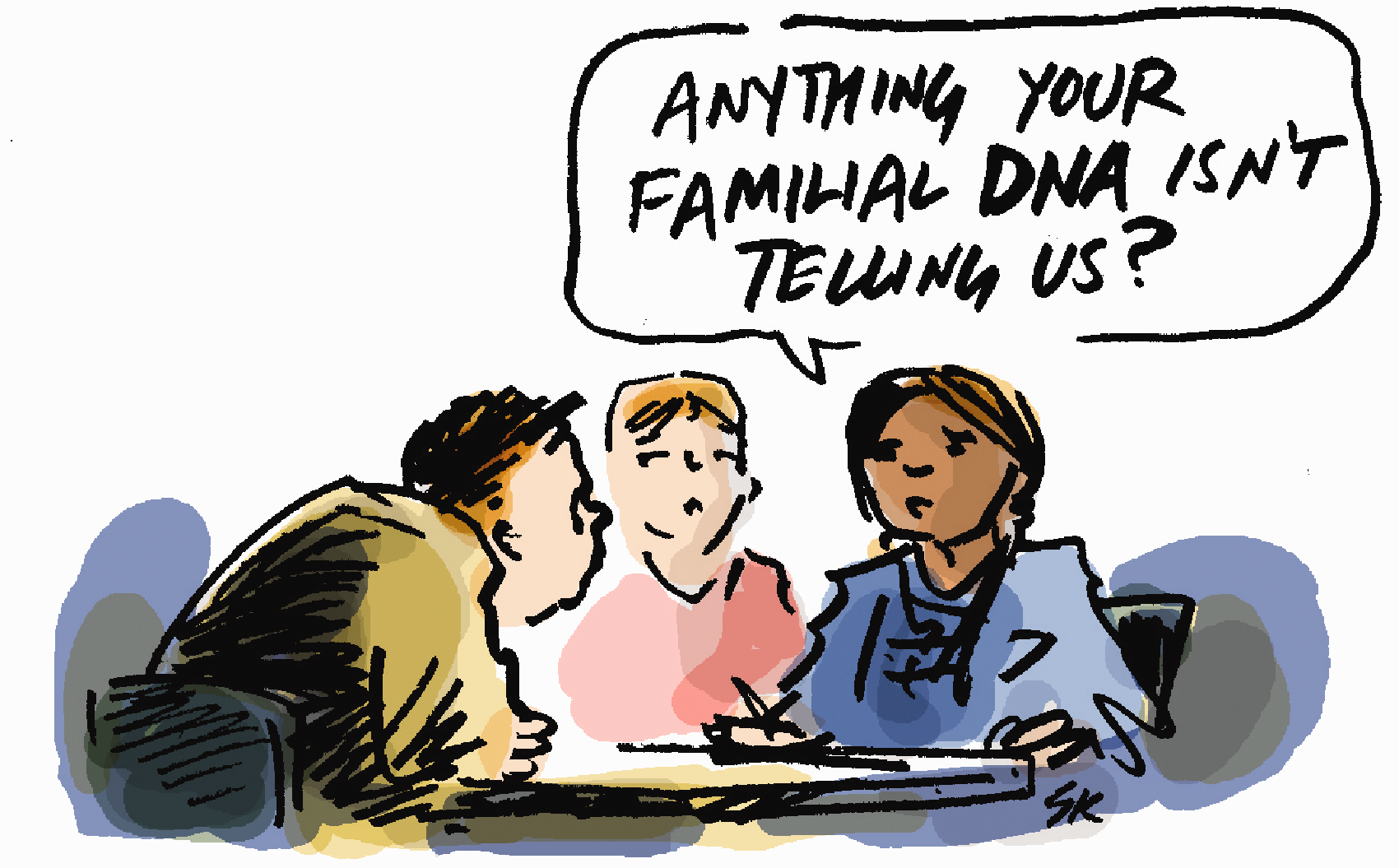
The origins of looking for familial matches to an unknown DNA profile is not a new approach, although it was not until 2004 that the prosecution used this evidence to secure a conviction. 5 In the last few years, particularly since 2018, law enforcement agencies have shown keen interest in consumer DNA databases. IGG is now actively relied upon in criminal investigations throughout the US and is becoming standard practice in some states. 6 In this article, we explain what IGG is, outline two case studies and address issues relating to informed consent. We then suggest that IGG is best regulated in two stages. In NSW, robust authorisation laws such as the Surveillance Devices Act 2007 (NSW) (SD Act) and Law Enforcement (Controlled Operations) Act 1997 (NSW) (CO Act) are required to ensure adequate approval to search consumer DNA databases and, once useful information is obtained, law enforcement agencies must adhere to existing forensic procedures Acts to obtain a lawful DNA sample from a suspect. As it is a matter of time before this forensic tool is used in Australia, it is incumbent on legislators to enact proactive regulation. 7
The investigative practice of IGG
IGG describes a practice adopted by law enforcement agencies to solve crimes. There are essentially two components to IGG: database matching of DNA profiles (to produce a candidate list) and the use of genealogy research to narrow a candidate list. IGG is utilised in cases in which there are no leads from analysis of crime scene DNA in the national DNA database. In these circumstances, law enforcement upload the DNA profile to a consumer DNA database(s). A list of potential candidates is obtained based on comparison with the profile. 8 Once law enforcement have this list, traditional genealogy research and police investigation are applied to narrow the search to identify candidates more accurately. This article is concerned with the first component.
DNA and database matching
DNA is a molecule that carries genetic information. 9 It forms a main component of human chromosomes and is largely responsible for the distinctive characteristics of a person’s biological makeup. Geneticist Sir Alec Jeffreys 10 developed DNA-based forensic testing in the 1980s and found that DNA is like a ‘fingerprint’; distinctive and singular to an individual. 11 Law enforcement agencies could identify an individual through scientific matching with genetic material gathered from crime scenes or victims. Because the genetic makeup of a child is a composite of both mother and father, 12 the method was able not only to identify exact matches but also to determine ‘partial’ matches with family members. 13
There have been many advances in DNA testing since the 1980s, and the accuracy of the science has increased considerably. 14 Database matching of DNA profiles attempts to identify candidates biologically related to an unknown DNA profile obtained at a crime scene. This is not ascertaining an exact match. 15 This technique permits determination of ‘[t]he degree of relatedness between two people, which is defined by the expected amount of shared DNA …’. 16 Put simply, familial relatives display a greater degree of genetic similarity compared with unrelated individuals. 17 Humans share DNA with their parents – 50 per cent from the mother and 50 per cent from the father. When analysis is extended to third cousins, the shared characteristics are only approximately 0.8 per cent. 18 Accurate relationship identification can be reliably predicted up to the second cousin, 19 although the science in this area is improving rapidly. Database matching for biological relatedness can increase the number of potential individuals for investigation compared with traditional forms of DNA matching that is limited to exact matches only. 20
Database matching and consumer DNA databases
Law enforcement agencies employing IGG are uploading DNA samples to consumer DNA databases to search for a match. The most widely used of these services is GEDmatch. 21 This is the public platform that led to the identification of the Golden State Killer. The database is designed for comparison of DNA profiles from DTC databases such as AncestryDNA, 23andMe, FamilyTreeDNA and MyHeritage. GEDmatch allows the user to ‘build’ a family tree and track lineal descendants across multiple platforms by uploading their raw DNA from other DTC databases. 22
In the wake of identification of the Golden State Killer, there was intense scrutiny of consumer DNA databases for allowing law enforcement to search their platforms. At the same time, they were also praised for playing a role in crime fighting. 23 Most companies have given users of their service a choice to opt out of law enforcement searches. 24 In contrast, a handful of these databases overtly promote their cooperation with law enforcement agencies. GEDmatch permits searches associated with violent crimes. 25 FamilyTreeDNA only permits this in the case of homicide, sexual assault and abduction. 26 The balance of databases requires a court order before they will permit law enforcement searches. 27 Despite all companies having policies about law enforcement use, there appears to be no practical barrier for the surreptitious use of it by such agencies. 28
Case studies
The ‘Golden State Killer’ is perhaps the most infamous case highlighting the use of IGG. 29 A string of rapes and murders from 1973 to 1986 occurred across various counties in California in the US. It was some 40 years after the commission of these offences that police investigators utilised GEDmatch to identify a familial match for the perpetrator. 30 GEDmatch elicited a number of individuals distantly related to Joseph DeAngelo. A precise family tree was constructed with this information, 31 and DNA material from a discarded tissue and car door handle confirmed DeAngelo as the perpetrator. This case was the first in the US to generate serious public debate about the use of consumer DNA databases’ data to identify potential suspects in serious criminal offences.
IGG was also successfully used to identify the individual responsible for the murder of a young Canadian couple in the US some 31 year after their murders. Jay Cook and Tanya van Cuylenborg travelled to Washington State in 1987 and were never heard from again. Their bodies were found in different locations. DNA from the two crime scenes was recovered and law enforcement used GEDmatch to obtain initial clues of the perpetrator’s identity. The database revealed two potential matches. A family tree was constructed and descendency research performed to narrow the results. Eventually, William Earl Talbott II was identified as a plausible suspect. Law enforcement obtained a discarded cup used by Talbott to perform DNA analysis; the results provided an exact match confirming the evidence. 32
These are two of the publicly available cases that have been solved using IGG. 33 They illustrate how powerful IGG can be under circumstances in which law enforcement DNA databases provide no helpful leads for either cold cases or active ones.
Informed consent
Given the increasing use of consumer DNA databases in criminal investigations, it is apposite to consider if individuals are cognisant of the risks involved in supplying a sample. Such a test is alluring when advertising only refers to the ability to track down distant relatives and to understand one’s familial history. These companies do not draw explicit attention to the fact that they can be required by law to grant access to DNA data in their possession. 34 They also do not require users to certify they understand and appreciate fully the nature of law enforcement searching. This could have significant impacts upon an individual’s choice to opt out. 35 It is also unknown to what extent, if at all, people are reading the terms and conditions, privacy statements and policies relating to law enforcement searching, or if they understand the implications involved in providing their DNA. There is good evidence to suggest that people do not read or understand terms and conditions before signing them. 36
Acceptance of DTC databases’ terms and conditions is unlikely to constitute sufficient prior and informed consent 37 for which the provision of a DNA sample reveals genetic information about relatives who have not consented. In a practical sense, those individuals who provide their DNA to DTC databases not only hand over some of the most intimate form of personal information to a private for-profit company but also they become genetic informants vis-a-vis their relatives. This serious implication is certainly not explicitly addressed in the terms and conditions of DTC databases. 38 We now turn to propose a regulatory scheme for IGG in Australia.
The law
Regulation of IGG in Australia could have two stages: the first might control the searching of consumer DNA databases for potential biological relatives; the second, use of this information. In the first stage, activity-specific legislation similar to the SD Act and CO Act is required to provide rigorous approval mechanisms. The second stage concerns what flows from police ascertaining a candidate list, for example, circumstances in which a DNA sample is necessary to confirm the identity of a suspect. In the US, in the case studies above, law enforcement agencies have obtained DNA material surreptitiously without the knowledge of the accused. We contend this is improper; a suspect ought to be arrested formally and the state and territory legislation specifically designed for the lawful conduct of forensic procedures should govern the acquisition of a DNA sample.
We now turn to examine two examples of investigative activity-specific legislation, which are potentially similar to the first stage of regulating IGG in Australian jurisdictions.
Surveillance Devices Act 2007 (NSW)
Surveillance devices are viewed as an intrusion of individual privacy. This is broadly analogous to searching a consumer DNA database for clues to identify a suspect; these activities are undertaken without the knowledge of the individual under investigation. Both activities are performed to establish identity to be used as evidence in a prosecution.
Recognition of the invasive nature of this type of investigation is reflected in the objects of the SD Act, 39 which state, inter alia, ‘to ensure that the privacy of individuals is not unnecessarily impinged upon by providing strict requirements around the installation, use and maintenance of surveillance devices’. 40 This objective is counterbalanced with the benefit that can flow from surveillance device data as evidence of criminal wrongdoing, or from which such wrongdoing can be legitimately inferred.
Only eligible judges and magistrates 41 declared by the Attorney-General are permitted to grant the use of surveillance devices under the SD Act. Whether a device is necessary for law enforcement to gather evidence about the commission of an offence, or the identity or location of an offender, is a central consideration on which an application will be granted. 42 In the application it must be stated if there are any other alternate means of obtaining the evidence sought and if those means will assist or prejudice the investigation. 43
The requirements to obtain warrants are rigorous, 44 and the onus rests with a law enforcement agency to persuade the judicial officer to grant the application. A number of mandatory considerations are to be taken into account when determining the application. These include privacy concerns, the nature and gravity of the alleged offence and other means of obtaining the evidence. 45 To add another hurdle for law enforcement, the application must provide as much information as is considered reasonably practicable in the circumstances. 46 This has the effect of providing a further safety net for any applications that might be unduly intrusive for the individual under investigation as they are unlikely to be aware of the significant invasion of their privacy.
Law Enforcement (Controlled Operations) Act 1997 (NSW)
Another example of legislation dedicated to regulating intrusive evidence gathering exercises, 47 the CO Act 48 is a form of covert investigation that is almost always conducted without the knowledge of a target. For this reason, even greater protections are required than in circumstances in which a suspect is aware of the conduct of an investigative procedure and its potential ramifications.
For the grant of a controlled operation, a law enforcement agency must apply to the chief executive of the agency for authority 49 rather than a judicial officer. Similar to the SD Act, a number of aspects must be raised in the application, such as the nature of the criminal activity or corrupt conduct targeted by the operation. 50 This forms the threshold consideration of whether an application has enough substance to proceed to determination. At this stage, if the executive officer desires further information for proper consideration, they are permitted to request further particulars. 51 This embeds a discretion for the decision-maker to request more information as deemed necessary. 52
Both the SD Act and CO Act regulate actions by law enforcement agencies that are designed to further criminal investigations and to gather evidence against a suspect. The rationale for separate, activity-specific legislation is found in recognition that the civil liberties and privacy of a suspect are clearly infringed if such activities are permitted. Safeguards are required in this instance as unwarranted probing by law enforcement agents into the lives of individuals does not accord with a free and just society. Robust authorisation before searching consumer DNA databases is essential to ensure that police are using these databases in appropriate circumstances and are not unduly invading individual privacy without just cause.
Forensic procedures Acts
The second stage of potential IGG regulation considers the extant legislation for forensic procedures on the collection of DNA samples. Taking blood or saliva, or swabbing a person’s body for the purpose of obtaining biological material is a forensic procedure, usually of an intimate nature. Each Australian state and territory has detailed legislative provisions in their respective Acts providing for consent to such procedures. 53 Some jurisdictions have comparatively more rigorous protections for a person suspected of committing a criminal offence.
In NSW, a suspect must be informed of a number of matters outlined in the Crimes (Forensic Procedures) Act 2000 (CFPA). 54 Some of the key components for ensuring informed consent are clear explanations by police officers personally or in writing as to the purpose of the procedure, 55 the offence to which it relates, 56 the way the procedure is to be carried out, 57 and that the suspect can refuse to consent to the procedure. 58 Information must also be given as to the use and potential further use of the sample; notably, the procedure can produce evidence to be used in court, 59 and the sample might be placed on the DNA database system which can be compared with information from the database systems of other participating jurisdictions. 60 Victoria, 61 Queensland, 62 Western Australia, 63 Australian Capital Territory (ACT) 64 and Tasmania 65 have provisions similar to NSW and place strong emphasis on the consent obtained from a suspect who has been properly informed.
On the other hand, the Northern Territory 66 and South Australia 67 merely require consent of the accused. There are no requirements for consent to be informed specifically with the details necessary in the other Australian jurisdictions. This is problematic given that a suspect is not provided with important information as to the exact details of the procedure and what flows from it. A suspect can be unaware why their DNA is being collected and how it will be used.
In a criminal justice system underpinned by procedural fairness, it is imperative that the accused plays an active and informed role in any procedures or processes related to a crime they are alleged to have committed. It is equally important that a person is given the opportunity to communicate with a lawyer who can explain the various and potentially far-reaching implications of either supplying or not supplying a DNA sample. This is an integral part of the principled core of the criminal law and its operative fairness. As Professor Andrew Ashworth emphasised in this regard, ‘persons accused of substantial wrongdoing ought to be afforded the protections appropriate to those charged with criminal offences’. 68 This principle is specifically directed to minimum protections declared in such provisions as Article 6 of the European Convention on Human Rights and similar instruments including the International Covenant on Civil and Political Rights (Article 14) to which Australia is a signatory. These human rights protections are essentially directed to the presumption of innocence and the right to be informed properly of the accusations made against a person and to information about the investigative procedures to be used.
The potential for unregulated use of IGG in Australia has serious implications for due process in criminal investigation and for suspects of crime. As seen in the US, the first an accused becomes aware that they are being investigated is when charged. By this time law enforcement already has DNA evidence of the individual’s involvement, and this evidence is likely to form the foundation of the prosecution case against them. It is, therefore, imperative that judicial authorisation, after careful consideration, is provided to law enforcement to search into consumer DNA databases. It is likewise important that, once law enforcement agencies have a suspect, they refer to the forensic procedures Acts to obtain a sample lawfully and with the informed consent of the accused.
A way forward
Overt intrusions into the privacy of individuals through covert and other investigative methods are given separate legislative consideration through the creation of rigorous approval procedures and other safeguards in NSW. With the availability of data from consumer DNA databases to Australian law enforcement, our considered recommendation is that state and territory legislatures formulate specific legislation to regulate the searching of consumer DNA databases. 69 The forensic procedures Acts across the country should then regulate the provision of a sample from a suspect following the normal process.
Need and proportionality should be guiding principles for legislation to regulate searching of consumer DNA databases. Law enforcement should only have access to consumer DNA databases if serious crimes are involved and those that have a strong public interest element, such as homicides, serious sexual assault and kidnappings. Authorisation from a judicial officer, in the form of a warrant, should be sought prior to law enforcement searching consumer DNA databases, and it should be regulated in a manner similar to the SD Act and CO Act. Judicial authorisation, however, should not supercede individuals’ informed choice not to participate in law enforcement searching within a consumer DNA database. To do so would have significant implications for privacy and established norms of the right against self incrimination.
Consumer DNA companies should obtain prior and informed consent from users who wish to engage in their platform. This should include a clear explanation of how their DNA will be used if permission is granted for law enforcement agencies to search the database. It should also plainly state that their sample can reveal biological relationships of their family members. This will ensure only informed members of the community have their DNA available to law enforcement and vitiates some of the associated privacy concerns. 70
If IGG produces evidence for the prosecution, defence counsel should have access to qualified genetic genealogists to verify the accuracy of the information. Genetic genealogists assisting law enforcement with IGG should be appropriately qualified with relevant education and/or experience. 71 If there is insufficient evidence for law enforcement agencies to charge a suspect, the question will arise as to circumstances in which it is appropriate for a covert sample to be obtained. Legislators will need to consider this carefully and also situations in which police are permitted to approach non-suspects for their DNA to further an investigation. 72
Conclusion
IGG is a groundbreaking new method for law enforcement agencies worldwide. It has the capacity to decrease the police investigation time required to solve crimes and to reduce significantly the number of cold cases. 73 IGG has been largely employed if serious cold cases have remained unsolved for many years but has equal veracity for active cases. It is for these reasons we are likely to see Australia adopt this practice in the not too distant future.
There are obvious positive social benefits for the use of IGG by Australian law enforcement agencies. At the same time there are manifold potential consequences if IGG is not properly regulated. On the one hand, faith in the Australian criminal justice system could be diminished if law enforcement has disproportionate powers to obtain an individual’s genetic information. On the extreme end of the spectrum is the propensity for miscarriages of justice resulting from improper use of IGG.
Considered thought and proactive legislative reform are required to anticipate the utilisation of consumer DNA databses in Australia. Some areas within the US have demonstrated the increasing reliance placed on IGG in serious criminal cases; this has shone a light on some important considerations for due process. If Australia contemplates making the move to add IGG to law enforcement’s investigative toolkit, it must be equally concerned with preserving human rights, civil liberties and public confidence in the criminal justice system.
Footnotes
Declaration of conflicting interests
The author(s) declared no potential conflicts of interest with respect to the research, authorship, and/or publication of this article.
Funding
The author(s) received no financial support for the research, authorship, and/or publication of this article.
2
For a thorough explanation of genetic genealogy: see Ellen M Greytak, Cece Moore and Steven L Armentrout, ‘Genetic Genealogy for cold case and active investigations’ (2019) 299 Forensic Science International 103. See generally Natalie Ram, ‘Fortuity and familial identification’ (2011) 63(4) Stanford Law Review 751; Natalie Ram, Christi J Guerrini and Amy L McGuire, ‘Genealogy databases and the future of criminal investigation’ (2018) 360(6393) Science 1078; Christi J Guerrini et al, ‘Should police have access to genetic genealogy databases? Capturing the Golden State Killer and other criminals using a controversial new forensic technique’ (2018) PLOS Biology 1.
3
4
Some DTC databases include AncestryDNA, MyHeritage, 23andMe. Genealogy services that offer information only include databases such as GEDmatch. Within this article, both types of database fall under the description of ‘Consumer DNA databases’.
5
Christopher N Maguire et al, ‘Familial Searching: A specialist forensic DNA profiling service utilising the National DNA Database® to identify unknown offenders via their relatives – the UK experience’ (2014) 8(1) Forensic Science International: Genetics 1, 2.
6
IGG is not used in every state in the US; Washington DC and Maryland both prohibit its use. The Federal Bureau of Investigation (FBI) does not permit interstate searches. Within states such as Virginia, Texas, Florida, Colorado and California, such practices are relatively commonplace.
7
8
It should be noted that law enforcement cannot obtain the raw DNA profile from GEDmatch without a valid warrant.
9
For a comprehensive ‘primer’ on DNA forensics: see Ram (n 2).
10
See A J Jeffreys, V Wilson and S L Thein, ‘Individual-Specific “Fingerprints” of Human DNA’ (1985) 316 Nature 76.
11
Rana Saad, ‘Discovery, Development, and Current Applications of DNA Identity Testing’ (2005) 18(2) Baylor University Medical Cente Proceedings 130.
12
Ibid.
13
See Ram (n 2) 759. Australia used ‘familial DNA testing’ for the first time in 2020 which led to the apprehension of a man responsible for a string of rapes in South Australia: Grace Tobin and Chris Gillett, ‘The controversial forensic test catching killers and rapists through relatives’ DNA’, ABC News (online, 15 June 2020)  .
.
14
DNA evidence is not without error: see generally Erin Murphy, Inside the Cell: The Dark Side of Forensic DNA (Little Brown, 2015). For more on DNA testing: see Ray A Wickenheiser, ‘Forensic genealogy, bioethics and the Golden State Killer case’ (2019) 1 Forensic Science International 114; Sara Debus-Sherrill and Michael B Field, ‘Familial DNA Searching: An emerging forensic investigative tool’ (2019) 20 Science & Justice 20; Ram (n 2) 760.
15
Traditional DNA testing looking for an ‘exact’ match uses autosomal short tandem repeats (STRs) whereas familial DNA searching applies single nucleotide polymorphisms (SNPs) to detect biological relatedness: Greytak, Moore and Armentrout (n 2).
16
Greytak, Moore and Armentrout (n 2).
17
Henry T Greely et al, ‘Family ties: the use of DNA offender databases to catch offenders’ kin’ (2006) 34(2) The Journal of Law, Medicine & Ethics 248, 253. See generally Ram (n 2) 759; Debbie Kennett, ‘Using Genetic Genealogy Databases in Missing Persons Cases and to Develop Suspect Leads in Violent Crimes’ (2019) 301 Forensic Science International 107.
18
On average, each person has around 175 third cousins, and there is around a two per cent chance that a pair of third cousins will share no DNA at all: UK government, ‘Should we be making use of genetic genealogy to assist in solving crime? A report on the feasibility of such methods in the UK’ (Web Page, 9 September 2020) .
19
See Kennett (n 17) 108.
20
For the success rate of forensic genealogy in the UK context: see generally Jim Thomson et al, ‘The Effectiveness of Forensic Genealogy Techniques in the United Kingdom: An experimental assessment’ (2019) 7 Forensic Science International: Genetic Supplement Series 765.
21
For more on GEDmatch and its use: see Kennett (n 17) 110–13. While GEDmatch was created in the US, and its predominant market resides there, Australia has been identified as one of the most ‘popular’ countries to use the database: Caitlin Curtis, ‘How Online Genealogy Created an Unregulated Forensic Database for Police’, ABC News (online, 13 November 2018) .
22
In practice, ‘[t]he data on GEDmatch therefore represents a publicly available subset of the data from each of the commercial companies’: Kennett (n 17) 110. Note that descendents can only be identified through GEDmatch if they are also GEDmatch users.
23
See, eg, Jason Tashea, ‘Genealogy sites give law enforcement a new DNA sleuthing tool, but the battle over privacy looms’, ABA Journal (Blog Post, 1 November 2019) . Interestingly, DNASolves (a private company) was created in 2018 by a leading genetic testing group Othram, for the sole purpose of assisting law enforcement. This may suggest how integral consumer DNA databases are becoming in criminal justice.
24
Both GEDmatch and FamilyTreeDNA allow users to ‘opt-in’ to law enforcement searching.
25
27
Including, but not limited to, AncestryDNA, 23andMe, Living DNA, and MyHeritage.
28
Such policies provide guidelines about when and how law enforcement can participate in their database. While DTC databases, including 23andMe, Ancestry DNA, MyHeritage, FamilyTreeDNA, Living DNA, MyHeritage and matching company, GEDmatch, have policies about law enforcement use, there appears no way for them to regulate covert use in breach of these policies. In fact, GEDmatch claims they are not responsible for data uploaded in contravention of their policy, which may suggest that it could occur unnoticed by the company.
29
Golden State Killer Trial (n 1).
30
The Combined DNA Index System (CODIS) had provided no useful information in the first instance.
31
Wickenheiser (n 14) 115. Law enforcement was assisted by genealogists and this itself raises important questions about the role of lay people in criminal investigations.
32
Greytak, Moore and Armentrout (n 2) 110–11.
33
For more case studies: see Greytak, Moore and Armentrout (n 2) 104, 110–11. The use of IGG has also led to overturning wrongful convictions, for example, in the case of Christopher Tapp who served a period of 21 years incarceration for the murder of Angie Dodge: Tashea (n 23).
34
Clear and more comprehensive privacy warnings are required; however, this is outside the scope of this article.
35
To understand and appreciate fully is different to merely signing a document to display agreement with terms and conditions.
36
See, eg, Phuong Nguyen and Lauren Solomon, Consumer Data and the Digital Economy: Emerging issues in data collection, use and sharing (Report of the Consumer Policy Research Centre, 2018) 28–40.
37
Suggestions on specific approaches to obtaining informed consent are outside the scope of this article and require further research.
38
Privacy in genetic information is another issue arising from participation in consumer DNA databases: see Ellen M Greytak et al, ‘Privacy and Genetic Genealogy Data’ (2018) 361 Science 857. See generally Ram, Guerrini and McGuire (n 2).
39
Surveillance Devices Act 2007 (NSW).
40
Ibid s 2A(c).
41
Ibid s 5.
42
Ibid s 17(1)(c).
43
Ibid s 17(3)(b).
44
Including affidavits accompanying the application with all of the required elements to be addressed: SD Act s 17(3A)(a)–(c).
45
Ibid s 19.
46
Ibid s 17(5)(a).
47
See definition of ‘controlled operation’: (a)–(d) CO Act s 3.
48
Law Enforcement (Controlled Operations) Act 1997 (NSW).
49
Ibid s 5. See definition of ‘law enforcement agency’: (a)–(e) CO Act s 3.
50
Ibid s 5(2A)(a)--(f).
51
Ibid s 5(3).
52
Ibid ss 6, 7.
53
NSW: Crimes (Forensic Procedures) Act 2000 (NSW); Victoria: Crimes Act 1958 (VIC); Northern Territory: Police Administration Act 1978 (NT); Queensland: Police Powers and Responsibilities Act 2000 (Qld); Western Australia: Criminal Investigation Act 2006 (WA); Tasmania: Forensic Procedures Act 2000 (Tas); ACT: Crimes (Forensic Procedures) Act 2000 (ACT); South Australia: Criminal Law (Forensic Procedures) Act 2004 (SA).
54
Crimes (Forensic Procedures) Act 2000 (NSW).
55
Ibid s 13(1)(b).
56
Ibid s 13(1)(c).
57
Ibid s 13(1)(d).
58
Ibid s 13(1)(i).
59
Ibid s 13(1)(e).
60
Ibid s 13(1)(k). In NSW and the ACT, an accused is given the opportunity to communicate with a legal practitioner before consenting to such procedures: CFPA s 9(2)(d) and Crimes (Forensic Procedures) Act 2000 (ACT) s 21(1)(c), respectively.
61
Section 464S requires that the police officer requesting the consent to inform the suspect in language likely to be understood by the person: Crimes Act 1958 (Vic) s 464S(1).
62
Informing the accused of the offence to which the forensic procedure relates is omitted, unless it can be captured under ‘why it is proposed to perform the forensic procedure on the person’: Police Powers and Responsibilities Act 2000 (Qld) ss 454(1)(a), s 454 generally. Interestingly, an accused under this Act is given a ‘reasonable time to consider the explanation’: Police Powers and Responsibilities Act 2000 (Qld) s 453(1).
63
Criminal Investigation Act 2006 (WA) s 91(3).
64
Crimes (Forensic Procedures) Act 2000 (ACT) s 24.
65
Forensic Procedures Act 2000 (Tas) s 10.
66
Police Administration Act 1978 (NT) s 145.
67
Criminal Law (Forensic Procedures) Act 2004 (SA) s 8. However, in South Australia the storage of a DNA sample on the database requires explicit consent: Criminal Law (Forensic Procedures) Act 2004 (SA) s 43.
68
Andrew Ashworth, ‘Is the Criminal Law a Lost Cause?’ in Ashworth, Positive Obligations in Criminal Law (Hart Publishing, 2013) 29.
69
Other more specific requirements are outside the scope of this article, however, could include the analysis be conducted in an accredited facility/environment and specific provisions addressing transmission of raw data, length of retention, and destruction of sample: see UK government (n 18) 5.
70
Although this does not address concerns relating to family members’ DNA being available by virtue of one member providing it to a DTC company. This is a significant question and requires further research.
71
The creation of a code may be appropriate to regulate the qualifications of genetic genealogists, which would address relevant qualifications and expertise.
72
73
Greytak, Moore and Armentrout (n 2).