







Abstract
Clients’ personality traits and individual characteristics, such as age, gender, reason for seeking counselling, and further compounding problems in their personal or academic lives, may pose risk factors that render career decision making difficult and may also impact the overall effectiveness of a career counselling intervention. Neuroticism and conscientiousness as well as clients’ age and gender directly affected clients’ satisfaction with life and certain aspects of their career indecision scores before participating in our short-term career counselling intervention. Career counsellors can use personality and career-specific and career-non-specific instruments to tailor career counselling interventions to meet clients’ individual needs.
Although processes underlying the effectiveness of psychological interventions and what makes change possible are difficult to study (Heppner & Heppner, 2003; Imel & Wampold, 2008), the effectiveness of career counselling has been well documented in the literature. Oliver and Spokane (1988) and Whiston, Sexton, and Lasoff (1998) published meta-analyses documenting moderate to large effect sizes for career counselling interventions. Whiston and colleagues found individual career counselling interventions to be the most effective and efficient treatment modality. However, little has been published regarding the influence of clients’ personality and individual characteristics on the effectiveness of career counselling (Swanson & O’Brien, 2002). Several authors have called for such research with regard to designing and implementing career counseling interventions according to clients’ individual characteristics (e.g., Hartung et al., 1998; Whiston & Rahardja, 2008). Therefore, the goal of this research was to study how clients’ personality and individual characteristics might influence their difficulties in making career choices and how these variables impact career indecision, satisfaction with life, and satisfaction with the intervention.
Clients’ personality and individual characteristics in career counselling
Career counselling interventions are often planned and guided by the results of various assessments (Harris-Bowlsbey, 2003) that measure client-specific variables, such as the client’s career interests, beliefs, maturity, skills, aptitudes, abilities, and personality (Whitfield, Feller, & Wood, 2009). Personality instruments may add information to a vocational battery to further describe clients’ strengths and weaknesses, indicate their emotional skill level, and help them in making career decisions (Rossier, 2005).
Neuroticism has been associated with depression and recovery from depression has been associated with a decrease in neuroticism; an increase in extraversion scores, and extraversion scores have served as a marker for well-being (Bagby, Joffe, Parker, Kalemba, & Harkness, 1995). Quilty et al. (2008) found that neuroticism and conscientiousness were significantly associated with response to treatment in 649 depressed outpatients. In two different grief group therapies, higher extraversion, openness, and conscientiousness and lower neuroticism were associated with more favorable client outcomes (Ogrodniczuk, Piper, Joyce, McCallum, & Rosie, 2003).
In vocational studies, agreeableness and conscientiousness accounted for a small but significant part of the relationship between personality and job performance, though moderated by Holland work environment (Fritzsche, McIntire, & Yost, 2002). Larson and Borgen (2002) found more specific patterns between five-factor personality traits, Holland types, and vocational interests in 323 gifted adolescents. Rolland (2004) cautioned that parameters other than personality, such as the reason for and the goal of the evaluation, the reason the person initially sought counselling, and other factors that become evident through counselling sessions, must also be taken into consideration when formulating hypotheses, lest the counsellor’s interpretations be considered “artificial” (p. 146).
This research was based on a large number of studies that have evaluated the impact of clients’ individual characteristics, such as gender, age, and school performance (e.g., Mau & Fernandes, 2001), on various constructs related to career counselling. Hijazi, Tatar, and Gati (2004) found gender differences relative to career decision-making difficulties in Israeli and Palestinian Arab high school samples. Blackhurst and Auger (2008) found gender differences with regard to students’ future career aspirations and expectations and further concluded that these differences may increase as children age. Certain external factors may also prohibit clients’ career decision-making capabilities, such as career choice, based on the desires expressed by one’s parents or entourage in younger clients (Zikic & Hall, 2009); job loss, economic hardship, or a slow economy (Duffy & Dik, 2009; Zikic & Hall, 2009); or family expectations and needs in adult clients (Duffy & Dik, 2009; Whiston & Keller, 2004).
Thus, the aims of this study were: (1) to investigate whether clients’ personality and individual characteristics were related directly to career decision-making difficulties, well being, and satisfaction with a career counselling intervention; and (2) to evaluate how clients’ personality and individual characteristics influence career decision-making and/or overall well-being as a result of participating in a brief career counselling intervention.
Method
Participants
Participants voluntarily sought career counselling at a university-run career counselling service in western Switzerland. Because this study was part of a larger study concerning the long-term effects of the career counselling intervention, the number of clients participating varied according to the time period (pre-, mid, or post-intervention) and the instruments completed. This sample was primarily composed of 179 participants who completed the Career Decision-Making Difficulties Questionnaire (CDDQ) and the Satisfaction with Life Scale (SWLS) at pre-intervention and the NEO Five Factor Inventory-Revised (NEO-FFI-R) at mid-intervention: 80 men (45%), 99 women (55%), with a mean age of 22.05 years (SD = 7.69). About 89% of participants were Swiss. Twenty-one (11.7%) were students at the end of their mandatory schooling (9th grade), 87 (48.6%) were high school students, 35 (19.6%) were enrolled in post-secondary (university-level) educational programs, and 29 (16.8%) were employed adults; seven participants did not report their student/employment status. Eighty-five (48.6%) reported having a personal difficulty, such as depression or a family conflict.
Two distinct age groups were found, representing two different developmental ages with regard to career decision making. Therefore, a bimodal distribution was retained for further analysis: 127 (70.9%) participants were 21 years of age or younger and 52 (29.1%) were 22 years of age or older. Regression analyses were performed on a subsample of 145 participants who completed the CDDQ and SWLS at pre- and post-intervention times, the NEO-FFI-R at mid-intervention, and the Satisfaction with the Intervention Scale (SWI) at post-intervention.
Intervention
The intervention consisted of four or five 1-hour face-to-face weekly career counselling sessions (based on clients’ needs) across four broad phases of treatment: analysis and clarification of the career counseling request, testing (e.g., for interests, personality, aptitude, and career/transversal skills), discussion of test results with clients in light of their counselling request, and discussion of concrete career plans relative to clients’ goals and concerns. In answer to calls in the literature for more holistic approaches (Heppner & Heppner, 2003), this intervention included the integrative blending of several theories (i.e., cognitive-behavioural, person-centered, work adjustment, and social cognitive career theory) and activities that addressed the interaction between clients’ personal and professional difficulties.
Some examples of these homework activities discussed in session included: timelines that highlight major (positive and negative) professional and personal events in the clients’ lives and worksheets that invite clients to reflect on their work experiences, skills, and their personalities (e.g., “What skills have I developed throughout my career?”; “What do I contribute to a team?”; “Why do people generally call on me?”; “What are my major achievements and successes?”; “What strengths and weaknesses would others say I have?”). The intervention was designed to help clients better “understand their career behavior” (Gysbers, Heppner, & Johnston, 2009, p. 47) and included at least four of the five critical ingredients identified by Brown et al. (2003): workbooks and written exercises, individualized interpretation and feedback, world of work information, and attention to building support. Support building also entailed involving younger clients’ parents or disabled or unemployed clients’ case managers in sessions. Modeling was not systematically present in each client’s intervention when an individual need for modeling was not deemed necessary (Masdonati, Massoudi, & Rossier, 2009).
The intervention was provided by advanced students enrolled in their second year of a Master of Science in Counselling Psychology/Career Counselling program. Qualified supervisors employed at the university provided weekly supervision of counselling services, using video-taping for all sessions and in vivo supervision to ensure that a certain standardization and treatment integrity of the intervention was maintained in light of adaptations made to suit individual clients’ needs. Supervisors and other supervisees watched the sessions live via closed-circuit video, and supervisors were available to answer questions or to intervene when necessary during the counselling session.
Instruments
Career Decision-Making Difficulties Questionnaire
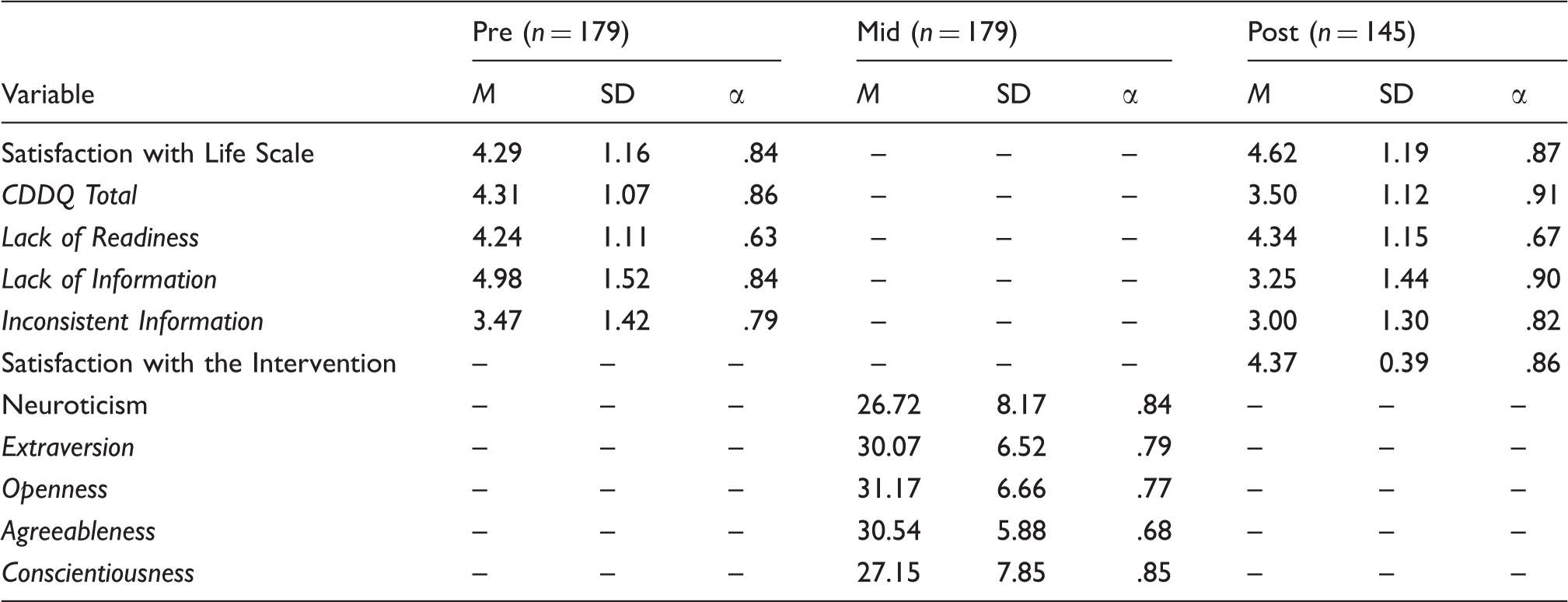
(CDDQ; Gati, Krausz, & Osipow, 1996; Gati, Osipow, Krausz, & Saka, 2000). The CDDQ is comprised of 34 items and yields a global career decision-making difficulties score with three difficulty scales: Lack of Readiness, Lack of Information, and Inconsistent Information. Clients indicated their agreement with items on the CDDQ-French version (Marro, 2009) based on a 9-point Likert-type scale (1 = does not apply to me, 9 = fully applies to me). Internal consistencies in this study were calculated pre- and post-intervention for all CDDQ scales: Total score (.86 and .91), Lack of Readiness (.63 and .67), Lack of Information (.84 and .90), and Inconsistent Information (.79 and .82). Gati et al. (1996) found similar coefficients on each of these scales: .95, .63, .95, and .89, respectively.
Satisfaction with Life Scale
(SWLS; Diener, Emmons, Larsen, & Griffin, 1985; Pavot & Diener, 1993). The SWLS is a 5-item measure of a person’s general well-being and overall satisfaction in life on a 7-point Likert-type scale (1 = strongly disagree, 7 = strongly agree). Because this instrument has good sensitivity, it was used to measure changes in clients’ life satisfaction pre- and post-intervention (Pavot & Diener, 2008). In this study, we found internal consistencies of .84 (pre-intervention) and .87 (post-intervention), which is similar to Diener et al.’s findings of .87.
NEO Five-Factor Inventory-Revised
(NEO-FFI-R; McCrae & Costa, 2004). The NEO-FFI-R is a 60-item measure that includes five dimensions corresponding to the five-factor personality model: Neuroticism, Extraversion, Openness, Agreeability, and Conscientiousness. Respondents rate their agreement with items based on a 5-point Likert-type scale (1 = strongly disagree, 5 = strongly agree). Aluja, García, Rossier, and García (2005) found internal consistencies on these scales of between .71 and .83, and we found similar results of between .68 and .85.
Satisfaction with the Intervention
(SWI; Massoudi, Masonati, Clot-Siegrist, Franz, & Rossier, 2008; Rossier, Bueno, & Massoudi, 2002). The SWI, created and administered in French, is a 10-item instrument that gauges clients’ satisfaction with different aspects of their career counselling experience on a 5-point Likert-type scale (1 = very unhelpful, 5 = very helpful). These aspects include the quality of the reception at the center (i.e., wait time and whether or not they felt welcomed by telephone and in person by the reception staff), the quality of the individual counselling sessions (i.e., helpfulness of the exchanges between counsellor and client, counsellor’s adequate understanding of the client’s expectations and reason for presenting for services), and the quality of the information and counselling received (i.e., relevance of the observations made by the counsellor and of the career counselling evaluation, relevance of the advice given, and general impressions). Massoudi et al. (2008) found an internal consistency of .87 and herein we found .86.
Demographic Data
Demographic data pertaining to age, gender, nationality, current or past school difficulties, and additional difficulties were based on client reports and collected via counsellor session summaries.
Procedure
Participants were clients voluntarily engaged in a short-term career counselling intervention and were recruited by their career counsellor-in-training after the first session. All participants were informed of the purpose of the study, the assessment schedule, and that they could ask questions about or withdraw from the research at any time. After consenting to participate, they received pre- (after their first counselling session) and post- measures (after their fifth or last counselling session) of the SWLS and the CDDQ; the NEO-FFI-R after their third counselling session; and the SWI questionnaire after their last counselling session.
Results
Mean scores and alphas at pre-, mid-, and post-intervention times.
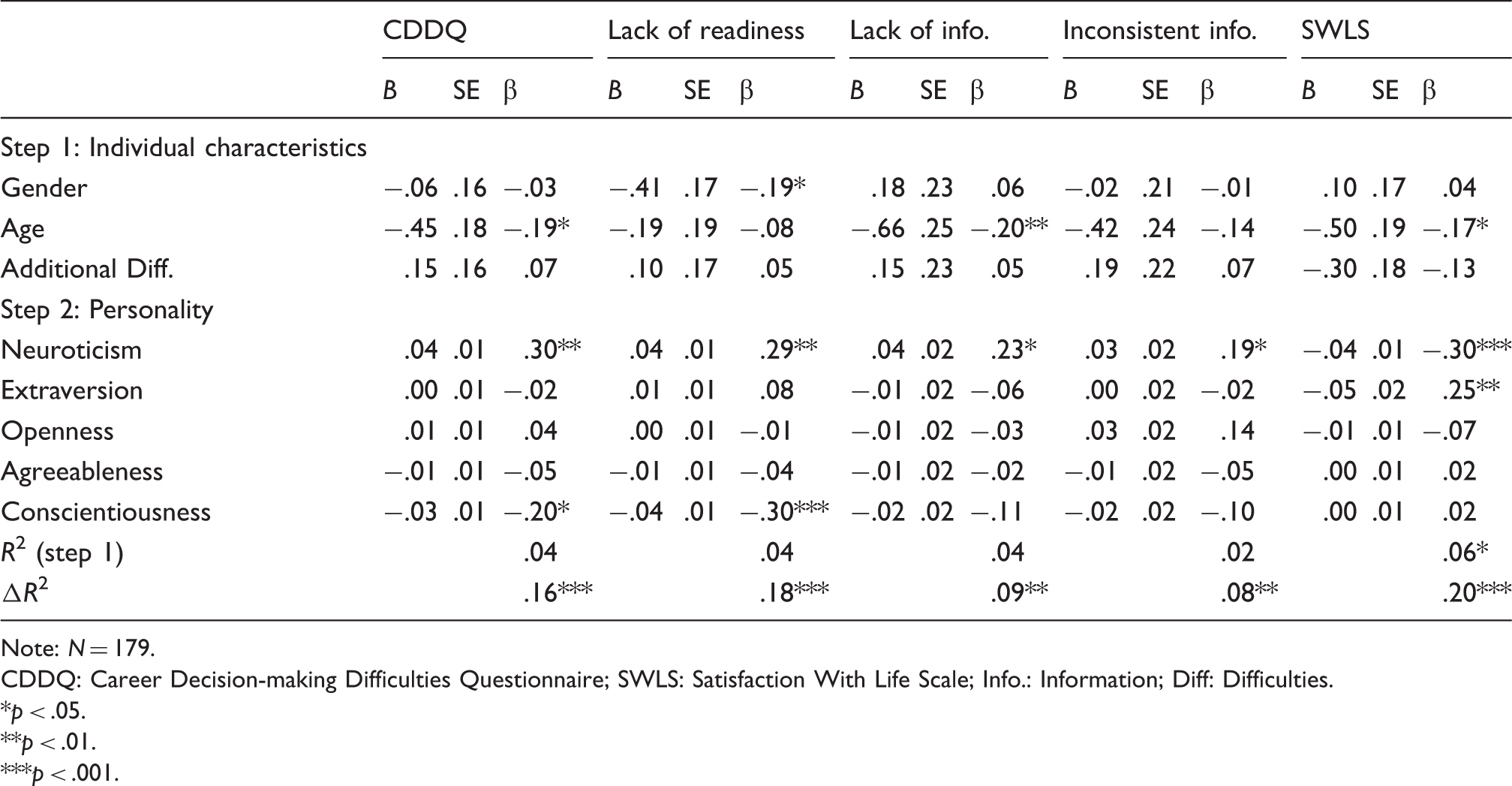
Direct effects of individual characteristics and personality on client scores at baseline (method enter).
Note: N = 179.
CDDQ: Career Decision-making Difficulties Questionnaire; SWLS: Satisfaction With Life Scale; Info.: Information; Diff: Difficulties.
p < .05.
p < .01.
p < .001.
We found several small to medium effects with respect to gender and age on baseline measures of indecision, but these effects did not affect the overall model. The trend indicated that older participants were less undecided, and particularly regarding the lack of information. However, it seems that age significantly explained lower satisfaction with life scores at baseline and within the overall model: Older clients reported less satisfaction with life. Additionally, men seemed to be less ready than women to make a career choice at the beginning of counselling sessions. Adding personality to the model helped to explain a significant percentage of the variance for each of the dependent variables and indicated a moderate effect on the model. Higher levels of neuroticism indicated more indecision difficulties and lower satisfaction with life at baseline. Conscientiousness helped to explain the total indecision variance and especially the lack of readiness to make a career decision for people with lower levels of conscientiousness.
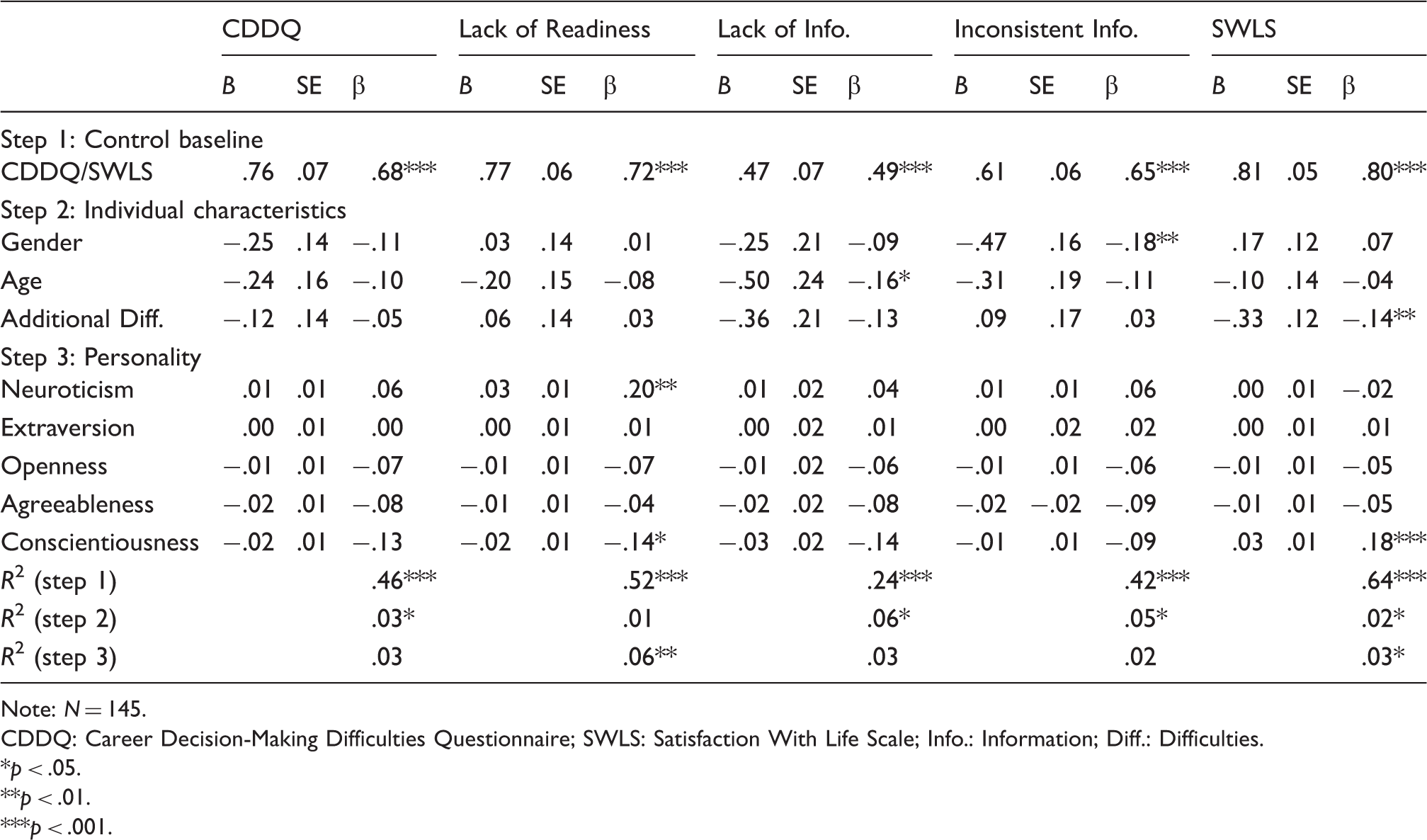
Moderator effects of individual characteristics and personality on the effectiveness of the intervention (method enter).
Note: N = 145.
CDDQ: Career Decision-Making Difficulties Questionnaire; SWLS: Satisfaction With Life Scale; Info.: Information; Diff.: Difficulties.
p < .05.
p < .01.
p < .001.
The impact of personality, entered in step 3, either disappeared or was strongly reduced in this model when compared with baseline measures. Significant small to medium effects remained regarding the lack of readiness. We found that the intervention was less effective for clients with higher levels of neuroticism and lower levels of conscientiousness. The impact of the intervention on clients’ lack of readiness was not significant when considered across the study. To tease out these effects, two repeated measures pre-/post-ANOVA were performed introducing Neuroticism and Conscientiousness as additional independent variables. In fact, clients with higher levels of neuroticism and lower levels of conscientiousness tended to have greater difficulties with lack of readiness across the course of the intervention, and clients with lower levels of neuroticism and higher levels of conscientiousness tended to have stable lack of readiness scores throughout the course of the intervention, F(1, 142) > 1.58, p < .056, partial η2 = .03. Finally, clients with higher levels of conscientiousness showed greater benefits in terms of satisfaction with life as a result of the intervention.
Clients’ individual characteristics did not significantly influence their satisfaction with the career counselling intervention they received, B < .01, t(142) < 1.48, ns. The model using individual characteristics as predictor variables did not explain a significant proportion of the variance, R2 = .04, F(3, 142) = 1.93, ns. When we added the five-factor personality dimensions in step 2, the results indicated that client personality, independent of the other individual characteristics cited above, did not exert a significant influence on clients’ satisfaction with the intervention, either: B < .01, t(142) < 1.74, ns. These personality factors did not explain enough of the variance to render the model significant: R2 = .07, F(8, 137) = 1.28, ns.
Discussion
In this study, we examined the direct and moderator effects that personality and clients’ individual characteristics could have on the effectiveness of a short-term career counselling intervention. This intervention required career counsellors to adapt their methods to the individual client’s personality, age, gender, and reason for presenting in counselling. Clients’ personal difficulties were taken into account when considering career counselling options (Multon, Heppner, Gysbers, Zook, & Ellis-Keaton, 2001). Overall, this intervention was relatively effective for clients. We noted moderately-sized direct effects regarding clients’ individual characteristics on their indecision and satisfaction with life scores at baseline and reduced moderating effects that were either non-significant or small regarding the effectiveness of the intervention on these outcome variables.
In this sample, neuroticism and conscientiousness showed direct effects on clients’ level of indecision and satisfaction with life before the career counselling intervention, explaining a moderate amount of the variance found independent of clients’ individual characteristics. Among these variables, neuroticism tended to serve as a barrier to well-being and career decision making, whereas conscientiousness served as a protective factor. Other researchers have also found extraversion (e.g., Bagby et al., 1995) and agreeableness (e.g., Fritzsche et al., 2002) to be protective factors in general and career counselling studies. Certain individual characteristics, such as clients’ age and additional difficulties, had direct, though small, effects on baseline life satisfaction scores. Older clients (22 and older) and younger clients (21 and under) appeared to have different career decision making and satisfaction with life difficulty profiles with regard to their presenting concerns. Because older clients reported lower satisfaction with life, concentrating some on non-career-specific goals and outlining steps to attain them may be appropriate during career counselling sessions. Because men showed more lack of readiness and younger clients showed indecision problems related more so to a lack of information, career counsellors should consider how their clients’ gender and the reason for presenting in counselling may factor into their larger career concerns. Additional difficulties reported in the beginning of counselling sessions did not appear to influence career indecision and satisfaction with life at the beginning of career counselling sessions, as evidenced by the relatively small proportion of variance explained by these variables at baseline.
Certain moderator effects merit further discussion. Personality traits, like neuroticism and conscientiousness, moderated the effectiveness of the career counselling intervention. Even after controlling for baseline effects, the intervention was more efficacious for clients who were conscientious and less efficacious for clients with high levels of neuroticism concerning their lack of readiness. Clients who were less conscientious or more neurotic were still not fully prepared to make a career decision and were not happier with their lives by the end of the intervention. The effect of age was reduced by the end of the intervention, especially regarding lack of information. This could indicate that older clients, for whom this was a more prominent concern, were able to find more career-related information, which helped them make a career decision by the end of the intervention. The fact that men continued to score significantly on the Inconsistent Information scale suggested that they were still conflicted about how their skills and abilities may be applied to the professions that interest them and that the intervention was less effective for them. We offer possible explanations, describe how these clients may present in counselling, and suggest ways of working with them that take the direct and moderator effects of clients’ personality traits and individual characteristics into account.
Implications for practice
Herein, we provide suggestions for how career counsellors may use personality and other individual or demographic variables to improve treatment planning, efficacy, and outcomes for their clients. The majority of participants in this sample scored within the average range on each dimension, but counsellors often have difficulty making and implementing session plans for clients that fall on the extreme ends of these scales. We further explain how clients on these ends of the spectrum may present in career counselling, some of the frustrations counsellors may face, and some suggestions for adapting the intervention to meet these clients’ individual needs.
Neuroticism
Clients in this sample who showed higher levels of neuroticism initially showed lower levels of satisfaction with life and higher levels of indecision. High levels of neuroticism have been linked with higher anxiety (Widiger, Costa, & McCrae, 2002). Clients with higher levels of neuroticism may tend to exhibit stress regarding career decision-making tasks, which may negatively impact their well-being or interfere with their ability to seek information or to otherwise prepare themselves to make sound career decisions. Lower levels of neuroticism were associated with a “lack of concern for potential problems” (Widiger et al., 2002, p. 448). Consequently, clients with lower neuroticism may take the stance that “ignorance is bliss” and may not have contemplated the career decision-making process before beginning counselling. These clients may have sought counselling because someone in their family or their school counsellor recognized a low level of lack of readiness to undertake the career decision-making process and referred, encouraged, or required them to seek help (Duffy & Dik, 2009; Whiston & Keller, 2004; Zikic & Hall, 2009). Being referred or required to come to counselling may create tension in the initial working alliance, which can openly be addressed between counsellor and client.
For those clients who did not demonstrate a lot of concern about the process, we cannot assume that they left counselling with a clearer understanding of the decision that lay ahead of them or how they could have best achieved their goals. Although certain clients may have acquired greater understanding of their career decision-making process, individuals with lower levels of neuroticism may also have “fail[ed] to appreciate normal, obvious, or readily apparent… consequences” (Widiger et al., 2002, p. 438).
Because neuroticism moderated this intervention’s effectiveness in regards to clients’ lack of readiness, we can suppose that clients with more negative affect did not benefit as much in the areas of motivation, decisiveness, or in changing their dysfunctional beliefs as those with lower levels of neuroticism. Rossier (2005) noted that career indecisiveness may stem from neuroticism and general negative affect and that clients with positive affect may be “pre-dispose[d] to higher decision making abilities” (p. 176). Perfectionism is also associated with high levels of neuroticism (Widiger et al., 2002). Perhaps those clients who stressed the most about engaging in the career decision-making process were also the most hesitant to finalize their decisions for fear of making a mistake and choosing a profession with which they were not sure to be happy. Planning for and using stress and anxiety management techniques may be helpful for clients with high levels of neuroticism, while reality testing, providing additional support, and role-playing support-seeking behaviours may be helpful to use with clients with low levels of neuroticism, for whom soliciting and maintaining support systems are difficult tasks.
Extraversion
Clients with higher levels of extraversion in this sample showed initially higher levels of satisfaction with life and lower levels of total indecision and lack of information, though none of these effects were significant. Perhaps highly extroverted individuals were unafraid to ask others for information, and they sought others’ opinions when making decisions. Those with lower levels of extraversion showed more indecision and lack of information. They may not have actively engaged with others to seek information or may not have found adequate information on their own to make a final career decision. To address this, we commonly teach, model, and role-play different self-esteem and social networking activities in session in order to reinforce information gathering and help-seeking behaviours, like asking a client to stand in the middle of town and ask people for directions to a coffee shop to practice engaging others in conversation and seeking help with a task. We also emphasize the importance of establishing and maintaining social support systems within the clients’ lives.
Openness
An individual scoring high on the Openness scale tends to be described as lacking practicality, “unpredictable in his or her plans and interests,” or “lost” (Widiger et al., 2002, p. 440) when faced with significant life decisions. Behaviours from individuals who “continually question and reject alternative value systems” and show “social rebelliousness and nonconformity that can interfere with social or vocational advancement” (Widiger et al., 2002, p. 440) are congruous with seeking, finding, and believing in conflicting or inconsistent information. Individuals with lower levels of openness “have difficulty adapting to social or personal change” (p. 440) and “do better with straightforward problems and concrete solutions,” (p. 440), so they tend to establish and maintain set routines (Widiger et al., 2002). In this sample, these individuals showed lower, though non-significant, levels of inconsistent information, perhaps because they either did not seek information from diverse sources or did not integrate or entertain ideas that went against their pre-established belief systems. Reality testing may be difficult with such rigid thinkers (Widiger et al., 2002), and counsellors may be frustrated by clients’ lack of flexibility. Tying career information back to clients’ interests and to concrete job market demands may serve to reality test clients who score on either end of the Openness scale.
Conscientiousness
Consistent with other treatment studies (e.g., Ogrodniczuk et al., 2003; Quilty et al., 2008), conscientiousness was a consistent moderator of the effectiveness of the present intervention, allowing clients with high levels to more fully benefit from the intervention and find greater satisfaction in life after terminating the intervention. It is important to consider how the client’s level of conscientiousness may impact the quality of the working alliance and the client’s engagement in the career counselling process. Clients with high levels of conscientiousness tend to be productive overachievers, may ruminate on details and all possible consequences of making a decision, taking more time in counselling to arrive at a career decision, and may be unable to fully commit to this decision due to fears of failure related to perfectionism (Widiger et al., 2002). Clients with low levels of conscientiousness may not fulfill their potential, be disorganized, make hasty decisions without considering the consequences, may not complete counselling homework assignments, or may neglect the importance of defining and following clear goals for themselves (Widiger et al., 2002).
Counsellors may feel that the working alliance is more intact with clients with higher conscientiousness due to their active engagement in the process. That treatment effects remained significant throughout the counselling process in this study demonstrates the importance of tending to clients’ level of conscientiousness and engagement in the counselling process over time. Counsellors must also be kind to themselves and put the onus back on clients to complete decision-making activities. As difficult as it is to have a client who painstakingly considers and ruminates on every aspect of the decision or, by contrast, one who cannot be persuaded to follow through with decision-making or other helpful activities, counsellors can only continue to encourage clients to see the process through to the end in order to arrive at a solution that works for them. Considering, assessing, and attending to the client’s stage of change (cf., Prochaska & Norcross, 2001) may also inspire other ideas for addressing clients’ lack of commitment to the decision-making process and their ultimate counselling outcome.
Clients’ individual characteristics
Taking other factors into consideration (Rolland, 2004), younger clients and those who have not reported additional life difficulties may be more future-oriented and less stressed by the difficulties that choosing a career or engaging in a career change might entail. Men, and particularly adolescent males, may be less ready to engage in career decision-making processes and seek help for their career concerns, which is consistent with other studies (e.g., Balin & Hirschi, 2010).
Individuals in the larger study with higher anxiety may have terminated the intervention with some doubts remaining; however, some still may have partially or completely achieved their stated career objectives one year later (i.e., Perdrix, Stauffer, Masdonati, Massoudi, & Rossier, 2012). Overall, the results suggested that the career intervention described here helped individuals to reconcile their career decision-making difficulties over a brief period of time and increase their satisfaction with life. These findings were more effective for younger clients, those with fewer additional problems, lower levels of neuroticism, and higher levels of conscientiousness.
Limitations
The present sample included clients who voluntarily sought services at the counselling center. We did not employ the use of a control or a comparison group in order to compare satisfaction with life, career indecision difficulties, or personality scores in the present study, though a comparison group was included in one part of the larger study (i.e., Masdonati et al., 2009). Our main aim was to track clients’ progress in career decision making over the course of the career counselling intervention. The within-subjects design of the larger study, combined with the between-subjects design employed here provided the basis for determining the extent to which personality traits and individual characteristics directly affected and moderated the effectiveness of this short-term career counselling intervention. People who did not participate in the intervention were not in a position to rate our services, which also was an aspect of quality control that we sought to study.
We lost a number of participants to attrition between pre- and post-intervention times. From beginning to end (about five sessions), we had about 19% attrition, with 25% of clients who did not respond to the SWI scale to rate our services. It is possible that these clients discontinued counselling. It is also possible that these clients continued or finished counselling, but still did not complete the instruments after their last counselling session. This could be due to error on the counsellor-in-training’s part (i.e., forgetting to offer the packet) or to the client formally or informally withdrawing from the study by not returning completed instruments.
Conclusions
Understanding the impact of clients’ personality patterns and individual characteristics may prompt counsellors to include certain interventions that may improve the working alliance between counsellor and client and may assuage counsellors’ frustrations in cases where these variables prevent the client from engaging in suggested between-session assignments or ultimately achieving the career goals they set in session. Obtaining personality and demographic information at or near the beginning of the counselling relationship can help counsellors to better plan for and tailor career counselling sessions and specific interventions to provide the maximum possible benefit to clients and to further evaluate the effectiveness of their particular career counselling process when compared with post-intervention data.
Footnotes
Declaration of conflicting interests
None declared.
Funding
This research was funded by the Swiss National Science Foundation (grant number 100014-120315), awarded to Prof. Jérôme Rossier.