







Abstract
A common threat to sustainable work and career experience is perceived overqualification (POQ; having more education, abilities, and talents than the job requires). Overqualified workers may experience lower health, satisfaction, and well-being levels than appropriately qualified workers, with potential subsequent negative long-term impacts on their career sustainability. As organisations must strive to foster decent work and sustainable conditions, we aimed to investigate the factors explaining how overqualification may threaten job satisfaction. We tested work engagement and mental exhaustion as mediators in the POQ-job satisfaction relationship. A sample of 314 workers (79% female; Mage 40.30; SDage = 12.12) voluntarily filled an online questionnaire. Our results supported the indirect effect of POQ on job satisfaction via parallel mediation of mental exhaustion and work engagement. As we shed light on the mechanism linking POQ to job satisfaction, we offer insights into how organisations and practitioners can foster healthy workplace conditions and sustainable development.
Introduction
Over the past two decades, the issue of perceived overqualification (POQ), defined as the impression that one's credentials surpass employment requirements, has received increased attention from both scholars and practitioners due to its global prevalence (Erdogan & Bauer, 2021; Mah et al., 2025). Previously, research on human resource management (HRM) mainly focused on the management of low-skilled individuals (e.g., Edwards et al., 2009); however, the focus has lately shifted to the management of people who are overqualified for their employment (Erdogan et al., 2011). Indeed, contemporary factors such as rising levels of education, global labour mobility, and the recent economic crisis have inevitably shaped workers’ career trajectories, often leading to misalignments between qualifications, aspirations, and available job opportunities, resulting in an increasing proportion of employees possessing abilities and education that exceed those necessary for their professions (Alfes et al., 2016; Censis-Ugl, 2023; European Commission, 2013). POQ may also be conceptualised as a specific form of underemployment, which more broadly includes situations in which jobs are considered suboptimal – such as insufficient compensation, inadequate working hours, or limited use of one's skills and training (Wassermann et al., 2017). According to the United Nations Sustainable Development Goals (SDGs), such complicated situations necessitate attention to safeguard and develop good organisational conditions and psychological well-being for individuals. It is widely held that overqualified workers are less likely to be happy and healthy than sufficiently qualified workers, and empirical research supports this view (Gong et al., 2021). In social and psychological research, previous studies have demonstrated the harmful impacts of overqualification on organisations and individuals. For example, studies have shown that overqualified employees have poorer health outcomes (Johnson & Johnson, 1996), higher turnover intentions (Maynard et al., 2006), and more negative job attitudes, such as disengagement and job dissatisfaction (e.g., Alfes et al., 2016; Kraimer et al., 2009).
In light of these challenges associated with overqualification, addressing sustainable career development becomes imperative, particularly as contemporary frameworks emphasise individual well-being and long-term organisational sustainability (Di Fabio, 2017; Di Fabio & Cooper, 2023a, 2023b; Di Fabio & Peiró, 2018, 2023). The implications of over-skilling extend beyond immediate job dissatisfaction, warranting further exploration into the mechanisms mediating its impact on sustainable career outcomes. Understanding how overqualification influences employee attitudes and actions at work is theoretically and practically essential (Erdogan & Bauer, 2021). According to Liu and Wang (2012), studies addressing the processes linking over-skilling to its prospective implications have been exceedingly rare. Job satisfaction and work engagement are two central dimensions of work-related well-being (Truxillo et al., 2012/2012). Thus, the present study examines how POQ may disrupt job satisfaction, positioning it as a key indicator of sustainable career outcomes. Specifically, we aim to explore the mediating roles of work engagement and mental exhaustion in this relationship, highlighting the dual role of these variables as both potential buffers and exacerbators of the adverse effects of overqualification (Chambel et al., 2021).
We will apply two theoretical models to explain the relationship between POQ, work engagement, mental exhaustion, and job satisfaction: the person-organisation (P/O) fit model, to explain the emergence of POQ, and the job demands and resources model, to explain the mediating roles of work engagement and mental exhaustion.
Theoretical Background: POQ and Job Satisfaction
POQ has been identified as a form of person-job (P-J) mismatch, referring to an individual's subjective awareness that their knowledge, abilities, and experience surpass the job's requirements (Wassermann & Hoppe, 2019). Person-job fit is often defined as aligning individuals’ knowledge, skills, and talents with the demands of their professions (Kristof, 1996), leading to better work outcomes (Kristof-Brown et al., 2005). Overqualification reflects a poor needs/abilities match, as the person possesses an excess of education, experience, and/or skills compared to the job's demands (Maynard & Parfyonova, 2013). This disparity is expected to have significant consequences, such as poor well-being (Chambel et al., 2021). Job satisfaction is an important positive dimension of work-related well-being (Truxillo et al., 2012/2012).
Overqualified individuals expect to work in roles that fully utilise their capabilities, believing that their education and professional experience qualify them for higher-level positions. The greater the relative deprivation, the more intense the sense of frustration leads to increasingly negative job attitudes, such as job dissatisfaction (Alfes et al., 2016; Feldman et al., 2002). For example, a recent meta-analysis by Harandi and Mirzaeian Khamseh (2024) confirmed a negative relationship between POQ and job satisfaction.
In line with previous studies, we hypothesise that:
H1. POQ will be negatively associated with job satisfaction.
The Mediator Role of Work Engagement and Mental Exhaustion
It is widely held that overqualified workers are less likely to be healthy and happy than sufficiently qualified ones, and empirical research supports this view (Feldman, 1996). Johnson and Johnson (1996) conducted a study of postal workers. They discovered a substantial negative association between POQ and employees’ subjective appraisal of their overall health, as well as a significant positive link between POQ and symptoms of depression and stress. Navarro et al. (2010) conducted a similar study with university teachers, finding a significant connection between POQ and fatigue.
However, the repercussions of overqualification are far-reaching, necessitating future inquiry into more complex models, such as mediation (Liu & Wang, 2012; McKee-Ryan & Harvey, 2011). For example, Li et al. (2024) studied the relationship between job satisfaction and work engagement among a group of nurses in China. The structural equation model showed that POQ is negatively correlated with job satisfaction and work engagement, while the latter is positively correlated with job satisfaction and mediates the relationship between POQ and job satisfaction. While work engagement and POQ have a significant negative relationship, burnout and overqualification have a significant positive relationship (Chambel et al., 2021; Harandi & Mirzaeian Khamseh, 2024).
A recent study by Guo et al. (2022) confirmed a significant positive relationship between POQ and burnout among intensive care nurses in China. These nurses perceived their knowledge, skills, and competence to exceed the tasks they performed, leading them to believe they had few opportunities to display their professionalism. This perception resulted in emotional exhaustion, negatively impacting on job satisfaction and performance. Specifically, the emotional exhaustion dimension of burnout appears to be affected by the perception of overqualification, also harming employees’ creativity (Gong et al., 2021). Employment stress could arise from employees feeling overqualified for the tasks, causing emotional exhaustion and a lack of creative thinking.
According to the JD-R (Job Demands-Resources) model, work engagement and exhaustion are core dimensions of health impairment and motivational processes (Bakker & Demerouti, 2017; Demerouti et al., 2001; Schaufeli, 2011). For example, previous research has shown a negative relationship between burnout and work satisfaction (Cao et al., 2023; Hameli et al., 2024). Similarly, research suggests that work satisfaction correlates with engagement (Chordiya, 2022; Huaman et al., 2023). Nevertheless, to date, the JD-R model has been underutilised in explaining the impact of overqualification on positive (or negative) outcomes within organisations. For example, the JD-R model has been used to study the relationship between perceptions of overqualification and job performance (Uddin et al., 2023), finding that workers who feel overqualified tend to be less committed to their work and perform less satisfactorily. However, few studies have explored the perception of over-skilling concerning work engagement and burnout within the theoretical framework of the JD-R model. To fill this gap, we hypothesise that:
H2a: Overqualification will be positively associated with mental exhaustion. H2b: Overqualification will be negatively associated with work engagement. H3a: Mental exhaustion will be negatively associated with job satisfaction. H3b: Work engagement will be positively associated with job satisfaction. H4a: Mental exhaustion will positively mediate the relationship between overqualification and job satisfaction. H4b: Work engagement will negatively mediate the relationship between overqualification and job satisfaction.
The hypotheses are depicted in Figure 1.
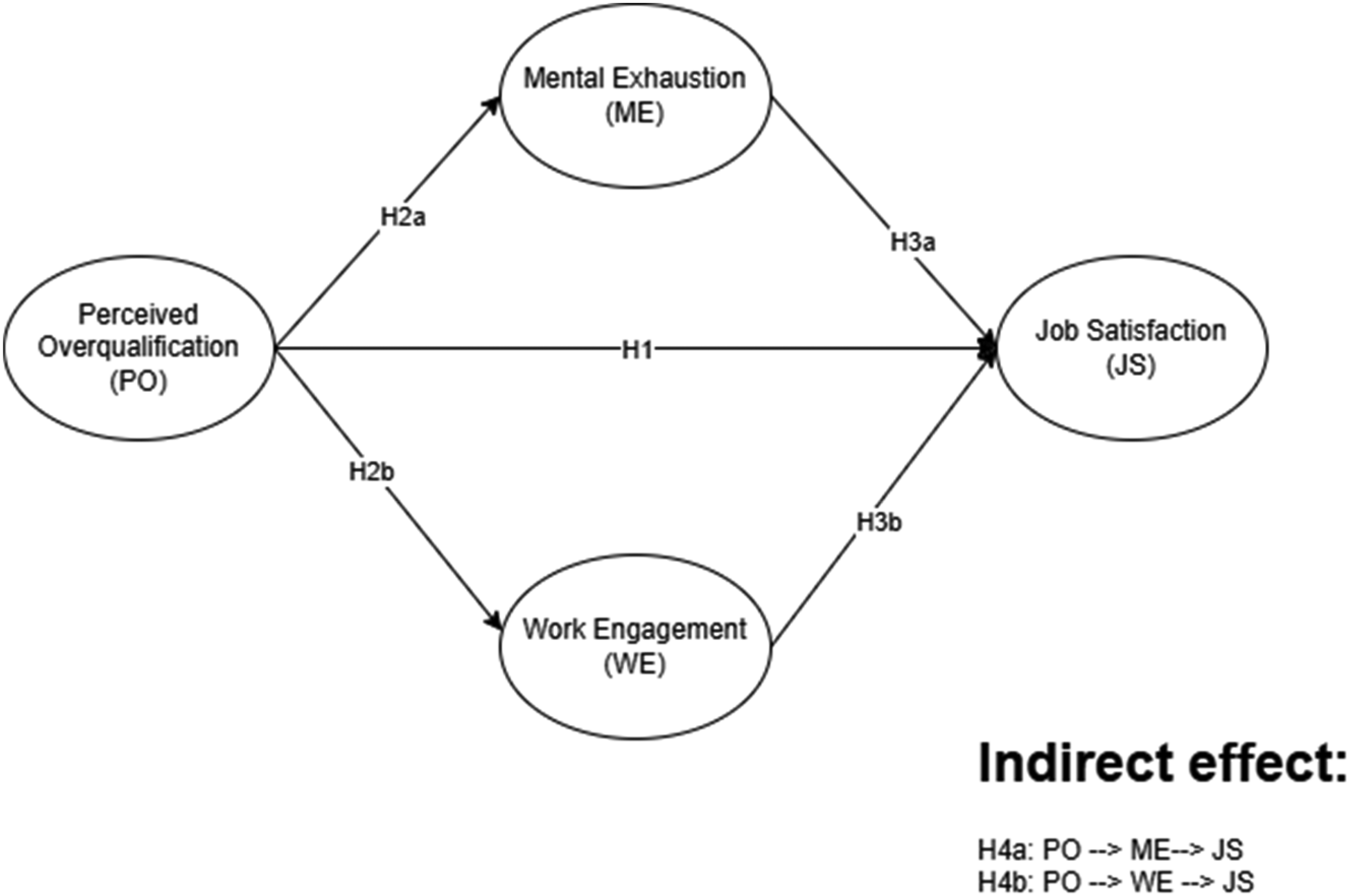
Hypothesised Model.
Method
Participants
Three hundred fourteen workers (79% female) voluntarily completed the online questionnaire. The average age of the respondents was 40.30 years (SD = 12.12), and on average, the participants had an overall working seniority of 15.34 years (SD = 12.59) and a seniority in the current role of 9.95 years (SD = 10.07). Of the sample, 65% were office workers.
Measures
The perception of overqualification was assessed using the Italian version (Paganin et al., in press) scale from Khan and Morrow (1991) scale. The subscale included four items (e.g., ‘My formal education qualifies me too much for my current job’). Each item was rated on a 5-point Likert scale, ranging from 1 (not at all agree) to 5 (completely agree). The scale showed good reliability (α = 0.72).
Exhaustion was measured using the exhaustion subscale of the Italian version of the BAT (Hadžibajramović et al., 2022; Mazzetti et al., 2022). The subscale included three items (e.g., ‘At work, I feel mentally exhausted’), rated on a 5-point scale from 1 (strongly disagree) to 5 (strongly agree). The scale showed good reliability (α = 0.77).
Work engagement was assessed using the Italian version of the ultra-short version of the Utrecht Work Engagement Scale (UWES; Paganin & Petruzziello, in press). The scale consists of three items: ‘At my work, I feel bursting with energy’ (vigour); ‘My job inspire me’ (dedication); and ‘I am immersed in my work’ (absorption). The response options ranged on a 7-point frequency scale from 0 (never) to 6 (always). The reliability of this scale in the current study was α = 0.76.
Finally, job satisfaction was assessed using a single item (‘Overall, are you satisfied with the work you do?’) by Wanous et al. (1997), with a scale ranging from 1 (not at all satisfied) to 5 (completely satisfied).
Procedure
The snowball sampling approach was used to recruit participants. Snowball sampling is a method of participant recruitment in which current research participants are encouraged to help researchers identify and recruit new subjects. Participants were asked to complete an anonymous online questionnaire created using Qualtrics, an online platform widely used in academia and industry to design, manage, and collect data. Participants received an email inviting them to complete the questionnaire by clicking an anonymous link.
Following the standards for handling personal data outlined in the Italian Data Protection Act (Legislative Decree DL-196/2003), the first page of the questionnaire included a cover letter explaining the scope and objectives of the study, as well as an emphasis on the participants’ privacy and anonymity. Consequently, it was assumed that by completing the survey, people had consented. The study did not require ethical approval based on relevant institutional or national criteria since it followed the Declaration of Helsinki (World Medical Association, 2013), which outlines ethical guidelines for research. There was no need for further ethical approval because there was no therapy, including medically invasive examinations or procedures that caused psychological or social distress to participants. Furthermore, the letter said that individuals might withdraw from the programme at any moment without explanation and that their employers would be unaware of their decision. As a result, completing the survey implied the participants’ informed consent.
Data Analysis
Data were checked for outliers, multicollinearity, and normality distribution using SPSS 28. The Mplus 8 software (Muthén & Muthén, 2017) was employed to test our model to estimate a structural equation model (SEM). Using the maximum likelihood (ML) methodology, we first conducted confirmatory factor analysis (CFA). Next, we tested our direct and indirect effects hypothesis.
Results
Descriptive Statistics
Since the lowest tolerance statistics of 0.86 and the most significant variance inflation factor of 1.16 were both well below the suggested cut-off of 10, there was no evidence of multicollinearity. Skewness levels (ranging from −1.46 to 0.16) and kurtosis values (ranging from 1.82 to − 0.27) were acceptable (George & Mallery, 2024). Table 1 shows the study variables’ mean and standard deviations, correlations, and Cronbach's alpha values.
Descriptive Statistics, Correlations, Cronbach's Alphas.
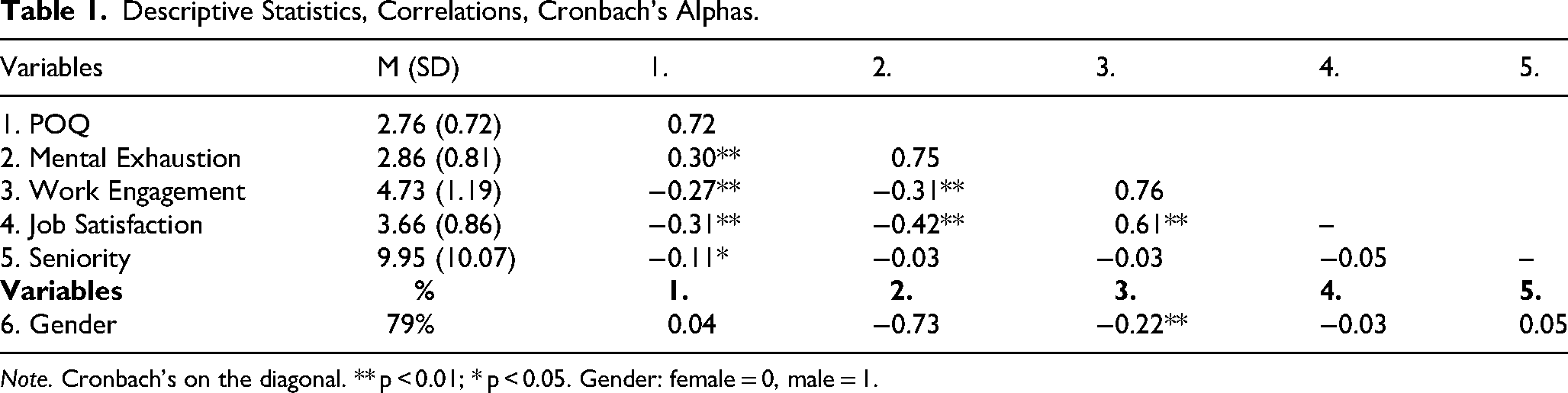
Note. Cronbach's on the diagonal. ** p < 0.01; * p < 0.05. Gender: female = 0, male = 1.
Confirmatory Factor Analysis (CFA) and Control of Common Method Bias
A maximum likelihood technique was employed to determine the structural validity of our metrics by performing a CFA. The following indices and cut-off criteria were used to assess the goodness of fit of the CFA and subsequent models (Byrne, 2001): RMSEA values between 0.08 and 0.05; SRMR values below 0.08; the CFI values above 0.90 and the TLI values between 0.90 and 0.95. CFA results are shown in Table 2.
Model fit Indices.
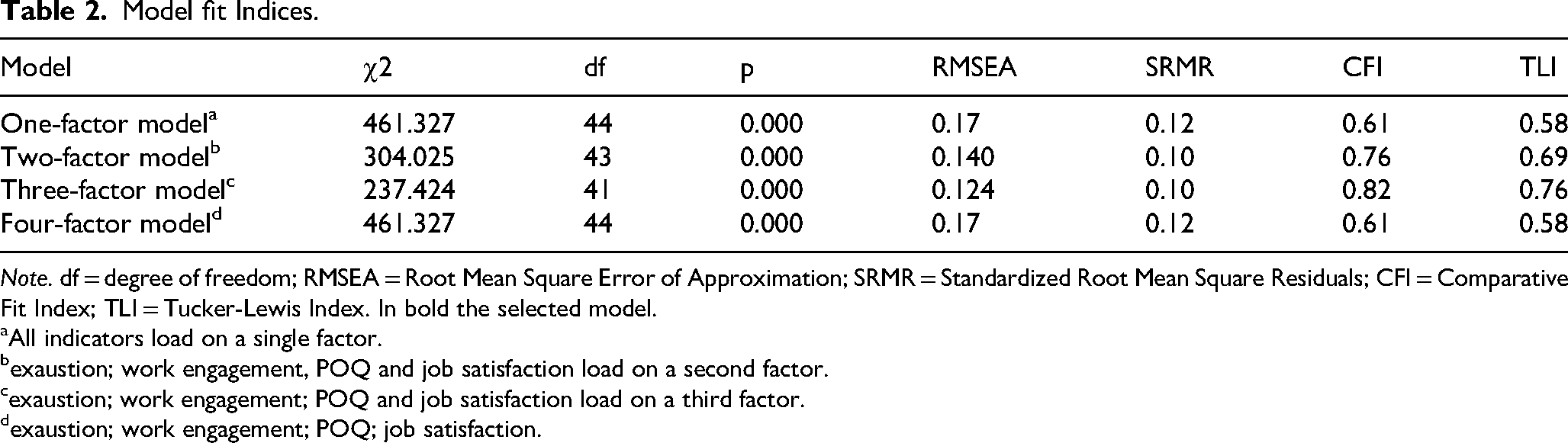
Note. df = degree of freedom; RMSEA = Root Mean Square Error of Approximation; SRMR = Standardized Root Mean Square Residuals; CFI = Comparative Fit Index; TLI = Tucker-Lewis Index. In bold the selected model.
All indicators load on a single factor.
exaustion; work engagement, POQ and job satisfaction load on a second factor.
exaustion; work engagement; POQ and job satisfaction load on a third factor.
exaustion; work engagement; POQ; job satisfaction.
The CFA findings showed that the four-factor model, including overqualification, exhaustion, work engagement, and job satisfaction, provided the best fit to our data when compared to competitive solutions (χ2(38) = 99.262, p = .000, RMSEA = 0.07, SRMR = 0.06; CFI = 0.94; TLI = 0.92). This finding demonstrates that the measures utilised in the current investigation have discriminant validity.
The Hypothesised Model: Direct and Indirect Effect
Our final model presents acceptable fit indices (χ2(40) = 116.038, p = .000, RMSEA = 0.08, SRMR = 0.07; CFI = 0.93; TLI = 0.90). POQ showed a non-significant relation to work satisfaction (H1). On the contrary, POQ showed a significant relation with exhaustion (H2a: β = 0.42, SE = 0.20, p = .000) and a negative significant relation with work engagement (H2b: β = -0.39, SE = 0.23, p = .004). Similarly, results indicated that mental exhaustion (H3a: β = -0.24, SE = 0.08, p = .002) and work engagement (H3b: β = 0.59, SE = 0.07, p = .000) showed a significant relation with work satisfaction. Concerning the hypothesised parallel mediations, the relationship between POQ and work satisfaction via exhaustion, was significant (H4a: β = 0.10, SE = 0.04, p = .007, 95%CI [-0.17, −0.04]) as well as the relationship between POQ and work satisfaction through work engagement (H4b: β = -0.23, SE = 0.05, p = .000, 95%CI [-0.33,-0.15]). Therefore, our mediation hypotheses are supported. Table 3 presents all the indirect effects analysed using the bootstrapping strategy. In Figure 2, we indicate direct effects.
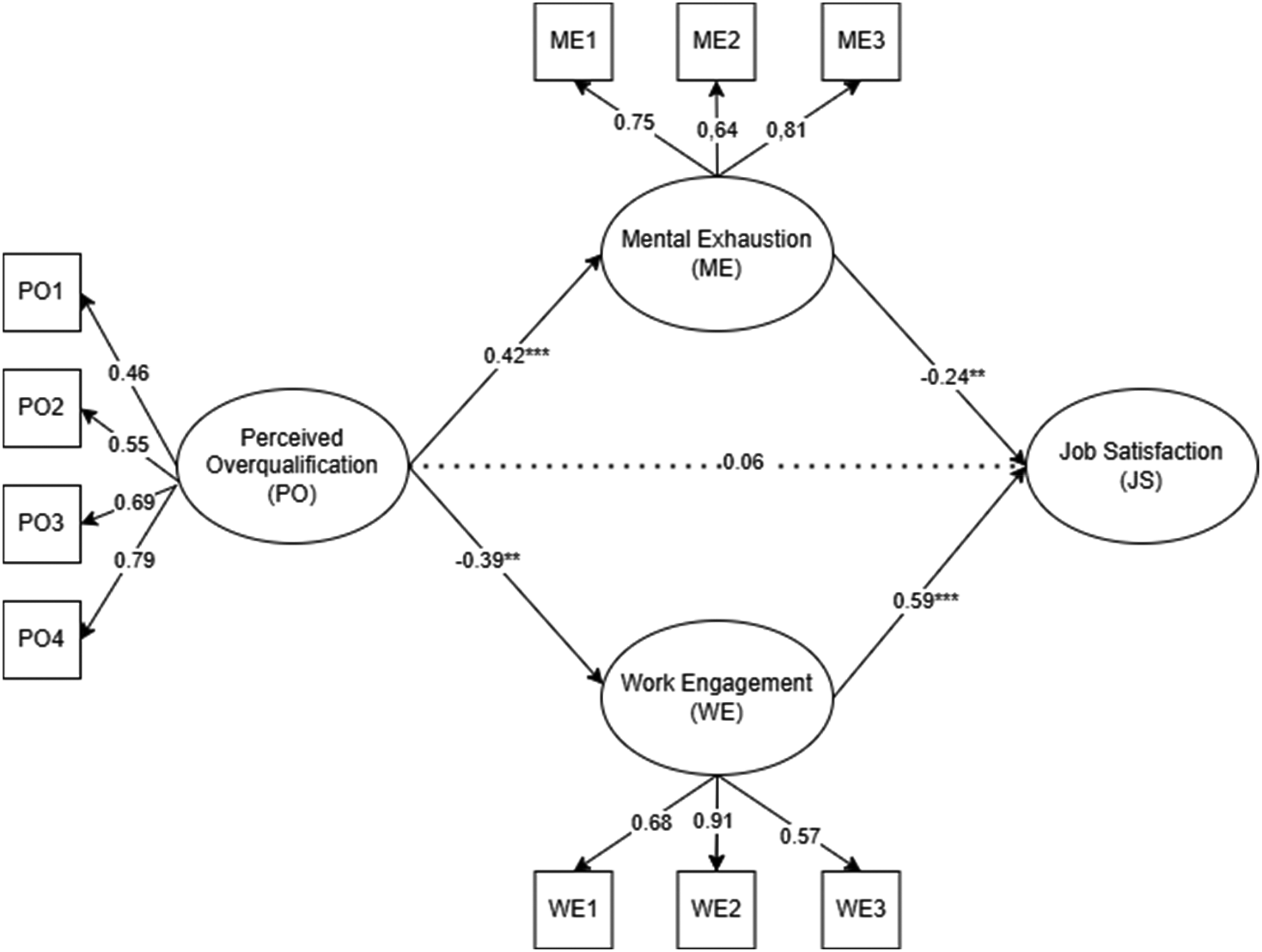
Model Direct Effect. Note. **p < 0.01; ***p < 0.001. Straight Arrows Indicate Significant Direct Effects; Dotted Arrows Indicate non-Significant Direct Effects; Ovals Indicate Latent Variables; Squares Indicate Observed Variables.
Bootstrapping Indirect Effects.

Discussion and Conclusions
Over-qualification (having more education, skills, and talents than the job demands) is a prominent issue worldwide (Erdogan & Bauer, 2021; Mah et al., 2025). Previous studies have demonstrated the harmful impacts of overqualification on organisations and individuals. For example, research has shown that overqualified employees have poorer health outcomes (Johnson & Johnson, 1996), higher turnover intentions (Erdogan & Bauer, 2009; Maynard et al., 2006), and more negative job attitudes, such as disengagement and job dissatisfaction (e.g., Alfes et al., 2016; Kraimer et al., 2009). From a broader perspective, overqualification can also be seen as a potential barrier to sustainable career development, particularly when the skills and competencies of employees are underutilised. However, the impacts of this over-skilling are far-reaching, necessitating future inquiry into more detailed patterns, such as mediation (McKee-Ryan & Harvey, 2011).
To this end, we applied two theoretical models to explain the relationship between POQ, job commitment, mental exhaustion and job satisfaction: the person-organisation (P/O) adaptation model, to explain the emergence of POQ and the job demands and resources model, to explain the mediating roles of commitment and exhaustion. Our results partially proved our hypothesis.
H1 was in fact, not confirmed. Contrary to our hypothesis, POQ is not significantly associated with job satisfaction. Recent literature emphasises the negative association between POQ and job satisfaction (Harandi & Mirzaeian Khamseh, 2024). However, this result can be understood by recalling the need to investigate the relationship between overqualification and satisfaction through complex models, such as mediation. Our result shows that other dimensions may be involved in the relationship between overqualification and job satisfaction reported by our sample.
Turning to the other hypothesised direct effects, our results confirmed the negative association between POQ and mental exhaustion (H2a) and between POQ and work engagement (H2b). In this case, the results are in line with previous literature. According to the person-environment theory, those who perceive themselves as overqualified may be less willing to engage and devote themselves to work with vigour, absorption, and energy (Luksyte et al., 2022). As a result, they will be less engaged at work. Few studies have looked at the link between POQ and work engagement, but those that have do provide evidence for a negative association (Luksyte et al., 2022; Tomás et al., 2023). Previous studies have also pointed out that POQ has adverse effects on subjective well-being (Erdogan & Bauer, 2009). Other studies have also demonstrated the link between POQ and burnout, of which mental exhaustion is one of the dimensions (Chambel et al., 2021).
For the last hypothesised direct effects, our results confirmed both the direct effect of mental exhaustion (H3a) and the direct effect of work engagement (H3b) on job satisfaction. This is in line with previous studies. Indeed, the adverse effect of exhaustion on job satisfaction and the positive effect of work engagement on satisfaction levels is well established. Previous research has shown that mental exhaustion may negatively impact job satisfaction (Cao et al., 2023; Hameli et al., 2024). On the other hand, work engagement has been demonstrated to directly influence satisfaction, corroborating research that suggests that significant involvement fosters a sense of fulfilment and job satisfaction (Chordiya, 2022; Huaman et al., 2023). Turning to our last hypotheses, concerning the indirect association between POQ and job satisfaction through mental exhaustion (H3a) and work engagement (H3b), our results confirmed them. Our results go toward clarifying, through more complex models, the repercussions of POQ. In previous studies, for example, (Li et al., 2024) explored the associations between POQ, job satisfaction, and work engagement among nurses in China. Their analysis revealed that POQ was negatively associated with both job satisfaction and work engagement. Additionally, work engagement was positively related to job satisfaction and served as a mediator in the relationship between POQ and job satisfaction. According to the JD-R (Job Demands-Resources) model, work engagement and exhaustion are core dimensions of health impairment and motivational processes (Bakker & Demerouti, 2017; Demerouti et al., 2001). Adopting this theoretical framework, it is possible to read the results of our study as a demonstration of how the perception of overqualification, associated with these two dimensions, can influence people's job satisfaction, leading to adverse outcomes, which must be considered in the intervention phase. Promoting sustainable work environments prioritising health and well-being is essential for fostering organisational sustainability (Johnson et al., 2018). This perspective is particularly relevant when addressing overqualification, as the mismatch between job roles and individual capabilities may decrease job satisfaction and impede sustainable development in the workplace. Furthermore, individual and organisational initiatives should focus on prevention and strive for a greater quality of working life throughout one's career by enriching and adapting resources (Di Fabio & Saklofske, 2021; Kenny et al., 2024; Peiró et al., 2023).
Practical Implications
Organisations and managers must support overqualified employees (Zhang et al., 2021). By acknowledging and proactively managing overqualified employees’ challenges, organisations can contribute to healthier, more satisfying, and sustainable career trajectories. From a HRM perspective, employees who perceive themselves as overqualified present specific needs that require careful attention (Ma et al., 2020). To foster sustainable careers and prevent dissatisfaction or disengagement, HR practices should be adapted to address the organisational and individual dimensions of overqualification. First, companies should strive to better align candidates’ qualifications with the job position's requirements during recruitment and hiring processes. A better person-environment fit could prevent the perception of overqualification and its subsequent adverse effects on well-being and job satisfaction. Once employees are onboarded, training and development initiatives, along with retention programmes, should be strategically designed to enhance the alignment between employees’ qualifications and job requirements, support their long-term career aspirations, and offer meaningful opportunities for professional growth. Thereafter, companies might also consider adopting job crafting strategies, allowing employees who perceive themselves as overqualified for their roles to modify or expand their tasks, making their work more challenging and stimulating. This approach could help reduce feelings of frustration, enhance their work engagement, and decrease their mental exhaustion, thereby promoting overall job satisfaction. Integrating sustainable career development frameworks into job crafting practices can further amplify these benefits, as aligning tasks with employees’ skills mitigates the risk of overqualification and fosters long-term employability and organisational sustainability. Previous research has also shown that overqualified employees who experience higher job autonomy tend to be less negatively affected by their POQ (Debus et al., 2020). This suggests that granting greater autonomy at work may buffer the detrimental effects of overqualification, thereby supporting employees’ well-being and satisfaction. Considering the perspective of career development, organisations could also consider offering personalised career paths and opportunities for internal mobility, enabling employees to find positions that better match their skills and aspirations (Pan & Hou, 2024). Internal mobility could reduce turnover rates and the associated organisational challenges in HRM. Moreover, the relationship quality between employees and their supervisors plays a crucial role. Findings by Alfes et al. (2016) indicate that overqualified employees who report positive and supportive relationships with their leaders are less likely to experience job dissatisfaction. These insights highlight the importance for managers to actively foster trust-based and supportive leader-member exchanges in order to mitigate the adverse outcomes associated with POQ.
Limitation and Future Directions
Although the study has yielded interesting results that contribute to expanding the understanding of the effects of overqualification on workers’ well-being and the mechanisms through which it can impact job satisfaction, it is not without limitations.
Firstly, the study employs a cross-sectional research design, which does not allow us to identify causal relationships between variables that endure over time. Additionally, while the sample size is sufficient for conducting statistical analyses, it does not allow for the generalisation of the results to a broader population of workers. Furthermore, the data were collected through self-report questionnaires, relying solely on the worker's perceptions without the possibility of triangulating these perceptions, for example, through the views of their supervisors. The use of a single item of job satisfaction could lead to further limitations.
Future studies could further explore the integration of perceived overqualification within the JD-R model, as our study represents one of the first attempts to extend this framework to a new common threat to sustainable work and satisfactory career experience. Moreover, future research should aim to replicate the study using longitudinal designs, which would enable the identification of causal relationships between POQ and job satisfaction and potentially allow for the assessment of the effectiveness of any promotional interventions implemented by organisations. Moreover, it could be valuable to collect data from different companies and sectors to assess the varying impact of these characteristics on the perception of over-qualification. Finally, to expand the available data and thus reach more in-depth conclusions, it would be appropriate to design studies involving workers’ supervisors’ participation, thereby including other reported measures. Future research could furthermore benefit from deep integrating a psychology of sustainability and sustainable development perspective. On the one hand, examining how organisational interventions aimed at promoting skill-job alignment, and on the other hand, considering the value of an inclusive sustainable career approach to work, taking care of others, the planet and future generations (Hartung & Di Fabio, 2024), might reduce perceptions of overqualification and enhance job satisfaction as well as long-term well-being.
Footnotes

Consent to Participate
Informed consent was obtained from all individual participants included in the study.
Funding
The authors received no financial support for the research, authorship, and/or publication of this article.
Declaration of Conflicting Interests
The authors declared no potential conflicts of interest with respect to the research, authorship, and/or publication of this article.