







Abstract
Adolescence is a critical period in acquiring a vocational identity. During this period, adolescents who experience a crisis related to their vocational identity need to make decisions that allow them to successfully navigate their vocational development and climb the steps toward becoming future leaders by making informed decisions. Thus, the current study aims to investigate the mediating role of psychological resilience in the relationship between adolescents’ emotional intelligence (EI) and career adaptability, with 580 adolescents voluntarily participating in the study. Mediation analyses were conducted to test EI's indirect effect on career adaptability through resilience. According to our findings, resilience serves as a mediating variable between EI and career adaptability. The findings from our study provide essential practical insights for career counselors working with adolescents. As our findings indicate, practitioners can be more successful at enhancing career adaptability by adopting an approach that focuses on increasing EI and resilience skills.
Introduction
The process of acquiring occupational identity, a developmental feature of adolescence, can be stressful and challenging for adolescents. Unlike Western societies, developing occupational identity, acquiring career maturity, and making career choices freely during career development are not easy in Türkiye. This is because the transitions from middle to high school, which corresponds to the pre-adolescent period in Türkiye, and from the final year of high school to university depend on high scores in challenging centralized testing systems. Students have to get high scores on these exams because they make their career decisions based on the scores they receive, which predominantly determine their career path. All the scores they receive correspond to different careers. In this regard, the career counseling process in Türkiye mostly concentrates on helping students make a reasonable match between their exam scores and career (Owen et al., 2011). Although the interests, abilities, and other career-related variables are important in the decision-making process, the most important factor is exam scores. In Türkiye, adolescents try to adapt and deal with physical, emotional, social, and cognitive changes during adolescence while simultaneously dealing with the pressure the central exam system creates. Overcoming all these challenges and making a desirable career plan can be an overwhelming task for adolescents.
A successful career planning process involves being able to cope with encountered obstacles, as well as creating corrective plans for potential problems (Lent, 2013). Career adaptability, emotional intelligence (EI), and resilience are essential variables that support adolescents in making an appropriate career plan, with previous studies having shown a meaningful relationship among EI, resilience, and career adaptability in adolescents, as well as in young adults and adults (Ahmad et al., 2019; Pang et al., 2021; Santilli et al., 2020; Xu et al., 2020). Exploring the role of self-regulation factors (i.e., EI, resilience) that are crucial for dealing with stress and obstacles in the context of career development is important when considering the academic and career-related pressures Turkish adolescents experience.
While the relationships among EI, resilience, and career adaptability have been examined over various populations, our study makes a distinctive contribution by focusing specifically on adolescents navigating a sociocultural context. Turkish adolescents face a particularly challenging convergence of developmental and systemic pressures. The normative identity crises of adolescence coincide with high-stakes centralized exams that essentially determine their entire career trajectory. This creates a double burden not typically found in Western contexts that have greater career flexibility. Understanding how EI and resilience function as protective factors in this high-pressure environment provides insights into adolescent career development under systemic constraints. Therefore, the present study investigates a mediation model involving EI, resilience, and career adaptability among Turkish adolescents.
Career Construction Theory and Career Adaptability (Concern, Control, Curiosity, and Confidence)
Career Construction Theory (CCT) is a significant theory in the field of career development (Savickas, 2005) and provides a comprehensive theoretical model for understanding vocational behaviors. CCT has three components: vocational personality, life themes, and career adaptability. Among these components, career adaptability is the readiness to cope with predictable tasks and the willingness to deal with unpredictable adjustments brought about by changes in job roles and working conditions. These components contribute to individuals’ psychosocial competencies and empower them to handle developmental tasks, career transitions, and job traumas (Savickas, 1997).
Career adaptability comprises four dimensions: concern, control, curiosity, and confidence (Savickas & Porfeli, 2012). Concern involves individuals’ thoughts about their future and helps them prepare for what they can do in the next stage of their careers. Control signifies one's ability to take responsibility in the next stage for shaping oneself and the environment through self-discipline, effort, and persistence. Curiosity is the force that motivates individuals to see themselves in various career-related situations and roles. Confidence is one's belief in their ability to confront challenges, overcome obstacles, solve problems, and cope with potentially stressful situations. According to CCT, these four components of career adaptability have a dynamic, interactive impact on career development (Savickas, 2005). Moreover, they are considered crucial skills for career development and preparation among adolescents (Hirschi, 2009).
Adolescence is a turbulent, stressful phase. This period involves a tumultuous process marked by conflicts and emotional fluctuations. At the same time, adolescence is when social identity, sexual identity, and occupational identity are developed (Havighurst, 1956). Resilience and EI (Yitshaki, 2012) are believed to be able to provide individuals with the strength to overcome obstacles in acquiring their occupational identity during this stressful, turbulent period. These variables give individuals the strength to cope with challenges and facilitate effective problem-solving, ultimately contributing to their potential as future leaders.
Emotional Intelligence and Career Adaptability
Emotional intelligence has been conceptualized through two distinct theoretical approaches in the literature. Stough et al. (2009) distinguished between ability-based models and trait EI models. Ability-based models conceptualize EI as a set of cognitive abilities related to processing emotional information (Mayer & Salovey, 1997). In contrast, trait EI models view emotional intelligence as emotion-related personality dispositions and self-perceptions (Bar-On, 1997; Petrides & Furnham, 2001). Petrides and Furnham's (2001) trait EI model specifically positions emotional intelligence as emotion-related self-perceptions that exist at personality hierarchies’ lower levels. This model emphasizes individuals’ beliefs about their emotional abilities rather than their actual emotional abilities. While both approaches contribute to understanding EI, they represent fundamentally different conceptualizations with different measurement approaches and theoretical implications.
EI refers to one's ability to understand, recognize, and manage their own emotions and to understand, recognize, and influence others’ feelings (Mayer et al., 2000). Bar-on (1997) conceptualized EI as emotional-social intelligence consisting of five elements: personal skills, interpersonal skills, stress management, adaptability, and general mood. EI's dimensions are closely related to CCT's subdimensions, more precisely career adaptability and the career adaptation process. For instance, EI's dimension of adaptability encompasses problem-solving skills, flexibility, and perception of reality, while stress management involves resilience and response control (Bar-on, 1997). These dimensions are closely associated with career adaptability's subdimensions of confidence and control. Meanwhile, Goleman (1996) gave another definition of EI, emphasizing social skills that include self-awareness, motivation, and leadership. EI is relevant to all aspects of life, such as academic and vocational success. These key concepts, particularly self-awareness involving accurate self-assessment and self-confidence, motivation incorporating an impulse for achievement, and social skills encompassing effective leadership through guiding others, play a crucial role in enhancing individuals’ career adaptability skills, especially in the process of training future leaders. Indeed, self-awareness fosters a sense of accurate self-evaluation and confidence, motivation drives the impulse for success, and social skills encompass the leadership qualities of directing others appropriately (Goleman, 1998).
These leadership qualities of EI extend beyond traditional transformational leadership models. The recently developed Human Capital Sustainability Leadership (HCSL) model emphasizes that leaders need EI competencies to promote both sustainable development and healthy organizations (Di Fabio & Peiró, 2018). This model highlights how emotional competencies enable leaders to balance organizational performance with employee well-being and environmental sustainability. The HCSL framework suggests that emotionally intelligent leaders can better navigate the complex challenges of creating sustainable work environments while fostering human capital development (Di Fabio & Peiró, 2023). This contemporary perspective reinforces how developing EI among adolescents prepares them not just for traditional leadership roles but also for the evolving demands of sustainable leadership in the twenty-first century.
The significant links between EI and career adaptability skills have been well documented. For example, Pong and Leung (2023) determined a significant association between EI and career adaptability skills in college students. Moreover, EI has a significant link with the sub-dimensions of career adaptability skills, including concern, control, curiosity, and career confidence (Pong & Leung, 2023). In addition, Coetzee and Harry (2014) determined EI to be a significant predictor of adaptability skills, while Parmentier et al. (2019) determined EI to have a causal relationship with career adaptability in adults.
Consistent with the theoretical frameworks of EI and career adaptability, the indicators of ability-based EI (i.e., perception, understanding, and managing) are related to the components of career adaptability. For instance, emotion perception enables adolescents to develop career concern by fostering self-awareness about their values and future aspirations (Pong & Leung, 2023). Emotion understanding supports career curiosity by helping adolescents comprehend their reactions to different career options (Parmentier et al., 2019). Finally, emotion management enhances both career control and confidence by enabling adolescents to regulate stress during career transitions such as from middle school to high school or from high school to university and to maintain their motivation when facing academic challenges (Kirikkanat, 2023; Pong & Leung, 2023). In another study, female university students in Türkiye with high levels of EI were reported to exhibit high career adaptability skills, indicating them to have better abilities for coping with the challenges in today's business world (Çizel, 2018).
Resilience and Career Adaptability
Positive psychological capital theory asserts resilience to be a crucial protective factor when experiencing/facing stressful life events (Luthans et al., 2007; Luthar et al., 2000). This theory is grounded on the principles of positive psychology, mainly relying on psychological strengths such as hope, resilience, optimism, and self-efficacy (Avey et al., 2011). These elements are considered fundamental components of psychological capital and to be closely associated with job satisfaction, performance, contentment, and confidence (Luthans et al., 2008; Tang et al., 2019).
The field of positive psychology explains psychological resilience as how some individuals recover quickly and return to their normal routines when facing negative events (Doğan, 2015). Psychological resilience has been defined as not being fragile, being strong, and showing healthy development under unhealthy conditions (Garmezy, 1971) and as a positive personal characteristic that increases adaptation and restores balance despite distress (Batmaz et al., 2021; Wagnild & Young, 1993). This theoretical framework indicates a high-level relationship between career adaptability skills and resilience. Similar to resilience, career adaptability skills in the career-related context also denote one's ability to regulate and proactively manage their career development in the face of changing and challenging conditions (Peeters et al., 2022).
Numerous studies have provided support for the theoretical framework between these two variables, with findings having shown a positive correlation between resilience and career adaptability in college students (Pang et al., 2021; Santilli et al., 2020). Concepts from positive psychology (e.g., hope, resilience) have been seen as variables with significant effects on career adaptability in university students, predicting their career development significantly (Buyukgoze-Kavas, 2016). One can conclude resilience to be one of the most significant indicators of career adaptability (Kalafat, 2018). For example, when adolescents encounter exam-related setbacks, those with higher resilience are more likely to maintain career concern by continuing to plan for alternative pathways (Pang et al., 2021; Santilli et al., 2020). Resilience also strengthens career control by enabling adolescents to persist in their preparation despite obstacles such as high risk exams (Buyukgoze-Kavas, 2016; He & Yu, 2022). In the domain of career confidence, resilient adolescents demonstrate greater ability to rebound quickly even if they fail exams and to refocus on subsequent opportunities with renewed determination (Ahmad et al., 2019; Xu et al., 2020).
Uncovering the association between resilience and career adaptability among adolescents will contribute significantly to the development of occupational identity. Moreover, equipping adolescents with the necessary tools to succeed and preparing them as future leaders are crucial in the twenty-first century. In summary, the theoretical framework presented above and the studies that have been conducted on resilience and career adaptability emphasize the importance of personal adaptability in achieving success in a changing world. Furthermore, the unique role of resilience in guiding adolescents through the distinct stress and tumultuous process of adolescence, particularly in navigating occupational transitions and overcoming unforeseen challenges, has been highlighted. This perspective suggests that adolescents with higher levels of resilience are likely to possess higher levels of career adaptability and to be able to more easily overcome the difficulties encountered in vocational development.
The Mediating Role of Resilience
Students approaching educational or career decision points often need to cope with uncertain, stressful, and sometimes tedious situations. CCT provides a broad perspective for explaining the dynamics of lifelong vocational behavior (Savickas, 2013). According to this theory, career development is viewed as a continuous process of adaptation or adjustment (Savickas, 2005). As part of this theory, career adaptability involves the skills necessary to successfully confront stressful, challenging, and unexpected difficulties encountered in career development (Johnston, 2016). In this context, EI and resilience contribute significantly to an adolescent's career development and adaptation. As findings have indicated, individuals with high levels of EI tend to develop high resilience (Shuo et al., 2022). Individuals with high levels of resilience are also more successful in coping with stressful and challenging situations (Gizir, 2007; Masten, 1994). An adolescent with high resilience is likely to possess the potential to cope with the difficulties and challenges encountered in career development, thereby enhancing their career adaptability skills (Tugade & Fredrickson, 2004). Therefore, adolescents’ EI levels can be considered an influential variable on career adaptability skills through resilience.
EI and resilience significantly predict individuals’ career adaptability skills (Kirikkanat, 2023). Zeng et al. (2022) reported finding resilience to predict and serve as a meaningful mediator variable in the relationship between parental support and the career adaptability skills of vocational high school students. Resilience also mediates the relationship between career adaptability skills and mental health (Xu et al., 2020). During the COVID-19 period, He and Yu (2022) conducted a study on individuals who had recently graduated from university and found the relationships between tolerance of uncertainty, anxiety sensitivity, and career adaptability to also be mediated by resilience. These findings suggest that resilience may serve as a mediating variable in the relationship between EI and career adaptability skills.
As evident from the findings of the above-mentioned studies, EI, resilience, and career adaptability are gaining increasing importance. However, few studies in the vocational psychology literature have investigated these variables together, with little attention having been paid to their combined impact. Thus, exploring the link between EI and resilience could enhance the understanding of individuals’ abilities to cope with unexpected challenges in their career development. Consequently, the literature supports the mediating role of resilience in the relationship between EI and career adaptability skills. However, further research is needed to comprehensively address the complex interaction between these variables.
Current Study
Guided by CCT (Savickas, 2005), positive psychological capital theory, and EI theory (Bar-On, 1997; Goleman, 1996), the findings from previous studies suggest that EI has a positive effect on all aspects of career adaptability through indirect pathways. The focal point of developmental guidance is preventive and developmental guidance interventions. The educational interventions that are provided to increase EI levels also significantly affect adolescents’ resilience levels and vocational experiences. Therefore, the findings obtained from the current research are believed to provide valuable data for identifying and enhancing areas that need attention in adolescents’ occupational identity development.
Career development studies have focused more on employees, adults, and university students, whereas adolescence is the focal point of guidance and counseling services in career development. However, no research is found to have investigated the mediating role of resilience in the relationship between adolescents’ EI and career adaptability skills. Our study is unique in that it not only contributes to the existing literature regarding EI's impact on career adaptability skills but also expands previous findings by examining the mediating effect of resilience in an adolescent sample navigating high-risk educational transitions.
Based on the theoretical frameworks and empirical evidence reviewed above, we propose that EI enhances career adaptability through both direct and indirect pathways. EI, through its components of perceiving, understanding, and managing emotions is expected to strengthen resilience by enabling adolescents to recover from career-related setbacks and maintain psychological balance under stress. In turn, resilient adolescents should demonstrate greater readiness to engage in future-oriented planning (concern), take responsibility for their career decisions (control), explore diverse career possibilities (curiosity), and maintain confidence when confronting obstacles (confidence). Consequently, the present study tests the following hypotheses:
Methods
Participants
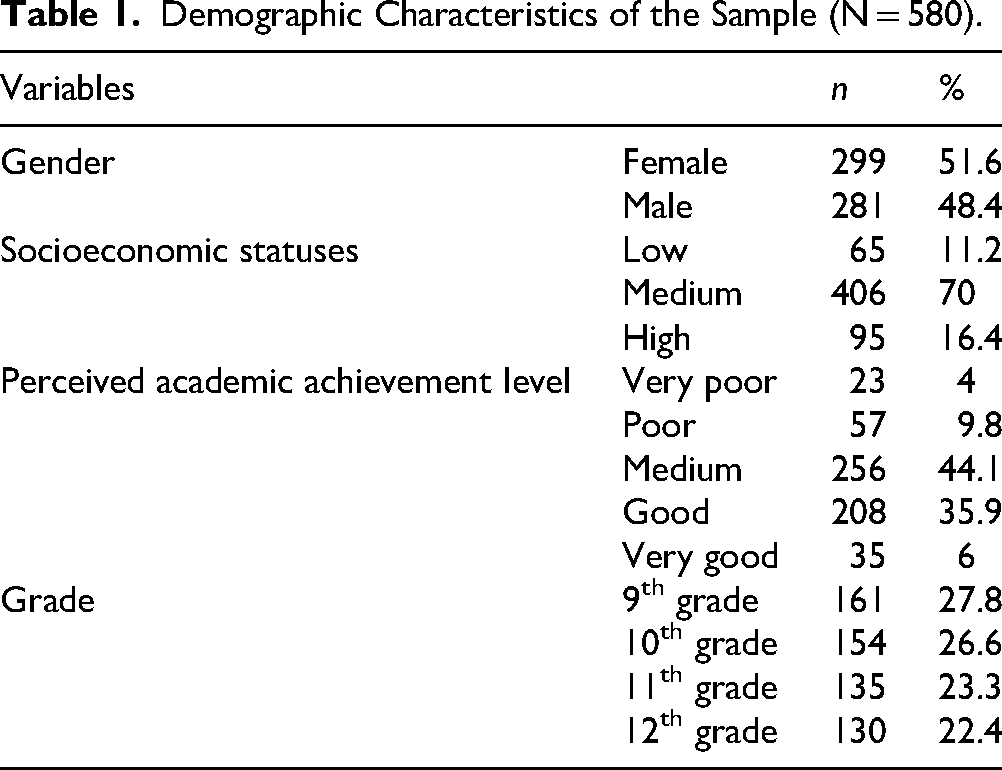
Table 1 displays the participants’ demographic characteristics, with the study having employed the purposive sampling method. Data were collected from five high schools in Siirt province in Türkiye's Southeastern Anatolia region. Compared to the western and urban provinces of the country, Siirt is characterized by relatively lower socioeconomic development indicators and more traditional cultural norms, which should be considered when interpreting the findings. Informed consent was received from the participants as well as their parents. The inclusion criteria for the study are being a high school student under the age of 18 and voluntary participation. The study has excluded 95 students who chose not to fill out or did not wish to complete the dataset. Consequently, 580 adolescents (299 females, 281 males) participated in the study. The participants’ ages range from 14–18 years, with a mean age of 16.26 (SD ± 1.13). Of the participants, 161 (27.8%) are ninth graders, 154 (26.6%) are tenth graders, 135 (23.3%) are eleventh graders, and 130 (22.4%) are twelfth graders. Of the participants, 11.2% identify as having a low socioeconomic status, 70% as medium, and 16.4% as high. Fourteen students (2.4%) chose not to specify their socioeconomic level. Related to perceived academic achievement levels, 23 (4%) rated it as very poor, 57 (9.8%) as poor, 256 (44%) as medium, 208 (35.9%) as good, and 35 (6%) as very good.
Demographic Characteristics of the Sample (N = 580).
Data Collection Tools
Emotional Intelligence Rating Scale (EIRS)
The study uses 18 items from the EIRS (Anguiano-Carrasco et al., 2015), adapted to Turkish by Arslan et al. (2015), to assess EI. The EIRS is based on Mayer and Salovey's (1997) ability-based EI model and measures individuals’ capacities for perceiving, understanding, and managing emotions. Turkish adaptation of the EIRS demonstrated strong psychometric properties, with the confirmatory factor analysis supporting the three-factor structure (χ2 = 357,85, RMSEA = .007, CFI = .95, RFI = .91). The EIRS demonstrates high internal consistency (α = .85). The scale has been used in Turkish adolescent populations (Arslan & İşeri, 2018). The scale has 18 items in three subscales: perception (e.g., “When asked, I can measure my level of sadness at a given time”), understanding (e.g., “I know what makes me sad.”), and management (e.g., “I can keep my cool in stressful situations”). The items are rated on a six-point Likert-type scale from 1 (Absolutely disagree) to 6 (Absolutely agree), with higher scores indicating greater perception, understanding, and management. The general EI score for an individual is obtained by adding the score from all the items. This study has calculated the internal consistency coefficients of the scale as α = .73 for the perception subscale, α = .79 for the understanding subscale, α = .70 for the management subscale, and α = .84 for the overall scale.
Brief Resilience Scale (BRS)
The study uses six items from the BRS (Smith et al., 2008) to assess resilience. The BRS was adapted to Turkish by Doğan (2015). The Turkish adaptation demonstrates excellent psychometric properties, with the confirmatory factor analysis confirming the one-dimensional structure (χ2 / df = 1.83, RMSEA = .005, CFI = .99, IFI = .99, GFI = .99). The Turkish version shows good internal consistency (Cronbach's α = .83). The scale has been widely used in Turkish adolescent populations in recent studies (Turan et al., 2025; Zorlu et al., 2025). The items (e.g., “I tend to bounce back quickly after hard times”) are rated on a five-point Likert-type scale ranging from 1 (Strongly Disagree) to 5 (Strongly Agree). Total scores range between 6–30, with higher scores indicating a higher level of resilience. The current study has found the internal consistency coefficient for the scale to be α = 0.78.
Career Adapt-Abilities Scale (CAAS)
The study uses 24 items from the CAAS (Savickas & Porfeli, 2012) to assess career adaptability. The CAAS was adapted to Turkish by Büyükgöze Kavas (2014) using a sample of 353 high school students with a mean age of 16.03, making it particularly relevant for our adolescent sample. The adaptation study's confirmatory factor analysis confirmed the four-factor structure (χ2 / df = 3.35, RMSEA = .060, CFI = .90, SRMR = .049) and demonstrated strong internal consistency (Cronbach's α = .92 for the overall scale and .83, .74, .79, and .85 for the respective factors of concern, control, curiosity, and confidence). The scale consists of four subscales: concern, control, curiosity, and confidence. The scale has 24 items for the four subscales, with such examples as “Thinking about what my future will be like” for concern, “Making decisions by myself” for control, “Exploring my surroundings” for curiosity, and “Taking care to do things well” for confidence. Items are rated on a five-point Likert-type scale ranging from 1 (Not Strong) to 5 (Strongest), with higher scores indicating greater concern, control, curiosity, and confidence. The sum of all item scores shows one's general career adaptability. When examining the internal consistency coefficients of the scale, the current study found the alpha coefficients to be α = .80 for concern, α = .72 for control, α = .76 for curiosity, α = .77 for confidence, and α = .89 for the overall scale.
Procedure
Before conducting the study, ethical permission was granted by the ethics committee of Siirt University (Ethics Reference No. 689, dated 11/3/2023). All facets of the research adhere to the principles delineated in the Declaration of Helsinki (World Medical Association, 2013). Five different high schools were visited within the scope of the research. Information about the purpose and scope of the study was provided to school administrators. Subsequently, informed consent forms were distributed to students, and parents were requested to sign the informed consent forms. Adolescents whose written consent forms were approved have been included in the research. The researchers personally entered the classrooms to provide information about the purpose and scope of the study. Participants were explicitly informed that they could cease filling out the measurement tool if they wished. In particular, participation in the research was highlighted to be voluntary. The participants were informed that all data would be used only for research purposes and that sensitivity regarding privacy would be ensured, continually emphasizing the importance of not disclosing personal information. All data were collected face-to-face using pen and paper. Data collection took approximately 15–20 min for each participant.
Data Analysis
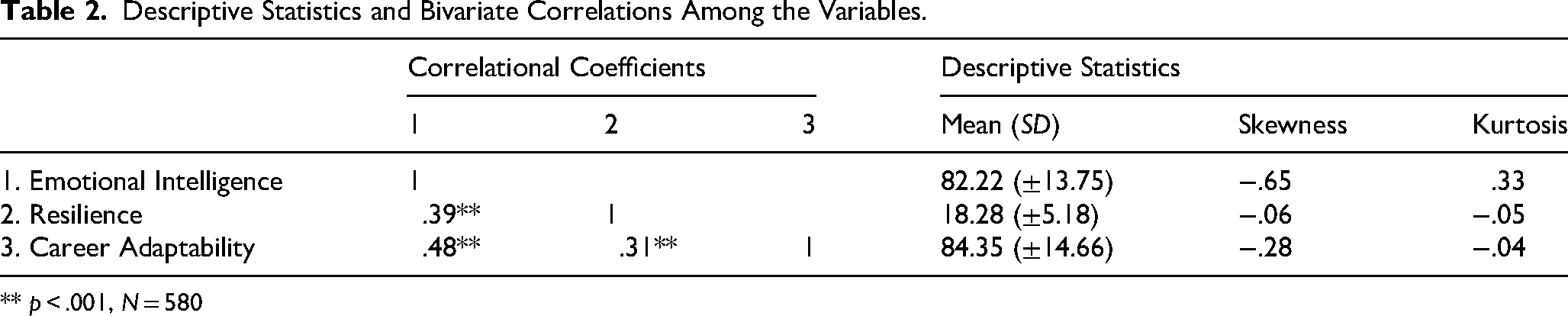
IBM® SPSS® (version 27) software was utilized for descriptive statistics, correlation, and regression analyses. Furthermore, the Process Macro-Model 4 extension developed by Hayes (2018) was employed to determine the mediating effect of resilience on the relationship between EI and career adaptability. Before analyzing the data, several procedures were used to assess certain assumptions for regression analyses. Skewness and kurtosis values within the ±2 range indicate a normal distribution (George & Mallery, 2010). Table 2 indicates that the data meet this assumption. Ensuring that VIF values are below 10 (Belsley et al., 2005) and CI values are under 30 (Young, 2017) is common practice for mitigating concerns related to multicollinearity. Moreover, multicollinearity in general is likely to exist when the absolute value of the Pearson correlation coefficient is close to 0.8 (Young, 2017). The primary techniques for detecting multicollinearity are the correlation coefficient, the variance inflation factor (VIF), and the condition index (CI) methods (Shrestha, 2020). The relationships between the variables range between .31-.48 (p < .001). For EI, resilience, and career adaptability, the VIF values range from 1.05–1.19, with confidence intervals (CI) ranging from 8.27–14.80. Our examination of the correlation coefficient, VIF, and CI values have confirmed all to be within acceptable limits. Given the exclusive reliance on self-report measures, Harman's single-factor test was conducted to assess common method bias (Podsakoff et al., 2003). The unrotated principal component factor analysis of all 48 items revealed the first factor to account for 20.56% of the total variance, which is below the critical threshold of 50%, suggesting that common method bias is not a substantial concern in the current dataset. To evaluate the significance of the mediating effects, we have employed a bootstrapping method comprised of 5,000 resamples at a 95% CI. According to Preacher and Hayes (2008), an effect is evaluated as significant when the CI contains no zeroes.
Descriptive Statistics and Bivariate Correlations Among the Variables.
** p < .001, N = 580
Results
Descriptive Statistics and Relationships Among the Variables
The findings indicate the connections between the variables to have a moderate range of magnitude. As presented in Table 2, EI has been positively associated with both resilience (r = .39, p < .001) and career adaptability (r = .48, p < .001). Resilience has also been positively associated with career adaptability (r = .31, p < .001).
The Mediating Role of Resilience
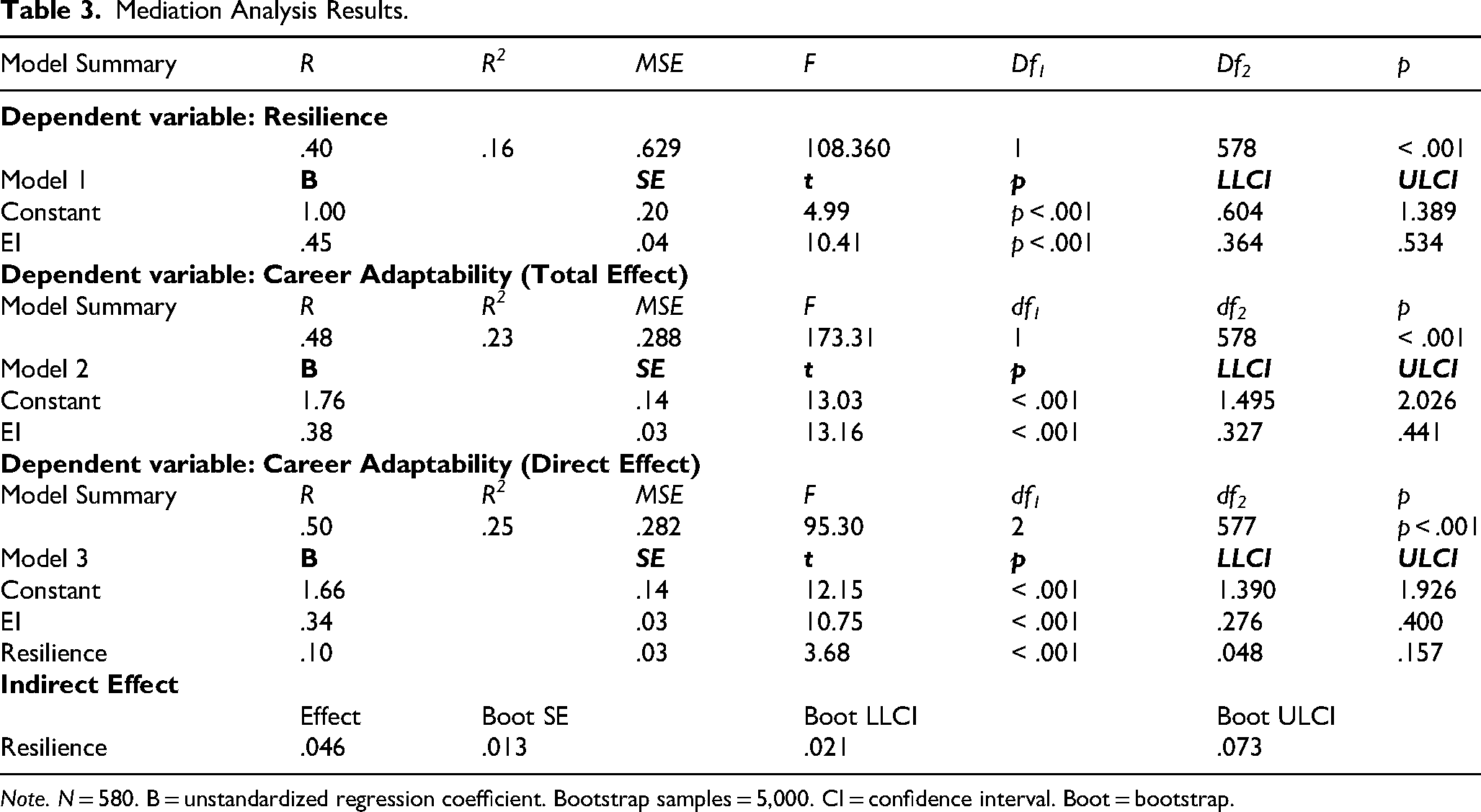
Table 3 and Figure 1 illustrate resilience's mediating role in the relationship between EI and career adaptability. Table 3 displays the outcome of the mediation analysis conducted using the PROCESS Macro-Model 4, a regression-based model.
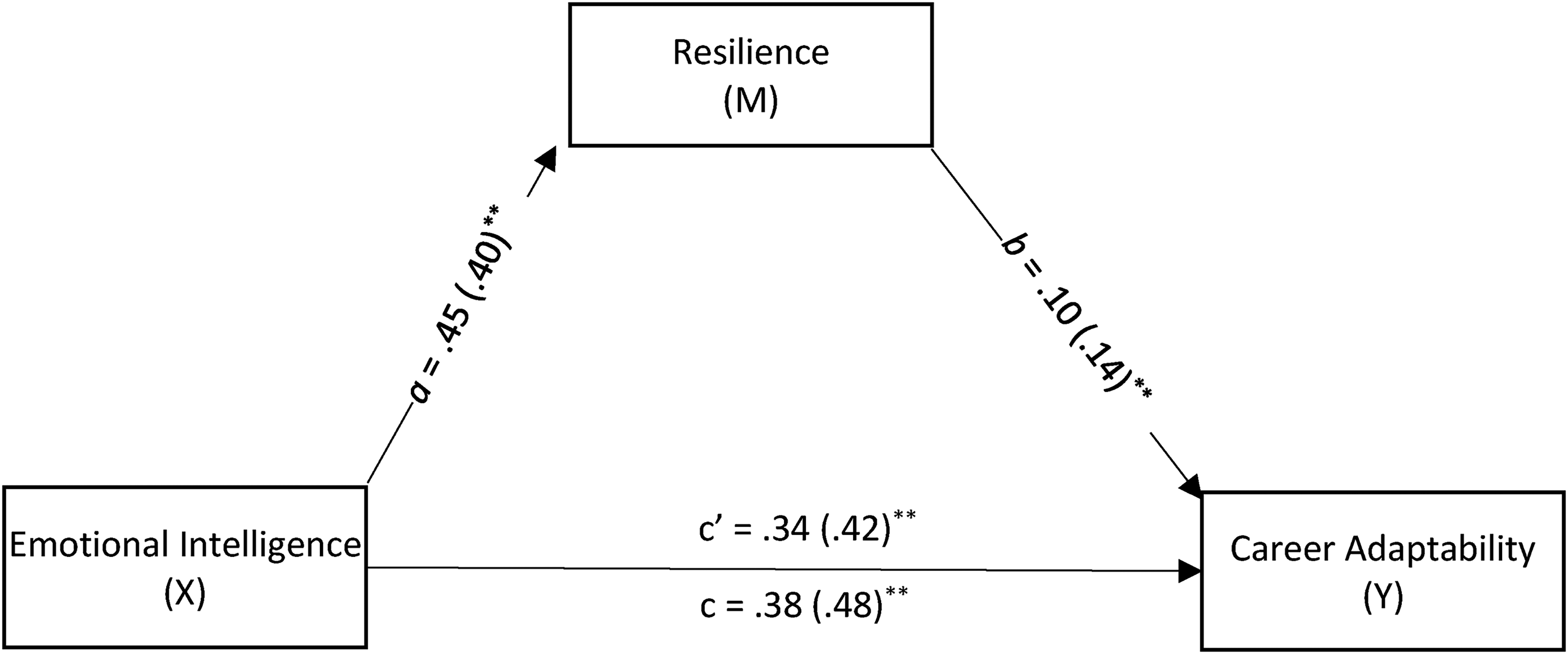
The partial mediating influence of resilience in the relationship between EI and career adaptability with raw coefficients (standardized coefficients are shown in parentheses). Note: c = total effect before including the mediator; c’ = direct effect after including the mediator. ** p < .001.
Mediation Analysis Results.
Note. N = 580. B = unstandardized regression coefficient. Bootstrap samples = 5,000. CI = confidence interval. Boot = bootstrap.
The initial phase of the analysis involves the findings regarding the regression analysis between EI and resilience. In the first model, EI predicts resilience significantly and positively (F = 108.360, R2 = .16, p < .001), with EI explaining 16% of the variance in resilience.
The second model was created to examine the total effect of EI on career adaptability. The study reveals EI to positively predict career adaptability (F = 173.31, R2 = .23, p < .001). Moreover, the findings indicate EI to account for 23% of the variance within the overall career adaptability.
The third model assesses the mediating role of resilience in the relationship between EI and career adaptability. The proposed model demonstrates statistical significance (F = 95.30, R2= .25, p < .001). As per Baron and Kenny (1986), a noteworthy reduction in the independent variable's predictive power regarding the dependent variable indicates a partial mediating effect when accounting for the mediating variable in the model. In this context, the unstandardized regression coefficient for EI decreased from B = .38 to B = .34 when resilience was included in the model. Therefore, including resilience in the model reveals resilience to partially mediate the relationship between EI and career adaptability.
According to the findings, EI has a significant positive predictive relationship with career adaptability (the total effect c = .38, 95%; CI [.33, .44], p < .001; see Figure 1 and Table 3). Furthermore, EI significantly and positively predicts resilience (a = .45, 95% CI [.36, .53], p < .001). Resilience has a positive predictive association with career adaptability (b = .10, 95% CI [.05, .16], p < .001). The model that emerged when considering resilience reveals EI to continue to significantly predict career adaptability. Nevertheless, the direct effect coefficient decreased (c’ = .34, 95% CI [.28, .40], p < .001]. The indirect effect of EI on career adaptability through resilience was statistically significant (ab = .046, BootSE = .013, 95% Bootstrap CI [.021, .073]). As the bootstrap confidence interval does not include zero, the mediating role of resilience was confirmed, indicating partial mediation.
As suggested during the review process, supplementary analyses were conducted to explore potential gender differences in the mediation model. To explore potential gender differences in the mediation model, the analysis was conducted separately for female (n = 299) and male (n = 281) adolescents. The results indicated that the indirect effect of EI on career adaptability through resilience was significant for both females (ab = .068, Boot SE = .022, 95% Bootstrap CI [.026, .114]) and males (ab = .033, Boot SE = .017, 95% Bootstrap CI [.003, .068]). However, descriptive comparison of the two groups revealed a notable pattern. The indirect effect was approximately twice as large for females, primarily driven by a stronger path from EI to resilience among female adolescents (B = .55, p < .001) compared to male adolescents (B = .36, p < .001). Conversely, the direct effect of EI on career adaptability was somewhat larger for males (c’ = .35, p < .001) than for females (c’ = .32, p < .001). In terms of the proportion of the total effect mediated, resilience accounted for approximately 18% of the total effect in females and 9% in males.
Discussion
Studies on EI and career adaptability have mostly been conducted on university students, adults, and employees. In addition, no research has investigated the mediating role of resilience between these two variables. What sets this study apart from others and makes it unique is that it focuses on adolescents, employs resilience as a mediating variable, and expands the existing literature using a new methodology. As mentioned in the introduction, adolescence is a critical period in acquiring a vocational identity. During this period, adolescents who experience crises related to their vocational identity need to make decisions that allow them to successfully navigate vocational development and climb the steps toward becoming future leaders by making informed decisions.
Findings expand on the literature by demonstrating resilience to mediate the relationship between EI and career adaptability, particularly during adolescence. Our adolescent sample provides unique insights into how these psychological resources operate during a critical developmental window characterized by simultaneous identity formation and career decision-making pressures. Furthermore, the high-stakes Turkish educational context, where exam results largely determine career paths, underscores the importance these psychological resources have for adolescents.
The findings indicate EI to play a significant role in predicting career adaptability. This result suggests adolescents’ EI to have a substantial positive impact on career adaptability. Numerous previous studies on EI and career adaptability support this finding (Celik & Storme, 2018; Coetzee & Harry, 2014; Parmentier et al., 2019). Additionally, EI has been seen to enhance adolescents’ self-confidence and self-efficacy in career decision making, contributing significantly to career adaptability (Darmayanti & Salim, 2020; Park et al., 2019). EI is a cognitively and emotionally flexible behavioral trait that can be developed through psychoeducational and psychological counseling interventions. Therefore, interventions aimed at adolescents can further support EI's role in career adaptability (Le et al., 2019), as our findings indicated.
EI is also related to other dimensions of CCT theory. For example, EI has been found to be the most critical variable in predicting individuals’ career success (Sharma & Tiwari, 2023), reduced career decision-making difficulties (Santos et al., 2018), and increased vocational exploration and commitment (Brown et al., 2003). However, considering the complexity of the relationship between EI and career adaptability is essential. While many studies have positively assessed the relationship between these two variables, some research has found no significant connection (Sidek & Bakar, 2020). This suggests that further investigation is needed in order to more comprehensively understand the relationship between these two variables.
Resilience and career adaptability are crucial in vocational development, especially during adolescence. This study indicates resilience to positively predict career adaptability. According to this result, as adolescents’ resilience levels increase, their career adaptability also increases, with previous studies supporting this finding (Buyukgoze-Kavas, 2016; Pang et al., 2021; Santilli et al., 2020). CCT asserts individuals with elevated career adaptability levels to exhibit greater capacities for navigating transitions and to possess increased psychological resources (Savickas, 1997). Therefore, psychological resources can be said to have significant effects on career adaptability. In particular, Buyukgoze-Kavas (2016) found resilience, hope, and optimism to be significant predictors of career adaptability, with these variables influencing the career adaptability control dimension and highlighting the development of self-regulation skills.
One potential explanation for this finding is that adolescents with high resilience cope better with stressful situations, obstacles, and challenges in their career development. As a result, they can find solutions within the complexities of career decision making and adapt to changing conditions in career development. In the specific context of Türkiye with its competitive education system, high youth unemployment rates, and elevated concerns during the transition to a career, an increased need exists for resilience and career adaptability (Buyukgoze-Kavas, 2016). Students with low persistence, confidence, and practical problem-solving skills also exhibit low levels of career adaptability (Hakiki et al., 2020). This highlights the importance of resilience in coping with the challenges adolescents face in transitioning to a career, emphasizing resilience to be a variable intervention programs should prioritize.
The final finding reveals resilience to serve as a mediating variable between EI and career adaptability. According to this result, EI indirectly affects career adaptability through the mediating role of resilience. In other words, as adolescents’ EI levels increase, their resilience also increases, which subsequently positively contributes to their career adaptability. When examining previous studies’ findings, these variables are observed to have been explored through simple linear regression or correlational studies and to have employed methodologies different from ours. However, our finding aligns with studies indicating resilience to mediate the relationship between EI and career adaptability, thus providing consistent results. For example, Sharma and Tiwari (2023) discovered the connection between EI and career success to be partially influenced by employee resilience. Another study (Zeng et al., 2022) examined the mediating effect of resilience and hope on the relationship between career-related parental support and career adaptability and found resilience to significantly mediate this relationship. Lastly, another study (He & Yu, 2022) conducted with university students found resilience to mediate the relationships among intolerance of uncertainty, anxiety sensitivity, and career adaptability. These studies indicate a combination of EI and resilience to significantly affect career adaptability.
Although our study was conducted in Türkiye's Southeastern Anatolia region, the findings have broader international relevance. The relationship among EI, resilience, and career adaptability represents universal psychological processes in adolescent development. While Turkish adolescents face unique stressors through the centralized exam system, similar academic pressures exist in many countries, particularly in East Asian contexts (e.g., South Korea's Suneung [College Scholastic Ability Test] exam, China's Gaokao [National College Entrance Exam]), where competitive exams determine career trajectories. Our findings align with studies from diverse cultural contexts, including research on Chinese adolescents (Pang et al., 2021) and Italian students (Santilli et al., 2020), suggesting that the mediating role of resilience may be a cross-culturally robust phenomenon. However, the specific manifestation and relative importance of these variables may vary in terms of educational systems and cultural values regarding career development.
Regarding the practical significance of the mediation, the completely standardized indirect effect (.058) and the proportion mediated (approximately 12%) indicate that resilience represents a modest but meaningful mechanism through which EI influences career adaptability. This suggests that resilience is one of several pathways, and other potential mediators such as self-efficacy, coping strategies, or social support should be explored in future research to provide a more comprehensive understanding of the EI and career adaptability relationship.
An additional noteworthy finding concerns the gender differences in the mediation pathways. The subgroup analyses revealed that, although the mediating role of resilience was significant for both female and male adolescents, the indirect effect was considerably stronger among females. This difference is primarily attributable to the path from EI to resilience, which was notably more pronounced in the female subsample. This finding suggests that, for female adolescents, the ability to perceive, understand, and manage emotions, which are the key indicators of EI, may play a particularly strong role in fostering resilience. One possible explanation is that female adolescents may engage in more reflective emotional processing, which in turn strengthens their capacity to recover from stressful experiences (Fernández-Berrocal et al., 2012). In contrast, the stronger direct effect observed among male adolescents suggests that, for males, EI may influence career adaptability through pathways other than resilience, such as self-efficacy or problem-focused coping, which warrant further exploration in future research. These findings have practical implications for career counseling, suggesting that interventions designed for female adolescents may benefit from emphasizing the EI-resilience connection, whereas programs targeting male adolescents might focus more directly on the application of emotional competencies to career planning tasks.
In conclusion, the finding that EI indirectly influences career adaptability through resilience contributes to expanding the literature on career adaptability. This finding provides a unique insight into the relationship among EI, resilience, and career adaptability regarding adolescents.
Conclusions and Implications for Practice
The findings from this research indicate adolescents with higher EI levels to exhibit higher levels of career adaptability compared to those with lower EI levels. Moreover, a significant positive relationship has been found between adolescents’ resilience and career adaptability. Given the stressful and challenging changes that occur during adolescence, coupled with the complex situations of exams and career transitions in Türkiye, adolescents are compelled to cope with multiple stressors. Resilience is crucial for adolescents to cope practically and functionally with these processes. All these results suggest that interventions aimed at enhancing adolescents’ EI, mainly through the lens of resilience, can elevate their career adaptability.
EI and resilience are learned skills that can be developed through targeted interventions. Therefore, practitioners should incorporate interventions for enhancing EI levels and developing resilience skills in their counseling practices in order to increase their clients’ career adaptability.
Specifically, structured group workshops focused on emotion regulation training could enhance adolescents’ capacity to perceive, understand, and manage their emotions, the core dimensions of the EI framework. For instance, psychoeducational programs that teach adolescents to recognize emotional triggers during exam preparation and to apply cognitive reappraisal strategies could strengthen their emotional management skills. In parallel, resilience-building activities such as developing adaptive coping strategies for academic setbacks and exam-related stress through cognitive-behavioral techniques could strengthen adolescents’ capacity to recover from career-related challenges. Furthermore, structured career adaptability programs that integrate future-oriented planning exercises and exploratory career activities could provide adolescents with practical tools for navigating career transitions. School counselors in Türkiye could implement such programs as part of the existing developmental guidance curriculum, particularly during the critical transition periods preceding the centralized examinations. Although developed in a Turkish context, these interventions are applicable to international career counseling practices, especially for adolescents in educational systems facing high-stakes career decisions under academic pressure.
All in all, we hope that we have provided career counseling practitioners with a unique perspective they can utilize in their therapeutic process for enhancing career adaptability. We anticipate that the findings of this research will contribute significantly to career counseling practices by aiding counselors in understanding the nature of the problem, planning interventions and treatments, and selecting relevant skills and theories in their practices.
Limitations
The cross-sectional nature of this study has made asserting a causal relationship among the variables difficult. Future longitudinal and experimental studies can test the findings obtained in this research and provide more precise information regarding causality. For instance, a three-wave panel design measuring EI at Time 1, resilience at Time 2, and career adaptability at Time 3 would enable more rigorous testing of the proposed mediation model. The sample of this study consists of high school students 18 years or younger from a small city in Türkiye's Southeastern Anatolia region. This geographical limitation restricts the generalizability of findings to international contexts. However, the theoretical relationships that have been identified likely apply across cultures, though the strength of these relationships may vary depending on the culture's emphasis on emotional expression, collective versus individual resilience, and autonomy in career decision making. Future research should examine these relationships in diverse cultural contexts to establish cross-cultural validity and identify culture-specific moderators.
A methodological consideration concerns the measurement of EI. Although the EIRS (Anguiano-Carrasco et al., 2015) is grounded in Mayer and Salovey's (1997) ability-based EI model, it employs a self-report format rather than performance-based tasks. This creates an inherent risk of capturing individuals’ self-perceived emotional competence rather than their actual emotional processing abilities, potentially leading to overlap with trait-based EI assessments. Nevertheless, the EIRS has demonstrated strong psychometric properties in Turkish adolescent populations (Arslan & İşeri, 2018; Arslan et al., 2015). Future research should consider employing performance-based EI measures alongside self-report instruments to examine whether the mediation model holds across different measurement approaches.
Regarding socioeconomic subgroup analyses, the unequal distribution of participants across SES levels (low = 65, medium = 406, high = 95) precluded meaningful multi-group comparisons of the mediation pathways. Future research should employ stratified sampling to ensure adequate representation across SES groups, enabling examination of whether the indirect effect of EI on career adaptability through resilience varies as a function of SES status.
To overcome this limitation and enhance the generalizability of the results, similar studies can be conducted with larger sample groups in larger cities and among diverse cultures, as well as involve adults and professionals. Finally, self-report scales have been used to collect the data in our research. Qualitative data collection methods such as observation and interviews can help overcome this limitation.
Footnotes

Ethics Approval
The ethical permission was granted by the ethics committee of Siirt University (ethics reference number 689, dated November 03, 2023)
Informed Consent
Informed consent was obtained from all participants and their parents to be included in the study.
Author Contribution
We two have contributed significantly to all parts of the study and are in agreement with the content of the manuscript.
Funding
The authors received no financial support for the research, authorship, and/or publication of this article.
Declaration of Conflicting Interests
The authors declared no potential conflicts of interest with respect to the research, authorship, and/or publication of this article.
Data Availability
The data supporting this study's findings are available from the corresponding author upon reasonable request.