






Abstract
The general aim of this study is to phenomenologically examine the factors affecting career adaptability through the eyes of prospective counsellors. This study has been methodologically structured within the phenomenological framework per qualitative research paradigms. Fifteen individuals were participated into this study via criterion sampling, a strategic variant of purposive sampling techniques. The apparatus deployed for data collection was a semi-structured interview schedule. The content analysis technique was rigorously applied to this study. The content analysis unfolded through a four-stage process. According to the study's findings, two themes were reached: “Explorations into Factors Contributing to the Formation of Vocational Identity in Counselling” and “Explorations on Factors Enhancing Career Adaptability in the Field of Counselling.” In addition, this process was analyzed with a total of 22 codes.
Keywords
Introductıon
Making career choices that resonate with one's authentic self not only leads to personal and professional fulfillment but also contributes to job satisfaction. Career adaptability plays a pivotal role in an individual's ability to successfully navigate their entry into the workforce (Savickas, 2013). Furthermore, career adaptability significantly influences job performance and overall productivity in one's professional life (Ohme & Zacher, 2015), serving as a foundational element for achieving a successful and fulfilling career (Bocciardi et al., 2017). From the perspective of counsellors, they serve as vital catalysts in enhancing the career adaptability of their clients. Nevertheless, for counsellors to effectively nurture the career adaptability of those they counsel, it is essential for them to first cultivate their own career adaptability. Within undergraduate and graduate education, counsellors play a significant role in fostering career adaptability. Educational institutions provide valuable opportunities for students to engage in critical aspects of career development, including career exploration and strategic planning (Murphy et al., 2010). Conducting a phenomenological exploration into the influence of psychological counseling education on individuals’ career adaptability can yield invaluable insights and findings, ultimately contributing to a deeper understanding of this critical aspect from an academic standpoint.
In the field of psychological counseling, both individual and group counseling services address diverse individual needs. Career counseling is a crucial aspect of psychological counseling services, emphasized by Blustein et al. in 2019. Training methods for counsellors vary globally, reflecting different approaches to professional development. Taking Turkey as an example, counseling education is structured into undergraduate and graduate programs. Turkey's educational framework serves dual purposes. Undergraduate studies establish fundamental counseling principles, theory, and foundations. Graduate education then enables specialization, aiming to equip students comprehensively for excellence in psychological counseling. Both undergraduate and graduate students engage in theoretical and practical career counseling courses. These courses provide robust knowledge and hands-on experience, preparing aspiring counsellors to tackle multifaceted career challenges effectively. In summary, psychological counseling encompasses individual and group services, including career counseling, crucial for holistic support. Global counselor training approaches differ, with Turkey adopting a structured framework of undergraduate and graduate education. This approach emphasizes a strong foundation and specialized knowledge, including career counseling, to produce competent counsellors capable of addressing multifaceted career challenges (Eryılmaz & Bektaş-Aydın, 2022).
The Career Construction Model of Adaptation emphasizes the importance of the relationships between the concepts of adaptivity, adaptability, adapting response, and adaptation result in the formation of career adaptability (Johnston, 2018; Kara et al., 2022; Rudolph et al., 2017a, 2017b). Adaptivity is an individual's readiness and willingness to respond to changes in their career path (Kara, 2023). Adaptability is a psychosocial resource that helps individuals cope with sudden and unexpected situations in their career processes (Savickas & Porfeli, 2012). Adapting response, refers to behavioral patterns that facilitate an individual's ability to fulfill career development tasks and adapt to changing career conditions (Johnston, 2018). Adaptation result refers to an individual's career outcomes during a successful career development process (Rudolph et al., 2017a). However, these factors are seen as an outcome variable. Counselor education is a process. After choosing a career, the person continues his/her career adaptability with the education he/she receives (Savickas, 2013). In particular, they use their career adaptability skills with the theoretical and practical education they receive (Eryılmaz & Kara, 2020). Examining the perceptions of prospective counsellors about how the aforementioned characteristics develop in this process may contribute to the literature on the developmental nature of the related constructs.
Career adaptability has a strengthening effect on career construction (Nota et al., 2014). Career adaptability has positive effects on adapting to work life, psychological resilience in the workplace, and successful entry into the workforce (Ocampo et al., 2022; Santilli et al., 2020; Xu et al., 2020). Due to these positive effects of career adaptability, numerous studies have been conducted to examine the career adaptability of counsellors. Some of these studies emphasize the importance of enhancing clients’ psychological resilience and also highlight the role of career adaptability in increasing the psychological resilience of counsellors (Bimrose & Hearne, 2012; Blustein et al., 2019; Buyukgoze-Kavas, 2016; Glavin et al., 2017).
The psychological counseling process is shaped by the convergence of many factors (Lambert & Cattani-Thompson, 1996). Psychological counselors manage the psychotherapeutic process during psychological counseling, but they also have to manage themselves in order to respond appropriately during the psychological counseling process. In addition, they must collaborate with their clients (Eryılmaz & Bek, 2019). There are individual factors that affect the psychological counseling process, such as personality traits (Fortunato et al., 2024; Sari et al., 2024), as well as environmental factors (Bardhoshi & Um, 2021). One of the necessary conditions for psychological counselors to carry out the psychological counseling process effectively is career adaptability (Akıncı & Eryılmaz, 2022; Bimrose & Hearne, 2012; Eryılmaz & Kara, 2020). The career adaptability of counsellors also progresses in stages (Eryılmaz & Bektaş-Aydın, 2022). The education process is an important part of these stages. Understanding how the education process affects the career adaptability of prospective counsellor can contribute to individual and societal regulations. There are also studies specifically aimed at increasing the career adaptability of counsellors (Bilgili & Kara, 2020; Kara & Eryılmaz, 2021). Before conducting such intervention studies, examining the impact of the education received by prospective counsellors on their career development processes from a phenomenological perspective can provide valuable insights for future interventions and enhance the quality of counsellor education. As a result, the general aim of this study is to phenomenologically examine the factors affecting career adaptability through the eyes of prospective counsellors. In line with this general purpose, two important questions will be answered in this study:
How do you evaluate the counselling profession in terms of your career adaptability? What is required for the counselling profession to be highly related to your career adaptability?
Method
Research Model
The primary aim of this study is to elucidate the experiences of career adaptability among prospective counsellors and to explicate the meanings they assign to these experiences. The central phenomenon under investigation is career adaptability. This inquiry has been methodologically structured within the phenomenological framework, as per qualitative research paradigms. Patton (2014) posits that phenomenological design is purposed to unearth the essence of participants’ lived experiences pertaining to the phenomenon and the concomitant meanings they attribute.
The analysis process, following the same line of reasoning, was not limited to merely coding and thematically classifying the data; it focused on understanding the essence of the experience through narratives reflecting participants’ experiences related to career adaptability. In examining the data, the principle of bracketing the researcher's own assumptions and prejudices was carefully observed in the first stage, and participant statements were approached with a neutral and open mindset. Following this stage, meaningful statements that best represented the participants’ experiences were identified. Through these statements, the experiences of career adaptability and the meanings attributed to them were revealed. The identified units of meaning were integrated within the framework of the phenomenological interpretation process to explain the typical structure and fundamental essence of the career adaptability experience. In this context, themes were treated not merely as descriptive categories but as holistic structures reflecting the patterns of meaning underlying participants’ experiences. Ultimately, the analysis process aimed to gain a deep understanding of the experiences of prospective counsellors regarding career adaptability and to make the essential dimensions of these experiences visible, consistent with the fundamental principles of the phenomenological approach.
Participants
This study included a total of 15 participants, selected using criterion sampling, a specific type of purposive sampling method (Neuman, 2016). The criteria established for participation in the study were: (a) being enrolled in a psychological counseling and guidance licensure program, (b) agreeing to participate in the study voluntarily and signing an informed consent form, and (c) not having an active psychiatric diagnosis that could significantly negatively affect participation in in-depth qualitative interviews, emotional regulation capacity, cognitive functions, or the ability to express experiences reflectively. The specified criterion does not aim to exclude all individuals with psychiatric diagnoses; it is applied to ensure that participants can engage in the interview process in an emotionally balanced manner and convey their career-related experiences in a meaningful and consistent way. Information regarding psychiatric diagnoses was obtained based on participants’ self-reports; no clinical assessments or diagnostic processes were conducted within the scope of the research. The participant group consisted of six men and nine women; participants’ ages ranged from 20 to 22. The names listed in the results section have been categorized as code names.
Researcher Roles
In the qualitative research approach, it is important for the researcher to explain his/her personal characteristics and role in the research process. Because in the qualitative research approach, the researcher is not a tool that records the phenomenon experienced by the participants one-on-one. Instead, the researcher functions as a data collection tool by involving himself/herself in the process (Yin, 2011). Therefore, in this approach, the researcher must explain demographic characteristics and role in the research process (Creswell, 2013).
This research was conducted by two researchers. The first researcher is a professor at a public university in Turkey. The researcher, who completed his undergraduate education in the department of guidance and psychological counselling and his master's and doctoral education in the field of educational psychology. The researcher, who continues his professional life as a positive psychotherapist and as an academic, has many studies on counselling education and career adaptability.
The second researcher continues his academic life as an associate professor at a public university in Turkey. He did his master's and doctoral education in the department of guidance and psychological counselling. In addition, he has academic studies in guidance and psychological counselling, especially career counselling, and has experience in group and individual career counselling practices.
Data Collection
The apparatus deployed for data collection was a semi-structured interview schedule. In the initial preparatory phase, a rigorous literature review was undertaken to inform the development of the interview protocol. Insights, empirical findings, and theoretical propositions from the existing literature informed the preliminary development of interview questions. This draft was subsequently subjected to the scrutiny of domain experts, whose critiques and amendments were solicited. Incorporating their recommendations, the research team meticulously revised the instrument, culminating in a refined semi-structured interview schedule primed for deployment.
The thematic core of the interviews revolved around the following inquiries:
How do you evaluate the counselling profession in terms of your career adaptability? What is required for the counselling profession to be highly related to your career adaptability?
Prior to the initiation of the interview process, participants were presented with an informed consent document, which encapsulated a synopsis of the research objectives and procedures. The document explicitly detailed the voluntary nature of participation and outlined the ethical assurances provided, including the guarantee of confidentiality and the use of anonymized identifiers in the dissemination of data.
The empirical data were gathered through a series of 15 individualized interview sessions, executed by the investigators. These sessions were hosted within the professional confines of a designated counselling chamber at a public university. The temporal bounds of each dialogic engagement ranged from 15 to 20 min, ensuring both depth and focus in the exploratory discourse.
Analysis of Data
Content analysis technique was rigorously applied within this study. The content analysis unfolded through a four-stage process (Yıldırım & Şimşek, 2013). Initially, pivotal participant statements were extracted and subjected to a meticulous coding process. Subsequently, the encoded data were systematically categorized based on thematic congruence and variances, yielding a rich tapestry of sub-themes and overarching themes. In the penultimate stage, the congruity and pertinence of the emergent sub-themes, themes, and codes were scrupulously appraised. The culmination of this analytical trajectory involved the delineation and interpretive synthesis of the findings (Yıldırım & Şimşek, 2013).
Ensuring Trustworthiness
Results
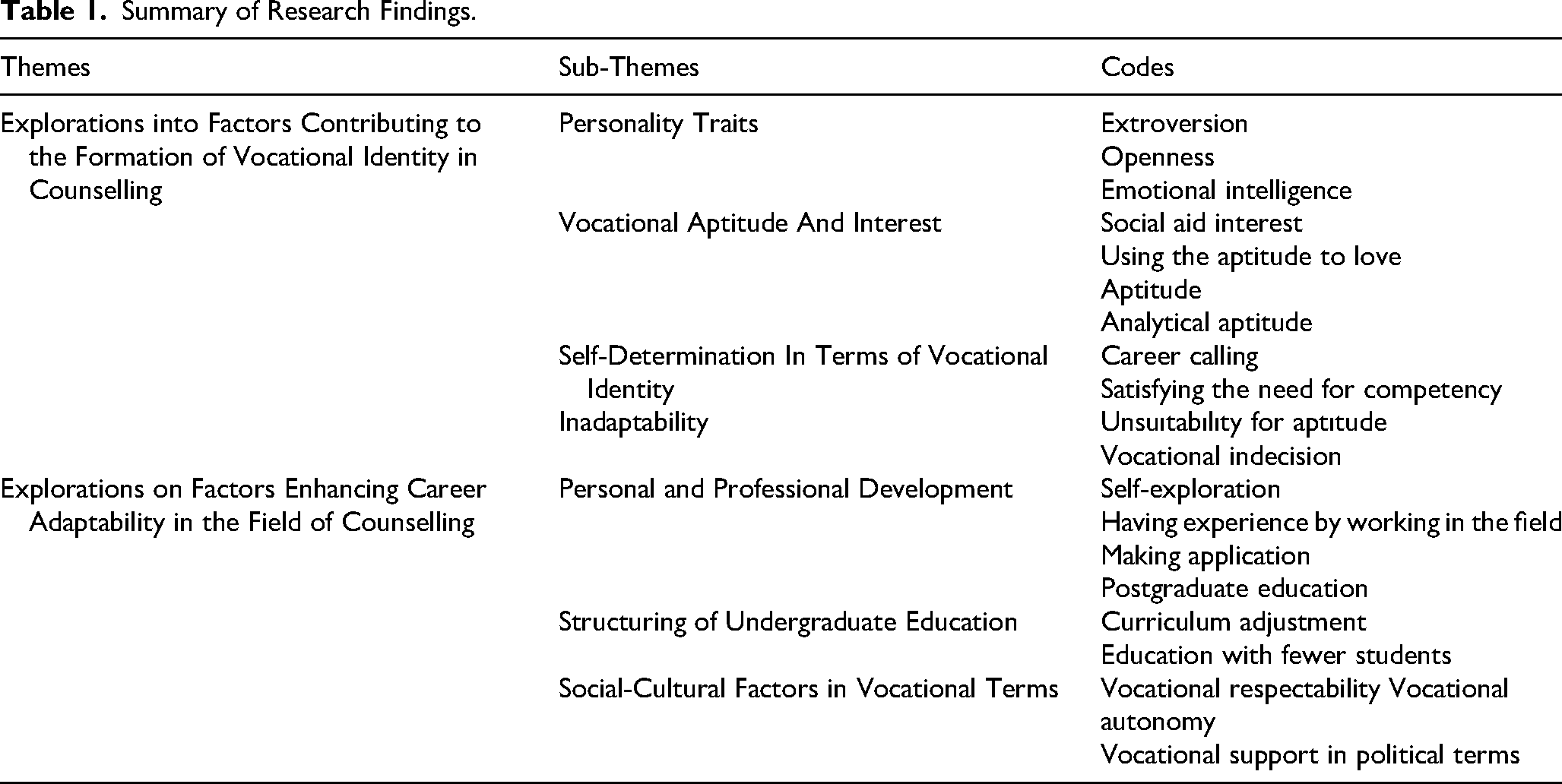
The study has delineated the perceptions of aspiring prospective counsellors towards vocational congruence through two principal thematic dimensions: “ Explorations into Factors Contributing to the Formation of Vocational Identity in Counselling” and “Explorations on Factors Enhancing Career Adaptability in the Field of Counselling”. Under the rubric of the former, four subsidiary themes have been discerned, namely ‘personality traits, vocational aptitude and interest, self-determination in terms of vocational identity, and inadaptability’ (refer to Table 1 for a detailed schematic).”
Summary of Research Findings.
Personality Traits
Prospective counsellors have stated that personality traits play a significant role in shaping their professional identity in the field of psychological counselling. Participant narratives reveal that traits such as extraversion, openness to experience, and emotional intelligence help candidates feel suitable for this profession. Participants who believed they possessed these traits emphasized that they had established a meaningful alignment between their personality structures and the requirements of the counselling profession; they stated that this alignment served as a source of confidence and motivation in shaping their professional identities. Participant statements suggest that personality traits are not merely individual qualities, but rather meaningful resources that are experienced during the process of forming a professional identity. Examples of the candidates’ perspectives on personality traits are provided below: “I find the domain of interpersonal communication very appealing; I enjoy establishing communication, being in interaction with people. That's why I am considering pursuing a career in this field” (Barış). “I believe that this profession suits both my interests and my abilities. I see it as a domain where I can develop myself. It won't be a stagnant career for me; I anticipate it to be continually progressing” (Kübra). “There are various aspects to the suitability of this profession for me, but the most prominent is perhaps the empathy skill, which I find quite developed in myself, making me see this profession as fitting for me” (Şenol).
Vocational Aptitude and Interest
Prospective counsellors have interpreted vocational aptitude and interest not merely as individual skills, but fundamentally as a social aid orientation. The concepts of the aptitude to love, analytical aptitude, and the desire to help people, which stand out in the participants’ narratives, show that they view the counselling profession as more than just a technical expertise, but as a human and ethical responsibility. Participants stated that developing a sense of belonging to the counselling profession and being able to practice it competently is closely related to the presence of these tendencies, which are considered compatible with the field. Below are illustrative examples of the candidates’ views on vocational aptitude and interest: “I’ve always considered myself inherently connected to this profession. I am tolerant towards people, I can understand them, and I can objectively evaluate their experiences with empathy and generate solutions. I’m able to do this not by imposing my solutions but by guiding them to realize these solutions on their own.” (Sevda). “I don't believe that everyone is cut out for this profession by nature or structure. In my opinion, it's not sufficient just to receive training to be able to practice in this field; one must have an inherent affinity. I believe that I have a certain talent for love in my interactions with people” (Süleyman). “I think I have an innate predisposition towards analytical ability, which I consider suitable for the field I want to work in. I want to work with children, so in this sense, it's appropriate for my interests too” (Fatma). “I was initially interested in the health sector as a child. Because I was not very strong in quantitative subjects, this field became more appealing to me. That's why I started in this profession, and when I did, I realized it was a good fit for me, and I believe it has greatly developed me. That's what I can say” (Cansu).
Self-Determination in Terms of Vocational Identity
Aspiring prospective counsellors have approached their vocational identity development within the context of self-determination, relating this process to the fulfillment of their competency needs and their sense of a career calling. In the participants’ narratives, it is evident that as they find opportunities to apply their psychological counselling skills and observe increasing positive changes in their clients, their perception of being suited for this profession is significantly strengthened. These experiences stand out as fundamental, reinforcing not only prospective counsellors’ perceptions of professional competence but also their sense of belonging and meaning in the psychological counselling profession. Below are some examples of the candidates’ views on self-determination in terms of vocational ıdentity: "I actually think that this profession is very suitable for me. Initially, during the first and second years, I didn't feel this way. However, as I became more involved in the practical components in the third and fourth years and began to see the change I could effect in others, I felt more suited to it. Especially during the practical assignments in the third and fourth years, and particularly after working with a client during the psychological counselling practice in the first term of the fourth year” (Onur). "I actually have a positive outlook. Especially when I engage in practical work, I think to myself that I am glad I chose this path. Listening to clients and being able to assist them is, I believe, a wonderful feeling.” (Melike).
Inadaptability
Some prospective counsellors have expressed that they experienced significant inadaptabilities in the process of establishing their vocational identity in the field of psychological counselling. These candidates have characterized the factors contributing to their perceived misalignment as vocational indecision and a lack of congruence with their abilities. Indeed, some participants described the skills they believed they possessed as not fully aligning with the role of psychological counselling, evaluating this situation as a fundamental factor complicating their professional identity development. Examples of the candidates’ perspectives on inadaptability are provided below: “I’m not sure if it suits my abilities. Honestly, I found the courses a bit tedious over the four years because they were more focused on verbal skills. I think this is partly due to the fact that the school I graduated from had a more quantitative emphasis” (Nurcan). “I actually thought this profession was suitable for me when I chose it, but during this last year, I began to wonder if I made the right choice because I haven’t reached a sense of professional fulfillment. We’re learning new things, but I still can’t find that sense of fulfillment. Maybe it's something to do with me, maybe I’m expecting too much from myself.” (Ümit).
The findings above have touched upon the subsidiary themes, codes, and quotes reached within the first theme. Additionally, the other theme conceptualized in this study is “Explorations on Factors Enhancing Career Adaptability in the Field of Counselling”. The theme of ‘discoveries related to factors that enhance career adaptability in the psychological counselling profession’ has been derived from four subsidiary themes, which include ‘personal and professional development, personality traits, structuring of undergraduate education and socio-cultural factors in vocational terms.
Personal and Professional Development
Prospective counsellors have emphasized that one of the fundamental elements supporting career adaptability in the field of psychological counselling is personal and professional development. Participants’ narratives reveal that career adaptability is not experienced as a passive adaptation process, but rather as an active process constructed through self-discovery, structuring one's professional identity, and engaging with the field. In this context, participants stated that strategies such as self-exploration, having experience by working in the field, making application, and postgraduate education strengthened their career adaptability. These statements indicate that career adaptability is based on the simultaneous development of personal awareness and professional competence, and that candidates perceive their careers as a long-term, ongoing development process. Below are examples of the candidates’ views on personal and professional development: “First, I think I need to become aware of myself. My interests, weaknesses, strengths. For instance, I want to work in a courthouse but I might not be able to handle the cases there, so I need to understand this. I need to see which part of my personality suits where. Maybe if I work with children, children will be better for me. I mean, I might need to see these through interest-aptitude tests or a career inventory” (Aysel). “I go to a school where the guidance service is very involved. There, when you really see people in need, and you feel needed, like you've done something and it mattered, I was able to convey it, give it to the other side. If I encounter such a situation, my love for the profession will increase even more, and I will be more motivated to develop myself” (Sevda). “I definitely need to do a literature review, as I've said before. I need to attend various seminars to better understand in which area I can develop myself. I want to pursue a master's degree but I want to do it abroad. For that, I'm preparing for the exams. Because here there is a certain system. Some professors say we apply the system of Germany. Some say since there's no certain system in Turkey, we take the United States as an example. It seems more logical to me to receive education abroad since it's not well-established here, and I want to develop myself in that direction” (Şenol).
Structuring of Undergraduate Education
Participant narratives suggest that adapting the curriculum to meet the current requirements of the profession and conducting education with fewer students, rather than in crowded classrooms, enhances the sense of professional competence and career-related confidence. In this context, undergraduate education has been described as a field that extends beyond the transfer of theoretical knowledge; it is an area where students can develop professionally, gain experience, and establish a clearer direction for their careers. The participants’ emphasis on this point suggests that educational arrangements serve as a crucial contextual resource in the development of career adaptability. Examples of the candidates’ views on the structuring of undergraduate education are provided below: “I am taking this short-term and solution-focused class, and I really liked the seating arrangement. For the first time in my fourth year, I am taking such a class. We sit face to face. We can look at each other and ask questions; there are only 30 of us in the class, and the instructor can take everyone's opinion individually. Even in three hours, there is enough time for this. For example, if we don’t understand something, at least we think about it in class; information isn’t just thrown at us, we make comments, we use our own minds. We are not robots there. We are different from ants just coming and going; this is what I would have liked to see throughout my educational life” (Süleyman). “For instance, there could be more courses, more credits. Practical courses could be increased. Honestly, some education science courses could even be reduced. Because I can say that some courses are not even useful to us” (Aslı).
Social-Cultural Factors in Vocational Terms
Participants who will work as psychological counsellors in the future emphasized that one of the essential factors supporting career adaptability is how professional identity is positioned within the sociocultural context. In the participants’ narratives, the profession's prestige in society, the provision of autonomy in professional practice, and the existence of structural support for the profession at the political level emerged as key elements that strengthen career adaptability. In this context, participant statements indicate that career adaptability is not limited to individual competencies; the profession is also supported by sociopolitical conditions, which determine counselling candidates’ perceptions of adaptability regarding their professional future. Here are some examples of the candidates’ views on social-cultural factors in vocational terms: "The PDR (Psychological Counselling and Guidance) profession could be suitable for me if the current policies were not so restrictive, just limited to the guidance services by the regulations. I believe that this profession should not be so simply reduced. The more I think about it, the more I feel that after all the hard work and high scores it took to get here, this department deserves at least as much recognition as law or medical schools, if not more. We should be provided with a workspace, an area of freedom to practice our profession. Of course, there are limitations and restrictions at the moment” (Onur). "First of all, I think that current policies need to be expanded. Instead of being obstructive, they should be more flexible, able to address the fields we work in. Right now, we are very constrained, surrounded by too many boundaries that we cannot move beyond, and our voices are not heard enough. Yes, something is being done, but too many obstacles are being placed in front of these efforts. That's why I think the policies need to be expanded” (Ayşenur). "I think our work areas should be relaxed a bit more, they should be left more free, in that way” (Mert).
Discussion
The objective of this scholarly inquiry is to phenomenologically scrutinize the progression of career adaptability among trainees in psychological counselling, drawing from their perceptions over the course of their undergraduate education. The research has yielded two pivotal thematic outcomes: one that provides explorations into factors contributing to the formation of vocational identity in counselling, and another that sheds light explorations on factors enhancing career adaptability in the field of counselling. This analytical process has been substantiated by an array of 22 distinct codes.
First of all, the findings of this study can be evaluated within the framework of career construction theory. When the findings of this study are evaluated, they point to the career adaptation abilities indicated by the Career Construction Theory, namely career confidence and career curiosity. Career Construction Theory (Savickas, 2013) states that gaining experience and participating in practical efforts are related to developing career confidence, while self-discovery among prospective counsellors are related to nurturing career curiosity. These characteristics have been accepted as the basis for career choice within the theoretical structures mentioned above. The study develops these theoretical frameworks by showing the ongoing effect of these factors throughout the career development process. When the prospective counsellor in the study use the relevant career adaptation abilities, their career adaptability also increases. In addition to all these, the study also highlights dimensions such as talent, interest and personality traits, socio-cultural factors that are important in career choice. The reason for this situation may be the reflection of individuals’ awareness of the factors they should consider in career choice.
The results of this investigation have elucidated critical insights, advocating for a holistic approach to career selection in psychological counselling that transcends academic achievement and aptitudes. It underscores the importance of integrating personality traits, requisite professional characteristics, personal interests, and vocational values into career decision-making processes (Holland, 1997). In this vein, the findings resonate with and lend empirical support to the tenets of several preeminent career counselling theories. The Trait and Factor Theory asserts the centrality of an individual's personal characteristics in career decision-making and adaptability (Parsons, 1909/1989). The identified codes within this study, such as extraversion, openness to experience, and social aid interest, echo the trait factors of this theoretical model. The Work Adjustment Theory categorizes social help interest as a core personal trait (Dawis & Lofquist, 1984). As per the Career Construction Theory (Savickas, 2013), gaining experience and engaging in practical endeavors are linked to developing career confidence, while self-exploration among prospective counsellor is associated with fostering career curiosity. These characteristics have been acknowledged as pivotal in career choice within the aforementioned theoretical constructs. The study enhances these theoretical frameworks by illustrating the continued influence of these factors throughout the career development process. Furthermore, the personal traits that have surfaced in this analysis correspond to the self-concept dimension within Super's Life-Span, Life-Space Theory (1980). Consequently, it is evidenced that prospective counsellors are gradually assimilating the professional identity of a “ counsellor” into their self-concept.
The research results can also be considered in the context of the Career Construction Model of Adaptation. Within this model, the concept of adaptivity is described as the individual's personality traits and cognitive abilities during the career development process (Hirschi et al., 2015). It can be said that the personality traits and analytical abilities in this study correspond to adaptivity. Adaptability in this model is expressed as the skills that provide resources for an individual and enable coping with challenges, obstacles, or crises in career development (Johnston, 2018). The vocational aptitude and interest and making application found in this research can be interpreted as equivalent to adaptability. The adapting response in this model is defined as the adaptive behaviors (career exploration, career planning, and belief in professional self-efficacy) that an individual uses to successfully accomplish career development tasks (Rudolph et al., 2017a). It could be said that the self- exploration and having experience by working in the field in this research show similarities to the adapting response concept. Lastly, the adaptation result in this model is explained as a concept evaluated with positive indicators such as satisfaction, commitment, professional identity, and career calling, in addition to an individual's adjustment with the environment (Rudolph et al., 2017a, 2017b). The career calling and self-determination in terms of vocational identity in this research can be said to correspond to the adaptation result. The information, findings, and theoretical explanations described in Table 2 have been concretized.
Summary of Research Findings in Terms of the Career Construction Model of Adaptation.

The findings from this study are consistent with the current theoretical framework (Hartung & Di Fabio, 2024) that positions sustainable development as the fourth paradigm in twenty-first-century career approaches. The personal characteristics (extraversion, openness to experience, emotional intelligence), vocational aptitude, interest, and self-determination components that stand out in the career adaptability experiences of prospective counsellors reflect not only the process of adapting to career preferences but also a long-term orientation toward developing a meaningful, balanced, and socially valuable career. In particular, themes related to career call perception, meeting competency requirements, and self-awareness processes align with the subjective meaning production, psychological well-being, and lifelong development emphases that underlie a sustainable career approach. In contrast, findings indicating professional indecision and adaptation difficulties suggest that sustainable career development may be weakened when individual resources are not sufficiently supported. Findings related to the quality of undergraduate education, opportunities for practice and experience, and socio-cultural support structures reveal the decisive role of contextual and systemic factors highlighted by the sustainable development paradigm. In this context, the career adaptability of prospective counsellors should be approached not only based on individual characteristics but also with an integrated perspective that includes educational, social, and political support. The findings reveal that when career adaptability is evaluated within the perspective of sustainable development, it corresponds to the process of establishing a dynamic balance between the individual, their professional life, and society.
In the literature, the importance of culturally sensitive practices in psychological counselling is emphasized (Akalın & Türküm, 2021; Bektaş, 2006). The findings of this study can also be considered in the context of training culturally sensitive counsellors. At this point, characteristics such as professional prestige, professional autonomy, professional support, curriculum adjustments, and receiving education with fewer students, highlighted by undergraduate students, can be regarded as cultural factors related to career adaptability and exploration in Eastern cultures.
The scholarly contribution of this study is significant. The educational pathways for counsellors differ internationally, being positioned at the graduate level in certain countries, whereas at the undergraduate level in others. It is observed that a predominant focus of the existing research corpus is on graduate cohorts. There is a discernible dearth of scholarly attention given to undergraduate students’ perceptions of their career exploration and adaptability (Eryılmaz & Bektaş-Aydın, 2022). This study, by virtue of its focus on undergraduates within a unique cultural context, has partially dissipated the ambiguities associated with this segment, thus providing a meaningful augmentation to the extant literature.
In Turkey, when choosing a profession, people primarily direct themselves to a career based on academic achievements. For example, selecting one of the areas in the university entrance exam, such as verbal, quantitative, or equal weight. Personality traits and interests are not considered as criteria for entering the profession in the training of counsellors. This leads to career inadaptability among individuals. The findings of this study particularly emphasize the importance of personality traits and interests during the process of psychological counselor education. Therefore, considering personality traits and interests along with abilities in the selection of counsellors will increase the quality of counselling education. It is observed that adaptability factors can change while choosing the profession, learning the profession, and sustaining the profession. In this regard, future studies can examine psychological counselor career adaptability in terms of choosing the profession, receiving education in the profession, and practicing the profession. This research has been evaluated with qualitative research approaches that offer the opportunity to examine in-depth the development of career adaptability of prospective counsellors during undergraduate education. Subsequent studies may deeply investigate the career adaptability processes of graduate counsellors with qualitative research approaches.
Footnotes
Acknowledgments
Not applicable.

Ethical Approval
All stages of the study were conducted according to Helsinki Declaration.
Informed Consent
All participants provided informed consent for the data to be published and to participate in the present study.
Funding
The authors received no financial support for the research, authorship, and/or publication of this article.
Declaration of Conflicting Interests
The authors declared no potential conflicts of interest with respect to the research, authorship, and/or publication of this article.
Availability of Data and Materials
The data set is available upon request.