






Abstract
As Chinese doctoral graduates increasingly transition to secondary education, this study explores the potential motivational mechanisms. Employing a grounded theory method, we analyzed the semi-structured interviews of 27 participants in China, we develop a multi-level motivational framework integrating human capital theory and social cognitive theories within a Push-Pull-Mooring (PPM) architecture. Findings reveal that push factors and pull factors operate through mooring conditions at both institutional and psychological conditions. Institutional security that is front-loaded interacts with psychological recourses to shape decision pathways. Reconceptualizing the transition as an active occupational recalibration rather than a passive withdrawal from academic precarity, we identify risk timing as a critical temporal mechanism in the PPM process: front-loaded security strengthens the pull toward alternative careers, whereas back-loaded security intensifies the push away from academia. The study illuminates highly skilled labor redistribution and offers implications for teacher workforce policy, and career support in China and comparable Asian contexts.
Keywords
Introduction
An increasing number of doctoral graduates are embarking on careers in secondary education, a shift that has garnered growing attention in academic circles and policy discussions. This trend not only reflects the limited availability of academic positions but also demonstrates recognition of the broad industry-transferability of doctoral-level skills (Horta & Dai, 2025; Zheng et al., 2024). The diverse doctoral training pathways across the globe have received attention, but the mechanisms for transitioning to secondary education remain understudied (Akkoumeh et al., 2023; Bekkouche et al., 2022; Fan et al., 2010; Schäfer & El Dali, 2019).
Although the proportion of doctoral graduates entering universities and research institutions has declined, more people are now working in nonacademic fields such as secondary schools and enterprises. This trend has been confirmed by the 27 Chinese university graduate quality reports (Luo & Gu, 2015). The saturated academic job market has prompted many doctoral students to explore alternative careers, including public administration and, particularly prominently, teaching positions (Arimoto et al., 2019; Austin, 2002; Li & Horta, 2024). From 2017 to 2021, the number of doctoral students admitted in China increased by 50%, rising from 83,976 to 125,800 (Ministry of Education, 2022). Surveys indicate that this trend is partly attributed to the intensification of academic internal competition and the limited absorption capacity of high-skilled industries (Li & Horta, 2024).
Institutional factors play a decisive role in shaping career choices (Ge, 2024; Li & Horta, 2022; Yang et al., 2024; Yang & Fumasoli, 2024). In China, the biānzhì system—lifetime tenure in public institutions— has emerged as a critical institutional factor. Under this policy, teachers employed in public school enjoy formal status, stable salary and state-guaranteed welfare benefits administered by education authorities, thereby providing front-loaded employment security. Compared with employees in the private sector, biānzhì teachers have clearer promotion pathways and long-term professional stability (Yang et al., 2024). These advantages make secondary teaching an appealing option for doctoral graduates facing uncertainty in the academia.
At the same time, this transition may also be driven by meaning-oriented motives and the pursuit of a more sustainable and socially contributive working life, rather than being solely a risk-management response.
Recent career development scholarship has proposed sustainable development as a fourth paradigm for twenty-first century careers, shifting attention from individual career success toward forms of working life that contribute to collective well-being (Hartung & Di Fabio, 2024). In a similar vein, Guichard (2022) calls for supporting individuals to design active lives through which they can contribute, with others, to sustainable and fair development in solidarity. Through this lens, doctoral graduates’ moves into secondary school teaching may involve both institutional pulls and value-oriented motives linked to meaningful contribution through education.
While doctoral career diversification has been explored in Western and East Asian contexts, little is known about transitions to secondary education. Existing work documents the incidence of nonacademic transitions and commonly identifies correlates such as academic job scarcity, perceived insecurity, and the attractiveness of stable employment arrangements (e.g., institutional security and clearer progression), but offers limited explanation of how structural constraints, institutional incentives, and psychological resources combine to produce enacted transitions. Addressing this gap, our study advances a processual, mechanism-based account that extends Push-Pull-Mooring (PPM) via risk timing as a temporal mechanism, specifies pull valuation through human-capital and teacher labor-market logics, and reconceptualizes mooring as a processing layer through Social Cognitive Career Theory's career self-management extension, clarifying how cognitive appraisals translate structural forces into enacted transition actions. To address this gap, the present study asks: How do structural, institutional, and psychological mechanisms interact to shape Chinese doctoral graduates’ transitions into secondary school teaching?
Literature Review
Push–Pull–Mooring as an Integrative Lens
Originating in migration and career transition research (Lee, 1966; Moon, 1995), the PPM model conceptualizes decision-making as the result of interacting “push” factors that drive individuals away from their current situation, “pull” factors that attract them toward alternatives, and “mooring” factors that moderate these dynamics. While the framework was initially used to explain geographic mobility, its parsimony makes it equally applicable to professional transitions where actors weigh risks, rewards, and personal attachments.
Unlike prior PPM adaptations that treat mooring as static constraint, this study reconceptualizes mooring as dual institutional–psychological anchoring operating over time. This framework provides a structured approach for integrating external structural conditions and internal psychological mechanisms in career decision-making. In the context of doctoral employment, the push-pull mechanism reveals how macro-level academic pressure and individual motivation converge into a transformational path. At the same time, the anchoring dimension helps to analyze the personal and situational anchors that stabilize or delay such dynamics.
Integrating Human Capital and Social Cognitive Perspectives into the PPM Framework
While the PPM framework robustly identifies the structural forces shaping career transitions, an organizing architecture alone does not specify how individuals evaluate these forces and translate them into behavioral intentions. To bridge this explanatory gap, we integrate human capital theory and social cognitive theory (SCT) to articulate the mechanisms operating within its pull and mooring dimensions. We operationalise this social-cognitive perspective in the career domain through Social Cognitive Career Theory (SCCT) and its career self-management (CSM) extension.
In this framework, PPM functions as the overarching organizing architecture that structures the transition context into push, pull, and mooring. Human capital and teacher labor market logic specify the valuation mechanism within pull (expected returns and skill utilization; destination attractiveness as overall compensation weighed against opportunity costs), whereas SCCT–CSM specifies the processing mechanism within mooring (self-efficacy and outcome expectations, operating through goals and conditioned by contextual supports and barriers, translate push–pull forces into adaptive transition behaviors). Together, this nested articulation adds explanatory value by moving beyond a static list of factors to explain how occupational alternatives are valued (pull) and how those valuations and structural pressures are converted into goal-directed actions (mooring).
Human Capital Theory: Explaining the Valuation of Pull Factors
Human capital theory posits that individuals invest in education and training to enhance their skills, and that career choices are guided by expected returns on those investments (Becker, 1989; Schultz, 1961). This valuation logic illuminates why secondary teaching exerts a strong pull-on doctoral graduate. In the teacher labor market, as Guarino et al. (2006) argue, individuals evaluate an occupation's attractiveness by weighing its overall compensation, including salary as well as rewards embedded in working conditions and personal satisfaction, against the opportunity costs of alternative paths.
For doctoral graduates, teaching is not merely a fallback but a professional field where specialized competencies (e.g., analytical rigor and domain expertise) may remain recognizable and valued, thereby sustaining perceived returns through continued skill utilization (Schultz, 1961). Evidence from teacher-choice research indicates that motivations commonly include perceived intrinsic career value, as well as job security and job transferability (Richardson & Watt†, 2006). These themes are echoed in recent studies of Chinese doctoral graduates, which identify professional stability and intrinsic interest as salient factors shaping their intentions to enter secondary education (Qing & Liang, 2019; Wang, 2022). Within the Chinese context, institutional arrangements like biānzhì stability can be theorized as context-specific components that strengthen pull by enhancing the perceived overall compensation of teaching and lowering the perceived opportunity costs relative to uncertain academic alternatives (Guarino et al., 2006).
Social Cognitive Mechanisms: from SCT to SCCT–CSM in Mooring Processing
Social cognitive theory emphasizes the interaction between personal agency, behaviors and environment (Bandura, 1982). Two constructs are central to career transitions: self-efficacy (belief in one's capacity to perform transition tasks) and outcome expectations (the anticipated consequences of the move). Building on SCT (Bandura, 1982), we draw on SCCT and its career self-management extension. Lent and Brown (2013) specify how SCCT can address how people manage normative tasks and cope with the myriad challenges involved in career preparation, entry, adjustment, and change, and they propose a CSM model applicable to adaptive behaviors such as career decision making, exploration, and the negotiation of work transitions.
In our framework, mooring is reconceptualized not as a static set of constraints, but as an active cognitive–contextual system. These cognitive appraisals function as a psychological filter that interprets and weights external push and pull forces. Mechanistically, self-efficacy, outcome expectations, and goals jointly shape adaptive career behaviors in interaction with environmental supports and barriers (Lent & Brown, 2013).
Theoretical Articulation: Integrating Mechanism Theories into the PPM Framework
The three theories are integrated at different levels of explanatory abstraction. PPM serves as the overarching structural framework for organizing the transition context. Within this framework, human capital theory explains why destination attributes are valued in terms of expected returns on accumulated investment (Becker, 1989; Schultz, 1961), while the labor-market account clarifies that choices involve weighing overall compensation against the opportunity costs of available alternatives (Guarino et al., 2006).
Meanwhile, SCCT's CSM extension specifies the processing mechanism inside the mooring dimension by shifting attention from where people end up to how they manage tasks and challenges during career transitions (Lent & Brown, 2013). Together, these mechanisms move beyond a static taxonomy of factors to reveal how structural risks are interpreted, valued and ultimately translated into career decisions (Li & Horta, 2022, 2024).
China's Mooring Regime
In China, institutional arrangement—such as biānzhì tenure, metropolitan prestige hierarchies, and age-bounded promotion rules—serve as structural moorings that redistribute and risks across career pathways. In particular, the biānzhì system provides early-stage employment security and social recognition that reconfigure risk timing. This contrasts with tenure-track regimes where stability is achieved only after long probationary periods.
We thus treat mooring as both institutional and psychological anchoring: institutional in the sense of stable employment mechanisms, and psychological in the sense of cognitive appraisals (self-efficacy/outcome expectations) that condition responses to push–pull forces.
Guiding Proposition
Building on the above synthesis, this study proposes two guiding propositions:
(P1) When employment security is front-loaded (e.g., biānzhì), pull valuations are amplified by mooring effects, making teaching more attractive.
(P2) When security is back-loaded or contingent (e.g., tenure-track probation), push forces persist longer and transitions occur only after repeated risk exposure.
Methodology
Approach
Career decision-making is complex and often shaped by both rational and affective considerations. Personal abilities, interest, and external advice typically guide career selection (Martínez-Moreno & Petko, 2024). In teaching-related careers, educational policies and labor market conditions further shape these decisions. However, research on the specific motivations of doctoral graduates entering secondary education is very limited. Existing surveys may introduce biases due to their reliance on preconceived constructs.
To address this deficiency, particularly regarding the interaction between structural constraints and individual agency, this study adopted a qualitative grounded theory approach. Developed by Glaser and Strauss (1967), grounded theory systematically generates theoretical frameworks from empirical data through iterative analysis (Charmaz, 2006). Given that this study aims to develop an explanatory model of the transition process, we adopted a Straussian grounded theory analytic procedure (Corbin & Strauss, 2008), while maintaining interpretive sensitivity and reflexive memoing consistent with constructivist sensibilities (Charmaz, 2006).
Semi-structured interviews captured the participants’ narratives about the decision-making process and their perceptions of career transitions. The research team consisted of three scholars in the fields of higher education and teacher development, which facilitated empathetic understanding but also required continuous reflective memos to minimize bias. Two of the members had previous experience in doctoral education research, while the third focused on teacher professional development. This combination ensured a balance between internal understanding and analytical distance.
Participants
This study employed purposive sampling to recruit research subjects who had direct experience transitioning from doctoral studies to teaching in secondary schools (Etikan et al., 2016). The sampling strategy was guided by the following four criteria:
First, examine the career stage at the time of transition: Those who enter the teaching field immediately after graduation may have different motivations compared to those who first work in academia or industry before switching (Li & Horta, 2024), highlighting the changing nature of motivation over time.
Secondly, assess the academic background: Graduates from STEM fields, humanities fields, and social science fields face different academic job markets, and may have varying perceptions regarding the alignment of their professional knowledge with the curriculum in middle schools.
Thirdly, consider the source of the doctoral degree-granting institutions: graduates from research-oriented universities (such as 985/211 institutions) and ordinary universities may have experienced different levels of academic internal competition and career expectations (Zhao, 2021).
Finally, geographical background factors were taken into account, as there are differences in high-level talent policies and secondary education development among different regions (Gong & Zhang, 2021). The research subjects included people from first-tier cities (such as Beijing, Shanghai, and Shenzhen) and those from non-first-tier regions, in order to capture these contextual differences.
A total of 27 doctoral graduates currently serving as middle school teachers were interviewed. They came from 16 academic disciplines, 17 universities and 7 provinces, with teaching experience ranging from 1 year to 12 years (average 3.4 years). Demographic details are shown in Table 1.
Participants’ Demographic Information.
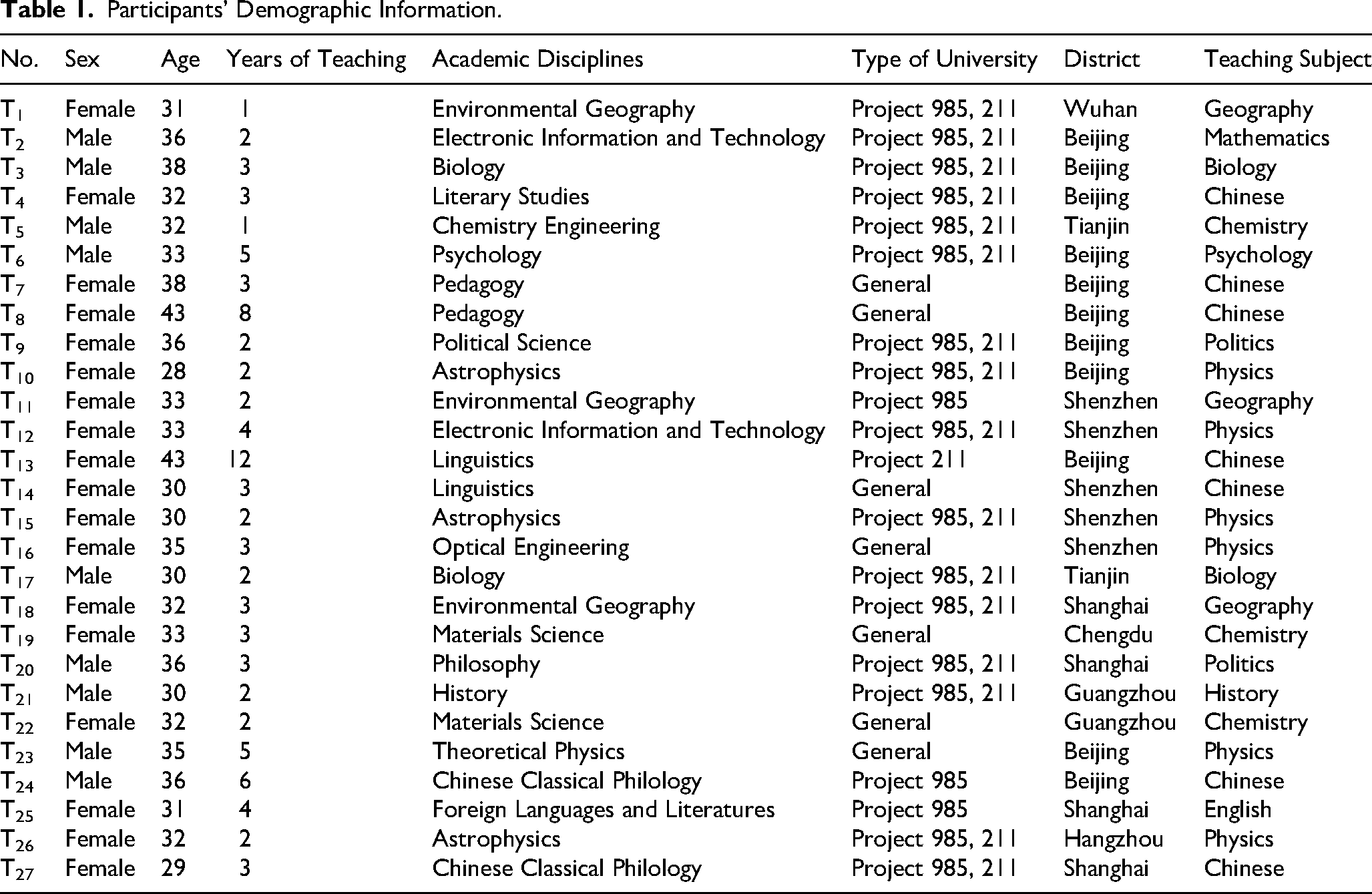
The interviews with 27 participants not only ensured the depth and diversity of the research, but also guaranteed the theoretical saturation. This number is in line with the recommendation in the grounded theory guidelines that 20 to 30 cases are needed to construct a robust theory (Guest, Bunce & Johnson, 2006). The sampling process emphasizes theoretical representativeness rather than statistical representativeness, aiming to capture the heterogeneity in different disciplines and contexts (Charmaz, 2006; Creswell & Poth, 2018).
Instrument
Drawing on previous studies on doctoral career mobility (Seo et al., 2021; Tang et al., 2024) and teacher career choices (Chen, 2021), we developed a semi-structured interview guide to explore the career decision-making process of the participants. This guide was refined through consultation with three experts in higher education and teacher education to ensure its validity and an open attitude towards diverse responses.
The interview covered four thematic domains: (1) Academic experiences and perceptions of career trajectories; (2) Motivations for choosing secondary school teaching; (3) Personal, professional, and contextual influences on decisions; (4) Retrospective evaluation of the transition process and teaching experience. Complete interview questions are detailed in Table 2.
Interview Questions.
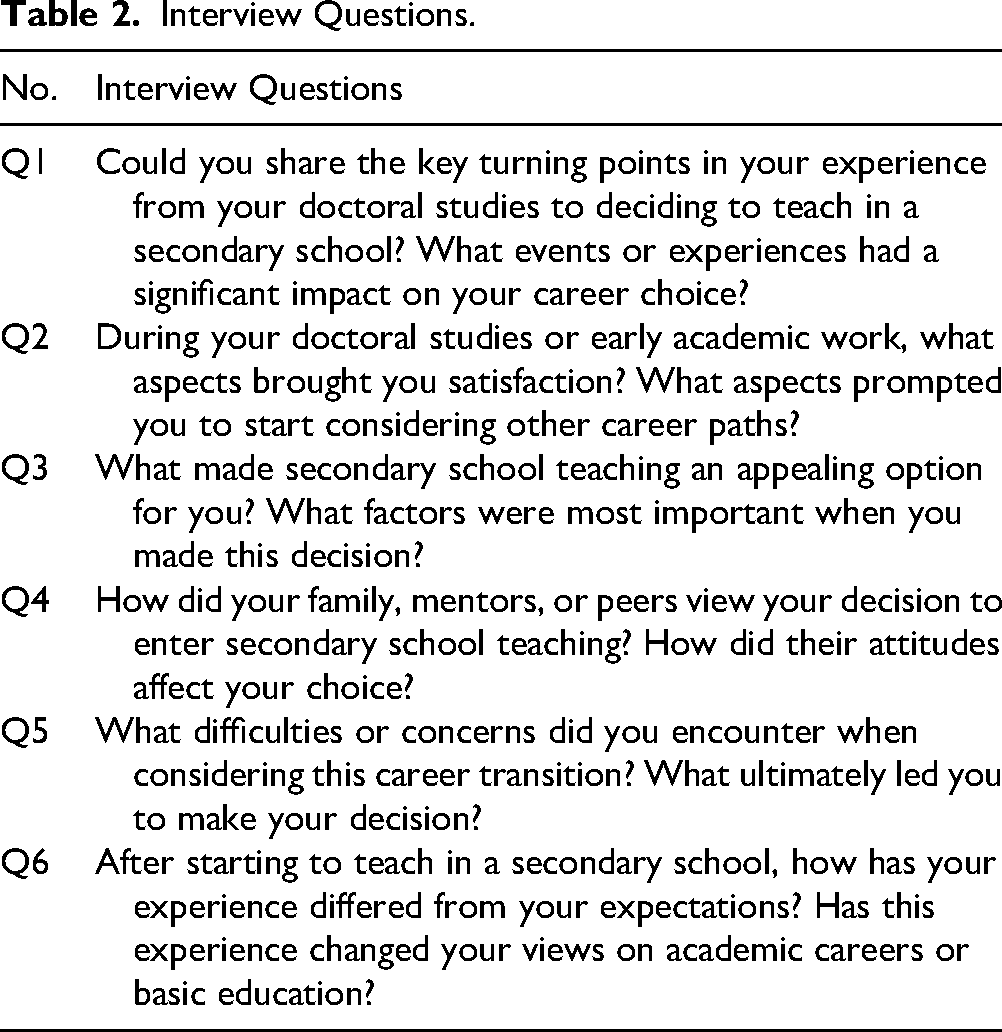
The semi-structured interview was chosen as the main data collection method because it can effectively combine guiding questions with the participants’ self-directed elaboration (Snyder, 2012). A pilot study involving four non-major sample participants tested the clarity and fluency of the questions. Subsequently, formal interviews were conducted either face-to-face or online, lasting 45 to 60 min, and audio recordings were made after obtaining informed consent. Open-ended prompts, such as “Could you describe the process of your decision to engage in teaching at the secondary level?”, encouraged participants to provide reflective narratives. The transcribed texts were anonymized and verified for accuracy.
Data Analysis
The analysis phase lasted for 14 months (from February 2024 to April 2025). This study has received ethical approval from the Ethics Review Committee of Capital Normal University, and all participants provided written informed consent.
Data analysis follows the three-stage grounded theory procedure: open coding, axial coding, and selective coding, and can identify key factors and construct a theoretical model that explains their interrelationships (Corbin & Strauss, 2008). Two researchers independently coded 20% (Approximately 30,000 words) of the transcribed text during the open coding stage, generating 138 initial codes. Any differences were resolved through discussion until complete agreement was reached (Cohen's κ = 0.87; Landis & Koch, 1977). This iterative process ensures the reliability of the research and minimizes researcher bias.
Open Coding
Open coding involves line-by-line examination to identify, label and conceptualize discrete elements (Corbin & Strauss, 2008). This process focuses on decomposing the raw data into meaningful themes while setting aside pre-existing theoretical assumptions, allowing concepts to naturally emerge from the participants’ narratives.
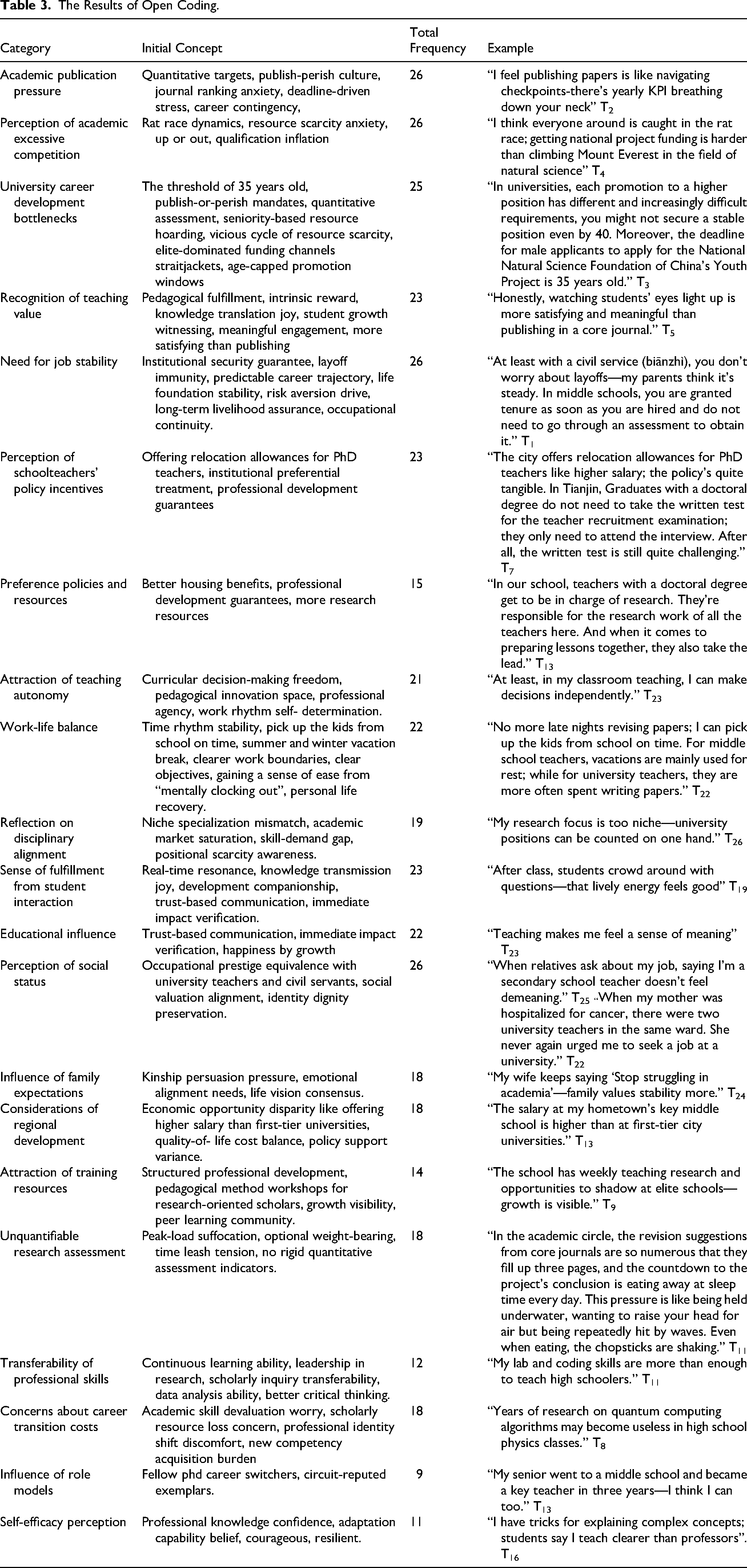
After conducting multiple iterations of reading all the transcribed texts and systematically comparing recurring themes, by aggregating related concepts, 19 initial categories were derived. These categories capture the core dimensions of doctoral graduates’ decision-making processes regarding secondary school teaching.
Representative examples include: “Sense of fulfillment from student interaction” emerged from accounts such as: “Witnessing students comprehend complex concepts provides a sense of fulfillment that I never experienced through laboratory research” (T3).
A comprehensive summary of all open coding outcomes is presented in Table 3.
The Results of Open Coding.
Axial Coding
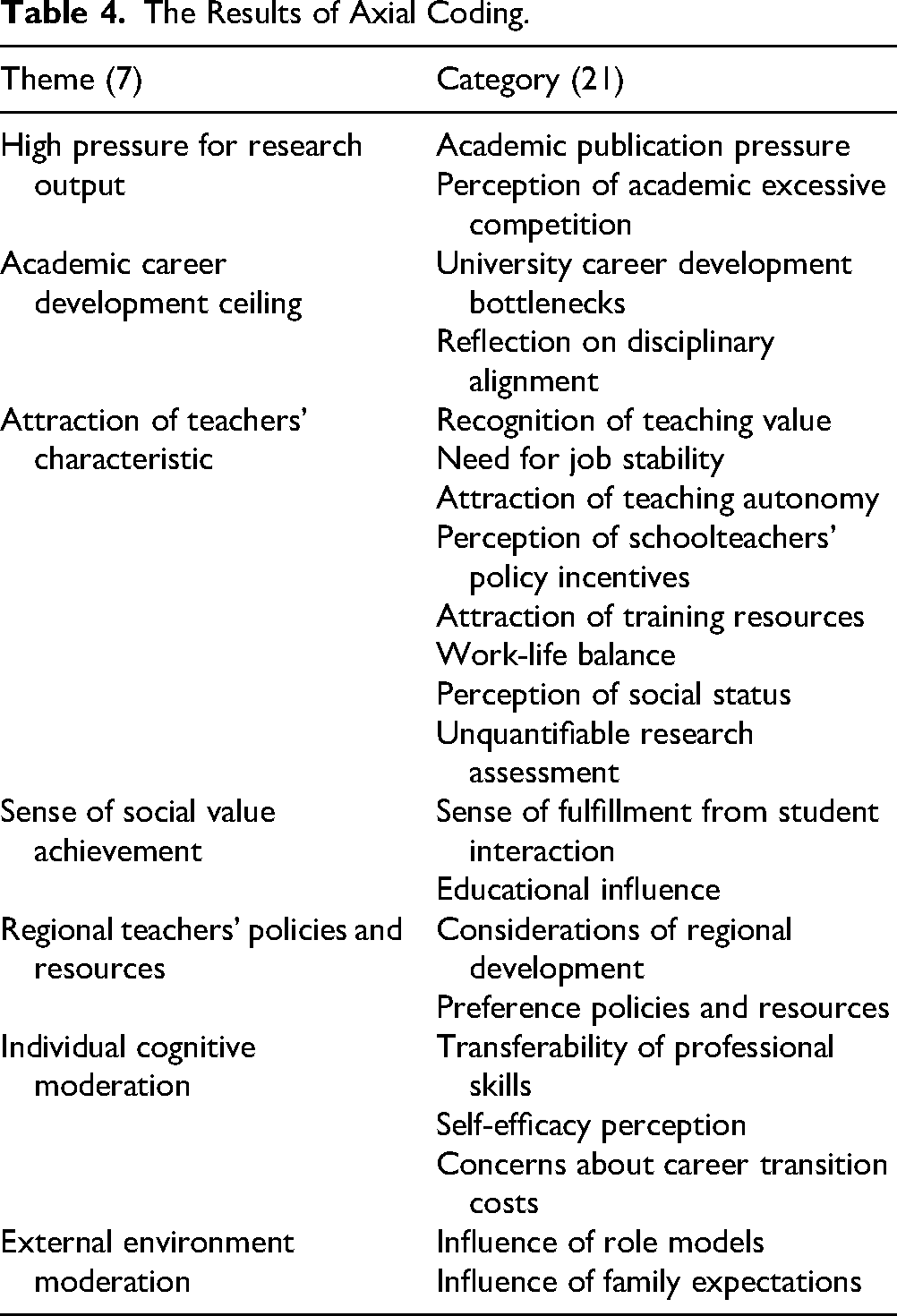
Axial coding connects open-coded categories to uncover higher-order themes that illuminate underlying patterns (Corbin & Strauss, 2008). This phase focuses on identifying relationships between categories to develop a more integrated theoretical framework. Drawing from 21 initial categories, this study synthesized 7 themes that structure doctoral graduates’ transition into secondary teaching.
Table 4 summarizes the seven axial themes and their alignment with the integrated framework. “High pressure for research output” and “Academic career development ceiling” map onto the push dimension of PPM. The pull dimension comprises “Attraction of teachers’ characteristics”, “Sense of social value achievement”, and “Regional teachers’ policies and resources”. The human capital logic is reflected within the theme “Individual cognitive moderation”, particularly through the sub-category transferability of professional skills. Mooring is captured through “Individual cognitive moderation” and “External environment moderation”, with sub-categories such as self-efficacy perception and influence of family expectation illustrating the the social cognitive mechanisms through which personal agency and environmental inputs shape transition intentions and actions. Overall, the analysis is inductive yet theory-informed and remains open to emergent constructs.
The Results of Axial Coding.
Selective Coding
Selective coding integrates core categories into a theoretical framework explaining underlying mechanisms (Corbin & Strauss, 2008). A systematic analysis of axial theme relationships yielded a PPM model for doctoral career transitions (Figure 1)—explaining how structural pressures, teaching attractions, and moderating factors interact to shape decisions.
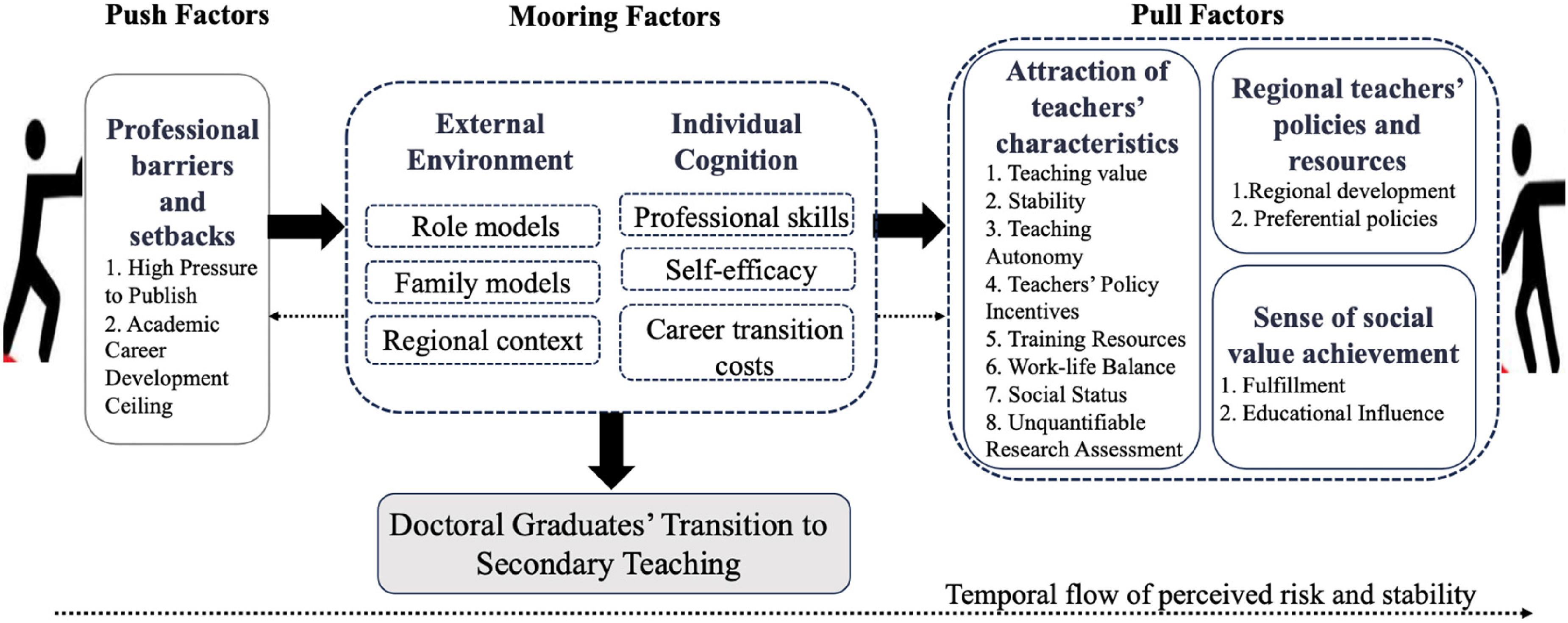
The PPM model of doctoral graduates teaching in secondary school.
The seven themes are organized into three constructs:
Academic Push Factors (“High pressure for research output”, “Academic career development ceiling”). The push factors which are negative become the direct cause that make doctoral graduates unwilling to engage in research work. These factors play a role in triggering their avoidance and withdrawal from academic research. Teaching Pull Factors (“Attraction of teachers’ characteristic”, “Sense of social value achievement”, “Regional teachers’ policies and resources”). The pull factors which are positive become the direct attractions that the teaching work in middle schools exerts on doctoral graduates, inspire their yearning and pursuit of this career. Mooring Factors (“Individual cognitive moderation”, “External environment moderation”). The mooring factors are where the push and pull forces come from and moor the push-pull dynamics. Eventually, they affect the career decisions of doctoral graduates. The main factors that influence how the mooring factors work are the individual driving forces and the external driving forces.
The above factors collectively drive career transition motivations. For example, academic pressures heighten sensitivity to teaching rewards, while personal values shape the prioritization of such factors. The model illustrates how structural forces and individual agency jointly influence career decisions, explaining nontraditional career path among doctoral graduates.
In Figure 1, pull is interpreted as a valuation mechanism (human capital/ teacher labor market logic), whereas mooring captures the processing mechanism (SCCT–CSM) through which push–pull forces are translated into action.
Theoretical Saturation Test
Theoretical saturation was assessed continuously throughout data collection and analysis (Corbin & Strauss, 2008). No new categories emerged after 25 interviews, and confirmatory re-analysis of 60 text segments yielded 90% inter-coder agreement (Guest, Bunce & Johnson, 2006; Saunders et al., 2018), indicating saturation and ensuring the robustness of subsequent findings.
Findings
The grounded theory analysis yields a data-driven account of doctoral graduates’ transitions to secondary education. Results are organized around three empirically derived domains—structural push, professional pull, and mooring—and an accompanying set of motivational orientations that emerged inductively: internally driven, externally driven, and interactive. We report each in the subsections that follow.
Structural Pressures Driving Departure from Academic Careers
Risk-Laden Work Intensification: “Publish or Perish” and Performance Anxiety
Work intensification emerged as a cumulative push mechanism, characterized by a publish or perish culture, rigid KPI requirements, and a pervasive sense of chronic competition. Nearly all participants (n = 26) reported that excessive competition and productivity metrics generated continuous psychological strain. “My university requires the publication of two papers to obtain a doctoral degree, and I encountered great difficulties during this process. The constant pressure to publish in top-tier journals with limited acceptance slots and intense competition makes me question the long-term viability of an academic career” (T2).
Participants frequently described a “checklist mentality” and internalized stress. As T4 majored in literary studies pointed out: “Research in the humanities cannot be rushed, yet universities demand one to two CSSCI papers per year for tenure-a feat that is almost impossible to achieve in reality.” (T4). Similarly, T23 recalled: “For me, the continuous high-pressure work pace has caused emotional exhaustion. I was always experiencing panic attacks before submission deadlines, and I think hard work alone is far from enough.” (T23)
Beyond publication pressure, participants emphasized intensified competition for resources. Some described persistent scarcity and uneven access to funding and support, which made early-career academic development feel fragile and uncertain. As T6 put it, they were “constantly struggling in limited resources” (T6). Overall, participants portrayed these pressures as recurrent and difficult to resolve, prompting many to actively seek more stable alternatives.
Bottlenecks in Academic Advancement: Scarcity and Positional Rationing
Beyond workload intensity, participants identified long-standing structural bottlenecks—including limited funding, age-linked promotion thresholds, reputation-based recruitment, and saturation of academic positions—as persistent sources of insecurity. Participants repeatedly framed these constraints as hard barriers that shaped whether an academic career remained viable.
Several participants described grant success rates and project acquisition as decisive for meeting promotion and contract-renewal requirements. For example, T15 noted: “Without a research project fund, it means that the hard requirement for the ‘up or out’ system cannot be met.” (T15). Others emphasized comparative competition: “Even if you publish papers, there will always be someone with a higher citation count or a superior academic background.” (T23).
Twenty participants talked about age ceilings, funding concentration, and positional scarcity as sources of chronic insecurity they encountered along the academic promotion path:“Applicants for associate professor must be under 35 years old.” (T4); “Professors in their sixties are holding the majority of the funds. By the time they retire, I will be over the age limit. In the academic circle, age always imposes certain restrictions.” (T10); “There are only three laboratories in China dedicated to gravitational wave research, and the number of doctoral students far exceeds the available positions.” (T26).
Participants also described reputational screening as shaping access to academic jobs and amplifying perceived inequality. Finally, some portrayed “up or out” arrangements as highly consequential for livelihood stability. As T2 stated: “The ‘up or out’ policy makes me feel insecure, this system means that you have a six-year probation period, and if you don't meet the standards, you're out with no chance to come back. I've seen colleagues with their entire families, but they were fired because they didn't publish enough papers. They talk about ‘academic stability’, but it's all a lie.” (T2). Collectively, these accounts indicate that structural scarcity and institutional rationing embed persistent uncertainty into academic career trajectories.
Professional Appeal of Secondary Education
Job Stability and Balanced Lifestyle
The most salient pull factor is the promise of stability and work–life balance embedded in the biānzhì system. Among 27 participants, 23 explicitly contrasted their current teaching life with the long, exhausting schedules of academic work: “No more 14-h days in the lab - now I can pick up my kids from school every day.” (T22) “Summer and winter breaks allow me to recharge, something I never had the feeling when I was rushing to meet deadlines during my doctoral studies.” (T8)
Equally appealing is the escape from the endless quantification and competition pervasive in academia. “Unlike the ‘publish or perish’ culture in academia, teaching success is measured by students’ growth rather than citation counts.” (T5)
Therefore, teaching offers temporal boundaries and psychological comfort, meeting the family's expectations for stability and normal life. This becomes the main attractive factor, prompting doctoral graduates to seek secondary teaching positions in order to cope with the instability in the academic field.
Intrinsic Value and Social Contribution
Apart from stability, participants also value the inherent meaning and immediacy of feedback in the teaching process. Qualities that are largely absent in research work, as recognition often takes several years to manifest. “The excitement of interacting with students is incomparable to having a paper accepted.” (T3) “When students come up to you after class to ask questions, you truly feel needed - a feeling I never had as a journal reviewer, who only sent back cold comments.” (T19)
92% of the participants (a total of 25 individuals) also emphasized that teaching can bring about “visible results” and long-term social contributions - as T23 referred to as “ripple effect work”.
Across accounts, participants framed teaching as meaningful because impact was immediate and relational, rather than delayed and mediated through publication cycles. Importantly, many described how institutional features of school work—such as job security, social recognition, and family-friendly rhythms—made this meaning sustainable over time, enabling them to combine doctoral competencies with visible social impact.
Policy Incentives and Professional Recognition
Material incentives have further enhanced the appeal. Many local governments and schools now recruit doctoral teachers by simplifying the process and offering more generous benefits. These measures simplify the career transition process, allowing doctoral students to apply their academic expertise without the continuous pressure to publish, thus maintaining the continuity of their careers. “There is no written teacher recruitment test and just have an interview for doctoral graduates in Tianjin.” (T5) “The teacher recruitment announcement of Shenshan Experimental School clearly states that the maximum annual salary exceeds ¥300,000.” (T11) “Schools also provide planned growth paths, including ‘weekly teaching seminars and positions that leverage doctoral expertise, such as leading teacher research teams. Over the past ten years since I joined the company, I have become a leading teacher.” (T13)
These institutional advantages, while ensuring security, also preserve professional identities. From an external perspective, biānzhì tenure, predictable workload, and government incentives reduce uncertainty; internally, the immediacy of classroom feedback and social recognition enhance a sense of achievement.
Individual and Contextual Influences on Push-Pull Dynamics
Although the thrust factor prompts doctoral graduates to leave the academic field, and the pull factor attracts them to the field of primary and secondary education, the final decision on the transformation depends on how individuals interpret, prioritize, and reconcile these opposing forces. These moderating variables, namely individual characteristics and situational factors - such as self-efficacy, family support, role models, and regional opportunity structures - determine whether the structural pressure is amplified or buffered.
Self-Efficacy and Perceived Skill Transferability as Mooring's Social Cognitive-Valuation Mechanisms
Self-efficacy emerges as a crucial individual regulatory factor in the transition process, shaping doctoral graduates’ confidence in their capacity to perform teaching-related tasks. At the same time, it is closely intertwined with participants’ perceived skills transferability, how far doctoral competencies are seen as applicable and valuable in secondary teaching. Together, these appraisals operationalize the mooring-as-processing mechanism in the expanded PPM framework: they determine whether push-pull conditions are translated into goal-directed transition actions. “The critical thinking skills developed during doctoral research can make classroom discussions more profound.” (T13) “Getting into a 985 university with excellent grades in the college entrance examination also indicates a solid foundation of basic education knowledge.” (T16)
Participants with high self-efficacy were more likely to recognize the applicability of their academic competencies and articulate a coherent skill–task fit: “My research rigor helps design clear lesson plans, and My PhD in optical engineering really lines up with what's taught in high school physics, especially the optics part in ‘Physics Elective 3-4’. The skills I picked up in optoelectronics and wave optics help me come up with creative ways to design lessons, which makes me a good physics teacher.” (T16)
In contrast, low self-efficacy, often amplified by concerns about career transition costs and perceived devaluation of doctoral training, generated resistance even under significant academic stress: “I’ll never manage a classroom full of teenagers, and all those years spent on seventeenth-century poetry will just go to waste. I really want to do research quietly in the lab rather than interact with these children.” (T10) “Not conducting research and publishing papers will lead to the loss of professional identity. It always feels like a waste to have a doctor teach high school students.” (T4)
Overall, these interview records indicate that perceived skill transferability functions as a proximal moderating variable: it shapes whether doctoral graduates can sustain the perceived returns of their prior human capital investment in the new occupational setting and, in turn, whether push and pull forces translate into concrete transition actions.
Family Support and Role Models as Contextual Support Shaping Social Cognitive Appraisal
Family expectations and peer role models represent salient contextual inputs in the transition environment. Within the integrated framework, these factors operate as supports/barriers that shape individuals’ self-evaluative beliefs and anticipated consequences of change. Participants described these contextual inputs as shaping both their confidence and their expectations about the consequences of change.
Supportive family members provide emotional support and practical assistance, which helped participants re-evaluate goals and sustain exploration during uncertainty: “My wife played a key role in encouraging me to leave academia, reminding him that personal happiness and long-term fulfillment mattered more than staying in a high-pressure, unsatisfying situation.” (T24)
Equally important were visible role models who had successfully undergone similar transitions. Seeing others’ post-transition success can alleviate fears and make the career change seem more feasible. As another participant mentioned, a former scholar became a principal teacher within three years of transitioning to secondary education (T13). Such emotional and social support transform teaching from an optional choice into a respected and attainable career pathway, thereby lowering perceived transition barriers and strengthening adaptive decision-making and action.
Regional Opportunity Structures as a Contextual Valuation Shift (Pull) and Feasibility Condition (Mooring)
Within the expanded PPM mapping, regional opportunity structures reshape both the valuation of destination options (pull) and the feasibility conditions under which individuals act (mooring). Spatial hierarchies and local policy arrangements alter the perceived overall compensation of secondary teaching relative to academic employment and change the opportunity costs of different pathways, while simultaneously functioning as contextual supports and barriers that condition whether push–pull pressures translate into concrete transition actions.
The geographical background plays a significant role in influencing career decisions. In first-tier cities such as Beijing, Shanghai, and Shenzhen, the competition for university biānzhì positions is extremely fierce, while in contrast, the number of positions in top high schools is abundant. “After failing to secure a university position in Beijing three times, I got a job as a senior teacher at a top high school in Beijing, a city I love, where I stayed for 12 years. The salary was equivalent to that of an associate professor.” (T21)
Twelve participants explicitly chose elite metropolitan schools to remain in preferred cities, illustrating how institutional and spatial hierarchies redistribute opportunities. In contrast, third-tier cities and rural areas offer more university posts but weaker cultural appeal. “I took a university job in a third-tier city. My colleagues joke I am an academic excellent experts. As teachers with a doctoral degree, we are often more highly recognized and valued in middle schools and are frequently entrusted with important teaching or research tasks.” (T16)
China's tiered higher education system, and unbalanced regional development thus shape professional mobility (Gong & Zhang, 2021; Yang & Wang, 2014). As a result, first-tier cities now take more PhDs into high schools – Shanghai hires over 300 doctoral graduates each year to teach in high schools. At the same time, local universities struggle to attract and retain doctoral graduates.
Taken together, regional hierarchies do not merely provide background context; they actively re-weight the pull valuation of secondary teaching and condition mooring feasibility, thereby shaping where and how doctoral graduates enact career transition decisions.
Integrated Interpretation: Mooring as the Processing Layer Translating Push–Pull Forces into Action
Synthesizing the above themes, these findings illustrate how mooring functions as the processing layer in the expanded PPM framework. Push pressures (e.g., intensified academic workload and career bottlenecks) and pull attractions (e.g., institutional security and improved reward packages) do not automatically produce transition behavior. Rather, they are translated into action through cognitive appraisals and contextual conditions. At the individual level, self-efficacy and perceived skill transferability shape whether doctoral graduates interpret the transition as feasible and whether the perceived returns on prior human-capital investment can be sustained. At the contextual level, family encouragement and visible role models operate as supports that lower perceived barriers and strengthen outcome expectations for change. Regionally, opportunity structures reshape both the valuation of alternatives (overall compensation and opportunity costs) and the feasibility of acting on them.
Together, these interacting mechanisms explain why similar push–pull conditions lead some individuals to withdraw from academic trajectories while enabling others to enact goal-directed transition actions.
Discussions
This study explores why doctoral graduates transition into secondary teaching by advancing an integrated, process-oriented account nested within a PPM framework. Specifically, we interpret push as temporally structured academic risk signals, pull as the valuation of destination rewards relative to opportunity costs (human capital/teacher labor market logic), and mooring as the cognitive–contextual processing layer through which self-efficacy, outcome expectations, goals, and supports/barriers translate push–pull forces into enacted transition actions (SCCT–CSM). Building on the grounded findings, the discussion below proceeds by (1) identifying the core mechanism in the Chinese context, (2) contrasting it with relevant international evidence, and (3) specifying how it refines or extends each component of the integrated framework.
Risk Timing Extends the PPM Model
We identify risk timing as a qualitative mechanism whereby recurrent, age-linked, and stage-gated evaluation requirements generate chronic insecurity across the doctoral-to-early-career pipeline. This pattern is produced by a segmented and continuous evaluation regime in which risk is repeatedly renewed rather than resolved. While tenure-track systems also concentrate pre-tenure pressure, the key difference here lies in the absence of a clear temporal boundary and the institutionalization of age-based exclusion signals. This extends PPM from a static taxonomy of push/pull attributes to a temporal process theory, in which both push intensity and pull valuation depend on the timing and durability of risk and security.
This pattern resonates with existing accounts of “publish-or-perish” cultures and workload intensification in academic settings, but our data further specifies the temporal configuration through which such pressure becomes chronic and boundaryless in the Chinese case (e.g., recurrent KPIs, age-linked thresholds, segmented checkpoints) (Li & Horta, 2024; Tian & Lu, 2016; Zhao, 2021).
The sense of job security from front-loading amplifies the pulling force, while the sense of job security from back-loading maintains the pushing force. Our participants did not merely report academic pressure. They described a system where performance appraisal requirements recur, are segmented, and are age-lates. T2 said, “Every year's KPIs are like a knife hanging over my neck,” T23 recalled, “I always have a panic attack before the submission deadline,” and T4 pointed out that both humanities scholars and natural scientists face the same SSCI or SCI index pressure, despite having fundamentally different research cycles. The research findings clearly show that academic push is not determined solely by workload, but is defined by the temporal configuration pattern of pressure.
Why does this model generate such strong resistance in China? The answer lies in the design of the performance evaluation system. Tenure-track appointment systems typically impose a fixed probationary period (commonly 6–7 years), during which employment is contingent on meeting evaluation criteria; passing the review leads to an open-ended contract and a tenured position, whereas failure results in contract termination at expiry (Yang et al., 2024). In contrast, our participants described China's academic evaluation regime as segmented and continuous, such that risk is repeatedly renewed rather than resolved. The 35-year-old age threshold for the National Natural Science Foundation of China's Youth Project, the annual KPI assessment linked to reappointment, and the “up or out” rule at each promotion stage together form a system where risk can never be completely eliminated. This pattern is consistent with qualitative accounts of Chinese tenure-track implementation as an “involuted” managerial culture that normalizes continuous competition, overwork, and metrics-based promotion and elimination (Si, 2023). Individuals do not “win” job security; they merely pass the current checkpoint and wait for the next (Jin & Hu, 2020; Li & Horta, 2022; Zou et al., 2024). This mechanism is compatible with evidence that “up-or-out” enforcement and higher publication requirements are associated with heightened job insecurity among tenure-track faculty (Yang et al., 2024). The structural bottlenecks reported by participants (funding scarcity, age-linked promotion constraints, reputational screening, and disciplinary positional rationing) echo broader accounts of academic labor-market stratification and uneven opportunity structures, but in our data they function as repeated “risk checkpoints” that sustain insecurity over time (Alfano et al., 2021; Jackson & Michelson, 2014; Kumar & Deo, 2011).
North American and European studies have well documented the pressure before tenure-track (Bekkouche et al., 2022), but that pressure is usually front-loaded and has a fairly clear boundary. Our participants described a qualitative difference, which is chronic, stateless anxiety from the doctoral stage, postdoctoral period to the early career stage, with no clear endpoint. Similar patterns of prolonged uncertainty under fixed-term employment have been documented internationally. For example, interview evidence from female PhD holders in STEM shows that fixed-term contracts and repeated renewals can produce a prolonged period of precarity—often experienced as an extended “probationary” phase that undermines wellbeing and career progression (Tardos & Paksi, 2024). The 35-year-old age threshold is particularly crucial here. It is not an informal preference but a written, non- negotiable qualification standard. When T4 said, “If you have not succeeded by this age, you will be permanently out. Even if you clear the 35-year-old “up-or-out” threshold, each appointment term will still be subject to assessment requirements covering the number of research projects and publications. Meanwhile, the pull of secondary school teaching stems from an opposite temporal logic. 26 participants explicitly listed job security as the primary attraction. As T1 said, “At least with a permanent position, there's no worry about being laid off, and my parents think it's stable”. This research shows that what individuals value is not stability per se, but rather a qualitative change in their perception of its value when stability is granted at the very beginning of their career (rather than gradually acquired over time). A permanent position offers front-loaded, unconditional lifetime security upon entry; while the academic track defers security, placing ti after a long and uncertain probationary period.
For the PPM theory, this temporal asymmetry demands a fundamental expansion. Current applications treat “work intensity” as a single thrust factor and “work stability” as a static pull attribute (Li & Horta, 2024). Our evidence indicates that both the thrust intensity and pull valuation are modulated by the temporal location and duration of performance requirements and security guarantees. The same publication requirement exerts a stronger thrust when it is recurrent and age-related; the same occupational stability exerts a stronger pull when it is front-loaded. Based on this, we formalize the two analytical propositions derived from the grounded analysis as follows:
(Front-end loading of security amplifies pull factors): When job security is granted at the career starting point (such as through a permanent position), the perceived value of institutional pull factors such as stability, autonomy, and work-life balance is amplified. The discounting of future risks by individuals decreases, resulting in a lower threshold for career transitions.
(Back-end loaded security maintenance thrust): When security assurance relies on a prolonged trial period or repeated performance validation, the thrust persists even if objective working conditions are comparable. Individuals remain in a vigilant risk assessment state and only exit after repeated exposure to in security signals.
These two propositions reshape PPM model from a static spatial taxonomy into a temporal process theory of career mobility. They simultaneously introduce the concept of institutional anchoring (front-end loaded security) and psychological anchoring (identity reconstruction, self-efficacy), which we will elaborate on in subsequent sections.
Human Capital Logic Explains Why Institutional Pull Is Effective
Institutional pull is strong when secondary teaching offers immediate, predictable, and institutionally guaranteed returns. Policy-enabled security and role design (e.g., simplified recruitment, PhD-led research teams) function as signals that doctoral capabilities remain deployable and valued in schools. This aligns with teacher labor market accounts in which occupational choice reflects comparisons of overall reward packages against opportunity costs, but our data highlight how risk-adjusted returns become salient under chronic academic insecurity. Human capital logic clarifies why pull works by specifying a valuation mechanism rather than treating stability as a static attribute. Prior work on teaching choice has often emphasized intrinsic motivation and the meaning of teaching, whereas our findings highlight how institutional features of the school setting (security, prestige, family-friendly rhythms) can stabilize and amplify intrinsic value by making meaning-making sustainable over time (Wang, 2022). In this study, educational settings refer to the institutional and organizational features of Chinese secondary schooling that structure everyday work and career returns. Participants’ accounts point to biānzhì-linked welfare and security, predictable work rhythms (e.g., clearer temporal boundaries and holidays), and school-level role design that can recognize and deploy doctoral expertise (e.g., teaching-research responsibilities and PhD-led research teams). These setting features condition not only whether teaching is valued, but how stability and meaning become feasible and sustainable in practice.
Recruitment and research positions jointly predict that a doctoral degree delivers risk-adjusted returns. Why do doctoral graduates place such high value on a permanent position? Why do simplified recruitment policies and research team positions led by doctoral graduates have such a strong appeal? Human capital theory (Bansal et al., 2005; Becker, 1989; Schultz, 1961) provides a concise microeconomic foundation. Individuals who have invested heavily in education seek career destinations that offer commensurate, predictable, and timely returns. Although academic careers enjoy prestige, they are increasingly unable to deliver such returns. Their returns are back-end loaded, performance-dependent, and statistically uncertain-poorly aligned with trainees’ risk-averse preferences as they enter employment.
In contrast, teaching profession tied to the civil service system offers a completely different profile of reward. Security is immediate rather than deferred; salary is guaranteed by contract rather than dependent on the success of competitive project applications; professional autonomy is not conditional on the validation of “up-or-out” system but is granted by the system. As human capital, teaching delivers both stability and a higher risk-adjusted return on doctoral investment. This explains why participants like T21, after three failed attempts to secure a teaching position at a Beijing university, accepted a position at a top middle school and described it as having a salary and status “equivalent to that of an associate professor”. They are not settling; They are rationally reallocating their human capital to a sector with a more favorable risk-return profile.
Perceived transferability of skills plays a core mediating role in this process of human capital valuation. 12 participants explicitly discussed whether their doctoral abilities could be applied to teaching. When doctoral graduates believe that their research skills such as analytical reasoning data literacy and domain expertise can be applied in the classroom the expected return on their previous investment is retained rather than depreciated. T16 (Optical Engineering) said, “My experimental and coding abilities are more than enough to teach high school students. These skills help me design creative lesson plans.” For him, teaching represents the continued use of human capital in a different risk regime. In contrast, those who expect their skills to depreciate have a significantly weakened perceived pull, even when the objective incentives are comparable. T4 said, “I always feel that it's a waste for a PhD to teach in a middle school.”
Policy incentives not only amplify the pull through material rewards but also function through institutional endorsement (Powell & DiMaggio, 2012). When Tianjin city exempts doctoral candidates from written tests, when schools in Shenzhen offer salaries higher than those of top universities in first-tier cities, and when top middle schools establish research teams led by doctors, they are certifying that the capabilities of doctors are recognized, valued, and deployable in the school setting. This certification directly counters the fear of skill depreciation. As T13 put it, “There are weekly teaching and research sessions at the school, and there are also opportunities to shadow at prestigious schools and the growth is visible.” The willingness of institutions to invest is itself evidence that skills still hold value.
This discovery extends the human-capital valuation account by showing that participants weighted not only monetary and security-related returns but also non-monetary, psychological rewards (e.g., satisfaction from knowledge transformation and visible student impact) when appraising destination options. Such non-monetary rewards align with the broader idea that workplaces generate both tangible benefits and intangible benefits (or psychic income), including recognition and support (Guramatunhu-Mudiwa & Scherz, 2013).
Social Cognitive Logic Explains How Anchoring Filters Decisions
Doctoral graduates facing similar push–pull configurations enact different decisions depending on cognitive appraisals and contextual supports. Family expectations and role models operate as salient supports/barriers that reshape outcome expectations and strengthen or weaken transition goals under uncertainty. While self-efficacy is widely linked to teaching performance and retention, our contribution is to theorize how self-efficacy and outcome expectations function upstream of entry to enable or inhibit transition actions. This reconceptualises mooring as a processing mechanism (SCCT–CSM) rather than a static set of demographic constraints.
Self-efficacy, outcome expectations, and family as a micro-institutional anchor jointly moderate the transformation of push-pull forces. The PPM model traditionally treats anchoring forces as a set of demographic, family or situational constraints that facilitate or hinder migration (Moon, 1995). This research findings call for a fundamental reconceptualization. Anchoring forces are both institutional and psychological, and they operate through continuous cognitive assessment. Social cognitive theory (Bandura, 1982, 2014) provides an exact theoretical framework for this assessment system.
Self-efficacy, the belief in one's ability to carry out a specific action process, is the most prominent cognitive regulatory factor. Participants with high teaching self-efficacy interpret academic pressure as a solvable challenge and perceive transformation as a controllable identity change. T16 said, I have the skills to explain complex concepts clearly, and my students say I explain better than the professor. Those with low self-efficacy, however, magnify the same structural pressure into an insurmountable threat. As T10 said, “I can’t control a room full of teenagers at all. I just want to do quiet research in the lab and don’t want to deal with these kids.” Doctoral students in the humanities and natural face similar academic job markets. However, those in identical structural positions make opposite career choices. This divergence arises from their differing beliefs about personal abilities and skill applicability.
The key point is that perceived transferability of skills is not an independent construct from self-efficacy but rather a domain-specific expression of it. The same doctoral ability is capital for those who can envision its application in the classroom and a sunk cost for those who cannot. This cognitive assessment determines whether institutional pull is seen as an opportunity or an identity compromise. The international literature on teacher self-efficacy has well established its role in classroom performance and job satisfaction (Arpaci et al., 2024; Martin et al., 2008). However, the literature focuses on in-service teachers and does not address how doctoral students from teaching self-efficacy beliefs before entering the profession. Our findings suggest that these beliefs are influenced by the structure of disciplinary knowledge and also by mastery experiences. For example, STEM doctoral students have more specific cognitive resources to imagine skill transfer than those in the humanities and social sciences.
Expected outcomes and value commitments constitute two additional paths of social cognitive theory. T24 said, “My wife always says, ‘don’t keep pushing in academia’ and the family values stability more”, and T13 said, “My senior went to a middle school and became a key teacher in three years, and I think I can do it too”. The research found that these are not generalized “social support” variables, and they are environmental inputs that positively adjust the subjective of push and pull forces.
Social cognitive theory clarifies its mechanism of action. Outcome expectations refer to an individual's judgement of the consequences of a specific behavior, mainly shaped by vicarious experience and verbal persuasion (Bandura, 2014). When trusted family members clearly convey the value judgment that “stability is more important than reputation”, the expected utility for the teaching profession increases accordingly. When respected peers successfully achieve similar career transitions, the individual's self-efficacy expectations for their own adaptability significantly enhance. These are not merely general emotional support, but rather information inputs with cognitive efficacy. Cross-cultural research consistently shows that the influence of family on career choice is stronger in collectivist societies than in individualist ones (Yang & Fumasoli, 2024). However, we go further by specifying the way in which family influence operates. It is not that Chinese doctoral graduates passively submit to parental authority. Instead, family members offer alternative assessment frameworks. When T24's wife said, “Don’t push it,” She was not giving an order to be obeyed, and she was presenting a different set of metrics for career success, such as personal happiness, work-life balance.
This research has given us a new understanding of the anchors in career choices. Generally, people think that anchors are the factors that tie people down and prevent them from changing jobs easily, such as stable income or position. However, our research has found that anchors have another side. Sometimes they can actually give people the courage to change jobs or switch careers. This makes individuals feel that leaving the academic field and choosing another path is reasonable, greatly reducing the psychological pressure of not being a scholar is a failure. We call this supportive anchoring.
Taken together, the evidence supports our reconceptualisation of anchoring as active and enabling: through cognitive appraisal and contextual inputs, mooring can lower perceived barriers and facilitate decisive transition action rather than merely tying individuals to the status quo.
Joint Interpretation Reveals the Pictures Each Single Theory Omitted
A single perspective is insufficient and nested explanations capture the interaction of structure, valuation and agency. Individually, each theoretical perspective illuminates one aspect of the doctoral career transition. PPM maps the structural factors field. Human capital theory explains the valuation logic of pull factors. Social cognitive theory clarifies the filtering mechanism of anchoring forces. Take T13 as an example, this science doctor chose a certain middle school in Shenzhen, which offers a permanent position as the head of a teaching research team, and a salary higher than that of first-tier city universities. PPM maps the structural configuration including academic push (scarce funds, publication pressure, 35-year-old threshold) and institutional pull (permanent position, salary, professional autonomy, research platform). It depicted the force field in which T13 was situated. The human capital theory explains why pull works. The positions in Shenzhen retain the T13's specialized human capital (experimental skills, data analysis, research design), and offer immediate, risk-adjusted returns that academic tracks cannot guarantee. The salary premium, research role, and unconditional tenure all signal that her doctoral capabilities will continue to generate returns rather than depreciate. Social cognitive theory explains why T13, unlike her peers facing the same structural conditions, turned this opportunity into action. A previously encountered enhanced role model who became an excellent teacher within three years strengthened her outcome expectations. Her strong teaching self-efficacy, derived from her early tutoring experience and confidence in her ability to explain, reframed this transition as an identity continuation rather than a break. She was not leaving academia and she was bringing the academic mental habits into a new institutional environment.
None of the single theories can fully explain this decision. PPM cannot predict why some people act while others do not when facing the same push-pull force configuration. Human capital theory cannot explain why comparable salary premium generate differentiated pull factors intensities among individuals. Social cognitive theory is difficult to explain why teaching rather than government or entrepreneurship becomes the preferred destination.
This nested explanation transcends the checklist of determinants paradigm adopted by many studies on career transitions. It offers a process-sensitive, multi-level interpretation of the flow of PhDs into basic education. It also demonstrates that these three theories are not rivals or alternatives, and they are different levels of a single explanatory framework, each answering specific questions that the others cannot. Having established the added explanatory value of the nested framework, we now clarify which aspects are context-specific boundary conditions and which reflect transferable functional logics.
At the same time, the functional mechanisms may travel beyond the Chinese case. First, risk timing captures how front-loaded versus back-loaded security alters how individuals discount future risks. Second, institutional (de-)anchoring describes how systems that repeatedly renew insecurity can sustain push even when workloads are comparable. Third, spatial anchoring reflects a general pattern whereby geographically clustered opportunities lead individuals to trade occupational status for location preference. Such bottlenecks can also be understood as opportunity-structure effects—where reputational screening and positional rationing concentrate desirable posts in specific institutional and spatial hierarchies—thereby shaping both mobility thresholds and destination valuation (Alfano et al., 2021; Jackson & Michelson, 2014). Finally, risk-adjusted valuation suggests that under precarity, individuals prioritize predictable returns and interpret institutional signals about whether their skills remain deployable in the destination sector.
Cross-national comparisons of employment security require caution because the legal category of civil servant varies across countries (OECD, 2023). Nevertheless, public employment systems do include institutionally protected security arrangements: public servants may be life-long civil servants or public employees on indeterminate labor contracts (OECD, 2023). This institutional heterogeneity indicates that front-end-loaded security is not unique to China, even though its coupling with the education sector via biānzhì constitutes a context-specific boundary condition.
The integrated framework explains the transition as a sequence: PPM identifies the force field (push–pull configuration), human capital/ teacher labor market logic specifies how the destination is valued (overall compensation and opportunity costs, including perceived skill deployability), and SCCT–CSM specifies how valuation and pressure are converted into enacted action (via self-efficacy, outcome expectations, goals, and contextual supports/barriers). None of the three perspectives alone can account for (a) why identical push–pull configurations yield divergent actions, (b) why the same incentives are valued differently across individuals, and (c) why secondary teaching—rather than other alternatives—becomes the preferred destination under specific opportunity structures. Together, the nested model provides a process-sensitive explanation of high-skilled mobility into secondary education.
Recommendations
Building on the integrated framework, this section translates the explanatory mechanisms into actionable recommendations for three stakeholder groups. The aim is not to prescribe a single pathway, but to identify leverage points that (1) strengthen perceived skill deplorability and risk-adjusted valuation (pull), and (2) enhance cognitive–contextual processing capacities and supports that enable adaptive transition actions (mooring).
Recommendations for Career Counselors
Traditional career counseling for doctoral students often regards alternative paths as consolation options after academic job search failure. Our findings suggest that this framework needs to be thoroughly reinterpreted. Secondary school teaching should be viewed as a positive, values-aligned choice that utilizes rather than abandons doctoral capital. Three evidence-based intervention strategies can be derived from our integrated framework.
First, strengthen human-capital valuation by assessing and cultivating perceived skill transferability. Design structured reflection exercises to help doctoral students clearly transform their research skills, such as problem design, data analysis, and argumentation, into abilities for curriculum design, student guidance, and school-based research. This will enhance their expected return valuation of the teaching profession. Counselors should not only ask “what skills do you have” but also “where else can these skills create value?” and “what evidence convinces you that they are transferable?”
Second, enable mooring-as-processing by building teaching self-efficacy through mastery and vicarious experiences. Guest lecturing, guided teaching internships, and systematic exposure to successful role models can reduce the identity threat associated with teaching (Feng et al., 2015; Wang, 2022; Zou et al., 2024).
Third, make the PPM risk–opportunity tradeoff explicit by incorporating a time-risk profile into career guidance. Career counseling tools should not only compare prestige and salary but also ask: how long will it take for career security to materialize? What performance conditions need to be met before it does? What is the statistical probability of success? This time- discounted intervention can help doctoral students counteract the instinctive tendency to overestimate immediate prestige and underestimate delayed risks.
Recommendations for Doctoral Training Institutions
Currently, 92% of our interviewees (25/27) did not receive any formal teaching training during their doctoral studies. If universities want to diversify the career options for doctoral students, they can consider: (a) embedding micro-certificates in teaching or graduate-level teaching method certificate programs alongside research training; (b) expanding guided teaching internships in local secondary schools and incorporating them into the doctoral curriculum; (c) legitimizing secondary school teaching as a valuable career destinating in departmental employment reports, alumni newsletters, and mentor guidance discourse-thereby reducing the stigma associated with nonacademic destinations. In our data, 24% (n = 9) of the participants who participated in guided undergraduate course design achieved a smoother transition, which is consistent with the research results of Burton et al. (2005).
Recommendations for Educational Policymakers
The success of teacher recruitment through doctoral positions in attracting doctoral talent to secondary schools indicates that front-end loaded security is an extremely cost-effective talent recruitment tool. Regions facing secondary school teacher shortages or seeking to enhance secondary school research capabilities can consider: (a) simplifying the recruitment process for doctoral candidates such as the no-written-exam, only-interview channel in Tianjin; (b) establishing university-school partnership programs to provide new doctoral teachers with reduced teaching hours, dedicated mentors, and protected time for school-based research during the transition year; (c) redefining teacher recruitment as an injection of human capital to attract high-skilled individuals to lead curriculum reform, head teacher research teams, and enhance the academic aspirations of students from disadvantaged backgrounds.
Collectively, these measures operationalize front-end-loaded security and structured transition supports as scalable policy levers to attract and retain doctoral talent in secondary education.
Limitations
Several limitations should be acknowledged. First, the sample is skewed toward graduates from elite universities and teachers working in first-tier cities. The experiences of doctoral graduates from non-elite institutions and those teaching in rural or less developed regions may therefore be under-represented. Second, the cross-sectional design relies on retrospective narratives, which may introduced post-decision rationalization bias. Third, data collection was conducted during a single period after the pandemic (2024–2025), which might have magnified participant's sensitivity to employment security and risk signals.
In addition, while family expectations and work–life considerations featured prominently in participants’ accounts, the study did not systematically elicit or analyse gender-role norms and caregiving responsibilities. As a result, we refrain from making claims about gender stereotypes as a mechanism in this transition process. Future research could examine whether gendered care responsibilities interact with institutional security regimes and school work rhythms to shape transition feasibility and meaning-making.
Building on these limitations, several directions for future research follow. First, to test the generalizability of the risk timing proposition, future studies should employ comparative designs across different institutional contexts. Second, beyond qualitative exploration, there is a need to develop front-end loading quantitative measures of security and perceived skill transferability. Moreover, conduct intervention studies to examine the impact of teaching self-efficacy training and skill transferability reflection interventions on doctoral career intentions. Finally, explore the institutional anchoring systems across different higher education systems would facilitate the development of a more inclusive career theory, moving beyond Western-centric assumptions to capture the construction of career meaning in global contexts.
Conclusion
This study developed a process-sensitive account of doctoral graduates’ transition into secondary teaching by integrating push–pull–mooring dynamics with human-capital valuation and social-cognitive processing. Three contributions follow. First, by introducing the concept of risk timing, formalizing front-end loading and back-end loading security guarantees as two analytical propositions, the PPM model is expanded from a static spatial taxonomy to a temporal process theory. Second, anchoring is reconceptualized as a dual anchoring system that operates through institutional, psychological and spatial channels. Third, it demonstrates a replicable theoretical integration methodology. This study embedded the middle-level mechanism theory within the overall structurally framework, while remaining open to new concepts that emerge from grounded data.
Beyond individual career management, this transition also raises questions about the public purpose of high-skilled work and the distribution of talent. In line with the United Nations 2030 Agenda for Sustainable Development, quality education (SDG 4) is a fundamental human right and a prerequisite for others development goals (2015). By choosing to educate the next generation, the doctoral teachers contribute not only subject knowledge but also cognitive habits such as critical thinking, which are essential qualities for cultivating informed and reflective citizens. This interpretation resonates with Guichard's (2022) call for career guidance to support the design of an active life oriented toward sustainable and equitable solidarity. It also aligns with Hartung and Di Fabio's (2024) proposal that sustainable development should become the fourth paradigm of twenty-first-century careers. While many participants framed their decisions primarily in terms of security and personal meaning, their choices nevertheless enact a core principle of sustainable careers: career decisions are also ethical decisions, and high-skilled work can and should serve collective prosperity.
Footnotes

Ethics Statement
The participants were reviewed and approved by The Capital Normal University Review Board. Consent form for participation was not required for this study in accordance with the national legislations and the institutional requirements.
Consent Participants
This study did not involve human participants.
Funding
The authors disclosed receipt of the following financial support for the research, authorship, and/or publication of this article: The research was supported by the 2024 General Project of the National Social Science Foundation of China's Later-stage funding under Grant [24FJKB022].
Declaration of Conflicting Interests
The authors declared no potential conflicts of interest with respect to the research, authorship, and/or publication of this article.
Data Avalability Statement
The data that support the findings of this study are available on request from the corresponding author.