






Abstract
Accelerating job automation and changing occupational requirements are creating new opportunities and challenges for career education stakeholders in developing young people's career preparedness. To critically examine the conceptual and practical complexities of supporting young people's preparedness for automation and job change, a case study was conducted of the Scottish career education system. This comprised of a thematic analysis of national career education documents, interviews with two career policymakers, a focus group with seven career practitioners, and interviews with five primary and secondary schoolteachers. Findings revealed policymakers and practitioners conceptualised automation as creating new occupations rather than resulting in the mass elimination of jobs. Alongside difficulties addressing new information demands and career uncertainty, stakeholders suggested that exploring the novel technological and occupational changes can inspire children's career development. It is argued that stakeholders can go beyond the promotion of meta/general skills to teach the principles underlying automation and job change.
Keywords
Introduction
Change has been a part of the history of the world of work (Autor, 2015). Revisiting the last several decades alone, various routine occupations were displaced and new jobs created due to the adoption of technologies and influence of socio-economic factors (Arntz et al., 2017). This past job automation was, however, largely limited to a few sectors (e.g., manufacturing) and mainly impacted routine occupations requiring manual labour skills (Autor, 2015). Recently, advancements across a range of digital technologies, including those based on machine learning, artificial intelligence, and mobile robotics, have informed predictions that accelerating changes are likely to occur across a wider range of occupations (PwC, 2018; World Economic Forum, 2020). Several models estimate that a substantial proportion of routine manual labour and cognitive roles could be replaced or significantly affected by these new technologies (e.g., trucking and administrative assistants), as well as some non-routine occupations and tasks (e.g., accountant) (Frey & Osborne, 2017; PwC, 2018). Occupations involving more non-routine tasks and domain-general skills such as creativity, problem-solving, and social intelligence are predicted to be less susceptible to automation (Frey & Osborne, 2017).
While the exact number of jobs displaced and created by these new technologies remains subject to ongoing debate (Arntz et al., 2017; PwC, 2018), there is widespread recognition that certain types of occupations and tasks are becoming more susceptible to automation and that different groups of workers could be impacted by these future changes (Autor, 2015; Frey & Osborne, 2017). Current and forthcoming generations of children and young people as future workers and career choice makers may particularly encounter new career challenges. This is because significant automation-related changes, which are predicted to take a decade or two to appreciably manifest (Frey & Osborne, 2017; PwC, 2018), could coincide with contemporary children's important educational and career decision making milestones. This presents decision making challenges and difficulties preparing for job requirements which are rapidly evolving. For instance, recent research suggests that a moderate proportion of contemporary school students (approximately 25% of 17–18 year olds) hold aspirations for occupations which are highly susceptible to automation and these career risks apply disproportionately to certain groups (e.g., low-income students, males, high-risk parental occupation) (Sowa et al., 2022).
Without addressing the risks resulting from accelerating automation and job change, young people could experience unemployment or job loss in some cases, as well as skill gaps, misspent time or financial expenditure, and other opportunity costs associated with pursuing or attaining occupations affected by automation. Given these changing career conditions and emerging risks, it is important to examine existing provisions used to support young people's career aspirations and preparedness to identify gaps and insights (Lent, 2018). In a systematic review of career aspiration interventions involving children aged 5–18, findings revealed that recent intervention approaches have broadly not addressed ongoing job change through their objectives or learning content (Sowa et al., 2023). Such gaps in existing approaches highlight the potential need for career education provisions to address issues of automation and job change with young people and different subgroups.
Supporting Children's Career Preparedness for Automation and Job Change
The term career preparedness has been devised to bring together different constructs (e.g., career adaptability and maturity) covering the capacities to identify, manage, and respond to future career changes (Marciniak et al., 2022). Supporting young people's career preparedness within the context of accelerating automation and job change may offer certain advantages. Recent survey evidence indicates many young people hold pessimistic beliefs about achieving future career success within rapidly changing job markets and may possess limited knowledge of job trends or evolving skill requirements (WorldSkills & OECD, 2019). From one perspective, fostering children's career beliefs and knowledge of automation could thereby aid their capacity to respond to occupational change and make informed decisions based on a more secure understanding of future job realities. The capacity to plan for, pursue and contribute to more sustainable careers (both on a personal, social, and ecological level) has been identified as an important new paradigm in career development (Hartung & Di Fabio, 2024).
Nonetheless, facilitating job change education may involve a range of challenges for different stakeholders as well. One conceptual challenge derives from the present issue that predictions of the future extent of job automation differ significantly (Arntz et al., 2017; PwC, 2018). Framing career education policy and provisions around one of these predictions could positively or negatively impact children's career preparedness or decision making depending on the accuracy of the projections used. Inaccurate or misleading conceptions of automation could dissuade some children from careers they may have otherwise achieved success in (Lent, 2018). Moreover, teaching children about the new capabilities of technology (e.g., AI-based technologies) and evolving skills and tasks within occupations could create anxiety or significant cognitive demands due to the speed and complexity of change, such as the increasing prominence of social tasks in technology jobs (World Economic Forum, 2020).
In sum, there are emerging possibilities for conceptual and practical issues to impact career education provisions with children. However, to date little empirical research has been dedicated to examining the complexities of implementing career provisions to prepare children for a rapidly changing world of work (Watson & McMahon, 2022). As these conceptual and practical issues are likely to vary depending on the context and stakeholders involved, it is important to understand the perspectives of different stakeholders who contribute to children's career education. Policymakers, career practitioners, parents, and teachers (as well as peers, media, etc.) can all play a role in shaping children's career development (Lent, 2013). Various stakeholders can support children in their career development in differing ways, with each holding certain knowledge, values, and institutional priorities. By obtaining, comparing, and integrating their perspectives, it is possible to acquire a more comprehensive understanding of the emerging career education challenges and opportunities (Ali et al., 2012). This line of enquiry can uncover conceptual inconsistencies and reveal practical barriers and opportunities, contributing to enhanced policy and practice concerning children's career preparedness for automation and job change.
Toward these ends, the aim of this study was to examine how career policymakers and practitioners perceive automation and job change, as well as the practical opportunities and challenges they encounter in educating children for the changing world of work. To explore and integrate the perspectives of different career education stakeholders an embedded case study design was used. For the purposes of this study, the Scottish career education system was selected as the focus of the case study. Scotland was chosen because it is a prominent contemporary example of a country which is making concerted efforts through various career-related policies and provisions to prepare children for the changing world of work (Scottish Government, 2020). Its independent education system and smaller size also made it more accessible for the researchers to connect with key stakeholders and organisations (sub-units of the case).
Scottish Career Education System
According to the Scottish Government (2020, p. 13), a common aim for career information and guidance organisations is to ‘assist individuals at differing points throughout their lives to make educational, training and occupational choices and to manage their career within changing education systems and labour markets’. Organisations in the Scottish career education system offer support from primary school to the post-graduate level. At the macro level, organisations such as the Scottish Government and Education Scotland set the policy agenda and standards for career guidance/education in Scotland. In the meso/middle levels, organisations such as schools, colleges, universities, and work-based learning providers facilitate the provision of career guidance or education for their service users. Specialised national agencies such as Skills Development Scotland offer skills and careers support and work directly with service users, including support for students’ career learning in schools (Scottish Government, 2020). In documentation produced by Skills Development Scotland, automation and the changing world of work are highlighted as an important issue for career development: Machines will be able to carry out more and more routine tasks, both physical and mental; this leaves, for humans, tasks that are much harder for machines to carry out such as working with and supporting others and using creativity and drive to solve complex societal challenges… Meta-skills and digital intelligence should be developed across the entire education and skills system in Scotland and maintained and further developed in the workplace (Skills Development Scotland, 2018, p. 18).
While there is some indication that automation and job change are viewed as increasingly important issues for Scottish career provisions to address, it is not clear whether and how this commitment is translating into practice with young people. In this respect the Scottish career education system offers the opportunity to explore a contemporary case where automation and job change are potentially being addressed to aid children's career preparedness. Scottish government policymakers, Skills Development Scotland, schools, and teachers all have responsibilities toward achieving these goals (Scottish Government, 2020). Examining the perspectives of these stakeholders can reveal some of the emerging conceptual and practical challenges and opportunities associated with supporting children's career preparedness for a rapidly changing world of work.
Theoretical Framework
To examine the complexities of preparing young people for their future careers, Social Cognitive Career Theory (SCCT) was used. SCCT aims to explain and support individuals in forming career goals and preparing for their careers by attending to the interplay of personal and environmental factors. The learning experiences a young people receives, as mediated by their personal inputs (e.g., gender, ethnicity, etc.) and environmental affordances, shape the development of their self-efficacy beliefs and outcomes expectations (Lent, 2013). These beliefs in turn shape their career interests, goals, and preparedness. Actual and perceived environmental supports and barriers proximal to choice making (e.g., changing job market realties) can further influence a young person's career choices and preparedness (Lent, 2018). Whilst SCCT maintains that a good-fitting match can be achieved and sustained between a person and their planned career, the theory recognises that these environmental barriers can disrupt this matching process. To help children develop both their career goals and preparedness for occupational change, career education organisations and stakeholders can provide career information, identifiable role models, opportunities for skill development, coping strategies, and environmental supports (e.g., career networks) (Lent, 2013).
While these SCCT concepts could be usefully applied to analyse the educational supports and barriers Scottish career policymakers and practitioners face in preparing young people for their future careers, the distinct contribution of job automation, including its theorised role as an actual and perceived environmental barrier (Lent, 2018), has received little empirical examination and was critically considered in this study. As young people commonly learn about the world of work beyond the experience of an isolated career intervention, it was important to investigate their career education through the organisations and contexts in which they live their daily lives (Ali et al., 2012). Accordingly, this study set out to examine the perspectives of key Scottish career education organisations and stakeholders to analyse their conceptions of automation and job change, identify emerging tensions, and uncover the practical opportunities and challenges they encounter in addressing automation and job change with children. Through this investigation two research questions were addressed:
How do policymakers and practitioners involved in children's career education conceptualise automation and the changing world of work? What practical opportunities and challenges do career education stakeholders face in supporting children's preparedness for automation and job change?
Materials and Methods
To examine these questions an embedded case study design was used. This research approach was adopted because accelerating technological developments (e.g., in artificial intelligence) and occupational change are recent phenomena that will be varyingly experienced and addressed across different country contexts (Arntz et al., 2017; PwC, 2018). A case study design allows for a contextually informed investigation of a national career education system concerned with accelerating job automation, enabling the integration of different organisational perspectives and sources of evidence to explore the phenomena from varying standpoints (Yin, 2017). To build up an understanding of the national case, three sub-units of analysis were examined. These included macro level institutions/stakeholders, including career policymakers from the Scottish Government, programme staff from Skills Development Scotland, and primary and secondary schools/teachers operating at lower levels. Because these institutions and stakeholders have distinct and interconnected roles in the Scottish career education system and promote conceptions of the changing world of work (Scottish Government, 2020), they were important sub-units to examine to answer the research questions.
As part of the case study, 10 career education documents published by the Scottish Government, including Education Scotland and Skills Development Scotland, were identified and reviewed as part of the thematic analysis discussed below. These published documents not only helped to reveal how key organisations in the Scottish career education system conceptualise automation and job change, but also contributed to an understanding of the assumptions that underlie policy initiatives (Yin, 2017). The ten documents were selected based on two criteria: 1) they referred to children's careers education and the changing world of work or job automation; 2) were published within the last two decades (up to 2023). Full details of the documents can be found in the data repository specified at the end of this article.
To combine findings from the document review with the perspectives of key stakeholders, a purposive sample of Scottish career policymakers and practitioners were recruited. This was done through email communications with gatekeepers at the Scottish Government and Skills Development Scotland. Two policymakers (one female and one male) from the Scottish Government were recruited based on their involvement in the development or implementation of some of the above-mentioned career education policy documents (i.e., Developing the Young Workforce (DYW) Strategy and Career Education Standard). Online semi-structured interviews were carried via Teams video call by the lead researcher with each policymaker, each lasting between 30–40 min. Interview guides included questions to prompt the interviewees to unpack their conceptions and perceived complexities of addressing automation and job change (e.g., How is Scottish career education policy trying to prepare children for the changing world of work?; What problems might emerge in children's learning about/preparation for the changing world of work?).
Seven career practitioners/staff members (two males and five females) from Skills Development Scotland were recruited based on their role in delivering career education sessions with children and adolescents across Scotland. A focus group was conducted to explore the perspectives of these career practitioners. A Programme Manager, five Career Advisers, and one STEM Engagement Adviser working with young people in different regions of Scotland made up the focus group participants. The focus group lasted around 50 min and was conducted via video call. A topic guide with several open-ended questions was prepared to explore participants’ conceptions of automation and how their programme supports Scottish children in preparing for the changing world of work. Questions were crafted with the intention of facilitating open and reciprocal discussion on the topic, with unscripted follow-up questions also posed to the group to pursue relevant lines of enquiry (Robinson, 2019).
To recruit schoolteachers both convenience and snowball sampling approaches were used. Five schoolteachers working in different urban and rural public schools in Scotland were recruited (3 primary school teachers and 2 sary school teachers; all females at various career stages teaching different subjects). Semi-structured interviews were conducted via video call with the primary and secondary school teachers, lasting around 30–40 min each. Open-ended questions were used to explore teachers’ conceptions of automation and job change, the career learning they support in schools, and the practical challenges and opportunities they face in preparing children for the changing world of work.
Data Analysis
A thematic analysis was undertaken to analyse the data collected from the interviews, focus group, and public documents. This method was used as a means by which to analyse the diverse data sources and capture the expressed thoughts, ideas, and experiences of the participants in order to discern repeated patterns of meaning (Braun & Clarke, 2006). These meanings covered shared and conflicting conceptions of the changing world of work, as well as practical complexities associated with addressing job automation with children. To inform the development and interpretation of the themes from the data, SCCT was drawn on. The personal and contextual factors specified in SCCT were used to critically evaluate the data on children's career education, including how actual and perceived environmental supports and barriers, such as changing job markets, can influence the process of developing children's career goals and preparedness (Lent, 2013). Recent models of job automation were also used to critically examine stakeholders’ conceptions of and approach to addressing automation and job change.
To begin the thematic analysis initial codes were created by the lead researcher through identifying and labelling meaningful features of the data. These codes were arrived at through inductive means and applying the theoretical categories from SCCT. More specifically, short phrases were manually recorded next to select data extracts to highlight explicit (low-level) meanings emerging from the data itself (e.g., ‘partial automation of roles’, ‘career learning across the curriculum’), with relevant surrounding information kept to ensure the codes retained important context (Braun & Clarke, 2006). Theoretical categories from SCCT (e.g., gender, career learning) were used as a supplementary lens to interpret and code the data. The codes covered different conceptual issues (i.e., perceived displacement/creation of new jobs; occupational changes; group impacts) and practical factors (e.g., career role models) related to addressing automation with young people. Any inconsistencies found in the data were also recorded and informed the subsequent development of the themes.
The next phase involved grouping the codes into preliminary themes; bringing together relevant coded data extracts with the identified themes (Braun & Clarke, 2006). Five themes and various sub-themes were formed through discussions between the authors to capture the core and interrelated meanings found in the dataset. Informed by SCCT constructs, these themes cover conceptions of automation, conditions underlying career education, perceived group impacts, emerging career learning and belief changes, and psychological barriers impacting career learning. Following critical discussions between the authors, themes were defined and reviewed in relation to the entire dataset and the associated coded data extracts. Agreement on the final themes was achieved through consensus. To minimise and account for potential bias during the research process, reflexivity was employed. In particular, as there was a risk of interpreting the data in light of our personal understanding of automation rather than participants’ expressed views, we consulted with participants to ensure our coding and description of the data accurately reflected their understandings. Documents showing the full development of the themes can be found in the data repository. Ethical approval for this research was given by Moray House School of Education Ethics Committee, University of Edinburgh (reference number: 2862).
Results
Findings from the case study were organised under five themes. Themes 1–3 relate to the first research question. While themes 4–5 cover the second research question. The following sections explore each theme in turn and include relevant extracts from the career education documents, focus group, and interviews with policymakers and practitioners. A thematic map is depicted in Figure 1 below, showing the themes (circles) and sub-themes (squares) from the thematic analysis.
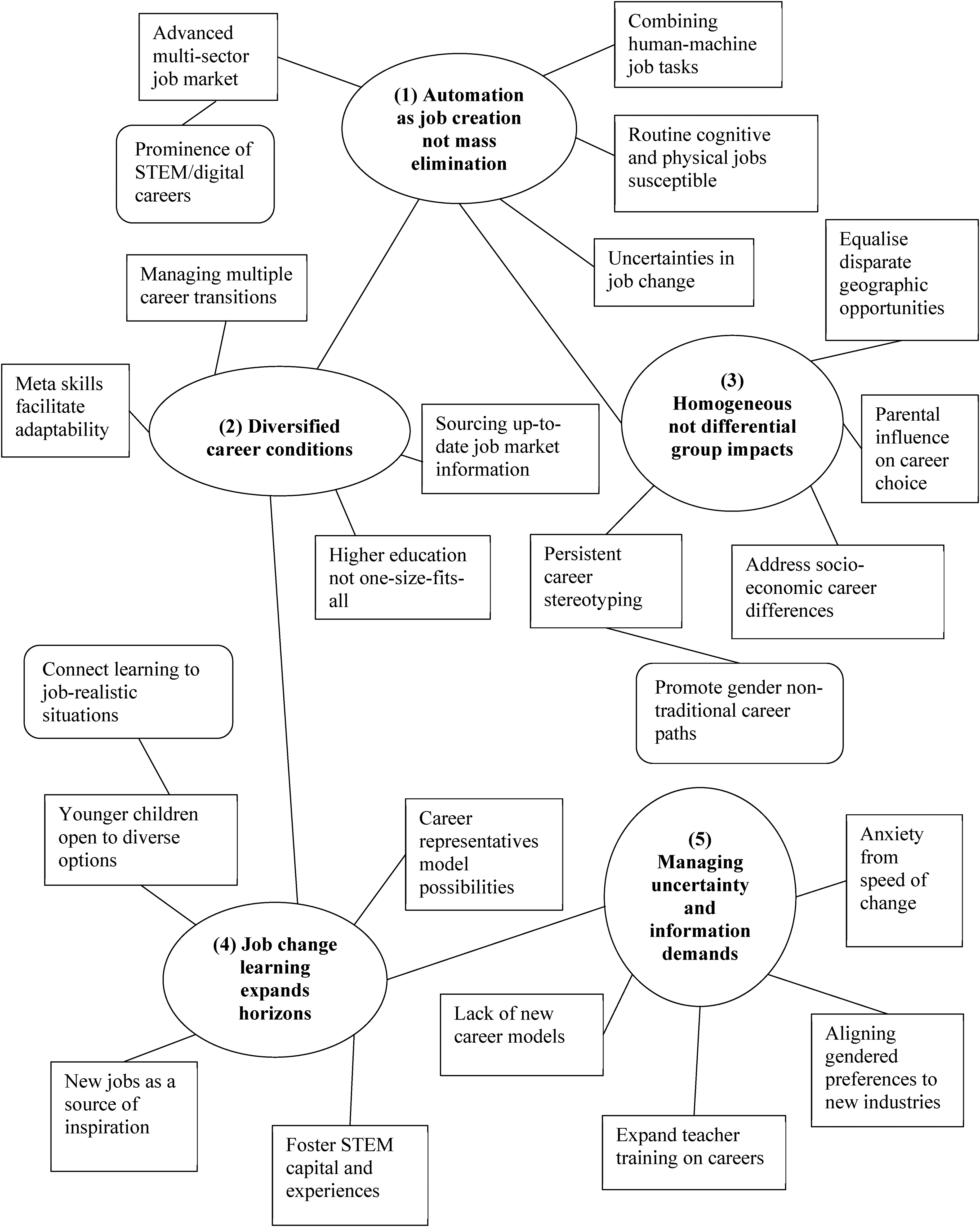
Thematic map of case study findings.
Theme 1: Automation as Job Creation not Mass Elimination
Across the documentation and interviews with career policymakers and practitioners, automation was widely understood as encompassing the creation of new occupations rather than the mass elimination of human-occupied jobs. Career Adviser 1 from Skills Development Scotland explained that: ‘I think probably 10–20 years down the line we will be in the same position where there will be new roles that we had never thought about’. While the prospect of substantial net job losses was viewed as unlikely by the career stakeholders, there was frequent acknowledgement that technology has the potential to both replace some present-day occupations and create new jobs. As explained by the DYW Government Official 1: As a society we like things quick and we like things fast pace, and a lot of the times all the quickest ways to do that is through machinery rather than being by hand. But I think we've got lots of new and emerging opportunities for people to work in supporting that.
However, despite the largely optimistic framing of automation, uncertainty in predicting future job change was reiterated in published career documents, as well as by the career policymakers and practitioners. In documentation produced by Skills Development Scotland on preparing people for Industry 4.0, it is explained that ‘although we can anticipate a number of key trends and their impact on the way we work and live, the only thing we can be certain about for the future is uncertainty itself’ (Skills Development Scotland, 2018, p. 6). Policymakers and practitioners nonetheless made reference to certain sectors and types of occupations as more likely to be increasingly prominent in the future. The Programme Manager from Skills Development Scotland outlined some of these more prominent sectors: ‘digital and IT, advanced manufacturing, finance, early years and childcare, health and social care, life and chemical sciences, construction, and engineering’. Frequent reference was made to the future growth of digital fields, with the DYW Government Official 1 suggesting: ‘I suppose a lot of it's probably just around the kind of wider digital fields… that's probably an industry that's quite booming’.
In general, the automation of routine manual labour and cognitive roles was conceived of as more likely than non-routine occupations. Yet, some documents and stakeholders added further nuance by also specifying that non-routine tasks in certain occupations could also be susceptible to automation. As secondary school teacher 1 commented: ‘I think that there's probably different kind of levels and complexities to the different types of automation; because I mean even hard parts of like lawyers’ jobs and things like that, you know, could potentially be automated as well as kind of mechanical processes’. These supplementary conceptions articulated by stakeholders, while not inconsistent, connote more nuanced and cautious messages of job change uncertainty and complexity when juxtaposed with a positive framing of the job creation consequences of automation. The challenge of interpreting these contrasting messages could raise difficulties for children's career preparedness. When considered through the framework of SCCT, children's self-efficacy beliefs and outcome expectations may be inhibited by this potentially complex and mixed messaging about the future of work. Without gaining a clear sense of what future career opportunities are available and the requirements underlying a specific occupation, there is a risk some children may fail to develop sufficiently positive beliefs and expectations to invest in their career preparedness (Lent, 2018).
Theme 2: Diversified Career Conditions
Reflecting on future changes in the world of work, career policymakers and practitioners expressed ideas which indicated a diversification of the conditions underlying careers. While the emergence of new jobs and industries would offer new opportunities for young people, the possibility of a young person remaining in a single occupation was perceived as increasingly less likely. Secondary school teacher 2 explained that: Now people tend to talk a lot more about sort of portfolio careers. So, various jobs that you know you might dip into and then move on to something else. I think a huge amount of that has obviously got to do with technology.
To prepare children for new job opportunities and non-linear career trajectories, many of the interviewees and career documents placed importance on supporting children's learning of widely applicable work skills or so-called meta-skills (e.g., self-management, social intelligence, and innovation). The Skills Development Scotland Programme Manager explained: ‘we are very focused on making sure that we talk about meta skills so that young people understand that those skills are the skills that all employers are going to be looking for’.
Despite stressing meta skills and career management skills as essential capacities for young people to adapt to job change, career stakeholders nevertheless implicitly maintained the assumption that good-fitting person-occupation matches could also be facilitated through the provision of job-specific information. As explained by the Program Manager at Skills Development Scotland: ‘we use labour market information to kind of back all this up… [we] give the young people information around that’. Thus, in addressing job change, general career skills were treated as a necessary but not a sufficient condition. A person-occupation matching approach, particularly for emerging sectors such as STEM, supplemented stakeholders’ repertoire of strategies to prepare children for the changing world of work.
Theme 3: Homogeneous not Differential Impact Across Groups
When presented with a question about whether automation and job change may contribute to differential impacts across groups, interviewees broadly took the view that all children will be impacted by automation irrespective of their group membership. Secondary school teacher 2 explained: ‘I think the challenge would be similar… equally the amount of support to deal with the changes’. Stakeholders’ views about the undifferentiated impact of automation across groups may, however, produce a possible inconsistency when combined with their understanding that automation could impact certain types of work more than others (e.g., low-skill and manual labour jobs) and that children from different gender or income groups tend to develop differing career aspirations. The STEM Engagement Adviser shared an observation to illustrate the emergence of gender-related differences in aspirations: between the nursery and primary one transition (around 5 years old) something happens that all of a sudden boys [who previously] can be mermaids and girls can be digger drivers in nursery… then they go to primary one and girls can't wear blue.
Socio-economic group differences in career aspirations and attainments were also noted by interviewees. The DYW Government Official 1 explained: ‘if you're in a SIMD 20 (Scottish Index of Multiple Deprivations) you get potentially lesser education and potentially you're in a household where potentially people don't work’. Yet, despite recognising social class, parental, and gender-related differences in children's career pursuits, the career documentation and stakeholders did not infer a logical connection between group aspirational differences and the likelihood of disparate career risks across groups due to the automation of specific job types. This oversight may lead stakeholders to neglect vulnerable groups (e.g., low-income males) who may otherwise benefit from career support which is tailored to their emerging needs (e.g., career information and role models outside of traditionally male dominated professions).
Theme 4: Job Change Learning Expands Horizons
A common viewpoint shared by interviewees was that supporting children's learning on automation and job change could serve as a basis for expanding their career horizons. The Education Scotland Official 1 explained how it is ‘far more exciting to make people aware by showing them examples; make them aware of the transient nature of the labour market’. A key point to recognise here is that whilst learning about different jobs has historically been important, occupations and job markets were relatively static. Whereas conveying the idea of accelerating job change by showcasing the novel technological and workplace developments, could stimulate young people's curiosity to reflect on the nature of jobs and explore new job opportunities.
Interviewees were widely of the view that it would be beneficial to start engaging children in career topics from primary school or earlier. A frequent justification for this proposal referenced younger children's greater openness to new career experiences and the possibility to intervene before children increasingly circumscribe their career options. Career Adviser 1 suggested how early scaffolding of career concepts has been beneficial in this regard: ‘the earlier we introduced new concepts and new ideas to young people, the more open they're going to be to different careers as they come up to high school’. Additionally, several practitioners, including primary school teacher 1, reported using career representatives to model emerging career opportunities to children, such as modelling digital opportunities to rural students. While such contextual affordances and supports for historically underserved groups will be important, SCCT also suggests existing environmental barriers (e.g., limited career networks and work experience opportunities in emerging sectors) need to be addressed to enable rural/disadvantaged students to achieve their career goals (Lent, 2013).
Theme 5: Managing Uncertainty and Information Demands
In discussing practical issues, the challenge of managing information overload among children was mentioned. The DYW Official 1 expressed the view that: ‘[there is] the challenge of being potentially too much information… if you're overloading kids with information about these various opportunities they've got for the world of work’. Stakeholders also discussed emotional challenges some children experience in learning about the changing world of work. These included anxiety about the unpredictability of future job change and job displacement resulting from increasing automation.
A further challenge expressed by the interviewees referred to children's possible difficulties comprehending the speed of technological and workplace change. The Programme Manager indicated that: ‘It's quite difficult for them to understand just the rate of change… That's why we talk about the transferable skills’. Though this emphasis on widely applicable skills may serve as a partially useful shorthand to help children with the challenge of comprehending accelerating job change, problematically, stakeholders did not suggest that this approach would be extended to engage children in thinking about the reasons and principles underlying automation and job change (e.g., understanding the technological reasons behind why specific task or skillset changes are more or less likely in different industries).
Discussion
In addressing the two research questions, findings from this study revealed a range of conceptual and practical complexities Scottish career education stakeholders face in supporting children's preparedness for automation and job change. The following section discusses the study findings in relation to the career learning mechanisms and environmental supports and barriers specified in SCCT and contemporary literature on job automation.
Conceptualising Automation and Job Change
Findings from the thematic analysis indicated that automation was primarily conceived of as creating new job opportunities rather than resulting in the mass displacement of jobs. This framing may have certain advantages given that recent research suggests many young people are not confident they can secure job opportunities in the future due to automation trends (WorldSkills & OECD, 2019). SCCT suggests that individuals’ perception of environmental barriers, such as job market barriers, can influence their career-related beliefs, goals, and preparedness (Lent, 2013). Presenting children with a more optimistic outlook for future job opportunities, both in policy and practice, may therefore help to minimise perceived career barriers and raise career-related beliefs and expectations among children (Lent, 2018).
Policymakers and practitioners’ conceptions of automation were nonetheless multifaceted. Stakeholders also referenced the uncertainty of future automation and the possible consequence of technology displacing certain types of occupations, such as routine manual and cognitive roles. They also explained how some non-routine tasks within occupations could be subject to automation, while other tasks will continue to be carried out by humans. Holding a more nuanced conception of the changing world of work may enable policymakers and practitioners to aid children's and adolescents’ preparedness for the unique changes in occupations and job markets, and help to develop relevant career supports (e.g., building career networks and resources) (Lent, 2018). As recent scholarship highlights, with complex changes in work, ecological, and social environments, career educators can take on the additional responsibility of broadening students’ field of view to adapt to evolving conditions, illuminating how career and life choices can contribute to sustainable development (Guichard, 2022; Hartung & Di Fabio, 2024).
Yet, adopting a relatively complex and cautious account of automation alongside a positive emphasis on the job creation consequences of new technologies, may mean that some children could become confused or misinterpret the meaning of the contrasting messages. This is because the contrasting messages may create doubt in the young person's mind about whether this occupation is likely be readily attainable in the future, or whether, due to its routine tasks, it is likely be at high risk of automation (Frey & Osborne, 2017). As discussed further on, some of these concerns regarding conceptual complexity or misunderstandings might be overcome through content scaffoldings approaches.
Compared to other sectors, digital occupations and skills were understood by stakeholders as increasingly important for the reason that the continued development and implementation of new technologies will require new roles to manage, service, and/or to work in tandem with machines. The conception of a closer entanglement between technology and workers could be used to stimulate children's thinking about their relationship to technology. By encouraging children to explore how technology, work, and people are not entirely separate entities, but are intimately linked and are in certain ways co-evolving to achieve wider goals, children may develop new modes of thinking about their career and life preparedness. However, it may also be important for stakeholders to not promote an overly generalised view about the creation of new digital jobs and skills. As some emerging technologies could potentially reduce demand for certain digital jobs and skills as well (e.g., coding) (World Economic Forum, 2020), career education provisions and stakeholders can help to foster a more sophisticated understanding of digital job opportunities and skill requirements.
Reconciling Person-Occupation Matching with General Career Skills Promotion
Rather than explicitly focusing on processes or approaches to match young persons (their skills, goals/choices) to specific occupations, stakeholders and documents placed emphasis on the importance of promoting meta-skills and career management skills to help children adapt to shifting career conditions and meet new skill demands. However, stakeholders’ emphasis on promoting meta skills was in possible tension with separate efforts to encourage children towards specific occupations and emerging sectors. In cases such as supporting young people toward jobs or sectors predicted to grow in future, such as STEM occupations (World Economic Forum, 2020), it is possible that a sustained person-occupation match is more feasible to achieve. However, in other instances, such as a young person who is more inclined to pursue routine manual labour or cognitive roles highly susceptible to automation, the usefulness of employing a person-occupation matching approach could become more limited (Sowa et al., 2023). Conceivably, it is important to make use of both approaches. Further research and building practitioners’ professional judgment will be important to identify and respond to cases where person-occupation matches remain viable.
Career stakeholders’ emphasis on meta skills and career management skills may also omit something important. While these general capacities may allow children to adapt to career change and meet generic skill demands, they do not in themselves enable young people to understand the nature of job change or the principles and reasons underlying future job automation. Conversely, a meta understanding of job change may provide young people with the reasoning tools and heuristics to deduce likely changes within occupations and job markets. By developing an understanding of how technology could affect certain occupational tasks and not others (e.g., tasks which are not well-defined problems or require extensive social intelligence), or how socio-economic factors could mediate the adoption of new technologies in workplaces, young people could be better prepared to anticipate future job changes and make more informed career planning decisions (Sowa et al., 2023).
Understanding the Implications of Automation for Different Groups
Findings from the case study showed there was a broad recognition among stakeholders that there exist average group differences in the career aspirations and attainments of young people. However, Scottish career policymakers and practitioners suggested automation will impact children universally and would not contribute to differential impacts across groups – despite also acknowledging that automation will affect certain types of jobs more than others. These two sets of viewpoints may produce inconsistencies in stakeholders’ conception of job automation. Evidence from recent studies indicates that different groups of children may encounter differing automation-related career risks (Sowa et al., 2022). These risk differences may span the group categories of gender (e.g., more male dominated occupations being at high risk), social class, region, and parental occupation. SCCT highlights the significant role gender and social background can play alongside job automation in shaping children's career aspirations and preparedness (Lent, 2013). Enhancing policymakers’ and practitioners’ awareness of the different group impacts of automation could thereby help to address new career education challenges emerging from accelerating job change.
Various stakeholders also highlighted the role parents can play in shaping children's career choices and the importance of involving parents in supporting children's career preparedness. Yet, the automation-related ramifications of parental influence on children's career preparedness were not recognised. Findings revealed by Sowa et al. (2022) suggest school students with parents holding a job at high risk of automation may be more likely than their peers to also hold a high-risk career aspiration. This finding may raise a dilemma for policymakers and practitioners. Partnering with parents to support children's career development could, in some cases, unintentionally result in more children with parents holding high-risk occupations pursuing similarly high-risk careers (or skillsets) as their parent(s). Though partnerships between career educators and parents should not be terminated, it is important for all parties to be aware of these potential automation-related risks and for parent-school collaborations to be responsive to them. Stakeholders could also encourage a diversification of career role models (e.g., invited industry experts or social media influencers) to help children consider a broader range of career options and more easily transition into fields which are not well represented in the home environment.
Practical Opportunities
In addressing the second research question it was shown that Scottish career education stakeholders perceive various practical opportunities in supporting children's preparedness for automation. Stakeholders explained that exploring the novel topics of automation and job change could serve to spark children's curiosity and inspiration to build their career preparedness. SCCT reiterates the importance of motivational factors in facilitating children's learning, career beliefs, and preparedness (Lent, 2013). In past generations occupations and job markets were comparatively stable (Autor, 2015). Now, as technological and occupational change accelerates, career practitioners and teachers could take advantage of the novelty and uncertainty created by ongoing change to inspire children to explore emerging careers options and requirements. This may include using virtual reality technologies to simulate future workplaces and occupational tasks. By immersing children in virtual work environments or situating them in career scenarios, career educators can raise students’ awareness of the transient nature of occupations and the career competencies needed to thrive in the future.
Stakeholders reported benefits in starting career education provisions in the early years of schooling or nursery to take advantage of young children's greater proclivity to explore new career opportunities, including those which may be gender counter stereotypical. Because children's preferred career options may be increasingly subject to change due to the impacts of automation, widening their pool of plausible alternatives can help them to transition to new career or educational paths more easily should they encounter insurmountable barriers (Lent, 2018). Findings showed stakeholders were nonetheless aware of possible challenges with early career education. Several stakeholders specified the importance of scaffolding career concepts to incrementally introduce children to more complex career ideas. These ideas were not, however, explicitly linked to the principles underlying automation and job change. Introducing concepts such as the automation of routine and some non-routine occupations, for instance, may only be suitable once children have acquired an understanding of the idea that occupations are comprised of different tasks. As children progress, they may investigate how technologies in various toys can perform different work-related tasks. The school curriculum can be strategically used to highlight connections between subject matter and emerging career opportunities or requirements (Sowa et al., 2023).
Practical Challenges
Teachers and career practitioners in this case study explained that finding future-relevant career role models in more remote or deprived communities can often be difficult. As technology and globalisation advances, new occupations are often located in urban areas. To minimise discrepancies between children in rural and urban areas, teachers and career practitioners working in more remote communities may make use of digital technologies (e.g., videoconferencing, virtual/augmented reality) to increase children's exposure to different workplaces and role models.
An emotional challenge highlighted by interviewees was the possibility of inducing anxiety among some children. This was purported to derive from learning about job losses due to automation and the uncertainty surrounding future occupations and job markets. Similar reports of anxiety concerning future job change have also been found in recent surveys involving adolescents across various countries (WorldSkills & OECD, 2019). Career anxiety and uncertainty can affect children's career goal setting and their development of positive self-efficacy beliefs and outcome expectations (Lent, 2013). Contributing to our understanding of SCCT, these study findings show job automation learning may have a dual function as both a source of inspiration and perceived barrier in the development of children's career preparedness.
Productive approaches to overcoming emotional problems may include communicating stories of young people's successful attempts to navigate career change, providing encouragement to explore new career opportunities, and building career supports/industry contacts to reduce career-related anxiety. Future career interventions should aim to trial and review the effects of different psychological and social support strategies for managing automation-related anxiety. Furthermore, to advance the field of career development, our findings show it is valuable to integrate a meta-understanding of job change as a new construct within contemporary career theories (e.g., SCCT and career construction), thereby extending competency-based notions of career adaptability and preparedness to include reasoning strategies specific to discerning automation-related changes to occupations and job markets.
Study Limitations
There are several limitations of this case study to note. First, as this study was conducted during a period of significant media coverage dedicated to new digital technologies (e.g., ChatGPT) and job automation, it is possible that the attitudes and conceptions expressed by stakeholders may evolve with time or might vary markedly in countries less saturated by mass media. Secondly, as convenience and purposive sampling techniques were used to select participants for the interviews and focus group, it is possible that selection biases may have contributed to a sample that was skewed towards participants with more background knowledge or interest in the topics of automation and job change. The number of participants involved in the study was also relatively small compared to the total population of Scottish schoolteachers and career practitioners. The sample size and sampling technique may therefore limit the generalisability of the study findings. Despite this, the diverse geographic locations and demographic characteristics of the participants may still have afforded a broad set of stakeholder perspectives. The transferability of the study findings is most appropriate to higher-income countries (with growing technology sectors) and where career education is delivered within and beyond formal education settings.
Conclusion and Implications
This case study explored the conceptual and practical complexities stakeholders can encounter in supporting young people's career preparedness for automation and job change. Findings showed Scottish policymakers and practitioners conceptualised automation as creating new job opportunities rather than resulting in the mass elimination of jobs. Concurrently, more cautious conceptions were raised about the uncertainty of job automation and possibility for routine occupations and some non-routine tasks to be replaced by machines. Yet, despite acknowledging persisting average group differences in children's career pursuits, policymakers and practitioners did not conclude that automation may contribute to differential career risks across groups. In advancing career education policy, it is important for policymakers to provide clear and comprehensible information on the nuanced impacts of automation on occupations and the associated career implications for different groups. Policy and curricular documents can also be further developed to aid stakeholders in addressing some children's pessimistic perceptions of automation and their future career prospects.
To also facilitate a comprehension of the more nuanced aspects of automation, teachers and career practitioners can support children's meta understanding of job change to raise their awareness of the reasons and principles underlying job change. Through this understanding young people could be more capable of discerning the likely consequences of automation within different occupations and job markets. Engaging children in learning about job change was highlighted as a source of inspiration for children's career preparedness due to the novelty and intrigue generated by new technologies reshaping the world of work. Practitioners and teachers may build on this idea by stimulating children's career learning through critically exploring new technological innovations in different industries (Lent, 2018), as well as providing diversified career role models and realistic learning experiences corresponding to emerging occupations.
Footnotes

Ethical Considerations
Ethical approval for this research was given by Moray House School of Education Ethics Committee, University of Edinburgh (reference number: 2862).
Consent to Participate
Written informed consent was obtained from all participants in this study.
Author Contributions
Stephen, Julie, and Andrew contributed to the study conception and design. Material preparation, data collection and analysis were performed by Stephen. The first draft of the manuscript was written by Stephen, while Andrew and Julie commented on previous versions of the manuscript. All authors read and approved the final manuscript.
Funding
The authors received no financial support for the research, authorship, and/or publication of this article.
Declaration of Conflicting Interests
The authors declared no potential conflicts of interest with respect to the research, authorship, and/or publication of this article.