






Abstract
Self-initiated expatriates (SIEs) represent an increasingly important group in global talent mobility and contribute to organizational knowledge creation in culturally diverse work environments. This study examines how cultural intelligence (CQ) and learning goal orientation relate to innovative work behavior among SIEs and investigates the mediating role of protean career orientation. Drawing on conservation of resources (COR) theory and protean career theory, we conceptualize CQ as a capability-based resource and learning goal orientation as a motivational resource that drives individuals’ resource investment in learning and adaptation. Protean career orientation is positioned as a higher-order resource management mechanism that guides the conversion of personal resources into career-related actions. Data were collected from 312 self-initiated expatriates working in Taiwan, and structural equation modeling (SEM) was used for analysis. The results show that protean career orientation partially mediates the relationships between CQ, learning goal orientation, and innovative work behavior, suggesting that personal resources are more effectively translated into innovative behavior through self-directed career management processes.
Keywords
Introduction
Contemporary career paths have become increasingly non-linear, diverse, and uncertain (Jiang, 2017). In response, individuals have adopted more flexible and boundaryless mindsets, demonstrating a growing willingness to move not only across organizations and industries (Feldman & Ng, 2007) but also across national borders in pursuit of career opportunities, personal development, and valuable resources (Cao et al., 2013; Hudson & Inkson, 2006). As a result, understanding who engages in international mobility and why has become central to explaining the dynamics of the global labor market (Tharenou, 2015). Recent scholarship further suggests that careers should be viewed through a life-design and sustainability perspective, in which individuals actively construct adaptive and meaningful career paths under conditions of uncertainty (Guichard, 2022; Hartung & Di Fabio, 2024). Within this context, international mobility is a key strategy through which individuals enact self-directed, adaptive career development.
Among globally mobile workers, self-initiated expatriates (SIEs) have emerged as a particularly important group. Unlike assigned expatriates, SIEs independently choose to work and live abroad, often driven by career aspirations, personal growth, and the desire to gain international experience (Doherty, 2013; Myers & Pringle, 2005; Tharenou, 2015). These individuals are typically career-oriented professionals who contribute valuable knowledge and skills that may be scarce in host-country labor markets (Ahrens et al., 2018; Bücker et al., 2020). Their international experiences also provide opportunities for significant learning, skill development, and career advancement (Crowley-Henry & Heaslip, 2014).
The career orientation of SIEs is often characterized by a Protean Career Theory, which emphasizes self-directedness and values-driven career management (Briscoe et al., 2012). In contrast to traditional organizational careers—where success is defined by external indicators such as promotion and salary (Abele & Spurk, 2009; Ng & Feldman, 2014)—protean careers reflect individuals’ active role in shaping their own career paths based on personal goals and values. This orientation is particularly relevant in international contexts, where SIEs must proactively navigate uncertainty and diverse cultural environments.
At the same time, organizations increasingly rely on expatriates’ ability to generate innovative ideas and contribute to competitive advantage (Unsworth & Parker, 2003; Yuan & Woodman, 2010). SIEs, in particular, can provide diverse perspectives and creative solutions that help organizations address skill gaps and adapt to complex environments (Rui et al., 2017). However, despite this potential, limited research has examined the factors that enable SIEs to translate their international experiences and career orientations into innovative work behavior. Existing studies have largely focused on outcomes such as career satisfaction, adjustment, and commitment (Cao et al., 2013; De Vos & Soens, 2008), while paying less attention to behavioral outcomes that directly contribute to organizational effectiveness.
Moreover, although protean career orientation has been linked to proactive and self-directed career management, its role in shaping innovative work behavior—particularly in cross-cultural contexts involving SIEs—remains underexplored (Gulyani & Bhatnagar, 2017; Lorenz et al., 2018). This gap is significant because innovative work behavior requires not only individual initiative but also the ability to leverage diverse experiences and perspectives gained from international mobility. In this regard, SIEs who adopt a protean career orientation are more likely to engage in proactive behaviors, such as setting self-concordant goals, taking initiative, and actively seeking opportunities for growth (Grant & Parker, 2011). Such proactivity, characterized by a forward-looking and change-oriented mindset, provides a critical foundation for innovative work behavior. Consequently, SIEs are more likely to generate novel and useful ideas that contribute to organizational outcomes (Parker et al., 2010). Building on this logic, this study examines how SIEs’ career orientations and personal resources jointly shape their innovative work behavior in international work contexts.
This study addresses a critical gap in the literature by integrating research on expatriation and career development with both Protean Career Theory (Hall, 1976) and COR Theory (Hobfoll, 2002). While prior studies have examined expatriate adjustment and career mobility, limited attention has been paid to how SIEs mobilize personal resources and translate them into sustainable career development in international contexts. COR theory provides a foundational motivational perspective, positing that individuals are driven to acquire, maintain, and protect valuable resources. Drawing on this framework, we conceptualize learning goal orientation (LGO) as a motivational resource that encourages SIEs to actively seek challenges, develop new competencies, and persist in uncertain environments (Maurer et al., 2003; VandeWalle, 1997). In parallel, cultural intelligence (CQ) is conceptualized as a capability-based resource that enables SIEs to interpret culturally diverse cues, respond effectively to ambiguity, and adapt their behaviors across different cultural settings. Together, these resources facilitate SIEs’ engagement in continuous learning, problem-solving, and the expansion of social networks, thereby enhancing their adaptability and organizational value.
Although COR theory explains why individuals invest in and accumulate resources, it offers limited insight into how these resources are strategically directed toward career development. To address this limitation, we incorporate protean career theory, which emphasizes individuals’ self-directedness and values-driven approach to career management. From this perspective, LGO and CQ not only influence SIEs’ resource allocation at work but are also enacted through a protean career orientation that guides the conversion of personal resources into adaptive career behaviors. This process is reflected in SIEs’ tendency to form a psychological contract with themselves rather than with organizations, as they proactively design and pursue sustainable career paths within dynamic international work environments.
This study addresses a critical gap in the literature by integrating research on expatriation and career development with both COR (Hobfoll, 2002) and Protean Career Theory (Hall, 1976). While prior studies have examined expatriate adjustment and career mobility, limited attention has been paid to how SIEs mobilize personal resources and translate them into innovative work behavior in international contexts. Drawing on COR theory, we conceptualize LGO as a motivational resource that drives individuals to develop competencies and persist in the face of uncertainty, and CQ as a capability-based resource that enables effective functioning across culturally diverse environments. These resources support SIEs’ continuous learning, problem-solving, and adaptation, thereby enhancing their potential to contribute value in international workplaces.
Although COR theory explains why individuals invest in and accumulate resources, it offers limited insight into how these resources are directed toward career-related behaviors. To address this limitation, we incorporate protean career theory, which emphasizes self-directed and values-driven career management. In this study, protean career orientation is conceptualized as a higher-order resource-management mechanism that guides individuals in allocating and using their personal resources. Specifically, protean career orientation channels CQ and LGO into proactive and future-oriented actions, thereby facilitating innovative work behavior.
Accordingly, this study examines whether and to what extent SIEs’ CQ and LGO are associated with innovative work behavior through the intervening role of protean career orientation. This research makes two main contributions. First, it advances understanding of the antecedents of SIEs’ innovative work behavior by introducing CQ and LGO as key personal resources. Second, it extends cross-cultural career research by positioning protean career orientation as a mechanism that translates personal resources into innovative outcomes. (Figure 1)
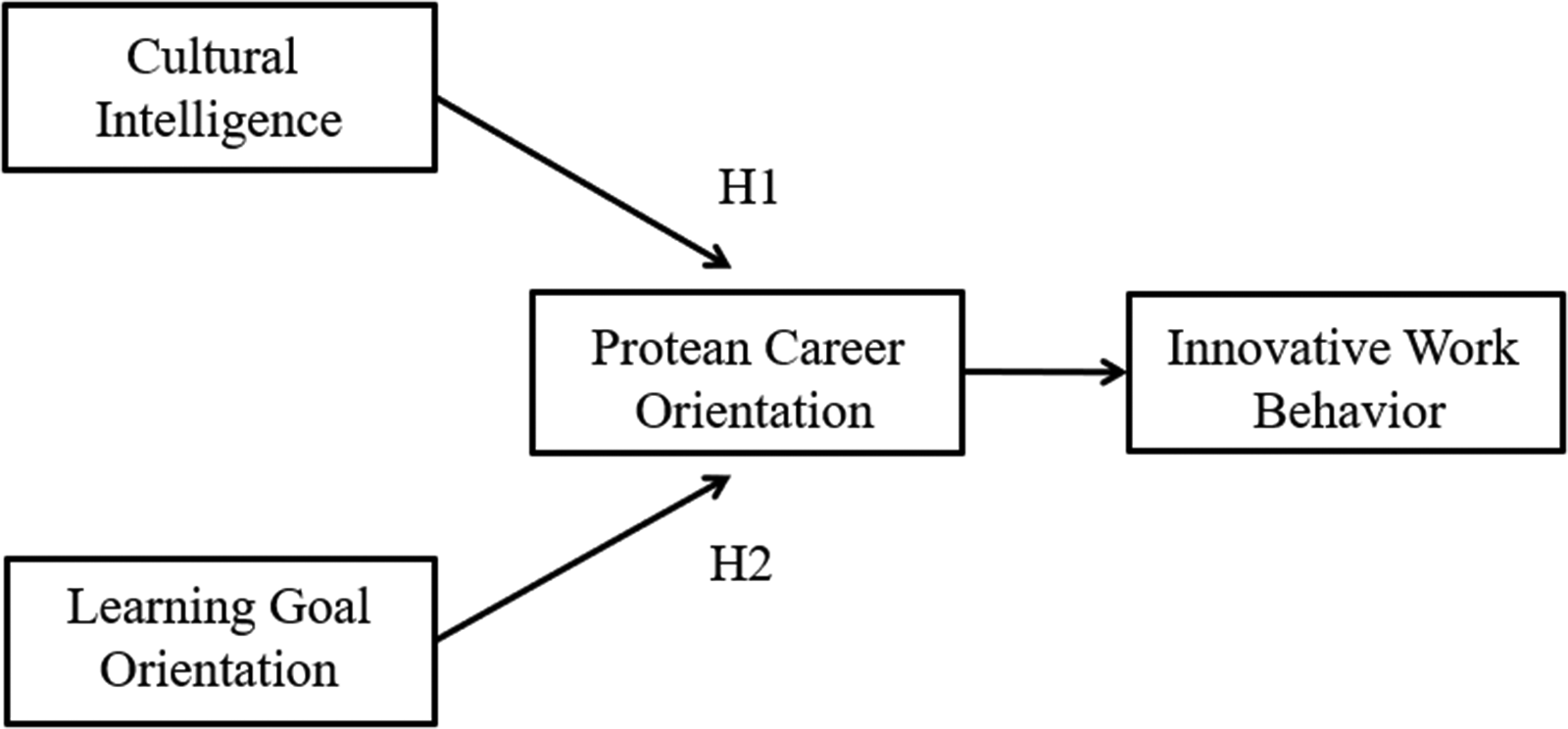
The hypothesized model.
Literature Review and Hypotheses Development
The Mediating Role of Protean Career Orientation in the Relationship Between Cultural Intelligence and Innovative Work Behavior
Numerous empirical studies have demonstrated that CQ plays a noticeable and increasingly critical role in gauging an individual's adaptability to new cultural contexts (Brislin et al., 2006; Earley & Ang, 2003). Much research has not only focused on the creation of CQ buildings based on current intelligence ideas. Additional studies have focused on the theoretical link between CQ capabilities and other indicators to extend Earley and Ang's (2003) theoretical explanation of CQ (Chen et al., 2011). For example, the role of CQ in enhancing employees’ innovative work behavior via different mechanisms such as knowledge sharing, work engagement, interpersonal trust, international opportunity recognition, and cross-cultural adjustment has been explored in recent innovation research (Afsar et al., 2021; Fan et al., 2020; Lorenz et al., 2018; Yunlu et al., 2017).
Protean career orientation may positively affect SIEs’ experiences by helping them see themselves as personal agents who actively manage their career paths, take responsibility for their development, and focus on learning, growth, and adaptability. This idea aligns well with the COR theory, as it involves actively acquiring and managing valuable resources where they invest their efforts. In this view, SIEs are more self-directed and actively express their intrinsic values in pursuing work behaviors across cultural boundaries in the host country (Cao et al., 2013; Doherty et al., 2011).
The literature confirms that individuals with a protean career orientation are more proactive at work (Gulyani & Bhatnagar, 2017). Furthermore, innovative and proactive work behavior resembles proactive disposition and intrinsic motivation, which involve future-oriented, self-initiated actions aimed at changing or improving the situation or oneself (Parker et al., 2010). These behaviors start with generating ideas and resources to enhance or develop work; sometimes, acting on these ideas can enable a person to surpass normal job expectations (Drucker, 1985; Seibert et al., 2001; Van Dyne & LePine, 1998).
In this study, drawing on COR Theory, we conceptualize CQ as a critical cognitive resource that enables SIEs to navigate culturally diverse work environments effectively. Individuals with higher levels of CQ are better able to interpret unfamiliar cultural cues, adapt their behavior across contexts, and build diverse social networks, thereby gaining access to valuable informational and relational resources. These resources not only enhance their ability to cope with uncertainty but also expand opportunities for learning and professional development in international settings (Cao et al., 2013; Janssen et al., 2004). From a COR perspective, individuals are motivated to invest available resources to acquire additional resources and sustain long-term gains. Accordingly, SIEs with higher CQ are more likely to proactively leverage their cross-cultural capabilities to pursue personally meaningful career goals and values. This tendency aligns with Protean Career Theory, which emphasizes self-directed, values-driven career management. In this sense, CQ fosters a stronger protean career orientation, as individuals become more confident and capable of independently shaping their career paths in dynamic international environments.
Furthermore, protean career orientation serves as a key mechanism through which personal resources are translated into work-related behaviors. Individuals with a strong protean career orientation are more likely to take initiative, seek opportunities for improvement, and engage in proactive behaviors that support innovation. As innovative work behavior involves the generation, promotion, and implementation of novel and useful ideas (Janssen, 2005; Yuan & Woodman, 2010), SIEs with higher protean career orientation are more likely to actively contribute to organizational innovation.
Taken together, CQ provides the resource foundation, while a protean career orientation channels these resources into proactive, innovative actions. Therefore, we propose that protean career orientation mediates the relationship between CQ and innovative work behavior.
The Mediating Role of Protean Career Orientation in the Relationship Between Learning Goal Orientation and Innovative Work Behavior
LGO reflects an individual's motivation to develop competence through learning, feedback, and mastery of new skills (Dweck, 1986; Potosky, 2010). Rather than being a static trait, LGO can be conceptualized within the COR framework as a motivational resource that drives individuals to invest effort in acquiring and expanding their knowledge base (Hobfoll et al., 2018). For SIEs, such resource investment is particularly important in culturally unfamiliar environments, where continuous learning and adaptation are required. Importantly, LGO does not straightforwardly translate into innovative work behavior. Instead, individuals high in LGO are more likely to engage in active resource investment processes, such as seeking feedback, acquiring new knowledge, and reframing challenges as learning opportunities, which progressively shape how they manage their career development. Within this process, protean career orientation plays a critical role as a higher-order resource management mechanism. Protean career orientation reflects a self-directed and values-driven approach to career management that guides how individuals allocate and convert their personal resources into career-related actions (Briscoe et al., 2012). From a COR perspective, protean career orientation functions as a resource-conversion mechanism that channels motivational resources, such as LGO, into proactive, future-oriented work behaviors.
Accordingly, SIEs with higher levels of LGO are more likely to engage in self-directed career management through a protean career orientation, which, in turn, facilitates innovative work behavior. These individuals view career development as an ongoing learning process, allowing them to continuously integrate new knowledge, explore alternative approaches, and generate novel solutions in their work context. Therefore, we propose that LGO is indirectly related to innovative work behavior through protean career orientation.
Method
Sample and Data Collection
Participants included SIEs working for multinational companies in Taiwan. The data in this study were collected from SIEs who were either full-time employees of local Taiwanese NGOs or of non-NGOs for at least 3 months. Participants holding various white-collar jobs were defined as knowledgeable professionals who were usually responsible for mental work and held authority in manufacturing, wholesale and retail trade, professional, scientific, and technical services, arts, entertainment, and recreation in Taiwan. To ensure that the potential participants were indeed SIEs, we selected them based on the following criteria: first, they must possess work permits issued by Taiwan's Council of Labor Affairs or other competent authorities; second, they are not enrolled as full-time or part-time university students; third, they are not dispatched to international posts by their home companies. These three criteria were finalized based on the definition of SIEs to ensure they had the freedom of choice and were not sent abroad by their employers. We only targeted skilled, professional SIEs with tertiary or higher education; thus, the sample comprised 312 participants who met the above criteria and were included in the data analysis. Paper-based questionnaires and gift vouchers (NT$100) were sent directly to all participants for their time in completing the survey. The survey participants were volunteers, and their information was kept confidential and used only for this study.
Over half of the participants were male (66.7%, n = 208), with an average age of 34.46 years. About 56.1% of participants were staff-level employees. Among the participants, 41.7% (n = 130) were married, and 53.5% (n = 167) were single; 50.6% (n = 158) were from Asia, 23.1% (n = 72) from North America, and 11.9% (n = 37) from Europe. Additionally, 22.9% (n = 70) worked in education, 19.3% (n = 59) in manufacturing, 6.2% (n = 19) in Internet and new technology, and 6.5% (n = 20) in marketing industries.
Measures
The questionnaire was originally developed in English, as all participants use English as their primary language. Therefore, translation into Chinese was deemed unnecessary to prevent potential misunderstandings or ambiguities in the wording.
Cultural Intelligence
CQ was assessed using a scale developed by Ang et al. (2007). The scale consists of 20 items: six for cognitive CQ, four for meta-cognitive CQ, five for motivational CQ, and five for behavioral CQ. Examples include: “I know the legal and economic systems of other cultures” (cognitive CQ), “I am aware of the cultural knowledge I utilize when interacting with people from different backgrounds” (meta-cognitive), “I enjoy engaging with people from various cultures” (motivational CQ), and “I adjust my nonverbal behavior when a cross-cultural situation calls for it” (behavioral CQ). All items are rated on a seven-point Likert scale from 1 (Strongly Disagree) to 7 (Strongly Agree). The scale's Cronbach's α coefficient was 0.94.
Learning Goal Orientation
LGO was measured using the scale developed by Button et al. (1996). The scale comprises eight items rated on a six-point Likert scale ranging from 1 (Strongly Disagree) to 6 (Strongly Agree). Strong agreement indicates a strong desire to perform challenging work, learn new skills, and develop alternative strategies when working on difficult tasks. A sample item is “I prefer to work on tasks that force me to learn new things.” In this study, Cronbach's α coefficient for the LGO scale was 0.95.
Protean Career Orientation
The Protean Career Attitude Questionnaire was developed by Briscoe and Hall in 2006. The literature indicates that this scale is the most commonly used for measuring protean career attitudes and has high reliability and validity (Waters et al., 2014). The scale features two dimensions with 14 items: self-direction (8 items) and values-driven (6 items). A sample item in the self-directed career management dimension is “When development opportunities have not been offered by my company, I have sought them out on my own.” A sample item in the values-driven career dimension is “I navigate my own career, based on my personal priorities, as opposed to my employer's priorities.” All items are rated on a 7-point Likert scale from 1 (Strongly Disagree) to 7 (Strongly Agree), with higher scores reflecting greater protean career orientation. In this study, Cronbach's α coefficient for this scale was 0.91.
Innovative Work Behavior
The innovative work behavior scale was initially developed by Scott and Bruce (1994) and later modified by Janssen (2000) based on Kanter's (1988) work. The scale includes three items each for idea generation, idea promotion, and idea realization. It consists of nine items rated on a five-point Likert scale from 1 (Never) to 5 (Always). Example items include: “Creating a new idea for difficult issues” (idea generation), “Mobilizing support for innovative ideas” (idea promotion), and “Transforming innovative ideas into useful applications” (idea realization). In this study, Cronbach's α for this scale was 0.88.
Control Variables
Following the literature, age, position level, and job tenure were selected as potential predictors of innovative work behavior. Age is measured in years. Position level is measured by job position (staff = 1, first-line manager = 2, mid-level manager = 3, high-level manager = 4). Job tenure is measured as the number of years worked at the current company. These control variables were incorporated into the final section on personal information of the questionnaire. Therefore, we controlled for age (Bindl et al., 2012; Carmeli & Schaubroeck, 2007; Fritz & Sonnentag, 2009; Janssen, 2005; Jung et al., 2003; Pieterse et al., 2010; Scott & Bruce, 1994), position level (Liao & Uen, 2012), and job tenure (Bindl et al., 2012; Fritz & Sonnentag, 2009).
Discriminant and Convergent Validity of Constructs
Before testing the hypotheses, we assessed construct validity, including both convergent and discriminant validity. Convergent validity was generally supported, as the average variance extracted (AVE) and composite reliability (CR) values for all study variables met recommended thresholds (Fornell & Larcker, 1981; Hair et al., 2019). Specifically, AVE values ranged from 0.69 to 0.95 across constructs, exceeding the recommended cutoff of 0.50, and CR values for all constructs were above 0.70.
To assess discriminant validity, the Fornell–Larcker criterion was applied by comparing each construct's AVE with its squared inter-construct correlations. The results indicated that, for all construct pairs, AVE values exceeded the corresponding squared correlations. For example, the correlation between CQ and protean career orientation was r = .60 (r2 = .36), which is substantially lower than the AVE values for both constructs (AVE_CQ = 0.89–0.92; AVE_Protean career orientation = 0.87–0.92). Despite moderate correlations among some constructs, these findings indicate that each construct explains more variance in its own indicators than in those of other constructs, thereby providing support for discriminant validity.
Confirmatory factor analysis (CFA) was conducted to evaluate the measurement model. We tested four-factor, three-factor, two-factor, and one-factor models to assess model fit, and the results are presented in Table 1. The four-factor model, which includes CQ, LGO, protean career orientation, and innovative work behavior, yielded fit indices of χ2/df = 2.39 and RMSEA = 0.07, indicating acceptable fit. However, the CFI (0.85), TLI (0.84), and IFI (0.85) were slightly below the conventional cutoff of 0.90. Importantly, the four-factor model demonstrated better fit than alternative models with fewer factors (see Table 1).
Summary of Measurement Models used in this Study.
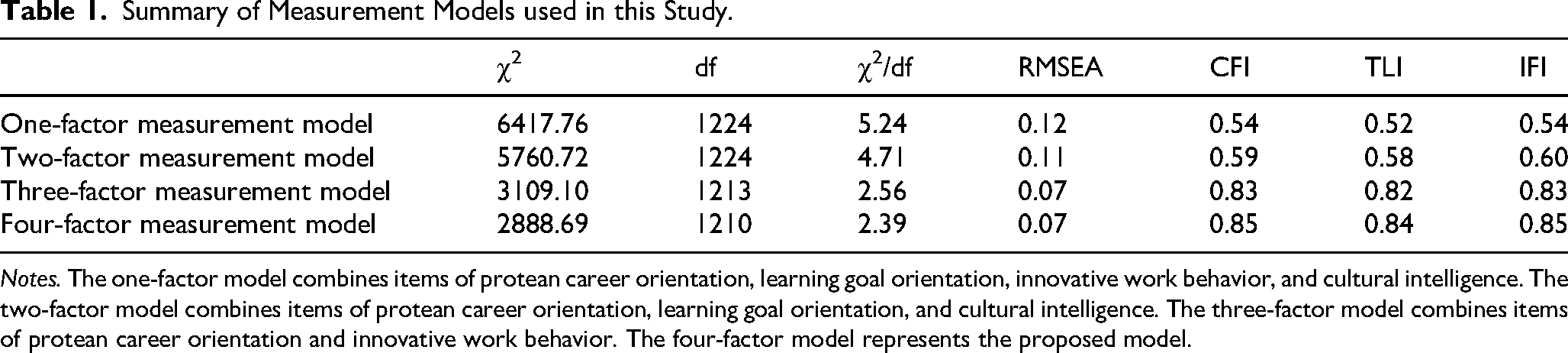
Notes. The one-factor model combines items of protean career orientation, learning goal orientation, innovative work behavior, and cultural intelligence. The two-factor model combines items of protean career orientation, learning goal orientation, and cultural intelligence. The three-factor model combines items of protean career orientation and innovative work behavior. The four-factor model represents the proposed model.
Results
The correlation analysis investigated the relationships among CQ, LGO, protean career orientation, and innovative work behavior. Control variables included age, position level, and job tenure. Table 2 shows the means, standard deviations, reliabilities, and correlations for all research variables. The reliability coefficients were notably high, with most exceeding 0.80. CQ was significantly positively associated with LGO (r = .58, p < .001), protean career orientation (r = .60, p < .001), and innovative work behavior (r = .44, p < .001). Additionally, LGO showed significant positive relationships with protean career orientation (r = 0.61, p < 0.001) and innovative work behavior (r = 0.45, p < 0.001). As anticipated, the main variables were positively correlated.
Variables’ Means, Standard Deviations, Correlations, and Reliability.
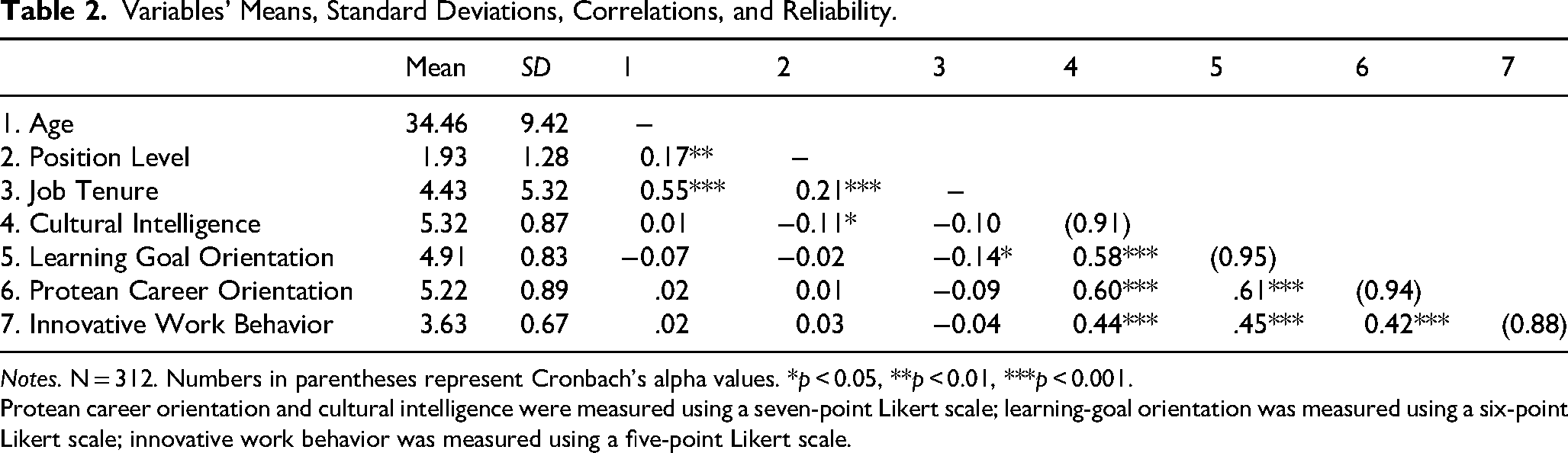
Notes. N = 312. Numbers in parentheses represent Cronbach's alpha values. *p < 0.05, **p < 0.01, ***p < 0.001.
Protean career orientation and cultural intelligence were measured using a seven-point Likert scale; learning-goal orientation was measured using a six-point Likert scale; innovative work behavior was measured using a five-point Likert scale.
Hypotheses Testing
Regarding hypothesis testing, this study employed structural equation modeling (SEM) using AMOS 28.0 to examine the proposed relationships among the study variables. To assess the mediating effects, we conducted a bootstrapping analysis with 2,000 resamples and estimated bias-corrected confidence intervals for indirect effects. Mediation was supported when the confidence intervals did not include zero (MacKinnon et al., 2004).
The results for Hypothesis 1 showed that the overall effect of CQ and innovative work behavior, mediated by protean career orientation, was significant (β = 0.51, p < 0.01, 95% CI [0.363, 0.642]). Its indirect effect among these variables was also significant (β = 0.21, p < 0.05, 95% CI [0.036, 0.467]), confirming an indirect relationship. The findings indicated that the direct effect of CQ on innovative work behavior remained significant after accounting for protean career orientation (β = 0.30, p < 0.05, 95% CI [0.004, 0.553]), as shown in Table 3, implying partial mediation. In other words, protean career orientation partially mediates the link between CQ and innovative work behavior. Therefore, Hypothesis 1 receives partial support. The SEM analysis for Hypothesis 2 showed that the total effect of LGO and innovative work behavior through protean career orientation was significant (β = 0.50, p < 0.01, 95% CI [0.363, 0.613]), as well as its indirect effect (β = 0.16, p < 0.01, 95% CI [0.049, 0.325]). The direct impact of LGO on innovative work behavior remained significant when controlling for protean career orientation (β = 0.34, p < 0.01, 95% CI [0.153, 0.500]), as shown in Table 3, indicating partial mediation. Thus, protean career orientation partially mediates the relationship between LGO and innovative work behavior. As a result, Hypothesis 2 is partly supported.
Mediating Effects of Protean Career Orientation on Cultural Intelligence and Learning Goal Orientation Toward Innovative Work Behavior.
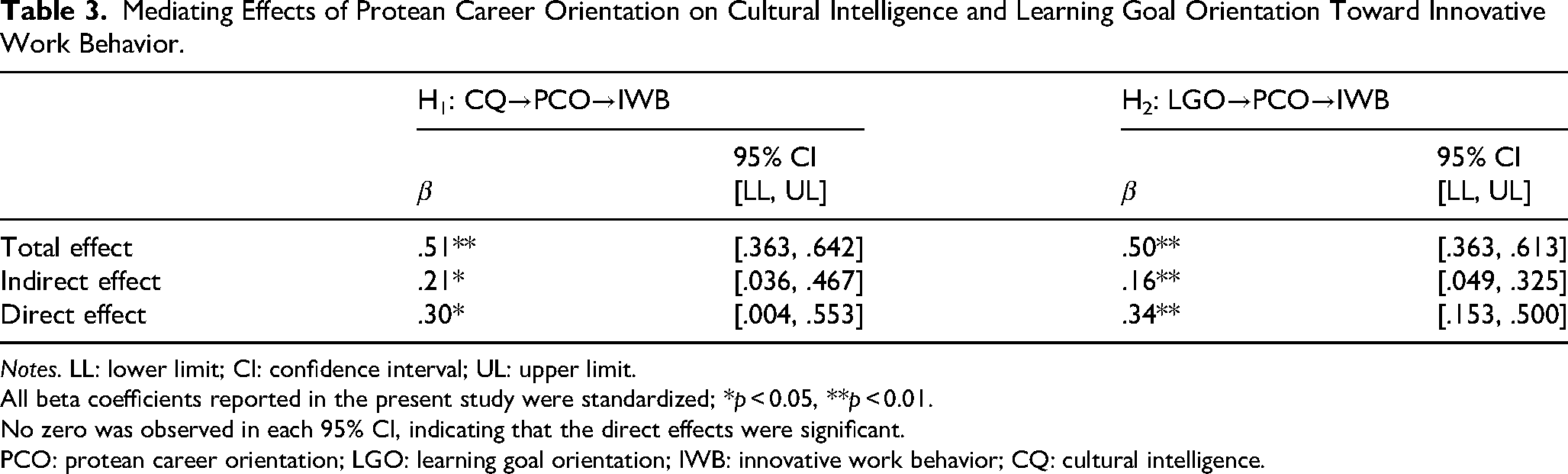
Notes. LL: lower limit; CI: confidence interval; UL: upper limit.
All beta coefficients reported in the present study were standardized; *p < 0.05, **p < 0.01.
No zero was observed in each 95% CI, indicating that the direct effects were significant.
PCO: protean career orientation; LGO: learning goal orientation; IWB: innovative work behavior; CQ: cultural intelligence.
Discussion
After analyzing data from 312 SIEs working in Taiwan, we discovered that protean career orientation serves as a mediating factor, facilitating the links between CQ and innovative work behavior, and between LGO and innovative work behavior.
The first hypothesis partially supported the significant mediating role of protean career orientation in the link between CQ and innovative work behavior. Scholars have examined the causation between CQ and innovative work behavior (Afsar et al., 2021; Fan et al., 2020; Lorenz et al., 2018). Our study distinguishes itself by clarifying the relationship between CQ and innovative work behavior in the context of SIEs and offering new insights into how protean career orientation mediates this connection. Our findings highlight the importance of protean career orientation for increasing innovative behavior among SIEs and its role as a key mechanism linking CQ with innovative work behavior in an international environment. In other words, when individuals with high CQ deliberately adapt to a multicultural setting, they learn to engage with others and manage work-related challenges. Consequently, they are more likely to become deeply involved and enthusiastic about their roles, and to develop strong relationships with peers, supervisors, and experts (Chen et al., 2023). SIEs can articulate their identities and plan their career development, motivating them to share knowledge, foster mutual understanding, and integrate ideas from colleagues to generate unique, valuable innovations.
Finally, the second hypothesis supports the first, showing that SIEs with high LGO engage in positive innovative work behavior through their strong protean career orientation. Considering the widespread cultural diversity within organizations, LGO appears to be a valuable resource across various management contexts. SIEs are highly focused on their goals and principles, always working to improve their skills through a learning orientation toward specific objectives (Dweck & Leggett, 1988; Lin, 2015). This high LGO reflects SIEs’ expatriation experience in a proactive, self-directed, and value-driven manner. These profound achievements enable the exploration of innovative work practices, diverse thinking, and new ideas.
Theoretical Contribution
The current study makes four contributions to the literature on SIEs and careers. First, it supports cross-cultural research on protean career orientation from the perspective of SIEs and, from the COR viewpoint, expands expatriate research by showing that protean career orientation increases psychological resources, linking CQ and LGO to innovative work behavior in the context of SIEs. Second, this study adopts a different approach from prior studies on protean careers, viewing SIEs’ innovative work behavior as outcomes of expatriation experiences aimed at generating and implementing ideas for new processes and products within a culturally diverse work environment. This differs from earlier empirical research that tests protean career attitudes or orientation as predictors of traditional positive outcomes, such as career success (Aydogmus, 2019; Lo Presti et al., 2018; Rodrigues et al., 2019).
Finally, this study introduces LGO and CQ as novel factors influencing SIEs’ innovative work behavior. LGOs are learning-related resources that motivate SIEs to stay focused on their goals and principles. They continuously seek to improve their skills by experimenting with new work practices and developing innovative solutions. CQ enables SIEs to interact effectively with local staff or teams and to understand how others think and behave across multiple cultures (Gregory et al., 2009), which is essential for building strong interpersonal relationships. Innovative work behavior relies on social support to transform knowledge into innovative ideas (Elenkov & Manev, 2009; Khan et al., 2016). The success of innovative ideas depends on strong social backing from other organizational members. CQ, which emphasizes interpersonal interactions, assists SIEs in gathering social support. Finally, this study enriches the SIEs literature by demonstrating how SIEs view themselves as protean talents, actively driving their career development and expatriation experiences in a proactive, self-directed manner, guided by personal values and subjective success criteria (Cao et al., 2013; DiRenzo & Greenhaus, 2011; Doherty, 2013; Doherty et al., 2011; Hall, 1996; Inkson et al., 1997). SIEs tend to be more proactive in seeking alternative career opportunities and are more willing to shift employment types and cross various boundaries in their career paths.
Implications for Practice
SIEs hold particular value for organizations seeking innovative human resources from multicultural backgrounds (Khan et al., 2016; Lorenz et al., 2018). Most organizations want their employees to demonstrate more innovation to stay competitive globally. SIEs are generally regarded as open-minded individuals who have absorbed other cultures, encouraging organizations to hire them for innovative teams (Dabic et al., 2015). The conceptual model developed in this study has significant implications for organizations aiming to benefit from SIEs’ innovation.
First, the results show that CQ and LGO are positively associated with innovative work behaviors. SIEs with higher CQ may be more likely to develop, motivate, and involve others in acquiring new skills and generating creative ideas in the workplace. To create an environment that enhances SIEs’ CQ, organizations and managers may consider forming work teams that include both SIEs and host-country nationals. This can help develop SIEs’ social networks, increase their integration within organizations, and improve their cross-cultural fit through local activities like sports events and community projects that promote informal interactions among SIEs and coworkers (Jannesari & Sullivan, 2021).
Second, supporting SIEs’ innovative work behavior primarily involves CQ training integrated into the human resource (HR) strategy (Azevedo & Shane, 2019). Training policies should equip learners with the necessary knowledge and skills, including intercultural communication and cross-cultural competencies (Livermore, 2011, 2016). These capacity-building efforts should consider cultural differences that influence CQ levels, helping SIEs establish better relationships with colleagues and manage positive conflicts effectively (Janssen et al., 2004). Creating an innovative environment helps boost employees’ attitudes toward innovation—for example, by encouraging open communication, voice, and sharing within workgroups, and fostering involvement in decision-making and group discussions (Shore et al., 2018). Importantly, while CQ can be developed through training and organizational practices, constructs such as learning goal orientation and protean career orientation are relatively stable individual differences. Therefore, organizations may benefit more from selection and person–environment fit strategies when leveraging these orientations.
Finally, our findings indicate that SIEs’ professional career development should be prioritized. Opportunities to build career capital should be provided during expatriation. To further promote SIEs’ innovative work behavior, HR strategies such as mentorship and self-improvement through learning are recommended. HR managers may facilitate alignment between employees’ career goals and organizational objectives. Additionally, organizations and host countries may better recruit and retain capable individuals over the long term if SIEs can achieve their professional goals aligned with their intrinsic values and preferences.
Limitations and Future Research
This study has several limitations that should be considered when interpreting the findings. First, all data were collected from a single source using self-reported measures, which may introduce common method bias. To mitigate this concern, procedural remedies were applied, including ensuring participant anonymity and confidentiality, and varying Likert-scale formats as recommended by Podsakoff et al. (2003). In addition, statistical tests were conducted. Harman's single-factor test indicated that a single factor did not account for the majority of the variance (35.54%), and CFA demonstrated that the hypothesized four-factor model provided a better fit than a one-factor model. AVEs and CRs also supported convergent and discriminant validity. Nevertheless, future research is encouraged to incorporate multisource data (e.g., from supervisors or colleagues) to further reduce potential bias.
Second, the cross-sectional design limits the ability to draw causal inferences. The relationships identified in this study should therefore be interpreted as associative rather than causal. Longitudinal research is needed to better capture the dynamic nature of SIEs’ career development over time and to examine potential causal mechanisms.
Third, limitations related to cross-cultural validity and generalizability should be acknowledged. Formal tests of measurement invariance and cross-cultural equivalence were not conducted. Although prior research, such as Lin's (2026) study on SIEs, has applied similar constructs in expatriate and non-Western contexts, the extent to which these measures fully generalize to SIEs in Taiwan remains uncertain. Future research is encouraged to adopt more rigorous cross-cultural validation techniques, such as multi-group CFA, to establish measurement equivalence. In addition, data were collected in a single national context characterized by a highly educated, technologically advanced environment, which may limit external validity. Future studies should examine whether these findings generalize across different national settings, particularly among SIEs working in larger Western economies, such as the United States, as well as other Eastern contexts.
Fourth, cultural and contextual factors were not directly examined. Prior research (e.g., Schwartz & Bardi, 2001) suggests that cultural values, such as collectivism versus individualism, may influence career attitudes and behaviors. Future research could examine whether SIEs from culturally diverse backgrounds experience different outcomes and whether cultural distance moderates these differences. Finally, this study did not account for several potentially important individual and contextual variables, including family ties, social networks, labor market conditions in the home country, and prior experience in the host country. These factors may influence SIEs’ career success and should be incorporated into future models to provide a more comprehensive understanding.
Footnotes
Acknowledgments
The author wishes to thank the anonymous reviewers for their helpful comments on earlier drafts of this manuscript. Special thanks for the financial support provided by the Ministry of Science and Technology of Taiwan [grant number: MOST 108-2410-H-003-076 -SSS-].

Funding
The author disclosed receipt of the following financial support for the research, authorship, and/or publication of this article: This work was supported by the National Science and Technology Council, (grant number MOST 108-2410-H-003-076 -SSS-).
Declaration of Conflicting Interests
The author declared no potential conflicts of interest with respect to the research, authorship, and/or publication of this article.