






Abstract
Refugees’ longer-term settlement is closely tied to education, employment, and access to decent and meaningful work, yet little is known about how they conceptualise ‘jobs’, ‘career’ and ‘career development’ after resettlement. This qualitative study explored these conceptions among seven people with refugee backgrounds in Australia and consulted them about career supports gaps and recommendations. Distinguishing jobs from careers, participants framed jobs as survival-oriented and contingent, and careers as longer-term, self-aligned pathways offering direction and stability. Their conceptions of career development expanded when prompted to consider contextual pressures, relational obligations, and life responsibilities as part of, rather than separate from, the process. Career support was often experienced as job-facing, invisible, and culturally unfamiliar. The need for culturally responsive, developmentally timed career support involving families, communities, dialogue, and exposure to host-country labour-market expectations is highlighted as part of a sustainable career development agenda. Implications for career theory, practice and research are outlined.
Keywords
Introduction
Refugee resettlement is a complex, multi-level challenge shaped by intersecting structural, social, and policy conditions across systems (United Nations High Commissioner for Refugees [UNHCR], 2026). Refugees commonly navigate disruption prior to and during migration (e.g., displacement, loss of livelihood, disrupted education, constrained access to secure work), with these disruptions often continuing post-resettlement as unfamiliar systems, language demands, and shifting expectations complicate participation in education and employment (Abkhezr, 2024; Arthur et al., 2025; Schenner & Neergaard, 2019). In economically developed resettlement contexts, employment is central to longer-term settlement, inclusion, and wellbeing, yet refugees often face disproportionate barriers relative to other migrants and native-born workers (Cheng et al., 2019). In host-country labour markets, many refugees funnel into low-status roles and short-term employment cycles, particularly where qualifications are unrecognised and local experience is demanded (O’Donovan & Sheikh, 2014; Schenner & Neergaard, 2019). These dynamics position career guidance and counselling, alongside education and community-based settlement supports, as key mechanisms for strengthening equitable participation and disrupting patterns of occupational marginalisation that restrict refugees’ access to decent and meaningful, as well as longer-term career development, stability, and purpose (Abkhezr, 2026b; Arthur et al., 2025; Fedrigo et al., 2022).
The Australian Context
Australia has participated in UNHCR resettlement since 1977 and remains a prominent resettlement country (UNHCR, 2022). Within this context, supporting refugees’ employment pathways is both a social imperative and an economic opportunity, requiring attention to how labour market structures, employer practices, and settlement systems shape refugees’ access to meaningful work (Koirala, 2016; Newman et al., 2022; Ortlieb & Knappert, 2023).
Refugees & Employment in Australia
Unacknowledged credentials, recruiter scepticism, dismissive colleagues, biased management, and cultural insensitivity, compounded by refugees’ language barriers, are among the significant obstacles to refugees’ meaningful employment and career development (Wali et al., 2018). Limited access to social capital (Ziersch et al., 2023), understood as the resources and infrastructure available through formal and informal social networks, further exacerbates these challenges (Lin, 2001; Ziersch, 2005). A significant portion of refugees experience underemployment (Hebbani & Khawaja, 2019) or difficulty securing jobs aligned with their qualifications (Deloitte, 2019), thus reducing their potential economic contribution, which hinges on obtaining skilled employment (Shergold et al., 2019).
Recognising that refugees should not bear the burden of integration alone, collective action across government, NGOs, employers, and education providers has been highlighted (Arian et al., 2021). This aligns with calls to shift refugee employment support away from rapid job placement and towards long-term career planning, including qualification upgrading and embedding career services within community organisations (Arthur et al., 2025). In Australia, however, many refugee-serving organisations predominantly provide only job-facing assistance (e.g., CV/interview support), limiting opportunities for longer-term reflection, planning, and pathway-building.
Careers and Career Development for Refugees in Post-Resettlement Contexts
Twentieth-century vocational guidance and early career counselling often framed careers as relatively linear sequences of paid work, shaped by expert-led matching and decision-making models (e.g., Parsons, 1909; Williamson, 1939). Contemporary perspectives, however, increasingly conceptualise careers as dynamic, non-linear, and socially situated life projects shaped by people's shifting positions within cultural, relational, and geographic contexts (McMahon & Abkhezr, 2024, 2026). Career development, in turn, is understood as unfolding across the lifespan and across life domains, incorporating environmental pressures, relationships, and responsibilities beyond paid work (Richardson, 2012), and shaped through evolving self-awareness and changing circumstances across multiple systems (Patton & McMahon, 2021). This broader framing is especially important in refugee resettlement contexts, where disrupted trajectories, settlement pressures, and urgent livelihood needs can narrow opportunities not only for longer-term reflection but also for career planning as an ongoing developmental practice (Abkhezr, 2026b). At the same time, policy and service responses often prioritise job placement and employability, creating tension with career development as a broader, culturally situated, and sustainable process of meaning-making, longer-term reflection, and career planning (Hartung, 2013) that hinges on the emergence and maintenance of a career identity (Meijers & Lengelle, 2012). This tension is particularly visible where agencies prioritise rapid entry into short-term ‘survival jobs’ over longer-term developmental pathways that could offer a sense of continuity and identity development (Lumley-Sapanski, 2019).
It is imperative to consider the limited applicability of concepts such as careers and career development across diverse cultures and economically developing countries (Arulmani et al., 2020). The modernist assumptions underpinning mainstream career theory and practice often privilege autonomy, linearity, and self-directed choice, which can sit uneasily alongside refugees’ pre-migration world of works and meaning systems (Abkhezr, 2026b; McMahon & Abkhezr, 2025). In many global south contexts, livelihoods are shaped by informality, subsistence economies, and collective obligations, rendering Western notions of careering less resonant (Abkhezr et al., 2024; Ribeiro, 2020; Sultana, 2020). Sultana’s (2020) work is useful here in specifying how, in many cultural contexts, work can be organised through spirituality and community, including understandings of work as a transcendental calling, interdependence and duty to the in-group and extended family responsibility, rather than individual self-actualisation and self-expression along with actively contributing to societal advancement. Moreover, for those whose work lives are characterised by underemployment, multiple jobs to sustain a livelihood, or prolonged unemployment, the term ‘career’ may feel distant or misfitting, particularly when livelihood is organised around informality, religion, collective obligations, and survival priorities (Arulmani & Kumar, 2023; Blustein et al., 2019; Sultana, 2020; Yazdankhoo et al., in press).
A key conceptual and practice-relevant gap remains in career development scholarship concerning how people with refugee backgrounds in post-resettlement contexts conceptualise ‘career’ and ‘career development’. Less is known about how these meanings inform their engagement in career planning, and whether they align with or diverge from the assumptions embedded in host-country career support frameworks. Evidence suggests that employment pathways are more likely to succeed when refugees can access comprehensive, well-resourced counselling and guidance, alongside support with language, credential recognition, and navigation of host-country systems (Ortlieb & Knappert, 2023). At the same time, Australian higher education and employment-support landscapes often default to generic career services, with targeted career guidance and counselling for culturally and linguistically diverse migrants and refugees remaining both uncommon and under-resourced (Newman et al., 2022). Policy recommendations, therefore, increasingly call for recognising refugees as an equity subgroup, with dedicated funding for tailored, scaffolded career guidance and transition support. Against this backdrop, the present study foregrounds refugees’ narrated understandings of ‘career’ and ‘career development’ as they are negotiated in context, to inform more culturally responsive and contextually meaningful career support. This focus also resonates with recent efforts to reposition career development within broader sustainable development agendas. Sustainable development has increasingly been framed as a fourth paradigm for twenty-first-century career science and practice, extending the field beyond individual differences, individual development, and life design towards greater attention to social systems, decent work, quality education, health, equality, sustainable communities, and human security (Hartung & Di Fabio, 2024). From this perspective, career interventions can no longer be limited to helping individuals adapt to existing labour-market conditions, but are also called to support people in designing active lives that contribute to sustainable and equitable development (Guichard, 2022). For people with refugee backgrounds, whose working lives may be shaped by displacement, disrupted education, survival needs, family responsibilities, and constrained access to decent work, these developments sharpen the need to understand how career and career development are locally conceptualised before assuming what sustainable or meaningful career support should involve.
Provision of Career Support Services to Refugees
Career support services include career guidance and career counselling, which are practices intended to support people's career development (McMahon & Abkhezr, 2026). Although contemporary career practice has increasingly moved beyond directive, assessment-led traditions towards collaborative, constructivist, and narrative approaches that emphasise meaning-making and attention to clients’ stories, cultures, and contexts (Abkhezr, 2026b; Hartung, 2013; Patton & McMahon, 2021), these developments are not strongly reflected in refugee-serving settings in Australia. Career development practitioners remain concentrated in educational settings rather than community organisations (Career Industry Council of Australia [CICA], 2020), while refugee support services continue to prioritise immediate settlement needs such as safety, housing, health, and income support (Arthur et al., 2025). Consequently, refugees are more often offered job-facing assistance, such as CV preparation, interview support, and mentoring, typically delivered through government or government-funded services by staff and volunteers whose training is usually in social, community, or health practice rather than contemporary career development and counselling (Goopy et al., 2020; Kandasamy, 2017). This gap points not only to a limitation in service provision, but also to a prior conceptual question: whether prevailing understandings of career support resonate with refugees’ own understandings of work, career, career development, and the value of career planning in post-resettlement Australia. This question matters because career support cannot be assumed to translate easily across cultural and economic contexts.
Even in its more contemporary forms, career counselling still draws on concepts shaped by Western histories of work, personhood, and future planning, often emphasising individual responsibility, autonomy, ongoing learning, and navigation of non-linear pathways (Haenggli et al., 2021). For many refugees from economically developing contexts, however, pre-migration understandings of livelihood may have been shaped less by formalised notions of career and more by informality, subsistence, collective obligation, spirituality, and communal responsibility (Abkhezr, 2026b; Sultana, 2020). In such circumstances, help-seeking around work may centre on securing immediate income rather than on a longer-term developmental project involving reflection, planning, and pathway-building. Career counselling may therefore not readily map onto refugees’ frames of reference and, even when available, may not be perceived as relevant or engaged with in expected ways. Before assuming what career support should look like in these settings, there is a need to pause and ask how people with refugee backgrounds in Australia themselves conceptualise ‘career’ and ‘career development’. The Integrative Ethical Lens provides a pragmatic framework for justifying this line of inquiry and guiding the next steps.
Engaging Refugees in Career Development Research: Ethical Starting Points
These conceptual and service gaps are not only practical issues but also ethical ones, because they raise questions about how needs are defined, whose meanings are centred, and how career support is conceived in research and practice. The Integrative Ethical Lens (IEL; Abkhezr, 2026a; Abkhezr et al., 2024) offers a pragmatic way to hold together the field's social justice commitments with a care-informed orientation that foregrounds voice, context, and relationality. The IEL treats care (as informed by an ethic of care; Gilligan, 1982; Noddings, 1984; Tronto, 1993) as the “sine qua non for social justice” (Abkhezr, 2026a, p. 3), offering a bridge between social justice values and goals, addressing a key ethical gap to facilitate context-responsive career research and practice. The IEL operationalises care through Tronto’s (1993) four elements: attentiveness, responsibility, competence, and responsiveness, understood as a cyclical process of ethical engagement in career research and practice (Abkhezr, 2026a). Responsiveness, in particular, highlights the need to co-define needs with those we seek to support, guarding against paternalism and extractive forms of ‘helping’ that unintentionally override local knowledges that could inform development of future practices. Attentiveness, includes an obligation to honour and cultivate people's narratives, and a deliberate curiosity about how they make sense of their lives and futures (McMahon et al., 2026).
Applied to refugees’ career development, this care-informed stance obliges researchers to work with multivocal narratives as situated knowledge, rather than treating meanings as singular, stable, or easily transferable (Abkhezr, 2026a). Crucially, the IEL also reframes how knowledge should be produced in research with communities who have historically been spoken about more than spoken with, positioning participants as epistemic partners and active contributors to knowledge production (Gutiérrez, 2018). This framing clarifies why the present study centres refugees’ understandings of jobs, careers, and career development in post-resettlement contexts, and treats these understandings as situated knowledge that should inform how ‘career support for refugees’ is conceived and enacted.
Accordingly, this study aims to explore a sample of people with refugee backgrounds’ perspectives and understandings of jobs, careers, and career development in Australia, and to consult with them about existing career supports, perceived gaps, and complexities related to seeking career support. To operationalise this IEL-informed orientation, we adopted a qualitative design that prioritised an egalitarian researcher–participant relationship and a collaborative, trust-oriented approach, supporting participants to articulate culturally grounded knowledges, priorities, and future possibilities (Abkhezr et al., 2020; Sultana, 2023). In doing so, the study generates situated insights to strengthen tailored and targeted practice, and inform policy beyond short-term job placement cycles, while also modelling the practical implications of IEL-informed strategies (Abkhezr, 2026a).
Method
A qualitative narrative research approach (Creswell, 2013) was adopted, predominantly guided by narrative inquiry (Clandinin, 2022). Narrative inquiry is a constructionist methodology that treats experience as relational and situated, shaped through interaction with social and material worlds (Clandinin, 2022). It centres lived experience as a legitimate source of knowledge and understands inquiry as a collaborative process between researcher and participants, over time, in place, and in social interaction. Working within the three-dimensional narrative inquiry space (temporality, sociality, and place), narrative inquirers attend to personal meanings alongside the cultural, institutional, familial, linguistic, and social narratives through which lives are lived and told. This work is often described through the interlinked processes of living, telling, retelling, and reliving, emphasising co-construction and ongoing meaning-making rather than one-off story capture (Trahar, 2013).
Narrative inquiry aligns with research with refugees, given experiences of protracted migration, repeated transitions, and extended time in liminal settings that can diminish agency and marginalise particular stories and voices (Abkhezr, 2026b; Brun, 2015). It creates a relational space in which voices can re-emerge through a trusting, collaborative relationship that privileges narrative agency and polyphonic accounts of self-in-context. Within this egalitarian stance, participants are positioned as active contributors to knowledge production, and narrative conversations become a site where multiple cultural and relational meanings can be voiced and held together (Abkhezr et al., 2020; Hawkes et al., 2021; Yazdankhoo et al., 2026). In this way, the approach supports engagement with refugees’ narrated understandings of work, including how livelihood needs, family duty, and survival priorities may coexist, sometimes in tension, with emerging aspirations in the host-country context.
Recruitment and Participants
Purposive sampling, followed by snowball sampling, was used to recruit participants. Inclusion criteria consisted of adult refugees under 40 who had migrated to Australia through humanitarian visa programs at least two years ago. Seven participants (five females, two males) were recruited through educational institutions and community organisations. As shown in Table 1, participants varied in their countries of birth and transition, age at arrival, time since resettlement, and educational trajectories in Australia, including schooling, Technical and Further Education (TAFE) institutions, and university participation. These contextual details are important for interpreting the findings within a narrative inquiry approach, as they locate participants’ accounts within particular migration, settlement, and educational histories and assist readers in considering the transferability of the findings to other contexts.
Participants’ Demographics.
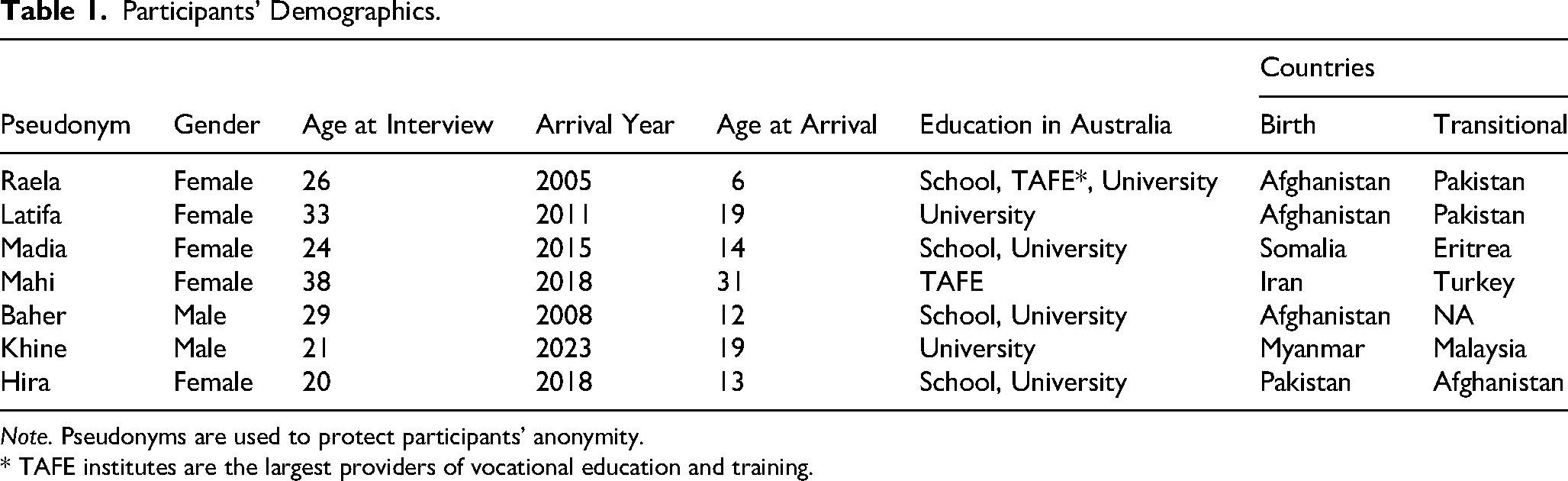
Note. Pseudonyms are used to protect participants’ anonymity.
* TAFE institutes are the largest providers of vocational education and training.
Data Collection Tools
Each participant completed one semi-structured narrative inquiry interview. An interview protocol (Appendix A) was developed to support narrative inquiry into participants’ pre- and post-resettlement life-career stories, drawing on prior qualitative research with refugees in Australia (Abkhezr et al., 2020, 2021). The protocol comprised two sections. Section 1 foregrounded participants’ migration journeys, including education and employment trajectories. Section 2 focused on participants’ conceptions of ‘career’ and ‘career development’, and invited reflections on perceived community career needs and feasible support strategies. Given the study's focus on conceptual resonance or misalignment, participants were first invited to articulate their own meanings, then to reflect on an academic definition to surface resonance, contestation, and reframing. Participants were first asked open-ended questions to elicit their own understandings of jobs, careers and career development, before being presented with a formal definition of ‘career development’ from the literature (Wolfe & Kolb, 1980; as cited in Patton & McMahon, 2021) to prompt reflection on its relevance to participants’ lived experiences and subsequent recommendations (see Appendix B).
Data Collection Procedures
Following ethical approval (Ref Number: 2022/194), recruitment materials were circulated through multiple channels. Interested individuals received a participant information sheet and consent form and returned signed forms before the interview. They were reminded that participation was voluntary and that withdrawal could occur at any time without consequence, including no impact on academic standing where relevant. Participants received either minimal course credit (where applicable) or a $AUD25 gift card as a token of appreciation for their time.
Interviews were scheduled at participants’ preferred university campuses. At the outset, the interviewer provided a brief orientation emphasising the consultative intent of the interview, positioning participants as experts in their own lives and outlining the collaborative nature of the process to support rapport and reduce power imbalances. The first section was conducted in a participant-led manner, allowing individuals to narrate migration, education, and work trajectories at their own pace. Broad prompts and follow-up probes were used to encourage narrative detail and elaboration, with attention to employment histories, aspirations, and plans. Building on this established partnership, the second section invited participants to articulate their understandings of concepts such as ‘job’, ‘career’, and ‘career development’, and to reflect on perceived gaps and needs in relation to career support within their communities. When participants were presented with the academic definition of ‘career development’ (Wolfe & Kolb, 1980; as cited in Patton & McMahon, 2021), they were explicitly informed there were no right or wrong answers, and were encouraged to share points of resonance, surprise, disagreement, or new insights, linking these reflections to earlier narratives. The interview then shifted towards consultative reflection, inviting participants to offer locally grounded suggestions and recommendations regarding career support strategies, accessibility, and service gaps for refugees and migrant communities. Interviews were audio-recorded, transcribed verbatim, and de-identified (mean duration = 75 min). Participants received a de-identified transcript draft for review and the opportunity to request revisions; none requested changes.
Data Analysis
Transcripts were analysed using a two-stage narrative analytic approach, combining within-case narrative profiling with cross-case narrative thematic synthesis organised across four analytic domains aligned with the study questions (jobs/careers; career development; career support; obstacles and recommendations) (Clandinin, 2022; Creswell, 2013; Riessman, 2008). In Stage 1, each transcript was read holistically and repeatedly to develop a narrative profile for each participant, attending to temporality (pre-/post-resettlement), sociality (relational, cultural, and institutional influences), and place (migration and resettlement settings) in line with narrative inquiry (Clandinin, 2022). These profiles were used to preserve narrative coherence and contextual grounding when moving into cross-case analysis and reporting.
In Stage 2, the second author generated initial codes across transcripts and organised them within the four domains, noting links to participants’ situated meanings and conceptions. Cross-case synthesis proceeded through reflexive thematic processes of collating coded extracts, developing provisional themes (analytic threads) within and across cases, and iteratively refining theme boundaries through review and discussion between authors (Braun & Clarke, 2006, 2019). Across multiple rounds, the authors consolidated overlaps, clarified the distinctiveness of themes, and agreed the final thematic structure and illustrative extracts. Finally, within-case comparisons of participants’ conceptions of career development before and after engagement with the academic definition were integrated into the write-up to examine how meanings were affirmed, extended, or contested, while retaining links to participants’ broader life-career narratives (Riessman, 2008).
Researchers Positionality
As lead researcher, I bring to this study my positioning as a [blinded for review] academic and practitioner who has lived outside [blinded for review] for over two decades while maintaining strong personal, familial, and cultural ties to the contexts in which I grew up. A key reflexive dimension in this project is discursive–linguistic. I began as a [blinded for review] and later became a career-development researcher working primarily in English, which has required ongoing translation and negotiation of terms such as ‘career’ and ‘career development’ across moral, cultural, historical, and institutional worlds. This movement across languages and contexts heightens my attentiveness to how Western career discourse centres on individual agency, planning, and self-directed progression, while other traditions have often organised meanings of work around livelihood, spirituality, duty, and family or communal obligation. These frames are neither singular nor static. [blinded for review] meanings of work, for example, have been continually renegotiated through modernising projects, education, migration, and transnational flows, producing layered and sometimes contradictory understandings alongside enduring traditions. These experiences sensitise me to how some young people with refugee backgrounds from the MENA region may not readily locate themselves within dominant career language. Accordingly, I approached participants as lived-experience experts, treated their accounts as situated knowledge, and remained alert to how my assumptions and wider societal narratives might shape interpretation.
In this research, I (Elyse) draw on my psychology training while recognising my developing expertise as a novice researcher. I paid attention to how my social position, background, and emotional responses could shape engagement with participants’ stories. As a young, white, Australian-born Honours student who progressed directly from secondary school to university, I acknowledge that my experiences differ markedly from those of refugee participants. Throughout the study, I reflected on assumptions and potential biases to remain open and curious, and the process strengthened my commitment to valuing diverse perspectives and advocating for inclusive practice.
Trustworthiness
Trustworthiness was established using Lincoln and Guba’s (1985) criteria of credibility, transferability, dependability, and confirmability, which address the truth value, applicability, consistency, and neutrality of qualitative findings (Stahl & King, 2020). Strategies were embedded across the research design, data collection, and analysis. Credibility was supported through sustained engagement with the research context, iterative discussions between authors during recruitment, data collection, and analysis, and voluntary member checking, whereby participants reviewed de-identified transcripts and could request revisions. The narrative inquiry design, together with the integrative ethical lens, further strengthened credibility by foregrounding participants’ voices, contextual meanings, and narrative coherence. Transferability was addressed through detailed description of the research context, participants, and methodological processes, enabling readers to judge applicability to other settings. As is consistent with qualitative inquiry, transferability rests with readers’ assessment of contextual similarity. Dependability was supported through documentation of methodological decisions, interview protocols, analytic steps, and theme development. Regular supervisory and research meetings functioned as audit and reflexive checkpoints, enhancing transparency and coherence across coding and interpretation. Confirmability was strengthened through ongoing reflexive practice, including critical attention to researcher assumptions, positionality, and potential biases. Analytic interpretations were discussed collaboratively to ensure they remained grounded in participants’ accounts. Collectively, these strategies supported rigour and transparency across the study.
Findings
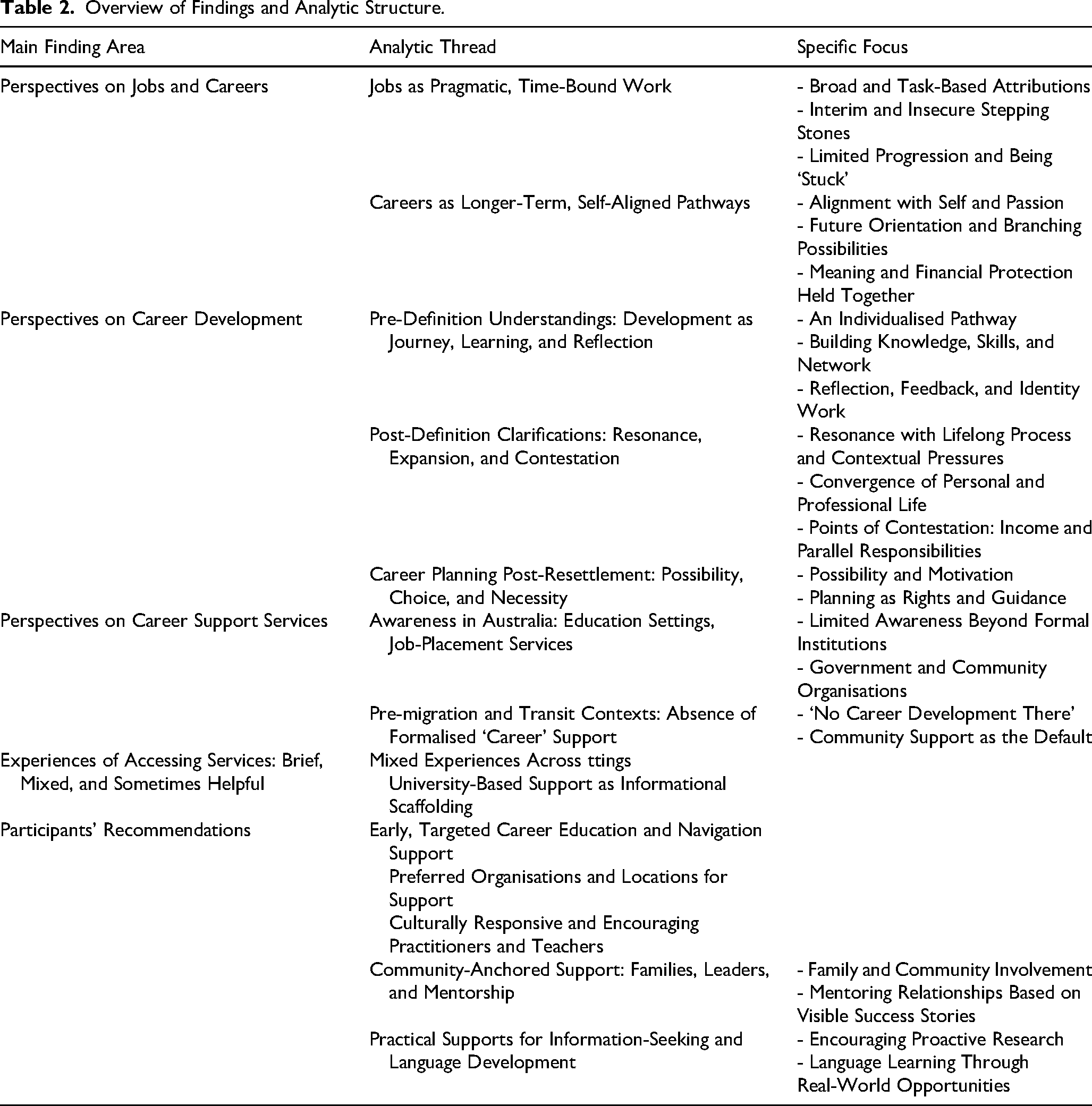
This section presents participants’ situated understandings of jobs, careers, and career development in their post-resettlement Australian contexts, alongside their perspectives on career support and locally grounded recommendations. Consistent with our two-stage narrative analysis, we report cross-case patterns of meaning-making while keeping participants’ accounts anchored in brief contextual descriptors (e.g., migration histories, study and work situations) at the point each voice is introduced. Findings are organised into five sections: (a) participants’ distinctions between jobs and careers, (b) their evolving understandings of career development (including reflections before and after engaging with an academic definition), (c) their awareness of career support across pre-migration, transit, and Australian resettlement settings, (d) their experiences of accessing career support services, and (e) their recommendations for strengthening career support beyond short-term job placement. Table 2 provides an overview of the main finding areas, analytic threads, and specific foci developed across these sections, offering a roadmap for how the findings are organised and how the narrative analysis progresses. Throughout, participants’ language is retained where possible to preserve the texture of their sense-making.
Overview of Findings and Analytic Structure.
Perspectives on Jobs and Careers
Participants did not treat ‘jobs’ and ‘careers’ as interchangeable labels, but narrated them as qualitatively different forms of life engagement, shaped by the practical demands of resettlement and the need to balance immediate livelihood with the possibility of longer-term direction. These distinctions were shaped by settlement realities or family expectations, including the need to secure income quickly while also trying to imagine longer-term trajectories in an unfamiliar context.
Jobs as Pragmatic, Time-Bound Work
Broad and Task-Based Attributions
Across cases, jobs were described in broad, everyday terms and often framed as task-based work. Khine, who had worked part-time in restaurants to fund schooling before resettlement, defined a job as “any job… you can do”, such as “part-time in a restaurant”. Madia similarly emphasised the performative nature of paid work, describing jobs as the “tasks” one is required to do.
Interim and Insecure Stepping Stones
Jobs were frequently positioned as short-term, financially necessary roles that may sit alongside longer-term aims, plans, and intended trajectories. Latifa, whose prior community-sector work took a “toll” on her health, captured this pragmatism: “It meant your heart and your soul may not be there, but you do it for the moment.” Participants also spoke about jobs as inherently contingent. Raela described jobs as “uncertain” and noted: “It's never guaranteed… you might not get another contract.” Latifa added that jobs can emerge “during whichever phase of your life you’re in”, while you “work on your career or on your passion on the side.”
Limited Progression and Being ‘Stuck’
For some, jobs were associated with constrained growth and limited identity expansion. Hira, who had balanced school with part-time work before shifting focus to university study, described roles where “you won’t be able to get anywhere. You will be stuck in the same position the whole time”, adding that you can end up “making their business grow instead of making your life.”
Careers as Longer-Term, Self-Aligned Pathways
Alignment with Self and Passion
In contrast, careers were narrated as work that resonates with values, enjoyment, and a sense of internal commitment. Latifa framed this as something that “comes from within, from your heart”, describing a career as “something you’re really passionate about and … do no matter what.” Participants often described this as a felt quality that distinguishes careers from “doing what you have to do” [Mahi].
Future Orientation and Branching Possibilities
Careers were also linked with long-term direction and identity continuity. Raela described a career as a “big part of your life”, while Madia described it as “somewhere you wanna specialise… where you wanna be.” For Hira, a career was “life-long” with “more possibilities branch off from it”, echoing notions of volition and expanding pathways over time (Blustein, 2006). Baher similarly positioned psychology as a career because it held a future of multiple projects: “writing books… coaching… research[ing]… [having] my own clinic.”
Meaning and Financial Protection Held Together
Even when careers were idealised as meaningful, participants kept survival in view. Khine described a career as what you are “passionate about” that can also “provide you with the necessities… for survival's sake.” This dual framing suggests that, for many participants, the ‘career’ category remained aspirational while also needing to be practically viable in the post-resettlement economy.
Perspectives on Career Development
When asked to define ‘career development’, participants first drew on lived experience and then revisited these ideas after engaging with an academic definition. This two-step process made visible both shared assumptions and points of divergence, particularly around contextual pressures, responsibilities, and the role of planning.
Pre-Definition Understandings: Development as Journey, Learning, and Reflection
An Individualised Pathway
Before engaging with the academic definition, participants commonly described career development as a personal “journey” shaped by one's circumstances and choices. Latifa noted that “the journey itself is learning”, while Raela connected development with ‘moving through’ education and training as steps “towards a career path”.
Building Knowledge, Skills, and Network
Several accounts foregrounded intentional skill-building and experience accumulation. Latifa emphasised seeking “knowledge… [and] experience” to reach “the career that you want.” Khine described “working in different… settings” as contributing to “holistic development”, and highlighted communication, relationships, and networking as part of the “skillset that you need.” Madia also located development in proactive action, including engaging career counsellors and completing “the things you need to get done to become that person.”
Reflection Feedback, and Identity Work
Reflection was repeatedly positioned as a mechanism for clarifying direction and self-understanding. Raela described reflecting across jobs to identify what she enjoyed: “the customer interaction… [that] became the decider for me, because I enjoyed helping through the conversations.” Latifa described learning from lived experience as shaping contributions to others: “over the years with education and living in an environment, you learn things and you want to give value to everybody else.” Hira narrated an evolving interpretation of what ‘counts’ as development. Looking back on earlier work, she re-framed it as “just time passing and no career” while still acknowledging, “it's ok, you can learn from your experience.”
Post-Definition Clarifications: Resonance, Expansion, and Contestation
Resonance with Lifelong Process and Contextual Pressures
When exposed to academic definition, some participants experienced it as language that captured what they already sensed. Baher said, “It makes a lot of sense… this puts what I’m thinking… into words.” Latifa highlighted the time and “environmental pressure” involved: “If you want to develop a career, there are those pressures that you need to accept… the time and commitment.” Khine focused on parental expectations as both supportive and demanding: “sometimes their expectations [are] too high” but they can also “encourage me.”
Convergence of Personal and Professional Life
Participants also engaged with the definition's framing of professional and personal development as intertwined. Baher linked this convergence to ethical self-scrutiny about professional identity: “on becoming a psychologist… what kind of psychologist I wanna be?… personal life and… professional life… overlap.”
Points of Contestation: Income and Parallel Responsibilities
Not all reflections were fully aligned. Hira argued that income and survival-oriented decision-making were under-emphasised, noting that “how much income you will have [matters]… when I was choosing psychology, I was researching about the income as well.” She also highlighted how career development unfolds alongside other roles and obligations: “I have to have the money to support my family.” At the same time, she described education as a portable resource, a “tool” that stays with you “anywhere you go.”
Career Planning Post-Resettlement: Possibility, Choice, and Necessity
Possibility and Motivation
Career planning was sometimes narrated as an achievable and empowering necessity. Mahi framed it as a pathway: “It's absolutely possible… you have… [to] focus [on] that aim and then move.” Others questioned whether planning is equally compelling for everyone. Khine suggested some people “just don’t want it… they are not that passionate… just want to enjoy life or get by.”
Planning as Rights and Guidance
For Hira, planning was tied to an emerging sense of choice: “I had no plan for future”… “Now… I get to choose… I can do it if I want, I have the right.” Several participants stressed planning as protective guidance in a fast-moving resettlement context. Baher noted, “It's important to know where you’re going… particularly for refugees transitioning to a new country like Australia.” Raela described how, without guidance, “we didn’t know any different” and argued, “It is so important to have a plan… for anyone… from abroad.” Latifa framed planning as a way to avoid wasted time, describing resettlement as moving “from a different world into western world where life… is fast.” She also noted that an interest “at home… may not be required here”, and that recognising transferable “strengths and abilities” can open alternative pathways. Madia added that a focus on “today” can be “very limiting”, describing a ‘quick-fix’ orientation where “all they think about is… I need money for survivor [survival].”
Taken together, these reflections position career planning as both an individual practice and a socially supported process that relies on guidance, accessible information, and permission to imagine longer-term futures in the midst of settlement demands.
Perspectives on Career Support Services
Participants’ accounts suggested that ‘career support’ was most visible within education settings and that, where services existed, they were often experienced as brief, informational, or oriented towards job acquisition rather than longer-term career development. Importantly, limited awareness was not simply an information deficit; it was also tied to pre-migration contexts where the discipline category of career counselling was unfamiliar or absent.
Awareness in Australia: Education Settings, Job-Placement Services
Limited Awareness Beyond Formal Institutions
Participants generally reported modest awareness of career support services in Australia. Khine had “heard that term career counselling” but was “not sure they have that here”, while Raela noted awareness of “career counsellors at University” but “outside of that, not much.” When services were named, they were commonly located in schools, Technical and Further Education (TAFE) institutions, or university settings. Participants described learning about services through informal networks and institutional outreach. Raela learned about career services from “friends who… intensively used [career counsellors]”, Hira from “a call from [the] University outreach staff”, and Latifa through searching the “University page” online.
Government and Community Organisations
Some participants also named government and community organisations (e.g., Centrelink; Department of Human Services; community agencies providing employment support). However, these were commonly described as focused on job-placement and short-term roles, reinforcing participants’ earlier distinctions between jobs and career as different categories of meaning and possibility.
Pre-Migration and Transit Contexts: Absence of Formalised ‘Career’ Support
‘No Career Development There’
When reflecting on home and transitional countries, participants consistently described an absence of formal ‘career development support’. Hira said there was “no career development there”, while Khine described “never, not at all” receiving such support. Raela contextualised this absence within linguistic and cultural frames, explaining that “the word counsellor doesn’t exist” in her language (as well as ‘psychologist’) and that the broader concept of a professional helper itself is unfamiliar, shaping how help-seeking is understood and enacted after resettlement.
Community Support as the Default
In place of formal services, participants described reliance on family, peers, and broader community networks. Raela described support as “mostly family support, friends, circle and the broader people I know… come together if you’re going through tough times.” Hira highlighted structural constraints on education access (“if they don’t have the money to pay for it, they can’t go [to university]”) and gendered restrictions (“for ladies, no… you don’t have the right”), illustrating how opportunity structures shaped what could be planned or pursued.
Experiences of Accessing Services: Brief, Mixed, and Sometimes Helpful
Mixed Experiences Across Settings
Two participants (Baher and Khine) reported never using career support services. Among those who did, experiences were varied and often brief. Mahi felt TAFE “helped…, but not very much,” though it “showed me [the] way to be a nurse… and provided individual support.” Raela described a “quite brief” experience at TAFE and wondered whether she was treated as “another kid… she's new. She doesn’t know anything.” Hira recalled her encounter with the school counsellor in Australia, and being “kind of… disappointed” because a school counsellor “couldn’t do much… there was no sense of reflecting on my future possibilities.”
University-Based Support as Informational Scaffolding
In contrast, Latifa and Madia described university-based services as helpful at key decision points. Madia attended a workshop where staff shared “information on the pathways” and relevant websites. Latifa sought career counselling when she felt “lost… going from one degree to another,” describing the interaction as timely support during a period of uncertainty. Taken together, these accounts suggest that even brief, informational forms of support can function as scaffolding when aligned with moments of transition and when they extend beyond immediate job placement to facilitating long-term reflectivity and planning.
Participants’ Recommendations
Participants’ recommendations centred on making career support more accessible, culturally responsive, and developmentally timed. Suggestions ranged from early education and system navigation to community-anchored mentoring and practical opportunities to build language and workplace confidence.
Early, Targeted Career Education and Navigation Support
Participants emphasised career education early after resettlement that goes beyond brief information-sharing and instead offers practical navigation knowledge about education systems, pathways, and labour-market realities in Australia. Raela advocated for “career information sessions at schools” that provide “in-depth information, not just skimming.” Madia suggested “more workshops about careers and things that exist in Australia”, including the education system, to build awareness of career planning “very early in the first months of arrival.” Latifa added that when refugees are “informed that there is a way for them to gain some sort of benefit,” they can be more readily prepared and linked to education and career pathways rather than only short-term employment.
Preferred Organisations and Locations for Support
Participants identified schools, community organisations, and education providers as key sites for delivering support because these are places refugees already access and trust. Raela highlighted “government support… through community organisations” and schools, while Latifa suggested “extra support dedicated to refugees” within universities and workplaces. Raela stressed the value of providing resources “early in transition [to the host country],” describing it as “like a new gift,” and observed that many refugees would be “happy to receive any information because they’re so unfamiliar and maybe lost.”
Culturally Responsive and Encouraging Practitioners and Teachers
Participants emphasised that effective support depends on practitioners’ and teachers’ understanding of refugee histories, culture, and settlement pressures, as well as their capacity to encourage rather than discourage. Latifa highlighted the need for practitioners’ “understanding of [refugees] culture and where they come from.” Hira suggested that teachers who “understand students more” can better support engagement, particularly where language learning, motivation, and unfamiliar system navigation intersect. Madia also emphasised the significance of encouragement, recalling how discouraging messages from school staff had dampened her early aspirations.
Community-Anchored Support: Families, Leaders, and Mentorship
Family and Community Involvement
Several recommendations centred community as a resource for sustaining career development. Baher suggested building from within: “By helping each other out first and then utilising whatever help government gives us… build on everything that we have.” Raela argued that raising parents’ awareness can support young people navigating “two lives” across cultural worlds, noting that “if the family has awareness, then it will help the children.” Participants also suggested collaboration with community leaders to circulate information and opportunities in culturally meaningful ways.
Mentoring Relationships Based on Visible Success Stories
Participants described the motivational value of seeing ‘people like us’ who have successfully navigated education and work pathways. Raela suggested inviting successful community members to share stories to show that “everything that they put their heart into they can achieve”, and proposed extending mentorship programmes “to all the schools where refugee children go.” Madia emphasised the impact of seeing “someone that looks like them” who has “already succeeded.” Khine favoured one-on-one mentoring with relatively close age proximity, noting that mentors from an “older generation… are concerned about… money or stability” and may feel less relatable for younger refugees seeking growth and opportunity.
Practical Supports for Information-Seeking and Language Development
Encouraging Proactive Research
Hira emphasised self-directed research as an essential strategy for navigating unfamiliar systems, recommending that individuals “do a lot of research” rather than relying solely on advice from community or even teachers, because it does not provide “the same amount of… knowledge.”
Language Learning Through Real-World Opportunities
Finally, Mahi recommended creating “more volunteer jobs” to help refugees “improve [their] English” and build workplace skills, emphasising the value of real-world exposure and interaction. She noted that children “improve their English very quick” through school because they can “communicate with others”, suggesting that everyday communicative environments can accelerate language development for young people.
Discussion
The present study explored young people with refugee backgrounds’ perspectives and understandings of jobs, careers, and career development in Australia, and consulted with them about existing career supports, perceived gaps, and complexities related to seeking career support. The findings highlight participants’ conceptions of career as a contested construct rather than a neutral, universally shared one. Participants’ distinctions between jobs and careers, their evolving conceptualisations of career development, and their mixed experiences of career support were shaped by settlement pressures, shifting rights and opportunities, and culturally and contextually mediated expectations about education, gender, and family responsibility (Abkhezr, 2026b; Sultana, 2020; Yazdankhoo et al., 2026). In what follows, the findings are discussed in relation to the conceptual and service gaps outlined earlier, and then some implications for theory, practice, and research are outlined.
Jobs, Careers, and the Search for Stability After Disruption
Participants’ accounts reinforced a pragmatic distinction between jobs and careers. Jobs were typically narrated as time-bound, task-based, and contingent, and as a mechanism for financial survival within the immediate demands of resettlement. Careers, by contrast, were narrated as longer-term, self-aligned and future-oriented pathways, associated with growth, branching possibilities, and a sense of identity continuity or reconstruction. This distinction echoes arguments that work participation is often organised around both meaning and necessity, particularly for populations navigating constrained opportunity structures (Blustein, 2006; Duffy et al., 2016).
‘Career’ operated as a symbolic counterpoint to prolonged uncertainty. While participants described jobs as insecure and provisional, career was associated with reduced fear of loss, and the possibility of stabilising the self within a new system. Interpreted alongside the literature on protracted displacement and the psychological costs of liminality, ‘career’ can therefore be read as more than an occupational category; it becomes a narrative resource for imagining continuity, control, and belonging after disruption (Brun, 2015). This distinction between jobs as survival-oriented and careers as more stable, meaningful, and self-aligned also aligns with scholarship on decent and meaningful work. Decent work has been framed as a human rights issue, with restricted access undermining basic needs for survival, social connection, and self-determination, particularly among marginalised groups (Blustein et al., 2018). Meaningful work, by contrast, refers to a more aspirational experience of significance, with access to both decent and meaningful work shaped by macro-level, organisational, and individual conditions (Blustein et al., 2023). Read through this lens, short-term jobs may support immediate survival, but not necessarily enable sustainable, meaningful, and dignified life-career trajectories after resettlement (Hartung & Di Fabio, 2024).
At the same time, participants’ conceptions of career largely gravitated towards paid employment, with limited attention to unpaid, volunteer, or community-based roles, despite the importance of such roles in settlement and social capital building. This paid-work gravity may partly reflect the structural realities of post-resettlement life, in which immediate income needs narrow the horizon of what is imaginable, and therefore, services commonly prioritise rapid job placement over longer-term career development (Arthur et al., 2025; Shergold et al., 2019). It may also reflect the enduring influence of pre-migration worlds of work and cultural meaning systems, in which work is often understood primarily in relation to livelihood, an activity to fulfil family and community responsibility, and collective survival, rather than as a sphere for self-expression, self-actualisation, or broader social participation. Read in this way, the limited salience of unpaid or volunteer roles does not simply suggest a narrow understanding of career, but rather highlights the tension, noted earlier in this manuscript, between Western notions of careering and the alternative moral, cultural, and economic logics through which work and future pathways may have been previously understood.
Career Development as Learning, Reflection, and Contextual Negotiation
Before engaging with the academic definition, participants narrated career development through experiential and developmental language: journey, learning, skill acquisition, relationships, and reflection. These emphases align with contemporary career development perspectives that foreground lifelong learning, self-awareness, and ongoing adaptation within multiple systems and changing circumstances (Wolfe & Kolb, 1980; as cited in Patton & McMahon, 2021). They also align with narrative approaches that treat career development as meaning-making across life roles and contexts, rather than as a linear sequence of job moves (Hartung, 2013; McMahon & Abkhezr, 2024, 2026).
The definition prompt functioned as an analytic hinge by revealing not only resonance and contestation but also a reframing effect. Before the prompt, several participants described career development in relatively linear terms (e.g., progressing through study, jobs, and positions) while locating family expectations, gendered/community norms, survival needs, and caregiving responsibilities as barriers outside career development. Post definition-presentation, many expressed a kind of relieved recognition; elements they had treated as obstacles were explicitly included as part of the career development process, particularly the contextual pressures and the convergence of personal and professional life (Patton & McMahon, 2021; Richardson, 2012). This suggests the definition offered language that some participants experienced as more reflective of their lived realities, and supports its continued relevance for career development in post-resettlement contexts where livelihood, relational obligations, and work-life transitions are deeply intertwined (Abkhezr, 2026b; Sultana, 2020).
Participants’ reflections on career planning further sharpened this tension. Planning was narrated as possible and as necessary, but also as unevenly accessible, dependent on guidance and the perceived legitimacy of imagining long-term futures while settlement pressures remain acute. Planning was sometimes narrated as an emerging right, particularly for younger participants who contrasted post-resettlement possibilities with gendered restrictions in pre-migration settings. This finding resonates with scholarship highlighting that resettlement can expand formal opportunities while intensifying relational tensions as families negotiate shifting cultural norms and identities (Hawkes et al., 2021; Yazdankhoo et al., 2026).
Career Development Support as Unevenly Visible and Often Job-Facing
Participants’ accounts suggested that career development support was most visible within education settings and that awareness beyond schools, TAFE, and university was limited. Where services were encountered, they were often experienced as brief, informational, or oriented towards entry-level job acquisition rather than long-term career awareness, planning and development. This aligns with concerns that refugee-serving systems frequently default to job placement and rapid labour-market entry, while career development support remains limited and unevenly resourced (Arthur et al., 2025; Goopy et al., 2020; Newman et al., 2022).
Participants’ accounts suggest that limited awareness of career support was not merely an information gap. Rather, help-seeking was shaped by emergent meanings of pre-migration and transit contexts in which ‘career guidance’ or ‘career counselling’ did not exist as recognisable professional categories, upon which ‘career support’ remained unfamiliar, culturally distant, or even stigmatised. These narratives extend the study's conceptual framing by showing how service non-use may reflect not only access barriers, but also a mismatch between institutional assumptive categories and participants’ prior meaning systems (Abkhezr, 2026b; Yazdankhoo et al., in press). In this sense, the findings problematise mainstream assumptions that career services become relevant simply by being made available, because availability does not guarantee perceived usefulness and accessibility. From an IEL perspective, this foregrounds responsiveness as an ethical and practical requirement (Abkhezr, 2026a); that career support cannot presume shared meanings of ‘career’, ‘counselling’, or ‘guidance’, but must be developed through attention to multiple voices that co-define needs, based on relational trust, and locally grounded understandings of ‘what support is for’.
Recommendations for Moving Beyond Job Placement
Aligned with calls to move beyond short-term placement cycles towards developmentally scaffolded career support (Arthur et al., 2025), participants’ recommendations offer a four-part, provisional practice-facing framework that directly addresses the service gap identified earlier.
Early Career Education and System Navigation Support for Refugees and Families
Participants called for support that begins early after arrival and extends beyond ‘skimming’, including support that helps refugees and their families become familiar with the idea of career development and with the education pathways, credentialing systems, and labour-market realities that shape future opportunities and planning.
Culturally Responsive and Encouraging Practitioners
Participants foregrounded the interpersonal and ethical quality of support, emphasising practitioners and teachers who understand refugee histories and settlement pressures who are encouraging and strengths-based (e.g., narrative career counselling), consistent with evidence on ramifications of cultural insensitivity and bias (Wali et al., 2018).
Family Engagement, Community Support, and Mentoring
Participants advocated early parent engagement, particularly soon after resettlement, so families can better understand what is involved in navigating the labour market and building towards preferred long-term career pathways. In turn, this may reduce the tendency to prioritise only immediate income, short-term job security, or hasty survival-based employment decisions for their children. They also recommended collaboration with community leaders and mentoring through visible success stories from migrant and refugee backgrounds, reflecting the importance of social capital and relational scaffolding in expanding access to opportunity (Ziersch et al., 2023).
Delivery Through Trusted and Accessible Settings
Participants emphasised schools, community organisations, and education providers as key delivery sites, with tailored supports also embedded in universities and workplaces (Ortlieb & Knappert, 2023).
Implications for Theory
These findings contribute to career development theory in three ways. First, they reinforce that ‘career’ and ‘career development’ operate as culturally situated constructs rather than universal descriptors. Participants’ accounts illustrate how dominant career language can function as both an aspirational resource and a potential misfit, depending on its alignment with lived experience, settlement demands, and where individuals are situated in the ongoing process through which pre-migration meaning systems are gradually negotiated and, to varying degrees, reshaped in the host-country context (Abkhezr, 2026b; Yazdankhoo et al., in press). This supports ongoing theoretical work that critiques Western-centrism and calls for contextual sensitivity, including attention to how work meanings are organised through duty, family responsibility (Ribeiro, 2020; Sultana, 2020), and livelihood needs and how they may evolve.
Second, the findings lend support to the IEL (Abkhezr, 2026a) as a pragmatic bridge between care and justice in vocational psychology. Participants’ limited awareness of services, the unfamiliarity of ‘counselling’ as a category, and their emphasis on co-ordinated, encouraging, culturally responsive support collectively underscore the ethical necessity of ‘attentiveness’ followed by ‘responsiveness’, for co-defining needs with communities rather than imposing presumed solutions (Abkhezr, 2026a; Abkhezr et al., 2024). In this study, the IEL provides a coherent interpretive frame for understanding why ‘more services’ is insufficient if services are conceptually misaligned or delivered in inaccessible ways.
Third, participants’ framing of ‘career’ as a departure from uncertainty invites a theoretical refinement; for refugee populations, career discourse may function as a narrative technology of stability and belonging, not merely a developmental construct. This interpretation extends work on disrupted trajectories by highlighting that the desire for progression can be inseparable from the desire for predictability and social anchoring after arrival in a host-country (Brun, 2015; Ghosn et al., 2021).
Implications for Practice
For practitioners, the most immediate implication is the need to avoid assuming shared meanings of core constructs. Career counselling with refugees should begin with careful elicitation of clients’ own language for jobs, careers, development, and planning, and should treat these meanings as situated knowledge. Narrative approaches are well suited here as they foreground story, context, and relationality, enabling practitioners to work with the person-in-context rather than treating counselling activity and assessment categories as culturally neutral (McMahon & Abkhezr, 2024).
A second practice implication concerns the developmental timing and location of support. Participants’ emphasis on early career education suggests that services should be designed as scaffolded encounters rather than one-off workshops. In schools, TAFE, and community organisations, this may involve curricular, co-curricular, and informal activities that gradually introduce young refugees to the host society's meanings and expectations around work, career development, labour-market navigation, and long-term planning, rather than assuming these concepts are already familiar or shared. In universities and workplaces, dedicated supports can help counter the tendency for generic services to miss culturally and contextually specific needs (Newman et al., 2022). Such scaffolded support also reflects a sustainable career-development agenda, where support is not only directed towards individual employability, but also towards expanding access to decent work, quality education, social participation, and longer-term life-career security. In this sense, career development can contribute to sustainable development by attending to meaningful work across wider social systems (Hartung & Di Fabio, 2024). It can also support individuals and groups in designing active lives that respond to economic, social, and ecological challenges, rather than merely preparing them to fit existing labour-market arrangements (Guichard, 2022). For refugee communities, this suggests that sustainable career support should be culturally responsive, family- and community-engaged, and developmentally timed, while opening possibilities for participation, contribution, and stability beyond short-term job placement.
Third, participants’ recommendations point to a combined intervention logic: mentoring plus practical exposure plus navigation knowledge. Mentoring programmes that connect newly arrived people with near-peer role models from similar backgrounds can support motivation and raise the visibility of possible pathways (Arthur et al., 2025; Ortlieb & Knappert, 2023). Mentoring is likely to be most effective when linked to concrete opportunities such as work placements, volunteering, and supported introductions to professional networks, alongside explicit system navigation education (Ortlieb & Knappert, 2023).
Finally, the findings underscore the ethical importance of encouraging and strengths-based approaches that account for cultural responsivity among teachers and practitioners. Discouraging messages were described as capable of dampening aspirations, whereas culturally attuned support was positioned as enabling. Based on IEL, this entails that competence and responsiveness of the career counsellors extend beyond technical knowledge, and include relational and cultural competence, and an openness to genuine dialogue with clients’ communities’ situated expertise (Abkhezr, 2026a).
Implications for Research
The findings point to research priorities. First, conceptual research is needed on how refugees understand and conceptualise career language. Future studies could examine the linguistic and cultural portability of terms such as career, development, counselling, and planning, including how meanings shift across languages and resettlement stages. Such work could also examine how concepts such as sustainable careers, decent work, meaningful work, and active lives travel across languages, migration histories, and resettlement contexts, particularly among communities whose understandings of work may be shaped by survival, family responsibility, disrupted education, and collective obligations. Context-sensitive and comparative qualitative designs (e.g., Cohen-Scali et al., 2022), alongside participatory action research (Bradbury, 2015) and social design-based experiments (Gutiérrez, 2018), mapped into longitudinal qualitative designs are well-suited to tracing how career meanings shift over time as settlement stabilises.
Second, intervention research is needed to test and refine the practice directions articulated by participants. Co-designed programmes that integrate navigation workshops, mentoring, and language-rich opportunities should be evaluated for outcomes such as educational persistence, qualification upgrading, and movement beyond low-status work. Evaluation could include outcomes that refugees value, including belonging, collective responsibility, social confidence, and perceived stability, rather than rapid job attainment alone, aligning with calls to move beyond job placement metrics in refugee employment policy and practice (Arthur et al., 2025).
Third, future research should attend to within-group diversity. Although participants shared patterns of meaning-making, their accounts also suggested differences shaped by age at arrival, gender, family expectations, and time since resettlement. Larger and more heterogeneous samples, and comparative designs across visa categories, origin and settlement contexts, could clarify how opportunity structures and cultural negotiations shape career development trajectories (Hebbani & Khawaja, 2019). Research including practitioners and organisational stakeholders alongside refugee participants could illuminate how institutional assumptions about ‘career support’ are produced, sustained, and shifted.
Limitations
Several limitations should be considered when interpreting these findings. The study involved a small purposive sample, and participants were predominantly recruited through education settings, which may have shaped the prominence of education-based career support in their accounts. Participants’ willingness to engage in an interview about career meanings may also indicate a higher level of reflection or interest than might be present in the broader refugee community. In addition, interviews were conducted in English, and although participants were able to communicate their meanings, linguistic nuance and culturally specific concepts may have been constrained.
A further limitation relates to interpretive judgement within narrative and thematic synthesis. While credibility and confirmability were supported through reflexivity, iterative analysis, and collaborative review, narrative work inevitably involves interpretation, particularly when accounts contain ambiguity or culturally embedded meanings. Future research could strengthen interpretive accountability by incorporating community-informed review of themes and interpretations, alongside the strategies used to enhance trustworthiness (Stahl & King, 2020).
Conclusion
This study highlights that ‘career’, ‘career development’, and subsequently, ‘career support’ are not culturally neutral constructs, but negotiated through local histories, languages, traversed labour-market conditions, and settlement pressures. Working with a small group of participants, this study showed that jobs and careers were distinguished pragmatically: survival-oriented, time-bound work versus longer-term, self-aligned pathways. Participants’ understandings of career development also broadened when a more holistic definition invited them to recognise contextual pressures, relational obligations, and life responsibilities as integral to career development rather than external to it. Their accounts further showed that career support was often experienced as job-facing and unevenly visible beyond education settings, with perceived relevance shaped by prior meaning systems in which ‘career counselling’ may not exist as a recognised category. As an early, exploratory contribution, this study underscores the need for further research that maps the multiple local meanings and subjectivities through which refugees understand work, long-term planning, sustainable careers, and support across different resettlement stages. It also points to the value of co-designed, culturally grounded, family- and community-engaged interventions that move beyond short-term job placement towards developmentally timed career education, and mentoring, system navigation, that facilitate access to personally meaningful work.
Footnotes

Funding
The authors received no financial support for the research, authorship, and/or publication of this article.
Declaration of Conflicting Interests
The authors declared no potential conflicts of interest with respect to the research, authorship, and/or publication of this article.
Appendix A
Interview Topics and Sample Questions.
Appendix B
Formal Conceptualisation Utilised During Study