







Abstract
Objective:
To determine whether fiction (narrative products) deals with the issue of suicide and, if so, what it tells us about suicide “drivers”.
Method:
Accounts of suicide in narrative products were sought through web-based lists, book club members, other active readers and a prize-winning film writer and producer.
Results:
Seventy-one depictions of fictional suicidal events were identified. In 12 suicides, the author appeared to indicate that the death was directly or indirectly due to mental disorder. In 15 suicides, the motivation could not be determined by the reader, and in 44 cases the motivation was social/situational factors.
Conclusions:
Suicidal events are depicted in fiction, and the features are broadly similar to the features of suicide in the real world. Should it be determined that cultural influences, including fiction, are important in suicide, any preventive activities aimed at modifying cultural influences will need to consider all forms of narrative product.
Suicide is a major public health problem around the world. It occurs in every country, and among people of every ethnic and religious background. This ubiquity has suggested a single cause, and mental disorder has been proposed. 1
However, the suicide rates of different countries are different and the relative positions have been maintained over time.2,3 For example, over a 35-year period the suicide rate of males in Finland was nine times higher than in Greece, and the suicide rate of females in Denmark was seven times greater than in Greece. 4 These differences cannot be explained by different rates of mental disorder. Recent studies from India and China have found mental disorder in less than half the young people who complete suicide, 5 leading to the need to reconsider the role of mental disorder 6 and search for other or additional influences.
Our group has proposed the concept of “predicament suicide” (self-killing as a means of avoiding unacceptable predicaments). 7 Two forms have been conceptualized, one relating to untreated or unresponsive mental disorder, and the other, non-mental disorder social factors (consistent with the concept of “impossible worlds”). 8
In the late 19th century, Durkheim 2 emphasized the importance of social/cultural factors in suicide. Durkheim’s view has often been ignored, but some recent papers9,10 have observed that culture should be considered in suicide theory and prevention programs. Prevention efforts to this point have sought to increase help-seeking behavior and restrict access to lethal means. 11 For our purposes, “culture” may be conceptualized as the system of information that codes the manner in which the people in an organized group, society or nation interact with their social and physical environment. 12 It includes sets or rules, regulations and mores; each member must learn the systems and structures.
Inextricably linked with the notion of culture are fiction and “narrative products”. "Fiction” is any literary work portraying imaginary characters or events, presented as a novel, poem or play. In recent times, the term has also been applied to films, comics and the stories underpinning electronic games. These can be collectively termed “narrative products”.
Narrative products have a number of functions. These include serving as an abstraction or model of social experience,13,14 and allowing simulation of social experience,14,15 providing the opportunity to consider personal responses to a range of situations. As such, narrative products are powerful in transmitting and sustaining the culture of groups. In pre-literate societies, oral narratives clearly performed this central function.
Some propose that stories can suggest cures of social problems. 16 Others observe that stories may depict social relations that may be unhealthy or that are not recommended.17,18 In addition, there is evidence that stories can transmit incorrect information.19,20 Given such concerns, Booth 21 opines that books are like friends, and just as we need to be careful in choosing our friends, we need to be careful in choosing our books.
As culture is important in suicide and narrative products influence culture, it makes sense to examine this nexus. Our aim was to explore whether narrative products deal with the issue of suicide and, if so, what they tell us about the drivers of suicide.
Method
The first step was to locate accounts of suicide in narrative products that were readily available in English. The web was searched for information; Wikipedia, among other resources, provided a helpful “list of suicides in fiction”. Suggestions were also sought from the members of a book club, several other active readers and a prize-winning film writer and producer.
In the majority of cases, the source material was examined. When the source material was not to hand, we studied copies, summaries, reviews and analyses.
The second step was to classify the motivation of individual suicides according to a three-category format: (1) the author intends to describe suicide being triggered (at least to some degree) by mental disorder; (2) the motivation for suicide is unknown (at least to the reader); and (3) the suicide appears to be motivated by social factors.
Previously, the second author (GW) and colleagues have examined accounts of mental illness in general and psychiatric treatments in various narrative products, including novels, poems and films,22–26 and these accounts included occasional descriptions of suicide e.g.23,24. The present study sought to consider other examples from fiction and to focus on suicide.
Results
Seventy-one depictions of suicide were identified from 61 narrative products.27–87 Thirty-nine suicides were from novels, 19 from films, 5 from TV series (including “Anime”), 5 from operas, plays or musical theatre, and there was 1 from each a poem, a short story and a video game.
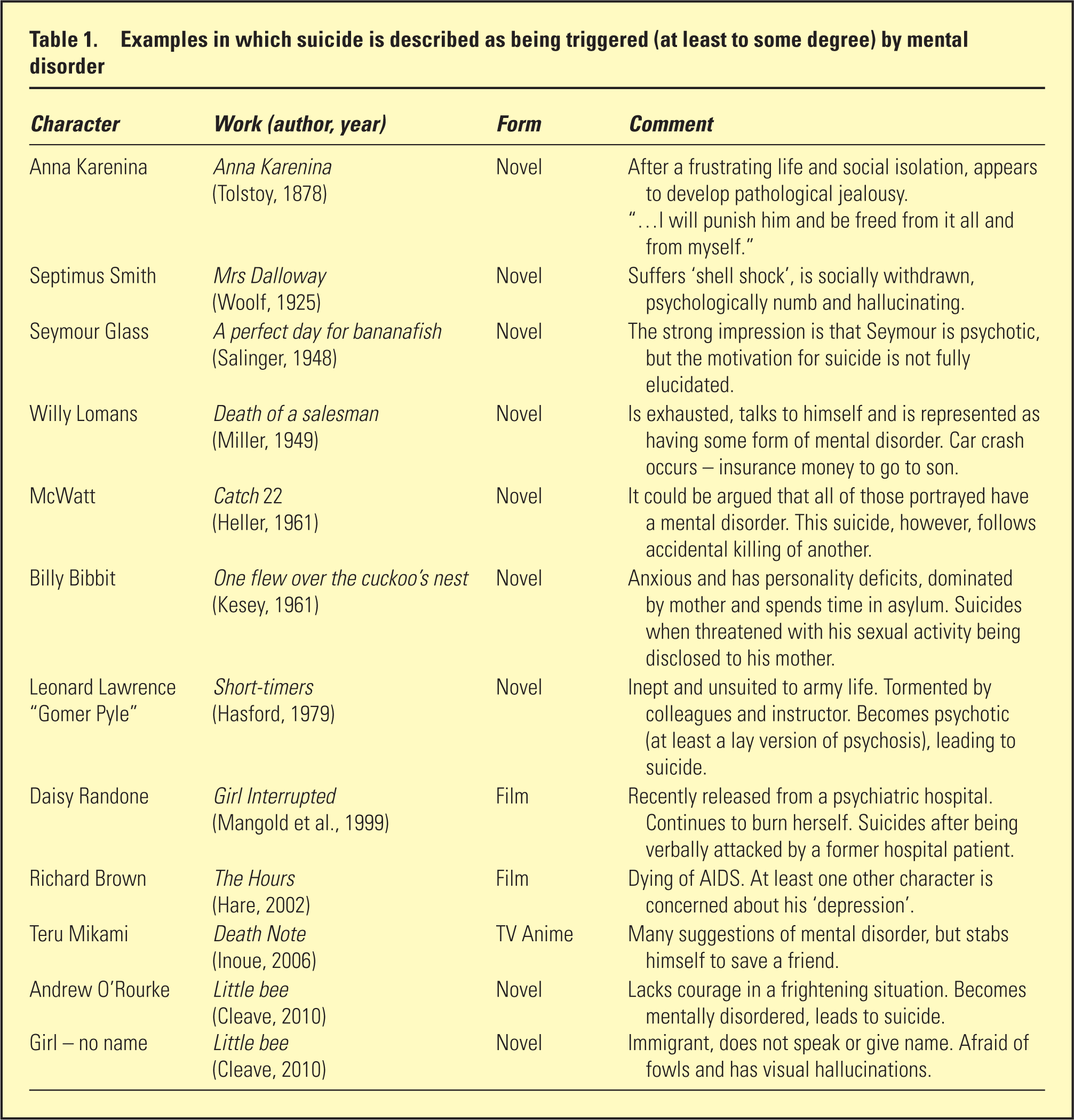
In 12 suicides, the author appeared to indicate that the death was directly or indirectly due to mental disorder (Table 1). Few of these were a well-described mental illness. There were three accounts of psychosis,38,78 one good account of “shell shock”, 87 one severe depression secondary to environmental events, one psychiatric inpatient who was shamed 59 and one recently discharged psychiatric inpatient who was bullied. 69
Examples in which suicide is described as being triggered (at least to some degree) by mental disorder
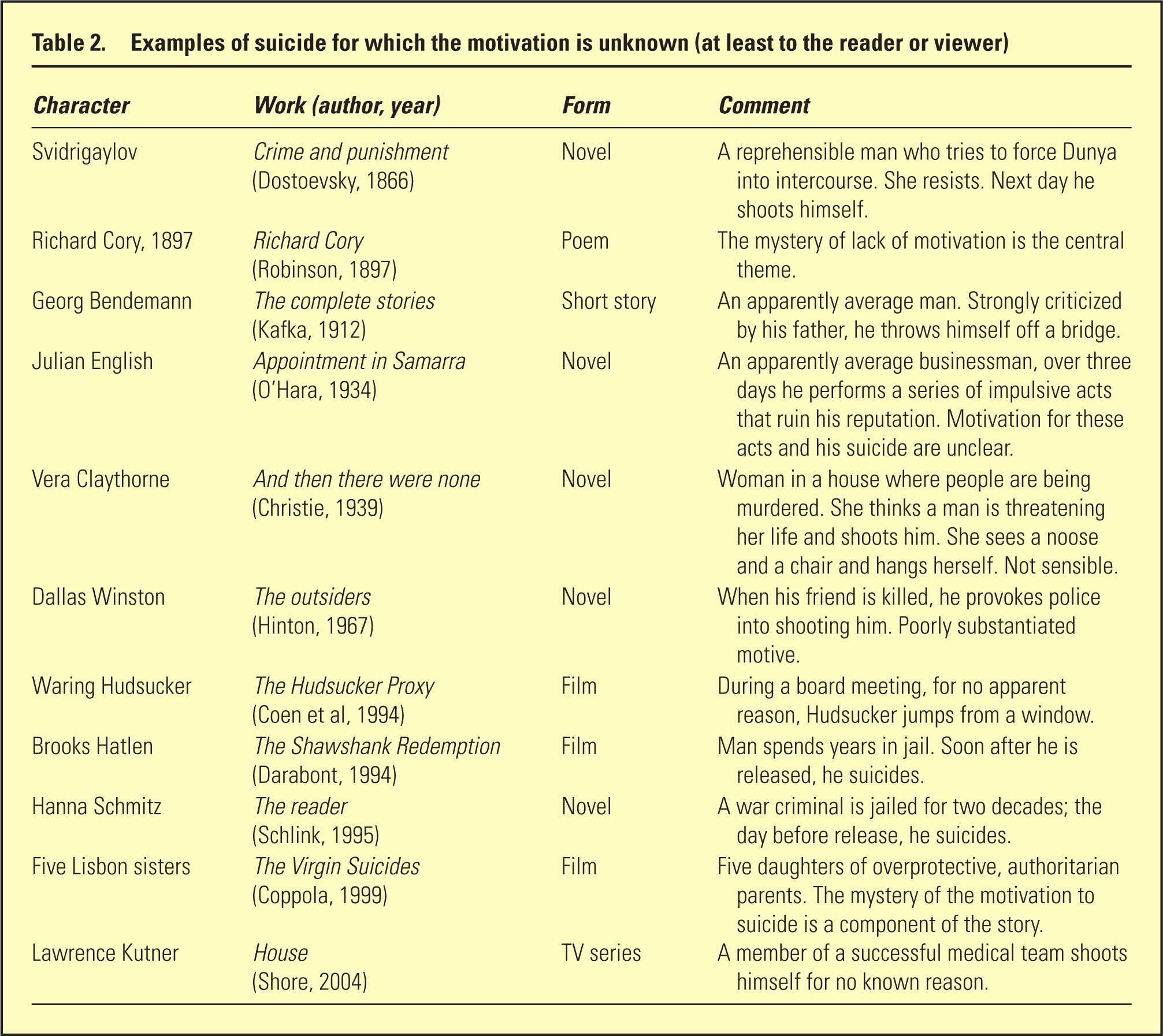
In 15 cases, the motivation for the suicide could not be determined by the reader (Table 2). In many of these, the mystery surrounding the suicide was a literary mechanism to generate interest.
Examples of suicide for which the motivation is unknown (at least to the reader or viewer)
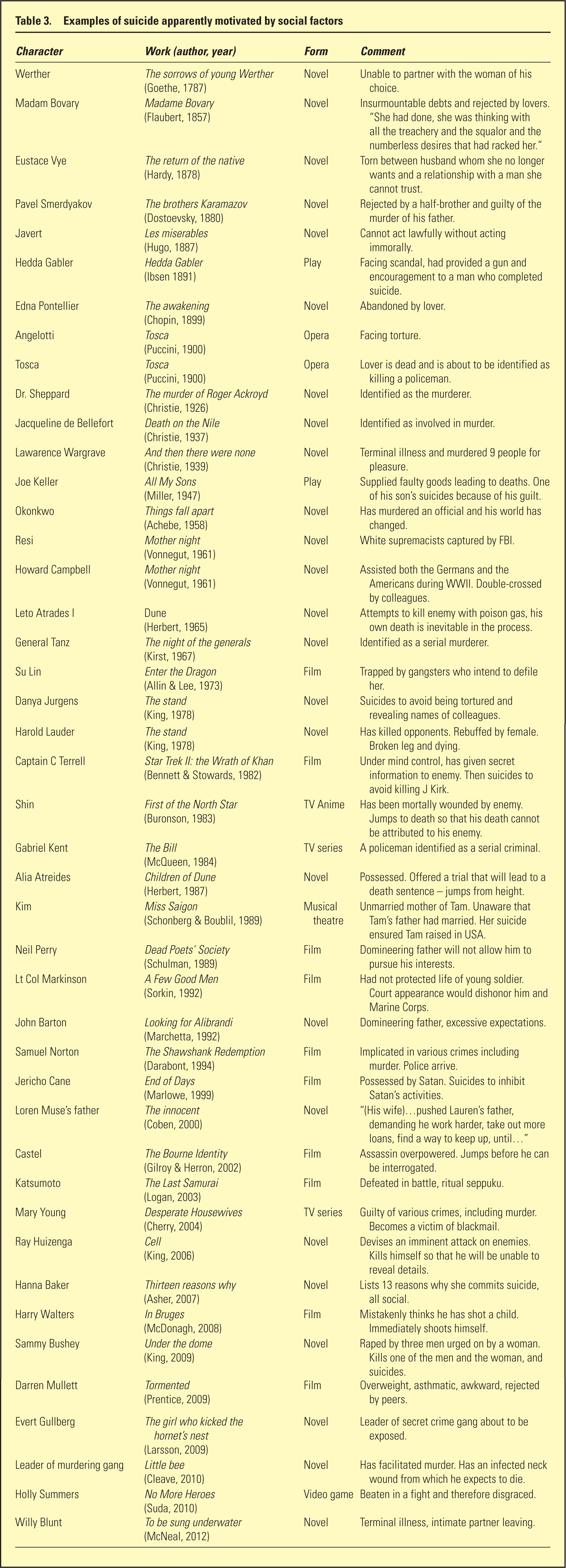
In 44 suicides, social/situational factors appeared to be the motivation (Table 3). In this last group, the motivation included escape from imminent torture or prosecution, loss of honor, guilt, excessive expectations of parents or spouse and imminent death by another means.
Examples of suicide apparently motivated by social factors
Hanging, leaping from a height, gunshot and drowning were the most common means. Poisoning, overdose of sleeping tablets, self-stabbing and carbon monoxide poisoning were also occasionally represented. There was a wide range of ages, including many teenagers and young adults, but also middle-aged and some older people with terminal illness.
Discussion
It would appear that art imitates death, as far as the depiction of suicide in narrative products is concerned. In fiction, as in the general community, suicide is a not an infrequent event, the age range of its victims is wide, the context includes underlying mental illness, but suicide may occur independently (including in response to social and situational factors alone), and a variety of lethal means may be potentially employed.
While the number of cases (71) that we have reported is not small, this sample is presumably not comprehensive and underestimates, perhaps sizably, the actual number of suicides that have been described in narrative products. Further, we only sourced narrative products that were in English (the vast majority had been originally written in English, but some had been translated from another language). We accepted all accounts that came to our attention, with two exceptions: (1) “Donnie Darko”, where we could not satisfactorily grasp the story; and (2) the character of “Kiyomi Takada”, who appears in a story about a magic book in which, if your name is written you die. It was written that Kiyomi would die, and she did, but her death was not a matter of free choice.
Supporting the notion that stories of suicide can be influential were events following the publication of Goethe’s “The Sorrows of Young Werther” in the late 18th century. 47 Werther was in love with Charlotte, but she was happily married. As Werther could not be with Charlotte, he became despondent and shot himself. Publication led to “Werther Fever” (“Werther-Fiebre”), the wearing by young males of clothing of the type described, and the suicide of some (indeed, perhaps as many as 2000).
While there might be little argument with the view that narrative products are, at least to some degree, influential, it should also be acknowledged that the impact of “great literature” may have lessened in the past century, with the advent of more “immediate” forms of media. Nowadays, “social media” and “celebrity culture” may have more bearing on people’s actions than novels.
Regrettably, suicide prevention activities, which have been largely based on early detection and treatment of mental disorders, have failed to make the desired impact on suicide rates throughout the world. 88 If we accept Durkheim’s stance that cultural factors contribute to suicide, it would also be sensible to contemplate whether cultural factors might be manipulated to reduce the rate. In such circumstances, a discussion about the portrayal of suicide in fiction is indicated. In turn, this must include careful consideration of the pros and cons of censorship (e.g. should a particular work have a restricted audience on the basis of its representation of suicide?) and encroaching on artistic freedom (e.g. is it prudent to make recommendations about the optimal depiction of suicide in fiction?), even when the stakes are “life and death”.
Footnotes
Acknowledgements
We thank Nerissa Soh and Philip Tam for their helpful comments on an earlier draft.
Disclosure
The authors report no conflict of interest. The authors alone are responsible for the content and writing of the paper.