







Abstract
Objective:
We aim to describe the rationale for and spectrum of leadership development programs, highlighting experience at a large healthcare institution (Cleveland Clinic, Cleveland, Ohio, USA).
Conclusions:
Developing leaders is a universal priority to sustain organizational success. In health care, significant challenges of ensuring quality and access and making care affordable are widely shared internationally and demand effective physician leadership. Yet, leadership competencies differ from clinical and scientific competencies and features of selecting and training physicians—who have been called “heroic lone healers” —often conspire against physicians being effective leaders or followers. Thus, developing leadership competencies in physicians is critical.
Leadership development programs have been signature features of successful organizations and various Australian organizations offer such training (e.g. The Australian Leadership Foundation and the University of South Australia), but relatively few health care organizations have adopted the practice of offering such training, both in Australia and elsewhere. As a United States example of one such integrated program, the Cleveland Clinic, a large, closed-staff physician-led group practice in Cleveland, Ohio has offered physician leadership training for over 15 years. This paper describes the rationale, structure, and some of the observed impacts associated with this program.
The complexity of challenges facing health care today—ensuring access, quality and safety, and affordability—has created a demand for effective leadership in health care. 1 As the faces and frontlines of care, physicians are best placed to serve in these increasingly challenging roles.2–9 To the extent, however, that leadership expertise differs from clinical or scientific expertise, that medical and training curricula characteristically do not address leadership competencies, and that physicians are “collaboratively challenged” by virtue of traditional selection criteria and training,4,5,10 there is an ever-increasing demand for professional training for physicians in leadership competencies.3,6–9,11 Such efforts are growing, with offerings by medical societies (such as the United States and Canadian Academy of Pathology, the Society for General Internal Medicine, and the American College of Chest Physicians, etc.), business schools, and by a few health care institutions (e.g. Queensland Health, the Cleveland Clinic, Baylor Scott and White Health, etc.).
The rationale for physician leadership
In developing effective leaders, many hospitals and health systems struggle to find consistent strategies. Indeed, because the nature of leadership and needed competencies have been perceived to be “complex, emergent, and unpredictable”; 12 some have even questioned whether such programs have demonstrable value.12,13
In defense of the need for developing effective leaders, more than 50% of hospitals report changes in their senior leadership team over the past 2 years, and nearly a quarter plan to add one or more roles to these teams over the next 2 years. 11 Yet, of 10 measurable dimensions of leadership effectiveness, CEOs rated as lowest their teams’ abilities to prepare internal candidates for future leadership positions. 11
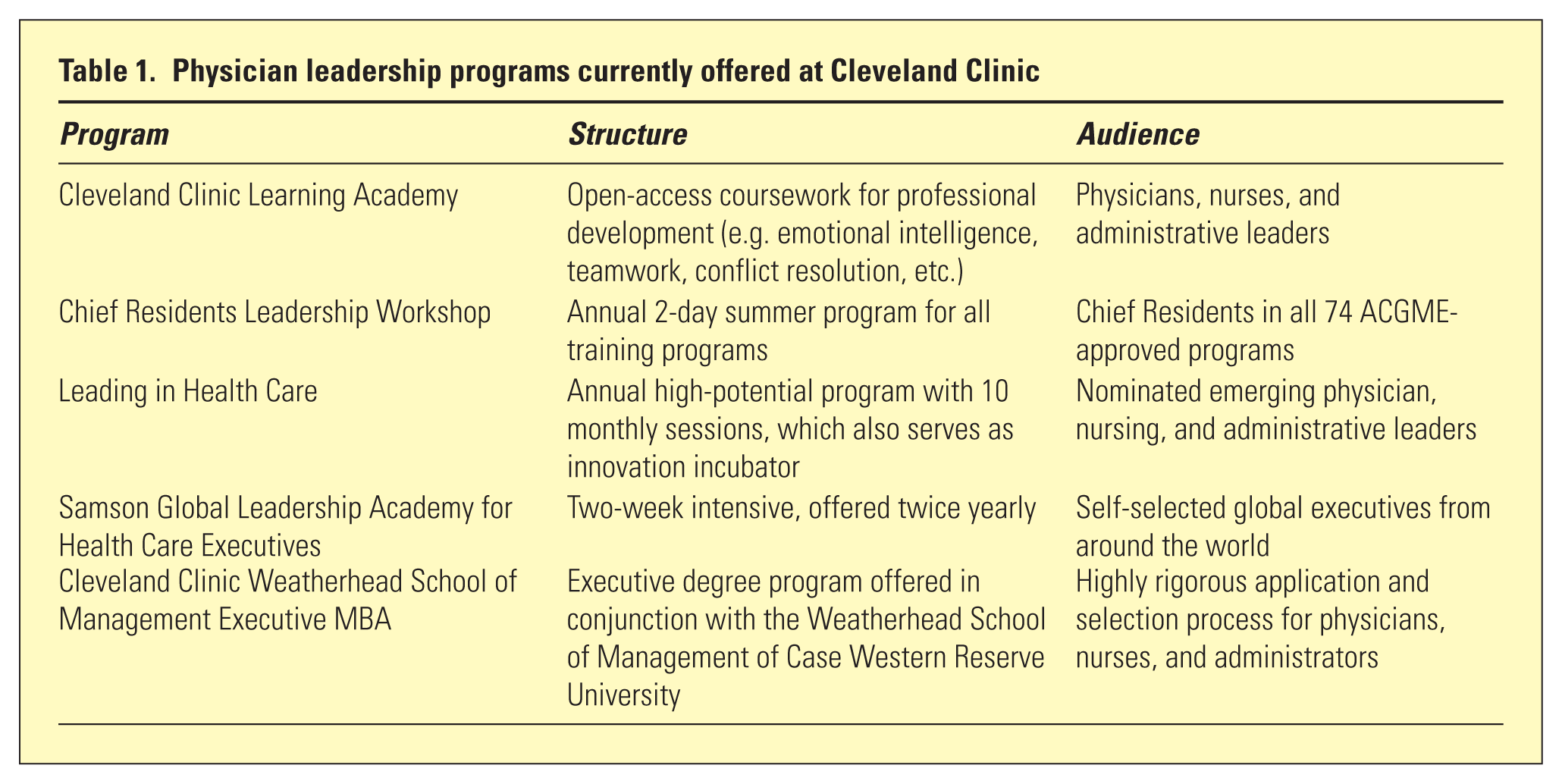
The Cleveland Clinic has had a longstanding commitment to training caregivers in leadership competencies for health care, addressed both through various intramural programs 8 as well as through programs that are offered extramurally (e.g. Samson Global Leadership Academy,14,15 Executive Visitors Program). The specific rationale for most of these programs, as well as their design features and target audiences, are reviewed in Table 1 and below.
Physician leadership programs currently offered at Cleveland Clinic
An historical perspective: physician leadership development at Cleveland Clinic
Founded in 1921, the Cleveland Clinic established a closed-staff, group practice model with a tripartite clinical, research, and educational mission of “better care of the sick, investigation of their problems, and more teaching of those who serve.” 16 This third piece, the education of those who serve, was the primary goal of the Cleveland Clinic Education Foundation when it was founded a little over a decade later.
Since its inception, the Education Foundation (now called the Education Institute (Figure 1)) has continued to extend the medical education vision of the founders, including the establishment of many educational offerings that serve a wide range of educational audiences, including the Lerner College of Medicine, the Cleveland Clinic Learning Academy, and various leadership development programs for physicians and other caregivers (Table 1).
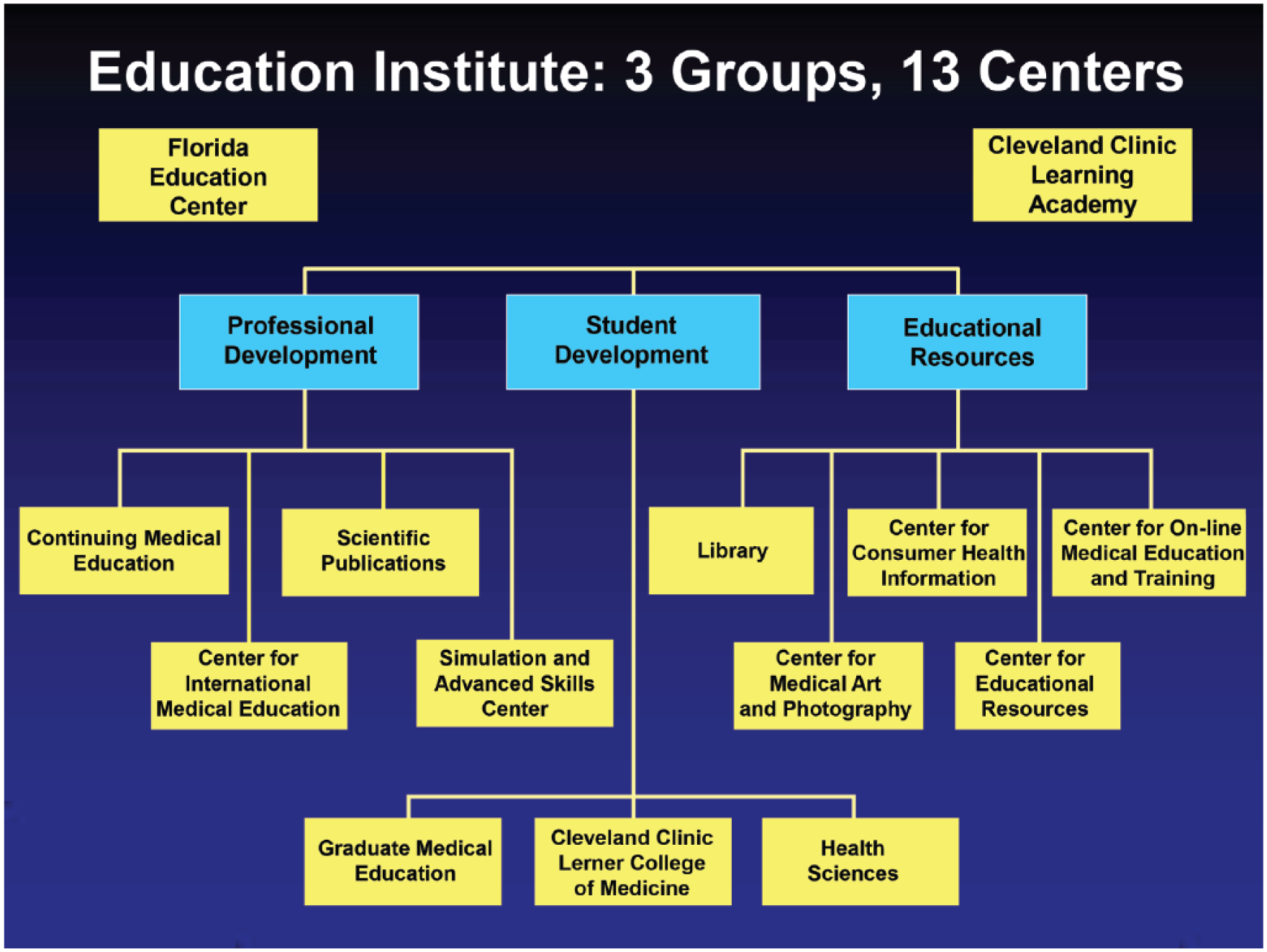
Table of organization of the Cleveland Clinic Education Institute.
Leading in Health Care
First offered in 2001, Leading in Health Care (LHC) is the first leadership development program that was offered at Cleveland Clinic. 17 The course is a cohort-based offering, which consists of 10 full-day sessions offered once monthly between September and June. As originally offered, the course enrolled physicians as it was felt that the physician leadership pipeline was thinnest among doctors. As it became clearer that effective organizational success requires inter-disciplinary leadership training, the course was expanded to its current inter-disciplinary cohort of approximately 70 physicians, nurses, and administrators, all of whom are nominated for participation by their respective chairpersons as high-potential emerging leaders. 18
The curriculum of the course is highly participatory and is organized around three themes:
Organizational mission, vision, and values, as informed by a series of conversations with organizational leaders and discussions about organizational history and culture,
Fundamentals of health care finance (including how to develop a formal business plan), and
Organizational development, which includes emotional intelligence, teambuilding, strategic planning, conflict resolution, and executive presentation skills, among others.
In addition to the skill-based sessions listed above, 360° feedback evaluations provide insight to each attendee, while also providing an opportunity to receive executive coaching on the same.
This course is also designed as an innovation incubator, with each attendee invited at course inception to propose an idea that he/she would like to implement. The top 12 ideas that the group most prefers are culled from the 70 submissions, and multi-disciplinary teams then form around each idea, with each team developing a full business plan over 10 months for implementation that is ultimately presented to Cleveland Clinic leadership at the final session.
The course has been uniformly well received by participants. Success as an innovation incubator is supported by the fact that 61% of the business plan ideas either have been implemented or have extinguished an idea that the team itself felt was infeasible based on fuller analysis. 17 Perhaps the greatest indicator of the program’s impact and success is that 43% of participants have been promoted to leadership positions at Cleveland Clinic over the ensuing decade, and an analysis that shows that the baseline emotional intelligence correlates of long-term promotion are having self-confidence, being a change catalyst, and having an achievement orientation. 18 Leading in Health Care is currently in its 13th year.
Cleveland Clinic Learning Academy
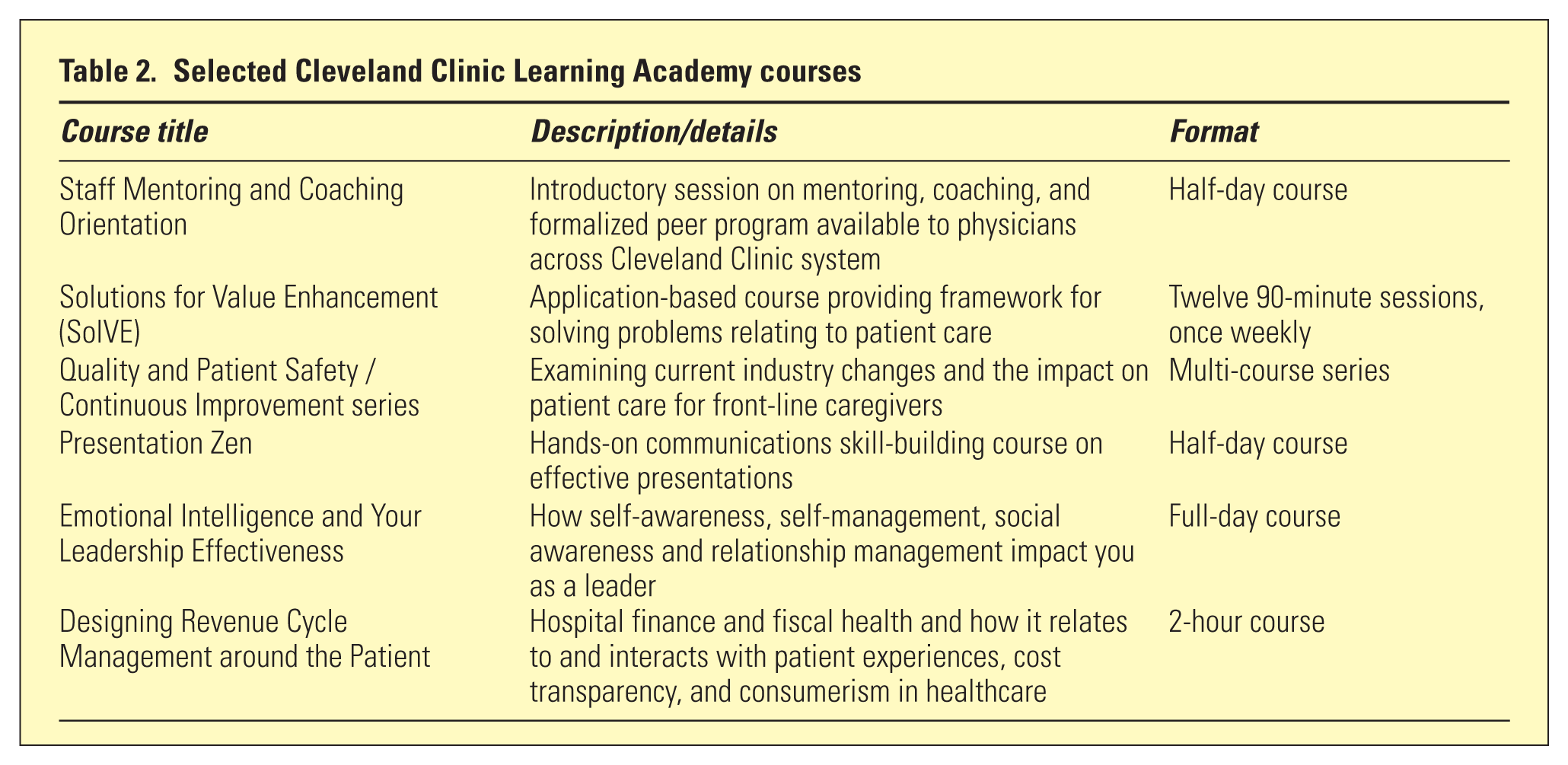
The Cleveland Clinic Learning Academy (CCLA) began in 2006 as a way to grow leadership development offerings and to offer standalone, competency-based courses to interested nurses, physicians, and administrators. In 2014, over 130 courses were offered (Table 2), with over 4250 unique participants and consistently high ratings of over 4.8 out of a possible 5.0 scale. 15
Selected Cleveland Clinic Learning Academy courses
Chief Residents’ Leadership Workshop
Based on the notion that leadership development should be offered to physicians at formative periods of their medical training, a 2-day leadership development has been offered to chief residents each summer since 2008. Chief Residents (CRs) from all specialties are invited to participate and, to date, 105 CRs have attended. As outlined in the companion paper in this volume, 19 attendees have rated the workshop highly and have reported enhanced familiarity with the leadership competencies taught after the workshop.
Cleveland Clinic—Weatherhead School of Management Executive MBA
To provide an opportunity for more in-depth learning and pursuit of a degree, a collaboration between the Cleveland Clinic Education Institute and the Weatherhead School of Management established this jointly taught program in 2015. 20 The curriculum offers a focus on health care leadership and management issues and is available to candidates both from the Cleveland Clinic and other organizations.
Samson Global Leadership Academy for Health Care Executives
As an outgrowth of experience with LHC and in response to outside interest, the Samson Global Leadership Academy was established in 2011. 7 The 2-week residential program is offered twice yearly in Cleveland and is organized around themes of self-development and systems thinking. The curriculum focuses on clarifying attendees’ leadership vision in the context of awareness of the issues that surround health care delivery. Attendees are aided by executive coaches, connect with the broader network of course alumni through an electronic portal and network, and prepare a brief address framing their vision for their colleagues as a capstone experience of the course. To date, 114 individuals from 21 countries (including Australia) have attended the Samson Global Leadership Academy.
Conclusion
Based on a review of best practices in industry programs commissioned by the United States Army (which has keen interest in leadership development), characteristics of an effective leadership development program have been summarized by Day and Halpin (Table 3). 21 The design and delivery of the Cleveland Clinic physician leadership development programs aligns with these recommendations. Programs have been uniformly well received, and, though there is clearly a continued need to assess impact based on skepticism and many unanswered questions,12,13,22 there is already available and growing 22 evidence of important institutional impact and value.
Features of Leadership Development Programs
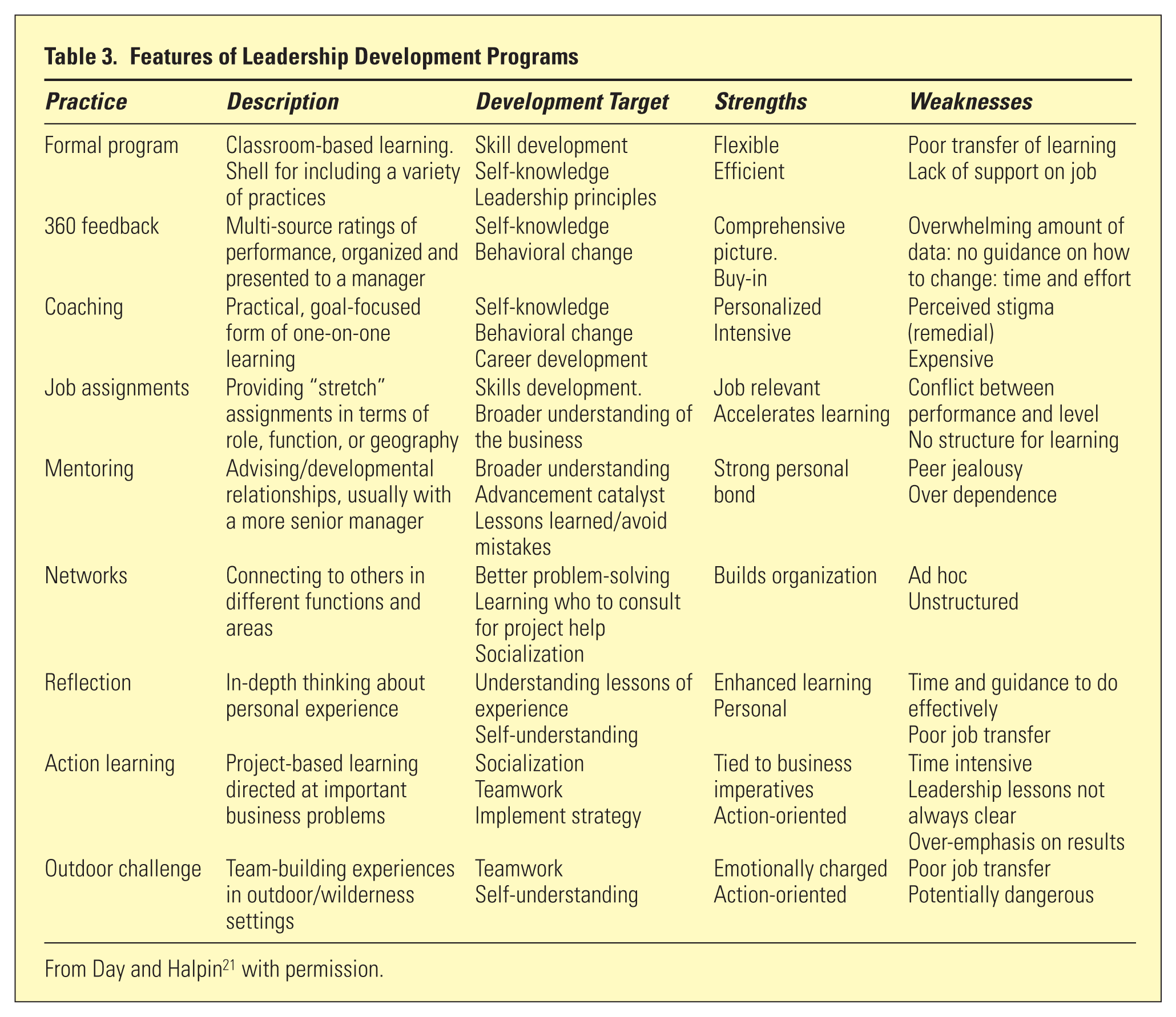
From Day and Halpin 21 with permission.
Ongoing efforts to offer inter-disciplinary programs and to include the full integration of these curricular offerings with the other dimensions of leadership development—coaching/mentoring and progressive experiential leadership assignments, as well as continued study of the actual impact of the programs on individuals’ leadership success and on organizational strategic goals.
The approach to leadership development at the Cleveland Clinic is now multi-disciplinary with the goal has been to develop pools of high-potential future health care leaders, while also providing foundational leadership skills to all physicians, who serve as the de facto leaders across the health system. Based on our experience and interactions with international health care leaders around leadership development (including from Australia and New Zealand), we believe that these goals apply broadly internationally.23–26
Footnotes
Disclosure
The authors report no conflict of interest. The authors alone are responsible for the content and writing of the paper.