






Abstract
Objectives:
This study aims to describe the impact of a mental health assertive community treatment prison model of care (PMOC) on improving the ability to identify prisoner needs, provide interventions and monitor their efficacy.
Methods:
We carried out a file review across five prisons of referrals in the year before the implementation of the PMOC in 2010 (n = 423) compared with referrals in the year after (n = 477).
Results:
Some improvements in the identification of needs and providing interventions were detected. There was increased use of medication management and clinically significant improvement in addressing engagement with families. Monthly multi-disciplinary team face-to-face contact improved.
Conclusions:
Meeting the needs of mentally ill prisoners is challenged by the complexity of the custodial environment. Improvements made resulted from changing the model of care, rather than adding new resources.
The prevalence rates of psychotic illness and major depression in prison populations are 14% (males) and 18% (females). 1 The ‘equivalence principle’ states that prisoners have a right to the same level of access to mental health treatment in prison as in the community. 1 Interventions that assist people in the community, such as social skills training, psycho-education and cognitive rehabilitation, 2 also assist in prison settings. Yet, access rates to such therapies are disappointing. 3
Prior to 2011, New Zealand prison mental health services to those suffering psychotic illnesses and major depression were provided by in-reach teams without an explicit model of care. Caseloads fell short of expected levels calculated from epidemiological prevalence rates. 4 Consequently, two Regional Forensic Psychiatric Services developed an explicit prison model of care (PMOC). The PMOC formalised a multi-disciplinary ‘modified’ assertive community treatment model with after-hours on-call emergency support. The principles of this model are assertive engagement, continuity of care, multi-disciplinary service delivery and a small case load. 5 Treatment interventions include medication management, psycho-education, psycho-social therapies, motivational interviewing, facilitation of family involvement, alcohol and substance misuse treatment, physical health support, referral to specialist agencies, addressing housing/financial needs, addressing educational needs and cultural support 5 (for Māori (50% of the prison population) and Pacific Island peoples (11%) 6 ).
The PMOC divides healthcare delivery into five steps – screening, referral, assessment, treatment and release planning. 5 There were no new resources for this change in service model, requiring clearer role definition within multi-disciplinary teams and collaboration with correctional staff. This model has shown positive impact on the detection 7 and community re-integration 8 of the caseload.
In the treatment phase, the PMOC requires needs to be identified, interventions provided and efficacy to be monitored (through monthly contact and three-monthly multi-disciplinary review). 5 The aim of this paper was to describe the impact of the PMOC on improving identification of needs, providing interventions and monitoring progress.
Methodology
Improvements in the requirements of the PMOC were measured by comparing a baseline one year prior to implementation in 2010, with the changes in the year following the implementation.
The five prisons in the study were a minimum/maximum security prison (456 pre-trial and sentenced women); a remand prison (966 men); and three minimum- to high-security prisons for 1979 sentenced men. All new referrals to the in-reach teams’ caseload in both periods were identified from electronic prison management systems and included in the study.
A file review of all new referrals was undertaken. Consent was not required as only de-identified data for aggregate analysis were extracted. This data related to socio-demographic and crime-related variables, prisoner needs, interventions and contacts/reviews. Needs were categorised according to the domains of the Camberwell Assessment of Need – Forensic Version (CANFOR). 9 These domains cover 25 health, social, clinical, functional and offence-related areas of life. Contacts and reviews were tracked in accordance with the minimum standards in the PMOC. 5 If prisoners had one instance where a monthly face-to-face contact or three-monthly review was missed, then a null result was recorded for their whole treatment episode.
Data were transferred to Excel spreadsheets and analysed using descriptive statistics. The statistical significance of the results was tested using Z-tests. The research was approved by the Upper South B Regional Ethics Committee (Ethics Ref: URB/10/12/053).
Results
Sample description
A total of 900 prisoners were referred to the mental health in-reach teams in the study period; 423 in the year pre-PMOC (women’s prison = 85; male remand prison = 108; sentenced male prisons = 230) and 477 in the year after (women’s prison = 51; male remand prison = 147; sentenced male prisons = 279).
The majority (701 of 900; 78%) were 40 years old or younger. Over half were Māori (538; 60%), the rest mainly Caucasian (250; 28%) or Pacific Island people (61; 7%). The most common type of offence for which prisoners were charged or convicted (398; 44%) were for violence offences.
The most common primary diagnosis was schizophrenia (407 of 900; 45%). Almost half (444, 49%) had a co-morbid substance use disorder, personality disorder or both, with no significant differences in any of these variables between groups in the pre and post periods.
Prisoner needs
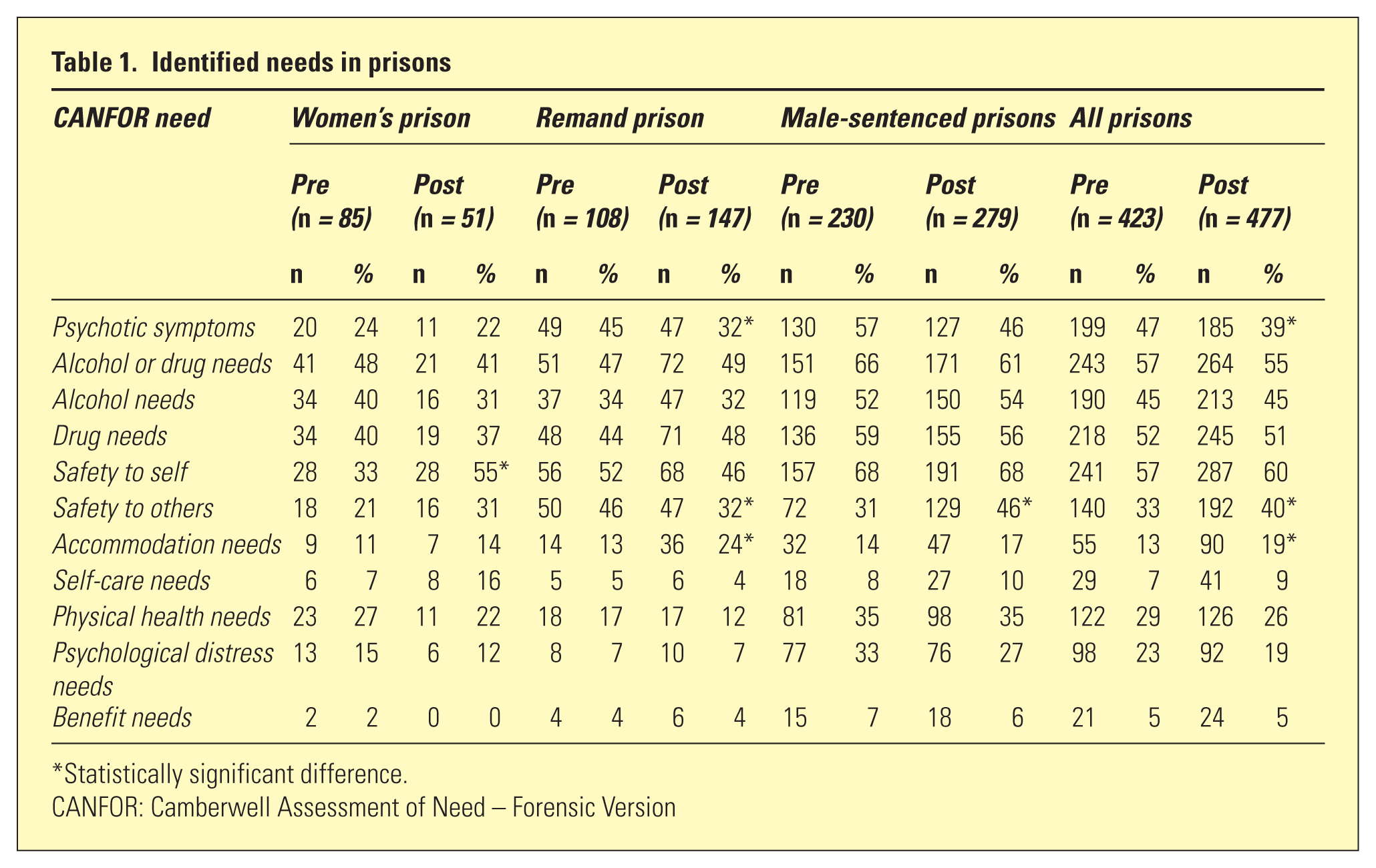
Although all domains of CANFOR were identified in the file reviews, only those with sufficient numbers for analysis are shown in Table 1. Across all the prisons, there was a significant increase in prisoners identified with needs related to safety to others (Z = −2.22, p = 0.03) and accommodation needs (Z = −2.39, p = 0.02). There was a significant decrease in prisoners identified with psychotic symptom needs after the introduction of the PMOC (Z = 2.5, p = 0.01).
Identified needs in prisons
Statistically significant difference.
CANFOR: Camberwell Assessment of Need – Forensic Version
The decrease in needs related to psychotic symptoms occurred in the remand prison (Z = 2.18, p = 0.03) and the sentenced male prisons (Z = 2.47, p = 0.01). The significant increase in needs related to safety to others occurred in the male-sentenced prisons (Z = −3.42, p = 0.001). At the women’s prison, there was a significant increase in the identification of needs related to safety to self after the introduction of the PMOC (Z = −2.52, p = 0.01).
Interventions
There was a significant improvement in the percentage of the caseload receiving medication management after the introduction of the PMOC (Z = −2.81, p = 0.005) (Table 2).
Interventions to meet needs

Number of Maori and Pacific prisoners in brackets. Percentages are calculated using these numbers.
Statistically significant.
Some improvements were unique to specific prisons. At the remand prison, there was a significant increase in the proportion receiving interventions relating to alcohol or drug use (Z = −1.97, p = 0.04). At male-sentenced prisons, there were significant increases in the facilitation of family involvement (Z = −2.30, p = 0.02).
Monitoring progress
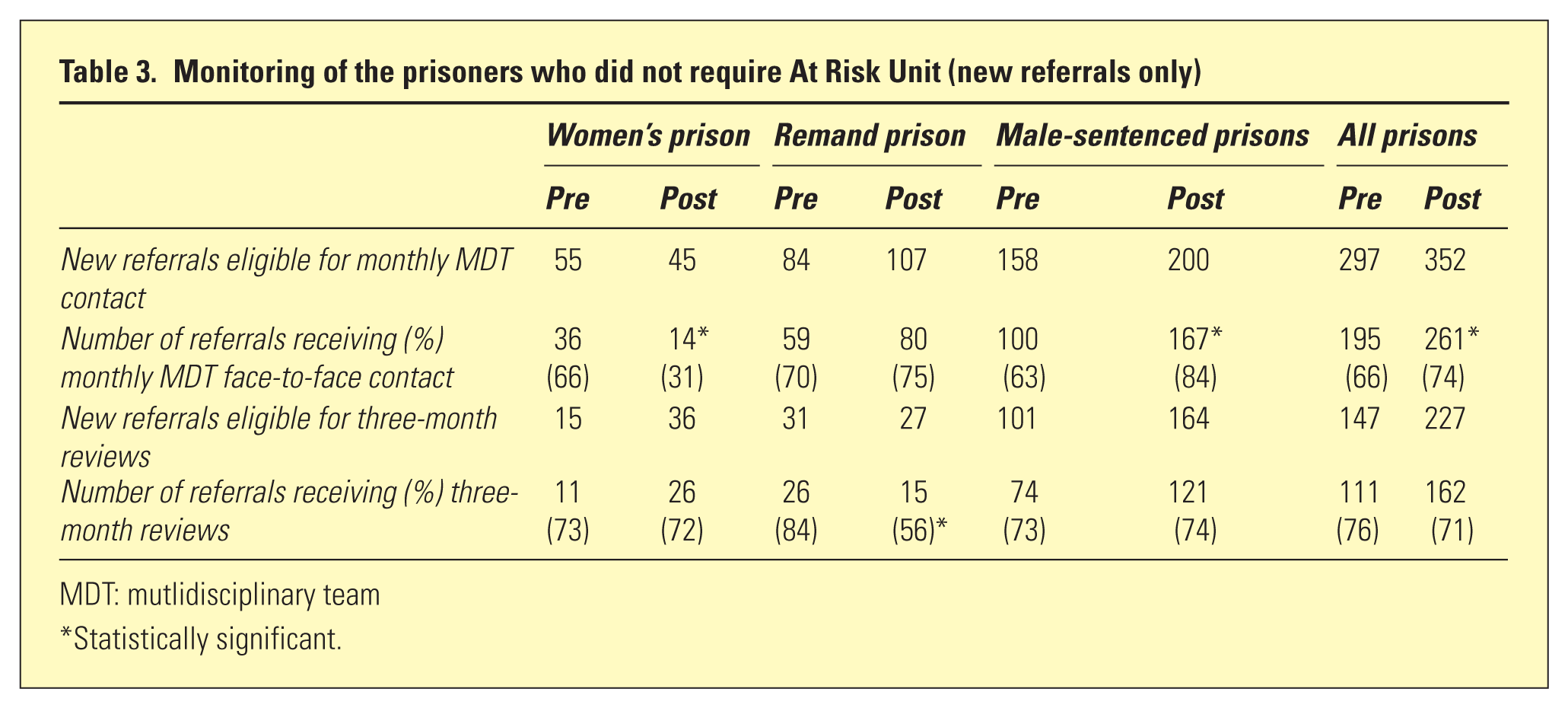
Table 3 shows the total number of new referrals eligible for monthly monitoring and three-monthly review (n = 295 of 423, 70%, pre-implementation; 352 of 477, 74%, post-implementation). The majority of prisoners requiring both monthly mutlidisciplinary team contact and three-monthly review had these completed both pre and post the PMOC. However, monthly contact improved in the prisons overall (Z = −2.36, p = 0.02), primarily in the male-sentenced prisons (Z = −4.36, p < 0.05). Paradoxically, the women’s prison had a significant decline in such contacts following the PMOC (Z = 3.42, p < 0.05) and the remand prison had a significant decline in the three-monthly reviews (Z = 2.36, p < 0.05).
Monitoring of the prisoners who did not require At Risk Unit (new referrals only)
MDT: mutlidisciplinary team
Statistically significant.
Discussion
Given the poor health outcomes of prisoners early on release, including suicide and relapse of mental illness, 8 it is imperative that early detection and treatment of mental illness occurs in prison. We found evidence over five prisons for some improvements in the ability of an Assertive Community Treatment based model of care to identify needs, undertake interventions to address them and monitor for efficacy. There was an increased emphasis on medication management and on social care needs such as improving contact with families. However, the treatment of some needs fell short of expectations. Some prisoners with serious mental illness may choose not to access services because of preference, concerns about their reputation, confidentiality concerns, prior experience or the symptoms of mental illness. 2 Prisons directly employ psychological expertise and the extent to which some needs were addressed by these services is not clear.
There was low engagement with specialist drug and alcohol treatment, despite high rates of identified needs. This may indicate some urgency for implementing shared responses between primary and specialist services in providing seamless services for people experiencing co-occurring mental health and addiction needs. 10 However, the remand prison was able to demonstrate improvements in the delivery of drug and alcohol treatment. This is heartening, as other studies have found that remand prisoners receive poorer treatment planning 11 secondary to the rapid turnover of the remand population.
Cultural expertise was integrated within the PMOC to address the predominance of prisoners of Māori and ethnicity requiring mental health services. However, the delivery of culturally specific support/treatment also fell short of expectations. During assessment, cultural staff are prioritised to determine the impact of culture on presentation, which may limit their involvement in culturally specific interventions. Prisons also have Māori cultural experts employed by Corrections and it is not clear whose role it is to address cultural needs. The involvement of cultural expertise in ongoing cultural support requires further investigation.
Limitations
Research within the context of a custodial environment is difficult to initiate. This was a naturalistic study, in which vagaries that applied to some prisons made comparisons difficult. These included a natural disaster that affected the women’s prison post-implementation, as well as the privatisation of the remand prison post-implementation. Both these prisons produced paradoxical results that coincided with these events.
There were also some limitations to the data collected. The CANFOR was designed for prisoner interviews. We identified needs from clinical notes. Therefore, the number and breadth of prisoner needs may have been underestimated. Data collection for the post-PMOC period commenced from the day of introduction of the model, when the implementation of the model was just beginning.
Finally, face-to-face contacts and reviews were recorded as null cases based on a single lapse throughout an episode of care. This may have been a harsh measure and over-represented uncompleted face-to face contacts and reviews.
Conclusion
We found that despite the challenges of providing therapeutic care in a custodial environment, particular attention to the service delivery model could improve the delivery of treatment to prisoners with serious mental illness. This was achieved by changing the model of care rather than adding new resources, suggesting it is the principles, as described in the model of care, that have had an impact.
Footnotes
Acknowledgements
We acknowledge the New Zealand Department of Corrections who approved this research.
Disclosure
The authors report no conflict of interest. The authors alone are responsible for the content and writing of the paper.
Funding
This work was supported by the Health Research Council, New Zealand (grant number 10/819).