







Abstract
Objective:
The aims of this paper are to describe a Māori approach to assessment and intervention planning using the Māori creation narrative Te Ara a Tāne (The Journey of Tāne) and to outline an evaluation one year after the model was implemented.
Conclusions:
Te Ara Waiora a Tāne is a kaupapa Māori (Māori-centred) mental-health engagement, assessment, goal setting and planning approach designed to enhance the mana (spiritual and personal authority) of whānau (individuals and family/families) at the point they enter a Māori service and during ongoing mental-health work. Preliminary evaluation indicated that staff considered the model user-friendly and helpful for whānau. Further evaluation is needed to assess the impact of this approach on Māori whānau engagement with services.
Io-matua-te-kore, creator of all things, residing in the 12th and highest heaven, looked down upon the many children of Papatūānuku (the earth mother) and Ranginui (the sky father) and decided to offer them knowledge from the higher realms. Io sent three messengers to choose one of them to undertake this quest: to bring the three kete (baskets) of knowledge back to earth for the benefit of humankind. Although several put themselves forward, it was Tāne-nui-ā-Rangi, one of the youngest, who was chosen, due to the wisdom in the method he proposed for the arduous journey to the upper realms. On his journey, he faced many challenges and obstacles. His jealous elder brother Whiro, determined to acquire the kete for himself, sent plagues of insects to harass Tāne and throw him off course. However, another brother Tāwhiri-mātea, guardian and deity of the winds, protected him by blowing the insects away and lifting Tāne closer to his goal. Finally, after overcoming many trials and pitfalls, Tāne reached the 12th Heaven and retrieved the three kete. He then returned to Papatūānuku and planted the baskets into her and from that time on this knowledge has been available to humanity.
The first bicultural mental-health unit dedicated to working with Māori whānau was set up in the early 1980s at Tokanui Hospital in the Waikato region of Aotearoa (New Zealand). By the early 1990s, other kaupapa Māori mental-health services were established, including Te Whare Mārie, which is based in Porirua, near Wellington. 1
At the same time, Māori models of health, including Te Whare Tapa Whā and Te Wheke, were being articulated to support clinicians and government agencies, amongst others, to consider holistic and Māori relevant approaches across the health sector. 2 Despite these models, it has been common in mainstream mental health and even kaupapa Māori services that assessment procedures follow traditional Western psychiatric models, with limited reference to Māori values and beliefs. 3 Given the history of colonisation in Aotearoa and many negative consequences of this for Māori, it has been suggested that such Western psychiatric approaches risk a further colonising effect on Māori whānau. 1
In the mid-1990s, a Māori therapeutic paradigm known as Mahi-a-Atua was introduced to Te Whare Mārie by Diana Rangihuna (Kopua D, pers. comm., 2018). This modality is a mental-health engagement, assessment and intervention approach based on Māori creation and custom narratives, which offers whānau access to Māori meaning frameworks and ancestral knowledge systems. 3
At Te Whare Mārie, ‘Te Ara a Tāne’ was renamed as ‘Te Ara Waiora a Tāne’ (Tane’s Journey of Well-Being) to emphasise the metaphor of a pathway towards well-being. It was chosen as a guiding narrative for assessment and intervention practices derived from Mahi-a-Atua 3 and aligned with the Choice and Partnership Approach (CAPA) adopted in our local mental-health services. 4 CAPA focuses on what whānau want from their encounter with mental-health services. The initial ‘Choice’ appointment is intended to identify shared goals that relate to the presenting mental health problems, based on a shared formulation. Subsequent ‘Partnership’ appointments, known as Tuakana-Teina appointments (a Māori metaphor for reciprocal collaborative clinician–whānau relationships), continue joint work towards the goals of the whānau.
Use of Te Ara Waiora a Tāne during Hui Whakatau (initial assessment meeting)
The Journey of Tāne is recounted in an ancient karakia (incantation) known as ‘Tēnei Au’. At the commencement of an assessment meeting, clinicians offer to start the session with a karakia, as is customary with many Māori whānau. If this is their wish, this karakia is recited, along with a brief explanation. Following this, or instead if they prefer not to have karakia, the clinician initiates mihimihi, a round of introductions and sharing of places of belonging, iwi (tribal) and genealogical connections. This serves an essential engagement purpose centred on Māori values and beliefs. Next, the clinician provides orientation information about our service and the process. They then commonly return to or introduce the account of Tāne’s journey, for example:
“Have you heard about Tāne going up to the heavens to bring back the three kete or baskets of knowledge? If you are familiar with this, tell me what you know … (This relates to the karakia that we started our session with today.) We can use this creation narrative to help us figure out together what you want from our appointment today and what we can offer you…”
Tāne’s quest is recounted and likened to the journey of the whānau towards well-being. The three baskets represent their goals for involvement with the service. The deity Whiro, Tāne’s jealous and bullying elder brother, is compared to the obstacles and challenges that they are facing in their lives. Tāwhiri-mātea, ‘guardian or deity of wind’, represents the relationships and personal qualities that sustain, lift and strengthen them. These aspects are depicted visually on a whiteboard, with Tāne at the bottom, the three kete at the top, Whiro (challenges) on the left and Tāwhiri-mātea (strengths and supports) on the right. In the middle of the diagram, steps ascend from Tāne upwards, representing each step of the jointly developed action plan for this whānau. Following this explanation, the assessment interview can proceed covering usual territories appropriate to a psychiatric assessment, as well as Māori and other cultural assessment. For example, whakapapa (genealogy) could be explored with a genogram identifying iwi connections, intergenerational patterns of strength and difficulty, and whānau dynamics. Wairua (spirituality) might be explored by an enquiry into whether family members are familiar with Māori spiritual values and experiences. 1 As the interview progresses, this information can be added to the Tāwhiri-mātea or Whiro sides of the diagram. Later, the ‘steps’ towards their goals can be negotiated, agreed upon and written into the diagram.
Where individuals or families indicate in their words or body language that they prefer not to proceed with this approach, then we respect their wishes.
Use of this method in later appointments provides a structure for a re-evaluation of progress, as well as a way to measure whether initial goals have been achieved and to determine an appropriate time for discharge. There are cultural processes such as Hui whakamutunga (finishing up meeting) at that time to celebrate the work that has been done and successes for the whānau.
Outcomes
Te Ara Waiora a Tāne has been used for the last three years in both adult and child and adolescent Māori teams at Te Whare Mārie. After the first 12 months, a preliminary evaluation of the implementation of the model included a short survey of all 14 remaining clinicians who were originally trained in the model. Qualitative interviews with a subset of eight staff members were completed (Campbell W, unpublished data, 2016). All survey respondents indicated that they considered the model moderately user-friendly or better, and believed the model was helpful in supporting whānau while they were engaged with the service (see Table 1). More than 90% indicated the model met the desired assessment and goal setting outcomes at least moderately well, and 69% were either quite or extremely satisfied with the model.
Clinician responses to Te Ara Waiora a Tāne implementation survey
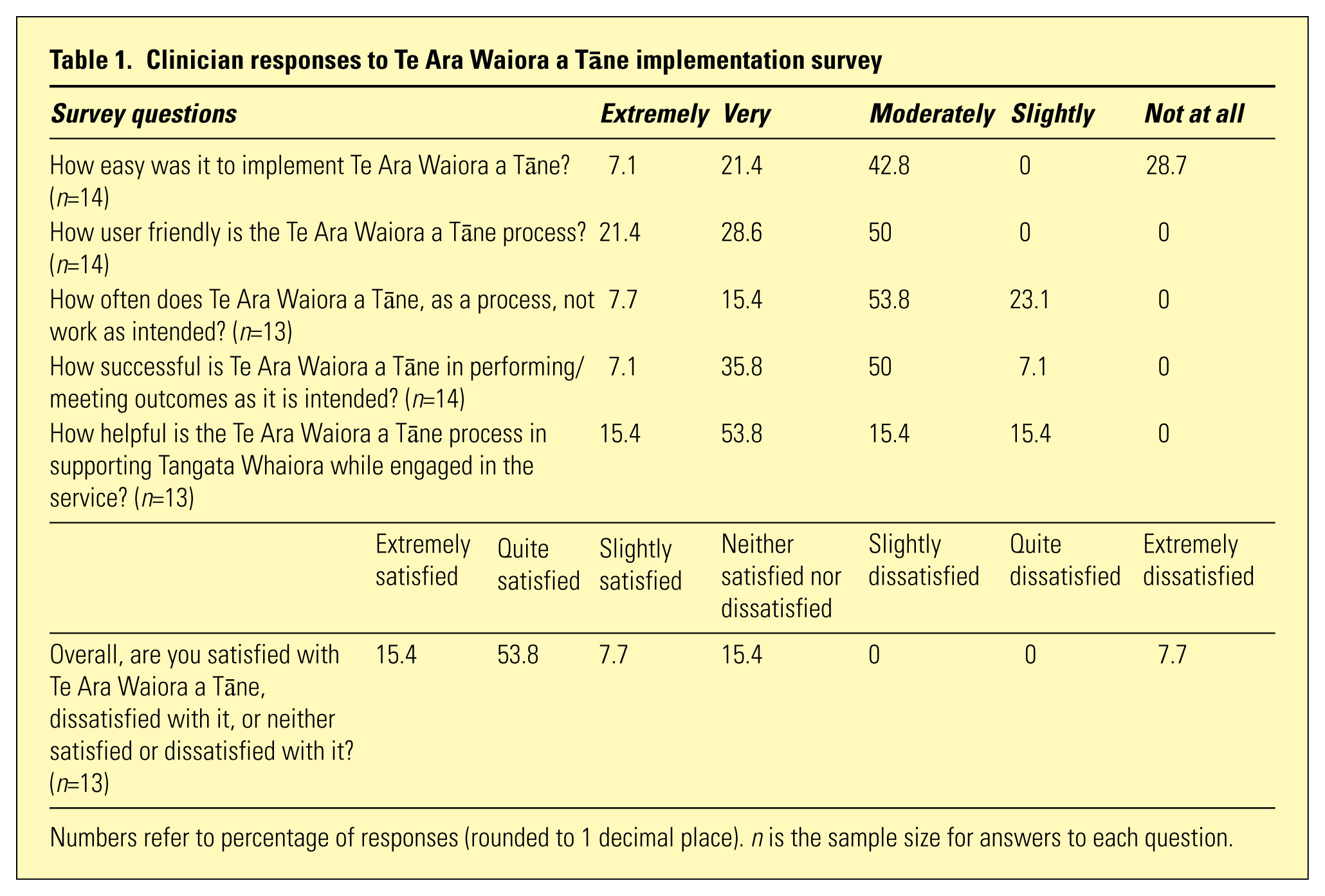
Numbers refer to percentage of responses (rounded to 1 decimal place). n is the sample size for answers to each question.
At the same time, more than 75% of respondents indicated that the process might not proceed as intended at least moderately often. Qualitative data provided possible explanations for this. One participant suggested clinicians not following the intended process was contributing to outcomes not being met, while another identified staff turnover as significant, with new staff less confident to engage with it initially.
Other qualitative responses suggested that Te Ara Waiora a Tāne benefited clinicians, including non-Māori staff, by developing their confidence in incorporating Māori cultural constructs into their clinical practice. Respondents considered that whānau engagement was improved and whānau had ‘more ownership’ of the process and more choice over what they wanted from their mental health care.
Discussion
In recent years, there has been increasing focus in kaupapa Māori services on Māori-specific models of service delivery which have Māori cultural values and beliefs at their core. 3 Te Ara Waiora a Tāne offers Māori whānau a culturally appropriate, innovative and practical structure for joint understanding, goal setting and planning next steps in their mental health care. The model is derived from Mahi-a-Atua 3 and embedded in Te Ao Māori (Māori world views) imbued with metaphorical possibilities inherent to te reo Māori (Māori language).
It has been reported that Māori whānau often feel disempowered in their interactions with mental-health providers. 3 Conventional mental-health processes may contribute to undermining the mana of whānau and poor engagement with services. 1 Clinicians suggested that whānau felt more empowered to make choices in their mental-health care after this model was introduced. This change is aligned with the principle of partnership in the Treaty of Waitangi included in health legislation in Aotearoa since the mid-1980s. 2 Furthermore, benefits for staff included increased confidence in using Māori approaches.
On the other hand, survey responses indicated frequent situations where the process of Te Waiora a Tāne did not proceed as intended. Interview responses suggested this could be due to clinicians not following the intended process, perhaps due to the newness of the model. Staff turnover was highlighted as a possible contributing factor, supporting the need for comprehensive training for new staff. Other potential reasons were not clarified in the initial evaluation.
Limitations include the preliminary nature of the evaluation which was not comprehensive, as well as the lack of evaluation of the views of Māori whānau about their experience of the model. Kaupapa Māori qualitative and quantitative research methods could be used to study this. 5
A significant unanswered question is the extent to which this model addresses domains covered in a bio-psycho-social formulation. 6 While biological, psychological and social predisposing, precipitating and perpetuating factors can be included in the Whiro side of the diagram and protective factors can be added to the Tawhiri-mātea side, this model may have less capacity to represent details of longitudinal history visually. Therefore, further research could examine the relationship between Te Ara Waiora a Tāne and conventional psychiatric formulation models.
Conclusion
Te Ara Waiora a Tāne is a collaborative, narrative-based kaupapa Māori mental-health engagement, assessment, goal-setting and planning approach embedded in Te Ao Māori. This approach is designed to enhance the mana of the whānau at the point of service entry and during ongoing mental-health work together. While an initial evaluation indicated that staff found it user-friendly and helpful for whānau, further research is needed to assess acceptability and effectiveness of this approach for Māori whānau.
Footnotes
Acknowledgements
We acknowledge the initiators of Te Whare Mārie, Pikau Te Rangi Arthur (koroua) and Ani Sweet (kuia), and all the kaimahi who have carried the vision of this Māori service. To all those who have passed on, Haere, haere, haere ki te pō, kapiti hono, tātai hono, koutou ki a koutou, kāti. We acknowledge Wakaiti Saba, Te Wera Kotua, the late Hemi Pou, Arna Mitchell, Kara Mihaere, Jayne Isaacs and Ngā Whānau o Te Whare Mārie. Thanks to Denis Grennell, Diana Kopua and Joanna MacDonald for their comments on this paper. We are indebted to Diana and Mark Kopua who guided and inspired the team with their kōrero-o-nehera (ancient knowledge).
Disclosure
The authors report no conflict of interest. The authors alone are responsible for the content and writing of the paper.
Funding
The authors received no financial support for the research, authorship, and/or publication of this article.