






Abstract
Objective:
To review the Hospital Outreach Post-suicidal Engagement (HOPE) service in the first six months of the pilot program in a metropolitan Melbourne setting, including a description of: (a) socio-demographic, health and psychosocial stressors of people referred; (b) method of presentation; (c) interventions provided and (d) outcomes measured.
Method:
A retrospective case file analysis reviewed the first six months of HOPE service operation.
Results:
Forty people received HOPE service during the study period, 60% female, mean age 35 years (range 17–58). The majority had previously engaged in self-harm (72.5%) or attempted suicide (67.5%). Stressors included social isolation, relationship breakdown, unemployment, financial stress, medical problems, history of mental illness, exposure to family violence and adverse childhood events. Statistically significant improvements occurred in the Outcome Rating Scale (ORS) and Session Rating Scale (SRS) following intervention. There were no deaths by suicide during the study period.
Conclusion:
People referred to HOPE had significant health and psychosocial stressors. Engagement significantly improved subjective well-being and connection with supports. Findings highlighted the need for an integrated clinical and psychosocial model to promote hope and connection in life post suicide attempt. It remains unclear which interventions improved well-being and if this contributes to suicide prevention.
Keywords
Preventing suicide is a global imperative. 1 In Australia, suicide is a leading cause of death; Victoria’s Suicide Prevention Framework seeks to halve the rate of suicide deaths by 2025. 2 As part of this objective, Hospital Outreach Post-suicidal Engagement (HOPE) initiatives have been piloted in selected Victorian health services. This outreach service provides up to 90 days of psychosocial care to individuals who have presented to an emergency department (ED), or had an admission to a medical unit following a suicide attempt who do not meet the threshold for entry into specialist public mental health care. At the area mental health service of this study, HOPE provides a person-centred, family-inclusive and recovery-oriented care approach utilising the collaborative recovery model (CRM). 3 The referral criteria includes that the person: (a) presents to ED following a suicide attempt, (b) agrees to referral and is aware of the model of support, (c) has needs that can be safely and appropriately met, (d) is aged over 18 years (unless clinical director approval is provided). Key interventions delivered by multidisciplinary practitioners included CRM, assertive outreach, family support, clinical risk assessment and management, safety planning, substance use intervention, referral and warm handover, and provision of therapeutic letters to GP, family, person and/or other practitioners.
Suicide prevention literature highlights the need to prioritise intervention research. 4 The aim of this study was to critically review the first six months of the HOPE service to address the following research questions:
(1) What were the socio-demographic, health and psychosocial stressors of people referred?
(2) What were the circumstances of presentation including suicide methodology?
(3) What were the main intervention components provided?
(4) What were the outcomes in relation to well-being and preventing suicide?
Method
A retrospective case file analysis reviewed all HOPE episodes of care during the first six months of operation (November 2017–May 2018). Relevant data were sourced from the clinical patient file including socio-demographic, health characteristics and categories of known suicide stressors (personal, interpersonal, physical, situational, exposure to suicide and previous suicide attempt) consistent with previous research. 5
The Outcome Rating Scale (ORS) measured personal, interpersonal, social and overall well-being on a 10-point self-rated Likert scale, and the Session Rating Scale (SRS) similarly measured the relationship, goals and topics, approach or method, and overall session satisfaction. 6 The scales have demonstrated psychometric properties, and the ORS has a clinically relevant cut-off score. 6 Family experience was measured using the Family Rating Scale (FRS), a locally developed measure of relationships, family inclusion, referral to carer supports, carer worry and stress level, overall well-being.
Data were imported into the Statistical Package for Social Sciences (SPSS V26). Study approval was granted by the hospital’s Human Research Ethics Committee QA87-2018.
Results
Referrals
Forty people received HOPE service in the first six months of operation. Referrals were received from ED (32.5%), Consultation Liaison Psychiatry Service (27.5%), Psychiatric Assessment and Planning Unit (25%) and the Crisis Assessment Treatment Team (15%).
Participant socio-demographic, mental health and substance misuse characteristics, stressors (personal, interpersonal, physical, situational), exposure to suicide and number of previous suicide attempts are summarised in Table 1.
People referred to HOPE: socio-demographic, mental health, personal stressors, interpersonal stressors, physical stressors, situational stressors, exposure to suicide and previous suicide attempt

Note. BPD = Borderline Personality Disorder or traits; BPAD = Bipolar Affective Disorder; ED = emergency department; HOPE = Hospital Outreach Post-suicidal Engagement; LGBTI = Lesbian, Gay, Bisexual, Transgender or Intersex; PTSD = Post Traumatic Stress Disorder.
Other mental health treatment included with private psychiatrist, psychologist, general practitioner, ED, Crisis Assessment Treatment Team, or other non-tertiary mental health service practitioner.
Socio-demographics
The sample was aged 17–58 years (mean 35.3 years). Sixty per cent were female and 40% male. Aboriginal Torres Strait Islander people represented 5% of the sample. Identification of Lesbian, Gay, Bisexual, and Transgender, Intersex (LGBTI) was largely unknown (77.5%). Education was completed at secondary level 7–10 (22.5%), 11–12 (27.5%), tertiary (15%) and vocational education (5%). Employment (37.5%) was in nursing, trades, hospitality, retail and transport.
Mental health
A history of mental ill health was evident for 85% (including 62.5% depression, 32.5% borderline personality disorder or traits, 27.5% anxiety). Over half had two or more diagnoses (52.5%). At the time of suicide attempt, 70% were prescribed psychiatric medication (including 55% antidepressant, 12.5% antipsychotic, 10% mood stabilisers) and 55% non-psychiatric medication. Previous mental health treatment included: inpatient (42.5%), community (25%) and ED presentation within six weeks (12.5%).
Substance misuse
Substance misuse was a current issue for 62.5%, substance use disorder was recorded for 22.5% (including 15% alcohol use disorder, 2.5% cannabis use disorder, 2.5% opioid use disorder).
Recent stressors
Social isolation was identified by 85%. Other frequent stressors included exposure to trauma (sexual abuse, current or historic issues relating to violence, family violence), recent relationship breakdown, medical diagnosis, pain, unemployment, and financial, legal and homelessness experiences.
Historical risk
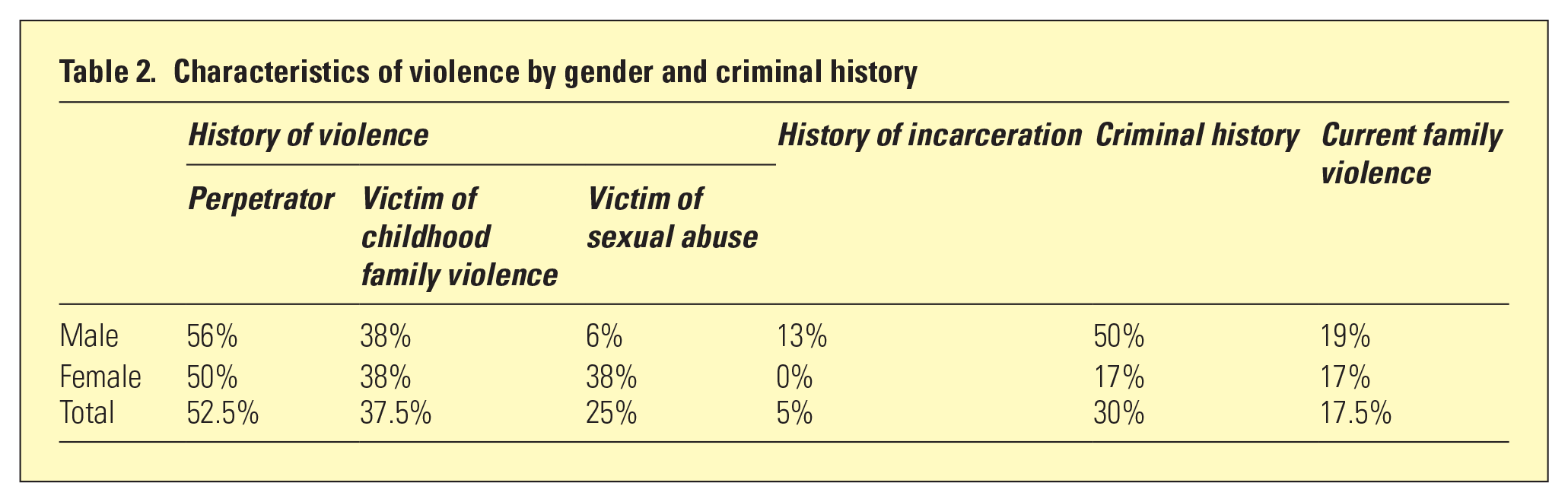
History of violence (52.5%), incarceration (5%) and family violence (37.5%) is detailed in Table 2. A family history of suicide was documented as present for 22.5%.
Characteristics of violence by gender and criminal history
Attempted suicide
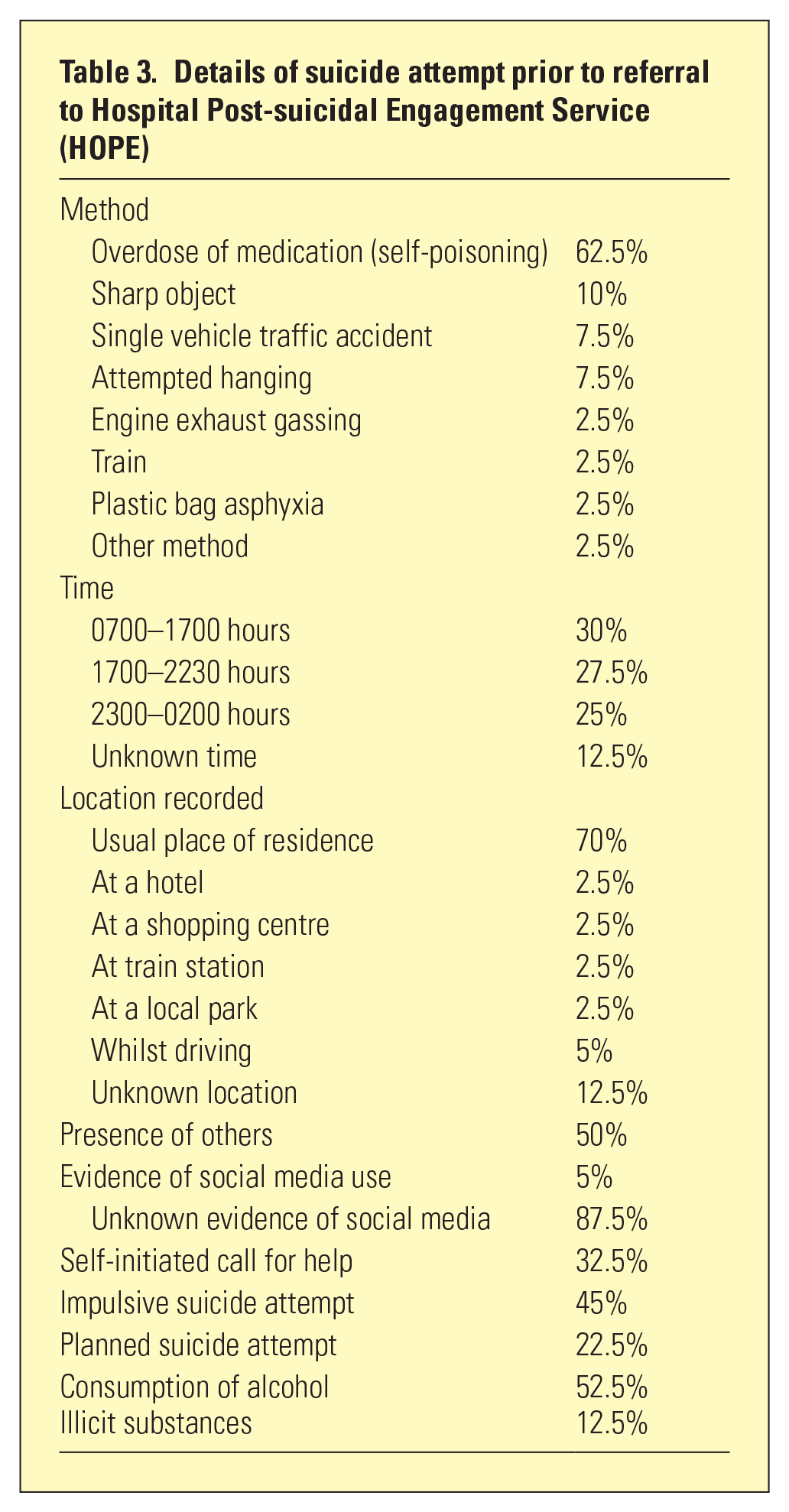
The predominant method of suicide attempt was self-poisoning. The location was the usually the person’s residence (70%) and the time was widely distributed. Alcohol use was associated in over 50%. An impulsive attempt was noted in nearly half, and a self-initiated call for help was present in one-third of presentations. Table 3 summarises details of the suicide attempt that initiated referrals to HOPE.
Details of suicide attempt prior to referral to Hospital Post-suicidal Engagement Service (HOPE)
HOPE referral followed the first suicide attempt for 27.5%; previous suicide attempt(s) had been made by 67.5%. Figure 1 illustrates the number of previous suicide attempts. Nearly three quarters documented a history of self-harm (72.5%).

Number of previous suicide attempts of people referred to Hospital Outreach Post-suicidal Engagement Service.
Interventions provided
The median length of care was 86 days (mean 71.3, range 2–114 days), with 52.5% over the 90-day target. The median number of face-to-face consultations provided was five (mean 5.5, range 0–22), and the median number telephone calls was 6.5 (mean 7.0, range 0–21). Whilst Consultant Psychiatrist review was not initially part of the model of care, this occurred in 12.5% of episodes of care provided. Key HOPE interventions provided are summarized in Table 4.
Key Hospital Outreach Post-suicidal Engagement (HOPE) interventions provided

Collaboration with support networks was frequent; family contacts (mean 4.5; median 3) included partners, parents, siblings, extended family and friends. Service linkages made included drug and alcohol, vocational, physical health, financial, family and family violence services.
Identification of reasons for living (47.5%) included family, friends, to have a family, become a mother, anticipating grandchild, having a child to look after, not wanting to hurt family, wanting to repair marriage, being able to drive, pet ownership, plans for pet sitting and future plans to travel.
Outcomes
There were no deaths during HOPE service in the study period. During the episode of care, 27.5% were known to engage in non-suicidal self-injury. The clinical risk assessment and management tool did not yield meaningful changes in low-, medium- and high-risk ratings. At referral to HOPE, 55% of people had formal supports; this increased to 82.5% on discharge following service linkage (p < 0.01).
The baseline ORS was completed by 35 people, of whom 15 completed a final ORS. Paired t-tests showed statistically and clinically significant improvements for the total and all subscale scores. Baseline ORS scores above the clinical cut-off increased from 10% (6.7% of the paired initial scores) to 80% at final ORS.
Baseline SRS was completed by 35 people; completion ratings were available for 14 people. Paired t-tests demonstrated a small but statistically significant change. SRS scores were consistently high.
Insufficient FRS data were collected to perform statistical analysis (Table 5).
HOPE outcome measures completed by the person and family: Outcome Rating Scale (ORS), Session Rating Scale (SRS), Family Rating Scale (FRS)

Note. HOPE = Hospital Outreach Post-suicidal Engagement.
Discussion
The study yielded important findings for the four research questions with important implications for designing, delivering and evaluating of HOPE services.
Participant social-demographic, health and psychosocial characteristics revealed frequent mental ill health, physical ill health, substance misuse, social isolation, relationship breakdown and situational stressors. Of priority populations1,2 in this sample, Aboriginal and Torres Strait Islander people were overrepresented (5% compared to 0.4% in our local population 7 ) and LGBTI was unable to be identified (77.5%). Both men and women demonstrated high rates of exposure to or perpetration of violence (including family violence), which may be underestimated by missing data. This finding is consistent with emerging evidence linking suicide risk to exposure to violence and adverse childhood events. 8 The majority had made a previous suicide attempt (67.5%). Whilst the psychosocial model of HOPE appeared to provide a service appropriate for the degree of psychosocial challenges experienced, it was not equipped to address the psychiatric and physical health morbidity of the cohort. This necessitated an integrated clinical and psychosocial model with psychiatric and diagnostic review.
Methods of presentation found that the predominant method of suicide attempt was self-poisoning, consistent with the need for population health approaches to means restriction.1,2
The study provides descriptive evidence of the range of HOPE interventions provided. The interventions appeared to strengthen connections with support services, and address frequent physical health needs and social disconnectedness.
The final study goal was to measure outcomes. Results demonstrated significant improvement in subjective well-being for those who voluntarily provided repeated measures. Sessions were rated highly across all domains. It remains unclear what specific interventions resulted in improved well-being or if the SRS scores correlated with reduced suicidality. Evaluation would be enhanced by a larger sample, tools measuring suicidality, satisfaction with HOPE and qualitative methodology for quality of life.
This study was limited by the small size, its selected sample population, the absence of a control group, the limited follow-up duration and reliance on voluntary completion of rating scales. There were incomplete data for factors known to be associated with increased risk of suicide (e.g. LGBTI, bereavement by suicide).1,2,4
Nonetheless, international literature calls for local audits, intervention research and service evaluation to identify what is effective in suicide prevention.2,4,5 This research, including lessons learned from its limitations, was able to inform the local HOPE model of care and the development of a local zero suicide strategy.
Conclusion
This study identified socio-demographic, complex health and psychosocial stressors, and presentations of the first cohort of people who received HOPE. Service engagement led to statistically significant improvements in subjective well-being. It remains unclear which specific interventions resulted in improved well-being and if this contributed to preventing suicide.
Footnotes
Acknowledgements
The authors wish to thank Ms Elia Barresi for her review of the manuscript, HOPE service staff at the mental health programme where the study was located. The authors also wish to acknowledge study participants and people with lived experience of suicidal thoughts, attempt(s), those caring for loved ones through suicidal crisis and those bereaved by suicide.
Disclosure
The authors report no conflict of interest. The authors alone are responsible for the content and writing of the paper.
Funding
The author(s) received no financial support for the research, authorship, and/or publication of this article.
Ethics Approval
Approval for this study was granted by Eastern Health Human Research Ethics Committee QA87-2018.
