






Abstract
Objective
To appraise the evolution of the RANZCP’s Code of Ethics on the occasion of its 30th anniversary.
Method
We scrutinised its five editions, focussing on the revision procedure and changes made, and reviewed relevant literature.
Results
The procedure of revision has remained constant: incorporating feedback from college members, committees and faculties, and consulting professional medical bodies and mental health advocacy organisations. Seven major themes of change have emerged with respect to patient exploitation, recognition of family and carers, the special place of Indigenous Peoples, confidentiality, engaging patients in decision-making, multidisciplinary collaboration and the well-being of psychiatrists.
Conclusions
The code has proved to be a dynamic instrument in keeping abreast of changes in psychiatry and society, and promises to maintain a prominent role in promoting high ethical standards in the profession.
The Code of Ethics of the Royal Australian and New Zealand College of Psychiatrists (RANZCP), first published in 1992, 1 has been revised four times, most recently in 2018. 2 When introducing the original Code, Pargiter and Bloch 3 highlighted its essentially dynamic character and the inevitability of changes in subsequent editions. As we approach the 30th anniversary of the Code’s first edition, it is a fitting moment to appraise its evolution. In doing so, we will describe the process undertaken for all four revisions, distil the major themes of change, and reflect on the lessons learned.
The process of revising the code
The process of revision has remained constant in light of its steady objective – to consider notable changes in psychiatric practice and in society. The review has entailed scrutiny of the Code’s principles and annotations, carried out in two stages by the Ethics Committee (and its successor, the Committee for Professional Practice) in consultation with Fellows experienced in devising ethical documents.4,5
In the first stage, suggestions for change have been sought from the college membership and its various committees and faculties. Responses have been considered methodically and, where appropriate, incorporated into a preliminary draft. In the second stage, feedback on the draft has been requested from those same groups and, in addition, from a range of external organisations, such as Australasian medical colleges and associations, international psychiatric bodies and mental health advocacy groups (e.g., SANE and Mind Australia).
Recommendations have been carefully reviewed, invariably leading to a revised draft. A final step has been its evaluation and ratification by the College Board. The new edition has then been widely distributed within the college and publicised in its newsletters and in Australasian Psychiatry.
How is the code organised?
The Code’s structure, based on that of the American Psychiatric Association’s equivalent document, has been retained throughout, testifying to its utility. Indeed, it is noteworthy that several psychiatric bodies have applied the same approach. 6 In essence, ethical principles central to psychiatric practice (and research) have been delineated, and each of them expounded through a series of annotations elaborating on their nature, application in practice and special cases.
The most recent revision introduced references to various college position statements and guidelines that explore in further detail ethical issues relating to specific aspects of practice, such as the assessment of asylum seekers, boundary violations, medico-legal examinations and the special needs of Indigenous Peoples. 2 Footnotes have also been added to elucidate complex concepts like conflict of interest, valid consent and the definition of a minor.
What changes have been made?
Major themes of change in revisions of the Code of Ethics of The Royal Australian and New Zealand College of Psychiatrists.
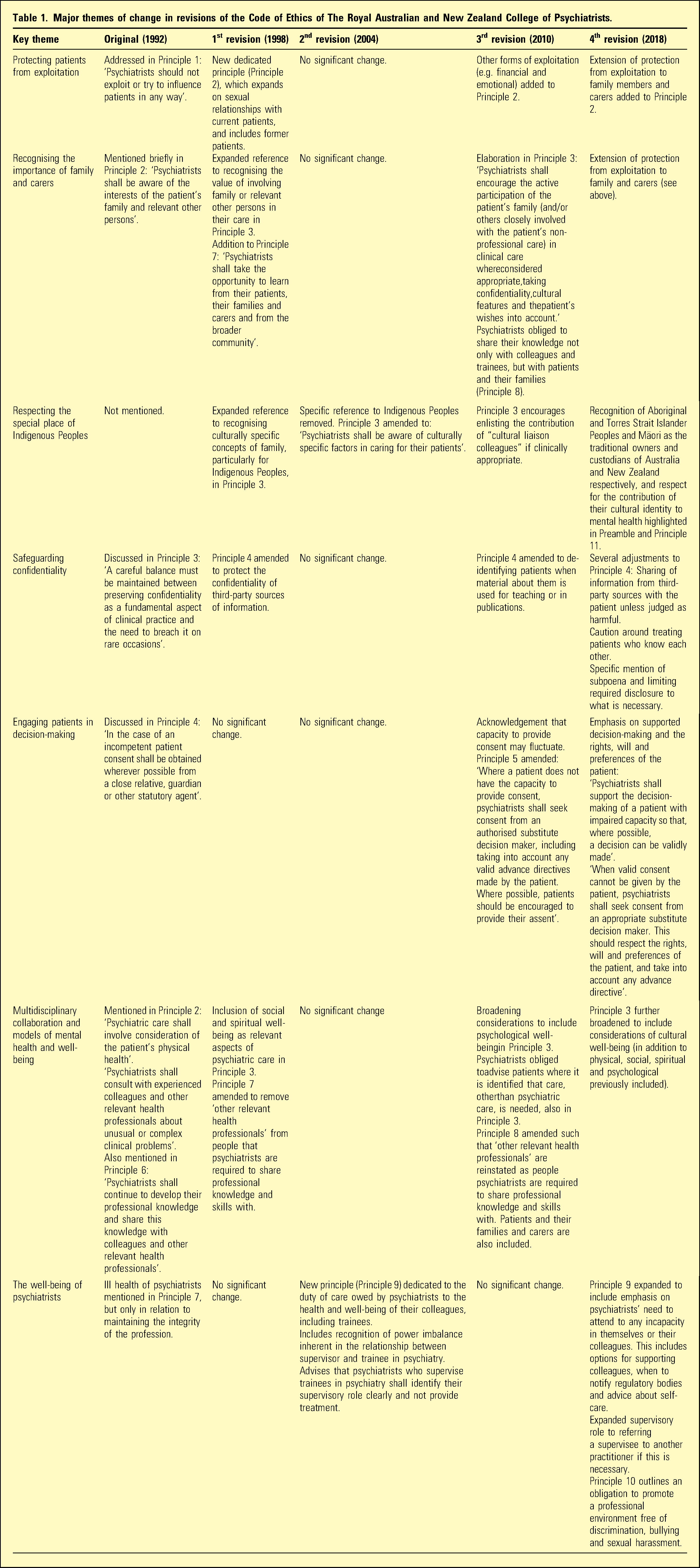
Protecting patients from exploitation
A significant early change was the introduction of a principle focussing on the power differential in the psychiatrist–patient relationship.5,7 An explicit emphasis was viewed as essential on the grounds of a growing concern about boundary violations in the 1990s and echoed in the literature.5,8 Prohibition of any sexual relationship between psychiatrist and current or former patient was the result, as was an obligation to approach all clinical encounters with an appreciation of the power imbalance in mind.
Recognising the importance of family and carers
The importance of families and carers has been increasingly recognised in the Code, not only as sources of knowledge about patients but also for their valuable insights into mental health policy and services. 4 Submissions from mental health advocacy organisations at the time of early revisions led to an emphasis on acknowledging the key role of families and carers in the lives of people with mental illness 5 and, where appropriate, encouraging their participation in clinical care. 2
Respecting the special place of Indigenous Peoples
In accordance with the RANZCP’s commitment to provide culturally sensitive mental health care for Aboriginal and Torres Strait Islander Peoples and Māori, the seminal place of culture is reflected in several revisions, including the recognition of culturally specific concepts of family 7 and the role of cultural experts in providing assistance, where appropriate. 9 In the fourth revision, Aboriginal and Torres Strait Islander Peoples and Māori were explicitly recognised as the traditional owners and custodians of Australia and New Zealand, respectively, 2 and Māori language for family (i.e. whānau) was incorporated.2,4
Safeguarding confidentiality
While patient confidentiality has always been a crucial aspect of ethical practice in psychiatry, there have been several changes to this principle over time, from the extension of confidentiality to third-party sources of information 7 and the de-identification of patient information for teaching and publication, 9 to an emphasis on sharing information from third-party sources with the patient and special cautions around treating patients who know each other. 2
Engaging patients in decision-making
The publication of international ethical statements such as the Madrid Declaration on Ethical Standards for Psychiatric Practice 10 and the Convention on the Rights of Persons with Disabilities (CRPD) 11 have informed revisions of the Code. The values underlying these documents have supported, for example, a greater emphasis on involving patients with impaired capacity, as well as minors, in the process of obtaining informed consent. 9 The CRPD has also sharpened a focus on the psychiatrist’s responsibility to pay heed to patients’ preferences, and to support them to surmount limitations in their ability to make decisions about treatment. 2
Multidisciplinary collaboration and models of mental health and well-being
The move towards inclusive and multidisciplinary treatment is reflected in amendments requiring psychiatrists to collaborate with other health providers and to share their knowledge with colleagues from all relevant health professions, as well as with patients, their families and carers. 9 These changes parallel an augmented understanding of mental health and well-being. For example, social and spiritual well-being were added as important facets of psychiatric care in the first revision, 7 while the relevance of psychological well-being and care beyond the psychiatric was noted in a later edition. 9
The well-being of psychiatrists
The well-being of psychiatrists has emerged as a vital concern of the RANZCP. 4 Attention to psychiatrists’ ill health was included in the original Code under the principle addressing professional integrity, 1 but was later elevated to a distinct principle dedicated to the duty of care owed by psychiatrists to one another. 12 The latter reflected well-documented evidence of the detrimental effects of discrimination, bullying and sexual harassment in the work environment. 2 Special attention has also been given to the vulnerability of trainees in the context of supervision. 12
Lessons learned and their implications for future revisions
Given the many notable changes the Code has undergone over its lifetime and the remarkable pace of societal change, we envision further modifications in the future to help guide the ever-evolving role of the psychiatrist in society, although we can only conjecture about the form they will take.
The matter of assisted dying springs to mind, where significant changes to law and clinical practice are unfolding across Australia and New Zealand.13,14 While RANZCP has released a position statement that touches on some of the key clinical and ethical issues in relation to the psychiatrist’s role in assisted dying practices, 15 it seems implausible that definitive ethical guidance could be integrated into forthcoming revisions of the Code while there are still such marked differences in legal frameworks governing these practices between jurisdictions. As such, assisted dying may be an illustrative example of how the Code needs to be supplemented by position statements on specific topics that can respond quickly to rapidly evolving ethico-politico-legal issues, recognising that psychiatrists are directed and constrained by local legislative frameworks.
Reviewing the Code’s evolution over three decades has the potential to illuminate, instruct and guide the profession. We have identified six issues in this context: • Revising a Code regularly should be regarded as axiomatic for it to remain a relevant and dynamic document. • The process of revision should be enable to the college to identify essential changes in light of developments in professional practice and in society-at-large. • College position statements, media releases and various practice guidelines should be kept in mind for possible incorporation into new editions of the Code. • Revised editions should be disseminated widely through published reports and educational and professional development programs to foster awareness of changes and their implications for practice. • College members, committees, faculties and branches should be encouraged to suggest changes to the Code at any time in anticipation of the next revision. • These groups should also be invited to raise any matters germane to a pending revision since they may point to an improved procedure.
Conclusion
We hope that the journey we have jointly undertaken will contribute to the above ends as well as generate a creative exchange on how the Code can continue to enhance our professional lives, promote our moral integrity and improve the ethically minded care of patients and their families.
Footnotes
Declaration of conflicting interests
The author(s) declared no potential conflicts of interest with respect to the research, authorship, and/or publication of this article.
Funding
The author(s) received no financial support for the research, authorship, and/or publication of this article.
