







Abstract
Objective
Australia faces a psychiatrist shortage, making it crucial to understand factors influencing specialty choice and workforce retention.
Method
An online cross-sectional survey was conducted among medical doctors in their prevocational and vocational stages working in Victoria, Australia. Participants were asked about various factors that influenced their choice of specialty. This study focused on those interested in or currently training in psychiatry. To explore differences in factors influencing specialty choice, prevocational doctors interested in psychiatry were compared to those undecided about their specialty.
Results
Of the 107 respondents, 56 expressed interest in or were training in psychiatry. The top five factors influencing psychiatry specialty choice were perceived ability, specialty culture, prior experience, work–life balance, and patient interactions. Both prevocational and vocational doctors shared similar views on these factors. Factors such as the cost of training, influence of family and friends, prestige, length of the training program, and salary were reported as less influential.
Conclusions
This study identified several factors that were important to junior doctors when selecting psychiatry as a specialty. Active consideration of these factors within service and training frameworks may facilitate improved junior doctor wellbeing and greater workforce retention.
There is a shortage of psychiatrists across Australia. 1 A key strategic pillar of the National Mental Health Workforce Strategy 2022–2032 is to ‘attract and train’ individuals into psychiatry. 1 However, there is limited literature in the Australian context as to what factors attract junior doctors to psychiatry training. Identifying the determinants of psychiatric career choices is crucial, as this information could be used to attract new trainees. Furthermore, ensuring that these factors are prioritised within the training program will also increase the morale and retention of trainees. Attracting and retaining psychiatry trainees is critical for addressing current workforce imbalances and meeting the healthcare demands of the community.
To attract more doctors to psychiatry training, the Royal Australian and New Zealand College of Psychiatrists established the Psychiatry Interest Forum (PIF) in 2013 to cultivate interest and reduce stigma and misconceptions about the speciality. 2 Furthermore, following the recommendation of the Victorian Mental Health Royal Commission, 3 a foundation psychiatry rotation for Victorian junior doctors became mandatory in 2023. The aim of this rotation is, among other things, to foster an interest in psychiatry and address the projected deficit of 125 full-time psychiatrist Australia-wide by 2030. 1 For these initiatives to be effective, it is crucial to identify the values prevocational trainees prioritise when selecting a specialty. Understanding these values is essential to provide a positive experience and ideally attract them to the speciality. 4
In addition to attracting new doctors, retaining psychiatry trainees throughout their training is essential to addressing workforce shortages. This requires understanding not only what draws doctors into psychiatry but also what sustains their interest and commitment during training. Concerningly, the recent Australian workforce survey report 2024 indicated that 90% of psychiatry trainees experience symptoms of burnout, and 13% of trainees are considering leaving the profession. 5 This highlights the urgent need for more support to current and future psychiatry trainees to avoid burnout and strive towards Fellowship. There has been significant debate around recent transition towards competency-based assessments in Royal Australian and New Zealand College of Psychiatrists (RANZCP) training6–8; however, what is notably lacking in this discourse is a focus on what psychiatry trainees value in the speciality and training program.
Addressing this gap in the literature is important to inform both the modernisation of the psychiatry training program and optimise service-specific issues, including rostering and leave arrangements. The objective of this study is to identify the factors that influence prevocational doctors and psychiatry registrars in selecting psychiatry as their chosen medical speciality.
Methods
Setting and data collection
Factors that influenced doctor’s choice of psychiatry.
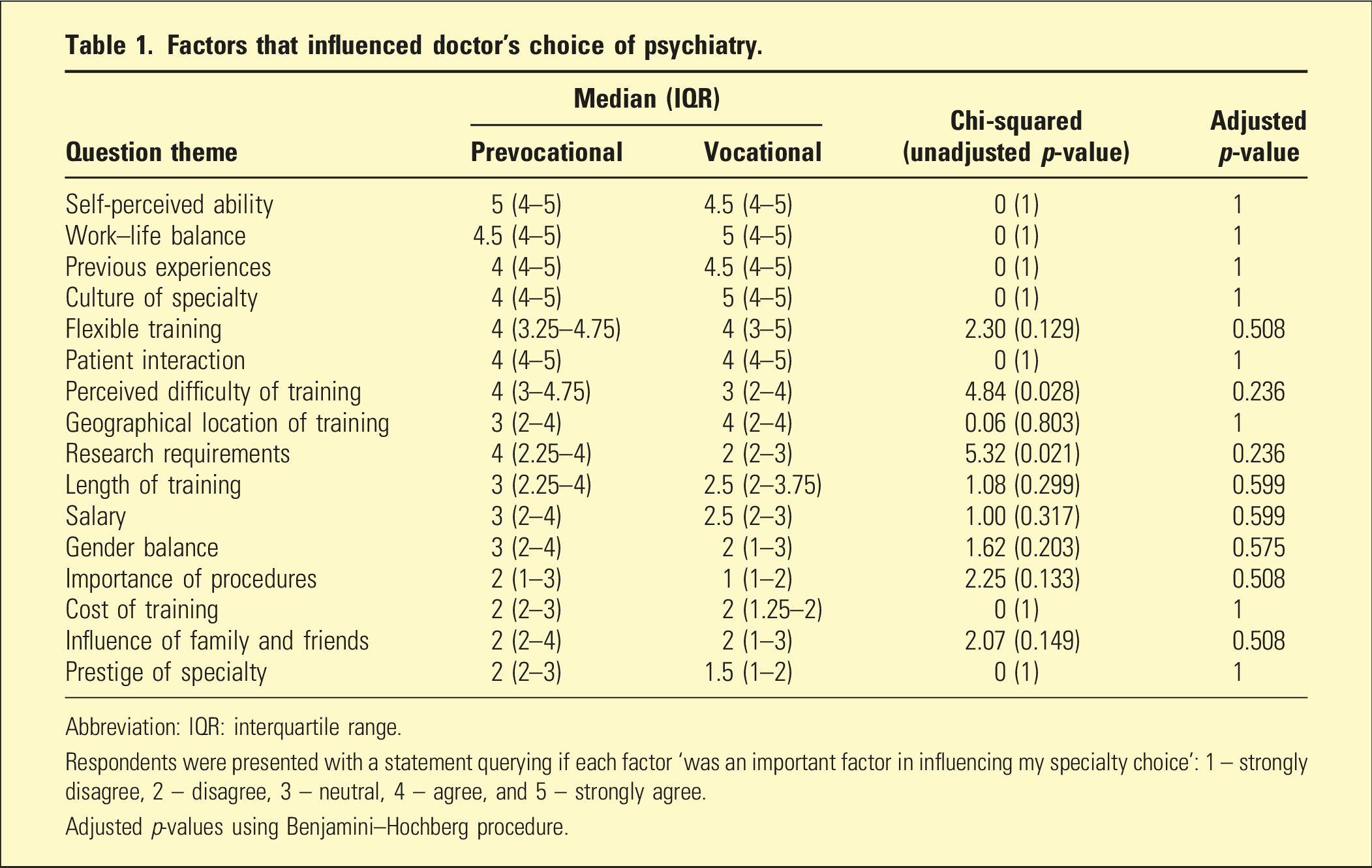
Abbreviation: IQR: interquartile range.
Respondents were presented with a statement querying if each factor ‘was an important factor in influencing my specialty choice’: 1 – strongly disagree, 2 – disagree, 3 – neutral, 4 – agree, and 5 – strongly agree.
Adjusted p-values using Benjamini–Hochberg procedure.
Study participants
We included participants currently enrolled in the psychiatry training program or intending to apply for it in the analysis. In addition to psychiatry-interested doctors, prevocational doctors undecided about their specialty were included as a comparator group. This allowed us to determine whether factors such as work–life balance, speciality culture, and prior experiences were specific to psychiatry or reflected broader influences in specialty selection.
Ethical considerations
The project was approved by a recognised ethics committee.
Statistical analyses
All analyses were conducted using Jamovi Version 2.6. Categorical data was presented in counts and proportions. Continuous data was checked for the normality of distribution. The Likert scale for each influence factor was presented as median and interquartile range (IQR). To compare the differences in the influence factors between prevocational and vocational doctors, the responses to the Likert scale were aggregated and converted to ‘disagree’ (1 or (2) and ‘agree’ (4 or (5) and compared using Chi-square tests. Adjustments for multiple comparisons was done using Benjamini–Hochberg procedure. A two-sided p-value of <0.05 was taken as statistically significant for all observed associations.
Results
Characteristics of participants.
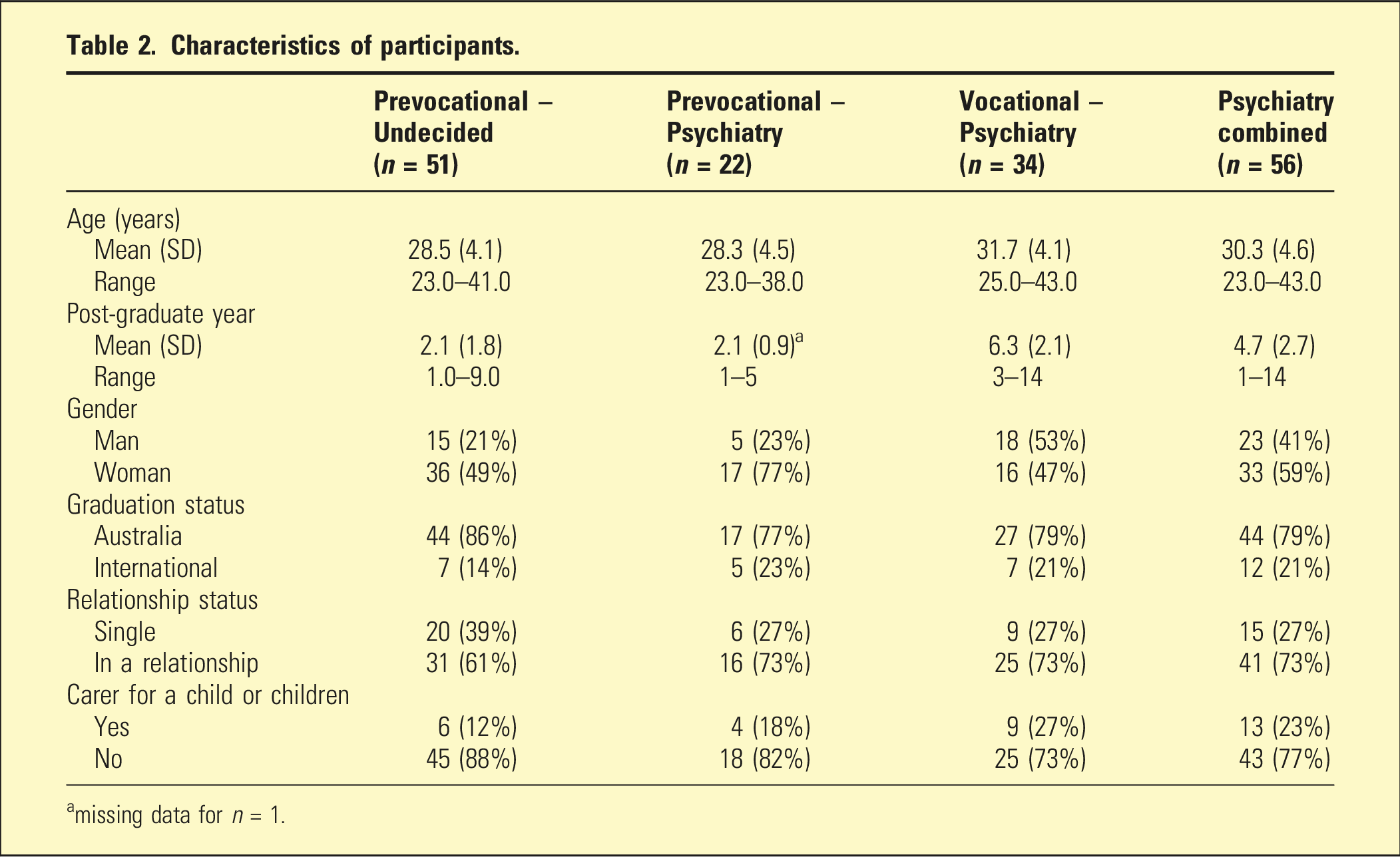
amissing data for n = 1.
When participants rated the factors that influenced their choice of psychiatry, the majority of participants agreed that self-perceived ability to do the work involved in the specialty, work life balance, previous experiences, the culture within psychiatry, flexible training, and patient interactions were important. On the other hand, they disagreed that gender, procedural skills, cost of training, and prestige and perception of family and friends were influential factors. They were neutral about the research requirements, length of training and salary.
When we separated the responses between vocational and prevocational doctors, they were largely similar (Table 1). After adjustment for multiple comparisons, there were no significant differences in the influential factors between prevocational and vocational doctors.
Comparison of factors important to prevocational doctors in their choice of specialty
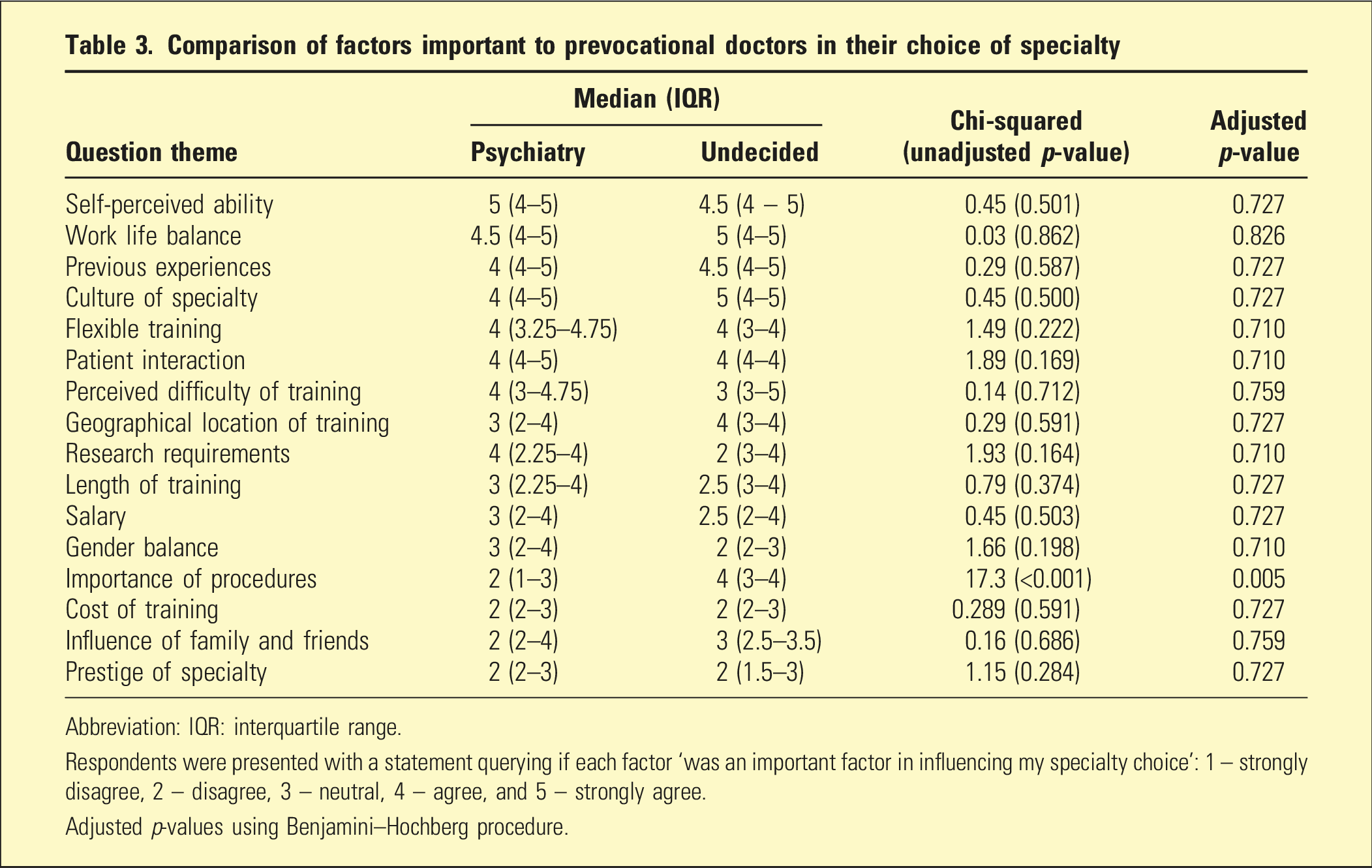
Abbreviation: IQR: interquartile range.
Respondents were presented with a statement querying if each factor ‘was an important factor in influencing my specialty choice’: 1 – strongly disagree, 2 – disagree, 3 – neutral, 4 – agree, and 5 – strongly agree.
Adjusted p-values using Benjamini–Hochberg procedure.
Discussion
This study explored the contemporary views of why junior doctors pursue psychiatry in the Australian setting. We found that both prevocational and vocational doctors aspiring to become psychiatrists share similar reasons for selecting this career. These reasons primarily relate to their perception of the work, including work–life balance, the flexibility of the training program, and previous positive experiences, in line with previous findings internationally that personal circumstances and working conditions were influential in their choice of psychiatry training.9,10 On the other hand, external factors such as prestige of the speciality and opinions of family/friends were less influential in their choice of medical field. These findings help to inform ongoing developments in the College’s psychiatry training program, as well as identify the strengths of psychiatry training when promoting this specialty to prevocational doctors. Since prevocational and vocational participants echoed similar influential factors, prioritising these influential factors will not only attract more prevocational doctors to psychiatry, but also ensure current registrars feel supported in their training.
In the broader context, the survey results mirrored key findings from previous literature, 11 that personal factors (i.e. work–life balance), workplace factors (i.e. specialty culture and flexibility of training) and professional factors (i.e. perceived ability and enjoyment and prior experiences) strongly influenced career choices. Workload with irregular and long work hours is a key issue faced by junior doctors, 12 and 1 in 4 junior doctors in Australia are working excessive hours that are associated with a doubling of their risk of mental health problems and suicidal ideation.13,14 Considering the ubiquitous nature of these issues, it is no surprise that our study findings indicate trainees value sensible and flexible rostering, with the current RANZCP Education Training Policy on Part-time Training suggesting that this cohort continues to constitute a significant proportion of enrolled registrars. 15 Our study results suggest that the support for flexible part-time training is valued by current and future trainees and is an influential factor in their choice of specialty. This may be a greater priority for vocational trainees who are older and have other personal priorities such as their partner and children. Health services recruiting psychiatry trainees should ensure equitable access to such arrangements, and actively promote their availability to attract and retain a diverse psychiatry workforce. Expanding flexible training options could help mitigate burnout, improve work–life balance, and enhance overall job satisfaction among psychiatry trainees, in line with the priorities of the National Medical Workforce Strategy 2021-2031. 16
Exposure to the culture of psychiatric medicine is demonstrated as being important to both prevocational and vocational trainees in selecting to pursue this specialty. It is therefore pertinent for medical students and junior doctors to tangibly engage with as many facets of the discipline as possible. This study aligns with the findings from the Royal Commission into Victoria’s Mental Health System, which has resulted in compulsory mandatory psychiatry rotations for junior doctors from 2023. 3 Given that early exposure to psychiatry could improve perceptions of psychiatry, other health jurisdictions should also consider a mandatory psychiatry rotation for junior doctors, supporting broader efforts to reduce the mental health workforce shortage. In addition to clinical placement, the findings of this study also highlight the importance of initiatives like the RANZCP Psychiatry Interest Forum (PIF; 15). PIF offers ample and varied opportunities for prevocational participants to explore psychiatry, including information sessions, workshops, conference stipends, and essay competitions. 17 Although a proportion of PIF members join with an explicit view to become psychiatrists, many join to gain knowledge and cultural insight. 4 This study’s findings on factors important to doctors interested in psychiatry can inform the content of future recruitment campaigns, including PIF initatives.
This study highlighted the importance of a supportive and positive workplace culture, underscoring the potential role of mentoring and supervision in fostering such an environment. While mentoring and supervision were not directly assessed in the survey, related findings such as the value placed on specialty culture, work–life balance, and positive prior experiences suggest that structured mentoring and supportive supervision could address critical workforce needs. Mentoring can be obtained in opportunistic ways, for example, junior medical staff establishing connections with senior medical staff, but also through formal arrangements such as the RANZCP mentoring program open to both trainees and early career psychiatrists, and hospital-network specific programs which link junior and senior doctors with a shared specialty interest. Regardless of the specific educational content discussed in a mentoring relationship, the relationship itself provides exposure to a core component of psychiatry, namely, supervision. Supervision has been described to encompass more than just a teaching and learning relationship, but also a supportive and mentoring one. 18 The creation of a ‘safe enough’ space encourages supervisees to self-reflect, receive thoughtful feedback, develop skills and advance their clinical work. 19 Early exposure to mentoring within the mental health domain offers junior doctors a window into the supportive culture of psychiatry, something which if better harnessed may entice larger volumes of passionate individuals to psychiatry.
Viewing psychiatry trainees through a developmental lens, their professional identities are still in a formative state, and thus are susceptible to the influences of the culture and learning environment. 20 In addition to rostering conditions previously discussed, psychiatry registrars navigate emotionally laborious conditions of mental health care, including in the context of involuntary hospitalisations, suicide and violence against staff. 21 90% of RANZCP trainees report experiencing symptoms of burnout, 5 indicating an overwhelming need for greater support. The results of this study emphasise the importance of specialty culture throughout the pathway to fellowship in psychiatry. Further investment in, and evaluation of, supervision and mentoring programs is recommended in order to sustain the junior, and eventual senior psychiatric workforce.
There are several limitations of this study. The study included a relatively small sample size which may limit the generalisability of the findings. The survey was conducted only in Victoria, Australia. This regional focus may not capture the full spectrum of factors influencing psychiatry specialty selection across different states or territories in Australia or in other countries. Furthermore, as the survey was designed to be kept brief to encourage response rates, other important factors that may be important were not asked, including the proportion of vocational trainees who had undertaken psychiatry rotations as a junior doctor. As our study focused on doctors interested in psychiatry training, the findings cannot be generalised to other specialties. Finally, as a cross-sectional survey, the study captures a snapshot of participants’ views at a single point in time. However, this study had several strengths. By including both prevocational and vocational doctors, it allowed for a better understanding the continuity of motivations from early training to specialisation. Furthermore, this study provides actionable insights for policy and training programs. Future research should include a broader geographical sample and qualitative data that can provide richer context relating to influential factors.
In conclusion, this study found that both doctors who plan to specialise in psychiatry and those already in fellowship training shared similar opinions as to why they chose psychiatry. Both groups of doctors strongly agreed that work–life balance, self-perceived ability to do the work involved in the speciality, culture of the specialty, previous experiences, and patient interactions contributed to their choice of psychiatry. These insights can inform strategic and sustainable recruitment methods whilst supporting current trainees to thrive in the workplace and progress to Fellowship.
Footnotes
Acknowledgements
The authors would like to thank the participants for their participations.
Disclosure
The author(s) declared no potential conflicts of interest with respect to the research, authorship, and/or publication of this article.
Funding
The author(s) disclosed receipt of the following financial support for the research, authorship, and/or publication of this article: This study is supported by the Medical Education Research Innovations (MERI) grant awarded by the Postgraduate Medical Council of Victoria (PMCV).
