







Abstract

Dear Editor,
In today’s climate of democratic backsliding and resurgent authoritarianism, the use of “madness” to delegitimise sociopolitical dissent warrants renewed vigilance. 1 Fifty years ago, on 24 March 1976, a coup d’état established a civic-military dictatorship (El Proceso) in Argentina, whose legacy continues to resonate. The junta’s self-styled “dirty war” (Guerra sucia) masked a coordinated repressive network of extrajudicial detention, physical and psychological torture, and systematic “disappearances” targeting anyone the regime deemed subversive. 2
Human rights organisations estimate that thousands of people were detained or “disappeared” before the dictatorship collapsed in 1983.
2
As their children were abducted, the Mothers of the “disappeared” organised. On 30 April 1977, they gathered in the Plaza de Mayo, the historic square at the heart of Buenos Aires. Forbidden from standing still, the Mothers walked in circles around a monument, a form of protest that skirted police intervention and has since taken place every Thursday afternoon (Image 1). The “Mothers of the Plaza de Mayo” hold a silent procession during the football World Cup in Argentina, 1978. Source: ASL/Anefo, National Archives. Public domain image available via Wikimedia Commons.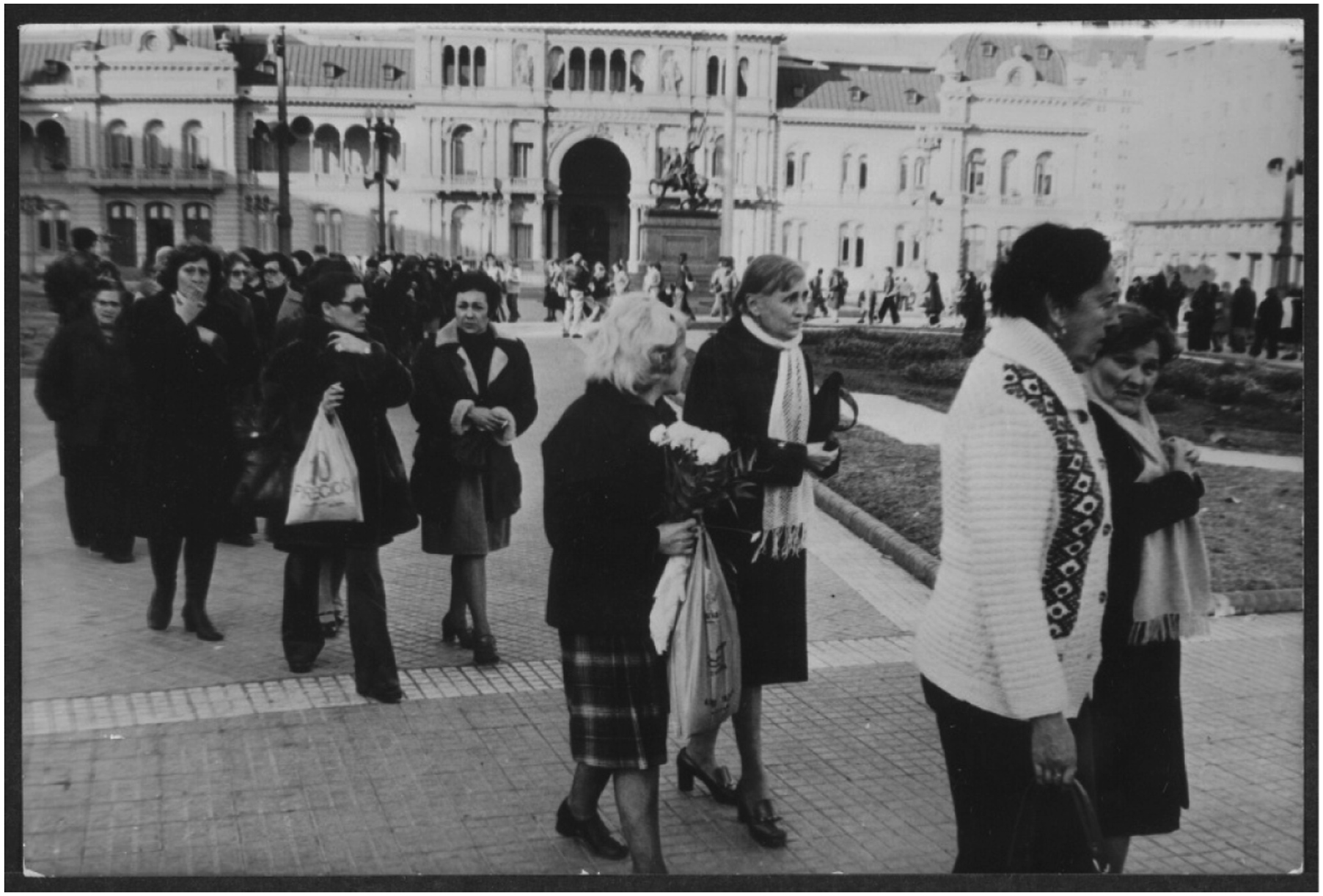
The junta and its press responded by deriding them as “the madwomen of the Plaza” (las locas de la Plaza) to discredit their demands. 2 Yet, this stigmatising epithet would come to signify defiance. Jean-Pierre Bousquet, an Agence France-Presse correspondent who documented the Mothers from their earliest appearances, recorded this firsthand. “‘The Mad Mothers of the Plaza de Mayo’ – that is a fine nom de guerre” a Mother told Bousquet, adding that one had to be “quite mad to challenge them [the junta] openly when everyone trembles before them.” 2
In reappropriating the language of “madness,” the Mothers inverted its charge, transforming mourning into civil disobedience and contesting the junta’s claims to reason and authority. 3 Nevertheless, this pathologising rhetoric echoed the clinical abuses perpetrated under El Proceso. Dr Silvia Rivilli, a psychiatrist who worked closely with the Mothers’ movement, noted that they also searched psychiatric hospitals, recognising that those confined within them may themselves have been “disappeared.” 4 Survivor testimonies from the period corroborate this, describing the involvement of mental health professionals in the torture and coercive psychopharmacological treatment of political dissidents. 5
Analogous patterns of abuse transcend Argentina, from “sluggish schizophrenia” diagnoses in the Soviet Union to the punitive hospitalisation of anti-hijab protestors and anti-war campaigners in modern-day Iran and the Russian Federation, respectively. 1 Such cases demonstrate how states can weaponise psychiatric concepts and institutions, which the profession bears an enduring responsibility to acknowledge and actively resist.
Perhaps unsurprisingly, the Mothers themselves were not spared from the junta’s violent campaigns, and several were abducted and murdered. 2 Harassed in the streets and marginalised as “mad,” they nonetheless persisted in their calls for the reappearance of their children and accountability for those responsible for crimes against humanity.
Currently, under President Javier Milei, revisionist currents in Argentina are seeking to rehabilitate El Proceso’s legacy. In this context, the Mothers of the Plaza de Mayo – still marching – endure as an insurgent counter-memory. More broadly, in a turbulent world, they serve as a timely reminder that the boundary between psychopathology and legitimate political resistance is one that psychiatry has a duty to protect.
