






Abstract
The mental health of youths in developed nations has been declining for at least two decades. Fear of climate change is one of the most prevalent causes of youth distress directly associated with declining function. We argue that the introduction of climate change activist materials into primary and secondary school curricula put children and adolescents at risk of harm. Preventing mental distress in children should be a higher priority for health and education professionals than combatting climate change, so these materials should be removed until they have been demonstrated to be safe for all students.
It is widely acknowledged that the mental health of young Westerners, including Australians and New Zealanders, has been deteriorating for decades. In addition to increasing rates of clinically significant anxiety and depression, both the public and health professionals have been alarmed by escalating incidences of self-harm and suicide. 1 Vulnerable populations including young First Nations people have been particularly affected. 2
We are concerned by what we consider to be the counter-productive approach of some public health advocates to the rising distress in young people caused by fear of climate change, known as eco-anxiety. Mental health and education experts who passionately pursue climate change activism appear to view this rising distress as a rational response to a real problem, 3 and in our opinion oppose efforts to reduce the distress because they might interfere with the campaign to address climate change. 4 That opinion has been challenged in an open letter, and we anticipate an ongoing dialogue. 5
The largest international survey on climate anxiety in young people, published in The Lancet Planetary Health, found that 59% of young people aged 16-24 globally reported feeling ‘very’ or ‘extremely’ worried about climate change, with more than 45% stating that climate anxiety negatively impacted their daily life and functioning. In the most alarming finding, over half believed that ‘humanity is doomed’, highlighting the scale of psychological distress linked to extreme climate narratives. 3 It is worth noting that one of the most extreme models of climate change, strongly criticised for distorting climate research and policy, 6 has recently been retired because it is now acknowledged to be implausible. 7
We propose that preventing mental distress in children should be a higher priority for health and education professionals than combatting climate change. We argue that the rapid growth of climate change activism among health and education professionals puts children's health at risk. We describe the need for a uniform approach to protect all children from eco-anxiety because it is a collective action problem that is difficult to address at the individual level.
Social media, smart phones, and the argument for collective action
Many theories have been proposed to explain increasing distress in young people, although none is dispositive. One of the most widely discussed and intuitively appealing is Jonathan Haidt’s hypothesis that children’s mental health is declining due to rapid cultural changes associated with unconstrained access to social media on smart phones. Haidt suggests that social media algorithms have trapped children in harmful schedules of contingent reinforcement that have replaced healthy social interaction in real world activities with isolating and anti-social online behaviours. 8 While we are not aware of any robust empirical research supporting Haidt’s theories, they are believed to have been a significant driver of public interventions intended to improve the mental health of young Australians. 9
Western teenagers’ essentially ubiquitous access to social media and smart phones leads to what Haidt describes as a collective action problem. There is widespread agreement that removing access would reverse the harms done by social media and phones. However, this position requires that access be removed from all children, because the algorithms' harmful social reinforcements would only be heightened if access was divided. 8
Australia has legislated a ban on social media use by children under 16 years of age that passed with bipartisan support by the major parties. Polls suggest that about 80% of Australians support the ban. 9 There has also been vocal opposition, including by supporters of marginalised groups such as LGBT + teenagers who believe the ban may cut them off from online supports and communities. 10 Nevertheless, it appears that the Australian public agrees that social media and smart phones are a collective problem demanding collective action, in large part due to popular authors based on minimal scientific research, including Jonathan Haidt. 9
Eco-anxiety in school-children as a collective action problem
We argue that the approach to climate change in Australian schools is also a problem requiring collective action. Climate change is a heavily politicised issue contested by well-organised and well-funded groups pursuing widely divergent agendas. Given that it is a social issue that appears to have an impact on the health and wellbeing of school-children at least comparable to other issues like bullying,3,11 we believe that it deserves a similar level of organised attention.
The dangers of climate change, the role of human activity, and the optimum mix of prevention and mitigation remain highly contested. The Intergovernmental Panel on Climate Change (IPCC) reports provide the most widely accepted statements of what is known about the past and predicted of the future climate. 12
The latest IPCC synthesis report noted that while human activity continues to contribute to climate change, current prevention/mitigation efforts are unlikely to prevent further global warming and the significant and widespread harms that are predicted to result. 12
Perhaps we may assume that the IPCC reports represent an agreement by many scientists about a real set of problems and the possible outcomes of a range of proposed solutions, including inactivity. But we do not accept that clinically significant and pervasive eco-anxiety among school-children is a reasonable response to the IPCC reports or any other public health or safety problem.
Developmental neuropsychology indicates that primary school-aged children are particularly vulnerable to fear-based narratives, at least in part because their undeveloped prefrontal cortex cannot inhibit fear-based responses in the amygdala. 13 At this stage children lack the cognitive capacity for abstract and probabilistic reasoning, so they often interpret complex issues in black-and-white terms. Their undeveloped executive functioning limits their ability to weigh long-term, global risks against immediate personal safety.
When adults present overwhelming existential threats, such as climate catastrophe, without a corresponding sense of safety or efficacy, it can create disproportionate and harmful psychological responses. 3 The common belief that ‘humanity is doomed’ among young people, discussed above, is a plausible example.
Unfortunately, the growing evidence of clinically significant eco-anxiety in school-aged children 3 suggests that approaches to climate change in school curricula at worst directly cause unacceptable levels of anxiety, or at best do not inoculate students against the fears caused by exposure outside school. Based on the materials we have seen we think it is plausible that schools are directly causing unacceptable levels of eco-anxiety in school-children. 14
Climate change activists have targeted school-age children with curricula that emphasise the potential harms of increasing global temperatures. 14 A recent open letter by activists proposed that ‘[w]hen done well, climate education doesn’t alarm, it empowers young people, equipping them with the skills to thrive in a changing climate’. 5
Examples of Australian school curricular materials which may encourage learned helplessness
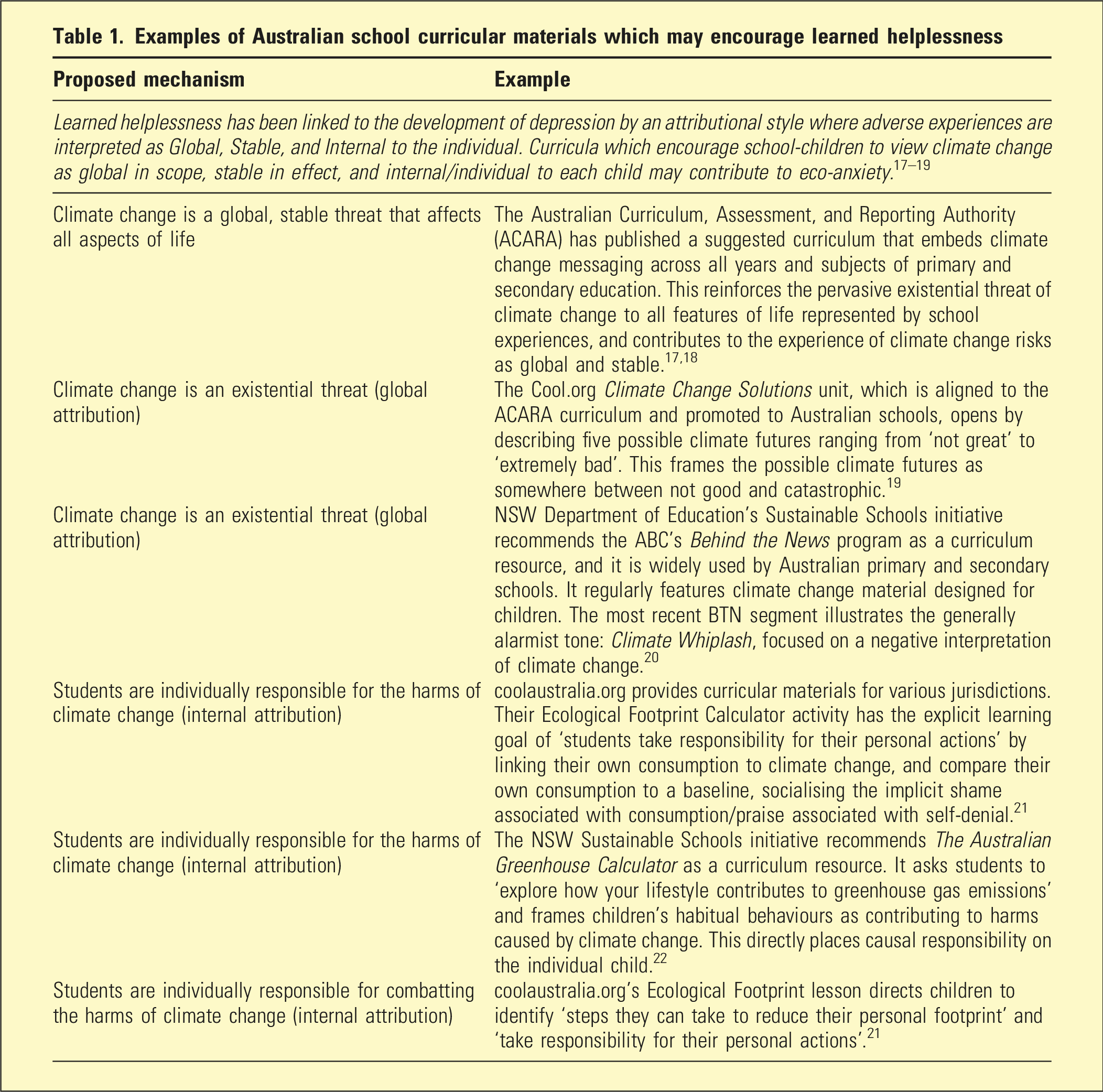
Rather than inspiring meaningful action, chronic exposure to catastrophic climate messaging risks promoting apathy, hopelessness, and long-term disengagement. The catastrophic beliefs of young people about climate change already noted are more suggestive of learned helplessness than empowerment. 3 Research in adults suggests that learned helplessness moderates the relationship between environmental concern and behaviours. 23
Seligman and colleagues have reconsidered their paradigm in the context of evidence that instrumental control in response to adverse events activates prefrontal circuitry that blunts dorsal raphe nucleus fear responses, preventing learned helplessness. They suggest that resilience to adversity can be facilitated by developing goal-directed learning mediated by prefrontal circuits. 15
Similarly, research suggests that campaigns to raise public awareness about the dangers of climate change and proposed solutions must be careful to communicate that while the problems may be real, they are also manageable and require collective rather than individual action. People who believe that climate change is likely to be catastrophic, that they bear personal responsibility for climate change, and that no solutions are available, appear to adopt a learned helplessness position and try not to think about what they cannot change. 24
Activist clinicians appear to agree that fear of climate change has materially worsened the mental health of Australia and NZ’s children. 5 However, unlike them we believe that the widespread and significant distress caused by eco-anxiety is a public health problem that a well-functioning education system would realistically target for reduction and elimination. Activists, on the other hand, appear to have reached the surprising conclusion that eco-anxiety is an inevitable reality that should simply be accepted.
It is worth thinking about the logic of a position that suggests it is impossible to protect kids from fear of climate change, but possible to prevent climate change itself. Given that carbon emissions have been steadily increasing throughout the period of climate hysteria up to the present, 25 and we have large-scale programs specifically designed to address school-based problems such as bullying, 11 this seems misguided at best and wilfully self-serving at worst.
Children's health is more important than climate change action
Clinically, the approach to eco-anxiety appears inconsistent with how we address other forms of anxiety in children. In cases of health anxiety, social anxiety, or phobias, evidence-based treatments focus on reducing distress, correcting cognitive distortions, and building a sense of safety and agency. Yet with eco-anxiety, in our opinion, some professionals have paradoxically normalised and even celebrated these anxious responses as rational, despite their debilitating impact. 5 Rather than alleviating distress, this approach abandons core therapeutic and public health principles, putting children at risk of internalising catastrophic fears.
There seems to be agreement that the mental health of Australian and New Zealand children and adolescents has been declining, and that one cause is eco-anxiety. We believe there should also be agreement that mental health and education professionals should prioritise the health of children over any political goal, including the prevention or mitigation of climate change.
However, the goals of including climate change in primary and secondary school curricula have not been clearly articulated. In our opinion, the only legitimate goals are to teach children and adolescents the facts about climate change, and to build their resilience against eco-anxiety. It should be simple to test how well students have learned facts about climate change using the same methods as are used for all other curricular content.
While we concede that it is theoretically possible to teach about climate change in schools in a way that empowers children without causing them distress, we maintain that the evidence of clinically significant eco-anxiety in school-age children proves that current approaches to climate change are not adequately building resilience. As we do not believe that it is possible to define what climate change materials and experiences are likely to promote resilience or distress in school-children a priori, we think it will be necessary to test the impact of these materials and experiences on resilience/distress empirically.
Therefore, we propose that climate change materials and experiences should be removed from primary and secondary school curricula until there is strong evidence available that they can be included without causing unacceptable levels of student distress. We also propose that if they are to be reintroduced at some point, they should be accompanied by systematic measures of eco-anxiety to ensure that they are empowering students instead of terrifying them. The survey published in the Lancet Planetary Health which reported widespread fears of planetary doom discussed above would be a good place to start. 3
Footnotes

Ethical considerations
The Authors declare that no ethics approval was required for this study, which was entirely based on publicly available information about published scientific articles and data at the population level.
Funding
The authors received no financial support for the research, authorship, and/or publication of this article.
Declaration of conflicting interests
The Authors declare that there were no conflicts of interest to report and no ethics approval was required for this paper. The first author was formerly a Deputy Editor of Australasian Psychiatry and was not involved in editorial handling of this paper. This paper was independently peer-reviewed.