Abstract
The Journal of Veterinary Diagnostic Investigation (JVDI)—the official journal of the American Association of Veterinary Laboratory Diagnosticians (AAVLD)—is devoted to all aspects of veterinary laboratory medicine. As a peer-reviewed scholarly journal, JVDI supports the efforts of the International Committee of Medical Journal Editors, the Council on Publication Ethics (COPE), and our publisher, Sage, to provide critically reviewed, scientifically sound, and readable material to our audience. To that end, through Sage and its platform, SageTrack, articles published in JVDI undergo a thorough peer-review process.
Here, further to our Best Practices symposium presented at the 2025 AAVLD annual meeting (posted on SageTrack in the Author and Reviewer Centers), 1 I review key steps in our peer-review process, particularly as artificial intelligence (AI) has become available to reviewers. 2 The key role of peer reviewers is to focus on the quality of the science in the manuscript. Great peer reviewers provide feedback to authors and editors that improves the scientific merit of the manuscript as well as the communication of that science.
How does one become a peer reviewer?
Training is available through various sources, including online from Sage. See Webinars & resources for reviewers. If you are new to the peer-review process, we encourage you to collaborate (reviewer-in-training) with your advisor or a senior colleague. Before you begin, consult with the editor about co-reviewing. The co-reviewer will need to check your review prior to submission. Guidance for peer reviewers is also available through various COPE resources.
JVDI has an evolving list of potential peer reviewers, categorized by their various areas of expertise. We track the number of reviews completed and those declined. We also take care not to overload our reviewers by tracking the time lapse between reviews to even the workload. Each reviewer is rated within SageTrack by JVDI section editors on 1) the quality of their reviews and 2) their timeliness. The scale is 0–3.0; reviewers with a rating of <2.70 are not invited again. We use a single-anonymized peer-review system in which the authors are known to the reviewers, but the reviewers remain anonymous. Peer reviewers who have contributed several quality peer reviews may be invited to join the Editorial Board (EB)—the reward for good work is more work! EB members are invited to review up to 8 manuscripts per year in a timely manner (2-wk turnaround).
How does JVDI encourage and reward peer reviewers?
Peer reviews are done on a completely volunteer basis, so what are the rewards to reviewers?
Recognition by JVDI, including a published thank you to reviewers that is featured in the January issue.
Access to the leading edge of science by having a first look at new material.
Satisfaction gained by contributing your expertise to the dissemination of quality science.
Continued professional development of your writing, reviewing, and editing skills. For feedback purposes, we copy reviews anonymously to the other reviewer, plus the markups by editors, in email correspondence to authors. Quid pro quo. If you have benefited from peer reviews of your work published in JVDI, then our expectation is that you will also serve as a peer reviewer.
Enhanced CV, with credit gained for your scientific contribution.
Tokens of appreciation from our publisher. Sage offers reviewers: 1) 20% discount on Sage Author Services, including English language editing, formatting assistance, plagiarism checking, and more; 2) free access to >1,000 Sage Journals for 60 d; 3) guidance on how to initiate reviews, write thoughtful assessments, and navigate the review process effectively (learn more from Sage Journals Support and browse support resources on the Information for Reviewers hub), and 4) Sage partners with Web of Science to formally acknowledge your peer-review contributions.
JVDI facilitation of the peer-review process
The onus is on authors to comply with the JVDI Instructions for Authors. Manuscripts are submitted via SageTrack and are checked by journal staff at intake. We strive to present a review-ready copy to reviewers.
Manuscripts may be rejected based on content (25% rejection rate; e.g., out of the scope of JVDI, lack of novelty).
Manuscripts may be rejected based on formatting (50% rejection rate). Major reasons include an incomplete authorship form, incorrect manuscript preparation, lack of ethical approval for animal use, references formatted incorrectly or not alphabetized, and inadequate figure format, quality, or layout. In such cases, we offer clear guidance to the authors: We have determined that your manuscript is not ready for review and will not be routed through the review process at this time. Submitted manuscripts must be in the style and format indicated in JVDI Instructions for Authors to conserve the time required in review by section editors and reviewers. Please take note of the following comments: . . . . Please be reminded that adequate English grammar, syntax, and spelling are the responsibility of the authors and not the Journal staff or reviewers. If possible, please have a revised manuscript reviewed by a native English-speaking veterinary scientist.
Use of artificial intelligence by peer reviewers
A revolutionary development is the availability of AI for use by authors, reviewers, and editors. Assistive AI, such as Word grammar- and spell-checker, is now in common use; a step up is generative AI, such as ChatGPT, which produces content. COPE and Sage have guidelines in place for the proper and limited use of AI. We have posted these guidelines in our Instructions for Authors.
New on the scene is the use of AI by reviewers. 2 Please see the Sage website for guidelines on the use of large language models and other AI in peer review. You might also refer to COPE’s podcast on responsible use of AI. In brief, confidentiality must be maintained (a manuscript may not be uploaded to a public AI tool such as ChatGPT); the peer-review process must be human-driven, and the reviewer must take full responsibility for their review. AI may be used to improve grammar (language polishing) or identify similar work, but this use must be disclosed.
Thank you, peer reviewers!
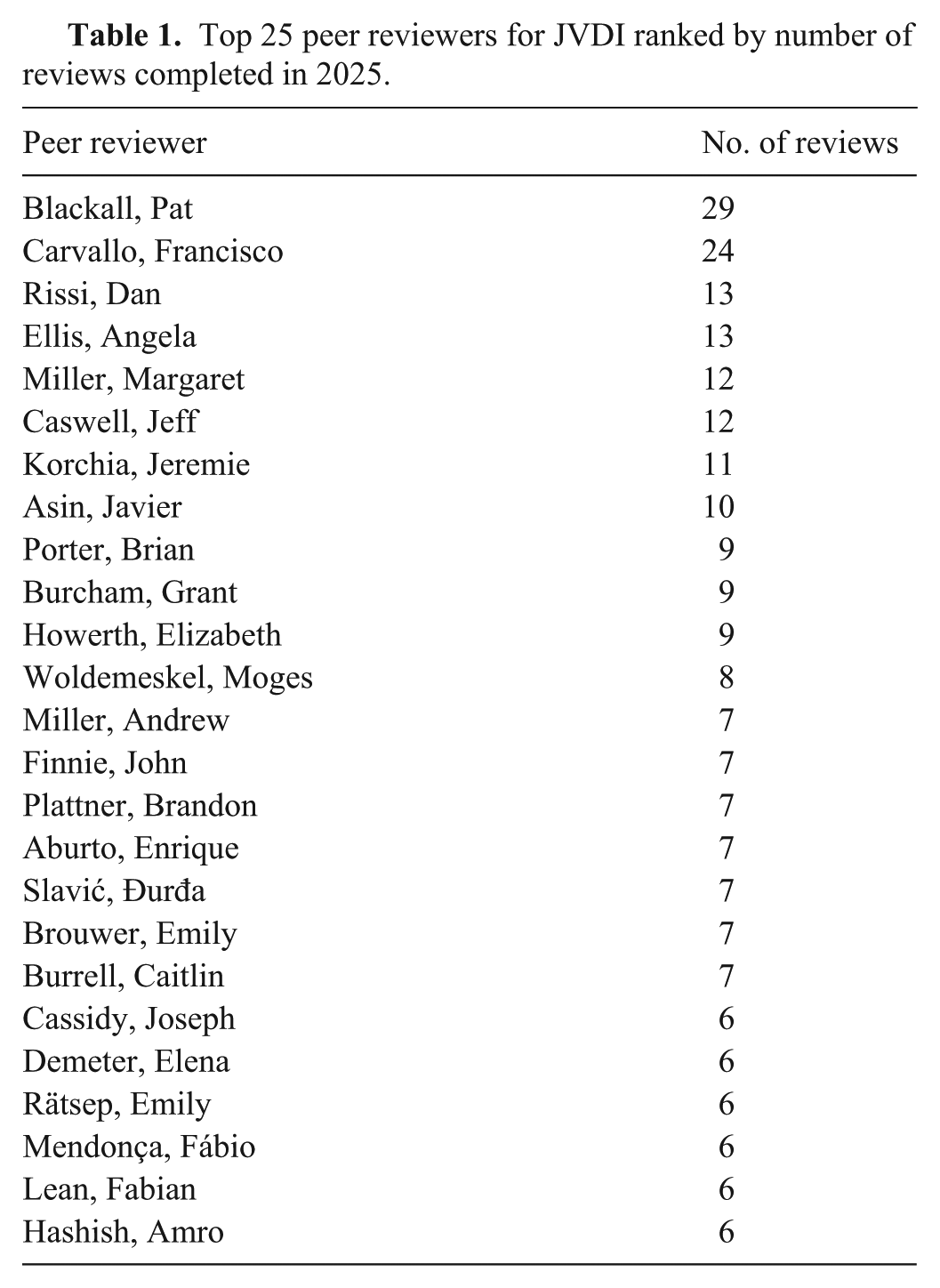
We are delighted to have a strong pool of willing and able peer reviewers. We’ve ranked them by number of reviews completed in 2025 and include here the top 25 who rated at or near 3.0 on our scale of 0–3.0 ( Table 1 ). JVDI section editors often serve as peer reviewers (Blackall, Rissi, Korchia; their numbers include reviews of revisions), plus this short list contains guest editors (Carvallo, Caswell; upcoming interstitial pneumonia issue), and Editorial Board members. All reviewers for 2025 were included in our thank-you note in the January 2026 JVDI issue. We thank again all 345 reviewers who submitted at least 1 review in 2025. We couldn’t do it without you!
Top 25 peer reviewers for JVDI ranked by number of reviews completed in 2025.
JVDI strongly supports our peer reviewers and greatly appreciates their invaluable input to the quality of our publication. We welcome feedback on improvements to our system.