







Abstract
Persisting with a losing project (i.e., a new product development project facing superior competition) is a social endeavor that can increase the costs of failure to the entrepreneur and other stakeholders. Yet, it tends to be explained almost exclusively in terms of intrapersonal predictors, such as the sunk cost fallacy. This paper examines whether, how, and under which conditions interpersonal influence, such as the intensity of a team’s recommendation to persist with a losing project, encourages entrepreneurs to persist. Drawing from the psychologies of escalation and self-regulation, we build a model of entrepreneurs’ undue persistence that we test through experimental design and conjoint analysis. We find that an entrepreneur’s decision to persist with a losing project is determined partly by the team’s recommendation to persist and that the strength of this effect varies across entrepreneurs based on their self-regulation and experience.
Keywords
Introduction
Entrepreneurial action in the form of new product development facing superior competition imposes a decision dilemma of whether to persist (McMullen & Kier, 2016). Persistence in the face of adversity is an important part of the entrepreneurship process (Cardon et al., 2009; DeTienne et al., 2008; Gimeno et al., 1997; Holland & Shepherd, 2013; Kuratko et al., 2021; Yamakawa & Cardon, 2017). However, if this persistence includes maintaining commitment to a losing course of action, especially in the face of negative news (Brockner, 1992; Staw, 1997), it can devolve into “throwing good money after bad” (Sleesman et al., 2012, p. 541) and make failure even more costly (McGrath, 1999; Shepherd et al., 2009). Entrepreneurs must revisit the decision to persist repeatedly as they encounter new information throughout the entrepreneurial journey (Brown & Eisenhardt, 1997; McGrath & Nerkar, 2004; McMullen & Dimov, 2013; Morris et al., 2012). However, as the life of a project extends, the effects of sunk costs (Arkes & Blumer, 1985) and goal completion proximity (Conlon & Garland, 1993) on decision making are likely to mount (McMullen & Kier, 2016), such that persistence can make recovery more difficult (Shepherd et al., 2009) and the cost of failure substantially higher for the entrepreneur and the venture’s stakeholders (DeTienne et al., 2008; Ruhnka et al., 1992).
To date, the individual entrepreneur has been emphasized in the decision to persist (e.g., DeTienne et al., 2008; Holland & Shepherd, 2013). However, new ventures often include teams (Cardon et al., 2017; Klotz et al., 2014; Lechler, 2001) and these teams are likely to influence (to varying degrees) the lead entrepreneurs’ decisions about persistence with a losing project facing superior competition. Acknowledging the importance of this interpersonal context, we ask, how do teams influence the lead entrepreneur’s decision to persist with a losing project?
To address our research question, we couple the literatures on self-regulation (e.g., Carver & Scheier, 1990; Kruglanski et al., 2000) and entrepreneurial experience (e.g., Parker, 2013; Ucbasaran et al., 2003) with the psychologies of escalation (e.g., Sleesman et al., 2012) and interpersonal influence (e.g., Asch, 1955, 1956). Using two studies—a randomized experiment and a conjoint experiment, we find that consistent with our theorizing, entrepreneurs struggle to pull the plug on losing projects when their motivational orientation is approach-oriented (exhibiting a bias for action) as opposed to avoidance-oriented (exhibiting a bias for inaction) and that, for better or worse, entrepreneurs are more likely to heed the team’s advice when the team’s recommendation aligns with the entrepreneur’s self-regulatory mode or experience bias.
Our findings contribute to theoretical development on entrepreneurial persistence in several ways. First, we move beyond self-justification and ego-preservation explanations (Brockner et al., 1986; Staw, 1976) of undue persistence by examining the effect of overt interpersonal influence, like that commonly experienced in new ventures. Second, we find empirical support for McMullen and Kier (2016) self-regulatory model of entrepreneurial escalation and their conjecture that motivational alignment could yield maladaptive strategies by encouraging efficient information processing and decision making, when slower and more deliberate consideration of circumstances may be more prudent. Third, we build on the work of scholars at the intersection of self-regulation and entrepreneurial persistence (e.g., DeTienne et al., 2008; Holland & Shepherd, 2013; Mueller et al., 2017; Yamakawa & Cardon, 2017) by showing how self-regulatory modes, specifically locomotion and assessment (Kruglanski et al., 2000), explains variance in entrepreneurs’ susceptibility to interpersonal influence from their team to persist with a losing project. Finally, we contribute to research on entrepreneurial experience by demonstrating the potential downside of founding experience given it encourages persistence with a losing project both directly and indirectly depending on the team’s recommendation.
Theory and Hypotheses
Interpersonal Influence and Entrepreneurial Persistence
Over the years, notable evidence from various disciplines has indicated that cohesive groups (such as the typical self-managing teams in entrepreneurship) tend to create internal pressures toward conformity that interfere with constructive critical analysis and ultimately lead to dysfunctional decisions (Asch, 1955, 1956; Goncalo & Duguid, 2012; Manz & Neck, 1995). For example, in a study of conformity pressure on project evaluation judgments, Chong and Syarifuddin (2010) found that project managers continue pursuing losing projects when conformity pressure is present. Furthermore, this effect is more pronounced for project managers with high self-esteem (which characterizes many entrepreneurs (Arora et al., 2013)) versus those with low self-esteem.
Not only can conformity pressure lead to dysfunctional decision making, but, because the actions of others can directly affect how one will respond to and act in a given situation (Becker & McCall, 1990), entrepreneurs’ interactions with their teams can influence whether they decide to persist with a losing project facing superior competition. Interpersonal influence is fostered by certain roles (i.e., founder of a new venture) that invoke expectations of behavior (Stryker, 1980). Turner (1982) explains that, when a person’s social identity becomes more salient, their motivations and perspectives become interchangeable with others who share the same social identity. For where they share a sense of social identity, group members embrace a common perspective in which their views become consensually shared (Haslam et al., 2006), even if that perspective involves ongoing commitment to a losing course of action (Brockner, 1992). The higher the salience of identity, the “greater the probability that a person will perceive a given situation as an opportunity to perform in terms of that identity” (Stryker, 1980, p. 84). Thus, when an entrepreneur faces pressure from his or her team to continue with a losing project, it is an opportunity to act in accordance with that identity and persist in the face of adversity (DeTienne et al., 2008; Gimeno et al., 1997; Holland & Shepherd, 2013; Kuratko et al., 2021; Yamakawa & Cardon, 2017).
Empirical research supports this claim. Individuals that identified with their group were more willing to commit more money to a losing project and generated more arguments in favor of that losing project (Dietz-Uhler, 1996). Indeed, in two different studies examining the effect of social identity on escalation of commitment, Haslam et al. (2006) found that individuals possessing a shared sense of identity were much more likely to remain committed to losing projects by maintaining both financial commitment and enthusiasm for the project. Furthermore, interpersonal influence to continue with a project can encourage persistence among entrepreneurs who seek to manage the impressions of those around them in hope of gaining social approval (Brockner et al., 1981). Generally speaking, the greater the pressure, the more likely the individual will comply (Freedman & Fraser, 1966). Given that research suggests that new product development teams remain highly vulnerable to undue persistence despite tools to safeguard against it (Van Oorschot et al., 2013), and that most individuals remain vulnerable to undue persistence even when informed of the effects of sunk costs or goal completion percentage (Kahneman & Egan, 2011), we offer the following as a baseline from which subsequent hypotheses modify:
Interpersonal Influence in Context
The decision to persist with a losing project facing superior competition is highly reminiscent of escalation of commitment, often defined as maintaining commitment to a losing course of action, especially in the face of negative news (Brockner, 1992; Staw, 1997). Over the years, an immense body of research on the psychology of escalation has been distilled through several meta-analyses (e.g., Sleesman et al., 2012) and comprehensive reviews (e.g., Sleesman et al., 2018) to reveal a number of “usual suspects” responsible for undue persistence. Two are variants of the sunk cost fallacy, which individuals commit when they continue a behavior or endeavor because of previously invested resources, such as time and money (Arkes & Blumer, 1985). The other is known as the goal substitution effect in which decision makers approaching completion substitute a completion goal for their original project success goals (Conlon & Garland, 1993).
These decision-making heuristics are well-documented predictors of undue persistence, and they are more likely than not to be present in any entrepreneurial decision to persist with a losing project facing superior competition. For example, conceptualizing entrepreneurial opportunities as projects, (Casson & Wadeson, 2007, p. 288) point out (1) “A project involves a stock of resources which are committed to a particular use over a considerable period of time,” (2) “Setting up a project may incur substantial sunk costs: it involves a commitment of resources which cannot be recovered if the project is abandoned later,” and (3) “The benefits generated by a project are usually realised only after many of the costs have been incurred.” Any decision that considers a team recommendation is also likely to consider information about the time and money invested to date and still required to succeed, as well as projections of how close to completion a project is estimated to be. Such information is likely to evoke status quo bias from both the decision maker and his or her advisor(s).
Interpersonal influence must be examined within the context of these well-known predictors of undue persistence. Although consideration of the effect of interpersonal influence, like that embodied in a venture team’s recommendation, is missing from the literature on undue persistence, it is unlikely to have an isolated effect in the decision to persist. Thus, Figure 1 examines the team’s recommendation as one more piece of information alongside these other three well-established information cues employed by entrepreneurs deciding whether to persist with a losing project. Unlike in Hypothesis 1a, however, the interpersonal influence of the team’s recommendation must compete for the entrepreneur’s attention with financial investment, time investment, and proximity to project completion. Thus, Study 2 Model.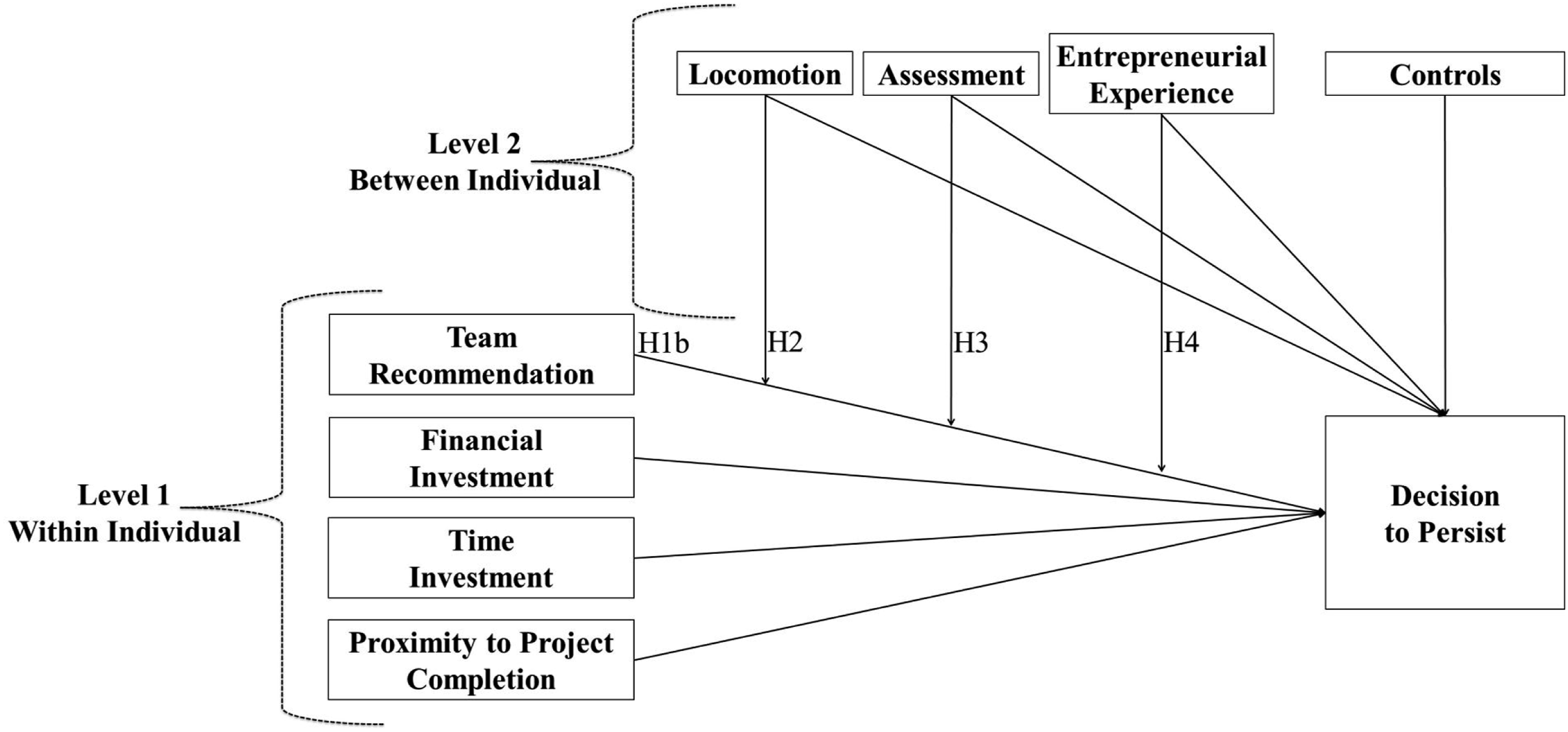
The Moderating Effects of Motivational Orientation
A team recommendation is expected to influence the likelihood of persistence with a losing project directly, but dispositional variance may affect how decision makers respond to interpersonal influence. Using the risky enterprise of mountain climbing expeditions under environmental uncertainty as inspiration and illustration, McMullen and Kier (2016) propose a model of escalation of commitment as a likely outcome of self-regulatory congruency between the approach-avoidance of the entrepreneur’s motivational orientation and the approach-avoidance content of the situation they find themselves in. They note that a situation framed as approach-oriented—for example, summiting Mount Everest—is likely to be evaluated differently by someone experiencing an approach orientation, which requires less interpersonal encouragement to persist, than someone experiencing an avoidance orientation, which requires more interpersonal encouragement to persist.
How these orientations influence which goals individuals pursue and how they pursue them is the focus of the self-regulation school of psychology (Higgins et al., 2003). Concerned with how individuals differ in goal pursuit (e.g., Carver & Scheier, 1990; Gollwitzer, 1990; Higgins, 1989), self-regulation refers to “a systematic process of human behavior that involves setting personal goals and steering behavior toward the achievement of established goals” (Zeidner et al., 2000, p. 751). Specifically, self-regulation involves “comparing and selecting among alternative desired end-states, comparing and selecting among alternative means to attain the selected desired end-state, and initiating and maintaining movement from some current state toward the desired end-state until the desired end-state is attained” (Kruglanski et al., 2000, p. 794). Therefore, consistent with McMullen and Kier (2016) model, the self-regulation school of psychology, and other scholars who have employed theories of self-regulation to explain undue persistence (Barsky & Zyphur, 2016; Molden & Hui, 2011) and entrepreneurial decision making (e.g., Hmieleski & Baron, 2008; Mueller et al., 2017; Wu et al., 2008), we conceive of motivational orientations as “self-regulatory means” or “meta-theoretical modes” and focus on locomotion and assessment (Kruglanski et al., 2000) as one of a host of promising self-regulatory approaches available.
Each self-regulatory mode is likely to have a moderating effect on the relationship between interpersonal influence and persistence depending on alignment between the approach-avoidance content of the decision one is confronting and the approach-avoidance content of the motivational orientation of the entrepreneur. For instance, the decision of whether to continue new product development can be framed as approach-oriented—for example., whether to persist—or it can be framed as avoidance-oriented—for example, whether to stop. A situation framed as approach-oriented (i.e., persistence) is likely to be evaluated differently by someone experiencing an approach orientation than someone experiencing an avoidance orientation. Because different self-regulatory modes highlight different aspects of the goal and the motivational orientation that can create this match/mis-match, they can either amplify or mute the effect of interpersonal influence on entrepreneurial persistence. Therefore, we develop each below.
Locomotion. Locomotion (Avnet & Higgins, 2003; Kruglanski et al., 2000) is a form of self-regulatory mode that distinguishes among various strategies used to pursue goals that may influence how one responds to a team’s recommendation to persist. Locomotion “constitutes the aspect of self-regulation that is concerned with movement from state to state and with committing the psychological resources that will initiate and maintain goal-related movement in a straightforward and direct manner, without undue distractions or delays” (Kruglanski et al., 2000, p. 794). Locomotors have an action bias in that they fear Type II errors (i.e., errors of omission or making a mistake by not acting). They are approach-oriented such that persistence is more likely than it would be for avoidance-oriented individuals. Decision makers high in locomotion are associated with a stronger task orientation—“the tendency to attend to an activity and persist conscientiously until completion” (Kruglanski et al., 2000, p. 795). They emphasize “doing,” which increases their tendency to commit effort to the execution of work-related tasks (Pierro et al., 2006) and heightens their desire to maintain the current course of action (Kruglanski et al., 2009). This tendency to maintain the current course of action comes from conscientious persistence and willingness to overcome distractions and difficulties encountered along the way to goal pursuit (Kruglanski et al., 2000; Kruglanski et al., 2009). As it relates to entrepreneurs, especially, locomotion leads to perseverance of effort and consistency of interest (Mueller et al., 2017). As a result, because of their desire to maintain goal-related movement in a straightforward and direct manner, without undue distractions or delays, locomotors will be influenced more strongly by the team’s recommendation to persist.
Motivational alignment occurs when there is a desire to maintain goal-related movement in a straightforward manner combined with a team recommendation to persist as explained by the notion of regulatory fit. The concept of fit in goal pursuit concerns the relation between an individual’s regulatory orientation to an activity and the manner in which the activity is pursued (Cesario et al., 2004). Motivational alignment occurs when an individual pursues a goal in a manner that sustains their regulatory orientation (Higgins, 2000). For example, there is a natural alignment between an approach state (e.g., persistence) and an approach orientation (e.g., locomotion), or pursuing goals with eager means (e.g., ensuring hits or ensuring against errors of omission) (Crowe & Higgins, 1997). This state of motivational alignment can create experiential value in the sense that it makes a decision “just feel right” (Higgins, 1997). Prior research has found that motivational alignment influences intensity during goal pursuit, prospective feelings about a future choice, retrospective evaluations of past decisions, and value assigned to a chosen object (Cesario et al., 2004; Higgins, 2000). In our study, when the team recommendation is to persist (i.e., an approach-oriented end-state), there is motivational alignment for those with an approach orientation. Thus, the motivational orientation of both team and entrepreneur are congruent in their encouragement of movement, leading to a positive interaction between the two preferences and a state of motivational alignment in which the decision to persist just feels right, further enhancing the team’s recommendation to persist.
The positive relation between the intensity of the venture team’s recommendation to persist with a losing project facing superior competition and the entrepreneur’s decision to persist will be stronger for entrepreneurs with higher locomotion than it is for entrepreneurs with lower locomotion.
Assessment. Alternatively, assessment “constitutes the comparative aspect of self-regulation concerned with critically evaluating entities or states, such as goals or means, in relation to alternatives in order to judge relative quality” (Kruglanski et al., 2000, p. 794). Fundamentally, assessment involves measuring, interpreting, or evaluating something by comparing one thing to another (Higgins et al., 2003). Assessors have an inaction bias in that they fear Type I errors (i.e., errors of commission or making a mistake by acting). They are avoidance-oriented such that persistence is less likely than it would be for approach-oriented individuals. Decision makers high in assessment are negatively associated with task orientation because they “disrupt smooth task flow by stopping more often to evaluate their selection of means or their choice of goals in the midst of engaging in a particular activity” (Kruglanski et al., 2000, p. 795). They are most concerned with making a thorough evaluation of all the options available before choosing the best way forward (Higgins et al., 2003). Because assessors constantly compare and reappraise their current goals and progress, assessment negatively affects an entrepreneur’s consistency of interest and perseverance of effort, especially when current goals are long-term in nature and entail significant adversity (Mueller et al., 2017). As a result, entrepreneurs will be influenced less by their team to persist because of their desire to continuously evaluate end goals and/or means. Motivational misalignment occurs when there is a desire to continuously evaluate end goals and/or means combined with a team recommendation to persist because the individual pursues a goal in a manner that does not sustain their regulatory orientation (Higgins, 2000). For example, there is misalignment between an approach state (e.g., persistence) and an avoidance orientation (e.g., assessment), or pursuing goals with vigilant means (ensuring correct rejections or ensuring against errors of commission) (Crowe & Higgins, 1997). This state of motivational misalignment does not create experiential value or make the decision “feel right” (Higgins, 1997). In our study, when the team recommendation is to persist (i.e., an approach-oriented end-state), there is motivational misalignment for those with an avoidance orientation. Thus, the motivational orientation of the team and entrepreneur are incongruent in their encouragement of movement. This leads to a negative interaction in which the decision to persist does not feel right, contradicting and diminishing adherence to the team’s recommendation to persist.
The positive relation between the intensity of the venture team’s recommendation to persist with a losing project facing superior competition and the entrepreneur’s decision to persist will be weaker for entrepreneurs with higher levels of assessment than it is for entrepreneurs with lower levels of assessment.
The Moderating Effects of Entrepreneurial Experience
Early research on entrepreneurial decision making argues that undue persistence or “escalation bias is a significant and common problem in decision making among entrepreneurs,” and further, “the characteristics of entrepreneurs and the nature of the decisions they are required to make leave them particularly vulnerable to escalation bias” (McCarthy et al., 1993, p. 22). Thus, entrepreneurial experience is likely to affect persistence with a losing project for several reasons.
For example, entrepreneurs tend to be personally responsible for many of the firm’s strategic decisions (Shepherd et al., 2009). As a result, they must spend a substantial amount of time convincing various stakeholders about the decisions they make and claiming that their business venture is viable (Fisher et al., 2017). This justification of previous decisions creates high commitment to the venture and encourages susceptibility to undue persistence. Self-justification theory and self-presentation theory posit that decision makers who are responsible for an initial course of action that is losing, tend to experience the need to justify their original decision, making them susceptible to undue persistence as a means of avoiding the public embarrassment of being linked to a losing project (Sleesman et al., 2012). These decision makers rationalize continued investment to protect themselves psychologically from feeling like they have made errors in judgment (Whyte, 1991).
Because the success of the venture is tied so closely with the entrepreneur’s self-esteem and self-identity (Baron, 1998; Hoang & Gimeno, 2010), entrepreneurs become emotionally involved (Devigne et al., 2016) such that their self-identity and firm identity become intertwined (Cardon et al., 2005; Morris et al., 2012). As the individual’s belongings, self-efficacy and self-identity become increasingly aligned with their venture (DeTienne et al., 2008), they experience higher levels of psychological ownership of their firms (Pierce et al., 2001). For example, Morris and colleagues (2012) argue that the entrepreneur and venture emerge as a function of ongoing experience, with the venture creating the entrepreneur as the entrepreneur creates the venture. Sleesman and colleagues (2018) add: “when leaders identify with and become heavily involved in decisions, they become socially bound to them and fear the loss of face both within and outside the organization if they allow the organization to de-escalate” (p. 189). Therefore, entrepreneurs are likely to suffer from the endowment effect (Kahneman et al., 1991) because of their emotional involvement and will place greater value on their firms merely because they own and control them. This emotional involvement makes it difficult to let go (Yamakawa & Cardon, 2017) due to the loss of identity and self-esteem that would occur with business failure (Shepherd, 2003). Thus, failure of new products considered core to the new venture’s development are likely to threaten the individual’s self-esteem and identity as an entrepreneur, such that the more integral this entrepreneurial identity is to the individual’s sense of self, the more likely undue persistence becomes. Arguably, experience would only exacerbate the problem.
Entrepreneurial experience has been examined in the literature over the years. MacMillan (1986) suggested that to learn more about entrepreneurship and the entrepreneurial process, scholars should study experienced entrepreneurs. Following MacMillan’s call, research has shown that experienced entrepreneurs differ from novices in their use of different sources of information and opportunity identification activities (Westhead et al., 2005). Some research has found that experienced entrepreneurs reap performance advantages and are favored by venture capitalists when investing in new ventures (Eesley & Roberts, 2012; Paik, 2014), while other research has found that entrepreneurial experience is related to pre-launch learning in customer and technology domains (Marvel et al., 2021). Such experience is expected to contribute to an individual’s competence and judgment as an entrepreneur.
However, the question of interest in this study is how experience affects the entrepreneur’s openness to interpersonal influence in the decision to persist with a losing project. Experienced entrepreneurs tend to make decisions by relying on heuristics, or rules of thumb that are frugal such that they ignore information and forgo optimization (i.e., finding the best solution) in favor of satisficing (i.e., finding a good-enough solution by choosing the first option that exceeds an aspiration level) (Gigerenzer, 2008; Simon, 1976). They employ heuristics to increase the speed of the decision and effectiveness of addressing emerging challenges or opportunities (Shepherd et al., 2015). Unfortunately, the use of these decision rules also results in cognitive biases or “thought processes that involve erroneous inference or assumptions” (Forbes, 2005: 623). Consequently, entrepreneurs suffer from cognitive biases such as (1) overestimating their ability to make correct predictions (i.e., overconfidence) (Busenitz & Barney, 1997), (2) overgeneralizing from limited information (i.e., representativeness) (Busenitz & Barney, 1997), (3) focusing more on their own competencies (i.e., egocentric bias) (Moore et al., 2007), and (4) over relying on their own experience (i.e., experience bias) (Parker, 2006, 2013).
Taken together, overconfidence, representativeness, egocentric bias, and experience bias, are likely to discourage experienced entrepreneurs from relying on their team in favor of relying on their own judgment. Given entrepreneurial action generally encourages persistence (McMullen & Kier, 2016), experienced entrepreneurs persist by default. To make matters worse, when there is limited information, decision makers tend to rely on a more intuitive approach (Mintzberg, 1984). Habitual and portfolio entrepreneurs (i.e., entrepreneurs with extensive founding experience) tend to operate with an intuitive cognitive style (Brigham & Sorenson, 2008; Mueller & Shepherd, 2016; Ucbasaran et al., 2003). Thus, those with greater entrepreneurship (i.e., founding) experience are more likely to rely on their own intuition and judgment and less likely to rely on the recommendations from their team.
In our study, when the team recommendation is to persist, there is motivational alignment for those with entrepreneurial experience given their natural inclination to persist. Thus, the motivational orientation of both team and entrepreneur are congruent in their encouragement of persistence, leading to a positive interaction between the two preferences and a state of motivational alignment in which the recommendation matches the entrepreneur’s intuitive drive to persist. Alternatively, when the team recommendation is to stop, there is motivational misalignment for those with entrepreneurial experience given their natural inclination to persist. Thus, the motivational orientation of both team and entrepreneur are incongruent. As a result, those with higher entrepreneurial experience are less likely to heed advice from their team and will continue to persist more so than those with lower entrepreneurial experience. Formally, we hypothesize:
The positive relation between the intensity of the venture team’s recommendation to persist with a losing project facing superior competition and the entrepreneur’s decision to persist will be stronger for entrepreneurs with greater entrepreneurial experience than it is for entrepreneurs with lesser entrepreneurial experience.
Method
We tested our hypotheses using two studies: a randomized experiment and a conjoint experiment. In Study 1, we employed a randomized experiment to establish the causality of the team’s recommendation on the entrepreneur’s decision to persist. By randomly assigning participants into different experimental conditions, we were able to test our main effect (Hypothesis 1a) of interpersonal influence on losing project persistence over and above any potentially relevant but unobserved variables. Having established the main effect of interpersonal influence on persistence decisions, we then sought to determine the relative importance of team recommendation in the context of other information known to encourage undue persistence (Hypothesis 1b). Such decision cues include financial investment (Arkes & Blumer, 1985), time investment (Soman, 2001), and proximity to project completion (Conlon & Garland, 1993). Hence, Study 2 uses conjoint analysis, first, to capture the decision policy of each entrepreneur (via within-participant variance at the first level of analysis); second, to examine whether individual differences such as approach- and avoidance-based self-regulatory modes and entrepreneurial experience relate to the decision to persist (via between-participant variance at the second level of analysis); and third, to examine whether and to what extent the effect of particular decision cues (such as team recommendation) on undue persistence are affected by individual differences, such that the effect of these cues become weaker or stronger in the decision to persist (via within-between interactions across levels of analysis). This allowed us to test our hypothesized contingent relationships (i.e., Hypotheses 2, 3, and 4).
Because we are interested in understanding how entrepreneurial experience influences the effect of interpersonal influence on the decision to persist, we chose not to restrict our sample to participants with entrepreneurship (i.e., founding) experience because doing so would restrict variance in the variable, precluding the ability to determine whether it is the decision cues (i.e., situation) or the nature of the decision maker (i.e., entrepreneurial experience or some unobserved variable associated with “being an entrepreneur”) that is responsible for our findings. Thus, in Study 2, we sampled decision makers with and without entrepreneurial (i.e., founding) experience, a point we discuss further in Study 2.
Study 1
Sample
For Study 1, we sampled entrepreneurs with founding experience currently operating a for-profit business with at least one employee. We recruited our participants using an online survey panel, Qualtrics, which prior research has shown to be a reliable means of data collection (e.g., Courtright et al., 2016; Kier & McMullen, 2018; Long et al., 2011). However, as an abundance of caution, we sought to verify the validity of the participants and responses received from the sampling service that administered the study online. First, to verify that our sample was comprised of entrepreneurs with founding experience, we asked the participants to confirm their status as both an owner or co-owner of a business and the founder or co-founder of the business. Second, the entrepreneur had to indicate that they were operating a for-profit business with at least one employee (other than their self or co-owners). Third, we added a basic knowledge question in the screening section of our study asking the entrepreneurs to report their legal business form (e.g., C-Corp, S-Corp, LLC, and Sole Proprietorship). Fourth, to detect potentially careless, inattentive, or insufficient-effort responses (e.g., Curran, 2016; DeSimone et al., 2015), we inserted multiple attention checks throughout the study by instructing participants to answer with a particular response option, such as “please choose somewhat agree” for this question. Following best practice recommendations, we also measured the participants’ overall response time—the time it takes for an individual to respond to a set of items—and removed any participant that completed the study in less than two seconds per question (Curran, 2016; DeSimone et al., 2015). This was intended to increase overall data accuracy by identifying and eliminating any participant who completed the study without paying attention to the questions. Thus, Qualtrics automatically removed participants who did not successfully meet the criteria above, and for a fee of approximately US$14 per participant, provided completed responses from 284 entrepreneurs. We then scrutinized the completed responses further by reviewing three comprehension questions about our experimental scenarios (explained below in the Data Validation/Manipulation Checks section). We removed 23 participants for failing two or more comprehension questions given the importance of understanding the scenarios to our research design, resulting in a final sample size of 261 entrepreneurs.
The entrepreneurs in our final sample had an average age of 43.27, 22.57 years of work experience, 50.6% were women, 53.64% had completed a 4-year college degree or higher, and 52% had taken an entrepreneurship class or workshop. All the participants were either a founder or co-founder of a for-profit business and reported on average 10.79 years of experience as an entrepreneur with two ventures attempted in their lifetime. The entrepreneurs reported having a legal business entity of Sole Proprietorship (40.6% of sample), Limited Liability Company (30.3%), Partnership (19.9%), S-Corp (5.4%), C-Corp (2.7%), and B-Corp (1.1%) with employees that ranged from 1 to 10,900 (mean = 140.23, SD = 835.38, median = 7). Finally, the entrepreneurs were from 19 different industry classifications located across 42 different US states.
Experimental Conditions
In Study 1, we conducted a randomized experiment to establish causality of the team’s recommendation on persistence. We experimentally manipulated the team’s recommendation to examine its effect on entrepreneurial decision making about whether and to what degree to continue investing in a new product as a founder and president of a new venture. The decision scenario was based on the classic radar blank plane scenario used by Arkes and Blumer (1985) to illustrate the sunk cost effect in which participants make investment decisions as the president of an airline company developing a plane that cannot be detected by radar. However, to ground the scenario in the context of entrepreneurship, we modified it slightly to refer to a new venture that is developing a new product.
We randomly assigned participants to one of three scenarios concerning the team’s recommendation: persist (Condition 1), stop (Condition 2), or control (i.e., no team recommendation, Condition 3). All three conditions received the following instructions from the control condition:
Please imagine you are the founder and president of a new venture. You have invested $9 million dollars of the company’s money and 3 years into the development of a new product. When the product is 90% completed, a competitor launches a similar product to what you are developing. It is apparent that the competitor’s product is superior to your product. The competitor’s product is much faster, far more economical (i.e., cheaper), and possesses better functionality and design than your product. Because you are the founder and president of the new venture, you have the final decision-making power.
Conditions 1 and 2 each had an additional sentence. For Condition 1, the team recommends persistence and reads, “All the members of your new venture team strongly believe you should invest the remaining US$1 million and finish your company’s product.” This additional sentence appears just before the concluding sentence of the scenario. Similarly, for Condition 2 the team recommends stop and reads, “All the members of your new venture team strongly believe you should forego further investment of the remaining US$1 million and not finish your company’s product.” This, too, appears just before the concluding sentence. A full description of each experimental condition as presented to the participants is included in the online Appendix.
Dependent Variable
For our dependent variable we used the amount of money the participant invests to finish their product captured on an 11-point scale: US$0, US$100K, US$200K, US$300K, US$400K, US$500K, US$600K, US$700K, US$800K, US$900K, and US$1M. Participants were specifically asked, “How much of the remaining $1 million dollars would you invest to finish your product?”
Data Validation/Manipulation Checks
Recent work outlining best practices in applying experimental methods to entrepreneurship research advocates for the importance of establishing both internal validity and ecological validity when conducting an experiment (Anderson et al., 2019; Grégoire et al., 2019; Hsu et al., 2017; Stevenson & Josefy, 2019; Williams et al., 2019). Consistent with these recommendations, we established internal validity using a randomized experiment, the gold standard for testing causality (Shadish et al., 2002), combined with post hoc manipulation checks (Grégoire et al., 2019). By randomly assigning participants to experimental conditions (i.e., persist, stop, or control), the effects of unobserved (exogenous) variables such as biases, attributes, and the environment are equalized between conditions, thereby removing their effects on the outcome variable (Hsu et al., 2017). We conducted post hoc manipulation checks to establish construct validity by assessing the extent to which the participant’s interpretation of the study’s procedures and material effectively matches the manipulations’ theoretically intended meaning (Grégoire et al., 2019). Specifically, we asked the participants to answer questions about the scenario such as “In the scenario you just read, how far along is product development at your company,” and “Please indicate the extent to which the competitor’s product is inferior or superior to your product.” These questions indicated whether the participant adequately comprehended and could recall the scenario for their decision—75% of the sample answered both questions correctly. We then asked the participants to “indicate how your new venture team believes you should proceed” and then matched their response to the corresponding condition (e.g., new venture team strongly believes you should finish your company’s product corresponds with the persist condition). All participants in the study answered this question correctly. Together, these questions established that the participants had indeed perceived and processed the manipulation scenarios in the way we intended. Finally, we ensured that the scenarios possessed adequate ecological validity—the extent to which the experiment reflects the real-life context/phenomenon it means to model or represent (Crano & Brewer, 2002)—by consulting expert scholars and entrepreneurs in our development of the scenarios. Doing so indicated that the scenarios were easy to comprehend and reflective of real-world phenomena in which entrepreneurs make decisions about whether to persist in new product development given significant past investment and potential for interpersonal influence.
Study 1: Results
An initial one-way analysis of variance (ANOVA) supported our first hypothesis by indicating a significant main effect for differences between the three conditions in our study F(2, 258) = 17.62, p = .000, η2 = 0.12. The partial eta-squared (η2 = 0.12) represents a medium-to-large effect size based on guidelines proposed by Cohen (1988) for interpreting eta-squared values (0.01 = small effect, 0.06 = medium effect, and 0.14 = large effect). We found no violation of the homogeneity of variance assumption of ANOVA. Figure 2 presents the mean levels of each condition. Least significant difference (LSD) post hoc tests revealed that participants in the team’s recommendation to persist condition (M = 6.74, SD = 3.18), invested significantly more in the losing project than participants in the control condition (M = 4.66, SD = 3.64), (p = .000) as well as participants in the team’s recommendation to stop condition (M = 3.64, SD = 3.66), (p = .000). Given the scale of our dependent variable, the mean difference of 2.08 between the persist and control condition and 3.10 between the persist and stop condition represents approximately US$200,000 and US$300,000, respectively, in added investment based on the team’s recommendation to persist versus either no team recommendation or a recommendation to stop, thereby supporting Hypothesis 1a. Although our scenarios are hypothetical, the results nevertheless demonstrate strong statistical and practical significance. Study 1 Mean Levels of Persistence by Condition.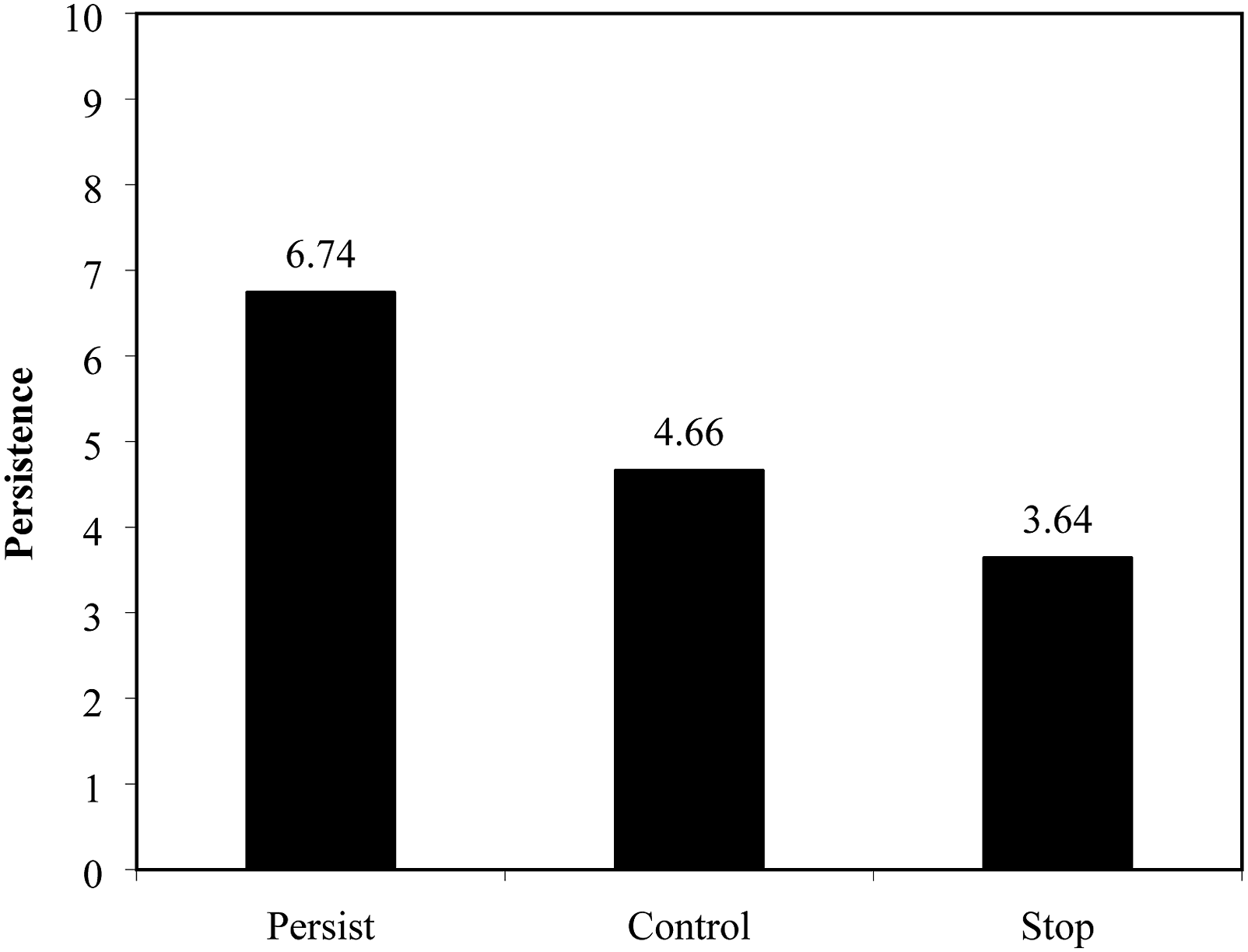
Study 2
Sample
Participants sampled in Study 2 consisted of entrepreneurs and entrepreneurship students. The entrepreneurs were recruited from a professional networking group in a large Midwestern city and the students were recruited from undergraduate and graduate entrepreneurship courses at a large Midwestern public university. Sampling entrepreneurship students makes sense when (1) “students are or resemble the population of interest,” (2) “manipulation is likely to be confounded by the professional experience of the participants,” and (3) “the relationships under investigation are grounded in a broad theory” (Hsu et al., 2017, p. 385). All three conditions apply in our study. First, given their similarities to first time founders (McGee et al., 2009), our student sample not only resembled our population of interest—all were majoring or concentrating in entrepreneurship, but many of them represented our population of interest, with 31% of the entrepreneurship students reporting that they had started new ventures in the past. Second, the participants in our study were asked to engage in entrepreneurial decisions within the context of a new venture. Therefore, sampling only participants with founding experience would have restricted variance on our entrepreneurial experience variable and precluded our ability to infer whether it was the nature of the situation or the decision maker that was responsible for our findings. Finally, the persistence behavior displayed in this study applies beyond entrepreneurship and is consistent with the strong theoretical foundation of escalation of commitment theory (Sleesman et al., 2012, 2018; Staw, 1976).
We sent out 465 participation requests. Following the guidance of Dillman (2000), we sent two follow up requests at one-week intervals. A total of 249 participants agreed to participate in our study representing a response rate of 53.5%. While all participants took part on a voluntary basis, they were informed that completed surveys would be entered into a raffle for one of three US$50 Amazon gift cards. We removed 33 student participants from the study because of low test-retest reliability resulting in a final sample of 216 participants (190 entrepreneurship students and 26 entrepreneurs actively managing a venture 1 ). The participants in our sample had an average age of 25.95 years and 64.35% were male. They reported on average 0.66 prior startups attempted in their lifetime.
Conjoint Analysis
To examine the role of interpersonal influence on the decision to persist with a losing project, we needed to consider the construct’s effect within the context of other well-known predictors of undue persistence. Thus, we turned to a methodology known as conjoint analysis which requires participants to make a series of judgments or choices based on manipulated profiles consisting of decision attributes present to varying degrees (Shepherd, 2011). In the process, the relative importance of each attribute is revealed (Lohrke et al., 2010).
In this study, participants were asked to make a series of decisions about their likelihood of continued investment in new product development in an entrepreneurial venture. First, we asked the participants to envision themselves as the founder and president of a new venture in the process of developing a new product or service. Then, the participants were given explicit feedback that a competitor had just launched a similar product or service that is superior in cost, functionality, and design to the product or service they are evaluating. We then presented the participants with a series of profiles in which we manipulated four attributes: financial investment, time investment, proximity to project completion, and intensity of team recommendation to persist to examine how these attributes influence the participant’s likelihood of continued investment in new product development in an entrepreneurial venture.
To ensure that our conjoint experiment possessed ecological validity—the extent to which the experiment reflects the real-life context/phenomenon it means to model or represent (Crano & Brewer, 2002), we consulted expert scholars and entrepreneurs in the development of the scenarios. Inquiry of practicing entrepreneurs suggested that persistence scenarios about new product development were common and complex, involving a number of moving parts. Turning to the escalation of commitment literature, we identified a well-validated instrument known as the classic radar blank plane scenario (Arkes & Blumer, 1985) and sought to modify its context slightly like we did in Study 1 to ensure the ecological validity of our experiment. Specifically, we toggled back and forth between the feedback received from entrepreneurs about the real-life complexity of new product development (i.e., that such decisions involve consideration of multiple decision attributes at multiple levels) and a rich body of theory on undue persistence and escalation of commitment. Next, we pilot tested our experiment and debriefed with participants about the realism of the scenarios. Doing so indicated that the scenarios were easy to comprehend and reflective of real-world decisions about whether and how much to continue investing in new product development. A sample decision profile is presented in the online Appendix.
Each of the resulting four decision attributes identified were varied at three levels (low, medium, and high) to yield 34 or 81 different profile combinations. By using an orthogonal fractional factorial design (McLean & Anderson, 1984), we reduced the number of profiles to 27. Consistent with prior conjoint analysis studies (e.g., Shepherd et al., 2013; Warnick et al., 2018), we randomly replicated nine profiles to test the reliability of the participant’s decision policy, resulting in an average test-retest correlation of 0.76. We also added two practice profiles in the beginning of the experiment to help familiarize the participants with the procedure (McMullen et al., 2016). Finally, we created four unique versions of the experiment in which the profiles were randomized to control for potential order effects. We then further account for individual differences by combining our experiment with a survey to capture chronic approach and avoidance orientations, entrepreneurial experience, and control variables.
Level 1: Persistence Determinants
Consistent with a meta-analysis on escalation of commitment (Sleesman et al., 2012) and inquiry of practicing entrepreneurs, we manipulated three common psychological determinants and one new interpersonal determinant at low, medium, and high levels: Financial Investment is the amount of money already invested in product development, Time Investment is the amount of time already invested in product development, Proximity to Project Completion is how close the product is to completion, and Team Recommendation (i.e., interpersonal influence) is the intensity of the team’s recommendation to continue investment in new product development. Please see the online Appendix for a complete definition and operationalization of each factor used in the conjoint analysis.
Level 2: Individual Differences
We measured approach and avoidance as potential moderators that may amplify or diminish the team’s recommendation to persist using Kruglanski and colleagues’ (2000) scale of Locomotion and Assessment. The initial scale consists of 24 items: 12 items for locomotion (e.g., “When I get started on something, I usually persevere until I finish it; When I decide to do something, I can’t wait to get started”), and 12 items for assessment (e.g., “I often critique work done by myself or others; I often compare myself with other people”). We measured each item on a Likert scale ranging from 1 (strongly disagree) to 6 (strongly agree) and then performed a confirmatory factor analysis to assess model fit, item reliability, and discriminant validity between the constructs. We removed three items for locomotion and five items for assessment due to poor item reliability (i.e., factor loadings below 0.40) resulting in a final construct reliability of 0.84 and 0.77 for locomotion and assessment, respectively. Our final two-factor measurement model showed acceptable goodness of fit: comparative fit index (CFI) = 0.856; standardized root mean square residual (SRMR) = 0.079; and, root mean square error of approximation (RMSEA) = 0.077. We compared a two-factor model with an alternative one-factor model to establish discriminant validity between the constructs. The two-factor model demonstrated better model fit than the one-factor model. Finally, we measured entrepreneurial experience as the number of ventures attempted in the participant’s lifetime and controlled for the participants’ age (number of years) and gender (dichotomous variable).
Dependent Variable
The dependent variable in Study 2 is the likelihood that the participant would continue investing in the product measured on a 9-point Likert-type scale anchored by (1) extremely unlikely to (9) extremely likely. Participants were specifically asked, “How likely would you be to continue investing in the product given the following conditions?” It should be noted that single item measures are the norm in conjoint analysis because reliability is established (as explained above) by comparing responses on original versus repeat profiles (cf. DeTienne et al., 2008; Holland & Shepherd, 2013; Shepherd et al., 2013; Wood & Williams, 2014).
Study 2: Results
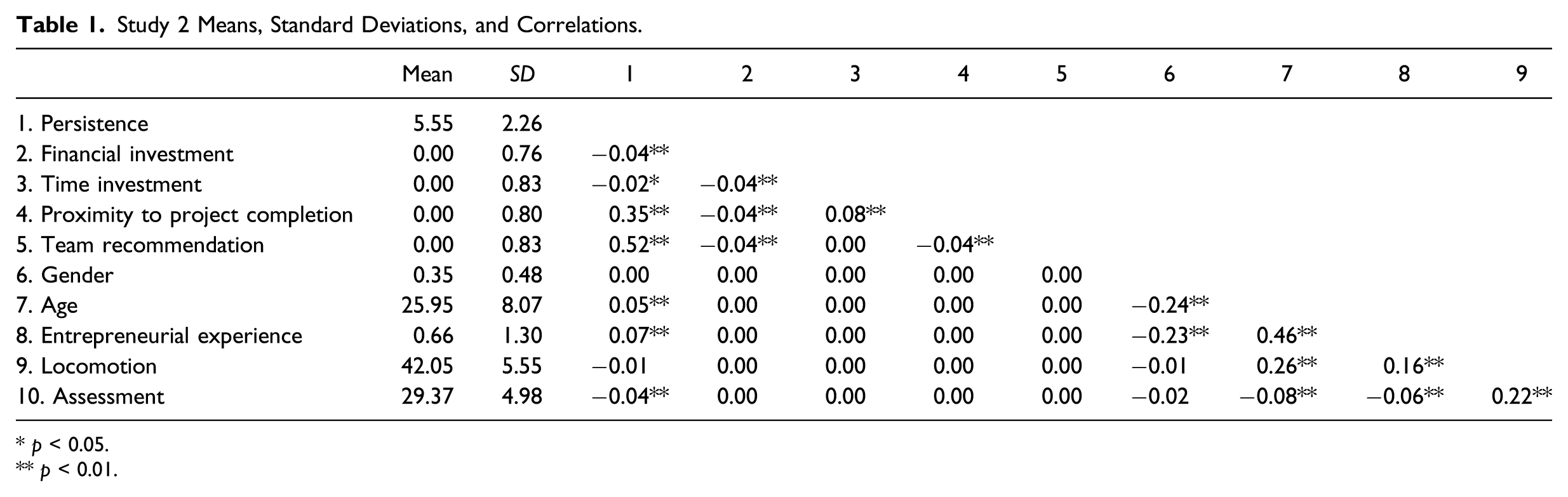
Study 2 Means, Standard Deviations, and Correlations.
* p < 0.05.
** p < 0.01.
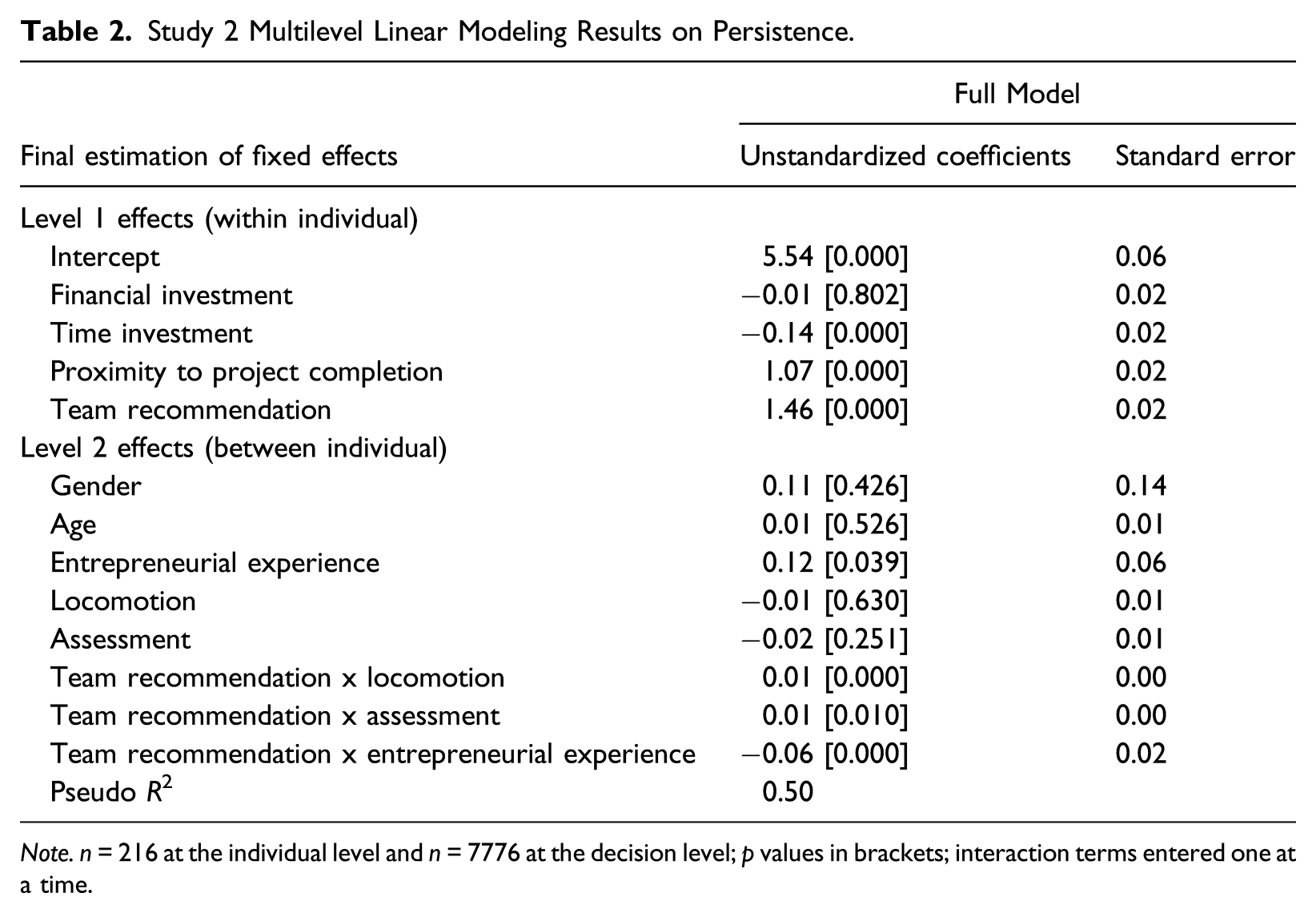
Study 2 Multilevel Linear Modeling Results on Persistence.
Note. n = 216 at the individual level and n = 7776 at the decision level; p values in brackets; interaction terms entered one at a time.
We found support for Hypothesis 1b that the venture team’s recommendation to persist with a losing project encourages the entrepreneur’s decision to persist, as team recommendation was positive and significantly related to persistence (b = 1.46, p = .000). This beta coefficient of team recommendation on persistence means that a one unit increase in team recommendation results in a 1.46 increase in persistence (measured on a 1–9 scale). This effect is over and above the effects of financial investment (Arkes & Blumer, 1985), time investment (Soman, 2001), and proximity to project completion (Conlon & Garland, 1993)—three variables recognized as strong predictors of persistence. The correlation of 0.52 between team recommendation and persistence found in Table 1 would be considered a large effect based on guidelines proposed by Cohen (1988) for interpreting correlations (0.1 = small effect, 0.3 = medium effect, and 0.5 = large effect). In addition, this correlation represents a stronger effect than other persistence determinants outlined in Sleesman and colleagues (2012) meta-analysis which reports estimated true-score correlations for sunk costs (i.e., financial investment ρ = 0.24), time investment (ρ =0.43), proximity to project completion (ρ = 0.39), and group identity (only significant interpersonal determinant in the meta-analysis ρ = 0.31).
Given that we were most interested in the effect of interpersonal influence on persistence, we examined the effects of higher levels of locomotion, assessment, and entrepreneurial experience on the effect of the team’s recommendation on the entrepreneur’s decision to persist. We found support for Hypothesis 2, such that the positive effect of the team’s recommendation to persist with a losing project on the entrepreneur’s decision to persist is stronger among entrepreneurs who are higher in locomotion (b = 0.01, p = .000). We also found support for Hypothesis 3, such that the effect of the team’s recommendation to persist with a losing project on the entrepreneur’s decision to persist is weaker among entrepreneurs who are higher in assessment (b = 0.01, p = .010). Finally, we found support for Hypothesis 4, such that the effect of the team’s recommendation to persist with a losing project on the entrepreneur’s decision to persist is stronger among entrepreneurs who are higher in entrepreneurial experience (b = −0.06, p = .000). Consistent with Cohen and Cohen (1983), we plotted the interaction effects at one SD below and above the mean to interpret effects as portrayed in Figures 3A–C, respectively. We also explored regions of significance by conducting a Johnson–Neyman floodlight analysis (Spiller et al., 2013) for all the interactions in our model. In doing so, we found that the interaction effects were significant at all levels of the moderators within our data. Study 2 Interactive Effect of Team Recommendation and (A) Locomotion, (B) Assessment, and (C) Entrepreneurial Experience on Persistence.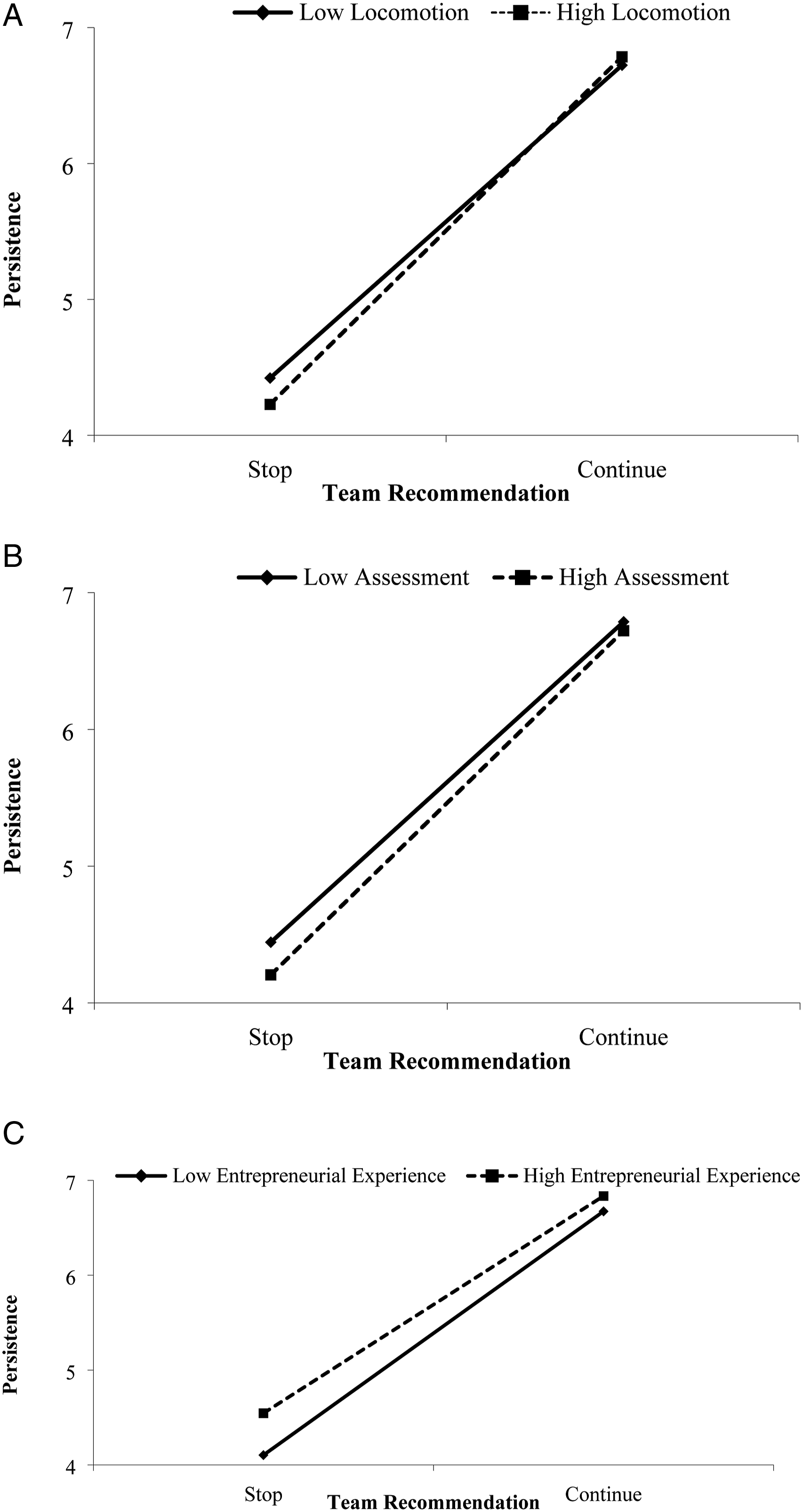
While these beta coefficient effect sizes are small, it is important to note that locomotion, assessment, and entrepreneurial experience are individual differences that are likely to influence new product development decisions repeatedly during venture creation. In fact, simulations by Martell et al. (1996) indicate that even the smallest effects can have powerful consequences when the effect is repeated over time. Thus, because locomotion, assessment, and entrepreneurial experience can color perceptions each time the lead entrepreneur interacts with his or her team, small effects in persistence can result in compounded effects of undue persistence.
Robustness Checks
The results of our analyses remained robust regardless of the inclusion of control variables, retaining the same pattern and significance of findings. In addition, given the heterogeneity of our sample, which includes entrepreneurs and entrepreneurship students, we sought to check the robustness of our results by splitting our sample and looking for differences between entrepreneurship students and entrepreneurs actively managing a venture. When doing so, we found that our results generally hold across the two subsamples. For example, we found identical main effects on the within-participant variables of Level 1 (i.e., significant effect of time investment, proximity to project completion, and team recommendation) in both subsamples. We also found that all interaction effects hold in the entrepreneurship student subsample. However, for the entrepreneur subsample, the interaction effect between team recommendation and locomotion lost its significance (b = 0.00, p = .661) and the interaction effect between team recommendation and entrepreneurial experience became marginally significant (b = −0.04, p = .056). Given that the entrepreneur subsample was limited to 26 entrepreneurs, these changes are more likely due to a lack of power than substantive differences.
Discussion
In two studies (a randomized experiment and a conjoint experiment), we examine not only whether interpersonal influence affects the decision to persist in new product development but also whether individual differences in entrepreneurs’ self-regulation and entrepreneurial experience affect their responsiveness to the team’s recommendation to persist with a losing project. Taken together, our studies find support that interpersonal influence encourages entrepreneurial persistence with a losing project both directly and to a varying degree depending on experience and self-regulatory mode. In the process, we believe our results yield important theoretical contributions to entrepreneurial persistence.
First, our findings contribute to entrepreneurial persistence research, which has traditionally focused on the psychological determinants of persistence without much regard for the interpersonal determinants of persistence. For example, individuals are more likely to continue their course of action when the decision involves high sunk costs (Arkes & Blumer, 1985), increased time investment (Soman, 2001), experience in the domain (Bragger et al., 2003; Garland et al., 1990), high self-efficacy (Judge et al., 1998), and ego threat/reputation (Rhee & Haunschild, 2006; Zhang & Baumeister, 2006). Self-justification theory (Aronson, 1968; Festinger, 1957) suggests that decision makers feel a need to justify or protect their original investment, experience in the domain, self-efficacy, and ego/reputation. Because the vast majority of new ventures include teams (Klotz et al., 2014), both logic and our findings suggest that persistence with a losing project is likely to result from interpersonal influence as much as psychological influence.
We directly investigate the role of interpersonal influence in increasing persistence tendencies across two separate studies. We find statistically significant results that, if anything, are understated. Our manipulation of interpersonal influence is likely to offer a more conservative test than what an entrepreneur would face in the field where relational bonds, such as teams’ perceived entitlement to trust, are likely to make it more difficult for the entrepreneur to ignore the team’s recommendation (Mach et al., 2010). Thus, we offer a first step toward answering Sleesman and colleagues’ (2012) call to look beyond the intrapersonal psychology of undue persistence to begin filling the “relative dearth of empirical studies examining the social determinants” (p. 553) of escalation. We find across Study 1 and Study 2 that the team recommendation to persist in new product development greatly impacts the likelihood of persistence with a losing project by the entrepreneur. How much stronger might this effect be if the entrepreneur had a trusting relationship with his/her team and was highly uncertain or personally ignorant about the future development prospects of the new product?
Our results also extend the work of other scholars studying entrepreneurial persistence. For example, DeTienne and colleagues (2008) and Yamakawa and Cardon (2017) both found a positive relationship between personal investment of time and the decision to persist with a losing venture. In Study 2, we found that increased time investment decreases persistence. We believe this counterintuitive finding leads to an important theoretical contribution. In Study 2, participants were informed of prior time investment, but they did not experience it or live it. In turn, they might not have felt personally responsible for the initial investment decision. This is an important theoretical distinction demonstrating that whenever entrepreneurs are not responsible for the original investment decision, they might not be concerned with saving face as self-justification theory implies. Taken in this light, our results are consistent with classic escalation of commitment research which shows that personal responsibility for the initial decision activates self-justification needs (Staw, 1976) and a desire to protect one’s self-identity (Brockner et al., 1986). In contrast, we show that, when entrepreneurs do not experience the actual time investment in the venture, their self-identity is unlikely to be tied to the venture (Cardon et al., 2005), such that they may not take psychological ownership of the decision (Pierce et al., 2001), and thus can remain impartial. In addition, our results further support Soman (2001) who found that the sunk cost effect disappears when the costs are temporal in nature because of the difficulties in mentally accounting for time. The implication of this finding is that because our context of new product development is commonplace to entrepreneurship, entrepreneurs may confront such decisions to persist in new product development in new ventures initiated by teams other than themselves. As a result, there appears to be differences in persistence decisions for entrepreneurs who have personally invested their own time into the venture versus entrepreneurs who come into the venture later and are required to make decisions going forward on projects initiated by others. However, this does not mean that entrepreneurs can remain completely impartial just because they were not responsible for the initial investment decision. Given that Study 2 found that persistence with a losing project is more likely when proximity to project completion increases, entrepreneurs still appear to be susceptible to goal completion effects as they get closer and closer to concluding a project (Conlon & Garland, 1993).
Second, we find empirical support for McMullen and Kier (2016) self-regulatory model of entrepreneurial escalation and their conjecture that undue persistence is a likely outcome of self-regulatory congruency between the approach-avoidance of the entrepreneur’s motivational orientation and the approach-avoidance content of the situation. They go on to illustrate how and why “the efficient thought that accompanies a congruency between ends and means – Higgins (2000) regulatory fit – is not necessarily an entrepreneur’s friend” (p. 682). Our experiments empirically support their anecdotal observation by showing that avoidance-based motivational orientations may be more desirable for preventing undue persistence when evaluating approach-oriented end-states (outcomes framed in terms of persistence either by oneself or others), precisely because of the motivational misalignment that arises from this self-regulatory incongruence. Therefore, contrary to the assumptions of self-regulatory researchers (e.g., Brandstätter & Frank, 2002), our findings suggest that self-regulatory mindsets may facilitate environmental adaptation under most, but certainly not all, circumstances. When contemplating novel circumstances, more deliberate thought may be called for, even if it is less efficient and less likely to “just feel right.”
Third, our findings answer the call by Sleesman and colleagues (2018) for “future research that could offer insight into the escalation literature by examining the degree to which leader attributes influence the commitment to failing endeavors” (p. 190) by explaining heterogeneity among individuals’ decisions to persist in new product development. To operationalize this heterogeneity, we introduced theories of self-regulation, specifically locomotion and assessment (Kruglanski et al., 2000), to explain variance in entrepreneurs’ responsiveness to interpersonal influence from their team to persist. In doing so, we show how and why entrepreneurs require different levels of influence to persist with a losing project.
In Study 2, we found that locomotion strengthens the effect of interpersonal influence on persistence when the team’s recommendation is to persist with a losing project. Locomotion constitutes the aspect of self-regulation concerned with movement from state to state, where the person desires not only to initiate but maintain movement in a straightforward and direct manner without undue distraction or delays (Kruglanski et al., 2000). Thus, when an entrepreneur’s team recommends continuing with new product development, the decision to persist represents movement in the same direction and pursuit of the status quo. Thus, we build on the work of Mueller and colleagues (2017) who find that locomotion is beneficial for entrepreneurs in that it leads to increases in grit and venture performance but qualify that locomotion “may also lead to rash impulsive behavior which may be detrimental to the firm” (p. 273). Indeed, we find that their concerns may be well-founded, given that locomotion amplifies the tendency toward persistence with a losing project when influence to persist is high.
However, we also find that locomotion results in lower persistence when the team’s recommendation is to stop in Study 2. These results as well as the results of when the team recommendation is to persist are explained by motivational alignment (misalignment) that occurs when an individual pursues a goal in manner that sustains (diminishes) their regulatory orientation (Higgins, 2000). For example, there is a natural alignment between an approach state (e.g., persistence) and an approach orientation (e.g., locomotion), or pursuing goals with eager means (e.g., ensuring hits or ensuring against errors of omission) (Crowe & Higgins, 1997). In our study, when team recommendation is to persist (i.e., an approach state), there is motivational alignment for those with an approach orientation leading to a positive interaction between the two preferences and a state of motivational alignment in which the decision to persist just feels right, further enhancing the team’s recommendation to persist. On the contrary, when the team recommendation is to stop, the motivational orientation of both team and entrepreneur are incongruent for those with an approach orientation leading to a state of misalignment and overall lower persistence.
In addition, we found that assessment—the comparative aspect of self-regulation concerned with the critical evaluation of alternatives to judge relative quality (Kruglanski et al., 2000)—diminishes interpersonal influence’s persistence effects when the team’s recommendation is to persist. Therefore, assessment may negatively affect an entrepreneur’s consistency of interest and perseverance of effort (Mueller et al., 2017), but when interacting with the recommendation to persist, it can also reduce persistence with a losing project. Again, these results are consistent with motivational alignment (misalignment) that occurs when individuals pursue a goal in manner that sustains (diminishes) their regulatory orientation (Higgins, 2000). In our study, when the team recommendation is to persist, there is misalignment between an approach state (e.g., persistence) and an avoidance orientation (e.g., assessment), or pursuing goals with vigilant means (ensuring correct rejections or ensuring against errors of commission) (Crowe & Higgins, 1997). Thus, the motivational orientation of the team and the entrepreneur are incongruent in their encouragement of movement, leading to a state of misalignment in which the decision to persist does not feel right, contradicting and diminishing adherence to the team’s recommendation to persist. We find a consistent pattern of results when examining the effects of assessment on the team’s recommendation to stop. When the recommendation is to stop, there is motivational alignment for those with an avoidance orientation resulting in even lower levels of persistence.
Finally, the results of our study contribute to research on entrepreneurial experience by demonstrating a potential downside of founding experience in undue persistence. Specifically, in Study 2, we found that entrepreneurial experience encourages persistence with a losing project both directly and indirectly depending on the team’s recommendation. Although not explicitly hypothesized, we found an overall main effect of entrepreneurial experience such that higher levels of entrepreneurial (i.e., founding) experience led to greater persistence with a losing project. 2 This finding provides empirical support for prior theorizing as to why entrepreneurs are highly susceptible to undue persistence (Baron, 1998; McCarthy et al., 1993). For example, one study found that “grittier” individuals were less willing to give up when failing, even though they were likely to incur a cost for their persistence (Lucas et al., 2015).
Entrepreneurs face pressure not only psychologically in their attempts to preserve their identity as a sound decision maker, leader, and creator of new ventures, but also interpersonally as they seek to protect their reputation with friends, family, peers, and team. We also found interaction effects such that, when the team recommendation is to persist, there is motivational alignment for those with higher entrepreneurial experience given their natural inclination to persist. It appears that the team may be telling the entrepreneur what he or she wants to hear. Alternatively, when the team recommendation is to stop, experienced entrepreneurs are more likely to rely on their own intuition and judgment, to be less affected by a recommendation from the team, and to persist regardless.
Limitations and Boundary Conditions
Although we believe our findings make important theoretical contributions to entrepreneurial persistence, our theorizing contains several boundary conditions that highlight potential limitations of our study and opportunities for future research. First, we use a self-regulatory approach and avoidance theoretical lens to explain the susceptibility to interpersonal influence to persist with a losing project. In doing so, we assume that the goal of new product development is an approach state, and therefore more congruent with an approach motivational orientation (i.e., locomotion), such that an entrepreneur is seeking to maximize return or attainment of some desired outcome as opposed to an avoidance state in which an entrepreneur would focus on preventing undesired outcomes by seeking to detect threats that might increase one’s exposure to risk or potential for loss via an avoidance motivational orientation (i.e., assessment) (McMullen & Kier, 2016; McMullen et al., 2009). Future research might examine such framing effects such as reference to a desired end-state in which the approach of a desired end-state evokes eagerness compared to reference to an undesired end-state in which the avoidance of an undesired end-state evokes vigilance (Molden, 2012). Second, there may be instances when new product development or other forms of entrepreneurial action may benefit from complementarity in which some members of the new venture team pursue goals eagerly and some members pursue goals vigilantly as long as there is general agreement regarding which goals to pursue (Bohns et al., 2013). Thus, future research on complementary goal pursuit is warranted, as is investigating when approach and avoidance orientations may be adaptive (Wrosch et al., 2003), given that both might influence undue persistence. Third, while our study focuses on dispositional approach and avoidance orientations, each may also be evoked situationally (Higgins, 1997), which might be especially relevant during the COVID-19 pandemic that could make even the most eager entrepreneur hyper vigilant. We therefore encourage future research to examine how situational and dispositional approach and avoidance orientations interact to influence undue persistence. Fourth, locomotion and assessment are one of many self-regulatory theories that can be used to operationalize approach and avoidance. For example, regulatory focus theory (Higgins, 1997) also distinguishes between approach and avoidance orientations via promotion focus and prevention focus. Thus, our model is not exclusive to use of locomotion and assessment. We therefore encourage future research that may employ other measures of self-regulation to test our theorizing (see Kruglanski & Higgins, 2007 and Vohs & Baumeister, 2013 for handbooks on self-regulation).
Alternative theoretical approaches to persistence with a losing project may also promise fruitful avenues of research. For example, groupthink (Janis, 1972) and game theory (Sanfey, 2007) could help explain the interpersonal influences of a team’s recommendation on persistence, while real options reasoning (McGrath, 1999; Sandri et al., 2010), pivoting (Grimes, 2018), and hustle (Fisher et al., 2020) might provide alternative explanations for the persistence of those engaged in entrepreneurial action. We also examine how entrepreneurs may persist under influence from their team using a consultative decision-making style (Vroom, 2000; Vroom & Jago, 1995), where the lead entrepreneur acts much a like a president consulting his or her cabinet for advice before making a final decision. This is only one of many plausible scenarios. For example, entrepreneurs who are part of a founding team might make decisions collectively and thus be susceptible to a different set of team dynamics that influence team entrepreneurial escalation of commitment (e.g., Huang et al., 2019).
Finally, it is important to note that our experimental methodology poses several constraints on generality (Simons et al., 2017). First, while the results of our study provide evidence of the effects of interpersonal influence by capturing persistence decisions regarding new product development in real time, they do so by using hypothetical scenarios that can lack ecological validity or introduce demand effects. Second, we include several decision attributes in our scenarios that are supported by a large body of persistence and escalation of commitment research; however, a number of factors regarding the venture and venture team are not included in our scenarios that could greatly influence results when researchers pursue this line of inquiry in the field. For example, the scenario in Study 1 utilizes a well-funded venture (i.e., US$9 million invested) with 3 years of development facing superior competition. Thus, multiple iterations of several scenarios are likely needed to account for ventures of different ages, sizes, resource endowments, and competitive environments. Moreover, our scenarios do not address the effects of various new venture team complexities such as ownership structure that could influence a team’s recommendation to persist as well as susceptibility to that influence to persist. Finally, decisions on new product development are likely influenced by other stakeholders such as employees, investors, or board of directors where terminating a project could mean significant layoffs or a drastic decline in stock price/firm value. Thus, we encourage future research to employ more fine-grained manipulations such as teams with and without equity ownership (Hellmann & Wasserman, 2017), ventures with various stakeholder powers (Hampel et al., 2020), resource scarce versus resource abundant ventures (Hanlon & Suanders, 2007), pre-revenue versus post-revenue ventures (Marvel et al., 2021), family versus non-family ventures (Ko et al., 2021), and/or corporate versus non-corporate ventures (Covin et al., 2018) as they examine entrepreneurial persistence with losing projects.
Given our sample of entrepreneurs and entrepreneurship students making decisions about whether to persist with new product development under conditions of substantial sunk costs and team influence, we expect our results to generalize to other entrepreneurs and university students. Nonetheless, we encourage replication of our work using pre-registered studies to determine the conditions under which our findings generalize. Finally, we did not provide direct evidence that our findings occur naturally in the field or under alternative conditions such as certain outcomes. However, “we have no reason to believe that the results of our studies depend on other characteristics of the participants, materials, or context” (Simons et al., 2017, p. 1126).
Conclusion
In this article, we used experimental techniques to examine a decision bias common in entrepreneurial persistence. We show that persistence with a losing project is more than a matter of sunk costs and goal completion effects, it is also a phenomenon in which the team’s recommendation serves as interpersonal influence that can significantly affect undue persistence. Furthermore, we find that individual differences in self-regulation (approach- or avoidance-based motivational orientations) as well as entrepreneurial experience influence the relationship between interpersonal influence and persistence in both positive and negative ways. Given that new ventures are often borne of new product development involving teams, and that entrepreneurs rarely enjoy a portfolio of products from which to choose when deciding whether to persist in entrepreneurial action, we invite others to join us in seeking to understand how entrepreneurs might more objectively evaluate losing projects.
Footnotes
Acknowledgments
We would like to thank Dean Shepherd for his helpful feedback on earlier drafts of this manuscript as well as Editor Jeffrey M. Pollack and the anonymous reviewers for their support and developmental comments.
Declaration of Conflicting Interests
The authors declared no potential conflicts of interest with respect to the research, authorship, and/or publication of this article.
Funding
The authors received no financial support for the research, authorship, and/or publication of this article.

Notes
Author Biographies