







Abstract
Although events such as the global financial crisis, natural disasters, or the COVID-19 pandemic have large impacts on entrepreneurship, the literature lacks a differentiated analysis of such events. This editorial highlights the importance of events which are discrete and bounded in space and time, unexpected, and strong enough to produce change that can lead to subsequent events. An event based approach is well suited to integrate context and time to predict entrepreneurial activity. We provide a more systematic description of events, their characteristics, and causal mechanisms to allow more holistic and generalizable analysis of the role of events in entrepreneurship.
Keywords
“History is just one damned thing after another.” - Arnold Toynbee
1
Introduction
When the COVID-19 pandemic emerged many researchers recognized it as a unique opportunity to study entrepreneurship in the face of an extreme event and initiated research projects. Theorizing and studying events is not new to entrepreneurship and the topic has been evaluated from different perspectives, such as disequilibrium (Eckhardt & Shane, 2003; Shane & Venkataraman, 2000), changes in the business environment (Davidsson, 2020), or crisis situations (Doern et al., 2019). However, the study of events is fragmented. For example, studies have examined different types of events, ranging from war to natural disasters, the global financial crisis and, most recently, the COVID-19 pandemic. These events clearly have certain characteristics in common, but they differ in some dimensions. For example, some events directly caused hundreds of deaths while other events caused economic disruption. We do not know whether or not these events are comparable so that it is possible to generalize from one event to another event context. To address these issues, we suggest an event-based perspective by carefully defining event characteristics and specifying the causal mechanisms between events and entrepreneurship.
Entrepreneurship research can benefit from a more systematic analysis of events. An event-based approach can inform entrepreneurship theory in three ways. Extreme events are becoming more prevalent. The past 15 years have included macro-level events such as the global financial crisis (2008), the banking crisis in the EU (2011), large fire catastrophes in California and Australia (both in 2019–2020), and the COVID pandemic (2020–21). An increasing number of entrepreneurs are and will be confronted with such events. Crisis events can even provide the seeds for entrepreneurship. For example, Schumpeter (1934) argued that entrepreneurs are key actors moving the economy towards equilibrium after major disruptions and implied that events provide opportunities and that entrepreneurs have a critical role in events. An event-based approach will not change our basic understanding of entrepreneurship theory and constructs will not become obsolete. However, events can affect relationships between constructs and how constructs operate. Therefore, an event-based approach can improve explanations in entrepreneurship theories.
Second, a more systematic analysis of events allows an event to be evaluated in light of other events. Entrepreneurship theorizing accepts that events are predictive and meaningful, but researchers need to categorize events to develop hypotheses, compare events and make generalizations. While events are unique and happen in context and time, a more systematic analysis of events can explain the phenomenon of events.
Finally, an event-based approach helps combine process and variance approaches. Both approaches are often contrasted and seen as mutually exclusive (Van de Ven & Engleman, 2004). An event-based approach can extend variance and process-based approaches by explaining how events become meaningful across contexts and time (Morgeson et al., 2015). Events provide opportunities to see how entrepreneurs become activated in the face of an event such that they develop a consistent response to the situation. Thus, an event-based perspective focuses on variability within entrepreneurs and firms across time and context (Hoffman & Lord, 2013).
Moreover, an event-based perspective can allow researchers to develop implications for practice. Events trigger some type of response to the event. By responding to events, entrepreneurs not only maneuvre their firm through events but help their communities to recover from events (Williams & Shepherd, 2016b). Several studies show that entrepreneurs are well equipped to respond to events (Brück et al., 2011; Davidsson & Gordon, 2016; Dutta, 2017). An event-based perspective of entrepreneurship can help governments, investors and other decision-makers develop robust event responses.
In this paper, we first define events, then we describe event characteristics and finally clarify the causal mechanisms between events and entrepreneurship activity. We conclude by integrating the event-based perspective into entrepreneurship theorizing.
Defining Events
Classification of Event Characteristics and Mechanisms.
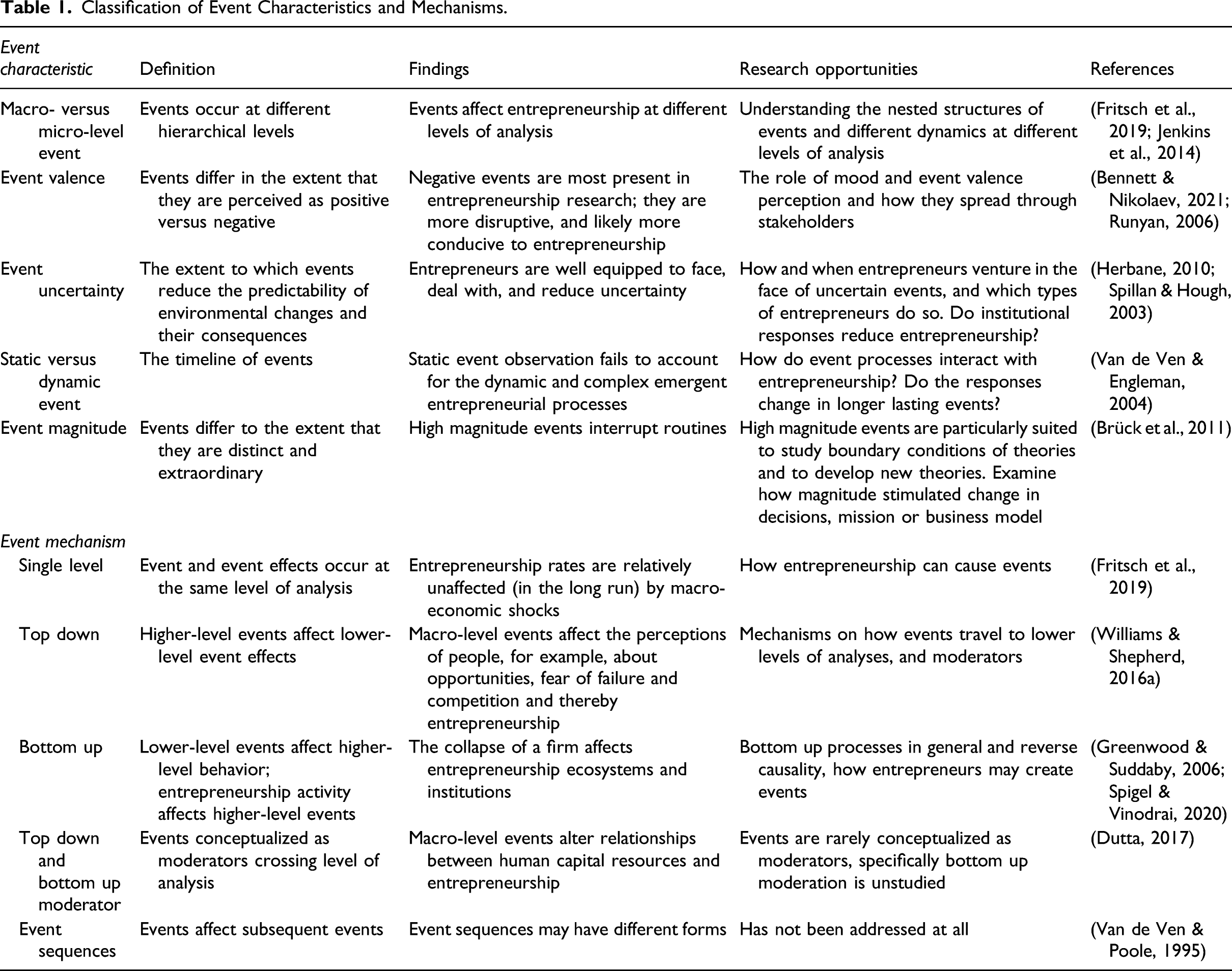
Event Characteristics
Events can be described along many different dimensions, such as micro versus macro—level events, event valence, event uncertainty, temporal focus (static vs. process events), or event magnitude. There are existing taxonomies of events (see Hoffman & Lord, 2013; Morgeson & DeRue, 2006; Morgeson et al., 2015; Peterson, 1998; Tilcsik & Marquis, 2013). Taxonomies have limitations as events are by definition unique. However, it is useful to discuss characteristics of events to compare aspects of events relevant to entrepreneurship, integrate event research in the entrepreneurship domain, and point to future research opportunities.
Micro-level Versus Macro-level Events
Events occur at different hierarchical levels and lower-level and higher-level events interact with each other. Events are critical at the individual level. For example, psychology has shown that experiences are perceived as events, that events are structured in memory and that these structures include connections between events (Zacks, 2020). Thus, large parts of the cognitive structure are dependent on events. This is important for entrepreneurship as event perception is dependent on knowledge and event perception is predictive and inferential. Thus, an event-based approach can contribute to the cognitive foundations of entrepreneurship (Baron, 2003; Baron & Ensley, 2006). The memory of events can have positive as well as negative effects. On the one hand, events that are stored and structured in memory can help to recognize opportunities (Baron, 2006). On the other hand, events can be so dramatic that they impair the memory of other events and reduce opportunity recognition (Rauch et al., 2018). Micro-level events are often embedded in macro-level events.
At the macro-level, events are very salient as they affect many people, firms, organizations, and institutions. Macro-level events often have a broad context, affecting many aspects of society, and a long temporal focus. A large body of entrepreneurship research has focused on macro-level events, such as the global financial crisis in 2008 (Davidsson & Gordon, 2016), natural disasters (Grube & Storr, 2018), or war events (Bullough et al., 2014).
Research Opportunities and Implications
Understanding the role of events in the theory of entrepreneurship requires formulating events and their consequences at the same level of analysis. Entrepreneurship research needs more studies on an intermediate level of analysis. Exceptions are studies examining firm failure (Jenkins et al., 2014) and events occurring at the level of a community (Williams & Shepherd, 2016b). These studies show an intermediate level of analysis can explain how event effects transcend to the next level of analysis (e.g., firm failure to entrepreneurs’ grief). Moreover, events at lower levels of analysis are more contextually focused and time restricted allowing more incremental changes and opportunities that build on existing knowledge and new skills accumulated during event exposure. On the other hand, larger events may have a broader context and timeline, thus calling for more radical changes in entrepreneurship activity. Finally, the causal dynamics must be specified at the same level of analysis. Studying different levels of events and event outcomes creates challenges in explaining the causal dynamics. For example, individual-level events, such as recurring ill health, first affect the individual functioning of the entrepreneur before affecting firm-level outcomes.
Event Valence
Positive events are pleasant (Pierre & Philip, 2011) whereas negative events are perceived as unpleasant (Hoffman & Lord, 2013). Both have important consequences, providing opportunities for change and thus for entrepreneurial activity. Notably, there are few studies on positive macro-level events in entrepreneurship. Exceptions are studies on the effect of mega-events on entrepreneurship, however the findings are relatively complex and difficult to interpret and it is not possible to easily establish how these mega-events interact with entrepreneurship activity (Hall, 2006; Hayduk, 2019; Spilling, 1996). Moreover, because of the large costs of mega-events and the large impacts on the environment and communities, such events are often highly regulated which might not support entrepreneurship. Negative events are more salient in entrepreneurship research as they disrupt ongoing routines, plans and conventional thinking, and facilitate change. As a result, negative events can be conducive to entrepreneurship. For example, Davidsson and Gordon (2016) reported a surprising persistence of nascent entrepreneurs through a macro-economic crisis and shocks (Fritsch et al., 2019).
Research Opportunities and Implications
We propose that negative events provide more opportunities for entrepreneurship than positive events do. Positive events can be compared to negative events on whether changes last. One critique of mega-events is that they often discourage competition and their economic effects are not long-lasting (Hall, 2006). Positive events often have a fixed duration, therefore, the effects of negative events on entrepreneurship could be hypothesized as longer lasting than those of positive events.
In addition, valence depends on perceptions; thus, valence is ascribed. Some entrepreneurs perceive a given event in a positive versus negative way. Biases such as optimism might play a role (Zhang & Cueto, 2017). Moreover, the way entrepreneurs perceive a given event as positive versus negative might affect responses to these events in a different way. Event valence also causes positive versus negative emotions. Such emotions spread and there are opportunities to explore how valence affects the people in the firm as well as customers and other stakeholders (Shepherd et al., 2019).
Event Uncertainty
The uncertainty caused by events reduces the ability to predict how environmental components are changing, how these changes in the environment will impact a firm and the consequences of a response to these changes (Milliken, 1987). Some events develop slowly and measurably. Such events allow for prediction and, thus, do not create the uncertainty associated with hard-to-predict events. Other events, such as the COVID pandemic, 2 are completely unpredictable and unexpected (Taleb, 2007), but economists and epidemiologists continue to make forecasts to advise and prepare decision-makers. However, under uncertainty, there are forecast errors with dramatic consequences (Makridakis & Taleb, 2009). While uncertainty and errors likely happen frequently at the individual level, error predictions can have catastrophic consequences at the level of whole economies. The entrepreneurship literature has a long tradition in theorizing and analyzing the relationship between uncertainty and entrepreneurship (Alvarez & Barney, 2005; Kirzner, 1997; McKelvie et al., 2011; McMullen & Shepherd, 2006). Most of this literature assumes that entrepreneurs are well equipped to face and deal with uncertainty—whether because they have more information, are more willing to deal with uncertainty, or start venturing and reducing uncertainty through action. While uncertainty is a threat to many people and organizations, entrepreneurs may perceive an opportunity.
Research Opportunities and Implications
While uncertainty, in general, leads to inaction, this is likely less so for entrepreneurs. The more uncertainty the more likely entrepreneurs collect information and try to reduce the uncertainty (McMullen & Shepherd, 2006). For example, Bradley (2015) argues that unpredictable changes disrupt established firms, as they reintroduce risk associated with new liabilities. Similarly, entrepreneurial organizations face challenges, as they lose transaction partners and resources. Moreover, government responses to events usually aim to support large, long established firms rather than newer entrepreneurial firms. Importantly, changing and dynamic environments provide ample opportunities for entrepreneurship and are often associated positively with entrepreneurship and performance (Rosenbusch et al., 2013). Entrepreneurial firms could have advantages during high uncertainty because they are younger with less inertia (Hannan & Freeman, 1977), or are more flexible and used to experimentation and adaptation (Bradley, 2015). Thus, small and entrepreneurial firms should be better equipped than more established and larger firms to respond to events that cause uncertainty (Herbane, 2010; Runyan, 2006; Spillan & Hough, 2003). This calls for action approaches for a better understanding of how and when entrepreneurs start venturing into the uncertainty associated with events.
It is also useful to understand better which types of entrepreneurs are more likely to take action in highly uncertain events and are more successful. In general, it is likely that entrepreneurship increases, rather than diminishes, in high uncertainty due to necessity entrepreneurship as established firms reduce their workforce due to their inability to adapt to uncertainty. Newly unemployed people might start a business venture (Dencker et al., 2021). Other entrepreneurs might have the expertise and specific knowledge and ability to deal with high uncertainty and find valuable opportunities. Thus, there are considerable differences in how entrepreneurs react to uncertainty.
Temporal Focus: Static versus Process Events
Events can be treated as a point in time or as a process involving a timeline that has an identifiable beginning and end (Hoffman & Lord, 2013). Most people have static point in time representations of events, even though many events unfold over time. Some events last for minutes or hours, such as an earthquake, and other events such as the global financial crisis last for years. Events also differ in the degree to which they generate subsequent events. For example, the global financial crisis in 2008 led to a banking crisis in 2011. Events lasting longer and generating more subsequent events have more impact as they require more attention and more resources. Perceiving these events as isolated and as static in nature can lead to poor event responses.
Research Opportunities and Implications
Both more static and longer lasting process events can be favorable for entrepreneurs. In general, longer lasting event processes are more difficult and disruptive (Morgeson & DeRue, 2006), but they also create more opportunities for new combinations of resources and event responses. Long-lasting events, such as climate change, do allow for analysis, predictions and planning responses. Such an environment might suit larger organizations, which are well-resourced to develop long term responses. Notably, the way such long-lasting events cause subsequent events is often not well understood, so the value of planning and forecasting is minimized. From the very moment of firm inception, entrepreneurs are anticipating developments and making judgments about how events evolve. They might be used to an effectual logic (Sarasvathy & Venkataraman, 2011) allowing them to address contingencies involved in such long term developments. Entrepreneurs are experts in experimentation, fast actions, and the creation of new resource combinations (Sarasvathy & Venkataraman, 2011). Thus, they are well equipped to respond to sudden events. Similarly, they can make changes based on customer feedback, and they experiment with what works and what does not work. This can be beneficial in a fast-changing environment. In short, there are ample opportunities to investigate how event sequences interact with entrepreneurship.
Event Magnitude
Events differ in the degree that they are ordinary day to day events or distinctive. Ordinary events are in line with expectations. They are important as they affect information processing, organizational structures (Katz & Kahn, 1978), stability and organizational change (Gersick, 1994). However, some events are extraordinary and rare such as the global financial crisis, or life-threatening and rare, such as the COVID pandemic, terrorist attacks or natural disasters. Existing theories of organizational adaptation can be inadequate in the face of life-threatening events (Mithani, 2020). High magnitude events interrupt routine ways of doing things and challenge routine scripts and schemata and the use of heuristics. They require focused and systematic information processing. Whether entrepreneurs rely on intuition and heuristics rather than on a systematic analysis for their decisions (Lévesque & Schade, 2005) and what decision-making styles are good or bad is an ongoing debate in entrepreneurship research (Zhang & Cueto, 2017). The magnitude of events is an antecedent that needs to be considered. There are some hints in leadership research that high magnitude events require active leadership interventions (Hoffman & Lord, 2013, p. 561). Such reactions might favor entrepreneurs who are in direct control of their firms and can adapt how they are running the enterprise. As with the other event characteristics discussed above, event magnitude interacts with context and time. For example, the magnitude depends on the level of analysis such that the same event is strong for an individual entrepreneur but less so for higher levels of analysis.
Research Opportunities and Implications
High magnitude events are best suited to test the boundaries of our theories. Current theories in entrepreneurship assume that entrepreneurs face and deal with uncertainty and adapt to environmental threats. However, high magnitude events that are qualitatively different from the “usual” uncertainty faced by entrepreneurs challenge the theoretical assumptions made in entrepreneurship theory. For instance, while entrepreneurship theory is well equipped to explain antecedents and consequences of firm failure, these theories do not account for life-threatening events, where the main concern is the survival of the entrepreneur rather than the firm. For example, perceived danger in a warzone environment changes the relationships of locus of control and predicts entrepreneurs’ exit intentions (Jahanshahi et al., 2019) while the locus of control usually predicts firm formation and firm performance (Rauch & Frese, 2007).
Events of high magnitude may also affect the type of business opportunity pursued. Extreme events of high magnitude do not allow firms to continue dominant routines and challenge previously successful business models. A research direction is how, and how quickly, entrepreneurs change their business model to adapt to the event. Some entrepreneurs might adapt how they do business, which could also work well in low magnitude events, while others may have to find a new source of income, find a new way to stay connected with customers or identify and exploit entirely new opportunities.
Many large companies develop procedures to minimize the impact of extreme events (Hannah et al., 2009), but this is less prevalent in small and medium-sized firms, which often lack a formal structure (Spillan & Hough, 2003). More importantly, there is more motivation for change in high magnitude events. Since entrepreneurial firms are more flexible and willing to adapt to changing conditions, they likely have more organizational resources to adapt to extreme contexts. The psychological resources such as psychological capital (Baron et al., 2016) and resilience (Bullough et al., 2014) of some entrepreneurs can help them manage high magnitude events.
Event Mechanisms
Studying events and how events affect entrepreneurship requires developing hypotheses about how events affect entrepreneurship. Two issues are important: how the effects of events travel across different levels of analysis, and relatedly the causal relationships between events and entrepreneurship. Both issues address the mechanism through which events interact with entrepreneurship. Five scenarios are important: single-level events, top down effects, bottom up effects, top down and bottom up moderators, and event sequences.
Single-level Events
The first mechanism assumes that events affect entrepreneurial behavior at the same level of analysis. An example is a study on disruptive historical shocks such as World War II and how such shocks affect the amount of entrepreneurship before and after such shocks (Fritsch et al., 2019). Both historical shocks and entrepreneurship rates are at the macro-level of analysis. Importantly, entrepreneurship rates remain relatively stable despite these events, particularly in more successful economic contexts (Fritsch et al., 2019). Another example is a study on the occurrence of historical infectious diseases (Bennett & Nikolaev, 2021), showing that infectious diseases are negatively related to the innovativeness of countries. Chell and Pittaway (1998) examined a single-level analysis of events at the firm level using the critical incident technique to develop a taxonomy of firm-level events and investigate how these events affected firm outcomes. For example, business owners of expanding firms reported events that indicated more radical changes. We are not aware of any study on reverse causality, specifically how entrepreneurship can affect or even create events at the same level of analysis. For instance, at the micro level of analysis, an entrepreneur’s decision might cause a firm failure event for the entrepreneur and employees (Shepherd & Wolfe, 2015).
Top Down Effects
Studies on events in entrepreneurship have investigated how higher-level events affect lower-level behaviors. An example is a study on the global financial crisis and how it affected firm-level decisions on disengagement, delay, compensation and adaptation to the crisis event (Davidsson & Gordon, 2016) which found that firms did not respond much to the event. A study on the Black Saturday bushfire in Victoria, Australia, in 2009 that claimed 173 lives (Williams & Shepherd, 2016b) found macro-level events can have effects on individual-level variables. The results indicated that those who created new ventures reported better post-disaster functioning and wellbeing. Other studies on the top down effects of events explored how the global financial crisis affected coping behavior of entrepreneurs (Egan & Tosanguan, 2009), human resource processes in small firms (Lai et al., 2016), and regional entrepreneurial activities (Bishop, 2019). Other studies showed that early life shocks such as bombings in war and famine affect individuals’ likelihood of engaging in self-employment (Awaworyi Churchill et al., 2021; Cheng et al., 2021).
Top down approaches on macro-level events and how they interact with entrepreneurship usually hypothesize the causal path from the higher level to the lower level of analysis, assuming that the events affect all levels in the same way. This oversimplified homological assumption could lead to poor model specification. However, even assuming that lower-level events are embedded in higher-level events, we need more theory expanding how the events pass over, between and across these levels. For example, the COVID pandemic appears to be adversely affecting physical retail stores more than online retail. It is important to develop assumptions about how the macro-environment affects the meso-environment and the micro-environment.
Bottom Up Processes
Bottom up processes, where lower-level events affect higher-level outcomes, are rarely studied in entrepreneurship research. The lack of such studies does not imply such processes are absent. For example, firms can affect institutions, particularly when events of an exceptional scale force institutions to respond, such as the collapse of Enron and the demise of Arthur Andersen (Greenwood & Suddaby, 2006). Two studies showed that a firm-level event, specifically the collapse of the Blackberry smartphone and its Canadian manufacturer Research in Motion—a firm failure event—and the withdrawal of a dominant market player (Pharmacia), had subsequently positive effects on the success of the surrounding ecosystem (Eliasson & Eliasson, 2006; Spigel & Vinodrai, 2020).
Micro-level events can have cumulative effects on macro-level changes and outcomes (Hoffman & Lord, 2013). For example, many small events at the meso-level (e.g., high rates of firm dissolution) might affect the macro-level environment (e.g., forcing regulatory changes to reduce firm dissolutions). Finally, bottom up processes are well suited to study reverse causality where events become an outcome of entrepreneurship activity. For example, computer users accessing the World Wide Web and the emergence of internet-related companies in the late 1990s was one of the enablers of the dot com bubble in 2000. Similar, the electrification of the United States and Western Europe was the outcome of the relentless efforts of so-called system entrepreneurs, like Edison, Insull, and Mitchell (Hughes, 1979). Finally, Shapero (1982) conceptualized the entrepreneurial event as an outcome variable.
Moderators of Top Down and Bottom Up Processes
Testing boundary conditions of entrepreneurship theorizing requires conceptualizing events as moderator variables (Jahanshahi et al., 2019), where moderators can affect either lower-level or higher-level relationships. This type of research assesses whether some predictors affect entrepreneurial behavior when the need arises due to extreme events. For example, a diverse array of voluntary organizations with diverse sets of resources, skills, and people is associated with the emergence of social entrepreneurship in natural disasters (Dutta, 2017). Similarly, a great recession affects the relationship between human capital and R&D intensity in new technology ventures (Cao & Im, 2018). Thus, there are cross-level top down moderator effects. While entrepreneurship research has recognized the importance of moderators in the macro environment, this research has focused on stable features of the environment (Welter et al., 2019), while events focus on changes in the environment. Finally, micro-level events might also alter relationships at a higher level of analysis. For example, individual events faced by the entrepreneur, such as a severe health condition, may alter firm-level processes that affect firm outcomes.
Event Sequences
Events do affect subsequent events and changes and these subsequent events can have different expressions from the initial event. For example, Hertz (1999) showed how radical and initial change events produce domino effects, a cumulative effect of similar events set off by an initial effect, thus affecting many participants in a network. Other events can produce ripple effects (an event affecting an increasingly larger proportion of a system), butterfly effects (a small event affecting large events) or snowball effects (an initial event building up and becoming larger and more serious). Our review of the event literature in entrepreneurship revealed that little is known about how such subsequent effects interact with entrepreneurship. An exception is Van der Ven (1993) early conceptual paper arguing that to understand firm emergence processes, one needs to look at sequences of event tracks, though he defines events broadly as any change. Conceptualizing events in sequences might require de-emphasizing research that simply compares pre-event and post-event relationships or research that compares entrepreneurs exposed to an event with entrepreneurs who do not experience the event. The reason is simply that complex chains of events do not allow identifying a simple causal reason for the entrepreneurship activity to occur. For example, the global financial crisis had a complex sequence of events with potentially differential effects on entrepreneurship. Any theory to explain the role of a specific entrepreneurship behavior in the face of such a complex sequence of events is necessarily incomplete and limited.
Embedding An Event-based View Into Entrepreneurship Theory
Events have been recognized in entrepreneurship theory before, but moving events into the center of entrepreneurship research is insightful and new. The study of entrepreneurship is shifting toward approaches that are more sensitive toward time and space (Aldrich, 2015). Entrepreneurship Theory and Practice has recognized these trends by calling for more context-specific paradigms for entrepreneurial activities (Welter, 2011; Welter et al., 2019) and time (Lévesque & Stephan, 2020). While context and time are often treated independently from each other, they are not independent of each other. An event-based approach is well suited to integrate context and time to predict entrepreneurial activity. Just as in physics, where events take place in space–time, events that take place in context and time explain entrepreneurial phenomena.
Events have played and continue to play an important role in three traditions of entrepreneurship theorizing: the study of firm formation, the opportunity recognition framework, and process approaches. First, approaches aiming to explain firm formation often proposed a triggering event generating disruptive conditions that are associated with uncertainty and are thus imperative for the emergence of generations of entrepreneurs imprinted in regions (Bygrave, 2006; Lippmann & Aldrich, 2016, p. 42). Moreover, researchers have developed models about triggering events (Moore, 1986; Shapero, 1982) and event sequences (Carter et al., 1996) that affect entrepreneurial intentions and firm formation. A more nuanced view on firm emergence is forcefully provided by the external enabler framework (Davidsson et al., 2020; Kimjeon & Davidsson, 2021). While not specifically looking at events, the framework differentiates changes in the business environment—external enablers—and how they affect emerging business ventures through mechanisms and roles. There is some overlap between the external enablers and the event characteristics discussed above. For example the geographic scope of enablers is related to the level of specificity, representing meso-level events; the duration of enablers is related to static versus process events and, finally, enablers differ by whether they are predictable or not, which is related to the extent of uncertainty involved. The event-based approach introduced in this paper is broader as it includes micro-level events and bottom up processes. We define events as discrete, while an enabler such as economic growth might not have a defined beginning and end. Most importantly, events are strong and challenging and call for a reaction while enablers may or may not be acted upon (Davidsson et al., 2020).
Second, opportunity recognition approaches have looked at disequilibrium conditions—some of which may be events—and how they affect the presence of opportunities in the entrepreneurship process (Eckhardt & Shane, 2003; Shane & Venkataraman, 2000). Types of such conditions include locus of change, information asymmetries, exogenous shocks, and changes in demand and supply (Eckhardt & Shane, 2003). Again, there is some overlap to the event-based approach introduced here, for example, events create disequilibrium conditions. However, not every disequilibrium can be classified as a discrete event that leads to subsequent events. Discussing events as something that exist in the environment, our approach is closely related to opportunity recognition scholars stressing the importance of objective, external factors (Eckhardt & Shane, 2003). However, events and the interpretation of events along the dimensions discussed in our framework need to be perceived by agents and these agents likely have very different perceptions about, for instance, whether a given event presents a threat or an opportunity. Therefore, we propose that while events exist in reality, they have a cognitive representation in entrepreneurs.
Both approaches looking at firm formation and opportunity recognition conceptualize the context as an antecedent of entrepreneurship. However, while events are embedded in context, they are different from context and can be antecedents, consequences and moderators of entrepreneurship. Moreover, individuals separate events from context (Zacks, 2020) and the meaning of an event depends on the context. For example, a pandemic can have a very different meaning in a well-developed economy where survival and wellbeing directly depend on healthcare, compared to a developing economy where survival and wellbeing may also depend on access to food which might be reduced during the pandemic.
Finally, the importance of events has been recognized in the entrepreneurship process literature. This literature is often not explicitly interested in the event itself but rather uses events to provide a temporal order to characterize processes (Moroz & Hindle, 2012; Schindehutte, 2015). For example, events have been used as timing markers to study innovation processes (Van de Ven & Poole, 1995). Similarly, Lévesque and Stephan (2020) suggested that events can be ordered in time to study processes (Davidsson & Gruenhagen, 2021). Events are bounded in time as they have a duration, their effects are affected by the timing of events, and the event strength may change over time. Nevertheless, events cannot be equated with time; rather, they are embedded in time and their occurrence can be recorded at a point in time (Van de Ven & Engleman, 2004). Thus, events in entrepreneurship are bounded in context and time, they have characteristics describing them, and they have interactive and reciprocal effects. An event-based approach allows us to integrate context (Zahra et al., 2014) and time (Wood et al., 2021) into the theory of entrepreneurship, rather than studying them in isolation.
Methodological Implications
Below we discuss examples of methodologies that are useful to analyze events. This list is not comprehensive but highlights research methodologies that can be useful in entrepreneurship research. All these models have in common that the researcher must define an event. Moreover, events can be described by using the event characteristics discussed above.
First, events can be studied in laboratory studies. For example, event perception corresponds with brain activity that can be measured in an fMRI (functional magnetic resonance imaging) study. Similarly, eye-tracking software and EEG methods have been used to study event perceptions (Zacks, 2020). Such studies might be useful to assess how entrepreneurs differ from other entrepreneurs or non-entrepreneurs in the cognitive properties of events. While laboratory studies are rare, they do occur in entrepreneurship and fMRI methods have been used to study investor interest (Shane et al., 2020) and the bonding behavior of entrepreneurs (Lahti et al., 2019). However, most experimental studies of events in entrepreneurship have used natural experiments, treating the event as an intervention and measuring changes ideally before and after events occur (see, e.g., Davidsson & Gordon, 2016). While such experiments have high ecological validity, there is usually little control over third variables affecting the findings of a natural experiment (Grégoire et al., 2019). Moreover, since the event is not directly manipulated, the researcher has no control over the specific event characteristics discussed above.
Another group of methods examining past events uses a retrospective analysis of events (Hulsink & Rauch, 2021). There are a number of different methods used to assess events in retrospective, such as life course analysis, biographic interviews, historiometric analysis, the critical incident methodology, and life history calendars. For example, the life history calendar was developed to provide detailed individual-level event timing and sequencing data, thus using time as cues to describe events (Axinn et al., 1999, p. 243). While all these approaches have in common that they can cover long time periods, they are vulnerable to biases such as recall bias and omitted variable bias. To minimize such biases, researchers standardize a period to be observed, specifying the timing of events and the recall period. Reducing the time period being measured can also minimize recall bias. For example, the day reconstruction method (Kahneman et al., 2004) asks participants to reconstruct the experiences and activities of the preceding day. The method minimized recall bias and allows uncommon and brief events and their duration to be investigated. Finally, these experiences and activities can be used to generate some event driven outcomes.
Next, events can be captured by examining their occurrences over time and then the subsequent consequences. The ongoing development of wearable sensors and devices has provided opportunities to collect data on events and behaviors in real-time and for periods ranging from hours to weeks. For example, Uy et al. (2010) advocated the use of the experience sampling methodology. This methodology collects data on daily experiences over time and has been used to capture events in situ as they occur. A similar approach is diary studies. While these methods avoid some of the biases inherent in retrospective event assessments, they cannot assess past events and, for practical reasons, they are restricted to a limited period.
Events can also be measured through longitudinal studies. Specifically, event-driven longitudinal studies build forward from the observed event towards outcomes (Van de Ven & Engleman, 2004). While such designs are rare in entrepreneurship research, they are used. For example, using a qualitative design, Gersick (1994) collected data from one new venture in monthly intervals for 1 year and identified two forms of pacing, one time-based and the other implying that action and changes occur only when events occurred. A more recent study collected event data longitudinally in 10 waves over 18 months and conducted a quantitative analysis, linking event information to the wellbeing of entrepreneurs (Lechat & Torrès, 2017).
The space–time cube provides a visualization of events in time and geographical space (Gatalsky et al., 2004) and describes events fully in their context and temporal occurrence. Not all previous methods discussed do that. For example, experience sampling requires coding of either events or time points. As a consequence, information on the context and time patterns of events is incomplete and not fully aligned with the event definition provided above. The advantages of the space–time cube have a cost: the focus on event occurrences emphasizes the uniqueness of events and limits generalizations.
Finally, events can be studied using qualitative research designs. Since narratives often report events, narrative analysis can focus on events. For example, Event Structure Analysis (Griffin, 1992) systematically organizes events aiming to understand the causal mechanism underlying events.
Application of the Event-based Approach
Examples of Event Descriptions.
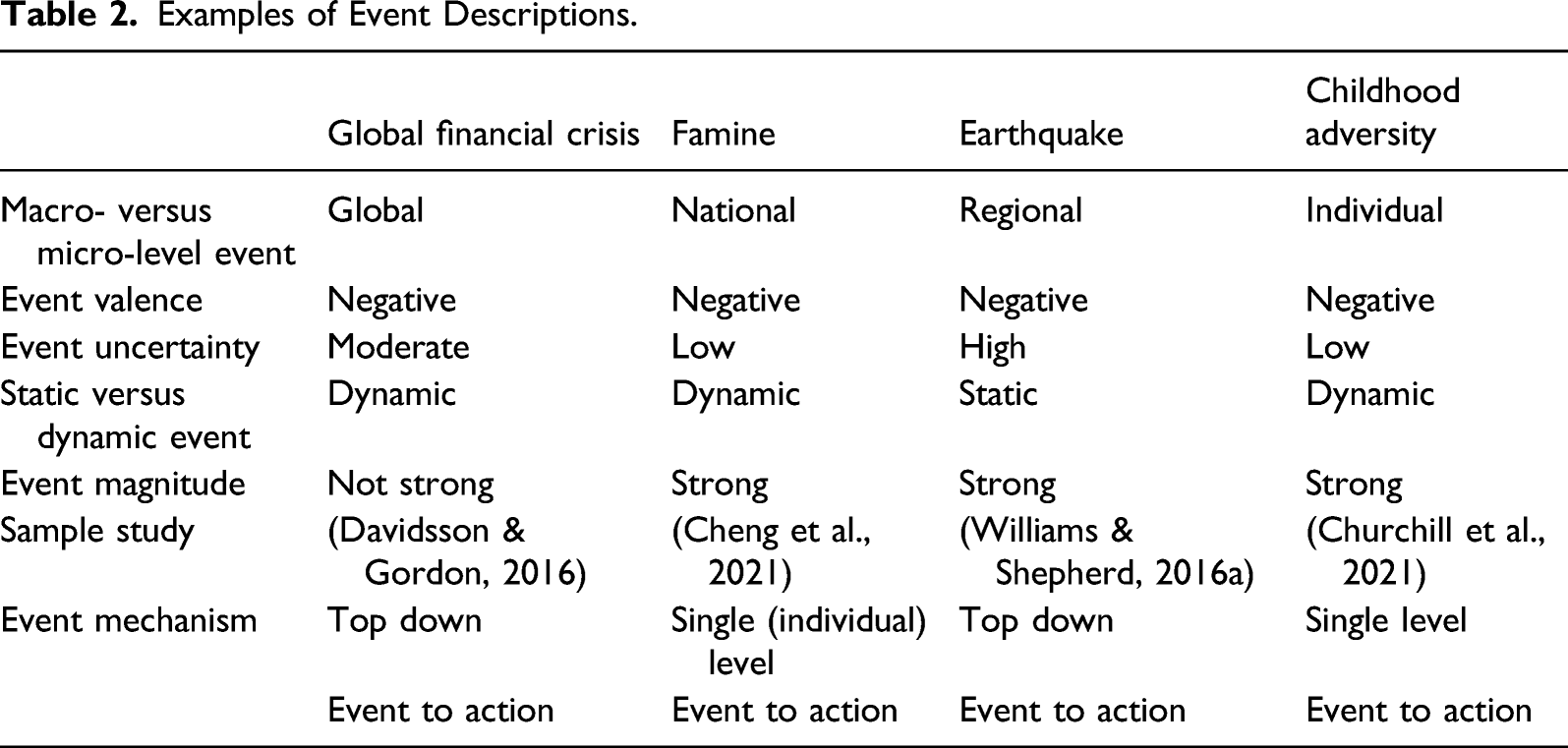
An analysis of event characteristics allows more specific hypotheses to be developed. For example, the moderate magnitude and low strength of the global financial crisis might not produce many opportunities for entrepreneurial activity but the subsequent recession likely produced more necessity entrepreneurship. In contrast, the high magnitude and strength of an earthquake might point to the critical role of entrepreneurs in community recovery. The literature is clear that negative childhood events are bad in general and impair career performance (e.g., Anda et al., 2004), but adverse childhood experiences may increase the likelihood of becoming an entrepreneur (Churchill et al., 2021). In this case, individual-level events can affect entrepreneurial activity. The table also provides sample studies and the causal mechanisms of these studies.
Conclusion
This paper aimed to provide advice on how to study events. We provide a framework of event characteristics and event mechanisms to highlight how events can be described. This can help integrate the research of events, to better identify the knowledge that has been established, and to identify gaps and future research opportunities.
Footnotes
Declaration of conflicting interests
The author(s) declared no potential conflicts of interest with respect to the research, authorship, and/or publication of this article.
Funding
The author(s) received no financial support for the research, authorship, and/or publication of this article.
