







Abstract
In this study, we examine the moderating role of subnational institutions (marketization) in the relationship between social stratification, on the one hand, and entrepreneurial choice and income growth, on the other. Our analyses, using data from 5,581 individual-wave observations from nine provincial regions in rural China, across six data collection waves, show that: (1) lower-class status is conducive to self-employment, while being from the upper class encourages individuals to become employers; (2) compared to their middle-class counterparts, both upper- and lower-class entrepreneurs enjoy higher levels of income growth; and (3) when subnational marketization is high, the positive effect of being upper class on selecting entrepreneurship as a career is weakened, but the effect on income growth among entrepreneurs is strengthened. We discuss the implications of our findings for theory and future research.
There has been a growing recognition of the role of social stratification in the study of entrepreneurship (Boone et al., 2019; Cullen et al., 2014; Deutschmann, 2020; Perry-Rivers, 2016). Social stratification categorizes members of a society into groups or classes by gender (Thébaud, 2015), age (Kouriloff, 2000), race (Shelton, 2010), religion (Audretsch et al., 2013), occupational prestige (Bian, 2002), and political capital (Bian & Logan, 1996). Members of a given class share similar attitudes and beliefs about themselves and the world, influencing their behaviors especially in regard to entrepreneurial choices and their economic consequences.
Currently, little is known how entrepreneurship varies across income-based classes—a key means of social stratification (Cagetti & De Nardi, 2006; Carter, 2011). Typically, members of a society fall into three major income classes: upper, middle, and lower. Prior researchers have primarily investigated specific income classes, rather than examining how entrepreneurial choices vary across all three classes (e.g., Banerjee & Duflo, 2008; Bruton et al., 2013; Perry-Rivers, 2016). This is an important gap as members of different income classes are likely to differ in their career ambitions, skills and access to resources. They are also likely to have (or perceive) different opportunities. Surprisingly, the literature lacks systematic analyses of how income class membership influences the choice of entrepreneurship as a career and, in turn, affects an entrepreneur’s subsequent income growth (Shelton, 2010). This is an important issue in the study of entrepreneurship (Burton et al., 2016), given that answering these questions also helps explain why people differ in their financial rewards from entrepreneurship (Åstebro & Chen, 2014). Therefore, our first research question (RQ) is:
RQ1: How does income stratification (hereafter class) influence people’s choice of entrepreneurship as a career and, as a result, their subsequent income growth?
Existing research also fails to document how the income class effects on entrepreneurial choice and financial rewards from entrepreneurship vary by context. This gap in the literature is surprising, given the wide recognition that the impact of stratification on entrepreneurship is subject to a society’s institutions (Bian, 2002; Boone et al., 2019; Nee, 1991, 1996; Nee & Cao, 1999; Wu, 2019). For instance, Bian (2002) notes that, in China, the state-dominated redistributive system caused inequalities and a stratified society before the economic reform period. With the advent of reforms through marketization (i.e., adopting the principles of the free market system), career choices may have changed. Marketization creates opportunities for entrepreneurship and makes it an attractive means for higher income. However, we do not know how subnational marketization, defined as the level of adoption of free market system practices by different provinces (Shi et al., 2012), interacts with income stratification and to what extent this affects the choice of entrepreneurship as a career and subsequent financial rewards. Therefore, our second research question is:
RQ2: How does subnational marketization influence the effect of income stratification on entrepreneurial career choice and subsequent income growth?
We address these questions using rural China as our research context. This is a unique context for studying entrepreneurial choice and income growth from the perspective of income stratification, since reforms in China have sought to reduce poverty on a massive scale. For instance, between 1981 and 2013, China lifted 850 million people out of poverty, and the poverty-stricken population cohort was reduced from 88% to 1.85% (Tan, 2018). Yet the spread of marketization has deepened social and economic stratification, leading to growing economic inequality. Accompanying these changesover the past 40 years, many Chinese people have pursued entrepreneurship to fight poverty, create wealth or climb the social ladder. Since reform and opening-up started in 1978, people living in rural China have experimented with all kinds of entrepreneurship, taking advantage of market liberalization (e.g., Nee, 1996, 1991; Si et al., 2015; Walder, 2002; Wu, 2019). Given these realities, we assert this setting offers an opportunity to examine the relationships between income stratification, subnational marketization and entrepreneurship.
Our study contributes to the literature in three ways. First, we examine how subnational marketization moderates the effects of income stratification on the choice of entrepreneurship as a career and its subsequent implications for income growth. The role of subnational institutions in shaping entrepreneurship is a growing research issue (Cui et al., 2018; Feng et al., 2015; Zhou, 2017). Even though the relationship between social stratification and entrepreneurship has been the subject of interest in prior research (e.g., Boone et al., 2019; Deutschmann, 2020), our study moves the literature forward by exploring the explanatory power of subnational institutions as a moderator. Second, the study explores the contingent value of income stratification. Specifically, we examine how income class membership influences the choice of entrepreneurship as a career and, in turn, how this affects an entrepreneur’s subsequent income growth (Shelton, 2010). Hence, we establish the boundaries of the explanatory power of income stratification. Third, in studying these relationships, we conduct our empirical tests in the largest emerging economy context—China. Therefore we draw attention to the role of context (Bruton et al., 2008; Zahra, 2007), especially for subnational institutions (Bian, 2002; Nee & Cao, 1999), in determining the motivation toward and benefits from entrepreneurship.
Theory and Hypotheses
Stratification and Entrepreneurship
In a society, individuals typically fall into different classes, based on given common traits such as membership in a kinship unit, personalities, achievements, possessions, authority, and power (e.g., Schotte et al., 2018). These traits are either ascribed (e.g., gender or race) or achieved (e.g., income or wealth), making some groups upper-class and powerful and others lower-class and disadvantaged (Massey, 2007). Income is a major basis for social stratification, underscoring the major gaps between upper- and lower-income groups in a society (Carter, 2011).
Research indicates that entrepreneurial choices vary across income-class groups. Entrepreneurship among upper-class members is likely to occur when they perceive and seize opportunities that allow them to exploit their savings and better social ties (Evans & Jovanovic, 1989; Perry-Rivers, 2016). The role of entrepreneurship among the middle class has been the subject of debate (Banerjee & Duflo, 2008). For instance, with its emphasis on the accumulation of human capital and savings in pursuit of social mobility, some consider the middle class the cradle of entrepreneurship (e.g., Doepke & Zilibotti, 2005). In contrast, Banerjee and Duflo (2008, p. 26) note that “nothing seems more middle class than the fact of having a steady well-paying job”; thus, they suggest, “middle class values” run contrary to the entrepreneurial spirit.
Controversies also exist about the role of entrepreneurship among the poor. Some argue that entrepreneurship can lift the poor out of their poverty by alleviating resource constraints, preventing social exclusion, and promoting social progress (cf. Sutter et al., 2019). Entrepreneurship can help create wealth, which is an important means of social mobility. However, other researchers argue that entrepreneurial activities are less likely for those at the bottom of the income pyramid, because they face greater constraints in borrowing and resource assembly and higher cost of external financing (e.g., Quadrini, 1999).
These competing claims suggest the need to better clarify the implications of income class membership for the choice of entrepreneurship as a career as well as income growth. As Figure 1 shows, we view income stratification as the basis of the three classes that we study. Entrepreneurial choice means whether or not a person chooses to be an entrepreneur, whether this be as self-employed or as an employer. 1 Finally, given that career choices bear different risks and require different skills and capabilities, we examine gains (income growth) from these career choices.
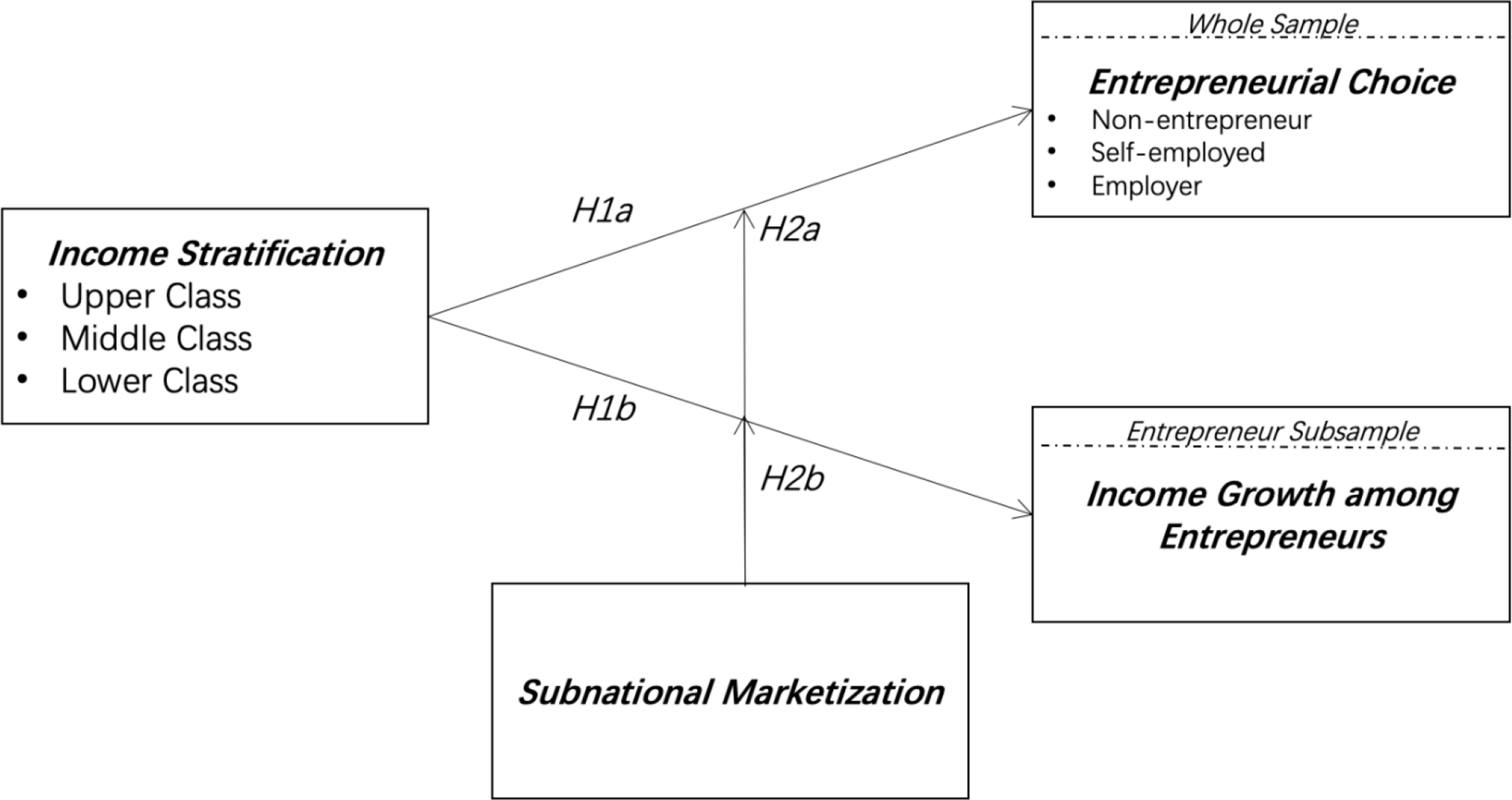
Conceptual framework.
Income Stratification, Entrepreneurial Choice and Income Growth Among Entrepreneurs
Research on entrepreneurial choice (e.g., Banerjee & Duflo, 2008; Burton et al., 2016) indicates that an individual will pursue a career in entrepreneurship when she or he expects higher net income from being self-employed or becoming an employer; otherwise, she or he will choose waged work. Our study further suggests that entrepreneurial choice depends on an individual’s income stratification (Davis, 1942; Davis & Moore, 1945; De Clercq & Dakhli, 2009; Koo, 1976; Nafziger, 1977; Weber, 1978). Income stratification endows individuals with initial resources (Nafziger, 1977), attitudes toward entrepreneurship as a career (Burton et al., 2016), and motivation to pursue it (Koo, 1976).
When it comes to motivation, research indicates that income stratification motivates individuals to climb the social ladder (Weber, 1978). One way to achieve such mobility is to create and accumulate wealth. This motivation encourages less financially endowed individuals to engage in entrepreneurship as an alternative to the traditional labor market, in order to achieve upward mobility (De Clercq & Dakhli, 2009). For individuals from the middle or upper class, entrepreneurship gives them the ambition to move up or maintain economic status (Nafziger, 1977).
When it comes to capability, income stratification also affects an individual’s capability in pursuing entrepreneurship. There are differences within and across income classes in resources, knowledge, skills, and abilities (e.g., Davis & Moore, 1945). Because of these differences, some individuals are not only endowed with more financial resources, but are more capable of handling complex and stressful functions (Haushofer & Fehr, 2014). These differences may also explain variations in identifying and seizing entrepreneurial opportunities (Shelton, 2010).
In this study, we focus on entrepreneurship in rural areas of China. Chinese rural people pursue entrepreneurial activities in most types of transportation, services and manufacturing business where private shareholding is allowed (cf. Chang & MacMillan, 1991; Su et al., 2020; Walder, 2002). Hence, individuals in these communities are not limited to agriculture or other relatively simple economic activities. Given this context, we propose that individuals from the upper class are likely to pursue entrepreneurship that involves hiring workers. As they climb the social ladder, these individuals gradually shift their attention from securing daily necessities to solidifying their economic positions, and then to pursuing their achievement and self-actualization needs (Nafziger, 1977). With their strong financial reserves, they are more likely to engage in activities that require long-term returns investments. Their tangible and intangible assets also work as a positive signal to bankers and venture capitalists (Demsetz, 1967), enabling them to secure the funds needed to support their new ventures. Further, these financial assets facilitate their investing in larger and more scalable businesses. Members of the upper class in Chinese rural areas also develop extensive connections, relationships and goodwill within their wealthy communities and gain social capital required for exploiting promising opportunities, and thus they are more willing to use their abilities to organize and lead others (Fan et al., 1996).
In comparison, individuals from the lower class may find it easier to be self-employed than to become waged workers or employers. People who live in poverty in China’s rural areas typically experience deprivation and are starved for day-to-day necessities (Karlan & Appel, 2011). The pursuit of such necessities and the desire for upward social mobility provide the strongest motivation for their business development activities (Bian, 2002). Unlike traditional occupations that require formal education and good family background (e.g., status, resources, and connections), self-employment typically starts from a small lifestyle business and is directed to addressing the poverty that pervades the lower class (cf. Peng, 2004). Struggling to overcome poverty and meet their basic needs, the poor usually have difficulty gaining quality education, making it hard for them to accumulate human capital (Si et al., 2015; Su et al., 2020). The poor with limited knowledge, skill and capabilities also make it more likely that they, for example, run a traditional livestock business rather than create a high technology venture. As for financial capital, the poor seldom own formally titled property and are frequently denied access to the formal banking system (Ansari et al., 2012). Thus they cannot afford to invest in building a scalable business or hire employees from outside the immediate family (e.g., Sarkar et al., 2018). Finally, the poor’s limited social capital constrains their entrepreneurial decisions, such as selecting the type and scale of the business they might create. Often disconnected from the larger social community, the poor have fewer opportunities for networking, further limiting their ability to discover and exploit market opportunities (Hansen, 1995).
Unlike those from upper or lower classes, members of the middle class often seek the right salaried job, build up their career, and maintain a stable family life (Banerjee & Duflo, 2008). They are usually well-educated and equipped with the skills needed to rise within the organizational hierarchy, without incurring major career risks that can threaten their class status. Hence, their career preferences center on being professionals with higher remuneration and lower risk, rather than becoming entrepreneurs. As a result, these individuals are likely to have fewer incentives to take risks in becoming self-employed or employers. Hence:
The literature also points to low earnings among entrepreneurs, suggesting that entrepreneurship does not always guarantee high economic returns (e.g., Åstebro & Chen, 2014; Hamilton, 2000). Dobrev and Barnett (2005) suggest that being an employer broadens avenues for economic attainment, while making it harder to rationalize this choice and exposing entrepreneurs to potential financial loss. Given these tradeoffs, we propose that entrepreneurs belonging to different classes are likely to vary in the financial rewards from their entrepreneurial activities (e.g., Davis & Moore, 1945; Parsons, 1940). Further, income growth can be a more important concern than absolute income for entrepreneurs belonging to particular classes (Weber, 1978).
Upper-class individuals who become entrepreneurs are likely to benefit from a supportive environment where they can target more lucrative opportunities. As a result, they can increase their income by pursuing entrepreneurship (Alvarez et al., 2015; Behrman et al., 2003). This is because they are usually better equipped with more resources and have the capabilities to identify and exploit more lucrative opportunities, and more confident in reaping returns from their entrepreneurial pursuits (e.g., Behrman et al., 2003). They can leverage their properties and connections to gain funding (e.g., Alvarez et al., 2015). Research supports this expectation in the Chinese rural context. For example, Fan et al. (1996) suggest that upper-class rural entrepreneurs are more likely to have superior economic returns.
For individuals from the lower class, entrepreneurship can empower them mostly through self-employment and lift them out of poverty (e.g., Bruton et al., 2013). The poor are usually excluded from wage employment, because they often lack formal education and social connections. Thus, entrepreneurship offers these individuals business opportunities to meet life’s basic needs. Moreover, the market for the poor embodies untapped opportunities that can be exploited using novel business models (Prahalad, 2005). Hence, facing severe resource constraints, the poor are likely to engage in a process of bricolage, developing innovative ways of recombining individually less useful resources for value creation (e.g., Baker & Nelson, 2005). Likewise, as evident in a recent study by Cheng et al. (2021), despite their limited resources, Chinese lower-class rural entrepreneurs can increase their income by addressing the urgent needs at the bottom of the pyramid, applying their unique perspectives toward specific market opportunities and developing innovative ways of resource mobilization.
Compared to upper- and lower-class entrepreneurs, middle-class individuals in rural China usually live a comfortable and stable life, as noted earlier. As a result, they are less likely to be motivated to change their income class by pursuing entrepreneurship. They also lack the motivation to learn the various entrepreneurial skills needed and build up social networks in their close communities as rich entrepreneurs do. Given these arguments, as indicated in Figure 1, we propose that:
The Moderating Role of Subnational Marketization
Thus far we have argued that choosing entrepreneurship as a career is embedded in income class and that financial rewards from entrepreneurship are also likely to vary across income classes. These two parallel processes do not happen in a vacuum; rather, both depend on the prevailing institutional environments in a society (cf. Shelton, 2010). The most significant institutional change that has happened in China over the last four decades is the introduction of marketization (Bian, 2002; Nee, 1991, 1996; Nee & Cao, 1999; Wu, 2019). As the level of development of market-based mechanisms and related institutions, marketization defines the “rules of the game” for institutional actors who engage in market activities (North, 1990; Shi et al., 2012). Given the gradually rolling-over process of marketization, and the political, cultural and geographical diversity across subnational regions in China, market-oriented institutions for economic growth are not equally developed or effective in all regions (Cui et al., 2020; Su et al., 2020; Zhao et al., 2015). Therefore, as Figure 1 shows, we focus on the moderating effect of subnational marketization.
Market mechanisms usually help reduce transaction costs, enhance information processing efficiency and accuracy, fill institutional voids, and improve decision making by reducing environmental uncertainty (Bruton et al., 2008; Peng, 2004; Su et al., 2020). In rural China, marketization paves the way for the emergence of entrepreneurs (Walder, 2002). As Bian (2002) observes, before marketization, private entrepreneurship was removed as a career choice. However, since 1978, having a career as an entrepreneur has gradually become a real possibility for many Chinese rural people, because of the development of market institutions (Walder, 2002). Private (e.g., household-, individual- or cadre-based) and collective (e.g., village/township- or production team-owned) entrepreneurship in these areas has been much encouraged by all levels of governments (Nee, 1991). Despite progress, there are major variations across China’s regions in their levels of marketization. For example, compared to the inland regions, the highly marketized coastal regions provide richer settings for those who are ambitious and capable of pursuing entrepreneurship (Nee, 1991; Su et al., 2020).
We propose that subnational marketization interacts with income stratification by magnifying or weakening the motivation and capability differences across income classes in entrepreneurial choice and the financial rewards gained from it. As noted, compared to the middle class, both the upper and lower classes are positively related to the likelihood of becoming entrepreneurs and achieving income growth. Effective subnational market mechanisms promote rural entrepreneurship for the upper and lower classes by strengthening their motivation, protecting their legal rights (e.g., contracts and properties), and making better use of resources and access to information. This is likely to enhance these individuals’ willingness to pursue entrepreneurship. Subnational marketization can also fill institutional voids in rural areas, thereby making it easier for “would be” entrepreneurs to approach market intermediaries (e.g., sales partners, brokers, and lawyers) and improve their capabilities to develop their new ventures. Thus, marketization allows these people to channel their efforts into productive uses, which can lead to higher financial rewards (Autio & Fu, 2015; Khanna et al., 2005; Yu et al., 2013).
When it comes to the upper class, a typical strategy in China is to promote regional marketization that encourages a small proportion of people to “get rich first”. Such “a small proportion of people” are more likely to be those who are already at the upper class of income stratification (e.g., professional elites in rural areas; Bian, 2002; Nee & Cao, 1999). These upper-class individuals tend to pursue entrepreneurial opportunities in highly marketized regions and achieve higher rates of growth, which often translates into higher income growth.
For the lower class, industrialization, along with market mechanisms, can promote the efficient division of labor and adoption and creation of sophisticated technologies, and enable low-income (class) entrepreneurs to emerge from poverty (e.g., Alvarez et al., 2015; McMullen, 2011; North, 1990). Such favorable subnational market development encourages many poor peasants to become street vendors or other self-employed business owners (Si et al., 2015), giving them higher financial returns than did reliance on land.
Conversely, in regions without supportive market mechanism, individuals across income classes are hindred by limited opportunities for entrepreneurial activities (Chang & MacMillan, 1991; Su et al., 2020). Weak or absent market institutions expose entrepreneurs to transaction uncertainty and illegal rent expropriation (e.g., Autio & Fu, 2015; Mair et al., 2012). Institutional voids also suppress the motivation and capability effects for the upper and lower classes with regard to entrepreneurial activities. Consequently, the effects of income classes on entrepreneurship and subsequent income growth are less salient in rural regions. Taken together, as indicated in Figure 1, these observations suggest the following hypotheses:
METHODS
Data and Sample
To test our hypotheses, we assembled our data primarily from three sources. The first database was the China Health and Nutrition Survey (CHNS), which was a collaborative project between the Carolina Population Center at the University of North Carolina and the National Institute for Nutrition and Health at the Chinese Center for Disease Control and Prevention. To date, there have been ten rounds of the survey in the years 1989, 1991, 1993, 1997, 2000, 2004, 2006, 2009, 2011, and 2015. 2 Nine Chinese provinces were covered, with a strong regional and economic representation (i.e., Liaoning, Heilongjiang, Jiangsu, Shandong, Henan, Hubei, Hunan, Guangxi, and Guizhou). This database has been widely used in studying poverty and inequality in China (e.g., Alkire & Fang, 2019; Mu & van de Walle, 2011). The second source was the National Economic Research Institute (NERI) Index of Marketization of China’s Provinces. We matched the institutional variables from the NERI to the CHNS. The index has been used to measure sub-national institutional development in the mainland of China (e.g., Cui et al., 2020; Gao et al., 2010; Zhou, 2017). The last source is Zhao et al.’s (2015) regional cultural index of China. The index is calculated on the basis of a survey of 3,690 participants and five experts, and has been increasingly cited in recent literature (e.g., Long et al., 2020; Sun et al., 2019).
To ensure a representative sample, we employed a set of procedures that included: (1) matching the CHNS and NERI databases and using the 1997, 2000, 2004, 2006, 2009, and 2011 waves of data; (2) limiting our focus to those individuals who responded in the previous wave; (3) keeping an individual whose age is greater than or equal to 18 years old; (4) retaining individuals in rural China; (5) excluding self-employed farmers who are different from self-employed entrepreneurs (Liu & Zhang, 2018); and (6) dropping individuals who did not report relevant information on the key variables. 3 These steps yielded a sample of 3,252 individuals with an unbalanced panel of 5,581 individual-wave observations in rural China.
Measurements
Income Stratification
We used per capita household income to capture income stratification in order to be consistent in identifying class membership across household members (e.g., Quadrini, 1999). In the CHNS database, per capita household income was measured using the sum of the net income from household businesses, farming, fishing, gardening, livestock, subsidies, retirement, non-retirement (wages, bonuses, etc.) and other sources divided by the number of family members. All the per capita household incomes were adjusted for inflation using the 2011 Chinese Yuan as a basis, as reported earlier.
We employed two sets of threshold incomes to define three classes of income stratification. One threshold was the relative poverty line. This concerns inequality of a particular society and employs a low-income level with respect to a society as a benchmark. We followed the World Bank (2012) by calculating the 60% of yearly median per capita household income of all the individuals in the specific provincial rural area where the focal individual was located. The other threshold was the high-income line. We used a relative basis calculation: the 90th percentile of yearly per capita household income of all the individuals in the specific provincial rural area where the focal individual was located.
Based on the two thresholds just described, we generated three dummy variables that captured the three classes that reflected income stratification as follows:
upper class, which equals 1 if a person’s per capita household income is equal to or higher than the high-income line, and 0 otherwise;
middle class, which equals 1 if a person’s per capita household income is equal to or more than the relative poverty line and less than the high-income line, and 0 otherwise; and
lower class, which equals 1 if a person’s per capita household income is less than the relative poverty line, and 0 otherwise.
We used the upper- and lower-class dummies in our estimation models to determine whether and to what extent the effects of upper- or lower-class status differ from those of middle-class status on entrepreneurial choice and income growth.
Entrepreneurial Choice
Our dependent variable, entrepreneur, includes self-employed and employer, and was measured using three questions in the CHNS: (B2) “Are you presently working?”, (B4) “What is your primary occupation?”, and (B5) “What is your employment position in this occupation?” (see Appendix I). We classified an individual as self-employed if she or he met the following conditions: (1) presently working, (2) being an independent operator with no employees, but (3) not a farmer, fisherman, or hunter. We classified an individual as an employer if she or he was (1) presently working and (2) an owner-manager with employees. By combining the two sets of criteria, we classified an individual as an entrepreneur if the participant was either self-employed or an employer and created a dummy variable for binary probit analyses. We also generated dummies for self-employed and employer in multinominal probit analyses.
Income Growth Among Entrepreneurs
This variable refers to the income derived from pursuing entrepreneurship as a career. Income growth among entrepreneurs was measured as their current wave’s absolute income minus the previous wave’s absolute income divided by the previous wave’s absolute income. 4 There were several outliers in the database in terms of income growth. For example, 2.5% of the observations in our second stage analysis grew their income by 2,000% per wave. We speculate that these individuals represented abnormal situations. To reduce the possible effects of these outliers while maintaining the sample size, we chose the winsorizing approach, to set the data above the 98th percentile to the 98th percentile in our analysis.
Subnational Marketization
Our moderating variable, subnational marketization, was measured by five components: (1) relationship between governments and market, (2) development of the non-state sectors in the economy, (3) development of product markets, (4) development of factor markets, and (5) development of market intermediaries and the legal environment (Fan et al., 2011). This index was released regularly from 1997 to 2018 and has been widely used for entrepreneurship research in economics and finance (Feng et al., 2015), marketing (Cui et al., 2018) and strategy (Zhou, 2017). Since the CHNS waves are unevenly distributed and span two to four years, we averaged the annual marketization level of every individual’s provincial location across the years between the survey wave and the next survey wave to capture the institutional environment to which the individual has been exposed.
Control Variables
Following prior studies (e.g., Åstebro & Åstebro & Chen, 2014), we also controlled for several personal demographic variables: the entrepreneur’s gender (male = 1 and female = 0), age (the number of years since birth), marital status (married = 1 and never married, divorced, widowed, separated = 0), education (0 = graduated from primary school; 1 = lower middle school degree; 2 = upper middle school degree; 3 = technical or vocational degree; 4 = university or college degree; 5 = master’s degree or higher), health index (weight divided by squared height multiplied by 104) and individual income (total net individual income, in thousands Chinese Yuan). Analyses also controlled for the effect of family size (the number of people in one focal family). Finally, we included provincial uncertainty avoidance and future orientation as the controls for entrepreneurial choice (Zhao et al., 2015), which are aggregated means of responses on a seven-point Likert scale based on the GLOBE’s measures.
Statistical Method and Analysis
Our study examines the impact of income stratification on entrepreneurial choice and income growth. Since entrepreneurial income does not occur randomly, we address the endogeneity issue using the Heckman two stage estimation procedure (Certo et al., 2016; Clougherty et al., 2016; Hamilton & Nickerson, 2003; Heckman, 1979). In the first stage, we pooled all individual-wave observations (n = 5,581) during the study period, including non-entrepreneurs and entrepreneurs, to determine whether an individual becomes an entrepreneur. We first estimated binary probit models to link income classes and the binary entrepreneurial choice, and then adopted multinominal probit models to predict the individual choice among non-entrepreneurs, self-employment and employer. We treated the three types of individual decisions as distinct groups, thereby avoiding misclassifying individuals belonging to two disparate groups into one category (Audretsch et al., 2013). Also, based on the probit models, we generated an Inverse Mill’s ratio for each entrepreneurial choice and included it in the models on entrepreneurial income.
In the second stage, we tested our hypotheses on income stratification and income growth among entrepreneurs using pooled OLS regressions (n = 1,513). We conducted the Breusch-Pagan LM test to select between the random effect versus pooled OLS regressions. Since we failed to reject the null hypothesis (i.e., no evidence of significant differences across individuals), pooled OLS regressions were preferable. Such a linear model is advantageous in that it is easier to compare our results to previous studies (e.g., Dikova et al., 2010).
The Heckman models require at least one variable that influences the selection in the first stage but has no relationship with the disturbance term in the second stage (Certo et al., 2016). Consequently, we draw on culture and entrepreneurship research (Hayton et al., 2002; Li & Zahra, 2012) and introduce regional cultural variables as exclusion restrictions. One is uncertainty avoidance, which is the extent to which a society relies on social norms, rules, and procedures to alleviate unpredictability of future events (House et al., 2004). It is argued that members of uncertainty-avoiding societies are likely to incur more opportunity costs when they engage in risk-taking activities and exhibit lower probabilities of becoming entrepreneurs. The other one is future orientation, which is the extent to which a society encourages and rewards future-oriented behaviors, such as planning or investing in the future (House et al., 2004). This orientation encourages long-term investments, facilitating entrepreneurship.
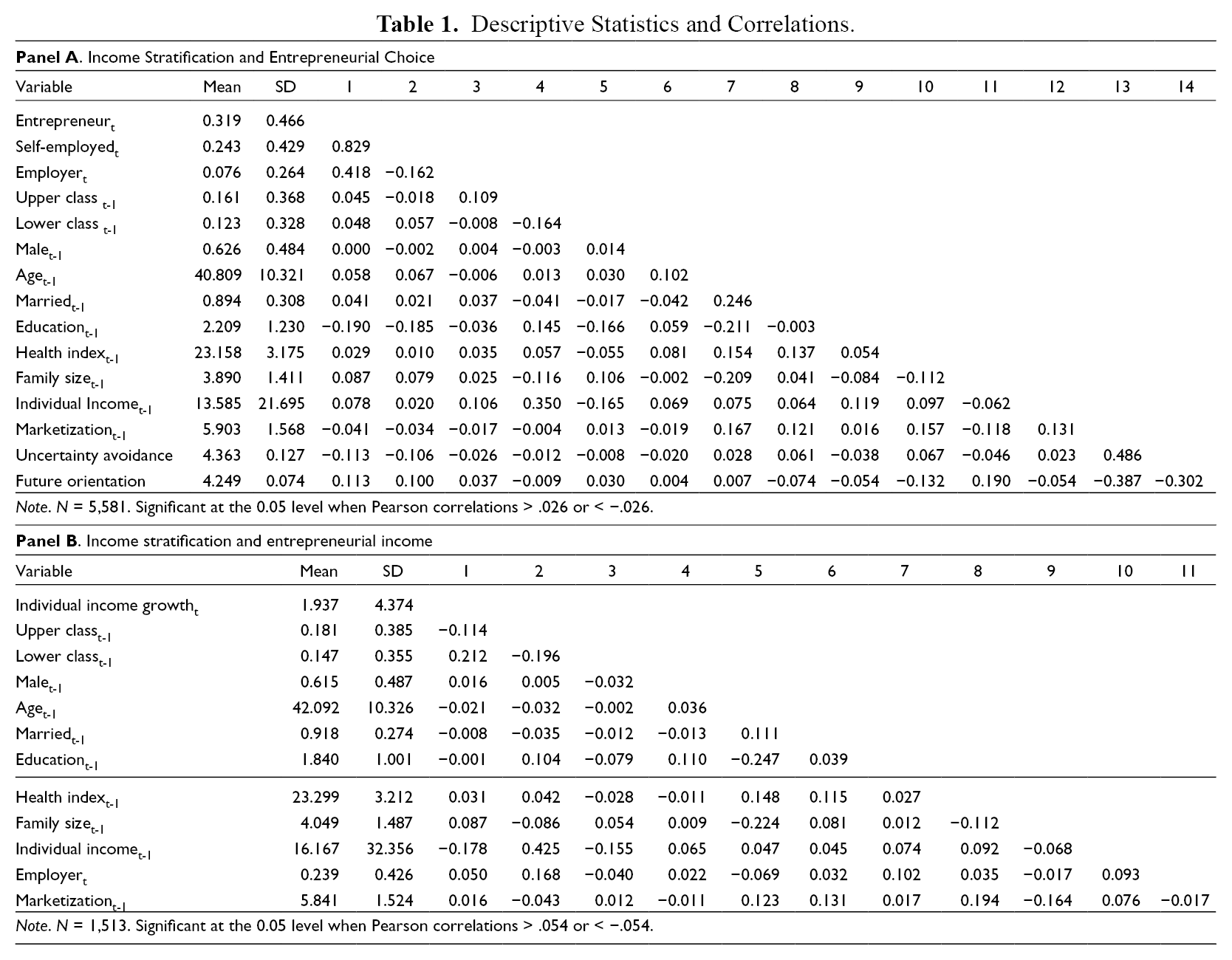
All the independent and control variables were lagged by one wave. Panels A and B of Table 1 presents the variable summaries and descriptive statistics of the first- and second-stage model separately. In Panel A, we observe that the percentages of entrepreneurs, self-employment and employers are 31.9%, 24.3%, and 7.6%, respectively. The upper- and lower- class individuals take up almost 16.1% and 12.3% of the whole sample. As shown in Panel B, the average income growth is 193.7%, indicating that rural China experienced a high economic growth in our study period. We examined potential multicollinearity using variance inflation factors (VIFs), which were all within acceptable ranges, that is, none was larger than the critical value of 10 (Studenmund, 1992).
Descriptive Statistics and Correlations.
RESULTS
Entrepreneurship, Income Stratification, and Subnational Marketization
Table 2 presents the binary and multinomial probit regression results for entrepreneurial choice, which predict being an entrepreneur, self-employed and employer separately. Models 1–3 are based on binary probit analyses, whereas Models 4–9 present the multinomial probit results for predicting self-employment and employer status. Models 1, 4, and 5 are the baseline models that only include control variables. Models 2, 6, and 7 additionally include the dummy variables for upper and lower class. Models 3, 8, and 9 further test the interaction effect between income stratification and subnational marketization. Table 3 presents the pooled OLS regression results for income growth in three subsamples, namely, entrepreneur (Models 10–12), self-employed (Models 13–15), and employer (Models 16–18). Models 10, 13, and 16 are the control models; Models 11, 14, and 17 additionally include upper class and lower class; and Models 12, 15, and 18 include the interaction terms. We tested Hypotheses 1b and 2b in the entrepreneur subsample and used the other two subsamples as robustness checks.
Income stratification and entrepreneurial choice.
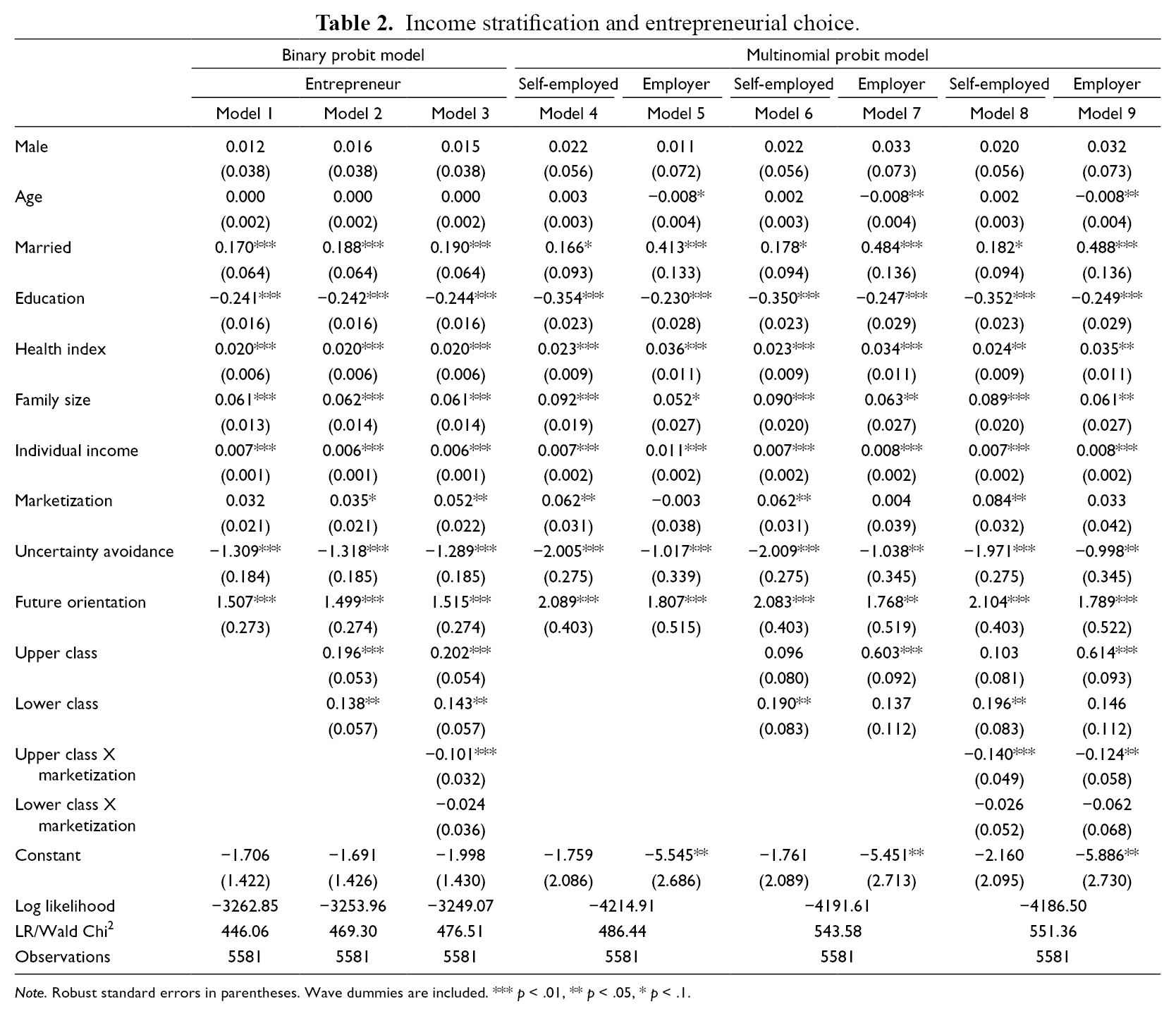
Note. Robust standard errors in parentheses. Wave dummies are included. *** p < .01, ** p < .05, * p < .1.
Income stratification and income growth among entrepreneurs.
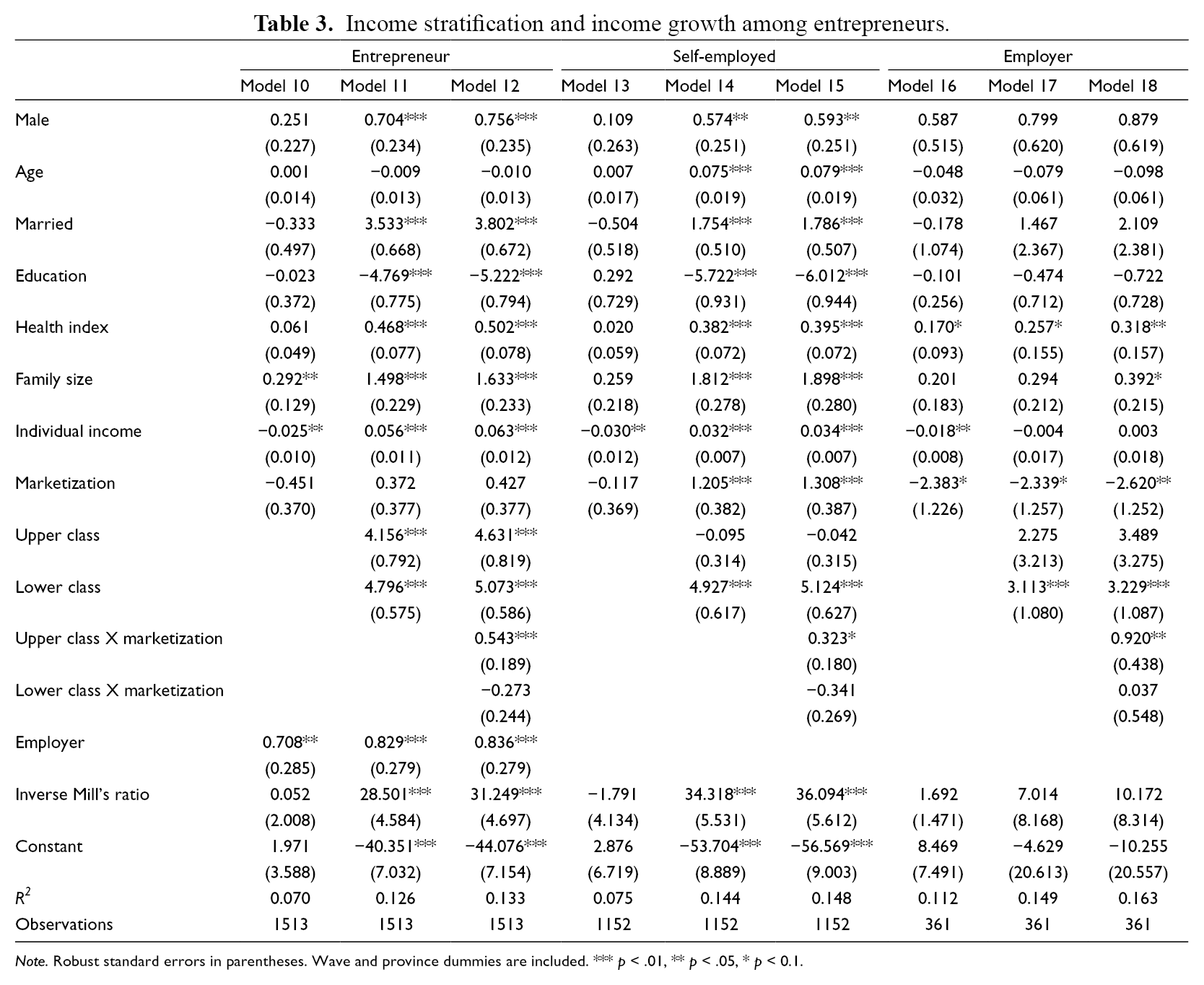
Note. Robust standard errors in parentheses. Wave and province dummies are included. *** p < .01, ** p < .05, * p < 0.1.
In Tables 2 and 3, the control variables are consistent in their signs and significance levels across models. For example, marriage is positively related with the likelihood of entrepreneurship, well-educated individuals are generally less likely to be entrepreneurs and to have lower income growth as entrepreneurs, and individuals with a larger family tend to be entrepreneurs with high levels of income growth. The two exclusion restrictions—uncertainty avoidance and future orientation—have significant effects on the likelihood of being entrepreneurs. We also observe positive and significant coefficients of employers through Models 10 to 12, suggesting that, compared to self-employed entrepreneurs, being an employer can increase their income more.
Hypothesis 1a states that, compared to middle-class status, upper-, and lower-class status is positively related to entrepreneurship: upper-class status is positively related to the likelihood of being an employer, but lower-class status is positively related to self-employment. In Model 2, the effects of upper and lower classes on entrepreneurship are positive and significant. The marginal effects of upper and lower classes are 0.066 (β = .196, p < .01) and 0.046 (β = .138, p < .05), respectively. This suggests that, compared to the middle class, being from the upper or lower classes will increase the probability of becoming an entrepreneur by 6.6% and 4.6%, respectively. The results are more straightforward in the multinomial probit analysis. As in Model 6, lower-class status positively affects self-employed status. The marginal effect of lower-class status on being self-employed is 0.037 (β = .190, p < .05), indicating that being lower class increases the probability of being self-employed by 3.7%. Similarly, in Model 7, upper-class status positively affects employer status. That is, the marginal effect of upper-class status on being an employer is 0.073 (β = .603, p < .01), indicating that upper-class status will increase the probability of being an employer by 7.3%. Therefore Hypothesis 1a is supported.
Hypothesis 1b posits that, relative to the middle class, upper- or lower-class status is positively related to income growth among entrepreneurs. In Model 11, we can see the positive coefficients of upper class (β = 4.156, p < .01) and lower class (β = 4.796, p < .01) for income growth among entrepreneurs. This suggests that entrepreneurs at upper- and lower-class levels increase income by 415.6% and 479.6%, respectively. Together, the results indicate that Hypothesis 1b is also supported. In the robustness checks using the self-employed and employer subsamples in Models 14 and 17, the coefficients of lower-class status are positive and significant, with those of upper-class status being insignificant, possibly because of reduced sample sizes.
We plotted the income stratification effects on the probability of being an entrepreneur, self-employed or an employer, and income growth among entrepreneurs in the Panels A, B, C, and D of Figure 2. In Panel A, the most salient pattern is that the individuals in the upper or lower classes are more likely to be entrepreneurs than are their middle-class counterparts. On average, the probabilities for an individual in the upper or lower class to become an entrepreneur are 36.9% and 34.8% respectively, while that for a middle-class individual are 30.2%. As Panel B reveals, the average probability that a lower-class individual becomes self-employed (27.7%) exceeds that for members of the middle class (23.9%) and upper class (23.3%). In Panel C, the probabilities for an upper-, middle-, or lower-class individual to be an employer, however, are 13.5%, 6.2%, and 6.9%, respectively, indicating a close connection between belonging to the upper class and entrepreneurial choice as an employer. Also significant are, in Panel D, the income growth among the entrepreneurs in the upper (463.4%), middle (47.8%), and lower (527.3%) classes.
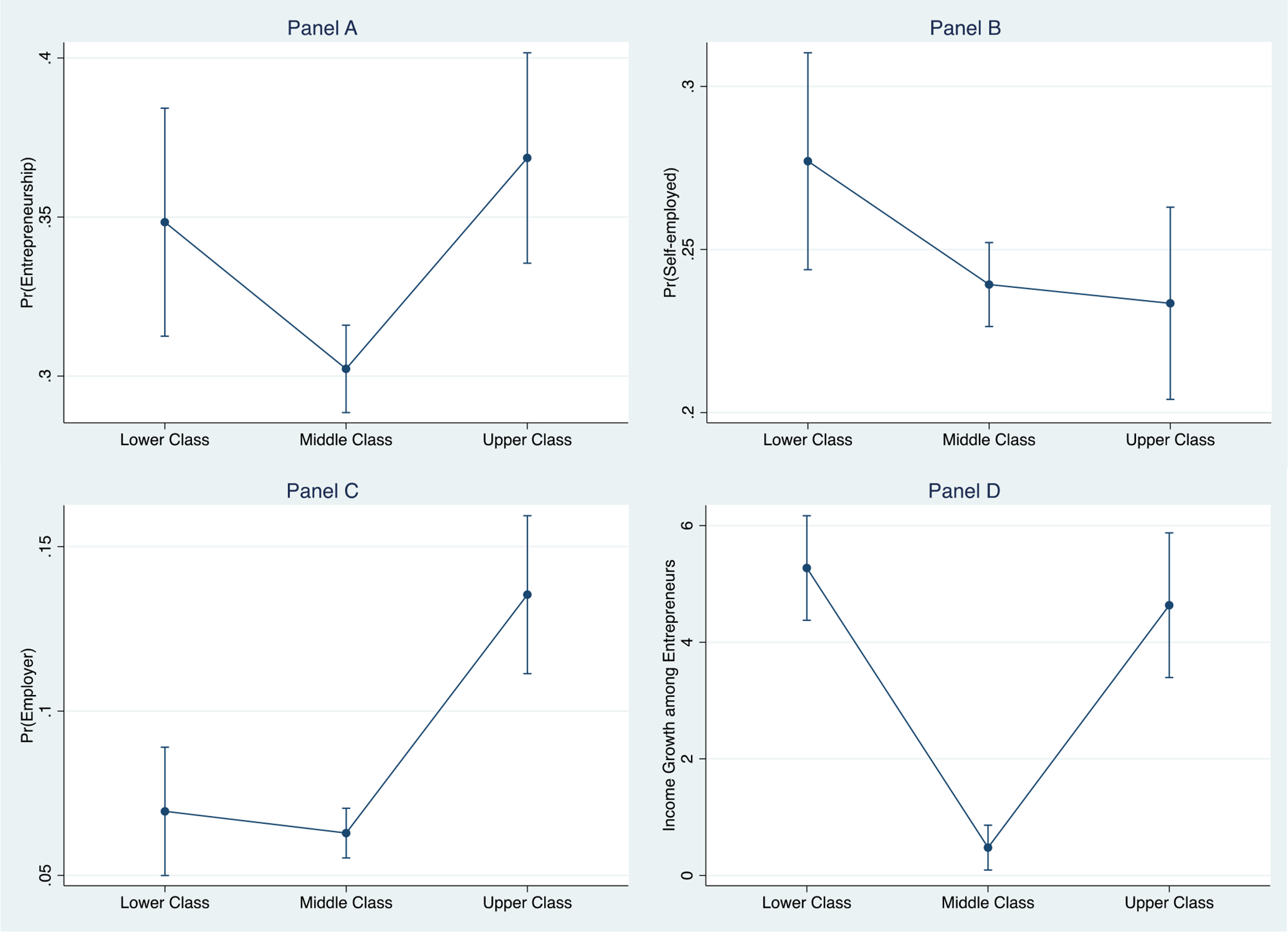
Income stratification, entrepreneurial choice and income growth.
Hypotheses 2a and 2b jointly predict that subnational marketization positively moderates the upper- and lower-class effects on entrepreneurship and income growth among entrepreneurs. The results for Models 3, 8, and 9 of Table 2 run contrary to Hypothesis 2a. The interaction terms between upper class and subnational marketization are negative and significant for the entrepreneur (β = −0.101, p < .01), self-employed (β = −0.140, p < .01), and employer (β = −0.124, p < .05), with those between lower class and subnational marketization insignificant for all the entrepreneurial choices across models. Thus, for upper-class status, as provincial marketization rises from two standard deviations below the mean to two standard deviations above the mean, the probability of being an entrepreneur decreases from 42.0% to 31.4%, while the probability for self-employment drops from 25.3% to 20.9%, and that of being an employer decreases from 17.4% to 10.1%.
We plotted Panels E, F, and G of Figure 3 to examine the moderating effect of subnational marketization on the relationship between income stratification and entrepreneurial choice. In the case of the upper class, as subnational marketization increases, the slopes for being an entrepreneur, self-employed or an employer decrease; conversely, the slopes for lower and middle classes increase or flatten. Taken together, subnational marketization negatively moderated the relationship between being upper class and entrepreneurship. Thus, Hypothesis 2a is not supported.
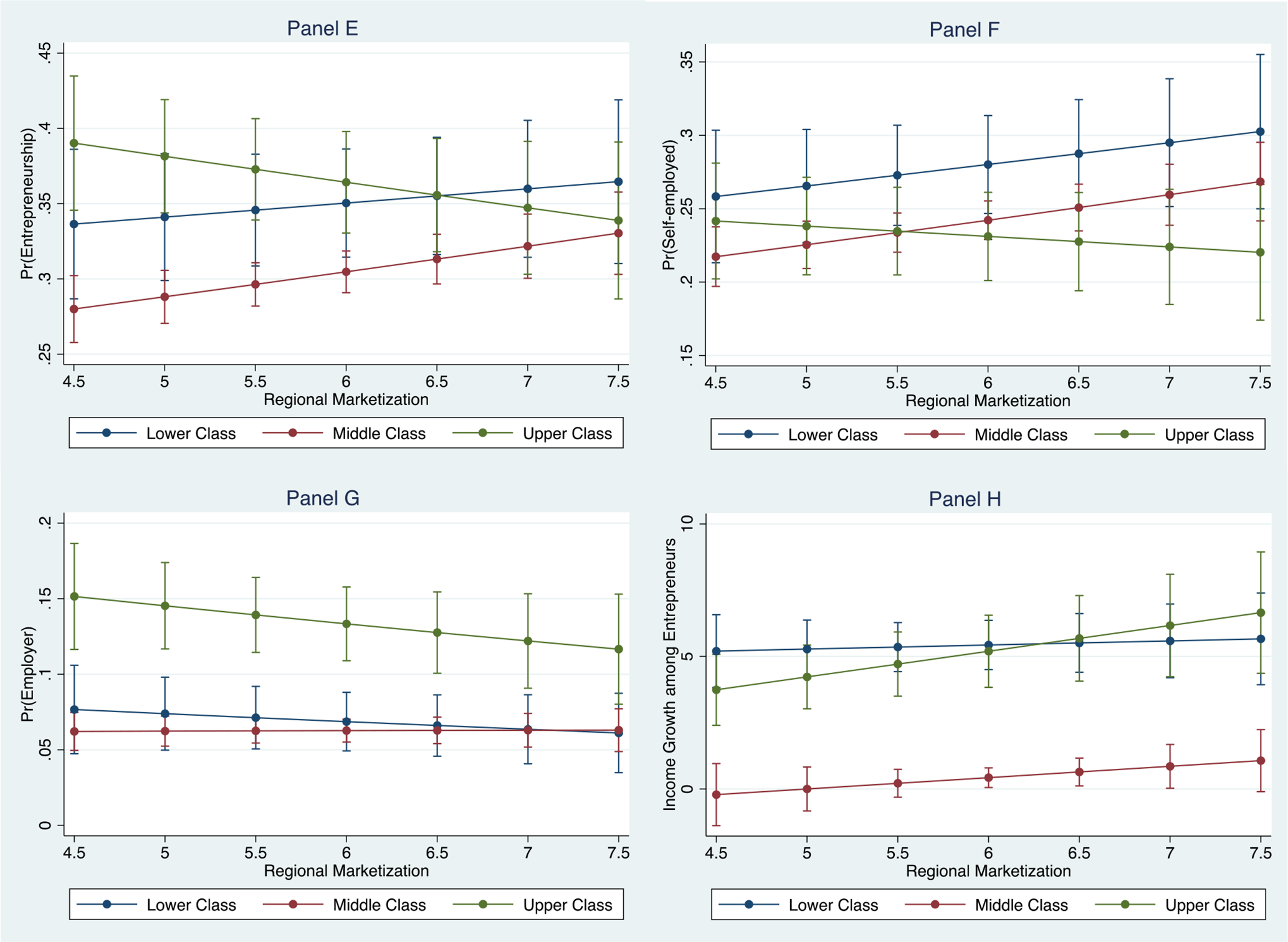
The moderating effects of subnational marketization.
In contrast, we find a positive interaction between subnational marketization and upper class for income growth among entrepreneurs. As the results for Model 12 show, the coefficient of upper class X marketization is significantly positive (β = .543, p < .01) with that of lower class X marketization insignificant, thus partially supporting Hypothesis 2b. That being said, as subnational marketization rises from two standard deviations below the mean to two standard deviations above the mean, the income growth for an upper-class entrepreneur increases from 208.7% to 799.9%. This pattern is evident in Panel H.
Robustness Checks
We also conducted a set of robustness checks. First, we used a person’s absolute income as an alternative measure of our dependent variable and find that (1) the effect of lower-class status is negative (β = −26.498, p < .05), while that of upper-class status is insignificant; and (2) the interaction term of upper class X marketization among employers is positive (β = 15.371, p < .05). Thus entrepreneurship may help the poor in rural China out of poverty, but it does not guarantee high income levels compared to those from other classes.
Second, we employed occupation dummies as a rough proxy for the industry effects as control variables on entrepreneurial income. The results that include occupation dummies show positive effects of upper (β = 4.068, p < .01) and lower (β = 4.799, p < .01) class on income growth, as well as a positive effect of upper class X marketization (β = .536, p < .01).
Third, we re-estimated all reported models by using alternative measures of income class based on household income (HI), individual income (II) and household wealth (HW). For entrepreneurial choice, the effect of upper-class status is positive (βHI = 0.111, p < .05; βII = 0.326, p < .01; βHW = 0.288, p < .01); that of lower-class status is mixed (βHI = 0.178, p < .01; βII = 0.120, p < .01; βHW = -0.228, p < .01); the interactive effect between upper-class status and subnational marketization is negative (βHI = -0.124, p < .01; βII = -0.068, p < .05; βHW = -0.057, p < .1). In regard to income growth, the effect of being upper class is positive (βHI = 1.749, p < .01; βII = 1.766, p = .136; βHW = 5.251, p < .01), while for being lower class it is mixed (βHI = 5.275, p < .01, βII = 6.495, p < .01; βHW = -4.060, p < .01); the interactive effect between upper-class status and subnational marketization is positive (βHI = 0.527, p < .01; βII = 0.225, p < .01; βHW = 0.554, p < .01). The inconsistent results based on household wealth may result from insufficient information about the value of the house/apartment and bank deposits in the CHNS dataset.
Fourth, we reported ‘robust’ standard errors in our main analysis, which can only account for heteroscedasticity but not pre-estimation error (Certo et al., 2016; Clougherty et al., 2016; Hamilton & Nickerson, 2003). As a remedy, we additionally used the bootstrapping approach and found consistent support by showing a positive effect of upper-class status on entrepreneurial choice (β = .196, p < .01) and income growth (β = 4.156, p < .01), a positive effect of lower-class status on entrepreneurial choice (β = .138, p < .05) and income growth (β = 4.796, p < .01) and an opposite interaction effect of upper-class status and subnational marketization on entrepreneurial choice (β = −0.101, p < .01) and income growth (β = .554, p < .01).
Fifth, we ran the analyses using panel-level fixed-effect (FE) and generalized estimating equations (GEE) models, with the results remaining largely the same. We found that the effects of upper-class status (βFE = 6.305, p < .01; βGEE = 4.158, p < .01), lower-class status (βFE = 7.503, p < .01; βGEE = 4.824, p < .01) and upper class X marketization (βFE = 0.579, p < .05; βGEE = 0.550, p < .01) are all positive on income growth among entrepreneurs.
Overall, these analyses support our findings and preclude alternative explanations.
Discussion
Using a multi-sourced, six-wave sample of 5,581 Chinese individual-wave observations, this study finds how entrepreneurial choice and their financial rewards vary with income stratification. Also, when subnational marketization is high, the positive effect of upper-class individuals in rural China in choosing entrepreneurship is weakened, whereas the effect on income growth among these upper-class entrepreneurs is strengthened. The analyses further suggest that having an entrepreneurial career offers higher levels of income growth for both upper- and lower-class individuals in these areas but the extent of this income growth depends on level of marketization. Our findings have important theoretical implications which we discuss next.
Theoretical Implications
The role of subnational marketization. Our study extends the social stratification theory of entrepreneurship by incorporating subnational marketization as a moderating effect of the relationships examined. One of our critical findings is the asymmetrical effects of subnational marketization on the upper and lower classes—the interaction effects of subnational marketization with upper-class status are significantly negative for entrepreneurial choice, but significantly positive for income growth among entrepreneurs. That is, upper-class individuals are hesitant to become entrepreneurs in highly marketized regions.
This counterintuitive finding can be explained by the possibility that marketization creates opportunities that upper-class individuals can viably exploit ways other than becoming entrepreneurs (e.g., Banalieva et al., 2015). For example, they can invest their money in other wealth-creating activities or become angel or venture capital investors. They can also exploit their education, experience and connections through gainful employment in high-level jobs or in becoming advisers and consultants, or serving as members of boards of established and entrepreneurial companies, which allows them to retain their already high social status and accumulate wealth. Interestingly, although upper-class individuals in highly marketized rural regions lack motivation to engage in entrepreneurship, our findings also reveal that these upper-class individuals in highly marketized regions can gain higher income growth once they engage in entrepreneurial activities. This finding supports our predictions that market institutions lower transaction costs and improve trading efficiency (Tonoyan et al., 2010).
We also identify that the interaction effects of subnational marketization with lower-class status are insignificant for both entrepreneurial choice and income growth. This may happen because highly developed markets may not be equally beneficial to entrepreneurs across income classes—social exclusion and poverty deny access to markets for many people (Mair et al., 2012). For example, some scholars (e.g., Bian, 2002; Wu, 2019) argue that, in rural China, the rich class can capitalize on the abundant supply of labor, while the poor peasant class has to cope with high and irregular taxes, state-imposed low prices for their agricultural products, and encroachment on their land and houses, among other problems, during market transactions. As a result, lower-class individuals in rural areas have been unable to benefit from their participation in the market. Our results support these observations.
Entrepreneurship in an income-stratified society. Following social stratification theory (Davis & Moore, 1945; Parsons, 1940; Tumin, 1953), our study conceptualizes the income effects from the perspective of an income-stratified society and analyzes entrepreneurship in three widely recognized income classes.We do so because entrepreneurs are vulnerable to risks arising from the liability of newness (Stinchcombe, 1965). As a result, successful entrepreneurship calls for a set of individual motivations and capability (Alvarez & Barney, 2014) and cannot be expected to naturally happen for individuals of every income class. These different entrepreneurial choices prevail across income classes in a society; moreover, entrepreneurial earnings are also likely to vary across these classes, with the rich (upper class) gaining far more than do those from other classes. Further, our results underscore the need to recognize class membership (stratification) in future studies seeking to establish the contributions of entrepreneurship to poverty alleviation and promoting social mobility, especially in emerging economies such as China.
Embracing the emerging economy context in entrepreneurship research. In line with prior research (e.g., Bruton et al., 2008; Zahra, 2007), we argue that context matters in studying entrepreneurship. Given the challenges facing emerging economies, entrepreneurship presents an important pathway to development, economic progress, and social mobility. This has led Bruton et al. (2008) to call for research that explores the rich institutional context of emerging economies, and how the institutional settings can affect entrepreneurial choice in these economies. Our study empirically contributes to understanding the moderating role of subnational institutions on being entrepreneurs and income growth in the largest emerging economy—China. The study’s findings offer some fresh insights into the role of institutions in shaping entrepreneurship. For example, the literature states that the basic function of market mechanisms is to channel entrepreneurs’ resources into productive activities that generate high economic returns (e.g., Autio & Fu, 2015). Yet one of our study’s surprising findings is that regional marketization in rural China does not strengthen the relationship between income stratification and entrepreneurial choice among the lower class. Further, compared to the upper class, regional marketization does not enhance their financial rewards from becoming entrepreneurs in rural areas. Thus members of the lower class in these areas cannot experience the claimed benefits of marketization. This may stem from the types of opportunities, resources and skills available to poor individuals operating in rural areas, which limit their ability to achieve higher income growth.
Further, some scholars (e.g., Ahlstrom & Ding, 2014) have highlighted the need to adopt a holistic view by combining macro institutions (e.g., market supporting mechanisms) and micro variables (e.g., individual characteristics) when investigating entrepreneurial choices. Our study addresses this research need, finding that income stratification affects income growth via entrepreneurship in rural China. With the spread of marketization, there have been more channels for lower-class individuals in these areas to climb the social ladder. Therefore our findings enrich research on how individuals can improve income growth, emphasizing the implications of a career in entrepreneurship for different income classes (cf. Bian, 2002; Bruton et al., 2013; Wu, 2019).
Limitations and Future Research
Our study has several limitations. First, since our study focuses on rural China, we encourage future researchers to include the research contexts of urban China and other institutional environments, and even other countries, as additional research contexts when analyzing such relationships. It would be prudent to examine such efforts to extend the validity of our findings.
Second, our study examines a single moderating effect—subnational marketization. Therefore future researchers need to consider other possible boundary conditions, such as regional cultures, and family ties or other social networks, which possibly substitute or complement the effects of marketization (cf. Arregle et al., 2015; Batjargal et al., 2013).
Third, as noted, the nonrandom missing values and especially high attrition rates constrain our final sample size and limit the generalizability of our findings. Even though similar problems occur in prior CHNS-based studies (e.g., Liu & Zhang, 2018; Wang, 2012), it would be useful for future researchers to test our framework using random sampling methods.
Lastly, our empirical setting in rural China between 1989 and 2011 imposes both temporal and spatial limitations. Future studies need to expand their research designs by including multiple countries and employing longer time horizons to validate our findings. Such constructive replications can help to clarify this issue.
Conclusion
This study documents the effects of income stratification (class) on the choice of entrepreneurship as a career. It finds that these choices vary significantly by income class, reflecting differences across upper, middle and lower classes in motivation and capability for entrepreneurship. Further, the study finds that income growth as a result of choosing entrepreneurship as a career varies by class. Such an effect is also based on the extent of subnational marketization. These results underscore the importance of social stratification theory as a lens through which to study these relationships.
Footnotes
Appendix I
The CHNS questionnaire for entrepreneurship.
B2 Are you presently working? *If retired but rehired, record 1.
B4 What is your primary occupation?
B5 What is your employment position in this occupation?
Acknowledgments
We would like to thank Professors Gary Bruton (Texas Christian University, US), Dean Xu (Monash University, Australia), Jun Xia (The University of Texas at Dallas, US), Changhui Zhou (Peking University, China), Yong Li (University of Nevada Las Vegas, US), Yu Li (University of International Business and Economics, China), and Xiangyang Zhao (Beijing Normal University, China) for their insightful suggestions in earlier versions of the manuscript. We especially appreciate the developmental comments of Professor Bat Batjargal (our editor) and the anonymous reviews. We also thank Dr. Rui Li (University of Electronic Science and Technology, China) for her research assistance at the early stage.
Declaration of Conflicting Interests
The author(s) declared no potential conflicts of interest with respect to the research, authorship, and/or publication of this article.
Funding
The author(s) disclosed receipt of the following financial support for the research, authorship, and/or publication of this article: National Natural Science Foundation of China (NSFC) (71972148); MOE (Ministry of Education in China) Project of Humanities and Social Sciences (18YJA630097).

Notes
Author Biographies