







Abstract
Transferring leadership across generations is a defining characteristic of family businesses. Yet many successors underperform, and little is known about why. We extend parental control theory to develop a model of parenting effects in family businesses. Primary dyadic data from successors and subordinates in 119 family businesses, supplemented with 24 interviews with family business leaders, shows that predecessors’ parenting style affects successors’ psychological functioning, which impacts employees’ citizenship and counterproductive behaviors. Among firms that make it to the second generation, the seeds of success are partially sown long before succession takes place, drawing attention to the important role of parenting.
Keywords
“I was raised in a very conservative family that was authoritative and controlling. At home we were very respectful and obedient of our parents and never dared question them. (My father’s) controlling nature has made me quite authoritative in the office and I follow in his leadership style of having a very power concentrated dynamic…I have a lot of professional respect for my employees but while in the office I make all the decisions and no employee has or will have anywhere close to the decision-making power that I have.” -Anonymous Interviewee “My parents have brought me up in a way where I’m supposed to treat everyone with utmost respect. Thus, my approach towards my subordinates is simple. I applaud them when they’re right and try to correct them when they’re wrong. I think this is extremely important so that your subordinates don’t take you for granted. Other than that I treat everyone equally. I don’t have any favorites.” -Anonymous Interviewee
One of the most critical issues facing family businesses is succession. Although business-owning families can groom successors from birth (Beach, 1993), many family businesses fail to transfer leadership to the next generation (Handler, 1994; Miller et al., 2003). Even when intrafamily succession takes place, many successors fail to meet expectations (Bennedsen et al., 2007; Cucculelli & Micucci, 2008), harming family relationships, employees, and the firm (e.g., Bennedsen et al., 2007; Schulze et al., 2001; Villalonga & Amit, 2006). Some successors’ sense of entitlement results in dysfunctional behaviors (Eddleston & Kidwell, 2012); others have difficulties because they feel inadequate compared to their parent-predecessor and unworthy of the inherited position (Cabrera-Suarez, 2005; Dyer, 1986). Many other successors, however, are ready for leadership and foster entrepreneurship, innovation, and growth (e.g., De Massis et al., 2016; Jaskiewicz et al., 2015; Westhead et al., 2002; Zellweger & Sieger, 2012). This wide disparity of post-succession outcomes raises important questions about why some family successors thrive and inspire employees while others struggle.
Given the length of the mentoring relationship between parent-predecessor and child-successor and evidence that parent–child relationships intensify in family businesses (Eddleston & Kidwell, 2012; Garcia et al., 2019; Lubatkin et al., 2007), one likely answer is found in parenting. Indeed, a large body of family science research shows that parenting affects important adult outcomes, such as need for achievement (e.g., Baumrind, 1971; Maccoby & Martin, 1983; Steinberg et al., 1989), self-confidence (e.g., Baumrind, 1991; Bun et al., 1988; Lamborn et al., 1991; Shucksmith et al., 1995), and feelings of entitlement (e.g., Barton & Hirsch, 2016; Cramer, 2011; Lonstein, 2019). Family business scholars acknowledge that parenting affects governance issues involving family contributions (Lubatkin et al., 2007), whether children are willing to engage in the family business (Bloemen-Bekx et al., 2021; Garcia et al., 2019; McMullen & Warnick, 2015; Schröder et al., 2011), and the degree to which children experience role conflict and ambiguity working in their family’s business (Cooper et al., 2013). We draw from and extend this research by developing a model of parenting effects in family businesses that explains how successors’ ability to positively inspire employees’ behavior is shaped by their parent-predecessor’s parenting style.
Our model is in line with family science research emphasizing the effect parenting has on individuals’ psychological well-being and ability to relate with others (Sabatelli & Bartle-Haring, 2003) and family business research acknowledging the important role parent-predecessors play in grooming potential child-successors (e.g., Cosson & Gilding, 2021; De Massis et al., 2008; Kidwell et al., 2018; McMullen & Warnick, 2015; Schröder & Schmitt-Rodermund, 2013). We draw on the most widely tested theory of parenting (i.e., Baumrind, 1971) to explain how successors’ ability to positively inspire employee behavior is influenced by their parent-predecessor’s parenting style. Our basic premise is that predecessor parenting style influences child-successors’ psychological functioning, thus explaining why some successors approach the CEO role with positive psychological well-being while others feel a sense of entitlement or self-doubt (i.e., impostor phenomenon). Based on well-established social norms regarding reciprocity (e.g., Gouldner, 1960), we anticipate that employees respond to CEOs’ psychological functioning with displays of positive or negative behaviors. Thus, our model of parenting effects in family businesses depicts the importance of the predecessor’s parenting style and explains one reason why some successors are more effective than others in promoting employees’ positive versus negative behaviors, also answering calls for more research on organizational citizenship behavior’s (OCBs) boundary conditions (Madison et al., 2021).
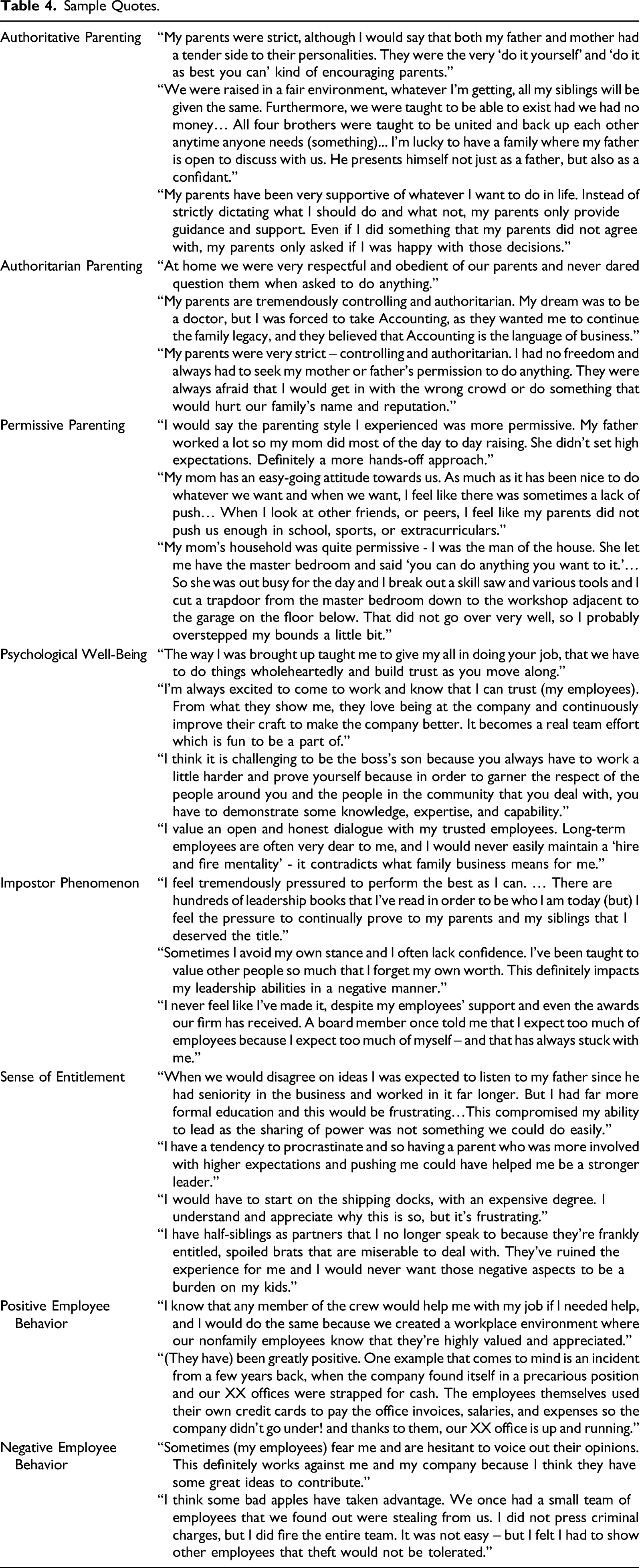
We test our framework using primary matched dyadic data from successors and direct-report subordinates in 119 family businesses. While our results are broadly consistent with our model of parenting effects, post hoc tests revealed that some parenting styles generate more variance than others in terms of successor psychological functioning and promoting employees’ positive versus negative behaviors. Given the complexity of our results, we followed Katila et al. (2017) to supplement our quantitative findings and sharpen our interpretation of the results. We gathered post hoc interviews with 24 later-generation family business leaders asking open-ended questions about their parents and their experiences as family business leaders. We use these interviews to illustrate our deductive theorizing and make sense of the additional complexity we observed. As such, our study follows a growing trend in the management and entrepreneurship fields of using qualitative interview data to triangulate arguments and offer further nuance (e.g., Ben-Oz & Greve, 2015; Eddleston & Mulki, 2021; Katila et al., 2017).
Our model of parenting effects in family businesses provides a theoretical contribution to family business research by adapting parental control theory to explain one reason some successors are better than others in promoting positive versus negative employee behaviors. Prior research acknowledges that parents shape their children’s interest and engagement in, and commitment to, the family business (Bloemen-Bekx et al., 2021; Garcia et al., 2019; Kidwell et al., 2012; McMullen & Warnick, 2015; Schröder et al., 2011), but lacks a more complete picture of how parenting affects successors post-succession and, through them, the family business. Leveraging parental control theory allows us to go beyond prior research on the positive impact of “good” parenting by explaining how specific parenting styles affect successors’ psychological functioning as CEO. Our study also moves beyond the succession literature’s focus on successor choice and succession planning (e.g., Cater et al., 2016; McMullen & Warnick, 2015) by linking conditions prior to succession to outcomes after the baton has passed. Knowledge about the long-term impact of parenting on family businesses is important because such knowledge could guide parenting decisions among family business owners who desire transgenerational leadership.
There have been theoretical models that suggest parenting matters (e.g., Garcia et al., 2019; McMullen & Warnick, 2015), but ours is the first to theoretically and empirically link predecessor parenting styles to family business outcomes. Several scholars have urged family business researchers to adopt theory from family science to better explain heterogeneity among family businesses (e.g., James et al., 2012; Jaskiewicz et al., 2017). This interdisciplinary body of research describes how family relationships (including parenting), systems, and transitional events shape a myriad of family and family member outcomes (e.g., health, well-being, and adaptability). The assumption of those who advocate adopting theory from family science is that each family’s unique characteristics transfer to the business (e.g., James et al., 2012; Jaskiewicz et al., 2017). Knowing that parenting influences successors’ psychological functioning seems insufficient if the resulting psychological functioning does not impact the business. Thus, we theorize and offer initial evidence that predecessors’ parenting style indirectly influences employee behavior in family businesses through successors’ psychological functioning, revealing the potential for parental control theory to advance organizational behavior research. As the opening quotes imply, a key implication is that parenting casts a long shadow on transgenerational family businesses.
Parenting Style, Successor Functioning, and Employee Behavior
Due to the importance of family businesses throughout the world and the economic and social costs that result from ineffective successions, researchers have long sought to understand how the attributes of family business predecessors (e.g., Sharma et al., 2003), the next generation (e.g., Miller et al., 2003), and relationships among family members (e.g., Cater et al., 2016) shape whether and how succession occurs. Parent-predecessors play an important role in this process by influencing children’s intrinsic desire to take over the firm (Garcia et al., 2019; McMullen & Warnick, 2015) and ensuring a smooth succession process (e.g., Cater et al., 2016).
Indeed, parents are one of the most frequently mentioned sources of influence on a child’s career choices (Dietrich & Kracke, 2009; Mortimer et al., 2002; Otto, 2000; Zhao et al., 2012). Although genetics appears to be one way through which parents influence their children’s career choices, longitudinal adoption data suggests biology tells only part of the story. Lindquist et al. (2015), for example, find that only one-third of the intergenerational transmission of entrepreneurship is attributed to genetics (i.e., biological parents), whereas two-thirds is attributed to upbringing and environment (i.e., adoptive parents). Among non-genetic factors, imprinting (Kidwell et al., 2018), often through role-modeling (Zhao et al., 2012), has a strong impact on skill development and career choices (Kidwell et al., 2018; Schmitt-Rodermund, 2004). Parental support has a positive impact on career development (Diemer, 2007), while non-participative and neglectful parenting have negative effects (Lim & Loo, 2003; Vignoli et al., 2005). Among business-owning families, theory and evidence suggest that parenting style (McMullen & Warnick, 2015), family dynamics (Bloemen-Bekx et al., 2019), and parental behaviors (Garcia et al., 2019; Schröder et al., 2011) influence children’s desire to join the family business. Parents in business-owning families can do much to foster—or dispel—a spirit of entrepreneurship and desire to join the family business as committed leaders (e.g., Garcia et al., 2019). However, researchers have not yet learned whether parenting translates into actual success in the family’s business once succession has occurred.
There is ample evidence that parenting affects children’s life outcomes, such as health, psychological well-being, and relationship quality (e.g., Dornbusch et al., 1987; Jago et al., 2011; Lamborn et al., 1991). However, when considering the work domain and business context, parenting effects are likely most visible in family businesses (Garcia et al., 2019; McMullen & Warnick, 2015; Kidwell et al., 2018). This is because the family business context and the succession process, in particular, present unique conditions wherein the mentoring relationship between parent-predecessor and child-successor is longer and more intense (Eddleston & Kidwell, 2012; Lubatkin et al., 2007). Given evidence that parenting affects many life outcomes and the unique conditions in family businesses, parenting might have long-lasting effects on successors’ psychological functioning and, in turn, how employees respond to their leadership. Thus, we draw on Baumrind’s (1971) parental control theory in building our theoretical model.
Baumrind (1971) developed parental control theory by observing 146 preschool children and their parents. Her seminal work has since received considerable empirical support and is now a focal theory of parenting style in sociology, psychology, healthcare, and education (e.g., Barton & Hirsch, 2016; Jago et al., 2011; Lamborn et al., 1991; Levin, 2011). Baumrind (1971) identified three primary parenting styles: Authoritative, Authoritarian, and Permissive. Maccoby and Martin (1983) extended Baumrind’s (1971) work by identifying the orthogonal dimensions “responsiveness” and “demandingness” as central parenting building blocks. Parenting styles differ based on parents’ commitment to and balance of demandingness (i.e., rules, punishment, and conformity) and responsiveness (i.e., warmth, acknowledgment, and autonomy). Demandingness refers to parents’ efforts to integrate children into the family through maturity demands, disciplinary efforts, and willingness to confront children who disobey. Responsiveness refers to parents fostering individuality, self-regulation, and self-assertion by being attuned to and supportive of children’s voice and needs. Baumrind predicted that authoritative parenting, which matches responsiveness to children’s needs with demandingness, leads to better adolescent and adult outcomes than parenting based on either strict authoritarian control, which is highly demanding and not responsive, or permissive freedom, which is highly responsive, but not demanding. 1 In the 50 years since Baumrind (1971), studies from sociology, psychology, and education have adopted her typology (with little change) to investigate how parenting style affects many adolescent and adult outcomes (e.g., Barber & Xia, 2013; Cuzzocrea et al., 2015; Harris-McKoy & Cui, 2013; Harris-McKoy, 2016).
Overall, the evidence strongly and broadly supports the theory across a wide spectrum of childhood and young adult outcomes, such as psychological and physical health (e.g., Jago et al., 2011; Shucksmith et al., 1995), grades (e.g., Steinberg et al., 1989), and prosocial behaviors (e.g., Lamborn et al., 1991). Recently, McMullen and Warnick (2015) suggested that parenting style influences a child’s commitment in joining the family business. Others have argued that the parent–child relationship affects how children perceive their role in the family business, sense of entitlement, and psychological well-being as employees (Cooper et al., 2013; Eddleston & Kidwell, 2012; Kidwell et al., 2018). However, researchers have yet to explore how parenting style influences successors and the family business post-succession. Thus, we extend Baumrind’s parental control theory to the family business context by building and testing a theoretical model explaining how predecessors’ parenting style affects successors’ psychological functioning as CEO which, in turn, influences employee behavior. Psychological functioning is important because it impacts successors’ ability to learn new roles, work with others, and make decisions independently (Cabrera-Suarez, 2005) and influences how employees behave through role-modeling and reciprocity (Gouldner, 1960). Our basic premise is that predecessors’ parenting style affects whether successors, as CEO, experience psychological well-being (“I can lead”), self-doubt in the form of the impostor phenomenon (“I’m not sure I can lead”), or psychological entitlement (“I’m born to lead”).
To investigate how successors’ psychological functioning might impact their employees, research suggests there are three broad employee behavioral domains we could consider: task performance, OCBs, and counterproductive work behaviors (CWBs) (e.g., Rotundo & Sackett, 2002). Following prior research that has focused on OCBs and CWBs because their opposing positive and negative features capture the full range of employee behaviors (e.g., Dalal, 2005), we adopted them as dependent variables. Organizational citizenship behaviors and CWBs are important outcomes in organizational behavior research (e.g., Dalal, 2005). Organizational citizenship behaviors are discretionary job behaviors that promote overall effectiveness but are not formally recognized by the firm’s reward system (Organ, 1988). Counterproductive work behaviors are in many ways the opposite; they are voluntary behaviors that violate organizational norms and threaten the well-being of the firm and/or its members (Robinson & Bennett, 1997). Studying these outcomes in family businesses is important because evidence suggests unique differences in this context (Madison et al., 2021).
The widely accepted “norm of reciprocity” suggests that employees will respond to successor-leaders with behaviors that reflect the way they feel treated (Gouldner, 1960). Our model anticipates that successors who are psychologically healthy, in part due to their parents’ authoritative style, are in the best position to encourage reciprocal OCBs and discourage CWBs. Such successors naturally think outwardly and focus on employees’ well-being and development. Successors who display the impostor phenomenon or entitlement, in contrast, focus inwardly and thus fail to show concern for employees, to which employees likely reciprocate with CWBs and lack motivation to pursue OCBs. Our model is depicted in Figure 1. Research model.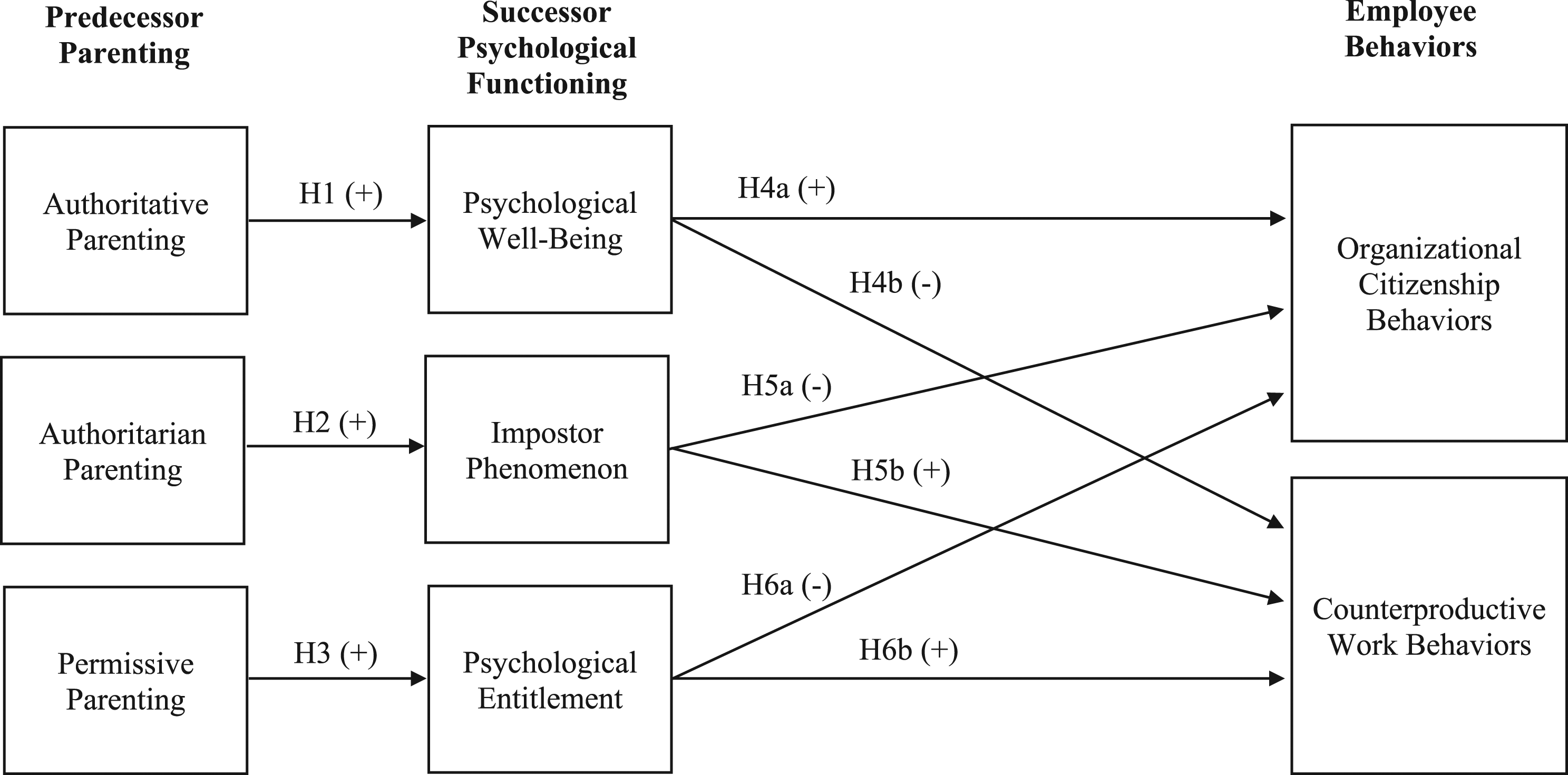
Predecessor Parenting Style and Successor Psychological Functioning
Authoritative parenting and successor psychological well-being
Authoritative parents are highly demanding, but they are also highly responsive to their children’s desire to express individuality. These parents encourage expressiveness, experimentation, and bidirectional communication, and they value maturity, independence, and self-reliance (Baumrind, 1971). Authoritative parents display a high degree of support and acceptance and promote dialogue and discussion within the family (Moscatelli & Rubini, 2009). At the same time, authoritative parents resist children’s coercive demands and gain desired behavior through positive and negative reinforcement, but they do so without overwhelming their children with restrictions. These parents provide clear expectation and behavioral norms that guide children’s behavior. Baumrind (1971) theorized that this parenting style results in the most positive outcomes for children.
Accordingly, we submit that among family business successors, authoritative parenting is associated with psychological well-being, which is defined by positive evaluations of oneself, continued growth and development, the belief that one’s life is purposeful, quality relations with others, and a sense of self-determination (Ryff, 2014; Ryff & Keyes, 1995). Authoritative parenting is positively associated with grades (Dornbusch et al., 1987), and this effect is partially mediated by a healthy sense of autonomy and positive psychological orientation towards work (Steinberg et al., 1989). Compared to peers, offspring of authoritative parents report greater self-reliance, less anxiety, and depression and are less likely to engage in delinquent behaviors (Steinberg et al., 1991). They score highest on psychosocial competence, lowest on psychological and behavioral dysfunction (Lamborn et al., 1991), and highest on active problem coping (Wolfradt et al., 2003). They are popular with their peers and demonstrate prosocial behaviors in school (Deković & Janssens, 1992). All this evidence suggests that authoritative parents tend to raise children who grow to be emotionally well-adjusted, self-regulated, and confident (e.g., Shucksmith et al., 1995), which should lead such children, as successors of their family business, to experience high psychological well-being. Thus, we expect that:
Hypothesis 1: Among transgenerational family businesses, predecessor authoritative parenting is positively related to successor psychological well-being.
Authoritarian parenting and successor impostor phenomenon
Authoritarian parents are highly demanding but not responsive to their children’s desire to express individuality (Baumrind, 1971). Rather than promote bidirectional communication, they attempt to control their children’s behavior according to a set of well-defined values and rules of conduct (Baumrind, 1991). These parents value respect for authority, work, order, and structure but do not support experimentation or independent decision-making (Baumrind, 1991). Authoritarian parents are strict disciplinarians who use power and position to deliver rewards and punishments that coerce children to behave in ways that conform to parents’ values; children are not to question authority (Maccoby & Martin, 1983). These parents are intrusive with respect to their children’s personal space, closely monitor children’s activities, and do not allow children to experiment with behaviors that are inconsistent with parental values (Baumrind, 1971).
Baumrind (1971) theorized that authoritarian parents inhibit independence and autonomous decision-making, which leads to fearful and timid behavior or blind acceptance of authority without question. Consistent with her theorizing, research shows that children of authoritarian parents score well on measures of obedience and conformity but have poor self-conceptions compared to other adolescents (Lamborn et al., 1991). They report more anxiety and depersonalization (i.e., watching oneself act while having no control) (e.g., Wolfradt et al., 2003) and have lower self-esteem (Bun et al., 1988). Overall, children of authoritarian parents lack self-confidence and are not emotionally balanced compared to children of authoritative parents.
When brought into the family business context, we believe that such parenting is associated with the impostor phenomenon, which is defined by the tendency for individuals to attribute their success to fraudulence rather than hard work or ability (Clance & Imes, 1978). It involves self-doubt and an “intellectual phoniness” that makes it difficult to internalize success (Clance & Imes, 1978, p. 241). Individuals with impostor traits are introverted, neurotic, anxious, and dependent; they exhibit low self-esteem, depression, and guilt (e.g., Ross et al., 2001). They do not feel good enough and fear being exposed as incompetent (Clance & Imes, 1978). Consistent with authoritarian parenting, theory about the impostor phenomenon predicts that such individuals are mostly raised in non-supportive environments by parents who are overly invested in their child’s accomplishments (Langford & Clance, 1993). Impostor traits result from parental overprotection and a lack of autonomy (Sonnak & Towell, 2001). This type of family often produces children who believe parents will only notice them when they excel, which eventually results in insecure overachievers (Kets de Vries, 2005). Psychotherapists report that adult children who follow demanding parents as family business leaders often question whether they could succeed elsewhere and express doubt in their ability (Freudenberger et al., 1989). Thus, family business successors from authoritarian households appear likely to disproportionately experience the impostor phenomenon. Stated formally:
Hypothesis 2: Among transgenerational family businesses, predecessor authoritarian parenting is positively related to successor impostor phenomenon.
Permissive parenting and successor psychological entitlement
Permissive parents are highly responsive, but not demanding. Such parents are very responsive and supportive of their children while giving them a high degree of freedom with little discipline (Moscatelli & Rubini, 2009). Permissive parents provide material and psychological resources for their children but do not take responsibility for shaping their behavior. They are non-punitive and allow children to decide and regulate their own activities (Baumrind, 1971). Permissive parents are lenient, accept children as they are, and consult with them in decision-making. These parents seek to indulge children either out of guilt or love, so children do not learn appropriate self-regulation or how to delay gratification (Baumrind, 1971). As a result, Baumrind (1971) theorized that children from these families will be less mature, less responsible, and less achievement-oriented.
We anticipate that successors with permissive parents likely demonstrate a strong sense of psychological entitlement as CEO of the family business. Psychological entitlement is a sub-dimension of narcissism defined as “a stable and pervasive sense that one deserves more and is entitled to more than others” (Campbell et al., 2004, p. 31). Psychological entitlement relates negatively to warmth, openness, positive emotions, agreeableness, straightforwardness, altruism, compliance, and modesty (Miller et al., 2011), and relates positively to the need for power and dominance, ambition, greed, toughness, and hostility (e.g., Campbell et al., 2004; Whitman et al., 2013). Entitled individuals often engage in self-enhancement behaviors at the expense of others (e.g., Whitman et al., 2013). They also expect others to solve problems for them and furnish them with extraordinary assistance and support (Segrin et al., 2012).
These traits and behaviors are consistent with outcomes found in permissive parenting research. While individuals with permissive parents develop superior social skills, a strong sense of self-confidence, and are less likely to experience depression (Darling, 1999), their self-confidence is born out of immature grandiosity (Cramer, 2011) rather than accomplishment (Lamborn et al., 1991). Less able to delay gratification or take actions that favor long-term outcomes, children with permissive parents are twice as likely to exhibit impulsive (Patock-Peckham & Morgan-Lopez, 2006) and aggressive behaviors (Rubin et al., 1995). Such children feel entitled in college (Barton & Hirsch, 2016), often remain dependent on their parents as a source of resources (Lonstein, 2019), and engage in hedonistic behaviors (Cramer, 2011). Damage caused by entitled family members has been documented in family businesses (Kidwell et al., 2012). Thus, the links between permissive parenting and entitlement suggests that permissive parenting is a likely factor in family business successors’ sense of entitlement. Accordingly, we predict that:
Hypothesis 3: Among transgenerational family businesses, predecessor permissive parenting is positively related to successor psychological entitlement.
Predecessor Parenting and Employee Behaviors Through Successor Functioning
While it is important to know how parenting impacts successors’ psychological functioning, for family business research, it is perhaps more important to know how parenting effects carry through to and impact important family business outcomes (Combs et al., 2020; Garcia et al., 2019). Such effects will most likely be visible on outcomes that are directly influenced by successors’ behaviors; specifically, their ability to effectively relate to and inspire employees (Madison et al., 2021). We therefore propose that predecessors’ parenting styles affect successors’ psychological functioning as CEO of the family business, which in turn, affects how successors relate to and inspire employee OCBs or CWBs.
Organizational citizenship behaviors are discretionary job behaviors that promote organizational effectiveness (Organ, 1988). Employees who engage in OCBs go “above and beyond” their job duties (Smith et al., 1983). Organizational citizenship behaviors involve “acts of cooperation, helpfulness, suggestions, gestures of goodwill, altruism, and other instances of what we might call citizenship behavior” (Katz, 1964, p. 132). They are essential to any organization’s functioning and are particularly salient in family businesses (Madison et al., 2021). Organizational citizenship behaviors can be directed at the organization (OCB-O) or individual (OCB-I) (Smith et al., 1983). Examples of OCBs include interpersonal helping (i.e., going out of the way to help coworkers), individual initiative (i.e., motivating others to express their ideas), personal industry (i.e., performing duties with few errors), and loyal boosterism (i.e., defending the firm when others criticize it) (Moorman & Blakely, 1995). Positive predictors include perceptions of procedural justice (Moorman, 1991), organizational commitment (Organ & Ryan, 1995), job satisfaction (Williams & Anderson, 1991), and leader supportiveness; OCBs are negatively related to leader neuroticism (Smith et al., 1983). Overall, satisfied employees with positive job attitudes are more willing to engage in extra-role behaviors that benefit the firm (LePine et al., 2002).
Counterproductive work behaviors, in contrast, are voluntary violations of organizational norms that threaten the well-being of the firm and/or its members (Robinson & Bennett, 1997). Counterproductive work behaviors can also be directed at the organization (CWB-O) and/or individuals (CWB-I) and includes insubordination, sabotage, theft, and aggression (Robinson & Bennett, 1997). CWBs are more likely to occur when an employee does not perceive the firm to be of value and thus lacks organizational commitment (Tepper et al., 2008). Other antecedents include frustration, perceived injustices (Bennett & Robinson, 2000), abusive supervision (Mitchell & Ambrose, 2007), unethical leadership (Mayer et al., 2009), and psychological contract breach (Bordia et al., 2008). In contrast, individuals who value the firm refrain from deviant behavior to avoid jeopardizing their job (Robinson & Bennett, 1997). Hollinger (1986) argued that employees’ attachment, commitment, and involvement with the firm reduce deviant behavior.
Successor psychological well-being and employee behaviors
We predict that successors with authoritative parents should, because of their own psychological well-being, be best equipped to elicit OCBs and minimize CWBs. The positive self-evaluation, willingness to grow and learn, and high-quality relationships that define psychological well-being (Ryff & Keyes, 1995) are consistent with the leader supportiveness (e.g., Smith et al., 1983) and perceived fairness (e.g., Organ & Ryan, 1995) that foster employee job satisfaction (e.g., Bettencourt & Brown, 1997) and yield OCBs (e.g., LePine et al., 2002; Madison et al., 2021; Williams & Anderson, 1991). A key mechanism driving these findings is the norm of reciprocity (Gouldner, 1960). Leaders who feel secure in themselves can focus outwardly on employees’ development and well-being and promote employees’ sense of fairness, trust, and commitment (Bennett & Robinson, 2000; Mayer et al., 2009; Mo & Shi, 2017). Employees reciprocate their leader’s efforts and attention with OCBs, going “above and beyond” because they feel their leader has gone “above and beyond” and “led by example” (Yaffe & Kark, 2011). Such leaders also likely discourage CWBs for the same reasons. If leaders promote a sense of fairness, trust, and commitment, employees should refrain from CWBs (Bennett & Robinson, 2000; Mayer et al., 2009; Mo & Shi, 2017). Thus, we expect that:
Hypothesis 4: Among transgenerational family businesses, predecessor authoritative parenting has a (a) positive influence on OCBs and a (b) negative influence CWBs that are mediated through successor psychological well-being.
Successor impostor phenomenon and employee behaviors
We theorized that authoritarian parenting results in successors who experience the impostor phenomenon. Impostors are introverted, neurotic, anxious, and dependent; they exhibit low self-esteem, depression, and guilt (Ross et al., 2001). They fear losing respect and affection if they fail (Rohrmann et al., 2016), and tend toward perfectionism, procrastination, and work-related stress and strain (Rohrmann et al., 2016). The impostor’s obsession with perfection and fear of failure can lead them to procrastinate or delay decisions, giving a general sense of “being in over their head” (Whitman & Shanine, 2012).
This type of timid leadership is correlated with work-related stress (Rohrmann et al., 2016), which is negatively linked to OCBs (Eatough et al., 2011) and positively linked to CWBs (Chiu et al., 2015). Impostors also experience neuroticism that makes them less likely to engage in OCBs in their own jobs (Smith et al., 1983), suggesting employees will reciprocate similarly (Yaffe & Kark, 2011). Impostors focus inwardly because of their emotional turmoil and lack the attention needed to focus outwardly on employees’ well-being and development. This weakens employees’ trust and a sense of fairness, which demotivates interest in citizenship behaviors (Moorman, 1991). Thus, we anticipate:
Hypothesis 5: Among transgenerational family businesses, predecessor authoritarian parenting has a (a) negative influence on OCBs and a (b) positive influence on CWBs that are mediated through successor impostor phenomenon.
Psychological entitlement and employee behaviors
We theorized that permissive parenting yields successors with a sense of psychological entitlement, and we anticipate that these successors will be poorly equipped to encourage OCBs and discourage CWBs. Like impostors, entitled leaders focus inwardly and tend to ignore employees’ well-being; however, the reasons are different. Whereas impostor leaders feel insecure in their positions, entitled leaders are narcissistic. Entitlement is a strong predictor of aggression (Reidy et al., 2008) and abusive supervision (Whitman et al., 2013), which undermines job satisfaction, a sense of fairness, and organizational commitment (Tepper, 2000), all of which are needed to encourage OCBs (LePine et al., 2002; Organ & Ryan, 1995). Abusive supervision is also an antecedent of CWBs because employees reciprocate to restore some of the lost control they feel due to leadership abuse (Mitchell & Ambrose, 2007; Tepper et al., 2008). Aggression towards employees can be viewed as unethical (Mayer et al., 2009) and unjust (Bennett & Robinson, 2000), and when entitled leaders break trust with employees (Mo & Shi, 2017) and create work-related stress (Chiu et al., 2015), employees likely reciprocate with CWBs. Therefore, we expect the following:
Hypothesis 6: Among transgenerational family businesses, predecessor permissive parenting has a (a) negative influence on OCBs and a (b) positive influence on CWBs that are mediated through successor psychological entitlement.
Method
Sample and Procedure
Our framework was tested using primary matched dyadic survey data from successors and subordinates (i.e., employees who report directly to the CEO) of family businesses. Our hypotheses required that we gather data on successors and employees in family businesses that were in at least their second generation. Given that less than a third of family businesses make this transition, doing so presented a challenge that we overcame by identifying qualified candidates from a panel of business owners who were pre-recruited by Qualtrics 2 (cf. Porter et al., 2019). We used questions at the beginning of the successor survey to gain consent and ensure that respondents were next-generation family business owners and CEOs whose parent had been the previous CEO. If these criteria were met, the successor completed the successor survey containing items about the firm, the predecessor’s parenting style, and their psychological functioning as CEO. At the end of the survey, we asked successors to provide email addresses for up to five subordinates who could complete the employee survey. Recognizing that the CEO’s psychological functioning might not affect all employees, especially in a large firm, our interest was in those employees the CEO works with directly. This approach is in line with research examining the link between leader-subordinate exchange and OCB or CWB (e.g., Han et al., 2018; Newman et al., 2017; Tepper et al., 2008). The employee survey contained items measuring OCBs and CWBs.
Qualtrics recruited 1884 potential respondents, of which 1648 self-identified as owner and CEO of a family business. However, only 505 (30.6%) were in at least the second generation, which is consistent with prior estimates of the proportion of family businesses that transition into a second generation (e.g., Handler, 1994). Of these 505 firms, 164 did not allow surveys of subordinates. After applying these screens, we collected surveys from 341 successors in transgenerational family businesses. We then collected 145 surveys from subordinates who work directly with the CEO in 119 of these 341 firms: 102 firms had one employee-respondent, eleven firms had two, four firms had three, one firm had four, and one firm had five. Because the work group—those who work directly with the CEO—is the unit of analysis, we aggregated employee responses to the group level after confirming that doing so was justified (see the Analysis section). Our final sample is from 119 transgenerational family businesses, although we use data from all 341 for robustness testing. Sample firms had an average of 475 employees. 3 Successors were 45 years of age on average, 47% were female, and 76% were college graduates. Subordinate respondents were 41 years of age on average, 49% were female, 63% were college graduates, and 65% were members of the business-owning family.
Survey Measures
Measurement model results.
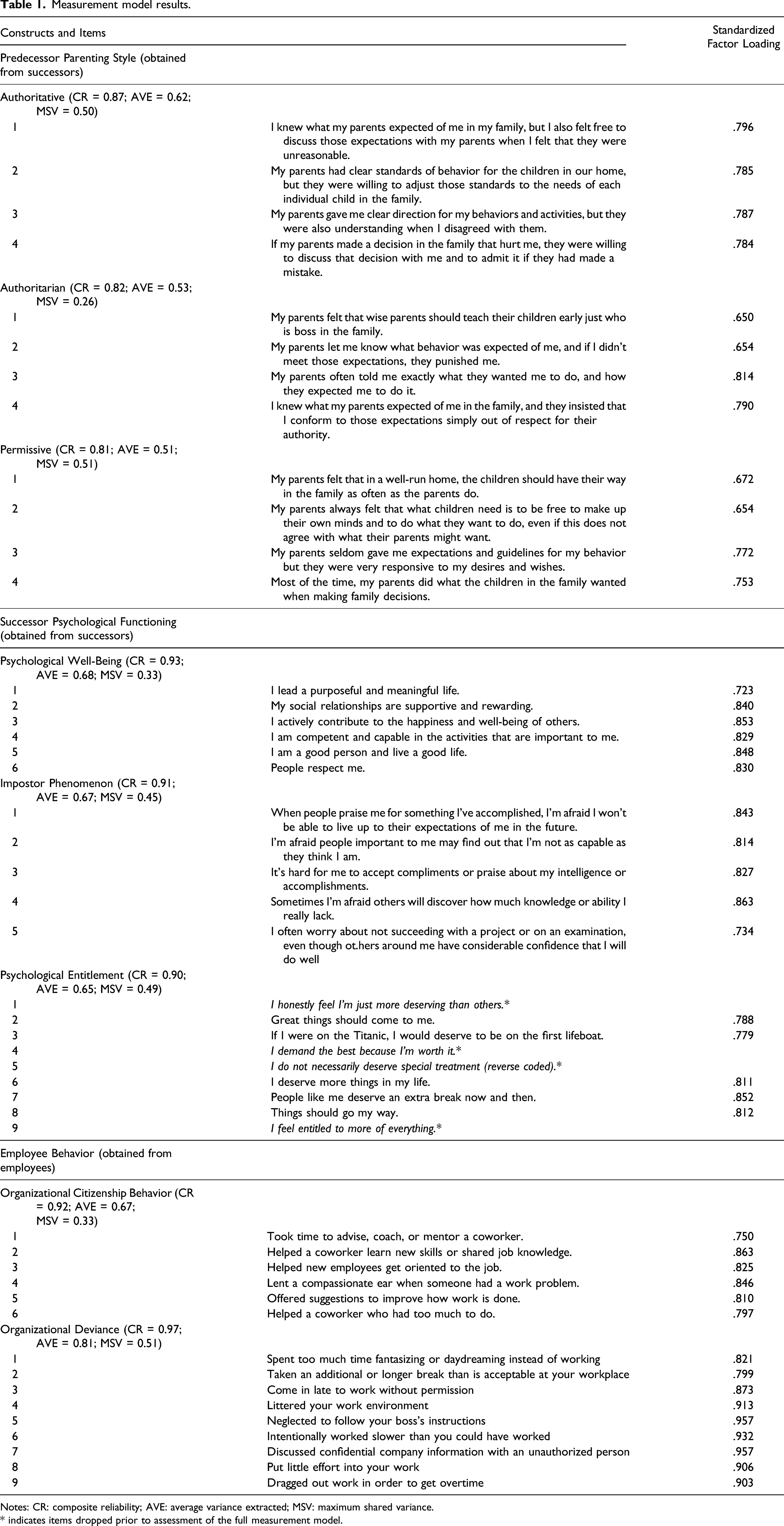
Notes: CR: composite reliability; AVE: average variance extracted; MSV: maximum shared variance.
* indicates items dropped prior to assessment of the full measurement model.
Predecessor parenting style
To measure authoritative, authoritarian, and permissive parenting, we adapted items from the Parental Authority Questionnaire (PAQ; Buri, 1991). The PAQ is a self-report measure consisting of 10 items for each parenting style, originally created to assess the parenting style of the mother. However, Baumrind (1991) observed substantial convergence between mothers’ and fathers’ ratings, and more recent studies found that parenting styles of mothers and fathers are strongly related (e.g., Tavassolie et al., 2016). While parenting practices may differ between mothers and fathers, inter-parental agreement on parenting style is very important to marital quality (e.g., Harvey, 2000). Even where parenting styles differ, adult children describe their parents’ parenting style based on their salient recalled experiences regardless of whether those experiences were most influenced by the mother, the father, or some blend of them. Thus, we adopted a joint parenting perspective and revised the PAQ items to be more inclusive by asking successor respondents about their “parents” rather than their “mother.”
Given the length of the adapted PAQ, we validated a shorter version before administering it to busy family business successors. We administered the adapted 30-item PAQ to undergraduate management and sociology students at a large university in the United States. Participation was voluntary, respondents were guaranteed anonymity, and extra credit was offered as incentive. We received 233 completed surveys. Most respondents were seniors (60%) and female (56%). Based on results of a factor analysis with an oblimin oblique rotation, we removed items with factor loadings less than .50 (Hair et al., 2010) and those that cross-loaded with a factor loading greater than .50. The final adapted and reduced scale contained four items for each parenting style, which were then included on the successor survey. Each scale achieved acceptable reliability: authoritative α = .87; authoritarian α = .82; and permissive α = .80.
Successor psychological functioning
Successors provided responses to each of the psychological functioning measures. To capture psychological well-being, we used the Psychological Well-Being Scale (Diener et al., 2009). It is an eight-item scale, sometimes called the Flourishing Scale (e.g., Silva & Caetano, 2013), that assesses social-psychological prosperity in areas such as relationships, life purpose, mastery, self-respect, engagement, and optimism (Diener et al., 2010). Flourishing, however, is broader than psychological well-being, so we only used the six items that aligned with the theoretical definition of psychological well-being (Ryff, 2014). Impostor phenomenon was measured with five items of the Clance Impostor Phenomenon Scale (Clance, 1985). In line with our theorizing, these items assess feelings of intellectual inauthenticity, inadequacy, and fear of being exposed as a fraud. To capture psychological entitlement, we used the Psychological Entitlement Scale (Campbell et al., 2004), which assesses the extent that respondents feel a sense of deservingness. We dropped four of the nine items of the scale during measurement model assessment (see the Results section and Table 1). Each of the successor psychological functioning variables achieved high reliability: psychological well-being α = .92; impostor phenomenon α = .91; and psychological entitlement α = .90.
Employee behavior
Employees provided responses to the workplace behavior measures. We assessed OCB with the OCB Checklist (Spector et al., 2010). The OCB Checklist contains 10 items: four items assess citizenship behaviors directed toward the organization and six items assess citizenship behaviors aimed at helping coworkers with work-related tasks. Given the blurred lines between family and firm in this context, the organizational-directed items (e.g., working on the weekends, attending meetings on my own time) likely capture family obligations. We therefore used only the six items depicting coworker helping behaviors. We assessed CWB with the Organizational Deviance Scale (Bennett & Robinson, 2000). It contains 12 items. However, we did not use the three items that assess illegal activity (e.g., stealing property, stealing money, and using illegal drugs), using only the nine items that assess compliance with organizational norms and expectations. Respondents were asked how often they engaged in each of the behaviors in the last year (1 = never; 5 = every day). Both variables exhibited high reliability: OCBs α = .92 and counterproductive work behavior α = .97.
Control variables
We controlled for firm, successor, and employee variables that could impact relationships in this study. We controlled for firm size using the number of full-time employees because the nature of the working relationship between CEOs and subordinate respondents changes as firms grow. We controlled for the age (measured in years), gender (coded 1 for females and 0 for males), and educational level (coded 1 for college graduate and 0 for high school or some college) for both successors and employees. We also controlled for the employee’s family status (coded 1 for family and 0 for nonfamily) due to “bifurcation bias” wherein family and nonfamily employees are treated differently and thus may exhibit different behavioral responses (Verbeke & Kano, 2012).
Analysis
Because we received more than one employee survey from some of the family businesses in our sample (see Sample section), we assessed the rwg index of agreement (James et al., 1984) and the two-way random intraclass correlation of absolute agreement. Results show that CEO subordinates had shared perceptions of OCBs (rwg = .94; ICC(2) = .90) and CWBs (rwg = .89; ICC(2) = .97), thus justifying aggregation to the group level (Klein & Kozlowski, 2000).
Following MacKinnon et al.’s (2002) guidance for models with mediating variables, we used structural equation modeling to simultaneously test our hypotheses. In a recommended two-step approach (Anderson & Gerbing, 1988) using Amos 25, we first conducted a series of confirmatory factor analyses to assess factor structure and discriminant validity. Specifically, we assessed separate measurement models for our independent variables, mediators, and dependent variables prior to assessing the full measurement model. We also assessed common method bias in this step. The second step tests the structural model and hypotheses. We assessed fit of the measurement and structural models using the chi-square statistic in relation to degrees of freedom, incremental fit index (IFI), Tucker Lewis index (TLI), comparative fit index (CFI), and root mean square error of approximation (RMSEA). We assessed mediation using bias-corrected 95% confidence intervals (CI) from 2000 bootstrapped samples (Taylor et al., 2017).
Results
Measurement Models
We used confirmatory factor analysis to assess the structure of the abbreviated and adapted PAQ. The three-factor measurement model produced acceptable fit (χ2 = 86.20, df = 51, CMIN/df = 1.69, IFI = .94, TLI = .93, CFI = .94, RMSEA = .08) and significantly better fit than a single-factor solution (Δχ2 = 187.14, p ≤ .001; Δdf = 3). Therefore, a three-factor solution including authoritative, authoritarian, and permissive parenting styles fits the data best.
The initial three-factor measurement model of successor functioning, including psychological well-being, impostor phenomenon, and psychological entitlement, exhibited adequate fit (χ2 = 293.02, df = 149, CMIN/df = 1.97, IFI = .91, TLI = .90, CFI = .91, RMSEA = .09). However, the psychological entitlement scale had one item with a low factor loading, two items that cross-loaded on the impostor phenomenon, and one item that cross-loaded on psychological well-being. After evaluating item content, we dropped these four items from the psychological entitlement scale. Dropping such items is the parsimonious and preferred solution for improving fit (Anderson & Gerbing, 1988); prior research also used shortened versions of this scale (e.g., Hammond et al., 2014). The re-specified model exhibited significantly improved fit (Δχ2 = 118.67, Δdf = 48, p ≤ .001).
The two-factor measurement model of employee behavior (i.e., OCBs and CWBs) exhibited acceptable fit (χ2 = 190.80, df = 89, CMIN/df = 2.14, IFI = .95, TLI = .94, CFI = .95, RMSEA = .10) with no modification.
We assessed fit of the full measurement model by incorporating the three predecessor parenting scales, three successor functioning scales, and two employee behavior scales into a single measurement model. Results showed that our hypothesized eight-factor model was a better fit (χ2 = 1383.28, df = 832, CMIN/df = 1.66, IFI = .88, TLI = .87, CFI = .88, RMSEA = .08) than the following, more parsimonious, models: a six-factor model collapsing authoritative, authoritarian, and permissive parenting (Δχ2 = 264.12, p ≤ .001; Δdf = 13), a six-factor model collapsing psychological well-being, impostor phenomenon, and psychological entitlement (Δχ2 = 799.77, p ≤ .001; Δdf = 13), and a four-factor model collapsing predecessor parenting and successor psychological functioning (Δχ2 = 1042.06, p ≤ .001; Δdf = 22).
We also assessed reliability and validity with all values exceeding recommended thresholds. Construct reliability was strong, as indicated by Cronbach’s alphas above 0.70 (range 0.80–0.97) and composite reliability (CR) values exceeding 0.60 (range 0.81–0.97; Bagozzi & Yi, 1988). Convergent validity was indicated by standardized factor loadings above 0.60 (range 0.65–0.96; Bagozzi & Yi, 1988) and significant at p < .05 (Anderson & Gerbing, 1988). Additionally, average variance extracted (AVE) values were greater than the recommended 0.50 level (range 0.51–0.81; Bagozzi & Yi, 1988). There is also evidence of discriminant validity because our AVE values exceeded both the maximum shared variance values (MSV; range 0.26–0.51) and the squared inter-construct correlations (range 0.00–0.40; Hair et al., 2010). Standardized factor loadings, CR, AVE, and MSV statistics are shown in Table 1.
Following Podsakoff et al. (2003), we controlled for common method bias through our research design by collecting independent and dependent variables from different sources. Specifically, successors assessed predecessor parenting and their subordinates assessed OCBs and CWBs. We did, however, collect mediating variables from successors. Therefore, we adopted the following additional procedural remedies: (1) we separated the measurement of the independent and mediator variables in the successor survey; (2) we assured respondents that there were no right or wrong answers; and (3) we used existing and validated scales to ensure that item wording was not ambiguous or complex. We also statistically assessed common method bias. First, we performed a Harman’s single-factor test. The single-factor solution explained 33.83% of the variance, well below the 50% threshold indicating common method bias (Hair et al., 2010). Second, we added a common factor to the full measurement model and loaded each item on the common factor in addition to its measurement factor (Podsakoff et al., 2003). Constraining the paths to be equal, the model revealed that items share only 16% common variance. Comparing fit statistics from the common method model (χ2 = 1380.08, df = 831, CMIN/df = 1.66, IFI = .88, TLI = .87, CFI = .88, RMSEA = .08) to fit statistics from the measurement model reveals no differences (Δχ2 = 3.20, Δdf = 1, p > .05); thus, bias was not detected. Taking these procedural methods and statistical results together, we conclude that common method bias is not a major concern.
Structural Model
Descriptive statistics and bivariate correlations.
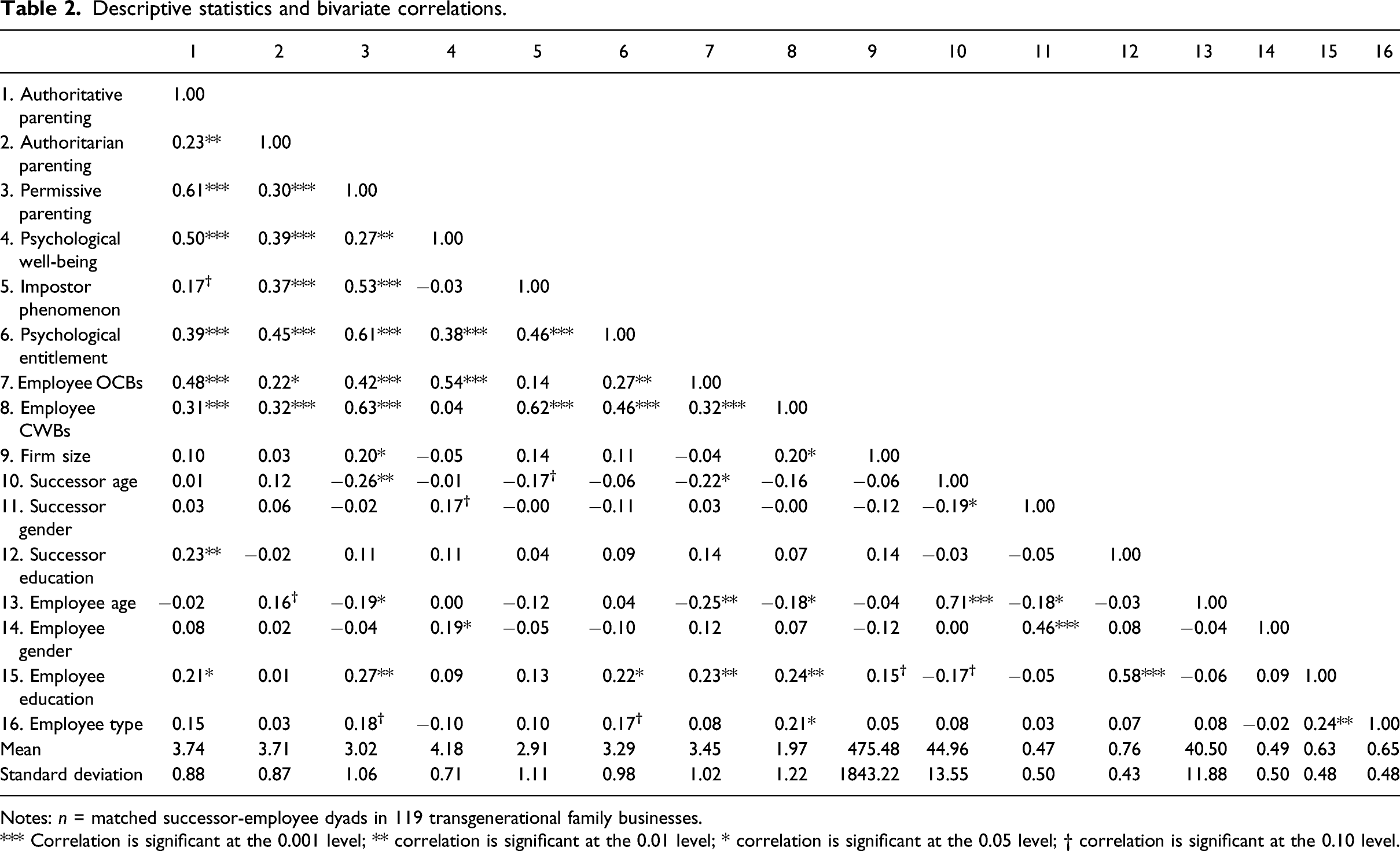
Notes: n = matched successor-employee dyads in 119 transgenerational family businesses.
*** Correlation is significant at the 0.001 level; ** correlation is significant at the 0.01 level; * correlation is significant at the 0.05 level; † correlation is significant at the 0.10 level.
Structural model and post hoc results.
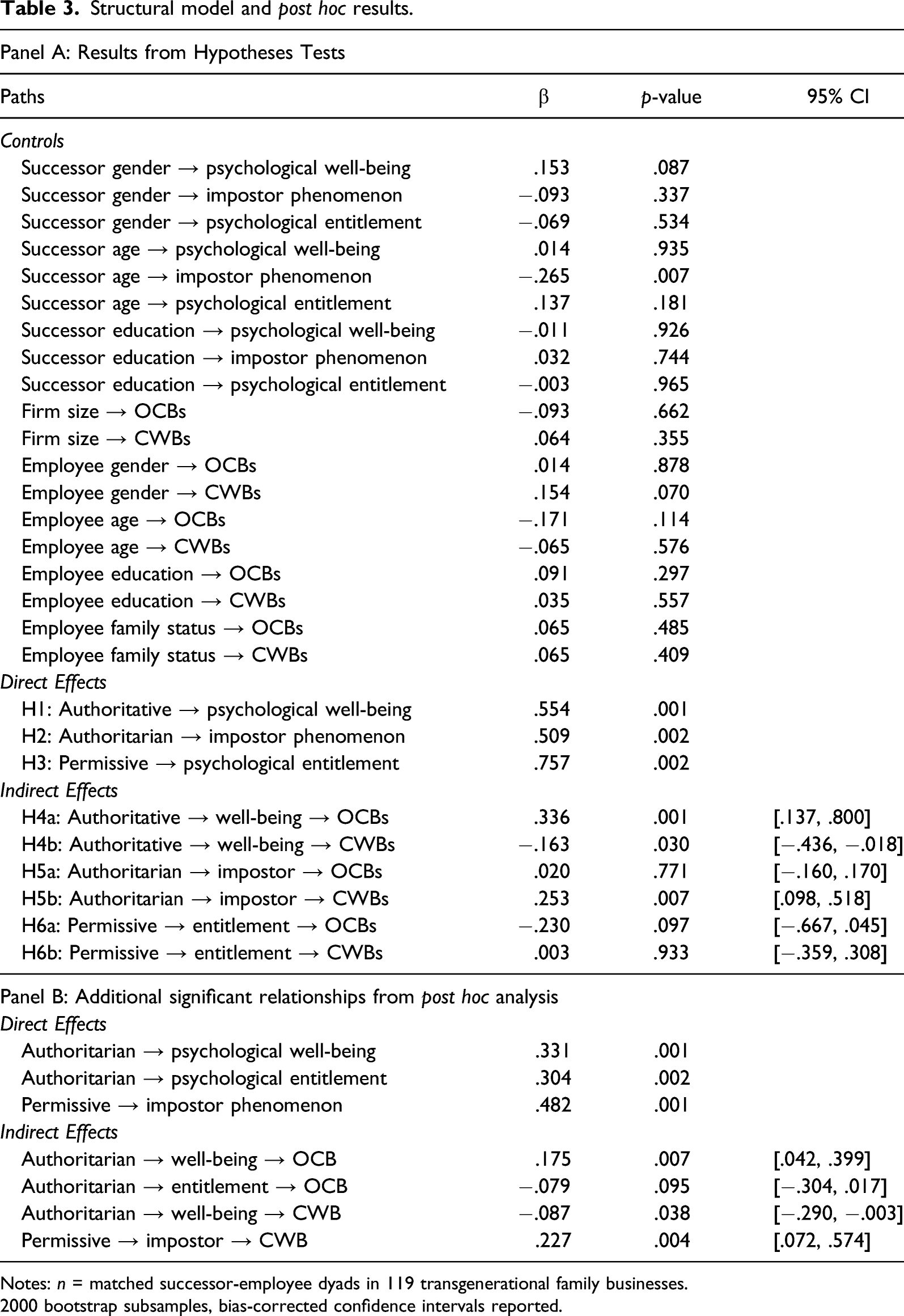
Notes: n = matched successor-employee dyads in 119 transgenerational family businesses.
2000 bootstrap subsamples, bias-corrected confidence intervals reported.
As shown in Panel A of Table 3, results support the hypothesized direct effects of predecessor parenting style on successor psychological functioning. Specifically, authoritative parenting is significantly and positively related to successor psychological well-being (β = .554, p ≤ .001); thus, Hypothesis 1 is supported. Authoritarian parenting is significantly and positively related to successor impostor phenomenon (β = .509, p ≤ .01); thus, Hypothesis 2 is supported. Permissive parenting is significantly and positively related to successor psychological entitlement (β = .757, p ≤ .01); thus, Hypothesis 3 is supported.
Results support the hypothesized indirect effects of authoritative parenting on OCBs and CWBs through successor psychological well-being. Specifically, Hypothesis 4a predicted that authoritative parenting has a positive influence on OCBs through successor psychological well-being, and the significant and positive indirect effect (β = .336, p ≤ .001, [.137, .800]) supports this hypothesis. Hypothesis 4b predicted that predecessor authoritative parenting has a negative influence on CWBs through successor psychological well-being, and the significant and negative indirect effect (β = −.163, p ≤ .05, [−.436, −.018]) supports this hypothesis.
We found partial support for the hypothesized indirect effects of authoritarian parenting on OCBs and CWBs through successor impostor phenomenon. Hypothesis 5a predicted that authoritarian parenting has a negative influence on OCBs through successor impostor phenomenon, but the indirect effect was not significant (β = .020, p > .10, [−.160, .170]); thus, Hypothesis 5a was not supported. Hypothesis 5b predicted that predecessor authoritarian parenting has a positive influence on CWBs through successor impostor phenomenon, and the significant and positive indirect effect (β = .253, p ≤ .01, [.098, .518]) supports this hypothesis.
We found partial support for the hypothesized indirect effects of permissive parenting on OCBs and CWBs through successor psychological entitlement. The indirect effect of permissive parenting on OCBs via successor entitlement was negative and weakly significant (β = −.230, p ≤ .10, [−.667, .045], 90% CI [−.597, −.002]); thus, Hypothesis 6a received weak support. 4 Hypothesis 6b predicted that predecessor permissive parenting positively influences CWBs via successor psychological entitlement. The indirect effect of permissive parenting on CWBs was not significant (β = .003, p >.10, [−.359, .308]); thus, we did not find support for this hypothesis.
Robustness Test
For our main analysis, we used matched successor-subordinate dyadic data from 119 family businesses. However, we collected surveys from successors in 341 family businesses. Therefore, we used all collected successor surveys to assess the robustness of the direct relationships between parenting style and psychological functioning (H1–H3). We could not assess the indirect relationships between parenting style and employee behaviors (H4–H6) because we did not have employee surveys from these additional 222 family businesses. Using the same parenting style, psychological functioning, and firm and successor control variables, the relationships between authoritative parenting and successor psychological well-being (β = .296, p ≤ .001), authoritarian parenting and successor impostor phenomenon (β = .389, p ≤ .001), and permissive parenting and successor psychological entitlement (β = .657, p ≤ .001) were positive and significant, demonstrating the robustness of the results from the main analysis.
Post Hoc Analyses
We did not receive empirical support for all hypothesized relationships, so we examined in a post hoc analysis the direct and indirect effects between each parenting style and each type of successor psychological functioning. Regarding the direct effects, our post hoc results indicate that authoritative parenting is not significantly related to impostor phenomenon or psychological entitlement; it is only significantly related to psychological well-being as theorized. In contrast, authoritarian parenting, in addition to its theorized and significant relationship with impostor phenomenon, has a positive and significant relationship with psychological well-being (β = .331, p ≤ .001) and psychological entitlement (β = .304, p ≤ .002). Permissive parenting, in addition to its theorized and significant relationship with psychological entitlement, has a positive and significant relationship with successor impostor phenomenon (β = .482, p ≤ .001). 5
These additional significant direct effects between predecessor parenting and successor functioning introduce additional significant indirect effects on employee behaviors. Regarding OCBs: the indirect effect of authoritarian parenting through psychological well-being is positive and significant (β = .175, p ≤ .01, [.042, .399]), and the indirect effect of authoritarian parenting through psychological entitlement is negative and weakly significant (β = −.079, p ≤ .10, [−.304, .017], 90% CI [−.274, −.005]). Regarding CWBs: the indirect effect of authoritarian parenting through psychological well-being is negative and significant (β = −.087, p ≤ .05, [−.290, −.003]), and the indirect effect of permissive parenting through impostor phenomenon is positive and significant (β = .227, p ≤ .01, [.072, .574]). These additional significant direct and indirect effects found during the post hoc analysis are reported in Panel B of Table 3.
Post Hoc Interviews
To better understand and triangulate our quantitative results, both anticipated and post hoc, we followed Katila et al. (2017) by collecting post hoc qualitative data from a separate sample. We gathered personal interviews with 24 second- or later-generation leaders conducted by their adult children as part of a capstone course for next-generation family business leaders. Interviews lasted 30–75 minutes. The students were given an interview protocol and trained to conduct the interview. They assured their parent-interviewees that responses would be kept confidential and anonymous. The instructor, who is also an author, originally joined three students during the interviews, but quickly learned that the parent and child were more candid without the author’s presence. While participants were informed that their anonymous interviews would be used for research purposes, the interviews also served to promote discussion in the class about the role of parenting in shaping family business leaders. In addition to gathering basic demographic information, interview questions included Describe how you were raised, specifically focusing on your parents’ style; Share a “typical” story or example that demonstrates your parents’ style; What effect did your parents’ parenting style have on your leadership abilities? Describe your approach towards subordinates; What effect do you think your leadership style has on employee behaviors? How has the relationship with your parents affected your ability to perform your job and to lead? How has this shaped how you are grooming the next generation for leadership?
Interviewees ranged in age from 46 to 61 (M = 52.54). The vast majority (79%) were male, and they held the following positions: Director or Managing Director (46%), CEO (42%), President (8%), and General Manager (4%). The oldest family business was in its sixth generation, while the majority were owned and managed by the second (42%) or were currently being transferred from the first to the second (37%) (i.e., the student is third generation). Although many interviewees were from a manufacturing industry (25%), a variety of industries were represented. No interviewees were in the survey sample used to test hypotheses.
Sample Quotes.
Discussion
Despite having ample time to prepare successors to take over the family business, the average family successor underperforms relative to both the founding generation and nonfamily successors (Bennedsen et al., 2007; Cucculelli & Micucci, 2008). Yet many family businesses excel across multiple generations with a string of talented family leaders (Jaskiewicz et al., 2015), raising important questions about what some families do differently. Building on prior family business theory acknowledging that parents help shape their children’s career intentions and decision to join the family business (e.g., Bloemen-Bekx et al., 2019; Garcia et al., 2019; McMullen & Warnick, 2015; Schröder et al., 2011), we leverage Baumrind’s (1971) parental control theory and the norm of reciprocity (Gouldner, 1960) to develop a model explaining one way parenting influences family businesses post-succession.
Findings and Triangulation
Authoritative Parenting: Our model anticipated that successors whose parents were authoritative, which is both demanding and responsive, experience psychological well-being as CEO. In turn, this enables successors to focus externally on employees’ well-being and growth thereby inspiring employees to reciprocate with OCBs and refrain from CWBs. Our main and post hoc results offer support; the positive benefits family science researchers suggest from authoritative parenting, including psychological well-being (Shucksmith et al., 1995), extend to family business successors. Several comments from our interviews illustrate links between authoritative parenting and psychological well-being among family business successors. One interviewee described his authoritative upbringing: “It was the attitude towards children as adults: work and strict obligations. [But] my parents never forced their kids to do anything or do anything under pressure. This… made us strong and confident at every stage of development.” Another interviewee explained: “My parents did not force me to do anything. They would ask for my opinion instead. I had spare time to do my own things. At the same time, they were also strict on my grades. Because of the freedom I got from my parents, I studied hard to reach the goals I set for myself in school. It feels like a win-win thing for the family.”
Importantly, the psychological well-being that arises from authoritative parenting positively impacts subordinates. This was a common pattern also identified in our post hoc interviews. For example, one interviewee from the third generation described the positive effect his grandparents had on his father’s leadership that, in turn, inspired employees’ positive behavior: “As my Dad knew that his father always trusted him, he wanted to give the same opportunities to people working under him … he felt that nonfamily employees should feel that they are a part of the family, which resulted in employee loyalty, satisfaction, and business success.” Similarly, this third generation interviewee explained how the authoritative parenting style of his grandfather helped his father to gain the respect of employees: “There was really no separation between a work relationship and a parent-child relationship. My grandpa was always harder on my dad than any other member of the crew, and my dad is grateful for that because when he took over, the crew respected him and knew that he was the most knowledgeable person there and was willing to work harder than anyone else.” Another interviewee with authoritative parents he described as both “strict and supportive” explained his approach towards employees: “I like my employees to be invested in what we do and who we are … We are a family, and when they need help we will be there, and when we need help so will they.” A central practical implication from our results and interviews is that authoritative predecessor parenting helps develop successors who inspire positive behaviors from employees. Accordingly, future research should seek to identify how business-owning families can better embrace authoritative parenting techniques.
Authoritarian Parenting: This parenting style, which is defined by demanding standards and little responsiveness, relates to multiple psychological outcomes. We found, as predicted, that successors with authoritarian parents are more likely to experience the impostor phenomenon. This finding was illustrated in several comments from our interviews. One interviewee, for example, explained that while he was raised under “strict protocols that we had to follow … the negative side to this story is that sometimes I avoid my own stance in doing [something] and I often lack confidence.” Another interviewee similarly said, “I had no freedom and always had to seek my mother or father’s permission to do anything. It definitely made me feel suffocated growing up. I’m a rather shy person and I think my parents being overly-protective made me less outgoing and more of an introvert.”
In post hoc tests, however, we were surprised to learn that authoritarian parenting is also associated with psychological well-being and psychological entitlement. Successors appear to have varied responses to authoritarian parenting, which we therefore explored via our post hoc interviews. Consistent with our unexpected findings showing that authoritarian parenting relates to psychological well-being, several of our interviewees with authoritarian parents interpreted their parents’ controlling behavior as efforts to groom responsible and effective leaders. One of our interviewees commented: “My mother’s more controlling parenting style helped me learn, organize, and execute my duties at the company.” Another interviewee who described his father as controlling explained: “He didn’t believe in letting us have it easy and made sure that we knew how hard it is to run a business successfully and earn money. (He) made us realize from when we were younger that we had to always be hardworking and brave in order to make a difference.” At the same time, other interviewees with authoritarian parents appeared entitled as revealed in this comment: “The authoritarian upbringing leads to being tough but a lack of empathy. This made me able to succeed even when things got really hard but also has made it difficult for me in the past to feel for someone that is struggling emotionally.”
The multiple psychological outcomes that relate to authoritarian parenting indicate that whether this style is “good” or “bad” may depend on other factors, suggesting that the effects of parenting on successors’ psychological functioning is more complex than originally thought. Much work on parenting compares authoritative parenting to other styles and finds it superior (e.g., Lamborn et al., 1991; Steinberg et al., 1991); our results suggest greater variance beneath these negative comparisons. While authoritarian parenting appears less effective, on average, it might interact with other factors to explain why one successor with authoritarian parents develops high psychological well-being while others experience the impostor phenomenon or a sense of entitlement. Identifying such factors appears to be a fruitful avenue for future research because it illustrates that parenting is not deterministic and there are other important variables at play. For example, birth order research often emphasizes how children find their niche within the family by competing in different ways for their parents’ attention (e.g., first-born children bask in the praise and attention earned from bowing to authoritarian parents and leave little room for later-born children to find their own psychologically supportive niche within the family) (cf. Sulloway, 1996). Consistent with this example, one interviewee discussed how birth order shaped siblings differently: “I’m the first-born, so it makes sense that I prefer to follow the ‘status quo’ and my sisters get attention by acting up and doing the opposite of what my parents want.” As such, birth order illustrates one avenue through which one child might accept and another reject his/her parents’ authoritarian style, and thus might help explain why authoritarian parenting relates to all three of the psychological outcomes.
Not surprisingly, the different psychological outcomes among leaders with authoritarian parents relate to different employee outcomes, and this quantitative finding was reflected in the interviews. As hypothesized, we found that authoritarian parenting can lead to the impostor phenomenon and that such leaders, in turn, allow CWBs to fester. Several interviewees with “controlling” parents and indicators of the imposter phenomenon revealed management styles consistent with this logic: “I probably let things go wrong for much longer than they should. When I can – I actually get a manager to discipline employees.” Another who felt “pressure to continually prove to my parents and my siblings that I deserved the title (CEO)” remarked that “employees tend to say that our company doesn’t have the typical ‘warmth’ that they usually get from a family business.”
However, as reflected in the post hoc tests showing that psychological entitlement mediates the relationship between authoritarian parenting and fewer OCBs, a few interviewees adopted a leadership style that reflects their parents’ “tough love” which, in turn, appeared to stifle employees. One interviewee who described his father as extremely controlling explained: “sometimes they [my employees] fear me and are hesitant to voice out their opinions.” In discussing how employees are hesitant to take initiative, another interviewee raised by authoritarian parents remarked: “the employee’s probably do not get as much flexibility in work style and schedule since I make most of the business decisions which frustrates them at times but I have always found my way to be the most efficient in the business.” Taken together, our results suggest that when successors with authoritarian parents feel a sense of entitlement, they often mirror their parents’ controlling behavior as leaders and thus weaken their employees’ willingness to display OCBs.
Finally, and on a more positive note, authoritarian parenting was also found to relate positively to OCBs and negatively to CWBs through psychological well-being. An interviewee with an authoritarian parent described: “My parents have definitely made me a very authoritarian leader who is strict with the rules and takes business seriously. The positive side is that everyone in the company obeys and respects me highly.” Another interviewee who described his parents as authoritarian explained: “Although I have patriarchal tendencies, I also value an open and honest dialogue with my trusted employees. Long-term employees are often very dear to me, and I would never easily maintain a hire and fire mentality - it contradicts what family business means for me.” This interviewee then emphasized his employees’ “low fluctuation [i.e., turnover] because employee satisfaction is very high.” Overall, as illustrated in our post hoc interviews, our unanticipated results open important avenues for future inquiry to discover the conditions under which authoritarian parenting can be an effective style for raising family business successors. For example, perhaps for some successors, being raised in an authoritarian manner translates to a more formalized family business setting where fairness and transparency encourage employees’ OCBs and discourages CWBs. Our interviews also suggest that authoritarian parenting may lead successors to adopt a patriarchal leadership style whereby they see nonfamily employees as part of the business family. Future research should explore these ideas, focusing on why authoritarian parenting affects successors’ differently and why it leads to different approaches towards family business leadership.
Permissive Parenting: In contrast to the clearly positive outcomes from authoritative parenting and the diverse outcomes from authoritarian parenting, permissive parenting appears decidedly negative. We theorized that permissive parenting leads to psychological entitlement, and that this, in turn, yields an inward focus that discourages reciprocal OCBs and fosters CWBs. Permissive parenting was common among interviewees. One explained: “my parents were never home…they let us do whatever we wanted.” Another remarked: “I would say the parenting style I experienced was more permissive especially compared to how I see my generations parenting style. My father worked a lot so my mom did most of the day to day raising. She didn’t set high expectations. Definitely a more hands off approach.” As another example, an interviewee stated: “…in reality they were never home. Often, we would go through every jacket in my parent’s closet to find some loose change to order some pizza from the local pizza shop because there was no food in the house.”
Consistent with our framework, we found that permissive parenting relates to psychological entitlement. As one successor with permissive parents emphasized, “I like being in charge and having things done my way.” Another successor with permissive parents described her approach similarly: “I am a person with a strong desire for control, so generally there are not too many people to refute the decisions I make.” Further, although our quantitative results only support a weak negative mediation effect of permissive parenting on OCBs through psychological entitlement, interview data suggest several negative consequences for employees. One interviewee noted how he was “intolerable of (employee) excuses,” which “creates stress for employees.” In describing how employees reacted to his leadership style another stated: “…my employees are afraid of me…everyone’s work efficiency slowly declined, and the employees’ work experience became very poor.” Another with permissive parents similarly stated: “there is a high employee turnover rate. People leave and tell me it is because I demand too much.”
Post hoc tests also showed that permissive parenting can lead to the impostor phenomenon, which indirectly fosters CWBs. Multiple interviewees who described their parents as permissive also appeared to experience the impostor phenomenon; they described a lack of confidence, trouble with discipline, and difficulty directing and/or motivating employees. One interviewee with permissive parents noted: “The negative influence of my leadership is that sometimes I become too accommodating towards employees. As a result, many employees take advantage of trust and violate some rules.” Another interviewee explained: “My management style is pretty laid back, and I think if you find good people, they appreciate the freedom and the latitude and the support. (But) once in a while it backfires… I probably should draw a line somewhere more often and speak my mind but I don’t want to hurt feelings.” Several interviewees also emphasized how they believed their businesses would be more successful if their parents had pushed them more as children and offered more guidance. One stated: “I would say I have a tendency to procrastinate and so having a parent who was more involved with higher expectations and pushing me could have helped me be a stronger leader.” Another interviewee stated: “I feel like my parents did not push us enough in school, sports, or extracurriculars. …with a little extra push we could have done really cool things.”
Overall, while permissive parenting yields more psychological outcomes than initially proposed, as theorized, the outcomes do not include psychological well-being and thus, tend to be negative for successors and their employees. As such, the effects of permissive parenting on entitled successors’ ability to inspire and lead employees may be more harmful than we predicted. It appears that such family business successors often create toxic environments for employees. Future inquiry might investigate how the unique family business context tolerates entitled successors who promote negative employee outcomes.
Contributions and Implications
Our model and findings contribute to the literature by extending parental control theory to the family business domain and, in doing so, reveal an important way—that is, parenting style—that differences among families shape differences among family businesses. Leveraging parental control theory allowed us to take an additional step forward by delineating how specific parenting styles affect successors and, by extension, employee behaviors. By explaining successor outcomes after succession, our model also moves beyond succession research centered on successor motivation and selection or succession planning and processes (e.g., Cater et al., 2016; McMullen & Warnick, 2015; Sharma, et al., 2003). Finally, our study is among the first to answer calls to extend theory from family science to explain key differences among family businesses (e.g., James et al., 2012; Jaskiewicz et al., 2017), lending credence to the belief that understanding family businesses requires learning about the families behind them and developing theory that links families to their firm’s actions and outcomes (Combs et al., 2020). Because employee behaviors such as OCBs and CWBs affect firm-level performance (e.g., Bennett & Robinson, 2000; LePine et al., 2002), these contributions have important implications for future family business research.
After a long period focusing on differences between family and nonfamily businesses, researchers now accept such differences and embrace the challenge of explaining heterogeneity among family businesses (e.g., Chrisman et al., 2012). Several scholars suggest that differences among the families behind family businesses are an important place to start and point to family science research as a theoretical foundation for doing so (e.g., James et al., 2012). Our study adopts this advice to show parenting as one way that preceding generations impact family businesses long after their departure. While we believe that our study is an important early step, we submit that there is substantial potential to better understand links between business-owning families and family businesses. In our study, the link between the family and the firm is through successor psychological functioning, but there are likely many other links, making it important to develop new theory to identify the mechanisms through which business-owning families influence family businesses (Combs et al., 2020). Future research should investigate whether other important family elements, such as family systems (Olson, 2000), family communication patterns (Ritchie & Fitzpatrick, 1990), and birth order (Campbell et al., 2019) interact with parenting in complex ways to influence how family businesses are managed.
Our study also has implications for researchers working to understand succession processes. Miller et al. (2003), for example, theorized three problematic succession processes, or patterns, that result in family business failure. They propose that intergenerational family dynamics that emphasize subservience result in “conservative” succession patterns, dynamics that de-emphasize conflict resolution result in “wavering” succession patterns, and dynamics that emphasize rejection and independence result in “rebellious” succession patterns. The apparent overlap between these patterns and parenting style—for example, authoritarian parenting demands subservience; permissive parenting de-emphasizes conflict—imply that different parenting styles might influence which succession process emerges. Parenting style might also influence other internal processes (e.g., strategic planning and decision-making), thus providing additional potentially fruitful avenues for future inquiry.
A third implication involves the reciprocal nature of the business and the family (e.g., Olson et al., 2003; Sharma, 2004). We presented parenting style as one of the factors that influences successors’ psychological functioning, but successors are also influenced by their experiences growing up in the family business. Children might observe, for example, that their parents act differently as business leaders than as parents and mimic their parents’ leadership style when it diverges from their parenting style. This theme emerged in our post hoc interviews and would provide an interesting path for future research. For example, one interviewee noted: “My father’s more permissive, friendlier parenting style helps me to understand the individuals with whom we work better…I try to find a balance between the controlling and more accepting style of leadership. It mostly depends on the coworker’s character which one I have to apply…I try to combine a controlling but at the same time understanding and supportive leadership style, which seems to work quite well with the younger employees. They enjoy and require a softer more supportive tone and like to be involved in the process of decision making and inventing new things. It doesn’t work as easy and smooth with the older generation of employees.” This illustrates that a family business successor potentially understands the need to adjust their behavior based on employee characteristics when moving from the family to the business system to deal with different logics present in each system.
Our study also has implications for leadership research because parenting influences everyone. Despite selection systems that identify skilled managers, entitlement (as part of narcissism) and the impostor phenomenon are found at all organizational levels (e.g., Kets de Vries, 2005; Whitman et al., 2013), suggesting that understanding leaders and their impact might ultimately require understanding leaders’ earliest influencers—that is, their parents.
Finally, our study has practical implications. Our findings show that for those aspiring to transgenerational succession, the effects of predecessor parenting on successor psychological functioning casts a long shadow on the family business. Given the intense emotional and time demands of entrepreneurial careers (Gish et al., 2019), permissive (“I don’t have time to set limits”) or authoritarian (“I don’t have time to be responsive”) parenting might seem easier and more natural. However, if parents wish to see their child become effective leaders, the benefits of slowing down and taking time to engage in authoritative parenting is difficult to ignore. Practical advice about parenting runs the gamut from instilling strict adherence to religious values (leaning authoritative) to building self-esteem by responding to children’s desires (leaning permissive), making it difficult to know which advice to follow. However, practical advice built on extensive research about authoritative parenting is easy to locate in popular magazines, such as Parenting and Parents, and popular books (e.g., Bailey, 2000).
Limitations
All studies have limitations and ours is no exception. Given the extensive challenges involved in finding second- or later-generation family businesses and getting surveys from both successors and their subordinates, we obtained a small sample relative to the complexity of our model. Despite the small sample, however, we found sufficient evidence to claim overall support for the idea that, in transgenerational family businesses, the predecessor generation influences employee behavior after their departure through parenting and its effects on successor psychological functioning. Future studies might investigate whether managers and first-generation entrepreneurs are similarly influenced by parenting style. Such evidence will bolster confidence that our model generalizes beyond family businesses.
Our findings indicate that parenting carries through successors to impact employee behavior, but we did not reveal the process through which this occurs. Theory suggests that imprinting processes (Kidwell et al., 2018), such as role-modeling (Zhao et al., 2012) and storytelling (Jaskiewicz et al., 2015), likely account for some of the effects that we find, but the mediating psychological processes through which family business successors, as children, interpret and respond to their parents’ actions are less understood and represent an opportunity for future inquiry. Indeed, such process-oriented research might provide an opportunity for “outbound theorizing” (Jaskiewicz et al., 2020) wherein research on family businesses could “give back” to the broader conversation on parenting.
We also did not collect data from different cultures. Evidence that, for example, the positive effects of authoritative parents is not as common in first-generation Chinese adolescents compared to European-American adolescents (Chao, 2001) suggests that future research could benefit from testing our framework across cultural contexts.
Another limitation is the potential that parenting style affects whether succession occurs, which would introduce selection bias. Research shows that children of authoritarian parents suffer poorer self-esteem and children of permissive parents engage in more misconduct (Lamborn et al., 1991). Poor self-esteem and misconduct might lead some parent-owners to avoid succession altogether and search for a different exit strategy. However, while such a bias is liberal with respect to authoritarian parenting (where our results are less surprising), it is conservative with respect to authoritative and permissive parenting (because fewer successors would be in the sample to give power to reveal the effects we find). Future research might find, for example, that while children from authoritarian and/or permissive homes are less likely to become successors, the damage they cause when they do might be much more than we observe in our sample. Future research might also investigate whether successors with permissive parents are more likely to impulsively sell the firm and deny future generations an opportunity to carry the family’s entrepreneurial legacy forward.
Conclusion
Many family businesses fail to transfer leadership to the next generation and, when they do, the successor often fails to meet expectations. The succession literature describes characteristics of key actors and relationships that shape effective successions but does not explain why some successors perform better after the succession event. Leveraging theory from family science to answer important questions about the heterogeneity of family businesses, we developed a model of parenting effects that explains how predecessors’ parenting style influences their successors’ psychological functioning and, through that, employee behaviors. We hope our research will help raise awareness among family business consultants and owners about the impact of parenting on succession outcomes and the long-term health of the family business. We also hope this study encourages other family business researchers to extend more theories from family science to better explain heterogeneity among family businesses.
Footnotes
Acknowledgments
We thank Alfredo De Massis, Jonathon Halbesleben, Peter Jaskiewicz, Ariane Prohaska, Bill Schultz, and Marilyn Whitman for their helpful comments on previous versions of this paper.
Declaration of Conflicting Interests
The author(s) declared no potential conflicts of interest with respect to the research, authorship, and/or publication of this article.
Funding
The author(s) received no financial support for the research, authorship, and/or publication of this article.
