







Abstract
Entrepreneurship researchers have focused on WEIRD samples—that is, Western, Educated, Industrialized, Rich, and Democratic samples. This editorial suggests that not all theories formed on and tested with WEIRD samples are generalizable to non-WEIRD contexts. A richer picture of entrepreneurial phenomena can come from non-WEIRD entrepreneurship research, especially (but not exclusively) by non-WEIRD researchers with local knowledge and interests. In this editorial, we hope to motivate more non-WEIRD entrepreneurship research by highlighting the potential problems with the dominance of a WEIRD perspective in our most impactful research, introducing each element of a non-WEIRD approach to solve those problems, and offering some big-picture thoughts and methods as future research opportunities. Indeed, we provide research opportunities that could lead to contextualized entrepreneurship theories embedded in contexts not well represented in the mainstream entrepreneurship literature, largely devoted to the WEIRD. We conclude this editorial with recommendations for reviewers and editors of these mainstream entrepreneurship journals.
Keywords
Introduction
WEIRD is an acronym and a play on words. The acronym WEIRD stands for Western, Educated, Industrialized, Rich, and Democratic. Like in many other academic fields and disciplines (e.g., behavioral science [Henrich et al., 2010], anthropology [Clancy & Davis, 2019], and evolutionary behavior [Apicella et al., 2020]), WEIRD samples dominate entrepreneurship research. For example, based on our review of research published in entrepreneurship’s top journals—Entrepreneurship Theory and Practice and the Journal of Business Venturing—over the last 10 years (Appendix Figure A1 details the review method), approximately 87% of all samples are WEIRD (in part or whole). Further, most of the first authors of empirical entrepreneurship papers are from WEIRD universities (i.e., 93% of all empirical papers). While studying WEIRD samples has decreased slightly over the last 5 years, they still comprise 86% of empirical papers (Appendix 2A plots the number of non-WEIRD studies over time); WEIRD entrepreneurship research dominates the inputs to the entrepreneurship literature.
However, the two most populated countries in the world are non-Western—India’s population is 1.451 billion, and China’s population is 1.419 billion compared to the most populated Western country, the United States, with a population of 0.345 billion. Indeed, seven countries contain more than half of the world’s population, and only one of them is Western—India (17.78%), China (17.39%), the United States (4.23%), Indonesia (3.47%), Pakistan (3.08%), Nigeria (2.85%), and Brazil (2.60%; worldometers.info.com). We suggest that not all theories formed and tested with samples from Western, educated, industrialized, rich, and/or democratic countries are generalizable to their corresponding non-WEIRD contexts. Therefore, important entrepreneurial issues that are not prominent in WEIRD samples may have been ignored or given insufficient attention by scholars and/or mainstream entrepreneurship journals (i.e., Entrepreneurship Theory and Practice and Journal of Business Venturing). 1 A richer picture of entrepreneurial phenomena can come from non-WEIRD entrepreneurship research. We define non-WEIRD entrepreneurship research as entrepreneurship research focusing on non-Western, non-educated, non-industrialized, non-rich, and/or non-democratic contexts.
Researchers from non-WEIRD contexts likely have local knowledge and interest in successfully publishing non-WEIRD entrepreneurship research in mainstream journals (i.e., pursuing me-search [Shepherd, Wiklund, & Dimov, 2021]). Similarly, research teams composed of researchers from WEIRD and non-WEIRD contexts (i.e., conducting we-search) will likely make important contributions by publishing their non-WEIRD entrepreneurship research in high-impact journals. For example, for researchers embedded in a WEIRD context, mentoring a doctoral student or assistant professor from a non-WEIRD context provides an opportunity for advancing this essential research stream. Thus, in this editorial, we hope to inform and motivate non-WEIRD entrepreneurship research.
However, we must set the expectations for this editorial with our key provisos before we begin with its content. First, we use the word WEIRD as a shortcut to highlight a need and to capture researchers’ attention. We do not believe that individuals from WEIRD contexts are dysfunctional, antisocial, or in any way inferior or superior to individuals from non-WEIRD contexts. Second, we do not suggest that non-WEIRD samples are the only underrepresented groups requiring scholarly attention. Third, the value of the WEIRD acronym is that it is simple. However, the interpretation and application of each attribute is not. While we separate each aspect of non-WEIRD, we recognize that they are difficult to disentangle in some contexts. Fourth, the purpose of this editorial is to draw attention to the dominance of WEIRD entrepreneurship research in the current formulation of the entrepreneurship field and call for more non-WEIRD entrepreneurship research; it is not to reflect the complexity and richness of non-WEIRD contexts or the excellent entrepreneurship research already conducted in these contexts.
Our call for more non-WEIRD entrepreneurship research rests on two primary assumptions. The first assumption is that what is found in WEIRD entrepreneurship research may not apply to non-WEIRD contexts. For example, will the findings regarding the effect of cognitive style on entrepreneurial intentions (Krueger et al., 2024) or the findings about lifestyle entrepreneurship (Ivanycheva et al., 2024) replicate in non-WEIRD contexts? Whether they are generalizable or not becomes an empirical question—one worth exploring. This editorial builds on the assumption that contexts can have essential differences that impact entrepreneurship (Welter, 2011; Welter & Baker, 2021)—some WEIRD entrepreneurship research may not be appropriate in non-WEIRD contexts, and some entrepreneurial issues critical in non-WEIRD contexts may not be present in WEIRD samples. Therefore, given the dominance of the WEIRD perspective in our mainstream entrepreneurship journals, many scholars may remain ignorant of critical entrepreneurial phenomena. Thus, non-WEIRD entrepreneurship research can be a source of new contextualized theories that advance entrepreneurship. The second primary assumption is that some non-WEIRD entrepreneurship research can generate new theories generalizable to WEIRD contexts.
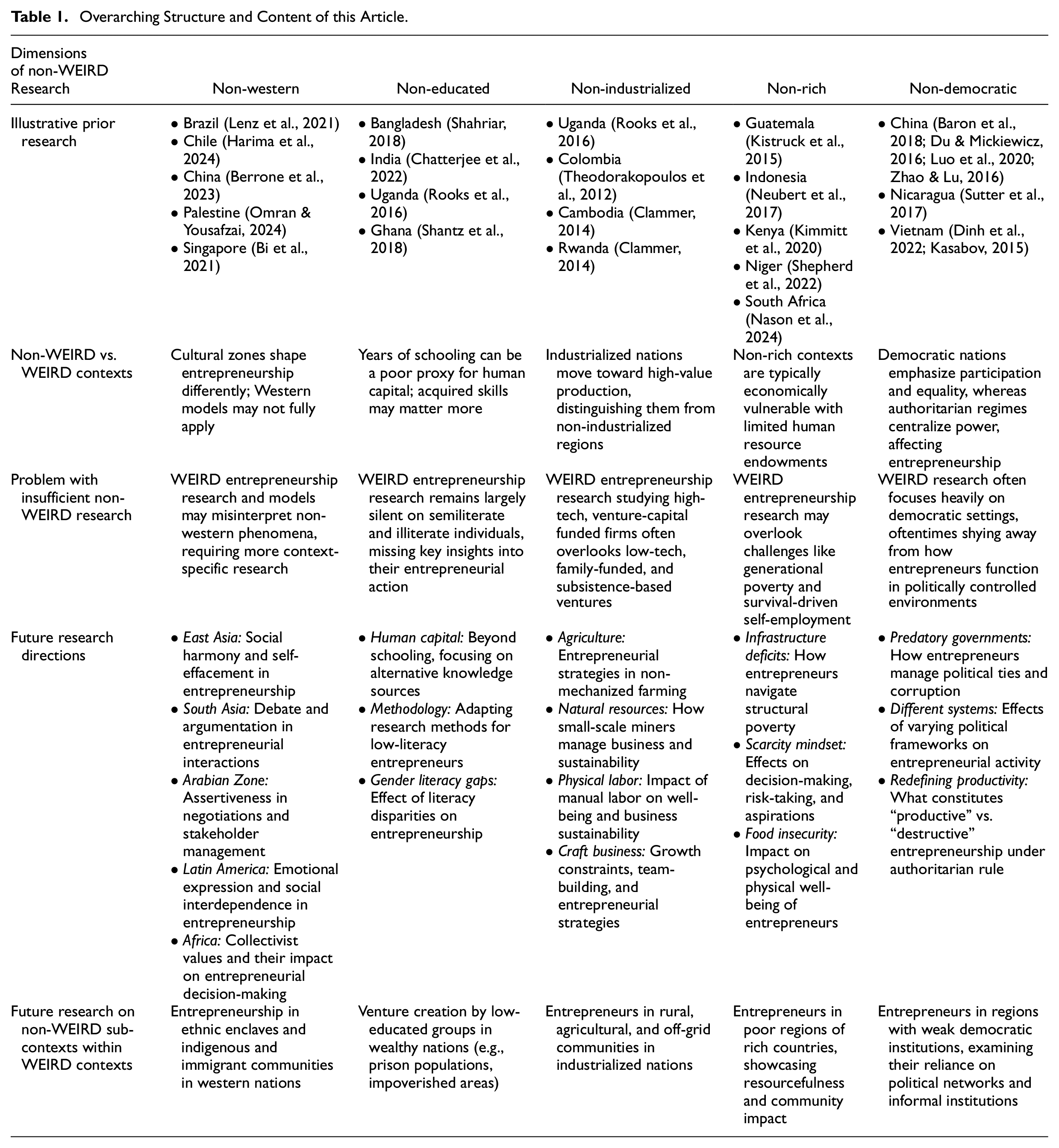
Table 1 offers an overarching structure and outlines the content of this article. We now explore the possibilities for continued non-WEIRD entrepreneurship research—contextualized or generalized.
Overarching Structure and Content of this Article.
A Call for More Non-WEIRD Entrepreneurship Research
The following sections provide more information about each dimension of non-WEIRD—non-Western, non-educated, non-industrialized, non-rich, and non-democratic. They do not provide a definitive review nor an exhaustive research agenda; they simply put forth ideas that we hope will stimulate future non-WEIRD entrepreneurship research. For each dimension, we start with a definition, offer examples of why the dominance of a WEIRD perspective is problematic for understanding non-WEIRD contexts, and then offer some broad questions that inform and motivate non-WEIRD entrepreneurship research that can make essential contributions to the mainstream entrepreneurship literature. 2
A Call for More Research on Entrepreneurs Who Are Non-Western
Non-Western vis-à-vis Western Contexts
The term Western usually refers to “countries in Western Europe and the countries they settled in, such as the US, Canada, Australia, and New Zealand” (Clancy & Davis, 2019, p. 173). The West represents a cultural zone—the “geographic area defined by an eco-cultural complex based on a view that the self is independent, emerging over the last 1,000 years” (p. 498). An Annual Review of Psychology article (Kitayama & Salvador, 2024) suggests that non-Western countries are in one of five cultural zones: (1) East Asia, (2) South Asia, (3) Arabia, (4) Latin America, and (5) Sub-Saharan Africa. These non-Western cultural zones differ from each other (and the Western cultural zone), and these differences could be important for entrepreneurship research.
However, we note that there are other ways to categorize countries as Western versus non-Western. For example, Karan (2004) proposes that the non-Western world includes countries that developed apart from the Greco-Judaic-Christian tradition, including East Asia, Southeast Asia, the Indian subcontinent, the Middle East, and Sub-Saharan Africa. Still, he excludes Latin America, Russian Asia, and Oceania countries. Moreover, Connell (2020) and others (Dados & Connell, 2012; Gray & Gills, 2016) emphasize non-Western contexts by highlighting the importance of research in the global south—“epistemic places where global futures are being forged by delinking from the colonial matrix of power” (Mignolo, 2011, p. 184; see also Özkazanç-Pan [2008] for the advantages of a postcolonial framework in international management). Therefore, cultural differences are only one way to approach non-Western entrepreneurship research. Indeed, we note criticisms of Hofstede’s assumptions that culture is “implicit; core; systematically causal, territorially unique; and shared” (McSweeney, 2002, p. 91), a debate that does not need to be resolved here. Further, while we focus on the attributes of non-Western geographical areas to develop theories and findings relevant to these relatively neglected contexts, we are mindful that these new theories may feed back to and advance entrepreneurship theories in Western contexts (Yeung, 2007).
In the sections below, we offer examples of possible entrepreneurship research in non-Western contexts that will hopefully stimulate others’ ideas, including different categorizations of non-Western, different conceptualizations of culture, and dynamic changes across and within regions that inform our understanding of entrepreneurship in these areas, with the possibility (but not the necessity) of providing feedback to how we think about entrepreneurship research in WEIRD contexts.
Problems With Insufficient Entrepreneurship Research in Western Contexts
With an emphasis on Western contexts, past entrepreneurship research has explored the role of culture in entrepreneurship. Culture impacts people’s values, attitudes, preferences, behaviors, and interactions as well as society’s norms, practices, and routines. All of these elements may shape entrepreneurship within a non-Western context differently than in a Western context. Therefore, entrepreneurship models that explain phenomena in Western contexts, such as key entrepreneurial attitudes, personal goals, proactive behaviors, new venture strategies, types of social networks, and so on, may (and will likely) be less explanatory in non-Western contexts, leading to problems. These problems include leading audiences (scholars and entrepreneurs) in non-Western contexts to erroneous conclusions about entrepreneurial phenomena. These problems of a Western-context bias and/or assuming generalization to non-Western contexts represent an opportunity for future research, to which we now turn.
Future Entrepreneurship Research in Non-Western Contexts
We recommend more entrepreneurship research in non-Western contexts. In the following subsections, we offer broad questions that we believe could make important contributions to the mainstream entrepreneurship literature. To address these questions, research can begin by building on and extending current mainstream entrepreneurship research, non-mainstream entrepreneurship research, and/or the literatures from other disciplines.
Specifically, new entrepreneurship research in non-Western contexts can build on and extend mainstream research on non-Western entrepreneurs, such as entrepreneurship research in Brazil (Lenz et al., 2021), Chile (Harima et al., 2024), China (Berrone et al., 2023; Jiang et al., 2018; Liu et al., 2024; Zhang & Yu, 2017), Ecuador (Shymko & Khoury, 2023), India (Chatterjee et al., 2022; Shepherd, Parida, & Wincent, 2021, 2024), Lebanon (Shepherd, Saade, & Wincent, 2020), Palestine (Omran & Yousafzai, 2024), Singapore (Bi et al., 2021), Sri Lanka (Shantz et al., 2024), and Turkey (Erdogan et al., 2020). Furthermore, new entrepreneurship research in non-Western contexts can build on non-mainstream entrepreneurship studies (e.g., Abd Hamid, 2020; Gamage & Wickramasinghe, 2012; Mousa, 2024) and literatures from various disciplines (e.g., Fahlberg, 2023; Kitayama & Salvador, 2024; Moosavi, 2023). We also recommend consulting other research-agenda papers for guidance (e.g., Muñoz & Kimmitt, 2018; Simba, 2024; Wickert et al., 2024). We now offer our broad set of research questions.
Building primarily on the cultural zones proposed by Kitayama and Salvador (2024), we explore opportunities for future research embedded in these contexts. First, non-WEIRD entrepreneurship research can focus on the East Asian cultural zone, including countries like China, Japan, North Korea, South Korea, and Taiwan. Kitayama and Salvador (2024, p. 512) suggest that the cultural zone of East Asia highlights “social harmony and self-defacement.” Social harmony refers to “friendly or cooperative relations among people, such that social interactions are congruous and conflict free” (APA Dictionary of Psychology). How do entrepreneurs use social harmony to co-construct and explore potential opportunities or solutions to (economic or social) problems, enroll and engage stakeholders (including family) to acquire resources, and create new ventures? Further, researchers can explore the entrepreneurial behaviors or venture moves that threaten or fracture social harmony (i.e., social disharmony), the implications of such threats or fractures (to entrepreneurs and/or ventures), and entrepreneurs’ responses to maintain or regain social harmony. Furthermore, in East Asian culture, self-effacement refers to “acting in such a way as to avoid drawing attention to oneself or making oneself noticeable” (APA Dictionary of Psychology). How do entrepreneurs promote themselves and their ventures to acquire critical resources from (potential) stakeholders and families while engaging in self-effacement? It would be interesting to investigate self-effacement strategies for interpersonal interactions to determine which are effective and which are not, what the penalties are for entrepreneurs drawing attention to themselves and/or their ventures (breaking the social norm), and how entrepreneurs effectively respond to and recover from (or get away with) cultural breaches of self-effacement?
Second, non-WEIRD entrepreneurship research can focus on the South Asian cultural zone. South Asian countries include Bangladesh, Bhutan, India, Pakistan, Nepal, and Sri Lanka (and some lists include Afghanistan and the Maldives). Kitayama and Salvador (2024, p. 512) suggest that the cultural zone of South Asia highlights “debate and argumentation as a means of maintaining commerce-based social relations.” How do entrepreneurs debate with (potential) stakeholders (including family members), what arguments do they use, and how do these debates and arguments facilitate their entrepreneurial endeavors? From such a view, it would be useful to determine if debates generate task conflict to reveal critical information for innovation, form and strengthen social relationships, and/or help different parties “sound each other out.” With all parties valuing debate and argumentation, studies may seek to understand how entrepreneurs and stakeholders eventually agree, how long it takes (are there costs for debates that are too short and/or too long), and how they avoid arguments becoming personal (presumably adversely impacting these relationships and thus the entrepreneurs and their ventures).
Third, non-WEIRD entrepreneurship research can also focus on entrepreneurs in the Arabian cultural zone, including countries like Bahrain, Kuwait, Iraq, Oman, Qatar, Saudi Arabia, and the United Arab Emirates. Kitayama and Salvador (2024, p. 514) suggest that the Arabian cultural zone highlights “self-assertiveness.” Assertiveness is “an adaptive communication style in which individuals express their feelings and needs directly while maintaining respect for others” (APA Dictionary of Psychology). Research can investigate the personal strategies entrepreneurs use to promote (or reflect) their assertiveness, which assertiveness practices are most effective (and why), and how these strategies lead to cooperative outcomes when stakeholders are also assertive. Do stakeholders eventually succumb to entrepreneurs’ assertiveness, or is there some optimal level of assertiveness achieved for both sides—some sort of assertiveness balance or equilibrium? How does such assertiveness manifest in a family-funded venture?
Fourth, non-WEIRD entrepreneurship research can focus on the Latin American cultural zone, including Argentina, Bolivia, Brazil, Chile, Costa Rica, Columbia, Cuba, Dominican Republic, Ecuador, Guatemala, Haiti, Honduras, Jamaica, Mexico, Panama, Peru, Paraguay, Uruguay, and Venezuela. Kitayama and Salvador (2024, p. 515) suggest that the Latin American cultural zone highlights “emotional expression as a means for social interdependence.” Interdependence is “a state in which two or more people, situations, variables or other entities rely on or react with one another such that one cannot change without affecting the other” (APA Dictionary of Psychology). Future research can explore (nascent) entrepreneurs’ networks and social capital endowments and how they influence the various stages of the entrepreneurial process. Indeed, it would be interesting to explore (nascent) entrepreneurs’ strategies for building, maintaining, and refining their social interdependence, on whom these entrepreneurs depend, and what happens when interdependence breaks down. For example, can damaged relationships be repaired (and if yes, how), and what impact does a damaged relationship have on an entrepreneur’s other existing relationships and their ability to create new relationships? With strong interdependence in relationships, are entrepreneurs careful with whom they form relationships, conscious of the substantial time commitments expected of such relationships?
Finally, non-WEIRD entrepreneurship research can focus on the Sub-Saharan African cultural zone, including Nigeria, Kenya, South Africa, Ghana, Ethiopia, Senegal, Uganda, Tanzania, and Rwanda. Kitayama and Salvador (2024, p. 501) suggest that countries in the cultural zone of Sub-Saharan Africa “tend to score low on individualism (or high on collectivism).” Collectivism is “a social orientation that prioritizes group cohesion over individual goals, emphasizing interdependence, shared responsibility, and mutual support within a community” (APA Dictionary of Psychology). Future research can explore how these collectivist values shape entrepreneurial decision-making, particularly resource-sharing, business partnerships, and community-based venture formation. Additionally, how do entrepreneurs in collectivist societies balance personal ambition with social obligations and expectations from extended family and local networks? It would be interesting to explore the role of trust and reciprocity in these informal business arrangements and how collectivist norms influence the scalability and long-term sustainability of entrepreneurial ventures in countries across Africa.
Future Entrepreneurship Research in Non-Western Subcontexts Within Western Contexts
Non-WEIRD entrepreneurship research can explore non-Western groups within Western countries. For example, there may be ethnic neighborhoods (e.g., Hispanic immigrant neighborhoods in Chicago [Tienda & Raijaman, 2004]), enclaves (Polish immigrant entrepreneurs in Great Britain [Marinoni, 2023]; self-employed Cubans in Miami, Koreans in New York, and Salvadorans in Los Angeles [Logan et al., 2003]; and Asian venture capitalists in Silicon Valley [Zhang, Wong, & Ho, 2016]), or Indigenous communities (Peredo et al., 2004; e.g., in Australia [Foley, 2003], Canada [Anderson, 2002], New Zealand [Tapsell & Woods, 2008], and the United States [Garsombke & Garsombke, 2000]) comprising non-Western people with non-Western cultures, norms, and attitudes that shape their entrepreneurial endeavors. Future research can explore these groups to expand our knowledge of entrepreneurship. Indeed, consistent with the research opportunities focused on a specific country, future research can explore non-Western aspects of entrepreneurship among groups within a Western country (building on and extending current work on the topic).
A Call for More Research on Entrepreneurs Who are Non-Educated
Non-Educated vis-à-vis Educated Contexts
Education is often used as a proxy for general human capital (for a meta-analysis, see Martin et al., 2013). General human capital refers to knowledge, skills, and experience that can be employed across various occupations and industries (e.g., Estrin et al., 2016) and is thus distinct from specific human capital. In countries with less educated populations and high variability in school quality, years of schooling is a poor proxy for general human capital; instead, researchers must capture the skills students obtain from education (Angrist et al., 2021). Such skills include literacy and numeracy. The United Nations Educational, Scientific and Cultural Organization describes literacy as an instrument to “empower individuals, communities, and societies.” Still, more than 260 million young people lack access to school-based education, with females lagging behind males in countries with the lowest literacy rates (Fish, 2021). Appendix Table A1 details the literacy rates and global rankings for countries below the median. For example, the literacy rate is 74.4% in India, 59.1% in Pakistan, 43% in Afghanistan, and 19.1% in Nigeria.
Problems With Insufficient Entrepreneurship Research in Non-Educated Contexts
With an emphasis on educated contexts, WEIRD research has underexplored or ignored semiliterate and illiterate people engaged in entrepreneurship. Indeed, entrepreneurship research in educated contexts may capture and explore variation in education, but that variation is truncated. For example, scholars often assume a minimal level of education in the scales they use (with the lowest level of education typically being some high school) and in their research methods (i.e., they frequently assume study participants can read instructions, fill out surveys, or understand numbers for experiments). While such research generates useful knowledge in educated contexts, it can lead to limited, useless, or misleading information in non-educated contexts. By ignoring illiteracy or a lack of numeracy, scholars likely lack a sufficient understanding of the types of businesses low-educated individuals create, the heuristics they use to overcome their lack of education-based knowledge, their creation of new ventures, and so on. Thus, we need more entrepreneurship research in non-educated contexts to advance the entrepreneurship field.
Future Entrepreneurship Research in Non-Educated Contexts
In the following subsections, we offer broad questions that we believe could make important contributions to the mainstream entrepreneurship literature. To address these questions, research can begin by building on and extending current mainstream entrepreneurship research, non-mainstream entrepreneurship research, and/or the literatures from other disciplines.
Specifically, new entrepreneurship research in non-educated contexts can build on and extend mainstream research on non-educated entrepreneurs, such as studies of entrepreneurs with low education in Bangladesh (Shahriar, 2018; Shahriar & Shepherd, 2019) and India (Chatterjee et al., 2022), entrepreneurs with a mean of 8.81 years of education in Uganda (Rooks et al., 2016), entrepreneurs in Ghana who gain most of their information from their families rather than from formal education (Shantz et al., 2018), and entrepreneurs who desire to give their children a greater education than they received themselves in Ghana (Newman & Alvarez, 2022) and India (Shepherd, Parida, & Wincent, 2021). Furthermore, new entrepreneurship research in non-educated contexts can build on non-mainstream entrepreneurship studies (e.g., Burchi et al., 2021; Fauzi et al., 2021; Munyuki & Jonah, 2022) and literatures from various disciplines (e.g., Cueto et al., 2021; Weixiang et al., 2022; Zhang, 2021). We also recommend consulting other research-agenda papers for guidance (e.g., Anshika & Singla, 2022; Arenius & Lenz, 2024; Graña-Alvarez et al., 2024; Molina-García et al., 2023). We now offer our broad set of research questions.
For the first set of research questions, we suggest that non-WEIRD entrepreneurship research focus less on general human capital, especially years of schooling as a proxy for general human capital, to explore entrepreneurial phenomena. Indeed, research may reveal the need to focus on education that builds specific human capital skills and/or non-educated sources of general human capital. There has already been important work on entrepreneurial training in Sub-Saharan Africa (Campos et al., 2017), highlighting the importance of teaching entrepreneurial skills for entrepreneurial outcomes among traditionally low-educated populations. Indeed, non-WEIRD entrepreneurship research needs to adjust existing scales and surveys to capture lower levels of education and the quality of that education. For example, scholars need to think more carefully about conducting studies with surveys and experiments when their samples comprise people who cannot read. We suspect that illiterate (nascent) entrepreneurs are often excluded from samples, which is problematic in countries where these individuals are prevalent. How do low-educated individuals think, feel, enact, and experience the entrepreneurial process? How do they compensate for their low literacy, such as through the industries they enter, their personal goals for their ventures, the entrepreneurial team members, family members, and/or employees they recruit, their construction and reliance on (potential) stakeholders, and so on? Further, a lack of numeracy often goes hand in hand with a lack of literacy (Purpura & Napoli, 2015). How do (nascent) entrepreneurs overcome their lack of numeracy to organize their operations, enroll and engage investors, and compete? We suspect research on non-educated entrepreneurs will reveal some ingenious “workarounds” and, in doing so, make important contributions to the entrepreneurship literature.
Furthermore, non-WEIRD entrepreneurship research can study the least literate people in countries with low literacy rates. In Table A2 of the appendix, we detail the 38 countries where the literacy gap between men and women is greater than 10%. Those countries with the greatest gender gap in literacy are Yemen (38.2%), Guinea (29.9%), Afghanistan (29.5%), Liberia (28.6%), and Guinea-Bissau (26.6%). How does the gender gap in literacy (which is absent in countries with high education) impact the entrepreneurial action of women? How does their low education (absolute and relative to men) impact the types of businesses these women create, the industries they enter, and the capital they raise? Indeed, we wonder how the gender literacy gap relates to other gender biases that influence women’s entrepreneurship. We hope future non-WEIRD entrepreneurship research explores how women’s entrepreneurship changes as the literacy gap in their local region closes (or opens). Furthermore, we wonder whether women’s entrepreneurship influences gendered social norms in business, family, and local communities, helping to close the gender literacy gap. If yes, what mechanisms underpin the reciprocal relationship between women’s entrepreneurship and the gender literacy gap?
Future Entrepreneurship Research in Non-Educated Subcontexts Within Educated Contexts
Non-WEIRD entrepreneurship research can also research people with low education within countries that have high education, on average, across all citizens. For example, the National Literacy Institute reports that in the United States, 21% of the adult population is illiterate, 54% of adults have literacy below the sixth-grade level, and 75% of people on welfare cannot read. The National Literacy Institute also reports the lowest literacy rates in Louisiana, Mississippi, and New Mexico. Furthermore, specific groups within wealthy countries that have low education include people living in prisons, poverty, and areas where property values are low as well as immigrants, non-native English speakers, and people with learning disabilities (for a review, see Haderlie & Clark, 2017). Future research can explore these groups of low-educated people to expand our knowledge of entrepreneurship.
A Call for More Research on Entrepreneurs From Non-Industrialized Contexts
Non-Industrialized vis-à-vis Industrialized Contexts
Scholars have characterized industrialization as modernization whereby businesses have made productivity gains through technology (Rasiah et al., 2015; Walton, 1987). Industrialized nations are “countries where there is sufficient infrastructure for businesses or goods to be produced locally” (Clancy & Davis, 2019, p. 174), which involves a shift from low-value-added businesses to high-value-added businesses (Piore & Sabel, 1984; Pyke & Sengenberger, 1992). Inkeles (1993, p. 1) distinguishes an industrialized region from a non-industrialized region in two ways: “First, the share of all products resulting from manufacture rather than agriculture increases markedly, and second, there is a major shift in the share of all fabrication undertaken not by craft hand labor but machine processes, especially driven by inanimate sources of energy.”Table A3 of the appendix lists countries below the median in industrialization. Countries low on the industrialization index include Iraq (.06), Albania (.12), Tanzania (.14), Cambodia (.19), Iceland (.20), Haiti (.24), New Zealand (.26), and Greece (.29).
Problems With Insufficient Entrepreneurship Research in Non-Industrialized Contexts
Entrepreneurship researchers emphasize industrialized contexts and focus on high-tech, venture-capital-funded, and highly scalable ventures. With such an emphasis on industrialized contexts, scholars have not fully explored entrepreneurship in pursuit of low-tech, family-funded opportunities, and low-growth (i.e., growth-constrained) ventures. The knowledge gained from research in industrial contexts is unlikely to apply to non-industrial contexts. It could lead audiences (entrepreneurs and scholars) to erroneous conclusions about entrepreneurship in these contexts. For example, the motivation and knowledge for entrepreneurial action on a high-tech potential opportunity is likely very different from the motivation and knowledge for entrepreneurial action in starting a craft business. Similarly, understanding how venture capitalists assess entrepreneurs and their ventures when deciding whether or not to invest their money likely offers little insight for an entrepreneur trying to raise money to buy a small subsistence farm. Furthermore, research on the effectiveness of new venture strategies (based on the assumption of entrepreneurs’ motivation to grow their businesses rapidly) is likely to provide misleading advice to entrepreneurs who have low-tech businesses that are family-funded and who are motivated to constrain the size of their businesses so they can manage them personally. Therefore, we need more entrepreneurship research in non-industrialized contexts.
Future Entrepreneurship Research in Non-Industrialized Contexts
In the following subsections, we offer broad questions that we believe could make important contributions to the mainstream entrepreneurship literature. To address these questions, research can begin by building on and extending current mainstream entrepreneurship research, non-mainstream entrepreneurship research, and/or the literatures from other disciplines.
Specifically, new entrepreneurship research in non-industrialized contexts can build on and extend mainstream research on rural entrepreneurship and craft work in non-industrialized countries. For example, a solid foundation for future research includes rural entrepreneurs in Uganda (Rooks et al., 2016), fish farmers and coffee growers in Colombia (Theodorakopoulos et al., 2012), community-based rural tourism businesses in Uganda (Victurine, 2000), and artisans in Cambodia and Rwanda (Clammer, 2014). Furthermore, new entrepreneurship research in non-industrialized contexts can build on non-mainstream entrepreneurship studies (e.g., Gyimah & Lussier, 2021; Kania et al., 2021; Komba et al., 2024; Yadav et al., 2023) and literatures from various disciplines (e.g., Qu & Zollet, 2023; Tabares et al., 2022; Thurnell-Read, 2021). We also recommend consulting other research-agenda papers for guidance (e.g., Aggarwal & Johal, 2021; Bouichou et al., 2021; McElwee & Atherton, 2021; Raza et al., 2024; Welter et al., 2017). We now offer our broad set of research questions.
First, non-WEIRD entrepreneurship research can focus on the non-industrialized entrepreneurial activity of agriculture (especially agriculture without heavy reliance on machinery). What is entrepreneurial about farming or agricultural businesses in non-industrialized regions? Perhaps farmers in such regions are particularly effective at applying bricolage (Baker & Nelson, 2005) to generate innovations, improve efficiency in non-mechanistic ways, and develop human systems rather than technological ones. Such research may start with a more fundamental question: what does entrepreneurship mean in non-industrialized regions? In asking this question, we do not advocate for endless definitional debates but suggest an open mind to understand who believes these farmers (e.g., owner-managers of a farm, albeit a small farm) are entrepreneurs and why. Should we expand our conceptualization of entrepreneurship to represent its meaning in agricultural (and other non-WEIRD) contexts? For example, if some farmers are considered entrepreneurs by themselves, their families, their communities, and their local societies, then perhaps that should be sufficient for us, as entrepreneurship scholars, to be interested in understanding more about them, their businesses, and the processes they drive.
Second, non-WEIRD entrepreneurship research can explore various activities centered on natural-resource exploitation. Mining, for instance, has emerged as a prominent sector, encompassing artisanal and small-scale operations that serve as critical income sources in resource-rich but economically marginalized areas (Paschal et al., 2024). How do individuals engage in small-scale mining—namely, what are their operations for extraction, transportation, and negotiation with buyers? It is interesting to consider how entrepreneurs’ reliance on manual labor in exploiting a natural resource may shape their decisions and actions toward health-related issues for themselves (and their workers), considerations of issues related to protecting the environment, and the impact of their entrepreneurial endeavors on their local communities (positive and negative).
Third, non-WEIRD entrepreneurship research can focus on entrepreneurs whose energy for production comes from human and other animal labor (Inkeles, 1993). On the one hand, the physicality of non-industrialized entrepreneurship may facilitate physical fitness and thus benefit psychological and subjective well-being. On the other hand, when physical well-being is paramount, a physical injury may impact the viability of an entrepreneur’s business. How does an entrepreneur’s physical well-being impact the entrepreneurial process in a non-industrialized context, and how does an entrepreneur’s engagement in the entrepreneurial process impact their physical well-being? Learning about entrepreneurs’ different strategies for using their labor, maintaining physical well-being, and supplementing their personal energy by finding or constructing (perhaps through bricolage) other energy sources is meaningful. For example, what happens to a venture as the focal entrepreneur ages: does the business deteriorate with the entrepreneur’s dwindled physical state, and/or does the entrepreneur’s physical condition trigger the implementation of a succession plan?
Finally, non-WEIRD entrepreneurship research can also investigate the types of craft businesses entrepreneurs create, the acquisition and deployment of skills necessary to perform different crafts and run these businesses, and whether and how entrepreneurs form teams of craftspeople or other workers. Do these craft entrepreneurs desire to grow their businesses? What are their primary obstacles to growth, and why can some overcome those obstacles and others cannot? We suspect entrepreneurs face interesting trade-offs between managing their crafts and their businesses.
Future Entrepreneurship Research in Non-Industrialized Subcontexts Within Industrialized Contexts
Non-WEIRD entrepreneurship research can research people in low-industrialized areas within high-industrialized countries. For example, the United Kingdom’s most rural locations are the Highlands of Scotland, Wales, and southwest England, which focus on agriculture and natural-resource extraction (House of Lords Library, 2024). In the United States, most farms or ranches are located in Texas (231,000), Missouri (87,600), Iowa (86,800), and Ohio (75,800; Statista, 2023). Over and above farmers, other groups emphasize a non-industrialized life, such as people living in Amish communities, Indigenous communities, and kibbutzim and those otherwise choosing to live “off the grid.” Future research can explore these groups to expand our knowledge of entrepreneurship. Indeed, consistent with the research opportunities focused on a specific country, future research can explore non-industrialized aspects of entrepreneurship among groups within an industrialized country (building on and extending current work on the topic).
A Call for More Research on Entrepreneurs Who Are Non-Rich
Non-Rich vis-à-vis Rich Contexts
Non-rich refers to having a low income and a low resource endowment. At the national level, the United Nations categorizes countries based on an index of income, human resource endowments, and economic vulnerability. The bottom of this index includes the least developed countries (LDCs). LDCs have low incomes, suffer from weaknesses in their human resources, and have high economic vulnerability (Cuervo-Cazurra & Genc, 2008). There are 45 LCD countries (UNCTAD, 2023), which represent approximately 14% of the global population (1.15 billion people) yet only 1.3% of the global gross domestic product (United Nations, 2024). Table A4 in the appendix lists these non-rich countries.
Problems With Insufficient Entrepreneurship Research in Non-Rich Contexts
With an emphasis on rich contexts, entrepreneurship research has underexplored or ignored entrepreneurship in resource-constrained environments. However, even entrepreneurship research on “resource constraints” can mean different things across rich and non-rich contexts. In resource-rich contexts, an entrepreneur’s resource constraints may indicate a current lack of external funding (from business angels or venture capitalists), a lack of time to experiment with new ideas, and the need for the entrepreneur to reconsider the (substantial) resources they have at hand. Therefore, the lessons we have learned from research on entrepreneurs in resource-rich, munificent environments and research on resource-constrained environments in rich contexts are likely to provide an incomplete picture of entrepreneurship in resource-constrained environments in non-rich contexts. For example, we underestimate the entrepreneurial challenges of individuals facing abject poverty (as generations before them), identifying as members of a stigmatized caste, living in stigmatized slums, and having no career opportunities other than self-employment in a dirty (stigmatized) business to provide for their families’ survival. Therefore, we need more entrepreneurship research in non-rich contexts.
Future Entrepreneurship Research in Non-Rich Contexts
In the following subsections, we offer broad questions that we believe could make important contributions to the mainstream entrepreneurship literature. To address these questions, research can begin by building on and extending current mainstream entrepreneurship research, non-mainstream entrepreneurship research, and/or the literatures from other disciplines.
Specifically, new entrepreneurship research in non-rich contexts can build on and extend mainstream research in developing countries, such as Guatemala (Kistruck et al., 2015), India (Chatterjee et al., 2022; Shepherd, Parida, & Wincent, 2021), Indonesia (Neubert et al., 2017), Kenya (Kimmitt et al., 2020), Niger (Shepherd, Osofero, & Wincent, 2022), and South Africa (Nason et al., 2024). Furthermore, new entrepreneurship research in non-rich contexts can build on non-mainstream entrepreneurship studies (e.g., Dzingirai, 2021; Morris & Tucker, 2023; Okolie et al., 2022) and literatures from various disciplines (e.g., Bossuroy et al., 2022; De Bruijn & Antonides, 2022; Sabol et al., 2021; Wang et al., 2022). We also recommend consulting other research-agenda papers for guidance (e.g., Amorós et al., 2021; Bruton, Ketchen, & Ireland, 2013; Bruton, Sutter, & Lenz, 2021; Santos & Neumeyer, 2021; Sutter, Bruton, & Chen, 2019).
First, non-WEIRD entrepreneurship research can focus on the entrepreneurial challenges presented in non-rich regions. For example, infrastructure is often underdeveloped in impoverished regions (Calderón & Servén, 2010). How do the contextual features of a non-rich region shape the businesses entrepreneurs create? How do entrepreneurs overcome regional constraints, and can some of these constraints turn into an advantage? Indeed, can entrepreneurship create wealth to overcome an entrepreneur’s current impoverished situation, or are the structural foundations of poverty too difficult to change quickly? Perhaps it takes generations of entrepreneurs chipping away at these structural foundations of poverty to make progress or an event that triggers collective action. Indeed, as we consider this stream of research, it is appropriate to consider the Matthew effect (Merton, 1968): “The rich get richer, and the poor get the picture” (attributed initially to Percy Bysshe Shelley). Non-WEIRD entrepreneurship research can explore how some impoverished entrepreneurs can disrupt the Matthew effect through the businesses they create, the opportunities they pursue, the strategies they execute, the stakeholders they enroll, and the value they generate.
Second, non-WEIRD entrepreneurship research can investigate the role of a scarcity mindset in how entrepreneurs make decisions and the impact of those decisions on their businesses, families, and themselves (see Morris et al., 2020). Indeed, small income shifts can dramatically impact people living in poverty (Bourguignon et al., 1991) and how they think about risks and the value of future benefits (Mullainathan & Shafir, 2013). How does a scarcity mindset impact entrepreneurs’ decisions about the businesses they create, their aspirations for venture growth, their strategies, and their definitions of success?
Finally, poverty can manifest as food deprivation (or food insecurity), which can impact the entrepreneurial process. Food deprivation refers to “inadequate individual consumption of food or specific nutrients, also known as undernutrition” (Uvin, 1994, p. 1) and can negatively impact psychological, emotional, and physical well-being (Gundersen & Ziliak, 2015). How does food deprivation (and its impact on well-being) affect entrepreneurs and their entrepreneurial endeavors? One of the ways to deal with food deprivation is by borrowing from microfinance institutions. However, the evidence of microfinance institutions’ success in stimulating entrepreneurship among impoverished individuals is mixed (Banerjee et al., 2015; Karlan & Zinman, 2011). We hope research continues to explore ways impoverished people can access capital to create and run their businesses. Indeed, how can individuals build financial knowledge and skills to help them access credit and debt at a reasonable cost, gain insurance against common risks, and build a buffer against small income shocks?
Future Entrepreneurship Research in Non-Rich Subcontexts Within Rich Contexts
Non-WEIRD entrepreneurship research can focus on entrepreneurs who are impoverished and/or living and working in impoverished locations within rich countries. Wealthy countries still have non-rich regions where people live and work in impoverished conditions. However, of the studies investigating necessity entrepreneurship in Entrepreneurship Theory and Practice and the Journal of Business Venturing over the last decade, only one paper focused on a non-WEIRD sample.
In the United States, the regions with the highest percentage of residents living below the poverty line are Puerto Rico (39.6%), Louisiana (18.9%), Mississippi (18%), New Mexico (17.8%), West Virginia (16.7%), and Kentucky (14%; (U.S. Census Bureau, 2023). Indeed, there are impoverished regions in other wealthy countries, such as Ireland’s Midlands and the Border Region (Central Statistics Office, 2017), Switzerland’s Ticino canton (Swiss Info, 2023), and Australia’s Northern Territory (Phillips & Prosser, 2020). How do entrepreneurs create and manage their businesses without possessing or being able to access necessary resources? We suspect there is a lot to learn about the inventiveness and innovativeness in these entrepreneurs’ resourcefulness. How do these entrepreneurs (and their innovative resourcefulness) impact the impoverished communities in which they are embedded: namely, to what extent are these entrepreneurs prosocially motivated to help others in their communities, how does this motivation manifest in prosocial behaviors, and how do these prosocial behaviors help members of impoverished communities?
A Call for More Research on Entrepreneurs in Non-Democratic Contexts
Non-Demographic vis-à-vis Demographic Contexts
Democracy refers to the broader system of governance and societal framework by which power and decision-making are distributed to the people such that citizens actively participate in shaping their communities and futures instead of power and decision-making being concentrated among a few. This means that participation, equality, and safeguarding fundamental rights and freedoms are at the forefront of democracy. Table A5 of the appendix details countries below the median for democracy quality measures. Authoritarian governments are low on democracy quality measures. In politics and government, authoritarianism is defined as the blind submission to authority and the repression of individual freedom of thought and action. Authoritarian regimes are systems of government that have no established mechanism for the transfer of executive power and do not afford their citizens civil liberties or political rights. Power is concentrated in the hands of a single leader or a small elite, whose decisions are taken without regard for the will of the people. The term authoritarianism is often used to denote any form of government that is not democratic, but studies have demonstrated that there is a great deal of variation in authoritarian rule. (Britannica.com)
Therefore, the rule of law—“a norm of equality before the law and the separation of the judiciary from other branches of government” (Sallai & Schnyder, 2021, p. 1317)—is critical to differences across governments. The rule of law establishes the principle of self-limitations (i.e., the government acknowledges “limits to its knowledge, capabilities, and powers” [Chen & Deakin, 2015, p. 4]) and state autonomy (i.e., “the separation of the state apparatus and particularistic interests of the governing elite” [Sallai & Schnyder, 2021, p. 1317]). The different types of non-democratic governments include approaches that are totalitarian-authoritarian; military rule; one-party rule; personal rule; and variations referred to as “semis,” hybrids, and other forms of “less-than-democratic” rule (Brooker, 2013). These different political systems impact economies in ways that likely shape the entrepreneurship embedded in them.
Problems With Insufficient Entrepreneurship Research in Non-Democratic Contexts
With an emphasis on democratic contexts, entrepreneurship research has underexplored the entrepreneurial process under conditions where entrepreneurs cannot rely on the rule of law, political connections are essential, and/or state-owned businesses are competitors. For example, research in democratic contexts has highlighted the importance of intellectual property protection as a strategy for minimizing competition for an innovative product. This strategy can be rewarded by venture-capitalist funding. However, knowledge of this intellectual property protection strategy and funding is likely uninformative (and unnecessarily costly in money and lead time) in non-democratic contexts where the government avoids or is lax in enforcing property rights. Similarly, research on entrepreneurs’ social networks has emphasized weak ties for generating creative ideas, finance, and venture growth. However, this knowledge about entrepreneurs’ networks understates the importance of political connections in non-democratic contexts for obtaining approvals to register a business, receiving big government contracts, and avoiding or minimizing harmful government interventions. Moreover, the lessons learned about competitive dynamics from democratic contexts are likely less applicable or misleading for entrepreneurs in non-democratic contexts where other organizations in their respective industry and adjacent industries are state-owned businesses. In such non-democratic contexts, the competitive dynamics are likely very different. Therefore, we need more entrepreneurship research in non-democratic contexts.
Future Entrepreneurship Research in Non-Democratic Contexts
In the following subsections, we offer broad questions that we believe could make important contributions to the mainstream entrepreneurship literature. To address these questions, research can begin by building on and extending current mainstream entrepreneurship research, non-mainstream entrepreneurship research, and/or the literatures from other disciplines.
Specifically, new entrepreneurship research in non-democratic contexts can build on and extend mainstream research on entrepreneurship in China (Baron et al., 2018; Burt & Opper, 2020; Du & Mickiewicz, 2016; Ge et al., 2019; Luo et al., 2020; Tang et al., 2017; Zhao & Lu, 2016), Nicaragua (Sutter, Webb, Kistruck, et al., 2017), and Vietnam (Dinh et al., 2022; Kasabov, 2015). Furthermore, new entrepreneurship research in non-democratic contexts can build on non-mainstream entrepreneurship studies (e.g., Farny & Calderon, 2015; Goel & Nelson, 2023; Serhan, 2021) and literatures from various disciplines (e.g., Márquez, 2016; Osa & Corduneanu-Huci, 2008; Wegner, 2019). We also recommend consulting other research-agenda papers for guidance (e.g., Ahlstrom & Ding, 2014; Balderacchi, 2022; He et al., 2019; Muhammad et al., 2024). We now offer our broad set of research questions.
First, non-WEIRD entrepreneurship research can explore the entrepreneurial process in countries with predatory governments and poor democracy standards. In a predatory government context, elites can execute entrepreneurship through opaque decision-making, institutional weaknesses, and monopolistic practices. Here, entrepreneurial opportunities may be limited and driven by corruption, lack of access to resources, and an uneven playing field or unequal market access, discouraging innovation and entrepreneurial entry. An example of a non-democratic context is China’s authoritarian government. Given the Chinese government’s powerful role in the Chinese economy, it is not surprising that researchers have revealed the importance of entrepreneurs’ strong political connections with government agencies and officials in China (Li et al., 2011). Future research can investigate how entrepreneurs form and maintain these political relationships, what benefits they provide entrepreneurs and the entrepreneurial system in the respective country (i.e., greasing the wheels of the economy), and what costs are borne by entrepreneurs and the entrepreneurial system in the country (i.e., sand in the wheels of the economy)? To what extent are entrepreneurs’ political connections maintained through corruption? If they are maintained in this way, how do entrepreneurs manage corrupt relationships with government officials, and why are some more successful at managing these relationships (gain more and/or pay less) than others? Furthermore, how do entrepreneurs compete with government-owned businesses without triggering the ire of powerful government officials?
Second, non-WEIRD entrepreneurship research can also explore entrepreneurship’s different forms, processes, and outcomes in non-democratic political systems other than China’s. For example, we highlighted above that governments differ in their adherence to the principle of the rule of law. Indeed, governments set different laws representing a country’s “rules of the game” for entrepreneurship. Specifically, Baumol (1996) proposes that such national factors set the rules of the game that determine the allocation of entrepreneurial effort into productive, unproductive, and destructive entrepreneurship. Therefore, non-WEIRD entrepreneurship research can explore entrepreneurs operating under different rules of the game in non-democratic environments and explore the ratios of productive to unproductive to destructive entrepreneurship and how these forms of entrepreneurship differ across countries with different forms of non-democratic governments. For instance, although we understand what productive entrepreneurship means in WEIRD contexts, what about in non-WEIRD contexts?
Finally, not only are the rules of the game different across countries with different forms of government but the game may also be different—that is, the nature of business might be substantially different. Therefore, what constitutes productive entrepreneurship may be very different when the game is non-democratic vis-à-vis democratic. The same goes for unproductive and destructive entrepreneurship. For example, destructive entrepreneurship in a democratic system refers to activities that harm society, such as environmental degradation, human exploitation, and the creation of harmful products (e.g., addictive substances). These activities are often criminalized or heavily regulated. In a non-democratic system, especially if the focal country is resource poor, destructive entrepreneurship may be pervasive and normalized due to the lack of institutional safeguards and enforcement. Activities that would be criminalized in democracies, such as black-market operations and resource plundering, may be tolerated or even incentivized by such regimes. These activities may be considered necessary in the short term and could allow for exploiting what would be considered destructive entrepreneurial opportunities in other societies. Therefore, if the rules of the game and the game itself differ across different types of governments (or political systems), then what is considered productive entrepreneurship in one system may be considered unproductive or destructive in another. Moreover, the dynamics of entrepreneurship are likely to change significantly when the game is changing, with new opportunities and challenges emerging based on the nature of the new system.
Future Entrepreneurship Research in Non-Democratic Subcontexts Within Democratic Contexts
Non-WEIRD entrepreneurship research can focus on entrepreneurs who live and work in regions that are less democratic, despite living in a democratic country. Indeed, while the quality of democracy can vary within a democratic country (e.g., Grumbach [2023] reports that the quality of democracy is lowest in the United States for Tennessee, North Carolina, and Wisconsin), it is an overreach to categorize these regions as non-democratic. However, what can we learn about entrepreneurial phenomena by situating research in less democratic contexts? Do entrepreneurs in these contexts focus on forming and maintaining political connections, employ strategies for dealing with corrupt government officials, help build the foundations for a more solid democracy, and/or rely more heavily on informal institutions to run their businesses?
Furthermore, even in democratic countries, residents may be precluded from participating in elections—that is, they are not allowed to vote. For example, in the United States, residents of Puerto Rico and Washington DC cannot vote in federal elections. Furthermore, certain groups cannot vote, including people convicted of a felony, illegal immigrants, legal and non-citizen residents, and people under the age of 18 (USA.gov, 2024). Does individuals’ inability to participate in the democratic system (based on one’s region or group) impact entrepreneurial inputs, processes, and outcomes? There is much to learn about entrepreneurship in low-quality democratic regions of a democratic country and for those who cannot participate in democracy.
Both Weird and Non-Weird Entrepreneurship Research
We defined non-WEIRD entrepreneurship research as focusing on non-Western, non-educated, non-industrialized, non-rich, and/or non-democratic entrepreneurship research. A critical aspect of the definition is the “and/or.” The needed research can come from one or more of these non-WEIRD sample attributes. Although we have discussed each attribute separately, we note that some pair-wise correlations are likely high. Disentangling these sample attributes may not be overly crucial for some research questions. However, it may be important for other research questions—the “disentangling challenge” reflects the attractiveness of these research opportunities. Indeed, some countries are WEIRD on some attributes and non-WEIRD on others. For example, New Zealand is relatively low on the industrialization index yet has a relatively high gross domestic product per capita. It is non-industrialized but rich. Another example is China, which is low on the democracy index yet high on education measures. It is non-democratic but educated. These countries with some WEIRD and some non-WEIRD attributes may be fascinating to explore as a contextualized model or through a study that compares and contrasts its findings with studies in the literature that share some but not all the non-WEIRD attributes.
There is considerable scope for future research to help advance the entrepreneurship field. To do so, researchers can likely rely on the methods dominant in WEIRD entrepreneurship research, but they will likely also need to use different methods for generating and testing non-WEIRD theories, to which we now turn.
Research Methods for Non-WEIRD Entrepreneurship Research
As alluded to above in offering some of the problems with using a WEIRD perspective to study entrepreneurs in non-WEIRD contexts, methodological issues may need to be solved. We discuss five critical methodological issues.
First, while some studies from WEIRD contexts may apply to non-WEIRD contexts, many may not. This is a speculation that could become an empirical question. Therefore, one research-method recommendation is that future research attempt to replicate studies from WEIRD contexts in non-WEIRD contexts. Such research will help reveal which WEIRD themes are generalizable and which are not. If the WEIRD relationships are not replicable, the replication studies could explore explanations, such as theorizing and testing various moderators. However, these incremental editions to WEIRD studies may not be sufficient to explain entrepreneurial phenomena in non-WEIRD contexts. Indeed, a lack of replication points to the need for more substantial work in developing a unique theory, or at least substantial theory elaboration, to gain a sufficient understanding of the focal entrepreneurial phenomenon in the non-WEIRD context.
Second, leading on from studies that fail to replicate findings from WEIRD contexts in non-WEIRD contexts, there is a need to develop theory. From a deductive perspective, this theory development will likely require building on literatures further afield than current efforts (e.g., distant literatures or different disciplinary perspectives) and/or engaging in theoretical bricolage (Boxenbaum & Rouleau, 2011) to build new theories. However, a lack of replication can also indicate the need for inductive methods to ground theorizing in the data of non-WEIRD contexts to build indigenous theories. This grounded approach to inductive research could build new theories of entrepreneurship that have broad applications for the many entrepreneurs who operate in non-WEIRD contexts. An alternate approach (to the deductive and inductive) is a middle ground—empirical theorizing (see Shepherd & Suddaby, 2017). This abductive approach of empirical theorizing involves a researcher starting with a guess (about a key relationship) and using empirical analysis to test and refine the guess to find an explanatory model that leads to propositions for subsequent work to test empirically. It is critical to realize that this method involves theory development or elaboration and is not theory testing (and needs to be transparently presented as such).
Third, researchers of non-WEIRD contexts will have to be innovative in establishing the measures and other aspects of their research methods. Above, we alluded to the challenges of studying semiliterate and illiterate individuals. Scholars will need to develop finer-grained measures of education to capture these low education levels and develop alternate measures of human capital given that education is likely a poor proxy for human capital in some contexts (especially when there may be little variation in education in a non-educated context). Researchers will likely need to be more inventive in collecting surveys and experimental data. That is, rather than these non-educated sample participants answering questions or performing number-based experiments (which they may not be able to do due to their lack of literacy and numeracy), researchers can follow the methods of others who have faced these challenges, such as hiring locals to conduct surveys verbally with sample participants (e.g., Shahriar & Shepherd, 2019). However, there is an opportunity to be more innovative, perhaps by validating and using one-item measures or using pictures to represent high and low levels of variables in experiments, such as conjoint studies. Our goal here is not to solve the methodological challenges of conducting non-WEIRD entrepreneurship research but to highlight them as research opportunities. We hope scholars can come up with methodological innovations that further open up entrepreneurship research in these critical contexts.
Fourth, while our focus is on entrepreneurship research in non-WEIRD contexts because it alone may reveal critical new insights to advance the entrepreneurship field, we do not want to discourage research methods that test the context (WEIRD vs. non-WEIRD) as a moderator of a relationship. Such a method can help reveal how different fundamental relationships span across WEIRD and non-WEIRD contexts. Although this research approach is important, we have not heavily emphasized it in this editorial because non-WEIRD contexts are considered some form of deviation from WEIRD contexts. We do not devalue this “WEIRD versus non-WEIRD” research but hope that it does not drown out or invalidate entrepreneurial research focused only on non-WEIRD contexts for developing new contextualized theories of entrepreneurship.
Finally, researchers of entrepreneurship in non-WEIRD contexts will need to access new databases. Here are three examples: (1) The World Bank offers data on business registrations from 180 economies (2006–2022) and the gender gap in entrepreneurship for 95 economies (2014–2022) (https://www.worldbank.org/en/programs/entrepreneurship); (2) The Global Entrepreneurship Monitor offers data from an adult population survey on entrepreneurial activity, aspirations, attitudes, perceptions, intentions, exit dash discontinuance, and informal investors (2014–present). The global entrepreneurship monitor also offers data from a national expert survey on entrepreneurial finance, government policy, infrastructure, entry regulations, and cultural and social norms (https://www.gemconsortium.org/). (3) The European Social Enterprise Monitor provides data on social entrepreneurship by country, including perceived political support, decent work, good health and well-being, gender inequality, funding gap, key barriers to entrepreneurship, and social impact (https://socialenterprisemonitor.knowledgecentre.euclidnetwork.eu/reports/#countryResearch).
While these multi-country databases likely will be useful for non-WEIRD research, we hope that researchers uncover country- or region-specific data that can advance non-WEIRD entrepreneurship research. While some challenges with accessing, cleaning, and coding data are similar to those when using WEIRD databases, other challenges may be unique. For example, accessing data in non-WEIRD contexts may be more complex because they may not be immediately available to the public, there may be challenges in aggregating multiple databases into one (e.g., there are no linking indicators/identifiers common across databases), and/or these data are stored in physical form (on paper in boxes) that need to be accessed and converted into a spreadsheet. Of course, local non-WEIRD data are likely to be in the local language. We encourage researchers from WEIRD countries to partner with local researchers or hire locals to access, understand, and interpret the results of this critically important research.
Multidisciplinary Approach to Non-WEIRD Entrepreneurship Research
Although entrepreneurship is already a highly multidisciplinary field, pursuing more non-WEIRD entrepreneurship research may introduce or shift the saliency of different disciplines. For example, with a focus on non-Western contexts, perhaps researchers with expertise in anthropology and sociology may be particularly capable of creating and pursuing these entrepreneurship-research opportunities. For entrepreneurship research focused on non-educated samples, scholars with disciplinary expertise in education (including special education, developmental psychology, and neurodiversity) are likely highly capable of contributing to this stream of research. Many disciplines may inform studies on non-industrialized entrepreneurship, such as agroscience for information about agricultural practices and innovations; meteorology for insights into the inputs and outputs of low-tech rural entrepreneurship; and geology for shining a light on soil quality for agriculture, conditions for mining, and consequences of overuse. Studies of non-rich entrepreneurs could benefit from the disciplines of economics (e.g., developmental economics, socioeconomic status, and the behavioral economics of scarcity), health (e.g., physical health as an input and output of the physical work of low-tech entrepreneurship), and nutrition (e.g., how poverty negatively impacts nutrition and poor nutrition impacts entrepreneurship). Finally, non-democratic entrepreneurship research could build on the disciplines of political science, such as comparative politics to analyze how different political systems (authoritarian, hybrid, or totalitarian) shape the regulatory environment and conditions for entrepreneurs and international relations to investigate how entrepreneurs facing international sanctions and geopolitical tensions (e.g., entrepreneurs in sanctioned states) find creative ways to access international markets. This research could also draw on sociology, including topics like how social structures, power relations, and class dynamics in non-democratic societies impact conditions for already constrained entrepreneurs. Therefore, we expect the multidisciplinary approach of entrepreneurship to continue (or even be rejuvenated) with a focus on non-WEIRD entrepreneurship research.
Cautions for Conducting Non-WEIRD Entrepreneurship Research
Consistent with an entrepreneurial mindset, we realize we are optimistic about non-WEIRD entrepreneurship research. We see the challenges of conducting this type of research as indications of its attractiveness as a research opportunity. However, we feel compelled to offer at least some salient cautions when engaging in this research stream.
First, as researchers, we must do no harm and ensure safety. We must ensure the safety of our respondents because, in many instances, they are highly vulnerable. Approaching these respondents with care and respect will go a long way to “doing no harm.” For example, consider an individual criticizing the government in a non-democratic country that does not allow dissent. We need to ensure anonymity because the consequences for them could be dire. Please be vigilant about study participants’ safety. Moreover, please take the necessary measures to secure the safety of your research team. Do not put yourself or members of your research team in an unnecessarily dangerous situation—please do your best to reduce these risks. Obvious risks are crime, conflict, or health hazards, particularly in areas with limited infrastructure or healthcare. Moreover, research in politically unstable regions may expose researchers and participants to other risks if sensitive topics are investigated. Mark De Rond is an excellent example of doing field research with care, safety, and respect for the context (Claus et al., 2019; De Rond, 2012; De Rond et al., 2022).
Second, we encourage all scholars interested in conducting non-WEIRD entrepreneurship research. However, some scholars may suggest that non-WEIRD research is a substantial risk for junior scholars in the “publish or perish” academic world. For example, Komba pursued a passion project as part of her dissertation to understand how entrepreneurs in her home country of Tanzania can overcome government corruption (Komba et al., 2024). Yes, there is a risk. However, scholars can develop a portfolio of papers and, within that portfolio, have a high-risk passion project exploring a non-WEIRD entrepreneurship topic. We cannot eliminate the risk, but we suggest that the returns (from conducting this research and hopefully publishing it) are worth taking that risk.
Finally, non-WEIRD entrepreneurship research may lead scholars to learn about new and important people, actions, processes, and outcomes that are not typically viewed as entrepreneurship. Great! These novel research outcomes are what we hope for. However, other scholars (particularly those focused on WEIRD entrepreneurship research) may believe that such studies do not reflect entrepreneurship and should thus be rejected from mainstream entrepreneurship journals. While this rejection is possible, we believe (and have found) that entrepreneurship scholars (and gatekeepers) are open to authors making the case for why a study contributes to our understanding of entrepreneurial phenomena. Indeed, how we conceive of entrepreneurship may evolve with more non-WEIRD entrepreneurship research. For example, in a study of jugaad (i.e., “assertive defiance, trial-and-error experiential learning, and the recombination of available resources to improvise a frugal quick-fix solution” [p. 100]) in rural India, a reviewer told us that it was not about entrepreneurship or innovation because the entrepreneur’s firm was unable to obtain a sustainable competitive advantage. We focused on the entrepreneur as a creative problem solver and were able to convince the reviewer that while economic value was not created for the firm, the individual created non-economic value for themselves and their community (Shepherd et al., 2020)—building on the notion of inclusive growth (George et al., 2012). These communication challenges represent uncertainties for scholars. However, researchers of non-WEIRD entrepreneurship can navigate these uncertainties by using pioneering studies as a foothold, engaging the existing entrepreneurship literature, and making the case (perhaps from data) that these phenomena capture essential elements of entrepreneurship.
If My Non-WEIRD Papers Are Rejected, Is It Because of a WEIRD Bias?
With our own WEIRD and non-WEIRD papers having been rejected, it is difficult to attribute the rejection of our non-WEIRD papers by mainstream journals to a WEIRD bias. Indeed, our more recent experience is that a paper’s non-WEIRD context is more likely to capture an editor’s attention and lead to a revise-and-resubmit decision. Nevertheless, there are some features scholars can add to better communicate non-WEIRD entrepreneurship research to mainstream journals. These recommendations are less of a “silver bullet” for successfully publishing non-WEIRD entrepreneurship research and more of a way to sell a study’s findings as a contribution.
First, non-WEIRD entrepreneurship research needs to acknowledge what we know in the mainstream literature about the focal topic and what we do not understand about this topic because an essential aspect of the story is missing (i.e., the gap given that the non-WEIRD dimension has not been sufficiently considered in previous studies). After establishing a gap in the literature (or problematizing the literature), the respective paper’s introduction needs to establish why filling that gap (or resolving the literature’s problem) is essential. Addressing these steps helps set up the contribution of the non-WEIRD study, which is critical for success in being accepted for publication in mainstream journals.
Second, while a study may be important because the phenomenon it explores is important, its contribution still needs to come from adding to an ongoing scholarly conversation. While a study does not need to compare and contrast the WEIRD and non-WEIRD contexts, it needs to enter and add to a conversation in the extant literature. While mainstream entrepreneurship journals have paid insufficient attention to non-WEIRD entrepreneurship research, some non-WEIRD papers are still published in mainstream journals. These pioneering papers can be used as footholds to enter ongoing scholarly conversations by highlighting the topic’s importance, the relevant conversation being entered, and the argument structure for communicating the respective paper’s contribution.
Third, a specific context may be more important to an author than to their readers. In other words, there is a risk that the author is overly focused on the data specifics, finding it difficult to abstract from the data. Please consider focusing on the specifics in the findings section (i.e., concrete thinking anchored in data) but abstracting these findings to explain the respective model in the discussion and the introduction. Such abstraction helps researchers link their models to the existing literature and thus indicate to readers how their studies extend that literature. We recognize the challenge of abstracting when one is so involved in the data. Without this abstraction, however, scholars risk a study being classified as “too descriptive.” Abstraction from detailed findings allows for an explanatory model. We realize that achieving this balance in building a contextualized model is challenging.
Finally, combining the above, we encourage non-WEIRD entrepreneurship research to consider what the respective context means—how and in what ways it is extreme or exemplary such that it provides a basis for the study at hand. For example, in a recent paper on recycling in Dharavi (a slum in Mumbai), Shepherd, Parida, and Wincent (2024) focus their theorizing on the context as one in which people are stigmatized for dirtiness—individuals born into a low caste, living in a slum, and engaging in dirty work. The context is the dirt and associated stigma more than the specifics of the Dharavi slum or even slums in general (despite the importance of entrepreneurship in these locations). We encourage authors to think deeply about their context and use these representations as the basis for their contextualized models.
Therefore, while we call for non-WEIRD entrepreneurship research, we recognize the challenges related to publishing any research and some unique challenges related to publishing non-WEIRD entrepreneurship research. We offer some hints we hope help scholars navigate these challenges.
Conclusion
We wish to conclude with four simple points. First, entrepreneurship research has focused on WEIRD samples, primarily from scholars at WEIRD institutions, to produce valuable knowledge on entrepreneurial phenomena. These studies may or may not be particularly generalizable to other contexts representing many people, including many entrepreneurs. Second, we need to pay greater attention to non-WEIRD contexts. While we hope this research includes WEIRD scholars, non-WEIRD scholars are best suited to conduct this research. Indeed, we hope WEIRD and non-WEIRD scholars form research teams to take up the challenge of broadening and deepening the field’s knowledge. Third, this editorial covers a broad topic and, therefore, cannot go deeply into each of the dimensions and the possible relevant literatures (Shepherd & Williams, 2023). It is not an exhaustive explanation or systematic review of non-WEIRD entrepreneurship research or a detailed agenda for future research. It is simply a call for scholars to conduct more non-WEIRD entrepreneurship research (recognizing that some excellent scholars already lead the way). Finally, we need to publish non-WEIRD entrepreneurship research. Therefore, we ask journal reviewers to recognize the additional value of non-WEIRD entrepreneurship research, whether it represents a stand-alone contextualized study, a direct comparison to a WEIRD sample, or a replication of a published study in a non-WEIRD context/sample. These publication approaches require reviewers to be open to the possibilities of a different worldview. Editors also have an essential role to play. They need the courage to step out of the safe path provided by publishing WEIRD entrepreneurship research. Editors must credit scholars who collect and analyze data from different sources, populations, and contexts for understanding entrepreneurial phenomena. Furthermore, editors must continue the recent advancement of appointing scholars from non-WEIRD countries and universities to review boards and editorships, hold paper workshops in non-WEIRD countries, and help non-English speakers communicate their excellent studies for publication (e.g., using AI-enhanced language translation models).
We humbly ask for more non-WEIRD entrepreneurship research.
Footnotes
Appendix
Least Democratic Countries*.
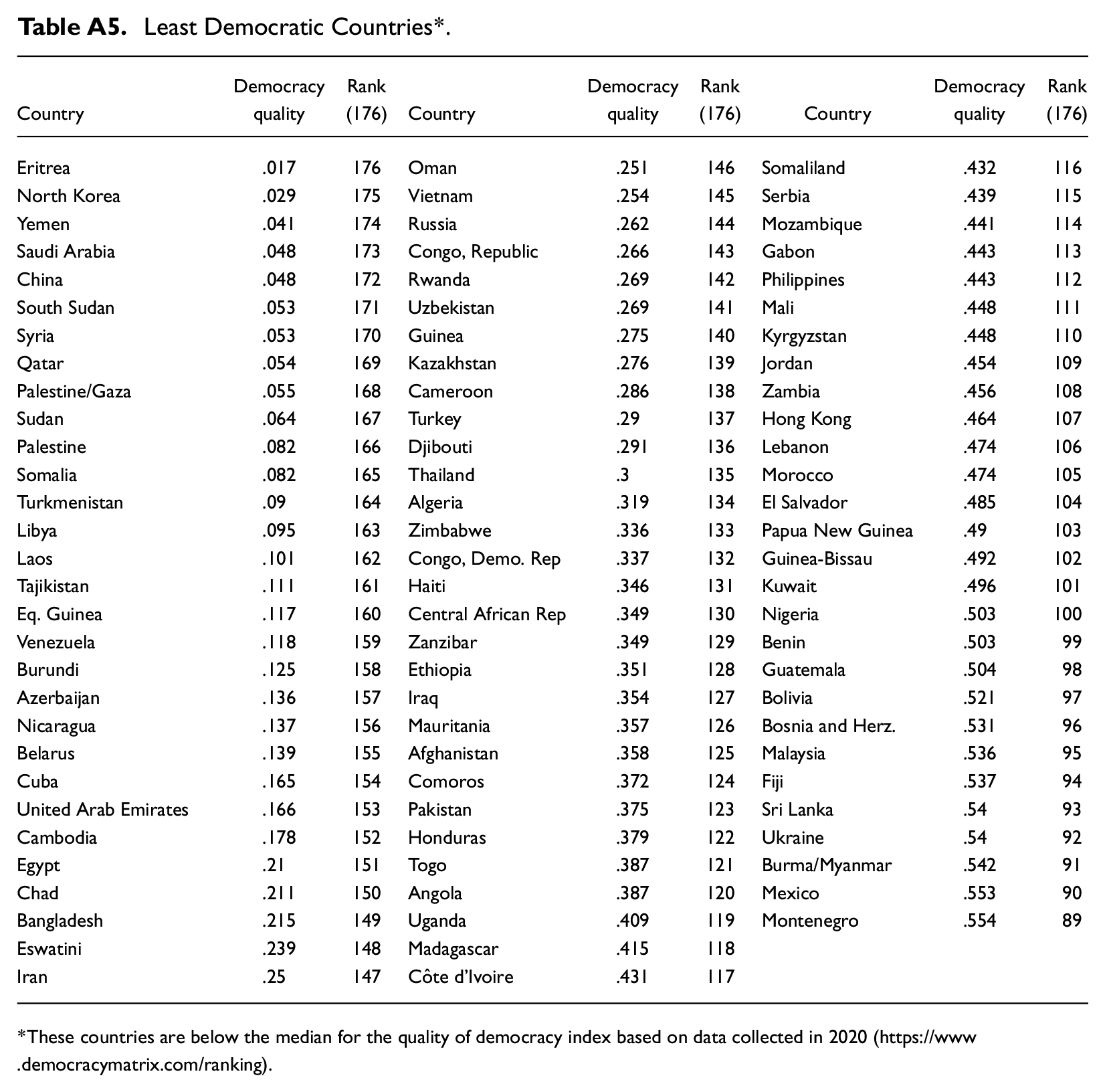
| Country | Democracy quality | Rank (176) | Country | Democracy quality | Rank (176) | Country | Democracy quality | Rank (176) |
|---|---|---|---|---|---|---|---|---|
| Eritrea | .017 | 176 | Oman | .251 | 146 | Somaliland | .432 | 116 |
| North Korea | .029 | 175 | Vietnam | .254 | 145 | Serbia | .439 | 115 |
| Yemen | .041 | 174 | Russia | .262 | 144 | Mozambique | .441 | 114 |
| Saudi Arabia | .048 | 173 | Congo, Republic | .266 | 143 | Gabon | .443 | 113 |
| China | .048 | 172 | Rwanda | .269 | 142 | Philippines | .443 | 112 |
| South Sudan | .053 | 171 | Uzbekistan | .269 | 141 | Mali | .448 | 111 |
| Syria | .053 | 170 | Guinea | .275 | 140 | Kyrgyzstan | .448 | 110 |
| Qatar | .054 | 169 | Kazakhstan | .276 | 139 | Jordan | .454 | 109 |
| Palestine/Gaza | .055 | 168 | Cameroon | .286 | 138 | Zambia | .456 | 108 |
| Sudan | .064 | 167 | Turkey | .29 | 137 | Hong Kong | .464 | 107 |
| Palestine | .082 | 166 | Djibouti | .291 | 136 | Lebanon | .474 | 106 |
| Somalia | .082 | 165 | Thailand | .3 | 135 | Morocco | .474 | 105 |
| Turkmenistan | .09 | 164 | Algeria | .319 | 134 | El Salvador | .485 | 104 |
| Libya | .095 | 163 | Zimbabwe | .336 | 133 | Papua New Guinea | .49 | 103 |
| Laos | .101 | 162 | Congo, Demo. Rep | .337 | 132 | Guinea-Bissau | .492 | 102 |
| Tajikistan | .111 | 161 | Haiti | .346 | 131 | Kuwait | .496 | 101 |
| Eq. Guinea | .117 | 160 | Central African Rep | .349 | 130 | Nigeria | .503 | 100 |
| Venezuela | .118 | 159 | Zanzibar | .349 | 129 | Benin | .503 | 99 |
| Burundi | .125 | 158 | Ethiopia | .351 | 128 | Guatemala | .504 | 98 |
| Azerbaijan | .136 | 157 | Iraq | .354 | 127 | Bolivia | .521 | 97 |
| Nicaragua | .137 | 156 | Mauritania | .357 | 126 | Bosnia and Herz. | .531 | 96 |
| Belarus | .139 | 155 | Afghanistan | .358 | 125 | Malaysia | .536 | 95 |
| Cuba | .165 | 154 | Comoros | .372 | 124 | Fiji | .537 | 94 |
| United Arab Emirates | .166 | 153 | Pakistan | .375 | 123 | Sri Lanka | .54 | 93 |
| Cambodia | .178 | 152 | Honduras | .379 | 122 | Ukraine | .54 | 92 |
| Egypt | .21 | 151 | Togo | .387 | 121 | Burma/Myanmar | .542 | 91 |
| Chad | .211 | 150 | Angola | .387 | 120 | Mexico | .553 | 90 |
| Bangladesh | .215 | 149 | Uganda | .409 | 119 | Montenegro | .554 | 89 |
| Eswatini | .239 | 148 | Madagascar | .415 | 118 | |||
| Iran | .25 | 147 | Côte d’Ivoire | .431 | 117 |
These countries are below the median for the quality of democracy index based on data collected in 2020 (https://www.democracymatrix.com/ranking).
Acknowledgements
We would like to thank Candy Brush, three anonymous reviewers, and ACERE audience members for their insightful comments that helped us to improve this editorial.
Declaration of Conflicting Interests
The author(s) declared no potential conflicts of interest with respect to the research, authorship, and/or publication of this article.
Funding
The author(s) received no financial support for the research, authorship, and/or publication of this article.
