







Abstract
This study examines hybrid entrepreneurship (HE) in non-Western contexts where informal and non-market institutions are central. Based on 31 case studies of female hybrid entrepreneurs in Ethiopia and 64 in-depth interviews, we conceptualize HE as a relational, co-constructed process shaped by institutional complexity. Women enact HE in liminal spaces sustained through relational practices: reconfiguring boundaries, cultivating ambiguity and gray areas, and maintaining webs of reciprocity. Institutional complexity both enables and constrains HE, underscoring its social embeddedness rather than individual agency. The study advances research on HE, female entrepreneurship, and institutional complexity by foregrounding relational dynamics and gendered experiences.
Keywords
Introduction
Hybrid entrepreneurship (HE), the simultaneous engagement in formal employment and self-employment (Folta et al., 2010), is significantly shaped by its institutional environment (Schulz et al., 2016). While often described as an individual decision (Demir et al., 2022), HE is not merely a matter of individual choice or career strategy. Institutional arrangements play a critical role in enabling individual’s ability to engage in entrepreneurial activity while maintaining formal employment (Demir et al., 2022; Schulz et al., 2016). Institutions encompass formal rules (e.g. laws and regulations), as well as informal rules (e.g. cultural norms and social expectations) that structure political, economic, and social interactions (North, 1990). Together, these formal and informal elements form institutional arrangements that set the “rules of the game” (North, 1990) shaping which economic activities are considered legitimate, who is allowed to participate, and which pathways are seen as viable (Battilana et al., 2009; Bruton et al., 2010; Chowdhury et al., 2019). These institutional arrangements are shaped by distinct institutional logics that provide meaning and legitimacy to action (Scott, 2013). HE unfolds at the intersection of two spheres that contain distinct logics: formal employment and entrepreneurship (Gänser-Stickler et al., 2022). The former emphasizes the performance-oriented norms of employing organizations, whereas the latter values autonomy and opportunity seeking. When individuals engage in HE, this can create tensions over identity, legitimacy, and the acceptable boundaries of entrepreneurial behavior (Fenters et al., 2025; Kuske et al., 2025).
So far, research on HE has largely been conducted in Western, high-income, and capital-rich contexts with strong formal and market-based institutions (Brattström & Wennberg, 2022), where stable regulatory frameworks, clear property rights, and abundant resources enable entrepreneurs to exercise individual agency by voluntarily engaging in HE as a relatively low-risk strategy before transitioning to full-time entrepreneurship (Folta et al., 2010; Raffiee & Feng, 2014). In these settings, HE has been conceptualized as an individualistic act of balancing dual roles of formal employment and entrepreneurship (Carr et al., 2023; Kuske et al., 2025; Thorgren et al., 2016) often used to “test waters” before engaging in full-time entrepreneurship (Folta et al., 2010; Raffiee & Feng, 2014). This, however, overlooks the realities in many non-Western settings and emerging economies, where HE is a common practice due to the difficulties in securing a living from formal employment (Dzomonda & Fatoki, 2018) and a strong informal economy that allow entrepreneurs to establish side businesses (Webb et al., 2013; Williams et al., 2017). Many (hybrid) entrepreneurs are embedded in institutional arrangements marked by low regulatory enforcement, political instability, and a reliance on informal norms and networks (Bothello et al., 2019). While often portrayed as “lacking” due to the absence of Western-style legal and market institutions (Doh et al., 2017), these contexts tend to be organized through alternative institutional arrangements in which economic activity is deeply interwoven with informal institutions, that is, “codes of conduct, norms of behavior, and conventions” (North, 1990, p. 36), rather than governed by formal structures (Mair et al., 2012).
In this paper, we focus on HE in non-Western settings and foreground the informal and non-market institutions as central organizing principles of economic life (Jones & Murray, 2025; Khavul et al., 2009; Webb et al., 2009). Informal and non-market institutions such as family (Gras & Nason, 2015; Khavul et al., 2009), ethnic group (Yenkey, 2015), and community (Jones & Murray, 2025; Lee & Lounsbury, 2015) frequently shape entrepreneurial activity and interact with formal and market-based institutions (Nason & Bothello, 2023). Such environments constitute spaces of institutional complexity (Greenwood et al., 2011), in which entrepreneurs “respond to diverse (and potentially conflicting) prescriptions and proscriptions within their institutional environment” (Nason & Bothello, 2023, p. 490). Complexity is therefore influenced by the manner in which institutions, such as family, market, profession, community, and others, interact and may come into conflict.
However, institutional complexity has received little attention in research on HE. While existing research acknowledges that hybrid entrepreneurs navigate multiple, sometimes conflicting expectations associated with formal employment and entrepreneurship (Fenters et al., 2025; Kappe et al., 2025), institutions are often viewed as external structures that constrain or enable HE (Gänser-Stickler et al., 2022; Schulz et al., 2016). In this paper, we explicitly foreground institutional complexity as a defining feature of HE. In contexts where informal and non-market institutions are strong, HE may be shaped not only by the logics of employment and entrepreneurship but also strongly by those rooted in kinship, family, and community, confronting hybrid entrepreneurs to multiple divergent expectations, values, and identities (Raynard, 2016).
We use the revelatory case of hybrid female entrepreneurship (HFE) in Ethiopia to generate novel theoretical insights about how institutional complexity shapes HE. Beyond reconciling the at times conflicting expectations tied to employment and entrepreneurship (Fenters et al., 2025; Kuske et al., 2025), hybrid female entrepreneurs also respond to familial and communal expectations that intertwine with gender norms, shaping how time, labor, and resources are mobilized (Baughn et al., 2006; Jennings & Brush, 2013). Institutional complexity, therefore, becomes a defining feature of HFE, particularly in non-Western settings, where women’s engagement in economic activity is often seen as secondary or supplementary (Ahl, 2006; Welter et al., 2014; Zhao & Yang, 2021). By explicitly taking into consideration institutional complexity, we develop an alternative conceptualization of HE grounded in women’s perceptions in a non-Western context.
Using an inductive research design, we studied 31 cases of HFE in Ethiopia, drawing on 64 in-depth interviews with entrepreneurs, colleagues, and family members. Including these multiple stakeholder perspectives enabled us to capture the diverse and conflicting prescriptions and proscriptions women respond to in their institutional environment. Our findings demonstrate how institutional complexity not only pushes but also pulls women toward HE. These dynamics give rise to HFE as a relational rather than an individual accomplishment, one that is continually enacted through three distinct practices: reconfiguring boundaries, cultivating gray areas and ambiguity, and sustaining webs of reciprocity. These practices unfold within liminal space—spatio-temporal configurations that are relationally constituted through everyday interaction across employment, entrepreneurial, and community domains. This liminal space creates the conditions for and sustains HFE showing how HFE emerges through, and becomes inseparable from, the social relationships in which it is embedded. Our findings further illustrate the implications women perceive from engaging in HE, and how their hybrid engagement in turn subtly shapes the institutional arrangements in which they are embedded.
Our study makes theoretical contributions to three literature streams. First, we contribute to the HE literature (Carr et al., 2023; Folta et al., 2010) showing that HE, particularly for women in contexts with strong informal and non-market institutions, may be better conceptualized as a relational, co-constructed process rather than an individual and agentic career strategy. Second, we contribute to the female entrepreneurship literature (Ahl, 2006; Brush et al., 2009) by shedding light on how HE can serve as a relational and empowering pathway for women navigating institutional and gendered constraints. Finally, we contribute to research on entrepreneurship under conditions of institutional complexity, particularly in non-Western settings (Nason & Bothello, 2023), by demonstrating that gender operates as a constitutive mechanism through which institutional complexity is differentially experienced as both enabling and constraining.
Theoretical Framework
Reorienting HE Research Toward Non-Western Institutional Settings
The majority of research on HE has been conducted in contexts with strong formal and market-based institutions (Folta et al.,2010; Gänser-Stickler et al., 2022; Klyver et al., 2020; Raffiee & Feng, 2014). The presence of strong institutions, defined as the formal and informal rules established by legal and state regulatory institutions, has been viewed as a critical resource for hybrid entrepreneurs (Folta et al., 2010; Schulz et al., 2016; Williamson, 2024). For example, Folta and colleagues (2010) showed that in the Swedish welfare state, labor protections and developed capital markets provide a safety net that enables individuals to experiment with ventures while maintaining stable employment. Similarly, Schulz and colleagues (2016) demonstrate that hybrid entrepreneurs are especially responsive to regulatory reforms, as their dual institutional embeddedness compels them to adapt quickly to maintain legitimacy across domains. Moreover, Gänser-Stickler and colleagues (2022) demonstrate that hybrid entrepreneurs are sensitive not only to uncertainty in entrepreneurship but also to uncertainty in wage employment, showing how stronger labor-market institutions (that lower paid-job risk) increase the attractiveness of HE relative to full-time entrepreneurship. While existing research has advanced our understanding of HE in contexts with strong legal and market-based institutions, particularly in Western settings, much less is known about how HE unfolds in contexts that are characterized by informal and non-market institutions (Nason & Bothello, 2023), such as those found in many non-Western settings.
In these non-Western contexts, entrepreneurs operate under conditions where “institutional arrangements to support markets are weak [or] absent” (Mair & Marti, 2009, p. 419). Such contexts are characterized by obstacles including weak property rights, restrictive laws, limited access to capital, crime, and political instability (Mair et al., 2012, Sydow et al., 2022; Webb et al., 2020). Although some scholars have described these contexts as “lacking,” due to the absence of legal and market-based institutions typically found in Western settings (Doh et al., 2017), they are in fact governed by alternative institutional arrangements that are not necessarily less effective (Bothello et al., 2019; Mair et al., 2012; Nason & Bothello, 2023). In such arrangements, economic activity is deeply interwoven with informal institutions, that is, “codes of conduct, norms of behavior, and conventions” (North, 1990, p. 36), rather than driven by formal structures codified and enforced by official authorities or by legal and market-based institutions (Khoury & Prasad, 2016; Mair et al., 2012; Nason & Bothello, 2023). For instance, Chinese entrepreneurs draw on guanxi (reciprocal connections and relationships in China) to access resources and legitimacy in the absence of reliable formal institutions (Puffer et al., 2010), South African entrepreneurs rely on Ubuntu, a philosophy of reciprocity and collective responsibility (Abubakre et al., 2021), and marginalized traders in Ghana’s Kejetia Market, who are excluded from state registration systems, mobilize Indigenous institutions such as the authority of the Ashanti King and community associations to gain recognition (Newman et al., 2025). Hence, institutional arrangements in non-Western settings often rely on non-market institutions, such as kinship, trust, and community-based interactions (Jones & Murray, 2025; Khavul et al., 2009; Webb et al., 2009), which can both facilitate and constrain entrepreneurial activity (Khoury & Prasad, 2016; Mair et al., 2012).
Institutional Complexity as a Feature of Hybrid Entrepreneurship
Institutional complexity arises whenever actors respond to multiple logics within their institutional environment that “prescribe divergent cultural expectations, values, understandings, and identities” (Raynard, 2016, p. 310). Complexity is therefore determined by the degree to which certain institutional domains and their respective logics—overarching sets of principles that prescribe appropriate behavior—interact and come into conflict (Greenwood et al., 2011). HE involves actors operating simultaneously across the institutional domains of formal employment and entrepreneurship (Carr et al., 2023; Demir et al., 2022; Kappe et al., 2025). These domains often involve diverse and potentially conflicting prescriptions and proscriptions. For example, the formal employment domain is often associated with a corporate logic prescribing values around hierarchy and rule adherence (Thornton et al., 2012), whereas the entrepreneurial domain emphasizes autonomy and opportunity seeking (Covin & Lumpkin, 2011; Shane & Venkataraman, 2000). Research has shown that combining formal employment and entrepreneurship can be demanding (Albrecht et al., 2026; Fenters et al., 2025; Kuske et al., 2025). For example, in the U.S. context, Fenters and colleagues (2025) show how HE generates identity tensions that shape how hybrid entrepreneurs cognitively structure and adopt new entrepreneurial identities. Likewise, Kappe and colleagues (2025) demonstrate that clashes between employment and entrepreneurial demands create strain and diminish satisfaction with formal employment. We therefore argue that as hybrid entrepreneurs simultaneously face the institutional domains of formal employment and entrepreneurship, each governed by its own logic, institutional complexity becomes an inherent feature of their engagement.
In settings characterized by strong informal and non-market institutions, HE may be shaped not only by the logics of employment and entrepreneurship but also by those related to kinship, family, and community. Research in non-Western settings has shown that entrepreneurs frequently rely on these social structures when formal institutional support is scarce (Ge et al., 2019; Nordman, 2016; Zhang et al., 2026). The community logic is particularly important as a non-market institution shaping entrepreneurial activity in such contexts (Gümüsay, 2020; Jones & Murray, 2025). It matters because communities have been shown to be essential for venture success in many non-Western settings (Bacq et al., 2022; P. Jennings et al., 2013). In China, “families and their wider kinship networks enmeshed in local communities, together with political networks, form a soft institutional infrastructure” (Ge et al., 2019, p. 1,125) that facilitates entrepreneurial activity. However, evidence from India suggests that it can also become difficult to balance a collectivist orientation of the family with the market and financial orientation of the entrepreneurial venture, creating tensions between the family and market logic (Lampel et al., 2017). Hence, in settings where strong informal and non-market institutions prevail, hybrid entrepreneurs may not only navigate different logics related to formal employment and entrepreneurship but also mediate between additional and sometimes divergent logics of kinship, family, and community.
We therefore extend prior research that has examined HE primarily through the lens of balancing formal employment and entrepreneurship (Folta et al., 2010; Kappe et al., 2025; Kuske et al., 2025) by drawing on insights from the literature on institutional complexity and highlighting how hybrid entrepreneurs, particularly in non-Western settings (Nason & Bothello, 2023), respond to multiple logics in their institutional environment. These multiple logics introduce additional audiences and legitimacy expectations that extend beyond those associated with entrepreneurship and formal employment, thereby expanding the range of demands hybrid entrepreneurs must manage. Doing so requires continuously interpreting and reconciling these potentially competing demands, a dynamic that has received limited attention in HE research.
HFE as an Exemplar of Institutional Complexity
For women, HE can offer multiple strategic advantages. Maintaining their formal employment alongside their entrepreneurial venture can mitigate financial risks (Williams et al., 2021) and facilitate the alignment of work and family responsibilities (Dost, 2025). For example, Liu and Wu (2022) demonstrate that women are strongly motivated by the security and flexibility that HE offers, enabling them to test business ideas without having to abandon their formal employment. Maintaining formal employment can provide a financial safety net during business development, thereby reducing the risks associated with full-time entrepreneurship (Block & Landgraf, 2016; Folta et al., 2010). Although this benefit is not gender-exclusive, it is especially relevant for women. Research indicates that women are more likely to encounter systemic financing barriers, face discouragement in loan applications, and have lower access to formal venture capital (Brush et al., 2009; Jennings & Brush, 2013; Marlow & Patton, 2005). For example, HE can enable women to counter gender norms that penalize visible failure or risk-taking through incremental experimentation and adaptation with minimal social or financial risk, helping them build confidence and credibility before going public with their venture (Dost, 2025). Taken together, gender barriers and disproportionate family responsibilities can make HE particularly attractive for women (Forrester & Neville, 2021; Yang et al., 2020).
The coexistence of multiple, at times conflicting, institutional demands can be particularly demanding for women (Ahl, 2006; Hundera et al., 2021; Welter et al., 2014). For example, traditional gender norms disadvantage women in both employment and entrepreneurship (Acker, 2006; Mair et al., 2012; Welter et al., 2014; Zhao & Yang, 2021), restricting access to resources and leadership opportunities (Cruz et al., 2019) and reinforcing cultural beliefs and social expectations that govern how rules and networks operate (Bullough et al., 2022; Nguyen, 2021). Similarly, the interplay of cultural norms, regulations, and market expectations tend to marginalize women’s business activities and reinforce their perceived role as supplementary or secondary (Ahl, 2006; Welter et al., 2014; Zhao & Yang, 2021). At the same time, informal networks and cultural norms can serve as enabling mechanisms. For example, in Bangladesh, where formal and informal logics collide, informal institutions such as kinship and networks shape market participation of women (Mair et al., 2012). Similarly, research has shown that women mobilize informal institutions to bypass barriers, providing alternative routes into economic activity such as cooperative networks and community-based practices (Ahlstrom & Bruton, 2002; Colovic & Mehrotra, 2020; Datta & Gailey, 2012). Thus, informal and non-market institutions can both reinforce gendered exclusions (Ahl, 2006; Hundera et al., 2021; Welter et al., 2014) and simultaneously create pathways for women to navigate or resist these constraints (Ejaz et al., 2023; Giménez & Calabrò, 2017; Zhao & Yang, 2021). Despite growing recognition that informal and non-market institutions simultaneously constrain and enable women’s economic participation, we know little about how HFE can provide a viable way to navigate such complexities. Therefore, this study asks: How do women enact HE in contexts characterized by institutional complexity, and what are the consequences of their engagement?
Methods
Research Setting: Ethiopia
Ethiopian entrepreneurs must navigate particularly strong demands stemming from instable state regulations as well as from deeply embedded informal systems rooted in religion, ethnicity, kinship, and local moral orders (De Smet & Boroş, 2021; Kebede & Butterfield, 2009). Regulatory and administrative systems remain inconsistent in implementation, producing uneven enforcement and prompting frequent reliance on informal networks to access opportunities or bypass barriers (Kenea & Yemane, 2020). Unlike the relatively stable institutional contexts characterized by strong formal and market-based institutions that dominate the HE literature, Ethiopia is characterized by the prevalence of informal and non-market institutions across both urban and rural contexts (De Smet & Boroş, 2021; Kebede & Butterfield, 2009).
For Ethiopian women, this complexity is further intensified by gendered institutional arrangements. Formal and market-based initiatives, such as microfinance and women-focused programs, have gained increasing traction as mechanisms to empower women and integrate them into the Ethiopian labor market (Haile et al., 2012). At the same time, informal institutions encompass a wide range of social norms, customs, and community-based arrangements that shape everyday life. For instance, grassroot associations such as Iddir (funeral societies), Ikub (rotating savings groups), and Mahaber (religious fellowship groups) provide critical resource-sharing and social security (Aredo, 2010; Dercon et al., 2006) but also reinforce patriarchal norms that define which economic activities are socially acceptable for women. Reciprocity often takes the form of labor contributions, extending domestic responsibilities into the community and further constraining women’s time and economic engagement (Aredo, 2010; Gudeta et al., 2018; Hundera et al., 2021). Taken together, these conditions create an institutional setting in which hybrid female entrepreneurs must respond to multiple, at times contradictory demands (Kenea & Yemane, 2020).
Ethiopia, therefore, offers a revelatory research setting (Yin, 2009) for studying HFE for two reasons. First, it allows us to observe dynamics of HE that are less visible—or entirely absent—in more stable institutional contexts. Our setting departs from existing theorizing developed in environments with stable formal and market-based institutions by foregrounding a context in which informal and non-market institutions are more dominant. This shift allows us to observe how HE unfolds where regulatory instability, kinship relations, and community-based systems structure entrepreneurial life in ways largely absent from prior studies (Aredo, 2010; Gudeta et al., 2018). Second, institutional complexity is particularly pronounced for hybrid female entrepreneurs in Ethiopia: multiple coexisting and at times conflicting logics intersect and shape women’s hybrid entrepreneurial practices. This intersection creates distinctive conditions that differ from those typically examined in the HE literature. Studying HFE within this context thus extends and complements theorizing on HE (Van Burg et al., 2022).
Research Design
To gain a deeper understanding of HFE in Ethiopia, we conducted an inductive study. In our study, we followed principles of grounded theory (Strauss & Corbin, 1990) to build an understanding “from the perspective of those living it” (Corley, 2015, p. 600). We entered the field with a broad interest in how Ethiopian women combine formal employment with entrepreneurial activity. Consistent with grounded theory’s iterative logic, our initial focus was progressively refined throughout our data collection and emergent understanding. As data collection unfolded, the complexity of navigating different demands and expectations, particularly related to social norms, customs, and community-based arrangements, became increasingly salient in our data. This analytic development ultimately led us to articulate our research question.
The first author, a native of Ethiopia, brought deep contextual expertise to the study through fluency in local languages (Amharic and Afan Oromo) and an intimate understanding of local norms, entrepreneurial cultures, and formal organizational environments. This embeddedness was critical for building trust with key informants, which was primarily done through community-based women’s associations, such as Mahiber (a voluntary religious and social association), Idir (a mutual aid association supporting members during times of crisis, especially funerals), and university-affiliated researchers. Through these connections, access to hybrid female entrepreneurs and logistical arrangements of scheduling interviews was facilitated. The first author led the participant selection, data collection, and initial data analysis. Fluent in both local languages and English, the first author made sure that culturally specific expressions, idioms, and metaphors were translated with attention to preserve their intended meanings (Brannen, 2004), thus maintaining linguistic and cultural integrity throughout the analytic process. The other authors, both knowledgeable in conducting female entrepreneurship research in non-Western settings, independently and iteratively analyzed the data and, together with first author, engaged in the theoretical framing and development of the study’s findings. Drawing on our collective experience researching entrepreneurship in non-Western settings, we were able to develop and compare findings in a manner that remained attentive to local meanings and context-specific dynamics.
Data Sources and Data Collection
Our data collection followed a theoretical sampling approach (Strauss & Corbin, 1990). We purposively selected 31 Ethiopian women simultaneously engaged in formal employment and entrepreneurship. We focused on women across different sectors and education levels to capture variation in formal employment (low salary positions vs. leadership roles) as well as a range of entrepreneurial activities (see Supplemental Appendix 1a for a full overview of our interviewees). Overall, we conducted 64 semi-structured, face-to-face interviews with hybrid female entrepreneurs and key stakeholders in two waves to gain rich, contextually embedded insights. In addition to hybrid female entrepreneurs, we interviewed colleagues and family members who directly interacted with them. These additional perspectives enabled us to gain deeper insights into the relational aspects of HE, particularly in the second round of data collection. Our interviews were audio-recorded (except for five interviews in which participants felt more comfortable when the first author took notes) and lasted between 30 and 120 min (see Supplemental Appendix 1b), with an average duration of approximately 75.5 min. Interviews were conducted in participants’ native languages to facilitate comfort, clarity, and depth of expression (Barner-Rasmussen et al., 2014; Brannen, 2004).
The first wave of data collection was conducted in November and December 2024 and involved 26 interviews. This wave focused on the life trajectories of 12 hybrid female entrepreneurs, examining how their personal and professional experiences shaped their entry into HE. In addition, we interviewed one (and in some cases two) key stakeholders who played a significant role in the enactment of HE and whom the hybrid entrepreneur identified as important resources. In line with our overarching research interest, these first interviews explored how women in Ethiopia enact HE and navigate dual demands (see Supplemental Appendix 2a and 2b for the semi-structured interview guide). In this round of data collection, two aspects stood out. First, while institutional arrangements at the intersection of employment, entrepreneurship, and community responsibilities constrained women from pursuing either full-time employment or full-time entrepreneurship, these same institutional arrangements made HE a viable and socially acceptable alternative. For example, gender norms often discouraged women from running a full-time business, as becoming a “business woman” could be perceived as stepping outside of appropriate gender roles. However, when entrepreneurial activities were combined with formal employment, the same norms rendered these efforts legitimate and even admirable. Running a business on the side was not perceived as a deviant attempt of gaining independence, but as a supplementary, acceptable extension showing care and responsibility for the family. Hence, for many hybrid female entrepreneurs, formal employment functioned as a legitimacy anchor that enabled them to pursue entrepreneurial ventures while remaining within social and institutional expectations. Second, our participants did not view HE as a stepping stone toward full-time entrepreneurship. Instead, they saw it as a deliberate and desirable form of economic activity that offers strategic value by advancing their careers, enabling professional autonomy, and mitigating gender discrimination and dependencies associated with both full-time entrepreneurship and employment. These insights directed our inquiry toward understanding how women enact and sustain HE, and the underlying dynamics that render this choice particularly advantageous.
Between March and April 2025, we conducted a second wave of 38 interviews with 19 hybrid female entrepreneurs and their key stakeholders (see Supplemental Appendixes 3a and 3b). A key insight of this wave was that HE was not perceived as an individual pursuit but as deeply embedded in community-based arrangements and customs, where entrepreneurial activity is framed and enacted as a collective endeavor. Another insight was that while hybrid female entrepreneurs primarily explained how they navigated their institutional arrangement at the intersection of entrepreneurship, employment and community, secondary informants revealed where women’s hybrid engagement subtly reshaped these arrangements, creating environments that differed from those in which their hybrid engagement had initially emerged. We concluded our data collection once we reached theoretical saturation. This was the case when additional data did not reveal any new insights to inform our main findings (Strauss & Corbin, 1990). Specifically, after the second wave of interviews dimensions such as why women engage in HE, how they mobilize their institutional arrangements to enact HE, and the consequences of their hybrid engagement were consistently reinforced across cases without yielding further conceptual variation.
Data Analysis
In the following, we present our data analysis approach that contained three analytical moves (Pratt et al., 2022). Our approach adhered to the principles of grounded theory through multiple rounds of coding, constant comparison, and iteration between data, theory, and emerging interpretations (Corley, 2015; Strauss & Corbin, 1990).
Move 1: Creating and Comparing Case Narratives
We constructed case narratives for each hybrid female entrepreneur, tracing their trajectories into both formal employment and entrepreneurial activity, and examining how institutional arrangements shape entry and enactment of HE. We also documented women’s perceived benefits as well as the persistent challenges associated with HE. Supplemental Appendix 4 provides an illustrative case narrative. The first author carefully created the case narratives, including power quotes (Pratt, 2008) and a thoughtful contextualization of the experiences reported in the interviews. While all authors engaged in a close reading of the full interview transcripts, the development and discussion of case narratives played a crucial role in cultivating a shared interpretive frame among the research team, facilitating collective sensemaking. We treated these narratives not as endpoints but as heuristic tools that facilitated open coding, memoing, and subsequent theorizing.
Throughout our analysis, we realized that hybrid female entrepreneurs perceived their environment as simultaneously enabling and constraining. Prior literature has emphasized the predominantly restrictive nature of institutional contexts in developing economies (Ejaz et al., 2023; Sydow et al., 2022; Webb et al., 2020), portraying entrepreneurship in non-Western contexts primarily as a necessity rather than opportunity (Fields, 2019). In contrast, our participants shared many enabling aspects in their environment, revealing a more dynamic interplay between institutional structures and hybrid entrepreneurial engagement. Specifically, women mobilized institutions such as ambiguous regulations or informal networks as spaces of opportunity, even as these same institutions constrained their activities. This observation redirected our analytic focus (Van Burg et al., 2022): HE appeared not only as a necessity driven by institutional pressures but also as a site of institutional opportunities and reconfiguration. In deepening our analysis, we also found variation in how women experienced and mobilized institutional arrangements based on their position and status in their formal employment.
Move 2: Deriving Core Constructs and Relationships
In the next step, we carried out systematic coding and analysis, using iterative coding cycles, code comparison, and visualizations to engage in reflexive analysis (Strauss & Corbin, 1990). After multiple rounds of discussion and the development of “consensual decision rules about how various terms or phases are to be coded” (Gioia et al., 2013, p. 22), we identified emerging patterns in our data. Specifically, two key analytical foci surfaced: (a) the institutional complexity in which hybrid female entrepreneurs are situated in and (b) the relational dynamics associated with navigating their environment. When analyzing the institutional complexity, we coded participants’ experiences to understand how multiple, intersecting logics of employment, entrepreneurship, community, and gender norms simultaneously constrained and enabled HE. Constraints such as “financial insecurity from a single income source” or “limited pathways for professional advancement in formal employment” often pushed women toward HE. At the same time, “organizational affiliation” and “collaborative social structures rooted in customs and traditions” conferred legitimacy and pulled women into HE. We labeled these conditions as “institutional push factors” and “institutional pull factors.” Similarly, we engaged more deeply with the practices through which women enact HE within a complex institutional environment. Following our key insight that HE was rarely seen as an individual pursuit but as deeply embedded in community arrangements, we coded how HE unfolded as a social practice rather than an individual strategy. Three distinct relational practices emerged from our analysis that we label as “reconfiguring boundaries,”“cultivating gray areas and ambiguity,” and “sustaining webs of reciprocity.” Finally, we coded the different experiences of how women’s engagement in HFE is perceived. Based on the experiences reported, we differentiated between “business enrichment,”“work enrichment,”“empowerment,” and “exhaustion” as direct consequences of women’s engagement in HFE.
Move 3: Building a Theoretical Model
In the final stage of our data analysis, we established the relationships among our core constructs through an iterative and abductive reasoning process (Gioia et al., 2013; Locke et al., 2008). We iteratively moved between our empirical material, the emerging data structure, and the existing literature on hybrid entrepreneurship, institutional complexity, and gender in entrepreneurship. Through this iterative process, we developed three interrelated sets of findings. First, we show the “conditions of institutional complexity driving HF,” illustrating how complex environments simultaneously push and pull women toward hybrid entrepreneurship. Second, our findings illustrate how women enact hybrid entrepreneurship through “relational practices of co-constructing liminal space”: spatio-temporal configurations, which momentarily come into being through entrepreneurs’ engagement with others. Liminal space materializes as women engage with multiple, conflicting logics stemming from employment, entrepreneurship, family, community, and gender norms. Within liminal spaces, hybrid female entrepreneurs and their stakeholders collectively blur and reconfigure expectations, co-creating spatio-temporal zones of flexibility that allow them to enact HE. These spaces do not exist prior to action but are continually enacted and sustained through the (tacit) participation of others. Third, we illustrate the “implications of HFE.”Figure 1 presents our data structure.
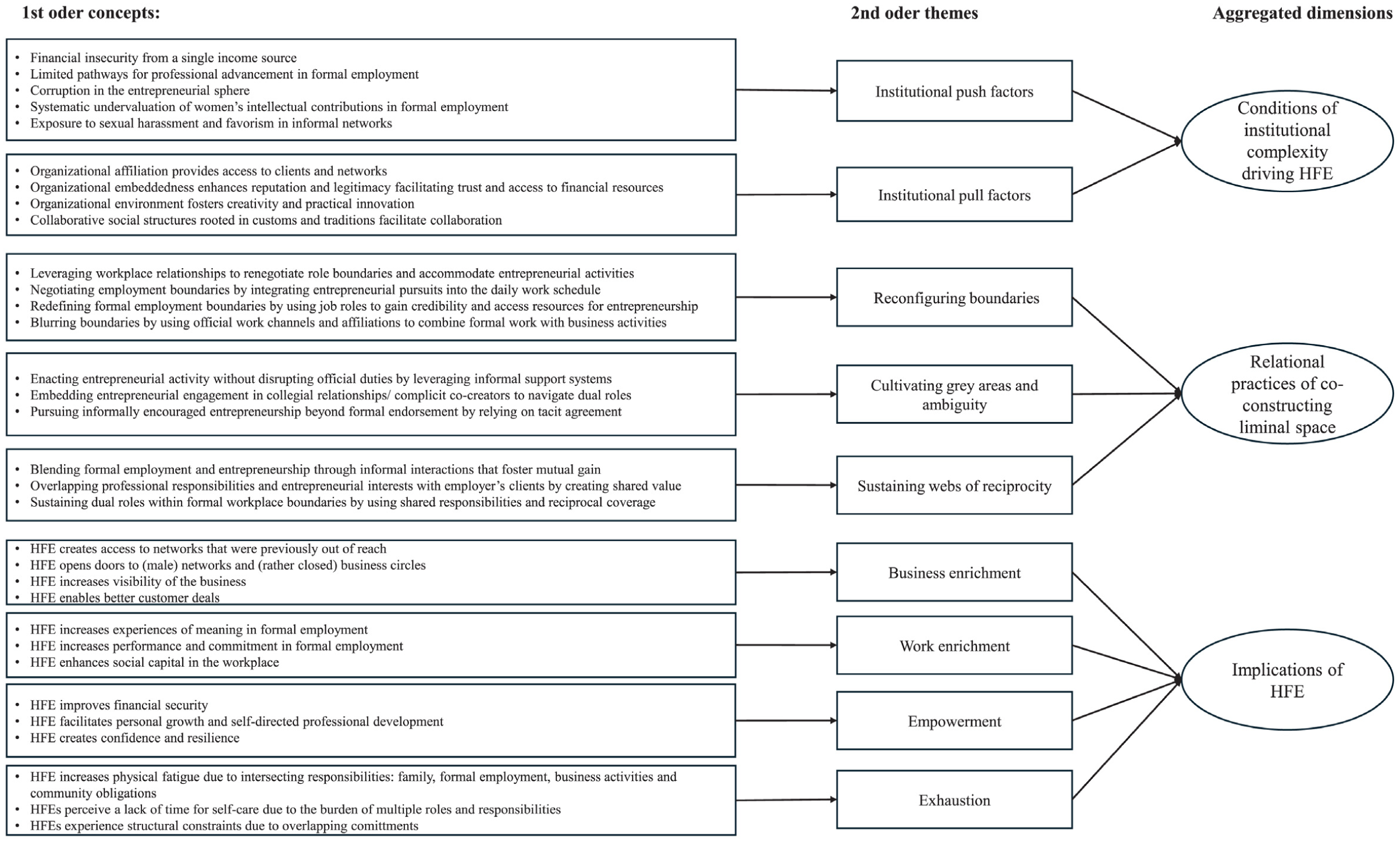
Data structure.
Findings
In the following, we illustrate how institutional complexity drives HFE, how women co-create liminal space to enact HFE, and how the resulting outcomes feed back into and shape the institutional environment that women inhabit. Figure 2 presents our conceptual model.
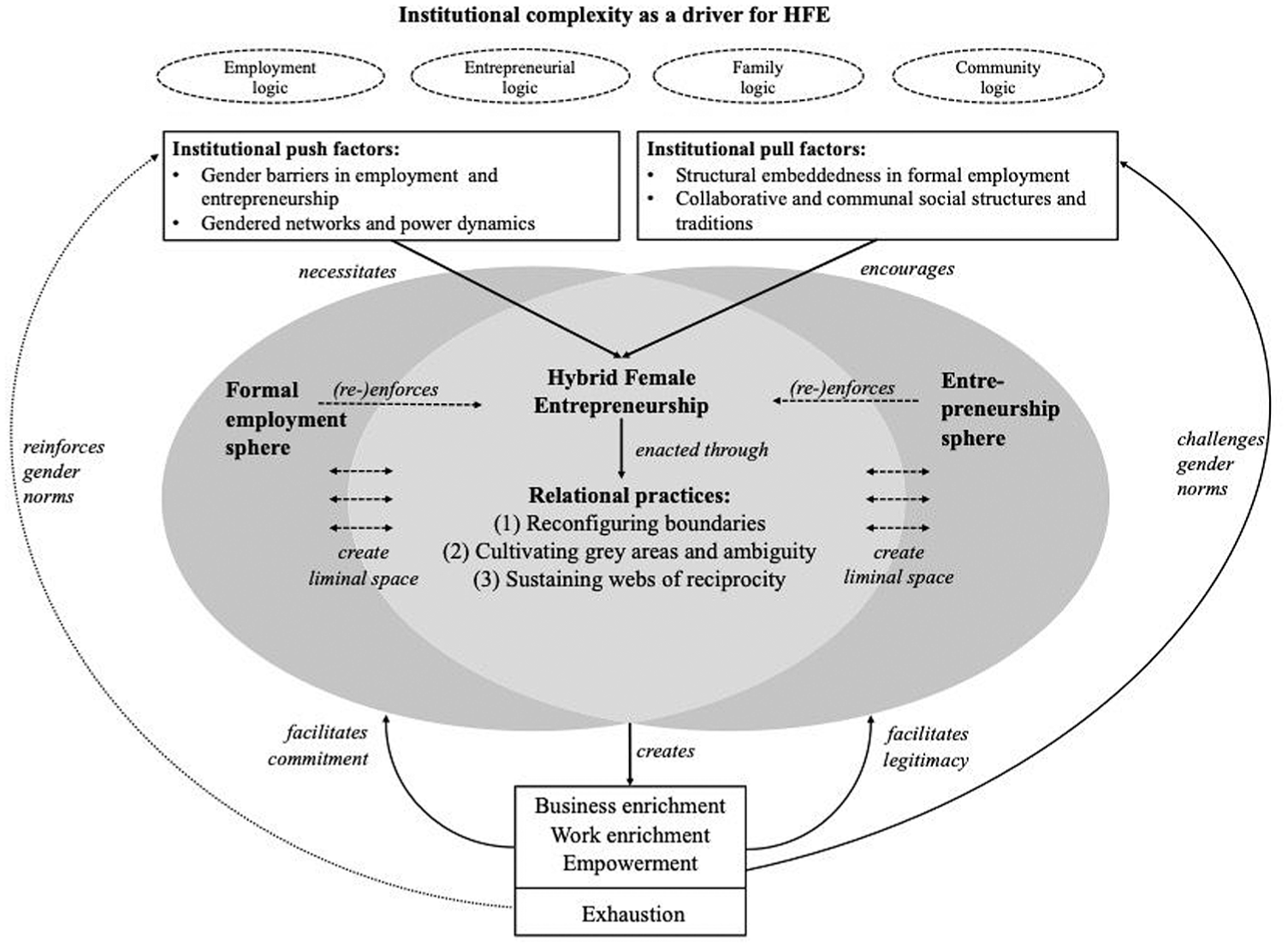
Institutional complexity and the co-construction of liminal space in hybrid female entrepreneurship.
Institutional Complexity as a Driver for HFE
In our study, women report that they often perceive conflicting expectations, simultaneously constraining and enabling their economic activities. We refer to these dynamics as “institutional push factors” and “institutional pull factors” that create the conditions in which women perceive HE as a more viable option compared to full-time entrepreneurship or formal employment.
Institutional Push Factors
When multiple institutional logics coexist and provide contradictory expectations for women, such complexity can push women toward HE. In the context we study, women are confronted with conflicting expectations regarding their role in formal employment, entrepreneurial activity, and their family responsibilities, creating conditions in which neither full engagement in formal employment nor entrepreneurship alone constitutes a viable pathway. While entrepreneurship is associated with financial autonomy and flexibility, gender norms still expect women to “make sure that [their] responsibilities at home are in order before [they] leave the house to go to work” (SFR6). At the same time, norms in formal employment strongly resolve around efficiency, while gender norms position women as primary caregivers with reduced productivity. For example, LEL16 notes: […] most of our leaders are men; they do not understand our [women’s] situation. For example, a female colleague who is educated and qualified for a position was denied because “she gives birth frequently,” which they say reduces her efficiency. (LEL 16)
Such evaluations reflect conflicting prescriptions regarding what constitutes a legitimate and capable worker, often constraining women’s ability to advance within employment. As SFR6 noted, “[…] men don’t have to think about evening dinners, a baby waiting at home needing to be breastfed, or picking up from daycare. […] Due to biases that prevail […] most [women] earn much less” (SFR6). Similarly, DB12 explains: “things often work through backdoor agreements, which require connections, which are often not accessible for women [due to their responsibilities]” (DB12). Hence, dominant expectations around what is expected from women diverge from those in the formal employment sphere, creating conflicting demands for women that make it difficult to fulfill these demands simultaneously. Women in lower-ranking positions, such as support staff and low-skill workers, for example, often experience financial insecurity from a single income source and limited pathways for professional advancement in formal employment. This pushes women toward HE as a means of survival. For instance, ME7 stated, “I am in lower rank, and my income is very low […] less chance to get promoted […] then I started the business in addition [….].” At the same time, participation in entrepreneurial activity is often shaped by regulatory constraints that privilege formalization as a condition for institutional support as explained by BLE23: The only thing I can do is a home-based business if I do not have a [paid] job, and because it is not registered, I cannot get formal support […] my income is very low to rely on just a business or job. (BLE 23)
Pursuing a home-based business aligns with gendered expectations around household and care responsibilities but undermines legitimacy within the regulatory domain, making it difficult to rely on full-time entrepreneurship for women alone. Many women also perceive high levels of corruption in the entrepreneurial sphere, which can hinder full entry into entrepreneurship without support from formal employment, as it facilitates access to resources and formal networks. For instance, AYA13 observed: Most things are informal and complicated, with unnecessary bureaucracy that opens many doors for corruption. Most women cannot deal with corruption; how we behave is often different because of how we are raised…first, I wanted to start leaving my job and start the business, but realizing such challenges, I decided to combine both with the expectation that I could leverage the benefit[s] […]. (AYA13)
Women in well-educated or higher positions often perceive conflicting expectations regarding what constitutes legitimate career progression and professional contribution. In formal employment, the corporate logic privileges hierarchical advancement, while gender norms produce systematic undervaluation of women’s intellectual contributions. For example, KU6 stated: …with my qualifications and long years of experience, I could have become head of the sales department […] however, I was denied the position and instead was promoted to executive secretary, a role no man competes for. That was when I wanted to start the business… (KU6)
Similarly, a colleague of MA11 noted: … No matter how much experience and expertise we [women] have, it is always challenging to move forward in our career. If my colleague [MA11] were a man, she could be in a higher rank of Auditing position; doing the business, I believe, serves her as an alternative way to use her talent… (Colleague of MA11)
MEG19 also pointed to the possibility of unleashing her potential in ways her job did not allow: The challenges I mentioned before in the system… I could not see myself moving up in the direction I aspired to by only relying on my teaching profession confined to the school system… so I was forced to look for another option… above all, I wanted something that enabled me to use my potential and be innovative. (MEG 19)
In other situations, gender norms expose women to coercive dynamics in which access to opportunities in informal networks involve exposure to sexual harassment: […] I also hear rumors that a few women were forced into unwanted relationships with people in power to have access to resources and opportunities for their career advancement, that is not for me, I would never exchange myself or my body to a gain position or benefits for my career, so I wanted to do something of my own to improve my life instead of solely relying on my work[paid job]. (BEZ14) Career advancement […] is not always based on individual performance […]. It’s often about personal relationships, and informal practices are common. (SFR8)
HE often provides an alternative pathway to realize professional aspirations and overcome vulnerabilities inherent in formal employment settings. Yet “running a business requires capital and networks, which are difficult to secure [without a paid job]” (KU6). Thus, while entrepreneurship offers autonomy and less exposure to asymmetric power relations, it imposes resource requirements that are difficult to meet without formal employment. As MEG19 noted: Without a paid position, running the business is also difficult. The business needs money, a physical location to run the business, and people who can buy the products… these can be compensated in the paid job context, at least to start small at the beginning. (MEG19)
As a consequence, HE becomes a necessity for many women to respond to conflicting demands. In formal employment, gendered norms confine women to lower positions, restrict access to leadership roles despite qualifications, and often expose women to harassment from those in power. At the same time, in the entrepreneurial domain, gendered norms create barriers to entry through limited access to capital and corruption. In this context, HE emerges as a situated response. By combining employment with entrepreneurial activity, women are able to maintain basic financial security from the employment domain while gradually engaging in entrepreneurial pursuits that allow for (more) autonomy and additional financial security. Table 1 provides a summary of the key concepts that function as institutional push factors.
Institutional Push Factors: Colliding Logics, Manifestation of Tensions, and Push Effect toward HE.
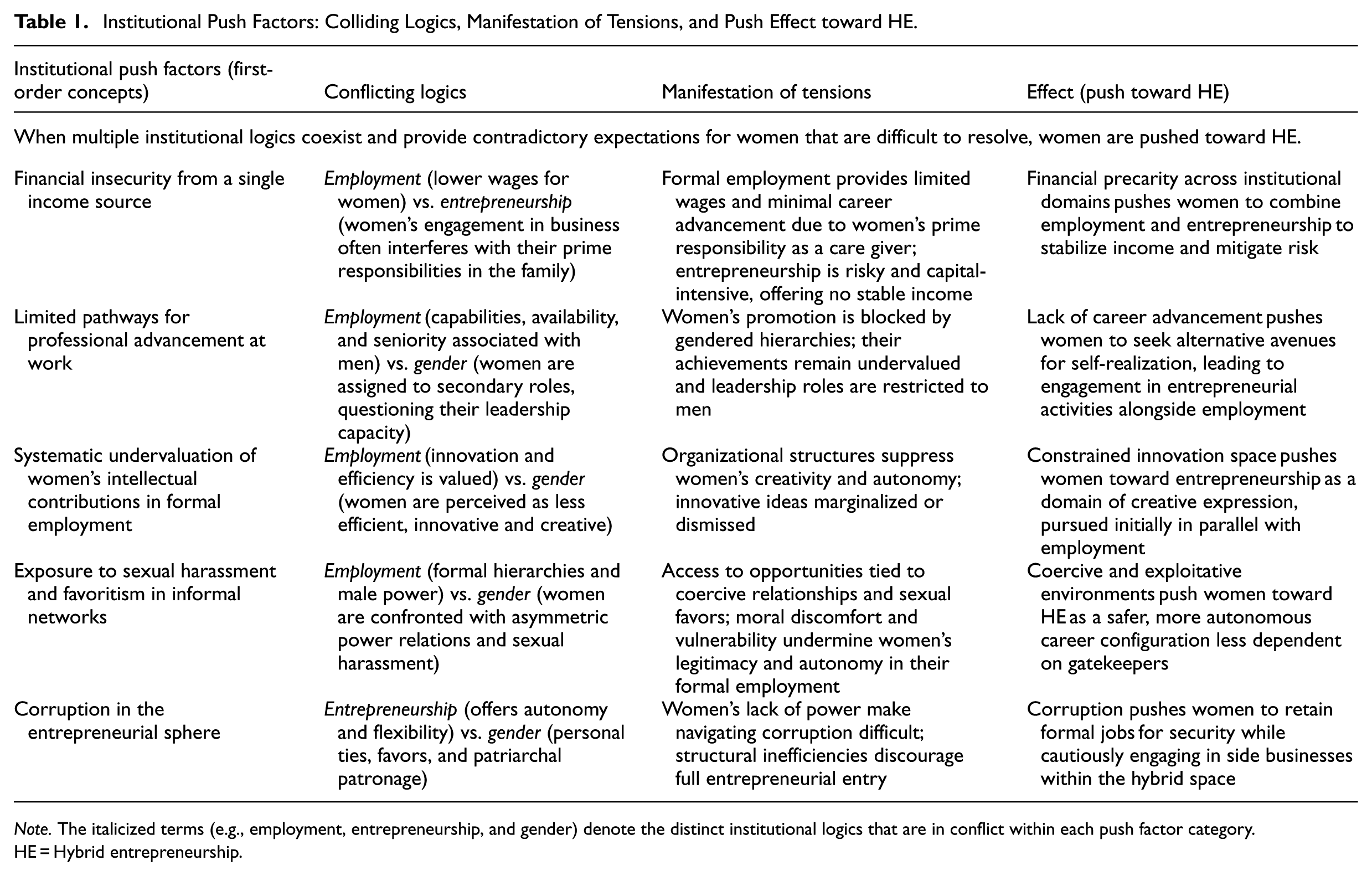
Note. The italicized terms (e.g., employment, entrepreneurship, and gender) denote the distinct institutional logics that are in conflict within each push factor category.
HE = Hybrid entrepreneurship.
Institutional Pull Factors
Being exposed to multiple logics can also create complementarities that pull women toward HE. Through their embeddedness in formal employment, women gain access to networks, legitimacy, and resources that can be mobilized for entrepreneurial activities. These resources are often inaccessible outside organizational settings, particularly in contexts where access to markets and capital is limited. Particularly for women with higher levels of education and higher positions in organizations, HE is attractive, as organizational affiliation provides access to clients and networks. For example, KU6 explained how her move to the CEO’s office reshaped her routine interactions, bringing her into contact with people whose activities resonated with her own emerging business interests: The advantage of working in this position, for example, someone I met after I moved to the CEO’s office frequently travels to Dubai for business activities. Of course, he does big business! (Laughs.) This is not something women like me typically do, but he connected me with local women in Dubai who do similar business and are willing to send me products. (KU6)
This case illustrates how formal employment provides access to networks that are typically beyond reach. At the same time, KU6’s case demonstrates the how push and pull factors interact: while gender norms confined her to a secretarial role in her formal employment and pushed her to seek opportunities outside her job (see previous section), her embeddedness in the same organization opened doors to valuable contacts that pulled her toward HE. In some cases, the organizational affiliation also protects from harassment and bribery as FAN30 notes: …since I work here [the paid job position], those officers who give hard time for others asking do not ask me for bribery […] I don’t face lengthy process in the custom clearance process […] I even support other people on this which is another opportunity for me to connect. (FAN30)
Moreover, other participants noted that their organizational embeddedness enhances reputation and legitimacy facilitating trust and access to financial resources. As WM24 noted: […] people from outside respect the organization, and all people who work here, regardless of our position, because it is the Supreme Court […] this helped me to start and run the side business […] for example, I got goods in a credit from ‘suppliers in mercato’ [the biggest market in Ethiopia]. (WM24)
While gendered norms and expectations in formal employment confined her to a low-ranking role (see previous section), her formal role also enhanced her trustworthiness in the entrepreneurial domain, enabling her to access supplier credit and initiate entrepreneurial activities. Similarly, DM3 notes: “when I was introduced to the managers as a [name of the company] worker, he trusted me and agreed to work with me in this business.” Here, HE allows women to leverage the symbolic capital of employment while engaging in market-based activities that generate additional income.
Some participants also noted that their organizational environment fosters creativity and practical innovation offering new opportunities that pull them toward HE. As MEG19 explained: […] our school system encourages us to be creative in terms of ensuring the practical application of what we teach… this encouraged me to use my talent in design, and I saw this as an opportunity when it comes to designing clothes that later motivated me to make it a business… (MEG19)
The same institutional environment that constrained her professional advancement (see section before) also fostered creativity and offered a pathway for creating a business.
Finally, collaborative social structures rooted in customs and traditions facilitate collaboration and provide strong pull factors that shape women’s pursuit of HE. While BEZ14 described how gendered networks and coercive dynamics pushed her away from dependence on formal career advancement toward HE (see previous section), she also reflected on how communal cultural values—locally referred to as Maheberawi Nuro, a traditional, communal way of life deeply rooted in shared social values—often serve as pull factors for women in lower-ranking positions with low salaries. For instance, BEZ14 shared, “[…] my co-workers supported me to start the side business. […] our Maheberawi Nuro at our office is strong.” Similarly, AD15 noted how gendered attitudes in her paid job pushed her toward HE (see previous section). At the same time, she also emphasized how informal and relational networks at work created a supportive base to engage in entrepreneurial activities: “[…] because we depend on each other, and this creates good relationships and a supportive work environment, that helped me in starting and running my business […].” While gender norms discouraged her from investing further energy in her formal work setting, collegial solidarity within the workplace provided the encouragement and resources to engage in entrepreneurial activities.
Together, intersecting logics around formal employment, entrepreneurship, family, community and gender norms do not only create conflicting demands that push women toward HE but also create productive dynamics that pull women toward HE. Specifically, expectations of organizational affiliation and embeddedness, along with community norms such as Maheberawi Nuro, provide access to networks, resources, and support typically beyond reach. Table 2 provides a summary of the key concepts that function as institutional pull factors.
Institutional Pull Factors: Overlapping Logics, Manifestation of Complementarity, and Pull Effect Toward HE.
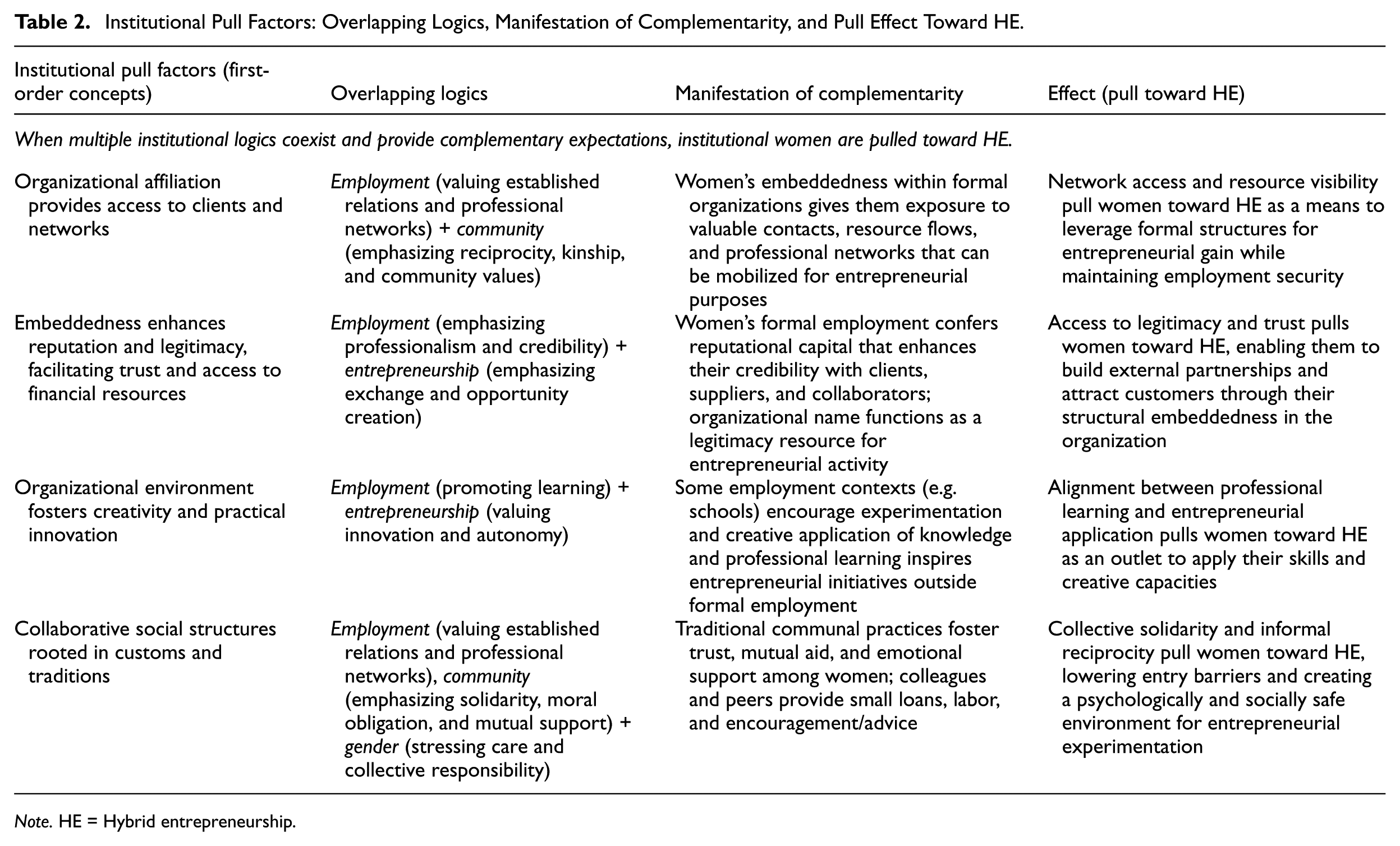
Note. HE = Hybrid entrepreneurship.
Creating and Enacting Liminal Space for HFE
Once women engage in HE, its enactment unfolds within what we conceptualize as “liminal space,” that is, spatio-temporal configurations that are relationally constituted through everyday interactions across employment, entrepreneurial, and community domains. These “in-between arenas” are not pre-existing structures but come into being through entrepreneurs’ ongoing engagement with others where multiple, at times conflicting, logics of employment, entrepreneurship, community, and gender intersect. Our analysis identifies three central practices—reconfiguring boundaries, cultivating gray areas and ambiguity, and sustaining webs of reciprocity—that sustain liminal space and enable HFE.
Reconfiguring Boundaries
This practice involves collaboratively redefining and repurposing the boundaries between wage employment and entrepreneurial activity. Hybrid female entrepreneurs engage in an ongoing, relational process through which they negotiate legitimacy, resources, and expectations with multiple actors, including colleagues, supervisors, and community members. Through such engagement, hybrid female entrepreneurs actively construct spaces in which the boundaries between employment and entrepreneurship become more flexible, allowing their hybrid activities to gain legitimacy through relationships and trust rather than through formal recognition. DAM3’s case is one of the many examples that demonstrate this practice: I saw a space which I could use to make the “yejebena buna” [coffee brewed using a distinctive clay pot] so, I asked the staff first if they are willing to drink coffee if I start making “yejebena buna” and most of them showed interest and I got the permission to start […] (DAM3)
DAM3 negotiated permission to use unused office space to prepare yejebena buna (traditional coffee), integrating the activity into workplace culture and collective enjoyment. She aligned her business with existing organizational resources by identifying an underutilized physical space within her office and informally gauging interest among colleagues. Her possibility to blur the boundaries between her formal employment and her emerging entrepreneurial role is central to this process. At first, DAM3’s side business was informal and stemmed from informal connections and a sense of collective support at work. However, her business progressed toward formalization with the employer’s agreement as her co-workers expressed interest and interacted with the idea. As she put it, “[…] now it is like part of my [paid] job […] all the staff and the supervisors use my service [side business] while we also interact for office duties […].” This practice exemplifies how hybrid female entrepreneurs reconfigure the boundaries between paid jobs and entrepreneurial activity: through negotiations through which they redefine legitimacy, resources, and expectations with colleagues and superiors. Similarly, a colleague of SFR8 said, “[…] we work in the same office, I am happy to help her official work when she goes for her other work [entrepreneurial activities] during working hours […] […], in such a way her absence does not affect her formal duty […]” SFR8 relied on colleagues to cover official duties during her business activities. By establishing official arrangements to ensure that her temporary absence would not affect her formal duties, SFR8 and her colleague negotiated and redefined the boundaries of SFR8’s paid job role to accommodate her informal business. This mutual arrangement allowed her to integrate entrepreneurial activities into her schedule without jeopardizing her formal employment. Similarly, MA11’s case shows how boundaries are reshaped through informal acceptance by colleagues: …she buys the items for her business from Dire Dawa city on her way for official duty; they are cheaper there,…um as an auditor she has the chance to travel, which helps her to use official time for the business as well, organizational vehicle to transport the goods…she manages effectively both her official duty and the business in the same trip…that is not a problem as long as her formal duty is not affected. (Colleague of MA11)
MA11’s case demonstrates the reconfiguration of roles and boundaries, where she strategically aligns work-related travel and organizational resources with her business operations. By explicitly negotiating with colleagues, the normative demarcation between formal employment and private business is not only blurred but redefined to accommodate and legitimize the informal business within the existing work context. Similarly, MUD 25 showed how hybrid female entrepreneurs actively reconfigure the boundaries between paid jobs and entrepreneurial activity. She explained: In most organizations that I go to deliver documents or letters as part of my regular duty, I carry the goods with me which I can sell to workers in these organizations on my way […] most of my colleagues and leaders know this, as long as it does not affect my regular responsibilities that is not a problem [….] I have good interaction with people in different organizations, I tell them my situation, they are happy to buy my products. (MUD25)
She transforms her formal employment duties and mobility into a channel for entrepreneurial activity. By openly communicating her situation and gaining the understanding of her colleagues and clients, she negotiates legitimacy for her enterprise within the structure of her paid employment. This illustrates how hybrid female entrepreneurs expand the functional and relational scope of paid work, turning professional interactions into legitimate spaces of entrepreneurial engagement. Moreover, MEA20 described how she managed business demands without undermining her teaching role: “when I couldn’t teach on a particular date because I had to collect items for my business, one of my colleagues handled the class, and no loophole was created.” This account illustrates of co-workers enables her to negotiate and redefine the boundaries between her paid job obligations and her side business. She strategically adjusts the boundary through collegial support, which enables her to enact business activities while maintaining legitimacy as a teacher.
Cultivating Gray Areas and Ambiguity
A second key practice through which hybrid female entrepreneurs enact liminal space is cultivating gray areas and ambiguity. In contrast to reconfiguring boundaries, which involves collaboratively redefining and repurposing boundaries, cultivating gray areas refers to collectively maintaining a degree of ambiguity in situations where institutional rules remain unclear. This ambiguity is not hidden but quietly sustained through tacit, relational understandings among co-workers. Such understandings allow women to carry out hybrid activities that stretch—but do not overtly violate—prevailing norms and regulations, thereby preserving legitimacy while enabling flexibility. For instance, IMU5’s case exemplifies how hybrid female entrepreneurs tactically create and sustain liminal spaces by leveraging institutional ambiguity. She states, I conduct experiments for poultry feeds, it is part of my business, and I do it inside the university laboratory. I try to ensure it doesn’t interfere with my official research work, but sometimes it is hard to draw a clear line between them.
In this case, IMU5 uses the university’s lab without explicit permission and navigates unclear boundaries rather than negotiating or redefining them. This act reflects a deliberate yet cautious use of institutional resources in ways that stretch but do not overtly violate formal rules. She said, “It is hard to draw a clear line,” showing the tension of working within overlapping domains. It emphasizes how hybrid female entrepreneurs navigate gray areas where expectations are flexible, and rule enforcement is uncertain. Importantly, this gray area is sustained not only by IMU5’s discretion but also by the tacit tolerance of colleagues and supervisors, who are aware of such overlaps yet refrain from enforcing strict boundaries. As her spouse, who works in the same organization, explained, “…no one talks about it, but it is understood that we sometimes use the lab for personal research because there is no strict rule against it; as long as it is for a good purpose, people usually overlook it […].” This illustrates how ambiguity is collectively maintained, enabling IMU5 to operate in a liminal space supported by shared silence and informal norms rather than explicit permission. In addition, most women in our study engage in informal saving groups (i.e. Ikub) within the formal jobs’ context. Ikub plays a key role in financing their side businesses; however, it operates within an institutional gray area, neither explicitly prohibited nor formally permitted.
I joined Ikub with other colleagues. With this, I could increase the number of orders I place so that I do not run out of stock so frequently and address customers’ needs […] allowing me to deliver them whenever needed […] … it does not affect our regular duties, in fact there is no rule that prohibit or permit Ikub at work. (HA2)
By leveraging this regulatory ambiguity, hybrid entrepreneurs expand their business operations while maintaining their employee role, subtly blending entrepreneurial and paid job activities without triggering institutional resistance. This relational practice relies on exploiting ambiguity rather than openly negotiating or contesting formal rules. DM1 colleague also explained: “…her position as sourcing specialist enable her connect with clients, she can also use the organization’s vehicle for transporting the items, but that is normal, most people here do something small on the side […].” DM1’s ability to channel the symbolic capital of her paid job into her business depends on the tacit acceptance of colleagues and supervisors, who recognize such practices as normal rather than inappropriate. This shared silence enables DM1 to use formal employment resources informally, thereby cultivating a gray area that supports her entrepreneurial activities. Similarly, AL27’s case further illustrates the strategic use of such gray zones, as her colleague explained: Her position in the school also helped her with the side business. The drivers who deliver logistics for the school feeding program also bring her the items she needs for the business on their way, which saves her time and transportation costs. This should not be a problem, as it does not violate any rules […] (LA 27)
AL27 informally taps into the school’s logistics network to lower operational costs and facilitate procurement for her side business. These actions are framed as non-deviant from formal regulations while acknowledging the absence of explicit endorsement. Moreover, WM24 explained how she tactically exploits institutional silences to extend their entrepreneurial activities while still appearing compliant. She said, “[…] when the judicial officers are in closed meeting sometimes the whole day and no court room’s activities, I focus on business, there is no rule which says I must sit in my office doing nothing […], I can use this time without affecting my formal work […].” This example illustrates how hybrid female entrepreneurs recognize and tactically occupy unregulated institutional pockets. WM24 emphasizes that there is “no rule” requiring her to remain idle. By carefully navigating this regulatory ambiguity, she could engage in hybridity without overtly violating norms or disrupting her formal responsibilities.
Hence, cultivating gray areas is inherently relational. These ambiguous spaces persist because co-workers, supervisors, and other institutional actors tacitly approve them—whether by overlooking minor boundary blurring, participating in informal practices such as Ikub, or informally facilitating logistics and market access. This collective tolerance enables hybrid female entrepreneurs to operate in ways that stretch institutional norms without triggering sanctions.
Sustaining Webs of Reciprocity
This practice involves intentionally creating value for and with others such as colleagues, supervisors, or clients so that they develop a shared stake in the side venture. It centers on building reciprocal arrangements in which both the entrepreneur and key stakeholders benefit from the activity, enabling the effective pursuit of side business within paid employment settings. In contrast to the other two practices, which primarily focus on opening new possibilities, sustaining webs of reciprocity ensures the continuity and stability of HFE by embedding it within ongoing relationships of mutual support and obligation. MA11’s example illustrates how hybrid female entrepreneurs foster mutual benefit by intentionally embedding their side business within reciprocal relationships at the workplace: Most of my colleagues also run side businesses, and I buy from them as well […] we buy from each other on credit and pay at the end of the month […] the price of the product we buy from each other is much less than when we buy from market […]we support each other and that is important for us to combine our regular duties with the business. (MA11)
In this case, MA11 engages in informal business networks where colleagues buy from each other on credit and at discount prices, creating value for her co-workers, who thereby gain a direct stake in her entrepreneurial activity. These reciprocal arrangements build trust, strengthen collaboration, and reduce risks for all involved. Importantly, such practices secure the continuity and acceptance of HFE within the formal paid job settings, as colleagues are not merely passive observers but active participants who benefit from the side business. In this way, fostering mutual benefit ensures that entrepreneurial activity is sustained through ongoing relationships of reciprocity and support. Another illustration of how hybrid entrepreneurs create mutual benefits is the intentional creation of value for clients through exceptional service in formal employment: Customer satisfaction is part of my main job as a division manager. Happy customers are important to attract and keep a client for my company. That also pays off because these customers helped me with my side business… in fact, they encouraged me to start from the beginning. (OBE31)
By exceeding clients’ expectations, she not only secures advantages for her employer but also builds lasting trust and goodwill with clients. This trust creates a reciprocal dynamic, whereby satisfied clients invest in her entrepreneurial journey, offer encouragement, referrals, and even resources that help her business grow. Their support is not incidental but arises precisely because they have benefited from her professionalism and therefore see her business as a continuation of the value she already provides. Such reciprocity sustains HFE by embedding it in enduring and reliable client relationships, ensuring continuity and stability beyond the uncertainties of both formal employment and entrepreneurial activity. Moreover, by intentionally cultivating reciprocal relationships with colleagues, hybrid female entrepreneurs navigate potential resistance to running side ventures during official working hours. These partnerships are not merely born out of convenience but represent collective endeavors that generate mutual benefits. For instance, TS9 reflected: […] It is for win-win scenarios to avoid any potential resistance to having a side business. While I am at some task, my colleagues, who are also partners, take over the task for a moment […] this is important as most of us don’t have working capital, but we earn a margin or profit as the product passes through our hands. (TS9)
TS9’s case demonstrates how a reciprocal arrangement enables the embedding of a side business within the formal employment sphere, making it more sustainable despite limited working capital. Similarly, BIN29 explained, “The staff supported me to start the refreshment service within the kitchen at the workplace, I am a messenger, I serve them something healthy while I do my regular duty.” BIN29 combines her paid job with a side business by fostering mutual benefit. By offering refreshments to colleagues while performing her messenger duties, she integrates entrepreneurial activity into her workplace routines in a way that serves both her business and the preferences of her co-workers, thereby sustaining acceptance of her business within the formal setting.
Implications of HFE
We found that women’s hybrid engagement simultaneously fosters experiences of business and work enrichment, empowerment, and exhaustion. These experiences, in turn, contribute to the reinterpretation and subtle transformation of the institutional norms that shape hybrid female entrepreneurs’ environment.
Business Enrichment
Our analysis shows how the boundary work of HE enables women to access networks, enter influential business circles, gain visibility for the business, and obtain better customer deals. In doing so, HE helps transform the benefits of organizational affiliation into tangible business outcomes. Many women reported that engagement in HE enabled them to participate in business circles that had previously been out of reach. For instance, FAN30’s case illustrates how HE extends legitimacy into broader network access. She explained: The image of my organization is something I can offer in the business network, because most of the big businessmen interact with my organization in relation to their work and other issues. I now participate in business events and networks that these people organize, which wouldn’t have been accessible had I not started the business. (FAN 30)
FAN 30’s case highlights how HE enables her to use organizational affiliation to enter influential business circles and gain visibility in networks that would otherwise remain inaccessible. Our findings also show that through HE, women gain visibility and credibility for their entrepreneurial activities. For example, ZEP22 explained, […] as an administrator in this respected business center, sellers trust me and offer me deals they wouldn’t offer others […] customers also believe in the quality of what I resell because they know I am connected to the center.
This case demonstrates how engagement in HE enhances women’s visibility and status within formal institutional spaces, which, in turn, translates into tangible market advantages such as preferential deals, customer trust, and broader acceptance of their business activities. Similarly, KD4 explained: […] people do trust me because of where I work…they could make me accountable if something goes wrong, so [I] connect individuals who want to rent or buy or sell houses to brokers with whom I share the commission. (KD4)
This position of trust and credibility helps her to build confidence among clients and negotiate exceptions in everyday transactions. Thus, women can lower barriers of suspicion, establish stronger client relationships, and secure opportunities through HE that would otherwise be inaccessible. Similarly, ME7 emphasizes, […] By starting the side business, I could also take the opportunity to network with key suppliers and wholesalers of cosmetics, whom I encounter in my regular duties as a business center facility officer; these people rent shops and warehouses in our building. (ME7)
Hence, HE fosters business enrichment by enabling entrepreneurs to draw on their organizational role as a source of legitimacy. Like FAN30, ME7 gains access to networks with key suppliers and wholesalers that are crucial to her business activities. Therefore, HE enables women to channel multiple forms of value from their formal job.
Work Enrichment
This implication involves positive spillovers from women’s businesses to their formal employment. Our respondents indicate that entrepreneurial activity feeds back into the formal work sphere by enhancing job meaning, performance, and workplace social capital. For example, OD 17 reflected on how entrepreneurial engagement led to a re-evaluation of her formal job, thereby increasing its perceived meaning.: I became more committed to my jobs, because I realized that it opened many doors for my business activities, for example, it connected me [to] important people, also [to] sell the products to and through my colleagues […] I could see its value now [more] than before I started the business. (OD17)
This example shows how hybrid experiences transform paid employment from a routine obligation into a strategic platform for advancing entrepreneurial goals. Similarly, LEL16 explained how HE enhances workplace performance, particularly among lower-income staff. She said, “[…] I have become more committed to my regular job and more satisfied overall, from my commitment and performance, my workplace [organization] also benefited from this […].” This case demonstrates how entrepreneurial activity improves organizational performance. Moreover, HE is seen as fostering stronger interpersonal bonds and increasing social capital within the workplace. A colleague of BLE23 shared: […] she encouraged me to start my side business. Now we support each other in business activities and our regular duties at the workplace. It has brought us closer together. Our job is where we all meet and do business. (Colleague of BLE23)
Hence, shared entrepreneurial activities among peers at the workplace can cultivate solidarity and peer support, positively affecting both business efforts and paid work collaboration. In general, these insights demonstrate how HE can enhance workplace cohesion by stimulating the entrepreneurial activities that enrich formal employment.
Empowerment
Participants also reported how HE has fostered their economic, social, and psychological empowerment. For example, MUD 25 said that running a business alongside her job created financial security that allowed her to support her son’s university education. She noted, “I do not have to worry anymore about my salary not being enough… that is security for my family.” A stable business income reduces stress and builds confidence in meeting family needs, enabling long-term planning rather than short-term survival. Similarly, DAM3 highlighted how financial independence enhances social status: I get more money and with money, it is not difficult to build strong social status […] people admire that I work hard in multiple responsibilities, often I get compliments from my people. Now I could easily make monetary contributions in social activities. (DAM3)
Household dynamics are also changing because of economic empowerment. AD15 shares that, […] my husband used to struggle financially, […] this business has improved our life as a family […] I often go to deliver orders and buy the logistics that I need after work, so I come home late. This time, my husband takes care of the children; he also encourages me in my work [business].
This reflects a shift in traditional gender roles, where women’s income and autonomy are increasingly acknowledged and valued within the family.
Moreover, many hybrid female entrepreneurs highlight the importance of psychological empowerment induced by their business activity, particularly when their engagement in HE stemmed not from a primary desire for financial gain, but from the pursuit of innovative ideas that were unsupported or undervalued within in the formal employment sphere and more self-directed professional development. For example, IMU5 explains how HE served to realize alternative professional aspirations, particularly in environments where women’s ideas are marginalized: […] I have not yet gained any financial benefits from this business. …in fact, that is not the main intention in the first place, as long as the profit from the business enable the social project ongoing. That is ok with me, personal fulfillment? Now I realize that I am capable of initiating projects and mobilizing people to collaborate. I am also glad that I did not give up, even when I couldn’t get support from the university [employer] to fund my ideas. Overcoming these challenges has taught me resilience, and I now believe that achieving even greater personal accomplishments is within my reach. (IMU5)
Similarly, KU6 highlights the empowering role of HE in fostering self-recognition and entrepreneurial confidence: […] yes, I have started considering myself more as a strong woman who is capable of overcoming challenges. I believe that I am capable of doing what I set my mind to. It gives me confidence and strengthens me. […] combining both activities has made me become active to analyze my situation […]. (KU6)
Finally, FE10 highlights the freedom she enjoys in the entrepreneurial domain echoing the importance of autonomy and personal empowerment. She said, “[…] when it comes to the business, it is the place where I fully exercise my independence, I don’t have to stick to certain rules […].” Hence, entrepreneurship is often perceived as a domain of autonomy and creativity, a pathway to realize career aspirations while the formal job offers necessary financial and relational capital.
Exhaustion
HE can also create unique challenges for women. Many women reported that they were already burdened with their formal employment responsibilities, their family responsibilities, and their community obligations. Their engagement in economic activities (whether through employment or entrepreneurship) did not exempt them from traditional gendered expectations such as domestic duties and community involvement. Consequently, many women in our study experienced what we label as a quadruple role burden, that is, the compounded workload resulting from the intersection of employment, entrepreneurship, family, and community responsibilities. This experience is well illustrated in the quote by OD17: […] to be honest, professional women are still responsible for family and social affairs like in our mothers’ or grandmothers’ time. On top of that, now we are also workers, and taking on a side business increases the responsibilities and workload. It is often exhausting because we need to fit into all these expectations […] (OD17)
While HE may offer enrichment and empowerment for many women, it can also lead to exhaustion intensifying gender roles, particularly in contexts where support systems (e.g. shared domestic labor, accessible childcare) are limited or nonexistent. This reinforces gender norms by positioning women as responsible for accommodating additional work, while structurally constraining their access to professional development and career advancement. For instance, MEA 20 said: As I mentioned, it [the business] has many benefits, but the workload is undeniable, with no time to take part in something extra […] for example, there is a continuous training opportunity at our school. I could get a certificate in sign language that could update my profile and allow me to take part in important meetings and events where people often need a sign language expert. I could also get better income from this. (MEA 20)
This illustrates how the added workload limits hybrid female entrepreneurs’ ability to engage in professional development, suggesting that the accumulation of responsibilities constrains opportunities for advancement. In this way, hybrid engagement can inadvertently reproduce gendered inequalities by constraining women’s upward mobility. FMA18 further emphasized, “This [side business] is not replacing my previous work; rather, it adds an additional responsibility, leaving me with no time to focus on myself or my profession.” Taken together, rather than displacing existing obligations, engagement in HE layered additional work onto an already demanding set of responsibilities, leaving traditional gender norms not only intact but reinforced.
Discussion
Our study explores how HFE unfolds under conditions of institutional complexity. The findings demonstrate that institutional complexity, although constraining women’s engagement and advancement in both full-time entrepreneurship and paid employment, can also pull women toward HE. They also show that HFE is enacted and sustained within liminal space: spatio-temporal configurations that are continuously constituted through the practices of boundary reconfiguration, navigating ambiguity, and sustaining reciprocity. Through our findings, we develop a relational understanding of HE and show its multifaceted implications. We thereby contribute to the literature on hybrid entrepreneurship, female entrepreneurship, and institutional complexity.
Contribution to the Hybrid Entrepreneurship Literature
We make two contributions to the HE literature. First, we advance research on HE by shifting its conceptualization from an individually agentic act to a relationally co-constructed process. Prior work, largely developed in contexts with strong formal and market-based institutions, portrays HE primarily as a strategic choice through which entrepreneurs reduce risk (Benitez et al., 2024; Folta et al., 2010), test feasibility (Raffiee & Feng, 2014), secure income (Demir et al., 2022), balance roles (Benitez et al., 2024; Klyver et al., 2020), or manage identity (Carr et al., 2023). These framings position hybrid entrepreneurs as autonomous actors whose hybrid engagement reflects rational calculation under uncertainty (Folta et al., 2010; Raffiee & Feng, 2014), responses to uncertainty across entrepreneurial and employment domains (Gänser-Stickler et al., 2022) or the cognitive structuring of intrapersonal identity networks (Fenters et al., 2025). In contrast, our findings from a context in which informal and non-market institutions prevail reveal HE as a fundamentally relational endeavor. Rather than emerging from individual calculation or career choice alone, HE is an ongoing accomplishment sustained through negotiation and collaboration with employers, business partners, family members, and community actors who tolerate, enable, or even actively participate in hybridity. By bringing HE research into institutional terrain where informal norms, reciprocal obligations, and non-market relations constitute primary structuring forces, our study shows that hybrid entrepreneurship is not simply enacted by individuals but co-produced through the social relationships in which it is embedded.
Second, we advance the HE literature by explaining how hybridity is enacted and sustained, particularly in contexts with strong informal and non-market-based institutions. While prior research has examined why individuals enter or remain in hybrid entrepreneurship (Brändle & Kuckertz, 2022; Folta et al., 2010; Raffiee & Feng, 2014), it offers limited insight into how HE is enabled and maintained in practice. We conceptualize HE as emerging through the creation and maintenance of liminal space, an in-between domain in which the boundaries between employment and entrepreneurship are intentionally blurred and left partially undefined. Our findings show that hybrid female entrepreneurs in Ethiopia sustain hybridity through three interrelated practices that blur these domains: reconfiguring boundaries, cultivating ambiguity and gray areas, and sustaining webs of reciprocity. Through reconfiguring boundaries, women continuously negotiate and redefine the limits of paid employment and business in interaction with others. In so doing, they stretch and reshape these boundaries to accommodate their entrepreneurial activities, creating a liminal space that enables hybridity. This challenges the dominant view in HE research that tends to treat employment and business as distinct domains (Albrecht et al., 2026; Folta et al., 2010). Through cultivating ambiguity, hybrid female entrepreneurs intentionally keep roles and expectations partially undefined. While prior research has examined tension and strain in HE, pointing to overlapping and potentially unclear role expectations, these conditions are predominantly framed as sources of role conflict or resource strain (Kuske et al., 2025; Mmbaga et al., 2023). Our findings extend this view by showing that ambiguity emerging from such unclear expectations is not only constraining, but can also be actively sustained as a productive capacity that enables hybridity. Finally, through sustaining webs of reciprocity, hybrid female entrepreneurs maintain ongoing relationships with employers, family members, and community actors who tolerate, enable, and at times actively participate in hybridity. Existing research typically explains HE, including both its persistence and eventual exit, through individual-level mechanisms, such as resource accumulation, opportunity evaluation, and the management of role conflict (Brändle & Kuckertz, 2022; Carr et al., 2023; Folta et al., 2010). In this view, whether individuals remain hybrid or transition out of hybridity is understood as personal capability and decision-making under competing demands of entrepreneurship, paid job and “private life” (Kuske et al., 2025). In contrast, we show that persistence in HE depends on the continued alignment and mutual accommodation of multiple actors, foregrounding the co-constitutive nature of HE in settings with strong informal and non-market institutions.
Contribution to the Female Entrepreneurship Literature
Our study contributes to the literature on female entrepreneurship by shedding light on how HE can serve as an empowering pathway for women navigating institutional and gendered constraints. Much of the existing scholarship emphasizes structural barriers that subordinate women within male-normed systems, thereby portraying female entrepreneurship as constrained or deficient (Ahl, 2006; Brush et al., 2009; Marlow & Patton, 2005). While we acknowledge that such barriers can discourage women from taking entrepreneurial action or growing their business (Jennings & Brush, 2013), we respond to critiques of deficit-oriented framings (Ahl, 2006; Marlow & Swail, 2014) and suggest that women are not merely passively responding to constraints. In contrast, we show how they actively engage in HE to negotiate legitimacy, mobilize resources, and subtly reshape institutional expectations in interaction with others. In doing so, we conceptualize women’s agency as contextually embedded and capable of gradually altering institutional arrangements and meanings over time. Emerging at the intersections of paid work, entrepreneurship, and community life, this form of agency enables hybrid female entrepreneurs to reconfigure organizational boundaries and expand zones of institutional indeterminacy. Agency therefore operates not only as a response to structural constraint but also as a force through which structures are gradually reconstituted from within. Accordingly, we complement and extend recent work that conceptualizes entrepreneurship as a form of emancipation (Datta & Gailey, 2012; Lewis & Crabbe, 2024; Rindova et al., 2022; Scott et al., 2012) by reframing emancipation as a relational enactment process through which situated, interactional practices accumulate and produce incremental changes, rather than a discrete individual act of liberation. This deepens our understanding of women’s entrepreneurial agency as embedded and contributes to broader theorizing on how entrepreneurship can incrementally reshape gendered institutions from within. At the same time, our findings highlight the ambivalent nature of this process: the additional workload associated with HE can generate exhaustion, thereby inadvertently reinforcing gendered role expectations and inequalities.
Second, we challenge the dominant narrative that female entrepreneurship in developing countries is primarily necessity-driven. Prior research often situates women’s entrepreneurial activity within a logic of survival and limited choice (Appiah et al., 2025; De Vita et al., 2014; Simba et al., 2023). Our findings demonstrate that hybrid entrepreneurship can also be an opportunity-driven strategy for women seeking personal and occupational advancement. By maintaining formal employment while developing business ventures, women gain access to networks, credibility, and resources that would otherwise remain unattainable. This perspective reframes female entrepreneurship under institutional constraints as proactive and aspirational rather than merely reactive. Our findings also relate to the broader literature questioning the dichotomy of opportunity and necessity entrepreneurship and the underlying assumption that necessity entrepreneurship is incompatible with taking agentic action to pursuing an opportunity (Nabi et al., 2015; O’Donnell et al., 2024; Williams & Williams, 2012).
Contribution to the Literature on Entrepreneurship and Institutional Complexity in Non-Western Settings
Finally, we contribute to research on entrepreneurship under conditions of institutional complexity (Nason & Bothello, 2023; Welter, 2011) showing that for women HE has both empowering and disempowering implications. While recent work has proposed that the interaction of gender with formal and informal institutions creates space for women’s entrepreneurial agency, it is unclear whether that space is enabling or carries its own constraints (Ejaz et al., 2023). Our study shows that institutional complexity can drive HE for women, generating not only experiences of enrichment but also forms of empowerment that extend beyond the cross-domain resource transfers that existing HE research has foregrounded (Asante et al., 2022). At the same time, while existing HE research has established that dual engagement generates well-being costs and exhaustion at the individual level (Ardianti et al., 2022; Kuske et al., 2025), our study shows that these costs may have a specific gendered source: women’s ongoing relational engagement to enact HE adds to the domestic and communal responsibilities women are expected to bear, creating a “quadruple burden” that intensifies their overall workload without redistributing the expectations that produce it. This suggests that the enabling role of informal and non-market institutions cannot be fully understood without also recognizing the gendered costs through which that enabling capacity is sustained. These costs are not incidental to the richness of informal institutions but often structurally embedded within it: the same reciprocal obligations and communal embeddedness that enable HE also bind women to the continual relational work required to maintain it, layered on top of existing domestic and communal responsibilities. We therefore suggest that accounts highlighting the richness of non-Western informal and non-market institutions (Bothello et al., 2019; Nason & Bothello, 2023) are most complete when they incorporate gender as a constitutive dimension of how those institutions are experienced.
Practical Contributions
Our findings also carry important implications for policymakers and supporters of female entrepreneurship in settings with strong informal and non-market institutions. First, we argue that interventions aimed at fostering female entrepreneurship in these contexts should present and teach HE as a relational practice that counters existing gender barriers. Importantly, HE holds the capacity to transform the system from within, as it allows women to pursue emancipation and agency without overtly violating existing social gender norms. Second, we provide concrete insights into relational behaviors that can be deliberately trained and practiced (i.e. reconfiguring boundaries, cultivating gray areas and ambiguity, and sustaining webs of reciprocity). These behaviors represent actionable levers for enhancing the effectiveness of support programs. Moreover, we highlight the multi-level benefits of supporting HE, creating gains that go beyond female entrepreneurs and their immediate environment. Female entrepreneurs’ hybrid strategies foster not only their personal and organizational growth but also contribute to other stakeholders’ well-being. However, our findings also caution that without adequate structural supports (e.g. equitable distribution of domestic labor), HE may intensity women’s workloads and inadvertently reinforce existing inequalities. We thereby contend that the support of HFE is a high-impact investment for policymakers as it strengthens entrepreneurial ecosystems, reduces structural gender inequalities, and advances progress toward SDG 5 (Gender Equality). But to fully realize its potential, this support must be paired with measures that mitigate unintended consequences.
Limitations and Future Research
This study is not without limitations, which also open valuable avenues for further research. First, while the study is rooted in the Ethiopian context, its theoretical insights extend beyond it. The relational and adaptive mechanisms identified are likely to emerge wherever formal institutions become less reliable. For instance, regulatory gaps around digital innovation and AI indicate that institutional fragility is not limited to non-Western settings. Future research could compare how hybrid entrepreneurs navigate contexts with less stable formal and market institutions. Second, as the data focuses exclusively on women, the findings do not allow for gender comparisons and should be interpreted as reflecting the experiences of female hybrid entrepreneurs in this context. Additionally, participants entered formal employment before starting side businesses, as the reverse pathway appears to be rare in Ethiopia. Future studies should include individuals who began with entrepreneurship and later entered formal employment to enable richer comparisons. Third, the study relies primarily on interviews from the first author’s fieldwork. While this provides strong contextual insight, longitudinal ethnographic research could offer a deeper understanding of how hybrid female entrepreneurs engage in relational practices over time and how these practices contribute to long-term institutional change.
Conclusion
Our study advances the conceptualization of HE by mobilizing insights from institutional complexity. Rather than emerging as an individualistic act of balancing dual roles of formal employment and entrepreneurship, HE unfolds as a relationally co-constructed process. We focus on the revelatory case of HFE in a non-Western setting and identify three relational practices—reconfiguring boundaries, cultivating gray areas and ambiguity, and sustaining webs of reciprocity—through which women co-create and maintain liminal space to enact their hybrid engagement. These practices enable women to pursue entrepreneurial activity under constraint while gradually reshaping the institutions in which they operate.
Supplemental Material
sj-pdf-1-etp-10.1177_10422587261453879 – Supplemental material for Toward a Relational Perspective on Hybrid Entrepreneurship: Institutional Complexity and the Co-Construction of Liminal Space in Hybrid Female Entrepreneurship
Supplemental material, sj-pdf-1-etp-10.1177_10422587261453879 for Toward a Relational Perspective on Hybrid Entrepreneurship: Institutional Complexity and the Co-Construction of Liminal Space in Hybrid Female Entrepreneurship by Mulu Hundera, Mona Mensmann and Stefanie Habersang in Entrepreneurship Theory and Practice
Footnotes
Acknowledgements
We would like to express our sincere gratitude to our research assistants at Haramaya University, particularly Mrs Elili Amenu and Mr Wendowosen Feleke, as well as the researchers at Addis Ababa University, including Mr Talila Birhanu and Mrs Liya Mola, for their invaluable support with data collection, transcription, and translation. We also gratefully acknowledge the contributions of women’s informal associations—especially Haile Garment Women’s Idir, “Yemisrach Lealem Hulu Women’s Ibiret,” and “Women’s Mreredaja Mahiberi”—for their vital role in facilitating participant recruitment.

Ethical Considerations
Ethics approval for this research was obtained from the Research Ethics Review Faculty of Management, Economics, and Social Sciences, University of Cologne, Germany, reference number 240052MM.
Consent for Publication
Verbatim informed consent for publication of the data was obtained from the participants at the beginning of each interview and subsequently transcribed. Non-essential identifying details have been omitted to protect confidentiality.
Funding
The authors disclosed receipt of the following financial support for the research, authorship, and/or publication of this article: This work was funded by the Deutsche Forschungsgemeinschaft (DFG, German Research Foundation) under Germany’s Excellence Strategy—EXC 2126/1–390838866
Declaration of Conflicting Interests
The authors declared no potential conflicts of interest with respect to the research, authorship, and/or publication of this article.
Data Availability Statement
The datasets generated during and/or analyzed in the current study are available from the corresponding author upon reasonable request.*
Supplemental Material
Supplemental material for this article is available online.
Author Biographies
Mulu Hundera is Postdoctoral Researcher at the University of Cologne, Germany. Her research focuses on entrepreneurship, gender, and institutional settings. She examines how gender norms, family support dynamics, and institutional environments shape entrepreneurial processes and outcomes across diverse socio-economic contexts. Her work also explores gender dynamics in organizations and the implications of institutional arrangements for entrepreneurship, equality, and inclusion. More broadly, she is interested in how differences in institutional environments influence entrepreneurial behavior and opportunities across developed and developing economies. She employs qualitative and mixed-methods approaches to investigate entrepreneurship and gender-related phenomena. Email:
Mona Mensmann is Professor of Innovation Management and Entrepreneurship at the University of Cologne. Her research focuses on the entrepreneurial mindset, entrepreneurship training, and female entrepreneurship, with a particular interest in how entrepreneurial capabilities can be developed among groups facing economic and social barriers, including entrepreneurs in developing countries, job seekers, and young people transitioning into the labor market. She employs experimental, qualitative, and mixed-methods approaches to examine the development of entrepreneurial capabilities and their implications for economic and personal outcomes. Email:
Stefanie Habersang is Assistant Professor of Digital Transformation at Leuphana University of Lüneburg, Germany. Her research focuses on organizational and strategic change, entrepreneurship for social change, and methodological advances in qualitative research, particularly qualitative meta studies. Stefanie also leads the female entrepreneurship program ScaleF at Leuphana. Her work has been published in the Journal of Management Studies, Organizational Research Methods and Organization Studies. Email:
References
Supplementary Material
Please find the following supplemental material available below.
For Open Access articles published under a Creative Commons License, all supplemental material carries the same license as the article it is associated with.
For non-Open Access articles published, all supplemental material carries a non-exclusive license, and permission requests for re-use of supplemental material or any part of supplemental material shall be sent directly to the copyright owner as specified in the copyright notice associated with the article.
