






Abstract
A tension exists between the potential entrepreneurial strengths associated with neurodiversity and the systemic barriers neurodiverse individuals face within entrepreneurial ecosystems. Applying Ecological Systems Theory, we analyze how neurodiverse entrepreneurs interact with the nested layers (Micro- to Chrono-system) of the entrepreneurial ecosystem. This multi-level perspective reveals how inter-system (mis)alignments create friction, necessitates theorizing neurodiverse ecological niches, and positions neurodiversity as influencing ecosystem co-evolution. We offer a dynamic, interactionist framework that resolves theoretical limitations and provides a foundation for building more inclusive and effective entrepreneurial environments supportive of cognitive diversity.
Keywords
Introduction
Entrepreneurial ecosystems (EEs) have captured significant scholarly attention as dynamic environments crucial for fostering innovation and high-growth ventures (Isenberg, 2011). Contemporary research portrays these ecosystems not merely as geographic clusters, but as intricate systems of interconnected actors, resource endowments, and institutional frameworks that collectively shape the trajectory of new venture creation (Stam, 2015; Spigel, 2017). The vitality of these ecosystems depends fundamentally on the diversity of their human capital (Torres & Godinho, 2022). Concurrently, a paradigm shift is underway regarding human capital within ecosystems via greater consideration of neurodiversity, which reframes neurological variations such as autism, attention-deficit/hyperactivity disorder (ADHD), and dyslexia as distinct cognitive profiles that may confer unique advantages in pattern recognition and innovation toward entrepreneurship (Austin & Pisano, 2017; Wiklund et al., 2018). Such variations may have profound implications for EEs where neurodiverse individuals tend to be sidelined in favor of frameworks implicitly predicated on neurotypical actors as those pursuing entrepreneurship and innovation.
Globally, it is estimated that 15% to 20% of the population exhibits some form of neurodivergence (Doyle, 2020). Excluding this substantial segment of human capital works directly against the ultimate goals of EEs, namely the generation of novel solutions and high-growth ventures. Recent empirical work demonstrates that neurodiversity is a profound driver of innovation and team performance because teams with diverse cognitive profiles benefit from varied problem-solving heuristics, nonlinear thinking patterns, and a wider range of perspectives that collectively mitigate groupthink and facilitate creative problem-solving (Axbey et al., 2023). Therefore, understanding the barriers that these founders face is not merely an exercise in social equity, but a potential strategic win–win for regional economies. By building neuro-inclusive ecosystems, regions could gain access to an untapped reservoir of high-variance cognitive capital that fuels disruptive innovation, while neurodiverse individuals obtain the structural support necessary to commercialize their unique insights. However, the precise dynamics of this potential mutual benefit remain largely unexplored, which is why a multi-level model is necessary.
Despite the potential implications of juxtaposing neurodiversity and EEs, extant research has largely overlooked their parallel importance, in part because theoretical tension exists at their intersection. On the one hand, studies indicate that neurodiverse traits such as ADHD can foster entrepreneurial intention and alertness (Wiklund et al., 2017) and autistic disposition can drive superior systematic analysis of innovation (Baron-Cohen et al., 2007; Ezerins et al., 2024). On the other hand, these cognitive advantages are fundamentally contingent on the interaction with the external environment such that neurodiversity advantage is not automatic but depends on the structural accommodation of the surrounding environment (Tucker et al., 2021). This is where ecosystems enter the equation. Research portrays EEs as engines of innovation where resource support naturally flows to entrepreneurs with high potential concepts (Spigel & Harrison, 2018; Stam, 2015). However, these flows are predicated on social mechanisms such as networking, social signaling, and adherence to normative behavioral scripts (Neumeyer et al., 2019). It is here that we find a functional paradox. EEs implicitly crowd out variation regarding entrepreneur types and the ventures that diverse entrepreneurs create (Wurth et al., 2022). Hence, the dominant architecture creates friction for individuals with neurodiverse profiles as these individuals can struggle to abide by social norms and related expectations, rending the advantages of leveraging EEs inaccessible.
To address this paradox, we develop a conceptual framework that reframes the structural components of the EE (Spigel, 2017; Stam, 2015) as nested interactional layers of social systems to map how neurodiverse entrepreneurs actively navigate network interconnections, institutional gatekeepers, and cultural norms, within the ecosystem to construct functional niches where neurodiversity is advantageously leveraged. This reframing is grounded in Ecological Systems Theory (EST; Bronfenbrenner, 1979) that establishes human cognition and behavior as residing within a complex system of relationships nested within interconnected levels of the surrounding environment. EST provides distinct analytical leverage compared to extant theoretical approaches in EEs ad in discussion of neurodiverse entrepreneurs. Specifically, EST bridges the gap by situating individual neurocognitive traits within a nested hierarchy of environmental layers, enabling a multi-level conceptualization of how neurodiverse entrepreneurs navigate neurotypical standardized norms and systems to identify where ecosystems create interactional friction as opposed to the commonly assumed enablement of entrepreneurship.
By integrating these dynamics at the nexus of ecosystems and neurodiversity our conceptual advances make three contributions to the scholarly conversation. First, we reconceptualize the implications of the normalization of neurotypical assumptions in EEs, foregrounding the interactional frictions that neurodiverse entrepreneurs must navigate as they seek to leverage the benefits ecosystems can provide (Spigel, 2017). Second, building on our ecological analysis of interactional friction we challenge the assumption of meritocratic accessibility in EEs. We identify that the reliance on heterogeneous weak ties within the mesosystem acts as a structural filter that systematically disadvantages neurodiverse founders regardless of venture viability (Granovetter, 1973). By integrating neurodiversity in the ecosystems conversation, we expose how normative social structures within EEs unwittingly suppress cognitive variance. Third, we apply a chronosystem lens to model ecosystem evolution. We theorize that successful neurodiverse ventures function as legitimacy building counter stereotypes that erode the rigid neurotypical norms embedded in the macrosystem (Zimmerman & Zeitz, 2002). This highlights the plasticity of EEs showing how outlier entrepreneurs can reshape the very institutional logic that initially excluded them.
Neurodiversity and Entrepreneurship
This section critically reviews the foundational concepts and literature necessary to build our framework. First, we examine the evolving understanding of neurodiversity, particularly within the entrepreneurial context, highlighting its individual-level focus and inherent tensions. Second, we introduce EST as our core theoretical lens, detailing its multi-level framework and demonstrating how the concept of the EE can be effectively analyzed within this ecological perspective. This structure reveals the lack of integration between individual neurocognitive variation and the multi-level systemic environment of entrepreneurship and position EST as the key to bridging it.
Neurodiversity in Entrepreneurship: Potential, Paradoxes, and Limitations
Neurodiversity refers to the concept that variations in the human brain regarding sociability, learning, attention, and other cognitive functions represent natural human variation rather than inherent deficits or disorders (Armstrong, 2010; Kapp et al., 2013). This perspective acknowledges that conditions such as autism spectrum disorder ADHD and dyslexia can confer distinct cognitive strengths within specific contexts (Austin & Pisano, 2017; Doyle, 2020). Foundational work in this domain highlights potential alignments between these neurodiverse traits and entrepreneurial competencies. For instance, research indicates that ADHD symptoms such as a risk-taking propensity, hyperfocus, and sensation seeking show strong parallels with entrepreneurial action orientation and alertness to new opportunities (Verheul et al., 2015; Wiklund et al., 2017). Similarly autistic traits regarding systemizing pattern recognition and attention to detail align with the demands of deep technological innovation or niche market development (Baron-Cohen et al., 2007; Ezerins et al., 2024). Studies on dyslexia have also pointed toward potential strengths in visuospatial reasoning and the delegation of tasks which may align well with the demands of venture leadership (Logan, 2009). This body of work relies heavily on cognitive and trait theories to explain how these variations align with the functional demands of entrepreneurship.
However, this burgeoning literature primarily adopts a perspective that isolates the entrepreneur from their broader ecological context (Tran et al., 2026). Both trait-based and person-environment fit models often fail to account for the complex interplay of factors beyond the individual’s immediate control. While a founder may possess high cognitive fit for opportunity recognition or product development, they may simultaneously experience low fit with the social environment required to mobilize resources (Markman & Baron, 2003). For instance, while studies link ADHD traits to superior opportunity identification they rarely model how the social environment prevents the enactment of those opportunities due to elements such as networking norms (Busch & Barkema, 2022). For that reason, neurodiverse individuals face hurdles such as biased funding evaluations or the reliance on social signaling which can block resource acquisition. Therefore, neurodiversity functions as an entrepreneurial asset at the cognitive level but faces persistent environmental barriers that hinder the translation of this potential into entrepreneurial success (Tucker et al., 2021). To better understand this dynamic, we move the unit of analysis from the individual to the interaction between neurodiverse individuals and the ecosystems in which they reside.
The Neurotypical Assumption in EEs
The concept of the EE represents a significant shift in economic geography by moving the analytical focus from the isolated firm to the regional context where the actors and factors in the region enables high-growth entrepreneurship (Acs et al., 2017; Stam, 2015). Unlike traditional cluster theory which emphasizes industrial specialization or regional innovation systems which focus on knowledge transfer between institutions, the ecosystem approach centers on the entrepreneur as the primary agent of value creation (Spigel & Harrison, 2018). Scholarship in this domain defines ecosystems as complex sets of interdependent actors and factors governed by both material attributes and cultural norms that collectively enable productive entrepreneurship within a specific territory (Stam, 2015).
To date, research has predominantly focused on identifying the structural attributes that distinguish high-performing regions from stagnant ones. Spigel (2017), for instance, examined differences in EE configurations through a relational lens by categorizing attributes into cultural social and material components that interact to reduce the friction of starting a new venture. Similarly, Stam and van de Ven (2021) distinguished between framework conditions such as formal institutions and culture alongside systemic conditions including networks, leadership, finance, and talent. These frameworks converge on the core premise that aligned ecosystem structures generate regional social capital, thereby streamlining the flow of resources to high potential ventures (Theodoraki et al., 2018). However, these models implicitly assume that actors possess the social fluidity required to navigate the ecosystems dense networks and decode complex cultural norms.
Consequently, current perspectives on EEs significantly fall short in explaining how individual agency interacts with these structures. As Roundy and Lyons (2023) argued, the dominance of the ecosystem lens has led researchers to emphasize macro-level dynamics while overlooking the micro foundations of how entrepreneurs interact with these systems. By treating ecosystem actors as homogeneous, current theory operates on an implicit assumption of the neurotypical entrepreneur who possesses the specific forms of structural cognitive and relational social capital required to navigate the complexities of ecosystems (Theodoraki et al., 2018). This reliance on a neurotypical image of the entrepreneur presents a critical theoretical problem. While research confirms that ecosystems require diversity to foster innovation (Spigel, 2017), current frameworks prioritize social connectivity and persuasive signaling as the essential mechanisms for resource acquisition (Malecki, 2018). This establishes a paradoxical standard where the social behaviors required to access resources effectively filter out the cognitive diversity needed for ecosystem vitality (Stam, 2015; Wiklund et al., 2018). This inadvertently privileges a neurotypical baseline for social interaction. Consequently, current theory fails to recognize that ecosystems may be exclusionary environments for neurodiverse founders because they operate outside normative behavioral scripts. Doing so creates a situation where ecosystems mechanisms designed to bolster entrepreneurship and innovation do the opposite; actively filtering out cognitive diversity and therein, undermining promising ideas that neurodiversity has been proven to foster (cf. Wiklund et al., 2016, 2018).
To address this tension, we turn to EST. EST offers a comprehensive framework for analyzing how individual behavior unfolds through the interplay between an entrepreneur and the changing environment (Bronfenbrenner, 1979). Central to this perspective is the concept of proximal processes defined as progressive complex and reciprocal interactions between an individual and the persons objects and symbols in their immediate environment (Bronfenbrenner & Morris, 2006). EST organizes the environment into a topology of four nested systems including the micro-, meso-, exo-, and macrosystems which collectively influence these proximal processes ultimately determining whether the environment fosters competence or creates dysfunction. While EE theory provides a necessary catalog of structural components entrepreneurs need to succeed, these frameworks often implicitly assume a standardized neurotypical approach to navigating them. EST provides the analytical leverage needed to challenge this assumption by focusing on the reciprocal interactions between a specific neurocognitive profile and those components. By integrating EST, we move beyond a view of ecosystem access as universal to a granular view where there is heterogeneity among the individuals operating within the ecosystem. The EST approach allows us to theorize how and why the barriers facing neurodiverse entrepreneurs are often the result of specific expectational and socio-interactional mismatches within the ecosystem.
EST: Integrating Neurodiversity and EEs
Before introducing EST in detail, it is useful to systematically outline what an ecological perspective adds to conventional ecosystem theory. Table 1 provides a synthesized comparison, illustrating how our EST-informed approach allows for a more nuanced understanding of the entrepreneurial actor, the concept of fit, and the nature of environmental barriers.
Integrating EST with EE Theory: A Comparative Framework.
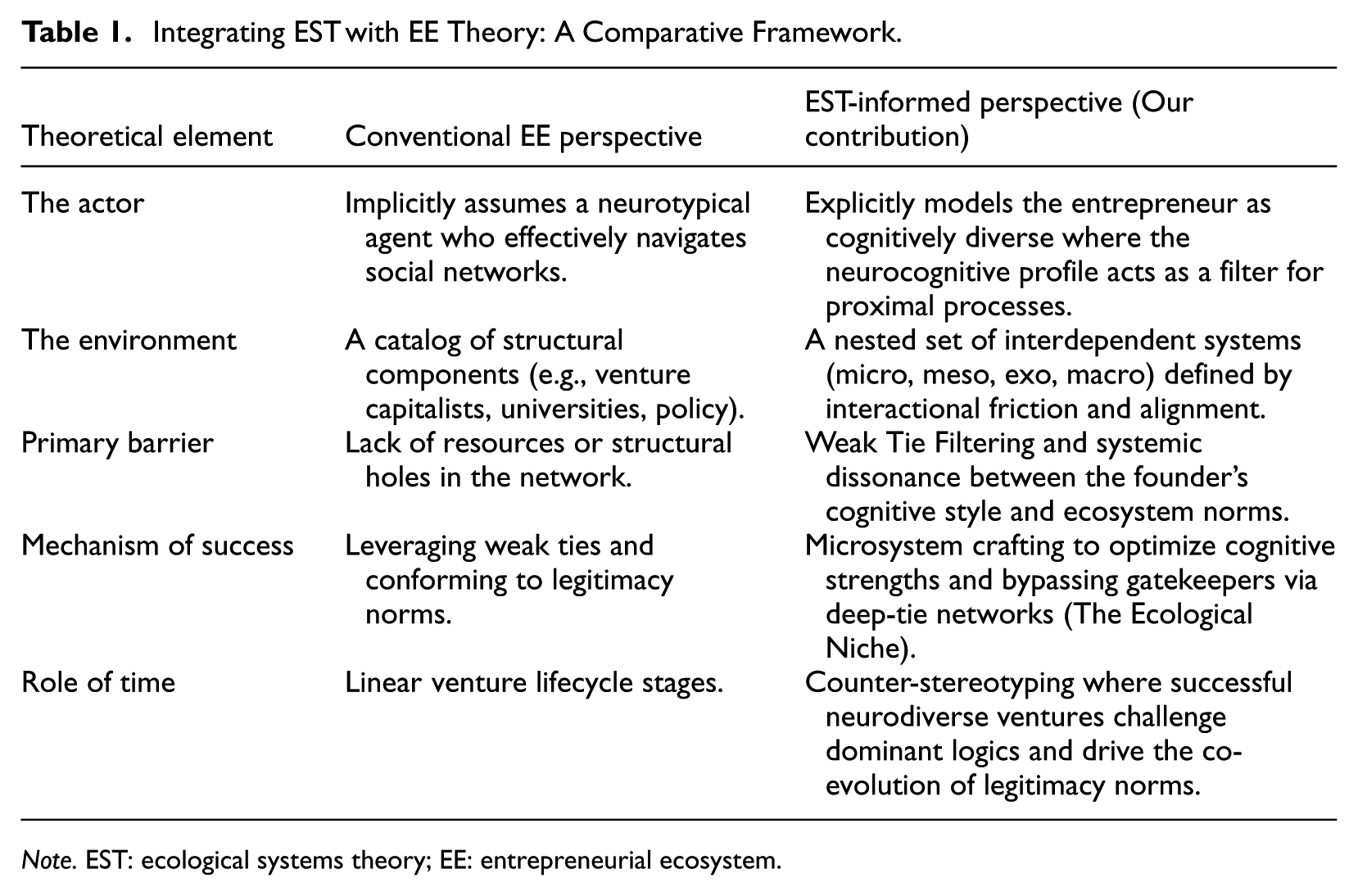
Note. EST: ecological systems theory; EE: entrepreneurial ecosystem.
EST (Table 2) analyzes how behavior emerges from the reciprocal interactions between an entrepreneur and their environment. In this view, the ecosystem functions as a set of nested structures that range from immediate face-to-face settings (microsystem) and their interconnections (mesosystem) to external institutional policies (exosystem) and overarching cultural patterns (macrosystem). By situating these interactions within the dimension of time (chronosystem), the framework provides the necessary analytical leverage to identify where systemic friction occurs. It shifts the focus from the presence of ecosystem attributes to the quality of the interaction between the individual and the system (Bronfenbrenner & Morris, 2006).
An Ecological Systems Framework for Neurodiversity in EEs.
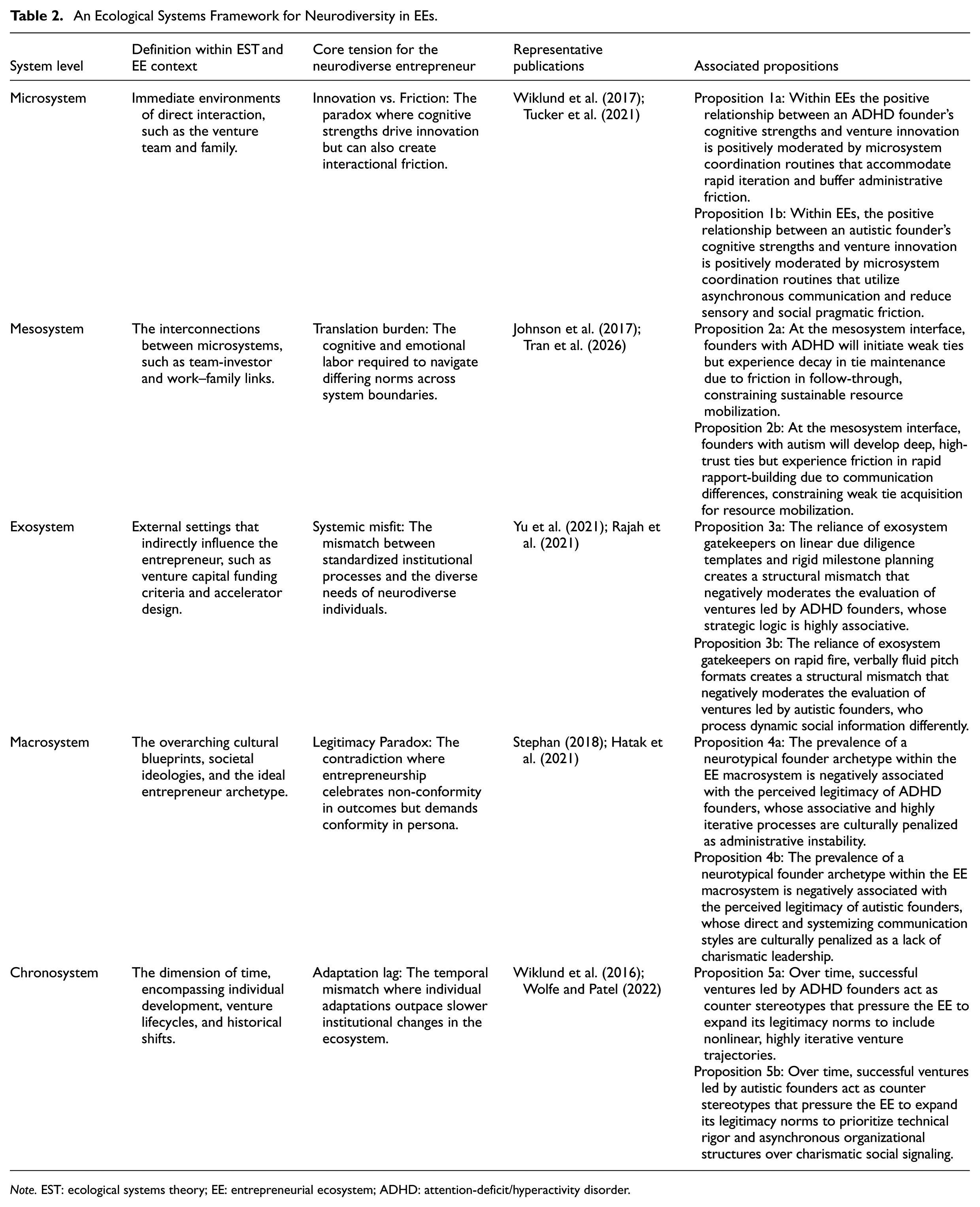
Note. EST: ecological systems theory; EE: entrepreneurial ecosystem; ADHD: attention-deficit/hyperactivity disorder.
By integrating these perspectives, we map the structural components of the EE (Spigel, 2017; Stam, 2015) onto the nested interactional layers of EST. This mapping reveals how standard EE attributes function as specific normative settings for the entrepreneur. For example, we locate daily venture interactions within the microsystem, network interconnections within the mesosystem, institutional gatekeepers within the exosystem, and cultural norms within the macrosystem. The resulting framework illustrated in Figure 1 moves beyond a list of ingredients to model how neurodiverse entrepreneurs actively navigate these nested systems to construct functional ecological niches defined as specialized configurations of support that align with specific neurocognitive profiles.
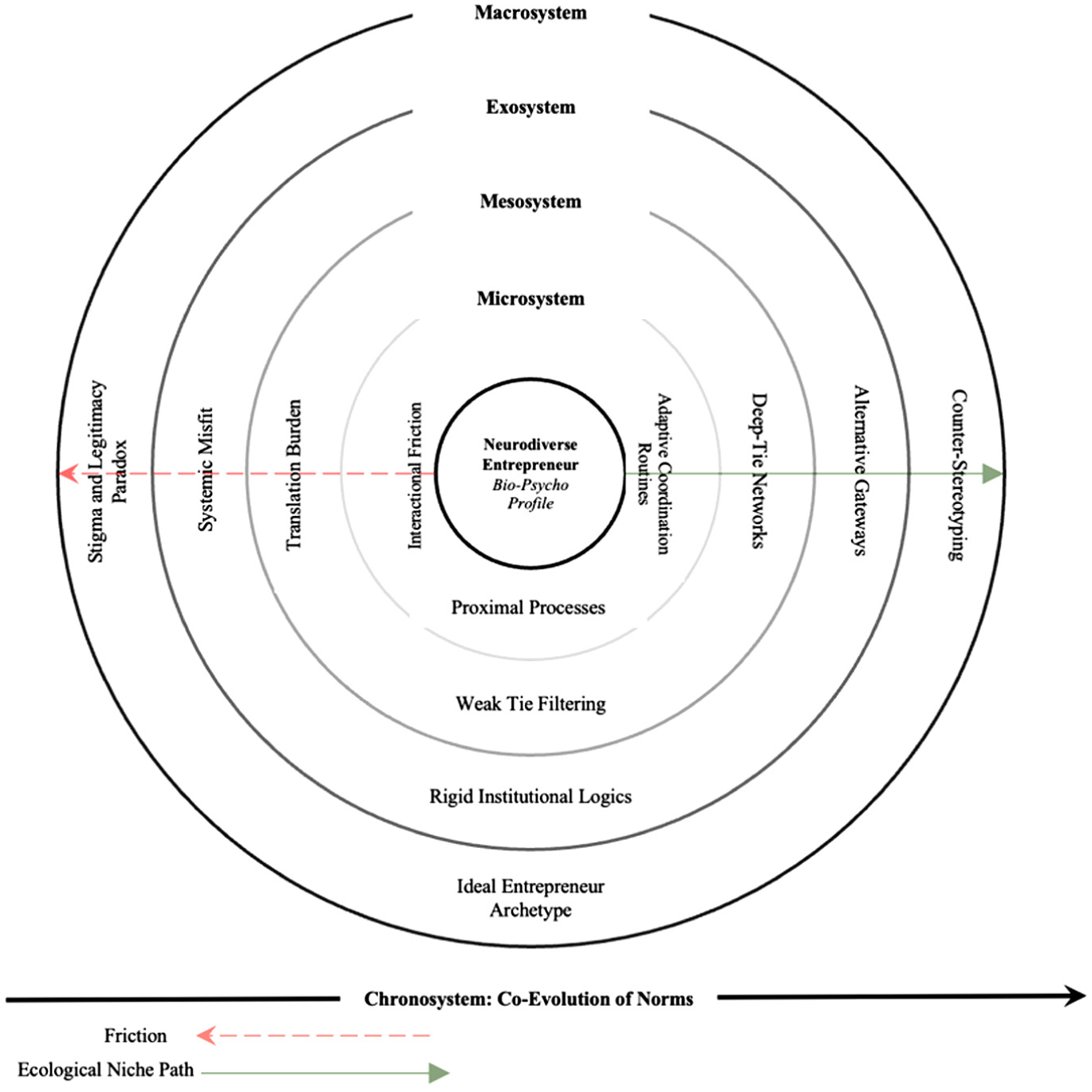
A dynamic ecological systems framework of neurodiverse entrepreneurship.
An Ecological Systems Framework for Neurodiversity in EEs
Building upon the foundational concepts and identified theoretical needs, this section develops our core conceptual framework by applying EST to analyze the intricate, multi-level interactions between neurodiverse entrepreneurs and the EE. For each system level (e.g., microsystem, mesosystem, exosystem, macrosystem, and chronosystem), we theorize these interactions, drawing connections to established theories and developing specific, testable propositions highlighting the unique pathways and challenges neurodiverse individuals navigate within the ecosystem maze. Our central argument posits that understanding the entrepreneurial experiences and outcomes of neurodiverse individuals requires analyzing multi-level, reciprocal person-ecosystem interactions, revealing previously overlooked complexities in the support function of EEs.
Proximal Processes and Nested Systems
We operationalize the EE by mapping its established structural components (Spigel, 2017; Stam, 2015) onto the interactional mechanisms of EST. Central to this framework is the concept of proximal processes. Bronfenbrenner and Morris (2006) defined proximal processes as the progressively complex reciprocal interactions between an individual and the persons, objects, and symbols in their immediate environment. In the context of entrepreneurship, these processes constitute the daily mechanics of venture creation where the cognitive profile of the founder interfaces with EE actors, factors, institutional, and cultural frames.
We examine these interactions across four nested layers. The microsystem comprises the immediate setting of the venture where proximal processes occur most intensely. The mesosystem encompasses the network of interconnections between distinct settings such as the interface between the internal venture team and external investor networks. The exosystem consists of external gatekeeping structures that indirectly influence the venture, and the macrosystem embodies the overarching cultural blueprints and legitimacy norms that shape the logic of the entire structure. By analyzing the friction or alignment within these layers, we move beyond a static list of ecosystem attributes to model the dynamic trajectory of the neurodiverse entrepreneur.
The Microsystem: Proximal Processes, Cognitive Styles, and Relational Dynamics
Bronfenbrenner (1979) conceptualized the microsystem as a pattern of activities, roles, and interpersonal relations experienced by a person in a given setting characterized by specific physical and material attributes. In the context of an EE, the microsystem is not merely the physical office but the immediate crucible of venture creation where the entrepreneur engages in proximal processes defined as sustained, complex, and reciprocal interactions with immediate ecosystem actors such as co-founders, early employees, and hands-on mentors (Bronfenbrenner & Morris, 2006).
Within this layer, the neurocognitive profile of the entrepreneur acts as a bio-psychological filter that directly shapes the nature of proximal processes. For founders with ADHD, cognitive traits such as impulsivity and sensation-seeking alter how they interact with immediate ecosystem actors (Wiklund et al., 2017). Within the microsystem, these traits can drive specific entrepreneurial advantages; specifically, the propensity of a founder with ADHD for rapid task-switching and cognitive flexibility can accelerate the fast-paced iteration cycles necessary to find product-market fit (Hatak et al., 2021). Conversely, for autistic founders, the characteristic cognitive focus and systematic processing style fundamentally reconfigure interpersonal interactions and task execution within the immediate venture setting (Baron-Cohen et al., 2007). This systematic disposition can manifest as a distinct operational advantage, such as the enforcement of rigorous code quality or operational standards that become the core competitive advantage of the venture (Austin & Pisano, 2017).
However, a critical tension arises when these neurocognitive styles collide with the normative interactional expectations of early-stage venturing. The startup microsystem is often characterized by ambiguity, the need for rapid social signaling, and hustle culture. Differences in communication pragmatics (Chevallier et al., 2012), executive functioning challenges regarding time management (Willcutt et al., 2014), or sensory sensitivities (Marco et al., 2011) can introduce significant interactional friction into the venture’s daily operations. This friction is not a result of the entrepreneur’s deficit but of a misalignment between their cognitive style and the rigid, neurotypical behavioral scripts often assumed in high-growth venture teams (Tran et al., 2026). If the microsystem operates on these default assumptions, the very cognitive variances that sparked the venture’s innovation may simultaneously destabilize its execution.
To resolve this tension, the microsystem must move beyond passive accommodation toward proactive modification of the work environment (Kristof-Brown et al., 2005). However, the specific nature of this modification is entirely dependent on the unique neurocognitive profile of the entrepreneur. For a founder with ADHD, proactive environmental adjustment requires coordination routines that accommodate rapid task-switching and associative thinking, such as connecting disparate market trends, generating nonlinear business model variations, or devising creative, lateral solutions to operational crises. These routines simultaneously buffer the founder from the friction of sustained administrative maintenance (Wiklund et al., 2017). Conversely, for an autistic founder, proactive environmental adjustment involves establishing asynchronous communication protocols, such as using written status updates on shared project boards rather than spontaneous verbal stand-up meetings, and highly structured, unambiguous social routines, such as establishing explicit meeting agendas with designated speaking slots. These protocols and routines serve to buffer against sensory overwhelm and social ambiguity in high-stimulation environments (Ezerins et al., 2024).
The Mesosystem: Navigating Inter-System Boundaries and Social Capital
The mesosystem comprises the interconnections between the distinct microsystems in which an entrepreneur actively participates (Bronfenbrenner, 1979). In the context of an EE, this layer forms the connective tissue linking the immediate venture team to external ecosystem actors such as seed investors, dealmakers, and university technology transfer officers. The quality and structure of these mesosystem linkages are critical for accessing resources, validating ideas, gaining legitimacy, and acquiring diverse forms of social capital beyond the immediate team (Adler & Kwon, 2002; Nahapiet & Ghoshal, 1998). Effective entrepreneurship requires navigating these inter-system boundaries to translate the venture vision and needs to different audiences with varying expectations and communication norms (Aldrich & Zimmer, 1986).
This interface presents a specific challenge for neurodiverse founders. The ecosystem typically demands rapid rapport building and social fluidity to bridge the gap between the technical reality of the venture and the expectations of external stakeholders. However, neurodiverse traits such as differences in social communication or a preference for directness can disrupt this translation process (Chevallier et al., 2012; Sedgewick et al., 2019). For example, the social cues required to secure seed capital in a high-velocity networking environment often conflict with the cognitive processing styles associated with autism or ADHD such as a limited capacity for sustained eye contact or a rigid preference for technical accuracy over persuasive storytelling. The friction here is not necessarily a lack of venture viability but a breakdown in the social mechanism required to transport value across ecosystem boundaries.
Current ecosystem theory posits that high performing regions rely heavily on dealmakers and heterogeneous weak ties to facilitate the flow of novel information and resources (Malecki, 2018). Ecosystems are often deliberately engineered to maximize these weak ties through mechanisms like mixers, pitch competitions, and high frequency networking events (Spigel, 2017). We argue that this interface presents a specific challenge, but the nature of the boundary spanning problem differs radically depending on the cognitive profile. For an ADHD entrepreneur, the behavioral manifestation of their profile may lead them to readily initiate many weak tie relationships; however, they will experience severe interactional friction regarding consistent follow-through and the administrative maintenance of those ties. Conversely, an autistic entrepreneur faces friction at the very onset of tie creation. Due to differences in processing ambiguous social dynamics and a preference for deep dyadic interactions, they may build fewer but deeper ties, struggling specifically with the rapid rapport building demanded by ecosystem networking norms.
The Exosystem: Institutional Logics, Resource Gateways, and Systemic Misfit
The exosystem represents the influential layer of organizations and structures that indirectly yet powerfully shape the entrepreneurial journey. As defined in EST the exosystem comprises settings that the individual does not actively participate in but which profoundly influence their immediate context (Bronfenbrenner, 1979). In the context of an EE, this layer includes powerful gatekeeping entities such as regulatory agencies and government officials who possess the authority to support or block venture initiatives through policy mandates (Stam, 2015; Acs et al., 2017). These organizations function as carriers of logics which are the socially constructed assumptions values and rules that define what is considered legitimate within a field (Thornton et al., 2012; Scott, 2013). The critical theoretical challenge is that these logics have historically evolved through interactions with a predominantly neurotypical founder population. Consequently, the selection criteria used by these gatekeepers embed deep seated assumptions about communication styles decision making and behavioral norms that implicitly define the entrepreneur (Stam, 2015; DiMaggio & Powell, 1983).
Gatekeeping organizations within the exosystem, particularly venture accelerators and seed funds, utilize institutional logics to manage the uncertainty inherent in new ventures (Stam, 2015). However, these evaluative heuristics effectively codify a neurotypical prototype, creating precise, mechanisms based structural mismatches for specific cognitive profiles. For example, exosystem gatekeepers frequently rely on highly structured, linear due diligence templates and rigid milestone planning. This creates a cognitive tax and structural friction for ADHD founders, whose strategic thinking and problem-solving are inherently more associative and nonlinear. Alternatively, exosystem actors rely heavily on pitch formats that reward rapid fire questions and answers, charismatic nonverbal signaling, and verbal fluency. This evaluative mechanism systematically disadvantages autistic founders because the institutional expectations for rapid, verbally fluid communication and charismatic nonverbal signaling are structurally incongruent with the preference of these founders for systematic, reflective cognitive processing and literal information exchange. Consequently, gatekeepers frequently miscode these systematic differences in social interaction and verbal pacing as a deficit in confidence, competence, or leadership potential, leading to exclusion based on interactive presentation rather than the objective viability of the venture.
The Macrosystem: Cultural Blueprints, Stigma, and the Quest for Legitimacy
Ultimately the entire ecological system is governed by the macrosystem which constitutes the overarching societal blueprint of cultural ideologies social structures and institutional logics that set the fundamental rules of the game (Bronfenbrenner, 1994). Within the context of entrepreneurship this layer operates as the supreme arbiter of legitimacy by preemptively defining the normative parameters for what a credible leader and a viable venture culture look like (Aldrich & Fiol, 1994; Scott, 2013). While these institutional norms originate at the societal level, they permeate every lower level of the ecosystem shaping the selection criteria of exosystem gatekeepers and patterning the interactional scripts within the mesosystem (North, 1990). These powerful macro-level forces are ultimately internalized and experienced within the immediate working environment of the venture where the founder must translate broad cultural blueprints into specific daily activities to signal their venture is a valid economic entity (Aldrich & Yang, 2012). Therefore, the macrosystem does not merely provide a backdrop for entrepreneurial action but actively constructs the cognitive and normative legitimacy requirements that founders must satisfy to access critical resources.
The primary mechanism regulating the configuration of legitimacy is the cultural archetype of the ideal entrepreneur, which functions as an institutionalized macrosystemic template that privileges extroverted, socially assertive, and highly optimistic leadership profiles (Gartner, 1988). Consequently, the evaluative penalties associated with non-conformity to this template diverge systematically based on the neurocognitive profile of the founder. For entrepreneurs with ADHD, evaluative discounting occurs when cognitive traits such as associative ideation and rapid pivoting diverge from institutional expectations of administrative constancy and sequential execution. Within the macrosystem, these nonlinear cognitive processing patterns are frequently miscategorized as operational instability or a deficit in strategic commitment. Conversely, for autistic entrepreneurs, evaluative discounting is triggered by deviations from normative expectations of performative expressiveness and narrative persuasion. Evaluators heavily weigh these differences in social presentation, thereby delegitimizing objective technical capability despite substantial task-specific expertise.
Thus, for neurodiverse entrepreneurs, this paradox functions as a primary barrier to gaining legitimacy as their competence and the viability of their venture become subordinated to judgments about whether their personal style aligns with the culturally sanctioned archetype (Zimmerman & Zeitz, 2002). This structural misalignment forces founders into an untenable position where they must either bear the high cognitive and emotional costs of impression management by constantly performing a neurotypical ideal or risk professional marginalization by acting authentically (Ashforth & Humphrey, 1993). When a founder fails to perform this script, the resulting societal stigma functions not only as an abstract mood but also as an active mechanism of devaluation that distorts the allocation of resources within an EE (Corrigan & Watson, 2002; Goffman, 1963). This stigma acts as a legitimacy barrier transmitted downward through the layers of the system causing investors to exclude founders based on social presentation rather than entrepreneurial potential (Spigel, 2017; Wurth et al., 2022). Consequently, the macrosystem creates a structural inefficiency where the ecosystem fails to capture the value of neurodivergent human capital by filtering out high potential innovators who do not conform to the institutionalized performance of the ideal entrepreneur.
The Chronosystem: Co-Evolution, Adaptation Lags, and Systemic Change
The chronosystem introduces the dimension of time and frames the relationship between the neurodiverse entrepreneur and the ecosystem as a cumulative and evolving process (Bronfenbrenner, 1986). Development is about how the person interacts with changing environmental conditions over historical time (Elder, 1998). In the context of entrepreneurship, this temporal lens reveals how neurodiverse entrepreneurs can influence the broader institutional structure of the ecosystem. While the macrosystem imposes top-down legitimacy constraints through the archetype of the ideal entrepreneur, the chronosystem accounts for bottom-up institutional work where entrepreneurs contest these constraints through their performance (Katz, 1991).
This process operates through a reverse causal mechanism where individual success forces adaptation across the ecosystem’s layers. It begins in the microsystem where the entrepreneur proves that their cognitive divergence drives innovation rather than dysfunction. This objective performance creates a breach in the mesosystem forcing investors and partners to prioritize economic outcomes over their preference for social fluidity and standard communication norms. As these anomalies accumulate, they generate a signal that puts pressure on gatekeepers to update their rigid pattern matching heuristics or risk missing high-growth opportunities. Finally, this structural pressure erodes the macrosystem legitimacy paradox as the cultural definition of the entrepreneur expands to accommodate these new, successful behavioral profiles (Rao, 1998).
Consequently, the ecosystem does not just shape the entrepreneur. The cumulative actions of neurodiverse founders gradually reshape the ecosystem. However, the nature of this co-evolution depends on the specific cognitive profile acting as the catalyst. Successful ADHD founders function as counter stereotypes that legitimize rapid iteration, pivot heavy venture models, ultimately pressuring the ecosystem to accept nonlinear growth trajectories. Conversely, successful autistic founders function as counter stereotypes that validate asynchronous organizational structures and deep tech focus, pressuring ecosystem gatekeepers to value technical rigor over charismatic social signaling. As more neurodiverse individuals achieve visibility, they demonstrate the viability of alternative leadership styles and organizational structures. The chronosystem thus describes a feedback loop where individual adaptation leads to systemic resilience and inclusivity over the long term (Stam, 2015).
Discussion
In this article, we have applied EST to move the study of neurodiverse entrepreneurship beyond individual-level trait analyses and toward a systemic, interactionist model of the entrepreneur–ecosystem relationship. This framework provides a dynamic, multi-level lens that illuminates the complex interplay between neurocognitive variation and the nested systems of the ecosystem, revealing inherent tensions and highlighting previously obscured mechanisms that shape entrepreneurial pathways. Synthesizing the insights gleaned from analyzing the micro-, meso-, exo-, macro-, and chronosystem interactions, we articulate three core theoretical contributions that advance our understanding of both neurodiversity in entrepreneurship and the functioning of EEs more broadly.
Reconceptualizing Fit as Multi-Level Systemic Alignment
Our first theoretical contribution is to reconceptualize entrepreneurial fit, moving beyond the static and limited concept of Person-Environment (P-E) fit to a dynamic model of multi-level systemic alignment. While valuable, traditional P-E fit approaches are insufficient for understanding the neurodiverse experience, as they tend to analyze a dyadic match between an individual and their immediate role, treating the wider ecosystem as a homogenous backdrop (Tucker et al., 2021). This fails to explain why a neurodiverse founder with profound strengths well-suited to the entrepreneurial process (Wiklund et al., 2017) and excellent fit within their own venture’s microsystem can still face insurmountable barriers.
Our EST framework broadens our theoretical perspective by offering theoretical diversity. We argue that for a neurodiverse entrepreneur, success is contingent not on a single point of congruence, but on the alignment, or misalignment, across the nested systems. The primary source of failure is often located in the frictional interfaces between these layers. For instance, a venture’s highly effective and tailored microsystem may be fundamentally misaligned with the rigid, neurotypical expectations of exosystem gatekeepers, creating a legitimacy crisis (Roundy & Lyons, 2023). This multi-level perspective allows us to see that the problem is not a poor fit in the traditional sense, but rather a systemic dissonance born from the conflicting institutional logics (Thornton et al., 2012) and resource architectures operating at different levels of the ecosystem (Spigel, 2017). This reframing relocates the locus of the challenge from an individual deficit to the structural and normative gaps between the ecosystem’s layers, offering a more robust theory for why individual potential so often becomes decoupled from entrepreneurial outcomes.
Theorizing the Neurodiverse Ecological Niche
This multi-level alignment perspective leads directly to our second theoretical contribution, which revitalizes and applies Bronfenbrenner’s own, often overlooked, concept of the ecological niche. We adapt this idea from its origins in organizational ecology (Hannan & Freeman, 1977) and redefine it through the lens of neurodiversity. We propose a niche is not merely a market segment, but a favorable configuration across multiple system levels that resonates with an entrepreneur’s specific neurocognitive profile. This suggests the most viable path for many neurodiverse founders is not assimilation into the ecosystem’s mainstream, but the strategic identification, cultivation, or creation of these specialized pockets where their unique strengths become profound assets (Gartner, 1988).
In practice, a viable neurodiverse ecological niche is a space where these different levels achieve a state of resonance. This might involve a macrosystem opportunity, like an underserved market uniquely understood through the founder’s identity and passion, combined with an exosystem where their specialized expertise is highly valued, bypassing traditional gatekeepers. This alignment would be supported by a mesosystem of affirming professional networks that provide tailored support and anchored in a psychologically safe microsystem designed to optimize the team’s cognitive strengths (Edmondson, 1999). Theorizing the niche helps resolve the paradox of why some neurodiverse entrepreneurs succeed despite pervasive systemic barriers. They do so by strategically operating within these pockets where the dominant ecosystem’s rules are modified or rendered less relevant, offering a powerful explanation for the heterogeneity of entrepreneurial outcomes (Wiklund et al., 2017).
Neurodiversity as a Catalyst for Ecosystem Co-Evolution
Our third theoretical contribution, revealed through the chronosystem, is to reframe neurodiversity as a catalyst for the co-evolution of the ecosystem itself. While traditional models often explain ecosystem change through external shocks or top-down policy interventions (Feldman, 2014; Stam & van de Ven, 2021), we conceptualize an internal, diversity-driven engine of change. We argue that neurodiverse entrepreneurs, by leveraging unique cognitive strengths (Wiklund et al., 2017), introduce novel variation and social perspectives into the ecosystem (Aldrich & Ruef, 2006). This variation is the essential raw material for systemic learning and adaptation, challenging the taken-for-granted assumptions of exosystem gatekeepers and the cultural norms of the macrosystem.
This evolutionary pressure unfolds across all system levels over time. At the microsystem level, entrepreneurs experiment with novel venture structures. At the mesosystem level, they build alternative support networks, driven by a need for both shared resources (Ingram & Lifschitz, 2006) and a collective identity that reinforces entrepreneurial passion (Renko et al., 2016). Their success stories serve as powerful counter-narratives that challenge limiting macrosystem archetypes (Rao, 1998), a legitimacy-building process familiar to other non-traditional entrepreneurs. Over time, this can influence the very architecture of exosystem support, much as academic entrepreneurship has co-evolved with its institutional environment (Rasmussen & Wright, 2015). While this process is slow and contested, facing the powerful inertia of institutional norms (DiMaggio & Powell, 1983), its long-term impact is profound. The chronosystemic perspective thus reframes neurodiversity from a static trait to be accommodated into an agentic force that enhances the ecosystem’s heterogeneity and resilience, paving the way toward a more inclusive and structurally dynamic future (Bronfenbrenner, 1979).
Future Research
Future research at the intersection of neurodiversity and EST calls for a shift in the empirical agenda for studying neurodiversity in entrepreneurship (see Table 3). To move forward, we must prioritize research designs that can capture the multi-level, interactional, and dynamic phenomena that EST illuminates. For example, deep qualitative and ethnographic inquiry into the lived experience of neurodiverse entrepreneurs. Methodologies like in-depth case studies and longitudinal interviews are not merely descriptive tools; they are essential for capturing the thick descriptions (Geertz, 1973) of how founders navigate the ecosystem’s layers, a necessary step to understand the experiences of any non-traditional entrepreneur. This is a pivotal route to advance our understanding behind our propositions, such as how founders leverage the bright sides of their conditions (Wiklund et al., 2017) within their microsystems, or how the translation burden at mesosystem interfaces impacts their entrepreneurial passion (Renko et al., 2016). Such foundational work is the critical first step for generating richer, context-sensitive hypotheses about the dynamics of ecosystem navigation and revealing the nuanced reality behind the structural interactions we have theorized.
Future Research Agenda on Neurodiversity in EEs.
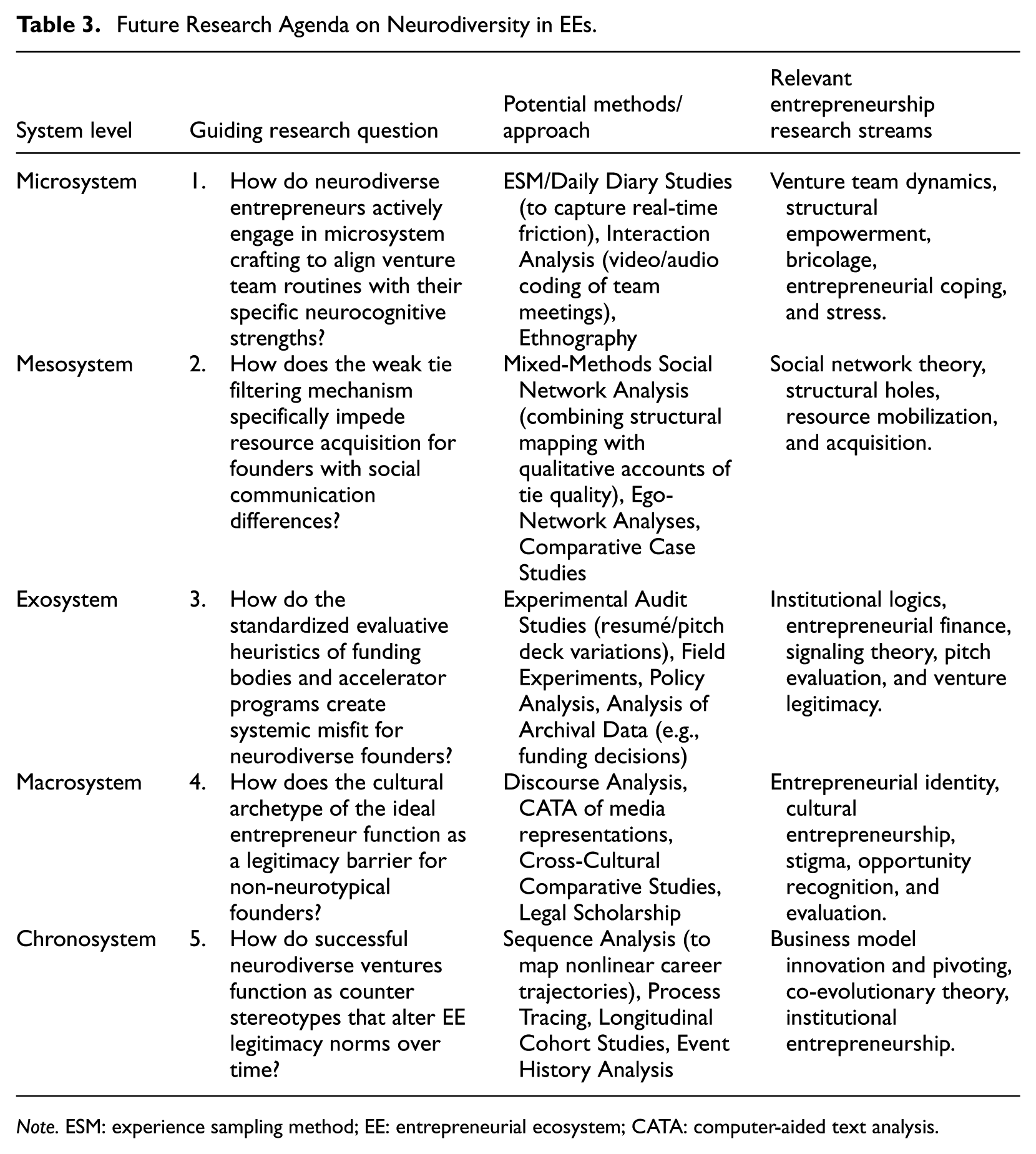
Note. ESM: experience sampling method; EE: entrepreneurial ecosystem; CATA: computer-aided text analysis.
Second, our framework points toward a more ambitious empirical frontier: the development of multi-level quantitative models. While we acknowledge the significant data collection challenges involved, such research is essential for testing the cross-level interactions proposed by our theory. This would require capturing data simultaneously across the nested systems: from individual neurocognitive profiles and team-level dynamics (microsystem) to the network structures of support (mesosystem), and the institutional properties of exosystem organizations. Advanced techniques like Hierarchical Linear Modeling would then be necessary to quantify how these layers interact (Raudenbush & Bryk, 2002). For instance, such models could test how macrosystem stigma moderates the effectiveness of an exosystem support program or how mesosystem network diversity mediates the path from individual traits to resource acquisition. Ultimately, the long-term goal for the field should be large-scale comparative studies that can empirically identify the specific configurations of cross-level alignment that constitute a viable neurodiverse ecological niche, moving our theoretical propositions from concept to testable reality.
Finally, our framework’s chronosystemic dimension demands ambitious longitudinal and intersectional research to understand the co-evolutionary dance between neurodiverse entrepreneurs and their ecosystems. Tracking cohorts of founders over time is an ambitious way to empirically test our propositions about adaptation and the potential for entrepreneurs to act as agents of systemic change (Van de Ven & Poole, 1995). Essentially, such longitudinal work must be informed by an intersectional lens. The temporal experience of navigating ecosystem barriers or catalyzing change is not uniform; it is profoundly shaped by the interplay of neurodiversity with other demographic markers. By investigating these compounded identities as they evolve, we can move beyond simplistic snapshots and develop a truly dynamic understanding of the lived realities and systemic impacts of the full spectrum of neurodiverse entrepreneurship.
Policy
The primary policy implication of our framework is a radical shift in focus: from interventions aimed at fixing the neurodiverse individual to a strategy of re-architecting the ecosystem itself. Our analysis shows that the most significant barriers are not individual deficits, but systemic dissonances and frictional interfaces between the nested layers of the ecosystem. Effective policy must therefore be multi-level, targeting these specific points of misalignment.
At the exosystem level, this means moving beyond generic support programs and toward interventions that intentionally cultivate neurodiverse ecological niches. This includes funding specialized accelerators with flexible, nonlinear curricula; training investors and mentors to recognize value in non-traditional communication styles; and designing funding instruments that accommodate different timelines and approaches to innovation. Simultaneously, these efforts must be reinforced at the macrosystem level by actively working to dismantle the limiting cultural archetypes of the ideal entrepreneur through the promotion of diverse, successful role models. The core insight for policymakers is that an intervention at one level will fail if it is contradicted by powerful barriers at another. By adopting a holistic, ecological approach, policymakers can create the conditions where neurodiversity is understood not as a barrier to be overcome, but as a vital source of the novel perspectives and disruptive innovation that benefit the entire system.
Conclusion
We integrate neurodiversity into EE theory to resolve the theoretical tension between cognitive variation and normative social structures. We propose specific mechanisms including microsystem crafting weak tie filtering and counter-stereotyping to model how neurocognitive profiles interact with EE layers. Our framework indicates that implicit assumptions of neurotypicality create structural inefficiencies in how an ecosystem captures human capital. We conclude that EE vitality depends on the flexibility of interactional structures to accommodate high-variance cognitive profiles.
Footnotes

Funding
The authors received no financial support for the research, authorship, and/or publication of this article.
Declaration of Conflicting Interests
The author declared no potential conflicts of interest with respect to the research, authorship, and/or publication of this article.