






Abstract
Gene- and cell-based therapies (GCTs) represent a disruptive and transformative class of biomedical innovations. They address diseases by adding, removing, repairing, or replacing genes and/or by endowing distinct living cells with additional biological functions. Through this plethora of options, numerous conditions—including genetic disorders, cancers, and degenerative diseases—have become potential targets for a curative therapy. Thus, GCTs are considered the “Future of Medicine” as they (i) offer a potential cure, particularly for rare and severe disorders previously considered untreatable, (ii) expand the treatment options for common diseases, and (iii) possess the possibility to complement currently applied conventional treatment options. Recognizing both the scientific promise and translational challenges of GCTs, Germany has launched a coordinated national initiative—the National Strategy for Gene- and Cell-Based Therapies. The Strategy was commissioned by the German Federal Ministry of Research, Technology and Space (BMFTR, formerly the German Federal Ministry of Education and Research [BMBF]) and developed through a multi-stakeholder process. The latter involved more than 150 experts from academia, industry, health care sector, professional associations, and patient organizations, who were nominated by the community and assembled into eight working groups to identify current roadblocks and propose possible solutions. Summarized in the Strategy Paper, which was submitted to the BMFTR and published on June 12, 2024, a comprehensive roadmap was developed in this bottom-up process to accelerate the development and clinical implementation of GCTs in Germany. Although it initially had a national focus, the resulting framework is increasingly contributing to the international GCT landscape through growing exchange with GCT initiatives launched in other European member states and with the European Society of Gene and Cell Therapy (ESGCT).
In brief, the initiative is focusing on translation starting from research through all steps to clinical application and beyond. This includes workforce development, regulatory frameworks, manufacturing capacity, patient access, and communication with the general public. Numerous targeted measures have been developed by the participating experts in the working groups and are currently being implemented in this broad, collaborative, and bottom-up multi-stakeholder approach. They encompass, for example, the establishment of a website as central information platform, including the GCT-Atlas, a web-based networking and information tool for stakeholders and actors in the GCT field, tailored communication and outreach formats, a Regulatory Support Unit providing independent regulatory guidance for publicly funded early-stage, nonclinical product development, different funding and entrepreneurship programs offering researchers and clinicians financial, educational, and mentoring support, as well as the establishment of translational infrastructure and exchange formats with investors to specifically foster the necessary scale-up and commercialization.
Overall, the main goal of the German National Strategy for GCT is to ensure patient access to advanced therapies while strengthening Germany’s position as an international hub for biomedical innovation. To accomplish this, existing resources need to be coordinated, streamlined, and prioritized to increase efficiency and support the long-term sustainability of the system. These objectives are closely aligned with current emerging European initiatives, including the EU Biotech Act and the Horizon Europe work program 2026, which aim to further optimize the framework conditions for this strategically important field and enhance future European competitiveness.
INTRODUCTION AND BACKGROUND
Introduction
By offering unique capabilities in treating medical conditions, gene- and cell-based therapies (GCTs) will play a pivotal role in shaping patient care in the future. Indeed, many of the approved GCTs have become game changers for patients and their caretakers as they offer a curative approach for the treatment of severe and life-threatening diseases that were previously considered incurable. However, the field of application has broadly expanded from the initial focus on rare and ultra-rare diseases toward common diseases, and even toward approaches in which GCTs are used to enhance the outcome of conventional treatments. Thus, millions of patients in Europe and worldwide could benefit if safe and effective novel GCTs become widely available.
The following nonexhaustive list is intended to define GCTs within the initiative:
Therapeutic approaches including Advanced Therapy Medicinal Products (ATMPs):
Somatic cell therapies (including stem cells, immune cells, and mesenchymal stromal cells). Gene therapies based on substitution, addition, or suppression using viral or nonviral vectors, as well as genome-editing technologies. Tissue-engineering products, including the generation of tissues for surgical application and the use of novel biomaterials.
Therapeutic approaches involving novel biological products, such as mRNA and other nucleic acid-based technologies, extracellular vesicles, or exosomes, when used in the context of a GCT approach.
Other related approaches within the field of GCTs.
Technologies developed outside the therapeutic context of GCTs (e.g., mRNA vaccines against infectious diseases).
Therapeutic approaches based
However, long development times and, in particular, high costs remain a huge concern regarding the accessibility and sustainability of these therapies.
Aim and design of the National Strategy for Gene- and Cell-Based Therapies
The initiative to develop a National Strategy for Gene- and Cell-Based Therapies (termed the “Strategy” for briefness) originated from the German parliament (Bundestag) in November 2022, whereupon the Berlin Institute of Health at Charité (BIH) was commissioned by the Federal Ministry of Research, Technology and Space (BMFTR, formerly the German Federal Ministry of Education and Research [BMBF]) to initiate and moderate the Strategy in March 2023.
The Strategy’s overarching objective is to improve patient welfare. GCTs offer new hope and therapeutic perspectives for patients suffering from severe and/or life-threatening diseases, including many rare disorders for which no effective treatment options currently exist. At the same time, the careful and responsible development of these therapies requires rigorous scientific evaluation to ensure efficacy and safety while anticipating and minimizing potential risks. In the interest of equitable health care provision, the Strategy aims to ensure that GCTs become accessible to all patients who (potentially) benefit from them, for example, via clinical studies and approved therapies. Equally important is the provision of transparent, evidence-based, and easily understandable information to patients and society.
A central feature of the Strategy and its proposed objectives and measures is its development in a comprehensive, open, and participatory bottom-up process based on a multi-stakeholder approach.
This integrative setting enabled the inclusion of diverse perspectives and innovation-promoting ideas from all major stakeholders across science, health care sector, industry, politics, and society, as well as professional associations, public institutions, foundations, ethics committees, and patients’ organizations. Through an iterative process involving the German GCT community, eight topics (Fig. 1) were identified, and dedicated working groups (WGs) were subsequently established. The WGs comprised community-nominated candidates, with a fixed number of experts to maintain the efficiency of the collaborative process.
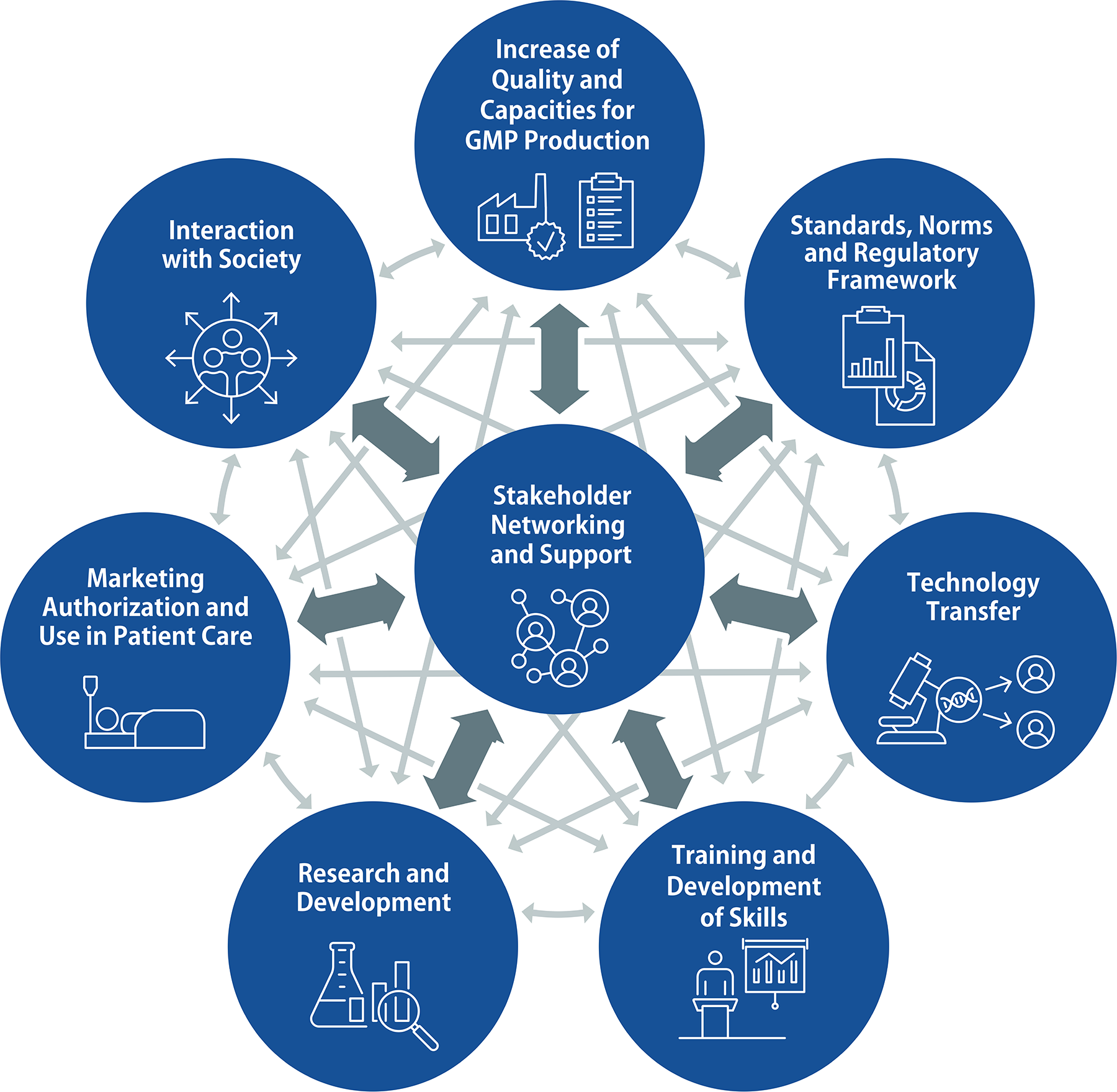
Eight topics of the German National Strategy for GCT. GCT, gene- and cell-based therapy.
Each WG then identified roadblocks for GCTs, defined objectives, and recommended different measures for implementation. While their work was focused on the respective topic, all WGs interacted with each other to avoid duplications. Moreover, the Strategy’s central coordination team participated in all WG meetings. As part of the WGs, in total, more than 150 experts from across Germany actively contributed to the development of the Strategy Paper, which was published in June 2024. 1
Thus, the Strategy is unique in combining the depth of a sector-specific strategy with the breadth of a national system transformation initiative, connected by a strong focus on translation into patient care. It thus represents a highly integrated and mission-oriented approach tailored to a rapidly emerging biomedical field.
PROGRESS AND SUCCESSES IN IMPLEMENTATION
The Strategy Paper was submitted to the BMFTR and published online on June 12, 2024, but importantly, the initiative did not end there. During its development and following publication, a wide range of measures were initiated and are continuously being refined and implemented. These measures are not treated as static elements but rather are being dynamically adapted to the changing conditions of this highly active field in medicine and the evolving needs within the community. Most of the stakeholders have remained actively engaged and continue to contribute their time and expertise to the implementation.
The implemented measures already provide substantial support and generate tangible benefits for the entire German GCT ecosystem, addressing several of the identified key bottlenecks in the field. Specifically, they are focused on:
Supporting coordination of activities and communication at a national level; Creating transparency regarding relevant stakeholders and available resources; Providing essential target group-specific information; Increasing public and political visibility of the topic; Facilitating permeability and exchange between academia, industry, and venture capital; Establishing infrastructure; Providing proactive regulatory support; and Overall fostering a mindset focused on product development, impact for patients, and value for society.
Improving coordination, networking, and communication
The newly established Administrative Office for the National Strategy for Gene- and Cell-based Therapies supported by the National Network Office for GCT is serving as a central coordination structure for the initiative. Responsibilities include moderating and organizing the overall process; networking the different relevant stakeholders—including patient and self-help organizations, academia, industry, policymakers, general public, regulatory authorities, and foundations—as well as supporting the implementation of the proposed measures. In parallel, the development of a long-term fully stakeholder-driven governance structure is ongoing to structurally anchor the initiative within the established German GCT community.
As one of the first measures, a central website for GCT has been developed and is available online. 2 It provides structured information on the Strategy’s objectives, thematic areas, measures, and stakeholders. In addition, it offers target group-specific content, information on current activities and events, and promotes knowledge transfer within the national GCT community. The content is continuously expanded, editorially maintained, and quality assured.
An integral part of this website is the GCT-Atlas, 3 which maps and visualizes the broad range of stakeholders within the innovation ecosystem via multiple interactive layers. The Atlas includes, among others, patient and self-help organizations, startups, GMP manufacturing facilities, research groups, and institutes at university hospitals and specialized research centers. It currently comprises more than 600 datasets and is being continuously curated and expanded.
Supported by the Administrative Office, the stakeholders 4 from the WGs are also actively engaged in strengthening visibility and communication. The early involvement of politicians and decision-makers is considered essential to ensure long-term support, visibility, and funding for GCT-related measures that ultimately benefit patients. To this end, communication materials have been developed, and contacts with parliamentary committees have been established. In addition, a dedicated expert dialogue format is being organized in which members of the German parliament (Bundestag) engage in direct dialogue with experts from academia, industry, health care, and patient organizations. Furthermore, there is an ongoing and productive exchange with regulatory authorities to explore opportunities for optimizing processes within the existing regulatory framework.
In parallel, several targeted assessments and analyses have been initiated or are currently being conducted in close collaboration with stakeholders to address specific challenges within the field.
Examples include:
Analysis of the German legal framework for a named patient use/individual treatment attempt with ATMPs that are not yet approved. Analysis of the legal conditions under which startups may utilize existing research infrastructures at academic institutions (and subsequently develop a guideline for research institutions). Analysis and quantification of the health economic potential of GCTs under current conditions and under optimized German and European framework conditions. Assessments of new educational formats to develop the next generation of gene and cell therapists.
The results of these and other assessments/analyses will be made publicly available through the website to benefit the entire community, increase transparency, and reduce redundant efforts across the ecosystem.
Supporting product development
Multiple measures have been implemented to directly support researchers and clinicians along the entire development pathway, thereby facilitating the translation of preclinical development into tangible therapeutic products and/or supporting diagnostic tools.
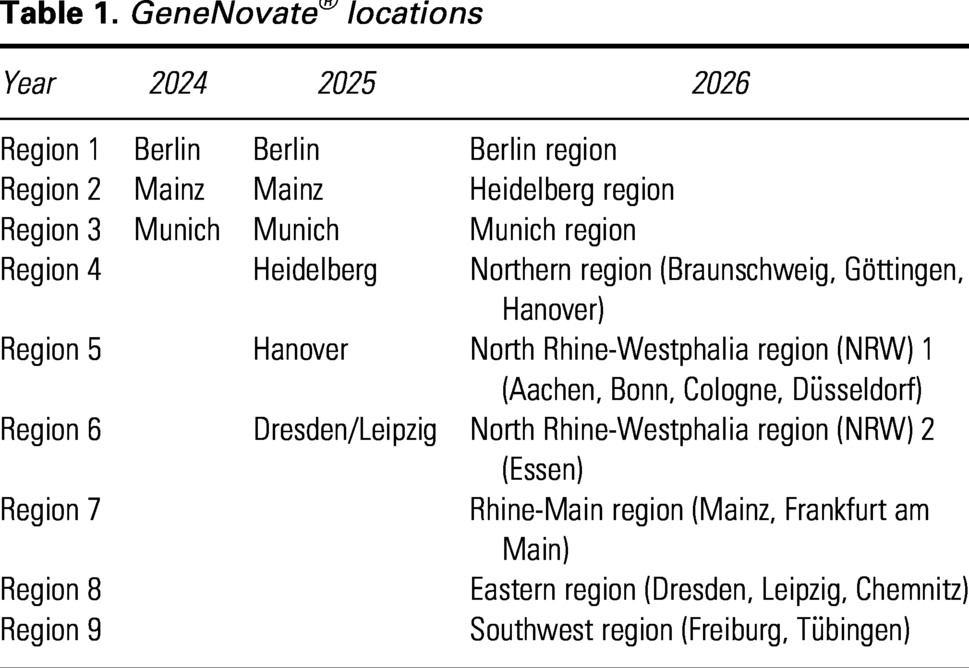
For early academic ideas, the first national entrepreneurship program, termed GeneNovate®, 5 was developed and launched in 2024. It aims to inspire scientists and physicians to pursue entrepreneurship, equip them with in-depth knowledge, and accelerate the transfer of innovative medical solutions to patients. The program includes online webinars, workshops with practical modules, mentoring, and a strong supporting expert network to transform innovative ideas into viable therapeutic products. It is currently offered in nine regions across Germany, with substantial contributions by the local partners (Table 1), and by the end of 2026, approximately 400 participants are expected to have successfully completed the program. As a next step, collaborations with European partners are being established to make the program accessible at an international level.
GeneNovate® locations
To further support translational GCT projects, two complementary funding programs have been implemented.
In a dedicated national project funding line, 6 40 individual or collaborative projects focusing on product and/or process development of therapeutic and diagnostic GCT applications were selected through an international peer-review process. These projects receive milestone-based funding according to the SPARK method, totaling approximately €20 million over 3 years. In addition to financial support for personnel and consumables, the funded teams benefit from expert industry mentorship, access to an extensive international network of investors, entrepreneurs, and specialists, and participation in workshops and webinars covering topics such as intellectual property, regulatory requirements, and business development.
In parallel, the “National Translational Tandem Program for Gene- and Cell-based Therapies” (nTTP-GCT) 7 has been established, targeting talented young scientists in academia and industry. It aims to support the (further) development of a translational mindset and strengthen Germany-wide networking. To this end, national tandems of one clinical and one nonclinical scientist are pursuing a joint project. A mandatory asset is granting the clinical partner time for research (“protected time”). In addition to the direct project support, both partners receive specialized training, education, and networking opportunities. Within this program, 15 tandems are currently being funded and receive a total of approximately €2.9 million over a 2-year period. The fellows’ first career successes resulting from the nTTP-GCT are already evident after just 1 year.
Addressing the challenges posed by the complex regulatory framework for GCTs and providing practical support in product development are major demands in the community. To this end, the newly established Regulatory Support Unit (RSU) 8 offers free, independent, and confidential regulatory advice to publicly funded research groups throughout Germany. The RSU focuses on early-stage, nonclinical product development, helping research teams to “think like a regulator” by keeping the intended final product in mind. This reverse-planning approach reduces risks and costs, avoids repetition or unnecessary work, and thus accelerates translation toward clinical applications. Since its establishment in 2024, the RSU has provided advice, guidance, and support to more than 40 projects across Germany. Furthermore, it has assisted in the preparation of—and at times directly participated in—11 scientific advice meetings with the Paul-Ehrlich-Institut (PEI) as well as the Federal Institute for Drugs and Medical Devices (BfArM), thereby strongly supporting researchers at this critical step of development.
Promoting accessibility to private capital and infrastructure
One of the major bottlenecks limiting the growth of GCT startups is the availability and accessibility of private capital. To address this challenge, the GeneNovate® Investors’ Day 9 has been established as a dedicated networking and matchmaking format that connects selected national and international GCT projects with venture capital firms and industry partners from Germany and abroad. The event focuses on curated project pitches, one-on-one meetings, and the development of long-term relationships between innovators and potential investors. More than 350 participants from these different stakeholder groups attended the inaugural event in Berlin in June 2025. The second Investors’ Day was held in conjunction with the bio:cap Life Science and AI Investival in Berlin in June 2026.
In addition to financial challenges, many GCT startups face limited access to suitable infrastructure and specialized support services. To address these needs, among others, the Strategy actively supports the establishment of the Berlin Center for Gene and Cell Therapies (BC-GCT). 10 The BC-GCT is an innovative public-private partnership that integrates research, development, and manufacturing of gene and cell therapies within a single translational environment. The initiative is led by Charité – Universitätsmedizin Berlin, Bayer AG, and the BIH and supported by further additional partners. The Center will include an incubator providing office and laboratory space for 15–20 startup companies, as well as a GMP-certified manufacturing facility, thereby creating optimal conditions for translating novel therapies from basic research into clinical applications. Construction has successfully started in 2025, and completion of the building is scheduled for 2028. The establishment of the Center is supported by funding from the State of Berlin and the BMFTR. As an integral component of the Strategy and a flagship project within the High-Tech Agenda Germany, the BC-GCT will function as part of a synergistic national infrastructure network to generate benefits for the entire German GCT ecosystem.
This synergistic national infrastructure network will be necessary to fully realize Germany’s overall potential and requires the establishment of additional centers with a similar translational focus on GCTs. As a multicentric and integrative contribution to the national infrastructure network with a focus on translating academic innovations along the full value chain, the consortium CREATION (Center for Gene and Cell Therapy in Regeneration and Transplantation) was launched. CREATION is an infrastructure short-listed in the BMFTR’s assessment of projects for large research infrastructures and is currently implemented as part of the BMFTR’s national prioritization process for infrastructural measures having far-reaching implications for the research landscape in Germany and its international competitiveness. CREATION aims to develop different innovative measures, e.g., to harmonize the ATMP production process across federal member states and production sites. Coordinating partners are Hannover Medical School (MHH), University Hospital Göttingen (UMG), Leipzig University Medical Center (LUMC), and the Fraunhofer Institute for Cell Therapy and Immunology (Fraunhofer-IZI) with its locations in Leipzig and Würzburg.
Furthermore, additional federal and state measures are expected to continuously strengthen this sector.
Optimizing the data landscape
The systematic collection, storage, and controlled access to interoperable clinical datasets are essential prerequisites for generating robust evidence in the field of GCTs. Building on the findings of the INTEGRATE-ATMP Innovation Fund project, the National Registry for Gene and Cell Therapies Germany e. V. (nGCT-R) 11 was founded in June 2025 and officially entered into the German register of associations in December 2025. The registry contributes to the development of binding framework conditions for the quality-assured application of existing and future GCTs in Germany, thereby supporting the provision of optimal patient care. Stakeholders involved in the Strategy provided important input during the establishment of the registry, and its ongoing development continues to receive financial and structural support through the initiative.
In addition to these ongoing implementations, numerous further measures will be progressively prioritized, developed, and implemented in close coordination with the stakeholders.
NEXT STEPS AND PERSPECTIVE
The Strategy is a perfect fit for the times and aligns closely with current European policy discussions. In light of the Draghi Report on European competitiveness, 12 structural weaknesses within the European innovation ecosystem—especially in biotechnology translation, scale-up, and market access—have become increasingly evident. The challenges include fragmented and complex regulatory pathways, insufficient manufacturing infrastructure, and comparatively limited access to venture capital. Addressing these shortcomings will be essential to fully realize the therapeutic and economic potential of advanced therapies.
Several complementary national and European initiatives and programs are already addressing these issues. Notably, France has launched its national Biotherapies and Bioproduction Strategy, the UK established the Cell and Gene Therapy Catapult, Italy and Spain have developed regional strategies and established ecosystems, the Nordic countries continue to expand their collaborative network structures, and the Netherlands and Belgium offer strong translational ecosystems. At the European level, policy initiatives such as the EU Pharmaceutical Package aim to modernize regulatory systems and improve patient access to innovative medicines, while the planned EU Biotech Act seeks to strengthen Europe’s technological sovereignty. In parallel, EU research funding instruments are increasingly focusing on advanced therapies; for example, the Horizon Europe work program 2026 includes a call to establish a network of Centers of Excellence for ATMPs in order to facilitate and accelerate cross-border collaboration and knowledge transfer.
Against this backdrop, the Strategy, as a multi-stakeholder approach, can serve as a scalable model for coordinated national action within Europe. Its structured approach—integrating academia, industry, regulatory authorities, and patient organizations—provides a blueprint for other member states to address country-specific bottlenecks while remaining aligned with broader European objectives. Strengthening interoperability between existing national initiatives will be essential to avoid duplication of efforts, leverage synergies, increase innovation capacity, and establish a coherent European GCT ecosystem.
At the same time, the geopolitical context underscores the urgency of coordinated action. The global biotechnology sector remains highly competitive, with the United States maintaining a leading position in innovation, investment, and commercialization, while China is rapidly expanding its capabilities through substantial public and private investments as well as implementing major regulatory updates, for example, the new Decree 818 program for IITs. In this environment, Europe must intensify internal collaboration and reduce fragmentation to remain competitive and safeguard technological sovereignty.
From a scientific and technological perspective, the GCT field continues to evolve at exceptional speed. Recent advances illustrate a transition from ex vivo to in vivo therapeutic approaches, with early clinical evidence demonstrating the feasibility of delivering gene-editing tools directly within the human body. At the same time, innovations in vector design, genome-editing technologies (e.g., CRISPR-based systems), and cell engineering are continuously expanding the therapeutic landscape. Manufacturing processes are also undergoing major transformations through the emergence of automated, decentralized, and modular production platforms designed to improve scalability, cost-efficiency, quality control, and point-of-care manufacturing. These developments will require adaptive regulatory frameworks as well as sustained investment in infrastructure, education, and workforce training.
Looking ahead, Europe must act in a coordinated and decisive manner to streamline regulatory procedures, harmonize standards, and expand manufacturing and clinical trial capacities. Failure to do so risks widening the gap with global competitors and limiting patient access to life-saving therapies. Conversely, strategic investment and stronger alignment across member states will yield substantial long-term benefits—not only economically, through the growth of a high-value biotechnology sector, but also societally, by enabling equitable and timely access to transformative treatments.
In this context, the Strategy represents a critical step toward a more integrated, resilient, and competitive European ecosystem. Of note, GCTs have recently been defined as one key element in biotechnology for the roadmap process of the High-Tech Agenda Germany, demonstrating recognition at the highest political level. However, the federal and state governments will need to continuously invest further resources given the long product development cycles and the considerable potential of Germany in this field. Progress in implementation of the Strategy, together with strengthened European collaboration, will serve concrete endpoints for translating scientific breakthroughs into accessible therapies and securing Europe’s position in this rapidly advancing field.
AUTHORS’ CONTRIBUTIONS
All authors conceptualized the work and performed review and editing of the article. C.G. and J.W. prepared the original draft of the text.
ETHICAL CONSIDERATIONS
There are no human participants in this article and informed consent is not required.
AUTHOR DISCLOSURE STATEMENT
C.G., D.B., C.C., T.G., N.H., E.L., C.v.K., J.W., and C.B. are employed by the BIH as coordinating unit of the National Strategy GCT. T.C., H.B., M.H., and A.S. received or receive project funding via the National Strategy GCT. All other authors declare no conflict of interest beyond their affiliation.
Footnotes
FUNDING INFORMATION
The authors received no financial support for the research, authorship, and/or publication of this article.